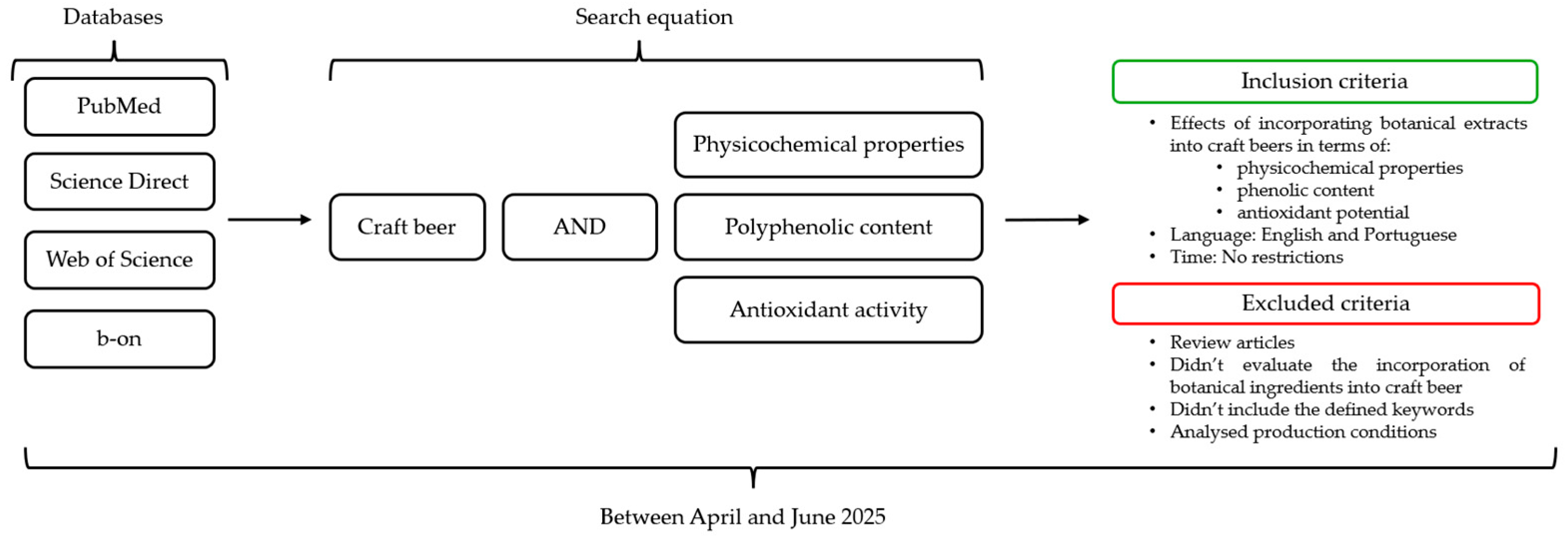


Impact of the Addition of Botanical Ingredients on the Physicochemical Properties, Polyphenolic Content, and Antioxidant Activity of Craft Beers


Highlights
- The addition of botanical ingredients to craft beers modifies their physicochemical parameters.
- The impact of incorporating botanicals depends on the matrix used, the concentration, the stage of addition, and the beer style.
- Most botanical ingredients promote an increase in the total polyphenol content.
- The increase in phenolic content is associated with an increase in the antioxidant activity of craft beers.
- The enhancement of antioxidant activity supports the potential of craft beers as functional beverages.
- The higher antioxidant activity contributes to improved oxidative stability of the final product.
Abstract
1. Introduction
2. Materials and Methods
3. Physicochemical Properties
3.1. Physical Properties
Color

| Ingredients/Stage of Incorporation/Beer Style | Color (EBC Scale) | Reference |
|---|---|---|
| Basil pepper (Ocimum selloi): aqueous extract (0.05 and 0.1%) and in natura (0.1 and 0.5%), added before and after the fermentation stage in Pilsner-style beer. | Addition of in natura leaves: color of the beers more intense. Addition of the aqueous extract: similar color to the control. | [36] |
| Bergamot (Citrus bergamia), juice; olive fruit (Olea europaea) extract, variety Carolea, added in Blanche-style and Weiss-style beer. | Significant decrease in color after adding bergamot to Blanche beer (7.5 ± 0.6 EBC) and olive to Weiss beer compared to the control (without bergamot, 4.6 ± 0.1; without olive, 4.6 ± 0.2), p < 0.05. | [44] |
| Coffee bagasse (1, 5, and 10 mg/mL), added during the maturation stage in Stout-style beer. | No significant differences between the control and the beer after the addition of coffee bagasse. | [9] |
| Elderberry (Sambucus nigra): dried fruit (20 g/L), added in the boiling stage and during maturation in Blonde Ale-style and Catharina Sour-style beer. | Blonde Ale beer: Increase in color after the addition of elderberry in the boiling phase (17 EBC) and during maturation (29 EBC) compared to control beer (8 EBC). Catharina Sour beer: Increase in color after adding elderberry in the boiling phase (17 EBC) and during maturation (21 EBC) compared to control beer (7 EBC). | [38] |
| Guava (Campomanesia adamantium) fruits and aqueous leaf extract (0.1%), added after the fermentation stage in Pilsner–style beer. | Change in beer color after adding guava fruit (14.09 ± 0.64 EBC) and leaf extract (14.05 ± 0.71 EBC). Color of the control: 14.01 ± 0.77 EBC). | [45] |
| Huaimi (Flos Sophorae Immaturus) varieties: Cyan and Golden (5 g/L), added in the wort saccharification phase, 10 min after the start of wort boiling, 10 min before the end of wort boiling, before the start of primary fermentation. | Significant increase in color of beer after adding huaimi (13.22 ± 0.02 to 16.17 ± 0.05 EBC) compared to control (12.32 ± 0.04 EBC), p < 0.05. | [39] |
| Jambu (Acmella oleracea): alcoholic extract of flowers 5 and 7.5 mL/L), added in the bottling process in Pilsner-style beer. | No color change. Beer with 5.0 mL/L and 7.5 mL/L showed a color value of 2.20 ± 0.5 EBC and 2.20 ± 0.4 EBC, respectively. Control: 2.20 ± 0.5 EBC. | [46] |
| Kamchatka berry (Lonicera caerulea var. kamtschatica) ‘Duet’ and ‘Aurora‘ variety and haskap (Lonicera caerulea var. emphyllocalyx) ’Lori‘ and ’Willa‘ variety fruit, added after 7 days of fermentation in Wheat-style beer. | Significant increase in color of beer after adding kamchatka berry and haskap fruit (28.4 ± 0.2 to 31.5 ± 0.5 EBC) compared to control (22.4 ± 0.4 EBC), p < 0.05. | [42] |
| Lemongrass (Cymbopogon citratus) (1, 2.5, and 5%), added on day 7 of fermentation in Wheat-style beer. | Significant decrease in color after adding lemongrass (16.9 ± 0.7 to 21.5 ± 0.5 EBC) compared to control (22.7 ± 0.6 EBC), p < 0.05. | [47] |
| Mushrooms (Pleurotus eryngii) (5 and 10 g/L), added before and after the fermentation stage. | Significant increase in color of beer after adding mushrooms (5.63 ± 0.34 to 11.85 ± 0.55 EBC) compared to control (3.82 ± 0.12 EBC), p < 0.05. The addition of 5 g/L before the fermentation stage showed no significant compared to control. | [10] |
| Olive (Olea europaea): leaf extract (0.5, 1, and 2%), added during the maturation stage in Light-style beer. | Significant increase in color of beer after adding 1% and 2% (15.0 EBC and 17.0 EBC, respectively) compared to control (9.0 EBC), p < 0.05. | [40] |
| Pine (Pinus sylvestris) shoot extract (15 g/L) added in the boiling stage in Wheat-style beer. | No significant differences between the control and the beer after the addition of pine shoots. | [48] |
| Pitaya (Hylocereus polyrhizus): pulp (5, 10 and 20% v/v), added in the beginning of the fermentation stage in Witbier-style beer. | Addition of pitaya significantly decreased the brightness of the beer compared to control, p < 0.05. Addition of pitaya significantly increased the green–red chroma of the beer compared to control, p < 0.05. | [41] |
| Propolis: ethanolic extract (0.05, 0.15, and 0.25 g/L), added during the maturation stage in Golden Ale-style beer. | No significant differences between the control and beer with propolis. | [17] |
| Purple grape pomace (1, 5 and 10% w/w), added before fermentation. | Significant increase in color after adding purple grape pomace (19.41 ± 0.03 to 22.50 ± 0.03 EBC) compared to control (14.99 ± 0.03 EBC), p < 0.05. | [43] |
| Red rice (Oryza sativa) from Bahia and Paraíba (3 Kg/35 L), added in the mashing stage. | Significant increase in color of beer after adding Bahia rice (43.1 ± 0.03 EBC); and significant decrease in color after adding Paraíba rice (27.0 ± 0.05 EBC) compared to control (34.2 ± 0.05 EBC), p < 0.05. | [35] |
| Freeze-dried cape gooseberry dried cape gooseberry (Physalis peruviana) (20, 40, and 60 g/L), added after reaching 75% of the fermentation. | Significant increase in color after adding purple gooseberry (11.76 ± 0.04 to 21.46 ± 0.09 EBC) compared to control (7.07 ± 0.05 EBC), p < 0.05. | [49] |
| Saskatoon berry (Amelanchier alnifolia) of the ’Thiessen‘ and ’Honeywood‘ species with and without ozonated treatment, added on day 7 of fermentation. | Significant increase in color of beer after adding saskatoon berry (23.1 ± 0.0 to 26.9 ± 0.1 EBC) compared to control (20.1 ± 0.3 EBC), p < 0.05. | [37] |
| Turmeric (Curcuma longa), black pepper (Piper nigrun) and aromatic hops (Humulus lupulus) (1, 1.5, and 5 g/mL, respectively), added during maturation (turmeric and black pepper) or the final boiling stage (aromatic hops) in Red Ale-style. Spices incorporated alone and in combination. | No significant differences between the control and the beer after the addition of spices. | [15] |
| Umatola (Parastrephia lucida) dry leaves (0.1, 0.5, 1 and 5%), added during the maturation stage in Aumaita Porter-style beer. | No significant differences between the control and the beer after the addition of 1% umatola. | [50] |
3.2. Chemical Properties
3.2.1. pH
| Ingredients/Stage of Incorporation/Beer Style | pH | Bitterness | Acidity | Alcohol Content | Reference |
|---|---|---|---|---|---|
| Basil pepper (Ocimum selloi): aqueous extract (0.05 and 0.1%) and in natura (0.1 and 0.5%), added before and after the fermentation stage in Pilsner-style beer. | N.D. | N.D. | N.D. | Significant increase in alcohol content with the addition of in natura leaves (7.78 ± 0.08% v/v to 8.50 ± 0.09% v/v and the aqueous extract (7.20 ± 0.08% v/v to 7.55 ± 0.09% v/v) compared to control (7.57 ± 0.12% v/v), p < 0.05. | [36] |
| Bergamot (Citrus bergamia), juice; olive fruit (Olea europaea) extract, variety Carolea, added in Blanche-style and Weiss-style beer. | Significant decrease in pH after adding bergamot to Blanche beer (4.2 ± 0.2) and olive to Weiss beer (4.2 ± 0.1) | Significant increase in bitterness after adding bergamot to Blanche beer (15 ± 1.0 IBU) and olive to Weiss beer (8 ± 0.4 EBC) compared to control (without bergamot, 11 ± 0.8 EBC; without olive, 17 ± 0.7 EBC), p < 0.05. (17 ± 0.5 IBU) compared to control (without bergamot, 11 ± 0.5 EBC; without olive, 13 ± 0.7 EBC), p < 0.05. | N.D. | No changes in alcohol content after the addition of bergamot or olive compared to the control. | [44] |
| Dandelion (Taraxacum spp.) (5, 10 and 20 mg/mL), added 45 min after boiling. | Significant increase in pH after adding dandelion (4.31 ± 0.01 to 4.32 ± 0.02) compared to control (4.22 ± 0.01), p < 0.05. | N.D. | Significant increase in acidity after adding dandelion (4.64 ± 0.19 to 5.15 ± 0.12 g/100 mL) compared to control (4.29 ± 0.06 g/100 mL), p < 0.05. | N.D. | [53] |
| Elderberry (Sambucus nigra): dried fruit (20 g/L), added in the boiling stage and during maturation in Blonde Ale-style and Catharina Sour-style beer. | Blonde Ale beer: decrease in pH after adding elderberry in the boiling stage (4.2) and during maturation (4.3) compared to control beer (4.4). Catharina Sour beer: increase in pH after adding elderberry in the boiling stage (3.8) and during maturation (3.4) compared to control (3.3). | Blonde Ale: Decreased bitterness after the addition of elderberry in the boiling phase (11 IBU) and during maturation (15 IBU) compared to control beer (16 IBU). Catharina Sour beer: Increased bitterness after the addition of elderberry in the boiling stage (6 IBU), compared to control (4 IBU) When added during the maturation stage, the same amount of bitterness was obtained (4 IBU). | N.D. | Blonde Ale: Increase in alcohol content after the addition of elderberry in the boiling phase (6.1% v/v) and during maturation (6.0% v/v) compared to control beer (5.4% v/v). Catharina Sour beer: Increase in alcohol content after the addition of elderberry in the boiling phase (5.7% v/v) and during maturation (5.6% v/v) compared to control beer (5.4% v/v). | [38] |
| Guava (Campomanesia adamantium) fruits and aqueous leaf extract (0.1%), added after the fermentation stage in Pilsner-style beer. | Increase in beer pH after adding guava fruit (4.71 ± 0.08) and leaf extract (4.60 ± 0.10), compared to control (4.51 ± 0.11). | N.D. | N.D. | The alcohol content increased after the addition of guava fruit (5.69 ± 0.12% v/v) and leaf extract (5.23 ± 0.11% v/v) compared to control (5.11 ± 0.09% v/v). | [45] |
| Huaimi (Flos Sophorae Immaturus) varieties: Cyan and Golden (5 g/L), added in the wort saccharification phase, 10 min after the start of wort boiling, 10 min before the end of wort boiling, before the start of primary fermentation. | Significant decrease in pH after adding huaimi (4.55 ± 0.01 to 4.74 ± 0.01) compared to control (4.80 ± 0.01), p < 0.05. | N.D. | Significant increase in acidity of beer after adding huaimi (2.62 ± 0.08 to 2.97 ± 0.04 mL/100 mL) compared to control (2.48 ± 0.09 mL/100 mL), p < 0.05. | Significant increase in alcohol content after adding huaimi (5.09 ± 0.01 to 6.06 ± 0.01% v/v) compared to control (4.96 ± 0.01% v/v) p < 0.05. | [39] |
| Jambu (Acmella oleracea): alcoholic extract of flowers 5 and 7.5 mL/L), added in the bottling process in Pilsner-style beer. | Increase in pH with the addition of 5 mL/L of extract (4.18 ± 0.003) and 7.5 mL/L of extract (4.25 ± 0.002) compared to control (4.10 ± 0.002). | No change in bitterness. Beer with 5.0 mL/L and 7.5 mL/L showed a bitterness value of 29.50 ± 0.5 IBU and 29.50 ± 0.8 IBU, respectively. Control: 29.50 ± 0.7 IBU. | N.D. | No alcohol content change. Beer with 5.0 mL/L and 7.5 mL/L showed an alcohol content value of 2.20 ± 0.012% v/v and 2.20 ± 0.012% v/v, respectively. Control: 2.50 ± 0.016% v/v. | [46] |
| Kamchatka berry (Lonicera caerulea var. kamtschatica) ’Duet‘ and ’Aurora‘ variety and haskap (Lonicera caerulea var. emphyllocalyx) ’Lori‘ and ’Willa‘ variety fruit, added after 7 days of fermentation in Wheat-style beer. | Significant decrease in pH after adding kamchatka berry and haskap fruit (4.01 ± 0.06 to 4.19 ± 0.07) compared to control (4.83 ± 0.02), p < 0.05. | Significant decrease in bitterness of beer after adding kamchatka berry and haskap fruit (11.1 ± 0.1 to 13.5 ± 0.5 IBU) compared to control (15.4 ± 0.2 EBC), p < 0.05. | Significant increase in acidity of beer after adding kamchatka berry and haskap fruit (3.33 ± 0.03 to 4.18 ± 0.04 M NaOH/100 cm3) compared to control (2.71 ± 0.01 M NaOH/100 cm3), p < 0.05. | Significant increase in alcohol content after adding kamchatka berry and haskap fruit (3.72 ± 0.08 to 4.36 ± 0.04% v/v) compared to the control (3.40 ± 0.10% v/v), p < 0.05. | [42] |
| Lemongrass (Cymbopogon citratus) (1, 2.5, and 5%), added on day 7 of fermentation in Wheat-style beer. | Significant decrease in pH after adding lemongrass (4.52 ± 0.02 to 4.68 ± 0.03) compared to control (4.79 ± 0.04), p < 0.05. | Significant increase in bitterness after adding lemongrass (16.1 ± 0.1 to 18.5 ± 0.5 IBU) compared to control (14.4 ± 0.3 IBU), p < 0.05. | Significant increase in acidity after adding lemongrass (4.36 ± 0.06 to 5.38 ± 0.08 M NaOH/100 mL) compared to control beer (3.82 ± 0.05 M NaOH/100 mL), p < 0.05. | Significant decrease in alcohol content after adding lemongrass (3.28 ± 0.07 to 4.00 ± 0.10% v/v) compared to control beer (4.73 ± 0.05% v/v), p < 0.05. | [47] |
| Mushrooms (Pleurotus eryngii) (5 and 10 g/L), added before and after the fermentation stage. | Significant increase in pH after adding mushrooms (4.26 ± 0.02 to 4.44 ± 0.04) compared to control (4.13 ± 0.04), p < 0.05. | N.D. | N.D. | Significant increase in alcohol content after adding mushrooms (4.28 ± 0.01 to 5.37 ± 0.01% v/v) compared to control (4.14 ± 0.01% v/v), p < 0.05. The addition of 5 g/L before the fermentation stage showed no significant differences compared to control. | [10] |
| Olive (Olea europaea): leaf extract (0.5, 1, and 2%), added during the maturation stage in Light-style beer. | No significant differences between the control and the beer after the addition of olive. | No significant differences between the control and the beer after the addition of olive. | No significant differences between the control and the beer after the addition of olive. | No significant differences were found with the addition of olive compared to control. | [40] |
| Pine (Pinus sylvestris) shoot extract (15 g/L) added in the boiling stage in Wheat-style beer. | Significant decrease in pH after adding pine shoots (4.31 ± 0.01) compared to (4.31 ± 0.00), p < 0.05. | Significant increase in bitterness of beer after adding pine shoots (17.36 ± 0.09 IBU) compared to control (16.94 ± 0.42 IBU), p < 0.05. | Significant decrease in acidity of beer after adding pine shoots (2.46 ± 0.03 M NaOH/ 100 mL) compared to control (2.70 ± 0.03 M NaOH/ 100 mL), p < 0.05. | Significant increase in alcohol content after adding pine shoots (4.90 ± 0.07% v/v) compared to control (4.27 ± 0.06% v/v), p < 0.05. | [48] |
| Pitaya (Hylocereus polyrhizus): pulp (5, 10 and 20% v/v), added in the beginning of the fermentation stage in Witbier-style beer. | Significant increase in pH after adding pitaya 20% v/v (4.52 ± 0.01) compared to control (4.38 ± 0.04), p < 0.05. | N.D. | No significant differences between the control and the beer after the addition of pitaya. | Significant increase in alcohol content after adding pitaya 10% v/v and 20% v/v (4.55 ± 0.70% v/v and 4.55 ± 0.60% v/v, respectively) compared to control (4.42 ± 0.00% v/v) p < 0.05. | [41] |
| Propolis: ethanolic extract (0.05, 0.15, and 0.25 g/L), added during the maturation stage in Golden Ale-style beer. | Significant decrease in pH after adding propolis (4.02 ± 0.07 to 4.06 ± 0.05) compared to control (4.18 ± 0.03), p < 0.05. | No significant differences between the control and beer with propolis. | Significant increase in acidity after adding 0.25 g/L propolis (0.167 ± 0.001 g lactic acid/L) compared to control (0.161 ± 0.001 g lactic acid/L), p < 0.05. | No significant differences between the control and beer with propolis. | [17] |
| Purple grape pomace (1, 5 and 10% w/w), added before fermentation. | Significant decrease in pH after adding 10% w/w purple grape pomace (3.94 ± 0.05) compared to control beer (4.08 ± 0.06), p < 0.05. | Significant decrease in bitterness after adding 5% and 10% w/w of grape pomace (15.00 ± 0.43 IBU and 16.66 ± 0.84 IBU, respectively) compared to control (28.57 ± 1.50 IBU), p < 0.05. | Significant decrease in acidity after adding 10% w/w purple grape pomace (3.13 ± 0.17% M NaOH) compared to control (2.56 ± 0.31% M NaOH), p < 0.05. | Increase in alcohol content after the addition of purple grape pomace (5.43% v/v to 5.5% v/v) compared to control (3.8% v/v). | [43] |
| Red rice (Oryza sativa) from Bahia and Paraíba (3 Kg/35 L), added in the mashing stage. | Significant increase in pH after adding Bahia rice (4.39 ± 0.01) compared to control (4.31 ± 0.01), p < 0.05. | N.D. | Significant increase in acidity of beer after adding Paraíba rice (0.13 ± 0.03 acetic acid w/v) compared to control (0.1 ± 0.02 acetic acid w/v), p < 0.05. | Significant increase in alcohol content after adding red rice from Bahia and Paraíba (5.9 ± 0.13 and 5.7 ± 0.18 °Gl, respectively) compared to control (4.8 ± 0.11 °Gl). | [35] |
| Freeze-dried cape gooseberry (Physalis peruviana) (20, 40, and 60 g/L), added after reaching 75% of the fermentation. | Significant decrease in pH after adding gooseberry (3.81 ± 0.02 to 3.93 ± 0.02) compared to control (4.15 ± 0.01), p < 0.05. | Significant decrease in bitterness of beer after adding gooseberry (6.66 ± 0.28 to 10.25 ± 0.83 IBU) compared to control (11.62 ± 0.08 IBU), p < 0.05. | Significant increase in acidity of beer after adding gooseberry (0.35 ± 0.01 to 0.73 ± 0.02% citric acid) compared to control (0.22 ± 0.01% citric acid), p < 0.05. | Significant increase in alcohol content after adding gooseberry (5.13 ± 0.08 to 6.13 ± 0.06% v/v) compared to the control (4.24 ± 0.04% v/v), p < 0.05. | [49] |
| Saskatoon berry (Amelanchier alnifolia) of the ’Thiessen‘ and ’Honeywood‘ species with and without ozonated treatment, added on day 7 of fermentation. | Significant decrease in pH after adding saskatoon berry (4.40 ± 0.10 to 4.47 ± 0.03) compared to control (4.54 ± 0.06), p < 0.05. | No significant differences between the control and the beer after the addition of saskatoon berry. | Significant increase in acidity after adding saskatoon berry (3.55 ± 0.05 to 4.22 ± 0.03 M NaOH/100 mL) compared to control (3.46 ± 0.06 M NaOH/100 mL), p < 0.05. | Significant decrease in alcohol content after adding saskatoon berry (3.21 ± 0.01 to 3.56 ± 0.10% v/v) compared to control (4.18 ± 0.04% v/v), p < 0.05. | [37] |
| Seriguela (Spondias purpurea) (3 and 6%) and orange peel (Citrus sinensis) (0.3, and 6%), added in the beginning of the fermentation stage. | No significant differences between control and beer after the addition of seriguela and orange peel. | N.D. | N.D. | No significant differences between the control and the beer addition of seriguela and orange peel. No significant differences between the control and the beer after addition of seriguela and orange peel. | [58] |
| Turmeric (Curcuma longa), black pepper (Piper nigrun) and aromatic hops (Humulus lupulus) (1, 1.5, and 5 g/mL, respectively), added during maturation (turmeric and black pepper) or the final boiling stage (aromatic hops) in Red Ale-style. Spices incorporated alone and in combination. | No significant differences between the control and the beer after the addition of spices. | Significant increase in bitterness after adding spices (29.91 ± 1.48 to 68.90 ± 1.09 IBU) compared to control (15.0 ± 1.00 IBU), p < 0.05. | N.D. | No significant differences between the control and the beer after the addition of spices. | [15] |
| Umatola (Parastrephia lucida) dry leaves (0.1, 0.5, 1 and 5%), added during the maturation stage in Aumaita Porter-style beer. | No differences between the control and the beer after the addition of 1% umatola. | Significant increase in bitterness of beer after adding umatola (34.95 ± 0.50 to 41.45 ± 1.12 IBU) compared to control (34.12 ± 0.54 IBU), p < 0.05. | No significant differences between the control and the beer after the addition of 1% umatola. | Control beer, beer with 0.5 and 1% of umatola: alcohol content of 5.2% v/v. Beer with 0.1 and 5% of umatola: alcohol content of 5.3% v/v. | [50] |
3.2.2. Bitterness
3.2.3. Acidity
3.2.4. Alcohol Content
3.3. Polyphenolic Content and Antioxidant Activity
3.3.1. Polyphenolic Content
3.3.2. Antioxidant Activity
4. Conclusions
Author Contributions
Funding
Institutional Review Board Statement
Informed Consent Statement
Data Availability Statement
Acknowledgments
Conflicts of Interest
Abbreviations
| ABTS | 2,2′-azino-bis(3-ethylbenzothiazoline-6-sulphonic acid) |
| DPPH | 2,2-diphenyl-1-picrylhydrazyl |
| DW | Dry Weight |
| EBC | European Brewery Convention |
| FRAP | Ferric Reducing Antioxidant Power |
| GAE | Gallic Acid Equivalent |
| °Gl | Degrees Gay-Lussac |
| IBU | International Bitterness |
| IC50 | Inhibitory concentration 50% |
| Min | Minutes |
| N.D. | No Data |
| NaOH | Sodium hydroxide |
| ORAC | Oxygen Radical Absorbance Capacity |
| SRM | Standard Reference Method |
| TE | Trolox Equivalent |
| TEAC | Trolox Equivalent Antioxidant Capacity |
| TPC | Total Phenolic Content |
References
- Brewers Association Craft Brewer Definition. Available online: https://www.brewersassociation.org/statistics-and-data/craft-brewer-definition/ (accessed on 31 August 2025).
- IL Presidente della Republica Legge 16 de Agosto 1962, n. 1354—Disciplina Igienica Della Produzione e Del Commercio Della Birra. Available online: https://www.normattiva.it/uri-res/N2Ls?urn:nir:stato:legge:1962;1354 (accessed on 31 August 2025).
- Maehle, R.C.N. Case Studies in the Beer Sector; Woodhead Publishing: Cambridge, UK, 2021; ISBN 978-0-12-817734-1. [Google Scholar]
- Tirado-Kulieva, V.A.; Hernández-Martínez, E.; Minchán-Velayarce, H.H.; Pasapera-Campos, S.E.; Luque-Vilca, O.M. A Comprehensive Review of the Benefits of Drinking Craft Beer: Role of Phenolic Content in Health and Possible Potential of the Alcoholic Fraction. Curr. Res. Food Sci. 2023, 6, 100477. [Google Scholar] [CrossRef]
- Villacreces, S.; Blanco, C.A.; Caballero, I. Developments and Characteristics of Craft Beer Production Processes. Food Biosci. 2022, 45, 101495. [Google Scholar] [CrossRef]
- Baiano, A. Craft Beer: An Overview. Compr. Rev. Food Sci. Food Saf. 2021, 20, 1829–1856. [Google Scholar] [CrossRef]
- Rossi, F.; Spigno, G.; Luzzani, G.; Bozzoni, M.E.; Donadini, G.; Rolla, J.; Bertuzzi, T. Effects of the Intake of Craft or Industrial Beer on Serum Homocysteine. Int. J. Food Sci. Nutr. 2021, 72, 93–98. [Google Scholar] [CrossRef]
- Breda, C.; Barros, A.I.; Gouvinhas, I. Characterization of Bioactive Compounds and Antioxidant Capacity of Portuguese Craft Beers. Int. J. Gastron. Food Sci. 2022, 27, 100473. [Google Scholar] [CrossRef]
- Chacón-Figueroa, I.H.; Medrano-Ruiz, L.G.; Moreno-Vásquez, M.d.J.; Ovando-Martínez, M.; Gámez-Meza, N.; Del-Toro-Sánchez, C.L.; Castro-Enríquez, D.D.; López-Ahumada, G.A.; Dórame-Miranda, R.F. Use of Coffee Bean Bagasse Extracts in the Brewing of Craft Beers: Optimization and Antioxidant Capacity. Molecules 2022, 27, 7755. [Google Scholar] [CrossRef] [PubMed]
- Cirlincione, F.; Pirrone, A.; Gugino, I.M.; Todaro, A.; Naselli, V.; Francesca, N.; Alfonzo, A.; Mirabile, G.; Ferraro, V.; Balenzano, G.; et al. Technological and Organoleptic Parameters of Craft Beer Fortified with Powder of the Culinary–Medicinal Mushroom Pleurotus eryngii. J. Fungi 2023, 9, 1000. [Google Scholar] [CrossRef]
- Đorđević, S.; Popović, D.; Despotović, S.; Veljović, M.; Atanacković, M.; Cvejić, J.; Nedović, V.; Leskošek-Čukalović, I. Extracts of Medicinal Plants as Functional Beer Additives. Chem. Ind. Chem. Eng. Q. 2016, 22, 301–308. [Google Scholar] [CrossRef]
- Horn, P.A.; Pedron, N.B.; Junges, L.H.; Rebelo, A.M.; da Silva Filho, H.H.; Zeni, A.L.B. Antioxidant Profile at the Different Stages of Craft Beers Production: The Role of Phenolic Compounds. Eur. Food Res. Technol. 2021, 247, 439–452. [Google Scholar] [CrossRef]
- Loh, L.X.; Ng, D.H.J.; Toh, M.; Lu, Y.; Liu, S.Q. Targeted and Nontargeted Metabolomics of Amino Acids and Bioactive Metabolites in Probiotic-Fermented Unhopped Beers Using Liquid Chromatography High-Resolution Mass Spectrometry. J. Agric. Food Chem. 2021, 69, 14024–14036. [Google Scholar] [CrossRef] [PubMed]
- Nardini, M.; Garaguso, I. Characterization of Bioactive Compounds and Antioxidant Activity of Fruit Beers. Food Chem. 2020, 305, 125437. [Google Scholar] [CrossRef]
- Nunes Filho, R.C.; Galvan, D.; Effting, L.; Terhaag, M.M.; Yamashita, F.; Benassi, M.d.T.; Spinosa, W.A. Effects of Adding Spices with Antioxidants Compounds in Red Ale Style Craft Beer: A Simplex-Centroid Mixture Design Approach. Food Chem. 2021, 365, 130478. [Google Scholar] [CrossRef] [PubMed]
- Taiti, C.; Stefano, G.; Percaccio, E.; Di Giacomo, S.; Iannone, M.; Marianelli, A.; Di Sotto, A.; Garzoli, S. Addition of Spirulina to Craft Beer: Evaluation of the Effects on Volatile Flavor Profile and Cytoprotective Properties. Antioxidants 2023, 12, 1021. [Google Scholar] [CrossRef]
- Ulloa, P.A.; Vidal, J.; Ávila, M.I.; Labbe, M.; Cohen, S.; Salazar, F.N. Effect of the Addition of Propolis Extract on Bioactive Compounds and Antioxidant Activity of Craft Beer. J. Chem. 2017, 2017, 6716053. [Google Scholar] [CrossRef]
- Mazengia, G.; Dessalegn, E.; Dessalegn, T. Effect of Moringa stenopetala Leaf Extracts on the Physicochemical Characteristics and Sensory Properties of Lagered Beer. Food Sci. Nutr. 2022, 10, 507–514. [Google Scholar] [CrossRef] [PubMed]
- Carocho, M.; Ferreira, I.C.F.R. A Review on Antioxidants, Prooxidants and Related Controversy: Natural and Synthetic Compounds, Screening and Analysis Methodologies and Future Perspectives. Food Chem. Toxicol. 2013, 51, 15–25. [Google Scholar] [CrossRef] [PubMed]
- Aquilani, B.; Laureti, T.; Poponi, S.; Secondi, L. Beer Choice and Consumption Determinants When Craft Beers Are Tasted: An Exploratory Study of Consumer Preferences. Food Qual. Prefer. 2015, 41, 214–224. [Google Scholar] [CrossRef]
- Carvalho, N.B.; Minim, L.A.; Nascimento, M.; Ferreira, G.H.d.C.; Minim, V.P.R. Characterization of the Consumer Market and Motivations for the Consumption of Craft Beer. Br. Food J. 2018, 120, 378–391. [Google Scholar] [CrossRef]
- Gómez-Corona, C.; Escalona-Buendía, H.B.; García, M.; Chollet, S.; Valentin, D. Craft vs. Industrial: Habits, Attitudes and Motivations towards Beer Consumption in Mexico. Appetite 2016, 96, 358–367. [Google Scholar] [CrossRef]
- Jardim, C.d.C.; Souza, D.d.; Machado, I.C.K.; Pinto, L.M.N.; Ramos, R.C.d.S.; Garavaglia, J. Sensory Profile, Consumer Preference and Chemical Composition of Craft Beers from Brazil. Beverages 2018, 4, 106. [Google Scholar] [CrossRef]
- Pokrivčák, J.; Supeková, S.C.; Lančarič, D.; Savov, R.; Tóth, M.; Vašina, R. Development of Beer Industry and Craft Beer Expansion. J. Food Nutr. Res. 2019, 58, 63–74. [Google Scholar]
- Rosales, A.; Talaverano, M.I.; Lozano, J.; Sánchez-Vicente, C.; Santamaría, Ó.; García-Latorre, C.; Rodrigo, S. Craft Beer vs Industrial Beer: Chemical and Sensory Differences. Br. Food J. 2021, 123, 4332–4346. [Google Scholar] [CrossRef]
- Vanderhaegen, B.; Delvaux, F.; Daenen, L.; Verachtert, H.; Delvaux, F.R. Aging Characteristics of Different Beer Types. Food Chem. 2007, 103, 404–412. [Google Scholar] [CrossRef]
- Matrella, M.L.; Amenta, B.; Canino, F.; Maffia, A.; Cocco, T.; Russo, M.; Adele, M. Bergamot and Olive Extracts as Beer Ingredients: Impact on Cell Viability, Reactive Oxygen Species and RNA Expression of Antioxidant Enzymes. Foods 2025, 14, 2012. [Google Scholar] [CrossRef]
- Gasinski, A.; Kawa-Rygieslska, J.; Szumny, A.; Czubaszek, A.; Gasior, J.; Pietrzak, W. Volatile Compounds Content, Physicochemical Parameters, and Antioxidant Activity of Beers with Addition of Mango Fruit (Mangifera indica). Molecules 2020, 25, 3033. [Google Scholar] [CrossRef] [PubMed]
- Cho, J.-H.; Kim, I.-D.; Dhungana, S.K.; Do, H.-M.; Shin, D.-H. Persimmon Fruit Enhanced Quality Characteristics and Antioxidant Potential of Beer. Food Sci. Biotechnol. 2018, 27, 1067–1073. [Google Scholar] [CrossRef]
- Deng, Y.; Lim, J.; Nguyen, T.T.H.; Mok, I.-K.; Piao, M.; Kim, D. Composition and Biochemical Properties of Ale Beer Enriched with Lignans from Schisandra chinensis Baillon (Omija) Fruits. Food Sci. Biotechnol. 2020, 29, 609–617. [Google Scholar] [CrossRef]
- Borșa, A.; Muntean, M.V.; Salanță, L.C.; Tofană, M.; Socaci, S.A.; Mudura, E.; Pop, A.; Pop, C.R. Effects of Botanical Ingredients Addition on the Bioactive Compounds and Quality of Non-Alcoholic and Craft Beer. Plants 2022, 11, 1958. [Google Scholar] [CrossRef] [PubMed]
- Eßlinger, H.M. Fermentation, Maturation and Storage. In Brewing: Processes, Technology, Markets; Wiley: Hoboken, NJ, USA, 2009; pp. 207–224. ISBN 978-3-527-31674-8. [Google Scholar]
- Caro, D.D.; Liguori, C.; Pietrosanto, A.; Sommella, P. A Low-Cost Device for Beer Color Measurement. In Proceedings of the 2019 IEEE International Workshop on Metrology for Agriculture and Forestry (MetroAgriFor), Portici, Italy, 24–26 October 2019; pp. 222–226. [Google Scholar] [CrossRef]
- Mitchell, D.; Haven, J.; Pixley, D.; Pupo, T.; Pattinson, R.; Blake, D.; Feltus, A.; Fitzpatric, T.; Linsner, M.; Zainasheff, J.; et al. Diretrizes de Estilos de Cerveja 2021. Beer Judge Certif. Program 2021, 1. Available online: https://www.bjcp.org/wp-content/uploads/2025/02/2021_Guidelines_Beer_1.25.pdf (accessed on 31 August 2025).
- Santana, J.C.O.; Pereira De Gusmão, R.; Tejo Cavalcanti, M.; De Luna Freire, K.R.; Moreira De Carvalho, L.; Sousa Galvão, M.; Madruga, M.S.; Abrantes Da Silva Souza, T.; Lisboa, H.M.; Nascimento, A.P.S. The Role of Red Rice in Craft Beer: A Sensory and Nutritional Evaluation. Cereal Chem. 2025, 102, 211–225. [Google Scholar] [CrossRef]
- Piva, R.C.; Verdan, M.H.; Mascarenhas Santos, M.D.S.; Batistote, M.; Cardoso, C.A.L. Manufacturing and Characterization of Craft Beers with Leaves from Ocimum selloi Benth. J. Food Sci. Technol. 2021, 58, 4403–4410. [Google Scholar] [CrossRef]
- Gorzelany, J.; Patyna, M.; Pluta, S.; Kapusta, I.; Balawejder, M.; Belcar, J. The Effect of the Addition of Ozonated and Non-Ozonated Fruits of the Saskatoon Berry (Amelanchier alnifolia Nutt.) on the Quality and pro-Healthy Profile of Craft Wheat Beers. Molecules 2022, 27, 4544. [Google Scholar] [CrossRef] [PubMed]
- Machado, J.C.; Carvalho, C.D.; Faria, M.A.; Melo, A.; Martins, Z.E.; Cancela, M.; Ferreira, I.M.P.L.V.O. Impact of Elderberry Enrichment on Beers: Effects of Addition Stage, Pasteurization, Filtration, Production Scale, and Ageing on Anthocyanin Content, Bioactivity, and Sensory Properties. J. Food Compos. Anal. 2025, 145, 107845. [Google Scholar] [CrossRef]
- Zhang, Y.; Wang, X.; Liu, H.; Peng, Z.; Lu, J.; Wu, D. Applying Huaimi (Flos Sophorae Immaturus) as a Brewing Adjunct and Its Impact on Sensory Properties of Beer. Int. J. Gastron. Food Sci. 2024, 36, 100933. [Google Scholar] [CrossRef]
- Cappelin, E.; Meneguzzi, D.; Hendges, D.H.; Oldoni, T.L.C.; Daltoé, M.L.M.; Marchioro, M.L.K.; Da Cunha, M.A.A. Low-Alcohol Light Beer Enriched with Olive Leaves Extract: Cold Mashing Technique Associated with Interrupted Fermentation in the Brewing Process. Electron. J. Biotechnol. 2024, 68, 81–89. [Google Scholar] [CrossRef]
- da Costa, L.S.M.; Bressan, C.R.; Sousa, C.L.; Taube, P.S.; Azevedo, M.M.R. Elaboration and Characterization of Pitaya (Hylocereus polyrhizus) Witbier Craft Beer. Int. J. Food Prop. 2024, 27, 1302–1314. [Google Scholar] [CrossRef]
- Belcar, J.; Kapusta, I.; Sekutowski, T.R.; Gorzelany, J. Impact of the Addition of Fruits of Kamchatka Berries (L. caerulea var. kamtschatica) and Haskap (L. caerulea var. emphyllocalyx) on the Physicochemical Properties, Polyphenolic Content, Antioxidant Activity and Sensory Evaluation Craft Wheat Beers. Molecules 2023, 28, 4011. [Google Scholar] [CrossRef]
- Luz, B.R.T.; Da Silva, C.N.; Hercos, G.D.F.D.L.; Ribeiro, B.D.; Egea, M.B.; Lemes, A.C. Innovative Craft Beers Added with Purple Grape Pomace: Exploring Technological, Sensory, and Bioactive Characteristics. Beverages 2024, 10, 80. [Google Scholar] [CrossRef]
- Muscolo, A.; Marra, F.; Salafia, F.; Andronaco, P.; Di Sanzo, R.; Carabetta, S.; Russo, M. Bergamot and Olive Extracts as Beer Ingredients: Their Influence on Nutraceutical and Sensory Properties. Eur. Food Res. Technol. 2022, 248, 2067–2077. [Google Scholar] [CrossRef]
- Verdan, M.H.; Mascarenhas Santos, M.D.S.; Castro, T.L.A.D.; Cardoso, C.A.L. Production and Characterization of Craft Beers with Addition of Campomanesia adamantium O. Berg Fruits and Leave. Orbital Electron. J. Chem. 2022, 14, 53–57. [Google Scholar] [CrossRef]
- Silva, S.P.d.; Fernandes, J.A.L.; Santos, A.S.; Ferreira, N.R. Jambu Flower Extract (Acmella oleracea) Increases the Antioxidant Potential of Beer with a Reduced Alcohol Content. Plants 2023, 12, 1581. [Google Scholar] [CrossRef] [PubMed]
- Belcar, J.; Gorzelany, J. Effect of the Addition of Lemongrass (Cymbopogon citratus) on the Quality and Microbiological Stability of Craft Wheat Beers. Molecules 2022, 27, 9040. [Google Scholar] [CrossRef] [PubMed]
- Dziedziński, M.; Stachowiak, B.; Kobus-Cisowska, J.; Kozłowski, R.; Stuper-Szablewska, K.; Szambelan, K.; Górna, B. Supplementation of Beer with Pinus sylvestris L. Shoots Extracts and Its Effect on Fermentation, Phenolic Content, Antioxidant Activity and Sensory Profiles. Electron. J. Biotechnol. 2023, 63, 10–17. [Google Scholar] [CrossRef]
- Rinaldi, B.J.D.; Montanher, P.F.; Johann, G. Brewing of Craft Beer Enriched with Freeze-Dried Cape Gooseberry: A Promising Source of Antioxidants. Braz. J. Food Technol. 2022, 25, e2022019. [Google Scholar] [CrossRef]
- Bustos, L.; Soto, E.; Parra, F.; Echiburu-Chau, C.; Parra, C. Brewing of a Porter Craft Beer Enriched with the Plant Parastrephia lucida: A Promising Source of Antioxidant Compounds. J. Am. Soc. Brew. Chem. 2019, 77, 261–266. [Google Scholar] [CrossRef]
- Lazzari, A.; Gibin, M.S.; Saraiva, B.R.; Sato, F.; Rosa, C.I.L.F.; Matumoto Pintro, P.T. Top-Fermented Beer Enriched with Ceylon Gooseberry Residue—The Effect on Bioactive Compound Content and Sensorial Profile. Int. J. Gastron. Food Sci. 2024, 37, 100991. [Google Scholar] [CrossRef]
- Humia, B.V.; Santos, K.S.; Schneider, J.K.; Leal, I.L.; de Abreu Barreto, G.; Batista, T.; Machado, B.A.S.; Druzian, J.I.; Krause, L.C.; da Costa Mendonça, M.; et al. Physicochemical and Sensory Profile of Beauregard Sweet Potato Beer. Food Chem. 2020, 312, 126087. [Google Scholar] [CrossRef]
- Yao, J.; Ma, Z.; Wang, Y.; Wang, Y.; Sun, L.; Liu, X. Effects of Dandelion Addition on Antioxidant Property, Sensory Characteristics and Inhibitory Activity against Xanthine Oxidase of Beer. Curr. Res. Food Sci. 2022, 5, 927–939. [Google Scholar] [CrossRef]
- Zhao, H. Endogenous Antioxidants and Antioxidant Activities of Beers. In Processing and Impact on Antioxidants in Beverages; Elsevier: Amsterdam, The Netherlands, 2014; pp. 15–24. ISBN 978-0-12-404738-9. [Google Scholar]
- Pai, T.V.; Sawant, S.Y.; Ghatak, A.A.; Chaturvedi, P.A.; Gupte, A.M.; Desai, N.S. Characterization of Indian Beers: Chemical Composition and Antioxidant Potential. J. Food Sci. Technol. 2015, 52, 1414–1423. [Google Scholar] [CrossRef]
- Poveda, J.M. Biogenic Amines and Free Amino Acids in Craft Beers from the Spanish Market: A Statistical Approach. Food Control 2019, 96, 227–233. [Google Scholar] [CrossRef]
- Bamforth, C.W. pH in Brewing: An Overview. Tech. Q. 2001, 38, 1–8. [Google Scholar]
- da Silva, A.A.; de Sousa, P.H.M.; de Siqueira Oliveira, L.; Gaban, S.V.F. Effects of Seriguela (Spondias purpurea) and Orange Peel (Citrus sinensis) on the Physicochemical and Sensory Properties, Phenolic Content, and Antioxidant Activity of Wheat Beer. ACS Food Sci. Technol. 2024, 4, 2867–2877. [Google Scholar] [CrossRef]
- Burnham, T.; Herz, J.; Holl, J.; Jones, C.; Storey, M.; Trautwein, L.; Sparhawk, A.; Puza, G.; Zander, N. Beer Styles Study Guide; Craft Beer.com; Brewers Association: Boulder, CO, USA, 2018. [Google Scholar]
- Luo, Y.; Kong, L.; Xue, R.; Wang, W.; Xia, X. Bitterness in Alcoholic Beverages: The Profiles of Perception, Constituents, and Contributors. Trends Food Sci. Technol. 2020, 96, 222–232. [Google Scholar] [CrossRef]
- Howe, S. Raw Materials. In The Craft Brewing Handbook; Woodhead Publishing: Cambridge, UK, 2020; ISBN 978-0-08-102079-1. [Google Scholar]
- Buiatti, S. Beer Composition: An Overview. In Beer in Health and Disease Prevention; Academic Press: Cambridge, MA, USA, 2009; pp. 213–225. ISBN 978-0-12-373891-2. [Google Scholar]
- Spedding, G. The Oxford Companion to Beer Definition of Acidity. Available online: https://beerandbrewing.com/dictionary/Bc3C4qEYz3/ (accessed on 31 August 2025).
- Rossi, S.; Sileoni, V.; Perretti, G.; Marconi, O. Characterization of the Volatile Profiles of Beer Using Headspace Solid-Phase Microextraction and Gas Chromatography-Mass Spectrometry. J. Sci. Food Agric. 2014, 94, 919–928. [Google Scholar] [CrossRef] [PubMed]
- Bamforth, C.W. Nutritional Aspects of Beer—A Review. Nutr. Res. 2002, 22, 227–237. [Google Scholar] [CrossRef]
- Anderson, H.E.; Santos, I.C.; Hildenbrand, Z.L.; Schug, K.A. A Review of the Analytical Methods Used for Beer Ingredient and Finished Product Analysis and Quality Control. Anal. Chim. Acta 2019, 1085, 1–20. [Google Scholar] [CrossRef] [PubMed]
- Hough, J.S.; Briggs, D.E.; Stevens, R.; Young, T.W. Malting and Brewing Science; Springer: New York, NY, USA, 1982; ISBN 978-1-4613-5727-8. [Google Scholar]
- Becchi, P.P.; Vezzulli, F.; Lambri, M.; Lucini, L.; Chinnici, F.; Romanini, E.; Gabrielli, M. Characterization of Italian Grape Ale Beers Obtained with Different Additions of Malvasia Di Candia Aromatica Must and Marcs. J. Food Compos. Anal. 2025, 137, 106970. [Google Scholar] [CrossRef]
- Ducruet, J.; Rébénaque, P.; Diserens, S.; Kosińska-Cagnazzo, A.; Héritier, I.; Andlauer, W. Amber Ale Beer Enriched with Goji Berries—The Effect on Bioactive Compound Content and Sensorial Properties. Food Chem. 2017, 226, 109–118. [Google Scholar] [CrossRef]
- Pereira, M.J.; Santos, D.; Cruz, A.; Jesus, Â.; Martins, J.P.; Moreira, F.; Santos, M.; Pinho, C.; Oliveira, A.I. Exploring Alternative Potentialities of Portuguese and Spanish Craft Beers: Antioxidant and Photoprotective Activities. Beverages 2025, 11, 11. [Google Scholar] [CrossRef]
- Taiti, C.; Di Sotto, A.; Stefano, G.; Percaccio, E.; Iannone, M.; Marianelli, A.; Garzoli, S. Identification of Volatile Molecules and Bioactivity of Gruyt Craft Beer Enriched with Citrus aurantium Var. Dulcis L. Essential Oil. Int. J. Mol. Sci. 2024, 25, 350. [Google Scholar] [CrossRef]
- Lamuela-Raventós, R.M. Folin-Ciocalteu Method for the Measurement of Total Phenolic Content and Antioxidant Capacity. In Measurement of Antioxidant Activity and Capacity: Recent Trends and Applications; Wiley: Hoboken, NJ, USA, 2018; pp. 107–115. ISBN 978-1-119-13538-8. [Google Scholar]
- Pires, J.S.; Torres, P.B.; Santos, D.Y.A.C.; Chow, F. Ensaio Em Microplaca de Substâncias Redutoras Pelo Método Do Folin-Ciocalteu Para Extratos de Algas; Instituto de Biociências, Universidade de São Paulo: São Paulo, Brazil, 2017. [Google Scholar] [CrossRef]
- Nedyalkov, P.; Bakardzhiyski, I.; Dinkova, R.; Shopska, V.; Kaneva, M. Influence of the Time of Bilberry (Vaccinium myrtillus L.) Addition on the Phenolic and Protein Profile of Beer. Acta Sci. Pol. Technol. Aliment. 2022, 21, 5–15. [Google Scholar] [CrossRef]
- Wu, J.; Zhang, Y.; Qiu, R.; Li, L.; Zong, X. Effects of Tea Addition on Antioxidant Capacity, Volatiles, and Sensory Quality of Beer. Food Chem. X 2024, 21, 101193. [Google Scholar] [CrossRef] [PubMed]
- Baek, J.; Lee, M.G. Oxidative Stress and Antioxidant Strategies in Dermatology. Redox Rep. 2016, 21, 164–169. [Google Scholar] [CrossRef]
- Atta, E.M.; Mohamed, N.H.; Abdelgawad, A.A.M. Antioxidants: An Overview on the Natural and Synthetic Types. Nat. Synth. Antioxid. 2017, 6, 365–375. [Google Scholar] [CrossRef]
- Alam, M.N.; Bristi, N.J.; Rafiquzzaman, M. Review on in Vivo and in Vitro Methods Evaluation of Antioxidant Activity. Saudi Pharm. J. 2013, 21, 143–152. [Google Scholar] [CrossRef] [PubMed]
- Munteanu, I.G.; Apetrei, C. Analytical Methods Used in Determining Antioxidant Activity: A Review. Int. J. Mol. Sci. 2021, 22, 3380. [Google Scholar] [CrossRef]
- Siddeeg, A.; AlKehayez, N.M.; Abu-Hiamed, H.A.; Al-Sanea, E.A.; AL-Farga, A.M. Mode of Action and Determination of Antioxidant Activity in the Dietary Sources: An Overview. Saudi J. Biol. Sci. 2021, 28, 1633–1644. [Google Scholar] [CrossRef]
- Urrea-Victoria, V.; Pires, J.; Torres, P.B.; Santos, D.Y.A.C.d.; Chow, F. Ensaio Antioxidante em Microplaca Do Poder de Redução Do Ferro (FRAP) Para Extratos de Algas; Instituto de Biociências, Universidade de São Paulo: São Paulo, Brazil, 2016. [Google Scholar] [CrossRef]
- Furdak, P.; Kut, K.; Bartosz, G.; Sadowska-Bartosz, I. Comparison of Various Assays of Antioxidant Activity/Capacity: Limited Significance of Redox Potentials of Oxidants/Indicators. Int. J. Mol. Sci. 2025, 26, 7069. [Google Scholar] [CrossRef] [PubMed]
- Rumpf, J.; Burger, R.; Schulze, M. Statistical Evaluation of DPPH, ABTS, FRAP, and Folin-Ciocalteu Assays to Assess the Antioxidant Capacity of Lignins. Int. J. Biol. Macromol. 2023, 233, 123470. [Google Scholar] [CrossRef]
- Zhao, H.; Li, H.; Sun, G.; Yang, B.; Zhao, M. Assessment of Endogenous Antioxidative Compounds and Antioxidant Activities of Lager Beers. J. Sci. Food Agric. 2012, 93, 910–917. [Google Scholar] [CrossRef]

| Ingredients/Stage of Incorporation/Beer Style | Total Phenolic Content (TPC) | Reference |
|---|---|---|
| Basil pepper (Ocimum selloi): aqueous extract (0.05% and 0.1%) and in natura (0.1% and 0.5%), added before and after the fermentation stage in Pilsner-style beer. | Increase after adding basil pepper (359.0 ± 2.8 to 371.9 ± 1.9 µg GAE/mL) compared to control (291.2 ± 4.0 µg GAE/mL). | [36] |
| Bergamot (Citrus bergamia), juice; olive fruit (Olea europaea) extract, variety Carolea, in Blanch-style and Eiss-style beer. | Significant increase after adding bergamot (468.49 ± 11 mg GAE/mL) and olive (530.14 ± 15 mg GAE/mL) compared to control (without bergamot, 356.89 ± 10 mg GAE/mL; without olive, 435.03 ± 16 mg GAE/mL), p < 0.05. | [44] |
| Coffee bagasse (1, 5, and 10 mg/mL), added during the maturation stage in Stout-style beer. | Significant increase after adding coffee bagasse (115.01 ± 1.95 to 537.130 ± 7.24 mg GAE/ g DW) compared to control (13.26 ± 0.94 mg GAE/g DW), p < 0.05. The levels of catechin, epigallocatechin gallate, epicatechin and p-coumaric acid increased in relation to the control beer. | [9] |
| Dandelion (Taraxacum spp.) (5, 10 and 20 mg/mL), added 45 min after boiling. | Increase after adding dandelion (255.00 ± 5.07 to 299.67 ± 7.06 mg/ GAE/L) compared to control (241.46 ± 6.25 mg GAE/L), p < 0.05. Increased content of chlorogenic acid, caffeic acid, ferulic acid and chicoric acid. | [53] |
| Guava (Campomanesia adamantium) fruits and aqueous leaf extract (0.1%), added after the fermentation stage in Pilsner-style beer. | Increase after adding guava fruit and aqueous leaf extract (384.9 ± 4.3 and 314.7 ± 4.1 µg GAE/mL, respectively) compared to control (256.3 ± 2.9 µg GAE/mL). | [45] |
| Huaimi (Flos Sophorae Immaturus) varieties: Cyan and Golden (5 g/L), added in the wort saccharification phase, 10 min after the start of wort boiling, 10 min before the end of wort boiling, before the start of primary fermentation | Significant increase after the addition of huaimi compared to control, p < 0.05. | [39] |
| Jambu (Acmella oleracea): alcoholic extract of flowers 5.0 and 7.5 mL/L), added in the bottling process in Pilsner-style beer. | Increase after adding 5.0 mL/L (226.89 ± 2.63 mg GAE/mL) and 7.5 mL/L of extract (229.11 ± 3.62 mg GAE/mL), compared to control (203.34 ± 1.52 mg GAE/L), p < 0.05. | [46] |
| Kamchatka berry (Lonicera caerulea var. kamtschatica) ’Duet‘ and ’Aurora‘ variety and haskap (Lonicera caerulea var. emphyllocalyx) ’Lori” and ’Willa‘ variety fruit, added after 7 days of fermentation in Wheat-style beer. | Significant increase after adding kamchatka berry and haskap fruit (180.3 ± 0.3 to 276.3 ± 0.3 mg GAE/L) compared to control (134.0 ± 0.2 mg GAE/L), p < 0.05. | [42] |
| Lemongrass (Cymbopogon citratus) (1, 2.5, and 5%), added on day 7 of fermentation in Wheat-style beer. | TPC after adding 1 and 5% lemongrass: significant decrease (230 ± 0.8 and 182.0 ± 0.5 mg GAE/L, respectively) compared to control (248.2 ± 0.5 mg GAE/L), p < 0.05. TPC after adding 2.5% lemongrass: significant increase (264.7 ± 0.06 mg GAE/L) compared to control, p < 0.05. | [47] |
| Olive (Olea europaea): leaf extract (0.5, 1, and 2%), added during the maturation stage in Light-style beer. | Significant increase after adding olive extract (234.53 to 437.4 mg GAE/mL) compared to control (171.09 mg GAE/mL), p < 0.05. | [40] |
| Pine (Pinus sylvestris) shoot extract (15 g/L) added in the boiling stage in Wheat-style beer. | TPC after main fermentation: increase after adding pine shoots after main fermentation (332.85 ± 37.35 µg/g) compared to control (87.34 ± 17.96 µg/g). TPC after one month of storage: beer with pine shoots (384.71 ± 45.68 µg/g) is higher than the control (82.12 ± 14.81 µg/g). | [48] |
| Pitaya (Hylocereus polyrhizus): pulp (5, 10 and 20% v/v), added in the beginning of the fermentation stage in Witbier-style beer. | TPC after adding pitaya 10% v/v: significant decrease (409.82 ± 5.99 mg GAE/mL) compared to control (502.17 ± 5.49 mg GAE/mL), p < 0.05. TPC after adding pitaya 5 and 20% v/v: non-significant change compared to control. | [41] |
| Propolis: ethanolic extract (0.05, 0.15, and 0.25 g/L), added during the maturation stage in Golden Ale-style beer. | Significant increase after adding propolis 0.25 g/L (306.5 ± 45.9 mg GAE/L) compared to control beer (242.0 ± 21.2 mg GAE/L), p < 0.05. Non-significant increase after adding propolis 0.05 and 0.15 g/L compared to control. | [17] |
| Purple grape pomace (1, 5 and 10% w/w), added before fermentation. | Significant increase after adding purple grape pomace (270.17 ± 4.71 to 308.10 ± 2.0 mg GAE/L) compared to control (181.56 ± 1.48 mg GAE/L), p < 0.05. | [43] |
| Red rice (Oryza sativa) from Bahia and Paraíba (3 Kg/35 L), added in the mashing stage. | TPC after adding red rice from Bahia: decreased (812 ± 37.35 mg GAE/100 g) compared to control (873 ± 39.30 mg GAE/100 g). TPC after adding red rice from Paraíba: significant increase (967 ± 45.46 mg GAE/100 g), compared to control (873 ± 39.30 mg GAE/100 g). | [35] |
| Freeze-dried cape gooseberry (Physalis peruviana) (20, 40, and 60 g/L), added after reaching 75% of fermentation. | Significant increase in after adding gooseberry (248.98 ± 8.70 to318.62 ± 6.58 mg GAE/L) compared to control (216.62 ± 5.18 mg GAE/L), p < 0.05. | [49] |
| Saskatoon berry (Amelanchier alnifolia) of the ’Thiessen‘ and ’Honeywood‘ species with and without ozonated treatment, added on day 7 of fermentation. | TPC after adding non-ozonated and ozonated saskatoon berry: significant increase (8.57 ± 0.69 to 9.16 ± 0.40 mg GAE/L and 7.37 ± 0.05 to 8.10 ± 0.34 mg GAE/L, respectively) compared to control (3.22 ± 0.08 mg GAE/L), p < 0.05. | [37] |
| Seriguela (Spondias purpurea) (3 and 6%) and orange peel (Citrus sinensis) (0.3, and 6%), added in the beginning of the fermentation stage. | No significant differences between the control and the beers with the addition of seriguela and orange peel. | [58] |
| Turmeric (Curcuma longa), black pepper (Piper nigrun) and aromatic hops (Humulus lupulus) (1, 1.5, and 5 g/mL, respectively), added during maturation (turmeric and black pepper) or the final boiling stage (aromatic hops) in Red Ale-style beer. Spices incorporated alone and in combination | Increase after adding turmeric and hop (304.17 mg GAE/L), and turmeric, black pepper, and hop (300.00 mg GAE/L) compared to control (298.01 mg GAE/L). | [15] |
| Umatola (Parastrephia lucida) dry leaves (0.1, 0.5, 1 and 5%), added during the maturation stage in Aumauta Porter-style beer. | Significant increase after the addition of umatola (480.16 ± 1.12 to 800.64 ± 4.00 mg GAE/L) compared to control (413.21 ± 2.24 mg GAE/L), p < 0.05. | [50] |
| Spirulina (Arthrospira platensis) 0.25%, added after bottling in American Pale Ale. | The addition of spirulina resulted in a non-significant increase in polyphenol content compared to the control. | [16] |
| Citrus aurantium var. dulcis essential oil at 0.025%, added before bottling in Gruyt-style beer. | After adding C. aurantium was equal to 2.2 ± 0.2 mg TAE/mL and in the control, it was 2.2 ± 0.2 mg GAE/L. | [71] |
| Ingredients/Stage of Incorporation/Beer Style | Antioxidant Activity | Reference |
|---|---|---|
| Basil pepper (Ocimum selloi): aqueous extract (0.05% and 0.1%) and in natura (0.1% and 0.5%), added before and after the fermentation stage in Pilsner-style beer. | DPPH assay: increase in antioxidant potential after adding basil pepper (50.3 ± 0.3 to 83.5 ± 0.4%) compared to control (45.1 ± 0.2%). Greater antioxidant potential in beers with the addition of aqueous basil pepper extract. Greater antioxidant potential in beers where basil pepper was added after the fermentation stage. | [36] |
| Bergamot (Citrus bergamia) juice; olive fruit (Olea europaea) extract, variety Carolea, in Blanch-style and Eiss-style beer. | DPPH assay: significant increase in antioxidant potential after incorporation of bergamot (48.75 ± 1.36 mg TE/L) and olive (52.71 ± 1.46 mg TE/L) compared to control (without bergamot, 37.21 ± 1.03 mg TE/L; without olive, 42.44 ± 1.63 mg TE/L), p < 0.05. ORAC assay: significant increase in antioxidant potential after incorporation of bergamot (289 ± 2.41 mg TE/L) and olive (296 ± 3.34 mg TE/L) compared to control (without bergamot, 199.12 ± 4.05 mg TE/L; without olive, 247.90 ± 2.37 mg TE/L), p < 0.05. | [44] |
| Coffee bagasse (1, 5, and 10 mg/mL), added during the maturation stage in Stout-style beer. | DPPH assay: significant increase in antioxidant potential after adding coffee bagasse (33.31 ± 0.06 to 110.10 ± 2.44 µMol of TE/g DW) compared to control (1.54 ± 0.14 µMol TE/g DW), p < 0.05. FRAP assay: significant increase in antioxidant potential after adding coffee bagasse (55.36 ± 6.03 to 246.71 ± 13.89 µMol of TE/g DW) compared to control (4.36 ± 0.49 µMol TE/g DW), p < 0.05. | [9] |
| Dandelion (Taraxacum spp.) (5, 10 and 20 mg/mL), added 45 min after boiling. | ABTS assay: increase in antioxidant potential after adding dandelion (66.73 ± 1.78 to 88.24 ± 2.62%) compared to control (63.12 ± 0.39%). DPPH assay: increase in antioxidant potential after adding dandelion (75.39 ± 2.96 to 95.68 ± 0.21%) compared to control (70.18 ± 1.31%). | [53] |
| Guava (Campomanesia adamantium) fruits and aqueous leaf extract (0.1%), added after the fermentation stage in Pilsner-style beer. | DPPH assay: increase in antioxidant potential with the addition of the fruit and aqueous leaf extract (70.2 ± 0.7 and 54.7 ± 0.3%, respectively) compared to control (39.3 ± 0.1%). | [45] |
| Huaimi (Flos Sophorae Immaturus) varieties: Cyan and Golden (5 g/L), added in the wort saccharification phase, 10 min after the start of wort boiling, 10 min before the end of wort boiling, before the start of primary fermentation | ABTS assay: significant increase in antioxidant potential after incorporation of huaimi (2.85 ± 0.11 to 3.36 ± 0.05 mmol/L TE) compared to control (2.15 ± 0.02 mmol/L TE), p < 0.05. DPPH assay: significant increase in antioxidant potential after incorporation of huaimi (1.63 ± 0.04 to 1.92 ± 0.04 mmol/L TE) compared to control (1.59 ± 0.03 mmol/L TE), p < 0.05. ORAC assay: significant increase in antioxidant potential after incorporation of huaimi (5.43 ± 0.05 to 6.20 ± 0.13 mmol/L TE) compared to control (4.64 ± 0.02 mmol/L TE), p < 0.05. | [39] |
| Jambu (Acmella oleracea): alcoholic extract of flowers 5.0 and 7.5 mL/L), added in the bottling process in Pilsner-style beer. | ABTS assay: significant increase in antioxidant potential after adding 5.0 mL/L (860.30 ± 0.02 µmol TE/L) and 7.5 mL/L of extract (944.8 ± 0.02 µmol TE/L) compared to control (771.40 ± 0.01 µmol TE/mL), p < 0.05. DPPH assay: significant increase in antioxidant potential after adding 5.0 mL/L (290.60 ± 0.05 µmol TE/L) and 7.5 mL/L of extract (335.60 ± 0.01 µmol TE/L) compared to control (265.90 ± 0.03 µmol TE/mL) p < 0.05. ORAC assay: significant increase in antioxidant potential after adding 5.0 mL/L (5087.21 ± 127.00 µmol TE/L) and 7.5 mL/L of extract (5396.25 ± 141.00 µmol TE/L) compared to control (3810.84 ± 121.84 µmol TE/mL), p < 0.05. | [46] |
| Kamchatka berry (Lonicera caerulea var. kamtschatica) ‘Duet’ and ‘Aurora’ variety and haskap (Lonicera caerulea var. emphyllocalyx) ‘Lori’ and ‘Willa’ variety fruit, added after 7 days of fermentation in Wheat-style beer. | ABTS assay: significant increase in antioxidant potential after incorporation of kamchatka berry and haskap fruit (1.27 ± 0.06 to 1.97 ± 0.03 mM TE/L) compared to control (1.01 ± 0.04 mM TE/L), p < 0.05. DPPH assay: significant increase in antioxidant potential after incorporation of kamchatka berry and haskap fruit (1.19 ± 0.06 to 2.14 ± 0.06 mM TE/L) compared to control (1.04 ± 0.06 mM TE/L), p < 0.05. FRAP assay: significant increase in antioxidant potential after incorporation of kamchatka berry and haskap fruit (2.07 ± 0.03 to 2.71 ± 0.04 mM Fe2+/L) compared to control (0.86 ± 0.04 mM Fe2+/L), p < 0.05. | [42] |
| Lemongrass (Cymbopogon citratus) (1, 2.5, and 5%), added on day 7 of fermentation in Wheat-style beer. | ABTS assay: significant decrease of antioxidant potential after adding 2.5 and 5% lemongrass (0.79 ± 0.01 and 0.46 ± 0.06 mM TE/L, respectively) compared to control (0.92 ± 0.10 mM TE/L), p < 0.05. The addition of lemongrass 1% significantly increases the antioxidant potential (1.46 ± 0.06 mM TE/L) compared to control. DPPH assay: significant decrease in antioxidant potential after adding lemongrass 2.5 and 5% (1.70 ± 0.05 and 1.08 ± 0.08 mM TE/L, respectively) compared to control (2.38 ± 0.08 mM TE/L), p < 0.05. The addition of lemongrass 1% did not significantly change the antioxidant potential compared to control. FRAP assay: significant decrease of antioxidant potential after adding lemongrass (0.92 ± 0.08 to 1.62 ± 0.07 mM Fe2+/L) compared to control (2.42 ± 0.08 mM Fe2+/L), p < 0.05. | [47] |
| Olive (Olea europaea): leaf extract (0.5, 1, and 2%), added during the maturation stage in Light-style beer. | ABTS assay: significant increase in antioxidant potential only after incorporation of olive extract at 2% compared to control, p < 0.05. DPPH assay: significant increase in antioxidant potential after incorporation of olive extract compared to control, p < 0.05. FRAP assay: significant increase in antioxidant potential only after incorporation of olive extract at 2% compared to control, p < 0.05. | [40] |
| Pine (Pinus sylvestris) shoot extract (15 g/L) added in the boiling stage in Wheat-style beer. | DPPH assay: no significant differences with the addition of pine shoots after main fermentation and one month of storage compared to control. | [48] |
| Pitaya (Hylocereus polyrhizus): pulp (5, 10 and 20% v/v), added in the beginning of the fermentation stage in Witbier-style beer. | ABTS assay: non-significant increased antioxidant potential after incorporation of pitaya. DPPH assay: significant increase in antioxidant potential after incorporation of pitaya 20% v/v (475.26 ± 70.10 mg GAE/L compared to control (311.70 ± 45.19 mg GAE/L), p < 0.05. FRAP assay: non-significant increase in antioxidant potential after incorporation of pitaya compared to control. | [41] |
| Propolis: ethanolic extract (0.05, 0.15, and 0.25 g/L), added during the maturation stage in Golden Ale-style beer. | ABTS assay: Significant increase in antioxidant potential after adding propolis 0.25 g/L (0.808 ± 0.197 mmol TE/L) compared to control beer (0.629 ± 0.038 mmol TE/L), p < 0.05. DPPH assay: non-significant change antioxidant potential after adding propolis compared to control. FRAP assay: Significant increase in antioxidant potential after adding propolis 0.15 and 0.25 g/L (1705.0 ± 131.5 and 1892.5 ± 251.0 µmol TE/L, respectively) compared to control (1415.0 ± 241.8 µmol TE/L), p < 0.05. | [17] |
| Purple grape pomace (1, 5 and 10% w/w), added before fermentation. | ABTS assay: significant increase in antioxidant potential after incorporating purple grape pomace (3031.81 ± 15.56 to 4294.52 ± 6.60 µM TE/L) compared to control (2468.33 ± 16.67 µM TE/L), p < 0.05. DPPH assay: significant increase in antioxidant potential after incorporating purple grape pomace (1258.59 ± 4.91 to 1878.22 ± 6.45 µM TE/L) compared to control (1044.82 ± 4.24 µM TE/L), p < 0.05. FRAP assay: significant increase in antioxidant potential after incorporating purple grape pomace (208.64 ± 14.84 to 844.75 ± 18.19 mg of ascorbic acid/L) compared to control (84.75 ± 4.09 mg of ascorbic acid/L), p < 0.05. | [43] |
| Red rice (Oryza sativa) from Bahia and Paraíba (3 Kg/35 L), added in the mashing stage. | ABTS assay: decrease in antioxidant potential after incorporating red rice from Bahia (74 ± 4.31 µmol TEAC/L) and Paraíba (73 ± 3.25 µmol TEAC/L) compared to control (77 ± 3.45 µmol TEAC/L). DPPH assay: increase in antioxidant potential after incorporating red rice from Bahia (69 ± 3.84 mg of DPPH/L) and Paraíba (63 ± 3.25 mg of DPPH/L) compared to control (75 ± 3.94 mg DPPH/L). FRAP assay: increase in antioxidant potential after incorporating red rice from Bahia (81 ± 3.88 µmol TEAC/L) compared to control (without red rice, 71 ± 3.96 µmol TEAC/L). | [35] |
| Freeze-dried cape gooseberry (Physalis peruviana) (20, 40, and 60 g/L), added after reaching 75% of fermentation. | ABTS assay: significant increase in antioxidant potential after incorporating gooseberry (1165.33 ± 94.52 to 1869.77 ± 111.82 µmol TE/L) compared to control (896.44 ± 90.76 µmol TE/L), p < 0.05. DPPH assay: significant increase in antioxidant potential after incorporating gooseberry (853.22 ± 53.16 to 1202.11 ± 160.05 µmol TE/L) compared to control (762.11 ± 18.36 µmol TE/L), p < 0.05. | [49] |
| Saskatoon berry (Amelanchier alnifolia) of the ’Thiessen‘ and ’Honeywood‘ species with and without ozonated treatment, added on day 7 of fermentation. | ABTS assay: significant increase in antioxidant potential after adding saskatoon berry (1.96 ± 0.04 to 2.22 ± 0.08 mM TE/L) compared to control (1.81 ± 0.05 mM TE/L), p < 0.05 DPPH assay: significant increase in antioxidant potential after adding saskatoon berry (2.34 ± 0.04 to 2.94 ± 0.01 mM TE/L) compared to control (2.27 ± 0.07 mM TE/L), p < 0.05. FRAP assay: significant decrease in antioxidant potential after adding saskatoon berry (1.46 ± 0.06 to 1.97 ± 0.03 mM Fe2+/L) compared to control (2.19 ± 0.04 mM Fe2+/L), p < 0.05. | [37] |
| Seriguela (Spondias purpurea) (3 and 6%) and orange peel (Citrus sinensis) (0.3, and 6%), added in the beginning of the fermentation stage. | DPPH assay: no significant differences in antioxidant potential after incorporation of seriguela and orange peel compared to control. Significant increases in antioxidant potential were found in beer with 6% seriguela (36.02 ± 4.99%) and in beer with 6% seriguela and 0.3% orange peel (26.77 ± 0.98%) compared to control (11.79 ± 1.08%), p < 0.05. | [58] |
| Turmeric (Curcuma longa), black pepper (Piper nigrun) and aromatic(Curcuma longa), black pepper (Piper nigrun), and aromatic hops (Humulus lupulus) (1, 1.5, and 5 g/mL, respectively), added during maturation (turmeric and black pepper) or the final boiling stage (aromatic hops) in Red Ale-style beer. Spices incorporated alone and in combination. | DPPH assay: decrease in antioxidant potential after adding spices (0.58 to 0.73 mmol TE/L) compared to control (0.80 mmol TE/L). FRAP assay: increase in antioxidant potential after adding spices (348.33 to 423.00 mmol TE/L) compared to control (342.64 mmol TE/L). | [15] |
| Umatola (Parastrephia lucida) dry leaves (0.1, 0.5, 1 and 5%), added during the maturation stage in Aumauta Porter-style beer. | ABTS assay: significant increase in antioxidant potential after incorporation of umatola (1.38 ± 0.03 to 3.34 ± 0.11 mmol TE/L) compared to control (1.15 ± 0.10 mmol TE/L), p < 0.05. FRAP assay: significant increase in antioxidant potential after incorporation 0.5, 1.0 and 5.0% umatola (2.38 ± 0.04 to 5.46 ± 0.04 mmol TE/L) compared to control (1.88 ± 0.05 mmol TE/L), p < 0.05. ORAC assay: significant increase in antioxidant potential after incorporation 1.0 and 5.0% umatola (13.46 ± 0.76 and 30.58 ± 1.20 mmol TE/L, respectively) compared to control (7.86 ± 0.14 mmol TE/L), p < 0.05. | [50] |
| Spirulina (Arthrospira platensis) 0.25%, added after bottling in American Pale Ale. | ABTS assay: significant increase in antioxidant potential after incorporating spirulina (IC50 = 1.9 µL/mL) compared to control (IC50 = 5.4 µL/mL), p < 0.05. DPPH assay: no significant differences after adding spirulina. | [16] |
| Citrus aurantium var. dulcis essential oil at 0.025%, added before bottling in Gruyt-style beer. | ABTS assay: no significant differences in antioxidant potential after addition of C. aurantium. DPPH assay: significant increase in antioxidant potential after incorporating C. aurantium (IC50 = 5.2 µL/mL) compared to control (IC50 = 23.9 µL/mL), p < 0.05. | [71] |
Disclaimer/Publisher’s Note: The statements, opinions and data contained in all publications are solely those of the individual author(s) and contributor(s) and not of MDPI and/or the editor(s). MDPI and/or the editor(s) disclaim responsibility for any injury to people or property resulting from any ideas, methods, instructions or products referred to in the content. |
© 2026 by the authors. Licensee MDPI, Basel, Switzerland. This article is an open access article distributed under the terms and conditions of the Creative Commons Attribution (CC BY) license.
Share and Cite
Pereira, M.J.; Santos, D.; Pinho, C.; Oliveira, A.I. Impact of the Addition of Botanical Ingredients on the Physicochemical Properties, Polyphenolic Content, and Antioxidant Activity of Craft Beers. Beverages 2026, 12, 26. https://doi.org/10.3390/beverages12020026
Pereira MJ, Santos D, Pinho C, Oliveira AI. Impact of the Addition of Botanical Ingredients on the Physicochemical Properties, Polyphenolic Content, and Antioxidant Activity of Craft Beers. Beverages. 2026; 12(2):26. https://doi.org/10.3390/beverages12020026
Chicago/Turabian StylePereira, Maria João, Diana Santos, Cláudia Pinho, and Ana Isabel Oliveira. 2026. "Impact of the Addition of Botanical Ingredients on the Physicochemical Properties, Polyphenolic Content, and Antioxidant Activity of Craft Beers" Beverages 12, no. 2: 26. https://doi.org/10.3390/beverages12020026
APA StylePereira, M. J., Santos, D., Pinho, C., & Oliveira, A. I. (2026). Impact of the Addition of Botanical Ingredients on the Physicochemical Properties, Polyphenolic Content, and Antioxidant Activity of Craft Beers. Beverages, 12(2), 26. https://doi.org/10.3390/beverages12020026