
Evaluation of In Vitro Cytoprotective Activity, Antioxidant Activity and Proteomic Profiles of Novel Sorghum-Based Fermented Beverages

 , , ,
, , ,  , and
, and 
Abstract
1. Introduction
2. Materials and Methods
2.1. Reagents and Standards
2.2. Polyphenols Extraction
2.3. Proteomics Sample Preparation
2.4. UHPLC-Q-Orbitrap HRMS Analysis
2.4.1. Polyphenols
2.4.2. Proteomics
2.5. Cell Culture
2.6. Cytotoxicity Assays
2.7. H2O2-Induced Cytotoxicity Assays
2.8. Intracellular Reactive Oxygen Species (ROS) Accumulation Assays
2.9. Statistical Analysis
3. Results
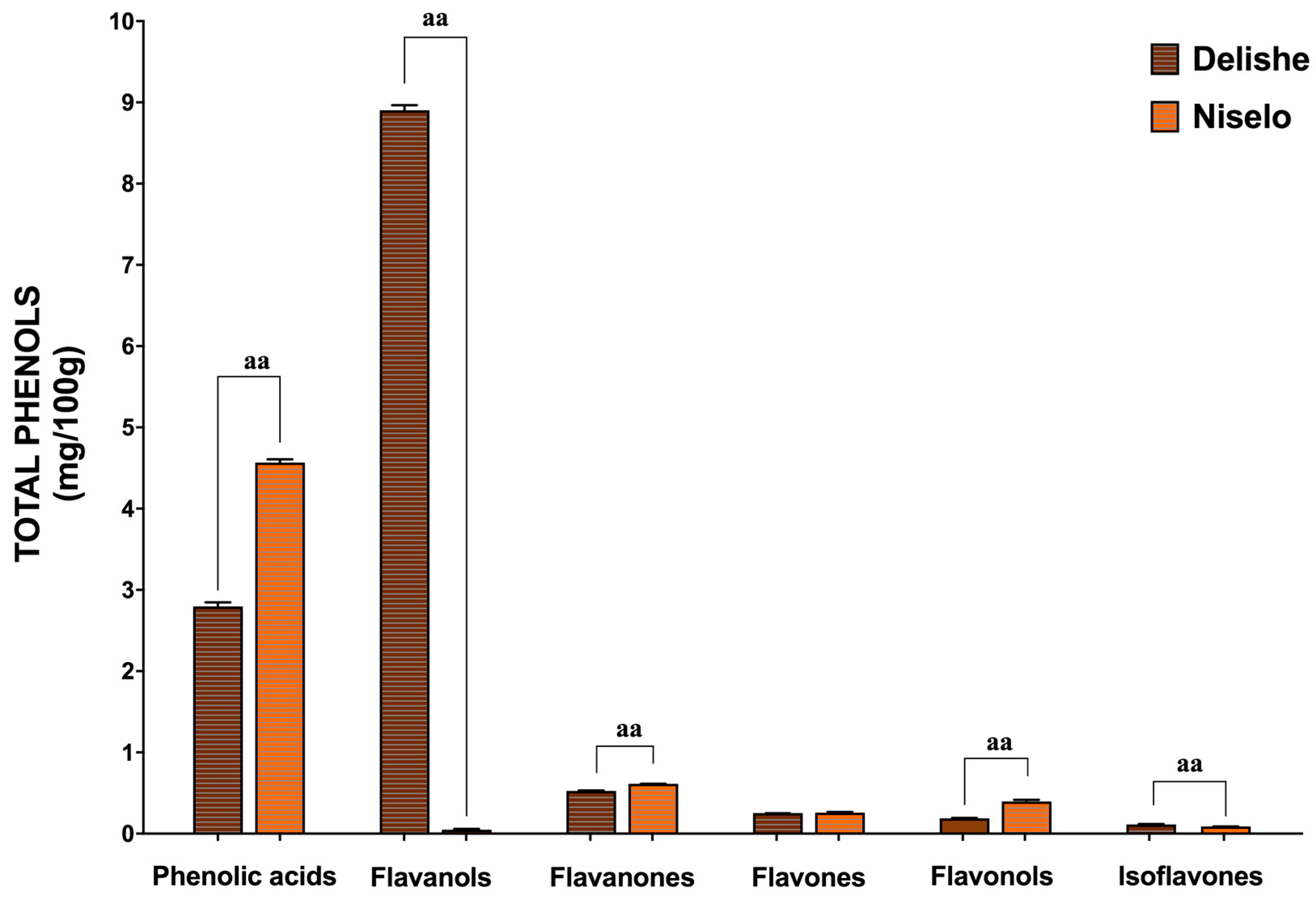
3.1. Analysis of Polyphenol Profiles in Niselo and Delishe Fermented Beverages
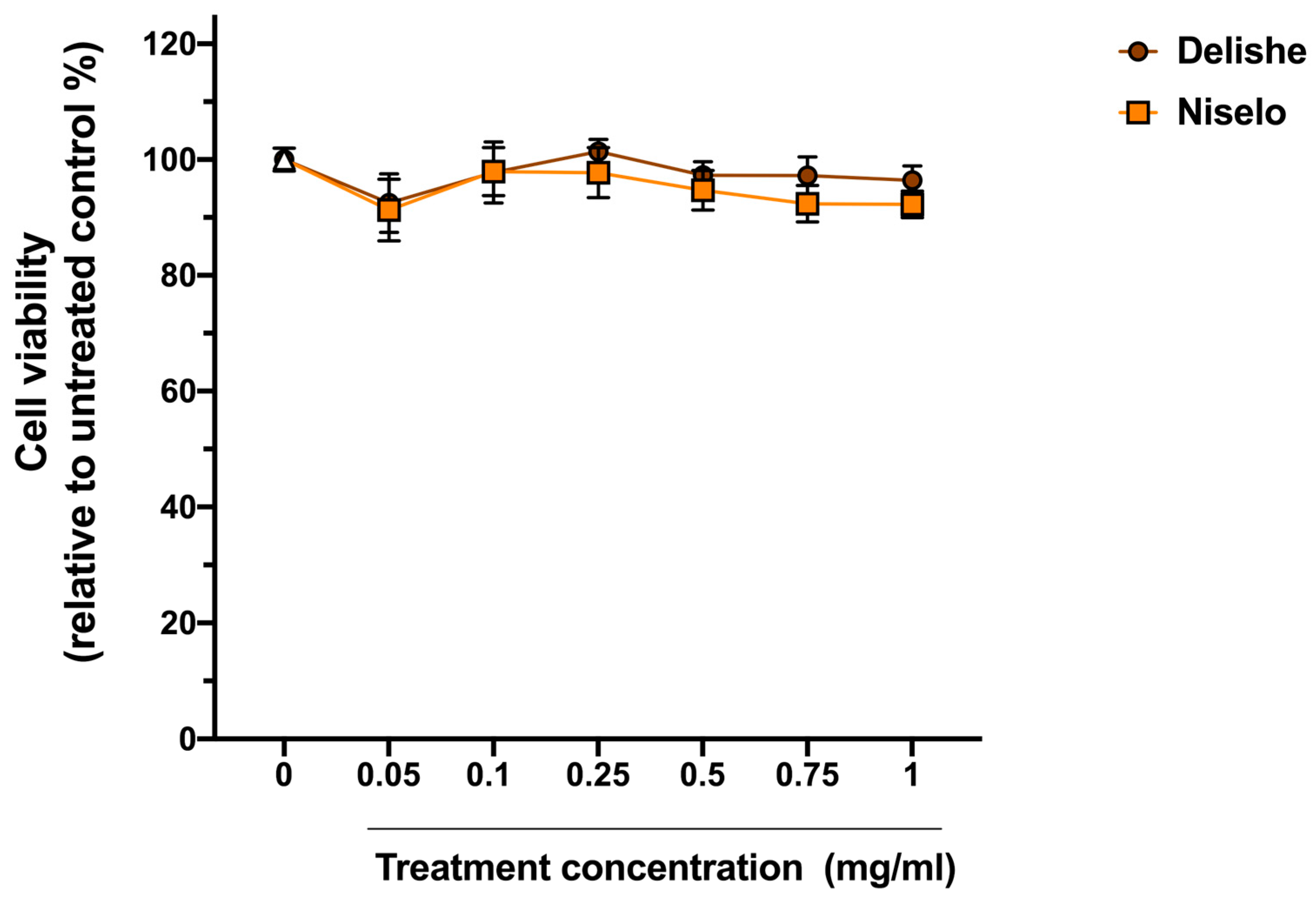
3.2. Effects of Niselo and Delishe Fermented Beverages on Cell Viability
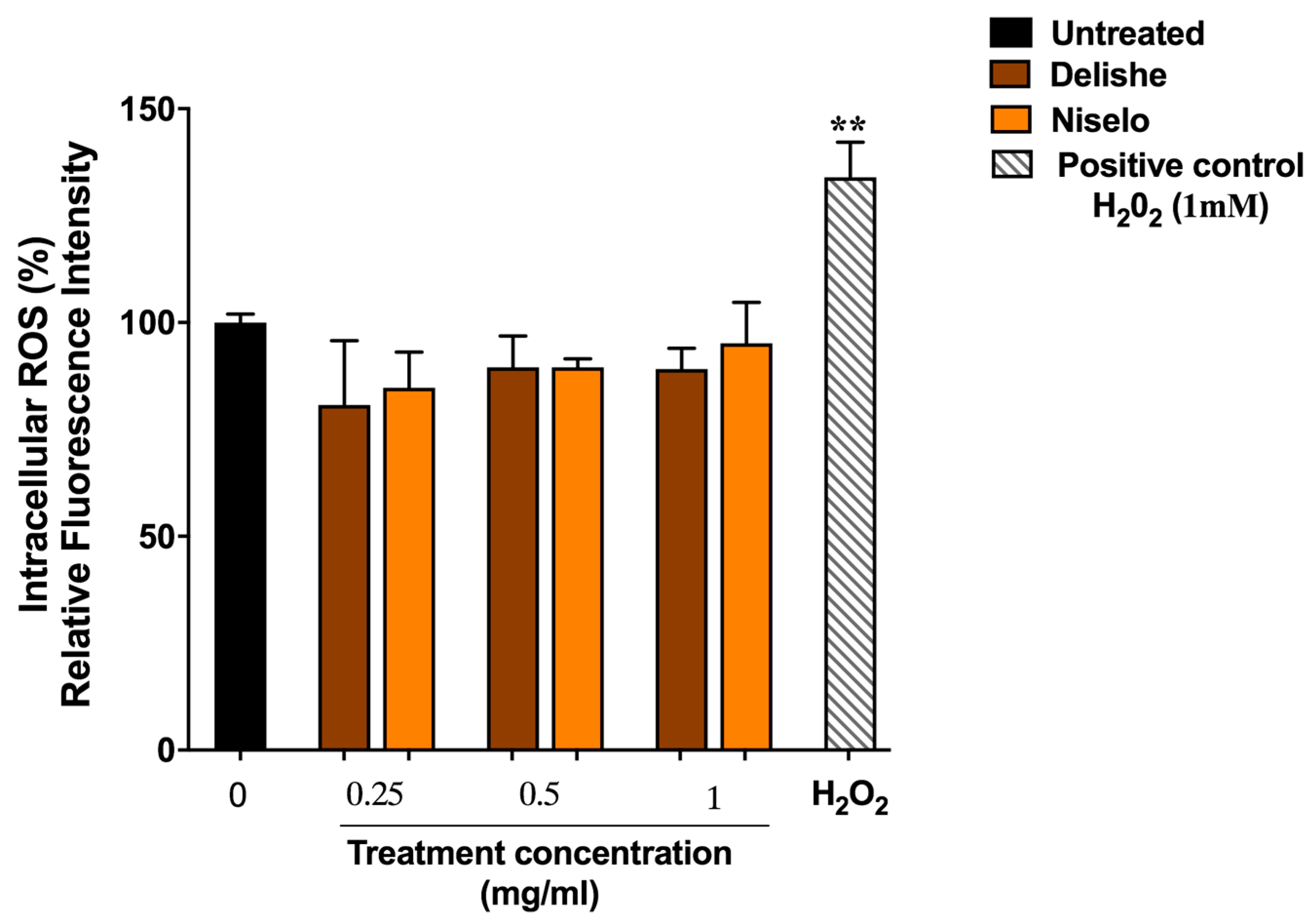
3.3. Intracellular ROS Levels in Caco-2 Cells Treated with Delishe and Niselo Beverages
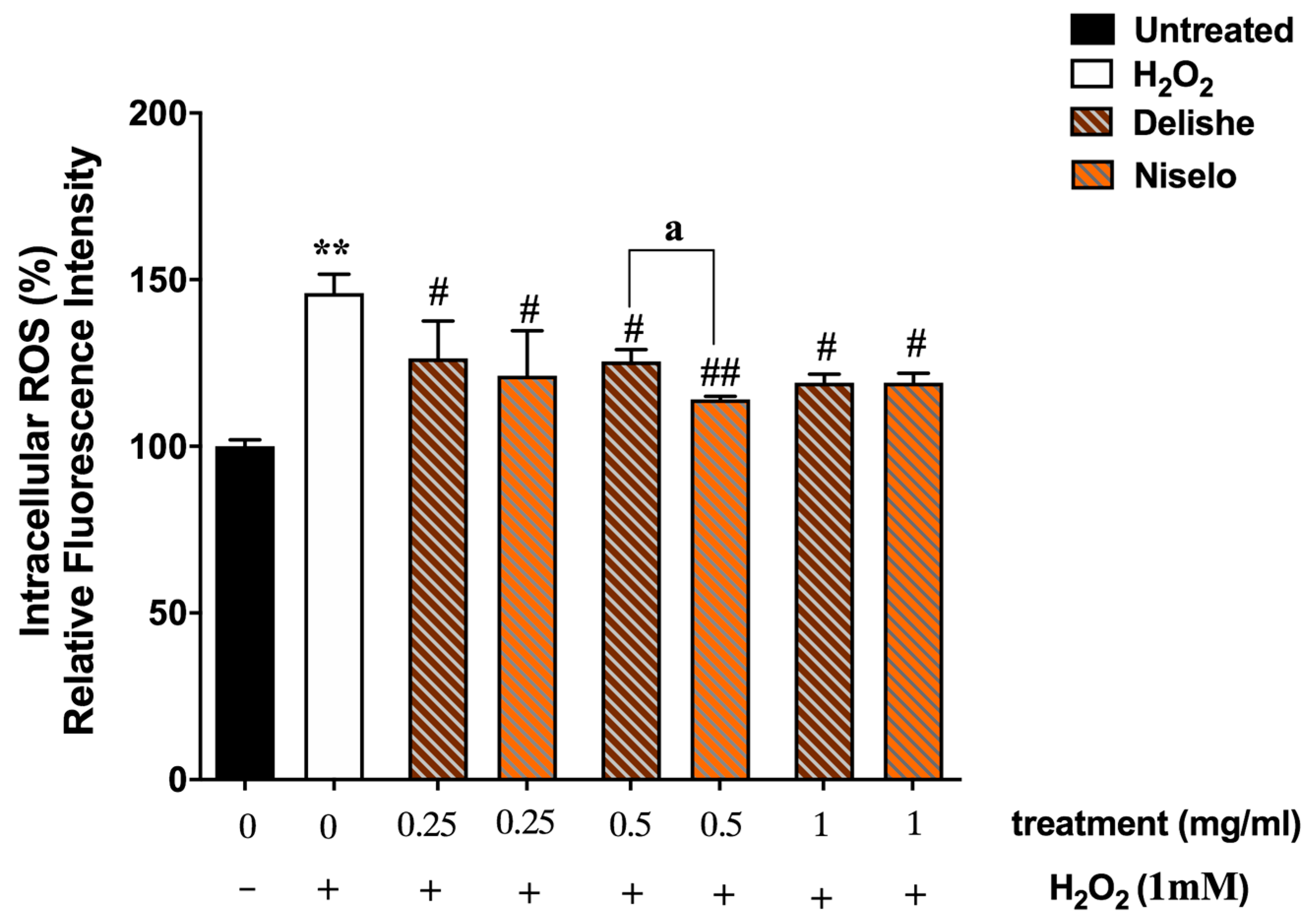
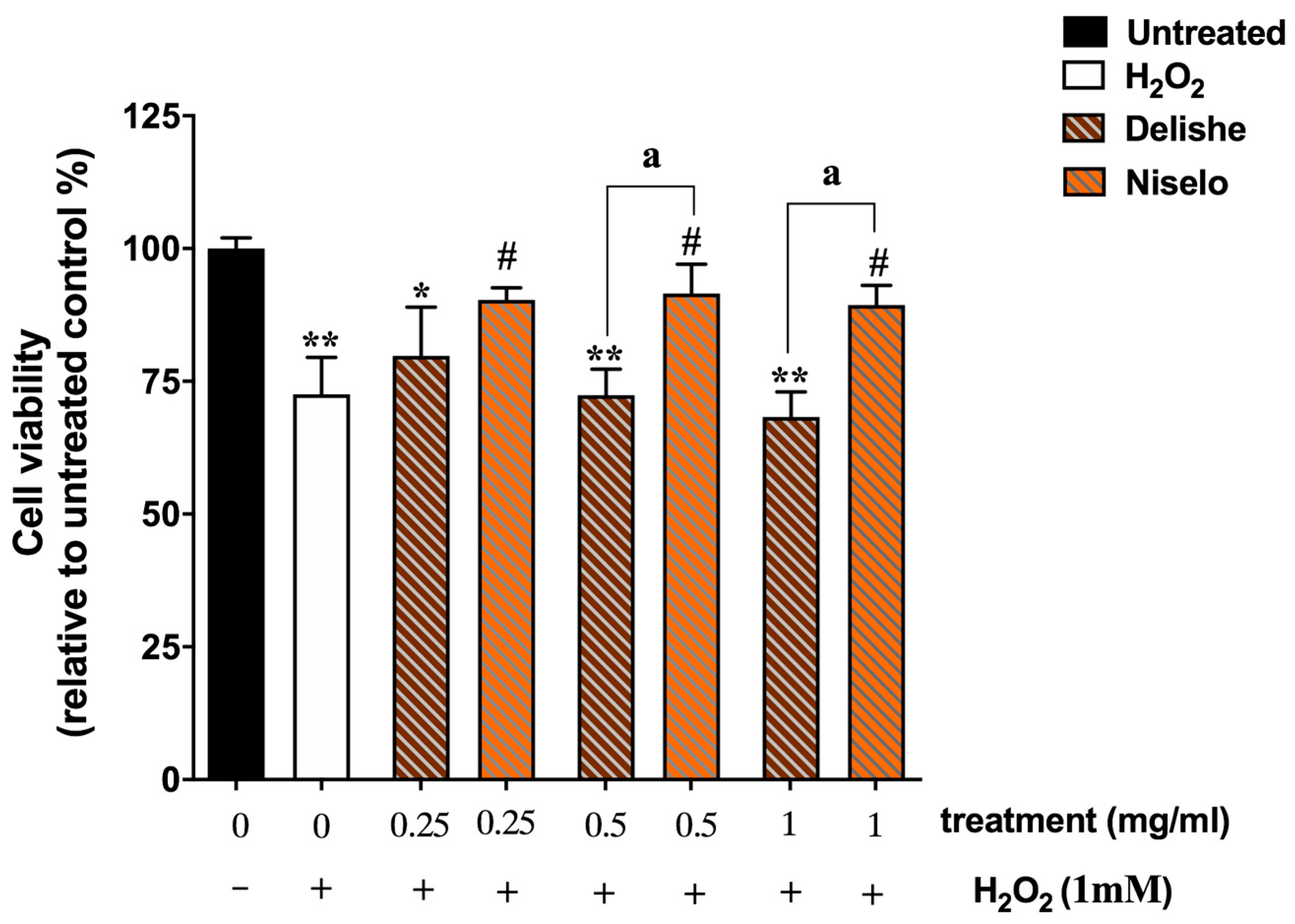
3.4. Cell Viability and Cytoprotective Effects of Delishe or Niselo Beverages in Caco-2 Cells Under Oxidative Stress
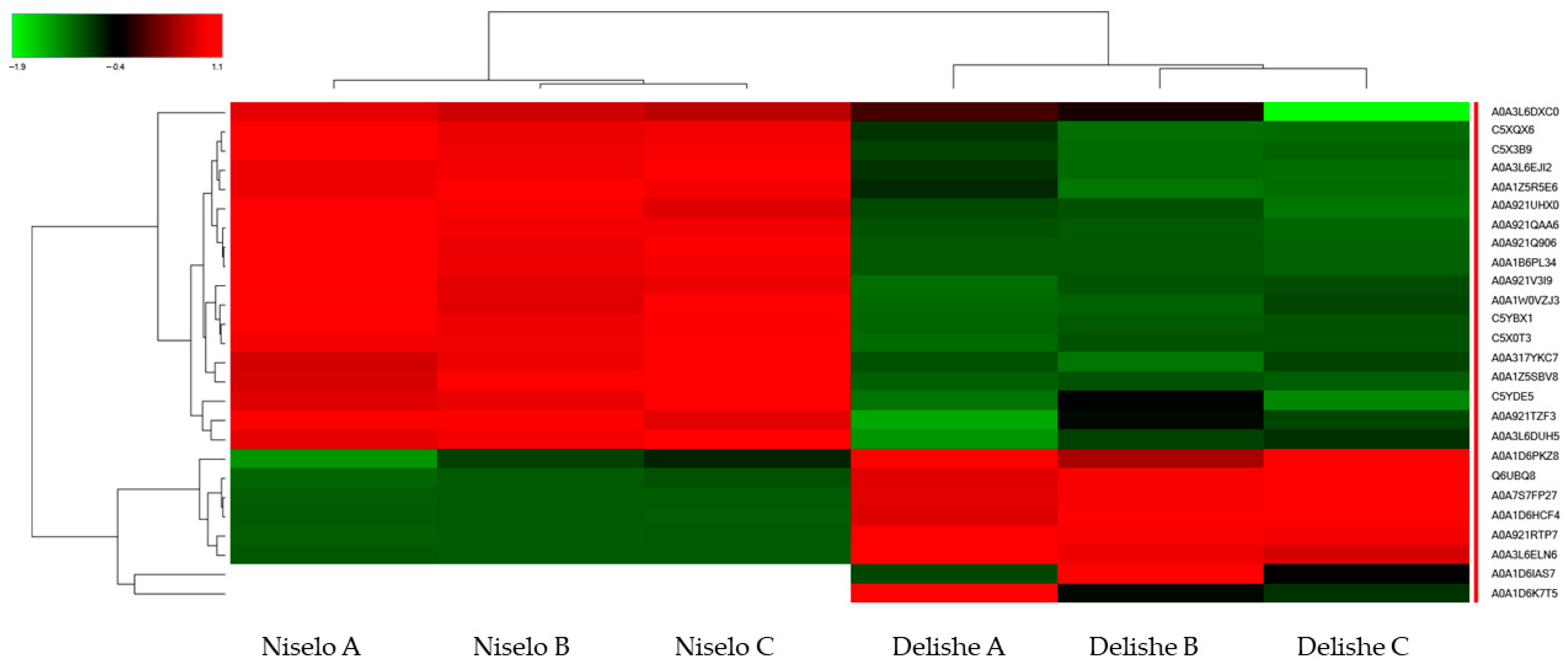
3.5. Proteomic Profiles in Niselo and Delishe Fermented Beverages
4. Discussion
5. Conclusions
Author Contributions
Funding
Institutional Review Board Statement
Informed Consent Statement
Data Availability Statement
Acknowledgments
Conflicts of Interest
References
- de São José, V.P.B.; Pereira, S.M.S.; Miranda Piermatei, Á.L.; Queiroz, V.A.V.; da Silva, B.P.; Martino, H.S.D.; Tako, E. Preclinical Evidence on the Impact of Sorghum (Sorghum bicolor) Genotypes, Fractions, and Processing Methods on Intestinal Health: A Review of an Ancient Grain Rich in Phenolic and Dietary Fiber. Crit. Rev. Food Sci. Nutr. 2025, 1–25. [Google Scholar] [CrossRef]
- Kazungu, F.K.; Muindi, E.M.; Mulinge, J.M. Overview of Sorghum (Sorghum bicolor L.), Its Economic Importance, Ecological Requirements and Production Constraints in Kenya. Int. J. Plant Soil Sci. 2023, 35, 62–71. [Google Scholar] [CrossRef]
- Bakari, H.; Djomdi; Ruben, Z.F.; Roger, D.D.; Cedric, D.; Guillaume, P.; Pascal, D.; Philippe, M.; Gwendoline, C. Sorghum (Sorghum bicolor L. Moench) and Its Main Parts (By-Products) as Promising Sustainable Sources of Value-Added Ingredients. Waste Biomass Valor 2023, 14, 1023–1044. [Google Scholar] [CrossRef]
- Espitia-Hernández, P.; Chávez González, M.L.; Ascacio-Valdés, J.A.; Dávila-Medina, D.; Flores-Naveda, A.; Silva, T.; Ruelas Chacón, X.; Sepúlveda, L. Sorghum (Sorghum bicolor L.) as a Potential Source of Bioactive Substances and Their Biological Properties. Crit. Rev. Food Sci. Nutr. 2022, 62, 2269–2280. [Google Scholar] [CrossRef] [PubMed]
- Tanwar, R.; Panghal, A.; Chaudhary, G.; Kumari, A.; Chhikara, N. Nutritional, Phytochemical and Functional Potential of Sorghum: A Review. Food Chem. Adv. 2023, 3, 100501. [Google Scholar] [CrossRef]
- Tian, X.; Qin, J.; Luo, Q.; Xu, Y.; Xie, S.; Chen, R.; Wang, X.; Lu, Q. Differences in Chemical Composition, Polyphenol Compounds, Antioxidant Activity, and In Vitro Rumen Fermentation among Sorghum Stalks. Animals 2024, 14, 415. [Google Scholar] [CrossRef]
- Abdulraheem, R.A.; Martins, R.N.; Bharadwaj, P.; Li, Z.; Coorey, R.; Johnson, S.; Binosha Fernando, W.M.A.D. Nutrients and Polyphenols-Rich Sorghum Bicolor Genotypes as Complementary Therapy for Alzheimer’s Disease. Phytochem. Rev. 2024, 23, 1889–1912. [Google Scholar] [CrossRef]
- Birhanu, S. Potential Benefits of Sorghum [Sorghum bicolor (L.) Moench] on Human Health: A Review. Int. J. Plant Soil Sci. 2021, 5, 16. [Google Scholar] [CrossRef]
- De Sousa, A.R.; De Castro Moreira, M.E.; Grancieri, M.; Toledo, R.C.L.; De Oliveira Araújo, F.; Mantovani, H.C.; Queiroz, V.A.V.; Martino, H.S.D. Extruded Sorghum (Sorghum bicolor L.) Improves Gut Microbiota, Reduces Inflammation, and Oxidative Stress in Obese Rats Fed a High-Fat Diet. J. Funct. Foods 2019, 58, 282–291. [Google Scholar] [CrossRef]
- A’yunin, N.A.Q.; Atmadja, T.F.A.-G.; Aini, N.; Haryanti, P. Characterisation of Polishing Frequency for Three Varieties of Sorghum Grain in Java, Indonesia. Int. J. Food Sci. 2022, 2022, 2949665. [Google Scholar] [CrossRef]
- McGinnis, M.J.; Webster, M. Current and Potential Future Uses of Sorghum to Increase Nutrient Density for Human Foods. J. Food Sci. 2024, 89, A42–A51. [Google Scholar] [CrossRef]
- Devi, P.B.; Vijayabharathi, R.; Sathyabama, S.; Malleshi, N.G.; Priyadarisini, V.B. Health Benefits of Finger Millet (Eleusine coracana L.) Polyphenols and Dietary Fiber: A Review. J. Food Sci. Technol. 2014, 51, 1021–1040. [Google Scholar] [CrossRef]
- Mallu, T.S.; Okbagabir, S.G.; Negassi, B.T.; Tesfay, T.; Negash, T.T.; Menghis, T.B.; Medhn, T.A.; Teklay, S.G.; Gebremeskal, Y.H.; Tewolde, R.H.; et al. A Comprehensive Review on Finger Millet (Eleusine coracana (L.) Gaertn): A Gluten-Free Superfood and Feed. J. Agric. Food Res. 2026, 25, 102528. [Google Scholar] [CrossRef]
- Sood, S.; Kant, L.; Pattanayak, A. Finger Millet [Eleusine coracana (L.) Gaertn.]: A Minor Crop for Sustainable Food and Nutritional Security. Asian J. Chem. 2017, 29, 707–710. [Google Scholar] [CrossRef]
- Abioye, V.F.; Babarinde, G.O.; Ogunlakin, G.O.; Adejuyitan, J.A.; Olatunde, S.J.; Abioye, A.O. Varietal and Processing Influence on Nutritional and Phytochemical Properties of Finger Millet: A Review. Heliyon 2022, 8, e12310. [Google Scholar] [CrossRef]
- Shobana, S.; Krishnaswamy, K.; Sudha, V.; Malleshi, N.G.; Anjana, R.M.; Palaniappan, L.; Mohan, V. Finger Millet (Ragi, Eleusine coracana L.): A Review of Its Nutritional Properties, Processing, and Plausible Health Benefits. Adv. Food Nutr. Res. 2013, 69, 1–39. [Google Scholar] [CrossRef] [PubMed]
- Patil, P.; Singh, S.P.; Patel, P. Functional Properties and Health Benefits of Finger Millet (Eleusine coracana L.): A Review. J. Phytopharm. 2023, 12, 196–202. [Google Scholar] [CrossRef]
- Kumari, T.; Deka, S.C. Potential Health Benefits of Garden Pea Seeds and Pods: A Review. Legume Sci. 2021, 3, e82. [Google Scholar] [CrossRef]
- Naveena, M.; Mohan, R.J.; Baskaran, N.; Vignesh, S. A Comprehensive Review on Ethnic Fermented Millet Food Products and Its Applications: A Global Scenario. Curr. Food Sci. Technol. Rep. 2025, 3, 18. [Google Scholar] [CrossRef]
- Hlangwani, E.; Adebiyi, J.A.; Adebo, O.A. Nutritional Compositions of Optimally Processed Umqombothi (a South African Indigenous Beer). Fermentation 2021, 7, 225. [Google Scholar] [CrossRef]
- Arya, P.; Vaidya, D.; Devi, S.; Kaushal, M.; Myathtwe, H.; Devi, D.; Gupta, A. Fermentation-Driven Bioactive Enhancement in Cereal Grains: Mechanisms, Nutritional Improvements, and Functional Food Applications. Trends Food Sci. Technol. 2025, 166, 105403. [Google Scholar] [CrossRef]
- Rollán, G.C.; Gerez, C.L.; LeBlanc, J.G. Lactic Fermentation as a Strategy to Improve the Nutritional and Functional Values of Pseudocereals. Front. Nutr. 2019, 6, 98. [Google Scholar] [CrossRef]
- Banwo, K.; Asogwa, F.C.; Ogunremi, O.R.; Adesulu-Dahunsi, A.; Sanni, A. Nutritional Profile and Antioxidant Capacities of Fermented Millet and Sorghum Gruels Using Lactic Acid Bacteria and Yeasts. Food Biotechnol. 2021, 35, 199–220. [Google Scholar] [CrossRef]
- Arunraj, K.; Gokhale, J.S. Enhancing the Antidiabetic and Antioxidant Potential of Yellow Sorghum via Lactic Acid Bacteria Fermentation. J. Cereal Sci. 2025, 126, 104262. [Google Scholar] [CrossRef]
- Arsov, A.; Tsigoriyna, L.; Batovska, D.; Armenova, N.; Mu, W.; Zhang, W.; Petrov, K.; Petrova, P. Bacterial Degradation of Antinutrients in Foods: The Genomic Insight. Foods 2024, 13, 2408. [Google Scholar] [CrossRef]
- Jeyakumar, E.; Lawrence, R. Microbial Fermentation for Reduction of Antinutritional Factors. In Current Developments in Biotechnology and Bioengineering; Elsevier: Amsterdam, The Netherlands, 2022; pp. 239–260. ISBN 978-0-12-823506-5. [Google Scholar]
- Anumudu, C.K.; Miri, T.; Onyeaka, H. Multifunctional Applications of Lactic Acid Bacteria: Enhancing Safety, Quality, and Nutritional Value in Foods and Fermented Beverages. Foods 2024, 13, 3714. [Google Scholar] [CrossRef]
- Peyer, L.C.; Zannini, E.; Arendt, E.K. Lactic Acid Bacteria as Sensory Biomodulators for Fermented Cereal-Based Beverages. Trends Food Sci. Technol. 2016, 54, 17–25. [Google Scholar] [CrossRef]
- Garzón, A.G.; Veras, F.F.; Brandelli, A.; Drago, S.R. Bio-functional and Prebiotics Properties of Products Based on Whole Grain Sorghum Fermented with Lactic Acid Bacteria. J. Sci. Food Agric. 2024, 104, 2971–2979. [Google Scholar] [CrossRef] [PubMed]
- Ashley, D.; Marasini, D.; Brownmiller, C.; Lee, J.A.; Carbonero, F.; Lee, S.-O. Impact of Grain Sorghum Polyphenols on Microbiota of Normal Weight and Overweight/Obese Subjects during In Vitro Fecal Fermentation. Nutrients 2019, 11, 217. [Google Scholar] [CrossRef] [PubMed]
- Nyathi, L.A.; Njobeh, P.B.; Dlamini, B.; Tesfamariam, K.; De Saeger, S.; Valerio, F.; Avantaggiato, G.; Akinmoladun, O.F.; Akanni, G.B.; Adebo, O.A. Nutritional Benefits, Technological Innovations and Safety of Fermented Cereal Products: Insights from Umqombothi. Food Biosci. 2025, 74, 107982. [Google Scholar] [CrossRef]
- Stefoska-Needham, A. Sorghum and Health: An Overview of Potential Protective Health Effects. J. Food Sci. 2024, 89, A30–A41. [Google Scholar] [CrossRef]
- Graziani, G.; Gaspari, A.; Di Vaio, C.; Cirillo, A.; Ronca, C.L.; Grosso, M.; Ritieni, A. Assessment of In Vitro Bioaccessibility of Polyphenols from Annurca, Limoncella, Red Delicious, and Golden Delicious Apples Using a Sequential Enzymatic Digestion Model. Antioxidants 2021, 10, 541. [Google Scholar] [CrossRef] [PubMed]
- Sessa, R.; Trombetti, S.; Bianco, A.L.; Amendola, G.; Catapano, R.; Cesaro, E.; Petruzziello, F.; D’Armiento, M.; Maruotti, G.M.; Menna, G.; et al. miR-1202 Acts as Anti-oncomiR in Myeloid Leukaemia by down-Modulating GATA-1S Expression. Open Biol. 2024, 14, 230319. [Google Scholar] [CrossRef]
- Liccardo, R.; Sessa, R.; Trombetti, S.; De Rosa, M.; Izzo, P.; Grosso, M.; Duraturo, F. MiR-137 Targets the 3′ Untranslated Region of MSH2: Potential Implications in Lynch Syndrome-Related Colorectal Cancer. Cancers 2021, 13, 4662. [Google Scholar] [CrossRef]
- Castaldo, L.; Toriello, M.; Izzo, L.; Sessa, R.; Lombardi, S.; Trombetti, S.; Rodríguez-Carrasco, Y.; Ritieni, A.; Grosso, M. Effect of Different Coffee Brews on Tryptophan Metabolite-Induced Cytotoxicity in HT-29 Human Colon Cancer Cells. Antioxidants 2022, 11, 2458. [Google Scholar] [CrossRef]
- Zou, J.; Hu, Y.; Li, K.; Liu, Y.; Li, M.; Pan, X.; Chang, X. Chestnuts in Fermented Rice Beverages Increase Metabolite Diversity and Antioxidant Activity While Reducing Cellular Oxidative Damage. Foods 2022, 12, 164. [Google Scholar] [CrossRef]
- Collins, A.; Francis, N.; Chinkwo, K.; Santhakumar, A.B.; Blanchard, C. Effect of In Vitro Gastrointestinal Digestion on the Polyphenol Bioaccessibility and Bioavailability of Processed Sorghum (Sorghum bicolor L. Moench). Molecules 2024, 29, 5229. [Google Scholar] [CrossRef] [PubMed]
- Vitali, M.; Makran, M.; Gandía, M.; Cilla, A.; Gamero, A. Differential Modulation of Cancer Cell Proliferation by Fermented Plant-Based Beverages: A Comparative Study of Tiger Nut, Carob and Rice Beverages in Colorectal Adenocarcinoma Cells. Foods 2025, 14, 3072. [Google Scholar] [CrossRef] [PubMed]
- Caponio, G.R.; Annunziato, A.; Vacca, M.; Cavaliere, M.; Ceglie, I.; Ranieri, M.; Di Luca, A.; D’Alessandro, A.G.; Tamma, G.; De Angelis, M. Comparative Evaluation of Functional Properties of Cow, Goat, and Donkey Milks Fermented with Lactic Acid Bacteria. Antioxidants 2025, 14, 1331. [Google Scholar] [CrossRef]
- Kus, M.; Ibragimow, I.; Piotrowska-Kempisty, H. Caco-2 Cell Line Standardization with Pharmaceutical Requirements and In Vitro Model Suitability for Permeability Assays. Pharmaceutics 2023, 15, 2523. [Google Scholar] [CrossRef]
- Adebo, O.A. African Sorghum-Based Fermented Foods: Past, Current and Future Prospects. Nutrients 2020, 12, 1111. [Google Scholar] [CrossRef] [PubMed]
- Trombetti, S.; Iaccarino, N.; Riccio, P.; Sessa, R.; Catapano, R.; Salvatore, M.; Luka, S.; De Nicola, S.; Izzo, P.; Roperto, S.; et al. Over-Expressed GATA-1S, the Short Isoform of the Hematopoietic Transcriptional Factor GATA-1, Inhibits Ferroptosis in K562 Myeloid Leukemia Cells by Preventing Lipid Peroxidation. Antioxidants 2023, 12, 537. [Google Scholar] [CrossRef] [PubMed]
- Yang, F.; Chen, C.; Ni, D.; Yang, Y.; Tian, J.; Li, Y.; Chen, S.; Ye, X.; Wang, L. Effects of Fermentation on Bioactivity and the Composition of Polyphenols Contained in Polyphenol-Rich Foods: A Review. Foods 2023, 12, 3315. [Google Scholar] [CrossRef]
- Yang, R.; Hui, Q.; Jiang, Q.; Liu, S.; Zhang, H.; Wu, J.; Lin, F.; O, K.; Yang, C. Effect of Manitoba-Grown Red-Osier Dogwood Extracts on Recovering Caco-2 Cells from H2O2-Induced Oxidative Damage. Antioxidants 2019, 8, 250. [Google Scholar] [CrossRef]
- Sawant, S.S.; Park, H.-Y.; Sim, E.-Y.; Kim, H.-S.; Choi, H.-S. Microbial Fermentation in Food: Impact on Functional Properties and Nutritional Enhancement—A Review of Recent Developments. Fermentation 2025, 11, 15. [Google Scholar] [CrossRef]
- Tsafrakidou, P.; Michaelidou, A.-M.; Biliaderis, C.G. Fermented Cereal-Based Products: Nutritional Aspects, Possible Impact on Gut Microbiota and Health Implications. Foods 2020, 9, 734. [Google Scholar] [CrossRef]
- Tamang, J.P.; Shin, D.-H.; Jung, S.-J.; Chae, S.-W. Functional Properties of Microorganisms in Fermented Foods. Front. Microbiol. 2016, 7, 578. [Google Scholar] [CrossRef]
- Marco, M.L.; Heeney, D.; Binda, S.; Cifelli, C.J.; Cotter, P.D.; Foligné, B.; Gänzle, M.; Kort, R.; Pasin, G.; Pihlanto, A.; et al. Health Benefits of Fermented Foods: Microbiota and Beyond. Curr. Opin. Biotechnol. 2017, 44, 94–102. [Google Scholar] [CrossRef]
- Adebo, O.A.; Gabriela Medina-Meza, I. Impact of Fermentation on the Phenolic Compounds and Antioxidant Activity of Whole Cereal Grains: A Mini Review. Molecules 2020, 25, 927. [Google Scholar] [CrossRef]
- Obafemi, Y.D.; Oranusi, S.U.; Ajanaku, K.O.; Akinduti, P.A.; Leech, J.; Cotter, P.D. African Fermented Foods: Overview, Emerging Benefits, and Novel Approaches to Microbiome Profiling. NPJ Sci. Food 2022, 6, 15. [Google Scholar] [CrossRef] [PubMed]
- Hawaz, H.; Bottari, B.; Scazzina, F.; Carini, E. Eastern African Traditional Fermented Foods and Beverages: Advancements, Challenges, and Perspectives on Food Technology, Nutrition, and Safety. Comp. Rev. Food Sci. Food Saf. 2025, 24, e70137. [Google Scholar] [CrossRef]
- Bouakkaz, S.; Zerizer, H.; Rachedi, K.; Accettulli, A.; Racioppo, A.; Bevilacqua, A. African Cereal-Based Fermented Foods: Microbiota, Functional Microorganisms, Starter Cultures and Nutritional Properties. Food Biosci. 2024, 62, 105212. [Google Scholar] [CrossRef]
- Sharma, R.; Diwan, B.; Singh, B.P.; Kulshrestha, S. Probiotic Fermentation of Polyphenols: Potential Sources of Novel Functional Foods. Food Prod. Process. Nutr. 2022, 4, 21. [Google Scholar] [CrossRef]
- Muhialdin, B.J.; Saari, N.; Meor Hussin, A.S. Review on the Biological Detoxification of Mycotoxins Using Lactic Acid Bacteria to Enhance the Sustainability of Foods Supply. Molecules 2020, 25, 2655. [Google Scholar] [CrossRef]
- Tamang, J.P.; Cotter, P.D.; Endo, A.; Han, N.S.; Kort, R.; Liu, S.Q.; Mayo, B.; Westerik, N.; Hutkins, R. Fermented Foods in a Global Age: East Meets West. Comp. Rev. Food Sci. Food Saf. 2020, 19, 184–217. [Google Scholar] [CrossRef]
- Ray, J.G.; Vermeulen, M.J.; Bharatha, A.; Montanera, W.J.; Park, A.L. Association Between MRI Exposure During Pregnancy and Fetal and Childhood Outcomes. JAMA 2016, 316, 952–961. [Google Scholar] [CrossRef]
- Trombetti, S.; Cimbalo, A.; Grosso, M.; Vila-Donat, P.; Mañes, J.; Manyes, L. Proteomic Analysis of the Murine Liver Response to Oral Exposure to Aflatoxin B1 and Ochratoxin A: The Protective Role to Bioactive Compounds. Toxins 2025, 17, 29. [Google Scholar] [CrossRef] [PubMed]
- Abdul Manan, M. Progress in Probiotic Science: Prospects of Functional Probiotic-Based Foods and Beverages. Int. J. Food Sci. 2025, 2025, 5567567. [Google Scholar] [CrossRef]
- Panou, A.; Karabagias, I.K. Composition, Properties, and Beneficial Effects of Functional Beverages on Human Health. Beverages 2025, 11, 40. [Google Scholar] [CrossRef]
- Dykes, L.; Rooney, L.W. Phenolic Compounds in Cereal Grains and Their Health Benefits. Cereal Foods World 2007, 52, 105–111. [Google Scholar] [CrossRef]
- Chandrasekara, A.; Shahidi, F. Determination of Antioxidant Activity in Free and Hydrolyzed Fractions of Millet Grains and Characterization of Their Phenolic Profiles by HPLC-DAD-ESI-MSn. J. Funct. Foods 2011, 3, 144–158. [Google Scholar] [CrossRef]
- Awika, J.M.; Rooney, L.W. Sorghum Phytochemicals and Their Potential Impact on Human Health. Phytochemistry 2004, 65, 1199–1221. [Google Scholar] [CrossRef]
- Bedoya-Ramírez, D.; Cilla, A.; Contreras-Calderón, J.; Alegría-Torán, A. Evaluation of the Antioxidant Capacity, Furan Compounds and Cytoprotective/Cytotoxic Effects upon Caco-2 Cells of Commercial Colombian Coffee. Food Chem. 2017, 219, 364–372. [Google Scholar] [CrossRef]
- Cilla, A.; Rodrigo, M.J.; Zacarías, L.; De Ancos, B.; Sánchez-Moreno, C.; Barberá, R.; Alegría, A. Protective Effect of Bioaccessible Fractions of Citrus Fruit Pulps against H2O2 -Induced Oxidative Stress in Caco-2 Cells. Food Res. Int. 2018, 103, 335–344. [Google Scholar] [CrossRef] [PubMed]
- Kumar, A.; Saranyadevi, S.; Thirumalaisamy, S.K.; Dapana Durage, T.T.; Jaiswal, S.G.; Kavitake, D.; Wei, S. Phenolic Acids in Fermented Foods: Microbial Biotransformation, Antioxidant Mechanisms, and Functional Health Implications. Front. Mol. Biosci. 2025, 12, 1678673. [Google Scholar] [CrossRef] [PubMed]
- Kumar, N.; Goel, N. Phenolic Acids: Natural Versatile Molecules with Promising Therapeutic Applications. Biotechnol. Rep. 2019, 24, e00370. [Google Scholar] [CrossRef] [PubMed]
- Rodríguez-Ramiro, I.; Martín, M.Á.; Ramos, S.; Bravo, L.; Goya, L. Comparative Effects of Dietary Flavanols on Antioxidant Defences and Their Response to Oxidant-Induced Stress on Caco2 Cells. Eur. J. Nutr. 2011, 50, 313–322. [Google Scholar] [CrossRef]
- Subba Rao, M.V.S.S.T.; Muralikrishna, G. Evaluation of the Antioxidant Properties of Free and Bound Phenolic Acids from Native and Malted Finger Millet (Ragi, Eleusine coracana Indaf-15). J. Agric. Food Chem. 2002, 50, 889–892. [Google Scholar] [CrossRef]
- Saleh, A.S.M.; Zhang, Q.; Chen, J.; Shen, Q. Millet Grains: Nutritional Quality, Processing, and Potential Health Benefits. Comp. Rev. Food Sci. Food Saf. 2013, 12, 281–295. [Google Scholar] [CrossRef]
- Kosová, K.; Vítámvás, P.; Prášil, I.T. Proteomics of Stress Responses in Wheat and Barleyâ—Search for Potential Protein Markers of Stress Tolerance. Front. Plant Sci. 2014, 5, 711. [Google Scholar] [CrossRef]
- Cannea, F.B.; Padiglia, A. Antioxidant Defense Systems in Plants: Mechanisms, Regulation, and Biotechnological Strategies for Enhanced Oxidative Stress Tolerance. Life 2025, 15, 1293. [Google Scholar] [CrossRef] [PubMed]
- Kazemi Oskuei, B.; Masi, A.; Kosmala, A.; Mahna, N. Plant Stress and Proteomics in Medicinal Plants. Front. Plant Sci. 2025, 16, 1656247. [Google Scholar] [CrossRef] [PubMed]
- Ali, A.E.E.; Sharp, R.E.; Greeley, L.; Peck, S.C.; Tabb, D.L.; Ludidi, N. Proteomic Dataset of Sorghum Leaf and Root Responses to Single and Combined Drought and Heat Stress. Sci. Data 2025, 12, 97. [Google Scholar] [CrossRef] [PubMed]



| Compounds | LOQ (ppm) | Retention Time (min) | Measured Mass (m/z) | Theorical Mass (m/z) | Accuracy (∆ ppm) | Chemical Formula |
|---|---|---|---|---|---|---|
| Quinic acid | 0.0049 | 0.72 | 191.05506 | 191.05528 | −1.466 | C7H12O6 |
| Protocatechiuc acid | 0.0195 | 3.93 | 153.01811 | 153.01857 | −3.006 | C7H6O4 |
| Catechin | 0.0049 | 4.14 | 289.07220 | 289.07205 | 0.519 | C15H14O6 |
| Chlorogenic acid | 0.0049 | 4.18 | 353.08847 | 353.08780 | 1.898 | C16H18O9 |
| Epicatechin | 0.0098 | 4.28 | 289.07248 | 289.07196 | 1.799 | C7H6O4 |
| Caffeic acid | 0.0049 | 4.32 | 179.03442 | 179.03455 | −0.726 | C9H8O4 |
| p-coumaric acid | 0.0195 | 4.53 | 163.03994 | 163.03937 | 3.496 | C9H8O3 |
| Ferulic acid | 0.0780 | 4.58 | 193.05014 | 193.05016 | −0.104 | C10H10O4 |
| Naringin | 0.0049 | 4.60 | 579.17279 | 579.17212 | 1.157 | C27H32O14 |
| Luteolin-7-glucoside | 0.0049 | 4.66 | 447.09418 | 447.09363 | 1.230 | C21H20O11 |
| Rutin hydrate | 0.0195 | 4.68 | 609.14648 | 609.14673 | −0.410 | C27H32O17 |
| Quercetin-3b-glucoside | 0.0049 | 4.71 | 463.08862 | 463.08884 | −0.475 | C21H20O12 |
| Diosmin | 0.0049 | 4.75 | 607.16736 | 607.16718 | 0.296 | C28H32O15 |
| Apigenin-7O-glucoside | 0.0049 | 4.80 | 431.09906 | 431.09860 | 1.067 | C21H20O10 |
| Kaempferol-3O-glucoside | 0.0049 | 4.86 | 447.09421 | 447.09363 | 1.297 | C21H20O11 |
| Ellagic acid | 0.0049 | 4.87 | 300.99911 | 300.99924 | −0.432 | C14H6O8 |
| Daidzein | 0.0049 | 5.04 | 253.05609 | 253.05699 | −3.556 | C15H10O4 |
| Quercetin | 0.0049 | 5.31 | 301.03595 | 301.03508 | 2.890 | C15H10O7 |
| Naringenin | 0.0195 | 5.38 | 271.06143 | 271.06186 | −1.586 | C15H12O5 |
| Genistein | 0.0195 | 5.48 | 269.04614 | 269.04555 | 2.193 | C15H10O5 |
| Luteolin | 0.0195 | 5.47 | 285.04086 | 285.04062 | 0.842 | C15H10O6 |
| Apigenin | 0.0049 | 5.78 | 269.04572 | 269.04555 | 0.632 | C15H10O5 |
| Untargeted Polyphenols | Retention Time (min) | Chemical Formula | Theorical Mass (m/z) | Measured Mass (m/z) | Accuracy (∆ ppm) |
|---|---|---|---|---|---|
| 1-O-coumaroylglycerol | 4.42 | C12H14O5 | 237.07685 | 237.07695 | 0.422 |
| 1-0-caffeylglycerol | 4.16 | C12H14O6 | 253.07176 | 253.07204 | 1.106 |
| 2-O-caffeoylglycerol | 4.28 | C12H14O6 | 253.07176 | 253.07204 | 1.106 |
| 7,3′,4′-trihydroxyflavone | 5.79 | C15H10O5 | 269.04555 | 269.04614 | 2.193 |
| 7,3′,4′,5′-tetrahydroxy flavanone | 4.77 | C15H12O6 | 287.05611 | 287.05685 | 2.578 |
| Eriodictyol | 5.08 | C15H12O6 | 287.05611 | 287.0567 | 2.055 |
| Chrysoeriol | 5.88 | C16H12O6 | 299.05611 | 299.05664 | 1.772 |
| Dihydroxy-octadecadienoic acid | 6.3 | C18H32O6 | 311.22278 | 311.22348 | 2.249 |
| Dihydroxy-octadecenoic acid | 6.51 | C18H34O6 | 313.23843 | 313.23907 | 2.043 |
| Trihydroxy-octadecenoic acid | 5.38 | C18H34O6 | 329.23335 | 329.23395 | 1.822 |
| Caffeic acid hexoside | 4.16 | C15H18O6 | 341.08781 | 341.08832 | 1.495 |
| Saccharide | 4.32 | C16H20O10 | 371.09837 | 371.09906 | 1.859 |
| 1,3-O-coumaroyl-caffeoyl-glycerol | 5.16 | C21H20O8 | 399.10854 | 399.10801 | −1.328 |
| 1,3-O-coumaroyl-feruloyl-glycerol | 5.45 | C22H22O8 | 413.12419 | 413.12488 | 1.670 |
| 1,3-O-dicaffeoylglycerol | 4.96 | C21H20O9 | 415.10346 | 415.1041 | 1.542 |
| 1-O-caffeoyl-2-O-glucosylglycerol I | 4.07 | C18H24O11 | 415.12458 | 415.12512 | 1.301 |
| 1-O-caffeoyl-2-O-glucosylglycerol II | 4.14 | C18H24O11 | 415.12458 | 415.12531 | 1.759 |
| Naringenin hexoside I | 4.52 | C21H22O10 | 433.11402 | 433.11441 | 0.900 |
| Naringenin hexoside II | 4.75 | C21H22O10 | 433.11402 | 433.1146 | 1.339 |
| Naringenin hexoside III | 4.88 | C21H22O10 | 433.11402 | 433.11462 | 1.385 |
| 1,3-O-diferuloylglicerol | 5.51 | C23H24O9 | 443.13476 | 443.13547 | 1.602 |
| Luteolin hexoside I | 4.57 | C21H20O11 | 447.09328 | 447.09406 | 1.745 |
| Luteolin hexoside II | 4.66 | C21H20O11 | 447.09328 | 447.09433 | 2.349 |
| Eriodictyol-O-hexoside | 4.32 | C21H22O11 | 449.10893 | 449.10956 | 1.403 |
| N1−N4-dicaffeoyl-spermidine | 4.25 | C25H31N3O6 | 468.21401 | 468.21451 | 1.068 |
| N1−N8-caffeoyl-feruloyl-spermidine | 4.37 | C26H33N3O6 | 482.22966 | 482.23056 | 1.866 |
| Targeted Polyphenols | Niselo | Delishe | ||
|---|---|---|---|---|
| mg/100 g | SD | mg/100 g | SD | |
| Phenolic acids | ||||
| Quinic acid | 0.055 | 0.004 | 0.014 | 0.002 |
| Protocatechiuc acid | 0.124 | 0.007 | 1.768 | 0.041 |
| Chlorogenic acid | 0.091 | 0.004 | 0.068 | 0.002 |
| Caffeic acid | 1.821 | 0.011 | 0.023 | 0.001 |
| Ellagic acid | <LOQ | - | <LOQ | - |
| Ferulic acid | 1.696 | 0.003 | 0.923 | 0.005 |
| p-coumaric acid | 0.78 | 0.009 | nf | - |
| Flavanols | ||||
| Catechin | <LOQ | - | 7.278 | 0.052 |
| Epicatechin | nf | - | 1.626 | 0.009 |
| Flavanones | ||||
| Naringin | 0.047 | 0.001 | 0.025 | 0.001 |
| Naringenin | 0.566 | 0.001 | 0.505 | 0.008 |
| Flavones | ||||
| Luteolin-7-glucoside | 0.063 | 0.001 | 0.04 | 0.002 |
| Luteolin | 0.101 | 0.001 | 0.15 | 0.002 |
| Apigenin-7O-glucoside | 0.059 | 0.004 | 0.015 | 0.001 |
| Apigenin | 0.037 | 0.001 | 0.048 | 0.001 |
| Flavonols | ||||
| Rutin hydrate | 0.23 | 0.007 | 0.088 | 0.001 |
| Quercetin-3b-glucoside | <LOQ | - | 0.022 | 0.002 |
| Diosmin | 0.054 | 0.009 | 0.024 | 0.001 |
| Kaempferol-3O-glucoside | 0.113 | 0.003 | 0.035 | 0.001 |
| Quercetin | nf | - | 0.019 | 0.001 |
| Isoflavones | ||||
| Genistein | 0.088 | 0.002 | 0.114 | 0.005 |
| Daidzein | <LOQ | - | <LOQ | - |
| Total phenols | 5.925 | 3.881 | ||
| Untargeted Polyphenols | Average Area | Average Relative Area (%) | ||
|---|---|---|---|---|
| Niselo | Delishe | Niselo | Delishe | |
| 1-O-coumaroylglycerol | 21,486,461 | 10,187,717 | 5.3 | 2.0 |
| 1-O-caffeylglycerol | 4,795,184 | 2,084,433 | 1.2 | 0.4 |
| 2-O-caffeoylglycerol | 52,248,570 | 19,312,528 | 12.9 | 3.8 |
| 7,3′,4′-trihydroxyflavone | 8,351,780 | 11,941,917 | 2.1 | 2.4 |
| 7,3′,4′,5′-tetrahydroxy flavanone | 69,223 | 1,420,205 | 0.0 | 0.3 |
| eriodictyol | 17,480,522 | 13,144,442 | 4.3 | 2.6 |
| chrysoeriol | 3,610,667 | 3,530,921 | 0.9 | 0.7 |
| dihydroxy-octadecadienoic acid | 11,826,432 | 27,447,241 | 2.9 | 5.4 |
| dihydroxy-octadecenoic acid | 36,843,093 | 86,826,889 | 9.1 | 17.1 |
| trihydroxy-octadecenoic acid | 84,007,160 | 264,078,432 | 20.8 | 52.0 |
| Caffeic acid hexoside | 5,772,458 | 5,237,493 | 1.4 | 1.0 |
| saccharide | 23,069,167 | 10,844,073 | 5.7 | 2.1 |
| 1,3-O-coumaroyl-caffeoyl-glycerol | 8,928,793 | 1,800,412 | 2.2 | 0.4 |
| 1,3-O-coumaroyl-feruloyl-glycerol | 8,080,541 | 3,253,165 | 2.0 | 0.6 |
| 1,3-O-dicaffeoylglycerol | 18,495,461 | 3,149,485 | 4.6 | 0.6 |
| 1-O-caffeoyl-2-O-glucosylglycerol I | 6,076,581 | 1,499,877 | 1.5 | 0.3 |
| 1-O-caffeoyl-2-O-glucosylglycerol II | 119,434 | 114,568 | 0.0 | 0.0 |
| naringenin hexoside I | 41,455,326 | 20,711,020 | 10.3 | 4.1 |
| naringenin hexoside II | NF | 1,237,224 | 0.0 | 0.2 |
| naringenin hexoside III | 1,947,173 | 877,997 | 0.5 | 0.2 |
| 1,3-O-diferuloylglicerol | 1,207,265 | 407,720 | 0.3 | 0.1 |
| luteolin hexoside I | 5,720,991 | 3,037,226 | 1.4 | 0.6 |
| luteolin hexoside II | 9,129,517 | 3,457,070 | 2.3 | 0.7 |
| eriodictyol-O-hexoside | 17,111,896 | 6,613,671 | 4.2 | 1.3 |
| N1−N4-dicaffeoyl-spermidine | 14,462,008 | 5,082,684 | 3.6 | 1.0 |
| N1−N8-caffeoyl-feruloyl-spermidine | 1,352,112 | 349,613 | 0.3 | 0.1 |
| Protein | Peptide | Average Scaled Abundance (%) | Abundance Ratio (Niselo/Delishe) | |||||||
|---|---|---|---|---|---|---|---|---|---|---|
| Accession Number | Description | Organism | Molecular Weight (kDa) | Biological Function | Matching Peptides Sequence | Protein Coverage (%) | Unique Peptides | Niselo | Delishe | |
| A0A921Q906 | Subtilisin-chymotrypsin inhibitor-2A | Sorghum bicolor | 8 | Stress response | [K].DKPDADIFVLPVGSPVTR.[D] | 60 | 3 | 147.7 | 52.3 | 2.901 |
| [R].IFVDTVAETPR.[V] | ||||||||||
| [K].QSWPEVVGLSVEEAK.[K] | ||||||||||
| A0A921QAA6 | Subtilisin-chymotrypsin inhibitor CI-1B | Sorghum bicolor | 8 | Stress response | [K].DMPNAYIQVLPVGSPVTLDIRPDR.[V] | 60 | 3 | 134.1 | 65.9 | 2.479 |
| [K].DMPNAYIQVLPVGSPVTLDIRPDR.[V] | ||||||||||
| [K].TSWPEVLGMSIK.[E] | ||||||||||
| [K].EATEIILK.[D] | ||||||||||
| A0A1Z5R5E6 | Non-specific lipid-transfer protein | Sorghum bicolor | 11.5 | Transport | [R].GISGLNAGNAASIPSK.[C] | 40 | 3 | 120.1 | 79.9 | 1.524 |
| [R].GQGSAPSAGCCSGVR.[S] | ||||||||||
| [K].CGVSVPYTISTSTDCSR.[V] | ||||||||||
| C5YBX1 | Glutaredoxin domain-containing protein | Sorghum bicolor | 13.4 | Stress response | [K].AIELDVESDGPELQNALK.[E] | 38 | 3 | 156.8 | 43.2 | 2.588 |
| [K].LVPLLTEAGAIAGSTSK.[T] | ||||||||||
| [K].EIVASAPLVVFSK.[T] | ||||||||||
| C5XQX6 | Bowman-Birk serine protease inhibitors family domain-containing protein | Sorghum bicolor | 9 | - | [K].ECTSWSGVYTCDDLLTK.[C] | 32 | 2 | 132.1 | 67.9 | 1.818 |
| [R].DFLPEGCPCK.[T] | ||||||||||
| Q6UBQ8 | Elongation factor Tu | Lacticaseibacillus rhamnosus | 25.9 | Protein metabolism | [K].TLDLGEAGDNVGVLLR.[G] | 30 | 4 | 66.7 | 133.3 | 0.491 |
| [R].DLLTEYDYPGDDIPVVR.[G] | ||||||||||
| [K].VGDEVEIVGLVDK.[V] | ||||||||||
| [K].SVVTGLEMFHK.[T] | ||||||||||
| [R].QVGVNYIVVFLNK.[C] | ||||||||||
| A0A1B6PL34 | Uncharacterized protein | Sorghum bicolor | 23.5 | Cell organization and biogenesis; protein metabolism; other metabolic processes; stress response | [R].LPENADLDSVAASLDNGVLTVR.[F] | 27 | 3 | 152.6 | 47.5 | 3.013 |
| [R].DEAAAVSPLSDVGLLADPFR.[I] | ||||||||||
| [R].ETPDAHEIVVDVPGMR.[R] | ||||||||||
| A0A921TZF3 | Starch synthase, chloroplastic/amyloplastic | Sorghum bicolor | 66 | Other metabolic processes | [R].FAFSDFPELNLPER.[F] | 26 | 13 | 108.4 | 91.6 | 1.367 |
| [K].EALQAEVGLPVDR.[NK] | ||||||||||
| [R].LSVDCNVVEPADVK.[K] | ||||||||||
| [R].FSLLCQAALEAPR.[I] | ||||||||||
| [K].DAWDTSVVSEIK.[MX] | ||||||||||
| [R].VLTVSPYYAEELISGIAR.[G] | ||||||||||
| [R].GCELDNIMR.[L] | ||||||||||
| [RK].NCMIQDLSWK.[G-V] | ||||||||||
| [K].YDVSTAVEAK.[A] | ||||||||||
| [K].VVGTPAYEEMVK.[N] | ||||||||||
| [K].IYGPDAGTDYK.[D] | ||||||||||
| [K].IPLVAFIGR.[L] | ||||||||||
| [R].FEPCGLIQLQGMR.[YV] | ||||||||||
| [K].VVGTPAYEEMVK.[N] | ||||||||||
| C5YDE5 | Oleosin | Sorghum bicolor | 16.2 | Developmental processes;other biological processes | [R].GGTGGGAGGYGDYNR.[G] | 25 | 3 | 112.7 | 87.3 | 1.258 |
| [R].GGGAGMYGESQQQQQK.[Q] | ||||||||||
| [K].QGAMMTAIK.[A] | ||||||||||
| A0A1Z5SBV8 | Bifunctional inhibitor/plant lipid transfer protein/seed storage helical domain-containing protein | Sorghum bicolor | 13.1 | Transport | [K].TVASCGVALPR.[C] | 17 | 2 | 115.8 | 84.3 | 1.258 |
| [K].AQQGCLCQFAK.[N] | ||||||||||
| A0A1D6K7T5 | Chitinase | Zea mays | 22.6 | Other metabolic processes; stress response | [R].ELAAFFGQTSHETTGGTR.[G] | 15 | 2 | 0 | 100 | 0.01 |
| [R].GAADQFQWGYCFK.[E] | ||||||||||
| A0A921V3I9 | SHSP domain-containing protein | Sorghum bicolor | 26.9 | Stress response | [K].VMVEDDTLVIR.[G] | 14 | 3 | 118.9 | 81.1 | 1.443 |
| [R].LFDDAVGFPMATR.[R] | ||||||||||
| [R].LPWDIVEDDK.[E] | ||||||||||
| A0A317YKC7 | Superoxide dismutase | Zea mays | 18.7 | Other metabolic processes;other biological processes | [K].AVAVLGSSEGVK.[G] | 14 | 2 | 154.2 | 45.8 | 1.817 |
| [R].AVVVHADPDDLGK.[GD] | ||||||||||
| A0A3L6DUH5 | Ubiquitin-40S ribosomal protein S27a | Zea mays | 20.9 | Protein metabolism; other metabolic processes | [K].TITLEVESSDTIDNVK.[AS] | 13 | 2 | 115.6 | 84.4 | 1.339 |
| [K].ESTLHLVLR.[L] | ||||||||||
| A0A1W0VZJ3 | Phytocyanin domain-containing protein | Sorghum bicolor | 26.6 | - | [R].SGPFFFISSDEDR.[C] | 11 | 2 | 126.4 | 73.5 | 1.757 |
| [R].LQAAAVGSSSGSSVLR.[L] | ||||||||||
| C5X3B9 | Peroxiredoxin | Sorghum bicolor | 24.2 | Other biological processes | [R].AVIAPSVSDEEAR.[K] | 11 | 2 | 136.2 | 63.8 | 2.049 |
| [K].VTYPILADPGR.[D] | ||||||||||
| A0A3L6EJI2 | Heat shock protein, mitochondrial | Zea mays | 30.4 | Stress response | [R].VAVEDGVLVIEGEK.[R] | 9 | 2 | 134.8 | 65.2 | 2.125 |
| [K].DGVLYVTVPR.[T] | ||||||||||
| A0A7S7FP27 | Glyceraldehyde-3-phosphate dehydrogenase | Lacticaseibacillus rhamnosus | 36.7 | Other metabolic processes | [R].VYAEPQAQNIPWVK.[N] | 8 | 2 | 53.2 | 146.8 | 0.363 |
| [K].AIGLVIPELNGK.[L] | ||||||||||
| A0A3L6ELN6 | Phosphoglycerate kinase | Zea mays | 42.4 | Other metabolic processes | [K].ELDYLVGAVANPK.[K] | 7 | 2 | 17.8 | 182.2 | 0.102 |
| [K].GVTTIIGGGDSVAAVEK.[VA] | ||||||||||
| C5X0T3 | Cupin type-1 domain-containing protein | Sorghum bicolor | 57.8 | - | [R].TLLGPEIAAAFGAR.[E] | 7 | 3 | 127.4 | 72.6 | 1.840 |
| [R].GGPFEFFGFTTSAR.[R] | ||||||||||
| [R].NSYGWTVSVDK.[H] | ||||||||||
| A0A1D6PKZ8 | Histone H2B | Zea mays | 25.7 | - | [K].QVHPDIGISSK.[A] | 7 | 2 | 68.7 | 131.3 | 0.520 |
| [K].SVETYK.[I] | ||||||||||
| A0A921RTP7 | EF-hand domain-containing protein | Sorghum bicolor | 46.2 | - | [R].EADVDGDGQINYEEFVK.[VM] | 7 | 2 | 65.1 | 134.9 | 0.480 |
| [K].DQNGFISAAELR.[H] | ||||||||||
| A0A1D6HCF4 | Glyceraldehyde-3-phosphate dehydrogenase (phosphorylating) | Zea mays | 55.7 | Other metabolic processes | [R].VPTVDVSVVDLTVR.[IL] | 6 | 2 | 29.8 | 170.2 | 0.158 |
| [RK].AASFNIIPSSTGAAK.[AVLG] | ||||||||||
| A0A1D6IAS7 | UTP--glucose-1-phosphate uridylyltransferase | Zea mays | 59.5 | Other metabolic processes | [K].VLQLETAAGAAIR.[FSV] | 5 | 2 | 0 | 100 | 0.010 |
| [K].SIPSIVELDSLK.[VS] | ||||||||||
| A0A921UHX0 | Plant antimicrobial peptide domain-containing protein | Sorghum bicolor | 52.2 | Stress response | [K].ACEWQYGEDTPR.[K] | 4 | 2 | 129.9 | 70.1 | 1.564 |
| [R].YEDQPWR.[T] | ||||||||||
| A0A3L6DXC0 | Histone H4 | Zea mays | 106.8 | - | [R].ISGLIYEETR.[GR] | 2 | 2 | 127.1 | 72.9 | 2.096 |
| [K].TVTAMDVVYALK.[R] | ||||||||||
Disclaimer/Publisher’s Note: The statements, opinions and data contained in all publications are solely those of the individual author(s) and contributor(s) and not of MDPI and/or the editor(s). MDPI and/or the editor(s) disclaim responsibility for any injury to people or property resulting from any ideas, methods, instructions or products referred to in the content. |
© 2026 by the authors. Licensee MDPI, Basel, Switzerland. This article is an open access article distributed under the terms and conditions of the Creative Commons Attribution (CC BY) license.
Share and Cite
Katerere, D.R.; Navarré Dopazo, A.; Sessa, R.; Trombetti, S.; Grosso, M.; Izzo, L. Evaluation of In Vitro Cytoprotective Activity, Antioxidant Activity and Proteomic Profiles of Novel Sorghum-Based Fermented Beverages. Beverages 2026, 12, 9. https://doi.org/10.3390/beverages12010009
Katerere DR, Navarré Dopazo A, Sessa R, Trombetti S, Grosso M, Izzo L. Evaluation of In Vitro Cytoprotective Activity, Antioxidant Activity and Proteomic Profiles of Novel Sorghum-Based Fermented Beverages. Beverages. 2026; 12(1):9. https://doi.org/10.3390/beverages12010009
Chicago/Turabian StyleKaterere, David R., Abel Navarré Dopazo, Raffaele Sessa, Silvia Trombetti, Michela Grosso, and Luana Izzo. 2026. "Evaluation of In Vitro Cytoprotective Activity, Antioxidant Activity and Proteomic Profiles of Novel Sorghum-Based Fermented Beverages" Beverages 12, no. 1: 9. https://doi.org/10.3390/beverages12010009
APA StyleKaterere, D. R., Navarré Dopazo, A., Sessa, R., Trombetti, S., Grosso, M., & Izzo, L. (2026). Evaluation of In Vitro Cytoprotective Activity, Antioxidant Activity and Proteomic Profiles of Novel Sorghum-Based Fermented Beverages. Beverages, 12(1), 9. https://doi.org/10.3390/beverages12010009