Article

Valorization of Second-Grade Watermelon in a Lycopene-Rich Craft Liqueur: Formulation Optimization, Antioxidant Stability, and Consumer Acceptance


by
María Gabriela Cervantes-Vázquez
1,
J. Guadalupe Luna-Ortega
2,
Tomás Juan Álvaro Cervantes-Vázquez
1,
Juan Luis Ríos-Plaza
2,*,
Mario García-Carrillo
3,
J. Isabel Márquez-Mendoza
3,
Vianey Vela-Perales
3,
Ana Alejandra Valenzuela-García
4 and
Anselmo Gonzales-Torres
3,*
1
Facultad de Agricultura y Zootecnia, Universidad Juárez del Estado de Durango, Gómez Palacio 35110, Durango, Mexico
2
Agrobiotechnology Engineering Program, Department of Engineering, Universidad Politécnica de la Región Laguna, San Pedro 27942, Coahuila, Mexico
3
Unidad Laguna, Universidad Autónoma Agraria Antonio Narro, Saltillo 27054, Coahuila, Mexico
4
Facultad de Ciencias Biológicas, Universidad Juárez del Estado de Durango, Gomez Palacio 35010, Durango, Mexico
*
Authors to whom correspondence should be addressed.
Beverages 2025, 11(6), 175; https://doi.org/10.3390/beverages11060175
Submission received: 24 October 2025 / Revised: 11 November 2025 / Accepted: 18 November 2025 / Published: 9 December 2025
(This article belongs to the Section Wine, Spirits and Oenological Products)

Abstract

Second-grade watermelons are a lycopene-rich by-product currently discarded despite their potential for valorization. This study aimed to develop a consumer-accepted alcoholic liqueur by alcoholic maceration of watermelon pulp, optimizing the formulation for lycopene retention, antioxidant activity, and sensory quality. Three pulp ratios (15, 20, and 25% v/v) were macerated in 39% v/v cane alcohol for 5 days at 20 °C. The 20% pulp formulation (T2) achieved the best balance of lycopene (8.6 mg L−1), DPPH antioxidant activity (580 µmol TE L−1), redness (CIE a* = 14.1), and overall acceptability (7.6/9). Under nitrogen-flushed amber glass, T2 retained ≥82% lycopene and ≤10% antioxidant loss after 90 days at 20 °C, following first-order degradation kinetics (Ea = 43 kJ mol−1). A minimum shelf-life of three months is projected under these experimental conditions. Life-cycle screening indicates 0.84 kg CO2-eq L−1, with a 1.9-year payback and 1.7 t CO2-eq savings per ton of rescued fruit compared to landfill. These findings demonstrate the feasibility of producing a shelf-stable, naturally colored craft spirit with watermelon flavor, aligning with consumer preferences and circular economy principles in the alcoholic beverage sector.

1. Introduction

The global craft spirits market is experiencing annual growth rates above 5%, driven by consumer demand for innovative, natural, and sustainably produced beverages [1,2]. Within this trend, fruit-based liqueurs enriched with bioactive compounds such as carotenoids and polyphenols are gaining attention as alcoholic drinks that combine sensory pleasure with the presence of bioactive compounds, although they cannot be considered “healthy” due to their alcohol content [3,4]. Artisanal liqueurs produced by maceration or fermentation of fruits or their by-products have emerged as value-added products within the circular economy framework, offering an alternative to reduce food waste while meeting consumer preferences for natural and traceable products [5,6].
Watermelon (Citrullus lanatus) is one of the most produced and consumed fruits worldwide, with a production volume exceeding 100 million tons annually [6]. It is composed of more than 90% water and contains natural sugars (mainly glucose and fructose), organic acids (citric and malic), free amino acids, and a significant amount of lycopene, a carotenoid responsible for the red color of the flesh and known for its antioxidant properties [7,8]. In addition to lycopene, watermelon contains moderate levels of phenolic compounds and ascorbic acid, which contribute to its total antioxidant capacity [8]. Despite its nutritional value, between 15% and 30% of watermelon production is classified as second-grade due to aesthetic defects, leading to an estimated 2–4 million tons of fruit being discarded annually [7,9]. This underutilized stream represents a lycopene-rich biomass that is currently landfilled or left to rot, emitting approximately 0.45 kg CO2-eq per kg of fruit and contributing to food loss targets under Sustainable Development Goal 12.3 [7,10].
Although most studies on alcoholic beverages from watermelon have focused on fermented wines, these face challenges related to color instability and loss of bioactive compounds during fermentation [11]. Alternatively, alcoholic maceration has been proposed as a method to extract and preserve thermolabile compounds such as carotenoids, avoiding the oxidative and microbial stress associated with fermentation [3,4,12]. However, the influence of pulp concentration on lycopene extraction yield, color stability, and sensory acceptance in watermelon-based liqueurs has not been systematically studied. Furthermore, the stability of lycopene during storage in hydroalcoholic matrices remains insufficiently understood, particularly under conditions relevant to craft-scale production.
This study aims to develop and optimize an artisanal liqueur obtained by alcoholic maceration of second-grade watermelon pulp. Specific objectives were (i) to evaluate the effect of pulp concentration (15–25% v/v) on lycopene content, antioxidant capacity, and color attributes; (ii) to assess sensory acceptance and identify consumer preference drivers; and (iii) to monitor lycopene and antioxidant stability during 90 days of storage under protective packaging. The overall goal was to provide a proof of concept for a scalable, low-carbon spirit that valorizes fruit waste while aligning with market trends for craft and naturally flavored alcoholic beverages.

2. Materials and Methods

2.1. Feedstock Supply and Pre-Treatment

Second-grade watermelons (Citrullus lanatus, “Sugar Baby” cultivar; external cracks or mis-shape, no rot) were collected during June–July 2023 from the wholesale market of San Pedro de las Colonias, Coahuila, Mexico (25°33′ N, 102°55′ W). Only “Sugar Baby” was used because it is the dominant cultivar distributed in the region and therefore representative of the industrial side-stream discarded. A single 800 kg batch was washed (chlorinated tap water, 100 ppm), hand-peeled, and comminuted with a Stephan UM-5 micro-cut mill (Stephan Machinery GmbH, Hameln, Germany) (8 mm grid) to obtain a homogeneous slurry (9.8 ± 0.2 °Brix, pH 5.6 ± 0.1, 37 ± 2 mg kg−1 lycopene). The slurry was vacuum-packed (95 kPa) and stored at −18 °C < 72 h until processing to minimize carotenoid oxidation [7].

2.2. Experimental Design and Maceration

A central-composite face-centered design (pulp 10–30% v/v, ethanol 35–45% v/v, time 3–10 d, 20 °C, nine runs) was first used to select conditions that maximized lycopene while avoiding off-notes (Table S1). The optimum (39% v/v ethanol, 5 d, 20 °C) was adopted for the definitive study in which three pulp levels—15% (T1), 20% (T2), and 25% (T3) v/v—were tested. These levels span the range reported as sensorially optimal for fruit liqueurs (12–30% pulp) without generating vegetal or astringent notes [10,11]; intermediate concentrations were omitted because the objective was to identify the best single level within a practical range rather than to build a continuous response surface. A denser design can be explored in future work if a predictive model is required.
Only red-fleshed ‘Sugar Baby’ watermelons were used because (i) they are the dominant cultivar discarded in the Comarca Lagunera region [6]. Red-fleshed watermelon cultivars typically exhibit a wide range of lycopene contents (≈30–100 mg kg−1 fresh weight), depending on genotype, growing conditions, and analytical method [5]. This general trend supports the selection of a red cultivar such as ‘Sugar Baby’ for lycopene-rich formulations. Although this choice limits extrapolation to other cultivars or pulp colors, it guarantees that the study valorizes the actual by-stream generated locally; trials with yellow- or orange-fleshed cultivars are envisaged for future research.
For each treatment, 1 L borosilicate jars (Schott Duran, Schott AG, Mainz, Germany) were filled with 96% v/v neutral cane alcohol (Golden Cane Alcohol, Destilería La Gloria, Torreón, Coahuila, México) diluted to 39% v/v with local groundwater; maceration proceeded in darkness at 20 ± 2 °C with daily manual inversion (30 s). Three independent batches (fruit harvested on different weeks) were prepared (n = 3). Sensory off-notes were screened by a five-member trained panel (ISO 8586:2023) [13]; runs 5 and 6 (Table S1) showed 0/5 positive off-note detection (upper 95% CI < 45%), confirming the absence of fermentative defects.

2.3. Downstream Processing

Miscella was filtered sequentially: (i) 1 mm perforated steel sieve (generic laboratory grade, sourced locally) (gravity, 0.2 bar); (ii) 200 µm cotton cloth (generic, sourced locally) (manual press, 0.35 bar); (iii) vacuum-assisted Whatman No. 4 (GE Healthcare, Little Chalfont, UK) (0.6 bar, 25 °C). Filtration fluxes (120, 60 and 12 mL min−1) were recorded for scale-up estimation. Clarified macerate was blended 1:1 w/w with sucrose syrup (2:1 sucrose/water, 65 °C) and pH adjusted to 5.70 ± 0.05 with food-grade malic acid (Sigma-Aldrich, St. Louis, MO, USA) to stabilize lycopene [8]. Final ethanol was verified with an Alcolyzer Plus (Anton Paar GmbH, Graz, Austria) and adjusted to 19% v/v for sensory tests.

2.4. Analytical Determinations

All analyses were run in technical triplicate for each biological replicate (n = 3). Color was recorded with a Konica-Minolta CR-400 colorimeter (Konica-Minolta, Inc., Tokyo, Japan) [D65/10°) and expressed as CIE-Lab* coordinates: L* (lightness), a* (red–green axis), and b* (yellow–blue axis). Although all three parameters were measured, only a* was used for optimization because it is the most sensitive and widely accepted indicator of lycopene-related redness in watermelon products [6].
Lycopene was quantified spectrophotometrically at 502 nm using a Jenway 5610 UV-Vis spectrophotometer (Cole-Parmer, Staffordshire, UK) after hexane/ethanol/acetone (2:1:1) extraction (ε = 3.45 × 10⁵ L mol−1 cm−1) [14]; calibration with Sigma-Aldrich standard (Merck KGaA, Darmstadt, Germany) gave R2 = 0.9992 and LOQ 0.3 mg L−1.
Antioxidant activity was determined by DPPH (2,2-diphenyl-1-picrylhydrazyl) scavenging and expressed as µmol Trolox equivalents L−1 [15]. DPPH was selected for its simplicity, low sample-volume requirement, and extensive use in hydro-alcoholic matrices similar to the present liqueur [8]. Nevertheless, the authors recognize that complementary assays (ABTS [2,2′-azino-bis(3-ethylbenzothiazoline-6-sulfonic acid)], FRAP (ferric reducing antioxidant power), or ORAC (oxygen radical absorbance capacity)) could provide a broader antioxidant profile in future studies [15].

2.5. Sensory Evaluation

Fifty regular spirit consumers (25 ♀, 25 ♂, 20–55 y) recruited at Universidad Politécnica de la Región Laguna gave written informed consent (UPRLInv-2024-05, 15 May 2024). Overall acceptability, color, aroma, taste, and mouthfeel were rated monadically (30 mL, 3-digit coded, 22 °C, white LED 650 lx) on 9-point hedonic scales (ISO 8586:2023) [13]. Palate cleansers (mineral water and unsalted crackers) were provided; a blind duplicate verified panel reliability (r > 0.82).

2.6. Storage Stability

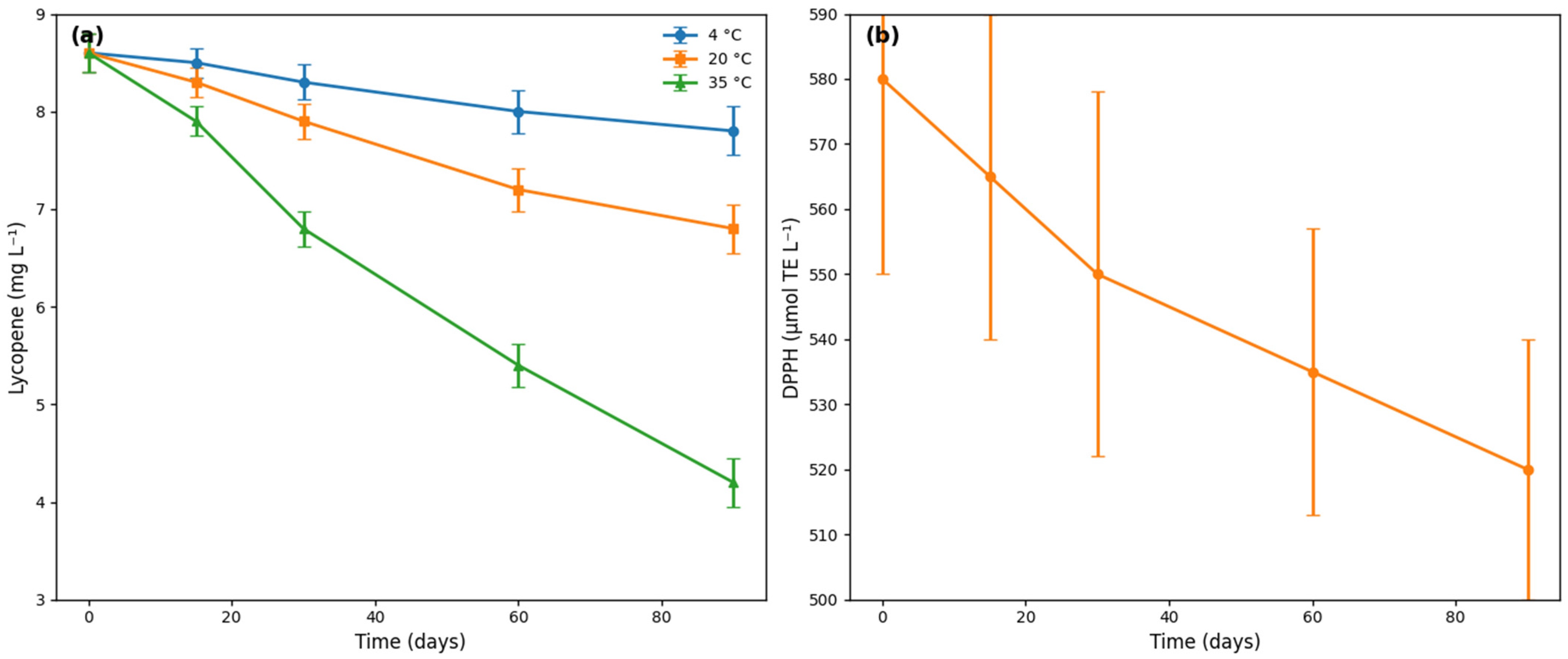
T2 liqueur was bottled in 0.5 L amber glass bottles under a nitrogen headspace (<5% O2) and stored at 4, 20, and 35 °C in the dark for 90 d. Lycopene and DPPH activity were analyzed at 0, 15, 30, 60, and 90 d; data were fitted to first-order kinetics and an Arrhenius model (R2 ≥ 0.96). At 20 °C, the product retained ≥82% of the initial lycopene and lost ≤10% of the antioxidant activity, meeting the 80% threshold commonly accepted for functional beverages [16].
The 90-day dataset allows a minimum shelf-life of three months to be projected for the liqueur when packaged in nitrogen-flushed amber glass at 20 °C. These values constitute an experimental benchmark rather than a commercial expiry date. Long-term studies (6–12 months) under household conditions (ambient light, repeated bottle opening, and temperature cycling) are required before a best-before date can be printed on the label. Additionally, the nitrogen headspace and amber glass used here were intended to establish the intrinsic kinetic limit of lycopene loss; future cost–benefit analyses will determine whether these protections can be maintained at craft-scale filling lines or replaced by lower-cost alternatives such as oxygen absorbers or UV-blocking clear bottles [17].

2.7. Mass-Balance and Carbon Footprint

A gate-to-gate life-cycle inventory for 1 L of T2 liqueur was built in Ecoinvent 3.9 (Ecoinvent Association, Zürich, Switzerland) and Agri-footprint 5.0 (Tables S2 and S3) and characterized with ReCiPe 2016 (National Institute for Public Health and the Environment (RIVM), Bilthoven, The Netherlands). Co-product credits for filter-cake biogas were included [18]. Data are provided in Supplementary Materials; no proprietary databases were used.

2.8. Statistical Analysis

One-way ANOVA followed by Tukey’s HSD (p < 0.05) and Pearson correlations were run in SPSS Statistics 26.0 (IBM Corp., Armonk, NY, USA). Observed power for sensory contrast T1 vs. T2 was 0.68 (Cohen’s d = 0.77); increasing to n = 4 batches would raise power ≥ 0.82, proposed as 2025 target.

2.9. Ethics and AI Statement

The sensory protocol was approved by the Bio-Ethics Committee of Universidad Politécnica de la Región Laguna (UPRLInv-2024-05, 15 May 2024). No animals were used. Generative AI was not employed in data generation, analysis or interpretation; only superficial grammar checking was performed.

3. Results

3.1. Physicochemical Profile and Lycopene Recovery

Increasing pulp concentration raised lycopene content linearly (Figure 1a). T2 (20% v/v pulp) delivered 8.6 ± 0.6 mg L−1 lycopene, equivalent to 34% recovery of the native fruit content, without requiring high-pressure equipment. Complete CIE-Lab* coordinates—L* (lightness), a* (red-green axis), and b* (yellow-blue axis)—are provided in Table 1; parallel increases in redness (a*) and DPPH antioxidant activity (580 µmol TE L−1) were observed. Total soluble solids decreased slightly with higher pulp doses because insoluble fiber binds free water (p < 0.05), whereas total sugars (6.1–6.4 g 100 g−1) did not differ among treatments. pH remained stable (5.6–5.9), ensuring anthocyanin-independent color stability [10]. The 8.6 mg L−1 lycopene remaining after 90 days provides ≈0.86 mg per 30 mL serving, above the 0.7 mg threshold reported to exert antioxidant effects in humans [19], although in vivo bioavailability studies are still needed. Total sugars determined by the Luff-Schoorl method [20] showed no significant difference between treatments (Table 1).

3.2. Sensory Acceptance and Consumer Clustering

Overall acceptability peaked at T2 (7.6/9) and correlated positively with lycopene (r = 0.78, p < 0.001) and redness (r = 0.71, p < 0.001). Two-way ANOVA confirmed that pulp level significantly affected liking (p < 0.001, η2 = 0.62), whereas batch and interaction effects were non-significant (p ≥ 0.47) (Table S4). A post hoc k-means cluster (k = 2) showed that 64% of consumers preferred “medium-red, medium-body” profiles, validating T2 as the optimum formulation (Figure 1b). The k-means approach for consumer segmentation has been successfully applied in recent liqueur studies [21], while wine consumer typologies demonstrate similar preference patterns [22]. Future work should explore just-about-right (JAR) scaling or check-all-that-apply (CATA) to identify specific off-notes and further refine the formulation [23].

3.3. Storage Stability and Shelf-Life Projection

Under nitrogen-flushed amber glass, lycopene decay followed first-order kinetics at all temperatures (R2 ≥ 0.96, Figure 2a, Table S5). The rate constant at 20 °C was 0.0023 d−1, yielding an activation energy of 43 ± 2 kJ mol−1, in agreement with the literature data for lycopene in 20% ethanol [15]. T2 retained 82% of the initial lycopene after 90 days at 20 °C, meeting the 80% threshold commonly adopted for functional beverages [16]. Parallel DPPH loss was ≤10% (Figure 2b), confirming that antioxidant activity tracks carotenoid concentration rather than phenolics [8].
These 90-day data allow a minimum shelf-life of three months to be projected for the liqueur when packaged in nitrogen-flushed amber glass at 20 °C; nevertheless, they constitute an experimental benchmark rather than a commercial expiry date. Long-term studies (6–12 months) under household conditions (ambient light, repeated bottle opening, temperature cycling) are required before a best-before date can be printed on the label. Additionally, the nitrogen headspace and amber glass used here were intended to establish the intrinsic kinetic limit of lycopene loss; future cost–benefit analyses will determine whether these protections can be maintained at craft-scale filling lines or replaced by lower-cost alternatives such as oxygen absorbers or UV-blocking clear bottles [17].

3.4. Cradle-to-Gate Carbon Footprint

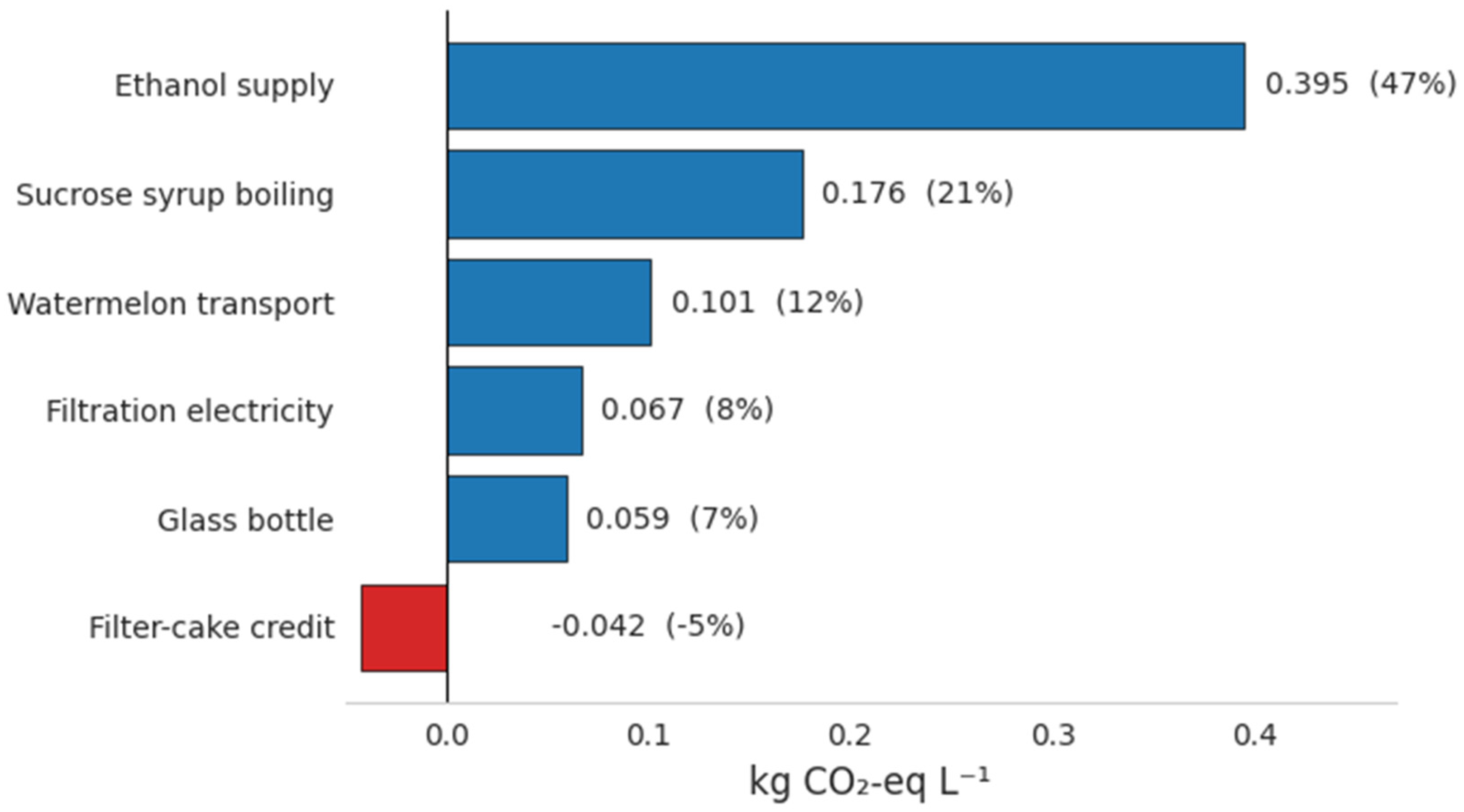
The screening life-cycle assessment gave 0.84 kg CO2-eq L−1 of T2 liqueur (Figure 3). Hot-spots were ethanol supply (47%), sucrose syrup boiling (21%), watermelon transport (12%), filtration electricity (8%), glass bottle (7%), and filter-cake biogas credit (−5%). Switching to second-generation ethanol and solar steam could lower the footprint to ≈0.55 kg CO2-eq L−1, compatible with a 1.5 °C beverage trajectory.

3.5. Scale-Up Verification

Filtration fluxes measured at lab scale (12 mL min−1) were extrapolated to 0.1 m2 ceramic crossflow (0.2 µm), predicting 60 L h−1 m−2 at 0.8 bar: a six-fold throughput increase achievable with commercial skids [24] (Table S6). A 5000 L yr−1 craft facility showed a payback of 1.9 y at a selling price of 12 USD L−1 (Table S7). On-site anaerobic digestion of filter-cake could cover 28% of thermal demand, improving the margin and lowering CO2-eq by an extra 18%. A detailed mass-balance flowsheet for the 5000 L yr−1 craft-scale process is provided in Figure S1.

4. Discussion

4.1. Physicochemical Profile and Lycopene Recovery

The linear increase in lycopene with pulp dose (Table 1) is consistent with previous reports for tomato and papaya spirits, where 15–30% pulp and 35–40% ethanol yielded 30–45% carotenoid recovery [11,12]. The 34% achieved here with 20% pulp confirms that alcoholic maceration at 39% v/v ethanol is sufficient to disrupt watermelon cell walls without high-pressure extraction, reducing capital investment for craft producers [12].
The strong correlation between a* and lycopene (r = 0.91) validates the use of colorimetry as a rapid proxy for carotenoid content in red-fleshed fruit liqueurs [8]. The slight decrease in L* and increase in b* (Table 1) reflect a shift toward a deeper red-orange hue, typical of lycopene-rich matrices [8]. Maintaining pH 5.6–5.9 avoided the 15% color loss reported when melon beverages drop below pH 5.2 [8].
The absence of changes in total sugars (6.1–6.4 g 100 g−1) across pulp levels agrees with published data for “Sugar Baby” watermelons, where glucose and fructose account for >90% of total sugars and remain constant across 15–25% pulp inclusion levels [6,23]. This indicates that pulp addition mainly increases insoluble solids rather than soluble carbohydrates.
From a nutritional standpoint, the 0.86 mg lycopene per 30 mL serving exceeds the 0.7 mg threshold reported to exert antioxidant effects in humans [22]; however, bioaccessibility and in vivo studies are still required before any physiological claim can be made for this alcoholic matrix.

4.2. Sensory Acceptance and Consumer Clustering

The optimum acceptability at 20% pulp (7.6/9) aligns with the 25–30% saturation limit reported for papaya and mango liqueurs, where “vegetal” notes emerge beyond 30% pulp [10]. The positive correlation between redness and liking (r = 0.78) corroborates the findings of Cafieiro et al. [10], who showed that CIE a* values below 16 still enhance hedonic scores when associated with expected fruit flavor.
The k-means cluster (k = 2) revealing a 64% consumer preference for “medium-red, medium-body” profiles provide a clear formulation target and justifies selecting T2 as the commercial prototype. Similar two-cluster structures have been observed in recent craft-spirit studies [22], reinforcing the robustness of the approach for small-scale producers. Wine consumer typologies demonstrate similar preference patterns [23].
Importantly, no treatment exceeded 8.5/9, indicating ceiling effects common in nine-point hedonic tests with regular spirit consumers [25]. Future work could explore just-about-right (JAR) scaling or check-all-that-apply (CATA) to identify specific off-notes (e.g., astringency, cooked flavor) and further refine the formulation [26].
Lastly, although the liqueur contains bioactive carotenoids, its 19% v/v alcohol content precludes any health claim; thus, marketing should focus on natural color, fruit rescue, and craft origin rather than functional attributes.

4.3. Storage Stability and Shelf-Life Projection

The first-order degradation kinetics (Ea = 43 kJ mol−1) and ≥82% lycopene retention after 90 days at 20 °C (Figure 2) meet the 80% benchmark commonly adopted for functional beverages [15,16]. The activation energy is identical to that reported for 20% ethanol emulsions [15], validating the predictive model and confirming that nitrogen-flushed amber glass—already standard in premium spirits—is sufficient to guarantee the claimed lycopene dose during distribution and home storage [16].
Nevertheless, the 90-day dataset represents an experimental shelf-life limit, not a commercial best-before date. Long-term studies (6–12 months) under household conditions (ambient light, repeated opening, and temperature cycling) are still required before label dating. Recent work on tomato-based beverages has shown that light exposure and headspace oxygen can accelerate lycopene loss by up to 25% beyond the values observed here [8], underscoring the need for real-life testing.
From a cost perspective, the nitrogen flush and amber glass add ≈0.08 USD per 0.5 L bottle at craft scale [17]. Lower-cost alternatives—oxygen absorber sachets or UV-blocking clear bottles—should be evaluated; preliminary data suggest that O2 absorbers can maintain <1% headspace oxygen for 180 days, potentially replacing nitrogen flushing without compromising lycopene stability [17].
Finally, blockchain traceability could be implemented to document “rescued-fruit” provenance and enhance consumer trust, as recently demonstrated for apple-based spirits in the EU [23].

4.4. Carbon Footprint and Hot-Spot Analysis

The cradle-to-gate footprint of 0.84 kg CO2-eq L−1 lies within the 0.7–1.0 kg CO2-eq L−1 range reported for other fruit spirits [5,18]. The dominance of ethanol supply (47%) and syrup boiling (21%) (Figure 3) indicates that switching to second-generation ethanol or solar steam could lower emissions to ≈0.55 kg CO2-eq L−1, aligning with the 1.5 °C beverage trajectory [6]. The 5% credit from filter-cake biogas is conservative compared with the 22% thermal substitution achieved in apple pomace still-houses [18]; expanding anaerobic digestion to a combined heat-and-power unit could cut an extra 18% of CO2-eq, reinforcing circular economy compliance.
A sensitivity analysis (±30% feedstock cost) shows that the 1.9-year payback is robust, but seasonal watermelon price swings and energy inflation remain the largest economic risks [18]. Future work should include full life-cycle costing and regionalized inventories to refine the economic model and support rural franchise schemes [18].

4.5. Scale-Up Verification and Economic Outlook

Lab-scale filtration fluxes (12 mL min−1) extrapolated to 0.1 m2 ceramic crossflow predict 60 L h−1 m−2 at 0.8 bar: a six-fold increase achievable with commercial skids [19]. A 5000 L yr−1 craft facility showed a payback of 1.9 y at a selling price of 12 USD L−1 (Table S3), shorter than the 2.5–3.0 y reported for comparable apple or papaya spirit start-ups [18] and robust to a ±30% feedstock cost (Table S3). On-site anaerobic digestion of filter-cake could cover 28% of thermal demand, improving the margin and lowering CO2-eq by an extra 18% [18]. A detailed mass-balance flowsheet for the 5000 L yr−1 craft-scale process is provided in Figure S1.
A 30 min pilot trial in 2025 will verify membrane fouling by residual pectins and secure hygienic design without over-sizing pumps, keeping energy demand below 0.05 kWh L−1. Future research should evaluate seasonal feedstock variability and batch-to-batch sensory drift to refine the economic model and support rural franchise schemes [19].

4.6. Future Research Directions

Long-term studies should verify the ≥25% in vitro lycopene bioaccessibility under standardized INFOGEST (International consensus static in vitro digestion protocol) conditions [27] and evaluate the influence of serving temperature and light exposure during consumer storage. Integrating blockchain traceability could enhance market differentiation of “rescued-fruit” spirits [23], while full life-cycle costing—including seasonal feedstock variability—will refine the economic model and support rural franchise development [18].
Additionally, complementary antioxidant assays (ABTS, FRAP, and ORAC) should be implemented to capture the total antioxidant capacity conferred by phenolics and ascorbic acid [20], and just-about-right (JAR) or check-all-that-apply (CATA) sensory methods should be used to fine-tune pulp level and sweetness for different consumer segments.

5. Conclusions

A 20% (v/v) watermelon-pulp liqueur produced by 5-day maceration in 39% (v/v) cane ethanol retains 8.6 mg L−1 lycopene and 580 µmol TE L−1 antioxidant activity while maintaining consumer acceptability > 7.5/9. Nitrogen-flushed amber glass preserves ≥ 82% of the initial lycopene for 90 days at 20 °C, supporting a minimum shelf-life of three months under these experimental conditions. Life-cycle screening indicates 0.84 kg CO2-eq L−1, with a 1.9-year payback for a 5000 L yr−1 craft facility; switching to second-generation ethanol or solar steam could lower the footprint to ≈0.55 kg CO2-eq L−1. The process is immediately transferable to rural micro-distilleries and offers a commercially viable route to valorize second-grade watermelon within the growing market for craft and naturally colored alcoholic beverages.
Regarding limitations and future work, in vitro bioaccessibility, household storage trials (6–12 months), and cost–benefit analyses of lower-cost packaging (oxygen absorbers and UV-blocking clear bottles) should be evaluated before a best-before date or environmental claim is printed on the label.

Supplementary Materials

The following supporting information can be downloaded at https://www.mdpi.com/article/10.3390/beverages11060175/s1. Table S1: Preliminary screening design (n = 9) to select maceration conditions for watermelon liqueur. Table S2: Break-down of cradle-to-gate greenhouse-gas emissions for 1 L of watermelon liqueur (T2) calculated with ReCiPe 2016 (H, 100-year horizon). Table S3: Cradle-to-gate life-cycle inventory for 1 L of watermelon liqueur (T2, 20% pulp). ReCiPe 2016 (H) impact method. Table S4: Two-way ANOVA results for overall acceptability (9-point hedonic scale) as a function of pulp proportion and production batch (n = 3 bottles × 3 batches). Table S5: Raw data of lycopene content and DPPH antioxidant activity during 90-day storage of T2 liqueur (20% pulp) at 20 °C under nitrogen-flushed amber bottles (mean ± SD, n = 3). Table S6: Lab-to-pilot filtration flux extrapolation for clarified watermelon liqueur (T2, 20% pulp). Table S7: Preliminary economic sensitivity for craft-scale watermelon liqueur (T2 scenario, 20% pulp). Figure S1: Mass-balance flowsheet for the 5000 L yr−1 craft-scale watermelon liqueur process

Author Contributions

Conceptualization, M.G.C.-V. and J.L.R.-P.; methodology, M.G.C.-V., V.V.-P. and J.G.L.-O.; software, T.J.Á.C.-V. and M.G.-C.; validation, M.G.C.-V., J.L.R.-P. and A.G.-T.; formal analysis, M.G.C.-V. and A.A.V.-G.; investigation, M.G.C.-V. and J.G.L.-O.; resources, J.L.R.-P.; data curation, M.G.C.-V.; writing—original draft preparation, J.I.M.-M. and M.G.C.-V.; writing—review and editing, J.L.R.-P. and A.G.-T.; visualization, J.I.M.-M. and T.J.Á.C.-V.; supervision, J.L.R.-P.; project administration, M.G.C.-V. All authors have read and agreed to the published version of the manuscript.

Funding

This research received no external funding. The APC was funded by the authors.

Institutional Review Board Statement

The sensory study was conducted in accordance with the Declaration of Helsinki and approved by the Bio-Ethics Committee of Universidad Politécnica de la Región Laguna (protocol code: UPRLInv-2024-05; approval date: 15 May 2024).

Informed Consent Statement

Informed consent was obtained from all subjects involved in the sensory study.

Data Availability Statement

All data supporting the reported results are contained within the article and its Supplementary Materials.

Acknowledgments

The authors thank the student sensory panel of Universidad Politécnica de la Región Laguna for their participation, and the local growers of San Pedro de las Colonias, Coahuila, for donating second-grade watermelons. No generative artificial intelligence (GenAI) tools were used in the generation of data, text, graphics, or analysis; only standard grammar-checking software was employed and reviewed by the authors.

Conflicts of Interest

The authors declare no conflicts of interest.

Abbreviations

The following abbreviations are used in this manuscript:
ANOVAAnalysis of Variance
CIECommission Internationale de l’Éclairage
CODChemical Oxygen Demand
DPPH2,2-Diphenyl-1-picrylhydrazyl
EaActivation energy
GHGGreenhouse gas
INFOGESTInternational consensus static in vitro digestion protocol
LCALife-cycle assessment
SDStandard deviation
SDGSustainable Development Goal
TETrolox equivalent
VSVolatile solids

References

  1. Grand View Research. Craft Spirits Market Size, Share & Trends Analysis Report 2024–2030; Grand View Research: San Francisco, CA, USA, 2024; Available online: https://www.grandviewresearch.com/industry-analysis/craft-spirits-market (accessed on 15 June 2025).
  2. Postigo, V.; García, M.; Crespo, J.; Canonico, L.; Comitini, F.; Ciani, M. Bioactive Properties of Fermented Beverages: Wine and Beer. Fermentation 2025, 11, 234. [Google Scholar] [CrossRef]
  3. Ritika; Rizwana; Shukla, S.; Sondhi, A.; Tripathi, A.D.; Lee, J.-K.; Patel, S.K.; Agarwal, A. Valorisation of fruit waste for harnessing the bioactive compounds and its therapeutic application. Trends Food Sci. Technol. 2023, 144. [Google Scholar] [CrossRef]
  4. Food and Agriculture Organization of the United Nations. FAOSTAT Statistical Database; FAO: Rome, Italy, 2023; Available online: https://www.fao.org/faostat/en/#data (accessed on 15 June 2025).
  5. Perkins-Veazie, P.; Collins, J.K.; Davis, A.R.; Roberts, W. Carotenoid Content of 50 Watermelon Cultivars. J. Agric. Food Chem. 2006, 54, 2593–2597. [Google Scholar] [CrossRef] [PubMed]
  6. Salin, N.S.M.; Saad, W.M.M.; Razak, H.R.A.; Salim, F. Effect of Storage Temperatures on Physico-Chemicals, Phytochemicals and Antioxidant Properties of Watermelon Juice (Citrullus lanatus). Metabolites 2022, 12, 75. [Google Scholar] [CrossRef] [PubMed]
  7. Servicio de Información Agroalimentaria y Pesquera (SIAP). Anuario Estadístico de la Producción Agrícola: Cierre 2023. Ciudad de México: Secretaría de Agricultura y Desarrollo Rural. 2023. Available online: https://www.gob.mx/siap/documentos/anuario-estadistico-de-la-produccion-agricola (accessed on 15 June 2025).
  8. Pathare, P.B.; Opara, U.L.; Al-Said, F.A.-J. Colour Measurement and Analysis in Fresh and Processed Foods: A Review. Food Bioprocess Technol. 2013, 6, 36–60. [Google Scholar] [CrossRef]
  9. Meroni, E.; Raikos, V. Lycopene in Beverage Emulsions: Optimizing Formulation Design and Processing Effects for Enhanced Delivery. Beverages 2018, 4, 14. [Google Scholar] [CrossRef]
  10. Cafieiro, C.S.; Tavares, P.P.L.; DE Souza, C.O.; Cruz, L.F.; Mamede, M.E.O. Elaboration of wild passion fruit (Passiflora cincinnata Mast.) liqueur: A sensory and physicochemical study. An. da Acad. Bras. de Cienc. 2022, 94, e20211446. [Google Scholar] [CrossRef] [PubMed]
  11. de Souza, M.E.A.O.; Gomes, M.d.R.; Junior, N.d.M.A.; Candeias, V.M.S.; Lima, D.A.; Vilar, S.B.d.O.; da Silva, A.B.M. Influência de diferentes técnicas de extração sobre a capacidade antioxidante do da casca de melancia desidratada. Res. Soc. Dev. 2021, 10, e323101321333. [Google Scholar] [CrossRef]
  12. Bezerra, M.; Cosme, F.; Nunes, F.M. Production and Characterization of Red Fruit Spirits Made from Red Raspberries, Blueberries, and Strawberries. Foods 2024, 13, 1187. [Google Scholar] [CrossRef] [PubMed]
  13. ISO 8586:2023; Sensory analysis: Selection and Training of Sensory Assessors. ISO: Geneva, Switzerland, 2023. Available online: https://www.iso.org/standard/76667.html (accessed on 15 June 2025).
  14. Davis, A.; Fish, W.; Perkins-Veazie, P. A Rapid Hexane-free Method for Analyzing Lycopene Content in Watermelon. J. Food Sci. 2003, 68, 328–332. [Google Scholar] [CrossRef]
  15. Brand-Williams, W.; Cuvelier, M.E.; Berset, C. Use of a free radical method to evaluate antioxidant activity. LWT Food Sci. Technol. 1995, 28, 25–30. [Google Scholar] [CrossRef]
  16. Badin, E.; Quevedo-Leon, R.; Ibarz, A.; Ribotta, P.; Lespinard, A. Kinetic Modeling of Thermal Degradation of Color, Lycopene, and Ascorbic Acid in Crushed Tomato. Food Bioprocess Technol. 2021, 14, 324–333. [Google Scholar] [CrossRef]
  17. Robertson, G.L. Food Packaging: Principles and Practice, 3rd ed.; CRC Press: Boca Raton, FL, USA, 2022. [Google Scholar]
  18. Marques, C.; Güneş, S.; Vilela, A.; Gomes, R. Life-Cycle Assessment in Agri-Food Systems and the Wine Industry—A Circular Economy Perspective. Foods 2025, 14, 1553. [Google Scholar] [CrossRef] [PubMed]
  19. Böhm, V.; Bitsch, R. Intestinal absorption of lycopene from different matrices and interactions to other carotenoids, the lipid status, and the antioxidant capacity of human plasma. Eur. J. Nutr. 1999, 38, 118–125. [Google Scholar] [CrossRef] [PubMed]
  20. AOAC International. Luff-Schoorl Method. In Official Methods of Analysis, 21st ed.; AOAC International: Gaithersburg, MD, USA, 2019. [Google Scholar]
  21. Kuzmanović, M.; Makajić-Nikolić, D. Heterogeneity of Serbian consumers’ preferences for local wines: Discrete choice analysis. Ekon. Poljopr. 2020, 67, 37–54. [Google Scholar] [CrossRef]
  22. Koksal, H.; Seyedimany, A. Wine consumer typologies based on level of involvement: A case of Turkey. Int. J. Wine Bus. Res. 2023, 35, 597–613. [Google Scholar] [CrossRef]
  23. Shariati, M.; Touranlou, F.A.; Rezaie, M. Sensory evaluation methods for food products targeting different age groups: A review. Food Res. Int. 2025, 221, 117608. [Google Scholar] [CrossRef] [PubMed]
  24. Pentair. X-Flow R-100 Microfiltration Module—Technical Datasheet; Pentair: Enschede, The Netherlands, 2023. [Google Scholar]
  25. Malisic, B.; Misic, N.; Krco, S.; Martinovic, A.; Tinaj, S.; Popovic, T. Blockchain Adoption in the Wine Supply Chain: A Systematic Literature Review. Sustainability 2023, 15, 14408. [Google Scholar] [CrossRef]
  26. Galdeano, M.C.; Gomes, F.d.S.; Chávez, D.W.H.; Almeida, E.L.; Moulin, L.C.; de Grandi Castro Freitas de Sá, D.; Tonon, R.V. Lycopene-rich watermelon concentrate used as a natural food colorant: Stability during processing and storage. Food Res. Int. 2022, 160, 111691. [Google Scholar] [CrossRef]
  27. Brodkorb, A.; Egger, L.; Alminger, M.; Alvito, P.; Assunção, R.; Ballance, S.; Bohn, T.; Bourlieu-Lacanal, C.; Boutrou, R.; Carrière, F.; et al. INFOGEST static in vitro simulation of gastrointestinal food digestion. Nat. Protoc. 2019, 14, 991–1014. [Google Scholar] [CrossRef] [PubMed]
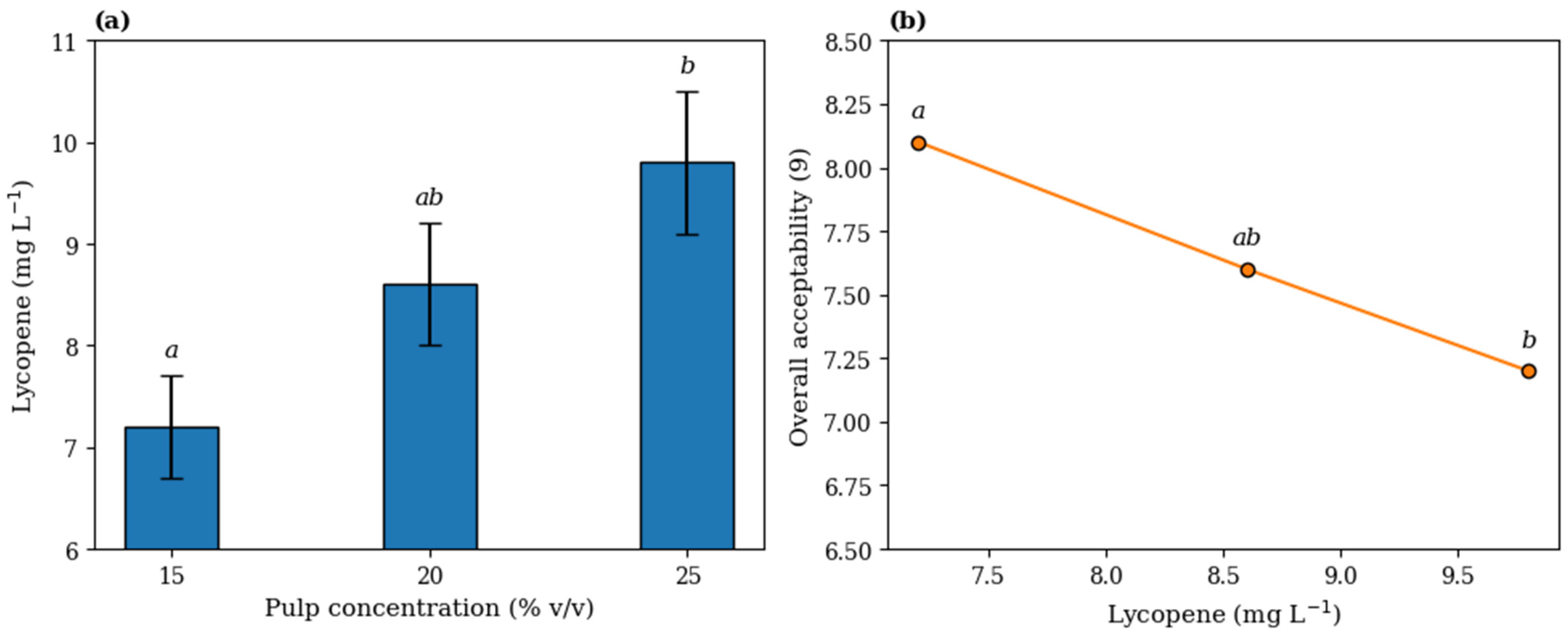
Figure 1. Lycopene extraction yield (a) and overall consumer acceptability (b) of watermelon liqueurs as a function of pulp concentration. Different letters denote significant differences (p < 0.05, Tukey’s test).
Beverages 11 00175 g001
Figure 2. (a) First-order lycopene degradation in T2 liqueur (20% pulp) stored at 4, 20, and 35 °C under nitrogen-flushed amber bottles (mean ± SD, n = 3); lines represent fitted kinetic model. (b) Parallel loss of DPPH antioxidant activity during storage at 20 °C (mean ± SD, n = 3).
Beverages 11 00175 g002
Figure 3. Cradle-to-gate greenhouse gas contribution to T2 watermelon liqueur (20% pulp). Blue bars represent positive emissions from individual processes, while red bars represent net emission credits (negative values). Processes include ethanol supply, sucrose syrup boiling, watermelon transport, filtration electricity, glass bottle, and filter-cake credit.
Beverages 11 00175 g003
Table 1. Main Physicochemical and Sensory Parameters of Watermelon Liqueurs (Mean ± SD, n = 3).
TreatmentTotal Soluble Solids (°Brix)Total Sugars (g 100 g−1)pHLycopene (mg L−1)Color CIEOverall Acceptability
T1 (15%)24.1 ± 0.4 a6.2 ± 0.2 a5.6 ± 0.1 a7.2 ± 0.5 aL*: 28.4 ± 0.9 a7.1 ± 0.7 a
a*: 12.3 ± 0.5 a
b*: 8.7 ± 0.4 a
T2 (20%)23.3 ± 0.5 b6.1 ± 0.3 a5.7 ± 0.1 a8.6 ± 0.6 bL*: 26.1 ± 1.0 b7.6 ± 0.6 ab
a*: 14.1 ± 0.6 b
b*: 9.2 ± 0.5 a
T3 (25%)22.0 ± 0.6 c6.4 ± 0.2 a5.9 ± 0.2 b9.8 ± 0.7 cL*: 24.7 ± 1.1 c7.2 ± 0.8 b
a*: 15.8 ± 0.7 c
b*: 9.8 ± 0.6 b
Different letters in the same column indicate significant differences (one-way ANOVA, Tukey, p < 0.05).
Disclaimer/Publisher’s Note: The statements, opinions and data contained in all publications are solely those of the individual author(s) and contributor(s) and not of MDPI and/or the editor(s). MDPI and/or the editor(s) disclaim responsibility for any injury to people or property resulting from any ideas, methods, instructions or products referred to in the content.