
Kombucha as a Sustainable Source of Metabiotics: Potential, Applications, and Future Perspectives


Abstract
1. Introduction
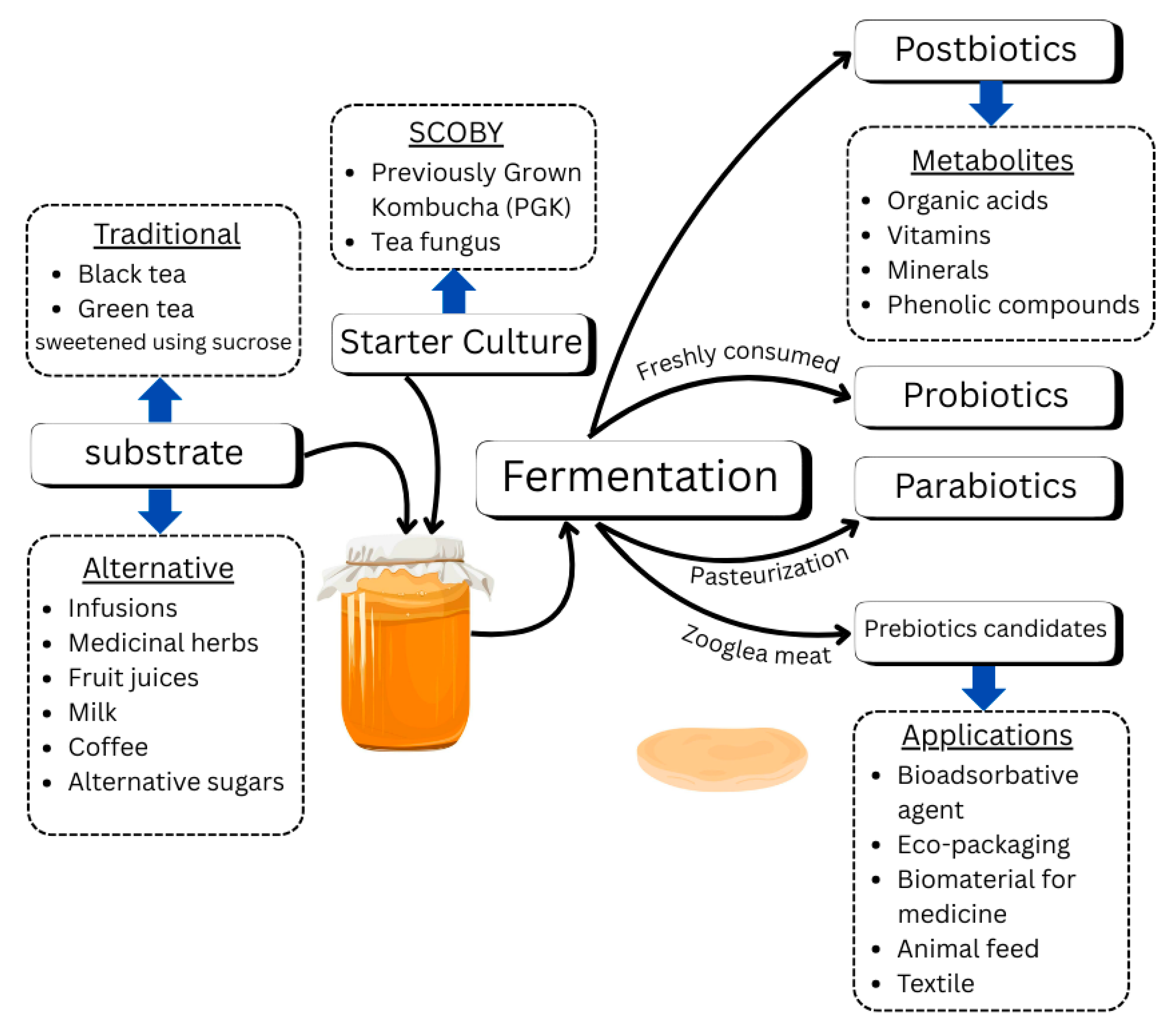
2. Connection of Kombucha to Postbiotics
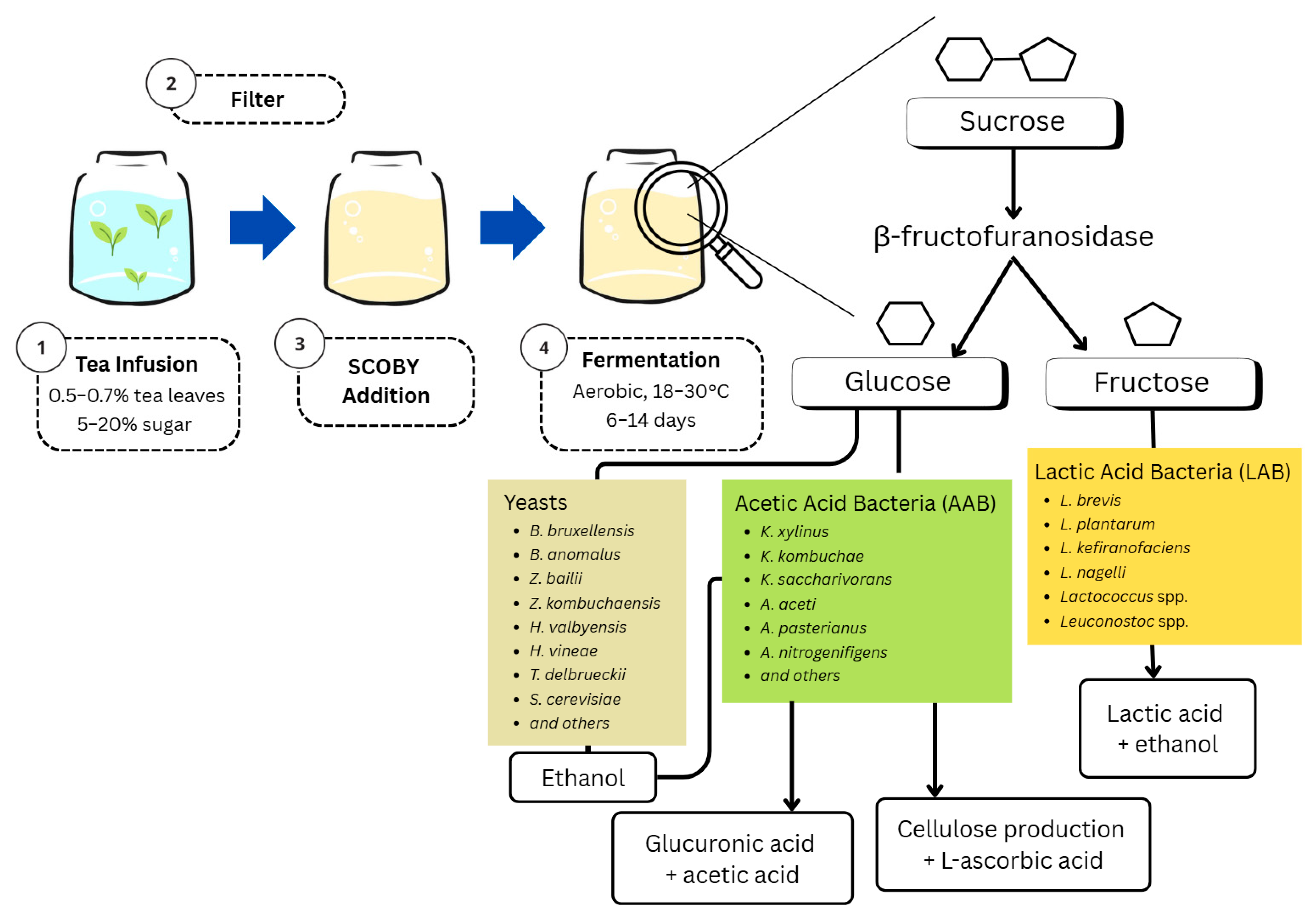
3. Microbial Ecology of Kombucha Fermentation
3.1. Kombucha Fermentation
3.2. Kombucha SCOBY-Related Postbiotics
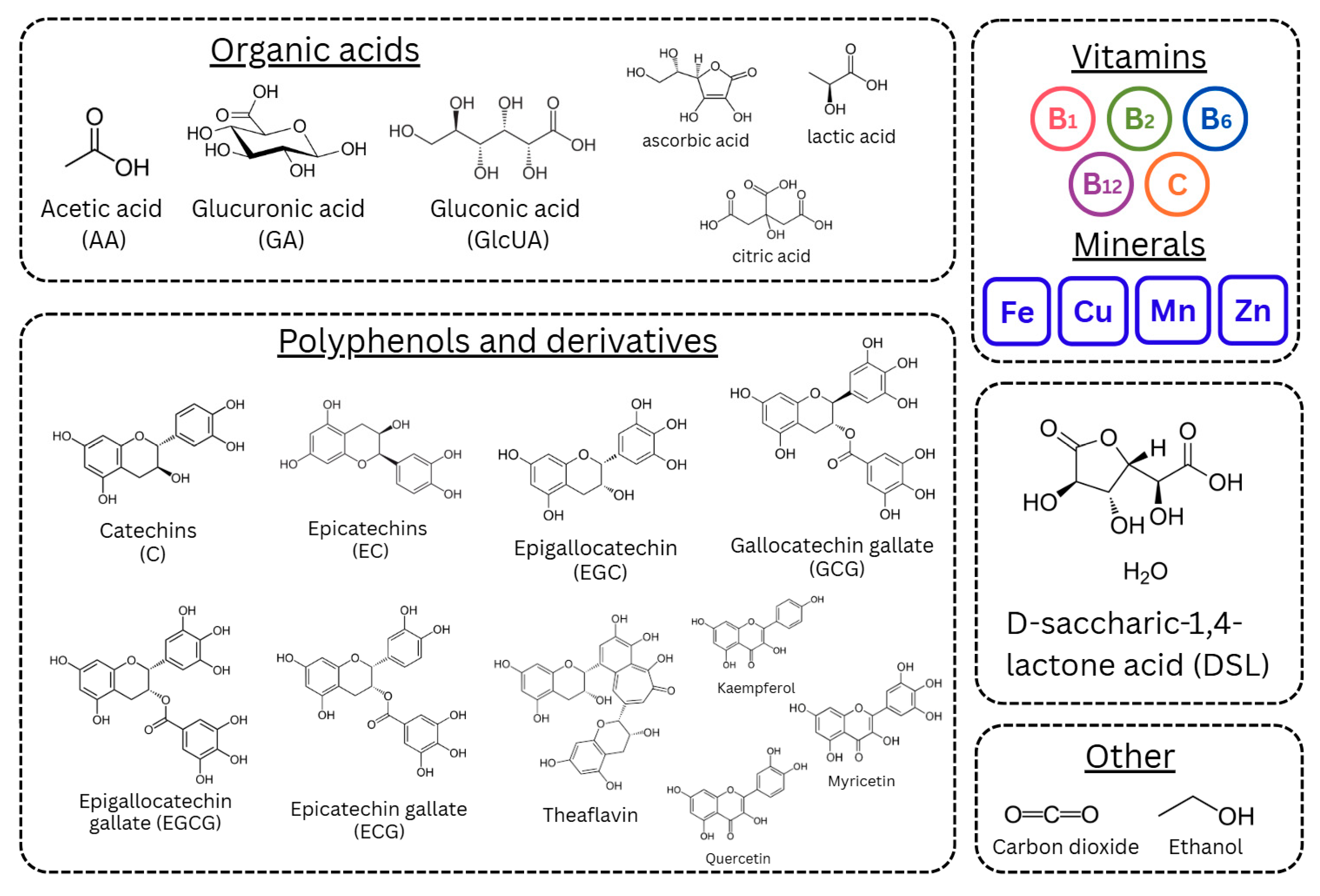
4. Metabolites Produced During Kombucha Fermentation
4.1. Organic Acids
4.2. Polyphenols and Derivatives
4.3. Vitamins and Minerals
4.4. DSL (D-Saccharic Acid-1,4-Lactone)
4.5. Emerging Trend for Metabiotics Studies in Kombucha
5. Health Benefits and Functional Properties of Kombucha-Derived Postbiotics
5.1. Antioxidant Activity
5.2. Antimicrobial Activity
5.3. Anicarcinogenic Activity
5.4. Gut–Brain Axis
5.5. Antidiabetic Effect
6. Sustainability Aspects of Kombucha Production
6.1. Low-Impact Production Process
6.2. Utilization of Alternative By-Products for Kombucha Production
6.3. Kombucha in the Circular Bioeconomy
7. Food Safety Aspects of Kombucha
8. Conclusions and Future Perspectives
Author Contributions
Funding
Institutional Review Board Statement
Informed Consent Statement
Data Availability Statement
Conflicts of Interest
Abbreviations
| SCOBY | Symbiotic Consortium Of Bacteria and Yeast |
| AAB | Acetic Acid Bacteria |
| LAB | Lactic Acid Bacteria |
| AA | Acetic Acid |
| GA | Gluconic Acid |
| GlcUA | Glucuronic Acid |
| DSL | D-saccharic acid-1,4-lactone |
| EGCG | Epigallocatechin gallate |
| EGC | Epigallocatechin |
| EC | Epicatechin |
| ECG | Epicatechin gallate |
| GCG | Gallocatechin gallate |
| GC | Gallocatechin |
| C | Catechin |
| TPC | Total Phenolic Content |
| EPS | Exopolysaccharides |
| FOS | Fructo-oligosaccharides |
| 5-MTHF | 5-methyltetrahydrofolate |
| FAN | Free Amino Nitrogen |
| GABA | Gamma-Aminobutyric acid |
References
- Greenwalt, C.J.; Steinkraus, K.H.; Ledford, R.A. Kombucha, the fermented tea: Microbiology, composition, and claimed health effects. J. Food Prot. 2000, 63, 976–981. [Google Scholar] [CrossRef] [Scilit]
- Villarreal-Soto, S.A.; Beaufort, S.; Bouajila, J.; Souchard, J.P.; Taillandier, P. Understanding kombucha tea fermentation: A review. J. Food Sci. 2018, 83, 580–588. [Google Scholar] [CrossRef] [Scilit]
- Dufresne, C.; Farnworth, E. Tea, kombucha, and health: A review. Food Res. Int. 2000, 33, 409–421. [Google Scholar] [CrossRef] [Scilit]
- Pihurov, M.; Păcularu-Burada, B.; Cotârlet, M.; Vasile, M.A.; Bahrim, G.E. Novel Insights for Metabiotics Production by Using Artisanal Probiotic Cultures. Microorganisms 2021, 9, 2184. [Google Scholar] [CrossRef] [Scilit]
- Jayabalan, R.; Malbasa, R.V.; Loncar, E.S.; Vitas, J.S.; Sathishkumar, M. A review on kombucha tea—Microbiology, composition, fermentation, and beneficial effects. Compr. Rev. Food Sci. Food Saf. 2014, 13, 538–550. [Google Scholar] [CrossRef] [Scilit]
- Marsh, A.J.; O’Sullivan, O.; Hill, C.; Ross, R.P.; Cotter, P.D. Sequence-based analysis of the bacterial and fungal compositions of multiple kombucha (tea fungus) samples. Food Microbiol. 2014, 38, 171–178. [Google Scholar] [CrossRef] [Scilit]
- Zendeboodi, F.; Khorshidian, N.; Mortazavian, A.M.; da Cruz, A.G. Probiotic: Conceptualization from a new approach. Curr. Opin. Food Sci. 2020, 32, 103–123. [Google Scholar] [CrossRef] [Scilit]
- Kolling, Y.; Salva, S.; Villena, J.; Marranzino, G.; Alvarez, S. Non-viable immunobiotic Lactobacillus rhamnosus CRL1505 and its peptidoglycan improve systemic and respiratory innate immune response during recovery of immunocompromised-malnourished mice. Int. Immunopharmacol. 2015, 25, 474–484. [Google Scholar] [CrossRef] [Scilit] [PubMed]
- He, F.; Morita, H.; Kubota, A.; Ouwehand, A.C.; Hosoda, M.; Hiramatsu, M.; Kurisaki, J.I. Effect of orally administered non-viable Lactobacillus cells on murine humoral immune responses. Microbiol. Immunol. 2005, 49, 993–997. [Google Scholar] [CrossRef] [Scilit] [PubMed]
- Deshpande, G.; Athalye-Jape, G.; Patole, S. Para-probiotics for preterm neonates—The next frontier. Nutrients 2018, 10, 871. [Google Scholar] [CrossRef] [Scilit] [PubMed]
- Nataraj, B.H.; Ali, S.A.; Behare, P.V.; Yadav, H. Postbiotics-parabiotics: The new horizons in microbial biotherapy and functional foods. Microb. Cell Factories 2020, 19, 168. [Google Scholar] [CrossRef] [Scilit] [PubMed]
- Diez-Ozaeta, I.; Astiazaran, O.J. Recent advances in Kombucha tea: Microbial consortium, chemical parameters, health implications and biocellulose production. Int. J. Food Microbiol. 2022, 377, 109783. [Google Scholar] [CrossRef] [Scilit]
- Mousavi, S.M.; Hashemi, S.A.; Amani, A.M.; Esmaeili, H.; Ghasemi, Y.; Babapoor, A.; Mojoudi, F.; Arjomand, O. Pb (II) removal from synthetic wastewater using kombucha scoby and graphene oxide/Fe3O4. Phys. Chem. Res. 2018, 6, 759–771. [Google Scholar]
- Mousavi, S.M.; Hashemi, S.A.; Babapoor, A.; Savardashtaki, A.; Esmaeili, H.; Rahnema, Y.; Mojoudi, F.; Bahrani, S.; Jahandideh, S.; Asadi, M. Separation of Ni (II) from industrial wastewater by kombucha scoby as a colony consisted frombacteria and yeast: Kinetic and equilibrium studies. Acta Chim. Slov. 2019, 66, 865–873. [Google Scholar] [CrossRef] [Scilit]
- Najafpour, A.; Khorrami, A.R.; Azar, P.A.; Tehrani, M.S. Study of heavy metals biosorption by tea fungus in kombucha drink using central composite design. J. Food Compos. Anal. 2020, 86, 103359. [Google Scholar] [CrossRef] [Scilit]
- Basak, A.K.; AswathyMol, R.; Benzegar, A.; Agunde, R.; Dinakar, S. Absorption of anthocyanin dye and its first order kinetics on bacterial cellulose produced by fermentation of black tea. J. Biotechnol. Biochem. 2015, 1, 28–32. [Google Scholar]
- Aduri, P.; Rao, K.A.; Fatima, A.; Kaul, P.; Shalini, A. Study of biodegradable packaging material produced from scoby. Res. J. Life Sci. Bioinform. Pharm. Chem. Sci. 2019, 5, 389–405. [Google Scholar]
- Sharma, C.; Bhardwaj, N.K. Fabrication of natural-origin antibacterial nanocellulose films using bio-extracts for potential use in biomedical industry. Int. J. Biol. Macromol. 2020, 145, 914–925. [Google Scholar] [CrossRef] [Scilit]
- El-Wakil, N.A.; Hassan, E.A.; Hassan, M.L.; El-Salam, S.S.A. Bacterial cellulose/phytochemical’s extracts biocomposites for potential active wound dressings. Environ. Sci. Pollut. Res. 2019, 26, 26529–26541. [Google Scholar] [CrossRef] [Scilit]
- Zhu, C.; Li, F.; Zhou, X.; Lin, L.; Zhang, T. Kombucha-synthesized bacterial cellulose: Preparation, characterization, and biocompatibility evaluation. J. Biomed. Mater. Res. 2014, 102, 1548–1557. [Google Scholar] [CrossRef] [Scilit] [PubMed]
- Chan, C.K.; Shin, J.; Jiang, S.X.K. Development of tailor-shaped bacterial cellulose textile cultivation techniques for zero-waste design. Cloth. Text. Res. J. 2018, 36, 33–44. [Google Scholar] [CrossRef] [Scilit]
- Kaminski, K.; Jarosz, M.; Grudzien, J.; Pawlik, J.; Zastawnik, F.; Pandyra, P.; Kołodziejczyk, A.M. Hydrogel bacterial cellulose: A path to improved materials for new eco-friendly textiles. Cellulose 2020, 27, 5353–5365. [Google Scholar] [CrossRef] [Scilit]
- Nyhan, L.M.; Lynch, K.M.; Sahin, A.W.; Arendt, E.K. Advances in Kombucha Tea Fermentation: A Review. Appl. Microbiol. 2022, 2, 73–103. [Google Scholar] [CrossRef] [Scilit]
- Chakravorty, S.; Bhattacharya, S.; Chatzinotas, A.; Chakraborty, W.; Bhattacharya, D.; Gachhui, R. Kombucha tea fermentation: Microbial and biochemical dynamics. Int. J. Food Microbiol. 2016, 220, 63–72. [Google Scholar] [CrossRef] [Scilit]
- Sievers, M.; Lanini, C.; Weber, A.; Schuler-Schmid, U.; Teuber, M. Microbiology and fermentation balance in a kombucha beverage obtained from a tea fungus fermentation. Syst. Appl. Microbiol. 1995, 18, 590–594. [Google Scholar] [CrossRef] [Scilit]
- Freitas, A.; Sousa, P.; Wurlitzer, N. Alternative raw materials in kombucha production. Int. J. Gastron. Food Sci. 2022, 30, 100594. [Google Scholar] [CrossRef] [Scilit]
- Barros, V.C.; Botelho, V.A.; Chisté, R.C. Alternative Substrates for the Development of Fermented Beverages Analogous to Kombucha: An Integrative Review. Foods 2024, 13, 1768. [Google Scholar] [CrossRef] [Scilit] [PubMed]
- Antolak, H.; Piechota, D.; Kucharska, A. Kombucha Tea—A Double Power of Bioactive Compounds from Tea and Symbiotic Culture of Bacteria and Yeasts (SCOBY). Antioxidants 2021, 10, 1541. [Google Scholar] [CrossRef] [Scilit]
- Villarreal-Soto, S.A.; Beaufort, S.; Bouajila, J.; Souch, J.P.; Renard, T.; Rollan, S.; Taillandier, P. Impact of fermentation conditions on the production of bioactive compounds with anticancer, anti-inflammatory and antioxidant properties in kombucha tea extracts. Process Biochem. 2019, 83, 44–54. [Google Scholar] [CrossRef] [Scilit]
- Chawla, P.R.; Bajaj, I.B.; Survase, S.A.; Singhal, R.S. Microbial cellulose: Fermentative production and applications. Food Technol. Biotechnol. 2009, 47, 107–124. [Google Scholar]
- Mamlouk, D.; Gullo, M. Acetic acid bacteria: Physiology and carbon sources oxidation. Indian J. Microbiol. 2013, 53, 377–384. [Google Scholar] [CrossRef] [Scilit] [PubMed]
- Laureys, D.; Britton, S.J.; De Clippeleer, J. Kombucha Tea Fermentation: A Review. J. Am. Soc. Brew. Chem. 2020, 78, 165–174. [Google Scholar] [CrossRef] [Scilit]
- De Filippis, F.; Troise, A.D.; Vitaglione, P.; Ercolini, D. Different temperatures select distinctive acetic acid bacteria species and promotes organic acids production during kombucha tea fermentation. Food Microbiol. 2018, 73, 11–16. [Google Scholar] [CrossRef] [Scilit]
- Pei, J.; Jin, W.; Elaty, A.M.A.; Baranenko, D.A.; Gou, X.; Zhang, H.; Geng, J.; Jiang, L.; Chen, D.; Yue, T. Isolation, purification, and structural identification of a new bacteriocin made by Lactobacillus plantarum found in conventional kombucha. Food Control 2019, 110, 106923. [Google Scholar] [CrossRef] [Scilit]
- Sreeramulu, G.; Zhu, Y.; Knol, W. Characterization of Antimicrobial Activity in Kombucha Fermentation. Acta Biotechnol. 2001, 21, 49–56. [Google Scholar] [CrossRef]
- Franks, M.; Lawrence, P.; Abbaspourrad, A.; Dando, R. The Influence of Water Composition on Flavor and Nutrient Extraction in Green and Black Tea. Nutrients 2019, 11, 80. [Google Scholar] [CrossRef] [Scilit] [PubMed]
- Greenwalt, C.; Ledford, R.; Steinkraus, K. Determination and Characterization of the Antimicrobial Activity of the Fermented Tea Kombucha. LWT 1998, 31, 291–296. [Google Scholar] [CrossRef] [Scilit]
- Dimidi, E.; Cox, S.R.; Rossi, M.; Whelan, K. Fermented foods: Definitions and characteristics, impact on the gut microbiota and effects on gastrointestinal health and disease. Nutrients 2019, 11, 1806. [Google Scholar] [CrossRef] [Scilit]
- Liu, Y.; Zheng, Y.; Yang, T.; Regenstein, J.M.; Zhou, P. Functional properties and sensory characteristics of kombucha analogs prepared with alternative materials. Trends Food Sci. Technol. 2022, 129, 608–616. [Google Scholar] [CrossRef] [Scilit]
- Anantachoke, N.; Duangrat, R.; Sutthiphatkul, T.; Ochaikul, D.; Mangmool, S. Kombucha Beverages Produced from Fruits, Vegetables, and Plants: A Review on Their Pharmacological Activities and Health Benefits. Foods 2023, 12, 1818. [Google Scholar] [CrossRef] [Scilit]
- Leonarski, E.; Guimaraes, A.C.; Cesca, K.; Poletto, P. Production process and characteristics of kombucha fermented from alternative raw materials. Food Biosci. 2022, 49, 101841. [Google Scholar] [CrossRef] [Scilit]
- Gamboa-Gomez, C.I.; Gonzalez-Laredo, R.F.; Gallegos-Infante, J.A.; Perez, M.M.L.; Moreno-Jimenez, M.R.; Flores-Rueda, A.G.; Rocha-Guzman, N.E. Antioxidant and angiotensin-converting enzyme inhibitory activity of Eucalyptus camaldulensis and Litsea glaucescens infusions fermented with kombucha consortium. Food Technol. Biotechnol. 2016, 54, 367–373. [Google Scholar] [CrossRef] [Scilit]
- Rahmani, R.; Beaufort, S.; Villarreal-Soto, S.A.; Taillandier, P.; Bouajila, J.; Debouba, M. Kombucha fermentation of African mustard (Brassica tournefortii) leaves: Chemical composition and bioactivity. Food Biosci. 2019, 30, 100414. [Google Scholar] [CrossRef] [Scilit]
- Četojević-Simin, D.D.; Velićanski, A.S.; Cvetković, D.D.; Markov, S.L.; Mrđanović, J.Ž.; Bogdanović, V.V.; Šolajić, S.V. Bioactivity of lemon balm kombucha. Food Bioprocess Technol. 2012, 5, 1756–1765. [Google Scholar] [CrossRef] [Scilit]
- Vazquez-Cabral, B.D.; Rocha-Guzman, N.E.; Gallegos-Infante, J.A.; Gonzalez-Herrera, S.M.; Gonzalez-Laredo, R.F.; Moreno-Jimenez, M.R.; Cordova-Moreno, I.T.S. Chemical and sensory evaluation of a functional beverage obtained from infusions of oak leaves (Quercus resinosa) inoculated with the kombucha consortium under different processing conditions. Nutrafoods 2014, 13, 169–178. [Google Scholar] [CrossRef] [Scilit]
- Vazquez-Cabral, B.D.; Larrosa-Perez, M.; Gallegos-Infante, J.A.; Moreno-Jimenez, M.R.; Gonzalez-Laredo, R.F.; Rutiaga-Quinones, J.G.; Gamboa-Gomez, C.I.; Rocha-Guzman, N.E. Oak kombucha protects against oxidative stress and inflammatory processes. Chem. Biol. Interact. 2017, 272, 1–9. [Google Scholar] [CrossRef] [Scilit]
- Sharifudin, S.A.; Ho, W.Y.; Yeap, S.K.; Abdullah, R.; Koh, S.P. Fermentation and characterisation of potential kombucha cultures on papaya-based substrates. LWT 2021, 151, 112060. [Google Scholar] [CrossRef] [Scilit]
- Rodrigues, R.D.S.; Machado, M.R.G.; Barboza, G.; Soares, L.S.; Heberle, T.; Leivas, Y.M. Características Físicas e Químicas de Kombucha à base de chá de Hibisco (Hibiscus sabdariffa, L.); ANAIS do 6° Simposio de Segurança Alimentar: Gramado, Brazil, 2018. [Google Scholar]
- Januário, J.B.; Moreira, B.R.; Paraiso, C.M.; Mizuta, A.G.; Madrona, G.S. Kombucha à base de Hibiscus sabdariffa L: Avaliação tecnológica para produção de uma nova bebida. Braz. J. Dev. 2020, 6, 3720–3732. [Google Scholar] [CrossRef] [Scilit]
- Silva, K.A.; Uekane, T.M.; de Miranda, J.F.; Ruiz, L.F.; da Motta, J.C.B.; Silva, C.B.; Silva, C.B.; de Souza Pitangui, N.; Gonzalez, A.G.M.; Fernandes, F.F.; et al. Kombucha beverage from non-conventional edible plant infusion and green tea: Characterization, toxicity, antioxidant activities and antimicrobial properties. Biocatal. Agric. Biotechnol. 2021, 34, 102032. [Google Scholar] [CrossRef] [Scilit]
- Majid, A.A.; Suroto, D.A.; Utami, T.; Rahayu, E.S. Probiotic potential of kombucha drink from butterfly pea (Clitoria ternatea L.) flower with the addition of Lactiplantibacillus plantarum subsp. plantarum Dad-13. Biocatal. Agric. Biotechnol. 2023, 51, 102776. [Google Scholar] [CrossRef] [Scilit]
- Abuduaibifu, A.; Tamer, C.E. Evaluation of physicochemical and bioaccessibility properties of goji berry kombucha. J. Food Process. Preserv. 2019, 43, e14077. [Google Scholar] [CrossRef] [Scilit]
- Ayed, L.; Hamdi, M. Manufacture of a beverage from cactus pear juice using “tea fungus” fermentation. Ann. Microbiol. 2015, 65, 2293–2299. [Google Scholar] [CrossRef] [Scilit]
- Ayed, L.; Abid, S.B.; Hamdi, M. Development of a beverage from red grape juice fermented with the Kombucha consortium. Ann. Microbiol. 2017, 67, 111–121. [Google Scholar] [CrossRef] [Scilit]
- Leonarski, E. Produção de Bebida Tipo Kombucha e Celulose Bacteriana Utilizando Subproduto da Acerola Como Matéria-Prima; Repositorio da Universidade Federal de Santa Catarina: Florianópolis, Brazil, 2020. [Google Scholar]
- Schroeder, J. Kombucha Fermentada A Partir de Resíduo de Acerola; Repositorio da Universidade Federal de Santa Catarina: Florianópolis, Brazil, 2019. [Google Scholar]
- Zubaidah, E.; Dewantari, F.J.; Novitasari, F.R.; Srianta, I.; Blanc, P.J. Potential of snake fruit (Salacca zalacca (Gaerth.) Voss) for the development of a beverage through fermentation with the Kombucha consortium. Biocatal. Agric. Biotechnol. 2018, 13, 198–203. [Google Scholar] [CrossRef] [Scilit]
- Watawana, M.I.; Jayawardena, N.; Gunawardhana, C.B.; Waisundara, V.Y. Enhancement of the antioxidant and starch hydrolase inhibitory activities of king coconut water (Cocos nucifera var. aurantiaca) by fermentation with kombucha “tea fungus”. Int. J. Food Sci. Technol. 2016, 51, 490–498. [Google Scholar] [CrossRef] [Scilit]
- Ahmed, R.F.; Hikal, M.S.; Abou-Taleb, K.A. Biological, chemical and antioxidant activities of different types Kombucha. Ann. Agric. Sci. 2020, 65, 35–41. [Google Scholar] [CrossRef] [Scilit]
- Francisco, A.R.; de la Jose, R.M.; Igor, H. Development of a no added sugar kombucha beverage based on germinated corn. Int. J. Gastron. Food Sci. 2021, 24, 100355. [Google Scholar] [CrossRef] [Scilit]
- Sun, T.Y.; Li, J.S.; Chen, C. Effects of blending wheatgrass juice on enhancing phenolic compounds and antioxidant activities of traditional kombucha beverage. J. Food Drug Anal. 2015, 23, 709–718. [Google Scholar] [CrossRef] [Scilit]
- Aspiyanto; Susilowati, A.; Iskandar, J.M.; Melanie, H.; Maryati, Y.; Lotulung, P.D. Characteristic of fermented spinach (Amaranthus spp.) polyphenol by kombucha culture for antioxidant compound. AIP Conf. Proc. 2017, 1803, 020018. [Google Scholar] [CrossRef] [Scilit]
- Melanie, H.; Susilowati, A.; Maryati, Y.; Lotulung, P.D. Fermentation of spinach (Amaranthus spp.) and broccoli (Brassica oleracea L.) using kombucha culture as natural source of folic acid for functional food. IPTEK J. Proc. Ser. 2017, 3, 39–49. [Google Scholar] [CrossRef] [Scilit]
- Ulusoy, A.; Tamer, C.E. Determination of suitability of black carrot (Daucus carota L. spp. sativus var. atrorubens Alef.) juice concentrate, cherry laurel (Prunus laurocerasus), blackthorn (Prunus spinosa) and red raspberry (Rubus ideaus) for kombucha beverage production. J. Food Meas. Charact. 2019, 13, 1524–1536. [Google Scholar] [CrossRef] [Scilit]
- Watawana, M.I.; Jayawardena, N.; Waisundara, V.Y. Enhancement of the functional properties of coffee through fermentation by “tea fungus” (kombucha). J. Food Process. Preserv. 2015, 39, 2596–2603. [Google Scholar] [CrossRef] [Scilit]
- Nizioł-Łukaszewska, Z.; Ziemlewska, A.; Bujak, T.; Zagórska-Dziok, M.; Zarebska, M.; Hordyjewicz-Baran, Z.; Wasilewski, T. Effect of fermentation time on antioxidant and anti-ageing properties of green coffee kombucha ferments. Molecules 2020, 25, 5394. [Google Scholar] [CrossRef] [Scilit] [PubMed]
- Tanticharakunsiri, W.; Mangmool, S.; Wongsariya, K.; Ochaikul, D. Characteristics and upregulation of antioxidant enzymes of kitchen mint and oolong tea kombucha beverages. J. Food Biochem. 2021, 45, e13574. [Google Scholar] [CrossRef] [Scilit]
- Tamer, C.E.; Temel, S.G.; Suna, S.; Karabacak, A.O. Evaluation of bioaccessibility tand functional properties of kombucha beverages fortified with different medicinal plant extracts. Turk. J. Agric. For. 2021, 45, 13–32. [Google Scholar] [CrossRef] [Scilit]
- Ziemlewska, A.; Nizioł-Łukaszewska, Z.; Bujak, T.; Zagorska-Dziok, M.; Wojciak, M.; Sowa, I. Effect of fermentation time on the content of bioactive compounds with cosmetic and dermatological properties in Kombucha Yerba Mate extracts. Sci. Rep. 2021, 11, 18792. [Google Scholar] [CrossRef] [Scilit]
- Gaggìa, F.; Baffoni, L.; Galiano, M.; Nielsen, D.S.; Jakobsen, R.R.; Castro-Mejía, J.L.; Bosi, S.; Truzzi, F.; Musumeci, F.; Dinelli, G.; et al. Kombucha Beverage from Green, Black and Rooibos Teas: A Comparative Study Looking at Microbiology, Chemistry and Antioxidant Activity. Nutrients 2019, 11, 1. [Google Scholar] [CrossRef] [Scilit]
- Zou, C.; Li, R.Y.; Chen, J.X.; Wang, F.; Gao, Y.; Fu, Y.Q.; Xu, Y.Q.; Yin, J.F. Zijuan tea-based kombucha: Physicochemical, sensorial, and antioxidant profile. Food Chem. 2021, 363, 130322. [Google Scholar] [CrossRef] [Scilit]
- Lopes, D.R. Obtenção e Avaliação de Extratos de Erva Mate (Ilex paraguariensis) Fermentados Com A Cultura Simbiótica Kombucha/Danielle Rubim Lopes; Repositorio FURG: Rio Grande, Brazil, 2019. [Google Scholar]
- Vitas, J.S.; Cvetanović, A.D.; Mašković, P.Z.; Švarc-Gajić, J.V.; Malbaša, R.V. Chemical composition and biological activity of novel types of kombucha beverages with yarrow. J. Funct. Foods 2018, 44, 95–102. [Google Scholar] [CrossRef] [Scilit]
- Barros, V.C.; Freitas, A.C. Biotecnología Alimentaria: Desarrollo de Nuevos Productos, 1st ed.; Editorial Académica Española: Beau Bassin, Mauritius, 2021; Volume 1, 84p. [Google Scholar]
- Zubaidah, E.; Khilyatun, Y.; Susanti, I.; Dewanti, T. Turmeric Kombucha as effective immunomodulator in Salmonella typhi- infected experimental animals. Biocatal. Agric. Biotechnol. 2021, 37, 4–8. [Google Scholar] [CrossRef] [Scilit]
- Shahbazi, H.; Hashemi Gahruie, H.; Golmakani, M.T.; Eskandari, M.H.; Movahedi, M. Effect of medicinal plant type and concentration on physicochemical, antioxidant, antimicrobial, and sensorial properties of kombucha. Food Sci. Nutr. 2018, 6, 2568–2577. [Google Scholar] [CrossRef] [Scilit] [PubMed]
- Pure, A.E.; Mofidi, S.M.G.; Keyghobadi, F.; Pure, M.E. Chemical composition of garlic fermented in red grape vinegar and kombucha. J. Funct. Foods 2017, 34, 347–355. [Google Scholar] [CrossRef] [Scilit]
- Kruk, M.; Trzaskowska, M.; Scibisz, I.; Pokorski, P. Application of the “SCOBY” and kombucha tea for the production of fermented milk drinks. Microorganisms 2021, 9, 123. [Google Scholar] [CrossRef] [Scilit] [PubMed]
- Hrnjez, D.; Vastag, Ž.; Milanovic, S.; Vukic, V.; Ilicic, M.; Popovic, L.; Kanuric, K. The biological activity of fermented dairy products obtained by kombucha and conventional starter cultures during storage. J. Funct. Foods 2014, 10, 336–345. [Google Scholar] [CrossRef] [Scilit]
- Belloso-Morales, G.; Humberto, H.-S. Manufacture of a Beverage from Cheese Whey Using a Tea Fungus Fermentation; Revista Latinoamericana de Microbiologia: Ciudad de Mexico, Mexico, 2003; Volume 5. [Google Scholar]
- Augusta, P.; Nurkolis, F.; Noor, S.; Permatasari, H.; Hardinsyah; Taslim, N.; Batubara, S.; Mayulu, N.; Wewengkang, D.; Rotinsulu, H. Probiotic beverage: The potential of anti-diabetes within kombucha tea made from sea grapes (Ceulerpa racemosa) containing high antioxidant and polyphenol total. Proc. Nutr. Soc. 2021, 80, 2368. [Google Scholar] [CrossRef] [Scilit]
- Aung, T.; Eun, J.-B. Production and characterization of a novel beverage from laver (Porphyra dentata) through fermentation with kombucha consortium. Food Chem. 2021, 350, 129274. [Google Scholar] [CrossRef] [Scilit]
- Aung, T.; Eun, J.-B. Impact of time and temperature on the physicochemical, microbiological, and nutraceutical properties of laver kombucha (Porphyra dentata) during fermentation. LWT–Food Sci. Technol. 2022, 154, 112643. [Google Scholar] [CrossRef] [Scilit]
- Muhialdin, B.J.; Osman, F.A.; Muhamad, R.; Wan Sapawi, C.W.N.S.C.; Anzian, A.; Voon, W.W.Y.; Hussin, A.S.M. Effects of sugar sources and fermentation time on the properties of tea fungus (kombucha) beverage. Int. Food Res. J. 2019, 26, 481–487. [Google Scholar]
- Watawana, M.I.; Jayawardena, N.; Ranasinghe, S.J.; Waisundara, V.Y. Evaluation of the effect of different sweetening agents on the polyphenol contents and antioxidant and starch hydrolase inhibitory properties of kombucha. J. Food Process. Preserv. 2017, 41, e12752. [Google Scholar] [CrossRef] [Scilit]
- Battikh, H.; Bakhrouf, A.; Ammar, E. Antimicrobial effect of Kombucha analogues. LWT Food Sci. Technol. 2012, 47, 71–77. [Google Scholar] [CrossRef] [Scilit]
- Zhang, J.; Van Mullem, J.; Dias, D.R.; Schwan, R.F. The chemistry and sensory characteristics of new herbal tea-based kombuchas. J. Food Sci. 2021, 86, 740–748. [Google Scholar] [CrossRef] [Scilit] [PubMed]
- Xia, X.; Dai, Y.; Wu, H.; Liu, X.; Wang, Y.; Yin, L.; Wang, Z.; Li, X.; Zhou, J. Kombucha fermentation enhances the health-promoting properties of soymilk beverage. J. Funct. Foods 2019, 62, 103549. [Google Scholar] [CrossRef] [Scilit]
- Tu, C.; Tang, S.; Azi, F.; Hu, W.; Dong, M. Use of kombucha consortium to transform soy whey into a novel functional beverage. J. Funct. Foods 2019, 52, 81–89. [Google Scholar] [CrossRef] [Scilit]
- Zhiwen, W.; Yijiao, S.; Xianhua, M.; Kai, L.; Fahu, Y. Production and characterization of a novel beverage from maize silk through fermentation with kombucha consortium. IOP Conf. Ser. Earth Environ. Sci. 2021, 792, 012053. [Google Scholar] [CrossRef] [Scilit]
- Vargas, B.K.; Fabricio, M.F.; Ayub, M.A.Z. Health effects and probiotic and prebiotic potential of Kombucha: A bibliometric and systematic review. Food Biosci. 2021, 44, 101332. [Google Scholar] [CrossRef] [Scilit]
- Leal, J.M.; Suárez, L.V.; Jayabalan, R.; Oros, J.H.; Escalante-Aburto, A. A review on health benefits of kombucha nutritional compounds and metabolites. CyTA J. Food 2018, 16, 390–399. [Google Scholar] [CrossRef] [Scilit]
- Neffe-Skocinska, K.; Rzepkowska, A.; Szydłowska, A.; Kołozyn-Krajewska, D. Chapter 3—Trends and Possibilities of the Use of Probiotics in Food Production. In Handbook of Food Bioengineering, Alternative and Replacement Foods; Holban, A.M., Grumezescu, A.M., Eds.; Academic Press: Cambridge, MA, USA, 2018; pp. 65–94. [Google Scholar] [CrossRef] [Scilit]
- Salminen, S.; Collado, M.C.; Endo, A.; Hill, C.; Lebeer, S.; Quigley, E.M.M.; Sanders, M.E.; Shamir, R.; Swann, J.R.; Szajewska, H.; et al. The International Scientific Association of Probiotics and Prebiotics (ISAPP) consensus statement on the definition and scope of postbiotics. Nat. Rev. Gastroenterol. Hepatol. 2021, 18, 649–667. [Google Scholar] [CrossRef] [Scilit]
- Fabricio, M.F.; Mann, M.B.; Kothe, C.I.; Frazzon, J.; Tischer, B.; Flores, S.H.; Ayub, M.A.Z. Effect of freeze-dried kombucha culture on microbial composition and assessment of metabolic dynamics during fermentation. Food Microbiol. 2022, 101, 103889. [Google Scholar] [CrossRef] [Scilit]
- Chen, C.; Liu, B.Y. Changes in major components of tea fungus metabolites during prolonged fermentation. J. Appl. Microbiol. 2000, 89, 834–839. [Google Scholar] [CrossRef] [Scilit]
- Nguyen, N.K.; Nguyen, P.B.; Nguyen, H.T.; Le, P.H. Screening the optimal ratio of symbiosis between isolated yeast and acetic acid bacteria strain from traditional kombucha for high-level production of glucuronic acid. LWT 2015, 64, 1149–1155. [Google Scholar] [CrossRef] [Scilit]
- Jayabalan, R.; Marimuthu, S.; Swaminathan, K. Changes in content of organic acids and tea polyphenols during Kombucha tea fermentation. Food Chem. 2007, 102, 392–398. [Google Scholar] [CrossRef] [Scilit]
- Loncar, E.; Djuric, M.; Malbaša, R.; Kolarov, L.J.; Klašnja, M. Influence of Working Conditions Upon Kombucha Conducted Fermentation of Black Tea. Food Bioprod. Process. 2006, 84, 186–192. [Google Scholar] [CrossRef] [Scilit]
- Zhao, Z.J.; Sui, Y.C.; Wu, H.W.; Zhou, C.B.; Hu, X.C.; Zhang, J. Flavour chemical dynamics during fermentation of kombucha tea. Emir. J. Food Agric. 2018, 30, 732–741. [Google Scholar] [CrossRef] [Scilit]
- Khaleil, M.M. A bioprocess development study of polyphenol profile, antioxidant and antimicrobial activities of kombucha enriched with Psidium guajava L. J. Microbiol. Biotechnol. Food Sci. 2020, 9, 1204–1210. Available online: https://office2.jmbfs.org/index.php/JMBFS/article/view/4505 (accessed on 25 July 2025). [CrossRef] [Scilit]
- Bauer-Petrovska, B.; Petrushevska-Tozi, L. Mineral and water soluble vitamin content in the Kombucha drink. Int. J. Food Sci. Technol. 2000, 35, 201–205. [Google Scholar] [CrossRef] [Scilit]
- Jakubczyk, K.; Kałdunska, J.; Kochman, J.; Janda, K. Chemical profile and antioxidant activity of the kombucha beverage derived from white, green, black and red tea. Antioxidants 2020, 9, 447. [Google Scholar] [CrossRef] [Scilit]
- Kaewkod, T.; Bovonsombut, S.; Tragoolpua, Y. Efficacy of kombucha obtained from green, oolong and black teas on inhibition of pathogenic bacteria, antioxidation, and toxicity on colorectal cancer cell line. Microorganisms 2019, 7, 700. [Google Scholar] [CrossRef] [Scilit] [PubMed]
- Wang, K.; Gan, X.; Tang, X.; Wang, S.; Tan, H. Determination of d-saccharic acid-1,4-lactone from brewed kombucha broth by high-performance capillary electrophoresis. J. Chromatogr. B Anal. Technol. Biomed. Life Sci. 2010, 878, 371–374. [Google Scholar] [CrossRef] [Scilit] [PubMed]
- Hassler, V.; Brand, N.; Wefers, D. Isolation and characterization of exopolysaccharides from kombucha samples of different origins. Int. J. Biol. Macromol. 2024, 267, 131377. [Google Scholar] [CrossRef] [Scilit]
- Larini, I.; Tintori, S.; Gatto, V.; Felis, G.E.; Salvetti, E.; Torriani, S. Comparative genomics reveals the potential biotechnological applications of Liquorilactobacillus nagelii VUCC-R001, a strain isolated from kombucha tea. Food Biosci. 2024, 59, 104001. [Google Scholar] [CrossRef] [Scilit]
- Khan, S.S.; Vieira, V.B.; Costa, A.C.S.; Silva, A.V.; Mendonça, A.A.; Morais, M.A., Jr.; Santos, D.S.; Torres, A.G.; Maciel, M.I.S.; Azevedo, E.P.P. Accumulation of 5-methyltetrahydrofolate and other bioactive compounds, in the course of fermentation of green tea (Camellia sinensis) kombucha. Heliyon 2024, 10, e32809. [Google Scholar] [CrossRef] [Scilit]
- Chakravorty, S.; Bhattacharya, S.; Bhattacharya, D.; Sarkar, S.; Gachhui, R. Kombucha: A promising functional beverage prepared from tea, Non-alcoholic Beverages. In The Science of Beverages; Elsevier Inc.: Amsterdam, The Netherlands, 2019; Volume 6. [Google Scholar] [CrossRef] [Scilit]
- Zubaidah, E.; Apriyadi, T.E.; Kalsum, U.; Widyastuti, E.; Estiasih, T.; Srianta, I.; Blanc, P.J. In vivo evaluation of snake fruit Kombucha as hyperglycemia therapeutic agent. Int. Food Res. J. 2018, 25, 453–457. [Google Scholar]
- Canete-Rodríguez, A.M.; Santos-Duenas, I.M.; Jimenez-Hornero, J.E.; Ehrenreich, A.; Liebl, W.; García-García, I. Gluconic acid: Properties, production methods and applications—An excellent opportunity for agro-industrial by-products and waste bio-valorization. Process Biochem. 2016, 51, 1891–1903. [Google Scholar] [CrossRef] [Scilit]
- Gomes, R.J.; Borges, M.F.; Rosa, M.F.; Castro-Gómez, H.R.J.; Spinosa, W.A. Acetic Acid Bacteria in the Food Industry: Systematics, Characteristics and Applications. Food Technol. Biotechnol. 2018, 56, 139–151. [Google Scholar] [CrossRef] [Scilit]
- Coelho, R.M.D.; de Almeida, A.L.; do Amaral, R.Q.G.; da Mota, R.N.; de Sousa, P.H.M. Kombucha: Review. Int. J. Gastron. Food Sci. 2020, 22, 100272. [Google Scholar] [CrossRef] [Scilit]
- Tran, T.; Grandvalet, C.; Verdier, F.; Martin, A.; Alexandre, H.; Tourdot-Marechal, R. Microbial dynamics between yeasts and acetic acid bacteria in kombucha: Impacts on the chemical composition of the beverage. Foods 2020, 9, 963. [Google Scholar] [CrossRef] [Scilit] [PubMed]
- Martínez-Leal, J.; Ponce-García, N.; Escalante-Aburto, A. Recent evidence of the beneficial effects associated with glucuronic acid contained in kombucha beverages. Curr. Nutr. Rep. 2020, 9, 163–170. [Google Scholar] [CrossRef] [Scilit] [PubMed]
- Vina, I.; Semjonovs, P.; Linde, R.; Denina, I. Current Evidence on Physiological Activity and Expected Health Effects of Kombucha Fermented Beverage. J. Med. Food 2014, 17, 179–188. [Google Scholar] [CrossRef] [Scilit]
- Tsao, R. Chemistry and biochemistry of dietary polyphenols. Nutrients 2010, 2, 1231–1246. [Google Scholar] [CrossRef] [Scilit]
- Wang, H.; Helliwell, K. Determination of flavonols in green and black tea leaves and green tea infusions by high-performance liquid chromatography. Food Res. Int. 2001, 34, 223–227. [Google Scholar] [CrossRef] [Scilit]
- Jayabalan, R.; Subathradevi, P.; Marimuthu, S.; Sathishkumar, M.; Swaminathan, K. Changes in free-radical scavenging ability of kombucha tea during fermentation. Food Chem. 2008, 109, 227–234. [Google Scholar] [CrossRef] [Scilit]
- Cardoso, R.R.; Neto, R.O.; Dos Santos D’Almeida, C.T.; Nascimento, T.; Pressete, C.G.; Azevedo, L.; Martino, H.S.D.; Cameron, L.C.; Ferreira, M.S.L.; de Barros, F.A.R. Kombuchas from green and black teas have different phenolic profile, which impacts their antioxidant capacities, antibacterial and antiproliferative activities. Food Res. Int. 2020, 128, 108782. [Google Scholar] [CrossRef] [Scilit]
- de Noronha, M.C.; Cardoso, R.R.; dos Santos D’Almeida, C.T.; Vieira do Carmo, M.A.; Azevedo, L.; Maltarollo, V.G.; Júnior, J.I.R.; Eller, M.R.; Cameron, L.C.; Ferreira, M.S.L.; et al. Black tea kombucha: Physicochemical, microbiological and comprehensive phenolic profile changes during fermentation, and antimalarial activity. Food Chem. 2022, 384, 132515. [Google Scholar] [CrossRef] [Scilit]
- Jafari, R.; Naghavi, N.S.; Khosravi-Darani, K.; Doudi, M.; Shahanipour, K. Kombucha microbial starter with enhanced production of antioxidant compounds and invertase. Biocatal. Agric. Biotechnol. 2020, 29, 101789. [Google Scholar] [CrossRef] [Scilit]
- Zhou, D.D.; Saimaiti, A.; Luo, M.; Huang, S.Y.; Xiong, R.G.; Shang, A.; Gan, R.Y.; Li, H.B. Fermentation with tea residues enhances antioxidant activities and polyphenol contents in kombucha beverages. Antioxidants 2022, 11, 155. [Google Scholar] [CrossRef] [Scilit] [PubMed]
- Xu, Y.-Q.; Zou, C.; Gao, Y.; Chen, J.X.; Wang, F.; Chen, G.-S.; Yin, J.-F. Effect of the type of brewing water on the chemical composition, sensory quality and antioxidant capacity of Chinese teas. Food Chem. 2017, 236, 142–151. [Google Scholar] [CrossRef] [Scilit]
- Ananingsih, V.K.; Sharma, A.; Zhou, W. Green tea catechins during food processing and storage: A review on stability and detection. Food Res. Int. 2013, 50, 469–479. [Google Scholar] [CrossRef] [Scilit]
- Wani, A.L.; Ara, A.; Usmani, J.A. Lead toxicity: A review. Interdiscip Toxicol. 2015, 8, 55–64. [Google Scholar] [CrossRef] [Scilit] [PubMed]
- World Health Organization. Guidelines for Drinking-Water Quality, 2nd ed.; Health criteria and other supporting information; World Health Organization: Geneva, Switzerland, 1996; Volume 2. [Google Scholar]
- Yang, Z.; Zhou, F.; Ji, B.; Li, B.; Luo, Y.; Yang, L.; Li, T. Symbiosis between microorganisms from kombucha and kefir: Potential significance to the enhancement of kombucha function. Appl. Biochem. Biotechnol. 2010, 160, 446–455. [Google Scholar] [CrossRef] [Scilit]
- Peng, X.; Yang, S.; Liu, Y.; Ren, K.; Tian, T.; Tong, X.; Dai, S.; Lyu, B.; Yu, A.; Wang, H.; et al. Application of kombucha combined with fructo-oligosaccharides in soy milk: Colony composition, antioxidant capacity, and flavor relationship. Food Biosci. 2023, 53, 102527. [Google Scholar] [CrossRef] [Scilit]
- Neffe-Skocińska, K.; Długosz, E.; Szulc-Dąbrowska, L.; Zielińska, D. Novel Gluconobacter oxydans strains selected from Kombucha with potential postbiotic activity. Appl. Microbiol. Biotechnol. 2024, 108, 27. [Google Scholar] [CrossRef] [Scilit] [PubMed]
- Verdier, J.R.R.F.; Tran, T.; Martin, A.; Aumeunier, A.; Alexandre, H.; Rieu, A.; Tourdot-Marechal, R.; Grandvalet, C. Exploring the role of production and release of proteins for microbial interactions in kombucha. LWT-Food Sci. Technol. 2024, 198, 116016. [Google Scholar] [CrossRef] [Scilit]
- Chong, A.Q.; Lau, S.W.; Chin, N.L.; Talib, R.A.; Basha, R.K. Fermented Beverage Benefits: A Comprehensive Review and Comparison of Kombucha and Kefir Microbiome. Microorganisms 2023, 11, 1344. [Google Scholar] [CrossRef] [Scilit] [PubMed]
- Dudikova, G.N.; Kuznetsova, E.S.; Butyrkina, N.P.P.T.I. Consortium of Microorganisms Lactobacillus Paracasei 2, Lactobacillus pontis 67, Pedicoccus Acidilactici P1-6, Saccharomyces Cerevisiae LV Used to Prepare Rye Bread Starter. Patent Number 27332, 16 September 2013. [Google Scholar]
- Ponomarova, O.; Gabrielli, N.; Sévin, D.C.; Sauer, U.; Ralser, M.; Raosaheb Patil, K. Yeast Creates a Niche for Symbiotic Lactic Acid Bacteria through Nitrogen Overflow. Cell Syst. 2017, 5, 345–357. [Google Scholar] [CrossRef] [Scilit]
- Senne de Oliveira Lino, F.; Bajic, D.; Vila, J.C.C.; Sánchez, A.; Sommer, M.O.A. Complex yeast–bacteria interactions affect the yield of industrial ethanol fermentation. Nat. Commun. 2021, 12, 1498. [Google Scholar] [CrossRef] [Scilit]
- Hamed, Y.S.; Abdin, M.; Rayan, A.M.; Akhtar, H.M.S.; Zeng, X. Synergistic inhibition of isolated flavonoids from Moringa oleifera leaf on α-glucosidase activity. LWT 2021, 141, 111081. [Google Scholar] [CrossRef] [Scilit]
- Salama, M.A.; El Harkaoui, S.; Nounah, I.; Sakr, H.; Abdin, M.; Owon, M.; Osman, M.; Ibrahim, A.; Charrouf, Z.; Matthaus, B. Oxidative stability of Opuntia ficus-indica seeds oil blending with Moringa oleifera seeds oil. OCL 2020, 27, 53. [Google Scholar] [CrossRef] [Scilit]
- Vaiserman, A.; Koliada, A.; Zayachkivska, A.; Lushchak, O. Nanodelivery of natural antioxidants: An anti-aging perspective. Front. Bioeng. Biotechnol. 2020, 7, 447. [Google Scholar] [CrossRef] [Scilit]
- Verrillo, M.; Salzano, M.; Cozzolino, V.; Spaccini, R.; Piccolo, A. Bioactivity and antimicrobial properties of chemically characterized compost teas from different green composts. Waste Manag. 2021, 120, 98–107. [Google Scholar] [CrossRef] [Scilit]
- Bhattacharya, D.; Bhattacharya, S.; Patra, M.M.; Chakravorty, S.; Sarkar, S.; Chakraborty, W.; Koley, H.; Gachhui, R. Antibacterial Activity of Polyphenolic Fraction of Kombucha Against Enteric Bacterial Pathogens. Curr. Microbiol. 2016, 73, 885–896. [Google Scholar] [CrossRef] [Scilit] [PubMed]
- Taupiqurrohman, O.; Hastuti, L.P.; Oktavia, D.; Al-Najjar, B.O.; Yusuf, M.; Suryani, Y.; Gaffar, S. From fermentation to cancer prevention: The anticancer potential of Kombucha. Phytomedicine Plus 2024, 4, 100633. [Google Scholar] [CrossRef] [Scilit]
- Ghandehari, S.; Goodarzi, M.T.; Nia, J.I.; Tabrizi, M.H. Evaluation of cytotoxicity, apoptosis, and angiogenesis induced by kombucha extract-loaded PLGA nanoparticles in human ovarian cancer cell line (A2780). Biomass Convers. Biorefinery 2022, 13, 13103–13115. [Google Scholar] [CrossRef] [Scilit]
- Batista, P.; Rodrigues Penas, M.; Vila-Real, C.; Pintado, M.; Oliveira-Silva, P. Kombucha: Challenges for Health and Mental Health. Foods 2023, 12, 3378. [Google Scholar] [CrossRef] [Scilit] [PubMed]
- Grondalska, J.; Kolniak-Ostek, J. Evaluation of Anti-Inflammatory, Antidiabetic, Antioxidant, and Anticholinergic Activities, as Well as Chemical Composition and Polyphenolic Compounds in Novel SCOBY-Fermented Juices. Molecules 2025, 30, 1940. [Google Scholar] [CrossRef] [Scilit]
- Kartelias, I.G.; Karantonis, H.C.; Giaouris, E.; Panagiotakopoulos, I.; Nasopoulou, C. Kombucha Fermentation of Olympus Mountain Tea (Sideritis scardica) Sweetened with Thyme Honey: Physicochemical Analysis and Evaluation of Functional Properties. Foods 2023, 12, 3496. [Google Scholar] [CrossRef] [Scilit]
- Kartelias, I.G.; Panagiotakopoulos, I.; Nasopoulou, C.; Karantonis, H.C. Evaluating the Effect of Adding Selected Herbs, Spices, and Fruits to Fermented Olympus Mountain Tea (Sideritis scardica) Kombucha Sweetened with Thyme Honey: Assessment of Physicochemical and Functional Properties. Beverages 2024, 10, 9. [Google Scholar] [CrossRef] [Scilit]
- Kim, Y.; Keogh, J.B.; Clifton, P.M. Polyphenols and Glycemic Control. Nutrients 2016, 8, 17. [Google Scholar] [CrossRef] [Scilit]
- Mouguech, N.; Taillandier, P.; Bouajila, J.; Romdhane, M.; Etteyeb, N. Enhanced Biological Potential and Phytochemical Profiling of Phoenix Dactylifera Leaves (Deglet Nour and Alig) by Kombucha Fermentation: Focus on Polyphenols, Antioxidant, Antidiabetic, and Cytotoxic Activities. Chem. Biodivers. 2025, 22, e202401592. [Google Scholar] [CrossRef] [Scilit] [PubMed]
- Adams, D.; Donovan, J.; Topple, C. Sustainability in large food and beverage companies and their supply chains: An investigation into key drivers and barriers affecting sustainability strategies. Bus. Strategy Environ. 2023, 32, 1451–1463. [Google Scholar] [CrossRef] [Scilit]
- Sabatini, F.; Maresca, E.; Aulitto, M.; Termopoli, V.; De Risi, A.; Correggia, M.; Fiorentino, G.; Consonni, V.; Gosetti, F.; Orlandi, M.; et al. Exploiting agri-food residues for kombucha tea and bacterial cellulose production. Int. J. Biol. Macromol. 2025, 302, 140293. [Google Scholar] [CrossRef] [Scilit]
- de Oliveira, P.V.; da Silva Júnior, A.H.; de Oliveira, C.R.S.; Assumpção, C.F.; Ogeda, C.H. Kombucha benefits, risks and regulatory frameworks: A review. Food Chem. Adv. 2023, 2, 100288. [Google Scholar] [CrossRef] [Scilit]
- Bortolomedi, B.M.; Paglarini, C.S.; Brod, F.C.A. Bioactive compounds in kombucha: A review of substrate effect and fermentation conditions. Food Chem. 2022, 385, 132719. [Google Scholar] [CrossRef] [Scilit]
- Selvaraj, S.; Gurumurthy, K. Metagenomic, organoleptic profiling, and nutritional properties of fermented kombucha tea substituted with recycled substrates. Front. Microbiol. 2024, 15, 1367697. [Google Scholar] [CrossRef] [Scilit]
- Kim, J.; Adhikari, K. Current Trends in Kombucha: Marketing Perspectives and the Need for Improved Sensory Research. Beverages 2020, 6, 15. [Google Scholar] [CrossRef] [Scilit]
- Le, B.X.N.; Phan Van, T.; Phan, Q.K.; Pham, G.B.; Quang, H.P.; Do, A.D. Coffee Husk By-Product as Novel Ingredients for Cascara Kombucha Production. J. Microbiol. Biotechnol. 2024, 34, 673–680. [Google Scholar] [CrossRef] [Scilit]
- Sanwal, N.; Gupta, A.; Bareen, M.A.; Sharma, N.; Sahu, J.K. Kombucha fermentation: Recent trends in process dynamics, functional bioactivities, toxicity management, and potential applications. Food Chem. Adv. 2023, 3, 100421. [Google Scholar] [CrossRef] [Scilit]
- Lazzaroli, C.; Sordini, B.; Daidone, L.; Veneziani, G.; Esposto, S.; Urbani, S.; Selvaggini, R.; Servili, M.; Taticchi, A. Recovery and valorization of food industry by-products through the application of Olea europaea L. leaves in kombucha tea manufacturing. Food Biosci. 2023, 53, 102551. [Google Scholar] [CrossRef] [Scilit]
- Santos, L.d.M.; Roselino, M.N.; Alves, J.d.C.; Viana, S.N.A.; dos Reis Requião, E.; dos Santos Ferro, J.M.R.B.; de Souza, C.O.; Ribeiro, C.D.F. Production and characterization of kombucha-like beverage by cocoa (Theobroma cacao) by-product as raw material. Future Foods 2025, 11, 100528. [Google Scholar] [CrossRef] [Scilit]
- Oliveira, Í.A.C.L.d.; Rolim, V.A.d.O.; Gaspar, R.P.L.; Rossini, D.Q.; de Souza, R.; Bogsan, C.S.B. The Technological Perspectives of Kombucha and Its Implications for Production. Fermentation 2022, 8, 185. [Google Scholar] [CrossRef] [Scilit]
- Su, J.; Tan, Q.; Tang, Q.; Tong, Z.; Yang, M. Research progress on alternative kombucha substrate transformation and the resulting active components. Front. Microbiol. 2023, 14, 1254014. [Google Scholar] [CrossRef] [Scilit]
- Angela, C.; Young, J.; Kordayanti, S.; Devanthi, P.V.P. Isolation and Screening of Microbial Isolates from Kombucha Culture for Bacterial Cellulose Production in Sugarcane Molasses Medium. KnE Life Sci. 2020, 5, 111–127. [Google Scholar] [CrossRef] [Scilit]
- Morales, D.; Gutiérrez-Pensado, R.; Bravo, F.I.; Muguerza, B. Novel kombucha beverages with antioxidant activity based on fruits as alternative substrates. LWT 2023, 189, 115482. [Google Scholar] [CrossRef] [Scilit]
- Cubas, A.L.V.; Provin, A.P.; Dutra, A.R.A.; Mouro, C.; Gouveia, I.C. Advances in the Production of Biomaterials through Kombucha Using Food Waste: Concepts, Challenges, and Potential. Polymers 2023, 15, 1701. [Google Scholar] [CrossRef] [Scilit]
- Ojo, A.O.; de Smidt, O. Microbial Composition, Bioactive Compounds, Potential Benefits and Risks Associated with Kombucha: A Concise Review. Fermentation 2023, 9, 472. [Google Scholar] [CrossRef] [Scilit]
- Technavio. Kombucha Market Analysis, Size, and Forecast 2025–2029: North America (US and Canada), Europe (France, Germany, Italy, and UK), Middle East and Africa (Egypt, KSA, Oman, and UAE), APAC (China, India, and Japan), South America (Argentina and Brazil), and Rest of World (ROW). Available online: https://www.technavio.com/report/kombucha-market-industry-analysis (accessed on 17 November 2025).
- Jayalath, M.M.; Perera, H.N.; Ratnayake, R.M.C.; Thibbotuwawa, A. Harvesting sustainability: Transforming traditional agri-food supply chains with circular economy in developing economies. Clean. Waste Syst. 2025, 11, 100264. [Google Scholar] [CrossRef] [Scilit]
- Villarreal Sotto, S.; Beaufort, S.; Caceres, I.; Barakat, N.; Bouajila, J.; Taillandier, P. Kombucha: An example of symbiotic microbial culture with many potential. In Proceedings of the XXIII Congreso Nacional de Microbiología de los Alimentos, Universidad Politécnica de Cartagena, Cartagena, Spain, 9–12 September 2024. [Google Scholar]
- May, A.; Narayanan, S.; Alcock, J.; Varsani, A.; Maley, C.; Aktipis, A. Kombucha: A novel model system for cooperation and conflict in a complex multi-species microbial ecosystem. PeerJ 2019, 7, e7565. [Google Scholar] [CrossRef] [Scilit] [PubMed]
- Provin, A.P.; de Aguiar Dutra, A.R. Circular economy for fashion industry: Use of waste from the food industry for the production of biotextiles. Technol. Forecast. Soc. Change 2021, 169, 120858. [Google Scholar] [CrossRef] [Scilit]
- Jayalakshmi, T.; Gayathry, G.; Kumutha, K.; Sabarinathan, K.; Amutha, R.; Veeramani, P. Plausible Avenues and Applications of Bioformulations from Symbiotic Culture of Bacteria and Yeast. J. Pure Appl. Microbiol. 2024, 18, 1489–1501. [Google Scholar] [CrossRef] [Scilit]
- Guevara, K.M.; Martínez-Valenzuela, G.; Sánchez-Vásquez, V.; Guerrero-Ruiz, K.; Fiallos-Cárdenas, M. Trends and perspectives on bacterial nanocellulose: A comprehensive analysis from the three helixes of innovation. Mater. Today Sustain. 2025, 30, 101090. [Google Scholar] [CrossRef] [Scilit]
- Mat Zin Boestami, R.; Kamari, A.; Eli, R.; Budi, H. Production of Kombucha SCOBY Cellulose by Using Tea and Pumpkin Peel Waste as Fermentation Substrates: A Comparison Study. J. Sci. Math. Lett. 2024, 12, 119–133. [Google Scholar] [CrossRef] [Scilit]
- Fernandes, L.N.; Lima, M.d.; Schmidt, V.C.R. Physical and chemical treatments in obtaining and purifying Kombucha SCOBY Cellulose. Obs. Econ. Latinoam. 2024, 22, e6622. [Google Scholar] [CrossRef] [Scilit]
- Bryszewska, M.A.; Tabandeh, E.; Jędrasik, J.; Czarnecka, M.; Dzierżanowska, J.; Ludwicka, K. SCOBY Cellulose Modified with Apple Powder—Biomaterial with Functional Characteristics. Int. J. Mol. Sci. 2023, 24, 1005. [Google Scholar] [CrossRef] [Scilit]
- Radadiya, B.; Singh, M.; Maitreya, B. Study of Leather Alternative from Bacterial Cellulose—A Review. Vidya—A J. Gujarat Univ. 2022, 1, 32–37. [Google Scholar] [CrossRef] [Scilit]
- Mokashi, A.; Harale, P.; Chougule, S.; Firodiya, R.; Gandhi, S.; Chougule, A. Vegan Leather from Kombucha Tea and Scoby. Medicon Eng. Themes 2022, 3, 70–75. [Google Scholar]
- Gala, P.; Pandya, B. Sustainable Eco-Friendly Vegan Bioleather. Int. J. Adv. Res. Sci. Commun. Technol. 2022, 2, 134–139. [Google Scholar] [CrossRef] [Scilit]
- Koreshkov, M.; Takatsuna, Y.; Bismarck, A.; Fritz, I.; Reimhult, E.; Zirbs, R. Sustainable food packaging using modified kombucha-derived bacterial cellulose nanofillers in biodegradable polymers. RSC Sustain. 2024, 2, 2367–2376. [Google Scholar] [CrossRef] [Scilit]
- Eggensperger, C.G.; Giagnorio, M.; Holland, M.C.; Dobosz, K.M.; Schiffman, J.D.; Tiraferri, A.; Zodrow, K.R. Sustainable Living Filtration Membranes. Environ. Sci. Technol. Lett. 2020, 7, 213–218. [Google Scholar] [CrossRef] [Scilit]
- Miao, C.; Zeller, V. Nutrient circularity from waste to fertilizer: A perspective from LCA studies. Sci. Total Environ. 2025, 965, 178623. [Google Scholar] [CrossRef] [Scilit] [PubMed]
- Krungkaew, S.; Hülsemann, B.; Kingphadung, K.; Mahayothee, B.; Oechsner, H.; Müller, J. New Sustainable Banana Value Chain: Waste Valuation toward a Circular Bioeconomy. Energies 2023, 16, 3453. [Google Scholar] [CrossRef] [Scilit]
- SungHee Kole, A.; Jones, H.D.; Christensen, R.; Gladstein, J. A Case of Kombucha Tea Toxicity. J. Intensive Care Med. 2009, 24, 205–207. [Google Scholar] [CrossRef] [Scilit]
- Sannapaneni, S.; Philip, S.; Desai, A.; Mitchell, J.; Feldman, M. Kombucha-Induced Massive Hepatic Necrosis: A Case Report and a Review of Literature. Gastro Hep Adv. 2023, 2, 196–198. [Google Scholar] [CrossRef] [Scilit]
- Srinivasan, R.; Smolinske, S.; Greenbaum, D. Probable Gastrointestinal Toxicity of Kombucha Tea: Is This Beverage Healthy or Harmful? J. Gen. Intern. Med. 1997, 12, 643–644. [Google Scholar] [CrossRef] [Scilit]
- Derk, C.T.; Sandorfi, N.; Curtis, M.T. A Case of Anti-Jo1 Myositis with Pleural Effusions and Pericardial Tamponade Developing after Exposure to a Fermented Kombucha Beverage. Clin. Rheumatol. 2004, 23, 355–357. [Google Scholar] [CrossRef] [Scilit]
- Lim, K.Y.J.; Chen, Y.Y.; Chia, W.Z.J.; Lim, M.Y.; Sutjipto, S. A Rare Case of Salmonella Enteritidis Sinusitis. Cureus 2024, 16, e75504. [Google Scholar] [CrossRef] [Scilit]
- Sabouraud, S.; Coppéré, B.; Rousseau, C.; Testud, F.; Pulce, C.; Tholly, F.; Blanc, M.; Culoma, F.; Facchin, A.; Ninet, J.; et al. Environmental lead poisoning from lead-glazed earthenware used for storing drinks. Rev. Médecine Interne 2009, 30, 1038–1043. [Google Scholar] [CrossRef] [Scilit]
- Phan, T.G.; Estell, J.; Duggin, G.; Beer, I.; Smith, D.; Ferson, M.J. Lead Poisoning from Drinking Kombucha Tea Brewed in a Ceramic Pot. Med. J. Aust. 1998, 169, 644–646. [Google Scholar] [CrossRef] [Scilit]
- de Miranda, J.F.; Ruiz, L.F.; Silva, C.B.; Uekane, T.M.; Silva, K.A.; Gonzalez, A.G.M.; Fernandes, F.F.; Lima, A.R. Kombucha: A Review of Substrates, Regulations, Composition, and Biological Properties. J. Food Sci. 2022, 87, 503–527. [Google Scholar] [CrossRef] [Scilit] [PubMed]
- McIntyre, L.; Trmčić, A.; Paphitis, K.; Parto, N. The Fermented Foods working group Safety of Fermented Foods. Assessing Risks in Fermented Food Processing Practices and Advice on How to Mitigate Them. Section 3.6 Yogurt 2023. Environmental Health Services, BC Centre for Disease Control. December 2024. Available online: http://bccdc.ca/resource-gallery/Documents/Educational%20Materials/EH/FPS/Food/Fermented/Fermented%20Foods%20Guidance%20-%203.6%20Yogurt.pdf (accessed on 15 August 2025).
- Claeys, W.L.; Cardoen, S.; Daube, G.; De Block, J.; Dewettinck, K.; Dierick, K.; De Zutter, L.; Huyghebaert, A.; Imberechts, H.; Thiange, P.; et al. Raw or Heated Cow Milk Consumption: Review of Risks and Benefits. Food Control 2013, 31, 251–262. [Google Scholar] [CrossRef] [Scilit]
- Brasil. Instrução Normativa No. 41. (Normative Instruction No. 41). Diário Oficial da União, September 17, 2019. Section 1, page 13. Available online: https://kombuchabrewers.org/brazil/ (accessed on 15 August 2025).



| Type of Raw Materials | Examples | References |
|---|---|---|
| Leaves | Oak leaves, red eucalyptus leaves, Lemonbalm, African mustard, papaya leaves | [42,43,44,45,46,47] |
| Flowers | Wax mallow flowers, hibiscus, malvaviscus, butterfly pea | [48,49,50,51] |
| Fruits | Grapes, coconut, papaya, goji berry, Acerola cherry, snake fruit, pear | [52,53,54,55,56,57,58] |
| Cereals | Wheatgrass, corn, rice, barley | [59,60,61] |
| Vegetables | Black carrot, broccoli, spinach | [62,63,64] |
| Coffee | Green and roasted beans | [65,66] |
| Herbs | Yerba-mate, linden, sage, mint, Rooibos, Zijuan, yarrow | [67,68,69,70,71,72,73,74] |
| Spices | Cardamom, cinnamon, turmeric, garlic | [75,76,77] |
| Milk | Yogurt, fermented milk, whey/cheese whey | [78,79,80] |
| Algae | Laver (Porphrya dentata), sea grapes | [81,82,83] |
| Sugars | Brown sugar, honey, coconut sugar molasses | [84,85] |
| Mixed ingredients | Infusions of more than 1 ingredient | [54,74,86,87] |
| Other | Soy milk, soy whey, corn silk | [88,89,90] |
| Type of Bioactive Metabolites and Postbiotics | Sources of Raw Materials | Ranges | References |
|---|---|---|---|
| Organic acids | |||
| AA | Black tea | 1.91 g/L | [87] |
| Green tea | 5.56 g/L | [95] | |
| GA | Black tea | 39 g/L | [96] |
| Zijuan tea | 2.3 g/L | [71] | |
| GlcUA | Several sources | 0.016–1.71 g/L | [97,98,99] |
| Succinic, citric, quinic, and malic acids | Several sources | below 1 g/L | [71] |
| Polyphenols and derivatives | |||
| EGC | Pu-erh tea | 0.031 mg/mL at 0 d to 0.041 mg/mL at the end-fermentation stage | [100] |
| EGCG | 0.307 mg/mL at 0 d to 0.135 mg/mL at the end-fermentation stage | ||
| GCG | 0.153 mg/mL at 0 d to 0.075 mg/mL at the end-fermentation stage | ||
| ECG | 0.079 mg/mL at 0 d to 0.040 mg/mL at the end-fermentation stage | ||
| TPC | Guava juice kombucha | 360 mg GAE equivalent/g DW | [101] |
| Vitamins and minerals | |||
| B1 | Black tea and green tea | 0.46 to 0.74 mg/L | [102] |
| B6 | 0.29 to 0.52 mg/L | ||
| B12 | 0.36 to 0.84 mg/L | ||
| C | 0.71 to 1.51 mg/L | ||
| Co | 0.004 μg/mL | ||
| Mg | 0.462 μg/mL | ||
| F | Variety of tea | 0.42 to 0.93 mg/L | [103] |
| DSL (D-saccharic acid-1,4-lactone) | |||
| Black tea | 0.48–2.24 g/L | [24] | |
| Thai black tea | 5.23 g/L | [104] | |
| Thai green tea | 3.44 g/L | ||
| Chinese kombucha | 0.057–0.132 g/L | [105] | |
| Other metabolic compounds | |||
| levans | Variety of tea | 33 to 562 mg/L | [106] |
| d-phenyllactic acid | Kombucha tea | 52 mg/L | [107] |
| 5-methyltetrahydrofolate (5-MTHF) | Green tea kombucha | 50.87 μg/mL in the liquid and 54.88 μg/mL in the biofilm | [108] |
| Metabiotics from Kombucha | Description | Target/Effect |
|---|---|---|
| Acetic Acid | Major antimicrobial agent; lipophilic properties allow penetration of both Gram-positive and Gram-negative bacteria | Broad-spectrum antibacterial activity |
| Polyphenols | Destabilize microbial cell surfaces and cytoplasmic membranes | Enhanced inhibition of enteric pathogenic bacteria |
| Lactic Acid Bacteria (LAB) Metabolites | -Production of bacteriocins (ribosomal peptides) with antimicrobial activity against bacteria and fungi -Proteolytic enzymes releasing antimicrobial peptides and amino acids | Antibacterial and antifungal effects |
| Alcohols and Aldehydes | Contribute to the antimicrobial spectrum | Additional antibacterial and antifungal activity |
| Extracellular Vesicles and Moonlighting proteins | Produced by bacteria such as Acetobacter indonesiensis; potentially involved in antimicrobial activity | May enhance bacterial inhibition mechanisms |
Disclaimer/Publisher’s Note: The statements, opinions and data contained in all publications are solely those of the individual author(s) and contributor(s) and not of MDPI and/or the editor(s). MDPI and/or the editor(s) disclaim responsibility for any injury to people or property resulting from any ideas, methods, instructions or products referred to in the content. |
© 2025 by the authors. Licensee MDPI, Basel, Switzerland. This article is an open access article distributed under the terms and conditions of the Creative Commons Attribution (CC BY) license (https://creativecommons.org/licenses/by/4.0/).
Share and Cite
Tandhanskul, A.; Krungkaew, S.; Li, L.; Kham, S.A.; Yonekura, L. Kombucha as a Sustainable Source of Metabiotics: Potential, Applications, and Future Perspectives. Beverages 2025, 11, 173. https://doi.org/10.3390/beverages11060173
Tandhanskul A, Krungkaew S, Li L, Kham SA, Yonekura L. Kombucha as a Sustainable Source of Metabiotics: Potential, Applications, and Future Perspectives. Beverages. 2025; 11(6):173. https://doi.org/10.3390/beverages11060173
Chicago/Turabian StyleTandhanskul, Atittaya, Samatcha Krungkaew, Luoluo Li, Sai Aung Kham, and Lina Yonekura. 2025. "Kombucha as a Sustainable Source of Metabiotics: Potential, Applications, and Future Perspectives" Beverages 11, no. 6: 173. https://doi.org/10.3390/beverages11060173
APA StyleTandhanskul, A., Krungkaew, S., Li, L., Kham, S. A., & Yonekura, L. (2025). Kombucha as a Sustainable Source of Metabiotics: Potential, Applications, and Future Perspectives. Beverages, 11(6), 173. https://doi.org/10.3390/beverages11060173