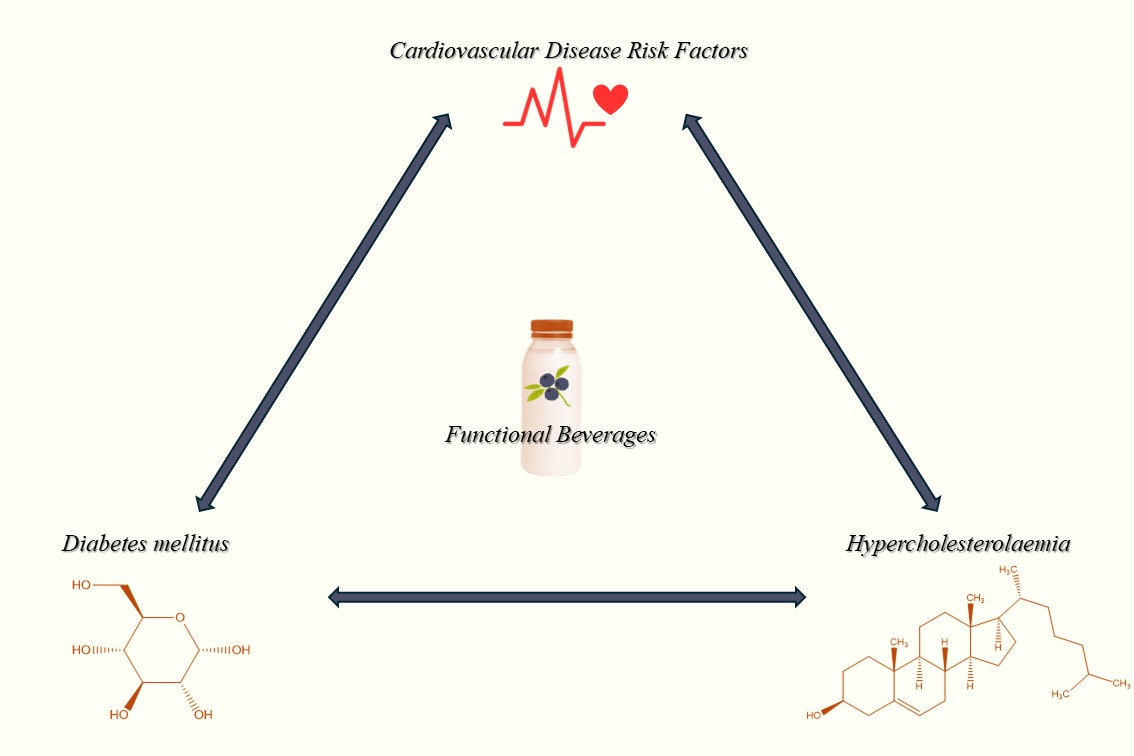

The Role of Functional Beverages in Mitigating Cardiovascular Disease Risk Factors: A Focus on Their Antidiabetic and Hypolipidemic Properties

 ,
,  ,
,  ,
,  ,
, 
 and
and 
Abstract
Share and Cite
Scarcelli, E.; Iacopetta, D.; Ceramella, J.; Bonofiglio, D.; Conforti, F.L.; Aiello, F.; Sinicropi, M.S. The Role of Functional Beverages in Mitigating Cardiovascular Disease Risk Factors: A Focus on Their Antidiabetic and Hypolipidemic Properties. Beverages 2025, 11, 21. https://doi.org/10.3390/beverages11010021
Scarcelli E, Iacopetta D, Ceramella J, Bonofiglio D, Conforti FL, Aiello F, Sinicropi MS. The Role of Functional Beverages in Mitigating Cardiovascular Disease Risk Factors: A Focus on Their Antidiabetic and Hypolipidemic Properties. Beverages. 2025; 11(1):21. https://doi.org/10.3390/beverages11010021
Chicago/Turabian StyleScarcelli, Eva, Domenico Iacopetta, Jessica Ceramella, Daniela Bonofiglio, Francesca Luisa Conforti, Francesca Aiello, and Maria Stefania Sinicropi. 2025. "The Role of Functional Beverages in Mitigating Cardiovascular Disease Risk Factors: A Focus on Their Antidiabetic and Hypolipidemic Properties" Beverages 11, no. 1: 21. https://doi.org/10.3390/beverages11010021
APA StyleScarcelli, E., Iacopetta, D., Ceramella, J., Bonofiglio, D., Conforti, F. L., Aiello, F., & Sinicropi, M. S. (2025). The Role of Functional Beverages in Mitigating Cardiovascular Disease Risk Factors: A Focus on Their Antidiabetic and Hypolipidemic Properties. Beverages, 11(1), 21. https://doi.org/10.3390/beverages11010021