Improving Balance and Gait in Older People with Parkinson’s Disease: A Randomized Controlled Trial of Technology-Assisted Rehabilitation Interventions
 , , , , ,
  ,
,  , and
, and
Abstract
1. Introduction
2. Materials and Methods
2.1. Subjects
2.2. Intervention
2.3. Statistical Analysis
3. Results
4. Discussion
5. Conclusions
Author Contributions
Funding
Institutional Review Board Statement
Informed Consent Statement
Data Availability Statement
Conflicts of Interest
Abbreviations
| SF-12 | 12-item Short Form Survey |
| BI | Barthel Index |
| CDR | Clinical Dementia Rating Scale |
| CG | control group |
| FAC | Functional Ambulation Category |
| FES-I | Falls Efficacy Scale—International |
| FW | follow-up |
| GDS | Geriatric Depression Scale |
| H&Y | Hoen and Yahr |
| IQR | interquartile range |
| MCID | minimal clinically important difference |
| MMSE | Mini Mental State Examination |
| n | number |
| PD | Parkinson’s disease |
| PIADS | Psychosocial Impact of Assistive Devices Scale |
| POMA | Tinetti’s Performance Oriented Mobility Assessment |
| RS | Rankin Scale |
| SD | standard deviation |
| T0 | baseline |
| T1 | end of the treatment |
| TG | Tymo group |
| WG | Walker View group |
References
- Dorsey, E.R.; Sherer, T.; Okun, M.S.; Bloem, B.R. The emerging evidence of the Parkinson pandemic. J. Park. Dis. 2018, 8, S3–S8. [Google Scholar] [CrossRef] [Scilit] [PubMed]
- Tolosa, E.; Garrido, A.; Scholz, S.W.; Poewe, W. Challenges in the diagnosis of Parkinson’s disease. Lancet Neurol. 2021, 20, 385–397. [Google Scholar] [CrossRef] [Scilit] [PubMed]
- Kalia, L.V.; Lang, A.E. Parkinson’s disease. Lancet 2015, 386, 896–912. [Google Scholar] [CrossRef] [Scilit] [PubMed]
- Kim, S.M.; Kim, D.H.; Yang, Y.; Ha, S.W.; Han, J.H. Gait Patterns in Parkinson’s Disease with or without Cognitive Impairment. Dement. Neurocogn. Disord. 2018, 17, 57–65. [Google Scholar] [CrossRef] [Scilit]
- Dibble, L.E.; Addison, O.; Papa, E. The effects of exercise on balance in persons with Parkinson’s disease: A systematic review across the disability spectrum. J. Neurol. Phys. Ther. 2009, 33, 14–26. [Google Scholar] [CrossRef] [Scilit]
- Li, S.; Chen, S.; Yu, X.; Quan, M.; Deng, R. Scoping review of AI-driven wearable technologies for rehabilitation and functional assessment in Parkinson’s disease: A protocol. BMJ Open 2026, 16, e110048. [Google Scholar] [CrossRef] [Scilit]
- Kim, S.D.; Allen, N.E.; Canning, C.G.; Fung, V.S.C. Postural instability in patients with Parkinson’s disease. CNS Drugs 2013, 27, 97–112. [Google Scholar] [CrossRef] [Scilit]
- Sarter, M.; Albin, R.L.; Kucinski, A.; Lustig, C. Where attention falls: Increased risk of falls from the converging impact of cortical cholinergic and midbrain dopamine loss on striatal function. Exp. Neurol. 2014, 257, 120–129. [Google Scholar] [CrossRef] [Scilit]
- Bouça-Machado, R.; Rosário, A.; Caldeira, D.; Caldas, A.C.; Guerreiro, D.; Venturelli, M.; Tinazzi, M.; Schena, F.; Ferreira, J.J. Physical activity, exercise, and physiotherapy in Parkinson’s disease: Defining the concepts. Mov. Disord. Clin. Pract. 2020, 7, 7–15. [Google Scholar] [CrossRef] [Scilit]
- Feng, Y.S.; Yang, S.D.; Tan, Z.X.; Wang, M.M.; Xing, Y.; Dong, F.; Zhang, F. The benefits and mechanisms of exercise training for Parkinson’s disease. Life Sci. 2020, 245, 117345. [Google Scholar] [CrossRef] [Scilit]
- Goodwin, V.A.; Richards, S.H.; Taylor, R.S.; Taylor, A.H.; Campbell, J.L. The effectiveness of exercise interventions for people with Parkinson’s disease: A systematic review and meta-analysis. Mov. Disord. Off. J. Mov. Disord. Soc. 2008, 23, 631–640. [Google Scholar] [CrossRef] [Scilit]
- Fernandes, J.V.A.; Figueiredo, V.L.F.A.; Oliveira, A.B.; Reis, I.A.; Henrique, G.L.D.; da Silva, E.A. Virtual reality in Parkinson’s disease: A systematic review and meta-analysis. Dement. Neuropsychol. 2025, 19, e20240257. [Google Scholar] [CrossRef] [Scilit] [PubMed]
- Bartolo, M.; Castelli, A.; Calabrese, M.; Buttacchio, G.; Zucchella, C.; Tamburin, S.; Fontana, A.; Copetti, M.; Fasano, A.; Intiso, D. A wearable system for visual cueing gait rehabilitation in Parkinson’s disease: A randomized non-inferiority trial. Eur. J. Phys. Rehabil. Med. 2024, 60, 245–256. [Google Scholar] [CrossRef] [Scilit] [PubMed]
- Schenkman, M.; Moore, C.G.; Kohrt, W.M.; Hall, D.A.; Delitto, A.; Comella, C.L.; Josbeno, D.A.; Christiansen, C.L.; Berman, B.D.; Kluger, B.M. Effect of highintensity treadmill exercise on motor symptoms in patients with de novo Parkinson disease: A phase 2 randomized clinical trial. JAMA Neurol. 2018, 75, 219–226. [Google Scholar] [CrossRef] [Scilit] [PubMed]
- Mak, M.K.; Wong-Yu, I.S.; Shen, X.; Chung, C.L. Long-term effects of exercise and physical therapy in people with Parkinson disease. Nat. Rev. Neurol. 2017, 13, 689–703. [Google Scholar] [CrossRef] [Scilit]
- Lauz’e, M.; Daneault, J.F.; Duval, C. The Effects of physical activity in parkinson’s disease: A review. J. Park. Dis. 2016, 6, 685–698. [Google Scholar] [CrossRef] [Scilit]
- Das, J.; Morris, R.; Barry, G.; Celik, Y.; Godfrey, A.; McDonald, C.; Walker, R.; Vitorio, R.; Stuart, S. Technological solution for the assessment and rehabilitation of visuo-cognition in Parkinson’s disease. Expert. Rev. Med. Devices 2023, 20, 253–257. [Google Scholar] [CrossRef] [Scilit]
- Maranesi, E.; Casoni, E.; Baldoni, R.; Barboni, I.; Rinaldi, N.; Tramontana, B.; Amabili, G.; Benadduci, M.; Barbarossa, F.; Luzi, R.; et al. The Effect of Non-Immersive Virtual Reality Exergames versus Traditional Physiotherapy in Parkinson’s Disease Older Patients: Preliminary Results from a Randomized-Controlled Trial. Int. J. Environ. Res. Public Health 2022, 19, 14818. [Google Scholar] [CrossRef] [Scilit]
- Zhou, J.; Salvendy, G.; Boot, W.R.; Charness, N.; Czaja, S.; Gao, Q.; Holzinger, A.; Ntoa, S.; Rau, P.-L.P.; Rogers, W.A.; et al. Grand Challenges of Smart Technology for Older Adults. Int. J. Hum.–Comput. Interact. 2025, 41, 4439–4481. [Google Scholar] [CrossRef] [Scilit]
- Mirelman, A.; Rochester, L.; Maidan, I.; Del Din, S.; Alcock, L.; Nieuwhof, F.; Rikkert, M.O.; Bloem, B.R.; Pelosin, E.; Avanzino, L.; et al. Addition of a non-immersive virtual reality component to treadmill training to reduce fall risk in older adults (V-TIME): A randomised controlled trial. Lancet 2016, 388, 1170–1182. [Google Scholar] [CrossRef] [Scilit]
- Tao, Y.; Luo, J.; Tian, J.; Peng, S.; Wang, H.; Cao, J.; Wen, Z.; Zhang, X. The role of robot-assisted training on rehabilitation outcomes in Parkinson’s disease: A systematic review and meta-analysis. Disabil. Rehabil. 2023, 46, 4049–4067. [Google Scholar] [CrossRef] [Scilit] [PubMed]
- Hoehn, M.; Yahr, M. Parkinsonism: Onset, progression and mortality. Neurology 1967, 17, 427–442. [Google Scholar] [CrossRef] [Scilit] [PubMed]
- Holden, M.K.; Gill, K.M.; Magliozzi, M.R. Gait assesment for neurologically imparired. Standards for outcome assessment. Phys. Ther. 1986, 66, 1530–1539. [Google Scholar] [CrossRef] [Scilit] [PubMed]
- van Swieten, J.C.; Koudstaal, P.J.; Visser, M.C.; Schouten, H.J.A.; van Gijn, J. Interobserver agreement for the assessment of handicap in stroke patients. Stroke 1988, 19, 604–607. [Google Scholar] [CrossRef] [Scilit]
- Rinaldi, P.; Mecocci, P.; Benedetti, C.; Ercolani, S.; Bregnocchi, M.; Menculini, G.; Catani, M.; Senin, U.; Cherubini, A. Validation of the five-item geriatric depression scale in elderly subjects in three different settings. J. Am. Geriatr. Soc. 2003, 51, 694–698. [Google Scholar] [CrossRef] [Scilit]
- Folstein, M.F.; Folstein, S.E.; McHugh, P.R. Mini-mental state. A pratical method for grading the cognitive state of patients for the clinician. J. Psychiatr. Res. 1975, 12, 189–198. [Google Scholar] [CrossRef] [Scilit]
- Morris, J.C. Clinical Dementia Rating: A Reliable and Valid Diagnostic and Staging Measure for Dementia of the Alzheimer Type. Int. Psychogeriatr. 1997, 9, 173–176. [Google Scholar] [CrossRef] [Scilit]
- Jutai, J.; Day, H. Psychosocial Impact of Assistive devices Scale (PIADS). Technol. Disabil. 2002, 14, 107–111. [Google Scholar] [CrossRef] [Scilit]
- Mahoney, F.I.; Barthel, D.W. Functional Evaluation: The Barthel Index. Md. State Med. J. 1965, 14, 61–65. [Google Scholar]
- Tinetti, M.E. Performance-oriented assessment of mobility problems in elderly patients. J. Am. Geriatr. Soc. 1986, 34, 119–126. [Google Scholar] [CrossRef] [Scilit]
- Ware, J.E.; Kosinski, M.; Keller, S.D. SF-12: How to Score the SF-12 Physical and Mental Health Summary Scales, 3rd ed.; QualityMetric Incorporated: Lincoln, RI, USA, 1998. [Google Scholar]
- Ruggiero, C.; Mariani, T.; Gugliotta, R.; Gasperini, B.; Patacchini, F.; Nguyen, H.N.; Zampi, E.; Serra, R.; Dell’aquila, G.; Cirinei, E.; et al. Validation of the Italian version of the falls efficacy scale international (FES-I) and the SHORT FES-I in community dwelling older persons. Arch. Gerontol. Geriatr. 2009, 49, 211–219. [Google Scholar] [CrossRef] [Scilit] [PubMed]
- Low, D.C.; Walsh, G.S. The minimal important change for measures of balance and postural control in older adults: A systematic review. Age Ageing 2022, 51, afac284. [Google Scholar] [CrossRef] [Scilit] [PubMed]
- Jahantabi-Nejad, S.; Azad, A. Predictive accuracy of performance oriented mobility assessment for falls in older adults: A systematic review. Med. J. Islam. Repub. Iran 2019, 33, 38. [Google Scholar] [CrossRef] [Scilit] [PubMed]
- Maranesi, E.; Di Donna, V.; Pelliccioni, G.; Cameriere, V.; Casoni, E.; Baldoni, R.; Benadduci, M.; Rinaldi, N.; Fantechi, L.; Giammarchi, C.; et al. Acceptability and Preliminary Results of Technology-Assisted Balance Training in Parkinson’s Disease. Int. J. Environ. Res. Public Health 2022, 19, 2655. [Google Scholar] [CrossRef] [Scilit]
- Bevilacqua, R.; Benadduci, M.; Riccardi, G.R.; Melone, G.; La Forgia, A.; MacChiarulo, N.; Rossetti, L.; Marzorati, M.; Rizzo, G.; Di Bitonto, P.; et al. SI-ROBOTICS System: A preliminary study on usability of a rehabilitation program in patients with Parkinson’s disease. In CEUR Workshop Proceedings; 2022; Volume 3323, Available online: https://ceur-ws.org/Vol-3323/paper3.pdf (accessed on 16 April 2026).
- Cano-de-la-Cuerda, R.; Blázquez-Fernández, A.; Marcos-Antón, S.; Sánchez-Herrera-Baeza, P.; Fernández-González, P.; Collado-Vázquez, S.; Jiménez-Antona, C.; Laguarta-Val, S. Economic Cost of Rehabilitation with Robotic and Virtual Reality Systems in People with Neurological Disorders: A Systematic Review. J. Clin. Med. 2024, 13, 1531. [Google Scholar] [CrossRef] [Scilit]
- Zhang, B.; Wong, K.P.; Kang, R.; Fu, S.; Qin, J.; Xiao, Q. Efficacy of Robot-Assisted and Virtual Reality Interventions on Balance, Gait, and Daily Function in Patients With Stroke: A Systematic Review and Network Meta-analysis. Arch. Phys. Med. Rehabil. 2023, 104, 1711–1719. [Google Scholar] [CrossRef] [Scilit]
- Lin, Y.; Li, Q.Y.; Qu, Q.; Ding, L.; Chen, Z.; Huang, F.; Hu, S.; Deng, W.; Guo, F.; Wang, C.; et al. Comparative Effectiveness of Robot-Assisted Training Versus Enhanced Upper Extremity Therapy on Upper and Lower Extremity for Stroke Survivors: A Multicentre Randomized Controlled Trial. J. Rehabil. Med. 2022, 54, jrm00314. [Google Scholar] [CrossRef] [Scilit]
- Bang, D.H.; Shin, W.S. Effects of an intensive Nordic walking intervention on the balance function and walking ability of individuals with Parkinson’s disease: A randomized controlled pilot trial. Aging Clin. Exp. Res. 2017, 29, 993–999. [Google Scholar] [CrossRef] [Scilit]
- Bevilacqua, R.; Benadduci, M.; Bonfigli, A.R.; Riccardi, G.R.; Melone, G.; La Forgia, A.; Macchiarulo, N.; Rossetti, L.; Marzorati, M.; Rizzo, G.; et al. Dancing With Parkinson’s Disease: The SI-ROBOTICS Study Protocol. Front. Public Health 2021, 9, 780098. [Google Scholar] [CrossRef] [Scilit]
- Aras, B.; Seyyar, G.K.; Fidan, O.; Colak, E. The effect of Tai Chi on functional mobility, balance and falls in Parkinson’s disease: A systematic review and meta-analysis of systematic reviews. Explore 2022, 18, 402–410. [Google Scholar] [CrossRef] [Scilit]
- Soke, F.; Guclu-Gunduz, A.; Kocer, B.; Fidan, I.; Keskinoglu, P. Task-oriented circuit training combined with aerobic training improves motor performance and balance in people with Parkinson’s Disease. Acta Neurol. Belg. 2021, 121, 535–543. [Google Scholar] [CrossRef] [Scilit]
- Picelli, A.; Melotti, C.; Origano, F.; Waldner, A.; Fiaschi, A.; Santilli, V.; Smania, N. Robot-assisted gait training in patients with Parkinson disease: A randomized controlled trial. Neurorehabilit. Neural Repair 2012, 26, 353–361. [Google Scholar] [CrossRef] [Scilit]
- Fundarò, C.; Maestri, R.; Ferriero, G.; Chimento, P.; Taveggia, G.; Casale, R. Self-selected speed gait training in Parkinson’s disease: Robot-assisted gait training with virtual reality versus gait training on the ground. Eur. J. Phys. Rehabil. Med. 2019, 55, 456–462. [Google Scholar] [CrossRef] [Scilit]
- Mehdizadeh, M.; Martinez-Martin, P.; Habibi, S.A.; Fereshtehnejad, S.M.; Abasi, A.; Niazi Khatoon, J.; Saneii, S.H.; Taghizadeh, G. Reliability and Validity of Fall Efficacy Scale-International in People with Parkinson’s Disease during On- and Off-Drug Phases. Park. Dis. 2019, 2019, 6505232. [Google Scholar] [CrossRef] [Scilit]



| Aspects | CG | WG | TG |
|---|---|---|---|
| Session Duration | 50 min | 30 min conventional + 20 min WV therapy | 30 min conventional + 20 min Tymo therapy |
| Number of sessions | 10 sessions (2×/week for 5 weeks) | 10 sessions (2×/week for 5 weeks) | 10 sessions (2×/week for 5 weeks) |
| Technological device | N/A | Walker View (sensorized treadmill with 3D camera) | Tymo (non-immersive VR balance platform) |
| Technological focus | N/A | Gait kinematics, symmetry, load distribution | Postural control, static and dynamic balance |
| Type of feedback | N/A | Real-time visual and auditory feedback on gait parameters | Real-time visual feedback through exergames |
| Targeted motor components | General mobility and coordination | Gait symmetry (step length, stance/swing phases, foot clearance, propulsion) | Balance strategies (weight shifting, postural sway, anticipatory/reactive balance control) |
| Training specificity | Non-specific, general functional training | Task-specific gait training with repetition and parameter-focused feedback | Task-specific balance training using mediolateral and anteroposterior load transfers |
| Therapist role | Full session guided by therapist | Therapist monitors and adjusts gait parameters on WV | Therapist customizes exergames and provides support during balance tasks |
| CG | WG | TG | p | |
|---|---|---|---|---|
| n = 18 | n = 18 | n = 22 | ||
| Gender, n (%) | 0.758 | |||
| Female | 8 (44.5%) | 8 (44.5%) | 12 (45.5%) | |
| Male | 10 (55.5%) | 10 (55.5%) | 10 (54.5%) | |
| Age, mean ± SD † | 75 ± 5.9 | 73.4 ± 6.8 | 72.8 ± 5.8 | 0.486 |
| Marital status, n (%) | 0.940 | |||
| Married | 15 (83.3%) | 14 (77.7%) | 18 (81.8%) | |
| Widowed | 2 (11.1%) | 2 (11.1%) | 4 (18.2%) | |
| Separated/Divorced | 1 (5.6) | 1 (5.6%) | 0 (0%) | |
| Single | 0 (0%) | 1 (5.6%) | 0 (0%) | |
| Educational level, n (%) | 0.613 | |||
| Primary education | 7 (38.8%) | 5 (27.8%) | 11 (50%) | |
| Secondary education | 8 (44.5%) | 8 (44.5%) | 6 (27.3%) | |
| University or more | 3 (16.7%) | 5 (27.8%) | 5 (22.7%) | |
| Hoehn and Yahr score, mean ± SD | 1.9 ± 0.9 | 1.7 ± 0.7 | 1.8 ± 0.7 | 0.097 |
| Rankin Scale score, mean ± SD | 1.9 ± 1.1 | 1.4 ± 1.0 | 1.2 ± 0.6 | 0.112 |
| GDS, mean ± SD | 1.6 ± 1.3 | 1.2 ± 1.0 | 1.4 ± 1.5 | 0.058 |
| FAC, mean ± SD | 4.6 ± 0.9 | 4.3 ± 0.8 | 4.6 ± 0.5 | 0.116 |
| MMSE, mean ± SD † | 26.5 ± 2.5 | 27.3 ± 1.8 | 27.6 ± 1.9 | 0.209 |
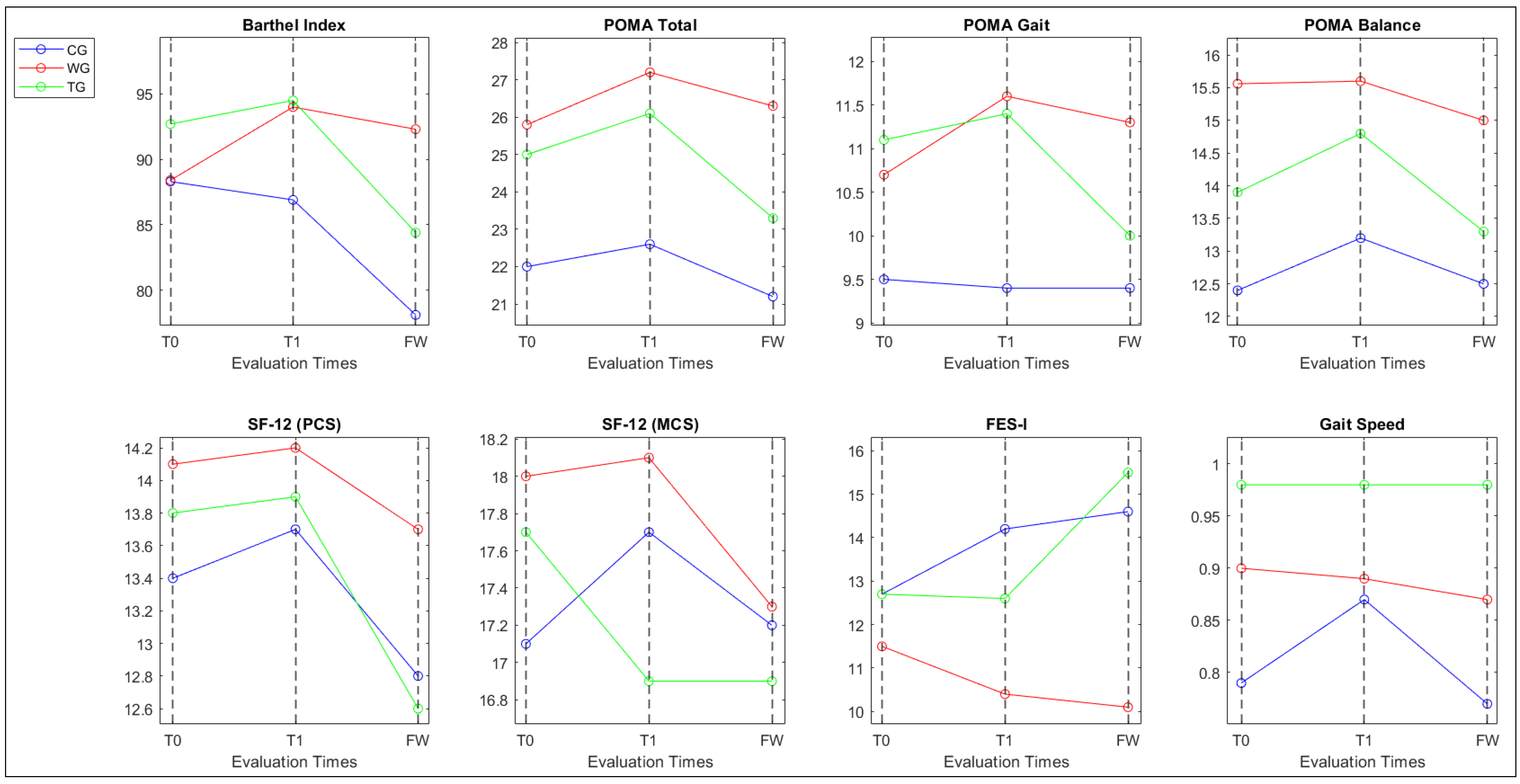
| PANELA—CG | T0 | T1 | FW | p-Value T0–T1 | p-Value T1–FW | p-Value T0–FW |
| BI | 88.3 ± 16.0 | 86.9 ± 16.9 | 78.1 ± 23.4 | 0.472 | 0.039 * | 0.0297 * |
| POMA | ||||||
| POMA Total | 22.0 ± 4.9 | 22.6 ± 6.2 | 21.2 ± 7.8 | 0.419 | 0.269 | 0.789 |
| POMA Gait | 9.5 ± 2.1 | 9.4 ± 3.1 | 9.4 ± 3.2 | 0.740 | 0.337 | 0.396 |
| POMA Balance | 12.4 ± 3.0 | 13.2 ± 3.1 | 12.5 ± 4.1 | 0.069 | 0.288 | 0.539 |
| SF-12 | ||||||
| PCS-12 | 13.4 ± 2.0 † | 13.7 ± 2.2 † | 12.8 ± 2.0 | 0.497 | 0.783 | 0.459 |
| MCS-12 | 17.1 ± 1.9 | 17.7 ± 1.7 | 17.2 ± 1.4 | 0.460 | 0.210 | 0.564 |
| FES-I | 12.7 ± 5.9 | 14.2 ± 6.9 | 14.6 ± 5.9 | 0.141 | 1.000 | 0.164 |
| Gait Speed [m/s] | 0.79 ± 0.31 † | 0.87 ± 0.36 † | 0.77 ± 0.26 | 0.091 | 0.085 | 0.423 |
| PANEL B—WG | T0 | T1 | FW | p-value T0–T1 | p-value T1–FW | p-value T0–FW |
| BI | 88.4 ± 15.8 | 94.0 ± 8.7 | 92.3 ± 14.5 | 0.140 | 0.485 | 0.111 |
| POMA | ||||||
| POMA Total | 25.8 ± 3.7 | 27.2 ± 1.4 | 26.3 ± 2.6 | 0.077 | 0.100 | 0.149 |
| POMA Gait | 10.7 ± 1.8 | 11.6 ± 0.7 | 11.3 ± 1.1 | 0.043 * | 0.334 | 0.052 |
| POMA Balance | 15.56 ± 2.1 | 15.6 ± 0.9 | 15.0 ± 1.6 | 0.155 | 0.065 | 0.411 |
| SF-12 | ||||||
| PCS-12 | 14.1 ± 1.5 † | 14.2 ± 1.6 † | 13.7 ± 1.7 | 0.879 | 0.240 | 0.199 |
| MCS-12 | 18.0 ± 1.3 | 18.1 ± 1.6 | 17.3 ± 2.3 | 0.515 | 0.354 | 0.094 |
| FES-I | 11.5 ± 4.0 | 10.4 ± 3.7 | 10.1 ± 3.9 | 0.254 | 0.582 | 0.100 |
| Gait Speed [m/s] | 0.90 ± 0.21 † | 0.89 ± 0.21 † | 0.87 ± 0.22 | 0.786 | 0.392 | 0.953 |
| PANEL C—TG | T0 | T1 | FW | p-value T0–T1 | p-value T1–FW | p-value T0–FW |
| BI | 92.7 ± 10.4 | 94.5 ± 13.3 | 84.4 ± 19.2 | 0.401 | 0.031 * | 0.371 |
| POMA | ||||||
| POMA Total | 25.0 ± 3.2 | 26.1 ± 2.5 | 23.3 ± 5.8 | 0.023 * | 0.013 * | 0.552 |
| POMA Gait | 11.1 ± 1.5 | 11.4 ± 1.0 | 10.0 ± 2.7 | 0.300 | 0.009 * | 0.120 |
| POMA Balance | 13.9 ± 2.1 | 14.8 ± 1.7 | 13.3 ± 3.3 | 0.005 * | 0.027 * | 0.689 |
| SF-12 | ||||||
| PCS-12 | 13.8 ± 1.6 † | 13.9 ± 1.2 † | 12.6 ± 3.2 | 0.797 | 0.111 | 0.150 |
| MCS-12 | 17.7 ± 1.6 | 16.9 ± 1.8 | 16.9 ± 1.4 | 0.107 | 0.451 | 0.158 |
| FES-I | 12.7 ± 5.4 | 12.6 ± 5.4 | 15.5 ± 6.3 | 0.923 | 0.253 | 0.359 |
| Gait Speed [m/s] | 0.98 ± 0.30 † | 0.98 ± 0.36 † | 0.98 ± 0.31 | 0.996 | 0.865 | 0.865 |
| MeanSq | F | p Value | |
|---|---|---|---|
| Group | 181.77 | 1.44 | 0.249 |
| Group × Time | 15.23 | 0.84 | 0.503 |
Disclaimer/Publisher’s Note: The statements, opinions and data contained in all publications are solely those of the individual author(s) and contributor(s) and not of MDPI and/or the editor(s). MDPI and/or the editor(s) disclaim responsibility for any injury to people or property resulting from any ideas, methods, instructions or products referred to in the content. |
© 2026 by the authors. Licensee MDPI, Basel, Switzerland. This article is an open access article distributed under the terms and conditions of the Creative Commons Attribution (CC BY) license.
Share and Cite
Maranesi, E.; Bevilacqua, R.; Casoni, E.; Barboni, I.; Barbarossa, F.; Margaritini, A.; Polverigiani, C.; Sgolastra, A.; Bertino, E.; Baldoni, R.; et al. Improving Balance and Gait in Older People with Parkinson’s Disease: A Randomized Controlled Trial of Technology-Assisted Rehabilitation Interventions. Bioengineering 2026, 13, 487. https://doi.org/10.3390/bioengineering13050487
Maranesi E, Bevilacqua R, Casoni E, Barboni I, Barbarossa F, Margaritini A, Polverigiani C, Sgolastra A, Bertino E, Baldoni R, et al. Improving Balance and Gait in Older People with Parkinson’s Disease: A Randomized Controlled Trial of Technology-Assisted Rehabilitation Interventions. Bioengineering. 2026; 13(5):487. https://doi.org/10.3390/bioengineering13050487
Chicago/Turabian StyleMaranesi, Elvira, Roberta Bevilacqua, Elisa Casoni, Ilaria Barboni, Federico Barbarossa, Arianna Margaritini, Chiara Polverigiani, Arianna Sgolastra, Emanuela Bertino, Renato Baldoni, and et al. 2026. "Improving Balance and Gait in Older People with Parkinson’s Disease: A Randomized Controlled Trial of Technology-Assisted Rehabilitation Interventions" Bioengineering 13, no. 5: 487. https://doi.org/10.3390/bioengineering13050487
APA StyleMaranesi, E., Bevilacqua, R., Casoni, E., Barboni, I., Barbarossa, F., Margaritini, A., Polverigiani, C., Sgolastra, A., Bertino, E., Baldoni, R., Benadduci, M., Amabili, G., Scendoni, P., Pelliccioni, G., Di Donna, V., & Riccardi, G. R. (2026). Improving Balance and Gait in Older People with Parkinson’s Disease: A Randomized Controlled Trial of Technology-Assisted Rehabilitation Interventions. Bioengineering, 13(5), 487. https://doi.org/10.3390/bioengineering13050487