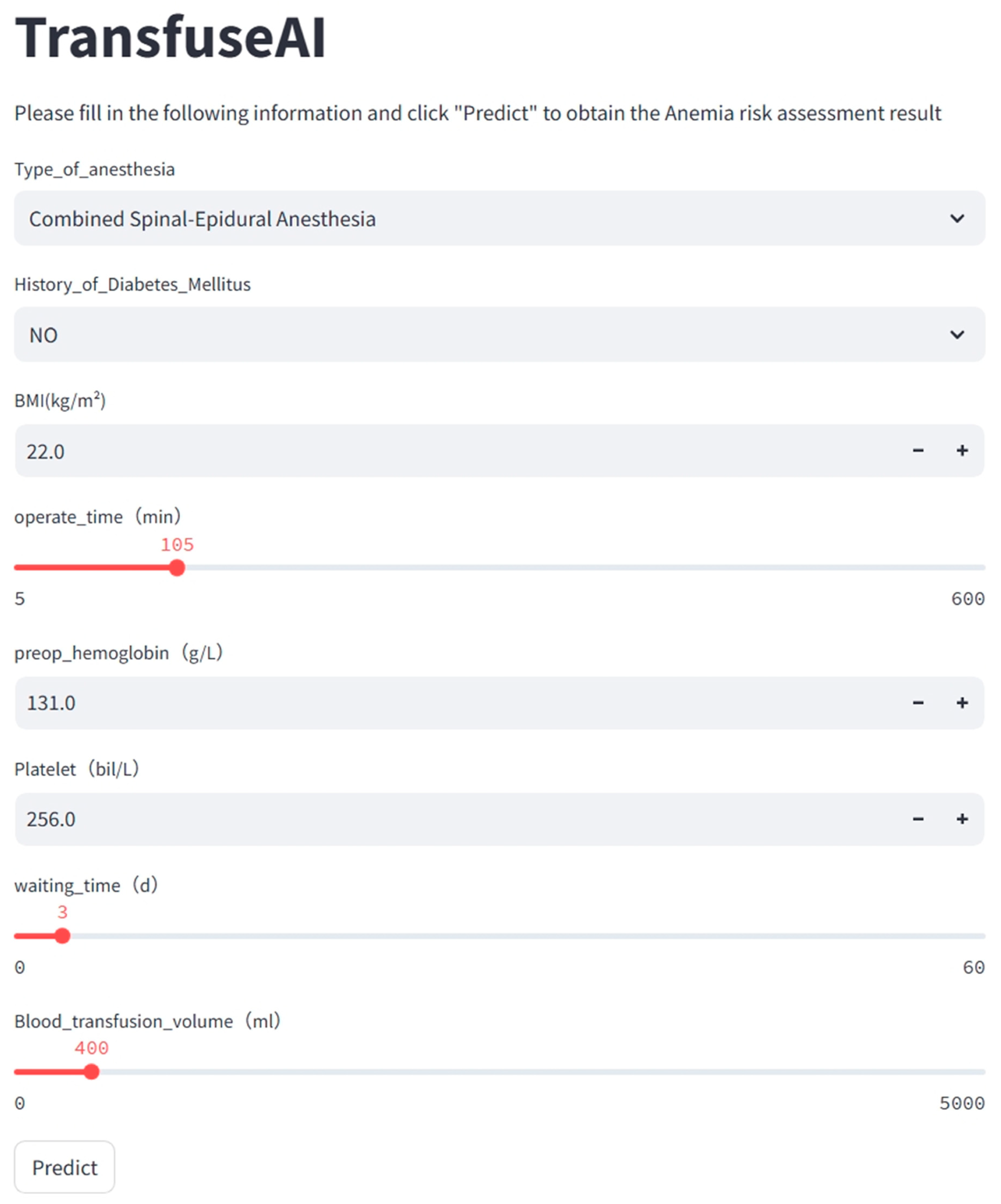
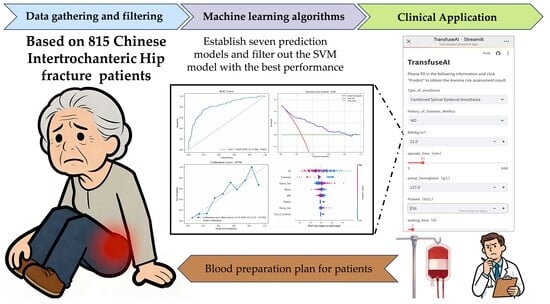
A Machine Learning-Based Clinical Decision Support Tool for Intertrochanteric Hip Fracture Patients to Predict Postoperative Anemia Risk: A Retrospective Cohort Study

Abstract
1. Introduction
2. Methods
2.1. Data Source
2.2. Data Collection
2.2.1. Outcome Definition
2.2.2. Predictors
2.2.3. Missing Data Handling
2.3. Data Preprocessing
2.4. Machine Learning Algorithms
2.5. SHAP Interpretability Analysis
2.6. Statistical Analysis
3. Results
3.1. Patient Characteristics
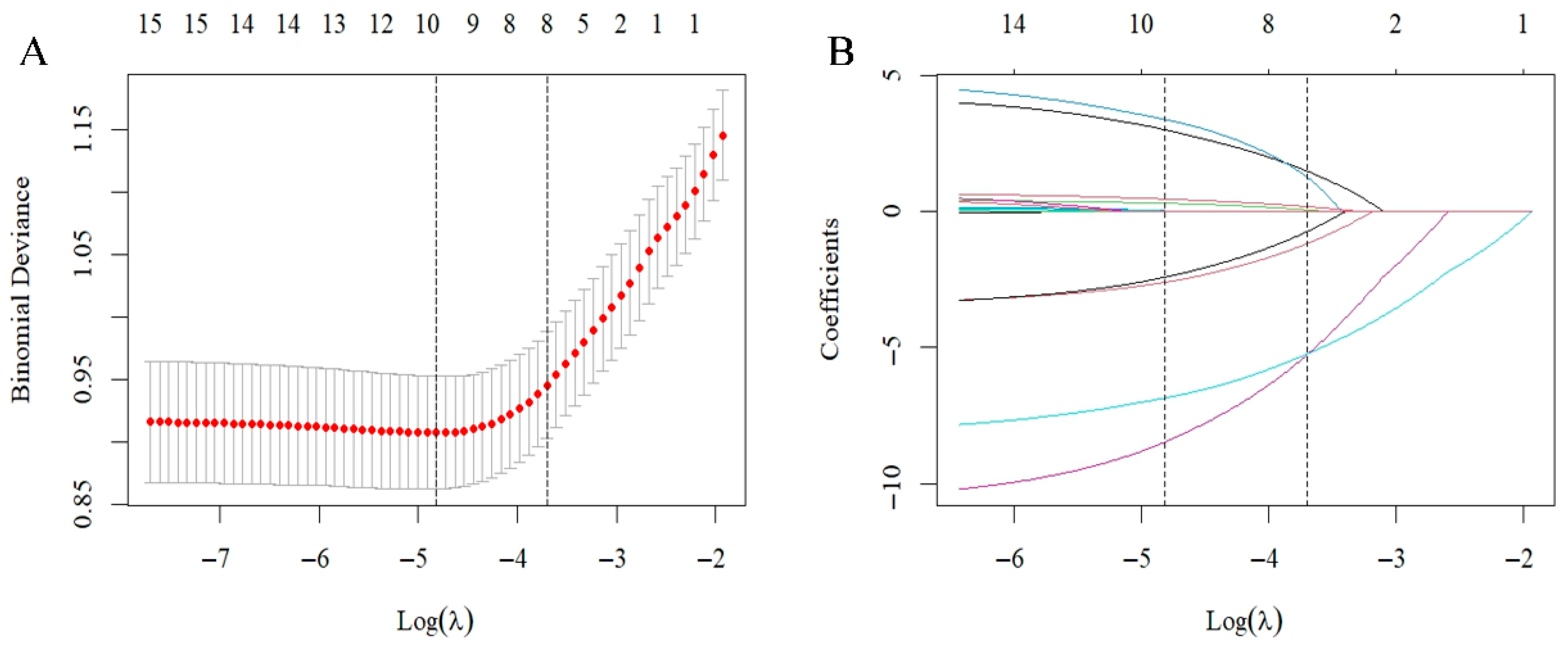
3.2. Predictor Selection
3.3. Model Development and Performance Comparison
3.4. Interpretability and Application of the Model
4. Discussion
5. Conclusions
Author Contributions
Funding
Institutional Review Board Statement
Informed Consent Statement
Data Availability Statement
Acknowledgments
Conflicts of Interest
References
- Deng, Y.; Zhou, X.-P.; Sun, B.; Li, G.-H.; Tong, Z.-M. Comparative outcomes of proximal femur intramedullary nailing vs. cemented bipolar hemiarthroplasty for treating intertrochanteric fractures in patients aged 75 and older: Analysis of risk factors for postoperative all-cause mortality. BMC Surg. 2025, 25, 130. [Google Scholar] [CrossRef] [Scilit]
- Wang, T.; Long, Y.; Wang, Z.; Hou, Z. The role of perioperative transfusion in mortality in geriatric patients with intertrochanteric fracture. Sci. Rep. 2025, 15, 16699. [Google Scholar] [CrossRef] [Scilit]
- Krishnan, S.; Koshy, G.; Reddy, A.; Rajeev, A. The Role of Endoscopy in Investigating the Causes of Persistent Anaemia in Post-operative Fractured Neck of Femur Patients. Cureus 2023, 15, e47982. [Google Scholar] [CrossRef] [Scilit] [PubMed]
- Jiang, Y.; Lin, X.; Wang, Y.; Li, J.; Wang, G.; Meng, Y.; Li, M.; Li, Y.; Luo, Y.; Gao, Z.; et al. Preoperative Anemia and Risk of In-hospital Postoperative Complications in Patients with Hip Fracture. Clin. Interv. Aging 2023, 18, 639–653. [Google Scholar] [CrossRef] [Scilit] [PubMed]
- Carson, J.L.; Terrin, M.L.; Noveck, H.; Sanders, D.W.; Chaitman, B.R.; Rhoads, G.G.; Nemo, G.; Dragert, K.; Beaupre, L.; Hildebrand, K.; et al. Liberal or Restrictive Transfusion in High-Risk Patients after Hip Surgery. N. Engl. J. Med. 2011, 365, 2453–2462. [Google Scholar] [CrossRef] [Scilit] [PubMed]
- Napolitano, L.M.; Kurek, S.; Luchette, F.A.; Anderson, G.L.; Bard, M.R.; Bromberg, W.; Chiu, W.C.; Cipolle, M.D.; Clancy, K.D.; Diebel, L.; et al. Clinical Practice Guideline: Red Blood Cell Transfusion in Adult Trauma and Critical Care. J. Trauma 2009, 67, 1439–1442. [Google Scholar] [CrossRef] [Scilit]
- Ekinci, M. A single dose of tranexamic acid infusion is safe and effective to reduce total blood loss during proximal femoral nailing for intertrochanteric fractures: A prospective randomized study. Turk. J. Trauma Emerg. Surg. 2022, 28, 1627–1633. [Google Scholar] [CrossRef] [Scilit]
- Carson, J.L.; Guyatt, G.; Heddle, N.M.; Grossman, B.J.; Cohn, C.S.; Fung, M.K.; Gernsheimer, T.; Holcomb, J.B.; Kaplan, L.J.; Katz, L.M.; et al. Clinical Practice Guidelines From the AABB. JAMA 2016, 316, 2025–2035. [Google Scholar] [CrossRef] [Scilit]
- Hendrickson, J.E.; Hillyer, C.D. Noninfectious Serious Hazards of Transfusion. Anesth. Analg. 2009, 108, 759–769. [Google Scholar] [CrossRef] [Scilit]
- Murphy, G.J.; Reeves, B.C.; Rogers, C.A.; Rizvi, S.I.A.; Culliford, L.; Angelini, G.D. Increased Mortality, Postoperative Morbidity, and Cost After Red Blood Cell Transfusion in Patients Having Cardiac Surgery. Circulation 2007, 116, 2544–2552. [Google Scholar] [CrossRef] [Scilit]
- Bian, F.C.; Cheng, X.K.; An, Y.S. Preoperative risk factors for postoperative blood transfusion after hip fracture surgery: Establishment of a nomogram. J. Orthop. Surg. Res. 2021, 16, 406. [Google Scholar] [CrossRef] [Scilit]
- Cho, M.-R.; Cho, Y.-J.; Song, S.-K. Factors affecting the need of postoperative blood transfusion in elderly patients with intertrochanteric hip fracture. Sci. Prog. 2022, 105. [Google Scholar] [CrossRef] [Scilit]
- Wei, D.; Jiang, Y.; Long, X.; Huang, N.; Xiang, J.; Cheng, J.; Zhao, J. Predicting the perioperative transfusion risk of proximal femoral antirotation nailing (PFNA) for elderly patients with intertrochanteric fractures: A new predictive nomogram. Biomed. Eng. OnLine 2025, 24, 80. [Google Scholar] [CrossRef] [Scilit] [PubMed]
- Tang, T.; Li, Z.; Lu, X.; Du, J. Development and validation of a risk prediction model for anxiety or depression among patients with chronic obstructive pulmonary disease between 2018 and 2020. Ann. Med. 2022, 54, 2181–2190. [Google Scholar] [CrossRef] [Scilit] [PubMed]
- Ogink, P.T.; Groot, O.Q.; Karhade, A.V.; Bongers, M.E.R.; Oner, F.C.; Verlaan, J.J.; Schwab, J.H. Wide range of applications for machine-learning prediction models in orthopedic surgical outcome: A systematic review. Acta Orthop. 2021, 92, 526–531. [Google Scholar] [CrossRef] [Scilit]
- Zhang, Z.; Zhao, Y.; Canes, A.; Steinberg, D.; Lyashevska, O. Predictive analytics with gradient boosting in clinical medicine. Ann. Transl. Med. 2019, 7, 152. [Google Scholar] [CrossRef] [Scilit]
- Valan, B.; Prakash, A.; Ratliff, W.; Gao, M.; Muthya, S.; Thomas, A.; Eaton, J.L.; Gardner, M.; Nichols, M.; Revoir, M.; et al. Evaluating sepsis watch generalizability through multisite external validation of a sepsis machine learning model. NPJ Digit. Med. 2025, 8, 350. [Google Scholar] [CrossRef] [Scilit]
- Chen, Z.; Li, T.; Guo, S.; Zeng, D.; Wang, K. Machine learning-based in-hospital mortality risk prediction tool for intensive care unit patients with heart failure. Front. Cardiovasc. Med. 2023, 10, 1119699. [Google Scholar] [CrossRef] [Scilit]
- Cansabuncu, G.; Turgut, A. Analysis of The Risk Factors for Postoperative Allogenic Blood Transfusion Requirement in Intertrochanteric Femur Fractures. Acta Chir. Orthop. Traumatol. Cech. 2022, 89, 48–52. [Google Scholar] [CrossRef] [Scilit] [PubMed]
- Pudjihartono, N.; Fadason, T.; Kempa-Liehr, A.W.; O’Sullivan, J.M. A Review of Feature Selection Methods for Machine Learning-Based Disease Risk Prediction. Front. Bioinform. 2022, 2, 927312. [Google Scholar] [CrossRef] [Scilit]
- Enders, C.K. Missing data: An update on the state of the art. Psychol. Methods 2025, 30, 322–339. [Google Scholar] [CrossRef] [Scilit]
- Xu, Y.; Goodacre, R. On Splitting Training and Validation Set: A Comparative Study of Cross-Validation, Bootstrap and Systematic Sampling for Estimating the Generalization Performance of Supervised Learning. J. Anal. Test. 2018, 2, 249–262. [Google Scholar] [CrossRef] [Scilit]
- Han, J.; Gondro, C.; Reid, K.; Steibel, J.P. Heuristic hyperparameter optimization of deep learning models for genomic prediction. G3 Genes Genomes Genet. 2021, 11, jkab032. [Google Scholar] [CrossRef] [Scilit]
- Breiman, L. Random Forests. Mach. Learn. 2001, 45, 5–32. [Google Scholar] [CrossRef] [Scilit]
- Burges, C.J.C. A Tutorial on Support Vector Machines for Pattern Recognition. Data Min. Knowl. Discov. 1998, 2, 121–167. [Google Scholar] [CrossRef] [Scilit]
- Li, W.; Yin, Y.; Quan, X.; Zhang, H. Gene Expression Value Prediction Based on XGBoost Algorithm. Front. Genet. 2019, 10, 1077. [Google Scholar] [CrossRef] [Scilit]
- Lundberg, S.M.; Erion, G.; Chen, H.; DeGrave, A.; Prutkin, J.M.; Nair, B.; Katz, R.; Himmelfarb, J.; Bansal, N.; Lee, S.I. From Local Explanations to Global Understanding with Explainable AI for Trees. Nat. Mach. Intell. 2020, 2, 56–67. [Google Scholar] [CrossRef] [Scilit]
- Hourston, G.J.M.; Chan, J.J.; Cooper, H.; Quinn, K.R.; Parker, M. The impact of hip fracture anatomy on admission haemoglobin levels and perioperative transfusion requirements: A 32-year experience. Eur. J. Orthop. Surg. Traumatol. 2025, 35, 399. [Google Scholar] [CrossRef] [Scilit] [PubMed]
- Modig, J. Regional anaesthesia and blood loss. Acta Anaesthesiol. Scand. 2008, 32, 44–48. [Google Scholar] [CrossRef] [Scilit] [PubMed]
- Zhou, S.-L.; Zhang, S.-Y.; Si, H.-B.; Shen, B. Regional versus general anesthesia in older patients for hip fracture surgery: A systematic review and meta-analysis of randomized controlled trials. J. Orthop. Surg. Res. 2023, 18, 428. [Google Scholar] [CrossRef] [Scilit]
- Li, X.; Jiang, H.-y.; Zhao, Y.-j.; Liu, S.-z.; Pan, L.-x. Establishment and validation of a nomogram to predict postoperative anemia after total hip arthroplasty. BMC Musculoskelet. Disord. 2024, 25, 141. [Google Scholar] [CrossRef] [Scilit] [PubMed]
- Nakamura, T.; Kobayashi, E.; Takenaka, S.; Endo, M.; Hayashi, K.; Nakata, E.; Ohshika, S.; Kawashima, H.; Hamada, T.; Horiuchi, K.; et al. Predictive variables for intraoperative blood loss and surgical time in resection of malignant soft tissue tumors without reconstruction. Jpn. J. Clin. Oncol. 2025, 55, 610–614. [Google Scholar] [CrossRef] [Scilit] [PubMed]
- Iglesias Morcillo, M.; Freuer, D.; Peters, A.; Heier, M.; Meisinger, C.; Linseisen, J. Body Mass Index and Waist Circumference as Determinants of Hemostatic Factors in Participants of a Population-Based Study. Medicina 2023, 59, 228. [Google Scholar] [CrossRef] [Scilit] [PubMed]
- Valle, M.M.; Robledo, A.; O’Leary, S.; Basurto, L.; Reyes-Maldonado, E.; Gaspar, J.; Rosales, E.; Vega-Garcia, S.; Martínez-Murillo, C. Cardiovascular risk factors associated with BMI and metabolic health phenotypes based on measures of coagulation factors. Int. J. Obes. 2025, 49, 2530–2537. [Google Scholar] [CrossRef] [Scilit]
- Kim, M.; Ling, K.; Nazemi, A.; Tantone, R.; Kashanchi, K.; Lung, B.; Komatsu, D.E.; Wang, E.D. Abnormal preoperative platelet count may predict postoperative complications following shoulder arthroplasty. JSES Int. 2022, 6, 935–941. [Google Scholar] [CrossRef] [Scilit]
- Kang, K.W. Preoperative consultation for determining the appropriate transfusion strategy. Blood Res. 2024, 59, 21. [Google Scholar] [CrossRef] [Scilit]
- Siddiqui, A.A.; Khalid, S.; Hussain, R.; Waleem, N.; Devi, R.; Jamshed, S.; Khan, F. Association of Postoperative Complications with Anemic Women Underwent Gynecologic and Obstetric Surgeries. J. Pharm. Res. Int. 2022, 34, 14–21. [Google Scholar] [CrossRef] [Scilit]
- McCartney, S.L.; Hensley, N.B.; Welsby, I. Anemia after cardiac surgery: What is its link to outcomes? Can. J. Anesth. 2023, 71, 307–310. [Google Scholar] [CrossRef] [Scilit]
- Wang, J.; Zhao, Y.; Jiang, B.; Huang, X. Development of a Nomogram to Predict Postoperative Transfusion in the Elderly After Intramedullary Nail Fixation of Femoral Intertrochanteric Fractures. Clin. Interv. Aging 2021, 16, 1–7. [Google Scholar] [CrossRef] [Scilit]




| Characteristics | Total (N = 815) | Non-Anemia (N = 607) | Anemia (N = 208) | p |
|---|---|---|---|---|
| Age, Median (IQR) | 76 (67, 83) | 75 (66, 82) | 77 (69, 84) | 0.027 |
| BMI, Median (IQR) | 22.5 (20.0, 24.3) | 22.5 (20.2, 24.5) | 21.7 (18.7, 24.1) | <0.001 |
| Hb, Median (IQR) | 105 (93, 118) | 110 (98, 121) | 94 (86, 104) | <0.001 |
| Albumin, Mean ± SD | 35.02 ± 3.88 | 35.37 ± 3.88 | 34.01 ± 3.70 | <0.001 |
| Calcium, Median (IQR) | 2.13 (2.04, 2.20) | 2.13 (2.05, 2.20) | 2.10 (2.02, 2.19) | 0.012 |
| Platelet, Median (IQR) | 196 (152, 261) | 197 (155, 263) | 187 (146, 247) | 0.023 |
| Operation time, Median (IQR) | 145 (100, 196) | 140 (100, 190) | 160 (108, 220) | 0.004 |
| Waiting time, Median (IQR) | 8 (6, 11) | 8 (6, 10) | 8 (6, 12) | 0.305 |
| Transfusion, Median (IQR) | 400 (0, 400) | 400 (0, 400) | 400 (0, 400) | 0.003 |
| Gender, n (%) | 0.297 | |||
| Male | 380 (46.6) | 290 (47.8) | 90 (43.3) | |
| Female | 435 (53.4) | 317 (52.2) | 118 (56.7) | |
| Evans, n (%) | 0.06 | |||
| Type 1 | 31 (3.8) | 25 (4.1) | 6 (2.9) | |
| Type 2 | 194 (23.8) | 156 (25.7) | 38 (18.2) | |
| Type 3 | 89 (10.9) | 71 (11.7) | 18 (8.7) | |
| Type 4 | 422 (51.8) | 300 (49.4) | 122 (58.7) | |
| Type 5 | 79 (9.7) | 55 (9.1) | 24 (11.5) | |
| Diabetes, n (%) | 0.205 | |||
| No | 620 (76.1) | 469 (77.3) | 151 (72.6) | |
| Yes | 195 (23.9) | 138 (22.7) | 57 (27.4) | |
| Osteoporosis, n (%) | 0.253 | |||
| No | 339 (41.6) | 260 (42.8) | 79 (38.0) | |
| Yes | 476 (58.4) | 347 (57.2) | 129 (62.0) | |
| Hypertension, n (%) | 0.931 | |||
| No | 439 (53.9) | 328 (54.0) | 111 (53.4) | |
| Yes | 376 (46.1) | 279 (46.0) | 97 (46.6) | |
| Type of anesthesia, n (%) | 0.009 | |||
| CSEA | 649 (79.6) | 497 (81.9) | 152 (73.1) | |
| GA | 166 (20.4) | 110 (18.1) | 56 (26.9) |
| Characteristics | Training Set (N = 533) | Validation Set (N = 228) | p |
|---|---|---|---|
| Age, Mean ± SD | 73 ± 12 | 72 ± 14 | 0.5312 |
| BMI, Mean ± SD | 22.39 ± 3.74 | 22.19 ± 3.23 | 0.4294 |
| Hb, Mean ± SD | 107 ± 18 | 107 ± 18 | 0.8519 |
| Albumin, Mean ± SD | 35.15 ± 3.83 | 34.93 ± 3.95 | 0.5456 |
| Platelet, Mean ± SD | 212 ± 98 | 224 ± 94 | 0.1228 |
| Calcium, Mean ± SD | 2.12 ± 0.14 | 2.12 ± 0.13 | 0.7751 |
| Operation time, Mean ± SD | 161 ± 81 | 174 ± 105 | 0.3461 |
| Waiting time, Mean ± SD | 9 ± 7 | 10 ± 6 | 0.0663 |
| Transfusion, Median (IQR) | 400 (0, 400) | 400 (0, 400) | 0.5312 |
| Gender, n (%) | 0.732 | ||
| Male | 252 (47.3) | 104 (45.6) | |
| Female | 281 (52.7) | 124 (54.4) | |
| Hypertension, n (%) | 0.2064 | ||
| No | 278 (52.2) | 131 (57.5) | |
| Yes | 255 (47.8) | 97 (42.5) | |
| Diabetes, n (%) | 0.8331 | ||
| No | 406 (76.2) | 176 (77.2) | |
| Yes | 127 (23.8) | 52 (22.8) | |
| Osteoporosis, n (%) | 0.2404 | ||
| No | 217 (40.7) | 104 (45.6) | |
| Yes | 316 (59.3) | 124 (54.4) | |
| Type of anesthesia, n (%) | 0.1653 | ||
| CSEA | 432 (81.1) | 174 (76.3) | |
| GA | 101 (18.9) | 54 (23.7) | |
| Evans, n (%) | 0.5788 | ||
| Type 1 | 19 (3.6) | 12 (5.3) | |
| Type 2 | 118 (22.1) | 59 (25.9) | |
| Type 3 | 65 (12.2) | 24 (10.5) | |
| Type 4 | 281 (52.7) | 112 (49.1) | |
| Type 5 | 50 (9.4) | 21 (9.2) |
| LR | DT | RF | XGBoost | LightGBM | SVM | ANN | ||
|---|---|---|---|---|---|---|---|---|
| training | AUC | 0.82 | 0.82 | 1.00 | 0.94 | 1.00 | 0.82 | 0.78 |
| Accuracy | 75.80% | 79.92% | 100.00% | 84.62% | 99.81% | 74.67% | 58.35% | |
| Precision | 52.24% | 60.69% | 100.00% | 64.43% | 99.28% | 50.71% | 36.96% | |
| Sensitivity | 76.09% | 63.77% | 100.00% | 90.58% | 100.00% | 77.54% | 86.23% | |
| Specificity | 75.70% | 85.57% | 100.00% | 82.53% | 99.75% | 73.67% | 48.61% | |
| F1 Score | 61.95% | 62.19% | 100.00% | 75.30% | 99.64% | 61.32% | 51.74% | |
| validation | AUC | 0.83 | 0.74 | 0.82 | 0.83 | 0.80 | 0.83 | 0.74 |
| Accuracy | 70.61% | 73.25% | 68.42% | 73.68% | 73.25% | 69.30% | 58.33% | |
| Precision | 45.83% | 48.53% | 43.93% | 49.41% | 48.84% | 44.33% | 37.32% | |
| Sensitivity | 74.58% | 55.93% | 79.66% | 71.19% | 71.19% | 72.88% | 89.83% | |
| Specificity | 69.23% | 79.29% | 64.50% | 74.56% | 73.96% | 68.05% | 47.34% | |
| F1 Score | 56.77% | 51.97% | 56.63% | 58.33% | 57.93% | 55.13% | 52.74% | |
| test | AUC | 0.80 | 0.72 | 0.78 | 0.80 | 0.77 | 0.83 | 0.79 |
| Accuracy | 81.48% | 81.48% | 72.22% | 81.48% | 79.63% | 77.78% | 57.41% | |
| Precision | 53.33% | 66.67% | 40.00% | 53.85% | 50.00% | 47.06% | 31.25% | |
| Sensitivity | 72.72% | 18.19% | 72.73% | 63.63% | 45.45% | 72.73% | 90.91% | |
| Specificity | 83.72% | 97.67% | 72.10% | 86.04% | 88.37% | 79.07% | 48.84% | |
| F1 Score | 61.53% | 28.57% | 51.61% | 58.33% | 47.62% | 57.14% | 46.51% |
Disclaimer/Publisher’s Note: The statements, opinions and data contained in all publications are solely those of the individual author(s) and contributor(s) and not of MDPI and/or the editor(s). MDPI and/or the editor(s) disclaim responsibility for any injury to people or property resulting from any ideas, methods, instructions or products referred to in the content. |
© 2026 by the authors. Licensee MDPI, Basel, Switzerland. This article is an open access article distributed under the terms and conditions of the Creative Commons Attribution (CC BY) license.
Share and Cite
Dong, X.; Wang, Q.; Huang, Z.; Wang, Y. A Machine Learning-Based Clinical Decision Support Tool for Intertrochanteric Hip Fracture Patients to Predict Postoperative Anemia Risk: A Retrospective Cohort Study. Bioengineering 2026, 13, 489. https://doi.org/10.3390/bioengineering13050489
Dong X, Wang Q, Huang Z, Wang Y. A Machine Learning-Based Clinical Decision Support Tool for Intertrochanteric Hip Fracture Patients to Predict Postoperative Anemia Risk: A Retrospective Cohort Study. Bioengineering. 2026; 13(5):489. https://doi.org/10.3390/bioengineering13050489
Chicago/Turabian StyleDong, Xinbei, Qinglong Wang, Zhipeng Huang, and Yucai Wang. 2026. "A Machine Learning-Based Clinical Decision Support Tool for Intertrochanteric Hip Fracture Patients to Predict Postoperative Anemia Risk: A Retrospective Cohort Study" Bioengineering 13, no. 5: 489. https://doi.org/10.3390/bioengineering13050489
APA StyleDong, X., Wang, Q., Huang, Z., & Wang, Y. (2026). A Machine Learning-Based Clinical Decision Support Tool for Intertrochanteric Hip Fracture Patients to Predict Postoperative Anemia Risk: A Retrospective Cohort Study. Bioengineering, 13(5), 489. https://doi.org/10.3390/bioengineering13050489