Article

4D Flow MRI at 0.6 T—Self-Gating Versus Camera-Based Respiratory Binning
1
Institute for Biomedical Engineering, University and ETH Zurich, 8092 Zurich, Switzerland
2
C.J. Gorter MRI Center, Department of Radiology, Leiden University Medical Center, 2333 RC Leiden, The Netherlands
3
Philips Healthcare, 5684 PC Best, The Netherlands
*
Author to whom correspondence should be addressed.
Bioengineering 2026, 13(3), 282; https://doi.org/10.3390/bioengineering13030282
Submission received: 30 November 2025 / Revised: 13 February 2026 / Accepted: 24 February 2026 / Published: 27 February 2026
(This article belongs to the Special Issue Recent Advances in Cardiac MRI)

Abstract

Four-dimensional (4D) flow MRI enables the comprehensive assessment of cardiovascular hemodynamics. To compensate for respiratory motion, self-gating strategies are typically used and perform reliably at clinical field strengths. With the recent push towards field strengths below 1 Tesla, these strategies need to be re-evaluated given the reduced signal-to-noise ratio (SNR). Camera-based, contactless respiratory monitoring offers an attractive alternative to self-gating, as it is unaffected by imaging. This study compared respiratory self-gating (SG) and camera-based (VE) binning for phase-contrast gradient-echo (PC-GRE) 4D flow MRI at 0.6 T. Data were acquired from twenty healthy subjects (age: 32.8 ± 12.6 years) using a pseudo-spiral undersampled Cartesian four-point velocity encoding scheme. Reconstructions were performed with FlowMRI-Net for the end-expiratory state using either SG or VE binning. SG and VE showed strong agreement, with cross-correlation coefficients of ~0.87, accuracies of ~0.87, and F1-scores of ~0.9. Velocity analysis revealed high concordance (R2 = 0.99; RMSE = 3.9 cm/s), with mean differences in peak velocity of 1.25 ± 2.36 cm/s. In this feasibility study, respiratory self-gating and camera-based binning yielded similar hemodynamic parameters from PC-GRE 4D flow MRI at 0.6 T, with the camera-based approach being independent of MR image SNR.

1. Introduction

Four-dimensional (4D) flow magnetic resonance imaging (MRI) is a time-resolved 3D phase-contrast (PC) technique that encodes blood flow velocities in all three spatial directions [1]. It enables comprehensive assessment of cardiovascular hemodynamics, from volumetric flow rates and peak velocities to advanced metrics such as wall shear stress, pressure gradients and 3D flow particle path visualization [2]. However, physiological motion, particularly due to respiration, represents one of the primary sources of artifacts in 4D flow MRI [3]. Consequently, respiratory compensation strategies have become a key objective in the development of 4D flow MRI protocols to enable broader clinical adoption.
Early approaches for respiratory motion compensation in 4D flow MRI relied on prospective gating using bellows [4,5,6] or navigators [7,8,9] to acquire data only during a restricted phase of the respiratory cycle. While these methods improved image quality, they also prolonged scan times and reduced acquisition efficiency, often resulting in clinically impractical examinations [10]. To overcome these limitations, more recent methods acquire data continuously in free breathing and retrospectively sort the measurement data into different respiratory bins using a surrogate signal [11]. Typically, the end-expiratory bin is reconstructed as it is the most reproducible respiratory phase [12]. Surrogate signals may be derived using MR-based self-gating (SG) [13,14,15,16] or other contactless approaches, such as video camera [17,18,19], pilot tone [10,20,21,22,23], or radar [24,25,26] approaches.
MR data-driven binning or self-gating derives the respiratory signal from the periodic sampling of the k-space center (k0(t)) [27,28,29] or from a one-dimensional profile (S(x,t)) [13,14,15,30,31,32]. In practice, SG often relies on projections spatially resolved along the superior–inferior (SI) direction, which provide robustness and specificity [33] of the respiratory signal arising from the periodic modulations of the heart–liver and lung–diaphragm interfaces. The breathing motion is typically extracted from the 1D profiles using principal component analysis (PCA). SG techniques have been widely implemented at clinical field strengths (1.5 T and 3 T), particularly for cine [15,28,29,30,34] and for PC imaging [11,13,31,35,36,37,38], where the high contrast-to-noise ratio (CNR) of the anatomical interfaces ensures robust respiratory signal extraction. However, with reduced SNR and CNR at lower magnetic fields, the respiratory modulation may become small relative to other signal components, potentially compromising respiratory signal extraction.
In recent years, mid-field MR systems operating at field strengths between 0.1 and 1 T have regained attention due to advantages such as reduced power deposition, favorable field homogeneity, and overall ease of use [39,40], which could facilitate more widespread adoption of 4D flow MRI in clinical practice. However, the intrinsically lower SNR at these field strengths may compromise SG, making a reassessment necessary. Most of the existing mid-field literature has focused on comparisons using standard clinical protocols, which are predominantly breath-held cine 2D acquisitions [41,42,43]. Recently, Sieber et al. compared a 5D CMR protocol to 2D cine reference scans and showed concordant results [44]. Recent mid-field research on flow imaging has primarily focused on PC balanced steady-state free precession (bSSFP) sequences [27,45] to exploit the higher intrinsic SNR and robust performance of bSSFP at these field strengths, leaving a gap regarding gradient-echo (GRE) 4D flow MRI, where the CNR of the heart–liver and lung–diaphragm interfaces may challenge reliable respiratory signal extraction. To this end, camera-based systems may provide a field strength-independent method for monitoring respiratory motion. The VitalEye (VE) implementation [19], for example, uses a camera to track chest motion to derive a respiratory signal [46,47]. The adoption of camera-based monitoring has been demonstrated across multiple applications, including abdominal imaging [48], cine imaging [49], 4D flow MRI [12,19], lung imaging [50,51], and cholangiography [52,53]. In the context of 4D flow MRI, prior studies have compared camera-based signals to navigators [19] or performed small-scale comparisons among camera, navigator, and self-gating against 2D reference acquisitions [54]. Despite these results, a direct comparison between camera-based and self-gating approaches for 4D flow MRI at mid-field has not yet been performed.
The objective of the present study is to demonstrate PC-GRE 4D flow MRI on a prototype 0.6 T scanner with high-performance gradients and to compare self-gating versus camera-based gating for respiratory motion compensation.

2. Methods

2.1. Signal Considerations

In radio-frequency-spoiled GRE [55], the transverse steady-state magnetization ( M s s ) is given by:
M S S M 0 B 0 1 e T R / T 1 B 0 s i n ( α ) 1 c o s ( α ) e T R / T 1 B 0 e T E / T 2 B 0 ,
where T R is the repetition time, T 1 and T 2 are the longitudinal and transversal relaxation times, α is the flip angle, M 0 is the equilibrium magnetization and B 0 is the field strength.
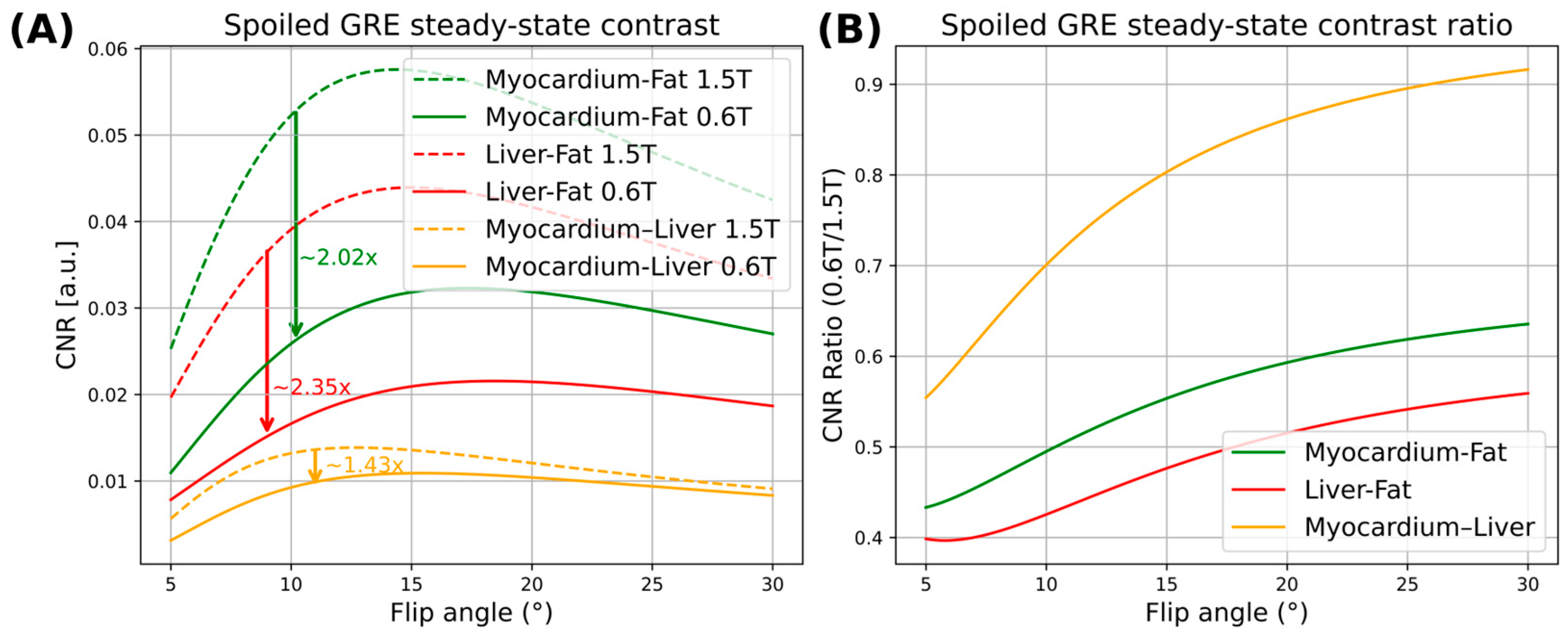
Respiration-induced motion is reflected by superior–inferior (SI) displacement of the heart–liver interface [33], making this anatomical interface the primary contributor to the motion visible in 1D projection profiles. These profiles also include signal contributions from subcutaneous and abdominal fat. Because fat appears bright in T1-weighted imaging, elevated fat signals can partially obscure the modulation arising from the heart–liver interface. A comparison of relative contrast-to-noise ratios (CNR) between 0.6 T and 1.5 T for fat, myocardium, and liver interfaces depending on flip angle is shown in Figure 1. The corresponding ratios between 0.6 T and 1.5 T are included. Relaxation parameters ( T 1   a n d   T 2 ) for 0.6 T and 1.5 T were taken from [39]. Accordingly, a 2.0–2.4 reduction in CNR is expected at 0.6 T when compared to 1.5 T, potentially compromising the accuracy and precision of self-gating approaches.

2.2. Self-Gating

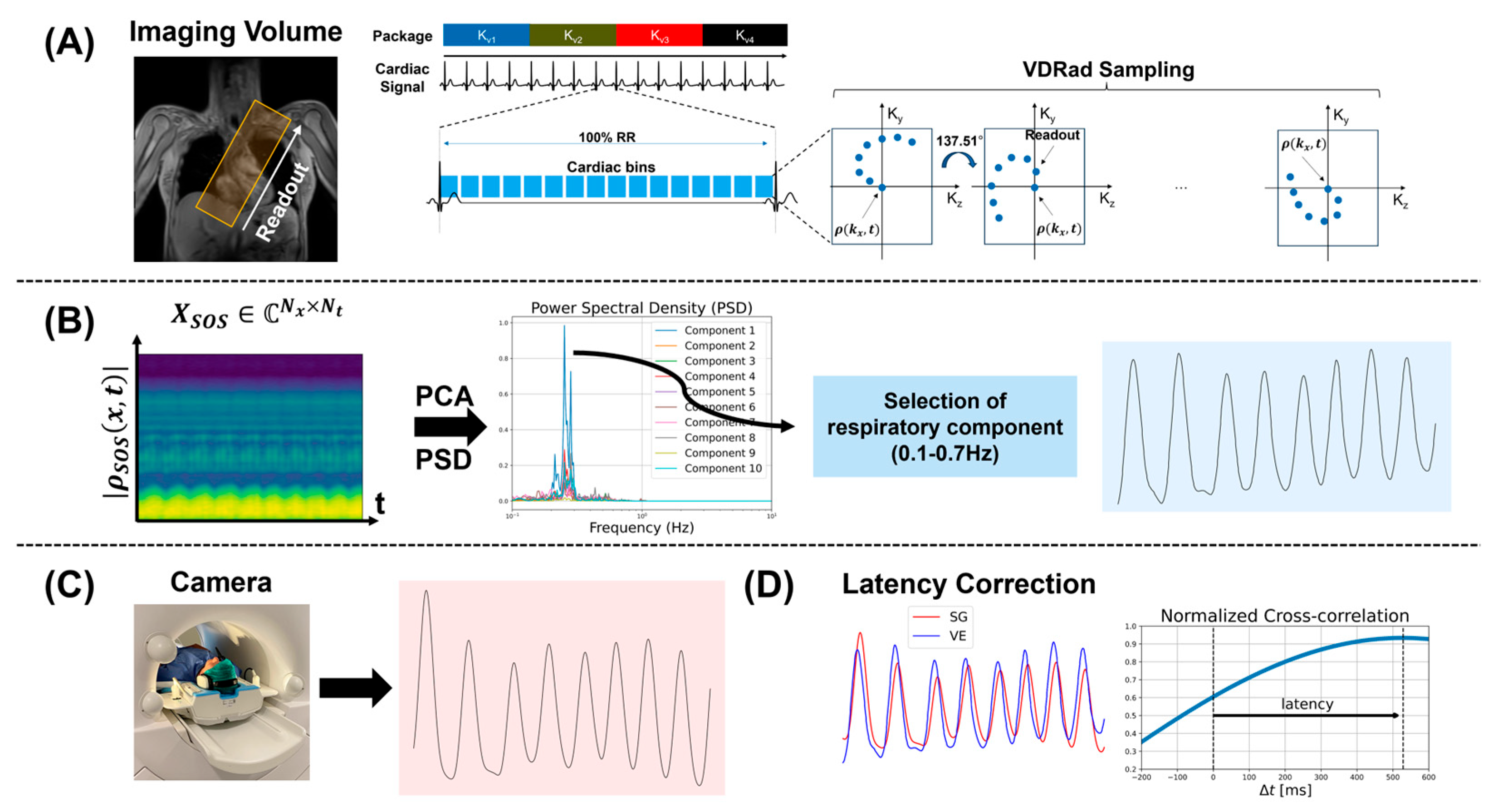
Self-gating signals are obtained by repetitively sampling the k-space center profiles as part of, e.g., pseudo-spiral Cartesian sampling (VDRad) [11] (Figure 2A):
S c ( k x , t ) = ρ c ( x , t ) · e i k x x d x ,
where S c ( k x , t ) is the 1D k-space profile for coil c ( c [ 1 , N C ] ) at time t ( t [ 1 , N t ] ) and ρ c x , t is the respective coil-weighted profile at that time.
Upon inverse Fourier transform of S c ( k x , t ) , the projection matrix X c ( x , t ) C N x × N t of the excited volume resolved along the spatial axis x over time is obtained. The projection was sampled approximately every 45 ms in our work, leading to a sampling rate of 22 Hz. The magnitude of the signal was used to derive the respiratory signal.
To extract respiratory motion from multi-coil 1D profiles, several strategies have been proposed in the literature [30,56]. Owing to spatially varying coil sensitivity profiles, individual coils emphasize different anatomical regions within the field of view. In this study, coil information was combined using a sum-of-squares (SOS) approach [28] (Figure 2B):
X s o s = c = 1 N c | X c | 2 R N x × N t ,
and principal component analysis (PCA) was applied to the resulting SOS projection. The first ten principal components were computed, and the respiratory motion signal was identified as the component exhibiting the maximum spectral power density within the expected breathing frequency range [0.1–0.7] Hz.
All data (=package) for one velocity encode (Kvi) were collected before acquiring the next velocity encode (Kvi+1) to reduce eddy current (EC)-related modulations of the SG signal [11] (Figure 2A).

2.3. Camera Gating

The camera was positioned to target the subject’s chest, capturing movements associated with breathing (Figure 2C). The recorded video was divided into equally sized rectangular patches, and video patches exhibiting periodic respiratory motion were automatically identified [47]. These patches were then weighted according to the strength of the detected motion, and the resulting signal was combined to provide an estimate of the subject’s respiratory motion.
To address potential processing and physiology-related latency of the camera-based respiratory signal [54], the VE signal y ( t ) was temporally aligned to the SG signal x ( t )   using normalized cross-correlation (Figure 2D). The relative delay Δ t was determined using:
max Δ t c o v ( x ( t ) , y ( t + Δ t ) ) v a r ( x ( t ) ) v a r ( y ( t + Δ t ) )

2.4. Data Acquisition and Reconstruction

Pseudo-spiral undersampled Cartesian four-point 4D flow MRI [11] was implemented, and data were acquired on a prototype 0.6 T MRI system (Philips Healthcare, Best, The Netherlands) equipped with high-performance gradients (max strength: 45 mT/m, max slew rate: 200 T/m/s) and a 32-channel receive coil. Data were obtained from 20 volunteers (age: 32.8 ± 12.6 years, Table 1) following written informed consent and in compliance with institutional and ethical guidelines.
All scans were retrospectively cardiac-gated using a vector electrocardiogram (VCG), and the camera-based respiratory signal was obtained using the VitalEye (VE) camera [19]. A sagittal oblique field-of-view (360 mm × 240–188 mm × 60 mm) covering the thoracic aorta was prescribed (Figure 2A), with an isotropic spatial resolution of 2.5 mm3. Further parameters are listed in Table 2. Additionally, three separate two-point breath-hold 2D PC-GRE scans, encoding velocities in- and through-plane, were acquired as reference, using a transverse slice positioned perpendicular to the ascending aorta at the level of the pulmonary trunk (Table 2).
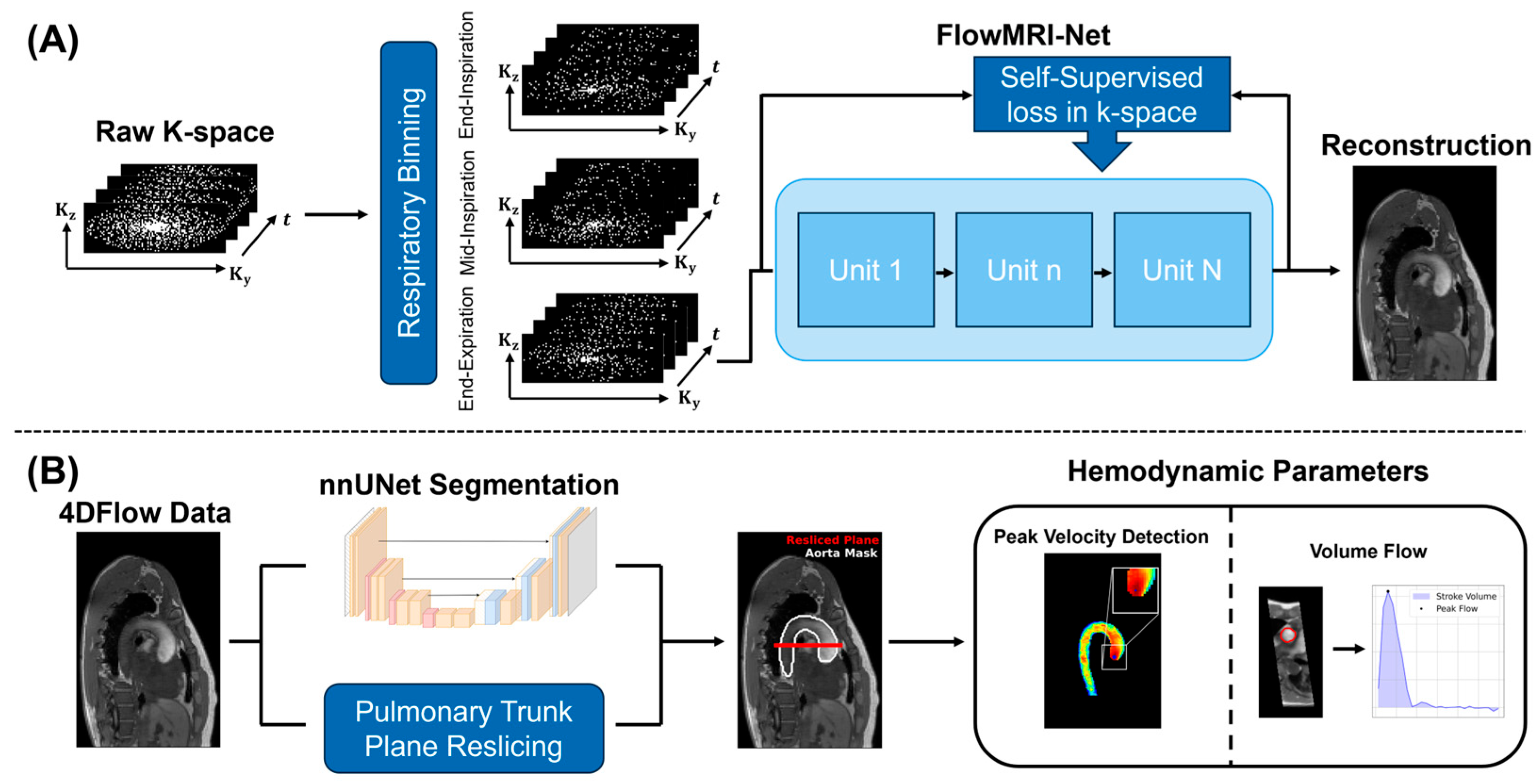
Respiratory gating was performed using either the SG signal or the VE system to bin the k-space data into three equally populated respiratory bins (Figure 3A). This binning strategy was chosen to provide a compromise between residual intra-bin respiratory motion and the increase in the effective undersampling associated with subdividing the data. Reconstruction was subsequently performed for the end-expiratory state (Figure 3A), resulting in an effective undersampling factor of approximately 12–13.5 for the end-expiratory bin.
Data using either SG or VE binning were reconstructed using FlowMRI-Net [12] (Figure 3A). Transfer learning was employed by initializing FlowMRI-Net with publicly available weights from pre-training on ten aortic 4D flow MRI acquisitions acquired at 1.5 T [57], which were subsequently fine-tuned for 100 epochs on four held-out acquisitions of the current 0.6 T data. Fine-tuning took ~2 days on an NVIDIA Titan RTX GPU and 32-core Intel Xeon Gold 6130 CPU. Once trained, image reconstruction took ~3 min per subject. Reconstructions were corrected for concomitant field terms [58] and first-order background phase correction was applied [59]. Potential velocity aliasing in-plane (AP and RL) was corrected using a 4D Laplacian algorithm [60].
The 2D PC-GRE scans were reconstructed using a standard parallel-imaging reconstruction pipeline available in precon (GyroTools LLC, Winterthur, Switzerland).

2.5. Data Analysis

2.5.1. Respiratory Analysis

To compare respiratory curves derived using SG ( x ( t ) ) and VE ( y ( t ) ) , the maximum of the cross-correlation function:
ρ x y ( τ ) = c o v ( x ( t ) , y ( t + τ ) ) σ x σ y
was quantified, where σ x and σ y denote the standard deviations of x ( t ) and y ( t ) , and c o v ( x ( t ) , y ( t ) ) denotes the covariance between the two signals.
To evaluate bin-level agreement, the end-expiratory state was treated as the positive class and the other two bins as the negative class, effectively formulating the problem as a binary classification task. The binning accuracy was computed as the fraction of time points for which the two signals were assigned to the same respiratory bin:
a c c u r a c y = T P + T N T P + T N + F P + F N
where TP are the true positives, TN the true negatives, FP the false positives and FN the false negatives. A respiratory consistency matrix was generated to provide characterization of bin-level agreement and disagreement, while the F1-score was calculated as a metric that simultaneously accounts for both precision and recall:
F 1 = 2 × r e c a l l × p r e c i s i o n r e c a l l + p r e c i s i o n = 2 T P 2 T P + F P + F N

2.5.2. 2D Analysis

An axial 2D slice orthogonal to the ascending aorta was extracted from the 3D volume at the level of the pulmonary trunk to enable comparison of flow rate and stroke volume between 2D and 4D flow MRI data (Figure 3B). Correlation plots and Bland–Altman analyses between VE and SG relative to the 2D reference are provided. The statistical significance of differences was calculated using a paired Wilcoxon signed-rank test with p < 0.05.

2.5.3. 3D Analysis

To compare 3D velocity vector field maps between SG and VE, the aorta was automatically segmented using a customized nnUNet network [61,62] (Figure 3B). The velocity maps were subsequently computed and masked using the segmentation mask ( M ( x , y , z ) ). To compare SG and VE-based reconstructions, the root-mean-square error ( R M S E v ) was computed within the vessel mask:
R M S E v ( u , v ) = i M u i v i 2
for the vector field components u i (SG) and v i (VE) and averaged across all cardiac phases.
The mean directional error (mDirrErr) within the vessel mask was computed for the systolic frames as:
m D i r r E r r ( u , v ) = 1 | M | i M 1 u i , v i u i 2 v i 2 .
and averaged over these frames.
Furthermore, the velocity magnitude ( v e l m a g = v x 2 + v y 2 + v z 2 ) was computed and a pixelwise correlation analysis was performed. The coefficient of variation ( R 2 ) is reported as a measure of the goodness of fit.
Peak velocities within the ascending aorta were extracted (Figure 3B), and agreement between VE and SG was assessed using Bland–Altmann analysis. To identify the region of maximum velocities, a non-maximum suppression strategy was employed at peak systole. First, a maximum intensity projection (MIP) was computed across the slice dimension to generate a 2D MIP map:
v e l m i p ( x , y ) = max z Z : M ( x , y , z ) = 1 v e l m a g ( x , y , z ) .
Subsequently, a sliding-kernel analysis was performed within the aortic mask. For each kernel position, the mean velocity was calculated, and the kernel yielding the highest mean velocity was designated as the peak velocity location:
μ p = 1 K p i , j K p v e l m i p i , j , p = max p μ p ,
where K p is a (4 × 4) kernel with all pixels belonging to M ( x , y , z ) . Peak velocity was then defined as the maximum voxel-wise velocity contained within this kernel:
v e l p e a k = max i , j K p v e l m i p ( i , j )

3. Results

3.1. Respiratory Gating Analysis

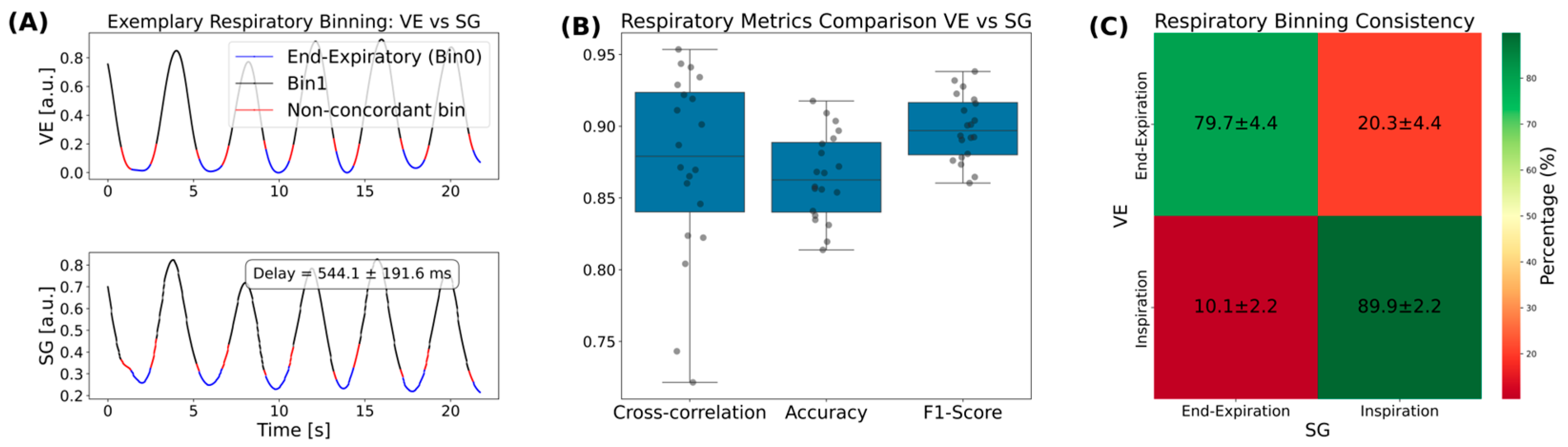
Exemplary VE and SG signals are shown in Figure 4A with indicated respiratory binning. The mean delay between the signals was found to be 544 ms across the cohort. The corresponding cross-correlation was 0.87 ± 0.07, the accuracy 0.87 ± 0.03 and the F1-score 0.90 ± 0.02 (Figure 4B). Respiratory consistency analysis (Figure 4C) revealed that 79.7 ± 4.4% of bins corresponding to the end-expiratory state were concordant between both respiratory gating methods and that 20.3 ± 4.4% were non-concordant. The inspiration bin concordance was 89.9 ± 2.2% (10.1 ± 2.2% discordant).

3.2. 2D Analysis

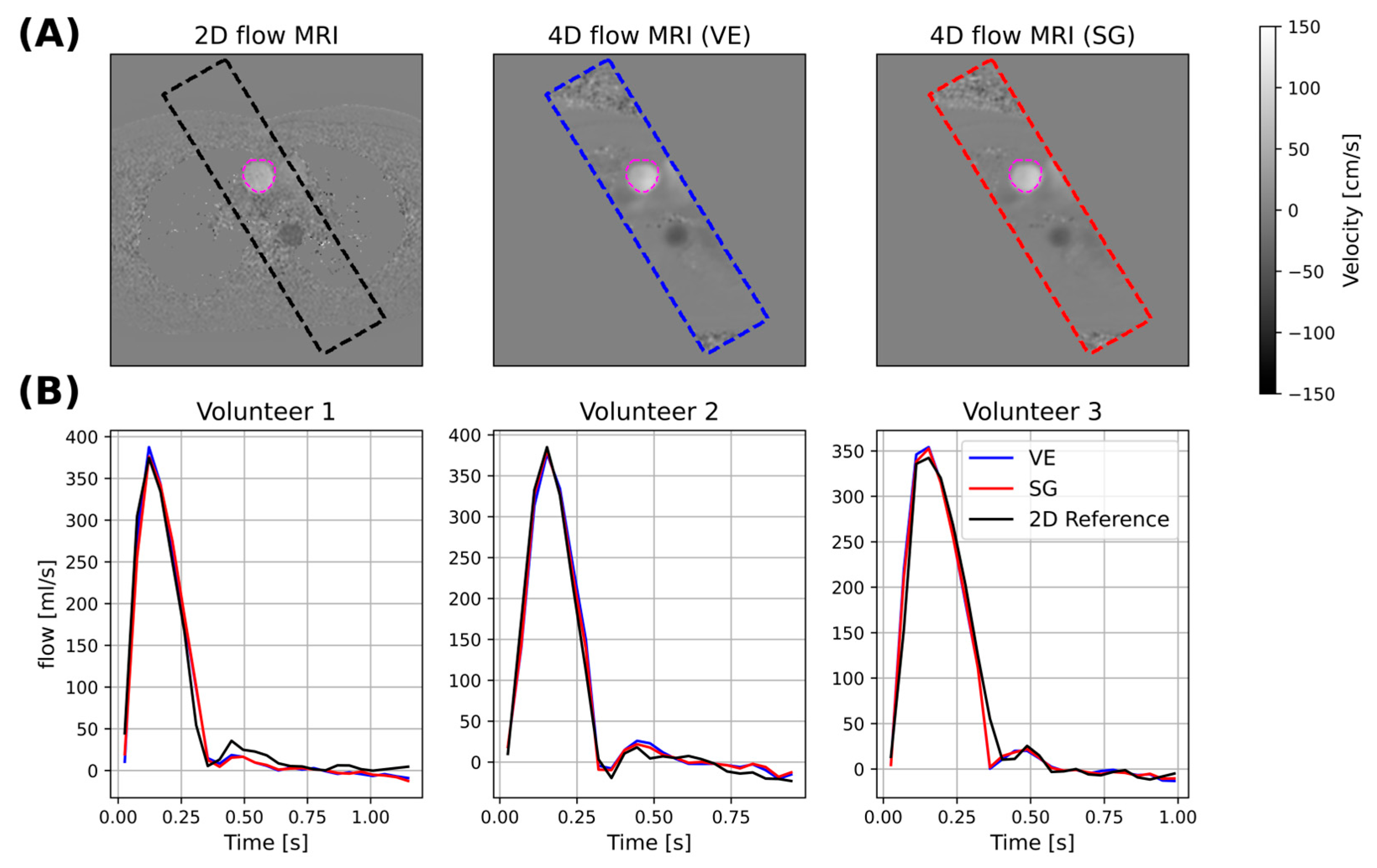
An example peak-systolic through-plane velocity map of the 2D flow MRI reference is compared to corresponding planes extracted from VE and SG 4D flow MRI data in Figure 5A.
Figure 5B shows the extracted flow curves from the 2D reference and the resliced 2D plane from VE and SG for three different volunteers. The flow profiles agree qualitatively for the three different cases.
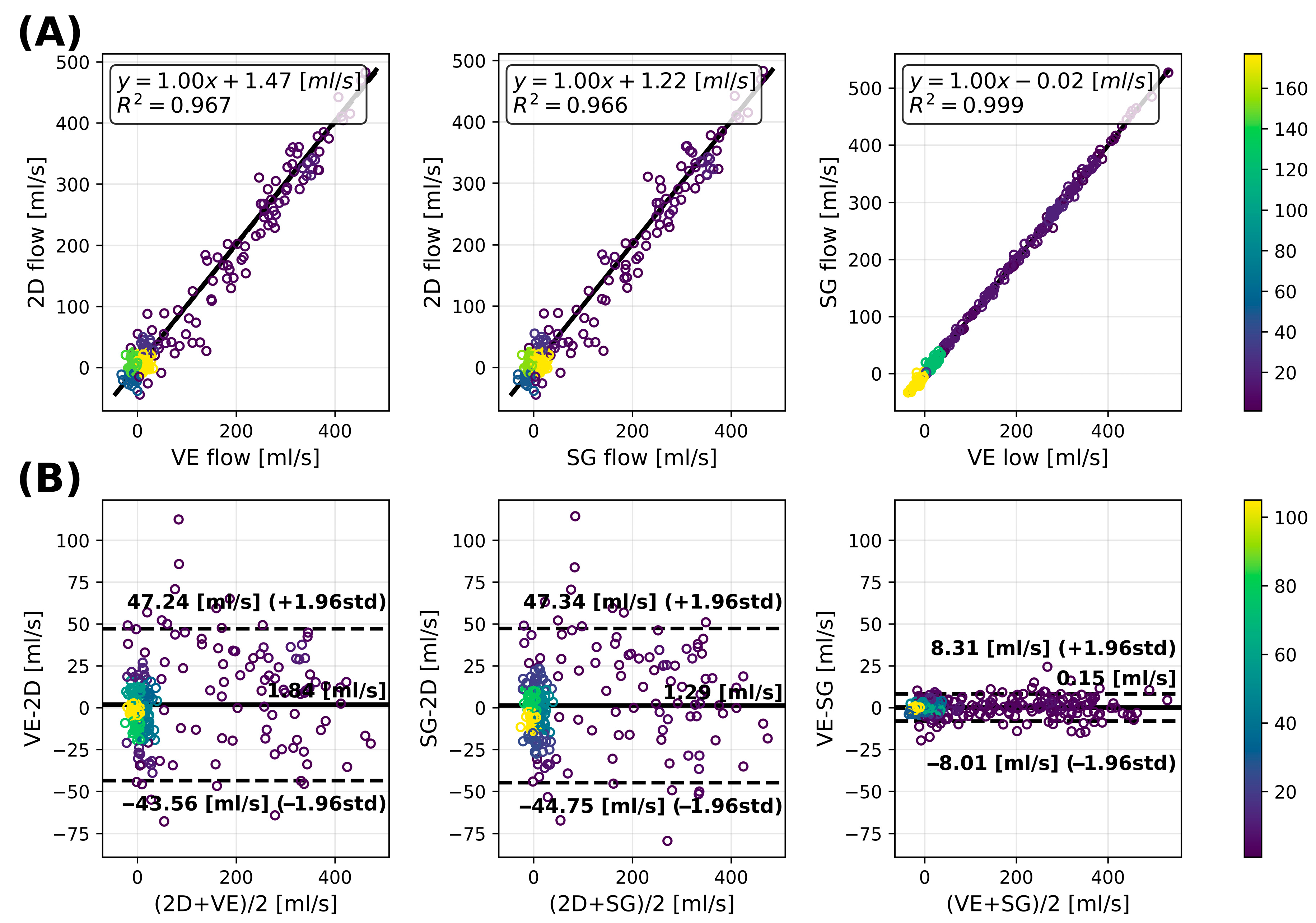
Quantitative results of the flow analysis are presented in Figure 6 and evaluated using correlation and Bland–Altman analyses. Good correlations were observed between the 2D flow and the 4D flow acquisition for both VE and SG (Figure 6A; R2 = 0.967 and R2 = 0.966, respectively). An excellent correlation was also observed between the VE and SG methods (R2 = 0.999). Bland–Altman analysis (Figure 6B) demonstrated a small bias between the 2D reference and the VE and SG methods (1.84 and 1.29 mL/s, respectively), with limits of agreement (−43.56 to 47.24 mL/s and −44.75 to 47.34 mL/s, respectively). In contrast, no relevant bias was observed between the VE and SG methods (0.15 mL/s), with narrow limits of agreement (−8.31 to 8.01 mL/s).
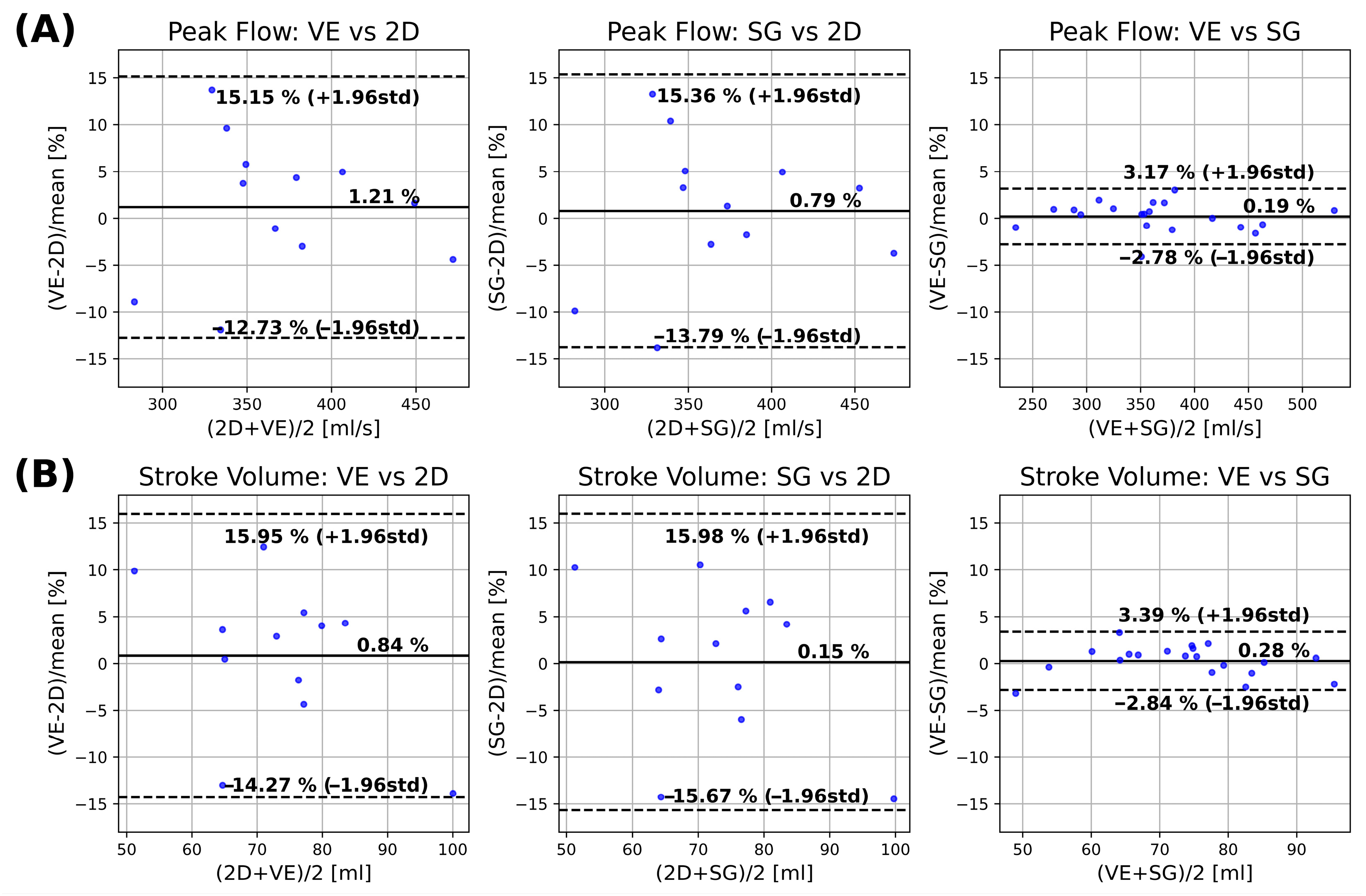
Agreement of hemodynamic parameters is shown in Figure 7 for peak flow (Figure 7A) and stroke volume (Figure 7B). Peak flow analysis shows a small bias between 2D flow and 4D flow MRI for VE and SG (1.21% and 0.79%), neither of which was significantly different from zero (p = 0.582 and p = 0.622). The corresponding limits of agreement were (−12.73 to 15.15% and −13.79 to 15.36%). Comparison between 4D VE and SG shows a non-significant bias (0.19%, p = 0.43) with narrow limits of agreement (−2.78 to 3.17%). Stroke volume analysis revealed biases between the 2D reference and the 4D VE and SG methods (0.84% and 0.15%, respectively), neither of which were statistically significant (p = 0.622 and p = 0.850). The corresponding limits of agreement were (−14.27 to 15.95% and −15.67 to 15.98%). Comparison between the 4D VE and SG methods showed a non-significant bias (0.28%, p = 0.368) with limits of agreement of (−2.84 to 3.39%).

3.3. 3D Analysis

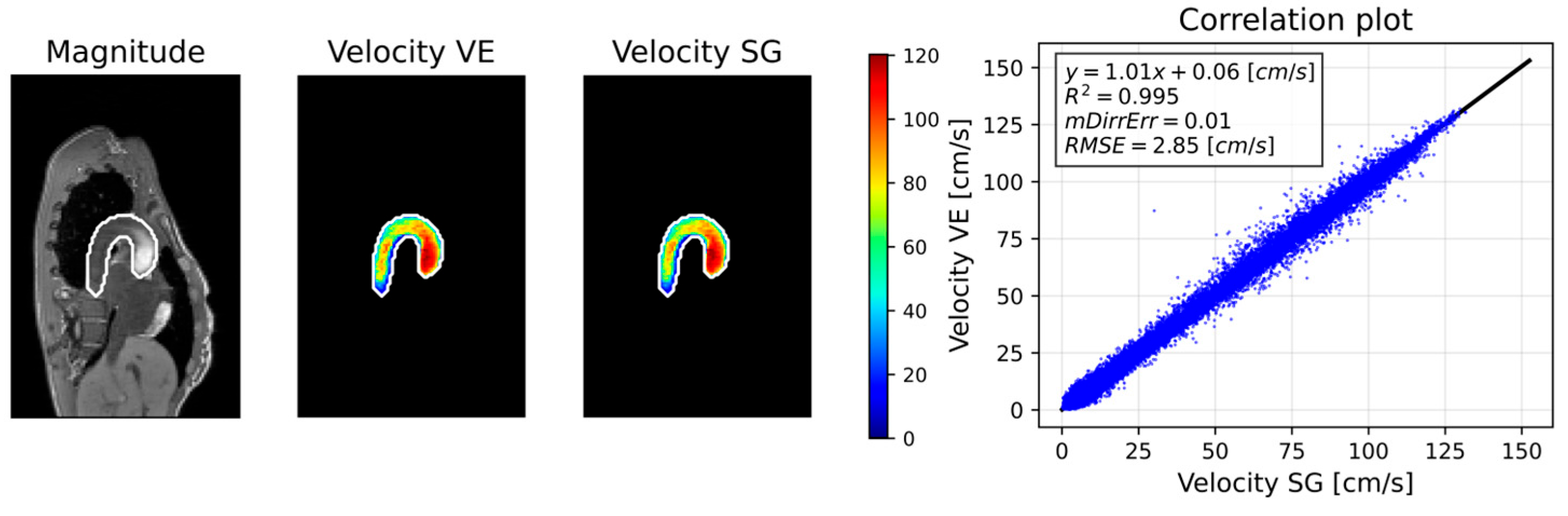
Figure 8 illustrates 4D flow reconstructions using VE versus SG in one volunteer, along with corresponding velocity correlations. Table 3 summarizes the results of the velocity field analysis across the cohort. A linear relationship was measured across all volunteers, with an average R 2 = 0.99 ± 0.009 and an intercept of 0.19 ± 0.28 cm/s. The velocity RMSE was 3.9 ± 1.02   cm/s, and the directional error (mDirErr) was 0.01 ± 0.007 .
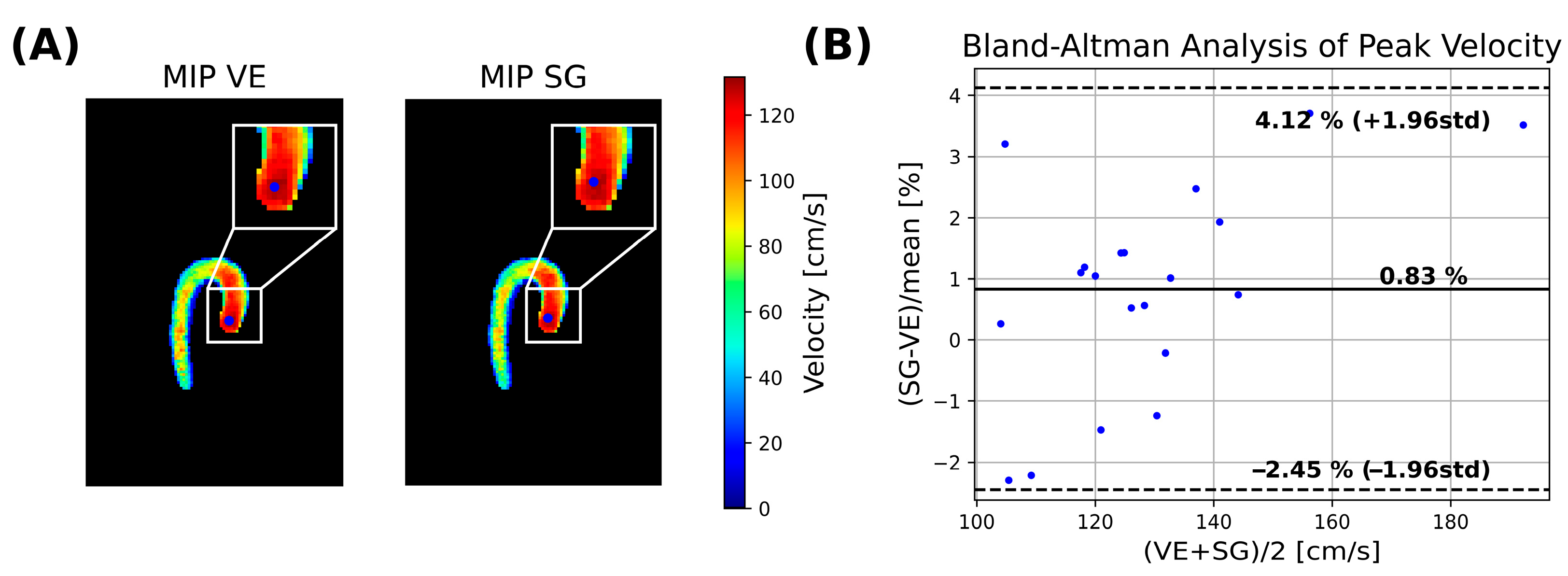
Peak velocity comparison (Figure 9B) yielded a bias of −0.83% (p = 0.064), with limits of agreement of (−2.45% to 4.12%).

4. Discussion

4D flow MRI was successfully implemented on a prototype 0.6 T system. Good agreement between the VE and SG signals was found after delay correction, indicating that binning into the end-expiratory bin using either VE or SG was sufficiently reliable. Overall, the analysis of respiratory binning demonstrated a good correlation, high accuracy, and high F1-score between VE and SG. Bin assignment was concordant in about 80% of cases between VE and SG. The remaining 20% is attributed to differences in signal amplitude and shape between VE and SG signals, given that different body structures are tracked with the two approaches.
Compared with the 2D flow MRI reference, 4D flow MRI showed a tendency toward slight overestimation of flow for both VE and SG. The variability of both 4D flow methods compared with the 2D reference was similar. Subsequent direct comparison between VE and SG further demonstrated that the two methods were in close agreement, with negligible bias and low variability for both flow and derived hemodynamic parameters.
The slight overestimation of 4D flow relative to the 2D reference is somewhat counterintuitive and contrasts with the general expectations described in the 4D flow consensus paper [2]. In this study, a slice thickness of 10 mm was employed to increase the SNR of 2D flow MRI at 0.6 T, making the measurements more susceptible to misalignment and partial-volume effects [63]. Another contributor may relate to the velocity encoding package interleaving scheme, which increases the sensitivity to hemodynamic changes over the duration of the scan compared with TR- or beat-interleaving schemes. Further studies are needed to investigate these effects.
Comparison of velocity flow fields revealed good agreement between VE and SG reconstructions. Vector field fidelity, evaluated using the root-mean-square error (RMSE) of velocity vectors, demonstrated low error levels, while directional errors calculated over systolic frames were slightly lower than values previously reported in the literature [12]. Peak velocity estimates further exhibited good agreement, with SG- and VE-based reconstructions showing negligible bias and narrow limits of agreement in Bland–Altman analysis.
This study has several limitations. First, the relatively small number of volunteers and hence limited statistical power prevents drawing generalizable conclusions regarding the comparison between the two gating methods. Second, the study population consisted of relatively lean volunteers only. Therefore, future work should evaluate the robustness of both SG and VE across broader body morphologies and in larger cohorts. Third, the SG and VE signals were aligned using cross-correlation to account for temporal delays between the two signals. This approach required the presence of both signals and cannot be applied when only VE is available. For the purposes of this feasibility study, we applied the alignment, but would like to note that further development of delay correction strategies is required in the future.

5. Conclusions

In this feasibility study, respiratory self-gating and camera-based respiratory binning yielded similar image quality and hemodynamic measurements from 4D flow MRI at 0.6 T. The camera-based approach offers practical advantages, as it is independent of imaging SNR. Further studies in larger and more diverse populations are needed to fully assess the robustness and generalizability of the methods at mid-field.

Author Contributions

Conceptualization, S.E. and S.K.; methodology, S.E., L.J., G.W., E.E. and J.S.; software, S.E., L.J., G.W., E.E. and J.S.; validation, S.E.; formal analysis, S.E.; investigation, S.E., J.M., Y.D. and M.N.; resources, Y.D., M.N., E.E. and J.S.; data curation, S.E. and J.M.; writing—original draft preparation, S.E.; writing—review and editing, L.J., J.M., G.W.,Y.D., M.N. and S.K.; visualization, S.E.; supervision, S.K.; project administration, M.N. and S.K.; funding acquisition, M.N. and S.K. All authors have read and agreed to the published version of the manuscript.

Funding

This research was funded by the Swiss National Science Foundation, grant numbers 325230_197702 and 200021-231558, as well as by the European Partnership on Metrology (22HLT02 A4IM), co-financed by the European Union’s Horizon Europe Research and Innovation Program and by the Participating States and by the collaboration project 0.6 T, which is co-funded by PPS Allowance made available by Health Holland to stimulate public–private partnerships and supports the contribution of MN and YD.

Institutional Review Board Statement

The study was conducted in accordance with the Declaration of Helsinki and approved by the Institutional Review Board of the Leiden University Medical Center.

Informed Consent Statement

Informed consent was obtained from all subjects involved in the study.

Data Availability Statement

The original contributions presented in this study are included in the article. Further inquiries can be directed to the corresponding author.

Acknowledgments

The authors would like to acknowledge the support and expert advice of Peter Boernert at Philips Research Hamburg, Germany, during the setup and testing of the 0.6 T prototype system.

Conflicts of Interest

Jouke Smink and Ece Ercan are employees of Philips Healthcare.

Abbreviations

The following abbreviations are used in this manuscript:
1DOne-dimensional
3DThree-dimensional
4DFour-dimensional
5DFive-dimensional
RFradiofrequency
MRIMagnetic resonance imaging
VEVitalEye
SGSelf-gating
ECEddy currents
PCAPrincipal component analysis
SNRSignal-to-noise ratio
CNRContrast-to-noise ratio
BMIBody mass index
TRRepetition time
TEEcho time
SISuperior-inferior
SOSSum-of-square
ECGElectrocardiogram
FHFeet-head
APAntero-posterior
RLRight-left
VNRVelocity-to-noise ratio
LoALimits of agreement
VDRadVariable-Density and Radial view ordering
mDirrErrDirectional error
RMSERoot-mean-square error
CMRCardiovascular magnetic resonance
bSSFPBalanced steady-state free precession
PCPhase-contrast

References

  1. Markl, M.; Frydrychowicz, A.; Kozerke, S.; Hope, M.; Wieben, O. 4D Flow MRI. J. Magn. Reson. Imaging 2012, 36, 1015–1036. [Google Scholar] [CrossRef]
  2. Dyverfeldt, P.; Bissell, M.; Barker, A.J.; Bolger, A.F.; Carlhäll, C.-J.; Ebbers, T.; Francios, C.J.; Frydrychowicz, A.; Geiger, J.; Giese, D.; et al. 4D Flow Cardiovascular Magnetic Resonance Consensus Statement. J. Cardiovasc. Magn. Reson. 2015, 17, 72. [Google Scholar] [CrossRef]
  3. Dyverfeldt, P.; Ebbers, T. Comparison of Respiratory Motion Suppression Techniques for 4D Flow MRI. Magn. Reson. Med. 2017, 78, 1877–1882. [Google Scholar] [CrossRef]
  4. Santelli, C.; Nezafat, R.; Goddu, B.; Manning, W.J.; Smink, J.; Kozerke, S.; Peters, D.C. Respiratory Bellows Revisited for Motion Compensation: Preliminary Experience for Cardiovascular MR. Magn. Reson. Med. 2011, 65, 1097–1102. [Google Scholar] [CrossRef] [PubMed]
  5. Ehman, R.; McNamara, M.; Pallack, M.; Hricak, H.; Higgins, C. Magnetic Resonance Imaging with Respiratory Gating: Techniques and Advantages. Am. J. Roentgenol. 1984, 143, 1175–1182. [Google Scholar] [CrossRef] [PubMed]
  6. Bissell, M.M.; Raimondi, F.; Ait Ali, L.; Allen, B.D.; Barker, A.J.; Bolger, A.; Burris, N.; Carhäll, C.-J.; Collins, J.D.; Ebbers, T.; et al. 4D Flow Cardiovascular Magnetic Resonance Consensus Statement: 2023 Update. J. Cardiovasc. Magn. Reson. 2023, 25, 40. [Google Scholar] [CrossRef] [PubMed]
  7. Ehman, R.L.; Felmlee, J.P. Adaptive Technique for High-Definition MR Imaging of Moving Structures. Radiology 1989, 173, 255–263. [Google Scholar] [CrossRef]
  8. Danias, P.G.; McConnell, M.V.; Khasgiwala, V.C.; Chuang, M.L.; Edelman, R.R.; Manning, W.J. Prospective Navigator Correction of Image Position for Coronary MR Angiography. Radiology 1997, 203, 733–736. [Google Scholar] [CrossRef]
  9. Wang, Y.; Rossman, P.J.; Grimm, R.C.; Riederer, S.J.; Ehman, R.L. Navigator-Echo-Based Real-Time Respiratory Gating and Triggering for Reduction of Respiration Effects in Three-Dimensional Coronary MR Angiography. Radiology 1996, 198, 55–60. [Google Scholar] [CrossRef]
  10. Falcão, M.B.L.; Di Sopra, L.; Ma, L.; Bacher, M.; Yerly, J.; Speier, P.; Rutz, T.; Prša, M.; Markl, M.; Stuber, M.; et al. Pilot Tone Navigation for Respiratory and Cardiac Motion-Resolved Free-Running 5D Flow MRI. Magn. Reson. Med. 2022, 87, 718–732. [Google Scholar] [CrossRef]
  11. Walheim, J.; Dillinger, H.; Kozerke, S. Multipoint 5D Flow Cardiovascular Magnetic Resonance—Accelerated Cardiac- and Respiratory-Motion Resolved Mapping of Mean and Turbulent Velocities. J. Cardiovasc. Magn. Reson. 2019, 21, 42. [Google Scholar] [CrossRef] [PubMed]
  12. Jacobs, L.; Piccirelli, M.; Vishnevskiy, V.; Kozerke, S. FlowMRI-Net: A Generalizable Self-Supervised 4D Flow MRI Reconstruction Network. J. Cardiovasc. Magn. Reson. 2025, 27, 101913. [Google Scholar] [CrossRef]
  13. Ma, L.E.; Yerly, J.; Piccini, D.; Di Sopra, L.; Roy, C.W.; Carr, J.C.; Rigsby, C.K.; Kim, D.; Stuber, M.; Markl, M. 5D Flow MRI: A Fully Self-Gated, Free-Running Framework for Cardiac and Respiratory Motion–Resolved 3D Hemodynamics. Radiol. Cardiothorac. Imaging 2020, 2, e200219. [Google Scholar] [CrossRef]
  14. Walheim, J.; Dillinger, H.; Gotschy, A.; Kozerke, S. 5D Flow Tensor MRI to Efficiently Map Reynolds Stresses of Aortic Blood Flow In-Vivo. Sci. Rep. 2019, 9, 18794. [Google Scholar] [CrossRef]
  15. Di Sopra, L.; Piccini, D.; Coppo, S.; Stuber, M.; Yerly, J. An Automated Approach to Fully Self-Gated Free-Running Cardiac and Respiratory Motion-Resolved 5D Whole-Heart MRI. Magn. Reson. Med. 2019, 82, 2118–2132. [Google Scholar] [CrossRef]
  16. Feng, L.; Coppo, S.; Piccini, D.; Yerly, J.; Lim, R.P.; Masci, P.G.; Stuber, M.; Sodickson, D.K.; Otazo, R. 5D Whole-Heart Sparse MRI. Magn. Reson. Med. 2018, 79, 826–838. [Google Scholar] [CrossRef]
  17. Madore, B.; Hess, A.T.; van Niekerk, A.M.J.; Hoinkiss, D.C.; Hucker, P.; Zaitsev, M.; Afacan, O.; Günther, M. External Hardware and Sensors, for Improved MRI. J. Magn. Reson. Imaging 2023, 57, 690–705. [Google Scholar] [CrossRef]
  18. Maclaren, J.; Aksoy, M.; Bammer, R. Contact-Free Physiological Monitoring Using a Markerless Optical System. Magn. Reson. Med. 2015, 74, 571–577. [Google Scholar] [CrossRef]
  19. Gottwald, L.M.; Blanken, C.P.S.; Tourais, J.; Smink, J.; Planken, R.N.; Boekholdt, S.M.; Meijboom, L.J.; Coolen, B.F.; Strijkers, G.J.; Nederveen, A.J.; et al. Retrospective Camera-Based Respiratory Gating in Clinical Whole-Heart 4D Flow MRI. J. Magn. Reson. Imaging 2021, 54, 440–451. [Google Scholar] [CrossRef] [PubMed]
  20. Solomon, E.; Rigie, D.S.; Vahle, T.; Paška, J.; Bollenbeck, J.; Sodickson, D.K.; Boada, F.E.; Block, K.T.; Chandarana, H. Free-Breathing Radial Imaging Using a Pilot-Tone Radiofrequency Transmitter for Detection of Respiratory Motion. Magn. Reson. Med. 2021, 85, 2672–2685. [Google Scholar] [CrossRef] [PubMed]
  21. Chen, C.; Liu, Y.; Simonetti, O.P.; Tong, M.; Jin, N.; Bacher, M.; Speier, P.; Ahmad, R. Cardiac and Respiratory Motion Extraction for MRI Using Pilot Tone–A Patient Study. Int. J. Cardiovasc. Imaging 2024, 40, 93–105. [Google Scholar] [CrossRef]
  22. Vahle, T.; Bacher, M.; Rigie, D.; Fenchel, M.; Speier, P.; Bollenbeck, J.; Schäfers, K.P.; Kiefer, B.; Boada, F.E. Respiratory Motion Detection and Correction for MR Using the Pilot Tone: Applications for MR and Simultaneous PET/MR Examinations. Investig. Radiol. 2020, 55, 153. [Google Scholar] [CrossRef] [PubMed]
  23. Tasdelen, B.; Yagiz, E.; Cinbis, B.R.; Tian, Y.; Nayak, K.S. Contactless Cardiac Gating at 0.55 T Using High-Amplitude Pilot Tone with Interference Cancellation (HAPTIC). Magn. Reson. Med. 2025, 94, 1182–1190. [Google Scholar] [CrossRef]
  24. Liang, X.; Bi, Z.; Yang, C.; Sheng, R.; Xia, X.; Zhang, Z.; Dai, Y.; Zeng, M. Free-Breathing Liver Magnetic Resonance Imaging with Respiratory Frequency-Modulated Continuous-Wave Radar-Trigger Technique: A Preliminary Study. Front. Oncol. 2022, 12, 918173. [Google Scholar] [CrossRef] [PubMed]
  25. Lee, W.; Ryu, K.; Li, Z.; Oscanoa, J.; Wu, Y.; Robb, F.; Vasanawala, S.; Pauly, J.; Scott, G. MRI Retrospective Respiratory Gating and Cardiac Sensing by CW Doppler Radar: A Feasibility Study. IEEE Trans. Biomed. Eng. 2025, 72, 112–122. [Google Scholar] [CrossRef]
  26. Wang, H.; Li, Y.; Xia, X.; Hu, L.; Zhao, J.; Chen, Q. Non-Contact Respiratory Triggering for Clinical MRI Using Frequency Modulated Continuous Wave Radar. In Proceedings of the Medical Imaging 2021: Physics of Medical Imaging; SPIE: Bellingham, WA, USA, 2021; Volume 11595, pp. 268–275. [Google Scholar]
  27. McGrath, C.; Bieri, O.; Kozerke, S.; Bauman, G. Self-Gated Cine Phase-Contrast Balanced SSFP Flow Quantification at 0.55 T. Magn. Reson. Med. 2024, 91, 174–189. [Google Scholar] [CrossRef]
  28. Paul, J.; Divkovic, E.; Wundrak, S.; Bernhardt, P.; Rottbauer, W.; Neumann, H.; Rasche, V. High-Resolution Respiratory Self-Gated Golden Angle Cardiac MRI: Comparison of Self-Gating Methods in Combination with k-t SPARSE SENSE. Magn. Reson. Med. 2015, 73, 292–298. [Google Scholar] [CrossRef] [PubMed]
  29. Piccini, D.; Feng, L.; Bonanno, G.; Coppo, S.; Yerly, J.; Lim, R.P.; Schwitter, J.; Sodickson, D.K.; Otazo, R.; Stuber, M. Four-Dimensional Respiratory Motion-Resolved Whole Heart Coronary MR Angiography. Magn. Reson. Med. 2017, 77, 1473–1484. [Google Scholar] [CrossRef]
  30. Pang, J.; Sharif, B.; Fan, Z.; Bi, X.; Arsanjani, R.; Berman, D.S.; Li, D. ECG and Navigator-Free Four-Dimensional Whole-Heart Coronary MRA for Simultaneous Visualization of Cardiac Anatomy and Function. Magn. Reson. Med. 2014, 72, 1208–1217. [Google Scholar] [CrossRef]
  31. Weiss, E.K.; Baraboo, J.; Rigsby, C.K.; Robinson, J.D.; Ma, L.; Falcão, M.B.L.; Roy, C.W.; Stuber, M.; Markl, M. Respiratory-Resolved Five-Dimensional Flow Cardiovascular Magnetic Resonance: In-Vivo Validation and Respiratory-Dependent Flow Changes in Healthy Volunteers and Patients with Congenital Heart Disease. J. Cardiovasc. Magn. Reson. 2024, 26, 101077. [Google Scholar] [CrossRef]
  32. Holtackers, R.J.; Stuber, M. Free-Running Cardiac and Respiratory Motion-Resolved Imaging: A Paradigm Shift for Managing Motion in Cardiac MRI? Diagnostics 2024, 14, 1946. [Google Scholar] [CrossRef] [PubMed]
  33. Wang, Y.; Riederer, S.J.; Ehman, R.L. Respiratory Motion of the Heart: Kinematics and the Implications for the Spatial Resolution in Coronary Imaging. Magn. Reson. Med. 1995, 33, 713–719. [Google Scholar] [CrossRef]
  34. Roy, C.W.; Milani, B.; Yerly, J.; Si-Mohamed, S.; Romanin, L.; Bustin, A.; Tenisch, E.; Rutz, T.; Prsa, M.; Stuber, M. Intra-Bin Correction and Inter-Bin Compensation of Respiratory Motion in Free-Running Five-Dimensional Whole-Heart Magnetic Resonance Imaging. J. Cardiovasc. Magn. Reson. 2024, 26, 101037. [Google Scholar] [CrossRef]
  35. Deng, Z.; Pang, J.; Yang, W.; Yue, Y.; Sharif, B.; Tuli, R.; Li, D.; Fraass, B.; Fan, Z. Four-Dimensional MRI Using Three-Dimensional Radial Sampling with Respiratory Self-Gating to Characterize Temporal Phase-Resolved Respiratory Motion in the Abdomen. Magn. Reson. Med. 2016, 75, 1574–1585. [Google Scholar] [CrossRef]
  36. Pruitt, A.; Rich, A.; Liu, Y.; Jin, N.; Potter, L.; Tong, M.; Rajpal, S.; Simonetti, O.; Ahmad, R. Fully Self-Gated Whole-Heart 4D Flow Imaging from a 5-Minute Scan. Magn. Reson. Med. 2021, 85, 1222–1236. [Google Scholar] [CrossRef] [PubMed]
  37. Denecken, E.; Sotelo, J.; Arrieta, C.; Andia, M.E.; Uribe, S. Impact of Respiratory Gating on Hemodynamic Parameters from 4D Flow MRI. Appl. Sci. 2022, 12, 2943. [Google Scholar] [CrossRef]
  38. Bastkowski, R.; Weiss, K.; Maintz, D.; Giese, D. Self-Gated Golden-Angle Spiral 4D Flow MRI. Magn. Reson. Med. 2018, 80, 904–913. [Google Scholar] [CrossRef]
  39. Campbell-Washburn, A.E.; Ramasawmy, R.; Restivo, M.C.; Bhattacharya, I.; Basar, B.; Herzka, D.A.; Hansen, M.S.; Rogers, T.; Bandettini, W.P.; McGuirt, D.R.; et al. Opportunities in Interventional and Diagnostic Imaging by Using High-Performance Low-Field-Strength MRI. Radiology 2019, 293, 384–393. [Google Scholar] [CrossRef]
  40. Guenthner, C.; Peereboom, S.M.; Dillinger, H.; McGrath, C.; Albannay, M.M.; Vishnevskiy, V.; Fuetterer, M.; Luechinger, R.; Jenneskens, T.; Sturzenegger, U.; et al. Ramping down a Clinical 3 T Scanner: A Journey into MRI and MRS at 0.75 T. Magn. Reson. Mater. Phys. Biol. Med. 2023, 36, 355–373. [Google Scholar] [CrossRef]
  41. Bandettini, W.P.; Shanbhag, S.M.; Mancini, C.; McGuirt, D.R.; Kellman, P.; Xue, H.; Henry, J.L.; Lowery, M.; Thein, S.L.; Chen, M.Y.; et al. A Comparison of Cine CMR Imaging at 0.55 T and 1.5 T. J. Cardiovasc. Magn. Reson. 2020, 22, 37. [Google Scholar] [CrossRef] [PubMed]
  42. Varghese, J.; Jin, N.; Giese, D.; Chen, C.; Liu, Y.; Pan, Y.; Nair, N.; Shalaan, M.T.; Khan, M.; Tong, M.S.; et al. Building a Comprehensive Cardiovascular Magnetic Resonance Exam on a Commercial 0.55 T System: A Pictorial Essay on Potential Applications. Front. Cardiovasc. Med. 2023, 10, 1120982. [Google Scholar] [CrossRef] [PubMed]
  43. Segeroth, M.; Winkel, D.J.; Vosshenrich, J.; Breit, H.-C.; Giese, D.; Haaf, P.; Zellweger, M.J.; Bremerich, J.; Santini, F.; Pradella, M. Cardiac Cine MRI Using a Commercially Available 0.55-T Scanner. Radiol. Cardiothorac. Imaging 2024, 6, e230331. [Google Scholar] [CrossRef]
  44. Sieber, X.; Binzel, K.; Varghese, J.; Liu, Y.; Yerly, J.; Roy, C.W.; Antiochos, P.; Prsa, M.; van Heeswijk, R.B.; Simonetti, O.P.; et al. Measuring Biventricular Function and Left Atrial Volume in a Single Five-Dimensional Whole-Heart Cardiovascular Magnetic Resonance Scan at 0.55 T. J. Cardiovasc. Magn. Reson. 2025, 27, 101906. [Google Scholar] [CrossRef]
  45. Xiang, J.; Ramasawmy, R.; Seemann, F.; Peters, D.C.; Campbell-Washburn, A.E. Balanced Steady-State Free Precession Phase Contrast at 0.55 T Applied to Aortic Flow. J. Cardiovasc. Magn. Reson. 2024, 26, 101098. [Google Scholar] [CrossRef]
  46. Kruger, M.G.; Springer, R.P.W.; Kersten, G.M.; Bril, R.J. Contact-Less Vital Sign Monitoring Using a COTS Resource-Constrained Multi-Core System. In Proceedings of the IECON 2019—45th Annual Conference of the IEEE Industrial Electronics Society, Lisbon, Portugal, 14–17 October 2019; Volume 1, pp. 3057–3062. [Google Scholar]
  47. Rocque, M. Fully Automated Contactless Respiration Monitoring Using a Camera. In Proceedings of the 2016 IEEE International Conference on Consumer Electronics (ICCE), Las Vegas, NV, USA, 7–11 January 2016; pp. 478–479. [Google Scholar]
  48. Stelter, J.; Weiss, K.; Steinhelfer, L.; Meineke, J.; Zhang, W.; Kainz, B.; Braren, R.F.; Karampinos, D.C. Abdominal Simultaneous 3D Water T1 and T2 Mapping Using a Free-Breathing Cartesian Acquisition with Spiral Profile Ordering. Magn. Reson. Med. 2026, 95, 268–285. [Google Scholar] [CrossRef]
  49. Krishnamoorthy, G.; Tourais, J.; Smink, J.; Breeuwer, M.; Kouwenhoven, M. Free-Breathing 2D Radial Cine MRI with Respiratory Auto-Calibrated Motion Correction (RAMCO). Magn. Reson. Med. 2023, 89, 977–989. [Google Scholar] [CrossRef]
  50. Wu, C.; Krishnamoorthy, G.; Yu, V.; Subashi, E.; Rimner, A.; Otazo, R. 4D Lung MRI with High-Isotropic-Resolution Using Half-Spoke (UTE) and Full-Spoke 3D Radial Acquisition and Temporal Compressed Sensing Reconstruction. Phys. Med. Biol. 2023, 68, 035017. [Google Scholar] [CrossRef]
  51. Murray, V.; Wu, C.; Otazo, R. High-Definition Motion-Resolved MRI Using 3D Radial Kooshball Acquisition and Deep Learning Spatial-Temporal 4D Reconstruction. Phys. Med. Biol. 2025, 70, 125012. [Google Scholar] [CrossRef] [PubMed]
  52. Harder, F.; Lohöfer, F.K.; Kaissis, G.A.; Zoellner, C.; Kamal, O.; Katemann, C.; Hock, A.; Senegas, J.; Peeters, J.M.; Rummeny, E.J.; et al. Camera-Based Respiratory Triggering Improves the Image Quality of 3D Magnetic Resonance Cholangiopancreatography. Eur. J. Radiol. 2019, 120, 108675. [Google Scholar] [CrossRef] [PubMed]
  53. He, M.; Xu, J.; Wu, Q.; Wang, X.; Ren, J.; Wang, X.; Xue, H.; Jin, Z. Application of Compressed Sensing 3D MR Cholangiopancreatography (CS-MRCP) with Contact-Free Physiological Monitoring (CFPM) for Pancreaticobiliary Disorders. Acad. Radiol. 2021, 28, S148–S156. [Google Scholar] [CrossRef]
  54. (ISMRM 2020) Retrospective Camera-Based Respiratory Binning for 4D Flow MRI—A Comparison with Liver Navigator and Self-Gating. Available online: https://archive.ismrm.org/2020/1330.html (accessed on 7 January 2026).
  55. Markl, M.; Leupold, J. Gradient Echo Imaging. J. Magn. Reson. Imaging 2012, 35, 1274–1289. [Google Scholar] [CrossRef]
  56. Zhang, T.; Cheng, J.Y.; Chen, Y.; Nishimura, D.G.; Pauly, J.M.; Vasanawala, S.S. Robust Self-Navigated Body MRI Using Dense Coil Arrays. Magn. Reson. Med. 2016, 76, 197–205. [Google Scholar] [CrossRef]
  57. Jacobs, L.; Piccirelli, M.; Vishnevskiy, V.; Kozerke, S. FlowMRI-Net Dataset, for Aortic and Cerebrovascular 4D Flow MRI; ETH Zurich: Zurich, Switzerland, 2025. [Google Scholar] [CrossRef]
  58. Bernstein, M.A.; Zhou, X.J.; Polzin, J.A.; King, K.F.; Ganin, A.; Pelc, N.J.; Glover, G.H. Concomitant Gradient Terms in Phase Contrast MR: Analysis and Correction. Magn. Reson. Med. 1998, 39, 300–308. [Google Scholar] [CrossRef] [PubMed]
  59. Busch, J.; Giese, D.; Kozerke, S. Image-Based Background Phase Error Correction in 4D Flow MRI Revisited. J. Magn. Reson. Imaging 2017, 46, 1516–1525. [Google Scholar] [CrossRef] [PubMed]
  60. Loecher, M.; Schrauben, E.; Johnson, K.M.; Wieben, O. Phase Unwrapping in 4D MR Flow with a 4D Single-Step Laplacian Algorithm. J. Magn. Reson. Imaging 2016, 43, 833–842. [Google Scholar] [CrossRef] [PubMed]
  61. (ISMRM 2025) Joint Magnitude and Phase Neural Network Segmentation for Cine 2D Flow MRI. Available online: https://archive.ismrm.org/2025/3505.html (accessed on 25 November 2025).
  62. (ISMRM 2025) Synthetically Trained Convolutional Neural Network Vessel Segmentation for 4D Flow MRI. Available online: https://archive.ismrm.org/2025/3506_0XsfdUQkw.html (accessed on 25 November 2025).
  63. Bernstein, M.A.; King, K.F.; Zhou, X.J. Chapter 9—Motion-Sensitizing Gradients. In Handbook of MRI Pulse Sequences; Bernstein, M.A., King, K.F., Zhou, X.J., Eds.; Academic Press: Burlington, MA, USA, 2004; pp. 274–291. [Google Scholar]
Figure 1. (A) Comparison of contrast-to-noise ratios (CNR) for tissue combinations present in the projection at the heart–liver interface as a function of flip angle. Tissue combinations include myocardium (heart)-liver, liver-fat and myocardium-fat. (B) Corresponding CNRs (right) for 0.6 T versus 1.5 T.
Bioengineering 13 00282 g001
Figure 2. Overview of data acquisition and respiratory signal processing. (A) Pseudo-spiral Cartesian sampling scheme (VDRad) with sampling of the center of k-space at each spiral arm ( ρ ( k x ,   t ) ). All data (=package) for one velocity encoding (Kvi) were collected before acquiring the next velocity encode (Kvi+1) to reduce eddy current (EC)-related modulations. (B) Respiratory motion is extracted from 1D profiles over time, yielding signal modulation at the heart-liver interface. Data from different coils are combined using the sum-of-squares (SOS) method to obtain projection matrix X S O S ( x ,   t ) . Thereafter, principal component analysis (PCA) is applied and the first ten principal components are extracted. The principal component with the maximum power within the breathing frequency range of [0.1–0.7] Hz of the power spectrum density (PSD) is selected as the breathing signal. (C) Camera system (VE) to record chest motion of the subject, providing an SNR- and EC-independent measurement of the respiratory signal. (D) Example respiratory signals (SG and VE). The normalized cross-correlation is used to correct for the systematic delay between the two signals.
Bioengineering 13 00282 g002
Figure 3. (A) Data reconstruction pipeline. The acquired k-space data are binned into three equally populated respiratory bins using either the SG or VE signals. The end-expiratory state is reconstructed using FlowMRI-Net [12]. (B) The reconstructed 4D Flow MRI data are processed using an automated aortic vessel segmentation network (nnUNet), generating aortic masks (white). Subsequently, a 2D axial slice is extracted at the level of the pulmonary trunk (red) and peak velocities, volume flow and stroke volume are compared relative to the 2D flow MRI reference and between the 4D Flow MRI reconstruction using either SG or VE for respiratory binning.
Bioengineering 13 00282 g003
Figure 4. Respiratory gating analysis. (A) Example respiratory curves for camera-based binning (VE) (top) and self-gating (SG) (bottom). The mean delay between the two signals is shown in the bottom plot. (B) Boxplots of cross-correlation, binning accuracy, and F1-score across all volunteers. (C) Respiratory binning consistency showing correspondence between VE and SG-based binning (mean ± SD, %).
Bioengineering 13 00282 g004
Figure 5. (A) Representative exemplary through-plane velocity maps of the 2D flow MRI reference (left) relative to maps from corresponding slices extracted from the 4D flow MRI data using VE and SG (middle, right). (B) Comparison of time-resolved through-plane aortic flow in three subjects.
Bioengineering 13 00282 g005
Figure 6. (A) Flow correlation analysis between 2D and 4D VE (left), 2D and 4D SG (middle) and 4D VE and 4D SG (right) and (B) Bland–Altman analysis (A). The color bar indicates the number of touching circles.
Bioengineering 13 00282 g006
Figure 7. Bland–Altman analysis of peak flow (A) and stroke volume (B) between 2D and 4D VE (left), 2D and 4D SG (middle) and 4D VE and 4D SG (right).
Bioengineering 13 00282 g007
Figure 8. Exemplary 3D velocity field analysis for one volunteer. The first column shows reconstructed magnitude images with the segmented aortic contour (white). The second and third columns display segmented velocity magnitudes for VE- and SG-based reconstructions, respectively. The right column shows the correlation analysis between both methods (R2). Pixelwise velocity metrics (RMSE, mDirErr) within the segmented aorta are reported.
Bioengineering 13 00282 g008
Figure 9. (A) Maximum intensity projection (MIP)-based extraction of peak velocity within the ascending aorta for one volunteer. The MIPs are shown for VE (left)- and SG (right)-based reconstructions, with peak velocity highlighted with a blue dot. (B) Bland–Altman analysis of extracted peak velocities across the volunteer cohort.
Bioengineering 13 00282 g009
Table 1. Characteristics of the volunteer cohort.
CharacteristicValue
Number of Volunteers20
Age [years]32.8 ± 12.6
Heart Rate [bpm]59.5 ± 8.3
Weight [kg]67.2 ± 7.3
Height [cm]174.4 ± 5.1
Females (%)50
Table 2. Protocol parameters of the 2D and 4D Flow MRI scans.
Parameters2D Flow4D Flow
ECG gatingRetrospectiveRetrospective
Respiratory compensationBreath-holdSG or VE Gating
FOV [mm3]236–260 × 260–280 × 10360 × 240–288 × 60
Voxel size [mm3]1.75 × 1.75 × 10.02.5 × 2.5 × 2.5
Undersampling factor R2~4–4.5
TR [ms]5.95.5–5.9
TE [ms]3.53.3–3.5
Temporal resolution [ms]41–4242–46
Flip angle [°]1515
Venc [cm/s] (FH-AP-RL)150–100–100150–100–100
Bandwidth [Hz]335478
Scan duration~20 s~9.6 min
Table 3. Metrics resulting from the 3D velocity field analysis across all volunteers.
MetricsMean ± Std.
RMSE [cm/s]3.9 ± 1.02
mDirrErr [a.u.]0.01 ± 0.007
Slope [a.u.]1.0 ± 0.008
Intercept [cm/s]0.19 ± 0.28
R2 [a.u.]0.99 ± 0.009
Disclaimer/Publisher’s Note: The statements, opinions and data contained in all publications are solely those of the individual author(s) and contributor(s) and not of MDPI and/or the editor(s). MDPI and/or the editor(s) disclaim responsibility for any injury to people or property resulting from any ideas, methods, instructions or products referred to in the content.