
Clinical Outcomes of ICSI Using Advanced Quantitative Phase Microscopy
 , ,
, ,
Abstract
1. Introduction
2. Materials and Methods
2.1. Study Design
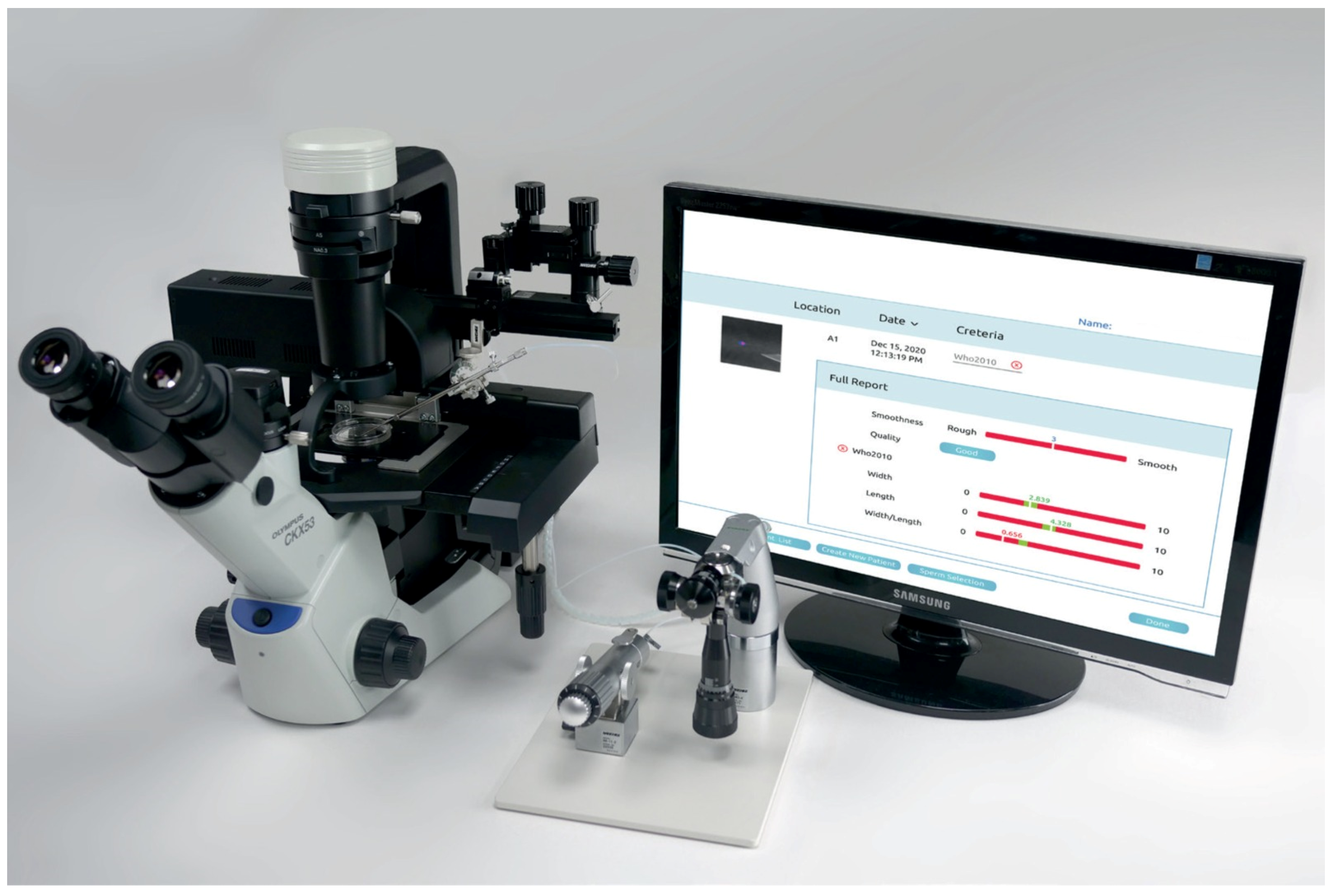
2.2. QPM Workflow and Sperm Selection Method
2.3. IVF Treatment Protocol
2.4. Frozen Embryo Transfer Protocols
2.5. Luteal Support
2.6. Sperm Preparation and Selection
2.7. IMSI Procedure
2.8. Study Outcomes
2.9. Statistical Analysis
3. Results
3.1. QPM Cycles vs. Self-Control and Historical Cohort Groups
3.2. QPM Cycles vs. IMSI Cycles
4. Discussion
Supplementary Materials
Author Contributions
Funding
Institutional Review Board Statement
Informed Consent Statement
Data Availability Statement
Acknowledgments
Conflicts of Interest
Abbreviations
| CPR | Clinical pregnancy rate |
| ICSI | Intracytoplasmic sperm injection |
| IMSI | Intracytoplasmic morphologically selected sperm injection |
| LBR | Life birth rate |
| OPU | Ovum pick-up |
| QPM | Quantitative phase microscopy |
References
- Louis, J.F.; Thoma, M.E.; Sørensen, D.N.; McLain, A.C.; King, R.B.; Sundaram, R.; Keiding, N.; Louis, G.M.B. The prevalence of couple infertility in the United States from a male perspective: Evidence from a nationally representative sample. Andrology 2013, 1, 741–748. [Google Scholar] [CrossRef]
- Rama, N.; Lescay, H.; Raheem, O. Male Factor Infertility: What Every OB/GYN Should Know. Obstet. Gynecol. Clin. N. Am. 2023, 50, 763–777. [Google Scholar] [CrossRef]
- Kumar, N.; Singh, A.K. Trends of male factor infertility, an important cause of infertility: A review of literature. J. Hum. Reprod. Sci. 2015, 8, 191–196. [Google Scholar] [CrossRef] [PubMed]
- Mann, U.; Shiff, B.; Patel, P. Reasons for worldwide decline in male fertility. Curr. Opin. Urol. 2020, 30, 296–301. [Google Scholar] [CrossRef] [PubMed]
- Huang, B.; Wang, Z.; Kong, Y.; Jin, M.; Ma, L. Global, regional and national burden of male infertility in 204 countries and territories between 1990 and 2019: An analysis of global burden of disease study. BMC Public Health 2023, 23, 2195. [Google Scholar] [CrossRef]
- Levine, H.; Jørgensen, N.; Martino-Andrade, A.; Mendiola, J.; Weksler-Derri, D.; Mindlis, I.; Pinotti, R.; Swan, S.H. Temporal trends in sperm count: A systematic review and meta-regression analysis. Hum. Reprod. Update 2017, 23, 646–659. [Google Scholar] [CrossRef] [PubMed]
- Tiegs, A.W.; Landis, J.; Garrido, N.; Scott, R.T.; Hotaling, J.M. Total Motile Sperm Count Trend Over Time: Evaluation of Semen Analyses From 119,972 Men From Subfertile Couples. Urology 2019, 132, 109–116. [Google Scholar] [CrossRef]
- Palermo, G.D.; Neri, Q.V.; Rosenwaks, Z. To ICSI or Not to ICSI. Semin. Reprod. Med. 2015, 33, 92–102. [Google Scholar] [CrossRef]
- Henningsen, A.-K.A.; Opdahl, S.; Wennerholm, U.-B.; Tiitinen, A.; Rasmussen, S.; Romundstad, L.B.; Bergh, C.; Gissler, M.; Forman, J.L.; Pinborg, A. Risk of congenital malformations in live-born singletons conceived after intracytoplasmic sperm injection: A Nordic study from the CoNARTaS group. Fertil. Steril. 2023, 120, 1033–1041. [Google Scholar] [CrossRef]
- ESHRE Special Interest Group of Embryology and Alpha Scientists in Reproductive Medicine. The Vienna consensus: Report of an expert meeting on the development of ART laboratory performance indicators. Reprod. Biomed. Online 2017, 35, 494–510. [Google Scholar] [CrossRef]
- WHO’s Human Reproduction Programme (HRP). WHO Laboratory Manual for the Examination and Processing of Human Semen, 6th ed.; World Health Organization: Geneva, Switzerland, 2021. [Google Scholar]
- Teixeira, D.M.; Miyague, A.H.; Barbosa, M.A.P.; Navarro, P.A.; Raine-Fenning, N.; Nastri, C.O.; Martins, W.P. Regular (ICSI) versus ultra-high magnification (IMSI) sperm selection for assisted reproduction. Cochrane Database Syst. Rev. 2020, 2, CD010167. [Google Scholar] [CrossRef]
- Gleicher, N.; A Kushnir, V.; Barad, D.H. Worldwide decline of IVF birth rates and its probable causes. Hum. Reprod. Open 2019, 2019, hoz017. [Google Scholar] [CrossRef]
- Cassuto, N.G.; Hazout, A.; Hammoud, I.; Balet, R.; Bouret, D.; Barak, Y.; Jellad, S.; Plouchart, J.M.; Selva, J.; Yazbeck, C. Correlation between DNA defect and sperm-head morphology. Reprod. Biomed. Online 2012, 24, 211–218. [Google Scholar] [CrossRef]
- Gunes, S.; El-Mazny, A.; Moretti, E. The relevance of sperm morphology in male infertility. Front. Reprod. Health 2022, 4, 945351. [Google Scholar]
- Auger, J.; Jouannet, P.; Eustache, F. Another look at human sperm morphology. Hum. Reprod. 2016, 31, 10–23. [Google Scholar] [CrossRef]
- Jakubik-Uljasz, J.; Gill, K.; Rosiak-Gill, A.; Piasecka, M. Relationship between sperm morphology and sperm DNA dispersion. Transl. Androl. Urol. 2020, 9, 405–415. [Google Scholar] [CrossRef] [PubMed]
- Sun, F.; Ko, E.; Martin, R.H. Is there a relationship between sperm chromosome abnormalities and sperm morphology? Reprod. Biol. Endocrinol. 2006, 4, 1. [Google Scholar] [CrossRef] [PubMed]
- Pandruvada, S.; Royfman, R.; Shah, T.A.; Sindhwani, P.; Dupree, J.M.; Schon, S.; Avidor-Reiss, T. Lack of trusted diagnostic tools for undetermined male infertility. J. Assist. Reprod. Genet. 2021, 38, 265–276. [Google Scholar] [CrossRef] [PubMed]
- Bartoov, B.; Berkovitz, A.; Eltes, F.; Kogosowski, A.; Menezo, Y.; Barak, Y. Real-time fine morphology of motile human sperm cells is associated with IVF-ICSI outcome. J. Androl. 2002, 23, 1–8. [Google Scholar] [CrossRef]
- Bartoov, B.; Berkovitz, A.; Eltes, F.; Kogosovsky, A.; Yagoda, A.; Lederman, H.; Artzi, S.; Gross, M.; Barak, Y. Pregnancy rates are higher with intracytoplasmic morphologically selected sperm injection than with conventional intracytoplasmic injection. Fertil. Steril. 2003, 80, 1413–1419. [Google Scholar] [CrossRef]
- Charles, D.K.; Lange, M.J.; Ortiz, N.M.; Purcell, S.; Smith, R.P. A narrative review of sperm selection technology for assisted reproduction techniques. Transl. Androl. Urol. 2024, 13, 2119–2133. [Google Scholar] [CrossRef]
- Worrilow, K.C.; Eid, S.; Woodhouse, D.; Perloe, M.; Smith, S.; Witmyer, J.; Ivani, K.; Khoury, C.; Ball, G.; Elliot, T.; et al. Use of hyaluronan in the selection of sperm for intracytoplasmic sperm injection (ICSI): Significant improvement in clinical outcomes—Multicenter, double-blinded and randomized controlled trial. Hum. Reprod. 2013, 28, 306–314. [Google Scholar] [CrossRef]
- Miller, D.; Pavitt, S.; Sharma, V.; Forbes, G.; Hooper, R.; Bhattacharya, S.; Kirkman-Brown, J.; Coomarasamy, A.; Lewis, S.; Cutting, R.; et al. Articles Physiological, Hyaluronan-Selected Intracyto-Plasmic Sperm Injection for Infertility Treatment (HABSelect): A Parallel, Two-Group, Randomised Trial. 2019. Available online: https://www.thelancet.com/journals/lancet/article/PIIS0140-6736(18)32989-1/fulltext (accessed on 22 November 2025).
- Michailov, Y.; Amsalem, E.; Umanski, N.; Tamadaev, V.; Friedler, S.; Saar-Ryss, B. Clinical outcome using the Q300™ device in a reproductive laboratory environment: An open-label, non-controlled and non-randomized study. Reprod. Biol. Endocrinol. 2025, 23, 90. [Google Scholar] [CrossRef] [PubMed]
- Michailov, Y.; Nemerovsky, L.; Ghetler, Y.; Finkelstein, M.; Schonberger, O.; Wiser, A.; Raziel, A.; Saar-Ryss, B.; Ben-Ami, I.; Kaplanski, O.; et al. Stain-Free Sperm Analysis and Selection for Intracytoplasmic Sperm Injection Complying with WHO Strict Normal Criteria. Biomedicines 2023, 11, 2614. [Google Scholar] [CrossRef] [PubMed]
- Barnea, I.; Karako, L.; Mirsky, S.K.; Levi, M.; Balberg, M.; Shaked, N.T. Stain-free interferometric phase microscopy correlation with DNA fragmentation stain in human spermatozoa. J. Biophotonics 2018, 11, e201800137. [Google Scholar] [CrossRef] [PubMed]
- Dardikman-Yoffe, G.; Mirsky, S.K.; Barnea, I.; Shaked, N.T. High-resolution 4-D acquisition of freely swimming human sperm cells without staining. Sci. Adv. 2020, 6, eaay7619. [Google Scholar] [CrossRef]
- Pedrosa, M.L.; Furtado, M.H.; Ferreira, M.C.F.; Carneiro, M.M. Sperm selection in ivf: The long and winding road from bench to bedside. J. Bras. Reprod. Assist. 2020, 24, 332–339. [Google Scholar] [CrossRef]
- Farkouh, A.; Salvio, G.; Kuroda, S.; Saleh, R.; Vogiatzi, P.; Agarwal, A. Sperm DNA integrity and male infertility: A narrative review and guide for the reproductive physicians. Transl. Androl. Urol. 2022, 11, 1023–1044. [Google Scholar] [CrossRef] [PubMed]
- Agarwal, A.; Majzoub, A.; Baskaran, S.; Selvam, M.K.P.; Cho, C.L.; Henkel, R.; Finelli, R.; Leisegang, K.; Sengupta, P.; Barbarosie, C.; et al. Sperm DNA fragmentation: A new guideline for clinicians. World J. Men’s Health 2020, 38, 412–471. [Google Scholar] [CrossRef]
- Andrabi, S.W.; Ara, A.; Saharan, A.; Jaffar, M.; Gugnani, N.; Esteves, S.C. Sperm DNA Fragmentation: Causes, evaluation and management in male infertility. J. Bras. Reprod. Assist. 2024, 28, 306–319. [Google Scholar] [CrossRef] [PubMed]


| Variable | QPM | Paired Control (p-Value) | Historical Control (p-Value) |
|---|---|---|---|
| Cycles analyzed (n) | 18 | 14 | 1192 |
| Female age (years) | 33.9 ± 1.2 | 34.2 ± 1.24 (0.04) | 32.8 ± 0.2 (0.39) |
| Male age (years) | 36.9 ± 1.5 | 35.1 ± 2.0 (0.1) | 33.9 ± 0.2 (0.07) |
| Previous cycles | 1.94 ± 0.93 | 1.25 ± 0.63 (0.64) | 1.36 ± 0.05 (0.54) |
| Antagonist protocol, n (%) | 18 (94.4) | 13 (92.8) (0.85) | 1192 (100) (<0.001) |
| Induction (days) | 10.11 ± 0.36 | 11.14 ± 0.67 (0.1) | NA |
| Total dose (units) | 3150.27 ± 291.1 | 3037.9 ± 464 (0.44) | NA |
| Progesterone on trigger day (ng/mL) | 0.56 ± 0.1 | 0.63 ± 0.15 (0.46) | NA |
| Follicles ≥ 13 mm on trigger day | 8.39 ± 4.9 | 7.23 ± 4.4(0.5) | 8.79 ± 5 (0.73) |
| Cumulus oocyte complexes retrieved | 9.06 ± 5.3 | 7.89 ± 5.4 (0.02) | 10.02 ± 6.4 (0.52) |
| Mean maturation rate (%) | 80.6 ± 19.07 | 78.49 ± 18.4 (0.7) | 75.1 ± 22.1 (0.2) |
| Semen volume (mL) | 3.27 ± 1.9 | 2.88 ± 1.9 (0.6) | 3.15 ± 3.7 (0.81) |
| Sperm concentration (106/mL) | 31.81 ± 24 | 41.83 ± 40 (0.3) | 23 ± 31.18 (0.2) |
| Mean sperm motility (%) | 40.56 ± 21.25 | 47.21 ± 19.79 (0.3) | 36.79 ± 21.7 (0.47) |
| Oocytes injected (n) | 124 | 79 | 8973 |
| Variable | QPM | Paired Control (p-Value) | Historical Control (p-Value) |
|---|---|---|---|
| Fertilization rate (%) | 66.48 ± 16.6 | 64.43 ± 25.13 (0.78) | 65.9 ± 23.94 (0.9) |
| KID-3 score | 3.81 ± 0.21 | 4.18 ± 0.25 (0.27) | 3.95 ± 0.13 (0.56) |
| KID-5 score | 6.23 ± 0.32 | 5.09 ± 0.59 (0.12) | 6.27 ± 0.22 (0.91) |
| Usable embryos per fertilization (%) | 61.8 ± 36.8 | 58.03 ± 39.0 (0.7) | 51.0 ± 29.30 (0.1) |
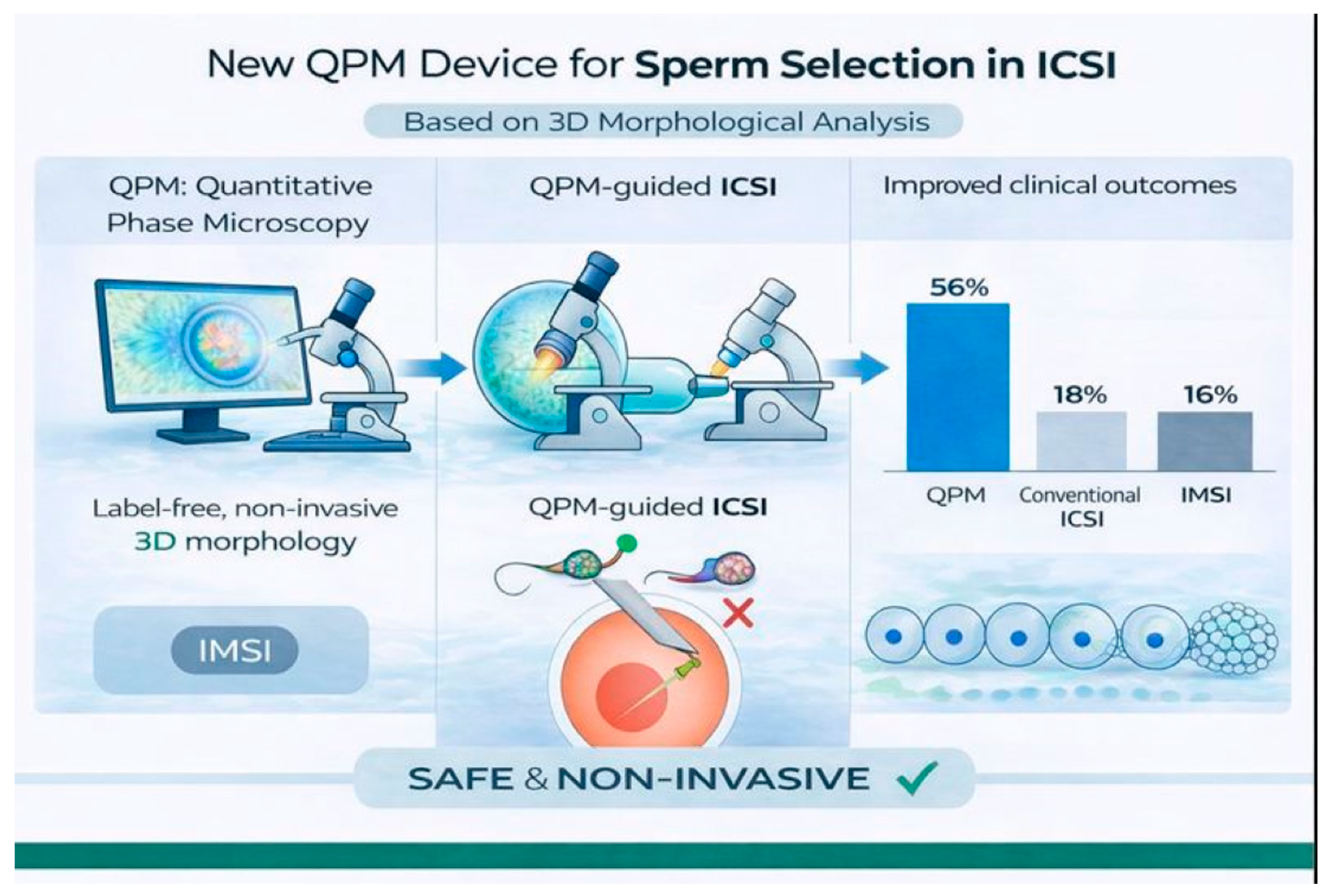
| Pregnancy rate per transfer, n (%) | 9 (56.2) | 2 (18.1) (0.04) | 388 (44.3) (0.3) |
| LBR, n (%) | 8 (50) | 1 (9) (0.02) | NA |
| Variable | QPM | IMSI | p-Value |
|---|---|---|---|
| Cycles analyzed (n) | 18 | 19 | |
| Female age (years) | 33.9 ± 1.2 | 32.4 ± 5.1 | 0.6 |
| Male age (years) | 36.9 ± 1.5 | 33.8 ± 5.5 | 0.02 |
| Antagonist protocol, n (%) | 17 (94.4) | 19 (100) | 0.2 |
| Induction (days) | 10.11 ± 0.36 | 10.26 ± 1.32 | 0.6 |
| Progesterone on trigger day (ng/mL) | 0.56 ± 0.1 | 0.83 ± 0.61 | 0.07 |
| Follicles ≥ 13 mm on trigger day | 8.39 ± 4.9 | 9.89 ± 4.68 | 0.3 |
| Cumulus oocyte complexes retrieved | 9.06 ± 5.3 | 9.89 ± 4.68 | 0.6 |
| Mean maturation rate (%) | 80.6 ± 19.07 | 71.3 ± 23 | 0.3 |
| Oocytes injected (n) | 124 | 118 |
| Variable | QPM | IMSI | p-Value |
|---|---|---|---|
| Fertilization rate (%) | 66.4 ± 16.9 | 74.7 ± 15.3 | 0.1 |
| Usable embryos | 2.66 ± 2.4 | 2.36 ± 1.57 | 0.5 |
| Pregnancy rate per transfer, n (%) | 9 (56.2) | 3 (16.6) | 0.01 |
| LBR, n (%) | 8 (50) | 3 (16.6) | 0.03 |
Disclaimer/Publisher’s Note: The statements, opinions and data contained in all publications are solely those of the individual author(s) and contributor(s) and not of MDPI and/or the editor(s). MDPI and/or the editor(s) disclaim responsibility for any injury to people or property resulting from any ideas, methods, instructions or products referred to in the content. |
© 2026 by the authors. Licensee MDPI, Basel, Switzerland. This article is an open access article distributed under the terms and conditions of the Creative Commons Attribution (CC BY) license.
Share and Cite
Rahav-Koren, R.; Nemerovsky, L.; Ghetler, Y.; Haikin-Herzberger, E.; Salzer-Sheelo, L.; Miller, N.; Wiser, A.; Levi, M. Clinical Outcomes of ICSI Using Advanced Quantitative Phase Microscopy. Bioengineering 2026, 13, 156. https://doi.org/10.3390/bioengineering13020156
Rahav-Koren R, Nemerovsky L, Ghetler Y, Haikin-Herzberger E, Salzer-Sheelo L, Miller N, Wiser A, Levi M. Clinical Outcomes of ICSI Using Advanced Quantitative Phase Microscopy. Bioengineering. 2026; 13(2):156. https://doi.org/10.3390/bioengineering13020156
Chicago/Turabian StyleRahav-Koren, Roni, Luba Nemerovsky, Yehudith Ghetler, Einat Haikin-Herzberger, Liat Salzer-Sheelo, Netanella Miller, Amir Wiser, and Mattan Levi. 2026. "Clinical Outcomes of ICSI Using Advanced Quantitative Phase Microscopy" Bioengineering 13, no. 2: 156. https://doi.org/10.3390/bioengineering13020156
APA StyleRahav-Koren, R., Nemerovsky, L., Ghetler, Y., Haikin-Herzberger, E., Salzer-Sheelo, L., Miller, N., Wiser, A., & Levi, M. (2026). Clinical Outcomes of ICSI Using Advanced Quantitative Phase Microscopy. Bioengineering, 13(2), 156. https://doi.org/10.3390/bioengineering13020156