
Synthesis and Characterization of Ibuprofen–TiO2 Functionalized PCL Biomembranes as Candidate Materials for Wound Dressing Applications
 ,
,  , , , , and
Abstract
1. Introduction
2. Materials and Methods
2.1. Membrane Manufacturing
2.2. Membrane Characterization
2.3. In Vitro Studies
2.4. Statistical Analysis
3. Results
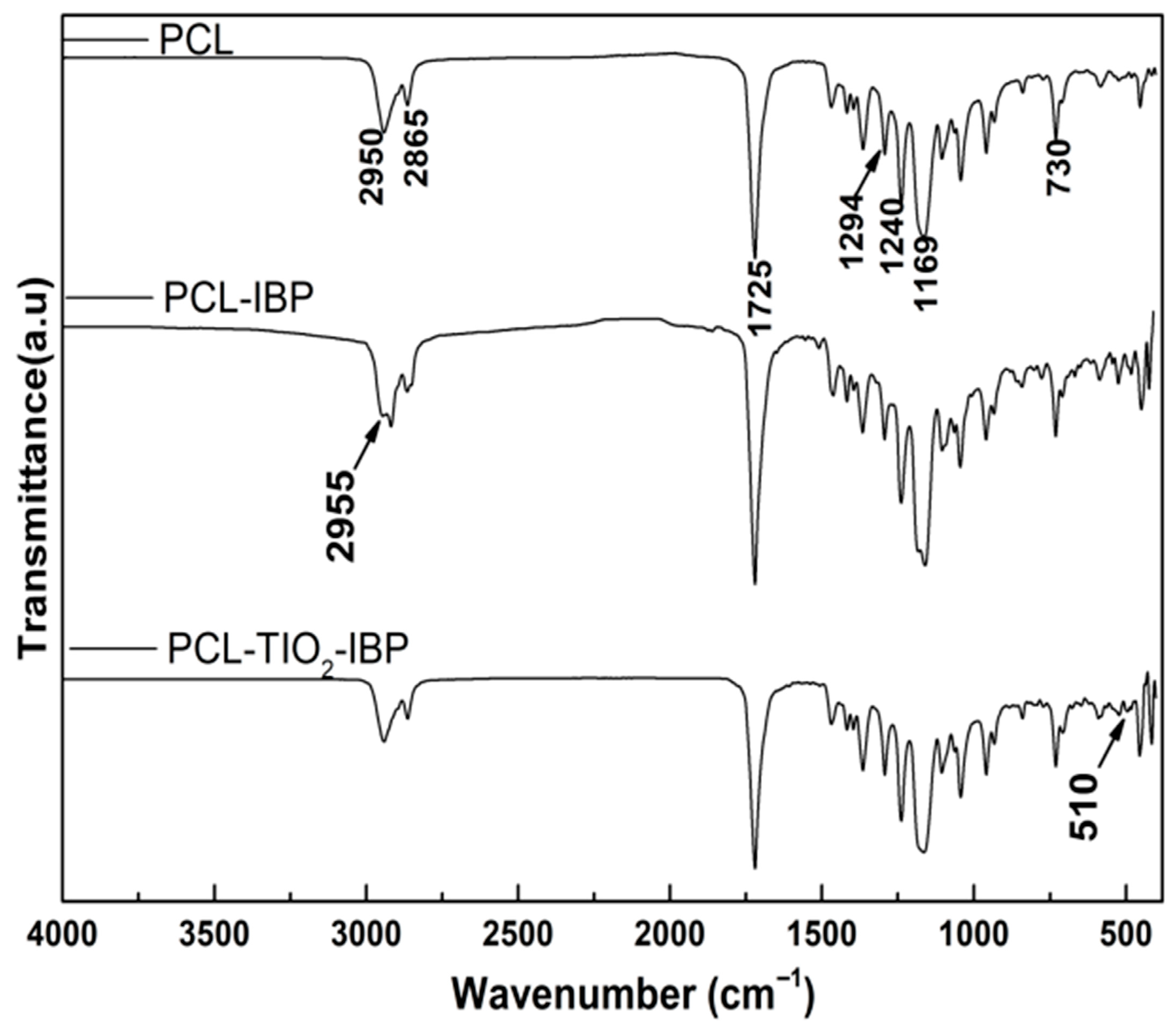
3.1. FTIR and X-Ray Diffraction Analyses
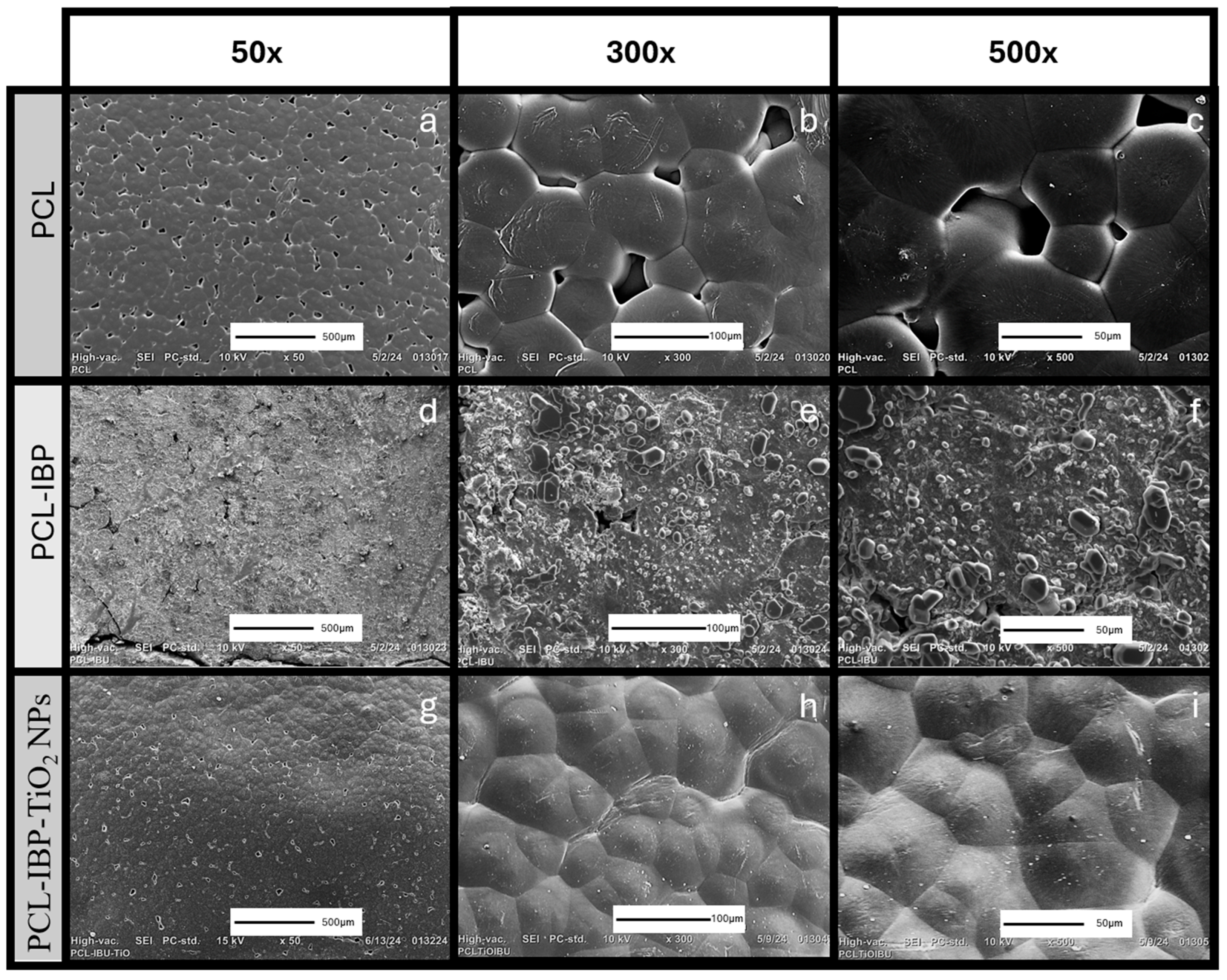
3.2. Microstructural Evaluation
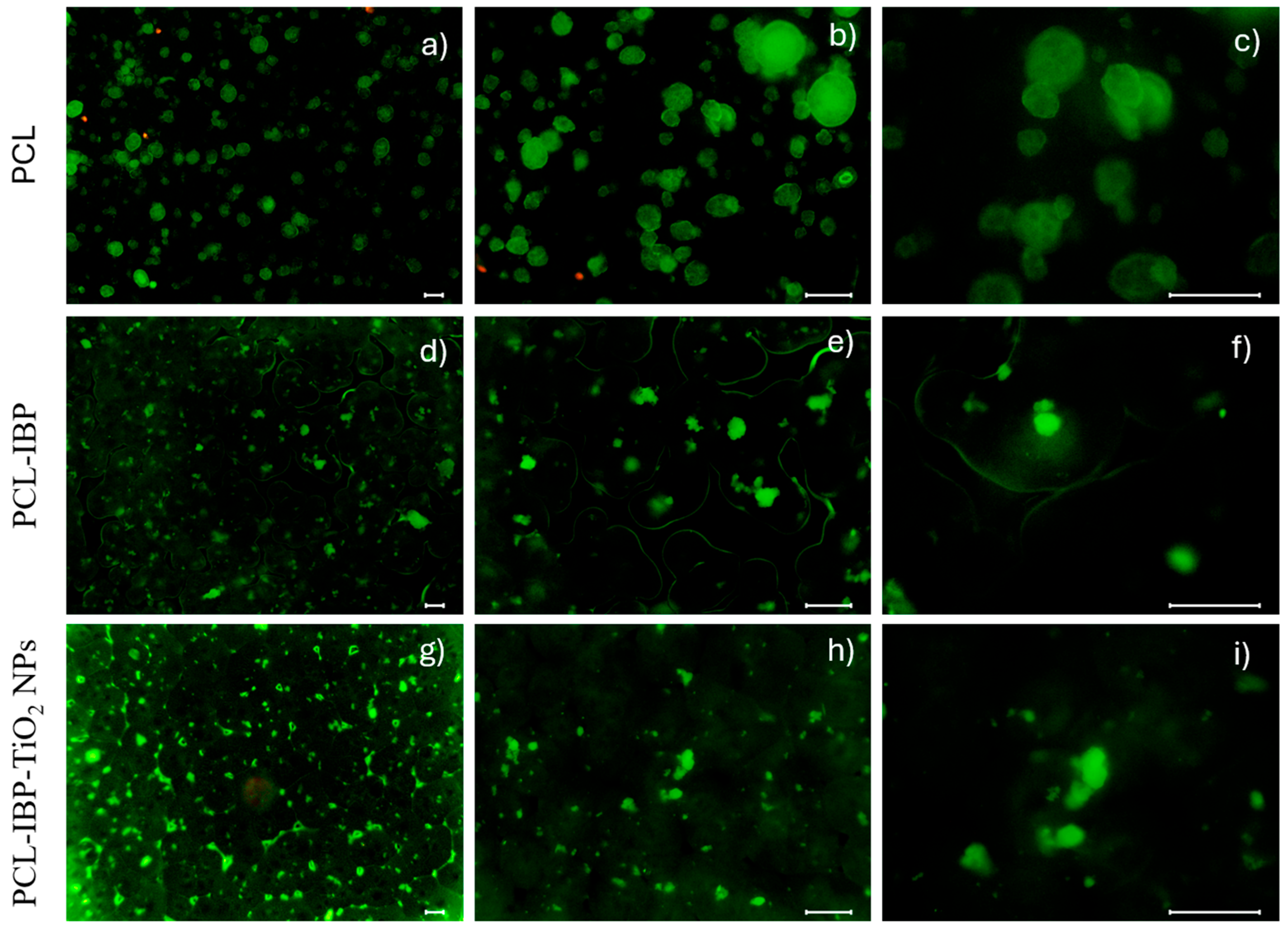
3.3. Biocompatibility Evaluation
4. Discussion
5. Conclusions
Author Contributions
Funding
Institutional Review Board Statement
Informed Consent Statement
Data Availability Statement
Acknowledgments
Conflicts of Interest
Abbreviations
| WDC | Wound Dressing Coverage |
| NSAID | Non-Steroidal Anti-Inflammatory |
| PCL | Polycaprolactone |
| NPs | Nanoparticles |
| TiO2 | Titanium Dioxide |
| IBP | Ibuprofen |
| FTIR | Fourier Transform Infrared Spectroscopy |
| XRD | X-ray Diffraction |
| SEM | Scanning Electron Microscopy |
References
- Grada, A.; Phillips, T.J. Nutrition and Cutaneous Wound Healing. Clin. Dermatol. 2022, 40, 103–113. [Google Scholar] [CrossRef] [PubMed]
- Zanchetta, F.C.; De Wever, P.; Morari, J.; Gaspar, R.C.; Prado, T.P.D.; De Maeseneer, T.; Cardinaels, R.; Araújo, E.P.; Lima, M.H.M.; Fardim, P. In Vitro and In Vivo Evaluation of Chitosan/HPMC/Insulin Hydrogel for Wound Healing Applications. Bioengineering 2024, 11, 168. [Google Scholar] [CrossRef]
- Ardelean, A.I.; Marza, S.M.; Dragomir, M.F.; Negoescu, A.; Sarosi, C.; Novac, C.S.; Pestean, C.; Moldovan, M.; Oana, L. The Potential of Composite Cements for Wound Healing in Rats. Bioengineering 2024, 11, 837. [Google Scholar] [CrossRef]
- Pittman, J.; Beeson, T.; Dillon, J.; Yang, Z.; Mravec, M.; Malloy, C.; Cuddigan, J. Hospital-Acquired Pressure Injuries and Acute Skin Failure in Critical Care: A Case-Control Study. J. Wound Ostomy Cont. Nurs. 2021, 48, 20–30. [Google Scholar] [CrossRef]
- Shu, W.; Wang, Y.; Zhang, X.; Li, C.; Le, H.; Chang, F. Functional Hydrogel Dressings for Treatment of Burn Wounds. Front. Bioeng. Biotechnol. 2021, 9, 788461. [Google Scholar] [CrossRef]
- Lima Júnior, E.M.; De Moraes Filho, M.O.; Costa, B.A.; Fechine, F.V.; Vale, M.L.; Diógenes, A.K.D.L.; Neves, K.R.T.; Uchôa, A.M.D.N.; Soares, M.F.A.D.N.; De Moraes, M.E.A. Nile Tilapia Fish Skin–Based Wound Dressing Improves Pain and Treatment-Related Costs of Superficial Partial-Thickness Burns: A Phase III Randomized Controlled Trial. Plast. Reconstr. Surg. 2021, 147, 1189–1198. [Google Scholar] [CrossRef]
- Sheokand, B.; Vats, M.; Kumar, A.; Srivastava, C.M.; Bahadur, I.; Pathak, S.R. Natural Polymers Used in the Dressing Materials for Wound Healing: Past, Present and Future. J. Polym. Sci. 2023, 61, 1389–1414. [Google Scholar] [CrossRef]
- Nguyen, H.M.; Ngoc Le, T.T.; Nguyen, A.T.; Thien Le, H.N.; Pham, T.T. Biomedical Materials for Wound Dressing: Recent Advances and Applications. RSC Adv. 2023, 13, 5509–5528. [Google Scholar] [CrossRef]
- Zhang, C.; Zhang, S.; Wu, B.; Zou, K.; Chen, H. Efficacy of Different Types of Dressings on Pressure Injuries: Systematic Review and Network Meta-Analysis. Nurs. Open 2023, 10, 5857–5867. [Google Scholar] [CrossRef] [PubMed]
- Gobi, R.; Ravichandiran, P.; Babu, R.S.; Yoo, D.J. Biopolymer and Synthetic Polymer-Based Nanocomposites in Wound Dressing Applications: A Review. Polymers 2021, 13, 1962. [Google Scholar] [CrossRef]
- Aderibigbe, B.A. Hybrid-Based Wound Dressings: Combination of Synthetic and Biopolymers. Polymers 2022, 14, 3806. [Google Scholar] [CrossRef]
- Francesko, A.; Petkova, P.; Tzanov, T. Hydrogel Dressings for Advanced Wound Management. Curr. Med. Chem. 2019, 25, 5782–5797. [Google Scholar] [CrossRef]
- Protzman, N.M.; Mao, Y.; Long, D.; Sivalenka, R.; Gosiewska, A.; Hariri, R.J.; Brigido, S.A. Placental-Derived Biomaterials and Their Application to Wound Healing: A Review. Bioengineering 2023, 10, 829. [Google Scholar] [CrossRef]
- Vázquez-Vázquez, F.C.; Arenas-Alatorre, J.; Chavarría-Bolaños, D.; Pozos-Guillén, A.; Alvárez-Pérez, M.A.; Ortiz-Magdaleno, M. Cellular Response of Surface Functionalized Polymeric Fiber Mesh Coating Onto Dental Titanium Implants. Odovtos Int. J. Dent. Sci. 2024, 26, 186–196. [Google Scholar] [CrossRef]
- Liu, Y.; Huang, S.; Liang, S.; Lin, P.; Lai, X.; Lan, X.; Wang, H.; Tang, Y.; Gao, B. Phase Change Material-Embedded Multifunctional Janus Nanofiber Dressing with Directional Moisture Transport, Controlled Release of Anti-Inflammatory Drugs, and Synergistic Antibacterial Properties. ACS Appl. Mater. Interfaces 2023, 15, 52244–52261. [Google Scholar] [CrossRef]
- A, H.; Sofini, S.P.S.; Balasubramanian, D.; Girigoswami, A.; Girigoswami, K. Biomedical Applications of Natural and Synthetic Polymer Based Nanocomposites. J. Biomater. Sci. Polym. Ed. 2024, 35, 269–294. [Google Scholar] [CrossRef] [PubMed]
- Merzougui, C.; Miao, F.; Liao, Z.; Wang, L.; Wei, Y.; Huang, D. Electrospun Nanofibers with Antibacterial Properties for Wound Dressings. J. Biomater. Sci. Polym. Ed. 2022, 33, 2165–2183. [Google Scholar] [CrossRef]
- Sanmugam, A.; Sellappan, L.K.; Manoharan, S.; Rameshkumar, A.; Kumar, R.S.; Almansour, A.I.; Arumugam, N.; Kim, H.-S.; Vikraman, D. Development of Chitosan-Based Cerium and Titanium Oxide Loaded Polycaprolactone for Cutaneous Wound Healing and Antibacterial Applications. Int. J. Biol. Macromol. 2024, 256, 128458. [Google Scholar] [CrossRef] [PubMed]
- Ferrando-Magraner, E.; Bellot-Arcís, C.; Paredes-Gallardo, V.; Almerich-Silla, J.M.; García-Sanz, V.; Fernández-Alonso, M.; Montiel-Company, J.M. Antibacterial Properties of Nanoparticles in Dental Restorative Materials. A Systematic Review and Meta-Analysis. Medicina 2020, 56, 55. [Google Scholar] [CrossRef]
- Rezk, A.I.; Lee, J.Y.; Son, B.C.; Park, C.H.; Kim, C.S. Bi-Layered Nanofibers Membrane Loaded with Titanium Oxide and Tetracycline as Controlled Drug Delivery System for Wound Dressing Applications. Polymers 2019, 11, 1602. [Google Scholar] [CrossRef]
- Khasabova, I.A.; Uhelski, M.; Khasabov, S.G.; Gupta, K.; Seybold, V.S.; Simone, D.A. Sensitization of Nociceptors by Prostaglandin E2–Glycerol Contributes to Hyperalgesia in Mice with Sickle Cell Disease. Blood 2019, 133, 1989–1998. [Google Scholar] [CrossRef]
- Gainza, G.; Villullas, S.; Pedraz, J.L.; Hernandez, R.M.; Igartua, M. Advances in Drug Delivery Systems (DDSs) to Release Growth Factors for Wound Healing and Skin Regeneration. Nanomed. Nanotechnol. Biol. Med. 2015, 11, 1551–1573. [Google Scholar] [CrossRef]
- Sequeira, R.S.; Miguel, S.P.; Cabral, C.S.D.; Moreira, A.F.; Ferreira, P.; Correia, I.J. Development of a Poly(Vinyl Alcohol)/Lysine Electrospun Membrane-Based Drug Delivery System for Improved Skin Regeneration. Int. J. Pharm. 2019, 570, 118640. [Google Scholar] [CrossRef] [PubMed]
- Augustine, R.; Hasan, A.; Patan, N.K.; Augustine, A.; Dalvi, Y.B.; Varghese, R.; Unni, R.N.; Kalarikkal, N.; Al Moustafa, A.; Thomas, S. Titanium Nanorods Loaded PCL Meshes with Enhanced Blood Vessel Formation and Cell Migration for Wound Dressing Applications. Macromol. Biosci. 2019, 19, 1900058. [Google Scholar] [CrossRef]
- Vazquez-Vazquez, F.C.; Chavarria-Bolaños, D.; Ortiz-Magdaleno, M.; Guarino, V.; Alvarez-Perez, M.A. 3D-Printed Tubular Scaffolds Decorated with Air-Jet-Spun Fibers for Bone Tissue Applications. Bioengineering 2022, 9, 189. [Google Scholar] [CrossRef]
- Ramírez-Cedillo, E.; Ortega-Lara, W.; Rocha-Pizaña, M.R.; Gutierrez-Uribe, J.A.; Elías-Zúñiga, A.; Rodríguez, C.A. Electrospun Polycaprolactone Fibrous Membranes Containing Ag, TiO2 and Na2Ti6O13 Particles for Potential Use in Bone Regeneration. Membranes 2019, 9, 12. [Google Scholar] [CrossRef] [PubMed]
- Lasalle, B.S.I.; Pandian, M.S.; Ramasamy, P. Molecular Interactions Studies on Chloroform in the Environment of O-Cresol: FTIR Spectroscopy and Quantum Chemical Calculations. Braz. J. Phys. 2023, 53, 97. [Google Scholar] [CrossRef]
- PDF 00-062-1286; Database for Materials Characterization. International Center for Diffraction Data (ICDD): Newton Square, PA, USA, 2024.
- PDF 00-032-1723; Database for Materials Characterization. International Center for Diffraction Data (ICDD): Newton Square, PA, USA, 2024.
- Safdari, F.; Gholipour, M.D.; Ghadami, A.; Saeed, M.; Zandi, M. Multi-Antibacterial Agent-Based Electrospun Polycaprolactone for Active Wound Dressing. Prog. Biomater. 2022, 11, 27–41. [Google Scholar] [CrossRef] [PubMed]
- Martin, A.; Cai, J.; Schaedel, A.-L.; Van Der Plas, M.; Malmsten, M.; Rades, T.; Heinz, A. Zein-Polycaprolactone Core–Shell Nanofibers for Wound Healing. Int. J. Pharm. 2022, 621, 121809. [Google Scholar] [CrossRef]
- Berniak, K.; Ura, D.P.; Piórkowski, A.; Stachewicz, U. Cell–Material Interplay in Focal Adhesion Points. ACS Appl. Mater. Interfaces 2024, 16, 9944–9955. [Google Scholar] [CrossRef]
- Metwally, S.; Ferraris, S.; Spriano, S.; Krysiak, Z.J.; Kaniuk, Ł.; Marzec, M.M.; Kim, S.K.; Szewczyk, P.K.; Gruszczyński, A.; Wytrwal-Sarna, M.; et al. Surface Potential and Roughness Controlled Cell Adhesion and Collagen Formation in Electrospun PCL Fibers for Bone Regeneration. Mater. Des. 2020, 194, 108915. [Google Scholar] [CrossRef]
- Yuan, Q.; Zhang, Q.; Xu, X.; Du, Y.; Xu, J.; Song, Y.; Wang, Y. Development and Characterization of Novel Orthodontic Adhesive Containing PCL–Gelatin–AgNPs Fibers. J. Funct. Biomater. 2022, 13, 303. [Google Scholar] [CrossRef] [PubMed]
- Oliveira, R.I.S.; De Oliveira, I.N.; De Conto, J.F.; De Souza, A.M.; Batistuzzo De Medeiros, S.R.; Egues, S.M.; Padilha, F.F.; Hernández-Macedo, M.L. Photocatalytic Effect of N–TiO2 Conjugated with Folic Acid against Biofilm-Forming Resistant Bacteria. Heliyon 2023, 9, e22108. [Google Scholar] [CrossRef] [PubMed]



Disclaimer/Publisher’s Note: The statements, opinions and data contained in all publications are solely those of the individual author(s) and contributor(s) and not of MDPI and/or the editor(s). MDPI and/or the editor(s) disclaim responsibility for any injury to people or property resulting from any ideas, methods, instructions or products referred to in the content. |
© 2026 by the authors. Licensee MDPI, Basel, Switzerland. This article is an open access article distributed under the terms and conditions of the Creative Commons Attribution (CC BY) license.
Share and Cite
Vergara-Lope Nuñez, J.A.; Pozos-Guillén, A.; Ortiz-Magdaleno, M.; Núñez-Tapia, I.A.; Maldonado Frias, S.; Álvarez-Pérez, M.A.; Vazquez-Vazquez, F.C. Synthesis and Characterization of Ibuprofen–TiO2 Functionalized PCL Biomembranes as Candidate Materials for Wound Dressing Applications. Bioengineering 2026, 13, 92. https://doi.org/10.3390/bioengineering13010092
Vergara-Lope Nuñez JA, Pozos-Guillén A, Ortiz-Magdaleno M, Núñez-Tapia IA, Maldonado Frias S, Álvarez-Pérez MA, Vazquez-Vazquez FC. Synthesis and Characterization of Ibuprofen–TiO2 Functionalized PCL Biomembranes as Candidate Materials for Wound Dressing Applications. Bioengineering. 2026; 13(1):92. https://doi.org/10.3390/bioengineering13010092
Chicago/Turabian StyleVergara-Lope Nuñez, Jael Adrian, Amaury Pozos-Guillén, Marine Ortiz-Magdaleno, Israel Alfonso Núñez-Tapia, Silvia Maldonado Frias, Marco Antonio Álvarez-Pérez, and Febe Carolina Vazquez-Vazquez. 2026. "Synthesis and Characterization of Ibuprofen–TiO2 Functionalized PCL Biomembranes as Candidate Materials for Wound Dressing Applications" Bioengineering 13, no. 1: 92. https://doi.org/10.3390/bioengineering13010092
APA StyleVergara-Lope Nuñez, J. A., Pozos-Guillén, A., Ortiz-Magdaleno, M., Núñez-Tapia, I. A., Maldonado Frias, S., Álvarez-Pérez, M. A., & Vazquez-Vazquez, F. C. (2026). Synthesis and Characterization of Ibuprofen–TiO2 Functionalized PCL Biomembranes as Candidate Materials for Wound Dressing Applications. Bioengineering, 13(1), 92. https://doi.org/10.3390/bioengineering13010092