
Influence of Water Storage on the Mechanical Properties of 3D-Printed Aligners: An In Vitro Study



Abstract
1. Introduction
2. Materials and Methods
2.1. Choice of Materials
2.2. Production and Post-Processing of the Test Specimens
2.3. Water Storage
2.4. Testing
2.4.1. Experiment Implementation of the Three-Point Bending Test (DIN 178)
- = flexural modulus [MPa]
- = bending stress at 0.25% bending strain [MPa]
- = bending stress at 0.05% bending strain [MPa]
2.4.2. Experiment Implementation of the Indentation Test (DIN 14577)
- HM = Martens hardness [N/mm2]
- Fmax = maximum force [N]
- h = penetration depth [mm]
- Hplast = plastic hardness [N/mm2]
- Fmax = maximum force [N]
- hr = intersection of the tangent to the unloading curve at Fmax with the depth axis [mm]
- CIT = indentation creep [ ]
- h1 = indentation depth at the beginning of the holding period [mm]
- h2 = indentation depth at the end of the holding period [mm]
2.4.3. Experiment Implementation of Abrasion Resistance
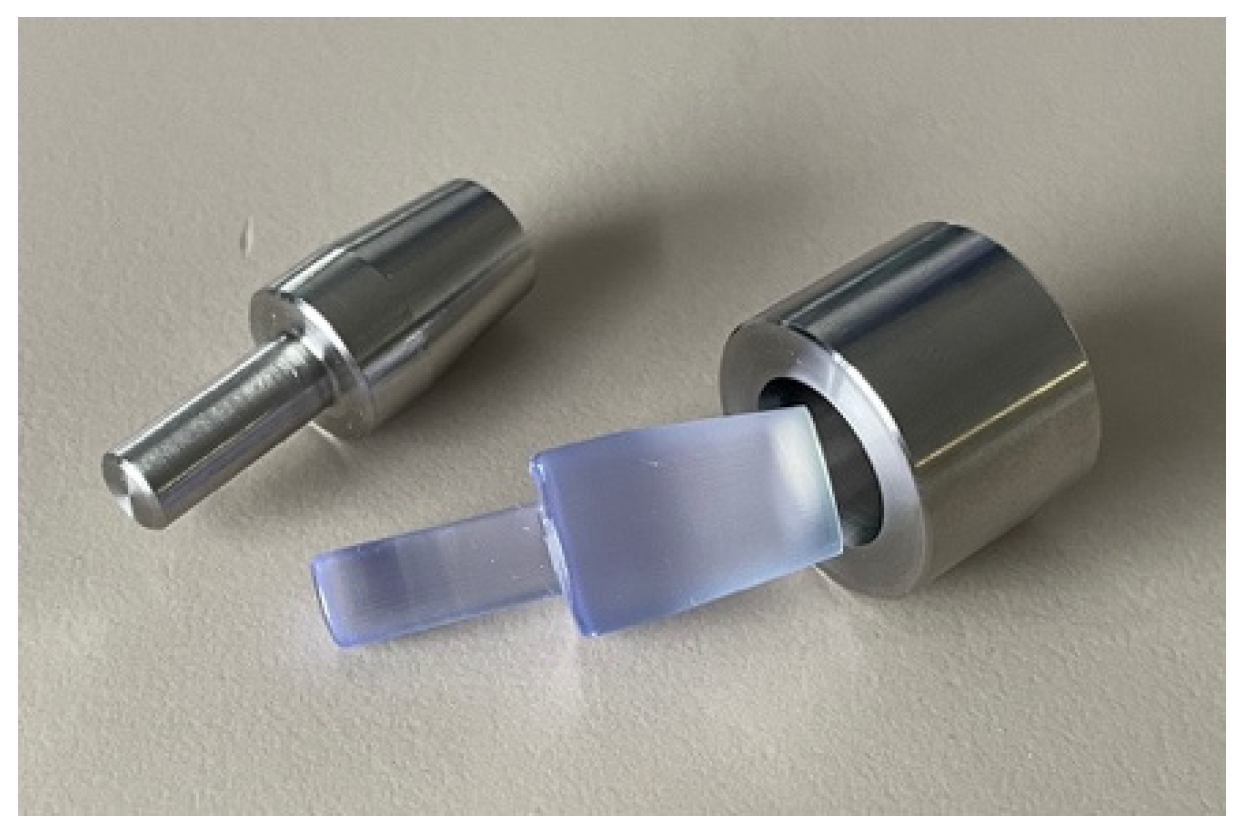
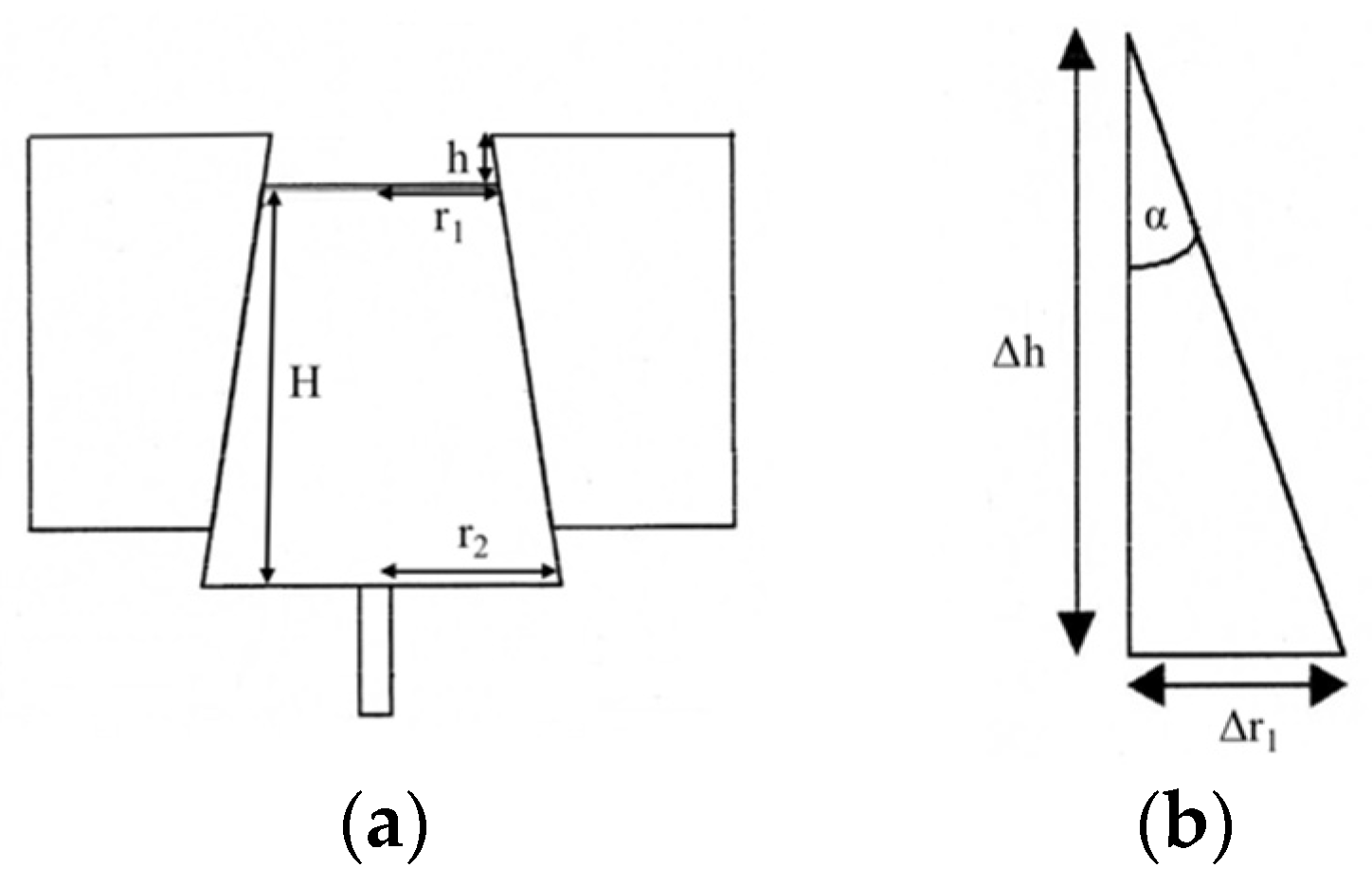
2.4.4. Experiment Implementation of the Hygroscopic Volume Increase
- = change in the radius of the upper surface [mm]
- h = change in the measured distance [mm]
- V = volume of a truncated cone [mm3]
- H = height [mm]
- r1 = upper radius [mm]
- r2 = lower radius [mm]

2.5. Statistical Analysis
3. Results
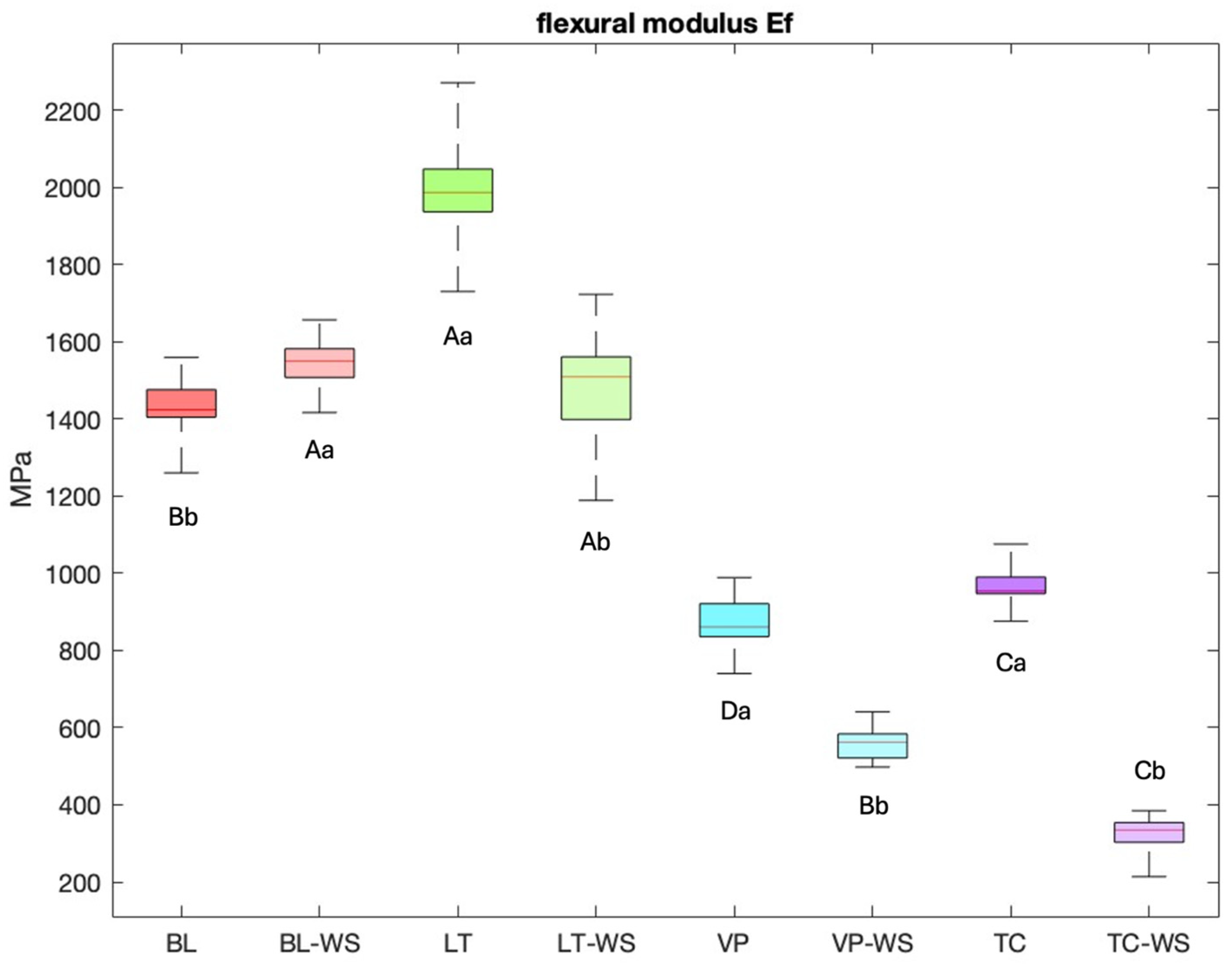
3.1. Three-Point Bending Test/Flexural Modulus
3.2. Indentation Test
3.3. Abrasion Resistance
3.4. Hygroscopic Volume Increase
4. Discussion
4.1. Three-Point Bending Test
4.2. Indentation Test
4.3. Abrasion Resistance/Two-Body-Wear-Test
4.4. Hygroscopic Volume Increase
4.5. Limitations
5. Conclusions
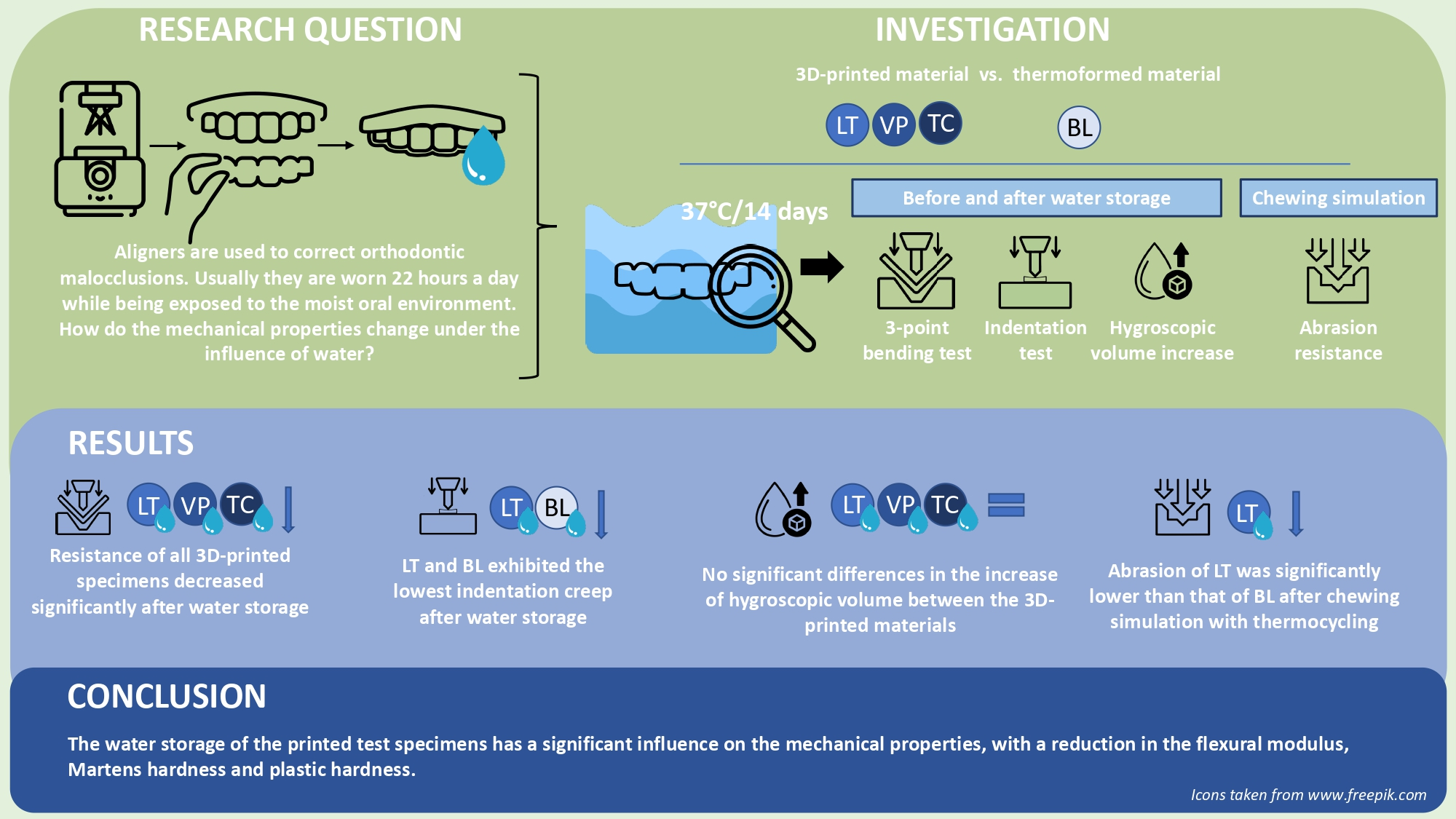
- Storing the printed test specimens in water significantly influences the mechanical properties by reducing the flexural modulus, Martens hardness, and plastic hardness.
- The flexural modulus of the LT material was very similar to that of the reference material BL when water was added; this indicates that LT is a suitable material for aligner production. Prior water storage appears to benefit the mechanical properties of this material.
- Mechanical abrasion of aligners during wear could release microplastic particles, posing potential risks. Further studies are needed to accurately assess the extent and clinical relevance of microplastic release.
Author Contributions
Funding
Informed Consent Statement
Data Availability Statement
Acknowledgments
Conflicts of Interest
References
- Miller, K.B.; McGorray, S.P.; Womack, R.; Quintero, J.C.; Perelmuter, M.; Gibson, J.; Dolan, T.A.; Wheeler, T.T. A comparison of treatment impacts between Invisalign aligner and fixed appliance therapy during the first week of treatment. Am. J. Orthod. Dentofac. Orthop. 2007, 131, 302.e1–302.e9. [Google Scholar] [CrossRef] [Scilit] [PubMed]
- Nedwed, V.; Miethke, R.R. Motivation, acceptance and problems of invisalign patients. J. Orofac. Orthop. 2005, 66, 162–173. [Google Scholar] [CrossRef] [Scilit]
- Wang, M.; Chen, J.; Wang, Z.; Wang, Y.; Zhang, Y.; Feng, Q.; Wei, F. Salivary microbiomes vary among orthodontic appliances and associate with clinical periodontal parameters. Orthod. Craniofacial Res. 2024, 27, 174–184. [Google Scholar] [CrossRef] [Scilit]
- Abbate, G.M.; Caria, M.P.; Montanari, P.; Mannu, C.; Orrù, G.; Caprioglio, A.; Levrini, L. Periodontal health in teenagers treated with removable aligners and fixed orthodontic appliances. J. Orofac. Orthop. 2015, 76, 240–250. [Google Scholar] [CrossRef] [Scilit]
- Ke, Y.; Zhu, Y.; Zhu, M. A comparison of treatment effectiveness between clear aligner and fixed appliance therapies. BMC Oral. Health 2019, 19, 24. [Google Scholar] [CrossRef] [Scilit]
- Kassam, S.K.; Stoops, F.R. Are clear aligners as effective as conventional fixed appliances? Evid. Based Dent. 2020, 21, 30–31. [Google Scholar] [CrossRef] [Scilit]
- Simon, M.; Keilig, L.; Schwarze, J.; Jung, B.A.; Bourauel, C. Forces and moments generated by removable thermoplastic aligners: Incisor torque, premolar derotation, and molar distalization. Am. J. Orthod. Dentofac. Orthop. 2014, 145, 728–736. [Google Scholar] [CrossRef] [Scilit]
- Weir, T. Clear aligners in orthodontic treatment. Aust. Dent. J. 2017, 62, 58–62. [Google Scholar] [CrossRef] [Scilit] [PubMed]
- Ma, Y.S.; Fang, D.Y.; Zhang, N.; Ding, X.J.; Zhang, K.Y.; Bai, Y.X. Mechanical Properties of Orthodontic Thermoplastics PETG/PC2858 after Blending. Chin. J. Dent. Res. 2016, 19, 43–48. [Google Scholar] [CrossRef] [Scilit]
- Zhang, N.; Bai, Y.; Ding, X.; Zhang, Y. Preparation and characterization of thermoplastic materials for invisible orthodontics. Dent. Mater. J. 2011, 30, 954–959. [Google Scholar] [CrossRef] [Scilit] [PubMed]
- Alexandropoulos, A.; Al Jabbari, Y.S.; Zinelis, S.; Eliades, T. Chemical and mechanical characteristics of contemporary thermoplastic orthodontic materials. Aust. Orthod. J. 2015, 31, 165–170. [Google Scholar] [CrossRef] [Scilit]
- Barile, C.; Cianci, C.; Paramsamy Kannan, V.; Pappalettera, G.; Pappalettere, C.; Casavola, C.; Suriano, C.; Ciavarella, D. Thermoplastic clear dental aligners under cyclic compression loading: A mechanical performance analysis using acoustic emission technique. J. Mech. Behav. Biomed. Mater. 2024, 152, 106451. [Google Scholar] [CrossRef] [Scilit] [PubMed]
- Skaik, A.; Wei, X.L.; Abusamak, I.; Iddi, I. Effects of time and clear aligner removal frequency on the force delivered by different polyethylene terephthalate glycol-modified materials determined with thin-film pressure sensors. Am. J. Orthod. Dentofac. Orthop. 2019, 155, 98–107. [Google Scholar] [CrossRef] [Scilit]
- Daniele, V.; Macera, L.; Taglieri, G.; Spera, L.; Marzo, G.; Quinzi, V. Color Stability, Chemico-Physical and Optical Features of the Most Common PETG and PU Based Orthodontic Aligners for Clear Aligner Therapy. Polymers 2022, 14, 14. [Google Scholar] [CrossRef] [Scilit] [PubMed]
- Staderini, E.; Chiusolo, G.; Papi, M.; Palone, M.; Lombardo, L.; Cordaro, M. Chemical, optical, and morphological properties of TPU and PET-G samples after aging in artificial saliva: An in vitro study. BMC Oral. Health 2025, 25, 533. [Google Scholar] [CrossRef] [Scilit]
- Cianci, C.; Pappalettera, G.; Renna, G.; Casavola, C.; Laurenziello, M.; Battista, G.; Pappalettere, C.; Ciavarella, D. Mechanical behavior of PET-G tooth aligners under cyclic loading. Front. Mater. 2020, 7, 104. [Google Scholar] [CrossRef] [Scilit]
- Tartaglia, G.M.; Mapelli, A.; Maspero, C.; Santaniello, T.; Serafin, M.; Farronato, M.; Caprioglio, A. Direct 3D Printing of Clear Orthodontic Aligners: Current State and Future Possibilities. Materials 2021, 14, 1799. [Google Scholar] [CrossRef] [Scilit]
- Edelmann, A.; English, J.D.; Chen, S.J.; Kasper, F.K. Analysis of the thickness of 3-dimensional-printed orthodontic aligners. Am. J. Orthod. Dentofac. Orthop. 2020, 158, e91–e98. [Google Scholar] [CrossRef] [Scilit] [PubMed]
- Grant, J.; Foley, P.; Bankhead, B.; Miranda, G.; Adel, S.M.; Kim, K.B. Forces and moments generated by 3D direct printed clear aligners of varying labial and lingual thicknesses during lingual movement of maxillary central incisor: An in vitro study. Prog. Orthod. 2023, 24, 23. [Google Scholar] [CrossRef] [Scilit]
- Jindal, P.; Juneja, M.; Siena, F.L.; Bajaj, D.; Breedon, P. Mechanical and geometric properties of thermoformed and 3D printed clear dental aligners. Am. J. Orthod. Dentofac. Orthop. 2019, 156, 694–701. [Google Scholar] [CrossRef] [Scilit]
- Shirey, N.; Mendonca, G.; Groth, C.; Kim-Berman, H. Comparison of mechanical properties of 3-dimensional printed and thermoformed orthodontic aligners. Am. J. Orthod. Dentofac. Orthop. 2023, 163, 720–728. [Google Scholar] [CrossRef] [Scilit]
- ISO 178:2019; Plastics—Determination of Flexural Properties. Deutsches Institut für Normung e.V. (DIN e.V.): Berlin, Germany, 2019.
- ISO 14577-1:2015; Metallic materials—Instrumented Indentation Test for Hardness and Materials Parameters, in Part 1: Test Method. Deutsches Institut für Normung e.V. (DIN e.V.): Berlin, Germany, 2019.
- ISO 23529:2020-10; Elastomere—Allgemeine Bedingungen für die Vorbereitung und Konditionierung von Prüfkörpern für Physikalische Prüfverfahren. Deutsches Institut für Normung e.V. (DIN e.V.): Berlin, Germany, 2020.
- Berli, C.; Thieringer, F.M.; Sharma, N.; Müller, J.A.; Dedem, P.; Fischer, J.; Rohr, N. Comparing the mechanical properties of pressed, milled, and 3D-printed resins for occlusal devices. J. Prosthet. Dent. 2020, 124, 780–786. [Google Scholar] [CrossRef] [Scilit] [PubMed]
- Di Lorenzo, M.L. Crystallization of Poly(ethylene terephthalate): A Review. Polymers 2024, 16, 1975. [Google Scholar] [CrossRef] [Scilit] [PubMed]
- Chen, Y.; Lin, Z.; Yang, S. Plasticization and Crystallization of Poly(ethylene Terephthalate) Induced by Water. J. Therm. Anal. Calorim. 1998, 52, 565–568. [Google Scholar] [CrossRef] [Scilit]
- Schotland, R.S. Influence of annealing on the density and tensile properties of polypropylene. Polym. Eng. Sci. 1966, 6, 244–247. [Google Scholar] [CrossRef] [Scilit]
- Struik, L.C.E. Physical Aging in Amorphous Polymers and Other Materials; Citeseer: Philadelphia, PA, USA, 1978; Volume 106. [Google Scholar]
- Lee, S.Y.; Kim, H.; Kim, H.-J.; Chung, C.J.; Choi, Y.J.; Kim, S.-J.; Cha, J.-Y. Thermo-mechanical properties of 3D printed photocurable shape memory resin for clear aligners. Sci. Rep. 2022, 12, 6246. [Google Scholar] [CrossRef] [Scilit] [PubMed]
- Reymus, M.; Stawarczyk, B. In vitro study on the influence of postpolymerization and aging on the Martens parameters of 3D-printed occlusal devices. J. Prosthet. Dent. 2021, 125, 817–823. [Google Scholar] [CrossRef] [Scilit]
- Maleki, T.; Meinen, J.; Coldea, A.; Reymus, M.; Edelhoff, D.; Stawarczyk, B. Mechanical and physical properties of splint materials for oral appliances produced by additive, subtractive and conventional manufacturing. Dent. Mater. 2024, 40, 1171–1183. [Google Scholar] [CrossRef] [Scilit]
- Can, E.; Panayi, N.; Polychronis, G.; Papageorgiou, S.N.; Zinelis, S.; Eliades, G.; Eliades, T. In-house 3D-printed aligners: Effect of in vivo ageing on mechanical properties. Eur. J. Orthod. 2021, 44, 51–55. [Google Scholar] [CrossRef] [Scilit]
- Sayahpour, B.; Zinelis, S.; Polychronis, G.; Eliades, T.; Goteni, M.; Kopp, S.; Eslami, S. Effects of intraoral aging on mechanical properties of directly printed aligners vs. thermoformed aligners: An in vivo prospective investigation. Eur. J. Orthod. 2024, 46, cjad063. [Google Scholar] [CrossRef] [Scilit]
- Choi, J.E.; Lyons, K.M.; McLean, M.C.; Waddell, N.J. Interarch comparison of intraoral pH and temperature: A pilot study. BDJ Open 2016, 2, 16008. [Google Scholar] [CrossRef] [Scilit] [PubMed]
- Patzelt, S.B.M.; Krügel, M.; Wesemann, C.; Pieralli, S.; Nold, J.; Spies, B.C.; Vach, K.; Kohal, R.-J. In vitro time efficiency, fit, and wear of conventionally-versus digitally-fabricated occlusal splints. Materials 2022, 15, 1085. [Google Scholar] [CrossRef] [Scilit] [PubMed]
- Quinzi, V.; Orilisi, G.; Vitiello, F.; Notarstefano, V.; Marzo, G.; Orsini, G. A spectroscopic study on orthodontic aligners: First evidence of secondary microplastic detachment after seven days of artificial saliva exposure. Sci. Total Environ. 2023, 866, 161356. [Google Scholar] [CrossRef] [Scilit]
- Ryokawa, H.; Miyazaki, Y.; Fujishima, A.; Miyazaki, T.; Maki, K. The mechanical properties of dental thermoplastic materials in a simulated intraoral environment. Orthod. Waves 2006, 65, 64–72. [Google Scholar] [CrossRef] [Scilit]
- Ihssen, B.A.; Willmann, J.H.; Nimer, A.; Drescher, D. Effect of in vitro aging by water immersion and thermocycling on the mechanical properties of PETG aligner material. J. Orofac. Orthop./Fortschr. Kieferorthop. 2019, 80, 292–303. [Google Scholar] [CrossRef] [Scilit] [PubMed]
- Šimunović, L.; Čekalović Agović, S.; Marić, A.J.; Bačić, I.; Klarić, E.; Uribe, F.; Meštrović, S. Color and Chemical Stability of 3D-Printed and Thermoformed Polyurethane-Based Aligners. Polymers 2024, 16, 1067. [Google Scholar] [CrossRef] [Scilit]
- Taneva, I.; Uzunov, T. Influence of post-polymerization processing on the mechanical characteristics of 3D-printed occlusal splints. J. Phys. Conf. Ser. 2020, 1492, 012018. [Google Scholar] [CrossRef] [Scilit]
- Milovanović, A.; Sedmak, A.; Golubović, Z.; Mihajlović, K.Z.; Žurkić, A.; Trajković, I.; Milošević, M. The effect of time on mechanical properties of biocompatible photopolymer resins used for fabrication of clear dental aligners. J. Mech. Behav. Biomed. Mater. 2021, 119, 104494. [Google Scholar] [CrossRef] [Scilit]



| Name (Group Code) | Manufacturer | Composition | Indication | Production Method | Batch Number |
|---|---|---|---|---|---|
| Biolon (BL) | Dreve Dentamid (Unna, Germany) | PET-G | Aligner & occlusal splints | Thermoplastic | 3787603 3778615 |
| Dental LT Clear V2 (LT) | Formlabs (Sommerville, MA, USA) | Acrylates and methylacrylates | Occlusal splints | Stereolitho-graphy | DC01220818-02 |
| V Print Splint Comfort (VP) | VOCO (Cuxhaven, Germany) | Acrylates and methylacrylates | Occlusal splints | DLP printing | 2312708 2241162 |
| TC-85 DAC (TC) | Graphy (Seoul, Republic of Korea) | Acrylates and urethaneacrylate | Aligner splints | DLP printing | 1-C1101C12 |
| Material | HM [N/mm2] | HM-WS [N/mm2] | Hplast [N/mm2] | Hplast-WS [N/mm2] | CIT [ ] | CIT-WS [ ] |
|---|---|---|---|---|---|---|
| BL | 92 ± 12 Ba | 91 ± 13 Ba | 222 ± 39 Aa | 202 ± 44 Aa | 0.08 ± 0.01 Da | 0.09 ± 0.01 Da |
| LT | 133 ± 16 Aa | 113 ± 10 Ab | 278 ± 53 Aa | 201 ± 39 Ab | 0.13 ± 0.02 Cb | 0.15 ± 0.02 Ca |
| VP | 64 ± 10 Da | 25 ± 3 Cb | 64 ± 10 Ba | 25 ± 3 Bb | 0.21 ± 0.02 Bb | 0.25 ± 0.02 Ba |
| TC | 76 ± 6 Ca | 18 ± 2 Db | 88 ± 10 Ba | 12 ± 1 Cb | 0.24 ± 0.02 Ab | 0.29 ± 0.02 Aa |
| Material | Volume Relative to the Reference Body Before Water Storage [%] | Volume Increase Relative to the Reference Body After Water Storage [%] |
|---|---|---|
| LT | 104.6 ± 1.5 A | 3.6 ± 1.1 A |
| VP | 83.9 ± 2.1 B | 3.1 ± 0.9 A |
| TC | 85.4 ± 2 B | 3.6 ± 1.3 A |
Disclaimer/Publisher’s Note: The statements, opinions and data contained in all publications are solely those of the individual author(s) and contributor(s) and not of MDPI and/or the editor(s). MDPI and/or the editor(s) disclaim responsibility for any injury to people or property resulting from any ideas, methods, instructions or products referred to in the content. |
© 2025 by the authors. Licensee MDPI, Basel, Switzerland. This article is an open access article distributed under the terms and conditions of the Creative Commons Attribution (CC BY) license.
Share and Cite
Puchert, K.; Ritzert, P.; Wille, S.; Naim, J.; Şen, S. Influence of Water Storage on the Mechanical Properties of 3D-Printed Aligners: An In Vitro Study. Bioengineering 2026, 13, 21. https://doi.org/10.3390/bioengineering13010021
Puchert K, Ritzert P, Wille S, Naim J, Şen S. Influence of Water Storage on the Mechanical Properties of 3D-Printed Aligners: An In Vitro Study. Bioengineering. 2026; 13(1):21. https://doi.org/10.3390/bioengineering13010021
Chicago/Turabian StylePuchert, Kathrin, Paul Ritzert, Sebastian Wille, Jusef Naim, and Sinan Şen. 2026. "Influence of Water Storage on the Mechanical Properties of 3D-Printed Aligners: An In Vitro Study" Bioengineering 13, no. 1: 21. https://doi.org/10.3390/bioengineering13010021
APA StylePuchert, K., Ritzert, P., Wille, S., Naim, J., & Şen, S. (2026). Influence of Water Storage on the Mechanical Properties of 3D-Printed Aligners: An In Vitro Study. Bioengineering, 13(1), 21. https://doi.org/10.3390/bioengineering13010021