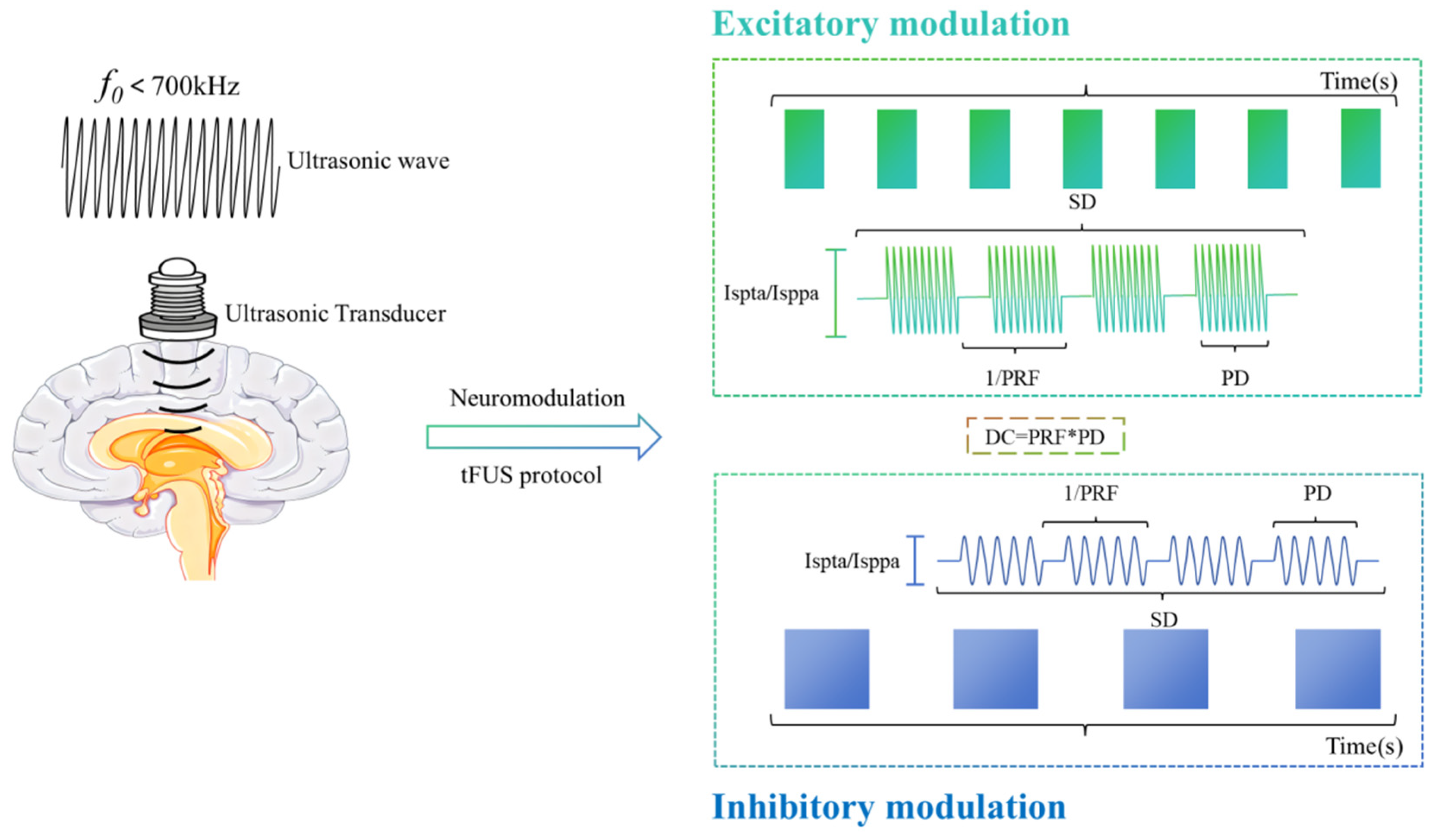
Parameter-Determined Effects: Advances in Transcranial Focused Ultrasound for Modulating Neural Excitation and Inhibition

 ,
,
Abstract
1. Introduction
2. Core Parameters of tFUS and Their Effects on Neuromodulatory Effects
2.1. Ultrasonic Frequency (Frequency, f0)
2.2. Ultrasonic Duty Cycle (DC)
2.3. Pulse Repetition Frequency (PRF)
2.4. Sonication Duration (SD)
2.5. Ultrasound Intensity (I)
3. Parameter Combination Schemes of tFUS and Neuromodulatory Effects
3.1. Excitatory Modulation Protocol of tFUS
3.2. Inhibitory Modulation Protocol of tFUS
3.3. Parameter Strategies and the Mechanistic Transition Underlying tFUS-Induced Offline Effects
3.3.1. From Transient Modulation to Sustained Remodeling: Parameter Strategies for Offline Effects
3.3.2. Mechanistic Hub: From Mechanical Gating to Molecular Plasticity
4. Safety of tFUS
5. Conclusions
Author Contributions
Funding
Institutional Review Board Statement
Informed Consent Statement
Data Availability Statement
Acknowledgments
Conflicts of Interest
Abbreviations
| f0 | Frequency |
| PRF | Pulse Repetition Frequency |
| DC | Duty Cycle |
| SD | Sonication Duration |
| Ispta | Space-Peak-Time-Average Intensity |
| Isppa | Space-Peak-Pulse-Average Intensity |
| PD | Pulse Duration |
| NR | No Report |
| S1 | Primary Somatosensory Cortex |
| LCN | Lateral Cerebellar Nucleus |
| MEP | Motor Evoked Potential |
| M1 | Primary Motor Cortex |
| AD | Alzheimer’s Disease |
| c-Fos | Cellular Fos Protein |
| GAD-65 | Glutamic Acid Decarboxylase, 65 kDa Isoform |
| BOLD | Blood Oxygenation Level-Dependent |
| SEP | Somatosensory Evoked Potential |
| V1 | Primary Visual Cortex |
| VEP | Visual Evoked Potential |
| SICI | Short-Interval Intracortical Inhibition |
| LICI | Long-Interval Intracortical Inhibition |
| Glx | Glutamate/Glutamine |
| hMT+ | Human Middle Temporal Area |
| ERP | Event-Related Potential |
| rIFG | Right Inferior Frontal Gyrus |
| VPL | Ventral Posterolateral Nucleus of Thalamus |
| ICF | Intracortical Facilitation |
| rPFC | Right Prefrontal Cortex |
| L-GP | Left Globus Pallidus |
| DRE | Patients with drug-resistant epilepsy |
| SOZ | Seizure onset zone |
| SEEG | stereo-electroencephalography |
Appendix A. Literature Search Methodology
Appendix B. Focused Transcranial Ultrasound Stimulation Probes for Neural Modulation
- The number of array elements
- 2.
- Center Frequency
- 3.
- Geometric Shapes
- 4.
- Driving Electronics System
- 5.
- Beamforming Technology
Appendix C. The Link Between Brain Rhythms and Underlying Neuronal Excitation-Inhibition
| Rhythms | Frequency Band (Hz) | The Significance of EEG | The Potential Connection with Neural Modulation (Excitation/Inhibition) (Based on MEP Evidence, All Studies Were Conducted on Healthy Individuals) |
| δ | 0.5–4 [120] | The hallmark of deep non-rapid eye movement sleep (slow-wave sleep) [120]. These delta oscillations are critically involved in synaptic homeostasis regulation and support system-level memory consolidation processes [121]. | During deep sleep characterized by prominent delta wave activity, MEP amplitude is markedly reduced or often fails to be elicited, indicating a profound inhibitory state of the cerebral cortex and corticospinal pathways [122]. |
| θ | 4–8 [120] | The midline prefrontal theta oscillation is strongly associated with cognitive control, conflict monitoring, as well as the encoding and maintenance processes of working memory [123,124]. Such oscillatory activity exhibits enhancement during tasks demanding high cognitive effort and sustained attention. | During inhibitory control tasks, prefrontal theta oscillatory activity is significantly enhanced; specific phases of the theta rhythm in the sensorimotor cortex may correspond to time windows of reduced neural excitability, indicating its critical role in top-down inhibitory regulation [123,124]. Furthermore, the modulatory effect of theta phase on TMS-induced neural plasticity further substantiates the functional relevance of theta oscillations in phase-dependent excitability regulation [125]. |
| α | 8–13 [120] | It is most prominent in the occipital lobe under conditions of wakefulness, relaxation, and closed eyes, and is often recognized as the “cortical idling” or “inhibitory control” rhythm [120]. | The alpha rhythm subserves functional cortical inhibition, with elevated power correlating with the gating of irrelevant sensory inputs [126,127]. Within the sensorimotor cortex, the power of the α(μ) rhythm exhibits a negative correlation with MEP amplitude [128], while its phase can transiently modulate cortical excitability [129]. |
| β | 13–30 [120] | It is associated with motor preparation, execution, maintenance, and cognitive control, and is recognized as a “status quo maintenance” signal [130,131]. | Elevated β power (e.g., during resting state or post-motor “β rebound”) is accompanied by reduced MEP amplitude [132]. Its oscillatory phase can also modulate excitability [129], suggesting that enhanced β activity may inhibit the initiation of novel movements and stabilize the existing state. |
| γ | 30–45 [120] | It has been associated with high-order processes including feature binding, selective attention, conscious perception, and memory retrieval [133,134]. | The augmentation of γ activity (e.g., during the motor preparation period) is accompanied by an increase in MEP amplitude [135], indicating that it serves as a physiological marker for the enhanced excitability and information integration of local cortical networks. |
References
- Jin, J.; Pei, G.; Ji, Z.; Liu, X.; Yan, T.; Li, W.; Suo, D. Transcranial Focused Ultrasound Precise Neuromodulation: A Review of Focal Size Regulation, Treatment Efficiency and Mechanisms. Front. Neurosci. 2024, 18, 1463038. [Google Scholar] [CrossRef] [PubMed]
- Folloni, D.; Verhagen, L.; Mars, R.B.; Fouragnan, E.; Constans, C.; Aubry, J.-F.; Rushworth, M.F.S.; Sallet, J. Manipulation of Subcortical and Deep Cortical Activity in the Primate Brain Using Transcranial Focused Ultrasound Stimulation. Neuron 2019, 101, 1109–1116.e5. [Google Scholar] [CrossRef] [PubMed]
- Davidson, B.; Bhattacharya, A.; Sarica, C.; Darmani, G.; Raies, N.; Chen, R.; Lozano, A.M. Neuromodulation Techniques—From Non-Invasive Brain Stimulation to Deep Brain Stimulation. Neurotherapeutics 2024, 21, e00330. [Google Scholar] [CrossRef] [PubMed]
- Zhi, W.; Li, Y.; Wang, L.; Hu, X. Advancing Neuroscience and Therapy: Insights into Genetic and Non-Genetic Neuromodulation Approaches. Cells 2025, 14, 122. [Google Scholar] [CrossRef]
- Lefaucheur, J.-P.; Aleman, A.; Baeken, C.; Benninger, D.H.; Brunelin, J.; Di Lazzaro, V.; Filipović, S.R.; Grefkes, C.; Hasan, A.; Hummel, F.C.; et al. Evidence-Based Guidelines on the Therapeutic Use of Repetitive Transcranial Magnetic Stimulation (rTMS): An Update (2014–2018). Clin. Neurophysiol. 2020, 131, 474–528. [Google Scholar] [CrossRef]
- Polanía, R.; Nitsche, M.A.; Ruff, C.C. Studying and Modifying Brain Function with Non-Invasive Brain Stimulation. Nat. Neurosci. 2018, 21, 174–187. [Google Scholar] [CrossRef]
- Davidson, B.; Schmidt, F.A.; Bichsel, O.; Hajiabadi, M.M.; Lozano, A.M. Transcranial Focused Ultrasound: A Transformative Tool for Intracranial Ablation, Drug Delivery, and Neuromodulation. IEEE Rev. Biomed. Eng. 2025. [Google Scholar] [CrossRef]
- Legon, W.; Sato, T.F.; Opitz, A.; Mueller, J.; Barbour, A.; Williams, A.; Tyler, W.J. Transcranial Focused Ultrasound Modulates the Activity of Primary Somatosensory Cortex in Humans. Nat. Neurosci. 2014, 17, 322–329. [Google Scholar] [CrossRef]
- Lee, K.; Park, T.Y.; Lee, W.; Kim, H. A Review of Functional Neuromodulation in Humans Using Low-Intensity Transcranial Focused Ultrasound. Biomed. Eng. Lett. 2024, 14, 407–438. [Google Scholar] [CrossRef]
- Shi, Y.; Wu, W. Advances in Transcranial Focused Ultrasound Neuromodulation for Mental Disorders. Prog. Neuropsychopharmacol. Biol. Psychiatry 2025, 136, 111244. [Google Scholar] [CrossRef]
- Kim, M.G.; Yu, K.; Yeh, C.-Y.; Fouda, R.; Argueta, D.; Kiven, S.; Ni, Y.; Niu, X.; Chen, Q.; Kim, K.; et al. Low-Intensity Transcranial Focused Ultrasound Suppresses Pain by Modulating Pain-Processing Brain Circuits. Blood 2024, 144, 1101–1115. [Google Scholar] [CrossRef]
- Yang, D.; Fu, S.; Zhao, M.; Shi, Y. The Promise of Transcranial Focused Ultrasound in Disorders of Consciousness: A Narrative Review. Crit. Care 2025, 29, 109. [Google Scholar] [CrossRef] [PubMed]
- Ho, H.-C.; Chen, W.-S.; Hsiao, M.-Y. Neuromodulation Effects of Low-Intensity Transcranial Focused Ultrasound in Human, a Systematic Review Focusing on Motor and Sensory Functions. J. Neuroeng. Rehabil. 2025, 22, 254. [Google Scholar] [CrossRef] [PubMed]
- Kubanek, J.; Wilson, M.; Rabbitt, R.D.; Armstrong, C.J.; Farley, A.J.; Ullah, H.M.A.; Shcheglovitov, A. Stem Cell-Derived Brain Organoids for Controlled Studies of Transcranial Neuromodulation. Heliyon 2023, 9, e18482. [Google Scholar] [CrossRef] [PubMed]
- Uddin, S.M.Z.; Komatsu, D.E.; Motyka, T.; Petterson, S. Low-Intensity Continuous Ultrasound Therapies—A Systematic Review of Current State-of-the-Art and Future Perspectives. J. Clin. Med. 2021, 10, 2698. [Google Scholar] [CrossRef]
- Krishna, V.; Sammartino, F.; Rezai, A. A Review of the Current Therapies, Challenges, and Future Directions of Transcranial Focused Ultrasound Technology: Advances in Diagnosis and Treatment. JAMA Neurol. 2018, 75, 246–254. [Google Scholar] [CrossRef]
- Zhang, T.; Pan, N.; Wang, Y.; Liu, C.; Hu, S. Transcranial Focused Ultrasound Neuromodulation: A Review of the Excitatory and Inhibitory Effects on Brain Activity in Human and Animals. Front. Hum. Neurosci. 2021, 15, 749162. [Google Scholar] [CrossRef]
- Clement, G.T.; Hynynen, K. A Non-Invasive Method for Focusing Ultrasound through the Human Skull. Phys. Med. Biol. 2002, 47, 1219–1236. [Google Scholar] [CrossRef]
- Sun, J.; Hynynen, K. Focusing of Therapeutic Ultrasound Through a Human Skull: A Numerical Study. J. Acoust. Soc. Am. 1998, 104, 1705–1715. [Google Scholar] [CrossRef]
- Javid, A.; Ilham, S.; Kiani, M. A Review of Ultrasound Neuromodulation Technologies. IEEE Trans. Biomed. Circuits Syst. 2023, 17, 1084–1096. [Google Scholar] [CrossRef]
- Chang, W.S.; Jung, H.H.; Zadicario, E.; Rachmilevitch, I.; Tlusty, T.; Vitek, S.; Chang, J.W. Factors Associated with Successful Magnetic Resonance-Guided Focused Ultrasound Treatment: Efficiency of Acoustic Energy Delivery Through the Skull. J. Neurosurg. 2016, 124, 411–416. [Google Scholar] [CrossRef]
- Mueller, J.K.; Ai, L.; Bansal, P.; Legon, W. Numerical Evaluation of the Skull for Human Neuromodulation with Transcranial Focused Ultrasound. J. Neural Eng. 2017, 14, 066012. [Google Scholar] [CrossRef]
- Chen, M.; Peng, C.; Wu, H.; Huang, C.; Kim, T.; Traylor, Z.; Muller, M.; Chhatbar, P.Y.; Nam, C.S.; Feng, W.; et al. Numerical and Experimental Evaluation of Low-Intensity Transcranial Focused Ultrasound Wave Propagation Using Human Skulls for Brain Neuromodulation. Med. Phys. 2023, 50, 38–49. [Google Scholar] [CrossRef] [PubMed]
- Ai, L.; Mueller, J.K.; Grant, A.; Eryaman, Y.; Legon, W. Transcranial Focused Ultrasound for BOLD fMRI Signal Modulation in Humans. In Proceedings of the 2016 38th Annual International Conference of the IEEE Engineering in Medicine and Biology Society (EMBC), Orlando, FL, USA, 16–20 August 2016; IEEE: Orlando, FL, USA, 2016; pp. 1758–1761. [Google Scholar]
- Legon, W.; Ai, L.; Bansal, P.; Mueller, J.K. Neuromodulation with Single-Element Transcranial Focused Ultrasound in Human Thalamus. Hum. Brain Mapp. 2018, 39, 1995–2006. [Google Scholar] [CrossRef] [PubMed]
- Tufail, Y.; Matyushov, A.; Baldwin, N.; Tauchmann, M.L.; Georges, J.; Yoshihiro, A.; Tillery, S.I.H.; Tyler, W.J. Transcranial Pulsed Ultrasound Stimulates Intact Brain Circuits. Neuron 2010, 66, 681–694. [Google Scholar] [CrossRef] [PubMed]
- Dallapiazza, R.F.; Timbie, K.F.; Holmberg, S.; Gatesman, J.; Lopes, M.B.; Price, R.J.; Miller, G.W.; Elias, W.J. Noninvasive Neuromodulation and Thalamic Mapping with Low-Intensity Focused Ultrasound. J. Neurosurg. 2018, 128, 875–884. [Google Scholar] [CrossRef]
- Tsui, P.-H.; Wang, S.-H.; Huang, C.-C. In Vitro Effects of Ultrasound with Different Energies on the Conduction Properties of Neural Tissue. Ultrasonics 2005, 43, 560–565. [Google Scholar] [CrossRef]
- Kim, H.; Chiu, A.; Lee, S.D.; Fischer, K.; Yoo, S.-S. Focused Ultrasound-Mediated Non-Invasive Brain Stimulation: Examination of Sonication Parameters. Brain Stimul. 2014, 7, 748–756. [Google Scholar] [CrossRef]
- Plaksin, M.; Kimmel, E.; Shoham, S. Cell-Type-Selective Effects of Intramembrane Cavitation as a Unifying Theoretical Framework for Ultrasonic Neuromodulation. eNeuro 2016, 3, ENEURO.0136-15.2016. [Google Scholar] [CrossRef]
- Yoon, K.; Lee, W.; Lee, J.E.; Xu, L.; Croce, P.; Foley, L.; Yoo, S.-S. Effects of Sonication Parameters on Transcranial Focused Ultrasound Brain Stimulation in an Ovine Model. PLoS ONE 2019, 14, e0224311. [Google Scholar] [CrossRef]
- Yu, K.; Niu, X.; Krook-Magnuson, E.; He, B. Intrinsic Functional Neuron-Type Selectivity of Transcranial Focused Ultrasound Neuromodulation. Nat. Commun. 2021, 12, 2519. [Google Scholar] [CrossRef] [PubMed]
- Lee, W.; Lee, S.D.; Park, M.Y.; Foley, L.; Purcell-Estabrook, E.; Kim, H.; Fischer, K.; Maeng, L.-S.; Yoo, S.-S. Image-Guided Focused Ultrasound-Mediated Regional Brain Stimulation in Sheep. Ultrasound Med. Biol. 2016, 42, 459–470. [Google Scholar] [CrossRef] [PubMed]
- King, R.L.; Brown, J.R.; Newsome, W.T.; Pauly, K.B. Effective Parameters for Ultrasound-Induced In Vivo Neurostimulation. Ultrasound Med. Biol. 2013, 39, 312–331. [Google Scholar] [CrossRef] [PubMed]
- Yu, K.; Liu, C.; Niu, X.; He, B. Transcranial Focused Ultrasound Neuromodulation of Voluntary Movement-Related Cortical Activity in Humans. IEEE Trans. Biomed. Eng. 2021, 68, 1923–1931. [Google Scholar] [CrossRef]
- Zadeh, A.K.; Raghuram, H.; Shrestha, S.; Kibreab, M.; Kathol, I.; Martino, D.; Pike, G.B.; Pichardo, S.; Monchi, O. The Effect of Transcranial Ultrasound Pulse Repetition Frequency on Sustained Inhibition in the Human Primary Motor Cortex: A Double-Blind, Sham-Controlled Study. Brain Stimul. 2024, 17, 476–484. [Google Scholar] [CrossRef]
- Badran, B.W.; Caulfield, K.A.; Stomberg-Firestein, S.; Summers, P.M.; Dowdle, L.T.; Savoca, M.; Li, X.; Austelle, C.W.; Short, E.B.; Borckardt, J.J.; et al. Sonication of the Anterior Thalamus with MRI-Guided Transcranial Focused Ultrasound (tFUS) Alters Pain Thresholds in Healthy Adults: A Double-Blind, Sham-Controlled Study. Brain Stimul. 2020, 13, 1805–1812. [Google Scholar] [CrossRef]
- Tyler, W.J.; Tufail, Y.; Finsterwald, M.; Tauchmann, M.L.; Olson, E.J.; Majestic, C. Remote Excitation of Neuronal Circuits Using Low-Intensity, Low-Frequency Ultrasound. PLoS ONE 2008, 3, e3511. [Google Scholar] [CrossRef]
- King, R.L.; Brown, J.R.; Pauly, K.B. Localization of Ultrasound-Induced In Vivo Neurostimulation in the Mouse Model. Ultrasound Med. Biol. 2014, 40, 1512–1522. [Google Scholar] [CrossRef]
- Yoo, S.-S.; Bystritsky, A.; Lee, J.-H.; Zhang, Y.; Fischer, K.; Min, B.-K.; McDannold, N.J.; Pascual-Leone, A.; Jolesz, F.A. Focused Ultrasound Modulates Region-Specific Brain Activity. Neuroimage 2011, 56, 1267–1275. [Google Scholar] [CrossRef]
- Sorum, B.; Docter, T.; Panico, V.; Rietmeijer, R.A.; Brohawn, S.G. Pressure and Ultrasound Activate Mechanosensitive TRAAK K+ Channels through Increased Membrane Tension. bioRxiv 2023. [Google Scholar] [CrossRef]
- Murphy, K.R.; Farrell, J.S.; Bendig, J.; Mitra, A.; Luff, C.; Stelzer, I.A.; Yamaguchi, H.; Angelakos, C.C.; Choi, M.; Bian, W.; et al. Optimized Ultrasound Neuromodulation for Non-Invasive Control of Behavior and Physiology. Neuron 2024, 112, 3252–3266.e5. [Google Scholar] [CrossRef] [PubMed]
- Darrow, D.P.; O’Brien, P.; Richner, T.J.; Netoff, T.I.; Ebbini, E.S. Reversible Neuroinhibition by Focused Ultrasound Is Mediated by a Thermal Mechanism. Brain Stimul. 2019, 12, 1439–1447. [Google Scholar] [CrossRef]
- Kim, E.; Anguluan, E.; Youn, S.; Kim, J.; Hwang, J.Y.; Kim, J.G. Non-Invasive Measurement of Hemodynamic Change During 8 MHz Transcranial Focused Ultrasound Stimulation Using Near-Infrared Spectroscopy. BMC Neurosci. 2019, 20, 12. [Google Scholar] [CrossRef] [PubMed]
- Nandi, T.; Kop, B.R.; Butts Pauly, K.; Stagg, C.J.; Verhagen, L. The Relationship Between Parameters and Effects in Transcranial Ultrasonic Stimulation. Brain Stimul. 2024, 17, 1216–1228. [Google Scholar] [CrossRef] [PubMed]
- Fisher, J.A.N.; Gumenchuk, I. Low-Intensity Focused Ultrasound Alters the Latency and Spatial Patterns of Sensory-Evoked Cortical Responses in Vivo. J. Neural Eng. 2018, 15, 035004. [Google Scholar] [CrossRef]
- Baek, H.; Pahk, K.J.; Kim, M.-J.; Youn, I.; Kim, H. Modulation of Cerebellar Cortical Plasticity Using Low-Intensity Focused Ultrasound for Poststroke Sensorimotor Function Recovery. Neurorehabil Neural Repair. 2018, 32, 777–787. [Google Scholar] [CrossRef]
- Manuel, T.J.; Kusunose, J.; Zhan, X.; Lv, X.; Kang, E.; Yang, A.; Xiang, Z.; Caskey, C.F. Ultrasound Neuromodulation Depends on Pulse Repetition Frequency and Can Modulate Inhibitory Effects of TTX. Sci. Rep. 2020, 10, 15347. [Google Scholar] [CrossRef]
- Li, X.; Wang, Q.; Wang, M.; Ma, Z.; Yuan, Y. Low-Intensity Transcranial Ultrasound Stimulation Modulates Neurovascular Coupling in Mouse Models of Alzheimer’s Disease. Cereb. Cortex 2024, 34, bhae413. [Google Scholar] [CrossRef]
- Yu, K.; Sohrabpour, A.; He, B. Electrophysiological Source Imaging of Brain Networks Perturbed by Low-Intensity Transcranial Focused Ultrasound. IEEE Trans. Biomed. Eng. 2016, 63, 1787–1794. [Google Scholar] [CrossRef]
- Hsieh, T.-H.; Chu, P.-C.; Nguyen, T.X.D.; Kuo, C.-W.; Chang, P.-K.; Chen, K.-H.S.; Liu, H.-L. Neuromodulatory Responses Elicited by Intermittent Versus Continuous Transcranial Focused Ultrasound Stimulation of the Motor Cortex in Rats. Int. J. Mol. Sci. 2024, 25, 5687. [Google Scholar] [CrossRef]
- Yang, P.-F.; Phipps, M.A.; Newton, A.T.; Jonathan, S.; Manuel, T.J.; Gore, J.C.; Grissom, W.A.; Caskey, C.F.; Chen, L.M. Differential Dose Responses of Transcranial Focused Ultrasound at Brain Regions Indicate Causal Interactions. Brain Stimul. 2022, 15, 1552–1564. [Google Scholar] [CrossRef] [PubMed]
- Lee, W.; Kim, H.; Jung, Y.; Song, I.-U.; Chung, Y.A.; Yoo, S.-S. Image-Guided Transcranial Focused Ultrasound Stimulates Human Primary Somatosensory Cortex. Sci. Rep. 2015, 5, 8743. [Google Scholar] [CrossRef] [PubMed]
- Lee, W.; Chung, Y.A.; Jung, Y.; Song, I.-U.; Yoo, S.-S. Simultaneous Acoustic Stimulation of Human Primary and Secondary Somatosensory Cortices Using Transcranial Focused Ultrasound. BMC Neurosci. 2016, 17, 68. [Google Scholar] [CrossRef] [PubMed]
- Mueller, J.; Legon, W.; Opitz, A.; Sato, T.F.; Tyler, W.J. Transcranial Focused Ultrasound Modulates Intrinsic and Evoked EEG Dynamics. Brain Stimul. 2014, 7, 900–908. [Google Scholar] [CrossRef]
- Lee, W.; Kim, H.-C.; Jung, Y.; Chung, Y.A.; Song, I.-U.; Lee, J.-H.; Yoo, S.-S. Transcranial Focused Ultrasound Stimulation of Human Primary Visual Cortex. Sci. Rep. 2016, 6, 34026. [Google Scholar] [CrossRef]
- Nandi, T.; Johnstone, A.; Martin, E.; Zich, C.; Cooper, R.; Bestmann, S.; Bergmann, T.O.; Treeby, B.; Stagg, C.J. Ramped V1 Transcranial Ultrasonic Stimulation Modulates but Does Not Evoke Visual Evoked Potentials. Brain Stimul. 2023, 16, 553–555. [Google Scholar] [CrossRef]
- Ai, L.; Bansal, P.; Mueller, J.K.; Legon, W. Effects of Transcranial Focused Ultrasound on Human Primary Motor Cortex Using 7T fMRI: A Pilot Study. BMC Neurosci. 2018, 19, 56. [Google Scholar] [CrossRef]
- Zhang, T.; Guo, B.; Zuo, Z.; Long, X.; Hu, S.; Li, S.; Su, X.; Wang, Y.; Liu, C. Excitatory-Inhibitory Modulation of Transcranial Focus Ultrasound Stimulation on Human Motor Cortex. CNS Neurosci. Ther. 2023, 29, 3829–3841. [Google Scholar] [CrossRef]
- Butler, C.R.; Rhodes, E.; Blackmore, J.; Cheng, X.; Peach, R.L.; Veldsman, M.; Sheerin, F.; Cleveland, R.O. Transcranial Ultrasound Stimulation to Human Middle Temporal Complex Improves Visual Motion Detection and Modulates Electrophysiological Responses. Brain Stimul. 2022, 15, 1236–1245. [Google Scholar] [CrossRef]
- Fine, J.M.; Mysore, A.S.; Fini, M.E.; Tyler, W.J.; Santello, M. Transcranial Focused Ultrasound to Human rIFG Improves Response Inhibition Through Modulation of the P300 Onset Latency. eLife 2023, 12, e86190. [Google Scholar] [CrossRef]
- Kim, H.-C.; Lee, W.; Weisholtz, D.S.; Yoo, S.-S. Transcranial Focused Ultrasound Stimulation of Cortical and Thalamic Somatosensory Areas in Human. PLoS ONE 2023, 18, e0288654. [Google Scholar] [CrossRef]
- Monti, M.M.; Schnakers, C.; Korb, A.S.; Bystritsky, A.; Vespa, P.M. Non-Invasive Ultrasonic Thalamic Stimulation in Disorders of Consciousness after Severe Brain Injury: A First-in-Man Report. Brain Stimul. 2016, 9, 940–941. [Google Scholar] [CrossRef] [PubMed]
- Yang, H.; Yuan, Y.; Wang, X.; Li, X. Closed-Loop Transcranial Ultrasound Stimulation for Real-Time Non-Invasive Neuromodulation In Vivo. Front. Neurosci. 2020, 14, 445. [Google Scholar] [CrossRef] [PubMed]
- Min, B.-K.; Bystritsky, A.; Jung, K.-I.; Fischer, K.; Zhang, Y.; Maeng, L.-S.; In Park, S.; Chung, Y.-A.; Jolesz, F.A.; Yoo, S.-S. Focused Ultrasound-Mediated Suppression of Chemically-Induced Acute Epileptic EEG Activity. BMC Neurosci. 2011, 12, 23. [Google Scholar] [CrossRef] [PubMed]
- Fomenko, A.; Chen, K.-H.S.; Nankoo, J.-F.; Saravanamuttu, J.; Wang, Y.; El-Baba, M.; Xia, X.; Seerala, S.S.; Hynynen, K.; Lozano, A.M.; et al. Systematic Examination of Low-Intensity Ultrasound Parameters on Human Motor Cortex Excitability and Behavior. eLife 2020, 9, e54497. [Google Scholar] [CrossRef]
- Ziebell, P.; Rodrigues, J.; Forster, A.; Sanguinetti, J.L.; Allen, J.J.; Hewig, J. Inhibition of Midfrontal Theta with Transcranial Ultrasound Explains Greater Approach Versus Withdrawal Behavior in Humans. Brain Stimul. 2023, 16, 1278–1288. [Google Scholar] [CrossRef]
- Cain, J.A.; Visagan, S.; Johnson, M.A.; Crone, J.; Blades, R.; Spivak, N.M.; Shattuck, D.W.; Monti, M.M. Real Time and Delayed Effects of Subcortical Low Intensity Focused Ultrasound. Sci. Rep. 2021, 11, 6100. [Google Scholar] [CrossRef]
- Lee, C.-C.; Chou, C.-C.; Hsiao, F.-J.; Chen, Y.-H.; Lin, C.-F.; Chen, C.-J.; Peng, S.-J.; Liu, H.-L.; Yu, H.-Y. Pilot Study of Focused Ultrasound for Drug-Resistant Epilepsy. Epilepsia 2022, 63, 162–175. [Google Scholar] [CrossRef]
- Yoo, S.; Mittelstein, D.R.; Hurt, R.C.; Lacroix, J.; Shapiro, M.G. Focused Ultrasound Excites Cortical Neurons via Mechanosensitive Calcium Accumulation and Ion Channel Amplification. Nat. Commun. 2022, 13, 493. [Google Scholar] [CrossRef]
- Blackmore, D.G.; Razansky, D.; Götz, J. Ultrasound as a Versatile Tool for Short- and Long-Term Improvement and Monitoring of Brain Function. Neuron 2023, 111, 1174–1190. [Google Scholar] [CrossRef]
- Darmani, G.; Bergmann, T.O.; Butts Pauly, K.; Caskey, C.F.; De Lecea, L.; Fomenko, A.; Fouragnan, E.; Legon, W.; Murphy, K.R.; Nandi, T.; et al. Non-Invasive Transcranial Ultrasound Stimulation for Neuromodulation. Clin. Neurophysiol. 2022, 135, 51–73. [Google Scholar] [CrossRef] [PubMed]
- Zeng, K.; Darmani, G.; Fomenko, A.; Xia, X.; Tran, S.; Nankoo, J.; Shamli Oghli, Y.; Wang, Y.; Lozano, A.M.; Chen, R. Induction of Human Motor Cortex Plasticity by Theta Burst Transcranial Ultrasound Stimulation. Ann. Neurol. 2022, 91, 238–252. [Google Scholar] [CrossRef] [PubMed]
- Samuel, N.; Zeng, K.; Harmsen, I.E.; Ding, M.Y.R.; Darmani, G.; Sarica, C.; Santyr, B.; Vetkas, A.; Pancholi, A.; Fomenko, A.; et al. Multi-Modal Investigation of Transcranial Ultrasound-Induced Neuroplasticity of the Human Motor Cortex. Brain Stimul. 2022, 15, 1337–1347. [Google Scholar] [CrossRef] [PubMed]
- Shamli Oghli, Y.; Grippe, T.; Arora, T.; Hoque, T.; Darmani, G.; Chen, R. Mechanisms of Theta Burst Transcranial Ultrasound Induced Plasticity in the Human Motor Cortex. Brain Stimul. 2023, 16, 1135–1143. [Google Scholar] [CrossRef]
- Yaakub, S.N.; White, T.A.; Roberts, J.; Martin, E.; Verhagen, L.; Stagg, C.J.; Hall, S.; Fouragnan, E.F. Transcranial Focused Ultrasound-Mediated Neurochemical and Functional Connectivity Changes in Deep Cortical Regions in Humans. Nat. Commun. 2023, 14, 5318. [Google Scholar] [CrossRef]
- Watts, W.W.; Clennell, B.; Jiang, J.K.; Izaki-Lee, K.; Binodh, A.; Cuthell, R.; Tonyali, D.; Crompton, J.; Taaffe, R.; Alqahtani, A.; et al. Brief Transcranial Focused Ultrasound Stimulation Causes Lasting Modifications to the Synaptic Circuitry of the Hippocampus. Brain Stimul. 2025, 18, 1587–1599. [Google Scholar] [CrossRef]
- Oh, S.-J.; Lee, J.M.; Kim, H.-B.; Lee, J.; Han, S.; Bae, J.Y.; Hong, G.-S.; Koh, W.; Kwon, J.; Hwang, E.-S.; et al. Ultrasonic Neuromodulation via Astrocytic TRPA1. Curr. Biol. 2019, 29, 3386–3401.e8. [Google Scholar] [CrossRef]
- Liu, D.; Munoz, F.; Sanatkhani, S.; Pouliopoulos, A.N.; Konofagou, E.E.; Grinband, J.; Ferrera, V.P. Alteration of Functional Connectivity in the Cortex and Major Brain Networks of Non-Human Primates Following Focused Ultrasound Exposure in the Dorsal Striatum. Brain Stimul. 2023, 16, 1196–1204. [Google Scholar] [CrossRef]
- Verhagen, L.; Gallea, C.; Folloni, D.; Constans, C.; Jensen, D.E.; Ahnine, H.; Roumazeilles, L.; Santin, M.; Ahmed, B.; Lehericy, S.; et al. Offline Impact of Transcranial Focused Ultrasound on Cortical Activation in Primates. Elife 2019, 8, e40541. [Google Scholar] [CrossRef]
- Naor, O.; Krupa, S.; Shoham, S. Ultrasonic Neuromodulation. J. Neural Eng. 2016, 13, 031003. [Google Scholar] [CrossRef]
- Lin, Z.; Bian, T.; Zhou, W.; Wang, Y.; Huang, X.; Zou, J.; Zhou, H.; Niu, L.; Tang, J.; Meng, L. Modulation of Neuronal Excitability by Low-Intensity Ultrasound in Two Principal Neurons of Rat Anteroventral Cochlear Nucleus. IEEE Trans. Ultrason. Ferroelectr. Freq. Control 2021, 68, 1752–1761. [Google Scholar] [CrossRef] [PubMed]
- Lin, Z.; Meng, L.; Zou, J.; Zhou, W.; Huang, X.; Xue, S.; Bian, T.; Yuan, T.; Niu, L.; Guo, Y.; et al. Non-Invasive Ultrasonic Neuromodulation of Neuronal Excitability for Treatment of Epilepsy. Theranostics 2020, 10, 5514–5526. [Google Scholar] [CrossRef] [PubMed]
- Rezai, A.; Ranjan, M.; Bhagwat, A.; Arsiwala, T.; Carpenter, J.; Schafer, M.; Adams, G.; Marton, J.; Tirumalai, P.; Farmer, D.; et al. Brain Injury During Focused Ultrasound Neuromodulation for Substance Use Disorder. Brain Stimul. 2025, 18, 2050–2053. [Google Scholar] [CrossRef] [PubMed]
- Pauly, K.B. Letter to the Editor in Response to “Brain Injury during Focused Ultrasound Neuromodulation for Substance Use Disorder”. Brain Stimul. 2025, 18, 2075–2076. [Google Scholar] [CrossRef]
- Klein-Flugge, M.C.; Airan, R.D.; Attali, D.; Aubry, J.-F.; Bubrick, E.J.; Caskey, C.F.; Cleveland, R.O.; Fouragnan, E.F.; Jones, R.M.; Khokhlova, T.D.; et al. Open Letter on Intervention Regimes and Adverse Events in Focused Ultrasound for Neuromodulation. Brain Stimul. 2026, 19, 102994. [Google Scholar] [CrossRef]
- United States Food and Drug Administration. Marketing Clearance of Diagnostic Ultrasound Systems and Transducers—Guidance for Industry and Food and Drug Administration Staff; U.S. Department of Health and Human Services: Washington, DC, USA, 2019.
- Martin, E.; Aubry, J.-F.; Schafer, M.; Verhagen, L.; Treeby, B.; Pauly, K.B. ITRUSST Consensus on Standardised Reporting for Transcranial Ultrasound Stimulation. Brain Stimul. 2024, 17, 607–615. [Google Scholar] [CrossRef]
- Murphy, K.R.; Nandi, T.; Kop, B.; Osada, T.; Lueckel, M.; N’Djin, W.A.; Caulfield, K.A.; Fomenko, A.; Siebner, H.R.; Ugawa, Y.; et al. A Practical Guide to Transcranial Ultrasonic Stimulation from the IFCN-Endorsed ITRUSST Consortium. Clin. Neurophysiol. 2025, 171, 192–226. [Google Scholar] [CrossRef]
- Kim, H.-C.; Lee, W.; Kowsari, K.; Weisholtz, D.S.; Yoo, S.-S. Effects of Focused Ultrasound Pulse Duration on Stimulating Cortical and Subcortical Motor Circuits in Awake Sheep. PLoS ONE 2022, 17, e0278865. [Google Scholar] [CrossRef]
- Lee, W.; Weisholtz, D.S.; Strangman, G.E.; Yoo, S.-S. Safety Review and Perspectives of Transcranial Focused Ultrasound Brain Stimulation. Brain Neurorehabil 2021, 14, e4. [Google Scholar] [CrossRef]
- Bishay, A.A.E.D.; Swenson, A.J.; Spivak, N.M.; Schafer, S.; Bych, B.P.; Gilles, S.D.; Dorobczynski, C.; Korb, A.S.; Schafer, M.E.; Kuhn, T.P.; et al. Preliminary Examination of the Effects of Focused Ultrasound on Living Skin and Temperature at the Skin–Transducer Interface. Bioengineering 2024, 11, 1126. [Google Scholar] [CrossRef]
- Xu, K.; Yang, Y.; Hu, Z.; Yue, Y.; Gong, Y.; Cui, J.; Culver, J.P.; Bruchas, M.R.; Chen, H. TRPV1-Mediated Sonogenetic Neuromodulation of Motor Cortex in Freely Moving Mice. J. Neural Eng. 2023, 20, 016055. [Google Scholar] [CrossRef] [PubMed]
- Cao, F.; Zhang, J.; Li, D.; Wang, M.; Lai, C.; Xu, T.; Bouakaz, A.; Ren, P.; Wan, M.; Han, J.; et al. Non-Invasive Ultrasound Modulation of Solitary Tract Nucleus Exerts a Sustainable Antihypertensive Effect in Spontaneously Hypertensive Rats. IEEE Trans. Biomed. Eng. 2023, 70, 1869–1878. [Google Scholar] [CrossRef]
- Sarica, C.; Nankoo, J.-F.; Fomenko, A.; Grippe, T.C.; Yamamoto, K.; Samuel, N.; Milano, V.; Vetkas, A.; Darmani, G.; Cizmeci, M.N.; et al. Human Studies of Transcranial Ultrasound Neuromodulation: A Systematic Review of Effectiveness and Safety. Brain Stimul. 2022, 15, 737–746. [Google Scholar] [CrossRef] [PubMed]
- Legon, W.; Adams, S.; Bansal, P.; Patel, P.D.; Hobbs, L.; Ai, L.; Mueller, J.K.; Meekins, G.; Gillick, B.T. A Retrospective Qualitative Report of Symptoms and Safety from Transcranial Focused Ultrasound for Neuromodulation in Humans. Sci. Rep. 2020, 10, 5573. [Google Scholar] [CrossRef] [PubMed]
- Oh, J.; Ryu, J.S.; Kim, J.; Kim, S.; Jeong, H.S.; Kim, K.R.; Kim, H.-C.; Yoo, S.-S.; Seok, J.-H. Effect of Low-Intensity Transcranial Focused Ultrasound Stimulation in Patients with Major Depressive Disorder: A Randomized, Double-Blind, Sham-Controlled Clinical Trial. Psychiatry Investig. 2024, 21, 885–896. [Google Scholar] [CrossRef]
- Rossano, F.; Aglioti, S.M.; Apollonio, F.; Ruocco, G.; Liberti, M. Probing Phased-Array Focused Ultrasound Transducers Using Realistic 3D in-Silico Trabecular Skull Models: A Numerical Study. Ultrasonics 2025, 154, 107692. [Google Scholar] [CrossRef]
- Jeong, J.S.; Shung, K.K. Improved Fabrication of Focused Single Element P(VDF-TrFE) Transducer for High Frequency Ultrasound Applications. Ultrasonics 2013, 53, 455–458. [Google Scholar] [CrossRef]
- Benkeser, P.J.; Pao, T.L.; Yoon, Y.J. Ultrasonic Phased Array Controller for Hyperthermia Applications. Ultrasonics 1991, 29, 85–88. [Google Scholar] [CrossRef]
- Bouakaz, A.; ten Cate, F.; de Jong, N. A New Ultrasonic Transducer for Improved Contrast Nonlinear Imaging. Phys. Med. Biol. 2004, 49, 3515–3525. [Google Scholar] [CrossRef]
- Pattyn, A.; Kratkiewicz, K.; Alijabbari, N.; Carson, P.L.; Littrup, P.; Fowlkes, J.B.; Duric, N.; Mehrmohammadi, M. Feasibility of Ultrasound Tomography-Guided Localized Mild Hyperthermia Using a Ring Transducer: Ex Vivo and In Silico Studies. Med. Phys. 2022, 49, 6120–6136. [Google Scholar] [CrossRef]
- Ilham, S.J.; Kashani, Z.; Kiani, M. Design and Optimization of Ultrasound Phased Arrays for Large-Scale Ultrasound Neuromodulation. IEEE Trans. Biomed. Circuits Syst. 2021, 15, 1454–1466. [Google Scholar] [CrossRef] [PubMed]
- Shin, M.; Seo, M.; Yoo, S.-S.; Yoon, K. tFUSFormer: Physics-Guided Super-Resolution Transformer for Simulation of Transcranial Focused Ultrasound Propagation in Brain Stimulation. IEEE J. Biomed. Health Inform. 2024, 28, 4024–4035. [Google Scholar] [CrossRef] [PubMed]
- Guo, J.; Song, X.; Chen, X.; Xu, M.; Ming, D. Mathematical Model of Ultrasound Attenuation with Skull Thickness for Transcranial-Focused Ultrasound. Front. Neurosci. 2021, 15, 778616. [Google Scholar] [CrossRef]
- Dupré, D.A.; Tomycz, N.; Oh, M.Y.; Whiting, D. Deep Brain Stimulation for Obesity: Past, Present, and Future Targets. Neurosurg. Focus. 2015, 38, E7. [Google Scholar] [CrossRef] [PubMed]
- Tsai, P.-C.; Gougheri, H.S.; Kiani, M. Skull Impact on the Ultrasound Beam Profile of Transcranial Focused Ultrasound Stimulation. In Proceedings of the 41st Annual International Conference of the IEEE Engineering in Medicine and Biology Society (EMBC), Berlin, Germany, 23–27 July 2019; pp. 5188–5191. [Google Scholar] [CrossRef]
- Niu, X.; Yu, K.; He, B. Transcranial Focused Ultrasound Induces Sustained Synaptic Plasticity in Rat Hippocampus. Brain Stimul. 2022, 15, 352–359. [Google Scholar] [CrossRef]
- Choi, H. Pre-Matching Circuit for High-Frequency Ultrasound Transducers. Sensors 2022, 22, 8861. [Google Scholar] [CrossRef]
- Wu, X.; Sherar, M. Theoretical Evaluation of Moderately Focused Spherical Transducers and Multi-Focus Acoustic Lens/Transducer Systems for Ultrasound Thermal Therapy. Phys. Med. Biol. 2002, 47, 1603–1621. [Google Scholar] [CrossRef]
- Hu, J.; Qian, S.; Ding, Y. Research on Adaptive Temperature Control in Sound Field Induced by Self-Focused Concave Spherical Transducer. Ultrasonics 2010, 50, 628–633. [Google Scholar] [CrossRef]
- Akhnak, M.; Martinez, O.; Ullate, L.G.; Montero de Espinosa, F. 64 Elements Two-Dimensional Piezoelectric Array for 3D Imaging. Ultrasonics 2002, 40, 139–143. [Google Scholar] [CrossRef]
- Tretbar, S.H.; Fournelle, M.; Risser, C.; Hewener, H.; Degel, C.; Bost, W.; Weber, P.; Mohammadjavadi, M.; Glover, G.H.; Butts Pauly, K.; et al. A New Versatile System for 3D Steered LIFU Based on 2D Matrix Arrays. Brain Connect. 2025. [Google Scholar] [CrossRef]
- Blackmore, J.; Shrivastava, S.; Sallet, J.; Butler, C.R.; Cleveland, R.O. Ultrasound Neuromodulation: A Review of Results, Mechanisms and Safety. Ultrasound Med. Biol. 2019, 45, 1509–1536. [Google Scholar] [CrossRef]
- Ryan, T.P.; Wikoff, R.P.; Hoopes, P.J. Design of an Automated Temperature Mapping System for Ultrasound or Microwave Hyperthermia. J. Biomed. Eng. 1991, 13, 348–354. [Google Scholar] [CrossRef] [PubMed]
- Tanter, M.; Aubry, J.F.; Gerber, J.; Thomas, J.L.; Fink, M. Optimal Focusing by Spatio-Temporal Inverse Filter. I. Basic Principles. J. Acoust. Soc. Am. 2001, 110, 37–47. [Google Scholar] [CrossRef] [PubMed]
- Marsac, L.; Chauvet, D.; Larrat, B.; Pernot, M.; Robert, B.; Fink, M.; Boch, A.L.; Aubry, J.F.; Tanter, M. MR-Guided Adaptive Focusing of Therapeutic Ultrasound Beams in the Human Head. Med. Phys. 2012, 39, 1141–1149. [Google Scholar] [CrossRef] [PubMed]
- Zhu, H.; Zhang, X.; Liu, W.; Long, H.; Cheng, Y.; Liu, X. Unidirectional Focusing for Broadband Lamb Guided Wave Based on Mode Conversion. Commun. Phys. 2025, 8, 122. [Google Scholar] [CrossRef]
- Hollmann, N.; Müller, S.; Purucker, L.; Krishnakumar, A.; Körfer, M.; Hoo, S.B.; Schirrmeister, R.T.; Hutter, F. Accurate Predictions on Small Data with a Tabular Foundation Model. Nature 2025, 637, 319–326. [Google Scholar] [CrossRef]
- Niedermeyer, E. Electroencephalography: Basic Principles, Clinical Applications, and Related Fields, 5th ed.; Niedermeyer, E., Lopes da Silva, F.H., Eds.; Lippincott Williams & Wilkins: Philadelphia, PA, USA, 2005; ISBN 978-0-7817-5126-1. [Google Scholar]
- Tononi, G.; Cirelli, C. Sleep and the Price of Plasticity: From Synaptic and Cellular Homeostasis to Memory Consolidation and Integration. Neuron 2014, 81, 12–34. [Google Scholar] [CrossRef]
- Hess, C.W.; Mills, K.R.; Murray, N.M. Responses in Small Hand Muscles from Magnetic Stimulation of the Human Brain. J. Physiol. 1987, 388, 397–419. [Google Scholar] [CrossRef]
- Cavanagh, J.F.; Frank, M.J. Frontal Theta as a Mechanism for Cognitive Control. Trends Cogn. Sci. 2014, 18, 414–421. [Google Scholar] [CrossRef]
- Hsieh, L.-T.; Ranganath, C. Frontal Midline Theta Oscillations During Working Memory Maintenance and Episodic Encoding and Retrieval. Neuroimage 2014, 85, 721–729. [Google Scholar] [CrossRef]
- Zrenner, C.; Desideri, D.; Belardinelli, P.; Ziemann, U. Real-Time EEG-Defined Excitability States Determine Efficacy of TMS-Induced Plasticity in Human Motor Cortex. Brain Stimul. 2018, 11, 374–389. [Google Scholar] [CrossRef]
- Klimesch, W. α-Band Oscillations, Attention, and Controlled Access to Stored Information. Trends Cogn. Sci. 2012, 16, 606–617. [Google Scholar] [CrossRef] [PubMed]
- Jensen, O.; Mazaheri, A. Shaping Functional Architecture by Oscillatory Alpha Activity: Gating by Inhibition. Front. Hum. Neurosci. 2010, 4, 186. [Google Scholar] [CrossRef] [PubMed]
- Sauseng, P.; Klimesch, W.; Gerloff, C.; Hummel, F.C. Spontaneous Locally Restricted EEG Alpha Activity Determines Cortical Excitability in the Motor Cortex. Neuropsychologia 2009, 47, 284–288. [Google Scholar] [CrossRef] [PubMed]
- Schaworonkow, N.; Triesch, J.; Ziemann, U.; Zrenner, C. EEG-Triggered TMS Reveals Stronger Brain State-Dependent Modulation of Motor Evoked Potentials at Weaker Stimulation Intensities. Brain Stimul. 2019, 12, 110–118. [Google Scholar] [CrossRef]
- Engel, A.K.; Fries, P. Beta-Band Oscillations—Signalling the Status Quo? Curr. Opin. Neurobiol. 2010, 20, 156–165. [Google Scholar] [CrossRef]
- Spitzer, B.; Haegens, S. Beyond the Status Quo: A Role for Beta Oscillations in Endogenous Content (Re)Activation. eNeuro 2017, 4, ENEURO.0170-17.2017. [Google Scholar] [CrossRef]
- Chen, R.; Yaseen, Z.; Cohen, L.G.; Hallett, M. Time Course of Corticospinal Excitability in Reaction Time and Self-Paced Movements. Ann. Neurol. 1998, 44, 317–325. [Google Scholar] [CrossRef]
- Fries, P. Neuronal Gamma-Band Synchronization as a Fundamental Process in Cortical Computation. Annu. Rev. Neurosci. 2009, 32, 209–224. [Google Scholar] [CrossRef]
- Buzsáki, G.; Wang, X.J. Mechanisms of Gamma Oscillations. Annu. Rev. Neurosci. 2012, 35, 203–225. [Google Scholar] [CrossRef]
- Muthukumaraswamy, S.D. Functional Properties of Human Primary Motor Cortex Gamma Oscillations. J. Neurophysiol. 2010, 104, 2873–2885. [Google Scholar] [CrossRef]


| Study | Subjects | Target Regions | f0 (kHz) | PRF (Hz) | DC (%) | SD | Intensity (Measurement Conditions) | Acoustic Pressure (MPa) | Main Effects |
|---|---|---|---|---|---|---|---|---|---|
| Fisher et al. [46] | Normal mice (n = 17) | S1 | 510 | 1000 | NR | 1 s | Ispta = NR; Isppa = 0.69 W/cm2 (In degassed water) | 0.17 MI: NR | Online: Shorten the latency of neural activity and influence the spatial pattern of calcium signals. |
| Baek et al. [47] | Stroke mice (n = 33) | LCN | 350 | 1000 | 50 | 300 ms | Ispta = 2.54 W/cm2; Isppa = 1.25 W/cm2 (In degassed water) | NR MI: 0.54 | Offline: Its intervention can effectively facilitate the long-term recovery of sensorimotor function following stroke and exert neuroprotective effects (e.g., alleviating cerebral edema). |
| Manuel et al. [48] | Brain sections of transgenic mice (n = 53) | M1 | 500 | 1500 | 60 | 0.4 ms | Ispta = NR; Isppa = NR (In degassed water) | 0.1 MI: NR | Online: An increase in calcium signals was observed, with the response rate to 1500 Hz PRF pulsed ultrasound (29%) being significantly higher than those elicited by continuous wave (<15%) and 300 Hz PRF pulsed ultrasound (5%). |
| Li et al. [49] | AD mice (n = 24) | hippocampus | 500 | 1000 | 30 | 50 ms | Ispta = NR; Isppa = NR (NR) | 0.31 MI: NR | Offline: It enhanced the impaired cerebral blood oxygen metabolic response and improved neural oscillation patterns by suppressing theta waves and enhancing gamma wave activity. |
| Yu et al. [50] | Anesthetized rats (n = 3) | Prefrontal cortex | 500 | 2000 | NR | 200 ms | Ispta = 0.1–0.6 mW/cm2; Isppa = 0.74–4.6 mW/cm2 (In degassed water) | 0.0183–0.0459 MI: NR | Online: It induced time-locked EEG responses, and the response amplitudes were enhanced as the ultrasound intensity increased. |
| Hsieh et al. [51] | rat (n = 24) | M1 | 1000 | NR | 30 | 30 s | Ispta = 187.7 mW/cm2; Isppa = NR (In degassed water) | 0.137 MI: NR | Offline: The amplitude of MEP increased, accompanied by upregulated c-Fos expression and downregulated GAD-65 expression. |
| Yang et al. [52] | Macaque (n = 2) | S1 (3a/3b) | 250 | 2000 | 50 | 300 ms | Ispta = 20.9/94/446 mW/cm2; Isppa = 0.4/1.9/8.9 W/cm2 (Obtained through measurements in degassed water experiments with transcranial attenuation correction.) | 0.925/0.425/0.2 MI: 0.68/1.0/1.46 | Online: The BOLD signal in the S1 increased as stimulus intensity increased. |
| Lee et al. [53] | Healthy individuals (n = 18) | S1 | 250 | 500 | 50 | 300 ms | Ispta = 1.5 W/cm2; Isppa = 3 W/cm2 (Numerical simulations using Wave 3000 software) | NR MI: 0.62 | Online: It elicits finger-specific tactile perception and responses analogous to somatosensory evoked potentials, which emerge and vanish in synchrony with the stimulus. |
| Lee et al. [54] | Healthy individuals (n = 10) | S1 | 210 | 500 | 50 | 500 ms | Ispta = 17.5 W/cm2 Isppa = 35 W/cm2 (In degassed water) | NR MI: NR | Online: Induce the tactile perception of the contralateral hand. |
| Mueller et al. [55] | Healthy individuals (n = 18) | S1 | 500 | 1000 | 36 | 0.5 s | Ispta = NR; Isppa = 23.87 W/cm2 (In degassed water) | 0.8 MI: 1.13 | Online: Modulate the phase dynamics of S1 neural oscillations within the Beta frequency band without changing the amplitude (power) of these oscillations. |
| Lee et al. [56] | Healthy individuals (n = 19) | V1 | 270 | 500 | 50 | 300 ms | Ispta = NR; Isppa = 0.7–6.6 W/cm2 (Numerical simulations based on individual CT and MRI data) | 1.48 MI: 0.3–1.2 | Online: Activate V1 and its associated neural network to elicit phosphenes. Specific evoked potentials emerge, namely N55 and P100. |
| Nandi et al. [57] | Healthy individuals (n = 14) | V1 | 270 | 250 | 50 | 300 ms | Ispta = NR; Isppa = 16 W/cm2 (In degassed water) | 0.7 MI: NR | Online: Augmented the neural response (the N75 component of the VEP) elicited by external visual stimuli. |
| Ai et al. [58] | Healthy individuals (n = 15) | Thumb region, M1 | 500 | 1000 | 36 | 500 ms | Ispta = NR; Isppa = 16.95 W/cm2 (In degassed water) | NR MI: 0.97 | Online: Augment the volume of BOLD activation during the finger-tapping task. |
| Zhang et al. [59] | Healthy individuals (n = 10) | M1 | 500 | 2000 | 40 | 500 ms | Ispta = 3.078–12.312 mW/cm2; Isppa = 0.6156–2.4624 W/cm2 (Measurements conducted in an ex vivo skull model) | NR MI: NR | Offline: The amplitude of MEP significantly increased; SICI and LICI significantly decreased; the proportion of Glx was upregulated. |
| Butler et al. [60] | Healthy individuals (n = 16) | hMT+, V5 | 500 | 1000 | 50 | 300 ms | Ispta = NR; Isppa = NR (Numerical simulations combining k-Wave software and human MRI data) | 0.44 ± 0.12 MI: NR | Online: Enhance visual motion detection and modulate motion-induced ERP. |
| Fine et al. [61] | Healthy individuals (n = 63) | rIFG | 500 | 1000 | 24 | 500 ms | Ispta = 5.38 W/cm2; Isppa = 22.43 W/cm2 (In degassed water) | 0.82 MI: 1.15 | Online: Enhance inhibitory performance and abbreviate the latency of P300. |
| Kim et al. [62] | Healthy individuals (n = 8) | S1; VPL | 250 | 350/700/1400 | 70 | 200 ms | Ispta = NR; S1: Isppa = 4.1 ± 2.3 W/cm2 VPL: Isppa = 3.4 ± 1.1 W/cm2 (Measurements conducted in degassed water combined with numerical simulations based on individual CT data) | NR S1: MI = 0.7 ± 0.2 VPL: MI = 0.6 ± 0.1 | Online: Evoke S1/thalamic potentials; Offline: Strengthen the functional connectivity of the sensorimotor region. |
| Monti et al. [63] | Individuals with disorders of consciousness (n = 1) | thalamus | 650 | 100 | NR | 30 s | Ispta = 720 mW/cm2; Isppa = NR (NR) | NR MI: NR | Offline: After three days of treatment, the patient disengaged from the minimally conscious state. |
| Study | Subjects | Target Regions | f0 (kHz) | PRF (Hz) | DC (%) | SD | Intensity (Measurement Conditions) | Acoustic Pressure (MPa) | Main Effects |
|---|---|---|---|---|---|---|---|---|---|
| Yang et al. [64] | Epileptic mice (n = 5) | Hippocampus (CA3) | 500 | 500 | 5 | 30 s | Ispta = 66.5 mW/cm2; Isppa = 1.75 W/cm2 (NR) | 0.23 MI: 0.28 | Online: Inhibit epileptic seizures. |
| Min et al. [65] | Epileptic rats (n = 27) | thalamus | 690 | 100 | 5 | NR | Ispta = 130 mW/cm2; Isppa = 2.6 W/cm2 (Obtained through measurements in degassed water experiments with transcranial attenuation correction) | 0.27 MI: 0.33 | Online: Inhibition of epileptic electrical activity and behavioral manifestations. |
| Zadeh et al. [36] | Healthy individuals (n = 21) | M1 | 250 | 10/100/1000 | 10 | 120 s | Ispta = 0.5 W/cm2; Isppa = 5 W/cm2 (Numerical simulation of BabelBrain software) | 0.98 MI: 0.44–1.19 | Offline: The MEP amplitude was decreased at PRF of 10/100 Hz, with effects persisting for at least 30 min and more than 60 min, respectively, while no significant change was observed at 1000 Hz. The latency remained unaltered. |
| Fomenko et al. [66] | Healthy individuals (n = 16) | M1 | 500 | 1000 | 30 | 0.1–0.5 s | Ispta = 0.69 W/cm2; Isppa = 2.32 W/cm2 (Obtained through measurements in degassed water experiments with transcranial attenuation correction) | 0.1–0.3 MI: 0.19 | Online: Reduces cortical excitability, enhances GABAergic inhibition, and improves reaction time. |
| Zhang et al. [59] | Healthy individuals (n = 10) | M1 | 500 | 50 | 2 | 500 ms | Ispta = 3.078–12.312 mW/cm2 Isppa = 0.6156–2.4624 W/cm2 (Measurements conducted in an ex vivo skull model) | NR MI: NR | Offline: The amplitude of MEP was significantly decreased. SICI and LICI were potentiated, while ICF was significantly attenuated. Additionally, the proportion of excitatory neurometabolites (Glx) was downregulated. |
| Ziebell et al. [67] | Healthy individuals (n = 152) | rPFC | 500 | 40 | 0.5 | 120 s | Ispta = 199 mW/cm2; Isppa = 40 W/cm2 (In degassed water) | 1.09 MI:1.86 | Offline: Decrease frontal midline theta power, enhance approach-related behavior, and improve emotional state. |
| Badran et al. [37] | Healthy individuals (n = 19) | Right anterior thalamus | 650 | 10 | 5 | 30 s | Ispta = 995 mW/cm2; Isppa = NR (Intracranial intensity estimated based on the FDA ultrasound attenuation model) | 0.72 MI: NR | Offline: An analgesic effect is induced following the cessation of stimulation. |
| Cain et al. [68] | Healthy individuals (n = 16) | L-GP | 650 | 10/100 | 5 | 30 s | Ispta = 720 mW/cm2; Isppa = 14.4 W/cm2 (In degassed water and numerical simulation of human CT data using k-Wave software) | 1.0558 MI: NR | Online: It resulted in a significant reduction in BOLD signals within the target region, its adjacent thalamic areas, and the widespread cortical networks extensively involved in functional connectivity. Offline: It results in a significant reduction in relative perfusion levels across the entire brain. |
| Lee et al. [69] | DRE (n = 6) | SOZ | NR | 100 | 30 | 600 s | Ispta ≤ 2.8 W/cm2; Isppa = NR (Estimation of skull attenuation using CT Images) | NR MI: 0.75 | Online: Altered the SEEG power; Offline: Seizure frequency was reduced in 2 cases. |
Disclaimer/Publisher’s Note: The statements, opinions and data contained in all publications are solely those of the individual author(s) and contributor(s) and not of MDPI and/or the editor(s). MDPI and/or the editor(s) disclaim responsibility for any injury to people or property resulting from any ideas, methods, instructions or products referred to in the content. |
© 2025 by the authors. Licensee MDPI, Basel, Switzerland. This article is an open access article distributed under the terms and conditions of the Creative Commons Attribution (CC BY) license.
Share and Cite
He, Q.-L.; Zhou, Y.; Liu, Y.; Li, X.-Q.; Zhao, S.-K.; Xie, Q.; Feng, G.; Wang, J.-X. Parameter-Determined Effects: Advances in Transcranial Focused Ultrasound for Modulating Neural Excitation and Inhibition. Bioengineering 2026, 13, 20. https://doi.org/10.3390/bioengineering13010020
He Q-L, Zhou Y, Liu Y, Li X-Q, Zhao S-K, Xie Q, Feng G, Wang J-X. Parameter-Determined Effects: Advances in Transcranial Focused Ultrasound for Modulating Neural Excitation and Inhibition. Bioengineering. 2026; 13(1):20. https://doi.org/10.3390/bioengineering13010020
Chicago/Turabian StyleHe, Qin-Ling, Yu Zhou, Yang Liu, Xiao-Qing Li, Shou-Kun Zhao, Qing Xie, Gang Feng, and Ji-Xian Wang. 2026. "Parameter-Determined Effects: Advances in Transcranial Focused Ultrasound for Modulating Neural Excitation and Inhibition" Bioengineering 13, no. 1: 20. https://doi.org/10.3390/bioengineering13010020
APA StyleHe, Q.-L., Zhou, Y., Liu, Y., Li, X.-Q., Zhao, S.-K., Xie, Q., Feng, G., & Wang, J.-X. (2026). Parameter-Determined Effects: Advances in Transcranial Focused Ultrasound for Modulating Neural Excitation and Inhibition. Bioengineering, 13(1), 20. https://doi.org/10.3390/bioengineering13010020