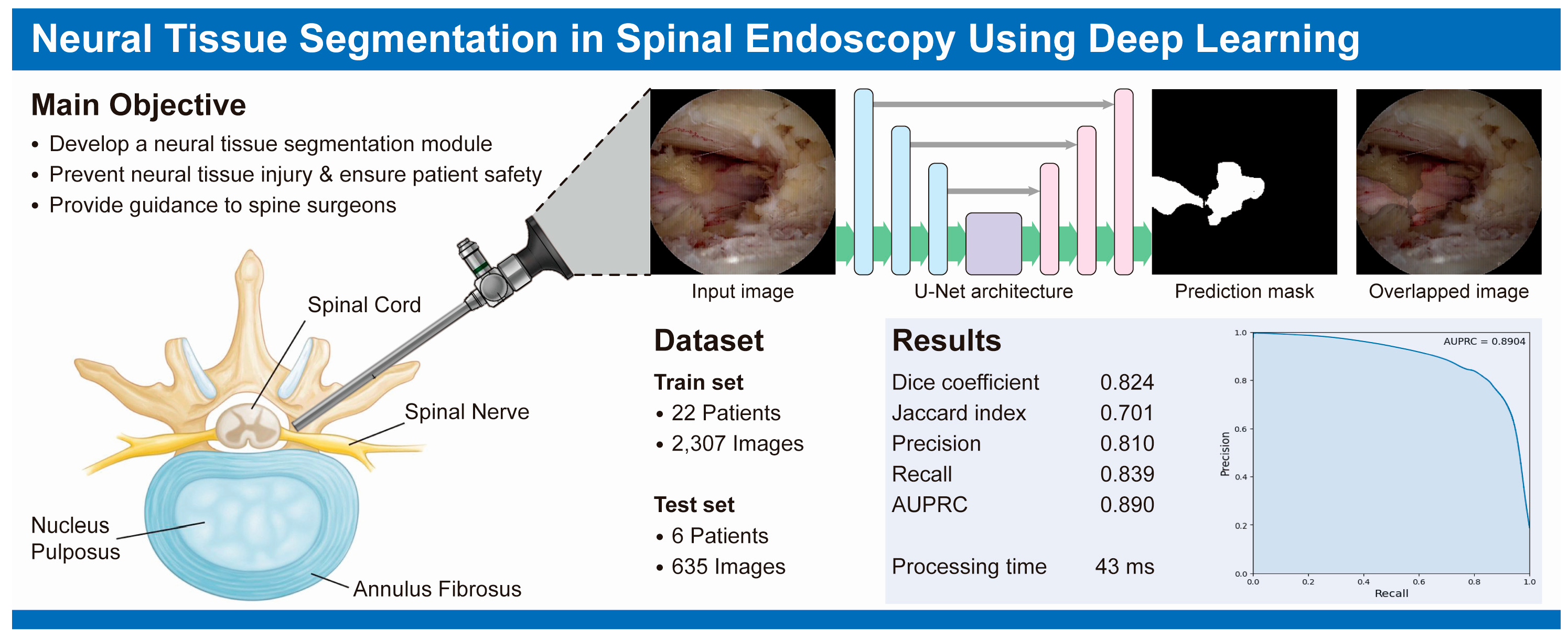

Deep Learning in Spinal Endoscopy: U-Net Models for Neural Tissue Detection



Abstract

1. Introduction
2. Materials and Methods
2.1. Dataset
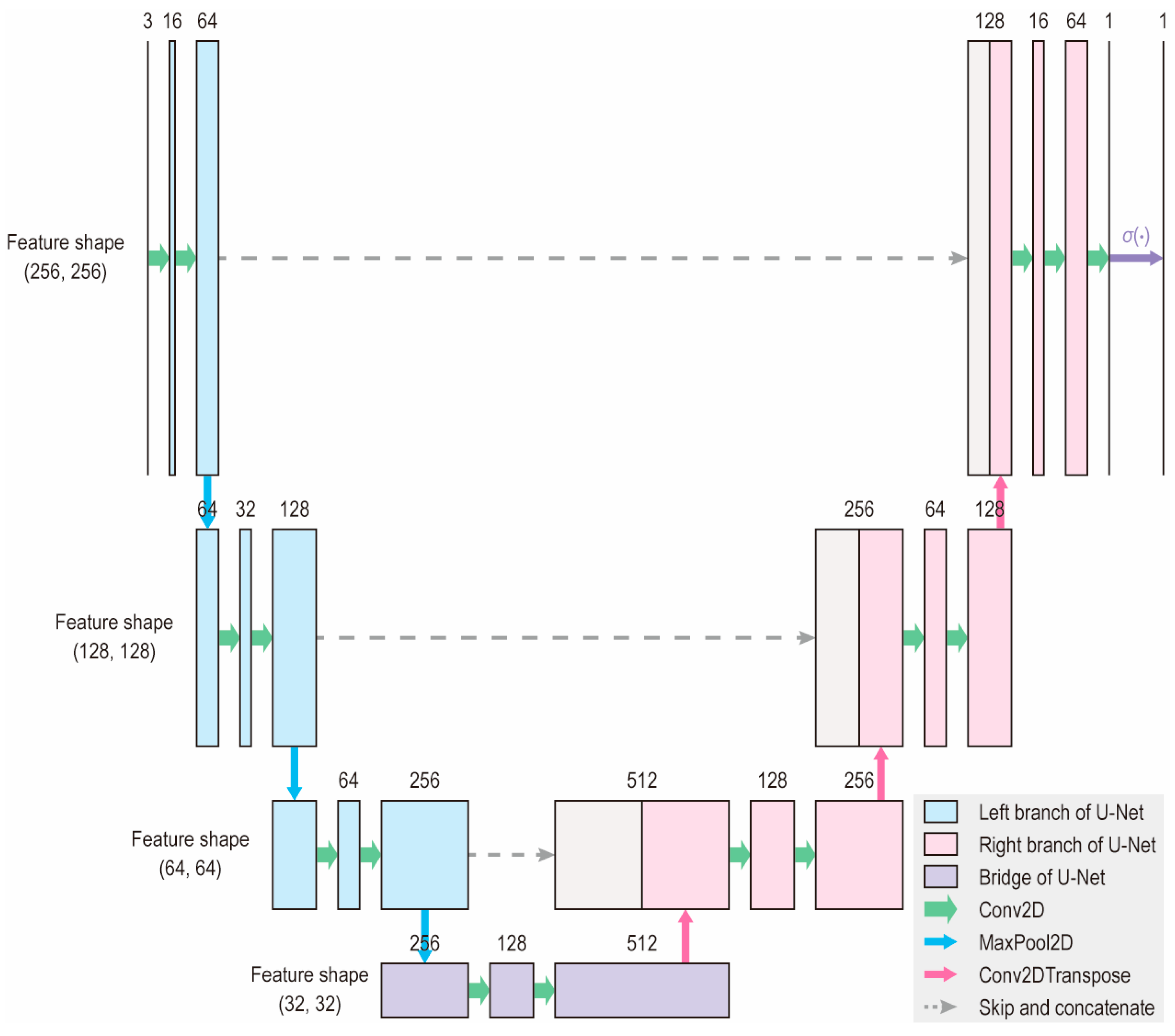
2.2. The U-Net Architecture
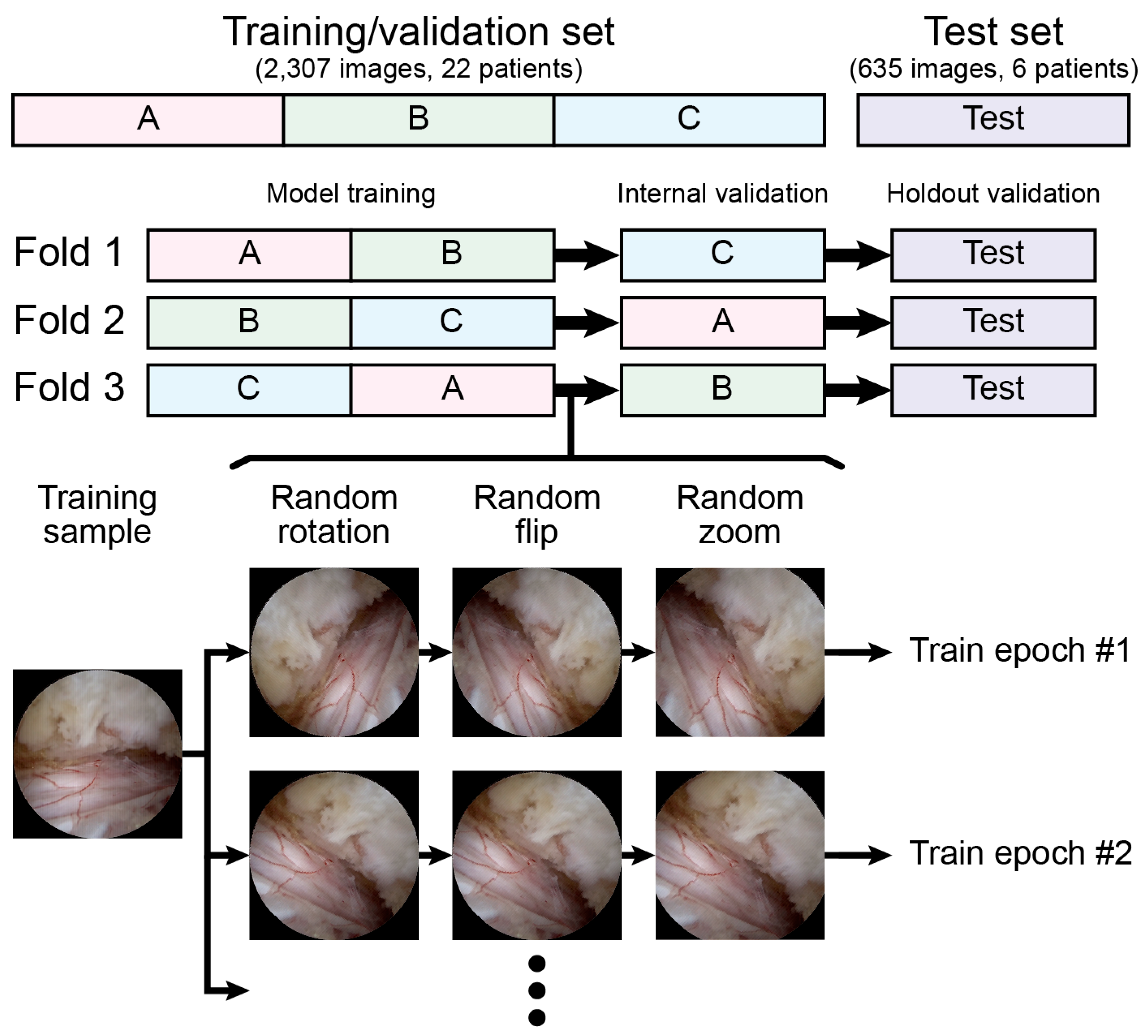
2.3. Model Training
2.4. Performance Assessment
2.4.1. Dice–Sorensen Coefficient
2.4.2. Jaccard Index
2.4.3. Precision and Recall
2.4.4. Qualitative Assessment
3. Results
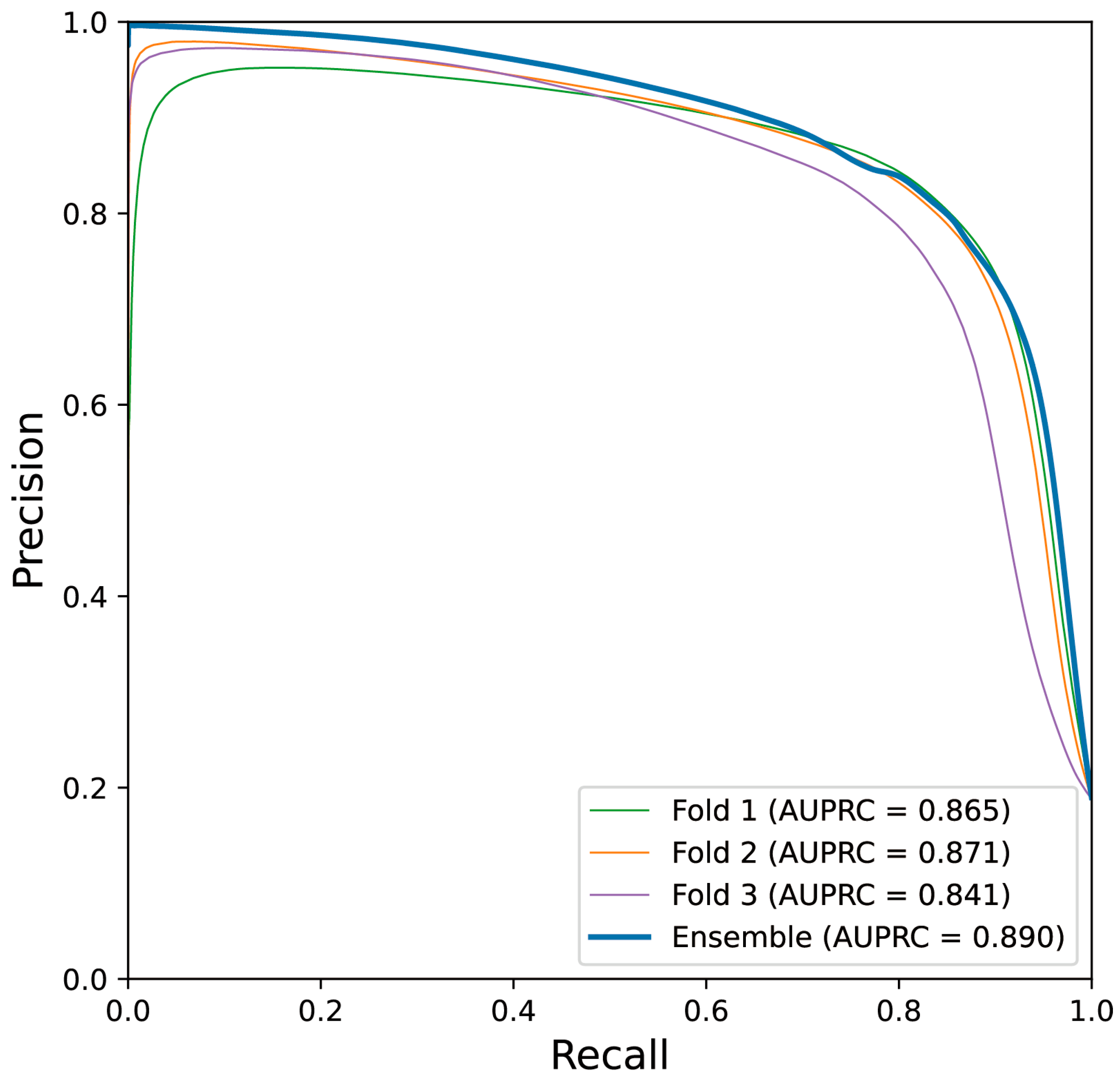
3.1. Quantitative Results
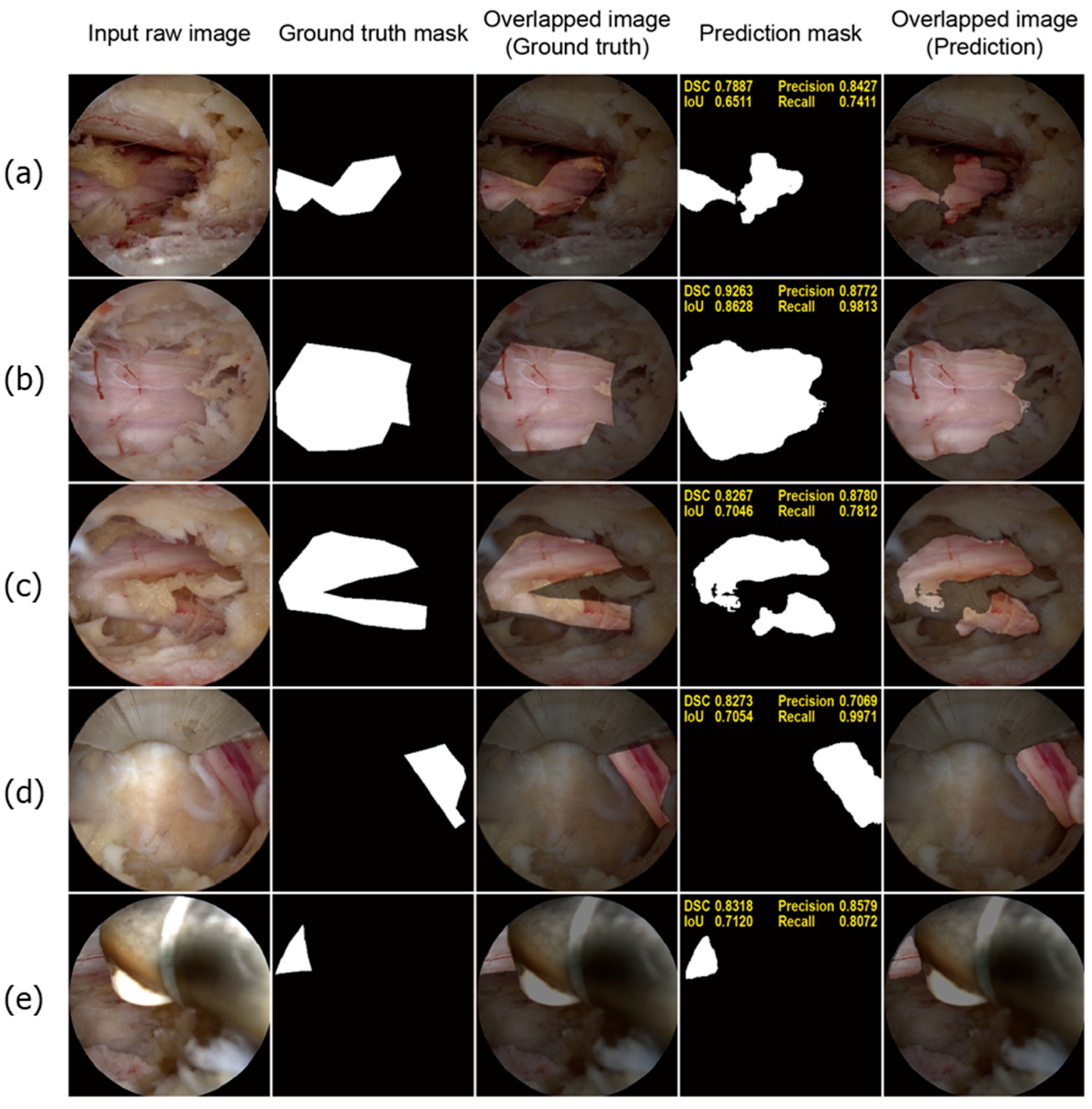
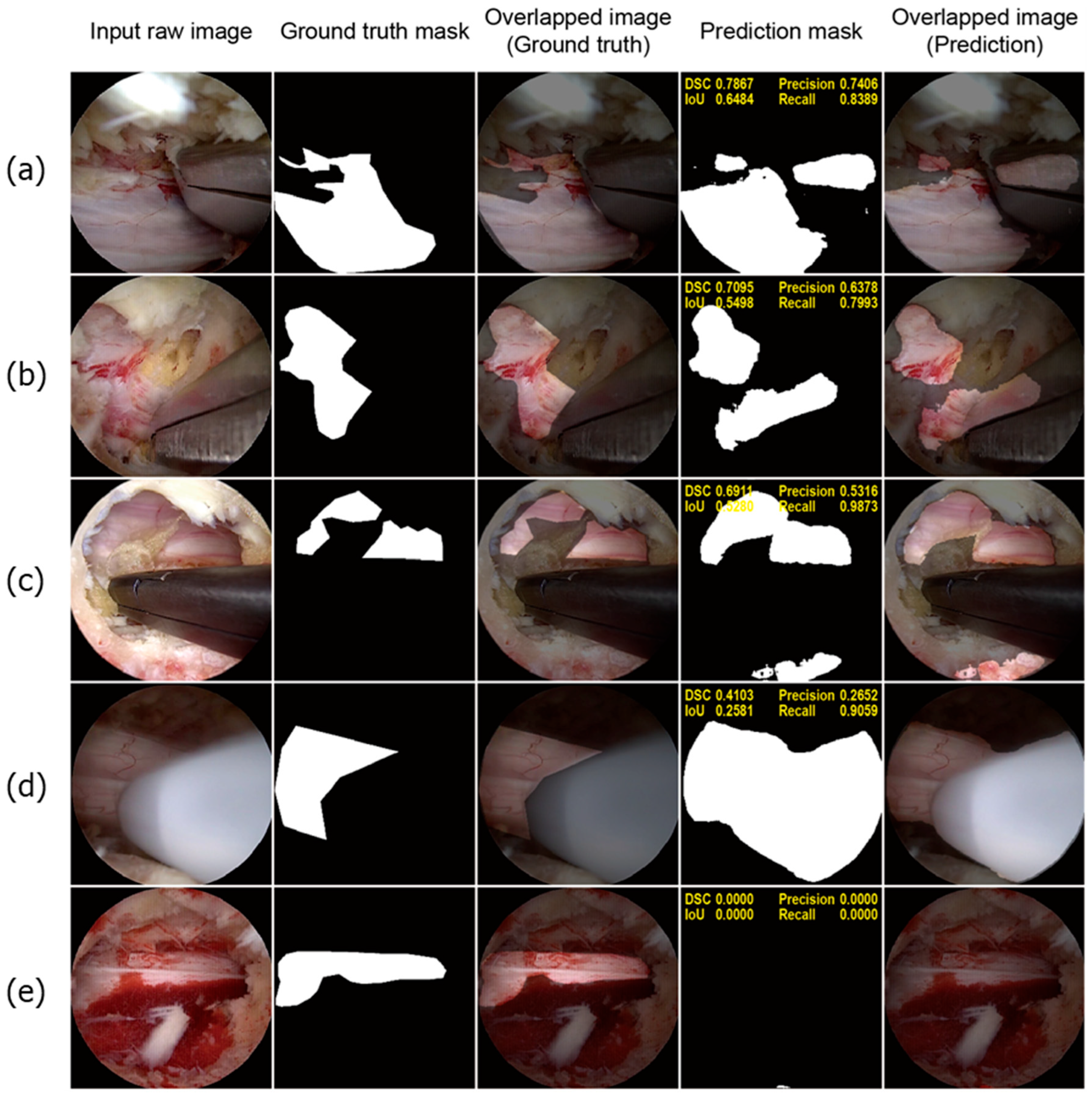
3.2. Qualitative Results
3.2.1. Well-Performing Samples
3.2.2. Poorly Performing Samples
4. Discussion
4.1. Comparison with Related Studies
4.2. Clinical Significance
4.3. Limitations and Future Work
5. Conclusions
Author Contributions
Funding
Institutional Review Board Statement
Informed Consent Statement
Data Availability Statement
Acknowledgments
Conflicts of Interest
References
- Junjie, L.; Jiheng, Y.; Jun, L.; haixiong, L.; Haifeng, Y. Comparison of Unilateral Biportal Endoscopy Decompression and Microscopic Decompression Effectiveness in Lumbar Spinal Stenosis Treatment: A Systematic Review and Meta-analysis. Asian Spine J. 2023, 17, 418–430. [Google Scholar] [CrossRef] [Scilit] [PubMed]
- Kim, J.-E.; Choi, D.-J.; Park, E.J.J.; Lee, H.-J.; Hwang, J.-H.; Kim, M.-C.; Oh, J.-S. Biportal Endoscopic Spinal Surgery for Lumbar Spinal Stenosis. Asian Spine J. 2019, 13, 334–342. [Google Scholar] [CrossRef] [Scilit] [PubMed]
- Kim, S.-K.; Kang, S.-S.; Hong, Y.-H.; Park, S.-W.; Lee, S.-C. Clinical comparison of unilateral biportal endoscopic technique versus open microdiscectomy for single-level lumbar discectomy: A multicenter, retrospective analysis. J. Orthop. Surg. Res. 2018, 13, 22. [Google Scholar] [CrossRef] [Scilit] [PubMed]
- Kwon, J.-W.; Moon, S.-H.; Park, S.-Y.; Park, S.-J.; Park, S.-R.; Suk, K.-S.; Kim, H.-S.; Lee, B.H. Lumbar Spinal Stenosis: Review Update 2022. Asian Spine J. 2022, 16, 789–798. [Google Scholar] [CrossRef] [Scilit] [PubMed]
- Lewandrowski, K.-U.; Hellinger, S.; De Carvalho, P.S.T.; Freitas Ramos, M.R.; Soriano-SáNchez, J.-A.; Xifeng, Z.; Calderaro, A.L.; Dos Santos, T.S.; Ramírez León, J.F.; de Lima e SilvA, M.S.; et al. Dural Tears During Lumbar Spinal Endoscopy: Surgeon Skill, Training, Incidence, Risk Factors, and Management. Int. J. Spine Surg. 2021, 15, 280. [Google Scholar] [CrossRef] [Scilit] [PubMed]
- Park, H.-J.; Kim, S.-K.; Lee, S.-C.; Kim, W.; Han, S.; Kang, S.-S. Dural Tears in Percutaneous Biportal Endoscopic Spine Surgery: Anatomical Location and Management. World Neurosurg. 2020, 136, e578–e585. [Google Scholar] [CrossRef] [Scilit] [PubMed]
- Ryu, K.; Kitaguchi, D.; Nakajima, K.; Ishikawa, Y.; Harai, Y.; Yamada, A.; Lee, Y.; Hayashi, K.; Kosugi, N.; Hasegawa, H.; et al. Deep learning-based vessel automatic recognition for laparoscopic right hemicolectomy. Surg. Endosc. 2024, 38, 171–178. [Google Scholar] [CrossRef] [Scilit] [PubMed]
- Chan, H.-P.; Samala, R.K.; Hadjiiski, L.M.; Zhou, C. Deep Learning in Medical Image Analysis. In Deep Learning in Medical Image Analysis: Challenges and Applications; Lee, G., Fujita, H., Eds.; Springer International Publishing: Cham, Switzerland, 2020; pp. 3–21. [Google Scholar]
- Chen, D.; Yang, W.; Wang, L.; Tan, S.; Lin, J.; Bu, W. PCAT-UNet: UNet-like network fused convolution and transformer for retinal vessel segmentation. PLoS ONE 2022, 17, e0262689. [Google Scholar] [CrossRef] [Scilit] [PubMed]
- Chen, L.C.; Papandreou, G.; Kokkinos, I.; Murphy, K.; Yuille, A.L. DeepLab: Semantic Image Segmentation with Deep Convolutional Nets, Atrous Convolution, and Fully Connected CRFs. IEEE Trans. Pattern Anal. Mach. Intell. 2018, 40, 834–848. [Google Scholar] [CrossRef] [Scilit] [PubMed]
- Shelhamer, E.; Long, J.; Darrell, T. Fully Convolutional Networks for Semantic Segmentation. IEEE Trans. Pattern Anal. Mach. Intell. 2017, 39, 640–651. [Google Scholar] [CrossRef] [Scilit] [PubMed]
- He, K.; Gkioxari, G.; Dollár, P.; Girshick, R. Mask R-CNN. In Proceedings of the 2017 IEEE International Conference on Computer Vision (ICCV), Venice, Italy, 22–29 October 2017; pp. 2980–2988. [Google Scholar]
- Feng, X.; Yang, J.; Laine, A.F.; Angelini, E.D. Discriminative Localization in CNNs for Weakly-Supervised Segmentation of Pulmonary Nodules. In Proceedings of the Medical Image Computing and Computer Assisted Intervention−MICCAI 2017: 20th International Conference, Quebec City, QC, Canada, 11–13 September 2017; Volume 10435, pp. 568–576. [Google Scholar] [CrossRef] [Scilit]
- Cho, S.M.; Kim, Y.G.; Jeong, J.; Kim, I.; Lee, H.J.; Kim, N. Automatic tip detection of surgical instruments in biportal endoscopic spine surgery. Comput. Biol. Med. 2021, 133, 104384. [Google Scholar] [CrossRef] [Scilit] [PubMed]
- Niha, A.; Muhammad, H.; Khurram, K.; Fatima, F.; Fahad, U. An Artificial Intelligence model for implant segmentation on periapical radiographs. J. Pak. Med. Assoc. 2024, 74, S-5–S-9. [Google Scholar] [CrossRef] [Scilit]
- Ronneberger, O.; Fischer, P.; Brox, T. U-Net: Convolutional Networks for Biomedical Image Segmentation. In Proceedings of the Medical Image Computing and Computer-Assisted Intervention–MICCAI 2015, Cham, Switzerland, 5–9 October 2015; pp. 234–241. [Google Scholar]
- Siddique, N.; Paheding, S.; Elkin, C.P.; Devabhaktuni, V. U-Net and Its Variants for Medical Image Segmentation: A Review of Theory and Applications. IEEE Access 2021, 9, 82031–82057. [Google Scholar] [CrossRef] [Scilit]
- He, K.; Gkioxari, G.; Dollar, P.; Girshick, R. Mask R-CNN. IEEE Trans. Pattern Anal. Mach. Intell. 2020, 42, 386–397. [Google Scholar] [CrossRef] [Scilit] [PubMed]
- Kundu, S.; Karale, V.; Ghorai, G.; Sarkar, G.; Ghosh, S.; Dhara, A.K. Nested U-Net for Segmentation of Red Lesions in Retinal Fundus Images and Sub-image Classification for Removal of False Positives. J. Digit. Imaging 2022, 35, 1111–1119. [Google Scholar] [CrossRef] [Scilit] [PubMed]
- Md Zahangir, A.; Chris, Y.; Mahmudul, H.; Tarek, M.T.; Vijayan, K.A. Recurrent residual U-Net for medical image segmentation. J. Med. Imaging 2019, 6, 014006. [Google Scholar] [CrossRef] [Scilit]
- Oktay, O.; Schlemper, J.; Folgoc, L.L.; Lee, M.; Heinrich, M.; Misawa, K.; Mori, K.; McDonagh, S.; Hammerla, N.Y.; Kainz, B. Attention u-net: Learning where to look for the pancreas. arXiv 2018, arXiv:1804.03999. [Google Scholar]
- Xavier, G.; Yoshua, B. Understanding the difficulty of training deep feedforward neural networks. In Proceedings of the Thirteenth International Conference on Artificial Intelligence and Statistics, Sardinia, Italy, 31 March 2010; pp. 249–256. [Google Scholar]
- Ioffe, S.; Szegedy, C. Batch normalization: Accelerating deep network training by reducing internal covariate shift. In Proceedings of the 32nd International Conference on International Conference on Machine Learning, Lille, France, 7–9 July 2015; Volume 37, pp. 448–456. [Google Scholar]
- Yun, S.; Han, D.; Chun, S.; Oh, S.J.; Yoo, Y.; Choe, J. CutMix: Regularization Strategy to Train Strong Classifiers With Localizable Features. In Proceedings of the 2019 IEEE/CVF International Conference on Computer Vision (ICCV), Seoul, Republic of Korea, 27 October–2 November 2019; pp. 6022–6031. [Google Scholar]
- Zhang, Z.; Liu, Q.; Wang, Y. Road Extraction by Deep Residual U-Net. IEEE Geosci. Remote Sens. Lett. 2018, 15, 749–753. [Google Scholar] [CrossRef] [Scilit]
- Bu, J.; Lei, Y.; Wang, Y.; Zhao, J.; Huang, S.; Liang, J.; Wang, Z.; Xu, L.; He, B.; Dong, M.; et al. A Multi-Element Identification System Based on Deep Learning for the Visual Field of Percutaneous Endoscopic Spine Surgery. Indian J. Orthop. 2024, 58, 587–597. [Google Scholar] [CrossRef] [Scilit] [PubMed]
- Wang, W.; Yu, K.; Hugonot, J.; Fua, P.; Salzmann, M. Recurrent U-Net for Resource-Constrained Segmentation. In Proceedings of the 2019 IEEE/CVF International Conference on Computer Vision (ICCV), Seoul, Republic of Korea, 27 October–2 November 2019; pp. 2142–2151. [Google Scholar]




| Training/Validation Set | Test Set | |
|---|---|---|
| Number of images | 2307 (78%) | 635 (22%) |
| Number of patients | 22 (79%) | 6 (21%) |
| Age (years) | 65.4 ± 10.7 | 63.8 ± 14.1 |
| Sex | ||
| Male | 9 | 3 |
| Female | 13 | 3 |
| Hyperparameter | Search Space |
|---|---|
| Batch size | {4, 8, 12, 16} |
| Initial learning rate | loguniform (0.001, 0.1) |
| Optimizer | {Adam, SGD} |
| Patience for learning rate reduction | {3, 4, 5, 6, 7} |
| Reducing factor for learning rate reduction | uniform (0.05, 0.15) |
| Trial | Hyperparameters | Performance Measures (Holdout Validation) | ||||||||
|---|---|---|---|---|---|---|---|---|---|---|
| Batch Size | Initial LR | Optimizer | Patience | Reduce Factor | DSC | IoU | Precision | Recall | mAP | |
| 1 | 12 | 0.00136 | Adam | 7 | 0.079 | 0.824 | 0.701 | 0.810 | 0.839 | 0.890 |
| 2 | 16 | 0.00868 | Adam | 7 | 0.123 | 0.817 | 0.690 | 0.790 | 0.845 | 0.844 |
| 3 | 16 | 0.00108 | Adam | 7 | 0.079 | 0.815 | 0.687 | 0.814 | 0.815 | 0.894 |
| 4 | 4 | 0.01101 | SGD | 7 | 0.107 | 0.814 | 0.687 | 0.786 | 0.845 | 0.864 |
| 5 | 12 | 0.00183 | Adam | 6 | 0.083 | 0.809 | 0.679 | 0.779 | 0.842 | 0.877 |
| 6 | 8 | 0.09321 | SGD | 5 | 0.090 | 0.809 | 0.679 | 0.766 | 0.857 | 0.846 |
| 7 | 8 | 0.03990 | SGD | 5 | 0.105 | 0.803 | 0.670 | 0.756 | 0.856 | 0.839 |
| 8 | 12 | 0.00711 | Adam | 6 | 0.149 | 0.798 | 0.664 | 0.759 | 0.842 | 0.820 |
| 9 | 12 | 0.01099 | Adam | 7 | 0.122 | 0.797 | 0.663 | 0.756 | 0.845 | 0.855 |
| 10 | 4 | 0.00103 | Adam | 3 | 0.146 | 0.794 | 0.659 | 0.746 | 0.849 | 0.865 |
| Internal Validation | DSC | IoU | Precision | Recall | AUPRC |
|---|---|---|---|---|---|
| Fold 1 | 0.818 | 0.692 | 0.808 | 0.828 | 0.849 |
| Fold 2 | 0.815 | 0.688 | 0.821 | 0.809 | 0.868 |
| Fold 3 | 0.810 | 0.680 | 0.805 | 0.814 | 0.870 |
| Holdout validation | DSC | IoU | Precision | Recall | mAP |
| Fold 1 | 0.827 | 0.705 | 0.813 | 0.841 | 0.865 |
| Fold 2 | 0.820 | 0.694 | 0.810 | 0.829 | 0.871 |
| Fold 3 | 0.792 | 0.656 | 0.806 | 0.780 | 0.841 |
| Ensemble | 0.824 | 0.701 | 0.810 | 0.839 | 0.890 |
Disclaimer/Publisher’s Note: The statements, opinions and data contained in all publications are solely those of the individual author(s) and contributor(s) and not of MDPI and/or the editor(s). MDPI and/or the editor(s) disclaim responsibility for any injury to people or property resulting from any ideas, methods, instructions or products referred to in the content. |
© 2024 by the authors. Licensee MDPI, Basel, Switzerland. This article is an open access article distributed under the terms and conditions of the Creative Commons Attribution (CC BY) license (https://creativecommons.org/licenses/by/4.0/).
Share and Cite
Lee, H.R.; Rhee, W.; Chang, S.Y.; Chang, B.-S.; Kim, H. Deep Learning in Spinal Endoscopy: U-Net Models for Neural Tissue Detection. Bioengineering 2024, 11, 1082. https://doi.org/10.3390/bioengineering11111082
Lee HR, Rhee W, Chang SY, Chang B-S, Kim H. Deep Learning in Spinal Endoscopy: U-Net Models for Neural Tissue Detection. Bioengineering. 2024; 11(11):1082. https://doi.org/10.3390/bioengineering11111082
Chicago/Turabian StyleLee, Hyung Rae, Wounsuk Rhee, Sam Yeol Chang, Bong-Soon Chang, and Hyoungmin Kim. 2024. "Deep Learning in Spinal Endoscopy: U-Net Models for Neural Tissue Detection" Bioengineering 11, no. 11: 1082. https://doi.org/10.3390/bioengineering11111082
APA StyleLee, H. R., Rhee, W., Chang, S. Y., Chang, B.-S., & Kim, H. (2024). Deep Learning in Spinal Endoscopy: U-Net Models for Neural Tissue Detection. Bioengineering, 11(11), 1082. https://doi.org/10.3390/bioengineering11111082