


Abstract
Nitrogen applied in excess of plant demand in intensive agricultural systems can be lost through runoff and leaching into surface and groundwater, with potentially negative effects on water quality. Zeolites, due to their high cation exchange capacity and internal porosity, can adsorb ammonium () and help mitigate excessive nitrate () leaching. Owing to such properties, zeolites can play an important role in reducing the potential negative impact associated with the extensive use of nitrogen-based fertilizers. In this study, we investigated the effects of two commercial natural zeolites on selected hydraulic properties, water storage, and solute transport parameters of three sandy-loam soils with different pedological characteristics. Laboratory experiments were conducted on disturbed soil columns. The leaching of and ions was monitored using ion-selective electrode analysis. The results indicate that zeolite application reduces the mobility of nitrate and ammonium. This effect can be attributed to changes in the original pore size distribution of the investigated soils, characterized by a reduction in macropore regions and a corresponding increase in meso- and micropore regions. In the case of ammonium, adsorption mechanisms are also involved, which further contribute to retarding its mobility. These effects were consistently observed across the investigated soils. For a given soil, the magnitude of the observed effects depended on both the type of zeolite used and the amount of zeolite mixed with the soil. Finally, ANOVA tests and multivariate analyses were applied to the full dataset to provide statistical support for the observed changes in the selected parameters.
1. Introduction
In agronomic systems, nitrogen management plays a crucial role in ensuring both crop productivity and environmental sustainability. Excess nitrogen compounds applied beyond the actual requirements of intensive agricultural systems are transferred to surface and groundwater, inducing eutrophication, algal blooms, and high fish mortality rates [1,2,3,4,5].
Surplus nitrogen can also be released into the atmosphere as inert gas (N2), contributing to anthropogenic climate change through nitrous oxide (N2O) emissions [6,7]. Ammonium () and nitrate () constitute the main inorganic forms of nitrogen. Caicedo [8] reported that their assimilation by plants can account for up to 70% of the total absorbed cations and anions.
In agricultural systems, nitrogen losses by leaching become significant when water inputs exceed the soil’s storage capacity, leading to downward water movement that transports soluble nitrogen species. Among these, nitrate is particularly mobile and easily leached, since its negative charge results in electrostatic repulsion (i.e., anion exclusion) between nitrate ions and the negatively charged surfaces of soil particles. As a result, ion is poorly retained within the soil matrix and readily move with percolating water [9,10,11].
By contrast, ammonium, being positively charged, interacts with cation exchange sites on clays and soil organic matter. Consequently, its mobility can be limited in fine-textured soils, whereas in sandy or coarse-textured soils, ammonium leaching may become more pronounced [12,13,14].
From a practical perspective, improving the retention of nitrate and ammonium in agricultural soils is of primary importance. Enhanced retention reduces nutrient losses through leaching, thereby increasing nitrogen use efficiency and lowering fertilizer requirements.
Over the years, numerous studies have focused on identifying practices that both enhance soil fertility and mitigate nutrient losses to water bodies [15,16]. Farmers adopt a variety of strategies to minimize these losses, such as splitting nitrogen applications, using controlled-release fertilizers, or incorporating soil amendments that enhance the retention of and [17,18]. Due to their high cation exchange capacity, zeolites can be used as an inexpensive cation exchanger to control release [16,19]. To retard the movement of anionic species, zeolites with high affinity for anions are required. It has been shown that surfactant-modified zeolites, when used as amendments, can effectively control release and meet these requirements [20,21]. However, the interactions between these modified zeolites and soils remain poorly understood and clearly warrant further investigation [22,23].
Zeolites are hydrated aluminosilicates characterized by a three-dimensional network of and tetrahedrons linked by oxygen atoms. The open three-dimensional framework is a negatively charged network characterized by open channels (30–40%) of nanometric dimensions (0.1–0.4 μm), where different kinds of polar and non-polar molecules can be adsorbed and exchanged.
It has been extensively shown [24,25,26,27,28] that the reduced mobility of both anionic and cationic species in soils mixed with zeolites can be attributed to their ability to alter soil porosity, particularly by increasing meso- and microporosity, as well as modifying soil tortuosity, and connectivity, since a finer fraction (i.e., zeolite) is added to the soil matrix. Such multifactorial interactions among all the distinct phases involved can ultimately modify soil hydraulic and solute transport properties.
Several studies have shown that the impact of zeolites may vary depending on soil type, zeolite characteristics, and application rate. In particular, the addition of fine zeolitic materials may reduce macroporosity and, in some cases, limit water availability for plants, especially at higher application rates. The magnitude of these effects is controlled by multiple interacting factors, including soil mineralogical composition, texture and structure, zeolite type, and water characteristics [29,30,31]. Consequently, soil–zeolite interactions may produce complex hydraulic and transport responses that are not always easily predictable [19,32,33].
Despite the growing body of literature on the use of zeolites as soil amendments, several knowledge gaps still remain. Most studies have primarily focused on ammonium adsorption or nitrate leaching reduction, often considering these processes separately [17,21,27]. However, the combined effects of natural zeolites on soil hydraulic properties and solute transport processes are still not fully understood, particularly in sandy-loam soils characterized by relatively high permeability [29,30]. Furthermore, although several investigations have demonstrated the potential of zeolites in reducing nitrogen losses under agricultural conditions, most studies have focused either on field-scale agronomic responses or on specific adsorption processes, without explicitly linking soil structural modifications to hydraulic and solute transport behavior [34,35]. In this context, a more integrated analysis relating soil structural changes, hydraulic behavior, and solute transport mechanisms is needed to better understand the role of zeolites in controlling nitrogen dynamics in agricultural soils.
Based on this evidence, and with the aim of establishing a rational experimental framework, we hypothesize that (i) the addition of natural zeolites modifies the soil pore structure, leading to measurable changes in soil hydraulic and transport properties, and (ii) these structural modifications reduce nitrate and ammonium mobility within the soil matrix. Furthermore, we hypothesize that the magnitude of these effects depends on both the type of zeolite used and the application rate. Accordingly, the objectives of the present study were defined to evaluate, through a series of laboratory experiments, the effect of two natural zeolites (namely chabazite and clinoptilolite), mixed with sandy-loam soils of different pedological features, on selected soil hydraulic and transport properties influencing and leaching. Sandy-loam soils were specifically selected for this study because they are characterized by moderate-to-high permeability, making them particularly vulnerable to nitrogen leaching processes.
To investigate soil transport properties, specific experiments were carried out using potassium chloride (KCl) as a conservative tracer, together with potassium nitrate (KNO3) and ammonium chloride (NH4Cl). Changes in soil hydraulic properties were independently evaluated through modifications in the measured soil water retention curves (SWRCs), allowing subsequent analysis of key hydraulic parameters and derived soil water storage parameters (SWSPs). Statistical analyses, including ANOVA and multivariate methods, were conducted on the experimental dataset to provide statistical validation of the changes observed in the selected parameters.
2. Materials and Methods
2.1. Physico-Chemical Characterization of Selected Soils and Zeolites
In the present research, several laboratory experiments were carried out on repacked soil samples collected from the Ap horizon (~0–20 cm below the soil surface). According to [36], three sandy-loam soils were considered, hereafter referred to as ME (i.e., Metaponto site, latitude: 40.37° N, longitude: 16.81° E), GE (Genzano site, latitude: 40.85° N, longitude: 16.03° E), and FE (San Ferdinando site, latitude: 41.30° N, longitude: 16.07° E).
The principal physico-chemical characteristics of these soils, including texture, organic carbon (OC), pH, and bulk density (ρb), are summarized in Table 1. These parameters were determined using standard procedures described by [37,38,39,40].
Table 1.
Principal physico-chemical properties and pedological classification of the investigated soils.
Regarding the zeolites, two commercial natural types were used, namely Chabazite (Zeolite® Italia, Gioia Tauro, Italy) and Clinoptilolite (Heiltropfen® Lab, Markovci, Slovenia). Details on the selected zeolites are reported in Table 2. Mineralogical characterization of zeolitic material was performed by X-ray diffraction (XRD) analysis.
Table 2.
(a) Qualitative and quantitative analysis of Chabazite and Clinoptilolite materials. (b) Chemical analysis of Chabazite and Clinoptilolite materials.
2.2. Estimation of Soil Hydraulic Properties and Soil Water Storage Parameters
For this set of laboratory experiments, the SWRCs were determined via the hanging water column technique, a widely adopted method for determining SWRCs in the low suction range investigated in the present study, and particularly suitable for reconstructed laboratory samples [41,42].
Following the procedure proposed by [43], the soil samples were oven dried at 105 °C, passed through a 2 mm sieve, and then combined by weight with zeolite at concentrations of 2% and 5% (hereafter referred to as Z2 and Z5). Once mixed, soil samples were built in PVC cylinders (8 cm in diameter and 7 cm in length) by gradually adding known weights of soil and slightly shaking the cylinder to settle the soil in a fixed height increment to reach a predefined final bulk density of the soil sample.
In addition, for each soil type, a control sample without zeolite (Z0) was prepared. In all, including Z0 samples, 60 soil samples were prepared (3 soils × 5 treatments × 4 replicates, where the five treatments are Z0, chabazite Z2, chabazite Z5, clinoptilolite Z2, and clinoptilolite Z5).
The RETC software (version 6.02, USDA-ARS U.S. Salinity Laboratory, Riverside, CA, USA) [44], based on the van Genuchten model [45], was specifically utilized for post-processing the acquired SWRCs. For the sake of completeness, Equation (1) reports the van Genuchten (vG) equation:
where θ, θs, and θr are respectively the volumetric water content, the volumetric water content at saturation, and the residual water content, and ψ (hPa) is the matric potential. The parameters n (-), m (=1 − 1/n), and α (hPa−1) are shape parameters.
A MATLAB (version R2024a, The MathWorks, Inc., MA, USA) code developed by the authors was used to calculate variations in soil porosity due to the addition of zeolite to soils. These variations were obtained using the equation proposed by [46]:
where W represents the potential weighted average water content between the matric potentials and , which are the boundary limits. With reference to these limits, in the present research, we adopted the value of ψ = −100 hPa as a threshold between macro- and mesoporosity regions, and the value of ψ = −15,000 hPa to separate the mesoporosity domain from the microporosity domain [47,48,49,50,51,52].
Available water content (AWC) was calculated as the difference between the volumetric water content at field capacity, θFC (measured at ψ = −100 hPa), and the volumetric water content at the permanent wilting point, θPWP (measured at ψ = −15,000 hPa):
To estimate the readily available water content (RAWC), we adopted the method proposed by [53,54]. Following these authors, RAWC was evaluated within the matric potential interval between ψ = −100 hPa and ψ = −1000 hPa:
Finally, saturated hydraulic conductivity (Ks) was determined on the same soil samples using the constant head method [55] under room temperature conditions. In particular, the hydraulic gradient was fixed at 1.25 cm/cm.
2.3. Estimation of Soil Solute Transport Parameters
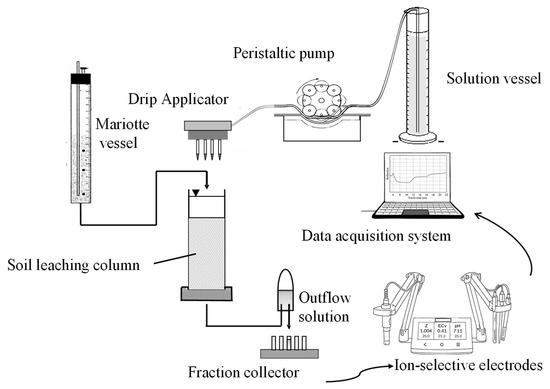
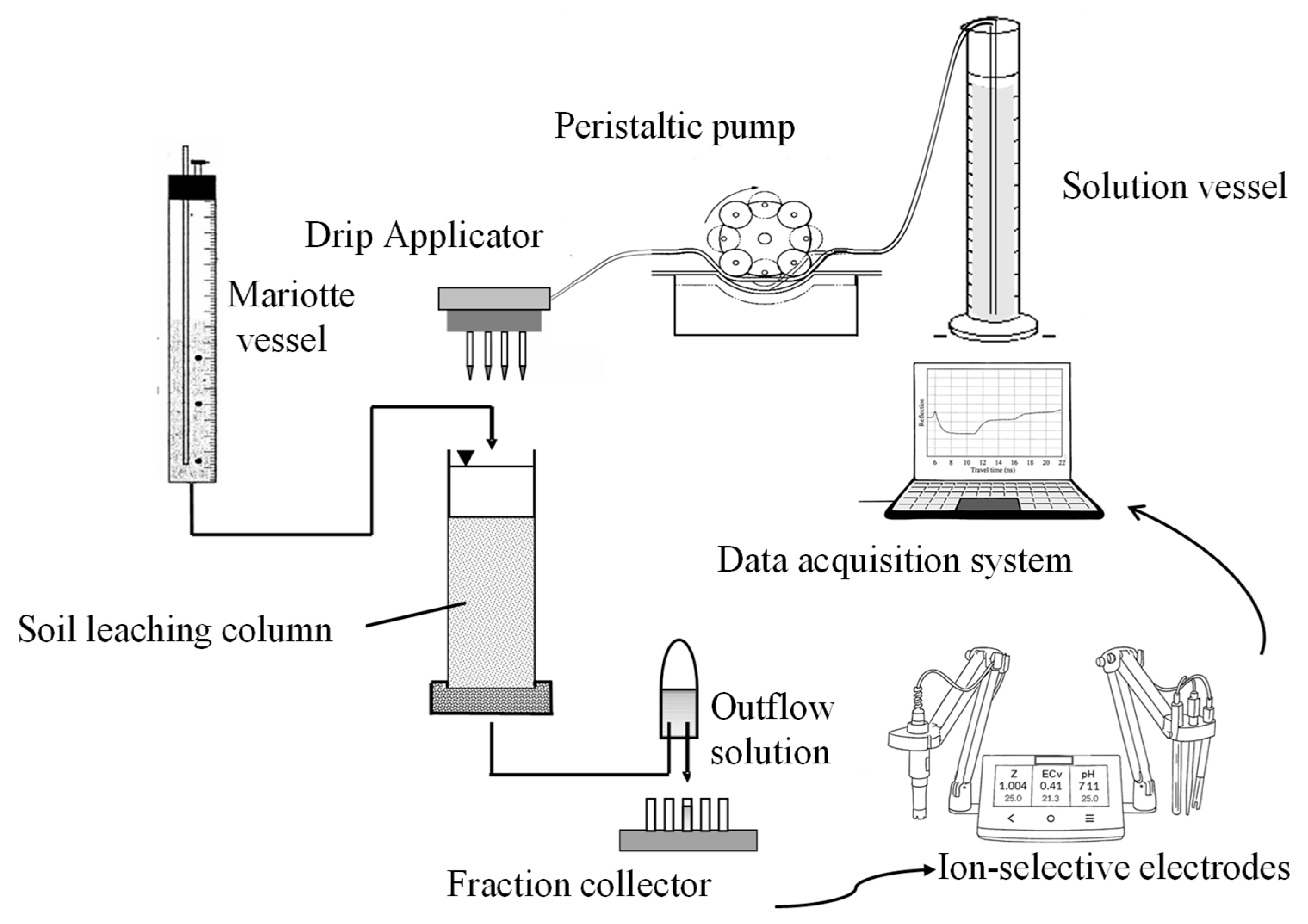
For this set of laboratory measurements, soil–zeolite mixtures were prepared according to the experimental protocol described in the previous section. In this latter case, the samples were repacked in PVC cylinders 8 cm in diameter and 11 cm in length. To determine the soil solute transport parameters of the selected soil–zeolite mixtures, solute transport tests were conducted using potassium chloride (KCl) as a tracer, and to monitor nitrate and ammonium dynamics we adopted potassium nitrate (KNO3) and ammonium chloride (NH4Cl). For the above experiments, the laboratory apparatus (Figure 1) mainly consisted of: (i) a Mariotte system for water application, (ii) a peristaltic pump (set at a flow rate of approximately 25 mL min−1) associated with a drip applicator for solute application, (iii) a fraction collector system located at the column outflow, (iv) an ion-selective electrode (ISE) apparatus, and (v) a data acquisition system.
Figure 1.
Schematic diagram of the laboratory apparatus developed for the miscible flow tests (adapted from [56]).
At the beginning of the leaching tests, the soil sample was fully saturated with water from the bottom. Once saturation was achieved, water was applied from the top of the soil sample. The Mariotte apparatus was adjusted to maintain a constant ponding level of approximately 2 cm. After steady-state flow had been established (steady-state conditions were assumed when consecutive outflow measurements exhibited negligible variations), the water supply was stopped and the ponded water at the soil surface was allowed to drain completely. Subsequently, 20 cm3 of a test solution was applied, in a few seconds, to the top of the sample using the drip applicator. After the solution pulse had fully infiltrated the soil surface, the Mariotte system was re-opened to allow the solute to leach downward. For each soil type, experiments were first performed on a sample without zeolite (Z0), which served as the control. Solute transport experiments were then conducted sequentially using a solution of 20 g/L of KCl, KNO3 and NH4Cl.
During the experiments, the ion concentration of , and was determined on the eluate collected at the bottom of the soil column using ion-selective electrodes connected to the data acquisition system (Hanna Instruments, Villafranca Padovana, Italy, model HI6000).
The experimental breakthrough curves (BTCs: concentration vs. time curves) were then analyzed by means of a MATLAB code developed by the authors to estimate solute transport parameters, such as soil pore water velocity, v (cm/min), soil dispersivity, λ (cm), which represents the spreading of the solute caused by mechanical dispersion within the soil pore network, coefficient of dispersion D = λv (cm2/min), and retardation factor R (-), which quantifies the delay of solute transport relative to water flow.
These parameters were obtained using the time moment analysis approach [57] which is known to allow the interpretation of experimental BTCs without the assumption of a specific process in the soil, and thus, of a specific model (e.g., a convection–dispersion equation, CDE; [58,59,60]). Temporal moments were numerically evaluated by integrating the experimental BTCs over time.
Briefly, the temporal moments of the experimental BTC at a position z and for a pulse input of a mass solute (non-reactive or reactive) are defined as:
Zeroth-order moment (area under the curve):
First-order moment (mean travel time):
Second-order moment (variance of travel times):
In the above, C is the solute concentration and t is the time variable.
Once these moments are calculated, the soil pore water velocity, v, can be determined as
and the dispersivity λ by using
CV being the coefficient of variation (i.e., ). It is worth noting that the λ values were determined through chloride transport tests [61,62,63].
Finally, in the case of ammonium, for a fixed soil–zeolite mixture, the retardation factor R was calculated from the ratio of the travel time variance of and that of [62]:
2.4. Statistical Analysis of Soil Hydraulic, SWSP, and Transport Parameters
Experimental data were collected with four replicates (n = 4) and analyzed using SPSS software (version 30.0, SPSS Statistics for data analysis, IBM Corp., Armonk, NY, USA) and OriginPro software (version 2026, OriginLab Corporation, Northampton, MA, USA). Results are reported as mean values. The effects of zeolite on hydraulic and transport parameters across the three soils were assessed using a one-way ANOVA statistical test to compare zeolite treatments within each soil group. A two-way ANOVA statistical test was performed to evaluate the main effects of soil (S), treatment (T), and their interaction (S × T). For both analyses, a Tukey post hoc test was employed for multiple comparisons between means. Statistical significance was defined at the significance level of p ≤ 0.05. The assumptions of normality and homogeneity of variance were verified using the Shapiro–Wilk (p ≤ 0.05) and the Levene (p ≤ 0.05) tests, respectively. Results were presented using the classical Compact Letter Display (CLD) method.
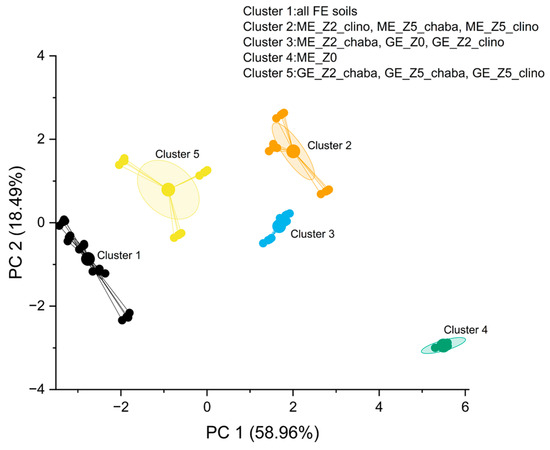
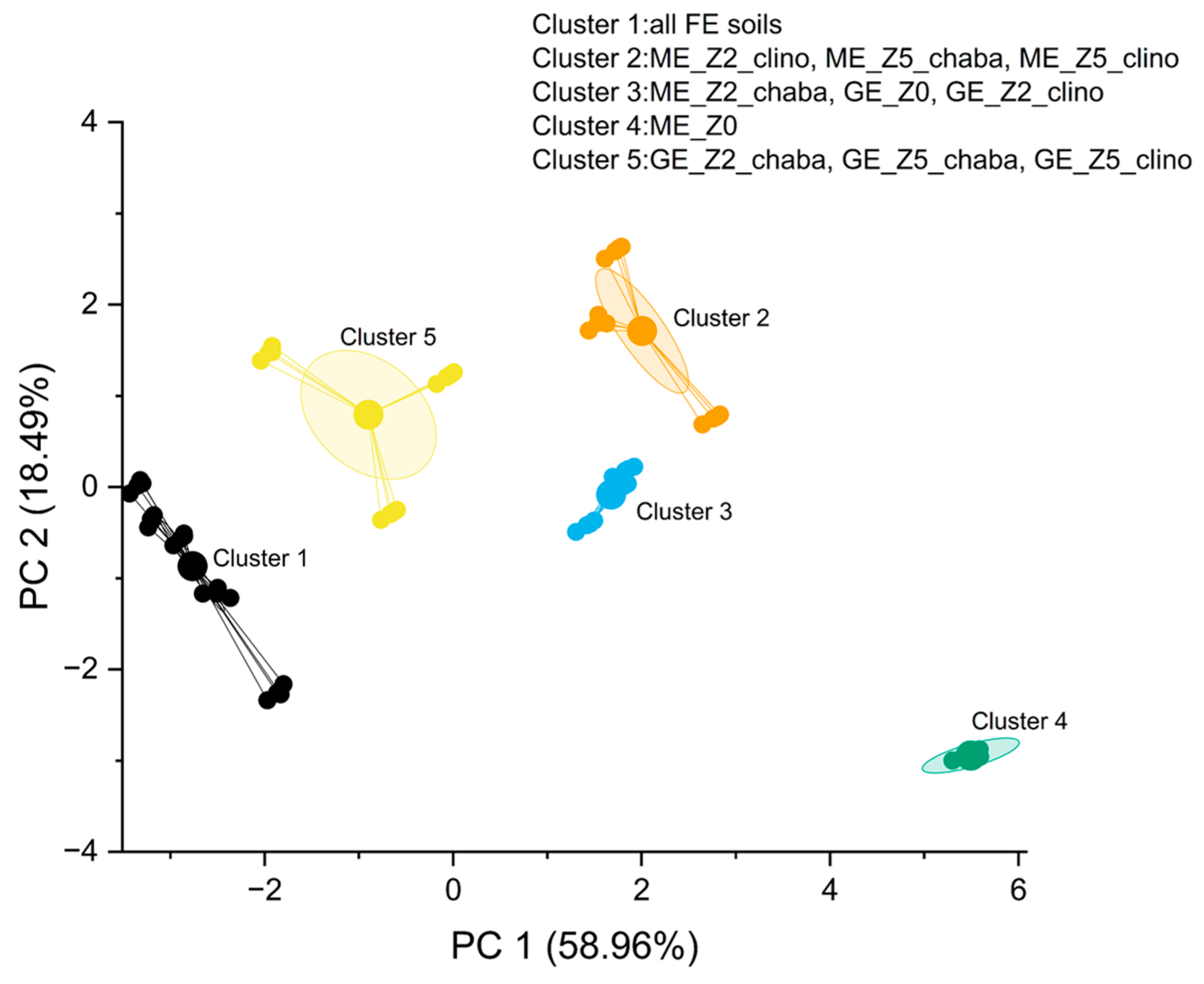
To identify homogeneous groups within a dataset comprising measurements from various samples subjected to specific treatments, a multivariate statistical approach was also adopted. A k-means clustering algorithm was applied to partition the observations into five distinct groups (Cluster 1, 2, 3, 4 and 5) based on the Euclidean distance between points in the principal component space [64,65]. The analysis was performed on all individual replicates, allowing the algorithm to account for internal variability and ensuring that the resulting clusters were robust and representative of the overall dataset distribution. Before processing, a z-score normalization was necessary to scale the variables into a common range (mean = 0, standard deviation = 1). The optimal number of clusters (k) was determined by cross-referencing the results of two complementary methodologies, namely the Elbow Method [66] and Silhouette Analysis [67]. The analysis identified k = 5 as the most robust partition for the given dataset. Finally, to visualize the fingerprint of each cluster, a radar chart was generated.
3. Results and Discussions
3.1. Effects of Zeolite on Soil Hydraulic and Soil Water Storage Parameters
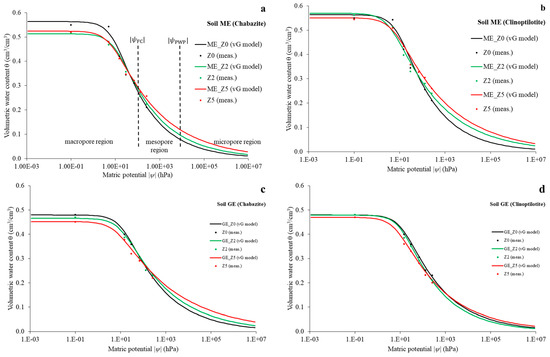
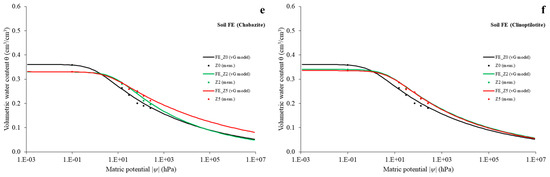
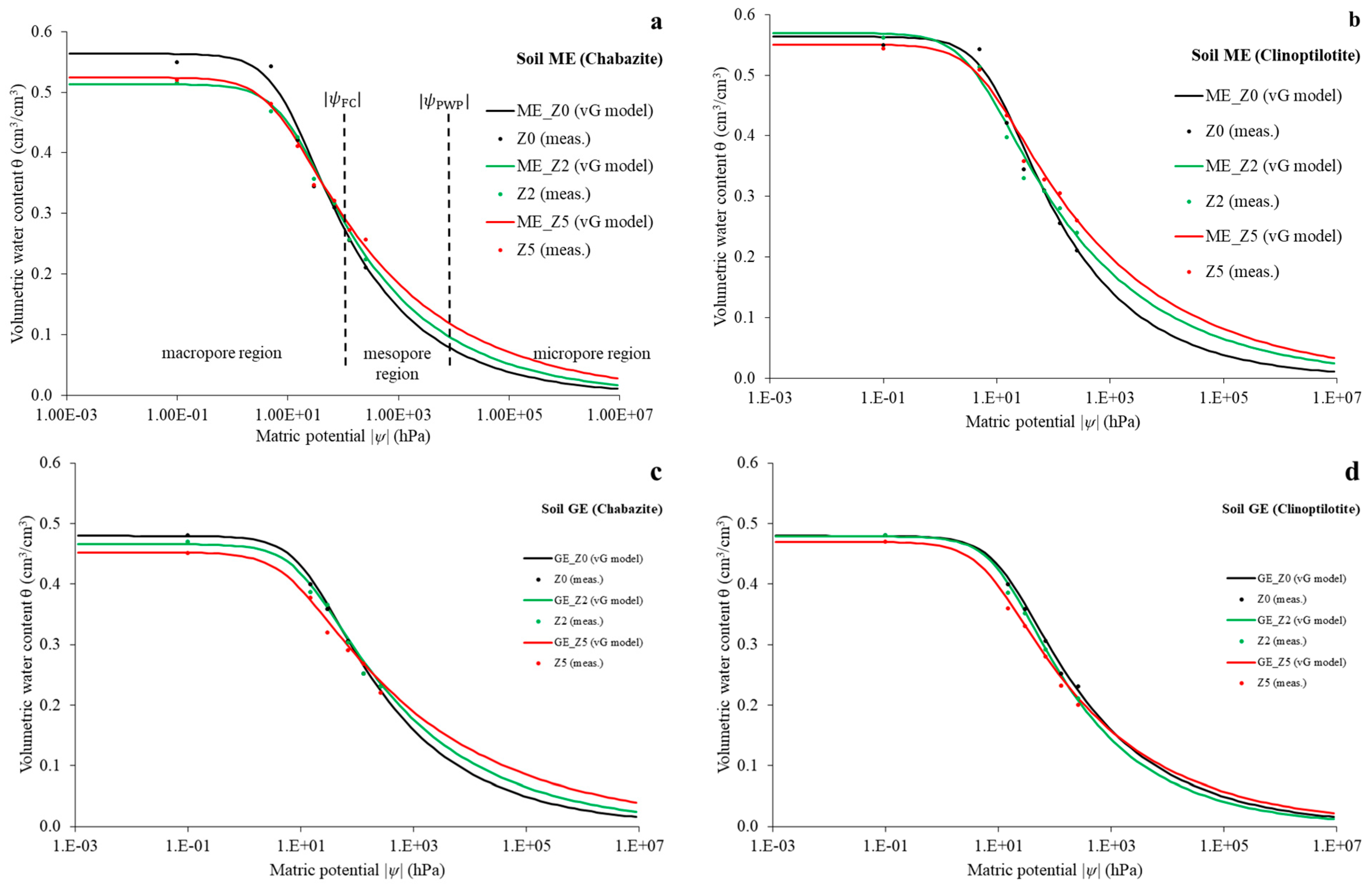
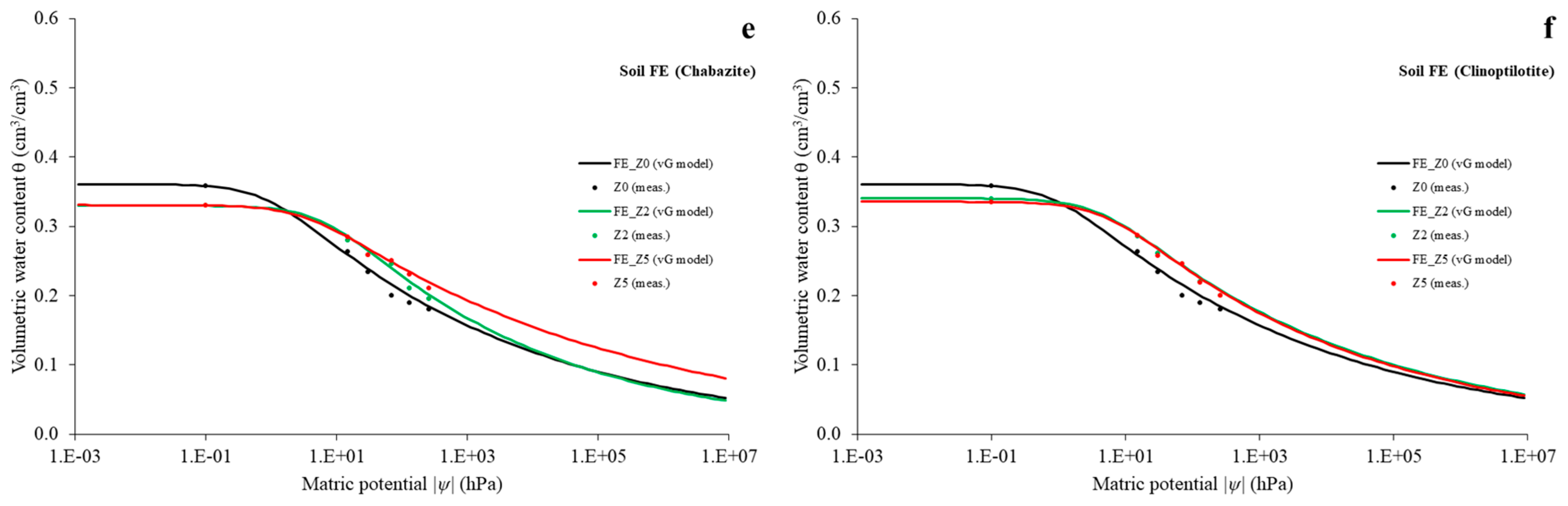
The influence of zeolite on the shape of the SWRCs can be observed in Figure 2a–f, which illustrate both the experimental data and the corresponding vG fitting curves obtained for each soil type and zeolite content. Figure 2a also reports the |ψFC| and |ψPWP| values (dashed vertical lines), which represent the limits between the macropore and mesopore domains, and between the mesopore and micropore domains, respectively.
Figure 2.
SWRCs measured and modeled by the vG Equation (1) of all soil–zeolite treatments: (a,b) ME, (c,d) GE, and (e,f) FE soils.
The results show that zeolite addition affects the overall shape of the SWRCs, leading to a substantial modification of the soil pore size distribution. For a given soil, increasing zeolite content results in a decrease in soil total porosity [67,68]. In general, the magnitude of this effect is proportional to the amount of zeolite applied.
Table 3 shows changes in the soil porosity fractions (macro-, meso-, and microporosity) induced by the addition of chabazite and clinoptilolite to the three soils (i.e., ME, GE and FE), and for the sake of completeness, the related vG parameters (α, n and m), along with the coefficient of determination (r2) indicating the quality of the fit between the measured and modeled SWRCs. These soil porosity modifications were determined, by means of Equation (2), as the ratio between the soil–zeolite mixture and the untreated control (i.e., Z0). The data reveal a consistent and notable trend across soil types, characterized by a decrease in macroporosity (all negative values) and an increase in meso- and microporosity (mostly positive values). This systematic change in pore size distribution can be attributed to two primary mechanisms: (i) the physical rearrangement of soil particles, where fine zeolite particles fill existing macropores, and (ii) the intrinsic microporous nature of the zeolites themselves, which directly contributes a significant additional volume of smaller pores to the soil matrix. For these reasons, in the resulting soil–zeolite mixture, the microporosity fraction is the sum of the neo-formed microporosity and that intrinsic to the zeolite [33]. Such pore size redistribution likely altered pore connectivity and flow path tortuosity, thereby contributing to the observed changes in water and solute transport behavior.
Table 3.
α, n, and m vG-shape parameters, coefficient of determination r2, obtained from experimental SWRCs with reference to the selected soils and zeolites, and changes in porosity fractions (macro-, meso- and microporosity) for all soil–zeolite treatments and soil types.
A comparable trend was observed across all the investigated soils. Comparison between the two zeolites reveals a clear dose-dependent response for both zeolites, and that chabazite generally induced more pronounced changes than clinoptilolite. Particularly at the higher application rate (Z5), chabazite led to the greatest reductions in macroporosity (−3.25% in ME soil and −2.86% in GE) and the most substantial increases in meso- (+5.33% in ME soil) and microporosity (+4.19% in GE). Clinoptilolite also followed the general trend but often with lower intensity, especially at low doses (Z2). A notable exception was the GE soil treated with a low dose of clinoptilolite (Z2), which showed a negligible variation in mesoporosity (−0.12%) and a very limited increase in microporosity (+0.19%), indicating a minimal effect on the soil structure under these specific conditions.
These results are consistent with previous studies [29,31,69,70], which reported that zeolite addition generally imparts a “clay-like” behavior to soils by slowing water and solute mobility due to the increased presence of smaller pores.
The above effects of zeolite can also be inferred by observing θs and Ks values reported in Table 4. The results clearly indicate that zeolite addition modifies the hydraulic behavior of all investigated soils. Again, the magnitude of the effects depends on both soil type and zeolite characteristics.
Table 4.
Soil hydraulic properties: (i) soil hydraulic conductivity at saturation (Ks), (ii) water content at saturation (θs), (iii) water content at field capacity (θFC), (iv) water content at permanent wilting point (θPWP), (v) water content at ψ = −1000 hPa (θ−1000), (vi) available water content (AWC), and (vii) readily available water content (RAWC). Values are means (n = 4). Data were analyzed by one-way ANOVA followed by Tukey’s post hoc test. For single soil, means in columns without a common superscript letter differ (p ≤ 0.05).
In the ME soil, a decrease in θs values was observed with chabazite additions in the range of approximately 6.90–8.90%, whereas clinoptilolite amendments showed no effect at Z2, and at Z5 the effect was ~2.0%. As regards Ks, the effects were more evident with both zeolites used, ranging from ~8.70–9.40% for chabazite and from approximately ~8.70–14.0% for clinoptilolite. For the GE soil mixed with chabazite, θs varied between approximately 3.0% and 5.60%, while the effect of clinoptilolite was very modest (~2.0% at Z5). Changes in Ks values were very similar to those observed for the ME soil, except for Z2 clinoptilolite, where Ks values decreased by only ~2% compared to Z0. Finally, for FE soil, while the changes in Ks values were very similar to those observed for ME, θs decreased more substantially in all examined cases. For chabazite, the effect at Z2 and Z5 was approximately ~8.5%, whereas for clinoptilolite it ranged between ~5.7% and ~7.0%. Similar results were also observed by [71,72,73].
It is evident that the observed reductions in Ks with increasing zeolite content should be considered not only in terms of changes in soil hydraulic behavior, but also with respect to their practical implications under agricultural conditions. From a practical perspective, the observed reductions in Ks indicate a slower movement of water through the soil profile, resulting in increased water residence time and reduced rapid drainage pathways. Such effects may contribute to limiting nitrate and ammonium leaching under agricultural conditions. However, excessive reductions in hydraulic conductivity could potentially impair soil drainage and aeration, particularly under high water input conditions.
Selected SWSPs of agronomic interest, such as θFC, θPWP, q−1000, AWC, and RAWC are also reported in Table 4. From analysis of the above parameters, it can be inferred that the impact of zeolite on water availability was highly soil-dependent, reflecting a complex balance between θFC and θPWP. In ME and GE soils, both AWC and RAWC were highest in the control and decreased as zeolite content increased. This occurs because, although zeolite may increase θFC, it raises θPWP to an even greater extent, thereby reducing AWC and RAWC values and indicating a net increase in microporosity relative to macroporosity. This mechanism is consistent with the findings of [26,74], who observed similar trends and suggested that increases in fine pore fractions can enhance total water retention while simultaneously reducing plant-available water. Conversely, FE soil, characterized by the lowest initial water retention (i.e., at Z0), responded positively to zeolite addition (especially at lower doses), with AWC and RAWC values increasing by about 18% on average.
The impact of zeolite on AWC appears to be closely linked to the baseline soil texture. In FE soil, characterized by the highest sand content (60.4%), zeolite incorporation effectively promoted a more favorable pore size distribution. Conversely, in ME and GE soils, which have higher silt and clay fractions, the amendment led to an increase in microporosity. These findings support a site-specific approach to zeolite application.
Notably, this evidence suggests that, even in coarse-textured or poorly retentive soils, zeolite can promote a beneficial pore structure that enhances soil water retention in the θFC-θPWP domain. Comparable improvements in sandy or coarse-textured soils have also been documented by [28,69,73], who reported increased plant-available water due to zeolite incorporation. However, the use of zeolite in finer sandy loams soils (like ME and GE) may be focused on its chemical benefits (e.g., increased CEC and nitrogen retention) rather than hydraulic ones. In these cases, the slight reduction in AWC is an acceptable compromise for reduced leaching and improved fertilizer efficiency [75,76].
These results are further supported by the two-way ANOVA analysis reported in Table 5, which indicates that soil (S) and treatment (T) factors, as well as their interaction (S × T), have a highly significant effect (even at a significance level of p ≤ 0.001) on all measured hydraulic properties.
Table 5.
Two-way ANOVA statistical test of soil type and zeolite treatment effects on water content at saturation (θs), water content at field capacity (θFC), water content at permanent wilting point (θPWP), water content θ−1000, available water content (AWC), readily available water content (RAWC), and soil hydraulic conductivity at saturation (Ks).
The high significance of the S × T interaction confirms that the efficacy of zeolite amendments is intrinsically linked to the starting physical properties of the soil matrix. This is consistent with previous research demonstrating that the interaction between soil type and zeolite treatment exerts a statistically significant influence on soil hydraulic behavior. In particular, Ref. [27] showed that both the main factors (soil and zeolite amount) and the relationships among them significantly affected soil physical quality indices and hydraulic responses. Similar conclusions were reached by [33], who observed that variations in hydraulic conductivity and pore size distribution in response to zeolite addition depended strongly on soil texture, confirming a clear S × T interaction effect. While the S factor emerged as the predominant factor of water retention capacity and total porosity (F-ratio = 39,789 for θs; F-ratio = 75,440 for AWC; F-ratio = 98,990 for RAWC), the T factor modulates these values in ways that can either enhance or diminish plant water availability depending on the soil’s original texture and pore size distribution.
3.2. Effects of Zeolite on Soil Solute Transport Properties
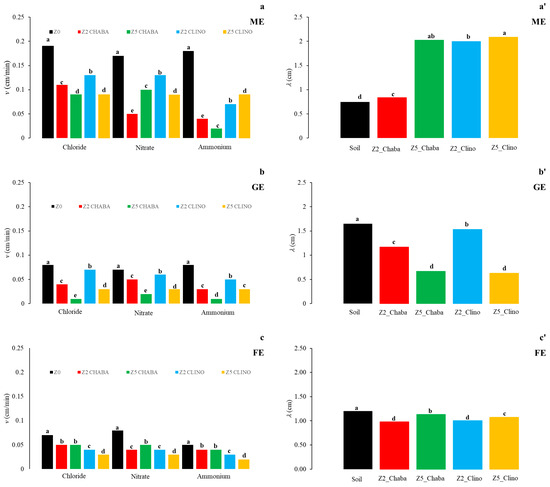
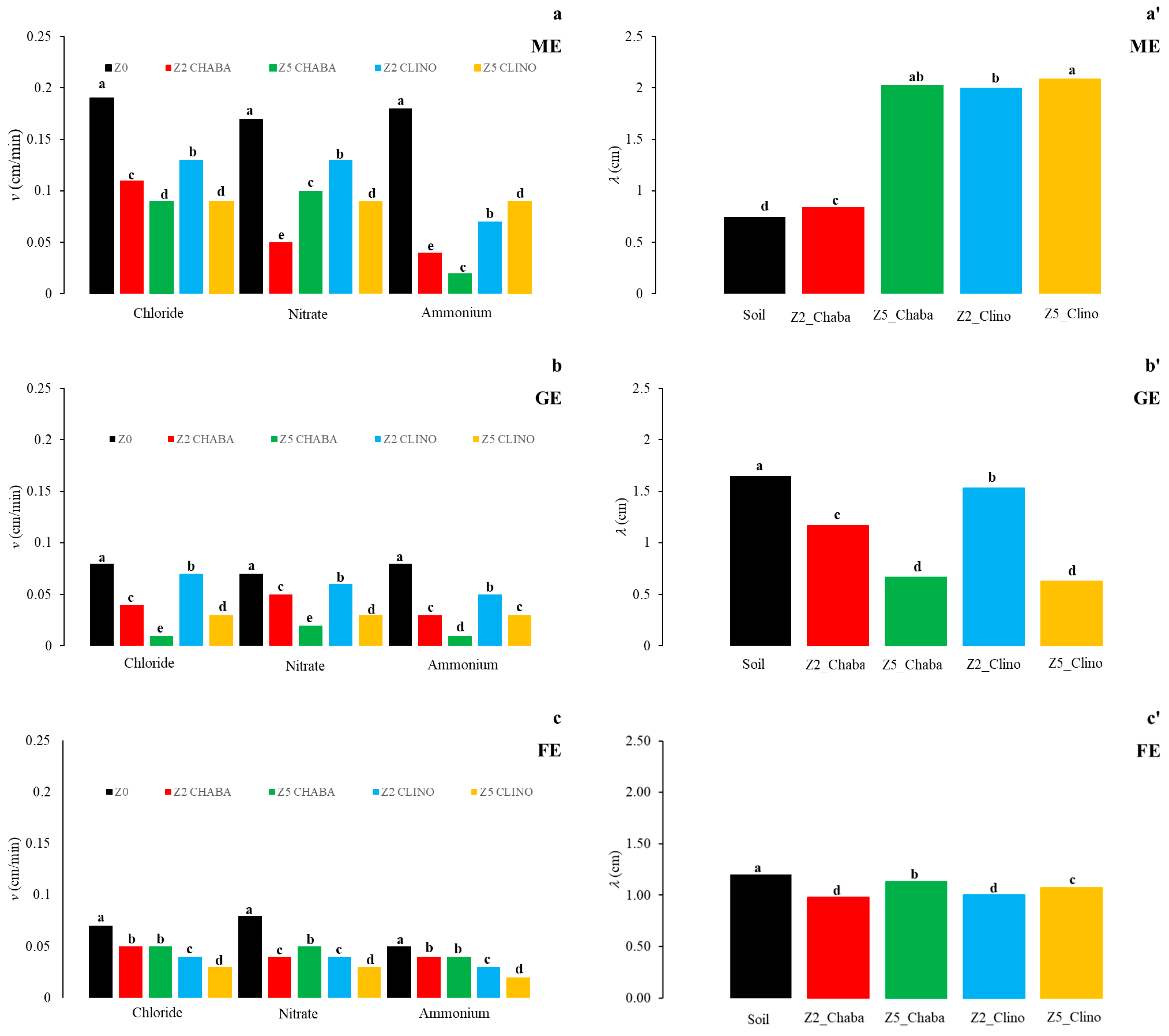
Estimated v and λ values are shown in Figure 3a–c,a′–c′. For each soil, the parameters were grouped according to the ion used in the transport test (i.e., chloride, nitrate, and ammonium), allowing the variations observed to be clearly identified as a function of the treatment. In the same graphics, letters displayed above the bars illustrate the results of the one-way ANOVA statistical test.
Figure 3.
Effects of zeolite treatments on solute transport parameters: (a–c) pore water velocity v, and (a′–c′) soil dispersivity λ. Values are means (n = 4). Data presented in each graph were analyzed by one-way ANOVA statistical test. Letters indicate that differences among treatments are statistically different at a significance level of p ≤ 0.05.
In general, v was observed to decrease with increasing zeolite addition. Under control conditions (Z0), ME soil showed the highest v values (0.17–0.19 cm min−1), followed by GE (0.07–0.08 cm min−1) and FE (0.05–0.08 cm min−1), indicating a more dynamic pore system in ME soil. In all Z0 soils, as expected, and behaved similarly, consistent with their quasi-conservative nature, whereas generally exhibited slightly lower velocities, suggesting the effect of cation exchange interactions. The addition of chabazite significantly reduced velocities in all soils, particularly at the Z5 level, with the strongest effects observed in GE and ME soils, where reached minimum values (down to 0.01–0.02 cm min−1), reflecting both structural changes (favoring meso- and microporosity regions) and enhanced adsorption mechanisms.
For a given treatment, differences in the magnitude of v among soils are undoubtedly related to the type of zeolite. An additional effect may arise from the initial soil texture. Although all soils are classified as sandy-loam, the sand fraction, particularly the fine (0.10–0.25 mm) and very fine (0.05–0.10 mm) fractions (see Appendix A for details), varies among the three soils. In particular, in GE and FE soils, the fine and very fine sand fractions are substantial, accounting for approximately 45–50% of the total sand fraction; in ME, these fractions are approximately 25%. Therefore, it is plausible that this textural difference, together with the complex interactions among the soils, their mineralogical composition, and the zeolite (which is not an inert material), may lead to distinct structural arrangements in the resulting soil–zeolite mixtures, thereby promoting the development of different proportions of meso- and micropores [33]. ME soil, which initially has the lowest percentage of fine and very fine sand (and therefore likely contains larger pore spaces at Z0 than GE and FE soils), is the one in which the addition of zeolite tends to produce fewer meso- and micropores, with consequent effects on the observed velocities.
These complex interactions between soil and zeolite may also play a role in the changes in soil dispersivity which are, to some extent, soil-dependent. Indeed, while for GE and FE soils, λ generally decreases with increasing zeolite content—the reduction ranging from ~5% (Z5_CHABA, FE soil) to ~60% (Z5_CLINO, GE soil)—for ME soil, λ values tend to increase with increasing zeolite fraction. In particular, in ME, both Z2 and Z5 levels of clinoptilolite resulted in λ values greater than 2 cm, which are significantly higher, up to ~170%, than Z0. For chabazite, λ increased by approximately 12% and 160% for Z2 and Z5, respectively. This trend is consistent with the findings of [52] who, working on sandy soils mixed with zeolite, reported increases in λ values (compared to the controls) of up to 28%. Similarly, Ref. [33], using a synthetic zeolite, observed increases in λ values.
Overall, the addition of zeolite to ME soil resulted in a more heterogeneous structure, creating additional interstitial spaces that enhanced mechanical dispersion [18,19]. Conversely, in GE and FE, the observed reduction in λ values suggests that the zeolites produced a more hydraulically uniform medium.
From this perspective, Ref. [32] suggested that the effects of zeolites on soils are highly specific: each zeolite exerts a distinct influence on a given soil, and such behavior may not necessarily be observed in other soil types. Nevertheless, this is an aspect that certainly warrants further investigation to fully understand the underlying mechanisms.
Further indications of zeolite-induced changes in soil transport properties may be drawn from additional parameters reported in Table 6, showing the mean travel time tmean (i.e., the average time required for solute particles to pass through the system, that is the centroid of the temporal distribution of the solute mass), the peak solute arrival time tpeak (i.e., the time needed by the solute peak concentration to pass through the system, that is to reach the bottom of the column at L = 11 cm), the peak solute velocity vpeak = (L/tpeak), the dispersion coefficient (D), and the retardation factor (R). The data are grouped by soil type and zeolite treatment. For each soil–zeolite combination, the estimated transport parameters are reported for every monitored ion.
Table 6.
Mean time (tmean), peak solute arrival time (tpeak), peak solute velocity (vpeak), dispersion coefficient (D), and retardation factor (R), determined from the experimental (, , and ) C/C0 breakthrough curves, referring to the selected soil (Z0) and soil–zeolite mixtures (Z2 and Z5). Letters indicate that differences among treatments are statistically different at a significance level p ≤ 0.05.
Under control conditions (Z0), clear differences among soils were observed for all the selected parameters. ME soil showed the lowest tmean values for all ions (~57–64 min), confirming its higher hydraulic conductivity and faster solute transport compared to GE and FE, where tmean values were approximately two to three times higher. The addition of chabazite markedly increased both tmean and tpeak values, especially at the highest dose (Z5). In GE soil, the test (for Z5 Chaba) showed an extreme increase in tmean (up to 909.74 min), with a strong reduction in vpeak (=0.010 cm min−1), and the highest R value of 3.20, highlighting intense chemical retention combined with reduced flow velocity. The high retardation factors observed for suggest that adsorption and cation exchange processes played a major role in controlling ammonium transport within the soil–zeolite mixtures. However, the magnitude of the observed R values may also reflect the complex interaction between chemical retention processes and the simultaneous reduction in pore water velocity induced by pore network reorganization.
The tmean, tpeak and vpeak values for and were also strongly affected by the soil–zeolite mixtures.
In FE soil, chabazite and clinoptilolite induced a moderate increase in tmean (up to ~317 min and ~597 min for the Z5 Chaba- test and Z5 Clino- test, respectively) and a more progressive and gradual decrease in vpeak values, ranging from 0.080 cm min−1 down to 0.020 cm min−1, suggesting a more buffered structural response compared to GE and ME.
Regarding the coefficient of dispersion, D values tended to decrease under high chabazite doses in GE and FE soils, reflecting reduced mechanical dispersion associated with lower flow velocities, whereas in ME soil some treatments (e.g., Z2 Clinoptilolite) showed increased D values, suggesting, in this case, enhanced spreading under intermediate flow conditions.
Overall, soil-specific responses were evident: ME soil displayed the widest range of variation and strongest chemical retardation under chabazite treatment, GE soil showed the most pronounced structural slowdown at high doses, and FE exhibited a more gradual and buffered response, indicating the complex interactions between soils and zeolites that depend on the intrinsic physico-chemical properties of soils and of these natural amendments.
3.3. Multivariate Analysis
To synthesize the complex interactions between soil texture, zeolite treatment, and hydraulic behavior, a multivariate statistical approach was adopted. The application of the k-means algorithm using Euclidean distance was specifically chosen because the dataset was standardized through z-score normalization (mean = 0, standard deviation = 1). This ensures that the distance in the principal component (PC) space reflects actual geometric similarity across variables of different units [65]. The identification of five distinct clusters, validated by the Elbow and Silhouette approaches, highlights the structural reorganization induced by zeolite. As shown in Figure 4, the first two principal components capture 77.5% of the total variance, revealing a clear segregation based on soil provenance and treatment.
Figure 4.
Spatial distribution and partitioning of soil samples into five distinct groups identified through k-means clustering (k = 5). The axes represent the first two dimensions of the multivariate dataset, accounting for 58.96% (PC1) and 18.49% (PC2) of the total variance. Solid ellipses denote the 95% confidence intervals for each cluster.
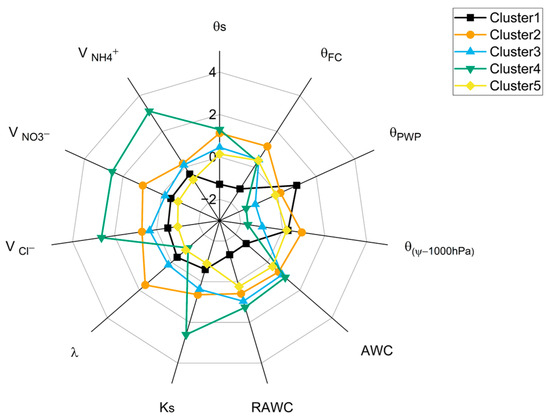
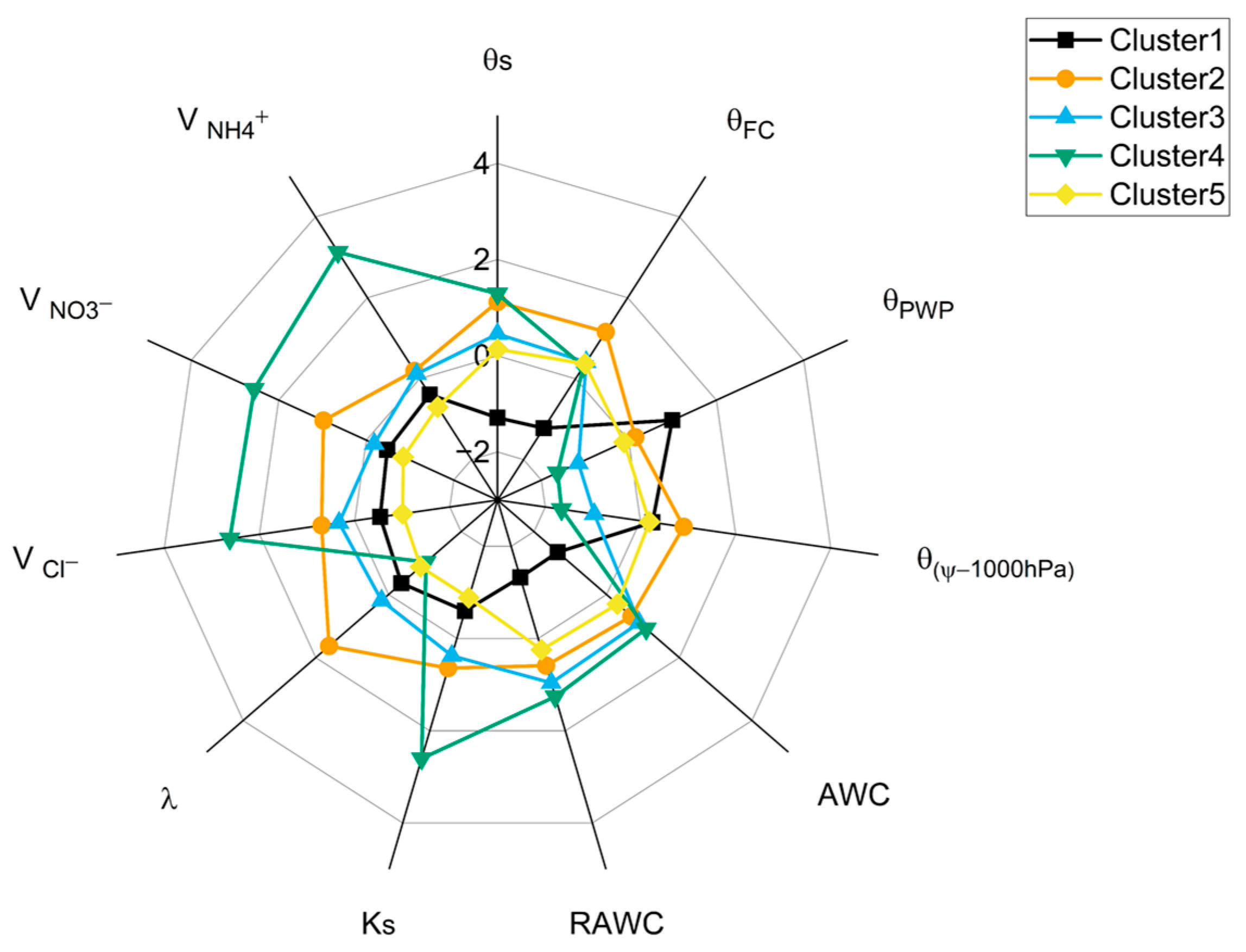
Cluster 1 primarily groups all FE soil samples, is positioned at negative PC1 values, and shows high internal cohesion and distinct separation from the others. In contrast, the proximity of clusters 2, 3, and 5 suggests shared hydraulic characteristics across the ME and GE sandy loams, though they remain statistically distinct. Cluster 4 (exclusively ME Z0) is isolated at the extreme positive end of PC1, representing the native macropore-dominated state before amendment. The spatial distribution of these clusters reveals clear segregation based on soil provenance and the impact of zeolite amendments. It is important to acknowledge that the identified clusters represent behavior patterns rather than rigid, isolated categories. Soil properties are inherently continuous, and the proximity of clusters 2, 3, and 5 suggests the existence of transitional hydraulic behavior. We argue that while grouping is a simplification, it is a necessary tool for categorizing soil management zones and providing practical agronomic recommendations. Further analysis, as shown in the radar chart in Figure 5, serves as a multivariate functional profile, highlighting the structural modifications induced by zeolite amendments in the studied soils. Because z-scores for the radar plot were used, the center of the radar plot represents the dataset mean, while the vertices show deviations in terms of standard units, allowing for a balanced comparison of heterogeneous variables like hydraulic conductivity and retention. Cluster 4 exhibits the highest Ks and velocity values for all monitored ions. This pattern, a distinctive feature among the analyzed soils, reflects a macropore-dominated structure that facilitates nutrient leaching and represents the condition most vulnerable to solute losses. In contrast, cluster 1 is mainly characterized by low θs and θFC values, reduced saturated hydraulic conductivity, low dispersivity, limited ion velocities, but relatively high values of θPWP and θ−1000. Such features indicate a pore network that restricts water flow and solute movement. This configuration reduces the risk of ion leaching while simultaneously enhancing water availability for plants.
Figure 5.
Radar diagram illustrating the multivariate functional profiles (centroids) of the five k-means clusters.
Cluster 2 shows elevated θFC and AWC values, relatively high dispersivity, and moderate ion velocities. This configuration indicates a pore network promoting water storage within plant-available pore classes, while maintaining sufficient permeability for drainage. Cluster 3 displays intermediate Ks, AWC, and RAWC values, along with moderate-to-low ion velocities and intermediate l values. These characteristics suggest a pore network with reduced flow path variability and moderate dispersive transport behavior. Cluster 5 represents a condition with moderate pore network reorganization that proportionally affects most parameters, and is associated with relatively contained ion velocities.
Ultimately, our findings demonstrate that there is no universal approach to zeolite application; rather, its role fundamentally depends on the baseline physical structure of the soil. In coarser-textured soils (sand ≥60%, such as the FE soil), zeolite acts primarily as a hydraulic enhancer by increasing plant-available water (AWC). Conversely, in medium-textured soils (with higher silt and clay content, such as ME and GE soils), the agronomic value of zeolite shifts toward nutrient conservation and environmental protection. Although zeolite may not increase the water available due to the narrowing of the AWC window, it restricts the leaching of fertilizers toward groundwater. These distinct behaviors, visually summarized by the spatial segregation in Figure 4 and the functional fingerprints in the radar chart (Figure 5), confirm that zeolite is a versatile tool for soil management [76].
4. Conclusions
The present research illustrated the effects of two commercial zeolites on several hydraulic and transport properties of three selected sandy-loam soils in southern Italy. It primarily showed that the addition of these natural zeolites affects soil pore structure, influencing the entire set of hydraulic and solute transport parameters. Such structural changes reduce the velocity of water and solutes in soils, limiting rapid flow pathways.
Between the two investigated zeolites, chabazite generally induced more pronounced modifications in hydraulic and transport properties, whereas clinoptilolite showed similar trends but typically with lower intensity, particularly at lower application rates.
As sandy-loam soils are characterized by moderate-to-high mobility for water and solutes, such modifications may have important environmental implications for nitrogen compound dynamics in such soils. The general increase in meso- and microporosity reduced the mobility of nitrates. Ammonium transport was further constrained by adsorption processes, resulting in increased retardation and prolonged residence time within the soil matrix. These effects were quantitatively reflected by the observed reductions in pore water velocity and peak solute velocity, together with the increase in retardation factors under the different zeolite treatments.
Together, these mechanisms contribute to retaining and in the root zone, thereby reducing nutrient losses and mitigating risks of groundwater contamination.
The results demonstrate that even relatively low zeolite application rates (as tested in this study) were sufficient to produce measurable effects on both soil hydraulic and solute transport properties. This finding highlights the efficiency of zeolite amendments, indicating that significant reductions in nitrogen leaching can be achieved without the need for high application rates. From both an agronomic and economic perspective, this supports the practical feasibility of zeolite use under field conditions and further reinforces their potential as a promising strategy to enhance nutrient use efficiency and minimize the environmental impacts associated with intensive fertilization.
Future research should focus on long-term field validation and performance under different climatic and irrigation conditions to support their adoption in sustainable agricultural management.
Author Contributions
A.C. (Alessandro Comegna): Conceptualization, Methodology, Investigation, Data curation, Formal analysis, Validation, Visualization, Writing—Original draft, Writing—Review and Editing; S.L.: Conceptualization, Methodology, Writing—Review and Editing; S.B.M.H.: Conceptualization, Methodology, Writing—Review and Editing; A.C. (Antonio Coppola): Conceptualization, Methodology, Writing—Review and Editing; A.S.: Conceptualization, Methodology, Investigation, Data curation, Formal analysis, Validation, Visualization, Writing—Original draft, Writing—Review and Editing. All authors have read and agreed to the published version of the manuscript.
Funding
This work was supported by the project “NPP-SOL—Modelling and Technological Tools to Prevent Surface and Ground-Water Bodies from Agricultural Non-Point Source Pollution Under Mediterranean Conditions”, funded by the European Union—Partnership for Research and Innovation in the Mediterranean Area (PRIMA Section 2)—CUP C83C23000100005.
Data Availability Statement
The data presented in this study are openly available in Zenodo at 10.5281/zenodo.18874001.
Acknowledgments
I dedicate this work to the memory of my father, Vincenzo Comegna, whose support, guidance, and encouragement will always remain with me.
Conflicts of Interest
The authors declare no conflicts of interest.
Appendix A
Appendix A.1. Haplic Calcisols (Metaponto, Basilicata, Southern Italy)
USDA Classification: Sandy-Loam
Table A1.
Particle size analysis.
Soil description: Soils developed on flat and well-preserved, sometimes gently or moderately sloping, surfaces of marine terraces. These areas are locally characterized by alluvial and colluvial deposits of modest thickness and are intersected by some deep incisions from the secondary hydrographic network. The parent materials are sands with lenses of gravel and limestone pebbles. The elevation ranges between 10 and 140 m above sea level.
These soils are widely found in gently sloping areas limited by strongly skeletal horizons. They are highly calcareous with abundant surface stoniness. Due to erosion, the calcic horizon is shallow, sometimes outcropping. The texture is loam or sandy-loam, with common coarse fragments, good drainage, and moderately high permeability. They are moderately calcareous in the plowed horizon and very calcareous in the underlying horizons. They have a very alkaline reaction.
Appendix A.2. Dystric Luvisols (Genzano, Basilicata, Southern Italy)
USDA Classification: Sandy-Loam
Table A2.
Particle size analysis.
Description: Soils on the rugged mountainous relief of the alternations of sandstones and marly clays.
The morphology is characterized by moderately steep to very steep slopes, often interrupted by steep tectonic scarps, at the base of which lie depressed areas with gentler gradients. The elevations range between 100 and 1100 m above sea level; the most represented altitudinal range is between 700 and 900 m.
The most widespread soils have a moderately differentiated profile due to brunification and partial carbonate removal, and show significant variability related to the prevalence of different lithological components. In areas with a predominant clay component, fine-textured soils are present, while on slopes dominated by the arenaceous (sandy) component, there are loam-textured soils. These are highly evolved and very deep soils, with a distinct argillic horizon. The Dystric Luvisol unit has a sandy-loam texture at the surface and a sandy clay loam texture at depth, and is free of coarse fragments. Non-calcareous, such soils have a neutral or slightly acidic reaction and medium or low base saturation. They have mediocre drainage and moderately low permeability.
Appendix A.3. Haplic Luvisol (San Ferdinando di Puglia, Puglia, Southern Italy)
USDA Classification: Sandy-Loam
Table A3.
Particle size analysis.
Description: This soil presents the classic Luvisol profile, with a light-colored, clay-leached surface horizon (E) over a denser, clay-enriched subsoil (Bt). Developed on calcareous alluvial and marine deposits of the Tavoliere plain, it is found on flat to gently sloping landscapes. The soil is generally well-drained but can have temporary waterlogging above the clay pan. Reaction is neutral in the surface and becomes alkaline with depth due to the calcareous parent material. The sandy-loam texture of the surface layer makes it very easy to work with and allows rapid water infiltration. The underlying clay-enriched horizon acts as a reservoir for moisture and nutrients.
Source:
https://www.regione.basilicata.it/siti/suoli-basilicata/index.htm (accessed on 1 January 2026).
https://pugliacon.regione.puglia.it/web/sit-puglia-sit/sistema-informativo-dei-suoli (accessed on 1 January 2026).
References
- Galloway, J.N.; Aber, J.D.; Erisman, J.W.; Seitzinger, S.P.; Howarth, R.W.; Cowling, E.B.; Cosby, B.J. The nitrogen cascade. BioScience 2023, 53, 341–356. [Google Scholar] [CrossRef] [Scilit]
- Erisman, J.W.; Galloway, J.N.; Seitzinger, S.; Bleeker, A.; Dise, N.B.; Petrescu, R.; Leach, A.M.; de Vries, W. Consequences of human modification of the global nitrogen cycle. Philos. Trans. R. Soc. B 2013, 368, 20130116. [Google Scholar] [CrossRef] [Scilit]
- Fowler, D.; Coyle, M.; Skiba, U.; Sutton, M.A.; Cape, J.N.; Reis, S.; Sheppard, L.J.; Jenkins, A.; Grizzetti, B.; Galloway, J.N.; et al. The global nitrogen cycle in the 21st century. Philos. Trans. R. Soc. B 2013, 368, 20130164. [Google Scholar] [CrossRef] [Scilit]
- Danielescu, S.; MacQuarrie, K.T.B.; Nyiraneza, J.; Zebarth, B.; Sharifi-Mood, N.; Grimmett, M.; Main, T.; Levesque, M. Development and Validation of a Crop and Nitrate Leaching Model for Potato Cropping Systems in a Temperate–Humid Region. Water 2024, 16, 475. [Google Scholar] [CrossRef] [Scilit]
- Hu, C.; Li, J.; Pang, Y.; Luo, L.; Liu, F.; Wu, W.; Xu, Y.; Li, H.; Tan, B.; Zhang, G. Deep-Learning-Driven Insights into Nitrogen Leaching for Sustainable Land Use and Agricultural Practices. Land 2025, 14, 69. [Google Scholar] [CrossRef] [Scilit]
- Beaulieu, J.J.; Arango, C.P.; Hamilton, S.K.; Tank, J.L. The production and emission of nitrous oxide from headwater streams in the Midwestern United States. Glob. Change Biol. 2008, 14, 878–894. [Google Scholar] [CrossRef] [Scilit]
- Linlin, T.; Yanjiang, C.; Hiroko, A. A review of indirect N2O emission factors from agricultural nitrogen leaching and runoff to update of the default IPCC values. Environ. Pollut. 2019, 245, 300–306. [Google Scholar] [CrossRef] [Scilit]
- Caicedo, J.R. Effect of total ammonia nitrogen concentration and pH on growth rate of duckweed (Spirodela polyrrhiza). Water Res. 2000, 34, 3829–3835. [Google Scholar] [CrossRef] [Scilit]
- Allred, B.J. Effects of nitrate concentration and ionic strength on nitrate anion exclusion under unsaturated flow conditions. Soil Sci. 2007, 172, 842–860. [Google Scholar] [CrossRef] [Scilit]
- Malekian, R.; Abedi-Koupai, J.; Eslamian, S.S. Influences of clinoptilolite and surfactant-modified clinoptilolite zeolite on nitrate leaching and plant growth. J. Hazard. Mater. 2011, 185, 970–976. [Google Scholar] [CrossRef] [Scilit]
- Kanthle, A.K.; Lenka, N.K.; Tedia, K. Land use and biochar effect on nitrate leaching in a Typic Haplustert of central India. Catena 2018, 167, 422–428. [Google Scholar] [CrossRef] [Scilit]
- Jellali, S.; Diamantopoulos, E.; Kallali, H.; Bennaceur, S.; Anane, M.; Jedidi, N. Dynamic sorption of ammonium by sandy soil in fixed bed columns: Evaluation of equilibrium and non-equilibrium transport processes. J. Environ. Manag. 2010, 91, 897–905. [Google Scholar] [CrossRef] [Scilit]
- Mthandi, J.; Kahimba, F.C.; Tarimo, A. Nitrogen movement in coarse-textured soils and its availability to maize (Zea mays L.) plant. Agric. Sci. 2013, 4, 30–35. [Google Scholar]
- Teutscherova, N.; Houška, J.; Navas, M.; Masaguer, A.; Benito, M.; Vazquez, E. Leaching of ammonium and nitrate from acrisol and calcisol amended with holm oak biochar: A column study. Geoderma 2018, 323, 136–145. [Google Scholar] [CrossRef] [Scilit]
- Stark, C.H.; Richards, K.G. The continuing challenge of nitrogen loss to the environment: Environmental consequences and mitigation strategies. Dyn. Soil Dyn. Plant 2008, 2, 41–55. [Google Scholar]
- Colombani, N.; Mastrocicco, M.; Di Giuseppe, D.; Faccini, B.; Coltorti, M. Batch and column experiments on nutrient leaching in soils amended with Italian natural zeolitites. Catena 2015, 127, 64–71. [Google Scholar] [CrossRef] [Scilit]
- Sepaskhah, A.R.; Barzegar, M. Yield, water and nitrogen-use response of rice to zeolite and nitrogen fertilization in a semi-arid environment. Agric. Water Manag. 2010, 98, 38–44. [Google Scholar]
- Souza, I.M.S.; Gurgel, G.C.S.; Medeiros, A.M.; Zonta, E.; Ruiz, J.A.C.; Paskocimas, C.A.; Motta, F.V.; Bomio, M.R.D. The use of clinoptilolite as carrier of nitrogened fertilizer with controlled release. J. Environ. Chem. Eng. 2018, 6, 4171–4177. [Google Scholar] [CrossRef] [Scilit]
- Mazloomi, F.; Jalali, M. Effects of vermiculite, nanoclay and zeolite on ammonium transport through saturated sandy loam soil: Column experiments and modeling approaches. Catena 2019, 176, 170–180. [Google Scholar] [CrossRef] [Scilit]
- Li, Z. Use of surfactant-modified zeolite as fertilizer carriers to control nitrate release. Microporous Mesoporous Mater. 2003, 61, 181–188. [Google Scholar] [CrossRef] [Scilit]
- Jiménez-Castañeda, M.E.; Medina, D.I. Use of Surfactant-Modified Zeolites and Clays for the Removal of Heavy Metals from Water. Water 2017, 9, 235. [Google Scholar] [CrossRef] [Scilit]
- Ciesla, J.; Franus, W.; Franus, M.; Kedziora, K.; Gluszczyk, J.; Szerement, J.; Jozefaciuk, G. Environmental-friendly modifications of zeolite to increase its sorption and anion exchange properties physicochem studies of the modified materials. Materials 2019, 12, 3213. [Google Scholar] [CrossRef] [Scilit]
- Mondal, M.; Biswas, B.; Garai, S.; Sarkar, S.; Banerjee, H.; Brahmachari, K.; Bandyopadhyay, P.K.; Maitra, S.; Brestic, M.; Skalicky, M.; et al. Zeolites Enhance Soil Health, Crop Productivity and Environmental Safety. Agronomy 2021, 11, 448. [Google Scholar] [CrossRef] [Scilit]
- Liang, B.; Ma, C.; Fan, L.; Wang, Y.; Yuan, Y. Soil amendment alters soil physicochemical properties and bacterial community structure of a replanted apple orchard. Microbiol. Res. 2018, 216, 1–11. [Google Scholar] [CrossRef] [Scilit]
- Jarosz, R.; Szerement, J.; Gondek, K.; Mierzwa-Hersztek, M. The use of zeolites as an addition to fertilisers-a review. Catena 2022, 213, 106125. [Google Scholar] [CrossRef] [Scilit]
- Larkin, R.P. Effects of selected soil amendments and mulch type on soil properties and productivity in organic vegetable production. Agronomy 2020, 10, 795. [Google Scholar] [CrossRef] [Scilit]
- Satriani, A.; Belviso, C.; Lovelli, S.; Di Prima, S.; Coppola, A.; Hassan, S.B.M.; Rivelli, A.R.; Comegna, A. Impact of a synthetic zeolite mixed with soils of different pedological characteristics on soil physical quality indices. Geoderma 2024, 451, 117084. [Google Scholar] [CrossRef] [Scilit]
- Satriani, A.; Lovelli, S.; Belviso, C.; Comegna, A. Effect of waste-derived synthetic zeolite on soil hydraulic properties and soil water storage parameters in sandy-loam soils. Catena 2025, 259, 109395. [Google Scholar] [CrossRef] [Scilit]
- Colombani, N.; Mastrocicco, M.; Di Giuseppe, D.; Faccini, B.; Coltorti, M. Variation of the hydraulic properties and solute transport mechanisms in a silty-clay soil amended with natural zeolites. Catena 2014, 123, 195–204. [Google Scholar] [CrossRef] [Scilit]
- Comegna, A.; Coppola, A.; Dragonetti, G. A soil non-aqueous phase liquid (NAPL) flushing laboratory experiment based on measuring the dielectric properties of soil–organic mixtures via time domain reflectometry (TDR). Hydrol. Earth Syst. Sci. 2019, 23, 3593–3602. [Google Scholar] [CrossRef] [Scilit]
- Comegna, A.; Coppola, A.; Dragonetti, G. Time domain reflectometry for dielectric characterization of olive mill wastewater contaminated soils. J. Agric Eng. 2020, 1092, 248–254. [Google Scholar] [CrossRef] [Scilit]
- Nakhli, S.A.A.; Delkash, M.; Bakhshayesh, B.E.; Hossein, K. Application of Zeolites for Sustainable Agriculture: A Review on Water and Nutrient Retention. Water Air Soil Pollut. 2017, 228, 464. [Google Scholar] [CrossRef] [Scilit]
- Comegna, A.; Belviso, C.; Rivelli, A.R.; Coppola, A.; Dragonetti, G.; Sobhani, A.; di Prima, S.; Satriani, A.; Cavalcante, F.; Lovelli, S. Analysis of critical water flow and solute transport parameters in different soils mixed with a synthetic zeolite. Catena 2023, 228, 107150. [Google Scholar] [CrossRef] [Scilit]
- Faccini, B.; Di Giuseppe, D.; Ferretti, G.; Coltorti, M.; Colombani, N.; Mastrocicco, M. Natural and NH4+-enriched zeolitite amendment effects on nitrate leaching from a reclaimed agricultural soil. Nutr. Cycl. Agroecosyst. 2018, 110, 327–341. [Google Scholar] [CrossRef] [Scilit]
- Wang, H.; Krug, L.J.; Li, Z.; Sun, P.; Qian, X.; Dittert, K. Zeolite reduces N leaching and runoff loss while increasing rice yields under alternate wetting and drying irrigation regime. Agric. Water Manag. 2023, 277, 108130. [Google Scholar] [CrossRef] [Scilit]
- IUSS Working Group WRB. World Reference Base for Soil Resources 2006. A Framework for International Classification, Correlation and Communication, 2nd ed.; World Soil Resources Reports No. 103; FAO: Rome, Italy, 2007. [Google Scholar]
- Day, P.R. Particle fractionation and particle-size analysis. In Methods of Soil Analysis, Part 1; Black, C.A., Ed.; American Society of Agronomy: Madison, WI, USA, 1965; pp. 545–567. [Google Scholar]
- Allison, L.E. Organic carbon. In Methods of Soil Analysis, Part 1; Klute, A., Ed.; Agronomy Monograph; ASA and SSSA: Madison, WI, USA, 1965; Volume 9, pp. 1367–1378. [Google Scholar]
- Eckert, D.J. Soil pH. In Recommended Chemical Soil Test Procedures for the North Central Region; Dahnke, W.C., Ed.; North Dakota Agricultural Experiment Station Bulletin No. 221 (Revised); North Dakota Agricultural Experiment Station: Fargo, ND, USA, 1988; pp. 6–8. [Google Scholar]
- Blake, G.R.; Hartge, K.H. Particle density. In Methods of Soil Analysis, Part 1, 2nd ed.; Klute, A., Ed.; American Society of Agronomy: Madison, WI, USA, 1986; pp. 377–381. [Google Scholar]
- Stackman, W.P.; Valk, G.A.; van der Harst, G.G. Determination of Soil Moisture Retention Curves: I. Sand Box Apparatus; Range, P.F., Ed.; ICW: Wageningen, The Netherlands, 1969; p. 119. [Google Scholar]
- Dane, J.H.; Hopmans, J.W. Hanging Water Column. In Methods of Soil Analysis; John Wiley & Sons Ltd.: Hoboken, NJ, USA, 2002; pp. 680–683. [Google Scholar] [CrossRef] [Scilit]
- Comegna, A.; Coppola, A.; Dragonetti, G.; Sommella, A. Estimating non-aqueous phase liquid (NAPL) content in variable saturated soils using time domain reflectometry (TDR). Vadose Zone J. 2016, 15, 1–11. [Google Scholar] [CrossRef] [Scilit]
- van Genuchten, M.T.; Leij, F.T.; Yates, S.R. The RETC Code for Quantifying the Hydraulic Functions of Unsaturated Soils; Rep. EPA/600/2–91/065; U.S. Environmental Protection Agency: Ada, OK, USA, 1991.
- van Genuchten, M.T. A closed-form equation for predicting the hydraulic conductivity of unsaturated soils. Soil Sci. Soc. Am. J. 1980, 44, 892–898. [Google Scholar] [CrossRef] [Scilit]
- Minasny, B.; McBratney, A.B. Integral energy as a measure of soil-water availability. Plant Soil 2003, 249, 253–262. [Google Scholar] [CrossRef] [Scilit]
- Tuller, M.; Or, D. Soil water retention and pore size distribution. In Soil Water Repellency: Occurrence, Prediction, and Impact on Soil-Water Relations; Springer: Berlin/Heidelberg, Germany, 2002; pp. 73–88. [Google Scholar]
- Raczkowski, C.W.; Mueller, J.P.; Busscher, W.J.; Bell, M.C.; McGraw, M.L. Soil physical properties of agricultural systems in a large-scale study. Soil Tillage Res. 2012, 119, 50–59. [Google Scholar] [CrossRef] [Scilit]
- Thomas, S.M.; Fraser, P.M.; Hu, W.; Clough, T.J.; van der Klei, G.; Wilson, S.; Tregurtha, R.; Baird, D. Tillage, compaction and wetting effects on NO3, N2O and N2 losses. Soil Res. 2019, 57, 670–688. [Google Scholar] [CrossRef] [Scilit]
- Jensen, J.L.; Schjønning, P.; Watts, C.W.; Christensen, B.T.; Munkholm, L.J. Soil water retention: Uni-modal models of pore-size distribution neglect impacts of soil management. Soil Sci. Soc. Am. J. 2019, 83, 18–26. [Google Scholar] [CrossRef] [Scilit]
- Fu, Z.; Hu, W.; Beare, M.; Thomas, S.; Carrick, S.; Dando, J.; Langer, S.; Müller, K.; Baird, D.; Lilburne, L. Land use on soil hydraulic properties and the contribution of soil organic carbon. J. Hydrol. 2021, 602, 126741. [Google Scholar] [CrossRef] [Scilit]
- Alessandrino, L.; Pavlakis, C.; Colombani, N.; Mastrocicco, M.; Aschonitis, V. Effects of Graphene on Soil Water-Retention Curve, van Genuchten Parameters, and Soil Pore Size Distribution-A Comparison with Traditional Soil Conditioners. Water 2023, 15, 1297. [Google Scholar] [CrossRef] [Scilit]
- Vomocil, J.A. Porosity. In Methods of Soil Analysis, Part 1; Black, C.A., Ed.; American Society of Agronomy: Madison, WI, USA, 1965; pp. 299–314. [Google Scholar]
- Gradwell, M.W. The moisture-holding properties of Waikato soils and methods of their determination. N. Z. J. Agric. Res. 1968, 11, 631–654. [Google Scholar] [CrossRef] [Scilit]
- Klute, A.; Dirksen, C. Hydraulic Conductivity and Diffusivity: Laboratory Methods. In Methods of Soil Analysis, Part 1: Physical and Mineralogical Methods; Klute, A., Ed.; SSSA Book Series: 5; ASA and SSSA: Madison, MI, USA, 1986. [Google Scholar]
- Comegna, A.; Dragonetti, G.; Kodesova, R.; Coppola, A. Impact of olive mill wastewater (OMW) on the soil hydraulic and solute transport properties. Int. J. Environ. Sci. Technol. 2022, 19, 7079–7092. [Google Scholar] [CrossRef] [Scilit]
- van Genuchten, M.T.; Wierenga, P.J. Solute dispersion coefficients and retardation factors. In Methods of Soil Analysis, Part 1: Physical and Mineralogical Methods, 2nd ed.; Agronomy Monograph No. 9; ASA and SSSA: Madison, MI, USA, 1986. [Google Scholar]
- Ward, A.L. Solute Transport in Unsaturated Soils with Spatially Variable Horizon Thickness. Ph.D. Thesis, University of Guelf, Guelph, ON, Canada, 1993; p. 270. [Google Scholar]
- van Wesenbeek, L.I.; Kachanoski, R.G. Effect of variable horizon thickness on solute transport. Soil Sci. Soc. Am. J. 1994, 58, 1307–1316. [Google Scholar] [CrossRef] [Scilit]
- Das, B.S.; Kluitenberg, G.J. Moment analysis to estimate degradation rate constants from leaching experiments. Soil Sci. Soc. Am. J. 1996, 60, 1724–1731. [Google Scholar] [CrossRef] [Scilit]
- Jacobsen, O.H.; Leij, F.J.; van Genuchten, M.T. Parameter determination for chloride and tritium transport in undisturbed lysimeters during steady flow. Nord. Hydrol. 1992, 23, 89–104. [Google Scholar] [CrossRef] [Scilit]
- Dadfar, H. The influence of Variable B Horizon Thickness (Tonguing) on Solute Transport Through Undisturbed Soil Columns. Ph.D. Thesis, University of Guelf, Guelph, ON, Canada, 1987; p. 174. [Google Scholar]
- Pang, L.; Goltz, M.; Close, M. Application of the method of temporal moments to interpret solute transport with sorption and degradation. J. Contam. Hydrol. 2003, 60, 123–134. [Google Scholar] [CrossRef] [Scilit]
- MacQueen, J.B. Some methods for classification and analysis of multivariate observations. In Proceedings of the Fifth Berkeley Symposium on Mathematical Statistics and Probability; Le Cam, L.M., Neyman, J., Eds.; University of California Press: Oakland, CA, USA, 1967; Volume 1, pp. 281–297. [Google Scholar]
- Hastie, T.; Tibshirani, R.; Friedman, J. The Elements of Statistical Learning: Data Mining, Inference, and Prediction, 2nd ed.; Springer Science & Business Media: Berlin/Heidelberg, Germany, 2009. [Google Scholar]
- Bholowalia, P.; Kumar, A. EBK-means: A clustering technique based on elbow method and K-means in WSN. Int. J. Comput. Appl. 2014, 105, 17–24. [Google Scholar]
- Rousseeuw, P.J. Silhouettes: A graphical aid to the interpretation and validation of cluster analysis. J. Comput. Appl. Math. 1987, 20, 53–65. [Google Scholar] [CrossRef] [Scilit]
- Gholizadeh-Sarabi, S.; Sepaskhah, A.R. Effect of zeolite and saline water application on saturated hydraulic conductivity and infiltration in different soil textures. Arch. Agron. Soil Sci. 2013, 59, 753–764. [Google Scholar] [CrossRef] [Scilit]
- Ramesh, K.; Reddy, D.D. Zeolites and Their Potential Uses in Agriculture. In Advances in Agronomy; Elsevier: Amsterdam, The Netherlands, 2011; Chapter 4; Volume 113, pp. 219–241. [Google Scholar] [CrossRef] [Scilit]
- Ibrahim, H.M.; Alghamdi, A.G. Effect of the particle size of clinoptilolite zeolite on water content and soil water storage in a loamy sand soil. Water 2021, 13, 607. [Google Scholar] [CrossRef] [Scilit]
- Mahabadi, A.A.; Hajabbasi, M.A.; Khademi, H.; Kazemian, H. Soil cadmium stabilization using an Iranian natural zeolite. Geoderma 2007, 137, 388–393. [Google Scholar] [CrossRef] [Scilit]
- Szatanik-Kloc, A.; Szerement, J.; Adamczuk, A.; J’ozefaciuk, G. Effect of low zeolite doses on plants and soil physicochemical properties. Materials 2021, 14, 2617. [Google Scholar] [CrossRef] [Scilit]
- Zarebanadkouki, M.; Hosseini, B.; Gerke, H.H.; Schaller, J. Amorphous silica amendment to improve sandy soils’ hydraulic properties for sustained plant root access under drying conditions. Front. Environ. Sci. 2022, 10, 935012. [Google Scholar] [CrossRef] [Scilit]
- Cataldo, E.; Salvi, L.; Paoli, F.; Fucile, M.; Masciandaro, G.; Manzi, D.; Masini, C.M.; Mattii, G.B. Application of Zeolites in Agriculture and Other Potential Uses: A Review. Agronomy 2021, 11, 1547. [Google Scholar] [CrossRef] [Scilit]
- Wang, H.; Krug, L.J.; Li, Z.; Sun, P.; Qian, X.; Dittert, K. Zeolite-induced enhancement of soil cation exchange capacity reduces nitrogen gaseous emissions and improves nitrate retention under urea fertilization. Environ. Technol. Innov. 2025, 40, 104567. [Google Scholar] [CrossRef] [Scilit]
- Kumar, S.; Kaur, S.; Kaushik, R.; Kaur, V.A. Exploring the potential of zeolites as a soil amendment: A review. Int. J. Res. Agron. 2025, 8, 237–244. [Google Scholar] [CrossRef] [Scilit]

Disclaimer/Publisher’s Note: The statements, opinions and data contained in all publications are solely those of the individual author(s) and contributor(s) and not of MDPI and/or the editor(s). MDPI and/or the editor(s) disclaim responsibility for any injury to people or property resulting from any ideas, methods, instructions or products referred to in the content. |
© 2026 by the authors. Licensee MDPI, Basel, Switzerland. This article is an open access article distributed under the terms and conditions of the Creative Commons Attribution (CC BY) license.