Article

Evaluation of SMAP Level 4 Versions 7 and 8 Soil Moisture Data in Rain-Fed Argentine Pampas Crops


by
María Florencia Degano
1,2,*,
Sabrina Beninato
1,2,
José Pasapera
3,
Mauro Ezequiel Holzman
2,4 and
Raúl Eduardo Rivas
1,5
1
Instituto de Hidrología de Llanuras “Dr. Eduardo Jorge Usunoff” (IHLLA), Tandil B7000GHG, Argentina
2
Consejo Nacional de Investigaciones Científicas y Técnicas (CONICET), Ciudad Autónoma de Buenos Aires C1425FQB, Argentina
3
Comisión Nacional de Investigación y Desarrollo Aeroespacial (CONIDA), San Isidro 15046, Lima, Peru
4
Instituto de Hidrología de Llanuras “Dr. Eduardo Jorge Usunoff” (IHLLA), Azul B7300AZA, Argentina
5
Comisión de Investigaciones Científicas de la Provincia de Buenos Aires (CICPBA), La Plata B1900ARF, Argentina
*
Author to whom correspondence should be addressed.
Hydrology 2026, 13(6), 146; https://doi.org/10.3390/hydrology13060146
Submission received: 7 April 2026 / Revised: 6 May 2026 / Accepted: 11 May 2026 / Published: 4 June 2026

Abstract

Soil moisture (SM) is a key variable for assessing plant water availability, especially in rain-fed systems where imbalances strongly affect crop development. Satellite missions such as SMAP provide global SM estimates, though representing vertical SM variability remains challenging. This study evaluates the performance of SMAP Level 4 Global 3-hourly 9 km grid EASE-Grid Surface and Root-Zone Soil Moisture Geophysical Data (SPL4SMGP, version 7 and the new and scarcely evaluated version 8) using field observations from the Argentine Pampas, a region dominated by Typic Argiudolls soils (~16 million ha). The analysis covered normal-wet and dry conditions across several crop seasons. Surface (SSM, ~5 cm) and root zone (RZSM, 0–100 cm) soil moisture were compared against field data using Pearson’s correlation (r), bias, and unbiased root mean square deviation (ubRMSD). Both SSM and RZSM achieved ubRMSD values close to the SMAP accuracy target (≈0.04 m3/m3). SSM correlated moderately with observations (r = 0.57–0.72) and showed a consistent negative bias (−0.08 ± 0.05 m3/m3). In contrast, RZSM exhibited low sensitivity to soil profile variability and a narrow dynamic range. Version 8 showed similar performance to version 7, with a tendency toward overestimation, mainly during dry periods. Overall, SPL4SMGP products effectively capture SSM dynamics but show limited skill in representing root zone variability in Typic Argiudolls.

1. Introduction

Soil moisture (SM) is a fundamental variable in agricultural and natural ecosystems as it regulates plant water availability, influences soil temperature, and affects processes such as evapotranspiration. Understanding SM dynamics is crucial for optimizing agricultural productivity, especially in rain-fed crop systems where plant water availability directly impacts yield and crop health [1]. Water deficits can induce plant stress, reduce photosynthetic activity, and limit nutrient uptake, while water excess can lead to root anoxia and promote the spread of diseases [2]. This is especially important for crop productivity in Argentina, one of the world’s leading grain exporters, where rain-fed crops cover about 90% of the Argentine Pampas [3].
In recent years, remote sensing technologies have become increasingly relevant to the study of SM. L-band (1.41 GHz) satellite missions, such as the National Aeronautics and Space Administration’s (NASA) Soil Moisture Active–Passive (SMAP), provide large-scale, continuous SM data, facilitating monitoring of its intra-weekly variability. In particular, SMAP offers different levels of SM products, including the Level 4 (L4) Global 3-hourly 9 km grid EASE-Grid Surface and Root-Zone Soil Moisture Geophysical Data (SPL4SMGP) version 7 and the recent version 8 (v7 and v8) [4,5], which provide surface SM (SSM, ∼5 cm) and root zone SM (RZSM, 0–100 cm) [6]. However, accurately representing SM dynamics at different depths remains a challenge, as different processes operate across different depths, such as plant root water uptake [7]. There is currently no clear consensus on the importance of SSM, typically retrieved from microwave missions, on the soil–plant interface and the coupling processes with RZSM [8]. In addition, SM products that integrate information over the 0–100 cm profile may not adequately represent water available for plant uptake, especially in grasslands and croplands, as root uptake tends to be concentrated in the upper soil layers (<40 cm) [8,9]. Finally, as far as we know, the recent SPL4SMGP v8 has been insufficiently evaluated against field measurements, with no studies reported for the Argentine Pampas.
Previous studies have evaluated the performance of SPL4SMGP SSM and RZSM data at a global scale, across different climate regions and land cover [10,11,12]. These studies showed that unbiased root mean square deviation (ubRMSD) values for SSM and RZSM meet the mission accuracy requirements (≈0.04 m3/m3) [10,11,12]. In addition, moderate correlations and better variability representation have been observed for the SPL4SMGP SSM product than for the RZSM, mainly over grasslands and croplands. This suggests that, despite meeting mission accuracy requirements, RZSM estimates still present uncertainties in representing SM variability across the soil profile [10,11]. In addition, SPL4SMGP SSM (v7) and other SMAP SM products have been evaluated in the Argentine Pampas, yielding similar performance results [13]. However, most of these evaluations conducted in this region have focused mainly on surface (~5 cm) and have been limited to areas near SMAP calibration and validation core sites with low regional representativeness [10]. Thus, evaluation in regions beyond these reference areas remains scarce, particularly for other predominant soil types in the Argentine Pampas, such as the Typic Argiudolls, which have been poorly considered. Despite the existence of international SM monitoring networks (e.g., International Soil Moisture Network [14]), their spatial coverage remains limited and uneven, particularly in regions such as South America. This scarcity of field observations at the surface and rootzone constrains the validation and calibration of satellite-derived SM products, highlighting the importance of locally acquired field measurements. Monitoring RZSM in highly productive soils such as the Typic Argiudolls of the Argentine Pampas is crucial for improving agricultural decision-making. Since this soil type predominates in some of the world’s most important agricultural regions (e.g., Ukraine, the United States, Russia, and Argentina), its evaluation using satellite-based products such as SMAP is essential for assessing model performance and supporting global applications. Also, they have high water-holding capacity, influencing not only productivity but also soil-atmosphere processes. Moreover, the extensive coverage of Typic Argiudolls across the Argentine Pampas (~16 million ha) provides an ideal setting for evaluating and improving these products under different hydric conditions.
This study aims to analyze the performance of SPL4SMGP SSM and RZSM (v7 and v8) products against SM field measurements between surface (∼5 cm) and rootzone (0–50 cm) on winter and summer rain-fed crops over Typic Argiudolls, in the southeastern sub-humid/humid regions of the Argentine Pampas during normal-wet and dry periods. Finally, the discussion provides insights into the challenges posed by this soil type for modeling SM across the soil profile using satellite data.

2. Materials and Methods

2.1. Characteristics of the Study Area

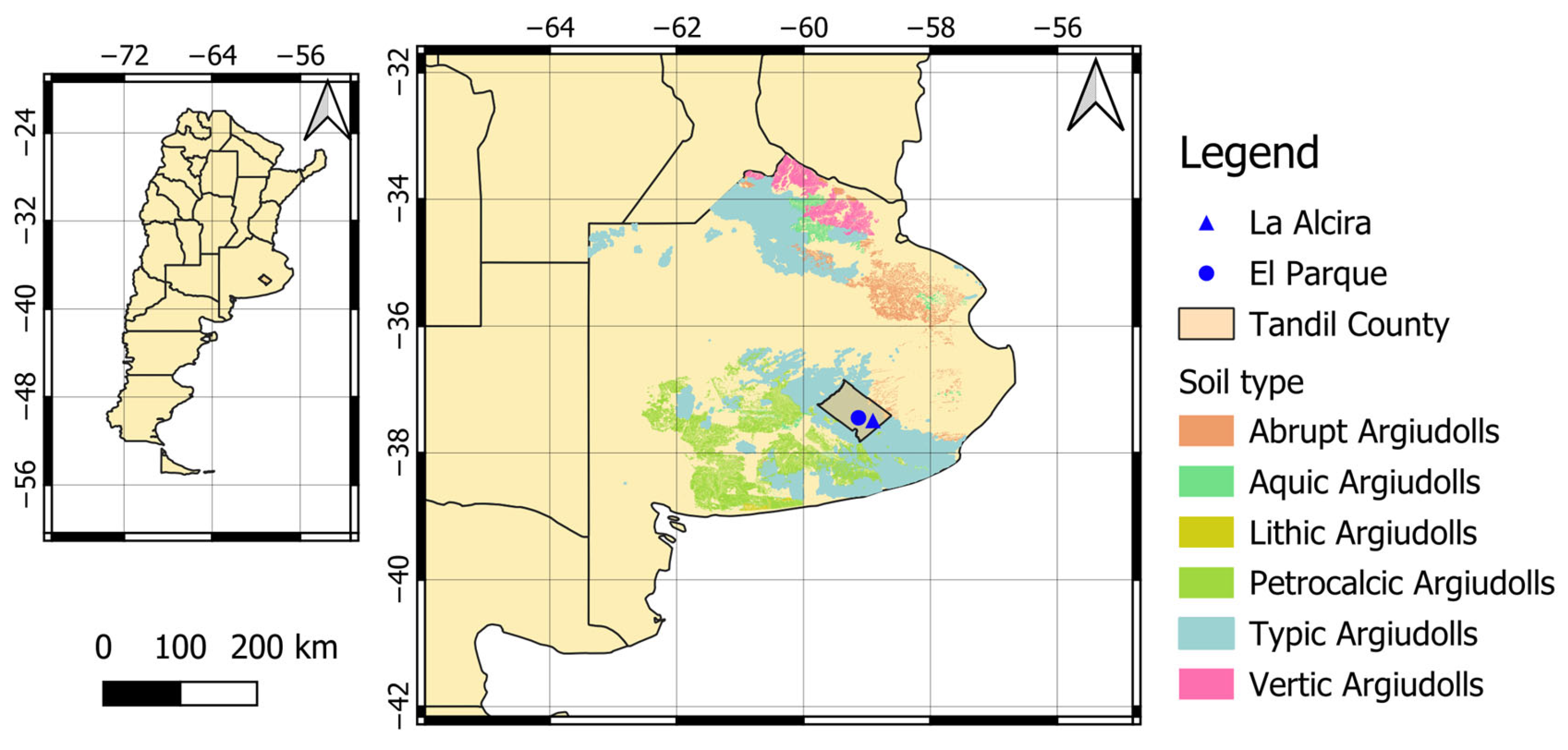
This study was conducted in Tandil County, Buenos Aires Province (Figure 1), considering two stations separated by ~23 km: La Alcira (37°29′22.92″ S, 58°54′12.24″ W, 190 m a.s.l.) and El Parque (37°26′51.36″ S, 59°07′54.48″ W, 290 m a.s.l.). In this area, the mean annual temperature is 14 °C, with annual precipitation (PP) of 920 mm, a relative humidity of 70%, and potential evapotranspiration of 1100 mm. The groundwater table in the area is >10 m, which does not favor capillary effects given the topographic condition of the study plots [15]. The mean slope of the study area is approximately 0.2% in La Alcira and between 2 and 3% in El Parque, indicating a predominance of vertical water fluxes [16,17]. Sporadic water deficits are common during December, January, and February, while water excess typically occurs from March to August [9,13].
As indicated by [9], approximately 70% of the area is dedicated to agricultural production, predominantly under rain-fed conditions, while the lower areas are mainly used for livestock activities. Soybeans represent the dominant summer crop, and barley is the second most important winter crop. Accordingly, the study area is representative of the main regional cropping systems and the associated hydrological processes at larger scales [7,16,18]. On the other hand, according to recent statistics, Argentina ranks as the world’s third-largest exporter of soybeans and the fourth-largest exporter of barley [19], highlighting its relevance at both regional and global scales. Moreover, their dominance at the regional scale allows analysis using medium- to low-resolution SM products [18].
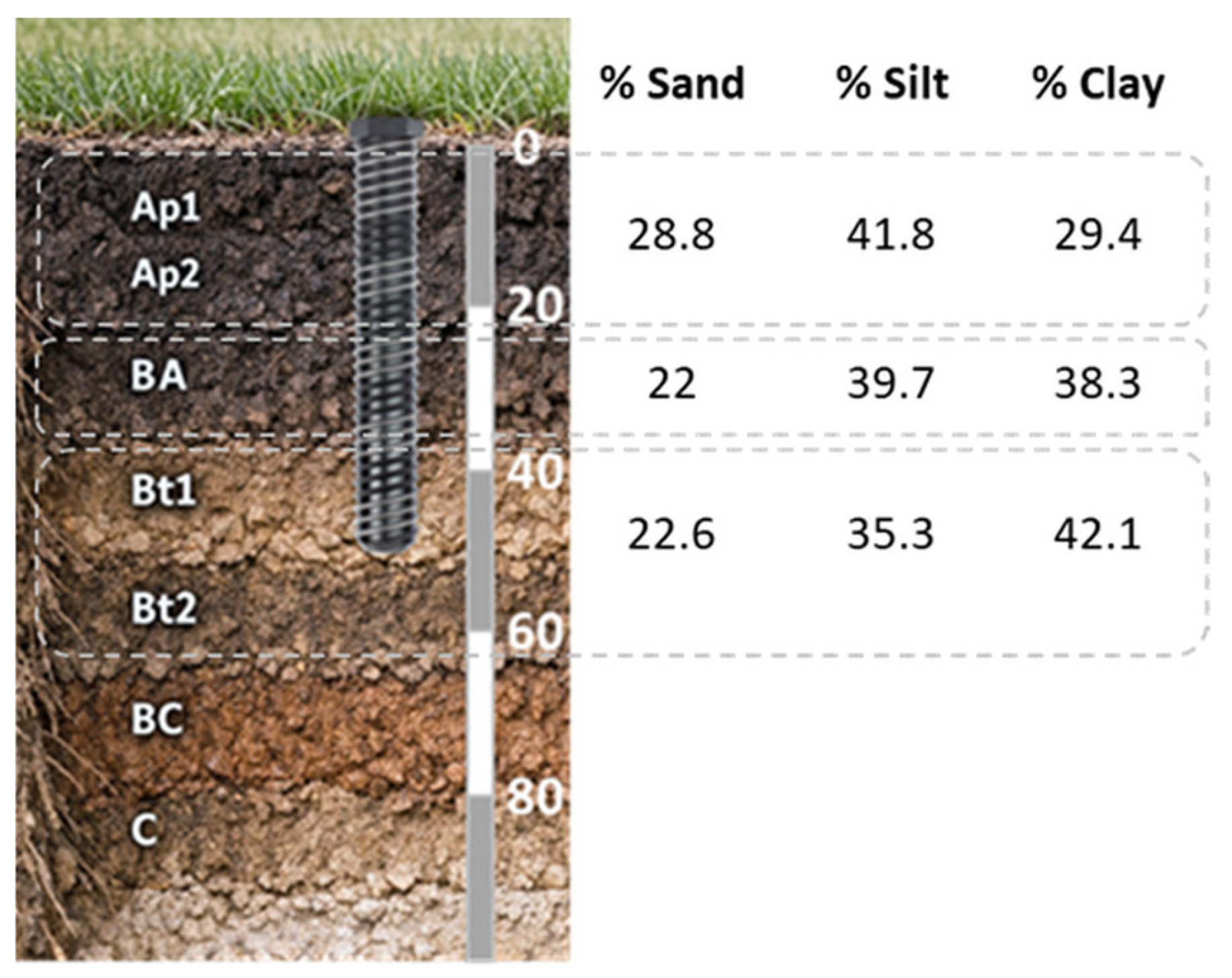
The dominant soil type is Mollisol, specifically Typic Argiudoll, with a Thermic temperature regime. Typic Argiudolls are the dominant and most productive soil types in the region, covering approximately 30% of the Argentine Pampas area. The soil profile in the area consists of Ap1 (0–7 cm), Ap2 (7–20 cm), and BA (20–35 cm) horizons with a clay loam texture, followed by Bt1 (35–57 cm) and Bt2 (57–70 cm) horizons with a clay texture. The BC (70–78 cm) and C (>78 cm) horizons exhibit loam and sandy loam textures, respectively (Figure 2) [20]. The organic matter content (3–5% in the shallow horizons) and water storage capacity (180 mm in the first meter) are relatively high, being a soil with good drainage and high water retention [21].
Figure 1. Study site, including the two field data stations and spatial distribution of Typic Argiudolls in Buenos Aires province (soilchart 3760-IV) [20].
Hydrology 13 00146 g001
Figure 2. Profile of a Typic Argiudoll in the study area showing textural differentiation between horizons [20]. The SoilVUE™10 sensor is included for SM monitoring. Depth in cm.
Hydrology 13 00146 g002

2.2. Field and Satellite Data

Field data were collected in agricultural fields during winter and summer crop seasons at La Alcira and El Parque (Figure 1) by the Instituto de Hidrología de Llanuras (IHLLA) [9]. Although measurements correspond to different sites and pixels, it should be noted that this product is the result of interpolating brightness temperature measurements from the SMAP footprint (~40 km) on a 9 km grid [4,5,6]. Consequently, all field data were analyzed jointly due to the proximity of the sites (~23 km) and similar soil, climate, and crop conditions. In addition, previous studies in the region (e.g., Ref. [22] reported strong agreement among nearby stations (R2 > 0.91), suggesting that under relatively homogeneous edaphic conditions, SM spatial variability is limited. Therefore, the point-scale measurements are assumed to be reasonably representative of the average signal within the satellite pixel.
SM measurements were recorded every 10 min using the SoilVUE™10 sensor (Campbell Scientific Inc., Logan, UT, USA) connected to a CR310-cell215 datalogger (Campbell Scientific Inc., Logan, UT, USA). The SoilVUE™10 sensor is based on the Time Domain Reflectometry (TDR) concept and consists of a cylindrical probe that is inserted vertically into the soil [9] (Figure 2). It measures at six depths (5, 10, 20, 30, 40, and 50 cm) covering eight specific seasons of the main regional crops: soybean (November to March) in 2020–2021, 2022–2023, and 2023–2024; barley (July to December) in 2019, 2020, and 2022; and wheat (July to December) in 2023 and 2024.
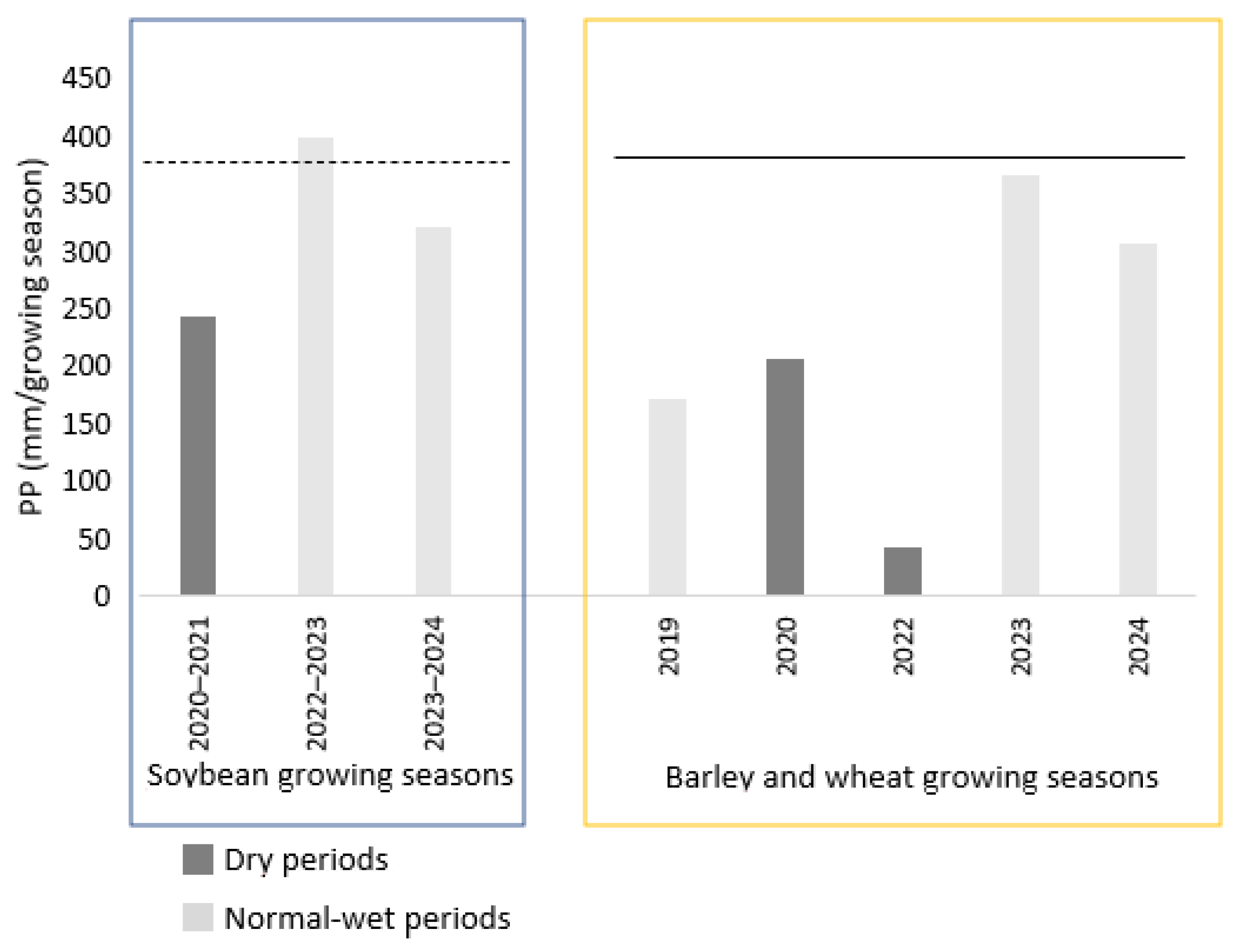
Figure 3 shows the historical PP (1991–2020) obtained from the Argentine National Meteorological Service (SMN) [23] and the accumulated PP for the analyzed growing seasons. These were categorized into two hydrological periods: a normal-wet period, corresponding to crop cycles with PP near or above the historical mean, and a dry period, corresponding to cycles with below-average PP. It is worth noting that in 2019, the annual PP was similar to the historical mean (3% higher), with 77% of the total occurring during the first semester [24]. Consequently, 2019 was included in the normal-wet group, as the soil profile exhibited adequate water availability before sowing.
The SPL4SMGP (v7 and v8) provides 3-hourly data on SSM (∼5 cm) and RZSM (0–100 cm) at a 9 km grid. Value-added L4 data products retrieve these data from L-band brightness temperature using a combination of the NASA Catchment Land Surface Model (CLSM), the microwave radiative transfer model, and the Ensemble Kalman filter (EnKF) for data assimilation. SSM is derived from SMAP radiometer measurements using the microwave radiative transfer model. Meanwhile, RZSM is estimated from the NASA CLSM, which simulates vertical moisture transfer between the surface and root zone based on the surface energy and water balance. This model uses input meteorological forcing data (i.e., PP, radiation, and air temperature) to compute a physically based equilibrium SM profile. It incorporates excess moisture at the surface and root zone as prognostic variables to represent deviations from this equilibrium, thereby enabling the simulation of RZSM dynamics [6].
Different SPL4SMGP versions provide global estimates of SSM and RZSM by assimilating satellite-derived brightness temperature observations into a land-surface model. Two major versions of the product are currently available: v7 and v8 (Table 1). V8 incorporates improvements over v7, including updated PP forcings, revised radiative transfer modeling, and expanded calibration using flux tower data. These updates aim to reduce both random and systematic errors in SM estimates and enhance the overall quality of the product, making v8 more suitable for applications requiring high-accuracy SM information [4,5,6].

2.3. Experimental Design and Statistical Analysis

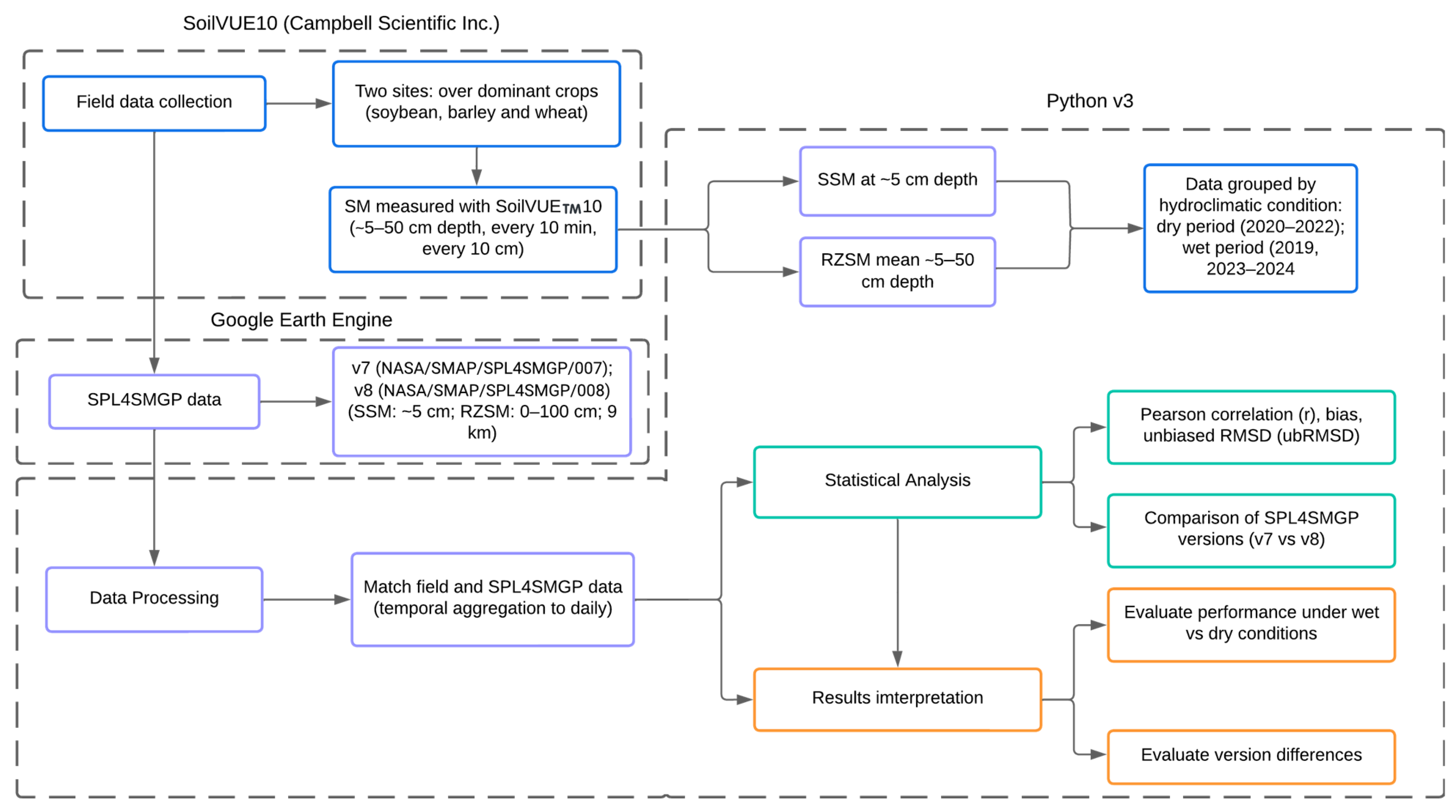
The performance of the SPL4SMGP SSM and RZSM (v7 and v8) was evaluated by comparison with field data using standard statistical metrics: Pearson’s correlation coefficient (r) to quantify the linear relationship, bias (field—estimated) to indicate overestimation or underestimation, and ubRMSD to represent random differences after removing the bias [25]. Figure 4 shows a flowchart of the experimental design and methodology.
Although the product provides data at a 3-hourly temporal resolution, our evaluations were based on metrics calculated at the daily scale. This is related to different reasons. The intraday variability was not significant, and the statistical results were similar to those obtained from 3-hourly data. Relevant changes in the soil–plant system for agricultural applications in the study area occur primarily at a daily rather than sub-daily scale. In this context, field measurements were aggregated to daily means. Finally, the daily average reduces the influence of short-term anomalous values. On the other hand, to ensure data consistency, values were excluded based on the following criteria. Days with high intraday variability (where the standard deviation exceeded 0.02 m3/m3) were excluded; that variability is generally associated with precipitation events, leading to abrupt short-term changes in SM. Also, these events are frequently associated with reduced quality of retrieved SM [6]. Finally, field measurements below 0.03 m3/m3 were excluded, as such low values are not physically consistent for these soil types. SPL4SMGP SSM and RZSM products were also aggregated to daily values and subsequently matched with the filtered field dataset.
For this analysis, the SPL4SMGP (v7 and v8) SSM and RZSM daily aggregates were evaluated using field data from the topsoil layer (∼5 cm) and the 0–50 cm average, respectively. In the study area, Ref. [9] found that most SM variations occur in the upper soil layers (5–30 cm), reflecting the combined influence of atmospheric demand, root distribution, and the response of shallow horizons to rainfall. In addition, Weinzettel and Usunoff [26] showed significant vertical homogeneity in SM between 50 and 120 cm in Typic Argiudolls of the study area during different hydric conditions. In the study sites, the capillarity effect from deep water is negligible due to the deep groundwater level (Section 2.1). Based on these previous studies and the lack of deeper SM data, field measurements up to 50 cm were assumed to represent the SM variability in the upper 100 cm of the soil profile. Similar approaches have been applied in previous studies, such as [11] for the SPL4SMGP RZSM product and [27,28] for other satellite-based RZSM products in different regions of the Argentine Pampas.

3. Results and Discussion

3.1. Surface and Deep Soil Moisture Dynamics

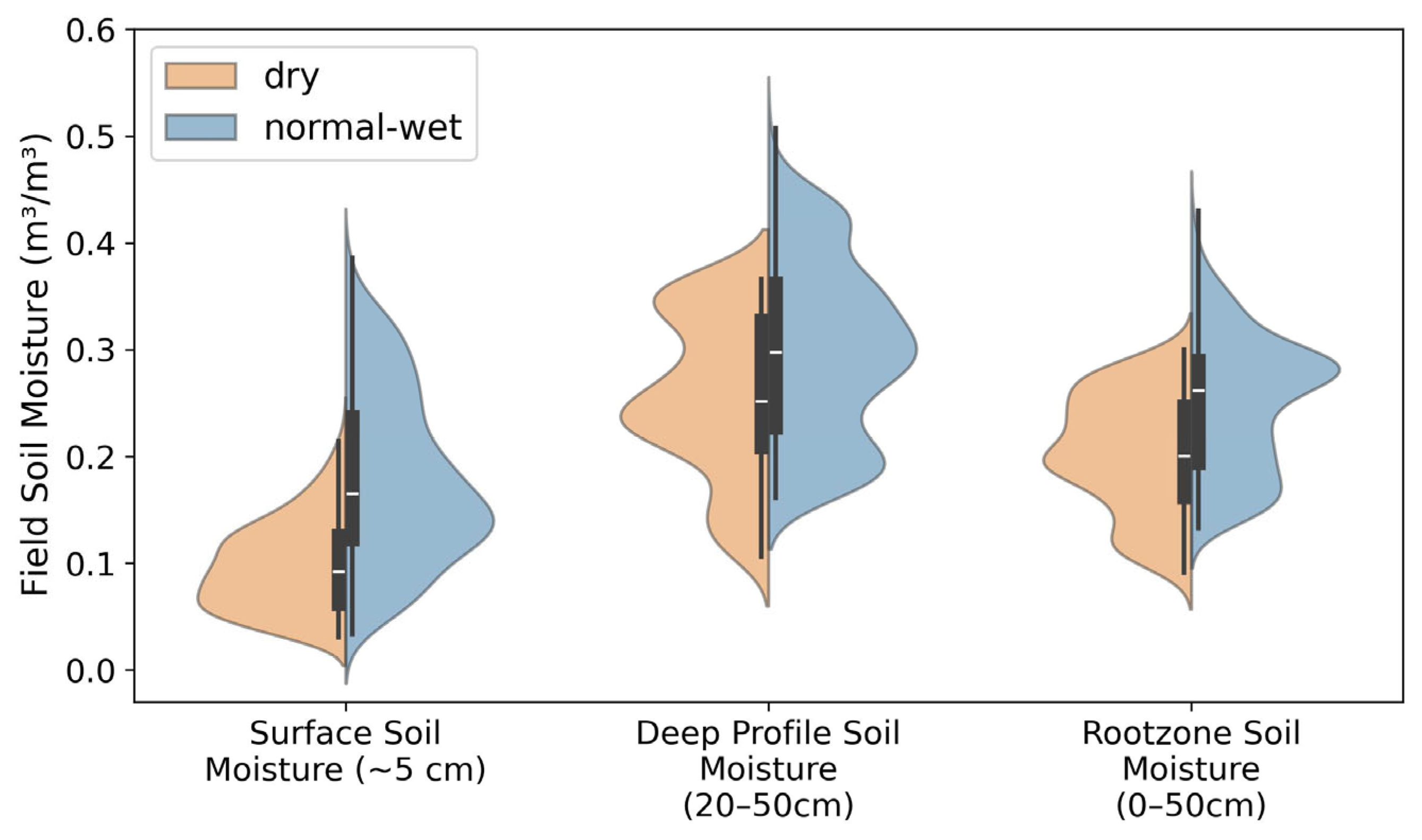
To illustrate the SM dynamics in the soil profile, Figure 5 shows the variability of field SSM (∼5 cm), deep profile SM (mean 20–50 cm), and RZSM (mean 0–50 cm) during the normal-wet and dry periods in the study area. RZSM was included to explore the dynamics at the same depths used for the subsequent comparison with SPL4SMGP. The median SSM increased from 0.09 m3/m3 during dry periods to 0.16 m3/m3 in normal-wet periods. SSM variability was lower during dry periods than during normal-wet periods, with unimodal distributions in both periods. During the dry periods, the closeness between the mean and median (0.09 m3/m3) suggested a relatively symmetric distribution. In contrast, during the normal-wet periods, the median was lower than the mean (0.18 m3/m3), indicating a right-skewed distribution. This pattern was likely associated with more frequent PP events during normal-wet periods.
Similar to the behavior observed in SSM, the variability of deep profile SM is lower during dry periods. Moreover, the median value was 0.25 m3/m3 in the dry periods and 0.31 m3/m3 in the normal-wet ones. The deep profile SM and RZSM distributions exhibited multimodal patterns, suggesting the coexistence of multiple hydrological states shaped by temporal fluctuations in water availability and retention processes.
The higher field SM values observed in the deep profile compared with SSM, particularly the high-density peak around 0.25–0.3 m3/m3, likely corresponded to the effect of finer soil textures of BA-Bt horizons on water holding. These horizons, characterized by their higher clay content, exhibited greater water-holding capacity (field capacity about 0.45 m3/m3 vs. 0.32 m3/m3 for the surface horizon) and tended to remain wetter due to slower drainage and enhanced capillary forces. Also, the topsoil layer exhibits stronger interactions with the atmosphere, such as through evapotranspiration processes [24]. Finally, RZSM exhibits behavior that integrates the other two depths (intermediate SM values and variability) and is consistent with the classification of dry and normal-wet campaigns, showing the predominance of drier conditions during the first.
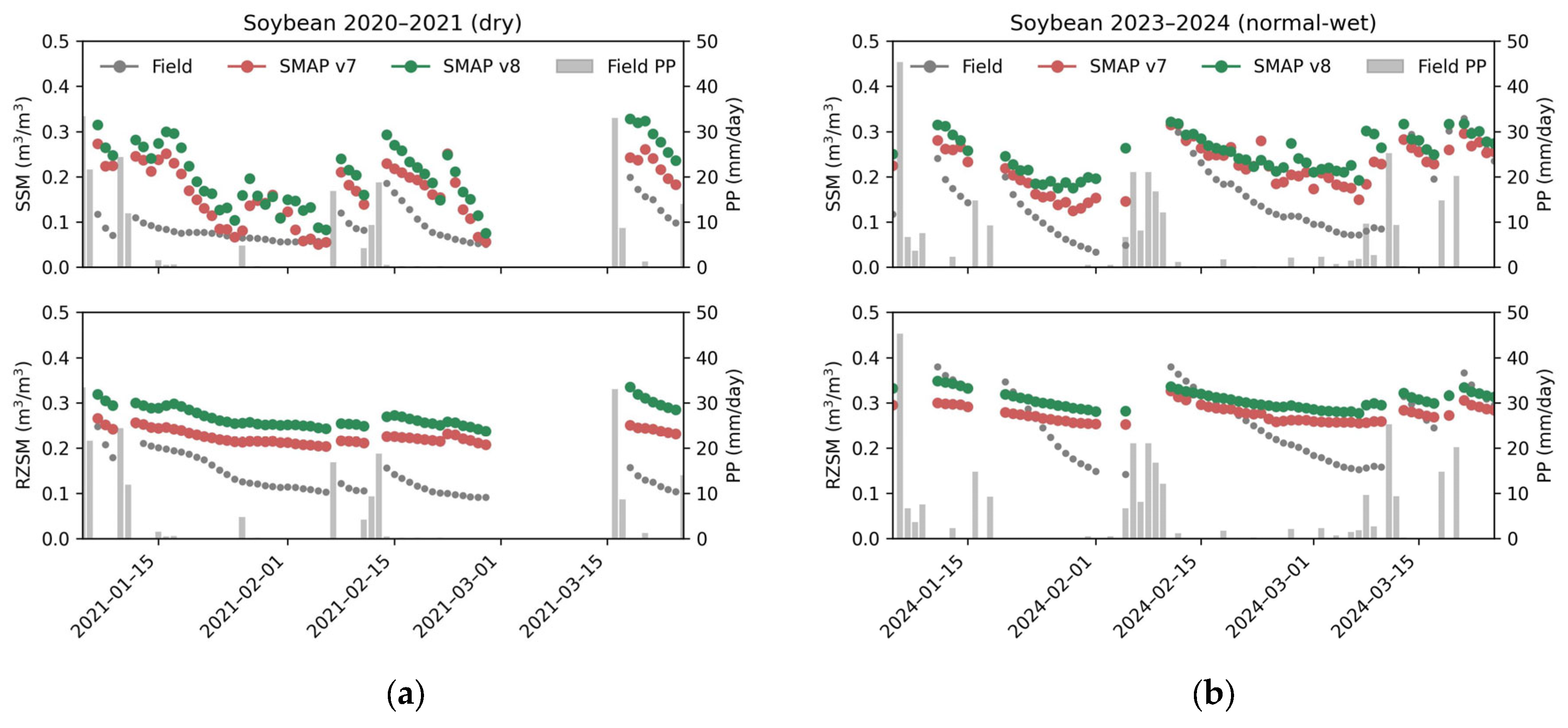
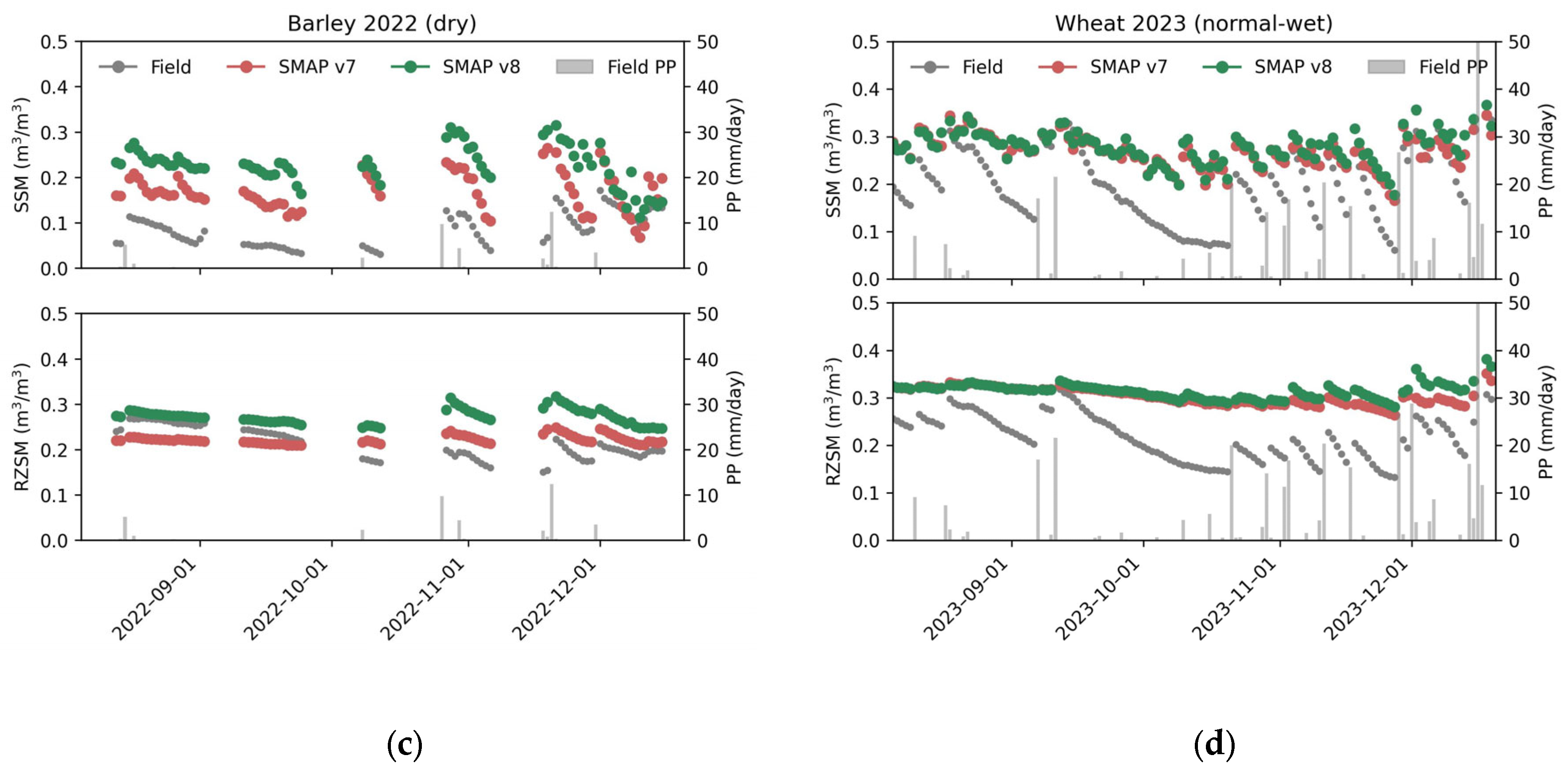
Figure 6 shows the temporal series of SSM and RZSM with daily field PP during two soybean (Figure 6a,b), barley, and wheat (Figure 6c,d) seasons with contrasting hydrological conditions; data gaps are due to the applied filter, the absence of SMAP product data, rodent problems, or a malfunctioning logger.
Under both dry and normal-wet conditions, SPL4SMGP versions generally overestimated SSM throughout the season, particularly v8. These differences decrease only toward the end of the soybean 2023–2024 season, the 2022 barley season, and the mid-to-late 2023 wheat season, especially for v7. Nevertheless, the data obtained from the SPL4SMGP versions capture the general temporal variability observed in field data. In the rootzone, SPL4SMGP exhibited more limited variability of short-term fluctuations, showing increases associated with significant rainfall pulses and decreases during drydowns. Field RZSM showed a faster drying trend than that of the SPL4SMGP product. Results suggest that the model smooths short-term fluctuations and attenuates rapid drying signals driven by atmospheric forcing at the surface. However, part of these discrepancies can be attributed to the differences in the depths considered [27]. The comparison between contrasting seasons highlights the importance of local evaluation for accurate SM retrievals in agricultural areas.
The difference observed between SSM and RZSM can be associated with the combined effects of data assimilation and model parameterization. SPL4SMGP assimilates SSM retrieved from the L-band radiometer, thereby capturing short-term changes associated with atmospheric forcing. On the other hand, the deeper SM is represented through the land-surface model, which appears to propagate moisture more conservatively and may overestimate the high retention capacity of Bt horizons (see Figure 7 and Figure 8).

3.2. Performance of SPL4SMGP v7 and v8 Under Wet and Dry Conditions

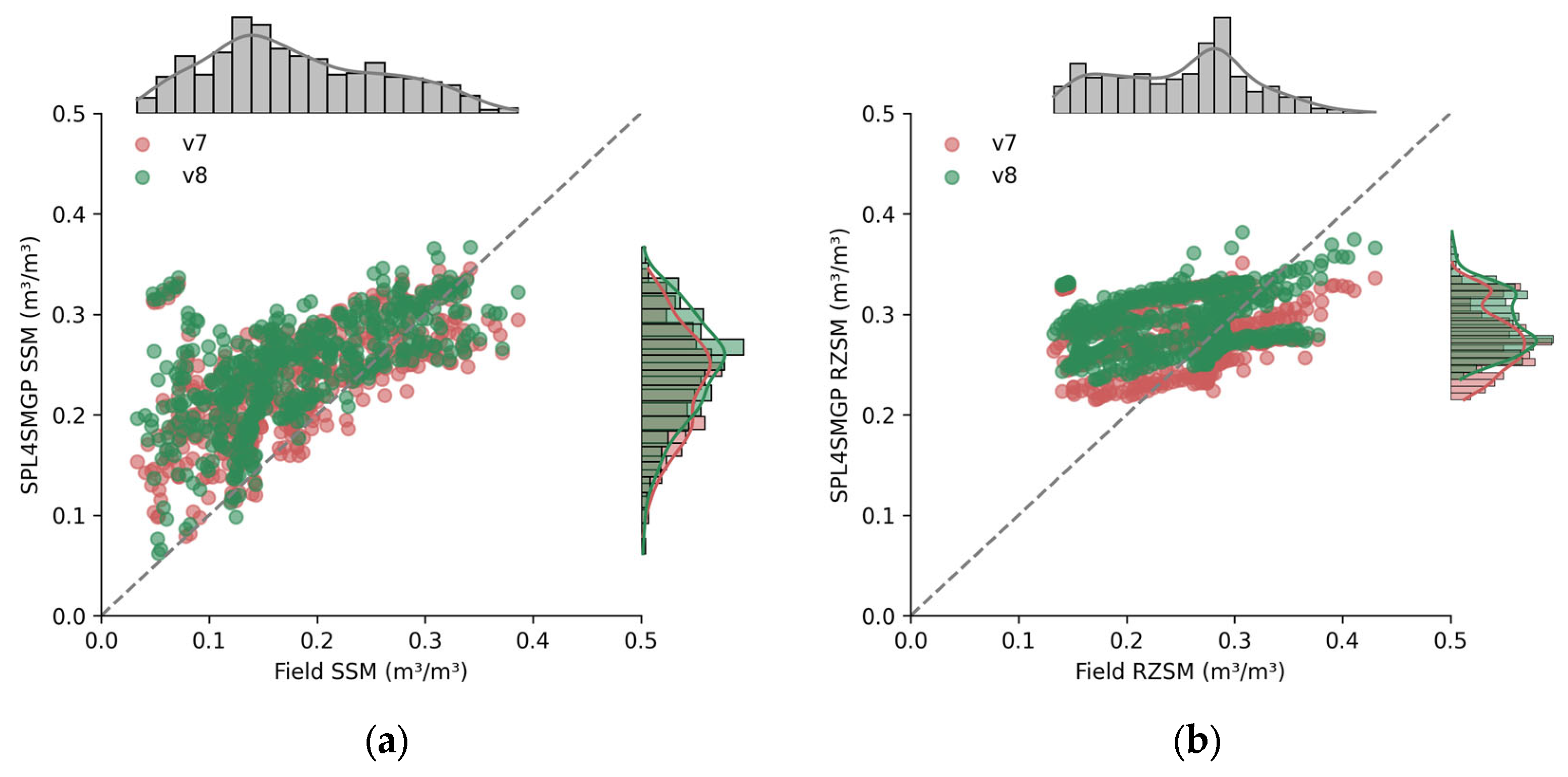
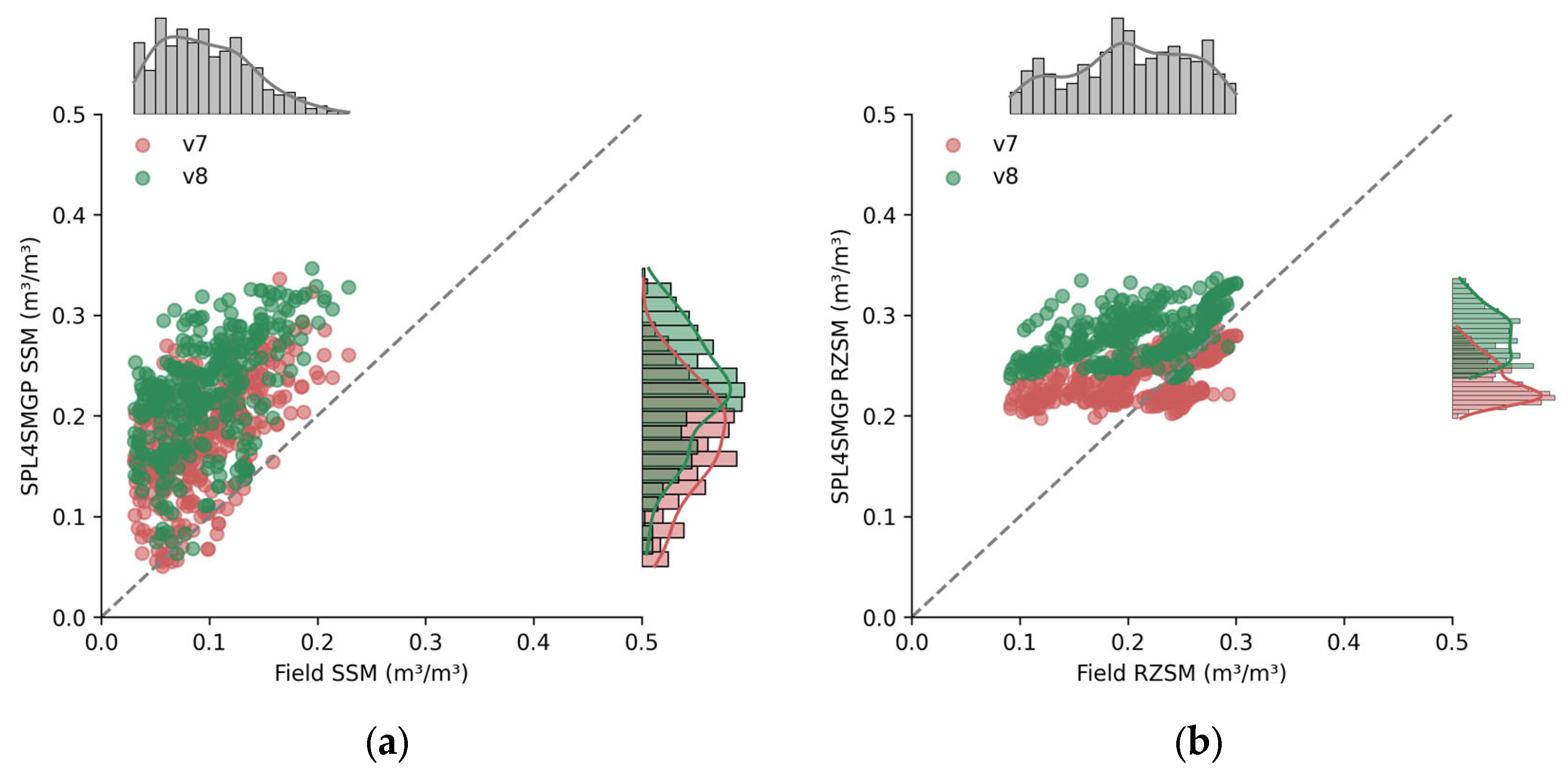
Concerning the SPL4SMGP v7 and v8 evaluation, Figure 7 and Figure 8 display the relationship between SM products and field data during the normal-wet and dry periods for SSM and RZSM. On the other hand, Table 2 shows the corresponding statistical metrics of the evaluation.
In general, both versions of SPL4SMGP SSM and RZSM exhibit ubRMSD (0.05–0.06 m3/m3) in line with the SMAP mission objective (≈0.04 m3/m3). However, a generalized negative bias was observed, indicating an overestimation of the product, consistent with SSM and RZSM patterns observed in Figure 7 and Figure 8. Previous evaluations of SPL4SMGP SSM and other satellite-derived SSM products have shown that, over the Argentine Pampas, overestimation is more pronounced under low field SSM conditions, highlighting the need to review calibration and validation frameworks for satellite SSM retrieval in these regions [10,13,27]. Similarly, evaluations of SPL4SMGP RZSM at regional to global scales have reported comparable biases and reduced variability to those observed in this study [11,28], consistent with findings from other RZSM non-SMAP-based products [29,30,31]. Notably, the main difference in bias between v7 and v8 was observed during dry periods, indicating that discrepancies between product versions are particularly sensitive to low SM.
Under normal-wet conditions, SSM for both SPL4SMGP versions showed a moderate correlation with field data (r = 0.72 for v7 and r = 0.66 for v8). Whereas SPL4SMGP RZSM correlation values were lower (r = 0.32 for v7 and r = 0.38 for v8), reflecting the lower sensitivity of the land surface model to soil profile dynamics. Comparative analysis of the data distributions (Figure 7 and Figure 8) reveals shifts in central tendency and variability between v7 and v8 of the SSM and RZSM datasets for dry periods. In this context, the SPL4SMGP SSM v8 distribution exhibits a clear displacement of the modal peak toward higher values. In the case of SPL4SMGP RZSM, v8 appears to retrieve greater variability and a more distributed range of values. This contrasts sharply with the v7 values, which exhibited an asymmetric distribution with data concentrated predominantly at lower values, partly explaining the bias difference mentioned above.
During the dry periods, both SPL4SMGP SSM versions (Figure 8, Table 2) exhibited a general decrease in correlation, indicating a lower performance of the land surface model under drier conditions. The correlation coefficients were 0.61 for v7 and 0.57 for v8, indicating a moderate relationship between estimated data and field observations. For the RZSM, the correlation remains moderate, with r = 0.53 for v7 and r = 0.52 for v8. These results show that SPL4SMGP RZSM performs better under drier conditions than under normal-wet conditions. However, the generally lower performance of RZSM SPL4SMGP can be attributed to the modeling framework and the input data used, given that RZSM is primarily estimated from model dynamics. First, SPL4SMGP assimilates only the SSM derived from the L-band radiometer; therefore, any bias present in the surface layer is vertically propagated into the modeled profile moisture. The estimation of RZSM is also strongly dependent on the meteorological forcing data, particularly PP. Biases in satellite-or reanalysis-based PP products (typically on the order of 10–30% [32]) can affect the simulated water balance and lead to deviations in deeper SM estimates [33].
In addition, the soil hydraulic parameters used by the CLSM are obtained from global soil databases (State Soil Geographic-STATSGO2-project, for the United States, and the Harmonized World Soil Database version 1.21-HWSD1.21), which may not accurately represent the soil properties at the study sites and assume these soil parameters are vertically homogeneous within the soil column [34]. In particular, the Typic Argiudolls analyzed in this study exhibit marked textural differentiation along the soil profile, with clay-enriched Bt horizons that enhance water retention and reduce drainage rates at depth. So, these assumptions about the soil profile homogeneity may constrain the SSM-RZSM coupling and tend to smooth clay contents [33].
Overall, these results show that SMAP L4 products better capture the general variability of SSM, mainly under normal-wet conditions. Overall, both versions exhibit higher correlations and lower biases during the normal-wet periods, indicating a better representation of SSM dynamics. Under dry conditions, correlations decrease by approximately 0.1 for SSM, while the bias becomes more negative, especially for v8, suggesting a more pronounced overestimation of SM during periods of low water content. These overall results highlight that the SPL4SMGP product tends to perform more reliably in wetter conditions for SSM, whereas under dry conditions, its sensitivity decreases, particularly in v8.

4. Conclusions

This study evaluated, at a daily scale, the performance of SMAP L4 Global 3-hourly 9 km grid EASE-Grid Surface and Root-Zone Soil Moisture Geophysical Data (SPL4SMGP) version 7 (v7) and the recent and scarcely evaluated version 8 (v8) over agricultural Typic Argiudolls in the Southeastern subhumid/humid Argentine Pampas, using field measurements collected under contrasting hydric conditions. The observed results contribute to understanding the performance of these products over this highly productive soil type.
The results indicate that both versions moderately captured the observed variability, and the bias for both surface soil moisture (SSM) and root zone SM (RZSM) remains within the expected ranges reported for the product. During the normal-wet periods, both versions tended to capture SSM dynamics and exhibited moderate correlation, while the lower correlations obtained for RZSM would indicate a limitation of the model to represent water dynamics in the soil profile. Under dry conditions, the decline in SSM correlation and the increase in negative bias suggest reduced model responsiveness at low SM levels.
Although the SPL4SMGP v8 product incorporates several improvements to its algorithms (including an updated L-band radiative transfer model, recalibrated brightness temperature parameters, corrected soil auxiliary data, and revised precipitation forcing), the results suggest that these changes do not necessarily result in substantial differences across all regions or metrics. The improvements of v8 aimed at global-scale reductions in systematic biases were not observed in our field analysis over Typic Argiudolls. In our study area, where land cover is relatively homogeneous and precipitation regimes are not strongly affected by the corrected regions in IMERG or soil reclassification, the v7 and v8 estimates show similar performance. Consequently, local validation statistics may show limited performance even though the global error structure improved. Future studies can conduct more widespread validation campaigns to evaluate v8 in Typic Argiudolls of other regions. Although the analysis was carried out taking previous studies monitoring the soil profile at 0–50 cm depth, some soil moisture dynamics may be under-monitored. It should be noted that the lack of data in the study area did not allow for an analysis of deeper horizons. Those future studies should complement measurements at a depth of 50–100 cm to enable a more comprehensive analysis of the product.
Overall, SPL4SMGP (v7 and v8) provides acceptable large-scale SM information for monitoring agricultural systems in Typic Argiudolls of the Argentine Pampas at the regional scale, given its relatively low spatial resolution. The tendency to overestimate SM should be taken into account, particularly under water-limited conditions in agricultural areas, to assess impacts on crops. Further improvements in representing vertical coupling processes can enhance their applicability for agricultural monitoring, given the influence of subsurface soil water on vegetation water conditions.

Author Contributions

Conceptualization, M.F.D. and S.B.; methodology, M.F.D. and S.B.; software, S.B.; validation, M.F.D. and S.B.; formal analysis, M.F.D., S.B., M.E.H. and R.E.R.; investigation, M.F.D., S.B., M.E.H. and R.E.R.; resources, M.F.D., S.B., M.E.H. and R.E.R.; data curation, M.F.D. and S.B.; writing—original draft preparation, M.F.D. and S.B.; writing—review and editing, M.F.D. and M.E.H.; visualization, M.F.D. and S.B.; supervision, M.E.H. and R.E.R.; project administration, M.F.D., S.B., M.E.H., J.P. and R.E.R.; funding acquisition, J.P. and R.E.R. All authors have read and agreed to the published version of the manuscript.

Funding

This research was funded by Comisión de Investigaciones Científicas, grant number EX-2024-14685687-GDEBA-DSTYADCIC (IP24/25), and the APC was funded by CONIDA, Perú 2026.

Data Availability Statement

The SPL4SMGP (version 7 and version 8) data were obtained from the Google Earth Engine (https://developers.google.com/earth-engine/datasets/catalog/NASA/SMAP/SPL4SMGP/007 and https://developers.google.com/earth-engine/datasets/catalog/NASA/SMAP/SPL4SMGP/008), accessed on 27 October 2025.

Acknowledgments

The authors would like to thank the Consejo Nacional de Investigaciones Científicas y Técnicas (CONICET), the Instituto de Hidrología de Llanuras “Dr. Eduardo Jorge Usunoff”, the Comisión Nacional de Investigación y Desarrollo Aeroespacial, and the Comisión de Investigaciones Científicas de la provincia de Buenos Aires. During the preparation of this manuscript, the authors used ChatGPT (version GPT-5.3) for the purposes of text editing and formatting. The authors have reviewed and edited the output and take full responsibility for the content of this publication.

Conflicts of Interest

The authors declare no conflicts of interest.

Abbreviations

The following abbreviations are used in this manuscript:
SMSoil Moisture
SMAPSoil Moisture Active–Passive
EASEEqual-Area Scalable Earth
SPL4SMGPSMAP Level 4 Soil Moisture Products
v7Version 7
v8Version 8
SSMSurface Soil Moisture
RZSMRoot Zone Soil Moisture
ubRMSDUnbiased Root Mean Square Deviation
hahectares
rPearson’s correlation
NASANational Aeronautics and Space Administration’s
PPPrecipitation
m a.s.lMeters Above Sea Level
IHLLAInstituto de Hidrología de Llanuras
TDRTime Domain Reflectometry
SMNArgentine National Meteorological Service
L4Level 4
CLSMCatchment Land Surface Model
EnKFEnsemble Kalman filter
CPCUClimate Prediction Center Unified
IMERGIntegrated Multi-satellitE Retrievals
GEOSGoddard Earth Observing System

References

  1. Wang, Y.; Shi, L.; Lin, L.; Holzman, M.; Carmona, F.; Zhang, Q. A robust data-worth analysis framework for soil moisture flow by hybridizing sequential data assimilation and machine learning. Vadose Zone J. 2020, 19, e20026. [Google Scholar] [CrossRef]
  2. Zhao, W.; Liu, L.; Shen, Q.; Yang, J.; Han, X.; Tian, F.; Wu, J. Effects of water stress on photosynthesis, yield, and water use efficiency in winter wheat. Water 2020, 12, 2127. [Google Scholar] [CrossRef]
  3. García, G.A.; García, P.E.; Rovere, S.L.; Bert, F.E.; Schmidt, F.; Menéndez, Á.N.; Nosetto, M.D.; Verdin, A.; Rajagopalan, B.; Arora, P.; et al. A linked modelling framework to explore interactions among climate, soil water, and land use decisions in the Argentine Pampas. Environ. Model. Softw. 2019, 111, 459–471. [Google Scholar] [CrossRef]
  4. Reichle, R.H.; Ardizzone, J.V.; Kim, G.K.; Lucchesi, R.A.; Smith, E.B.; Weiss, B.H. Soil Moisture Active Passive (SMAP) Mission Level 4 Surface and Root Zone Soil Moisture (L4_SM) Product Specification Document; National Aeronautics and Space Administration (NASA): Greenbelt, MD, USA, 2025. [Google Scholar]
  5. Reichle, R.H.; De Lannoy, G.J.; Koster, R.D.; Crow, W.T.; Kimball, J.S.; Liu, Q.; Bechtold, M. SMAP L4 Global 3-Hourly 9 km EASE-Grid Surface and Root Zone Soil Moisture Analysis Update, Version 7; NASA National Snow and Ice Data Center Distributed Active Archive Center: Boulder, CO, USA, 2022. [Google Scholar] [CrossRef]
  6. Reichle, R.H.; De Lannoy, G.J.; Koster, R.D.; Crow, W.T.; Kimball, J.S.; Liu, Q.; Bechtold, M. SMAP L4 Global 3-Hourly 9 km EASE-Grid Surface and Root Zone Soil Moisture Analysis Update, Version 8; NASA National Snow and Ice Data Center Distributed Active Archive Center: Boulder, CO, USA, 2025. [Google Scholar] [CrossRef]
  7. Holzman, M.E.; Rivas, R.; Bayala, M. Subsurface soil moisture estimation by VI–LST method. IEEE Geosci. Remote Sens. Lett. 2014, 11, 1951–1955. [Google Scholar] [CrossRef]
  8. Feldman, A.F.; Short Gianotti, D.J.; Dong, J.; Akbar, R.; Crow, W.T.; McColl, K.A.; Konings, A.G.; Nippert, J.B. Remotely sensed soil moisture can capture dynamics relevant to plant water uptake. Water Resour. Res. 2023, 59, e2022WR033814. [Google Scholar] [CrossRef]
  9. Olivera Rodríguez, P.; Holzman, M.E.; Aldaya, M.M.; Rivas, R.E. Water footprint in rainfed summer and winter crops: The role of soil moisture. Agric. Water Manag. 2024, 296, 108787. [Google Scholar] [CrossRef]
  10. Colliander, A.; Reichle, R.H.; Crow, W.T.; Cosh, M.H.; Chen, F.; Chan, S.; Das, N.N.; Bindlish, R.; Chaubell, J.; Kim, S.; et al. Validation of soil moisture data products from the NASA SMAP mission. IEEE J. Sel. Top. Appl. Earth Obs. Remote Sens. 2022, 15, 364–392. [Google Scholar] [CrossRef]
  11. Nadeem, A.A.; Zha, Y.; Shi, L.; Ran, G.; Ali, S.; Jahangir, Z.; Afzal, M.M.; Awais, M. Multi-scale assessment of SMAP level 3 and level 4 soil moisture products over the ShanDian River Basin, China. Remote Sens. 2022, 14, 982. [Google Scholar] [CrossRef]
  12. Xu, X. Evaluation of SMAP level 2, 3, and 4 soil moisture datasets over the Great Lakes region. Remote Sens. 2020, 12, 3785. [Google Scholar] [CrossRef]
  13. Degano, M.F.; Beninato, S.; Holzman, M.E.; Bayala, M.I.; Rivas, R.E.; Massari, C. Soil moisture: Analysis of SMAP satellite products in plain zones. In Proceedings of the VII IEEE Biennial Congress of Argentina (ARGENCON), San Nicolás de los Arroyos, Argentina, 18–20 September 2024; pp. 1–8. [Google Scholar] [CrossRef]
  14. Dorigo, W.; Himmelbauer, I.; Aberer, D.; Schremmer, L.; Petrakovic, I.; Zappa, L.; Preimesberger, W.; Xaver, A.; Annor, F.; Ardö, J.; et al. The International Soil Moisture Network: Serving Earth system science for over a decade. Hydrol. Earth Syst. Sci. 2021, 25, 5749–5804. [Google Scholar] [CrossRef]
  15. Ruiz de Galarreta, V.A.; Banda Noriega, R.B.; Guerrero, E.M.; Jacinto, G.P.; Coria, D.L.; Rodriguez, C.I.; Barranquero, R.S.; Miguel, R.E.; Díaz, A.A. Diagnóstico Integral del Recurso Hídrico en el Partido de Tandil: Pautas Para su Gestión Sustentable; Technical Report; Consejo Nacional de Investigaciones Científicas y Técnicas: Buenos Aires, Argentina, 2011. [Google Scholar]
  16. Beninato, S.; Holzman, M.E.; Rivas, R.E. Sensitivity of land surface temperature and normalized difference water index to soil moisture on wheat and barley. Agriscientia 2025, 42, 3. [Google Scholar] [CrossRef]
  17. Instituto Geográfico Nacional. Mapa Interactivo de Argentina. Available online: https://mapa.ign.gob.ar/ (accessed on 15 December 2025).
  18. Niclòs, R.; Rivas, R.; Garcia-Santos, V.; Dona, C.; Valor, E.; Holzman, M.; Bayala, M.; Carmona, F.; Ocampo, D.; Soldano, A.; et al. SMOS level-2 soil moisture product evaluation in rain-fed croplands of the Pampean region of Argentina. IEEE Trans. Geosci. Remote Sens. 2015, 54, 499–512. [Google Scholar] [CrossRef]
  19. Ministerio de Agricultura, Ganadería y Pesca. Agricultural Estimates. Available online: http://datosestimaciones.magyp.gob.ar/ (accessed on 18 December 2025).
  20. Instituto Nacional de Tecnología Agropecuaria (INTA). Cartas de Suelos de la República Argentina, Provincia de Buenos Aires; Zenodo; Instituto Nacional de Tecnología Agropecuaria (INTA): Buenos Aires, Argentina, 2023. [Google Scholar] [CrossRef]
  21. Travasso, M.I.; Suero, E.E. Estimación de la capacidad de almacenaje de agua en suelos del sudeste bonaerense. Boletín Técnico 1994, 125, 9. [Google Scholar]
  22. Mancino, C.A.; Rivas, R.E. Completado de datos medidos por sensores de humedad de suelo: Caso de estudio en estación de monitoreo automática (EMA) de la red IHREDA. In Proceedings of the XVI Encuentro del Centro Internacional en Ciencias de la Tierra (E-ICES 16), Virtual format, Argentina, 16–19 November 2021. [Google Scholar]
  23. Servicio Meteorológico Nacional. Available online: https://www.smn.gob.ar/descarga-de-datos (accessed on 30 November 2025).
  24. Beninato, S.; Holzman, M.E.; Rivas, R.E.; Diez, J.F. Profundidad óptica de la vegetación (VOD): Revisión de productos SMAP y aplicaciones agrícolas. Rev. Geol. Apl. Ing. Ambient. 2024, 51, e021. [Google Scholar] [CrossRef]
  25. Gruber, A.; De Lannoy, G.; Albergel, C.; Al-Yaari, A.; Brocca, L.; Calvet, J.-C.; Colliander, A.; Cosh, M.; Crow, W.; Dorigo, W.; et al. Validation practices for satellite soil moisture retrievals: What are the errors? Remote Sens. Environ. 2020, 244, 111806. [Google Scholar] [CrossRef]
  26. Weizettel, P.; Usunoff, E. Calibración de una sonda de capacitancia en suelos argiudoles. Estud. Zona No Saturada Suelo 2003, 6, 165–170. [Google Scholar]
  27. Spennemann, P.C.; Fernández-Long, M.E.; Gattinoni, N.N.; Cammalleri, C.; Naumann, G. Soil moisture evaluation over the Argentine Pampas using models, satellite estimations and in situ measurements. J. Hydrol. Reg. Stud. 2020, 31, 100723. [Google Scholar] [CrossRef]
  28. Hao, L.; Chen, J.; Wei, Z.; Miao, L.; Zhao, T.; Peng, J. Validation of satellite soil moisture products by sparsification of ground observations. IEEE J. Sel. Top. Appl. Earth Obs. Remote Sens. 2024, 17, 5970–5985. [Google Scholar] [CrossRef]
  29. Beninato, S.; Holzman, M.; Degano, M.F.; Rivas, R. ERA5-Land: Soil moisture dry-down detection over the Argentine Pampas. In Proceedings of the Latin America GRSS and ISPRS Remote Sensing Conference (LAGIRS 2025), Foz de Iguazú, Brazil, 10–13 November 2025. [Google Scholar] [CrossRef]
  30. Zhu, L.; Tan, Y.; Yuan, S.; Jin, J.; Tang, Z.; Walker, J.P. DeepProfile: An inverse fusion framework for root zone soil moisture profile estimation. Remote Sens. Environ. 2026, 339, 115408. [Google Scholar] [CrossRef]
  31. Pablos, M.; Gonzalez-Zamora, A.; Sanchez, N.; Martínez-Fernández, J. Assessment of root zone soil moisture estimations from SMAP, SMOS and MODIS observations. Remote Sens. 2018, 10, 981. [Google Scholar] [CrossRef]
  32. Huffman, G.J.; Bolvin, D.T.; Joyce, R.; Kelley, O.A.; Nelkin, E.J.; Portier, A.; Stocker, E.F.; Tan, J.; Watters, D.C.; West, B.J. IMERG V07 Release Notes; NASA Goddard Space Flight Center: Greenbelt, MD, USA, 2023. [Google Scholar]
  33. Qiu, J.; Dong, J.; Crow, W.T.; Zhang, X.; Reichle, R.H.; De Lannoy, G.J. The benefit of brightness temperature assimilation for SMAP level-4 soil moisture analysis. Hydrol. Earth Syst. Sci. 2021, 25, 1569–1587. [Google Scholar] [CrossRef]
  34. Reichle, R.H.; Koster, R.D.; De Lannoy, G.J.; Crow, W.T.; Kimball, J.S. Level 4 Surface and Root Zone Soil Moisture (L4_SM) Data Product; Technical Note; NASA: Washington, DC, USA, 2014. [Google Scholar]
Figure 3. Accumulated PP for soybean growing seasons (2020–2021, 2022–2023, and 2023–2024; historical mean: 372.9 mm/growing season, dashed line), barley (2019, 2020, and 2022) and wheat (2023 and 2024; historical mean: 374.5 mm/growing season, solid line), measured by the energy balance station rain gauge TE525MM (Campbell Scientific Inc., Logan, UT, USA).
Hydrology 13 00146 g003
Figure 4. Schematic representation of the methodological framework adopted in this study, including data collection, processing, and comparison steps for the evaluation of SPL4SMGP products (v7 and v8) under different hydric conditions.
Hydrology 13 00146 g004
Figure 5. Variability of field SSM, deep profile SM, and RZSM during the normal-wet and dry periods. Negative values in the violin plots are an artifact of the kernel density estimation (KDE).
Hydrology 13 00146 g005
Figure 6. Time series of SSM and RZSM from field measurements and SPL4SMGP (versions 7 and 8), together with daily field precipitation (PP). The figure includes two soybean growing seasons under dry (2020–2021) (a) and normal-wet (2023–2024) (b) conditions, and barley growing season under dry (2022) (c) and wheat growing season under normal-wet conditions (d).
Hydrology 13 00146 g006aHydrology 13 00146 g006b
Figure 7. Relationship between the SPL4SMGP product and field data for the normal-wet periods for (a) SSM and (b) RZSM. The histograms at the top show the distribution of field measurements, while the side histograms show the distribution of SPL4SMGP estimates, allowing comparison of data frequency, spread, and central tendency under normal-wet conditions.
Hydrology 13 00146 g007
Figure 8. Relationship between the SPL4SMGP product and field data for the dry periods for (a) SSM and (b) RZSM. The histograms at the top show the distribution of field measurements, while the side histograms show the distribution of SPL4SMGP estimates, highlighting differences in variability and concentration of values during dry conditions.
Hydrology 13 00146 g008
Table 1. Comparison of SPL4SMGP v7 and v8.
CategoryVersion 7Version 8
Main
Inputs
SMAP brightness temperatures
CLSM forcings
Soil parameters
Daily PP corrected by Climate Prediction Center Unified (CPCU—Integrated Multi-satellitE Retrievals
IMERG v06)
Daily PP corrected by CPCU (IMERG v07)
Main
Outputs
SSM and RZSM (0–5 cm and 0–100 cm)
Surface and upper soil layer temperatures
Research outputs: surface meteorological forcing fields, land surface fluxes, soil temperature and snow states, and runoff
Assimilation
Algorithm
Goddard Earth Observing System (GEOS) CLSM
Brightness temperatures assimilated from Version 5, both R17 and R18 iterations (or Level 1 Composite Release Identifiers), and Version 6 R19 Brightness temperatures assimilated from Version 6 R19 of the SPL1CTB product
Wang & Schmugge’s soil mixing approachMironov’s soil mixing approach
Input data from Version 5 of the SMAP Level-2 dual-channel SM retrieval product (SPL2SMP_E)Input data from Version 6 of the SMAP Level-2 dual-channel SM retrieval product (SPL2SMP_E)
CalibrationLimited number of FLUXNET tower sitesExpanded FLUXNET calibration dataset (~410 sites), representing more plant functional types
Performance vs.
in situ
Moderate accuracy for SSM and RZSMSlightly improved accuracy for SSM; reduced ubRMSD
AvailabilityAvailable until 30 June 2025Current
Table 2. Statistical metrics from the comparison between the field and the SMAP product of SSM and RZSM for normal-wet and dry periods.
PeriodZoneVersionnrBias (m3/m3)ubRMSD (m3/m3)
Normal-wetSSM74310.72−0.040.05
84240.66−0.060.06
RZSM74310.32−0.020.06
84240.38−0.030.06
DrySSM73340.61−0.080.05
83340.57−0.130.05
RZSM73340.53−0.030.05
83340.52−0.080.05
Disclaimer/Publisher’s Note: The statements, opinions and data contained in all publications are solely those of the individual author(s) and contributor(s) and not of MDPI and/or the editor(s). MDPI and/or the editor(s) disclaim responsibility for any injury to people or property resulting from any ideas, methods, instructions or products referred to in the content.