

GRACE Downscaling and Machine Learning Models for Groundwater Prediction: A Systematic Review



Abstract
1. Introduction
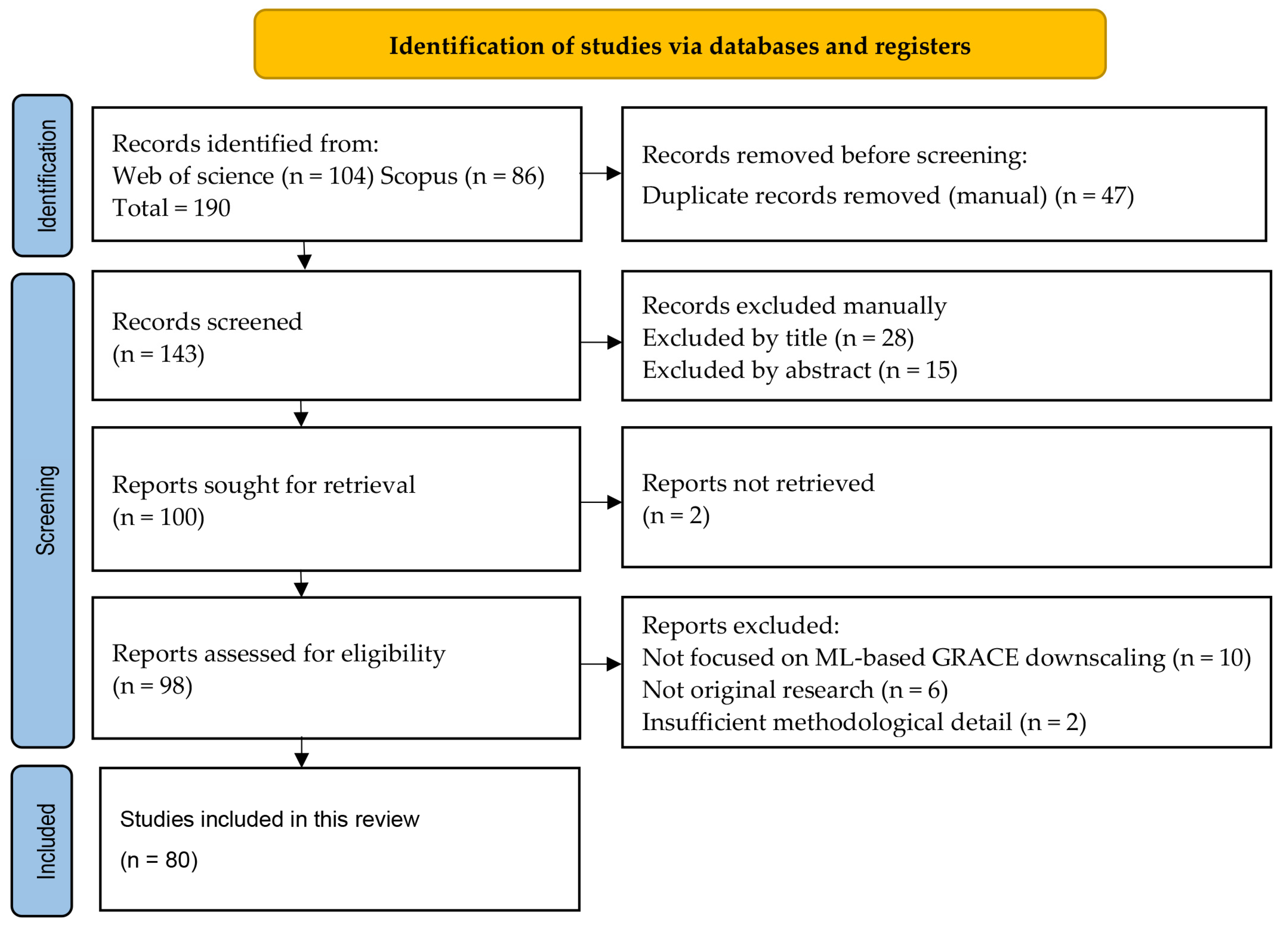
2. Review Methodology
- Exclusion criteria: The following criteria were employed to exclude any article:
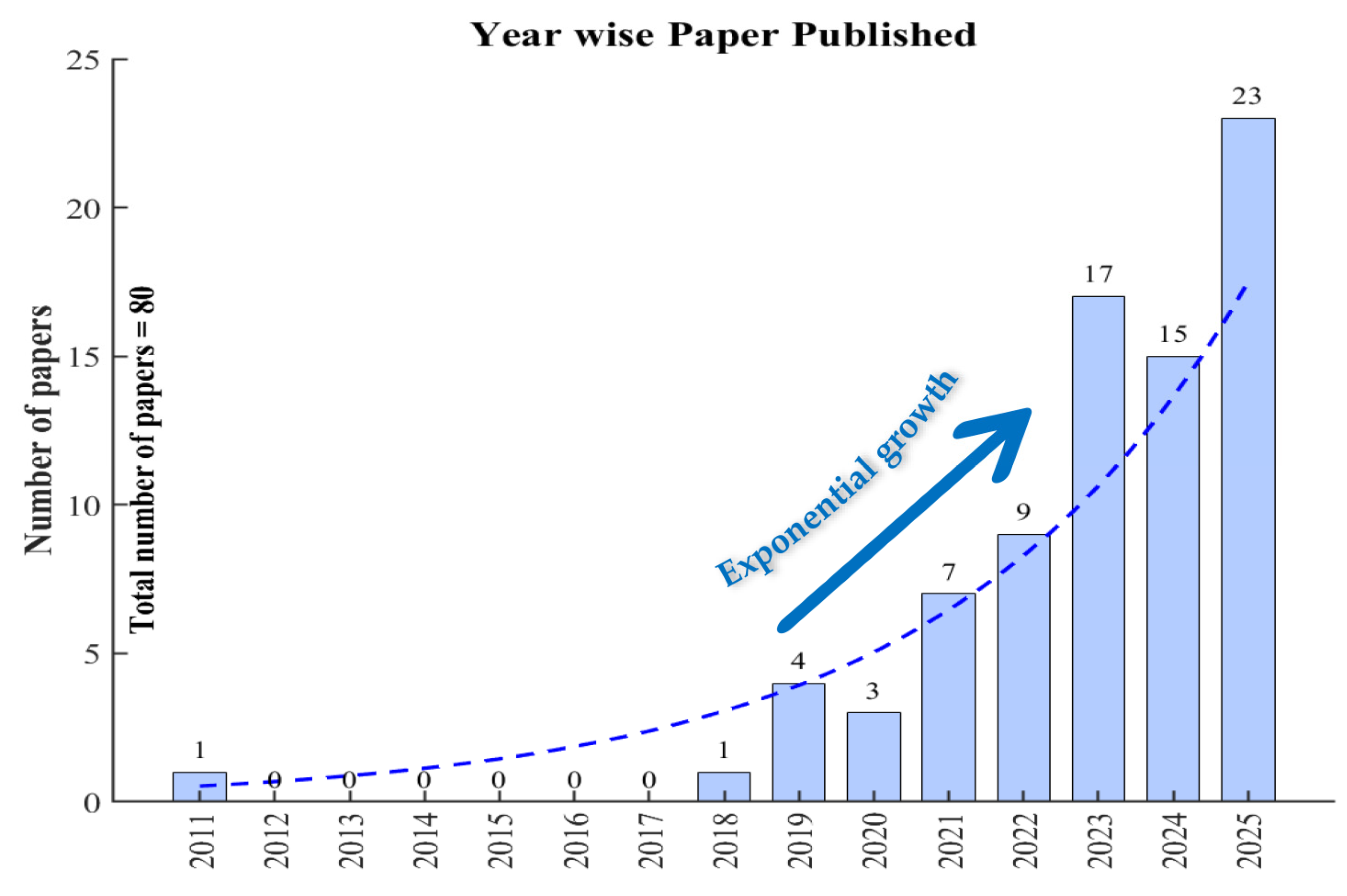
- Inclusion criteria: The study included 80 papers that fulfilled the following criteria and were considered in the review process:
- Studies applying ML algorithms, such as GB, RF, SVM, and deep learning, to spatial downscale GRACE data.
- Publications using GRACE/GRACE-FO data to downscale to a finer spatial resolution using auxiliary datasets such as precipitation, MODIS, or land surface models.
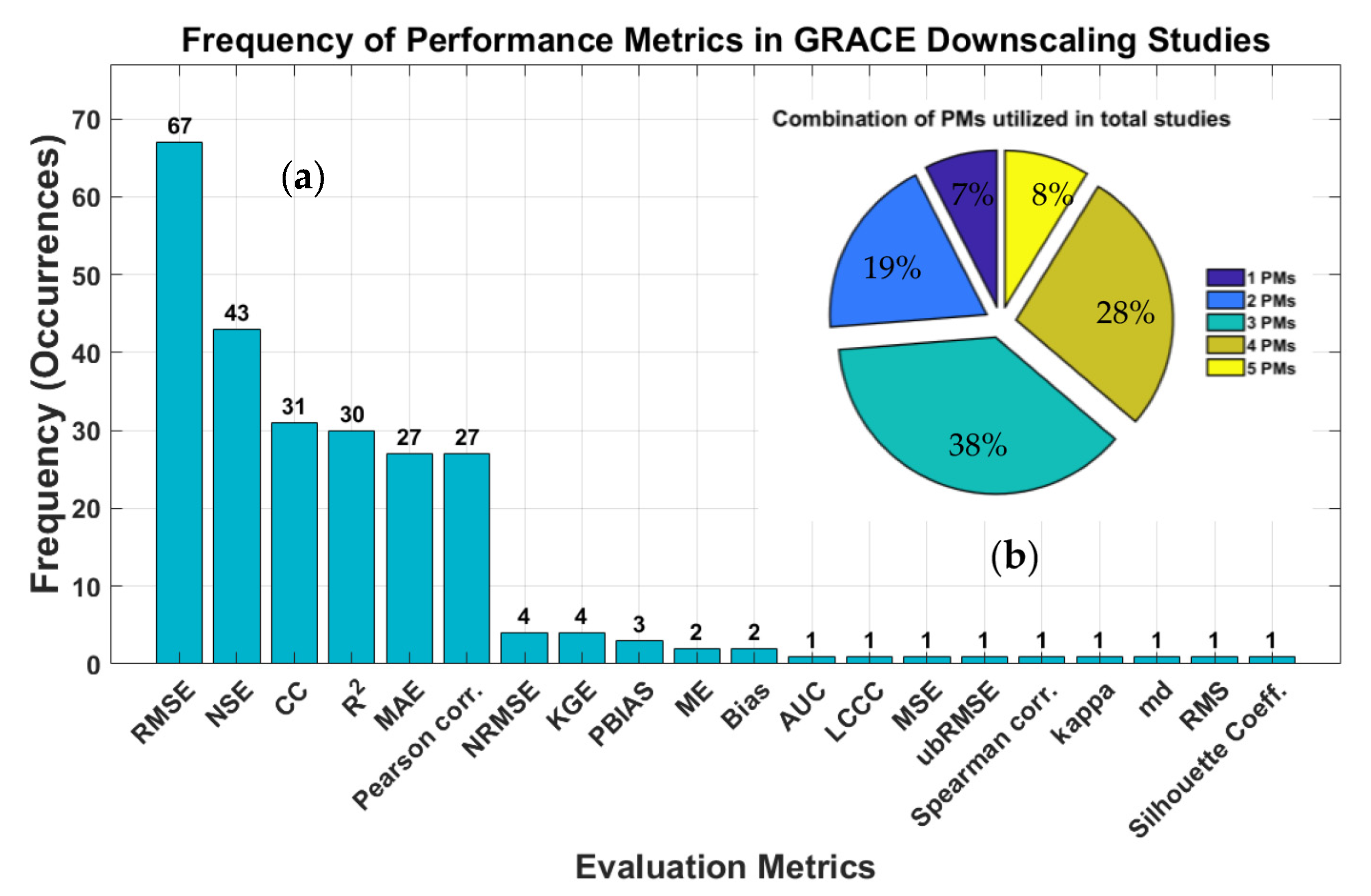
- Peer-reviewed journal articles in English, published up to December 2025, presenting original methods, results, and validation metrics (e.g., RMSE, MAE, NSE, R2).
3. Results and Discussion
3.1. Downscaling GRACE Data Utilizing ML-Based Models
3.2. Input Variables
3.3. Evaluation Metrics
3.4. Noted Patterns in the Reviewed Studies
3.5. Drivers of Groundwater Storage Decline
4. Challenges and Limitations
5. Future Research Directions
6. Conclusions
Supplementary Materials
Author Contributions
Funding
Data Availability Statement
Conflicts of Interest
Abbreviations
| GRACE | Gravity Recovery and Climate Experiment |
| PRISMA | Preferred Reporting Items for Systematic Reviews and Meta-Analyses |
| NASA | National Aeronautics and Space Administration |
| DLR | Deutsches Zentrum für Luft- und Raumfahrt (German Aerospace Center) |
| TWS | Terrestrial Water Storage |
| GWS | Groundwater Storage |
| SM | Soil Moisture |
| SWE | Snow Water Equivalent |
| SW | Surface Water |
| CW | Canopy Water |
| ET | Evapotranspiration |
| Pr | Precipitation |
| Qs | Surface Runoff |
| GLDAS | Global Land Data Assimilation System |
| NDVI | Normalized Difference Vegetation Index |
| LST | Land Surface Temperature |
| DEM | Digital Elevation Model |
| T | Temperature |
| ML | Machine Learning |
| RF | Random Forest |
| GB | Gradient Boosting |
| ANN | Artificial Neural Network |
| SVM | Support Vector Machine |
| SVR | Support Vector Regression |
| LSTM | Long Short-Term Memory |
| DNN | Deep Neural Network |
| SD | Statistical Downscaling |
| DD | Dynamic Downscaling |
| RMSE | Root Mean Square Error |
| MAE | Mean Absolute Error |
| NSE | Nash–Sutcliffe Efficiency |
| R2 | Coefficient of Determination |
References
- Singh, L.; Saravanan, S. Satellite-Derived GRACE Groundwater Storage Variation in Complex Aquifer System in India. Sustain. Water Resour. Manag. 2020, 6, 43. [Google Scholar] [CrossRef]
- Li, L.; Barry, D.A.; Pattiaratchi, C.B.; Masselink, G. BeachWin: Modelling Groundwater Effects on Swash Sediment Transport and Beach Profile Changes. Environ. Model. Softw. 2002, 17, 313–320. [Google Scholar] [CrossRef]
- Ahuja, S. Water Quality Worldwide. In Handbook of Water Purity and Quality; Elsevier: Amsterdam, The Netherlands, 2021; pp. 19–33. [Google Scholar]
- Miro, M.E.; Famiglietti, J.S. Downscaling GRACE Remote Sensing Datasets to High-Resolution Groundwater Storage Change Maps of California’s Central Valley. Remote Sens. 2018, 10, 143. [Google Scholar] [CrossRef]
- Chen, Z.; Zheng, W.; Yin, W.; Li, X.; Ma, M. Improving Spatial Resolution of GRACE-Derived Water Storage Changes Based on Geographically Weighted Regression Downscaled Model. IEEE J. Sel. Top. Appl. Earth Obs. Remote Sens. 2023, 16, 4261–4275. [Google Scholar] [CrossRef]
- Tapley, B.D.; Bettadpur, S.; Watkins, M.; Reigber, C. The Gravity Recovery and Climate Experiment: Mission Overview and Early Results. Geophys. Res. Lett. 2004, 31. [Google Scholar] [CrossRef]
- Mukherjee, A.; Ramachandran, P. Prediction of GWL with the Help of GRACE TWS for Unevenly Spaced Time Series Data in India: Analysis of Comparative Performances of SVR, ANN and LRM. J. Hydrol. 2018, 558, 647–658. [Google Scholar] [CrossRef]
- Scanlon, B.R.; Longuevergne, L.; Long, D. Ground Referencing GRACE Satellite Estimates of Groundwater Storage Changes in the California Central Valley, USA. Water Resour. Res. 2012, 48. [Google Scholar] [CrossRef]
- Syed, T.H.; Famiglietti, J.S.; Rodell, M.; Chen, J.; Wilson, C.R. Analysis of Terrestrial Water Storage Changes from GRACE and GLDAS. Water Resour. Res. 2008, 44. [Google Scholar] [CrossRef]
- Jyolsna, P.J.; Kambhammettu, B.V.N.P.; Gorugantula, S. Application of Random Forest and Multi-Linear Regression Methods in Downscaling GRACE Derived Groundwater Storage Changes. Hydrol. Sci. J. 2021, 66, 874–887. [Google Scholar] [CrossRef]
- Seyoum, W.M.; Kwon, D.; Milewski, A.M. Downscaling GRACE TWSA Data into High-Resolution Groundwater Level Anomaly Using Machine Learning-Based Models in a Glacial Aquifer System. Remote Sens. 2019, 11, 824. [Google Scholar] [CrossRef]
- Nourani, V.; Ghaneei, P.; Kantoush, S.A. Robust Clustering for Assessing the Spatiotemporal Variability of Groundwater Quantity and Quality. J. Hydrol. 2022, 604, 127272. [Google Scholar] [CrossRef]
- Nourani, V.; Jabbarian Paknezhad, N.; Ng, A.; Wen, Z.; Dabrowska, D.; Üzelaltınbulat, S. Application of the Machine Learning Methods for GRACE Data Based Groundwater Modeling, a Systematic Review. Groundw. Sustain. Dev. 2024, 25, 101113. [Google Scholar] [CrossRef]
- Afrifa, S.; Zhang, T.; Appiahene, P.; Varadarajan, V. Mathematical and Machine Learning Models for Groundwater Level Changes: A Systematic Review and Bibliographic Analysis. Futur. Internet 2022, 14, 259. [Google Scholar] [CrossRef]
- Rodell, M.; Chen, J.; Kato, H.; Famiglietti, J.S.; Nigro, J.; Wilson, C.R. Estimating Groundwater Storage Changes in the Mississippi River Basin (USA) Using GRACE. Hydrogeol. J. 2007, 15, 159–166. [Google Scholar] [CrossRef]
- Foroumandi, E.; Nourani, V.; Huang, J.J.; Moradkhani, H.; Jeanne Huang, J.; Moradkhani, H. Drought Monitoring by Downscaling GRACE-Derived Terrestrial Water Storage Anomalies: A Deep Learning Approach. J. Hydrol. 2023, 616, 128838. [Google Scholar] [CrossRef]
- Yirdaw, S.Z.; Snelgrove, K.R. Regional Groundwater Storage from GRACE over the Assiniboine Delta Aquifer (ADA) of Manitoba. Atmos. Ocean. 2011, 49, 396–407. [Google Scholar] [CrossRef]
- Verma, K.; Katpatal, Y.B. Groundwater Monitoring Using GRACE and GLDAS Data after Downscaling Within Basaltic Aquifer System. Groundwater 2020, 58, 143–151. [Google Scholar] [CrossRef]
- Zhang, G.; Zheng, W.; Yin, W.; Lei, W. Improving the Resolution and Accuracy of Groundwater Level Anomalies Using the Machine Learning-Based Fusion Model in the North China Plain. Sensors 2020, 21, 46. [Google Scholar] [CrossRef]
- Ali, S.; Liu, D.; Fu, Q.; Cheema, M.J.M.; Pham, Q.B.; Rahaman, M.M.; Dang, T.D.; Anh, D.T. Improving the Resolution of GRACE Data for Spatio-Temporal Groundwater Storage Assessment. Remote Sens. 2021, 13, 3513. [Google Scholar] [CrossRef]
- Vishwakarma, B.D.; Zhang, J.; Sneeuw, N. Downscaling GRACE Total Water Storage Change Using Partial Least Squares Regression. Sci. Data 2021, 8, 95. [Google Scholar] [CrossRef]
- Zuo, J.; Xu, J.; Chen, Y.; Li, W. Downscaling Simulation of Groundwater Storage in the Tarim River Basin in Northwest China Based on GRACE Data. Phys. Chem. Earth Parts A/B/C 2021, 123, 103042. [Google Scholar] [CrossRef]
- Ali, S.; Liu, D.; Fu, Q.; Cheema, M.J.M.; Pal, S.C.; Arshad, A.; Pham, Q.B.; Zhang, L. Constructing High-Resolution Groundwater Drought at Spatio-Temporal Scale Using GRACE Satellite Data Based on Machine Learning in the Indus Basin. J. Hydrol. 2022, 612, 128295. [Google Scholar] [CrossRef]
- Yin, W.; Zhang, G.; Liu, F.; Zhang, D.; Zhang, X.; Chen, S. Improving the Spatial Resolution of GRACE-Based Groundwater Storage Estimates Using a Machine Learning Algorithm and Hydrological Model. Hydrogeol. J. 2022, 30, 947–963. [Google Scholar] [CrossRef]
- Pascal, C.; Ferrant, S.; Selles, A.; Maréchal, J.-C.; Paswan, A.; Merlin, O. Evaluating Downscaling Methods of GRACE Data: A Case Study over a Fractured Crystalline Aquifer in South India. Hydrol. Earth Syst. Sci. Discuss. 2022, 2022, 1–25. [Google Scholar]
- Yin, W.; Zhang, G.; Han, S.; Yeo, I.; Zhang, M. Improving the Resolution of GRACE-Based Water Storage Estimates Based on Machine Learning Downscaling Schemes. J. Hydrol. 2022, 613, 128447. [Google Scholar] [CrossRef]
- Agarwal, V.; Akyilmaz, O.; Shum, C.K.; Feng, W.; Haritashya, U.; Chen, W. Machine Learning Application for Modeling High-Resolution Groundwater Storage Variations in North China Plain. Res. Sq. 2022, preprint. [Google Scholar] [CrossRef]
- Pulla, S.T.; Yasarer, H.; Yarbrough, L.D. GRACE Downscaler: A Framework to Develop and Evaluate Downscaling Models for GRACE. Remote Sens. 2023, 15, 2247. [Google Scholar] [CrossRef]
- Khorrami, B. Satellite-Based Investigation of Water Stress at the Basin Scale: An Integrated Analysis of Downscaled GRACE Estimates and Remotely Sensed Data. J. Hydroinformatics 2023, 25, 1501–1512. [Google Scholar] [CrossRef]
- Agarwal, V.; Akyilmaz, O.; Shum, C.K.K.; Feng, W.; Yang, T.-Y.T.; Forootan, E.; Syed, T.H.; Haritashya, U.K.; Uz, M. Machine Learning Based Downscaling of GRACE-Estimated Groundwater in Central Valley, California. Sci. Total Environ. 2023, 865, 161138. [Google Scholar] [CrossRef]
- Sabzehee, F.; Amiri-Simkooei, A.R.; Iran-Pour, S.; Vishwakarma, B.D.; Kerachian, R. Enhancing Spatial Resolution of GRACE-Derived Groundwater Storage Anomalies in Urmia Catchment Using Machine Learning Downscaling Methods. J. Environ. Manag. 2023, 330, 117180. [Google Scholar] [CrossRef] [PubMed]
- Ghaffari, Z.; Easson, G.; Yarbrough, L.D.; Awawdeh, A.R.; Jahan, M.N.; Ellepola, A. Using Downscaled GRACE Mascon Data to Assess Total Water Storage in Mississippi Alluvial Plain Aquifer. Sensors 2023, 23, 6428. [Google Scholar] [CrossRef]
- Khorrami, B.; Ali, S.; Gündüz, O. Investigating the Local-Scale Fluctuations of Groundwater Storage by Using Downscaled GRACE/GRACE-FO JPL Mascon Product Based on Machine Learning (ML) Algorithm. Water Resour. Manag. 2023, 37, 3439–3456. [Google Scholar] [CrossRef]
- Tao, H.; Al-Sulttani, A.H.; Salih, S.Q.; Mohammed, M.K.A.A.; Khan, M.A.; Beyaztas, B.H.; Ali, M.; Elsayed, S.; Shahid, S.; Yaseen, Z.M. Development of High-Resolution Gridded Data for Water Availability Identification through GRACE Data Downscaling: Development of Machine Learning Models. Atmos. Res. 2023, 291, 106815. [Google Scholar] [CrossRef]
- Yazdian, H.; Salmani-Dehaghi, N.; Alijanian, M. A Spatially Promoted SVM Model for GRACE Downscaling: Using Ground and Satellite-Based Datasets. J. Hydrol. 2023, 626, 130214. [Google Scholar] [CrossRef]
- Rafik, A.; Ait Brahim, Y.; Amazirh, A.; Ouarani, M.; Bargam, B.; Ouatiki, H.; Bouslihim, Y.; Bouchaou, L.; Chehbouni, A. Groundwater Level Forecasting in a Data-Scarce Region through Remote Sensing Data Downscaling, Hydrological Modeling, and Machine Learning: A Case Study from Morocco. J. Hydrol. Reg. Stud. 2023, 50, 101569. [Google Scholar] [CrossRef]
- Shilengwe, C.; Banda, K.; Nyambe, I. Machine Learning Downscaling of GRACE/GRACE-FO Data to Capture Spatial-Temporal Drought Effects on Groundwater Storage at a Local Scale under Data-Scarcity. Environ. Syst. Res. 2024, 13, 38. [Google Scholar] [CrossRef]
- Wang, Y.; Li, C.; Cui, Y.Y.; Cui, Y.Y.; Xu, Y.; Hora, T.; Zaveri, E.; Rodella, A.-S.; Bai, L.; Long, D. Spatial Downscaling of GRACE-Derived Groundwater Storage Changes across Diverse Climates and Human Interventions with Random Forests. J. Hydrol. 2024, 640, 131708. [Google Scholar] [CrossRef]
- Kalu, I.; Ndehedehe, C.E.; Ferreira, V.G.; Janardhanan, S.; Currell, M.; Kennard, M.J. Statistical Downscaling of GRACE Terrestrial Water Storage Changes Based on the Australian Water Outlook Model. Sci. Rep. 2024, 14, 10113. [Google Scholar] [CrossRef]
- Arshad, A.; Mirchi, A.; Taghvaeian, S.; AghaKouchak, A. Downscaled-GRACE Data Reveal Anthropogenic and Climate-Induced Water Storage Decline Across the Indus Basin. Water Resour. Res. 2024, 60, e2023WR035882. [Google Scholar] [CrossRef]
- Ali, S.; Ran, J.; Khorrami, B.; Wu, H.; Tariq, A.; Jehanzaib, M.; Khan, M.M.; Faisal, M. Downscaled GRACE/GRACE-FO Observations for Spatial and Temporal Monitoring of Groundwater Storage Variations at the Local Scale Using Machine Learning. Groundw. Sustain. Dev. 2024, 25, 101100. [Google Scholar] [CrossRef]
- Liu, C.; Zhang, Z.; Xu, C.; Zhang, W. Reconstructing Long-Term, High-Resolution Groundwater Storage Changes in the Songhua River Basin Using Supplemented GRACE and GRACE-FO Data. Remote Sens. 2024, 16, 4566. [Google Scholar] [CrossRef]
- Nannawo, A.S.; Lohani, T.K.; Eshete, A.A. Analyzing Groundwater Storage Anomalies in Data-Scarce Areas of Ethiopia’s Rift Valley Basin Using Artificial Neural Network. World Water Policy 2024, 10, 909–939. [Google Scholar] [CrossRef]
- Yin, G.; Park, J.; Yoshimura, K. Spatial Downscaling of GRACE Terrestrial Water Storage Anomalies for Drought and Flood Potential Assessment. J. Hydrol. 2025, 658, 133144. [Google Scholar] [CrossRef]
- Youssefi, F.; Soltani, S.S.; Ali, S.; Khorrami, B. Integrating Fully-Coupled Hydrological Modeling and Random Forest to Enhance Spatial Resolution of GRACE-Observed Water Storage Across the Rhine Basin. Nat. Resour. Res. 2025, 34, 2667–2684. [Google Scholar] [CrossRef]
- Hamou-Ali, Y.; Karmouda, N.; Mohsine, I.; Bouramtane, T.; Kacimi, I.; Tweed, S.; Tahiri, M.; Kassou, N.; El Bilali, A.; Chafki, O. Downscaling GRACE Total Water Storage Data Using Random Forest: A Three-Round Validation Approach under Drought Conditions. Front. Water 2025, 7, 1545821. [Google Scholar] [CrossRef]
- Cui, L.; Li, Y.; Zhong, B.; An, J.; Meng, J.; Guo, H.; Xu, C. Assessing the Impact of 2022 Extreme Drought on the Yangtze River Basin Using Downscaled GRACE/GRACE-FO Data Obtained by Partitioned Random Forest Algorithm. Int. J. Remote Sens. 2025, 46, 1219–1247. [Google Scholar] [CrossRef]
- Mikaeeli Ahamadabad, F.; Dastjerdi, P.A.; Nasseri, M.; Ahamadabad, F.M.; Dastjerdi, P.A.; Nasseri, M. Spatiotemporal GRACE TWS Downscaling Using Statistical and Machine Learning Methods: Random Forest, Area-to-Area Kriging, and Hybrid Methods. J. Hydrol. Reg. Stud. 2025, 62, 102885. [Google Scholar] [CrossRef]
- Ghaffari, Z.; Awawdeh, A.R.; Easson, G.; Yarbrough, L.D.; Heintzman, L.J. Evaluating an Ensemble-Based Machine Learning Approach for Groundwater Dynamics by Downscaling GRACE Data. Limnol. Rev. 2025, 25, 39. [Google Scholar] [CrossRef]
- Mohtaram, A.; Shafizadeh-Moghadam, H.; Ketabchi, H. A Flexible Multi-Scale Approach for Downscaling GRACE-Derived Groundwater Storage Anomaly Using LightGBM and Random Forest in the Tashk-Bakhtegan Basin, Iran. J. Hydrol. Reg. Stud. 2025, 57, 102086. [Google Scholar] [CrossRef]
- Kashani, A.; Safavi, H.R. Assessing Groundwater Drought in Iran Using GRACE Data and Machine Learning. Sci. Rep. 2025, 15, 14671. [Google Scholar] [CrossRef]
- Avila, L.; de Lavenne, A.; Ramos, M.-H.; Kollet, S. Estimation of Monthly Water Table Depth Anomalies Based on the Integration of GRACE and ERA5-Land with Large-Scale Simulations Using Random Forest and LSTM Networks. Water Resour. Manag. 2025, 39, 2899–2918. [Google Scholar] [CrossRef]
- Tian, B.; Yang, T.; Xu, S.; Wang, W.; Dou, B.; Tan, X.-C. Spatiotemporal Variation Characteristics of Groundwater Storage and Groundwater Resource Assessment in Jinan City Based on MGWR Model. China Rural. Water Hydropower 2025, 60–67. [Google Scholar] [CrossRef]
- Wu, C.; Lu, C.; Hu, J.; Liu, B.; Shu, L.; Zhang, Y. Machine Learning-Based Downscaling of GRACE Data to Enhance Assessment of Spatiotemporal Evolution of Coastal Plain Groundwater Storage. Water Resour. Manag. 2025, 39, 6377–6397. [Google Scholar] [CrossRef]
- Solovey, T.; Śliwińska-Bronowicz, J.; Janica, R.; Stradczuk, A.; Brzezińska, A. Temporal and Spatial Variability of Groundwater Storage Derived from Downscaled GRACE Data in the Transboundary Bug River Basin (Poland–Ukraine–Belarus Border Region). Sci. Total Environ. 2025, 1009, 181023. [Google Scholar] [CrossRef]
- Breiman, L. Random Forests. Mach. Learn. 2001, 45, 5–32. [Google Scholar] [CrossRef]
- Kratzert, F.; Klotz, D.; Brenner, C.; Schulz, K.; Herrnegger, M. Rainfall–Runoff Modelling Using Long Short-Term Memory (LSTM) Networks. Hydrol. Earth Syst. Sci. 2018, 22, 6005–6022. [Google Scholar] [CrossRef]
- Shen, C. A Transdisciplinary Review of Deep Learning Research and Its Relevance for Water Resources Scientists. Water Resour. Res. 2018, 54, 8558–8593. [Google Scholar] [CrossRef]
- Rodell, M.; Famiglietti, J.S.; Wiese, D.N.; Reager, J.T.; Beaudoing, H.K.; Landerer, F.W.; Lo, M.-H. Emerging Trends in Global Freshwater Availability. Nature 2018, 557, 651–659. [Google Scholar] [CrossRef]
- Nash, J.E.; Sutcliffe, J. V River Flow Forecasting through Conceptual Models Part I—A Discussion of Principles. J. Hydrol. 1970, 10, 282–290. [Google Scholar] [CrossRef]
- Chai, T.; Draxler, R.R. Root Mean Square Error (RMSE) or Mean Absolute Error (MAE)?—Arguments against Avoiding RMSE in the Literature. Geosci. Model Dev. 2014, 7, 1247–1250. [Google Scholar] [CrossRef]
- Ali, S.; Ran, J.; Luan, Y.; Khorrami, B.; Xiao, Y.; Tangdamrongsub, N. The GWR Model-Based Regional Downscaling of GRACE/GRACE-FO Derived Groundwater Storage to Investigate Local-Scale Variations in the North China Plain. Sci. Total Environ. 2024, 908, 168239. [Google Scholar] [CrossRef]
- Hu, L.; Wang, L.; Peng, Z.; Zhang, H. High-Resolution Groundwater Storage Anomalies in the Middle and Lower Yangtze River Basin of China Using Machine Learning Fusion of in-Situ Wells, Satellite Gravity and Hydrological Model. J. Environ. Manag. 2025, 375, 124322. [Google Scholar] [CrossRef]
- Memarian Sorkhabi, O.; Asgari, J.; Randhir, T.O. Monitoring Groundwater Storage Based on Satellite Gravimetry and Deep Learning. Nat. Resour. Res. 2023, 32, 1007–1020. [Google Scholar] [CrossRef]
- Wada, Y.; Van Beek, L.P.H.; Van Kempen, C.M.; Reckman, J.W.T.M.; Vasak, S.; Bierkens, M.F.P. Global Depletion of Groundwater Resources. Geophys. Res. Lett. 2010, 37. [Google Scholar] [CrossRef]
- Tapley, B.D.; Watkins, M.M.; Flechtner, F.; Reigber, C.; Bettadpur, S.; Rodell, M.; Sasgen, I.; Famiglietti, J.S.; Landerer, F.W.; Chambers, D.P.; et al. Contributions of GRACE to Understanding Climate Change. Nat. Clim. Change 2019, 5, 358–369. [Google Scholar] [CrossRef] [PubMed]
- Schumacher, M.; Forootan, E.; van Dijk, A.I.J.M.; Müller Schmied, H.; Crosbie, R.S.; Kusche, J.; Döll, P. Improving Drought Simulations within the Murray-Darling Basin by Combined Calibration/Assimilation of GRACE Data into the WaterGAP Global Hydrology Model. Remote Sens. Environ. 2018, 204, 212–228. [Google Scholar] [CrossRef]
- Al-Abadi, A.M.; Hassan, A.A.; Al-Moosawi, N.M.; Handhal, A.M.; Alzahrani, H.; Jabbar, F.K.; Anderson, N.L. Drought Susceptibility Mapping in Iraq Using GRACE/GRACE-FO, GLDAS, and Machine Learning Algorithms. Phys. Chem. Earth Parts A/B/C 2024, 134, 103583. [Google Scholar] [CrossRef]
- Ali, S.; Khorrami, B.; Jehanzaib, M.; Tariq, A.; Ajmal, M.; Arshad, A.; Shafeeque, M.; Dilawar, A.; Basit, I.; Zhang, L.; et al. Spatial Downscaling of GRACE Data Based on XGBoost Model for Improved Understanding of Hydrological Droughts in the Indus Basin Irrigation System (IBIS). Remote Sens. 2023, 15, 873. [Google Scholar] [CrossRef]
- Arshad, A.; Mirchi, A.; Samimi, M.; Ahmad, B. Combining Downscaled-GRACE Data with SWAT to Improve the Estimation of Groundwater Storage and Depletion Variations in the Irrigated Indus Basin (IIB). Sci. Total Environ. 2022, 838, 156044. [Google Scholar] [CrossRef] [PubMed]
- Arshad, A.; Shafeeque, M.; Tran, T.N.D.; Mirchi, A.; Xiang, Z.; He, C.; AghaKouchak, A.; Besnier, J.; Rahman, M.M. Multi-Model Ensemble Machine Learning-Based Downscaling and Projection of GRACE Data Reveals Groundwater Decline in Saudi Arabia throughout the 21st Century. J. Hydrol. Reg. Stud. 2025, 60, 102552. [Google Scholar] [CrossRef]
- Awawdeh, A.R.M.; Yasarer, H.; Ghaffari, Z.; Yarbrough, L.D. Downscaling GRACE Data for Improved Groundwater Forecasting Using Artificial Neural Networks. Civ. Eng. J. 2025, 11, 406–419. [Google Scholar] [CrossRef]
- Chen, L.; He, Q.; Liu, K.; Li, J.; Jing, C. Downscaling of GRACE-Derived Groundwater Storage Based on the Random Forest Model. Remote Sens. 2019, 11, 2979. [Google Scholar] [CrossRef]
- Chen, Z.; Zheng, W.; Yin, W.; Li, X.; Zhang, G.; Zhang, J. Improving the Spatial Resolution of Grace-Derived Terrestrial Water Storage Changes in Small Areas Using the Machine Learning Spatial Downscaling Method. Remote Sens. 2021, 13, 4760. [Google Scholar] [CrossRef]
- Cui, B.; Xue, D.; Gui, D.; Liu, Q.; Abd-Elmabod, S.K.; Chen, X.; Goethals, P.; De Maeyer, P. Downscaled GRACE Data Reveals Anthropogenic Dominance in Groundwater Storage Decline across China’s Oases. Ecol. Indic. 2025, 179, 114209. [Google Scholar] [CrossRef]
- Djima, R.; Wan, X.; Fiifi, R.; Sidi, A.B.; Bouko, D. The Egyptian Journal of Remote Sensing and Space Sciences Assessing Groundwater Storage Variations in the Volta River Basin Combining Remote Sensing Tools and Machine Learning Downscaling Techniques. Egypt. J. Remote Sens. Sp. Sci. 2025, 28, 383–394. [Google Scholar] [CrossRef]
- Gaffoor, Z.; Gritzman, A.; Pietersen, K.; Jovanovic, N.; Bagula, A.; Kanyerere, T. An Autoregressive Machine Learning Approach to Forecast High-Resolution Groundwater-Level Anomalies in the Ramotswa/North West/Gauteng Dolomite Aquifers of Southern Africa. Hydrogeol. J. 2022, 30, 575–600. [Google Scholar] [CrossRef]
- Gao, G.; Zhao, J.; Wang, J.; Zhao, G.; Chen, J.; Li, Z. Spatiotemporal Variation and Driving Analysis of Groundwater in the Tibetan Plateau Based on GRACE Downscaling Data. Water 2022, 14, 3302. [Google Scholar] [CrossRef]
- Gorugantula, S.S.; Kambhammettu, B.P. Sequential Downscaling of GRACE Products to Map Groundwater Level Changes in Krishna River Basin. Hydrol. Sci. J. 2022, 67, 1846–1859. [Google Scholar] [CrossRef]
- He, H.; Yang, K.; Wang, S.; Petrosians, H.A.; Liu, M.; Li, J.J.; Marcato Junior, J.J.; Goncalves, W.N.; Wang, L.; Li, J.J.; et al. Deep Learning Approaches to Spatial Downscaling of GRACE Terrestrial Water Storage Products Using EALCO Model Over Canada. Can. J. Remote Sens. 2021, 47, 657–675. [Google Scholar] [CrossRef]
- Kalu, I.; Ndehedehe, C.E.; Ferreira, V.G.; Kennard, M.J. Machine Learning Assessment of Hydrological Model Performance under Localized Water Storage Changes through Downscaling. J. Hydrol. 2024, 628, 130597. [Google Scholar] [CrossRef]
- Khorrami, B.; Pirasteh, S.; Ali, S.; Gungor, O.; Vaheddoost, B. Statistical Downscaling of GRACE TWSA Estimates to a 1-Km Spatial Resolution for a Local-Scale Surveillance of Flooding Potential. J. Hydrol. 2023, 624, 129929. [Google Scholar] [CrossRef]
- Kumar, R.; Gaur, S.; Soni, P.; Maurya, P.; Ohri, A. HRU-Based Downscaling of GRACE-TWS to Quantify the Hydrogeological Fluxes and Specific Yield in the Lower Middle Ganga Basin. J. Hydrol. 2024, 639, 131591. [Google Scholar] [CrossRef]
- Li, P.; Yu, H.; Zhou, P.; Zhang, P.; Wang, R. Downscaling Inversion of GRACE-Derived Groundwater Storage Changes Based on Ensemble Learning Downscaling Inversion of GRACE-Derived Groundwater Storage Changes Based on Ensemble Learning. Int. J. Digit. Earth 2023, 16, 2998–3022. [Google Scholar] [CrossRef]
- Liang, Q.; Hao, X.; Ci, M.; Yuan, M.; Di, Y.; Sun, F.; Wang, C.; Zhang, J.; Fan, X.; Xiong, H. Disentangling and Integrating Spatiotemporal Features: Deep Learning-Based Downscaling of Groundwater Storage Anomalies from GRACE and GRACE-FO Satellites. J. Hydrol. Reg. Stud. 2025, 62, 102982. [Google Scholar] [CrossRef]
- Milewski, A.M.; Thomas, M.B.; Seyoum, W.M.; Rasmussen, T.C. Spatial Downscaling of GRACE TWSA Data to Identify Spatiotemporal Groundwater Level Trends in the Upper Floridan Aquifer, Georgia, USA. Remote Sens. 2019, 11, 2756. [Google Scholar] [CrossRef]
- Mojtaba, S.; Mohammad, M.; Kavianpour, R. A Non–Stationary Downscaling and Gap–Filling Approach for GRACE / GRACE–FO Data under Climatic and Anthropogenic Influences. Appl. Water Sci. 2025, 15, 1–15. [Google Scholar] [CrossRef]
- Nourani, V.; Paknezhad, N.J.; Mohammadisepasi, S.; Zhang, Y. Regionalization of GRACE Data in Shorelines by Ensemble of Artificial Intelligence Methods. J. Hydrol. 2024, 636, 131268. [Google Scholar] [CrossRef]
- Rahaman, M.M.; Thakur, B.; Kalra, A.; Li, R.; Maheshwari, P. Estimating High-Resolution Groundwater Storage from GRACE: A Random Forest Approach. Environments 2019, 6, 63. [Google Scholar] [CrossRef]
- Raza, A.; Ryo, M.; Ghazaryan, G.; Baatz, R.; Main-knorn, M.; Inforsato, L.; Nendel, C. International Journal of Applied Earth Observation and Geoinformation Predicting Regional-Scale Groundwater Levels at High Spatial Resolution Using Spatial Random Forest Models. Int. J. Appl. Earth Obs. Geoinf. 2025, 144, 104918. [Google Scholar] [CrossRef]
- Sahour, H.; Sultan, M.; Vazifedan, M.; Abdelmohsen, K.; Karki, S.; Yellich, J.A.; Gebremichael, E.; Alshehri, F.; Elbayoumi, T.M. Statistical Applications to Downscale GRACE-Derived Terrestrial Water Storage Data and to Fill Temporal Gaps. Remote Sens. 2020, 12, 533. [Google Scholar] [CrossRef]
- Satizábal-Alarcón, D.A.; Suhogusoff, A.; Ferrari, L.C. Characterization of Groundwater Storage Changes in the Amazon River Basin Based on Downscaling of GRACE/GRACE-FO Data with Machine Learning Models. Sci. Total Environ. 2024, 912, 168958. [Google Scholar] [CrossRef] [PubMed]
- Wang, J.; Xu, D.; Li, H. Constructing GRACE-Based 1 Km Resolution Groundwater Storage Anomalies in Arid Regions Using an Improved Machine Learning Downscaling Method: A Case Study in Alxa League, China. Remote Sens. 2023, 15, 2913. [Google Scholar] [CrossRef]
- Xue, H.; Wang, H.; Dong, G.; Li, Z. Spatial Downscaling of GRACE Groundwater Storage Based on DTW Distance Clustering and an Analysis of Its Driving Factors. Remote Sens. 2025, 17, 2526. [Google Scholar] [CrossRef]
- Yang, R.; Zhong, Y.; Zhang, X.; Maimaitituersun, A.; Ju, X. A Comparative Study of Downscaling Methods for Groundwater Based on GRACE Data Using RFR and GWR Models in Jiangsu Province, China. Remote Sens. 2025, 17, 493. [Google Scholar] [CrossRef]
- Yuan, Y.; Shen, D.; Cao, Y.; Wang, X.; Zhang, B.; Dong, H. An Ensemble Machine Learning Approach for High-Resolution Estimation of Groundwater Storage Anomalies. Water 2025, 17, 1445. [Google Scholar] [CrossRef]
- Zhang, G.; Xu, T.; Yin, W.; Bateni, S.M.; Jun, C.; Kim, D.; Liu, S.; Xu, Z.; Ming, W.; Wang, J. A Machine Learning Downscaling Framework Based on a Physically Constrained Sliding Window Technique for Improving Resolution of Global Water Storage Anomaly. Remote Sens. Environ. 2024, 313, 114359. [Google Scholar] [CrossRef]
- Zhang, J.; Liu, K.; Wang, M. Downscaling Groundwater Storage Data in China to a 1-Km Resolution Using Machine Learning Methods. Remote Sens. 2021, 13, 523. [Google Scholar] [CrossRef]





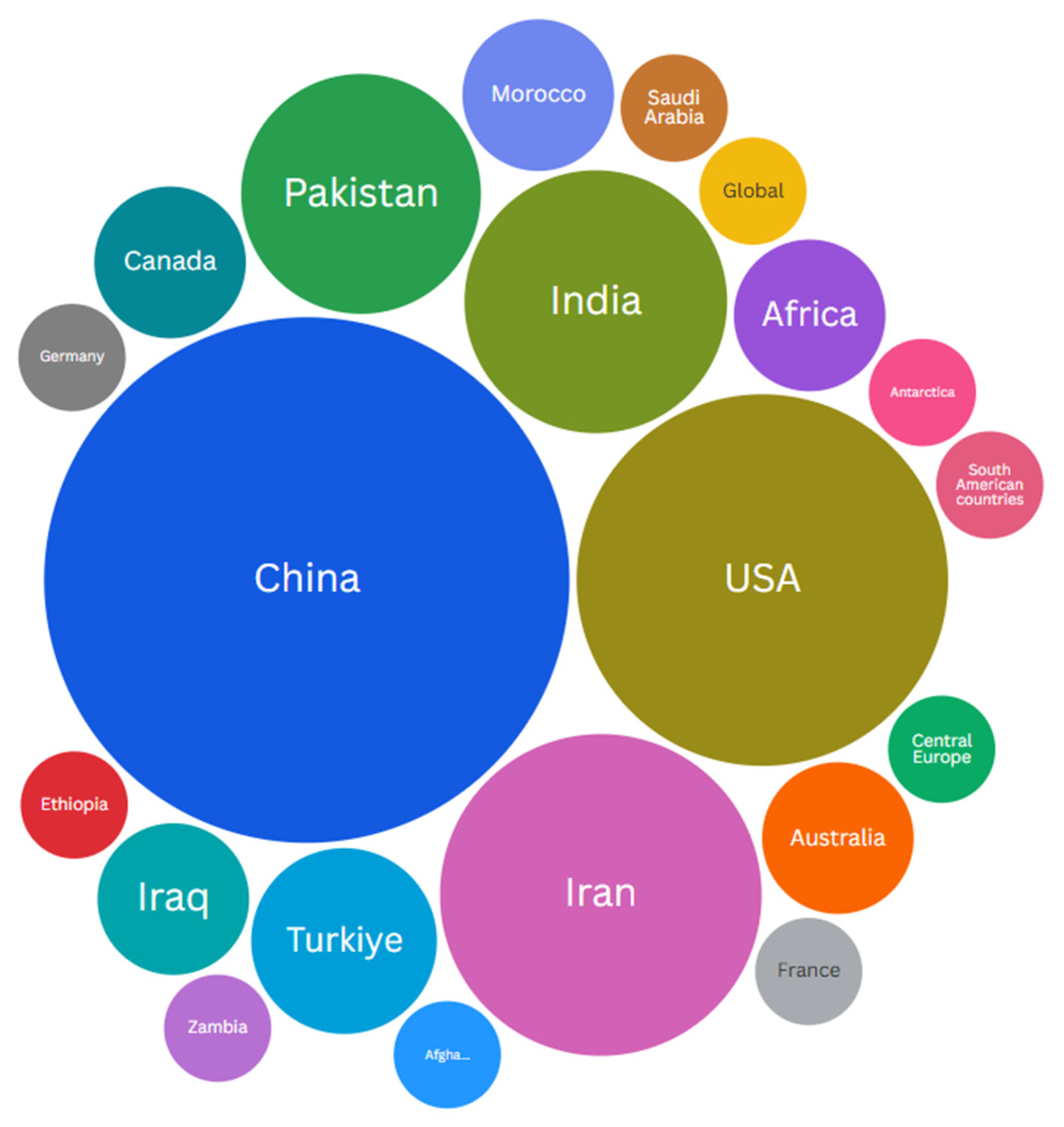



| Reference | Study Area | Native Resolution | Downscaled Resolution | ML Method | Inputs | Evaluation Metrics |
|---|---|---|---|---|---|---|
| [17] | Assiniboine Delta Aquifer, Canada | 1° | 2.5 km | ANN | GW level | CC, RMSE |
| [18] | Maharashtra State, India | 1° | 0.125° | ANN | SM, CWS | CC |
| [19] | North China Plain, China | 1° | 0.25° | GB | Pr, Qs, ET, SM, SWE, TWSA | Pearson correlation, RMSE, MAE, NSE |
| [20] | Indus Basin, Pakistan | 1° | 0.25° | ANN, RF | SM, Pr, ET, DEM, slope, aspect, Qs, CWS, T | CC, RMSE, MAE, NSE |
| [10] | Four Hydrogeological basins, India | 1° | 0.25° | MLR, RF | bare soil evaporation, CWS, canopy water evaporation, ET, Pr, LST, SM, Qs, Qss | RMSE, CC |
| [21] | 160 global river basins | 3° | 0.5° | PLSR | Pr, ET, Qs | RMS |
| [22] | Tarim River Basin, China | 1° | 1 km | RF | LST, NDVI | CC, R2, RMSE, MAE, NSE |
| [23] | Indus Basin, Pakistan | 1° | 0.25° | GB, RF, SVM, ANN | Pr, DEM, Slope, Aspect, SM, T, ET, Qs, CWS | Pearson correlation, NSE, RMSE, MAE |
| [24] | Haila River Basin, China | 1° | 0.25° | MLR, RF | ET, LST, NDVI, T, SM, SWE | Pearson correlation, NSE, RMSE |
| [25] | Fractured crystalline aquifer, India | 3° | 0.5° | RF | NDVI, Pr, surface SM | Pearson correlation, R2, RMSE |
| [26] | Haiha River Basin, China | 0.5° | 0.05° | RF | T, ET, NDVI, Pr, SM, LST, SWE, Qs, PWC | Pearson correlation, RMSE |
| [27] | North China Plain, China | 0.25° | 5 km | RF | SM, Pr, T, slope, wells data, Saturated hydraulic conductivity (K), | CC, NSE, RMSE |
| [28] | State of Mississippi, USA | 0.5° | 1 km | Keras dense NN, GB, MLP, KNN | GRACE, TerraClimate grid cells, CHIRPS grid cells | R2, NSE, RMSE, Pearson correlation, Spearman correlation |
| [29] | Western Mediterranean Basin, Turkey | 0.5° | 10 km | RF | SM, SWS, T, ET, Pr, Qs, elevation | CC, RMSE |
| [30] | Central Valley, California, USA | 3° | 0.05° | RF | Pr, T, SM, ET, Slope, Texture, Saturated hydraulic conductivity | NSE, CC, RMSE |
| [31] | Lake Urmia catchment, Iran | 0.25° | 0.1° | RF, SVR, MLP | SM, Pr, NDVI, Qs, ET, LST, SWE | NSE, Pearson correlation, RMSE |
| [32] | Mississippi Alluvial Plain, USA | 0.5° | 5 km | RF | T, DEM, Pr, ET, NDVI, soil type, land cover, Aquifer thickness | MAE, RMSE, R2 |
| [33] | Western Anatolian Basin, Türkiye | 50 km | 10 km | RF | DEM, SM, snow water, rainfall, Qs, ET | CC, R2, MAE, RMSE |
| [34] | National scale, Iraq | 1.0° | 0.1° | RF, SVM, ANN | Pr, ET, Qs, Qss, surface water thickness, SM | NRMSE, NSE, md, R2, KGE |
| [35] | Semirom Basin and its neighbors, Iran | 0.5° | 0.25° | SP-SVM | In situ Pr, in situ E, Eta, Pr, NDVI, EVI, SM, SWE, RZSM, CSW | R2, RMSE, MAE, Bias |
| [36] | Iguerounzar basin, Morocco | 0.25° | 9 km | RF, SVR | Pr, ET, SM, Qs, NDVI, LST, DEM, Slope, Soil map, LULC | NSE, RMSE, R2, PBIAS |
| [37] | Barotse catchment, Zambia | 0.25° | 5 km | XGBoost and RF | Pr, ET, SM, LST, NDVI, EVI | NSE, R2, MAE, RMSE |
| [38] | Central Yunnan, China | 1° | 0.1° | RF | Pr, LST, NDVI, EVI, ET, SM | CC, NSE, RMSE, MAE |
| [39] | Cambrian Limestone Aquifer (CLA), Australia | 1.0° | 0.05° | SVM | Pr, ET, Qs, GWL | RMSE, NSE, MAE |
| [40] | Transboundary Indus Basin (Pakistan, India, China, Afghanistan) | 0.25° | 1 km | EF, RFgw | elevation, ET, SM, Pr, NDVI, population density, CWS, SWS | NSE, R2, RMSE, KGE, CC |
| [41] | Upper Indus Plain Aquifer (Pakistan) | 0.5° | 0.1° | XGBoost | SMS, ET, T, Qs, rainfall, DEM, slope, aspect, GWL | Pearson correlation, NSE, RMSE, PBIAS |
| [42] | Songhua River Basin, NE China | 0.25° | 1 km | GWR, RF | Pr, NDVI, ETa, SM, T | NSE, RMSE, CC |
| [43] | Rift Valley Basin, Ethiopia | 1° | 0.25° | ANN | Pr, ET, T, SM, CWS, SWS | RMSE, CC, NSE |
| [44] | Texas–Gulf Basin, USA | 3° | 0.5° | LSTM, RF | SM, SWE, canopy water, Qs, latent heat flux, GW, Pr, T | R, MAE, ubRMSE, |
| [45] | Rhine Basin, Central Europe (9 countries; focus on German part) | 0.25° | 0.1° | RF | Pr, T, SMS, ET, Qs, SWE, DEM, ParFlow–CLM (PFC) fully coupled hydrological model outputs | Pearson correlation, RMSE, NSE |
| [46] | Northern Morocco | 1° | 1 km | RF | Pr, NDVI, LST, ET, DEM, NDSI | NSE, RMSE, MAE, R2, CC |
| [47] | Yangtze River Basin, China | 1° | 0.1° | RF | PRE, ET, SM, SWE, PCW, Qs, ST | NSE, RMSE, CC, LCCC |
| [48] | Karkheh & Karoon basins, Iran | 0.5° | 0.1° | RF | SM, T, air pressure, longwave radiation, Qs, ET, streamflow, Pr, snow cover | CC, NSE, KGE, RMSE, MAE |
| [49] | Mississippi Delta, USA | 0.5° | 1 km | RF | Pr, T, NDVI, SM, Qs, aquifer thickness | R2, MAE, RMSE |
| [50] | Tashk–Bakhtegan–Maharlo basin, Iran | 1° | 1 km | LightGBM, RF | SMS, SWE, CWS, Qs, ET, LST, NDVI, DEM, Pr | NSE, CC, RMSE |
| [51] | Six major basins of Iran, Iran | 0.5° | 0.25° | XGBoost | SM, SWE, CWS, Qs, T, ET, Pr, DEM, Teleconnections data, Canadian Earth System Model (CanESM5) data | RMSE, CC, MAE |
| [52] | Seine River Basin, France | 0.25° | 0.11° | RF and LSTM | Pr, T, E | KGE, RMSE, Pearson correlation |
| [53] | North China Plain, China | 3° | 0.25° | RF | Pr, ET, SM, T, CWS, Qs, SWE, SAR data | CC, NSE, RMSE |
| [54] | Hang-Jia-Hu coastal plain, Zhejiang, China | 0.5° | 4 km | RF, XGBoost, LightGBM | TerraClimate vars, DEM, SM, CW, Qs, snow, GW | CC, R2, NRMSE |
| [55] | Bug River Basin, at the Poland–Ukraine–Belarus border | 0.25° | 0.1° | RF | SM, SWS, CWS, Pr, ET, Qs, GW level | RMSE, CC |
| [35] | Semirom Basin and its neighbors, Iran | 0.5° | 0.25° | SP-SVM | In situ Pr, in situ E, Eta, Pr, NDVI, EVI, SM, SWE, RZSM, CSW | R2, RMSE, MAE, Bias |
| [36] | Iguerounzar basin, Morocco | 0.25° | 9 km | RF, SVR | Pr, ET, SM, Qs, NDVI, LST, DEM, Slope, Soil map, LULC | NSE, RMSE, R2, PBIAS |
| [37] | Barotse catchment, Zambia | 0.25° | 5 km | XGBoost and RF | Pr, ET, SM, LST, NDVI, EVI | NSE, R2, MAE, RMSE |
| [38] | Central Yunnan, China | 1° | 0.1° | RF | Pr, LST, NDVI, EVI, ET, SM | CC, NSE, RMSE, MAE |
| [39] | Cambrian Limestone Aquifer (CLA), Australia | 1.0° | 0.05° | SVM | Pr, ET, Qs, GWL | RMSE, NSE, MAE |
| [40] | Transboundary Indus Basin (Pakistan, India, China, Afghanistan) | 0.25° | 1 km | EF, RFgw | elevation, ET, SM, Pr, NDVI, population density, CWS, SWS | NSE, R2, RMSE, KGE, CC |
| [41] | Upper Indus Plain Aquifer (Pakistan) | 0.5° | 0.1° | XGBoost | SMS, ET, T, Qs, rainfall, DEM, slope, aspect, GWL | Pearson correlation, NSE, RMSE, PBIAS |
| [42] | Songhua River Basin, NE China | 0.25° | 1 km | GWR, RF | Pr, NDVI, ETa, SM, T | NSE, RMSE, CC |
| [43] | Rift Valley Basin, Ethiopia | 1° | 0.25° | ANN | Pr, ET, T, SM, CWS, SWS | RMSE, CC, NSE |
| [44] | Texas–Gulf Basin, USA | 3° | 0.5° | LSTM, RF | SM, SWE, canopy water, Qs, latent heat flux, GW, Pr, T | R, MAE, ubRMSE, |
| [45] | Rhine Basin, Central Europe (9 countries; focus on German part) | 0.25° | 0.1° | RF | Pr, T, SMS, ET, Qs, SWE, DEM, ParFlow–CLM (PFC) fully coupled hydrological model outputs | Pearson correlation, RMSE, NSE |
| [46] | Northern Morocco | 1° | 1 km | RF | Pr, NDVI, LST, ET, DEM, NDSI | NSE, RMSE, MAE, R2, CC |
| [47] | Yangtze River Basin, China | 1° | 0.1° | RF | PRE, ET, SM, SWE, PCW, Qs, ST | NSE, RMSE, CC, LCCC |
| [48] | Karkheh & Karoon basins, Iran | 0.5° | 0.1° | RF | SM, T, air pressure, longwave radiation, Qs, ET, streamflow, Pr, snow cover | CC, NSE, KGE, RMSE, MAE |
| [49] | Mississippi Delta, USA | 0.5° | 1 km | RF | Pr, T, NDVI, SM, Qs, aquifer thickness | R2, MAE, RMSE |
| [50] | Tashk–Bakhtegan–Maharlo basin, Iran | 1° | 1 km | LightGBM, RF | SMS, SWE, CWS, Qs, ET, LST, NDVI, DEM, Pr | NSE, CC, RMSE |
| [51] | Six major basins of Iran, Iran | 0.5° | 0.25° | XGBoost | SM, SWE, CWS, Qs, T, ET, Pr, DEM, Teleconnections data, Canadian Earth System Model (CanESM5) data | RMSE, CC, MAE |
| [52] | Seine River Basin, France | 0.25° | 0.11° | RF and LSTM | Pr, T, E | KGE, RMSE, Pearson correlation |
| [53] | North China Plain, China | 3° | 0.25° | RF | Pr, ET, SM, T, CWS, Qs, SWE, SAR data | CC, NSE, RMSE |
| [54] | Hang-Jia-Hu coastal plain, Zhejiang, China | 0.5° | 4 km | RF, XGBoost, LightGBM | TerraClimate vars, DEM, SM, CW, Qs, snow, GW | CC, R2, NRMSE |
| [55] | Bug River Basin, at the Poland–Ukraine–Belarus border | 0.25° | 0.1° | RF | SM, SWS, CWS, Pr, ET, Qs, GW level | RMSE, CC |
Disclaimer/Publisher’s Note: The statements, opinions and data contained in all publications are solely those of the individual author(s) and contributor(s) and not of MDPI and/or the editor(s). MDPI and/or the editor(s) disclaim responsibility for any injury to people or property resulting from any ideas, methods, instructions or products referred to in the content. |
© 2026 by the authors. Licensee MDPI, Basel, Switzerland. This article is an open access article distributed under the terms and conditions of the Creative Commons Attribution (CC BY) license.
Share and Cite
Al Nadabi, M.S.; El-Diasty, M.; Etri, T.; Nikoo, M.R. GRACE Downscaling and Machine Learning Models for Groundwater Prediction: A Systematic Review. Hydrology 2026, 13, 135. https://doi.org/10.3390/hydrology13050135
Al Nadabi MS, El-Diasty M, Etri T, Nikoo MR. GRACE Downscaling and Machine Learning Models for Groundwater Prediction: A Systematic Review. Hydrology. 2026; 13(5):135. https://doi.org/10.3390/hydrology13050135
Chicago/Turabian StyleAl Nadabi, Mohammed S., Mohammed El-Diasty, Talal Etri, and Mohammad Reza Nikoo. 2026. "GRACE Downscaling and Machine Learning Models for Groundwater Prediction: A Systematic Review" Hydrology 13, no. 5: 135. https://doi.org/10.3390/hydrology13050135
APA StyleAl Nadabi, M. S., El-Diasty, M., Etri, T., & Nikoo, M. R. (2026). GRACE Downscaling and Machine Learning Models for Groundwater Prediction: A Systematic Review. Hydrology, 13(5), 135. https://doi.org/10.3390/hydrology13050135