Article

Transient Responses of Freshwater Lens Development and Seawater Intrusion Mitigation to Freshwater Injection in Unconfined Island Aquifers

Boone Pickens School of Geology, Oklahoma State University, Stillwater, OK 74078, USA
*
Author to whom correspondence should be addressed.
Hydrology 2026, 13(5), 136; https://doi.org/10.3390/hydrology13050136
Submission received: 26 March 2026 / Revised: 9 May 2026 / Accepted: 12 May 2026 / Published: 14 May 2026

Abstract

Subsurface freshwater in oceanic islands is typically shaped like a thin lens due to limited land area and recharge, often the primary freshwater source for local communities and highly vulnerable to seawater intrusion (SWI). Freshwater injection (FI) is considered as a feasible strategy for mitigating SWI in coastal aquifers. However, its transient effectiveness for freshwater lens (FWL) development and SWI mitigation in island aquifers and how the design parameters like FI depth, intensity, duration and injectant concentration affect its performance remain poorly understood. To address this, this study employs a two-dimensional, variable-density island groundwater model to simulate the transient responses of FWL development and SWI mitigation to various FI patterns. Five indicators are developed for comprehensive evaluation, including (1) freshwater recovery efficiency (FRE), and the relative changes in (2) average water table elevation (WTE), (3) FWL depth, (4) FWL volume, and (5) total aquifer salt mass. Results reveal FI universally raises average WTE, expands FWL dimensions, and promotes aquifer desalinization. Injection intensity is the primary driver of WTE rises and salt mass reduction, with higher intensities consistently yielding greater WTE rises and salt mass reductions. Deeper injection within the mixing zone increases FWL depth, but reduces the net gain in FWL volume. Moreover, early-stage FI is highly efficient for expanding FWL volume, often yielding FRE values above 100%, but FRE converges toward zero over time as the system moves toward a new hydrodynamic equilibrium, returning diminishing marginal benefits for long-term FI.

1. Introduction

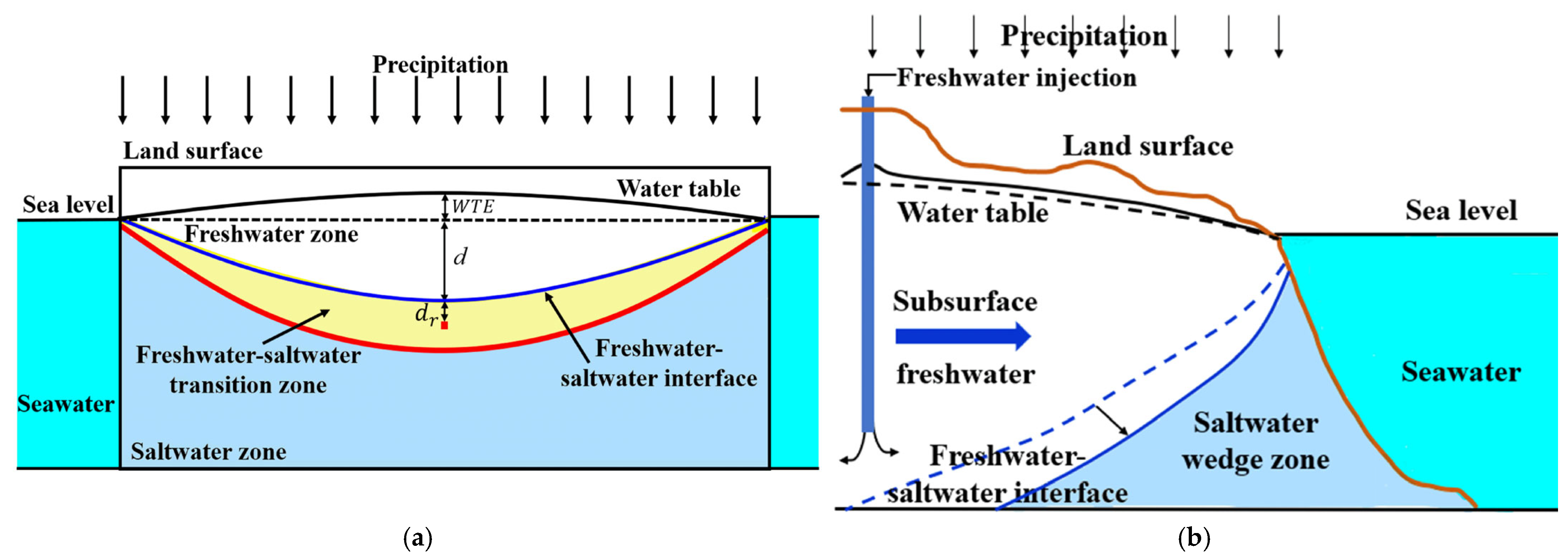
Seawater intrusion (SWI) represents a process of subsurface freshwater–seawater interface migrating landward and the subsequent salinization of coastal aquifers. It is widely acknowledged that SWI is driven by excessive groundwater extraction and/or climate change, which result in a decrease in the hydraulic gradient between seaward-discharging freshwater and landward-moving seawater [1,2,3]. It endangers coastal aquifer ecosystems and restrict subsurface freshwater access for local communities [4,5]. Island aquifers, different from terrestrial coastal aquifers, are usually replenished solely by precipitation recharge, forming lens-shaped freshwater bodies atop denser seawater [6] (Figure 1a). These freshwater lenses are typically thin due to the limited land area, low recharge rates, or/and high hydraulic conductivity [7,8], which restrict water accumulation. Due to its characteristics, freshwater lens (FWL) is therefore highly vulnerable to SWI. For many island communities, freshwater aquifers are the sole accessible and economically viable source of freshwater [6,9,10], so protecting these critical subsurface resources from SWI is important.
In coastal aquifer management, one of the commonly employed strategies for controlling SWI is the positive hydraulic barrier, also known as the recharge hydraulic barrier. This approach operates by elevating groundwater levels through artificial recharge, thereby sustaining an enhanced hydraulic gradient that drives the freshwater–saltwater interface seaward and reduces saline encroachment [11,12]. The barrier can be established either by direct freshwater injection (FI) through wells (Figure 1b) or by infiltration from surface water bodies. Compared with surface water infiltration, which is restricted to confined aquifers and poses risks of secondary salinization if evaporation intensifies, leading to surface water salinity increases and subsequent downward saltwater leakage, the FI strategy provides broader applicability and more direct hydraulic control. In this strategy, a line of injection wells is installed parallel to the coastline, where freshwater is injected continuously or intermittently to establish a hydraulic ridge that prevents the inland advancement of seawater.
Over the past decades, the effectiveness of the FI strategy in SWI mitigation has been explored extensively through analytical, experimental, and numerical approaches. Analytical solutions have laid the theoretical foundation: Kashef [13] showed how multiple equal-spaced injection wells can combat SWI in confined coastal aquifers using superposition principles, while Hunt [14] derived closed-form solutions via Strack’s potential theory [15] for estimating the freshwater–saltwater interface toe location, considering scenarios with either a single injection well or an infinite number of wells in both unconfined and confined aquifers, which later served as benchmarks for verifying numerical simulation results [16,17]. Based on Strack’s single-potential solution [15], Park, et al. [18] derived explicit algebraic expressions for estimating the minimum FI intensity required to suppress a prescribed SWI extent, where the number of injection wells should be odd and greater than one.
Laboratory-scale sandbox experiments have provided physical validation of FI’s effectiveness and addressed several limitations of analytical models [17,19,20]. Experiments conducted by Luyun Jr, et al. [17] demonstrated that placing injection wells near the saltwater wedge toe produced the greatest reduction in SWI length, and that, for a given recharge rate, point and line injection were equally effective.
Numerical simulations expanded FI investigations into realistic field settings and complex conditions. Mahesha [16,21] employed finite element models to explore how FI rates, well spacing, and duration influence barrier effectiveness. Reichard and Johnson [22] and Bray and Yeh [23] adopted the simulation–optimization approach to identify the optimal FI schemes for SWI control at the West Coast Basin of coastal Los Angeles (USA) and the Alamitos Barrier Project in Los Angeles (USA), respectively. More recent studies commonly employ SEAWAT to account for variable-density flow and solute transport [24,25,26,27]. These simulation results confirmed FI’s ability to suppress SWI, showed the importance of well placement outside the wedge zone to avoid trapping saltwater, and highlighted the potential of treated wastewater as a recharge source.
Overall, the effectiveness of the FI strategy in SWI mitigation largely depends on its design parameters and aquifer properties. Higher FI rates generally reduce SWI extent but exhibit diminishing benefits and potential risks if FI pressures exceed soil limits [16,18,28]. Optimal FI well placement is typically near the saltwater wedge toe [17,24], but excessive well spacings lower the protection of pumping wells [29]. The influence of FI depth correlates with the FI well locations; specifically, increasing the FI depth can promote the barrier efficiency in SWI retardation when FI wells are located at the seaside of the saltwater wedge toe [30]. Regarding aquifer characteristics, either higher hydraulic gradients [24,31] or aquifer stratification can enhance the efficiency of FI barriers in SWI retardation. Moreover, for a given FI scheme, higher aquifer porosity and saltwater density tend to diminish FI performance [24].
Recently, increasing attention has been given to strategies for enhancing subsurface freshwater resources and mitigating SWI in island aquifers. Various approaches, such as cutoff walls [32,33,34] and groundwater pumping management [35,36], have been proposed to improve the resilience of island aquifers to SWI and to reduce the risk of SWI associated with climatic stressors. However, although the FI strategy shows considerable potential for groundwater management, it has been investigated primarily in the context of terrestrial coastal aquifers and has received limited attention as a solution for enhancing FWL development and mitigating SWI in oceanic island environments. Island aquifers are inherently constrained by limited freshwater resources; nevertheless, several viable sources can support FI, including surface water, harvested rainwater, treated wastewater, and desalinated brackish water [11]. These options underscore FI’s potential as a strategy for island subsurface freshwater storage (aquifer banking), thereby enhancing the island aquifer resilience against SWI. Despite this potential, to the best of the authors’ knowledge, no previous studies have systematically examined the temporal impacts of FI strategies on FWL dynamics and SWI extent in island aquifers, nor have they explored how different FI patterns influence the transient evolution of FWL and SWI in island aquifers.
Motivated by these, this study aims to investigate the time-dependent performance of FI in FWL development and SWI mitigation in unconfined island aquifers, and explore how the design parameters, such as FI depth, intensity, duration, and injected freshwater concentration, affect its effectiveness. This investigation employs a simplified two-dimensional (2D), variable-density, dispersive island aquifer simulation model based on hydrogeological conditions observed in the island aquifer of San Salvador Island, Bahamas. It focuses on a single-well problem, with the FI well positioned at the island’s geographic center. Specifically, a predefined set of SWI simulation scenarios is designed to quantify the impact of the FI depth, intensity, injected freshwater concentration, and management horizon on average water table elevation (WTE), FWL depth, subsurface freshwater volume, freshwater recovery efficiency (FRE), and aquifer salt mass. These simulations are conducted using the MODFLOW family SEAWAT model to capture the complex, time-dependent interactions between the FI activity and the island groundwater system.

2. Methodology

2.1. Study Area: San Salvador Island

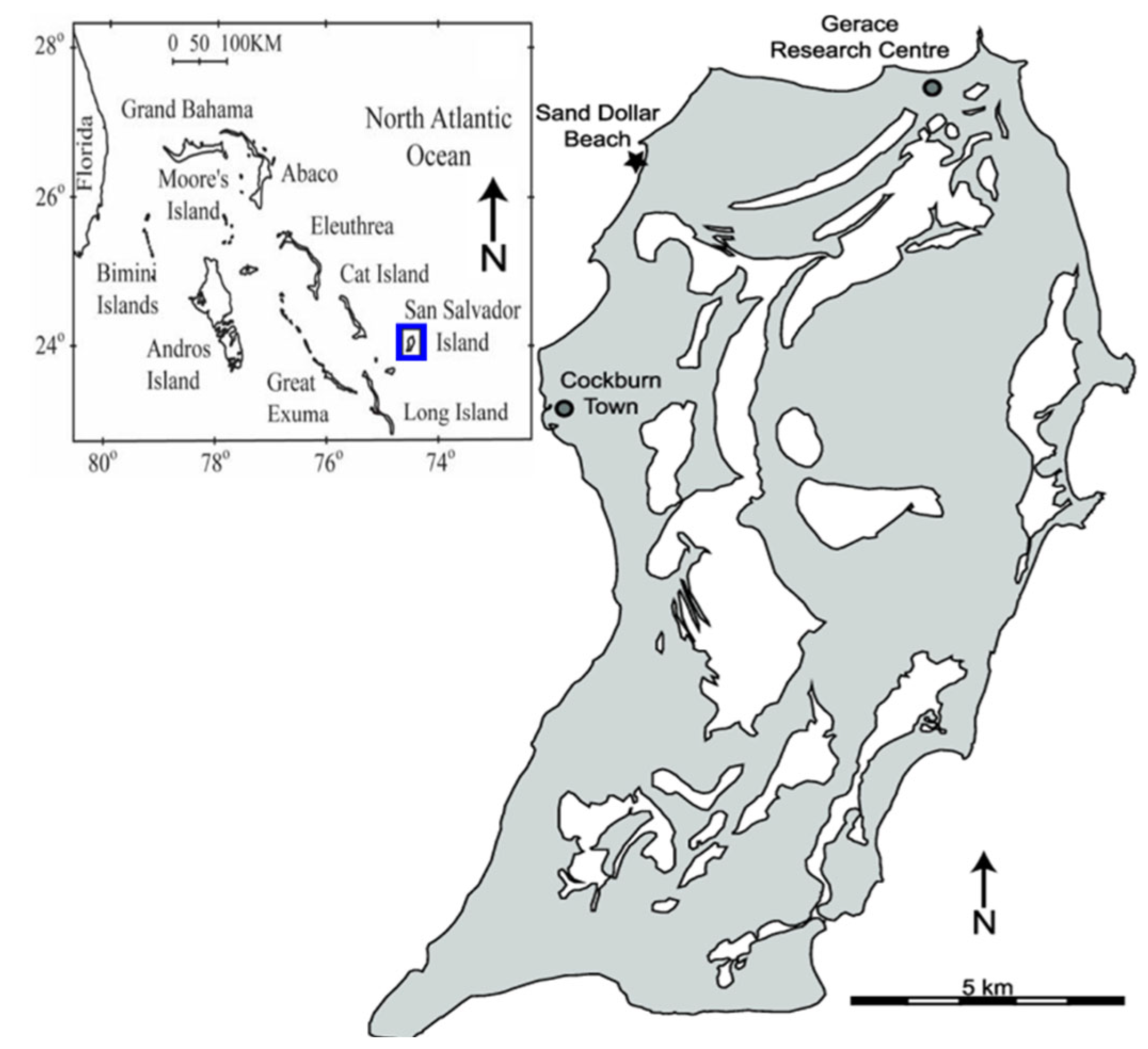
This study aims to investigate the temporal influence of implementing FI on FWL development and SWI mitigation in unconfined island aquifers, and evaluate how different FI patterns affect the transient behaviors of FWL and SWI extents, using the San Salvador Island aquifer as a case study. San Salvador Island is located within the Bahamian archipelago (Figure 2), about 600 km east–southeast of Miami, and sits on a small, isolated carbonate platform [37,38]. This is a strip island, and it is about 20 km long north-to-south and has an average width west-to-east of approximately 8 km [39]. The topography is dominated by consolidated carbonate dune ridges, with elevations a few meters above sea level [40]. Characterized by a subtropical climate, San Salvador Island has an annual temperature ranging between 22 and 28 °C [38] and annual precipitation and potential evaporation of 1000–1250 mm/year and 1250–1375 mm/year, respectively [41].

2.2. Development of Numerical Simulation Model for SWI

This study applies the SEAWAT model to simulate the transient dynamics of FWL evolution and SWI extent in the unconfined island aquifer under FI activity. SEAWAT couples the groundwater flow model (MODFLOW) and the solute transport model (MT3DMS) to solve the variable-density flow equations using a finite-difference numerical approach [42]. Since the SEAWAT model can account for water density variations that depend on salt concentration, it is well-suited for simulating flow in aquifers characterized by freshwater–seawater interactions. Governing equations for groundwater flow and solute transport can be found in Langevin, et al. [42].
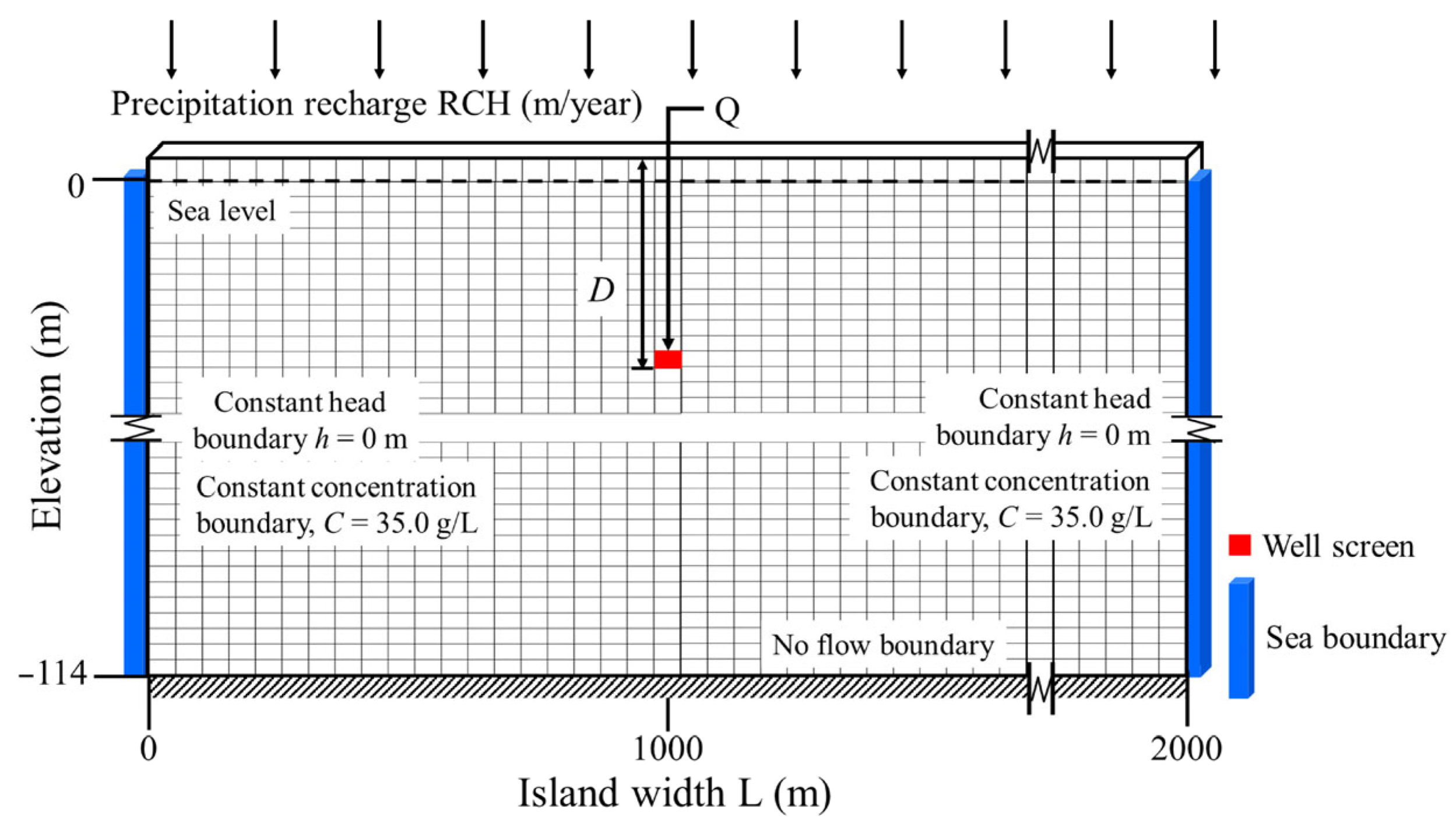
To efficiently evaluate the temporal performance of various FI strategies in FWL development and SWI mitigation in San Salvador Island, a simplified 2D, variable-density, dispersive, vertical ‘cross-section’ model is adopted, representing an idealized north–south transect across the long width of the island. The elongated ‘strip’ geometry of San Salvador (20 km by 8 km) justifies the use of a cross-sectional model, as flow is primarily perpendicular to the long axis of the island. This 2D cross-section model represents a homogeneous, isotropic, unconfined island aquifer as a rectangular domain measuring 2000 m in length, 116 m in height and 1 m in width. The aquifer domain is discretized into a finite-difference regular grid with a cell size of 2 m × 2 m at the top layer, and 2 m × 1 m in the remaining layers, in the lateral and vertical directions, respectively. Two additional grid columns are used to represent the boundary conditions at the leftmost and rightmost ends of the domain, so that the finite-difference grid is made up of 1002 columns and 115 layers, for a total of 115,230 cells.
Figure 3 shows a conceptualization of the aquifer domain along with the numerical model grid and its boundary conditions. A no-flow boundary is prescribed at the model bottom. The model top is a specified flux boundary, reflecting the aquifer recharge from precipitation, which is denoted as RCH. RCH is uniform over the island width and constant over time for each SWI simulation case. At the left and right boundaries, a constant head (h) boundary of 0.0 m is prescribed over the water column, which represents the sea level (at the datum). At the same boundaries, a constant seawater salt concentration C of 35.0 g/L is imposed. The one-well FI system is placed at the island center and represented by a point sink located at depth D, injection rate Q, and injected water concentration C F I , which represents the volume of freshwater injected into the aquifer per unit time and per unit aquifer width.
The simulation of island groundwater flow and solute transport under various FI strategies consists of two stress periods. The first stress period represents the establishment of steady-state conditions under natural RCH and prescribed boundary conditions, without FI. This period is run until both hydraulic head and groundwater concentration fields reach dynamic equilibrium, and the resulting solution is used as the initial condition for the subsequent stress period. The second stress period simulates the aquifer response to FI over the specified management horizon. The total simulation time is defined as the duration of FI (in years) multiplied by 360 days, and this stress period is discretized into uniform time steps of 30 days to capture the transient evolution of hydraulic and transport processes. The groundwater flow equation is solved using the Preconditioned Conjugate Gradient solver, with both the head-change convergence criterion and residual convergence criterion set to 1 × 10⁻⁵, and solute transport was solved using the Generalized Conjugate Gradient package within MT3DMS, with a relative concentration convergence criterion of 1 × 10⁻⁶. These solver tolerances were selected to ensure numerical stability and solution accuracy for density-dependent flow conditions. Table 1 provides a list of the relevant parameters adopted in the simulation model introduced above. These parameters are based on published case studies of island aquifers in the Bahamian archipelago [34,35,36,43,44].
This idealized 2D cross-section island groundwater model assumes homogeneous and isotropic aquifer conditions, ignoring real-world three-dimensional (3D) spatial complexities, aquifer heterogeneities, and transient dynamics on shoreline boundaries, which may lead to an underestimation of the mixing zone width and salt transport velocity. Moreover, this work focuses on a single-well setup to efficiently gain insight into the transient responses of island groundwater system to various FI patterns, omitting the complexities of real-world multi-well systems. A single FI well creates a localized freshwater bulb, whereas a multi-well barrier system could distribute injected water more uniformly to achieve more efficient displacement of the saltwater wedge. It should be noted that a single-well setup does not account for the overlapping pressure mounds inherent in multi-well fields, which would likely alter the shape of FWL more rapidly. Although the 2D model with single-well setup cannot fully capture the spatial complexities of real-world 3D systems, it is considered as the primary benchmark for investigating the fundamental transient physics of FI in strip-island settings, and this approach was intentionally selected to ensure computational viability and maintain feasibility within the scope of this study.

2.3. SWI Simulation Scenarios

This work employs SEAWAT simulations to investigate how FWL and SWI extent in unconfined island aquifers respond to FI over time, with a focus on the influence of FI patterns on this response. Herein, FI patterns are defined by four primary decision variables (DVs): (1) the depth D [L] at which FI occurs; (2) the intensity of constant injection Q [L2T−1]; (3) the injected freshwater concentration C F I [ML−3]; and (4) the FI duration t [T]. In this work, to evaluate how injection placement relative to the freshwater–saltwater interface affects FI effectiveness, the FI depth is expressed as the vertical distance from the freshwater zone bottom, denoted by d r (Figure 1a). Negative values of d r indicate injection locations positioned above (shallower than) the FWL bottom, whereas positive values represent injection locations below (deeper than) the freshwater zone base. Inherently, numerous SWI simulations need to be conducted, with these four independent DVs, d r , Q, C F I and t, being varied continuously. To draw conclusions while limiting computational costs, this investigation is based on the analysis of a predefined set of SWI simulation scenarios (i.e., SEAWAT model runs), expressed as a prescribed ensemble of variable sets. The comparison of differences in WTE, FWL geometry, freshwater storage and aquifer salinization will be conducted as the basis to draw general conclusions.
Table 2 provides a description of the ensemble of DV sets ( d r , Q, C F I , t) used in this study. In this work, nine values of d r are considered (−6, −4, −2, −1, 0, 1, 2, 4, and 6 m), spanning shallow placements within the freshwater zone to deep placements extending into the saltwater zone, to examine the role of vertical FI position in shaping FWL dynamics and SWI control. Q is evaluated at five levels: 0.1RCH · L, 0.2RCH · L, 0.4RCH · L, 0.6RCH · L, and 0.8RCH · L. For injected water quality, herein, groundwater with a salt concentration of 1.0 g/L or less is defined as freshwater [34,35]. Accordingly, C F I is evaluated at three levels, 0.25, 0.5, and 1.0 g/L, representing a wide quality range of freshwater sources available for FI implementation. The freshwater source for injection may include harvested rainwater, treated wastewater effluent, and desalinated saline or brackish water. This range is intended to reflect realistic variations in source water quality and quantity and to enhance the applicability of the modeling results to diverse water supply conditions, particularly in small island environments where multiple water sources often have to be combined. This study does not explicitly quantify the water balance required to sustain FI (e.g., available rainwater, wastewater, or desalination capacity), as the focus is on the transient hydrodynamic and transport responses of the aquifer to FI, independent of the water source. A site-specific feasibility assessment incorporating water availability is an important direction for future applied research. The FI strategy is evaluated over four management horizons (t): 5, 10, 25, and 50 years.
A full-factorial combination of these DV values leads to an ensemble of 9 × 5 × 3 × 4 = 540 alternative FI strategies, and thus as many SEAWAT model runs. An additional model run is also needed to simulate the baseline “no-FI” scenario.

2.4. Indicators for Quantifying FWL Dynamics and SWI Extent

To systematically evaluate the impact of FI patterns on the transient behaviors of FWL and SWI extent in island aquifers, this study develops five indicators: (1) relative change in average WTE ( W T E a v g ), providing a normalized measure of the overall water table shift for comparing changes across different scenarios; (2) relative change in FWL depth ( d ), quantifying how much the freshwater–saltwater interface deepens or shallows; (3) relative change in fresh groundwater volume ( F V ), measuring the change in freshwater storage in the aquifer; (4) the ratio of the net increase in subsurface freshwater storage to the total volume of injected freshwater (FRE), quantifying the efficiency of implementing FI in promoting freshwater storage; (5) relative change in total salt mass in the aquifer ( S M ), quantifying the extent of aquifer salinization under SWI [34].
W T E a v g at the management horizon t is calculated as
W T E a v g , t = W T E a v g , t W T E a v g , 0 W T E a v g , 0 · 100   [ % ]
where W T E a v g , 0 represents the average WTE at the steady state in the baseline scenario, and W T E a v g , t is the average WTE at a specific FI duration, t, for other SWI simulation scenarios, which depends on the DV set. The average WTE is calculated by integrating the water table elevations across all top-layer island aquifer cells and then dividing by the number of these grid cells.
d for a given FI duration t is calculated by
d t = d c d 0 d 0 · 100   [ % ]
where d 0 represents the FWL depth at the steady state in the baseline scenario, and d c is the FWL depth at the management horizon t for other SWI simulation scenarios. The FWL depth, in this study, is defined as the distance from the freshwater–saltwater interface at the island center to the ground surface (see Figure 1a). This study defines groundwater with a salt concentration of 1.0 g/L or less as freshwater. The 1.0 g/L threshold is a common convention in island hydrogeology and numerical modeling of the freshwater–saltwater interface, which can effectively represent the transition between potable fresh groundwater and the brackish mixing zone [34,35,36].
For the management horizon t , F V is formulated as
F V t = F V t F V 0 F V 0 · 100   [ % ]
where F V t represents the freshwater volume in the aquifer at the end of the management horizon t , and F V 0 is the subsurface freshwater volume before FI implementation. Subsurface freshwater volume is calculated by spatial integration of the pore volume in those grid cells where the simulated salt concentration is no more than 1.0 g/L. Therefore, positive values indicate increases in FWL volume, whereas negative values denote a decrease.
FRE at the management horizon t is formulated as
F R E t = F V t F V 0 V t · 100   [ % ]
where V t is the total volume of injected freshwater until the end of the FI period t .
The S M at the end of the management horizon t is calculated by
S M t = S M t S M 0 S M 0 · 100   [ % ]
where S M 0 is the total salt mass in the aquifer before FI, and S M t is the total salt mass at the end of FI duration t. Values of aquifer salt mass are calculated by integrating the salt concentration multiplied by the pore volume over all model grid cells. Herein, negative values indicate a reduction in salt mass, whereas positive values denote an increase.

3. Results and Discussion

3.1. FWL and SWI Extent Prior to the Implementation of FI

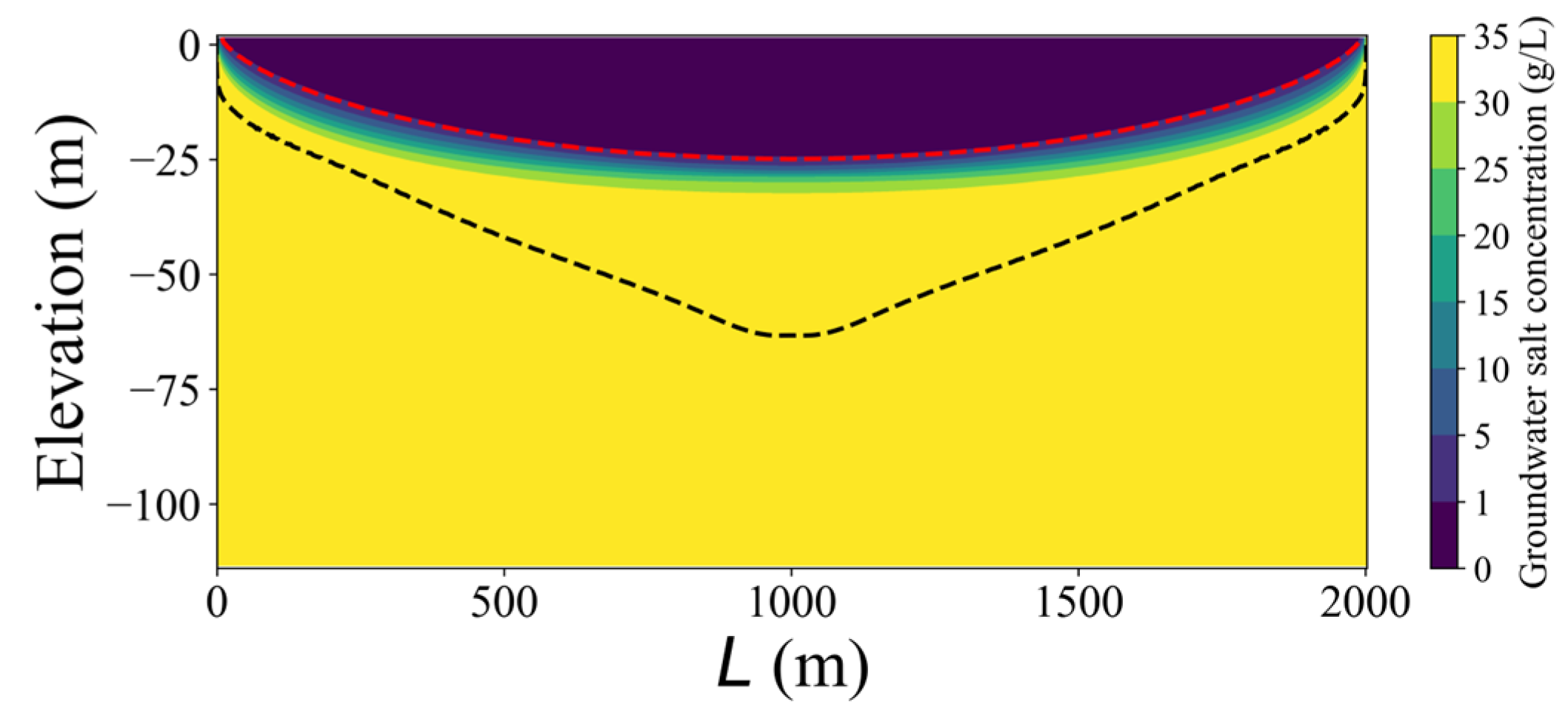
The steady-state groundwater concentration distribution for the baseline scenario prior to FI implementation is depicted in Figure 4. Under the natural condition, FWL depth varies from zero in proximity of the shoreline to about 26 m relative to the datum at the island center. The corresponding depth to the seawater increases from about 10 m near the coast to roughly 60 m at the island center. It indicates that the freshwater–saltwater mixing zone gradually widens from the shoreline to the island center, in agreement with theoretical predictions [45].
Table 3 shows a summary of initial indicator values for the island aquifer in the baseline case. These reference values are provided to facilitate interpretation of the relative change plots by establishing a consistent benchmark against which scenario-based deviations can be quantitatively evaluated.
The simulated results of W T E a v g , 0 and W T E p , 0 in the baseline case show close agreement with the corresponding estimates according to the established theoretical solutions [7,8,46], and visually, the freshwater–saltwater mixing zones in Figure 4 gradually widen from the shoreline to the island center, in agreement with theoretical predictions [45], thereby validating the developed model’s accuracy. These robust validations highlight this model’s reliability for subsequent investigations on the transient response of island groundwater systems to various FI patterns.

3.2. Transient Responses of WTE Indicator to Various FI Patterns

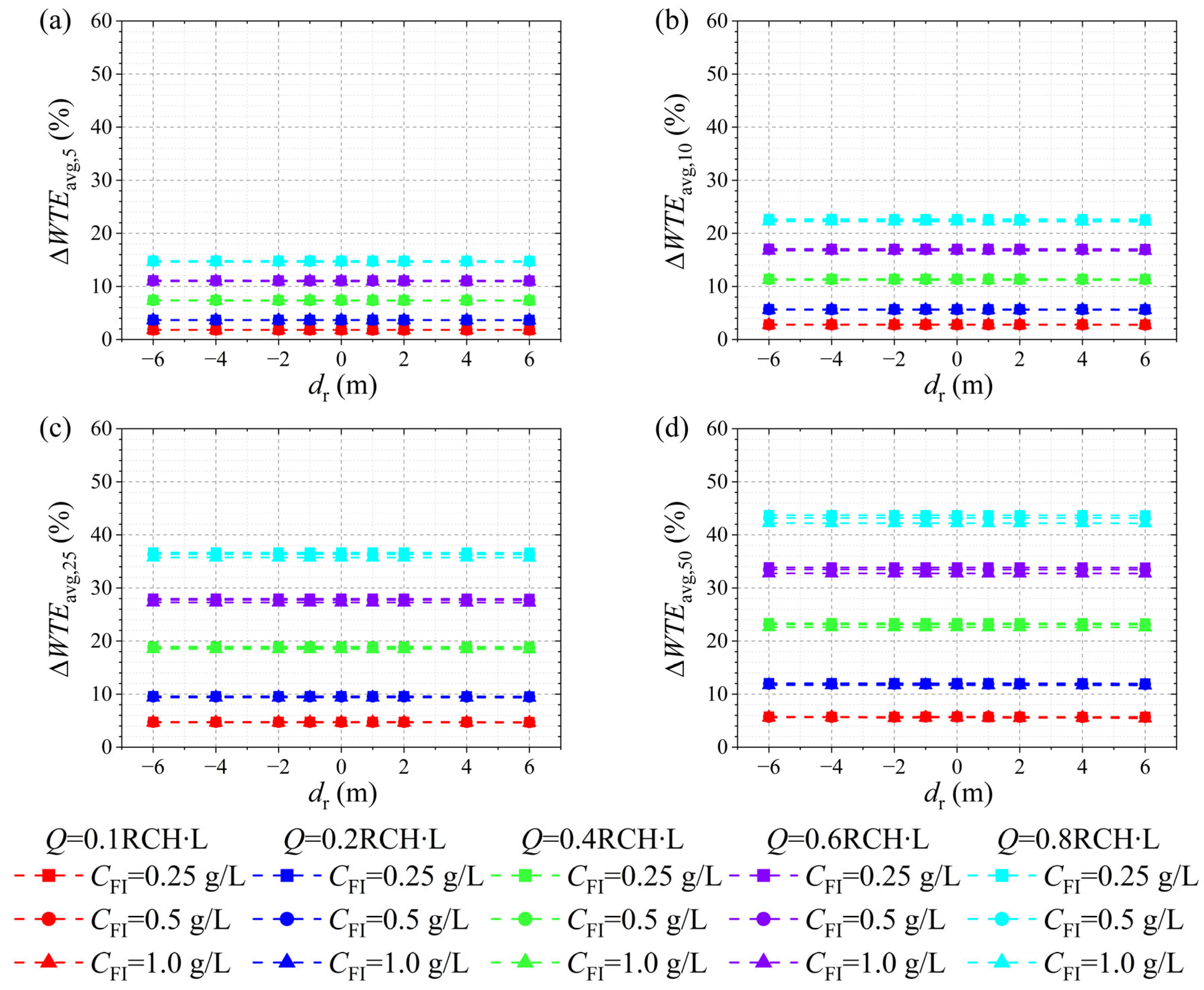
Figure 5 shows the transient responses of W T E a v g to various FI patterns across four management horizons, from t = 5 to 50 years. Each panel displays W T E a v g as a function of the relative FI depth ( d r ), with separate profiles representing different levels of Q and C F I . It shows that all W T E a v g profiles in Figure 5 are characterized by a nearly horizontal hierarchy governed by the FI intensity, Q, where the W T E a v g profiles for the same Q are tightly grouped together and higher Q values consistently generate higher W T E a v g values regardless of t and C F I , with all W T E a v g values remaining positive. Although these W T E a v g profiles appear nearly horizontal with respect to d r , a closer inspection reveals that W T E a v g values for any given FI pattern actually decline slightly as d r increases. For instance, with d r increasing from −6 m to 6 m, W T E a v g decreases slightly from 27.27% to 27.24% in the scenario where C F I   = 1.0 g/L, Q = 0.6RCH · L, and t = 25 years, and that declines slightly from 43.70% to 43.66% under C F I   = 0.25 g/L, Q = 0.8RCH · L, and t = 50 years.
Figure 5a–d depict that extending t leads to the increases in W T E a v g values for all FI patterns, and the magnitudes of these increases are significantly more pronounced under higher-Q FI patterns, which consequently expands the vertical separations between W T E a v g profiles of different Q levels over time. As t progresses, it is noted that both the growth rate of W T E a v g values and the expansion rate of the separations between W T E a v g profiles for different Q levels gradually diminish, suggesting that the system is approaching a stable equilibrium in terms of average WTE. Notably, lower-Q FI patterns are observed to eventually approach a stable equilibrium in terms of average WTE much sooner than the higher-Q FI patterns.
The extension of the FI duration also makes the Influence of C F I on W T E a v g more evident for higher-Q FI patterns. Specifically, at t = 25 or 50 years, W T E a v g values are slightly higher at lower C F I than those using saltier injected water for Q = 0.6RCH · L or 0.8RCH · L, differing from the conditions at t = 5 and 10 years, where W T E a v g profiles across different C F I values are almost identical. Conversely, for Q < 0.6RCH · L, W T E a v g remains unaffected by C F I with t increasing, maintaining the same behavior as the earlier horizons, where W T E a v g values at different C F I are almost identical.
The observations from Figure 5, overall, reveal that (1) FI leads to a rise in the aquifer-wide average WTE; (2) the magnitudes of the rise in the average WTE diminish slightly as the FI depth increases; (3) Q is the predominant factor for determining the rising magnitude of the WTE, where higher-Q FI patterns generate substantially greater rises in WTE and under the same Q, the magnitudes of these rises in WTE are tightly grouped regardless of d r , C F I , and t; (4) t is another important factor governing the responses of WTE to FI. Extending t leads to a progressive increase in WTE across all FI patterns, and expands the gaps between WTE values under different Q conditions, further amplifying the influence of Q on WTE. However, with the system approaching a new stable hydraulic equilibrium for WTE, the rising rate of WTE and the expansion rate of the separations between WTE values under different Q levels gradually diminish over time. Lower-Q FI patterns achieve this equilibrium state sooner than their higher-Q counterparts, which require longer management horizons to stabilize WTE due to the larger volumes of water being redistributed. (5) C F I is a secondary factor in determining WTE responses to FI compared to Q and t. Low- C F I FI patterns generally result in slightly higher increases in WTE than high- C F I patterns, but its impact depends on both Q and t; specifically, C F I can play a noticeable role under high-Q and long-t conditions while exerting a negligible influence on WTE under low-Q or short-t conditions.
These can be attributed to the physics of groundwater mounding and the localized dissipation of hydraulic energy. When freshwater is injected at a specific point, the aquifer’s hydraulic resistance necessitates the buildup of a localized pressure head, or recharge mound, to drive the water outward into the surrounding formation. This indicates that the WTE rise would be most pronounced at the FI well, where the hydraulic gradient is steepest, and this local rise would exceed that in the island-wide average WTE. Higher Q requires a significantly higher-pressure head at the source to overcome resistance. Initially, the recharge mound is steep and localized, but with t increasing, the injected water redistributes toward the island’s margins, leading to a more uniform rise across the aquifer. This causes the initial growth rates to diminish as the system approaches a new stable hydraulic equilibrium. Regarding the FI depth, as d r increases (deeper injection), the water must travel further vertically to reach the water table. This increased travel distance results in greater dissipation of the pressure head, explaining why the WTE indicator, W T E a v g , declines as the injection point moves deeper. Moreover, higher-purity water (lower C F I ) is less dense and exerts slightly more buoyancy, contributing to a marginally higher water table rise. This effect becomes noticeable only under high-Q and long-t conditions where the volume of low-density water is sufficient to impact the overall WTE.

3.3. Transient Response of FWL Depth to Various FI Patterns

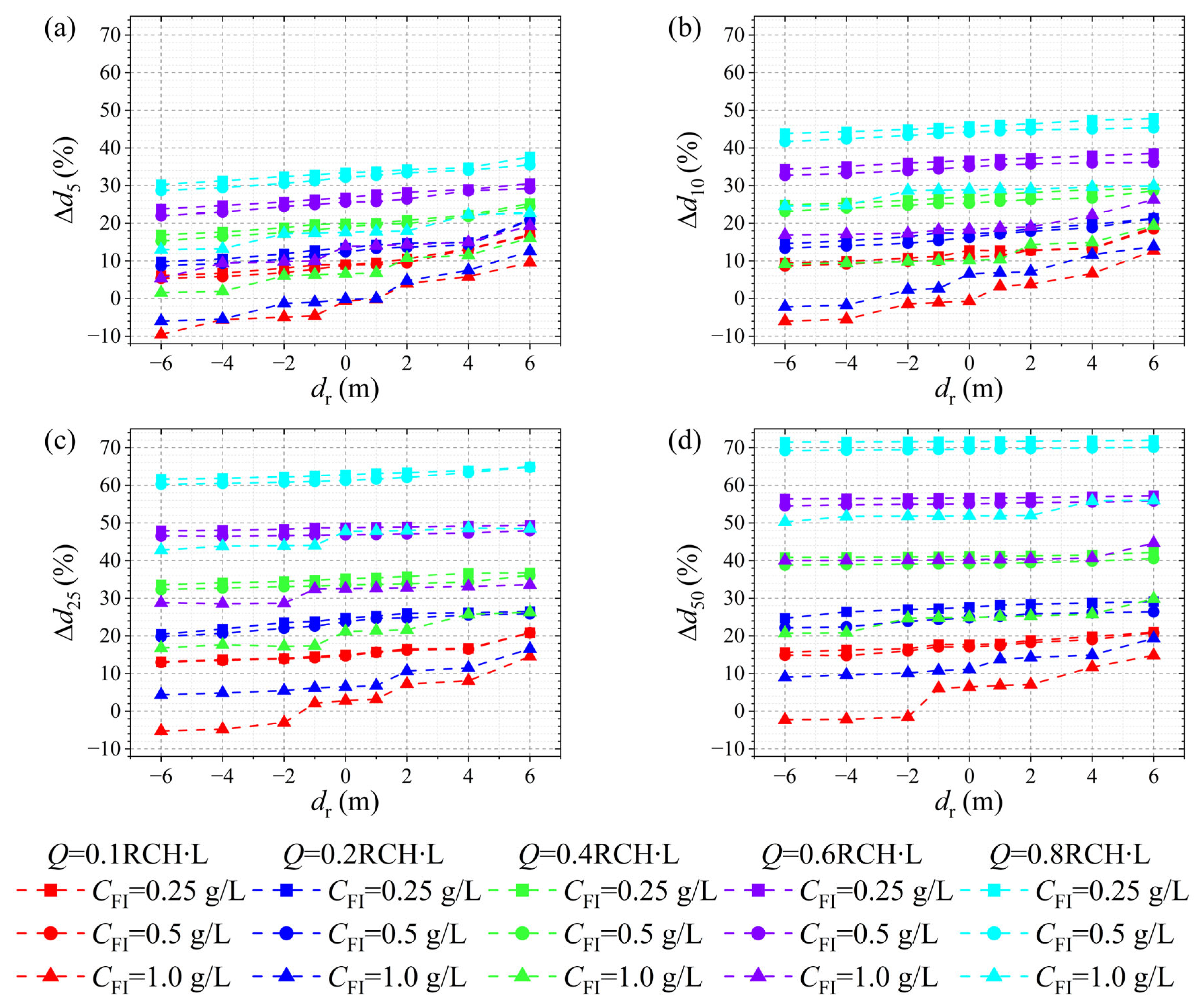
Figure 6 illustrates the transient responses of d to various FI patterns across four management horizons, from t = 5 to 50 years, and each panel displays d as a function of the relative FI depth ( d r ), with separate profiles representing different levels of Q and C F I . In Figure 6, all d profiles exhibit an increasing behavior with d r , and the magnitudes of these increases in d values differ significantly, depending on the C F I level. For FI patterns with the same Q and t, the d profiles experience a slow, gradual growth for C F I   = 0.25 and 0.5 g/L with d r increasing from −6 to 6 m, while the d profiles experience much more remarkable growth for C F I   = 1.0 g/L over the same FI depth range. Moreover, at any given Q and t, the d profiles under lower C F I remain consistently higher than their higher- C F I counterparts, with the d profiles under high-purity injected water conditions ( C F I = 0.25 and 0.5 g/L) positioned closely together and the d profiles under C F I = 1.0 g/L being substantially lower, in which d values may be negative in some cases of C F I = 1.0 g/L, demonstrating a significant divergence from the high-purity group.
A quantitative comparison further highlights those observations. At Q = 0.2RCH · L and t = 5 years, increasing d r from −6 to 6 m causes the d profile for C F I = 0.25 g/L to rise from 9.74% to 20.91% (an increase of 11.17%), and similarly, the d profile for C F I   = 0.5 g/L grows from 8.68% to 20.24% (an increase of 11.56%), showing that the d profile under C F I = 0.25 g/L is slightly higher than that under C F I = 0.5 g/L and these two high-purity d profiles are closely aligned. However, for C F I   = 1.0 g/L, the d profile increases from −5.98% to 12.61% across the range of d r , a significantly larger rise of 18.59%, indicating that the d profile under C F I   = 1.0 g/L is not only substantially lower than those under C F I = 0.25 and 0.5 g/L but also exhibits greater sensitivity to changes in d r .
As seen from Figure 6, Q plays an important role in determining d values. At a given C F I , higher-Q FI patterns consistently generate higher d profiles compared to their lower-Q counterparts across all FI depths and durations, indicating the greater increases in FWL depths under higher-Q conditions. With t increasing from 5 to 50 years, the d profiles under any combinations of Q and C F I gradually become higher, and concurrently, the vertical separations between d profiles of different Q levels generally expand over time. It is worthwhile to note that with t continuously increasing, both the growth rate of d values and the expansion rate of the divergence between d profiles of different Q levels generally diminish. This trend suggests that the system is asymptotically approaching a stable hydraulic equilibrium in terms of FWL depth. Specifically, the growth rate of d under lower-Q patterns decelerates more rapidly, indicating that systems characterized by lower-Q FI reach a steady-state equilibrium sooner than those utilizing higher-Q FI patterns. This disparity arises because higher-Q configurations involve the redistribution of much larger water volumes, requiring more extensive management horizons to achieve hydraulic stabilization.
A quantitative review of the FI scenarios where C F I = 0.25 g/L and d r = 6 m illustrates these trends. With t = 10 years, d values are 18.99%, 21.29%, 29.14%, 38.53%, and 47.81% for Q levels of 0.1, 0.2, 0.4, 0.6, and 0.8RCH · L, respectively. When t increases to 25 years, these values rise to 20.86%, 26.48%, 36.74%, 49.38%, and 64.70%, respectively; and by t = 50 years, they correspondingly reach 20.99%, 29.13%, 42.20%, 57.23%, and 72.92%. These data confirm that while d increases with both Q and t, the growth rate of these values gradually diminishes over time, with lower-Q patterns decelerating more rapidly. Notably, the system appears to achieve near-stabilization for the Q = 0.1RCH · L case by t = 25 years, as the d value only marginally increases from 20.86% to 20.99% over the subsequent 25-year period. Furthermore, the widening separation between the d values at different Q levels over time demonstrates that higher-Q FI strategies provide increasingly greater relative benefits in expanding FWL depth over longer management horizons.
In summary, the observations from Figure 6a–d reveal that (1) FI generally promotes the expansion of the FWL depth, but a contraction of the FWL depth, evidenced by negative d values, could occur in specific FI patterns, which are characterized by low purity ( C F I = 1.0 g/L), low Q, and shallow injection point. This suggests that injecting lower-purity freshwater with low intensity and shallow location may inadvertently cause the FWL to contract rather expand. (2) Placing the FI point deeper within the freshwater–saltwater mixing zone can enhance the expansion of FWL depth, and the FWL depth under low-purity FI conditions ( C F I = 1.0 g/L) exhibits a higher sensitivity to changes in FWL depth than under high-purity conditions ( C F I = 0.25 or 0.5 g/L). (3) Both Q and C F I are predominant factors determining the resulting FWL depth. Regardless of t and d r , lower- C F I FI patterns consistently produce greater expansion in the FWL depth than their higher- C F I counterparts, and higher-Q FI patterns consistently outperform lower-Q levels in terms of expanding FWL depth. Notably, neither factor completely overshadows the other; in other words, an FI strategy with low Q and low C F I can actually outperform a high-Q pattern if its injectant is of low purity ( C F I   = 1.0 g/L). (4) Extending t leads to a progressive increase in FWL depth across the FI patterns and widens the divergence of FWL depths between different Q conditions, effectively amplifying the influence of Q on FWL depth over time. However, both the growth rate of FWL depths and the expansion rate of the separations between FWL depth values under different Q levels gradually diminish over time with the system approaching a new stable hydraulic equilibrium. Lower-Q FI patterns achieve this equilibrium state significantly sooner than their higher-Q counterparts.
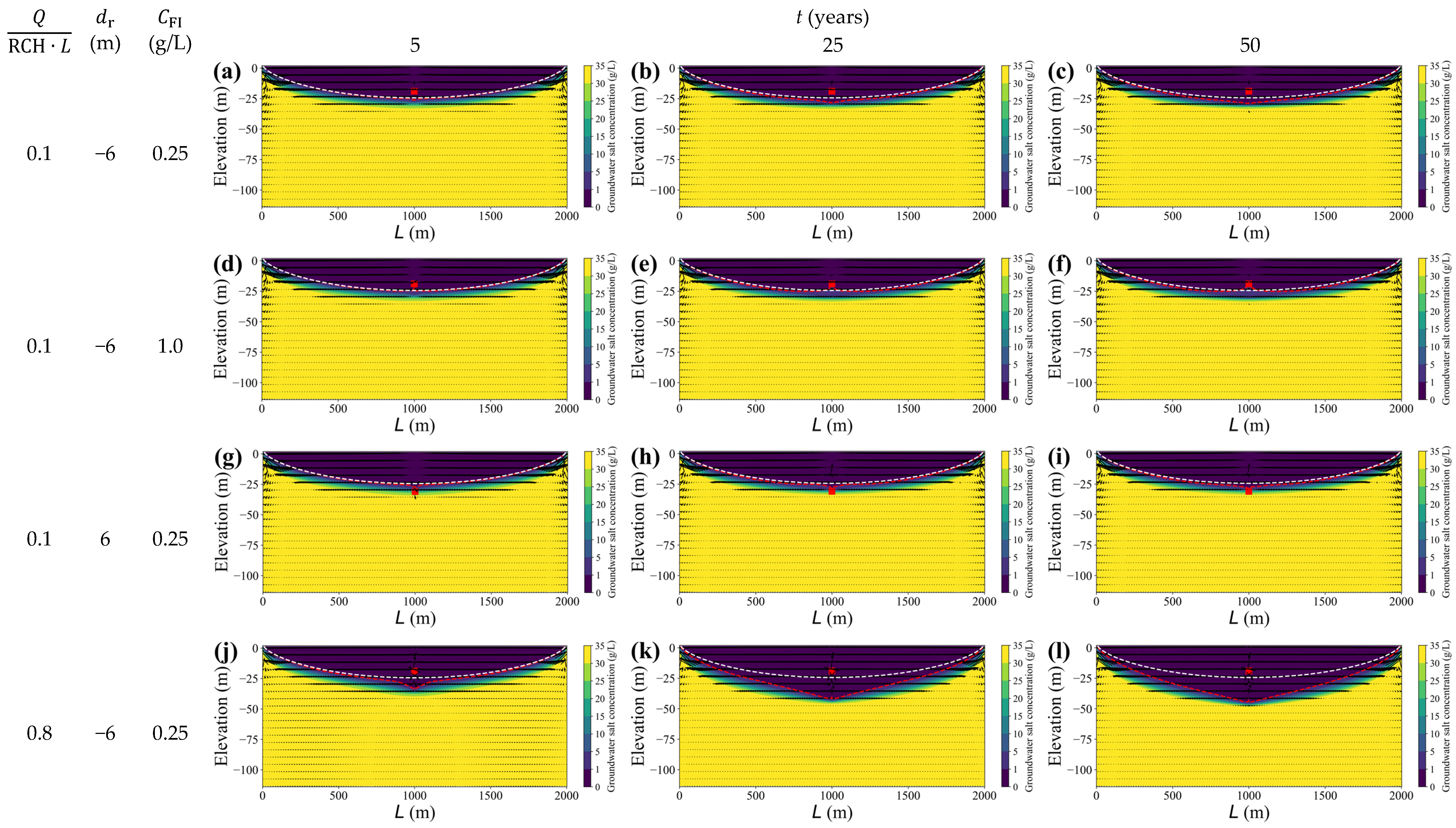
The physical mechanisms underlying the aforementioned findings are further elucidated by Figure 7, in which the simulated groundwater flow fields and salt concentration distributions resulting from FI implementation across various combinations of Q, d r , C F I and t are illustrated. Figure 7 is organized row-wise to compare specific FI strategies, with the top row representing the FI strategy with Q = 0.1RCH · L, d r = −6 m, and C F I = 0.25 g/L, followed by rows reflecting individual variations in injectant concentration ( C F I = 1.0 g/L), injection depth ( d r = 6 m), and injection intensity (Q = 0.8RCH · L). From left to right, the columns represent the management horizons at t = 5, 25, and 50 years, respectively.
As seen from Figure 7a–c, FI with Q = 0.1RCH · L, d r = −6 m, and C F I = 0.25 g/L drives groundwater below the FI well downward, effectively expanding the FWL interface downward and increasing its depth, and concurrently, the FI process induces an upward flow component above the well, which explains why FI tends to lift the WTE. These two different flow directions, upward above the well and downward below it, become significantly more pronounced in Figure 7j–l, where the Q is increased to 0.1RCH · L. With t extending from 5 to 50 years, the FWL Interfaces for both cases of Q = 0.1RCH · L and Q = 0.8RCH · L migrate deeper and exhibit a clear trend toward hydrodynamic stabilization. However, the temporal scale of this stabilization varies, with the FWL interface at Q = 0.1RCH · L reaching a near-steady state by approximately t = 25 years while that at Q = 0.8RCH · L continues to expand through t = 50 years. This confirms that lower-Q FI patterns achieve equilibrium in terms of the FWL shape more rapidly than higher-Q patterns, as they induce less extensive groundwater redistributions within the aquifer.
Figure 7d–f demonstrates that increasing C F I to 1.0 g/L induces an upward groundwater flow even below the FI well, causing the FWL interface to shift upward and reducing the overall lens depth. This phenomenon is driven by the reduced density contrast between the injectant and the underlying saline groundwater. While a low-concentration injectant (0.25 g/L) is sufficiently buoyant to displace denser brackish water downward, the 1.0 g/L injectant increases the fluid density within the mixing zone. Based on the Ghyben–Herzberg principle, a higher-density freshwater fraction narrows the density differential, which physically necessitates an upward migration of interface to maintain hydrodynamic equilibrium. Therefore, hydraulic pressure from the FI well, rather than expanding the FWL downward, forces existing lighter freshwater and the transition zone upward toward the water table, thereby limiting the FI effectiveness for deep FWL development.
Figure 7g–I demonstrates that positioning the FI well at a greater depth ( d r = 6 m) effectively expands the FWL downward in the immediate vicinity of the FI point, thereby increasing the local FWL depth. However, a comparison with the shallower FI case in Figure 7a–c ( d r = −6 m) reveals that the total FWL area is visually smaller when the FI point is deeper. This suggests that while placing the FI point deeper within the mixing zone can enhance the FWL depth locally at the well location, it is less effective at expanding the overall FWL volume across the aquifer.

3.4. Transient Response of Freshwater Storage and FRE to Various FI Patterns

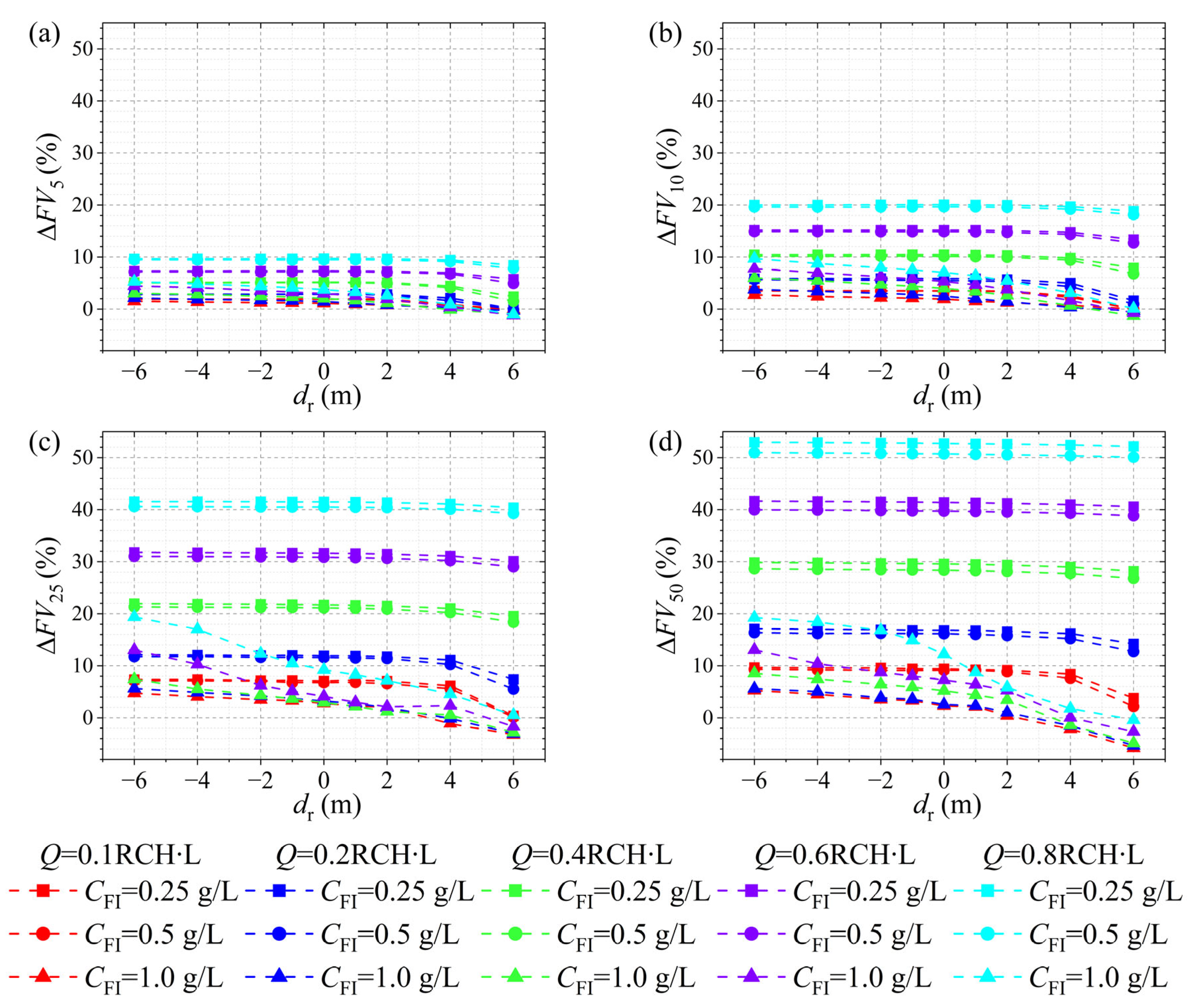
Figure 8 presents the transient responses of F V to various FI patterns across four management horizons, from t = 5 to 50 years, and each panel displays F V as a function of the relative FI depth d r , with separate profiles representing different levels of Q and C F I . In most cases, the F V values are positive, indicating that the implementation of FI successfully expands the FWL volume. It can be observed that with d r increasing from −6 to 6 m, the F V profiles for all FI patterns exhibit a decreasing behavior, a trend that is primarily sensitive to C F I . For C F I = 1.0 g/L, the F V profiles show a significant decline as the FI point moves deeper, which becomes more pronounced as the management horizon extends from 5 to 25 years before reaching a quasi-stable state at t = 50 years. Notably, for this high C F I , injecting at d r = 4 or 6 m could actually result in negative F V values, suggesting a contraction of the FWL under FI. In contrast, for C F I = 0.25 and 0.5 g/L, the F V values remain positive across all depths, exhibiting only a slow gradual decline with increasing d r from −6 to 6 m, though F V profiles show a more remarkable decrease when d r exceeds 4 m, a trend more evident for lower-Q patterns (e.g., 0.1RCH · L and 0.2RCH · L).
Regarding the influence of Q, for a given C F I , higher-Q FI patterns consistently generate superior F V profiles compared to their lower-Q counterparts across all FI depths and durations. With the FI duration extending from 5 to 50 years, the F V values for all FI patterns generally increase, and concurrently, the vertical separations between F V profiles of different Q levels expand over time, both trends that are particularly pronounced for C F I = 0.25 and 0.5 g/L. These indicate that the impacts of Q on F V values become increasingly significant both over time or/and as the value of Q increases, especially at C F I = 0.25 and 0.5 g/L. Moreover, with t continuously increasing, both the growth rate of F V values and the expansion rate of the separations between F V profiles for different Q levels gradually diminish, suggesting that the system is approaching a stable equilibrium in terms of freshwater volume. Notably, the growth rate of F V under lower-Q FI patterns diminishes more rapidly over time, indicating that systems characterized by lower Q reach a stable equilibrium of freshwater storage sooner than those with higher-Q patterns. On the other hand, it should be noted that, with t increasing, FI patterns characterized by C F I = 1.0 g/L and d r = 4 or 6 m generate much lower and, in some cases, increasingly negative F V values across all Q levels.
Figure 8a–d further illustrate that, with t increasing to 25 and 50 years, the F V profiles for C F I = 0.25 and 0.5 g/L under the same Q gradually diverge, with the F V profiles for C F I = 0.25 g/L consistently a bit higher than those for C F I = 0.5 g/L. This trend contrasts with the behavior observed in earlier horizons (t = 5 and 10 years), where the F V profiles for these two C F I levels under the same Q are nearly identical and overlap. Such divergence highlights the growing importance of high-purity injected water for the long-term enhancement of FWL volume, suggesting that minor differences in salinity of injected freshwater produce cumulative effects on FWL volume over sufficiently longer FI periods.
The observations and analysis of Figure 8a–d, overall, reveal that (1) implementing FI either slightly above or below the freshwater–saltwater interface generally succeeds in expanding subsurface freshwater storage ( F V > 0); (2) the FI effectiveness in enhancing freshwater storage decreases as the FI point is placed deeper, and the magnitude of this decline is primarily driven by C F I , with high-purity FI strategies ( C F I = 0.25 and 0.5 g/L) exhibiting a slow gradual decline and those low-purity FI patterns ( C F I = 1.0 g/L) showing a significant decline; (3) Q is a primary driver of FWL expansion. For any given C F I , higher Q values consistently yield superior freshwater volume growth across all depths and timeframes. The marginal benefit of increasing Q for enhancing FWL volume becomes more pronounced as the management horizon extends. (4) Using lower- C F I water for FI is inherently beneficial for FWL volume enhancement, but the influence of this higher-purity water ( C F I   = 0.25 and 0.5 g/L) on FWL volume is time-dependent. These two C F I levels (0.25 and 0.5 g/L) yield nearly identical results in the short term, but they diverge over longer periods (t = 25 years), suggesting that minor differences in the salinity of high-purity injected water require sufficient time to produce cumulative, physically significant effects on freshwater storage. (5) With FI duration continuously extending, the rate of change in subsurface freshwater volume gradually diminishes, indicating that the system is approaching a new stable equilibrium. Lower-Q FI patterns reach this steady state much faster than higher-Q patterns, which require longer durations to stabilize due to the larger scale of hydrological redistribution and fluid mass displacement. (6) It can be inferred that given a sufficiently wide range of FI depths, a critical depth threshold exists, beyond which the net increase in freshwater volume drops to zero, rendering the FI strategy ineffective for FWL volume expansion. This critical depth threshold is positively correlated with Q and negatively correlated with C F I ; specifically, the threshold extends deeper for higher Q values and lower C F I levels.
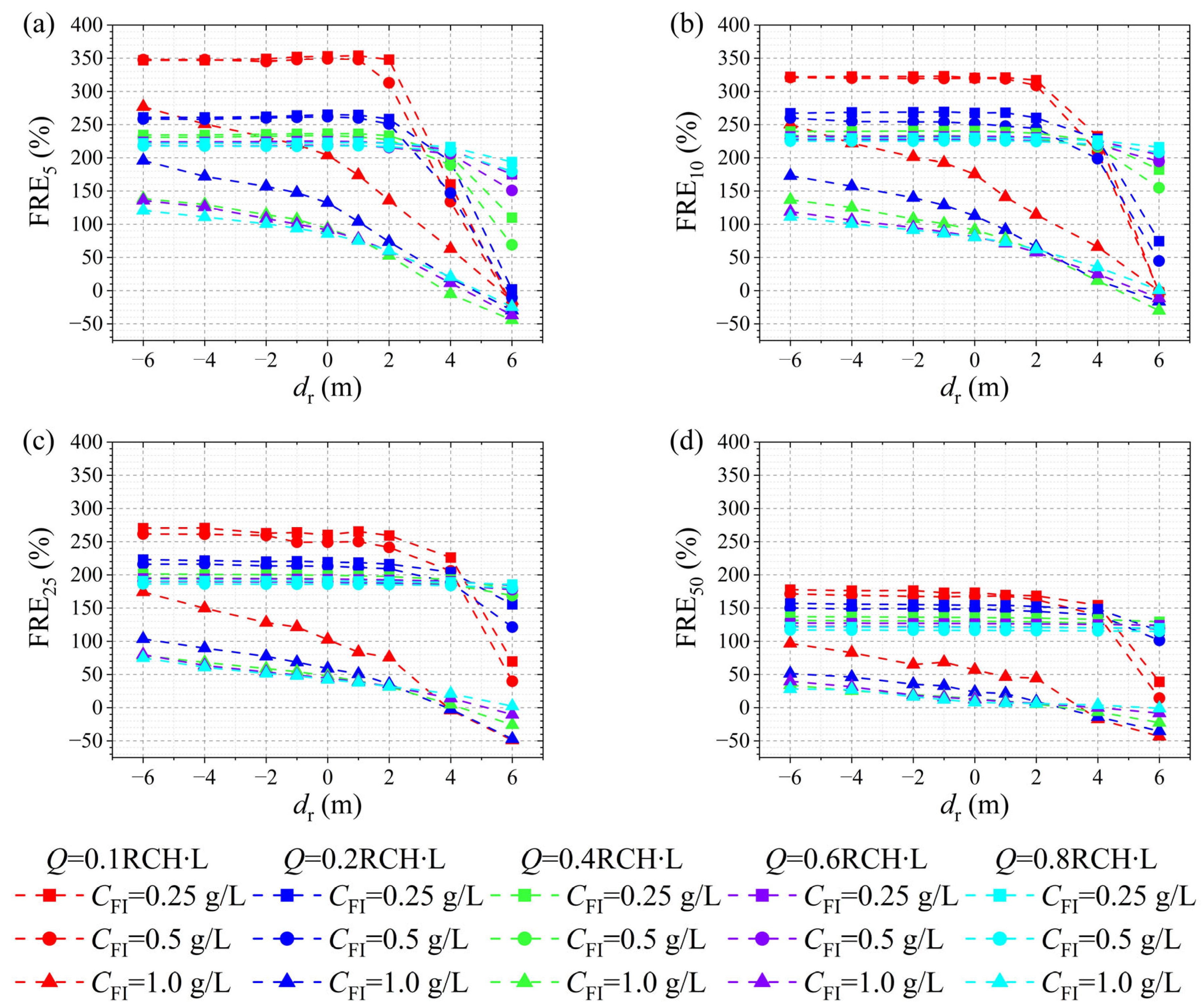
Figure 9 illustrates the transient responses of FRE across various FI patterns over four management horizons (t = 5, 10, 25, and 50 years), and each panel presents FRE as a function of the relative FI depth ( d r ), with distinct profiles categorized by Q and C F I . Consistent with the F V trends in Figure 8, FRE values under high-purity conditions ( C F I = 0.25 or 0.5 g/L) are higher than those under lower-purity conditions ( C F I = 1.0 g/L), with the FRE profiles for C F I = 0.25 and 0.5 g/L closely aligned but the FRE profiles for C F I = 1.0 g/L noticeably lower, demonstrating a marked divergence from the high-purity group; the FRE profiles for all FI patterns exhibit a decreasing trend with d r increasing (Figure 9a–d), and this decline is highly sensitive to the injectant concentration, C F I . For FI patterns with C F I = 1.0 g/L, the FRE profiles show a significant and rapid decline as the FI point moves deeper, which is particularly pronounced during the early management stages. It is noted that at d r = 4 and 6 m, the high- C F I FI can even result in negative FRE values, as F V is negative in these regions (Figure 9), indicating a negative efficiency, where FI fails to expand the lens and instead leads to a contraction of the FWL volume. In contrast, for high-purity FI patterns ( C F I = 0.25 or 0.5 g/L), FRE values remain positive across the entire defined FI depth range, and show a two-stage decline. Specifically, under high-purity FI conditions, for t = 5 and 10 years, the FRE decline is gradual until d r = 2 m, beyond which a more notable decrease occurs, while for t = 25 and 50 years, this inflection point shifts deeper, with the more pronounced decrease occurring only after d r exceeds 4 m. These trends are especially evident in lower-Q patterns (e.g., 0.1RCH · L).
Regarding the influence of FI intensity, lower-Q FI patterns generally yield higher FRE values than their higher-Q counterparts at shallower injection depths ( d r   2 m). However, a performance crossover occurs as the FI point moves deeper; when d r 4 m, higher-Q FI patterns begin to outperform lower-Q FI configurations in terms of FRE. This reversal suggests that at shallow FI depths, the system is highly sensitive to the volume of freshwater added, and lower-Q patterns are more efficient at storing freshwater in the aquifer. In contrast, at greater FI depths, where the FI must counteract higher saline water pressure, a higher Q is required to overcome the ambient density effects and effectively displace the saltwater interface, thereby maintaining a relatively higher FRE.
Furthermore, Figure 9a–d illustrate that FRE values in most cases are larger than 100%, a trend particularly evident for the FI patterns characterized by shallow FI depth ( d r 4 m), high-purity injected freshwater ( C F I = 0.25 or 0.5 g/L) and shorter management horizons. For example, FRE values for FI strategies with Q = 0.1RCH · L, d r 4 m, C F I = 0.25 or 0.5 g/L yield FRE values exceeding 300% at t = 5 years, and FRE values for those with Q ranging from 0.2RCH · L to 0.8RCH · L, d r 2 m, C F I = 0.25 or 0.5 g/L, and t = 10 years also remain high, falling approximately between 230% and 270%. These exceptionally high FRE values indicate the FWL expands with high efficiency, where the volume of the expanded FWL significantly surpasses the total volume of freshwater injected. This can be explained by the Ghyben–Herzberg relationship, which dictates that a unit rise in the WTE above sea level results in an approximately 40-fold expansion of the FWL depth below sea level. As shown in Figure 5, FI effectively lifts the aquifer-wide average WTE, which significantly expands the available freshwater storage capacity, and thus the aquifer can trap and store a greater volume of natural precipitation recharge alongside the injected freshwater. Since the resulting increase in total freshwater volume is the combined product of the injected freshwater and the retained natural recharge, the expansion of the FWL volume significantly exceeds the volume of the injectant itself.
With t increasing from 5 to 50 years, the positive FRE values, overall, gradually decline, while the negative FRE values become slightly less negative. In other words, the FRE values across all FI patterns gradually converge toward the zero-efficiency baseline over time. This convergence suggests that the system is approaching a new steady-state hydraulic equilibrium, in which the incremental growth (or contraction) of the FWL volume slows down with the saline interface reaching its new stable position. Meanwhile, the cumulative volume of injected water continues to increase linearly with time, while the net change in freshwater volume, whether through FWL expansion or loss, becomes progressively smaller relative to the total volume of injected water as t extends. This indicates that the most significant gains in FRE are achieved during the early stages of management, and with a sufficiently prolonged t, FRE values across all FI configurations could eventually approach zero. From the perspective of FRE, FI may not be a highly sustainable long-term solution for continuous FWL expansion, as the marginal returns on injected water diminish significantly once the system stabilizes. Moreover, with the FRE profiles for all FI patterns converging toward the zero-efficiency baseline over time, the divergence of FRE profiles between different Q levels, different FI depths, and different concentration levels gradually diminishes. This indicates that extending t effectively reduces the influence of FI intensity, depth, and injectant quality on FRE.
As a result, the impacts of FI patterns on FRE can be summarized as follows: (1) FRE values under lower C F I conditions are consistently larger than those observed under higher C F I levels, with the narrow divergence between the high-purity cases ( C F I = 0.25 or 0.5 g/L) and the noticeable gaps between these high-purity conditions and the lower-purity condition ( C F I = 1.0 g/L); (2) FRE values decline with the FI depth increasing, but the reduction is consistently significant under low-purity conditions ( C F I = 1.0 g/L), whereas high-purity conditions ( C F I = 0.25 or 0.5 g/L) exhibit a more complex two-stage response characterized by a gradual initial decrease followed by a more remarkable decline as the FI depth extends beyond a certain distance from the FWL interface; (3) the influence of Q on FRE is characterized by a distinct depth-dependent performance crossover. In the region proximal to the FWL interface, lower-Q patterns generally yield higher FRE values, but with the FI point moving deeper, higher-Q FI configurations begin to outperform their lower-Q counterparts. (4) FRE values in most cases are larger than 100%, a trend particularly evident for the FI patterns characterized by shallow FI depth, high-purity injected freshwater and shorter management horizons, indicating the high efficiency of FI for FWL development. However, with the management horizon extending, the FRE values across all FI patterns gradually converge toward the zero-efficiency baseline over time, suggesting that FRE values across all FI configurations could eventually approach zero with a sufficiently prolonged t. (5) Continuously extending the FI duration can diminish the influence of FI depth, intensity, and injected freshwater quality on FRE.
The indicator F V measures changes in freshwater storage, while FRE highlights the efficiency of the FI strategy for FWL volume expansion. A critical difference lies in these two indicators’ long-term behavior: while freshwater storage ( F V ) eventually stabilizes at a favorable equilibrium, FRE values across all FI configurations gradually converge toward zero over time. This suggests that while FI can successfully expand the FWL to a new stable state, its efficiency as a continuous underground freshwater recovery strategy diminishes as the system equilibrates, indicating it may not be a sustainable long-term solution for constant freshwater growth when considering FRE.

3.5. Transient Response of Total Aquifer Salt Mass to Various FI Patterns

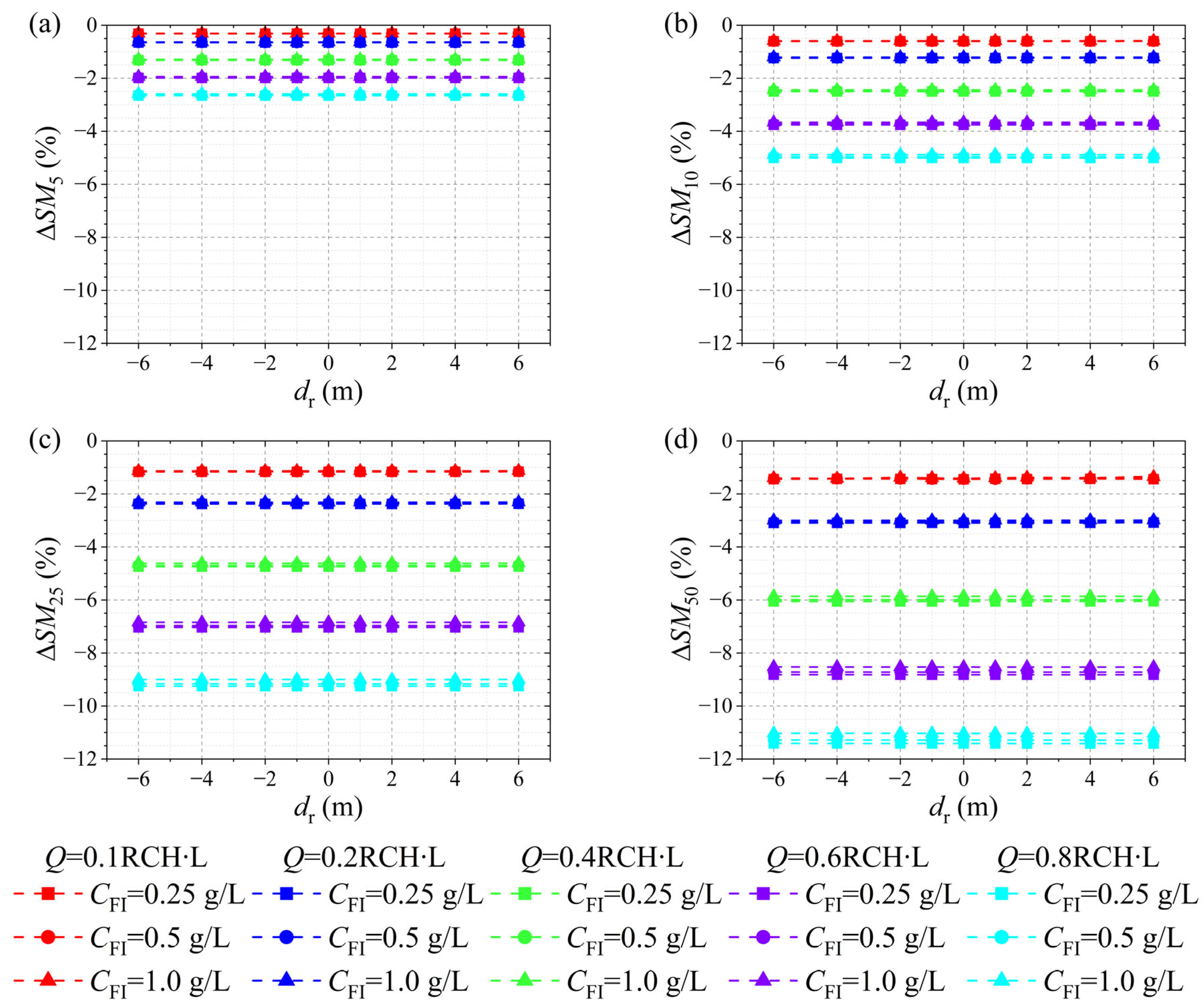
Figure 10 presents the transient responses of S M to various FI patterns across four management horizons, from t = 5 to 50 years. Each panel displays S M as a function of the relative FI depth d r , with separate profiles representing different levels of Q and C F I . All S M profiles in Figure 10 are characterized by a distinct vertical hierarchy that is primarily governed by Q, where the S M profiles for the same Q are tightly grouped together and higher Q values consistently result in more negative S M values, with all S M values remaining negative. While these S M profiles appear nearly horizontal with respect to d r , a closer inspection reveals that S M values for any given FI pattern actually decline slightly as d r increases. For example, with d r increasing from −6 m to 6 m, S M decreases slightly from −11.41% to −11.45% in the scenario where C F I = 0.25 g/L, Q = 0.8RCH · L, and t = 50 years, and it declines slightly from −11.03% to −11.05% in the scenario where C F I = 1.0 g/L, Q = 0.8RCH · L, and t = 50 years.
With the management horizon (t) extending from 5 to 50 years, S M values for all FI patterns become increasingly negative, and simultaneously, C F I plays a more critical role in determining S M over time, a trend that is particularly pronounced under higher-Q and longer-t conditions. To be specific, initially, at t = 5 years, S M profiles for different C F I levels are nearly identical under the same Q conditions. However, by t = 10 years, S M profiles with lower C F I at Q = 0.8RCH · L begin to diverge, showing more negative S M values than those using saltier injected water. As t reaches 25 and 50 years, this divergence extends to Q = 0.4RCH · L and 0.6RCH · L, where lower C F I consistently yields more negative S M values than those using saltier injected water. Conversely, for Q = 0.1RCH · L and 0.2RCH · L, S M remains largely unaffected by C F I throughout the study period, maintaining the behavior observed in earlier horizons. Moreover, while S M decreases over time, the magnitude of this decrease is significantly more pronounced under higher-Q FI patterns. The declining rate of S M tends to diminish as time progresses, and S M profiles under lower-Q FI patterns are observed to eventually approach a stable equilibrium of aquifer salt mass much sooner than their higher-Q counterparts.
Based on the analysis of Figure 10, several key insights regarding the transient responses of total salt mass to FI can be identified: (1) the results confirm that implementing FI is an effective strategy for alleviating aquifer salinization caused by SWI; (2) among the design parameters, Q plays the most predominant role in determining the efficacy of the FI strategy in aquifer salinization mitigation; (3) the vertical placement of the FI well imposes minor influence on its performance in aquifer salt removal. Specifically, positioning the FI deeper within the freshwater–saltwater mixing zone tends to slightly enhance its effectiveness for aquifer salt mass reduction. (4) The impact of C F I on aquifer salt removal is related to both Q and t. In high-Q and long-t scenarios, utilizing higher-purity freshwater (lower C F I ) yields significantly better outcomes of mitigating aquifer salinization. (5) While extending the FI duration generally expands its efficacy for aquifer salt removal, particularly for high-Q FI patterns, the system tends to eventually approach a stable equilibrium. This steady state is reached much sooner for lower-Q FI patterns compared to their higher-Q counterparts.
The impact of C F I on aquifer salt removal depends on both Q and t and can be attributed to the cumulative mass balance of salt and the time-lagged nature of solute transport. In high-Q FI scenarios, the large volume of injected water creates a substantial hydraulic gradient that actively flushes the aquifer; when this water is of high purity (low C F I ), it significantly enhances the dilution and displacement of saline groundwater. This effect is not immediate because the physical removal of salt ions from the pore space is a slower, dispersive–advective process. Consequently, the mitigation benefits of lower C F I only become statistically evident in scenarios of high Q and long management horizons as the purer water has sufficient time to circulate through and freshen the larger aquifer volume. In contrast, at low Q, the injection volume is insufficient to alter the overall salt mass significantly, rendering C F I a negligible factor regardless of the time elapsed.

4. Conclusions

This study investigated the effectiveness of FI for promoting FWL development and mitigating SWI in unconfined island aquifers, and specifically, focused on the time-dependent responses of the FWL and SWI extents to various FI patterns. The variable-density 2D island groundwater models based on hydrogeological conditions representative of Bahamian island aquifers were developed using SEAWAT to simulate aquifer response to different configurations of FI depth, intensity, injectant concentration, and injection durations. To quantitatively assess the impact of FI on the WTE, FWL depth, FWL volume, FRE and aquifer salt removal, five hydrological indicators were formulated.
The simulation results demonstrated that the overall WTE, FWL depth, freshwater storage, FRE, and total aquifer salt mass exhibit distinct transient responses to FI, and these responses are driven by a complex interplay between the FI design parameters, including d r , Q, C F I , and t. FI universally raises WTE and promotes the aquifer salt removal. Q is the primary driver of these changes, as higher Q values consistently produce greater rises in WTE and more significant reductions in total aquifer salt mass. Extending t is likely to enhance the rises in WTE and promote reductions in aquifer salt mass, a trend more evident under higher-Q FI patterns, consequently leading to widening gaps in WTE and salt mass between different Q levels and indicating that the influence of Q on WTE rises and aquifer salt removal amplifies over time. The influence of C F I on WTE and aquifer salt mass highly depends on t and Q. In the short term, C F I has a negligible impact on average WTE and total aquifer salt mass. However, with t increasing, under high-Q conditions, lower- C F I (higher-purity) injectants lead to slightly higher aquifer-wide average WTE rises and more effective salt removal compared to higher- C F I counterparts; under low-Q FI patterns, C F I remains a negligible factor regardless of t. Within the defined depth range, d r plays a marginal role, with deeper injection slightly diminishing WTE rises and reducing the efficacy of salt mass removal.
Implementing FI generally expands FWL depth and volume. Q remains a critical determinant of this effectiveness, in which higher Q consistently produces greater expansions in both FWL depth and volume, and this influence of Q on FWL morphology amplifies over time. In contrast to the marginal influence of C F I on WTE and aquifer salt mass, the importance of C F I is comparable to that of Q, with lower- C F I FI patterns consistently generating greater expansions in FWL depth and volume and, in some cases, a low-Q FI strategy at a low C F I can outperform high-Q patterns that use high- C F I water, indicating Q is not the sole predominant factor and C F I is an essential variable for FWL expansions. Impacts of d r on FWL depth and volume are fundamentally opposite. With deeper FI point within the freshwater–saltwater mixing zone, the FWL depth gradually increases while its volume concurrently decreases, both trends being more pronounced under high- C F I conditions. Notably, poorly configured FI patterns, particularly those characterized by high C F I , deep injection points, and extended management horizons, can lead to a net loss of freshwater storage rather than a gain. These reveal that while deeper FI within the mixing zone can further expand the FWL depth locally at the well, it may result in a smaller overall FWL volume compared to the pre-injection state.
With a sufficiently long t, the impacts of various FI patterns on the average WTE, freshwater storage, and aquifer salt removal tend to stabilize, as the groundwater system eventually reaches a new hydrodynamic equilibrium, which requires longer durations to redistribute groundwater.
This study also found that FI is highly efficient in the short term, with FRE often exceeding 100%, particularly under shallow, low- C F I , and low-Q FI strategies. Increasing d r generally reduces FRE, and this decline is more severe for higher- C F I injectants. The impact of Q on FRE exhibits a depth-dependent crossover: near the FWL interface, lower-Q FI patterns are more efficient, but at greater depths, higher-Q configurations are required to obtain superior FRE. FRE values across all FI configurations gradually converge toward zero with t continuously increasing, as the marginal returns on injected freshwater diminish significantly once the system stabilizes under sufficiently long duration. Therefore, extending the FI duration diminishes the influence of d r , Q, and C F I on FRE.
The location of FI relative to the initial FWL interface strongly affects its effectiveness for FWL development and SWI mitigation, and this study assumes the FWL interface depth is known in advance. In practice, identifying the precise geometry and interface of an FWL under the natural condition remains a significant field challenge, representing a fundamental limitation on applying FI strategies to real-world scenarios. Moreover, findings in this study are intended to be generic to island aquifers, even though they are based on the general characteristics of a specific site. As such, this analysis serves as a crucial initial step towards developing more sophisticated models that can effectively evaluate the time-dependent FI performance in real-world island aquifers for FWL development and SWI mitigation. Next, it is important to couple the process-based modeling framework developed here with site-specific water availability assessments and economic evaluations to determine whether FI is a cost-effective practical management strategy for real-world small islands. Future work also should focus on developing field-calibrated models and advanced 3D simulations to provide site-specific, multi-well management strategies, and on evaluating how aquifer characteristics affect the FI performance, such as recharge conditions and heterogeneity, to enhance understanding of island resilience to SWI under FI.

Author Contributions

Conceptualization, W.Y.; methodology, W.Y. and Y.Z.; software, W.Y.; validation, W.Y.; formal analysis, W.Y.; investigation, W.Y. and Y.Z.; resources, Y.Z.; data curation, W.Y.; writing—original draft preparation, W.Y.; writing—review and editing, W.Y. and Y.Z.; visualization, W.Y.; supervision, Y.Z.; funding acquisition, Y.Z. All authors have read and agreed to the published version of the manuscript.

Funding

This work was supported by Yipeng Zhang’s startup grant from Oklahoma State University, USA, and by the U.S. Environmental Protection Agency STAR program (Grant No. R840618).

Data Availability Statement

Some or all data, models, or code that support the findings of this study are available from the corresponding author upon reasonable request. The SEAWAT code is publicly available at https://www.usgs.gov/software/seawat-a-computer-program-simulation-three-dimensional-variable-density-ground-water-flow (accessed on 11 May 2026).

Acknowledgments

The authors would like to thank the editor and anonymous reviewers for their kind feedback and insightful comments, which helped improve the clarity of this paper.

Conflicts of Interest

All authors declare that the research was conducted in the absence of any commercial or financial relationships that could be construed as a potential conflict of interest.

Abbreviations

The following abbreviations are used in this manuscript:
SWISeawater intrusion
FWLFreshwater lens
FIFreshwater injection
2DTwo-dimensional
WTEWater table elevation
FREFreshwater recovery efficiency
RCHAquifer recharge
HKHydraulic conductivity
DVsDecision variables
3DThree-dimensional
LIsland aquifer width
DFI depth
Qintensity of constant injection
C F I injected freshwater concentration
tFI duration
d r FI depth expressed as the vertical distance from the freshwater zone bottom
W T E a v g relative change in average WTE
d relative change in FWL depth
F V relative change in fresh groundwater volume
S M relative change in total salt mass in the aquifer
W T E a v g , t W T E a v g at the management horizon t
W T E a v g , t average WTE at a specific FI duration t
W T E a v g , 0 average WTE at the steady state in the baseline scenario
d t d for a given FI duration t
d c FWL depth at a specific FI duration t
d 0 FWL depth at the steady state in the baseline scenario
F V t F V for a given FI duration t
F V t freshwater volume at a specific FI duration t
F V 0 subsurface freshwater volume before FI implementation
F R E t FRE   at   the   management   horizon   t
V t total   volume   of   injected   freshwater   until   the   end   of   the   FI   period   t
S M t S M at the end of the management horizon t
S M t total salt mass at the end of FI duration t
S M 0 total salt mass in the aquifer before FI

References

  1. Columbus, N. Viscous model study of sea water intrusion in water table aquifers. Water Resour. Res. 1965, 1, 313–323. [Google Scholar] [CrossRef]
  2. Henry, H.R. Salt intrusion into fresh-water aquifers. J. Geophys. Res. 1959, 64, 1911–1919. [Google Scholar] [CrossRef]
  3. Kishi, Y.; Fukuo, Y. Studies on salinization of groundwater, I: Theoretical consideration on the three-dimensional movement of the salt water interface caused by the pumpage of confined groundwater in fan-shaped alluvium. J. Hydrol. 1977, 35, 1–29. [Google Scholar] [CrossRef]
  4. Agoubi, B. A review: Saltwater intrusion in North Africa’s coastal areas-current state and future challenges. Environ. Sci. Pollut. Res. 2021, 8, 17029–17043. [Google Scholar] [CrossRef] [PubMed]
  5. Jasechko, S.; Perrone, D.; Seybold, H.; Fan, Y.; Kirchner, J.W. Groundwater level observations in 250,000 coastal US wells reveal scope of potential seawater intrusion. Nat. Commun. 2020, 11, 3229. [Google Scholar] [CrossRef] [PubMed]
  6. Werner, A.D.; Sharp, H.K.; Galvis, S.C.; Post, V.E.; Sinclair, P. Hydrogeology and management of freshwater lenses on atoll islands: Review of current knowledge and research needs. J. Hydrol. 2017, 551, 819–844. [Google Scholar] [CrossRef]
  7. Fetter, C.W. Position of the saline water interface beneath oceanic islands. Water Resour. Res. 1972, 8, 1307–1315. [Google Scholar] [CrossRef]
  8. Van der Veer, P. Analytical solution for steady interface flow in a coastal aquifer involving a phreatic surface with precipitation. J. Hydrol. 1977, 34, 1–11. [Google Scholar] [CrossRef]
  9. Ghassemi, F.; Molson, J.W.; Falkland, A.; Alam, K. Three-dimensional simulation of the Home Island freshwater lens: Pre-liminary results. Environ. Model. Softw. 1998, 14, 181–190. [Google Scholar] [CrossRef]
  10. Sharan, A.; Lal, A.; Datta, B. A review of groundwater sustainability crisis in the Pacific Island countries: Challenges and solutions. J. Hydrol. 2021, 603, 127165. [Google Scholar] [CrossRef]
  11. Hussain, M.S.; Abd-Elhamid, H.F.; Javadi, A.A.; Sherif, M.M. Management of seawater intrusion in coastal aquifers: A review. Water 2019, 11, 2467. [Google Scholar] [CrossRef]
  12. Polemio, M.; Zuffianò, L.E. Review of utilization management of groundwater at risk of salinization. J. Water Resour. Plan. Manag. 2020, 146, 03120002. [Google Scholar] [CrossRef]
  13. Kashef, A.A.I. Control of salt-water intrusion by recharge wells. J. Irrig. Drain. Div. 1976, 102, 445–457. [Google Scholar] [CrossRef]
  14. Hunt, B. Some analytical solutions for seawater intrusion control with recharge wells. J. Hydrol. 1985, 80, 9–18. [Google Scholar] [CrossRef]
  15. Strack, O.D.L. A single-potential solution for regional interface problems in coastal aquifers. Water Resour. Res. 1976, 12, 1165–1174. [Google Scholar] [CrossRef]
  16. Mahesha, A. Steady-state effect of freshwater injection on seawater intrusion. J. Irrig. Drain. Eng. 1996, 122, 149–154. [Google Scholar] [CrossRef]
  17. Luyun, R., Jr.; Momii, K.; Nakagawa, K. Effects of recharge wells and flow barriers on seawater intrusion. Groundwater 2011, 49, 239–249. [Google Scholar] [CrossRef]
  18. Park, N.; Cui, L.; Shi, L. Analytical design curves to maximize pumping or minimize injection in coastal aquifers. Groundwater 2009, 47, 797–805. [Google Scholar] [CrossRef]
  19. Botero-Acosta, A.; Donado, L.D. Laboratory scale simulation of hydraulic barriers to seawater intrusion in confined coastal aquifers considering the effects of stratification. Procedia Environ. Sci. 2015, 25, 36–43. [Google Scholar] [CrossRef]
  20. Sriapai, T.; Walsri, C.; Phueakphum, D.; Fuenkajorn, K. Physical model simulations of seawater intrusion in unconfined aquifer. Songklanakarin J. Sci. Technol. 2012, 34, 679–687. [Google Scholar]
  21. Mahesha, A. Transient effect of battery of injection wells on seawater intrusion. J. Hydraul. Eng. 1996, 122, 266–271. [Google Scholar] [CrossRef]
  22. Reichard, E.G.; Johnson, T.A. Assessment of regional management strategies for controlling seawater intrusion. J. Water Resour. Plan. Manag. 2005, 131, 280–291. [Google Scholar] [CrossRef]
  23. Bray, B.S.; Yeh, W.W.G. Improving seawater barrier operation with simulation optimization in southern California. J. Water Resour. Plan. Manag. 2008, 134, 171–180. [Google Scholar] [CrossRef]
  24. Armanuos, A.M.; Ibrahim, M.G.; Mahmod, W.E.; Takemura, J.; Yoshimura, C. Analysing the combined effect of barrier wall and freshwater injection countermeasures on controlling saltwater intrusion in unconfined coastal aquifer systems. Water Resour. Manag. 2019, 33, 1265–1280. [Google Scholar] [CrossRef]
  25. Ebeling, P.; Händel, F.; Walther, M. Potential of mixed hydraulic barriers to remediate seawater intrusion. Sci. Total Environ. 2019, 693, 133478. [Google Scholar] [CrossRef]
  26. Abd-Elaty, I.; Straface, S.; Kuriqi, A. Sustainable saltwater intrusion management in coastal aquifers under climatic changes for humid and hyper-arid regions. Ecol. Eng. 2021, 171, 106382. [Google Scholar] [CrossRef]
  27. Abd-Elaty, I.; Javadi, A.A.; Abd-Elhamid, H. Management of saltwater intrusion in coastal aquifers using different wells systems: A case study of the Nile Delta aquifer in Egypt. Hydrogeol. J. 2021, 29, 1767–1783. [Google Scholar] [CrossRef]
  28. Sheahan, N.T. Injection/Extraction Well System–A Unique Seawater Intrusion Barrier. Groundwater 1977, 15, 32–50. [Google Scholar] [CrossRef]
  29. Shi, L.; Lu, C.; Ye, Y.; Xie, Y.; Wu, J. Evaluation of the performance of multiple-well hydraulic barriers on enhancing groundwater extraction in a coastal aquifer. Adv. Water Resour. 2020, 144, 103704. [Google Scholar] [CrossRef]
  30. Rastogi, A.K.; Choi, G.W.; Ukarande, S.K. Diffused interface model to prevent ingress of sea water in multi-layer coastal aquifers. J. Spat. Hydrol. 2004, 4, 2. [Google Scholar]
  31. Motallebian, M.; Ahmadi, H.; Raoof, A.; Cartwright, N. An alternative approach to control saltwater intrusion in coastal aquifers using a freshwater surface recharge canal. J. Contam. Hydrol. 2019, 222, 56–64. [Google Scholar] [CrossRef]
  32. Yan, M.; Lu, C.; Werner, A.D.; Luo, J. Analytical, experimental, and numerical investigation of partially penetrating barriers for expanding island freshwater lenses. Water Resour. Res. 2021, 57, e2020WR028386. [Google Scholar] [CrossRef]
  33. Yang, J.; Graf, T.; Luo, J.; Lu, C. Effect of cut-off wall on freshwater storage in small islands considering ocean surge inundation. J. Hydrol. 2021, 603, 127143. [Google Scholar] [CrossRef]
  34. Yu, W.; Zhang, Y. Impacts of sea-level rise and recharge fluctuations on cutoff wall effectiveness for freshwater lens development and seawater intrusion mitigation in unconfined island aquifers. Hydrology 2026, 13, 76. [Google Scholar] [CrossRef]
  35. Yu, W.; Baù, D.; Mayer, A.S.; Mancewicz, L.; Geranmehr, M. Investigating the impact of seawater intrusion on the operation cost of groundwater supply in island aquifers. Water Resour. Res. 2023, 59, e2023WR034798. [Google Scholar] [CrossRef]
  36. Yu, W.; Baù, D.; Mayer, A.S.; Geranmehr, M. An efficient surrogate-based multi-objective optimisation framework with novel sampling strategy for sustainable island groundwater management. Adv. Geosci. 2024, 64, 23–26. [Google Scholar] [CrossRef]
  37. Ho, H.C.; Mylroie, J.E.; Infante, L.R.; Rodgers, J.C. Fuzzy-based spatial modelling approach to predict island karst distribution: A conceptual model. Environ. Earth Sci. 2014, 71, 1369–1377. [Google Scholar] [CrossRef]
  38. McGee, D.K.; Wynn, J.G.; Onac, B.P.; Harries, P.J.; Rothfus, E.A. Tracing groundwater geochemistry using δ13C on San Salvador Island (southeastern Bahamas): Implications for carbonate island hydrogeology and dissolution. Carbonates Evaporites 2010, 25, 91–105. [Google Scholar] [CrossRef]
  39. Martin, J.B.; Moore, P.J. Sr concentrations and isotope ratios as tracers of ground-water circulation in carbonate platforms: Examples from San Salvador Island and Long Island, Bahamas. Chem. Geol. 2008, 249, 52–65. [Google Scholar] [CrossRef]
  40. Davis, R.L.; Johnson, C.R. Karst hydrology of San Salvador. In Proceedings of the Fourth Symposium on the Geology of the Bahamas; Mylroie, J.E., Ed.; Bahamian Field Station: San Salvador Island, Bahamas, 1989; pp. 118–135. [Google Scholar]
  41. Moore, P.J. Controls on the Generation of Secondary Porosity in Eogenetic Karst: Examples from San Salvador Island, Bahamas and North-Central Florida, USA. Ph.D. Thesis, University of Florida, Gainesville, FL, USA, 2009. [Google Scholar]
  42. Langevin, C.D.; Thorne, D.T., Jr.; Dausman, A.M.; Sukop, M.C.; Guo, W. SEAWAT Version 4: A Computer Program for Simulation of Multi-Species Solute and Heat Transport. In U.S. Geological Survey Techniques and Methods; U.S. Geological Survey: Reston, VA, USA, 2008; Volume Book 6, Chapter A22, pp. 1–39. [Google Scholar] [CrossRef]
  43. Gulley, J.D.; Mayer, A.S.; Martin, J.B.; Bedekar, V. Sea level rise and inundation of island interiors: Assessing impacts of lake formation and evaporation on water resources in arid climates. Geophys. Res. Lett. 2016, 43, 9712–9719. [Google Scholar] [CrossRef]
  44. Holding, S.; Allen, D.M. From days to decades: Numerical modelling of freshwater lens response to climate change stressors on small low-lying islands. Hydrol. Earth Syst. Sci. 2015, 19, 933–949. [Google Scholar] [CrossRef]
  45. Volker, R.E.; Mariño, M.A.; Rolston, D.E. Transition zone width in ground water on ocean atolls. J. Hydraul. Eng. 1985, 111, 659–676. [Google Scholar] [CrossRef]
  46. Budd, D.A.; Vacher, H.L. Predicting the thickness of fresh-water lenses in carbonate paleo-islands. J. Sediment. Res. 1991, 61, 43–53. [Google Scholar] [CrossRef]
Figure 1. (a) Cross-section diagram of an FWL in an island aquifer. Key parameters include water table elevation (WTE), FWL depth (d), and freshwater injection depth relative to the FWL interface ( d r ). (b) An illustration of a freshwater-injection hydraulic barrier placed in the coastal aquifer. Black dashed and solid lines represent the water table position before and after the barrier implementation, respectively; blue dashed and solid lines represent the freshwater–saltwater interface before and after implementing the hydraulic barrier, respectively.
Hydrology 13 00136 g001
Figure 2. Location map of San Salvador Island [41]. The blue box in the inset map indicates the position of San Salvador within the Bahamian archipelago. On the main map, the gray and white areas represent land and surface water bodies, respectively.
Hydrology 13 00136 g002
Figure 3. Island aquifer SEAWAT cross-sectional model grid, along with the associated boundary conditions and the placement of the FI well.
Hydrology 13 00136 g003
Figure 4. Groundwater concentration distribution at the steady state in the baseline scenario. The red dashed line represents the 1.0 g/L concentration contour, delineating the freshwater–saltwater transition zone, while the black dashed line indicates the 35.0 g/L contour, approximating the seawater boundary.
Hydrology 13 00136 g004
Figure 5. Profiles of the relative change in average WTE ( W T E a v g ) for various FI patterns at four management horizons: (a) 5 years, (b) 10 years, (c) 25 years, and (d) 50 years. Profile legends are provided at the bottom of the figure.
Hydrology 13 00136 g005
Figure 6. Profiles of the relative change in FWL depth ( d ) for various FI patterns at four management horizons: (a) 5 years, (b) 10 years, (c) 25 years, and (d) 50 years. Profile legends are provided at the bottom of the figure.
Hydrology 13 00136 g006
Figure 7. Groundwater flow fields and salt concentration distributions for FI implementation with different combinations of Q, d r , C F I and t: (a) Q = 0.1RCH · L, d r = −6 m, C F I = 0.25 g/L, t = 5 years; (b) Q = 0.1RCH · L, d r   = −6 m, C F I = 0.25 g/L, t = 25 years; (c) Q = 0.1RCH · L, d r = −6 m, C F I = 0.25 g/L, t = 50 years; (d) Q = 0.1RCH · L, d r = −6 m, C F I = 1.0 g/L, t = 5 years; (e) Q = 0.1RCH · L, d r = −6 m, C F I = 1.0 g/L, t = 25 years; (f) Q = 0.1RCH · L, d r = −6 m, C F I = 1.0 g/L, t = 50 years; (g) Q = 0.1RCH · L, d r = 6 m, C F I = 0.25 g/L, t = 5 years; (h) Q = 0.1RCH · L, d r = 6 m, C F I = 0.25 g/L, t = 25 years; (i) Q = 0.1RCH · L, d r = 6 m, C F I = 0.25 g/L, t = 50 years; (j) Q = 0.8RCH · L, d r = −6 m, C F I = 0.25 g/L, t = 5 years; (k) Q = 0.8RCH · L, d r = −6 m, C F I = 0.25 g/L, t = 25 years; (l) Q = 0.8RCH · L, d r = −6 m, C F I = 0.25 g/L, t = 50 years. Red markers denote the FI well. White dashed lines represent the initial FWL boundary before FI, and red dashed lines represent the FWL boundary with FI.
Hydrology 13 00136 g007
Figure 8. Profiles of the relative change in fresh groundwater volume ( F V ) for various FI patterns at four management horizons: (a) 5 years, (b) 10 years, (c) 25 years, and (d) 50 years. Profile legends are provided at the bottom of the figure.
Hydrology 13 00136 g008
Figure 9. Profiles of freshwater recovery efficiency (FRE), the ratio of the net increase in subsurface freshwater storage to the total volume of injected freshwater, for various FI patterns at four management horizons: (a) 5 years, (b) 10 years, (c) 25 years, and (d) 50 years. Profile legends are provided at the bottom of the figure.
Hydrology 13 00136 g009
Figure 10. Profiles of the relative change in total aquifer salt mass ( S M ) for various FI patterns at four management horizons: (a) 5 years, (b) 10 years, (c) 25 years, and (d) 50 years. Profile legends are provided at the bottom of the figure.
Hydrology 13 00136 g010
Table 1. Model parameters used for SWI simulation in the 2D island aquifer model.
Model ComponentParametersUnitsValues
Groundwater FlowRCHm/year0.2
Effective porosity\0.3
Specific yield\0.15
Horizontal hydraulic conductivity (HK)m/day50.0
HK transversal anisotropy ratio\1.0
HK vertical anisotropy ratio\1.0
Solute TransportLongitudinal dispersivitym1.0
Transversal dispersivitym0.1
Vertical dispersivitym0.01
Molecular diffusion coefficientm2/s 1.0   × 10−9
Aquifer recharge concentrationg/L0
Density
dependence
Freshwater densitykg/m31000
Seawater densitykg/m31025
Density/concentration slope 1\0.7143
1 The water density ρ w [kg/m3] varies linearly with the salt concentration C [kg/m3] through the equation ρ w = 1000 + 0.7143 · C [42].
Table 2. Values of decision variables (DVs) considered for the FI patterns for island aquifer management.
DVsDiscrete Values
d r (m)−6−4−2−101246
Q (m2/year) 0.1 RCH · L 0.2 RCH · L 0.4 RCH · L 0.6 RCH · L 0.8 RCH · L
C F I (g/L)0.250.51.0
t (year)5102550
Table 3. Summary of initial indicator values for the island aquifer in the baseline case.
Indicators W T E a v g , 0 (m) d 0 (m) F V 0 (m2) S M 0 (kg/m)
Value0.5825.7236,7366,323,667
Disclaimer/Publisher’s Note: The statements, opinions and data contained in all publications are solely those of the individual author(s) and contributor(s) and not of MDPI and/or the editor(s). MDPI and/or the editor(s) disclaim responsibility for any injury to people or property resulting from any ideas, methods, instructions or products referred to in the content.