


Spatiotemporal Evolution of Groundwater System Sustainability in Northeast China’s Transboundary River Basins Under Agricultural Expansion and Climate Variability: Insights from GRACE Satellite Observations
Abstract
1. Introduction
2. Materials and Methods
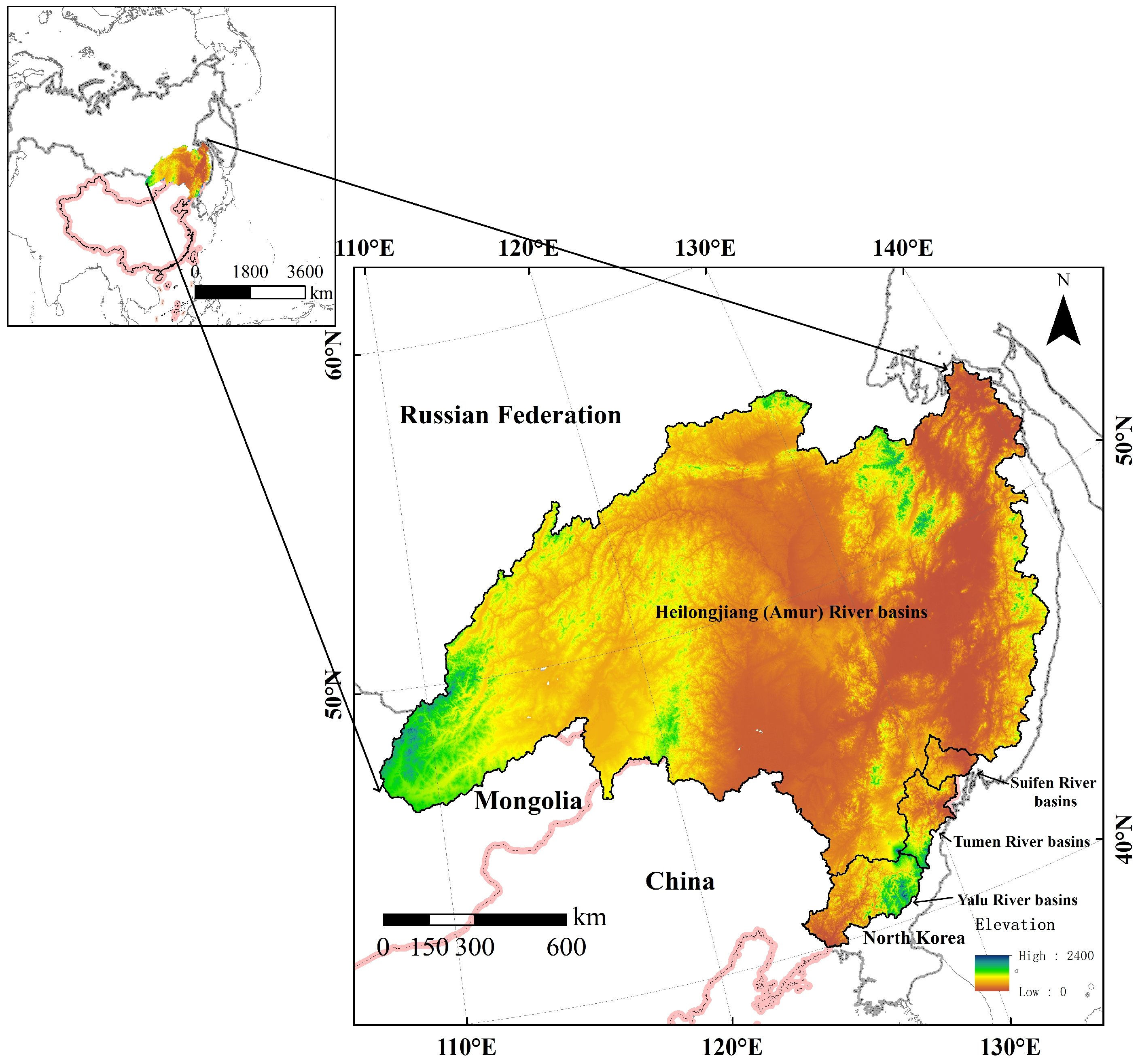
2.1. Study Area
2.2. Data Sources
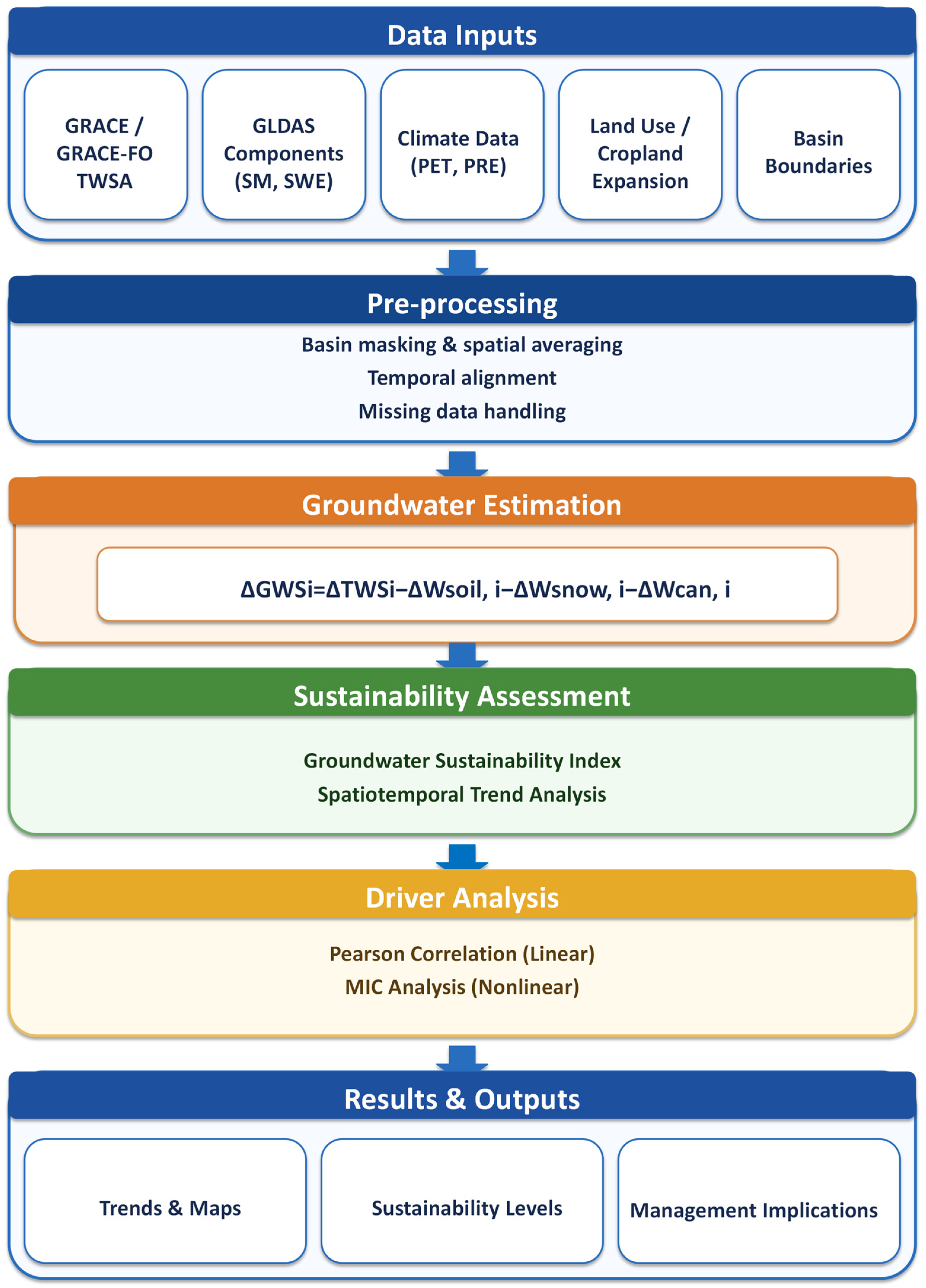
2.3. Methods
2.3.1. SSA Interpolation Method
2.3.2. Inversion of Groundwater Storage Anomalies (ΔGWS)
2.3.3. GRACE Groundwater Drought Index (GGDI)
2.3.4. Groundwater Sustainability Assessment (SI)
2.3.5. Driving Factor Analysis
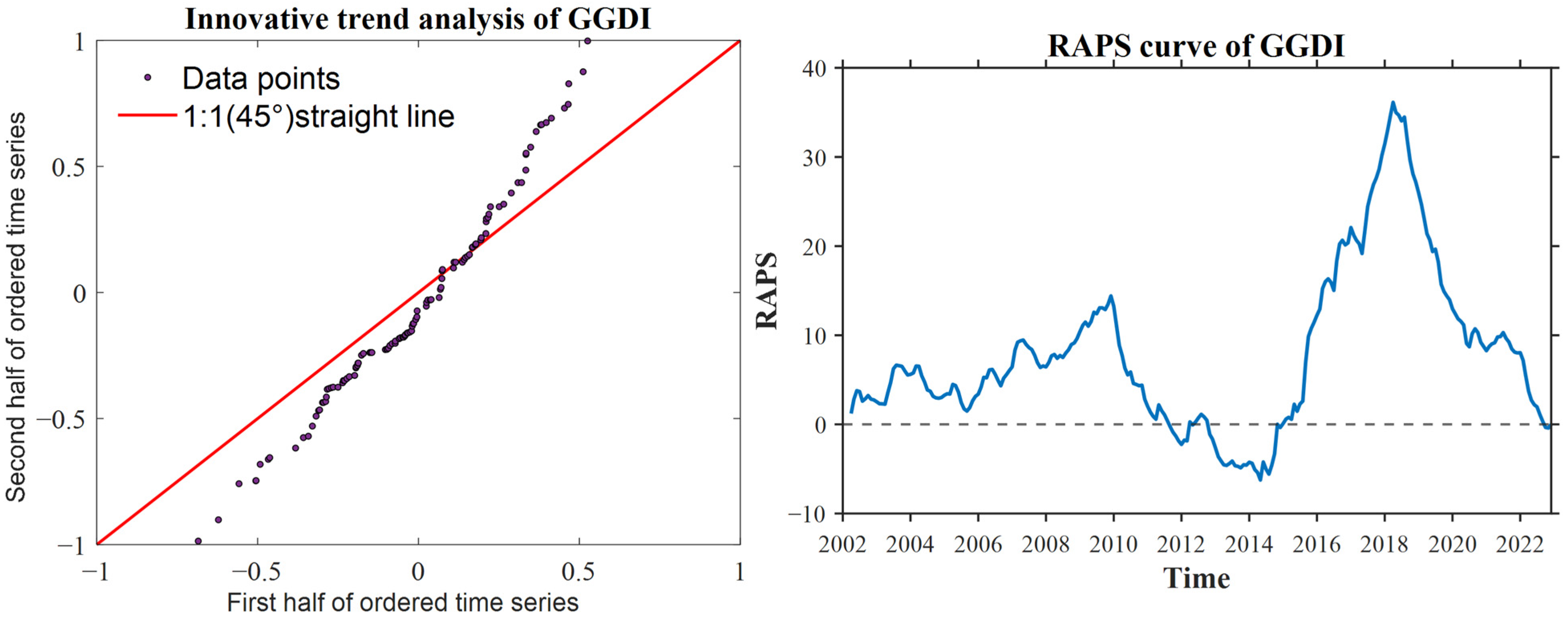
2.3.6. Time-Series Robustness Analysis (RAPS and ITA)
3. Results
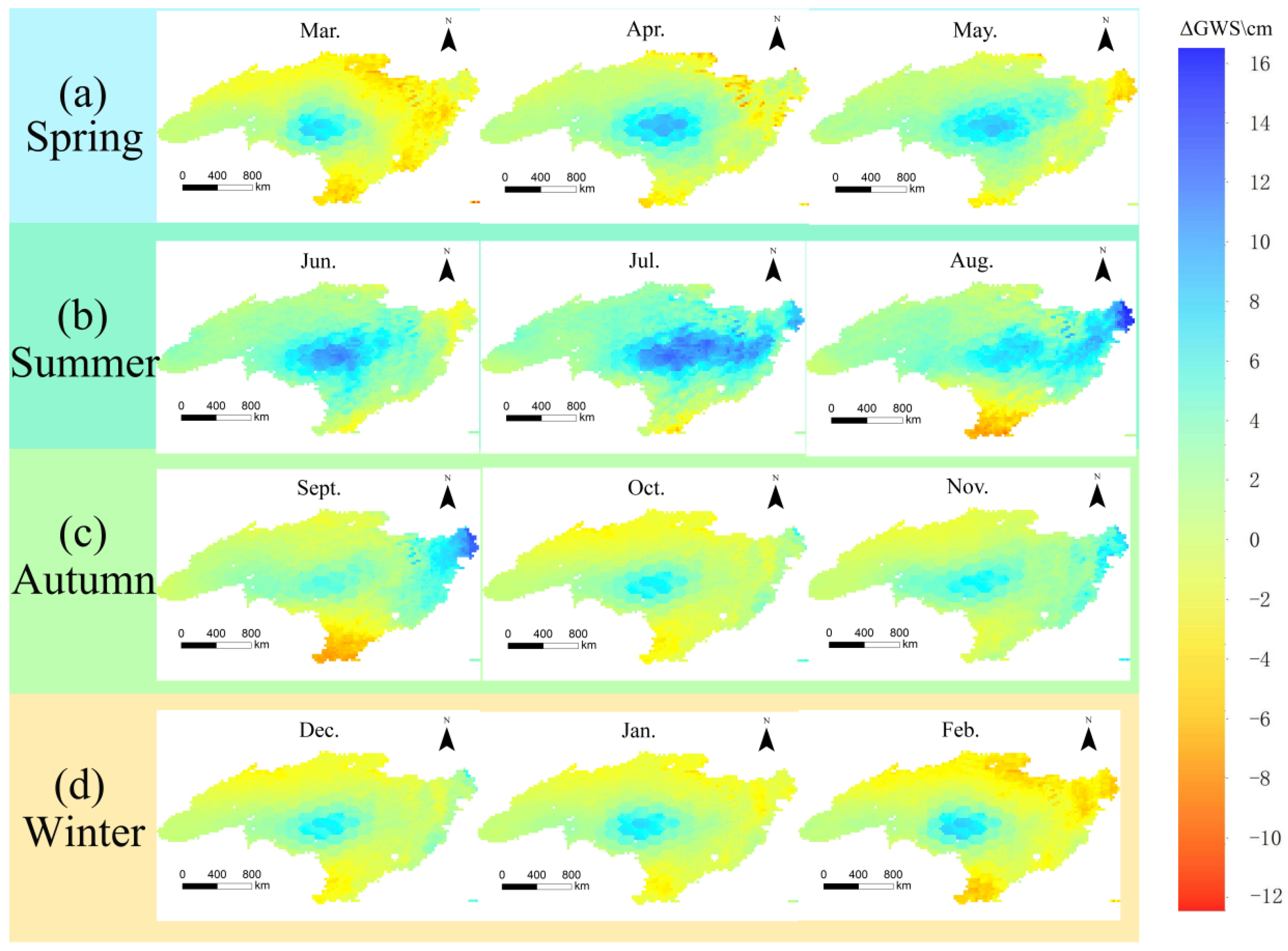
3.1. Spatiotemporal Anomaly Characteristics of Groundwater Storage
3.2. Spatiotemporal Variations of GGDI
3.3. Groundwater Sustainability Assessment in the Transboundary River Basins of Northeast China
3.4. Analysis of Factors Influencing Groundwater Sustainability
3.4.1. Relationship Between Precipitation and ΔGWS
3.4.2. Land-Use Change
4. Discussion
4.1. Effects of Climatic Factors on Groundwater Sustainability
4.2. Effects of Human Activities on Groundwater Sustainability
4.3. Impacts of Agricultural and Regional Development Policies on Groundwater Systems
4.4. Spatial Heterogeneity of Groundwater Sustainability and Implications for Transboundary Water Resources Management
4.5. Methodological Uncertainties and Limitations
5. Conclusions
- (1)
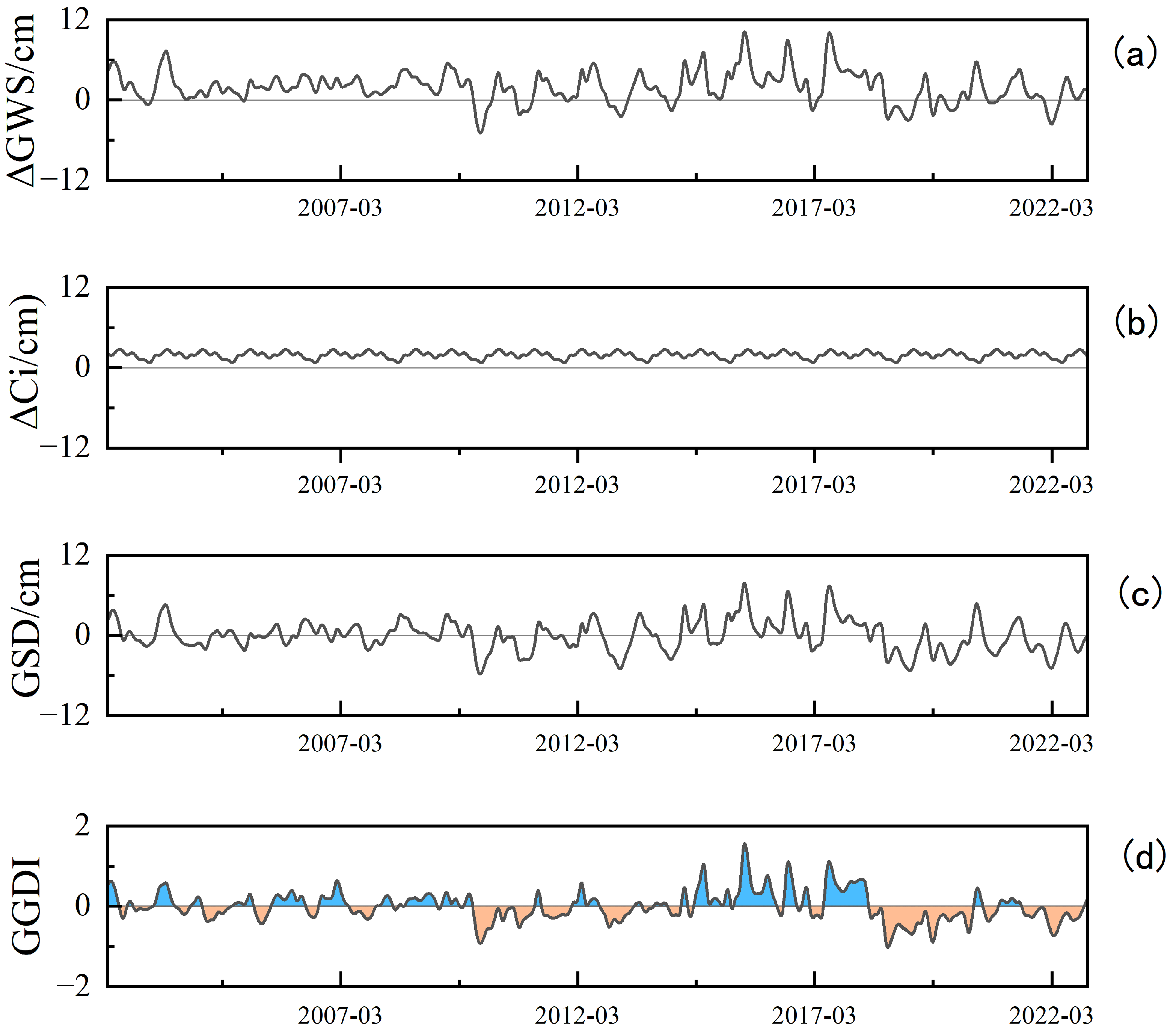
- Continuous groundwater storage decline, intensifying drought conditions, and pronounced spatial heterogeneity. During 2002–2022, ΔGWS in the study area exhibited a fluctuating downward trend, with the highest values occurring in July and the lowest in February. The upper reaches of the Heilongjiang (Amur) River basin showed relative water surplus conditions, whereas the southern Yalu River basin experienced persistent deficits. GGDI results indicate that groundwater drought has continuously intensified since 2018, with agriculturally intensive regions such as the Songnen Plain and the San Jiang Plain emerging as core areas of long-term structural groundwater drought.
- (2)
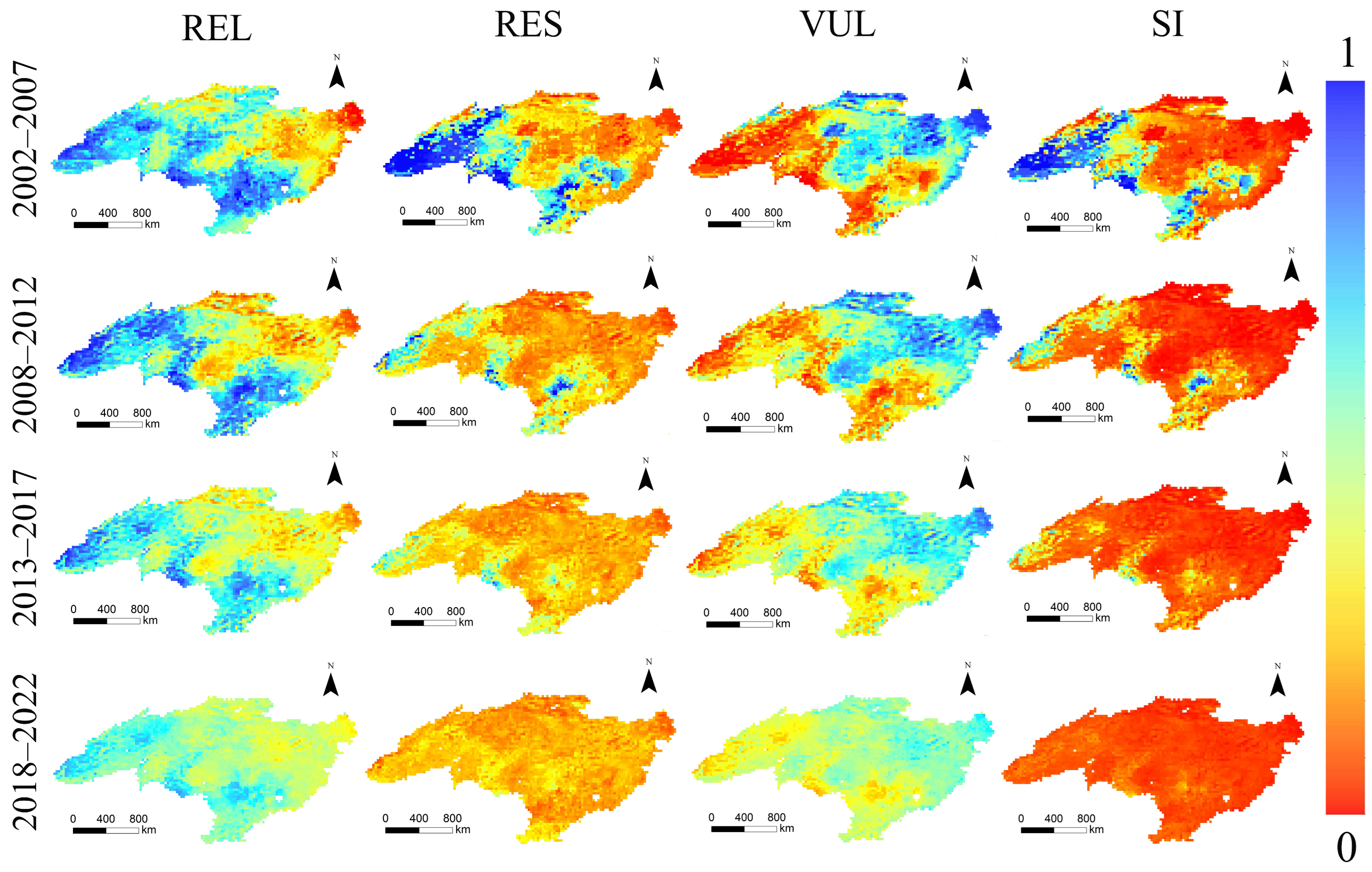
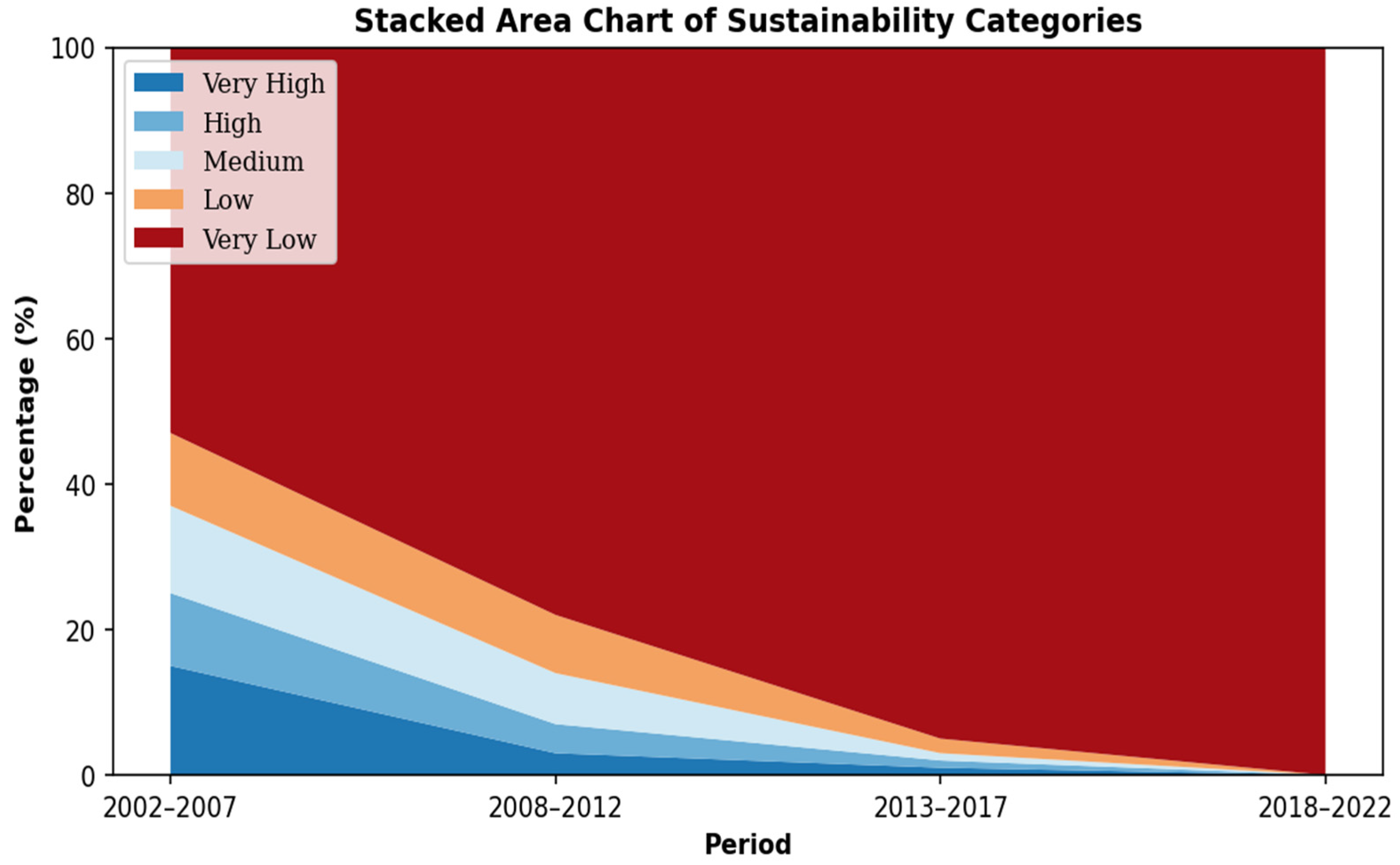
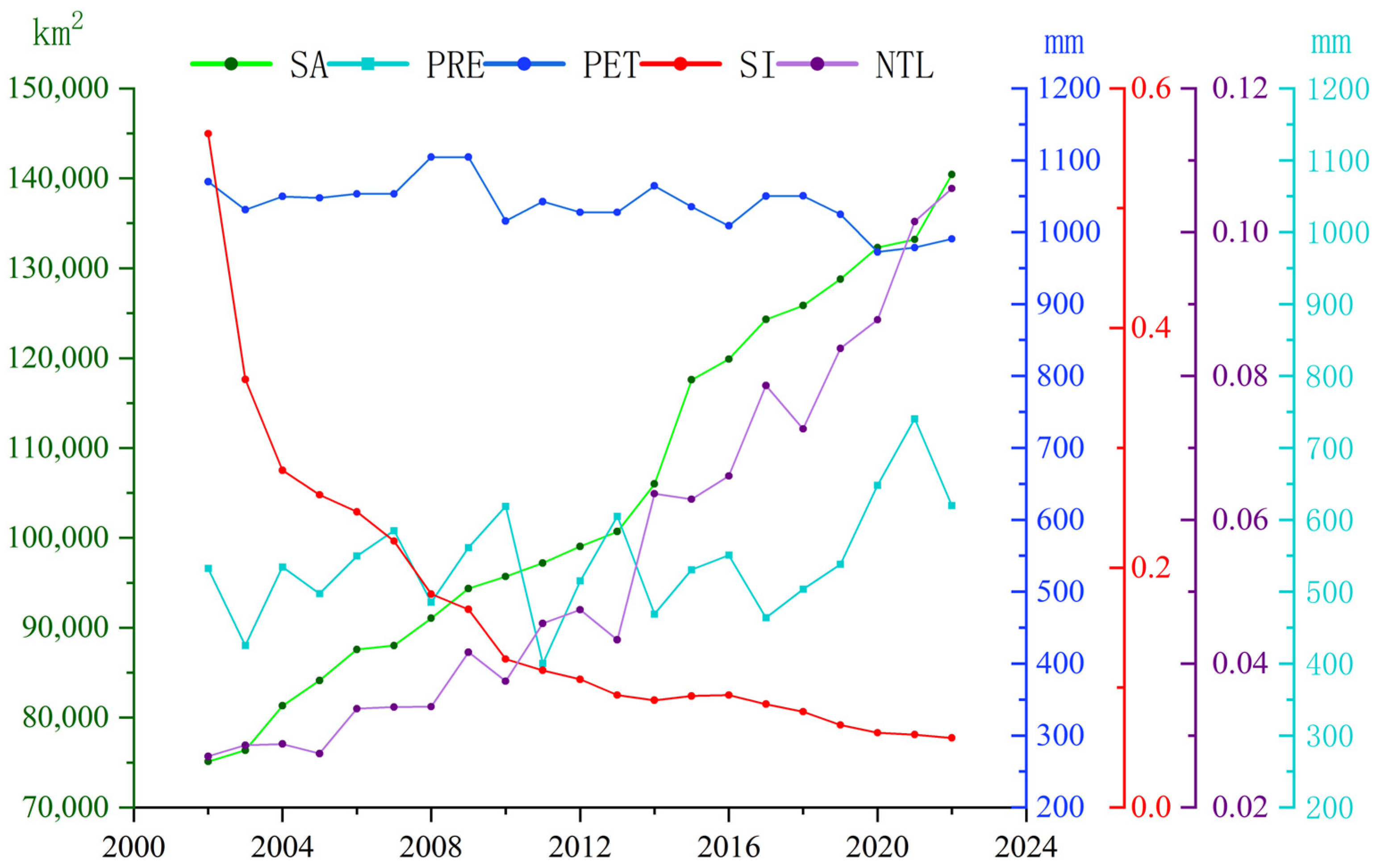
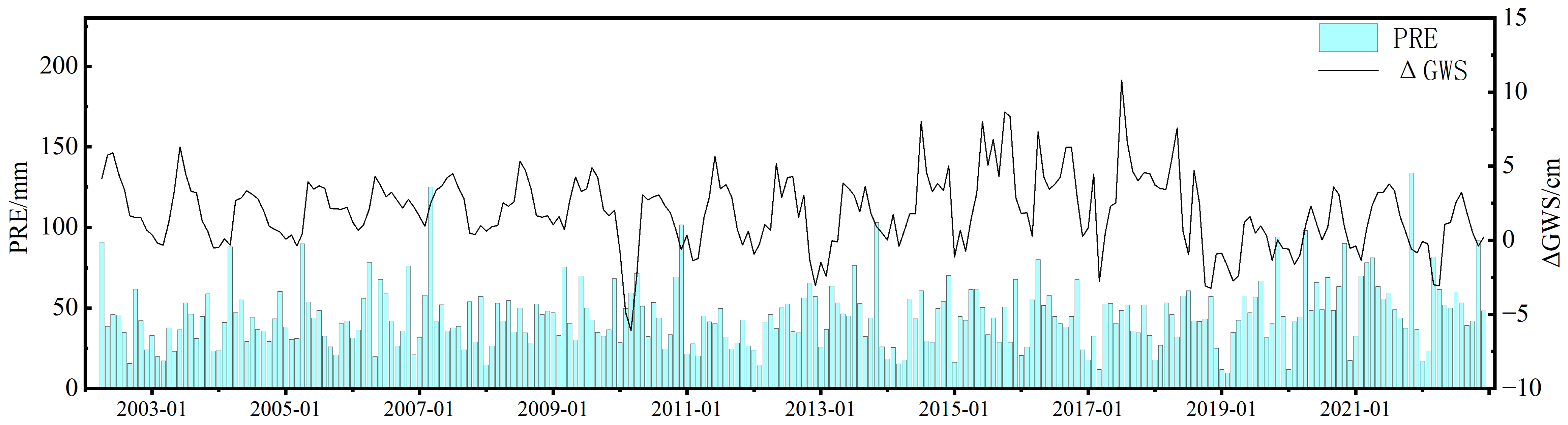
- Persistent decline in groundwater sustainability, characterized by reduced reliability and resilience and increasing system vulnerability. Groundwater sustainability consistently deteriorated over the study period, manifested by weakened reliability, reduced recovery capacity, and heightened sensitivity to external disturbances. The SI values for the four successive stages were 0.32, 0.14, 0.09, and 0.06, respectively, while the proportion of areas with extremely low sustainability increased from 51.6% to 99.6%, covering nearly the entire basin. Notably, although precipitation exhibited an increasing trend during the same period, groundwater conditions did not improve and instead continued to deteriorate. In contrast, sown area (MIC = 0.98) and nighttime light intensity (MIC = 0.92) showed much stronger synchronicity with groundwater sustainability changes. This indicates that groundwater dynamics are no longer primarily controlled by natural recharge, but are increasingly dominated by agricultural expansion and urban development. The evolution of REL, RES, and VUL further corroborates this shift, highlighting a transition from natural regulation to human water-use dominance and a marked increase in regional groundwater security risks.
- (3)
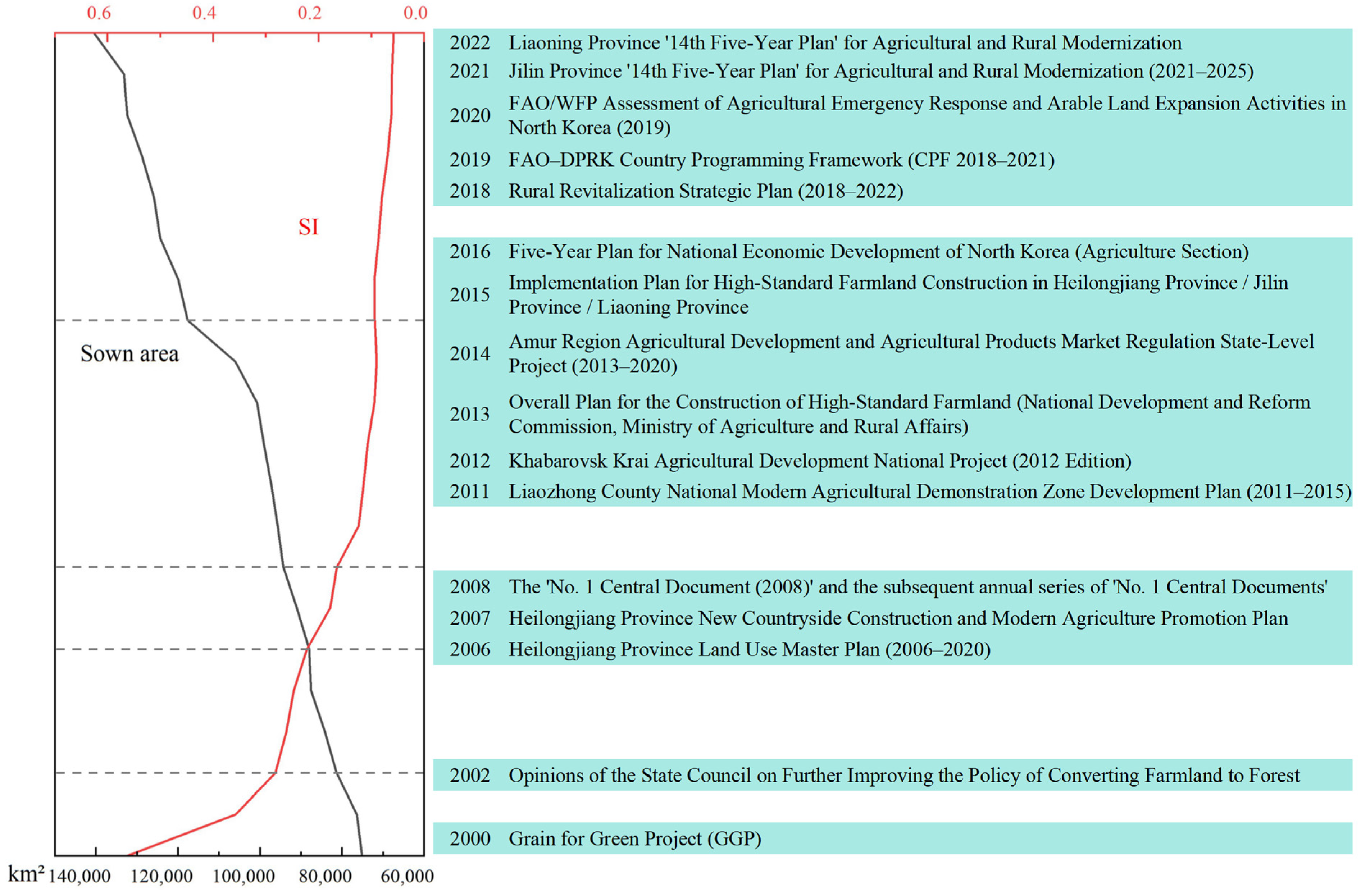
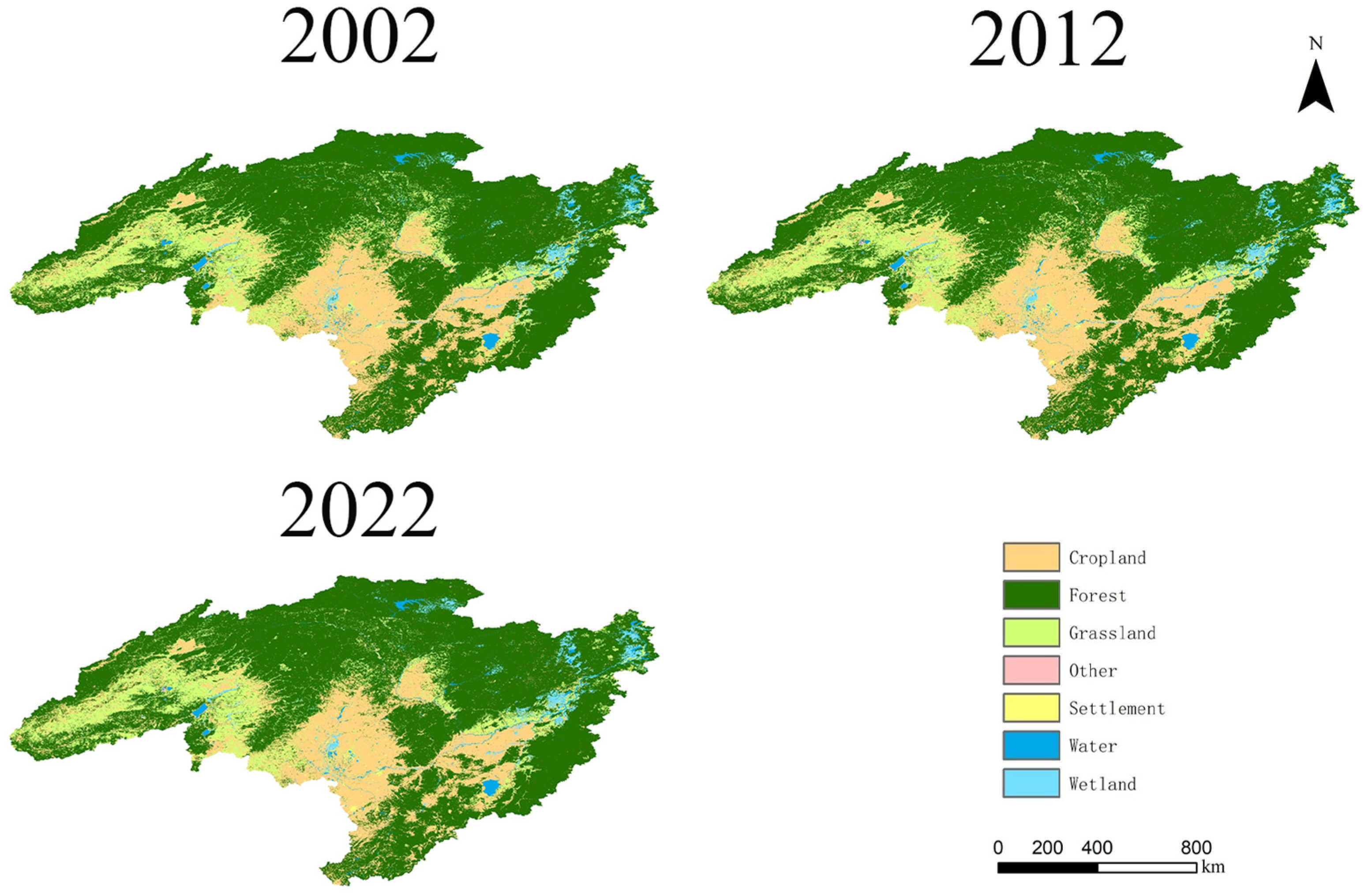
- Agricultural expansion and human activities are the primary drivers of declining groundwater sustainability, with policy factors as the underlying causes. MIC analysis reveals that sown area (SA) exerts the strongest influence on SI (0.98), followed by nighttime light intensity (NTL, 0.92), both substantially exceeding the impacts of climatic factors. During 2002–2022, cropland area increased by 0.96%, built-up land by 75.07%, and sown area by 86.97%. Policy orientations such as “high-standard farmland construction,” “grain yield enhancement,” and “rural revitalization” have promoted agricultural intensification well beyond natural recharge capacity, constituting a key institutional driver of long-term groundwater depletion.
- (4)
- Enhancing groundwater sustainability requires integrated efforts in agricultural restructuring, water-saving technologies, and transboundary cooperative governance. Given the difficulty of reversing natural drivers in the short term, priority should be given to reducing the proportion of water-intensive crops, optimizing cropland spatial allocation, strengthening wetland protection, and expanding the application of water-saving irrigation technologies. Moreover, considering the substantial policy differences among China, Russia, and North Korea, enhanced data sharing, joint monitoring, and coordinated governance across transboundary river basins will be critical pathways toward achieving long-term, sustainable utilization of regional water resources.
Author Contributions
Funding
Data Availability Statement
Conflicts of Interest
References
- Famiglietti, J.S. The global groundwater crisis. Nat. Clim. Change 2014, 4, 945–948. [Google Scholar] [CrossRef]
- Rodell, M.; Famiglietti, J.S.; Wiese, D.N.; Reager, J.T.; Beaudoing, H.K.; Landerer, F.W.; Lo, M.-H. Emerging trends in global freshwater availability. Nature 2018, 557, 651–659. [Google Scholar] [CrossRef]
- Taylor, R.G.; Scanlon, B.; Döll, P.; Rodell, M.; van Beek, R.; Wada, Y.; Longuevergne, L.; Leblanc, M.; Famiglietti, J.S.; Edmunds, M.; et al. Ground water and climate change. Nat. Clim. Change 2013, 3, 322–329. [Google Scholar] [CrossRef]
- UNESCO. World Water Development Report 2020; UNESCO Publishing: Paris, France, 2020. [Google Scholar]
- Bierkens, M.F.P.; Wada, Y. Non-renewable groundwater use and groundwater depletion: A review. Environ. Res. Lett. 2019, 14, 063002. [Google Scholar] [CrossRef]
- Sun, J.Q.; Li, H.Y.; Wang, X.J.; Shahid, S. Water resources response and prediction under climate change in Tao’er River Basin, Northeast China. J. Mt. Sci. 2021, 18, 2635–2645. [Google Scholar] [CrossRef]
- Chen, Q.; Chen, H.; Wang, J.; Zhao, Y.; Chen, J.; Xu, C. Impacts of Climate Change and Land-Use Change on Hydrological Extremes in the Jinsha River Basin. Water 2019, 11, 1398. [Google Scholar] [CrossRef]
- Schyns, J.F.; Hoekstra, A.Y.; Booij, M.J.; Hogeboom, R.J.; Mekonnen, M.M. Limits to the world’s green water resources for food, feed, fiber, timber, and bioenergy. Proc. Natl. Acad. Sci. USA 2019, 116, 18306–18312. [Google Scholar] [CrossRef]
- Wolf, A.T. Conflict and cooperation over transboundary waters. Water Policy 1998, 1, 251–265. [Google Scholar] [CrossRef]
- Gleeson, T.; Cuthbert, M.; Ferguson, G.; Perrone, D. Global Groundwater Sustainability, Resources, and Systems in the Anthropocene. Annu. Rev. Earth Planet. Sci. 2020, 48, 431–463. [Google Scholar] [CrossRef]
- Tapley, B.D.; Bettadpur, S.; Ries, J.C.; Thompson, P.F.; Watkins, M.M. GRACE measurements of mass variability. Science 2004, 305, 503–505. [Google Scholar] [CrossRef] [PubMed]
- Liu, R.; Li, Z.; Fok, H.S.; Shum, C.K. Remote sensing of groundwater changes: A synthesis of approaches and applications. Remote Sens. 2020, 12, 845. [Google Scholar] [CrossRef]
- Feng, W.; Zhong, M.; Lemoine, J.M.; Biancale, R.; Hsu, H.-T.; Xia, J. Evaluation of groundwater depletion in North China using the Gravity Recovery and Climate Experiment (GRACE) data and ground-based measurements. Water Resour. Res. 2013, 49, 2110–2118. [Google Scholar] [CrossRef]
- Wu, H.; Ye, X.; Du, X.; Wang, W.; Li, H.; Dong, W. Assessing groundwater level variability in response to climate change: A case study of large plain areas. J. Hydrol. Reg. Stud. 2025, 57, 102180. [Google Scholar] [CrossRef]
- Wada, Y.; van Beek, L.P.H.; van Kempen, C.M.; Reckman, J.W.T.M.; Vasak, S.; Bierkens, M.F.P. Global depletion of groundwater resources. Geophys. Res. Lett. 2010, 37, L20402. [Google Scholar] [CrossRef]
- Scanlon, B.R.; Faunt, C.C.; Longuevergne, L.; Reedy, R.C.; Alley, W.M.; McGuire, V.L.; McMahon, P.B. Groundwater depletion and sustainability of irrigation in the US High Plains and Central Valley. Proc. Natl. Acad. Sci. USA 2012, 109, 9320–9325. [Google Scholar] [CrossRef]
- Sahoo, S.; Russo, T.A.; Elliott, J.; Foster, I. Machine learning algorithms for modeling groundwater level changes in agricultural regions of the U.S. Water Resour. Res. 2017, 53, 3878–3895. [Google Scholar] [CrossRef]
- Herbert, C.; Döll, P. Assessing groundwater drought hazard in groundwater depletion regions: Recommendations for large-scale drought early warning systems. Water Resour. Res. 2025, 61, e2024WR038684. [Google Scholar] [CrossRef]
- Mays, L.W. Groundwater resources sustainability: Past, present, and future. Water Resour. Manag. 2013, 27, 4409–4424. [Google Scholar] [CrossRef]
- Zeydalinejad, N. An overview of the methods for evaluating the resilience of groundwater systems. MethodsX 2023, 10, 102134. [Google Scholar] [CrossRef]
- Jain, H. Groundwater vulnerability and risk mitigation: A comprehensive review of the techniques and applications. Groundw. Sustain. Dev. 2023, 22, 100968. [Google Scholar] [CrossRef]
- Bierkens, M.F.P.; Wada, Y. Sustainability of global water use: Past reconstruction and future projections. Environ. Res. Lett. 2014, 9, 104003. [Google Scholar] [CrossRef]
- Rodell, M.; Velicogna, I.; Famiglietti, J.S. Satellite-based estimates of groundwater depletion in India. Nature 2009, 460, 999–1002. [Google Scholar] [CrossRef] [PubMed]
- Kurylyk, B.L.; MacQuarrie, K.T.B.; McKenzie, J.M. Climate change impacts on groundwater and soil temperatures in cold and temperate regions: Implications and simulation tools. Earth-Sci. Rev. 2014, 138, 313–334. [Google Scholar] [CrossRef]
- D’Odorico, P.; Chiarelli, D.D.; Rosa, L.; Bini, A.; Zilberman, D.; Rulli, M.C. The global value of water in agriculture. Proc. Natl. Acad. Sci. USA 2020, 117, 21985–21993. [Google Scholar] [CrossRef]
- Yan, J.; Jia, S.; Lv, A.; Zhu, W. Water Resources Assessment of China’s Transboundary River Basins Using a Machine Learning Approach. Water Resour. Res. 2019, 55, 632–655. [Google Scholar] [CrossRef]
- Li, F.; Zhang, G.; Li, H.; Lu, W. Land use change impacts on hydrology in the Nenjiang River Basin, Northeast China. Forests 2019, 10, 476. [Google Scholar] [CrossRef]
- Zhang, B.; Song, X.; Zhang, Y.; Ma, Y.; Tang, C.; Yang, L.; Wang, Z.-L. The interaction between surface water and groundwater and its effect on water quality in the Second Songhua River basin, northeast China. J. Earth Syst. Sci. 2016, 125, 1495–1507. [Google Scholar] [CrossRef]
- Wang, Y.; Yu, H.; Wang, S.; Li, H.; Wang, Y. Unveiling trends and environmental impacts of global black soil crop production: A comprehensive assessment. Resour. Conserv. Recycl. 2024, 208, 107717. [Google Scholar] [CrossRef]
- FAO. FAOSTAT Crop Profiles: Maize, Rice, Soybean; Food and Agriculture Organization of the United Nations: Rome, Italy, 2020. [Google Scholar]
- Ouyang, W.; Xu, Y.; Hao, F.; Wang, X.; Siyang, C.; Lin, C. Effect of long-term agricultural cultivation and land use conversion on soil nutrient contents in the Sanjiang Plain. CATENA 2013, 104, 243–250. [Google Scholar] [CrossRef]
- Dong, J.; Xiao, X.; Menarguez, M.A.; Zhang, G.; Qin, Y.; Biradar, C.; Moore, B. Tracking the dynamics of paddy rice areas in northeastern Asia with Landsat time series and phenology-based algorithms. Remote Sens. Environ. 2015, 160, 99–113. [Google Scholar] [CrossRef]
- Zhang, G.; Xiao, X.; Biradar, C.M.; Dong, J.; Qin, Y.; Menarguez, M.A.; Zhou, Y.; Zhang, Y.; Jin, C.; Wang, J.; et al. Spatio-temporal patterns of paddy rice croplands in China and India from 2000 to 2015. Sci. Total Environ. 2017, 579, 82–92. [Google Scholar] [CrossRef]
- Chen, Z.; Wei, W.; Liu, J.; Chen, J. Identifying the recharge sources and age of groundwater in the Songnen Plain (Northeast China) using environmental isotopes. Hydrogeol. J. 2011, 19, 163–176. [Google Scholar] [CrossRef]
- Du, J.; Laghari, Y.; Wei, Y.-C.; Wu, L.; He, A.-L.; Liu, G.-Y.; Yang, H.-H.; Guo, Z.-Y.; Leghari, S.J. Groundwater depletion and degradation in the North China Plain: Challenges and mitigation options. Water 2024, 16, 354. [Google Scholar] [CrossRef]
- Chen, H.; Zhang, W.; Gao, H.; Nie, N. Climate change and anthropogenic impacts on wetland and agriculture in the Songnen and Sanjiang Plain, Northeast China. Remote Sens. 2018, 10, 356. [Google Scholar] [CrossRef]
- Mao, D.H.; Tian, Y.L.; Wang, Z.M.; Jia, M.M.; Du, J.; Song, C.C. Wetland changes in the Amur River Basin: Differing trends and proximate causes on the Chinese and Russian sides. J. Environ. Manag. 2021, 280, 111670. [Google Scholar] [CrossRef]
- Save, H.; Bettadpur, S.; Tapley, B.D. High-resolution CSR GRACE RL06 mascons. J. Geophys. Res. Solid Earth 2016, 121, 7547–7569. [Google Scholar] [CrossRef]
- Wiese, D.N.; Landerer, F.W.; Watkins, M.M. Quantifying and reducing leakage errors in the JPL RL05M GRACE mascon solution. Water Resour. Res. 2016, 52, 7490–7502. [Google Scholar] [CrossRef]
- Yi, S.; Sun, W.; Feng, W.; Chen, J. Anthropogenic and climatic contributions to groundwater depletion in North China Plain. Remote Sens. Environ. 2016, 175, 214–226. [Google Scholar] [CrossRef]
- Rodell, M.; Houser, P.R.; Jambor, U.; Gottschalck, J.; Mitchell, K.; Meng, C.-J.; Arsenault, K.; Cosgrove, B.; Radakovich, J.; Bosilovich, M.; et al. The Global Land Data Assimilation System. Bull. Am. Meteorol. Soc. 2004, 85, 381–394. [Google Scholar] [CrossRef]
- Beaudoing, H.; Rodell, M. GLDAS Noah Land Surface Model L4 Monthly Version 2.1; NASA Goddard Space Flight Center: Greenbelt, MD, USA, 2016.
- Araki, R.; Mu, Y.; McMillan, H. Evaluation of GLDAS soil moisture seasonality in arid climates. Hydrol. Sci. J. 2023, 68, 1109–1126. [Google Scholar] [CrossRef]
- Schneider, U.; Becker, A.; Finger, P.; Rustemeier, E.; Ziese, M. GPCC Monitoring Product: Near Real-Time Monthly Land-Surface Precipitation from Rain-Gauges Based on SYNOP and CLIMAT Data; Version 2022 at 1.0°; Deutscher Wetterdienst (DWD), Global Precipitation Climatology Centre (GPCC): Offenbach, Germany, 2022. [CrossRef]
- Running, S.W.; Mu, Q.; Zhao, M. MODIS Global Evapotranspiration Algorithm (MOD16) User Guide; NASA: Washington, DC, USA, 2017.
- Miralles, D.G.; Holmes, T.R.H.; De Jeu, R.A.M.; Gash, J.H.; Meesters, A.G.C.A.; Dolman, A.J. Global land-surface evaporation estimated from satellite-based observations. Hydrol. Earth Syst. Sci. 2011, 15, 453–469. [Google Scholar] [CrossRef]
- Copernicus Climate Change Service (C3S). Land Cover Classification Gridded Maps from 1992 to Present Derived from Satellite Observations (Version 2.1.1); Climate Data Store (CDS): Bonn, Germany, 2025. [Google Scholar] [CrossRef]
- Chen, Z.; Yu, B.; Yang, C.; Zhou, Y.; Qian, X.; Wang, C.; Wu, B.; Wu, J. The Global NPP-VIIRS-Like Nighttime Light Data (Version 2) for 1992–2024; Harvard Dataverse: Cambridge, MA, USA, 2020. [Google Scholar] [CrossRef]
- FAO. FAOSTAT: Crops and Agriculture Database; Food and Agriculture Organization of the United Nations: Rome, Italy, 2025. [Google Scholar]
- International Food Policy Research Institute (IFPRI). Spatial Production Allocation Model (SPAM) 2000/2010/2020 v3.0; IFPRI Dataset: Washington, DC, USA, 2020. [Google Scholar]
- International Food Policy Research Institute (IFPRI). Spatial Production Allocation Model (SPAM) 2005: Technical Documentation; HarvestChoice Working Paper; International Food Policy Research Institute (IFPRI): Washington, DC, USA, 2016; Available online: https://hdl.handle.net/10568/148285 (accessed on 24 December 2025).
- Yu, Y.; Zhang, G.; Qi, P.; Sun, J.; Zhang, Q.; Hu, B.; Xu, Y. Irrigated agriculture expansion drives groundwater storage decline in Black Soil Region of Northeast China. Agric. Water Manag. 2025, 319, 109813. [Google Scholar] [CrossRef]
- Zhang, Q.; Sun, J.; Dai, C.; Zhang, G.; Wu, Y. Sustainable development of groundwater resources under the large-scale conversion of dry land into rice fields. Agric. Water Manag. 2024, 298, 108851. [Google Scholar] [CrossRef]
- Golyandina, N.; Zhigljavsky, A. Singular Spectrum Analysis for Time Series; Springer: Berlin/Heidelberg, Germany, 2013. [Google Scholar]
- Li, W.; Wang, W.; Zhang, C.; Wen, H.; Zhong, Y.; Zhu, Y.; Li, Z. Bridging terrestrial water storage anomaly during GRACE/GRACE-FO gap using SSA method: A case study in China. Sensors 2019, 19, 4144. [Google Scholar] [CrossRef]
- Yi, S.; Sneeuw, N. Filling the Data Gaps Within GRACE Missions Using Singular Spectrum Analysis. J. Geophys. Res. Solid Earth 2021, 126, e2020JB021227. [Google Scholar] [CrossRef]
- Hassani, H. Singular spectrum analysis: Methodology and comparison. J. Data Sci. 2007, 5, 239–257. [Google Scholar] [CrossRef]
- Jin, T.Y.; Li, X.L.; Shum, C.K.; Ding, H.; Xu, X.Y. The Balance and Abnormal Increase of Global Ocean Mass Change from Land Using GRACE. Earth Space Sci. 2020, 7, e2020EA001104. [Google Scholar] [CrossRef]
- Liu, Q.; Zhang, X.; Xu, Y.; Li, C.; Zhang, X.; Wang, X. Characteristics of groundwater drought and its correlation with meteorological and agricultural drought over the North China Plain based on GRACE. Ecol. Indic. 2024, 161, 111925. [Google Scholar] [CrossRef]
- Thomas, B.F.; Famiglietti, J.S.; Landerer, F.W.; Wiese, D.N.; Molotch, N.P.; Argus, D.F. GRACE Groundwater Drought Index: Evaluation of California Central Valley groundwater drought. Remote Sens. Environ. 2017, 198, 384–392. [Google Scholar] [CrossRef]
- Loucks, D.P.; Van Beek, E. Water Resource Systems Planning and Management; Springer: Cham, Switzerland, 2017. [Google Scholar]
- Sandoval-Solis, S.; McKinney, D.C.; Loucks, D.P. Sustainability index for water resources planning and management. J. Water Resour. Plan. Manag. 2011, 137, 381–390. [Google Scholar] [CrossRef]
- Mishra, A.K.; Singh, V.P. Drought indices and indicators. In Handbook of Applied Hydrology; McGraw-Hill: New York, NY, USA, 2017. [Google Scholar]
- Xu, Z.M.; Wang, Z.T. Detect Songhua River Basin groundwater spatiotemporal variation characteristics by GRACE and multi-source hydrological data. Geomat. Inf. Sci. Wuhan Univ. 2023, 48, 1409–1415. [Google Scholar]
- Reshef, D.N.; Reshef, Y.A.; Finucane, H.K.; Grossman, S.R.; McVean, G.; Turnbaugh, P.J.; Lander, E.S.; Mitzenmacher, M.; Sabeti, P.C. Detecting novel associations in large data sets. Science 2011, 334, 1518–1524. [Google Scholar] [CrossRef] [PubMed]
- Gleeson, T.; Alley, W.M.; Allen, D.M.; Sophocleous, M.; Zhou, Y. Towards sustainable groundwater use: Setting long-term goals, backcasting, and managing adaptively. Groundwater 2012, 50, 19–26. [Google Scholar] [CrossRef]
- Reshef, D.; Reshef, Y.; Mitzenmacher, M.; Sabeti, P. Equitability analysis of the maximal information coefficient, with comparisons. arXiv 2013, arXiv:1301.6314. Available online: https://arxiv.org/abs/1301.6314 (accessed on 24 December 2025).
- Helsel, D.R.; Hirsch, R.M. Statistical Methods in Water Resources; U.S. Geological Survey: Reston, VA, USA, 2002.
- Benesty, J.; Chen, J.; Huang, Y.; Cohen, I. Pearson correlation coefficient revisited and its applications. IEEE Trans. Audio Speech Lang. Process. 2009, 17, 130–135. [Google Scholar] [CrossRef]
- Garbrecht, J.; Fernandez, G.P. Visualization of trends and fluctuations in climatic records. JAWRA J. Am. Water Resour. Assoc. 1994, 30, 297–306. [Google Scholar] [CrossRef]
- Şen, Z. Innovative trend analysis methodology. J. Hydrol. Eng. 2012, 17, 1042–1046. [Google Scholar] [CrossRef]
- Đurin, B.; Raič, M.; Sušilović, P. Application of the RAPS Method of Time Series Analysis to the Assessment of Grout Curtain Performance in Karst—A Case Study of the Hydro Energy Power Plant (HEPP) Mostar Dam in Bosnia and Herzegovina. Hydrology 2022, 9, 192. [Google Scholar] [CrossRef]
- Wu, W.-Y.; Lo, M.-H.; Wada, Y.; Famiglietti, J.S.; Reager, J.T.; Yeh, P.J.-F.; Ducharne, A.; Yang, Z.-L. Divergent effects of climate change on future groundwater availability in key mid-latitude aquifers. Nature Commun. 2020, 11, 3710. [Google Scholar] [CrossRef]
- Green, T.R.; Taniguchi, M.; Kooi, H.; Gurdak, J.J.; Allen, D.M.; Hiscock, K.M.; Treidel, H.; Aureli, A. Beneath the surface of global change: Impacts of climate change on groundwater. J. Hydrol. 2011, 405, 532–560. [Google Scholar] [CrossRef]
- Mahmoudi, M.H.; Najafi, M.R.; Singh, H.; Schnorbus, M. Spatial and temporal changes in climate extremes over northwestern North America: The influence of internal climate variability and external forcing. Clim. Change 2021, 165, 14. [Google Scholar] [CrossRef]
- Zhang, T.; Frauenfeld, O.W.; Serreze, M.C.; Etringer, A.; Oelke, C.; McCreight, J.; Barry, R.G.; Gilichinsky, D.; Yang, D.; Ye, H.; et al. Spatial and temporal variability in active layer thickness over the Russian Arctic drainage basin. J. Geophys. Res. 2005, 110, D16101. [Google Scholar] [CrossRef]
- Konikow, L.F. Contribution of global groundwater depletion since 1900 to sea-level rise. Geophys. Res. Lett. 2011, 38, L17401. [Google Scholar] [CrossRef]
- Siebert, S.; Burke, J.; Faures, J.M.; Frenken, K.; Hoogeveen, J.; Döll, P.; Portmann, F.T. Groundwater use for irrigation—A global inventory. Hydrol. Earth Syst. Sci. 2010, 14, 1863–1880. [Google Scholar] [CrossRef]
- Elvidge, C.D.; Baugh, K.E.; Anderson, S.J.; Sutton, P.C.; Ghosh, T. The Night Light Development Index (NLDI): A spatially explicit measure of human development from satellite data. Soc. Geogr. 2012, 7, 23–35. [Google Scholar] [CrossRef]
- Kahlown, M.A.; Ashraf, M.; Zia-ul-Haq. Effect of shallow groundwater table on crop water requirements and crop yields. Agric. Water Manag. 2005, 76, 24–35. [Google Scholar] [CrossRef]
- Liu, J.; Zang, C.; Tian, S.; Yang, S.; Zhang, J.; Du, Y.; Ren, Z. Water conservancy projects and water resource management in China: A review. Water Resour. Manag. 2013, 27, 1327–1346. [Google Scholar] [CrossRef]
- Giordano, M. Agricultural water policy in China: Challenges, issues, and options. Water Policy 2007, 9, 1–9. [Google Scholar] [CrossRef]
- Sun, T.; Dai, C.; Zhang, K.; Liu, Y. Evaluation of groundwater storage in the Heilongjiang (Amur) River Basin using remote sensing data and machine learning. Sustainability 2025, 17, 9758. [Google Scholar] [CrossRef]
- De Stefano, L.; Petersen-Perlman, J.D.; Sproles, E.A.; Eynard, J.; Wolf, A.T. Assessment of transboundary river basins for potential hydro-political tensions. Glob. Environ. Change 2017, 45, 35–46. [Google Scholar] [CrossRef]
- Scanlon, B.R.; Zhang, Z.; Save, H.; Wiese, D.N.; Landerer, F.W.; Long, D.; Chen, J. Global evaluation of new GRACE mascon products for hydrologic applications. Water Resour. Res. 2016, 52, 9412–9429. [Google Scholar] [CrossRef]
- Akl, M.; Thomas, B.F. Challenges in applying water budget framework for estimating groundwater storage changes from GRACE observations. J. Hydrol. 2024, 639, 131600. [Google Scholar] [CrossRef]
- Thomas, B.F.; Nanteza, J. Global assessment of the sensitivity of water storage to hydroclimatic variations. Sci. Total Environ. 2023, 879, 162958. [Google Scholar] [CrossRef] [PubMed]
- Akl, M.; Thomas, B.F.; Clarke, P.J. Global Groundwater Drought Assessment Revisited: A Holistic Re-Evaluation of the GRACE-Groundwater Drought Index Across Major Aquifers. Water Resour. Res. 2025, 61, e2025WR040389. [Google Scholar] [CrossRef]






| Data Category | Dataset Name and Source | Spatial/Temporal Resolution | Time Span | Purpose |
|---|---|---|---|---|
| Satellite gravimetry data | GRACE/GRACE-FO Mascon RL06 (CSR) | 0.25° × 0.25° | April 2002–December 2022 (249 months) | Retrieval of terrestrial water storage anomalies (TWSA) and estimation of groundwater storage changes (ΔGWS) |
| Terrestrial water data | GLDAS Noah (NASA GSFC, and NCEP) | 0.25° × 0.25° | 2002–2022 (monthly) | Acquisition of soil moisture, snow water equivalent, and canopy water storage, used to estimate groundwater storage |
| Meteorological data | GPCC Monitoring Product (precipitation, PRE) | 1.0° × 1.0° | 2002–2022 | Assessment of precipitation variability and its relationship with groundwater changes |
| MODIS MOD16A3 (potential evapotranspiration, PET) | 500 m | 2002–2022 | Evaluation of the impact of evapotranspiration changes on groundwater storage | |
| Land use data | Copernicus Global Land Cover | 300 m | 1992–present | Long-term monitoring of cropland, forest, wetland, and built-up land changes |
| Nighttime light intensity data | Global Annual Simulated VIIRS Nighttime Light intensity | 500 m | 1992–2023 | Representation of regional human activity intensity |
| Agricultural statistics data | FAOSTAT (FAO) crop harvested area | National statistics | 2002–2022 | Analysis of agricultural scale and its temporal variation |
| SPAM v3.0 (IFPRI) crop production maps | Multi-scale (≈10 km) | 2000, 2010, 2020 | Provision of the spatial distribution of crops and supplementary information on agricultural intensity |
| Grade | Range | |||
|---|---|---|---|---|
| REL | RES | VUL | SI | |
| Extremely low | 0–0.25 | 0–0.20 | 0–0.10 | 0–0.20 |
| Low | 0.25–0.40 | 0.20–0.30 | 0.10–0.40 | 0.20–0.30 |
| Moderate | 0.40–0.60 | 0.30–0.50 | 0.40–0.60 | 0.30–0.50 |
| High | 0.60–0.75 | 0.50–0.75 | 0.60–0.75 | 0.50–0.75 |
| Extremely high | 0.75–1 | 0.75–1 | 0.75–1 | 0.75–1 |
| SA | PRE | PET | NTL | |
|---|---|---|---|---|
| MIC | 0.98 | 0.38 | 0.44 | 0.92 |
| R | −0.79 | −0.27 | −0.43 | −0.70 |
| Year | Land Use Types (km2) | ||||||
|---|---|---|---|---|---|---|---|
| Cropland | Forest | Grassland | Other | Settlement | Water | Wetland | |
| 2002 | 452,584.33 (20.73%) | 1,361,235.43 (62.35%) | 289,055.71 (13.24%) | 4922.95 (0.23%) | 8570.58 (0.39%) | 29,084.44 (1.33%) | 37,626.05 (1.72%) |
| 2012 | 456,727.60 (20.92%) | 1,361,216.01 (62.35%) | 280,980.51 (12.87%) | 4321.00 (0.20%) | 11,660.00 (0.53%) | 29,766.24 (1.36%) | 38,410.82 (1.76%) |
| 2022 | 456,953.84 (20.93%) | 1,359,058.91 (62.25%) | 274,464.70 (12.57%) | 4418.88 (0.20%) | 15,005.00 (0.69%) | 30,975.20 (1.42%) | 42,205.64 (1.93%) |
Disclaimer/Publisher’s Note: The statements, opinions and data contained in all publications are solely those of the individual author(s) and contributor(s) and not of MDPI and/or the editor(s). MDPI and/or the editor(s) disclaim responsibility for any injury to people or property resulting from any ideas, methods, instructions or products referred to in the content. |
© 2026 by the authors. Licensee MDPI, Basel, Switzerland. This article is an open access article distributed under the terms and conditions of the Creative Commons Attribution (CC BY) license.
Share and Cite
Liu, Y.; Liu, Y.; Zhang, K.; Dai, C. Spatiotemporal Evolution of Groundwater System Sustainability in Northeast China’s Transboundary River Basins Under Agricultural Expansion and Climate Variability: Insights from GRACE Satellite Observations. Hydrology 2026, 13, 69. https://doi.org/10.3390/hydrology13020069
Liu Y, Liu Y, Zhang K, Dai C. Spatiotemporal Evolution of Groundwater System Sustainability in Northeast China’s Transboundary River Basins Under Agricultural Expansion and Climate Variability: Insights from GRACE Satellite Observations. Hydrology. 2026; 13(2):69. https://doi.org/10.3390/hydrology13020069
Chicago/Turabian StyleLiu, Yujia, Yang Liu, Kaiwen Zhang, and Changlei Dai. 2026. "Spatiotemporal Evolution of Groundwater System Sustainability in Northeast China’s Transboundary River Basins Under Agricultural Expansion and Climate Variability: Insights from GRACE Satellite Observations" Hydrology 13, no. 2: 69. https://doi.org/10.3390/hydrology13020069
APA StyleLiu, Y., Liu, Y., Zhang, K., & Dai, C. (2026). Spatiotemporal Evolution of Groundwater System Sustainability in Northeast China’s Transboundary River Basins Under Agricultural Expansion and Climate Variability: Insights from GRACE Satellite Observations. Hydrology, 13(2), 69. https://doi.org/10.3390/hydrology13020069