Article

Using High-Resolution Hydrodynamic Models to Assess the Environmental Status of Highly Modified Transitional Waters in Salt Marshes


by
Cira Buonocore
1,2,*,
Juan J. Gomiz-Pascual
1,
Ander López Puertas
1,
Óscar Álvarez Esteban
1,
Rafael Mañanes
1,
María L. Pérez Cayeiro
2,
Alfredo Izquierdo González
1,
Antonio Gómez Ferrer
3,
Noelia P. Sobrino González
3 and
Miguel Bruno
1
1
Department of Applied Physics, Cadiz University, 11510 Cadiz, Spain
2
Department of Regional Geographic Analysis, Cadiz University, 11510 Cadiz, Spain
3
Servicio de Dominio Público Hidráulico y Calidad de Aguas, Consejería de Agricultura, Ganadería, Pesca y Desarrollo Rural, Junta de Andalucía, 11008 Cádiz, Spain
*
Author to whom correspondence should be addressed.
Hydrology 2026, 13(2), 55; https://doi.org/10.3390/hydrology13020055
Submission received: 22 December 2025 / Revised: 28 January 2026 / Accepted: 31 January 2026 / Published: 2 February 2026

Abstract

Effective management of transitional waters requires collaboration between administrative and scientific institutions, in line with the sustainable water management principles established by the Water Framework Directive (WFD, 2000/60/EC). The Cadiz and San Fernando salt marshes, classified as wetlands of international importance, currently exhibit an ecological and chemical status that is “worse than good.” However, there is still a lack of high-resolution, spatially explicit tools to identify where contaminants are most likely to accumulate in highly modified transitional waters, which limits effective monitoring and management strategies. This study aims to fill this gap by combining a high-resolution hydrodynamic model with a Lagrangian-particle-tracking approach to determine areas most vulnerable to contaminant accumulation from wastewater discharges. Simulations across multiple tidal cycles revealed that contamination is concentrated near discharge points and in low-flow channels, with tidal dynamics strongly influencing transport patterns. Key findings indicate that certain marsh sectors consistently experience higher contaminant exposure, highlighting priority areas for monitoring and management. The study provides novel insights by integrating modeling tools to produce a vulnerability classification of high-, medium-, and low-risk zones. These results contribute to the broader scientific understanding of contaminant dynamics in transitional waters and offer a transferable framework for improving wetland management in other heavily modified coastal systems.

1. Introduction

Wetlands are areas of land that are saturated with water, either permanently or seasonally. The Ramsar Convention defines wetlands as marshes, fens, peatlands, or water (natural or artificial, fresh, brackish, or salt), including shallow marine areas [1]. Coastal wetlands, such as salt marshes, are transitional waters where freshwater and saline water mix and are often heavily modified by human activities, posing significant management challenges [2,3]. These ecosystems provide essential services, including flood control, water purification, and habitat provision [4]. Globally, approximately 35% of wetlands have disappeared in the last 50 years, and many remaining areas have deteriorated due to abandonment or economic development, highlighting the urgent need for restoration and sustainable management. There has been growing global interest in coastal wetland restoration [5,6,7], yet many projects have shown limited success [8,9]. This low effectiveness is often linked to inadequate governance and poor site selection that fail to fully account for the biophysical and socioeconomic conditions necessary for restoration [10,11,12]. Given the urgency of effective salt marsh management and restoration [13], these efforts must be supported by detailed spatiotemporal data and adaptive approaches that recognize the complexity and uncertainty of tidal wetland processes [14].
Several studies have shown that salt marshes can act as sinks for various pollutants (herbicides, pesticides, organochlorines, heavy metals), most of which originate from anthropogenic sources [15,16]. The persistence of these contaminants represents a significant environmental risk, yet there remains a lack of high-resolution tools to predict where pollutants accumulate in highly modified transitional waters. This knowledge gap limits the effectiveness of monitoring programs and the implementation of management strategies aimed at protecting water quality and ecosystem health [16,17].
Directive 2000/60/EC of the European Parliament and the Council (Water Framework Directive-WFD), of 23 October 2000, which establishes a community framework for action in the field of water policy, incorporated into the Spanish law through Royal Legislative Decree 1/2001, of 20 July, and Royal Decree 907/2007, of 6 July, requires Member States to achieve and maintain good chemical and ecological status in surface and groundwater bodies, and subsequently a good global status, defined by the worse of the ecological or chemical status. Despite progress, only 40% of European surface waters currently achieve “good” status, highlighting ongoing challenges in water management (https://environment.ec.europa.eu/topics/water/surface-water_en, accessed on 22 July 2025).
Effective monitoring and management of transitional waters, particularly in highly dynamic systems, require integrating hydrodynamic modeling with in situ observations to link pollutant behavior to environmental processes, such as river flows [18], tides and currents [19,20,21]. Previous studies have demonstrated the usefulness of numerical models for simulating contaminant dispersion in estuaries [22,23,24]. However, their application often lacks the fine-scale, site-specific resolution necessary for effective management in areas of high ecological value. Therefore, multidisciplinary approaches that integrate hydrodynamic modeling, water quality data, and ecological assessments are essential to accurately characterize pollution patterns and identify the most influential processes affecting water quality [25,26].
In this context, the present collaborative study between the Andalusian Regional Government (Andalusian Environment and Water Agency-AEWA) and the Department of Applied Physics of the University of Cádiz aims to identify areas prone to pollutant accumulation in the Cádiz and San Fernando salt marshes, classifying them as high-, medium-, and low-risk zones. This information supports the design of targeted monitoring strategies and informed management decisions, addressing critical knowledge gaps in pollutant dynamics in transitional waters and providing a transferable framework for other coastal systems. Gorito et al. [27], in their study, underline precisely the importance of effective monitoring and management practices to protect environmental water compartments, highlighting the importance of the influence of parameters such as tide and sampling depth on the micropollutant concentration. On the other hand, the lack of application of environmental regulations along with poor management, for example, can cause negative impacts on ecosystems and public health [28], as for the case of the transitional and coastal waters of Northern Ireland in the past years [29,30,31]. In this regard, this study aims to highlight the importance of a methodology for identifying new sampling points in areas with “worse than good” water status. The semi-enclosed water bodies of the study area are impacted by intensive aquaculture and seasonal population increases, prompting the administration to review exploitation licenses and water quality requirements. Scientific research can support management by providing tools and data to inform decision-making and ensure water quality suitable for recreational use.

2. Materials and Methods

2.1. Study Area

2.1.1. General and Management Information

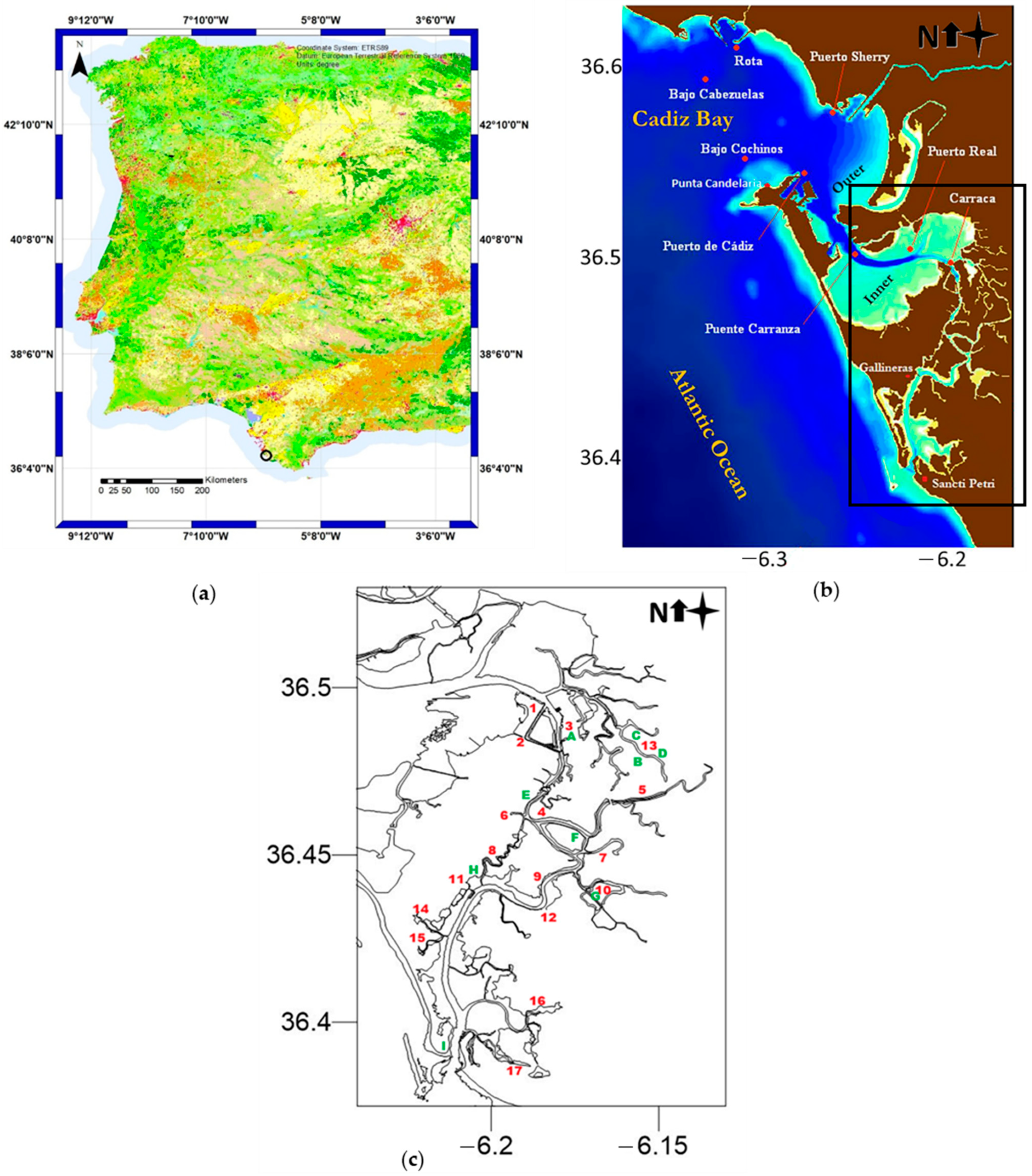
The Cadiz and San Fernando salt marshes, part of the Guadalete and Barbate hydrographic confederation, are located within the Cadiz Bay, on the SW of the Iberian Peninsula, Spain (Figure 1a). This shallow, semi-enclosed transitional water body (AT-T12 classification, meaning “mesotidal Atlantic estuary with irregular river discharges”; Royal Decree 817/2015) covers an area of 81 km2 and represents a site of high ecological value, supporting biodiversity and water cycle functions. The area covers part of the territory that was declared a vulnerable zone and is part of the Bahía de Cádiz wetland, which includes several zones in the Register of Protected Areas (Table 1).
In the latest Guadalete-Barbate Hydrological Plan (2022–2027), the Cadiz and San Fernando salt marshes are classified as heavily modified water bodies (HMWB), due to the significant influence of human activities that have substantially altered their natural structure and functioning, including intertidal zone occupation and resources extraction. HMWBs have adjusted environmental objectives, aiming for “good ecological potential and good chemical status” rather than “good ecological status and good chemical status”. The Bay of Cádiz encompasses six municipalities with over 639,000 inhabitants, with Cadiz and San Fernando having the highest population densities in the province, with 9696 and 3095 inhabitants per km2, respectively [32].
The marshes are heavily used for aquaculture and salt production, which significantly modify local hydrodynamics. The transformed marshes or former salt marshes constitute the largest environmental unit in terms of area, with high ecological importance, scenic uniqueness, and ethnological and cultural significance. Furthermore, 56% of marine aquaculture located in the natural park is located in active conservation areas [33]. Aquaculture activities carried out in the marshes primarily occur protected areas. In the Bay of Cadiz, extensive farming, both traditional and improved, is the main farming system, accounting for almost 80% of the total authorized area. This category also includes companies that, through extensive and improved extensive farming, are diversifying the profitability of aquaculture with complementary activities in tourism, environmental education, gastronomy, or other activities related to the culture and tradition of marine farming [33].

2.1.2. Hydrodynamics of the Study Area

In the Cadiz and San Fernando salt marshes the dominant water masses movement is driven by the propagation of the ocean tidal wave from the open sea into the interior. The dimensions and morpho-bathymetric characteristics of the channels connecting the marshes to the open ocean play a decisive role in tidal propagation as they modify both the amplitude and phase of the astronomical constituents through shallow water and non-linear effects. Distortions of the fundamental astronomical constituents, as well as the generation of shallow water constituents (which cause differences between high and low tide ranges), have a strong influence on dispersive processes in this shallow water environment [34]. Therefore, these parameters must be determined with the highest possible precision.
The main element of this configuration is the Sancti Petri Channel (Figure 1b), a flood/ebb tidal channel extending from the inner Cadiz Bay to the Gulf of Cadiz. It is approximately 17 km long and is connected to several minor channels that supply water to extensive floodplains. This area supports a number of sustainable activities related to Gallineras (the marina and fishing port of San Fernando), Sancti Petri (natural park, population and marina port), and the military shipyard of La Carraca. It also includes the coexistence of densely populated urban centers with areas of high ecological value.
The channel bed has a deeper central zone and much shallower area in both margins [35]. Depths along the main course range from 9 m close to the open sides, to 3 m in inner areas. The seabed is composed mainly of cohesive sediments, particularly clay and silt. The channel is associated to small tributaries. The most important is Iro river with an estimated length of 5 km and averaged depths of 3 m, constitutes a tidal channel subjected to flooding and ebbing flows associated with the tide, with intertidal zones that are dried up in periods of low tide [36]. This tributary crosses Chiclana which in summertime suffers overpopulation, being one of the main points of the waste water spills in the study area.

2.2. Models and Data

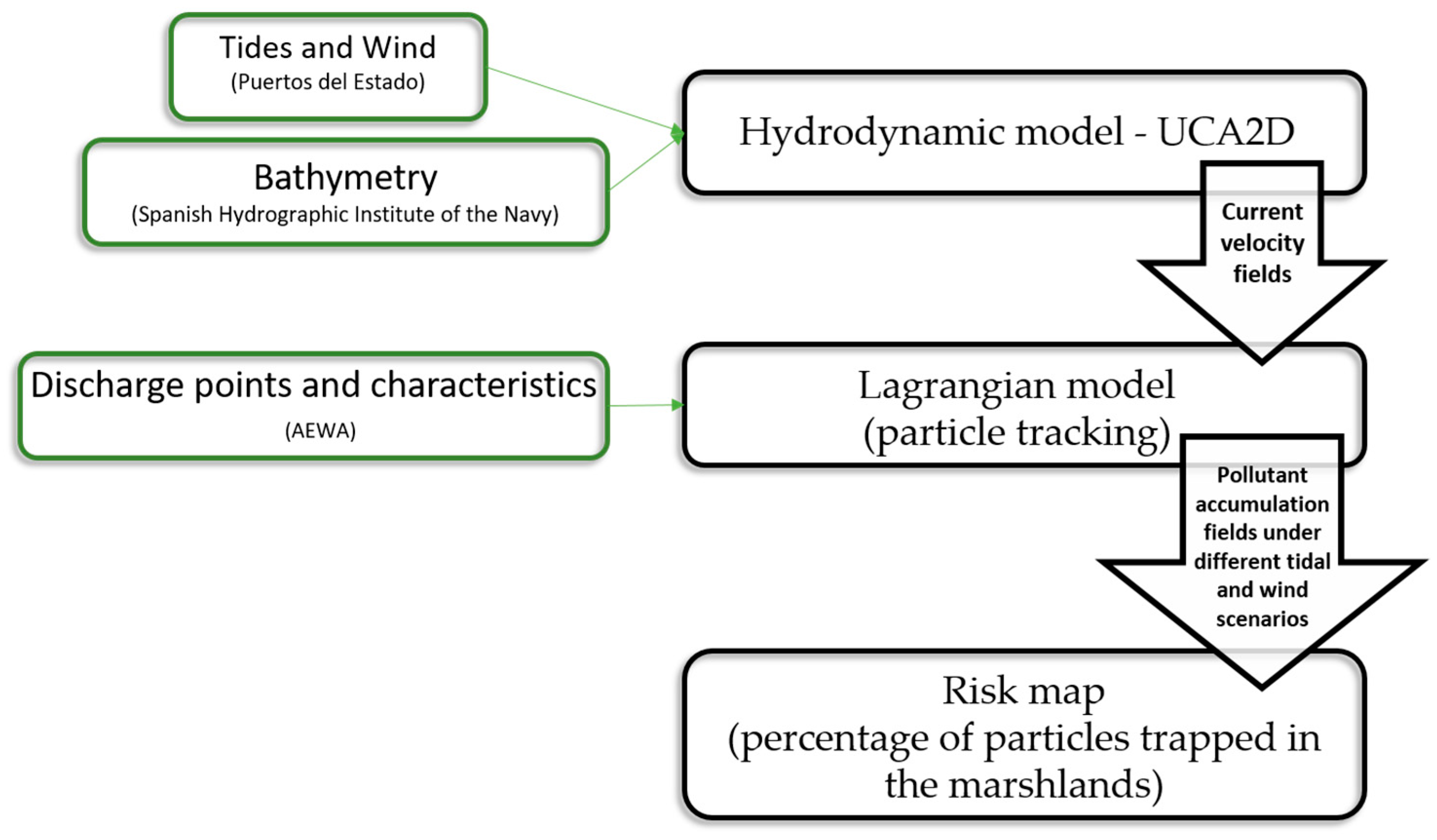
The proposed strategy uses modelled water current velocity fields to simulate transport and dispersion processes through a Lagrangian-particle-tracking model. To account simultaneously for multiple discharge points and potential pollutant accumulation areas, a risk map was developed based on the percentage of particle accumulation. A schematic diagram of the methodology is shown in Figure 2.
The precise application of the hydrodynamic numerical model to the Cadiz Bay domain requires, as an essential premise, the availability of elevation and current time series, obtained experimentally at different strategically selected sites throughout the study area. To best reproduce the dynamic boundary conditions at the open boundary of the domain and, therefore, making comparisons with the results generated by the model, the input data must be of adequate quality. In this study, 8 tide-gauge stations were used [37]. Moreover, to determine the velocity conditions at the boundary with the open ocean, current velocity data from the Bajo Cochinos and Bajo de las Cabezuelas were used (Figure 1b). Elevation time series are also available at these locations, which are essential for obtaining the dynamic elevation conditions at this boundary. Furthermore, elevation data from Carraca, Puerto Real, Puente de Carranza, Puerto de Cádiz, Puerto Sherry and Base Aeronaval de Rota were used to adjust and validate the model results.
Velocity data between the mouth of the Sancti Petri channel and the inner bay were obtained from two current meters (Aquadopp profiler, Nortek, Norway) moored at 5 m and 7 m depth, respectively.
In addition, oscillations with periods shorter than 1 h that could be identified as noise were eliminated, since their periodicities do not have astronomically deterministic origins, and so can be subtracted for a study of tidal variability. Sea-level and depth-averaged current velocity series were submitted to standard harmonic analysis [38,39,40], in order to obtain the amplitudes and phase-constants of the resolvable tidal constituents. Results for the main semidiurnal and diurnal constituents within Cadiz Bay are shown in Table 2. The bathymetric distribution used by the numerical model was obtained from nautical charts No. 443A and 443B, published by the Spanish Hydrographic Institute of the Navy [41,42,43].

2.2.1. UCA2D Hydrodynamic Model

The UCA2D hydrodynamic model [41] was used to reproduce the tidal current velocity fields. It is a two-dimensional, high-resolution, nonlinear, finite-difference hydrodynamic model. The model has already been used for different research projects in the study area, giving very satisfactory results [36,37,41,42,43,44].
In shallow-water regions of constant density, water motion is predominantly horizontal. Consequently, the hydrodynamic processes in these areas, governed by the Navier–Stokes and mass conservation equations, can be reduced to a two-dimensional system; see, e.g., [45]. Using these approximations, the 2D shallow-water equations can be expressed as follows [46]:
𝜕 u 𝜕 t + u 𝜕 u 𝜕 x + v 𝜕 u 𝜕 y f v + g 𝜕 ξ 𝜕 x +   τ x z z = h ρ H =   τ x z z = ξ ρ H
𝜕 v 𝜕 t + u 𝜕 v 𝜕 x + v 𝜕 v 𝜕 y + f u + g 𝜕 ξ 𝜕 y + τ y z z = h ρ H = τ y z z = ξ ρ H
𝜕 ξ 𝜕 t + 𝜕 u H 𝜕 x + 𝜕 v H 𝜕 y = 0
Here, u and v are the vertically averaged Cartesian velocity components; ξ is the free-surface elevation above the mean water level h; H = h + ξ is the total depth; f is the Coriolis parameter; and τ x z z = ξ   ,   τ x z z = h and τ y z z = ξ   ,   τ y z z = h represent, respectively, the surface wind stress and bottom friction in the momentum equations, parameterized as follows:
τ x z z = h =   ρ r u u 2 + v 2
τ x z z = ξ = ρ a C D w x w x 2 + w y 2
τ y z z = h = ρ r v u 2 + v 2
τ y z z = ξ = ρ a C D w y w x 2 + w y 2
where r is the bottom friction coefficient, often expressed using a constant von Kármán parameter. CD is the empirically determined wind drag coefficient, dependent on wind speed and surface roughness [47,48]; and wx, wy are the wind components. A numerical viscosity term is introduced in the momentum equations to remove high-frequency disturbances, thereby smoothing and stabilizing the solution:
Κ x = A h H H u
Κ y = A h H H v
with = 𝜕 𝜕 x , 𝜕 𝜕 y , Ah represents the numerical viscosity coefficient.
In shallow water areas with a limited spatial domain, choosing a computational grid that realistically approximates the physical domain (coastline and bathymetry) becomes a critical factor, since the quality of the simulation results strongly depends on it.
This choice is especially relevant in the Bay of Cadiz, since the narrow section of the Puntales Strait exerts, as will be seen throughout the results, a determining influence on the hydrodynamic behaviour of the tide. Therefore, the coastline contour must be adjusted with particular precision in this area, seeking to obtain a faithful reproduction in the discrete domain. The size of each grid cell was selected considering the length of the smallest section. For the main channel, the numerical grid has a space resolution of 20 m, while for the tertiary channels, to achieve sufficient spatial resolution, it was of 3 m.
A radiation condition [49] was imposed at the open boundaries and written in terms of deviations of tidal elevation and velocity from their values available at these locations, which were established by interpolation/extrapolation techniques from previously validated simulations for Cadiz Bay [41,50]. Based on the above considerations, as in González et al., [43], the open boundary was chosen on the natural border connecting the Bay of Cádiz with the Atlantic Ocean, that is, the imaginary straight line linking Punta Morena, near the Rota marina, and Punta Candelaria in Cádiz (Figure 1b).
Through a linear interpolation/extrapolation process of the values observed at the Bajo de Cabezuelas and Boya de Cochinos sites, the amplitude and phase of the elevation associated with each of the main constituents along the open boundary were determined (Table 2). Likewise, in the radiative velocity condition, the amplitude and phase of the normal velocity to the open contour were generated by linearly interpolating/extrapolating, to the entire open boundary, the values of the vertically averaged normal velocity recorded in Bajo de Cabezuelas and that were obtained experimentally at 9 m depth in Boya de Cochinos. Completing this analysis, the tidal characteristics along the open boundary were compared with the results for tidal constituents from other regional models including the Gulf of Cadiz area, such as that of Quaresma and Pichon [51], showing concordant results.
In order to evaluate the specific domain of the Sancti Petri channel, the tidal elevation constituents M2, S2, N2, K1, and O1 at its open boundary were extracted from the numerical results of Cadiz Bay at these locations. Furthermore, to complement the radiation condition, the velocity constituents were estimated in such a simple way to show a ratio between the velocity and elevation amplitude and their phase difference [40].

2.2.2. Lagrangian Model

To determine the areas where pollutants from industrial activity, cities, and fish farms can accumulate, a Lagrangian advection-transport diffusion model was chosen. The model used was the same one used in the study of González et al. [43] and Gomiz-Pascual et al. [52] in open-ocean areas. For this work, a total of 17 discharge points were identified: 13 of them currently operating and corresponding to urban and aquaculture wastewater and 4 more points that have requested a license and were awaiting approval when this study began. These points are located near salt marshes and sites with growing populations. The Andalusian Environment and Water Agency (AEWA) provided all the information regarding the discharge points and their characteristics.
The UCA2D provides the current velocity fields that feed the Lagrangian model and, to give it a high degree of reliability, the model has been complemented with the Eulerian calculation of the mass conservation equation in a dispersive medium [50].
In this study, the released particles were treated as conservative tracers. Particle tracking was assumed to be governed by advective and dispersive transport associated with the two-dimensional, horizontal depth-averaged current velocity field. The horizontal geographic position of each particle at any given time step was computed based on its position at the previous time step, according to the following equation:
p i + 1 =   p i + u i t + δ
where pi and ui are the horizontal position vector of a particle and the current velocity vector, respectively, calculated by the UCA2D model, forced by tide and winds, at the i-th multiple of the time-step Δt. The vector term δ represent turbulent diffusion and is computed according to a 2-D random-walk model [53] as follows:
δ = r   2 D H t
where r = rxi + ryj is a two dimensional horizontal vector whose components are random values drawn from a normal distribution with zero mean and unit standard deviation [54], i and j are unit vectors, and DH is the horizontal turbulent diffusion coefficient. In this study DH was set to 2.5 m2/s, estimated from the current velocity fluctuations measured in the study area. The mass of the substance discharged from each spill point is expressed in terms of the number of particles released (n) at each time-step (Δt), as follows:
m 0 =   α n 0 =   C 0 q 0 t
where C0 is the pollutant concentration and q0 is the spill flow rate. After a sensitivity analysis, a continuous releasing rate of 100 particles per time-step was selected, representing the maximum representative number in order to optimize the computational time. Particles were released from each selected point every 6 min. The total simulation time of the Lagrangian model was set to capture a complete tidal cycle, as particle behavior is repeated in subsequent cycles. All particles in this study were assumed to be fully persistent, with a half-life of zero.

3. Results and Discussion

3.1. Models Results

The experiments that are presented below were carried out with the chosen control parameters during a simulation period of 240 h, to ensure the total stability of the periodic solution. Table 3 reflects the results of the amplitudes and phases corresponding to the elevation of the M2 calculated in each simulation, as well as the root-mean-square error (RMSE).
Constituent M2, representative of the mean tide, shows close matches, as demonstrated by the mean errors between the calculated and observed elevations at the different locations, with values of 0.5 cm for the amplitude, less than 1% of the total elevation, and 0.5° for the phase. The highest mean errors are found in constituent N2, with 1.6 cm for the amplitude and 5.5° for the phase. For this constituent, the difference between the results obtained for the observed amplitude and phase compared to those calculated for the same measurements observed at the tide gauge located in Puerto Real is quite significant. These anomalous values appear to be due to an error in data processing, since the numerical results indicate a smooth variation in amplitude and phase across the domain, corroborated by the results observed at the other locations. However, the small magnitude of the mean errors obtained allows the simulations to be considered highly representative.
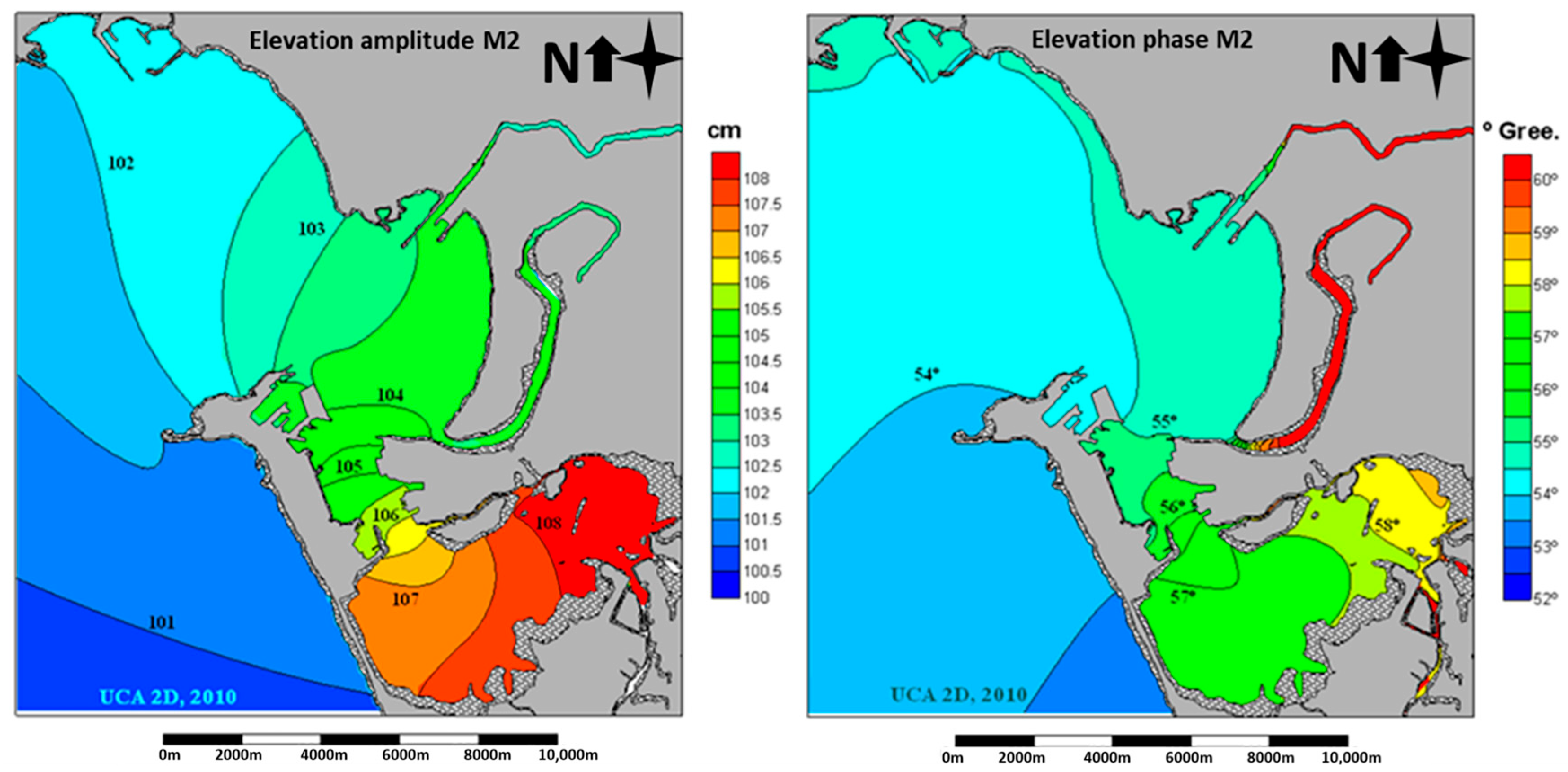
It is evident, in view of the observed elevation values, that the M2 constituent, representative of the mean tide, determines the behaviour of the tidal wave in the Bay, since it presents the greatest elevation amplitude, greater than 1 m throughout the domain (Figure 3). The region bordering the Atlantic Ocean marks the minimum values, 103 cm, which increase to a maximum of 108.5 cm in the eastern part of the Interior Bay. This increase is influenced by the presence of the Puntales Strait, where a more pronounced increase is observed, that is, 3 cm between its extremes, separated by 4 km.
During spring tides, the tidal range reaches 1.6 m, while during equinoctial spring tides it is 1.8 m. Therefore, velocities increase proportionally to the tidal range, reaching values close to 1.2 m/s in the Puntales Strait area.
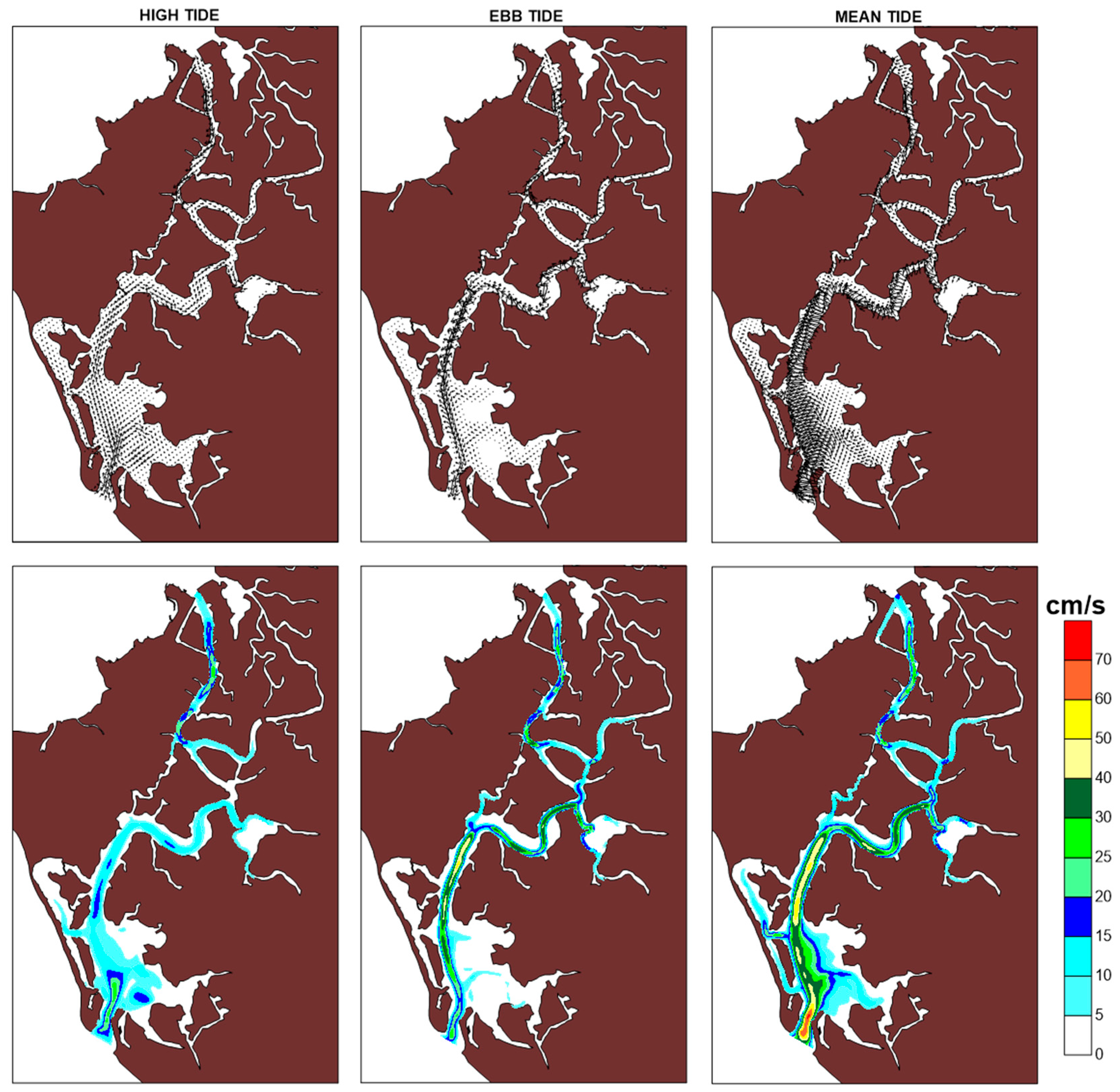
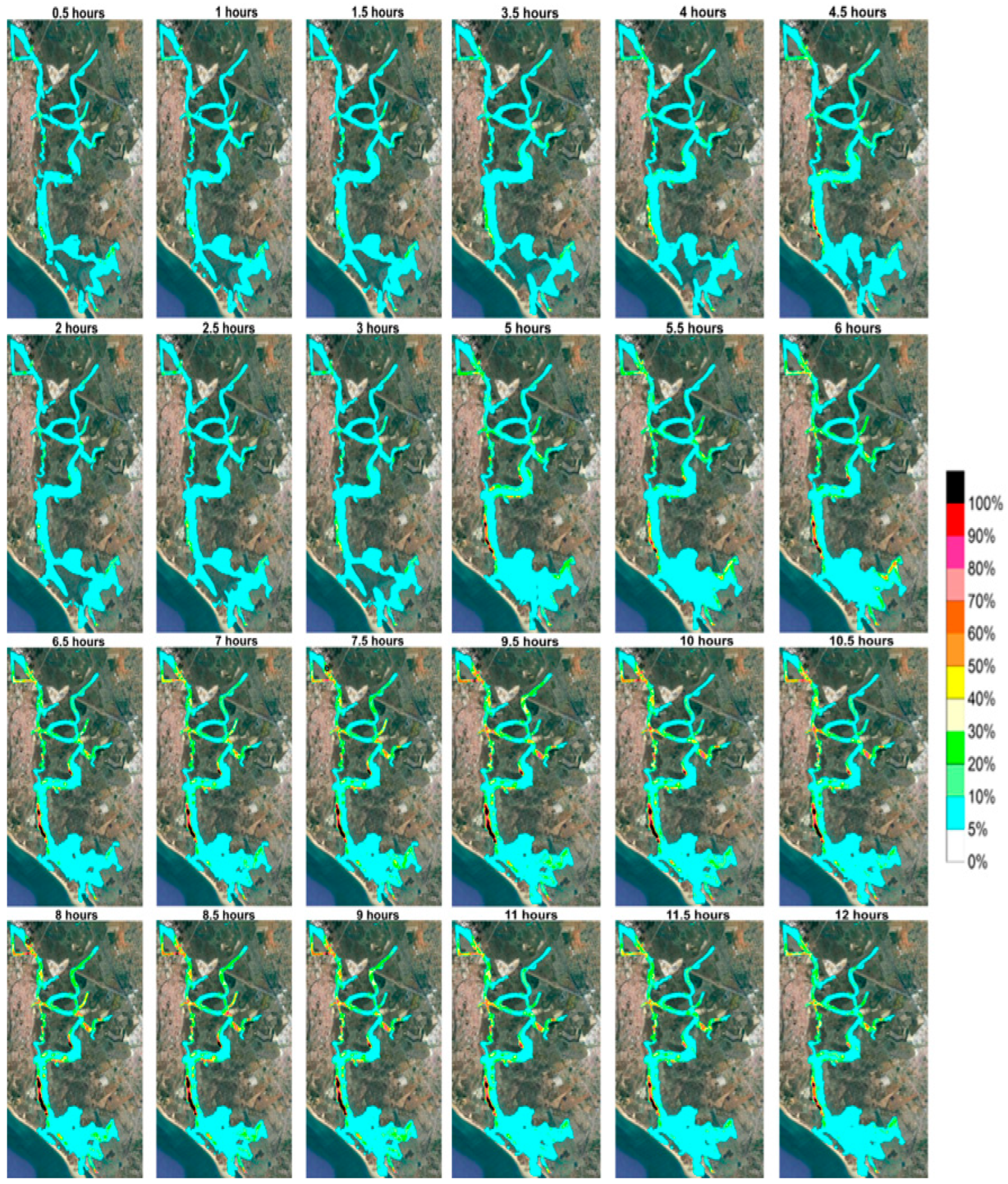
Experimental data show that the Sancti Petri Channel forms a very unique waterway where the tidal wave enters through both of its connections to the open sea with a small difference in amplitude and phase. Figure 4 shows the current velocity with high tide, ebb tide and mean tide. Maximum velocities are around 50 cm/s while during spring tides they are around 30 cm/s. This analysis allows us to identify which scenario represents the worst-case situation for the contaminant transport simulations. Finally, a five-day simulation was carried out at the 17 selected spill points. In this study, we present the evolution of simulated spill dispersion during the last tidal cycle of the experiment. Figure 5 shows how the spill concentration evolves every half hour during the last tidal cycle of the simulation under midtide conditions.

3.2. Water Quality Management Cooperation of Salt Marshes

The results of the models allowed us to identify areas with potential risk of accumulation of harmful substances due to wastewater discharge. Using information obtained from the evolution of spill particles during a tidal cycle under mid-tide conditions, a risk zone map was created. In this study, we focused exclusively on the percentage of particles that the hydrodynamic of the area is unable to transport to the river mouth, thereby becoming trapped at various points within the marshlands. After the simulation period, areas with the highest number of particles indicate the greatest pollution risk.
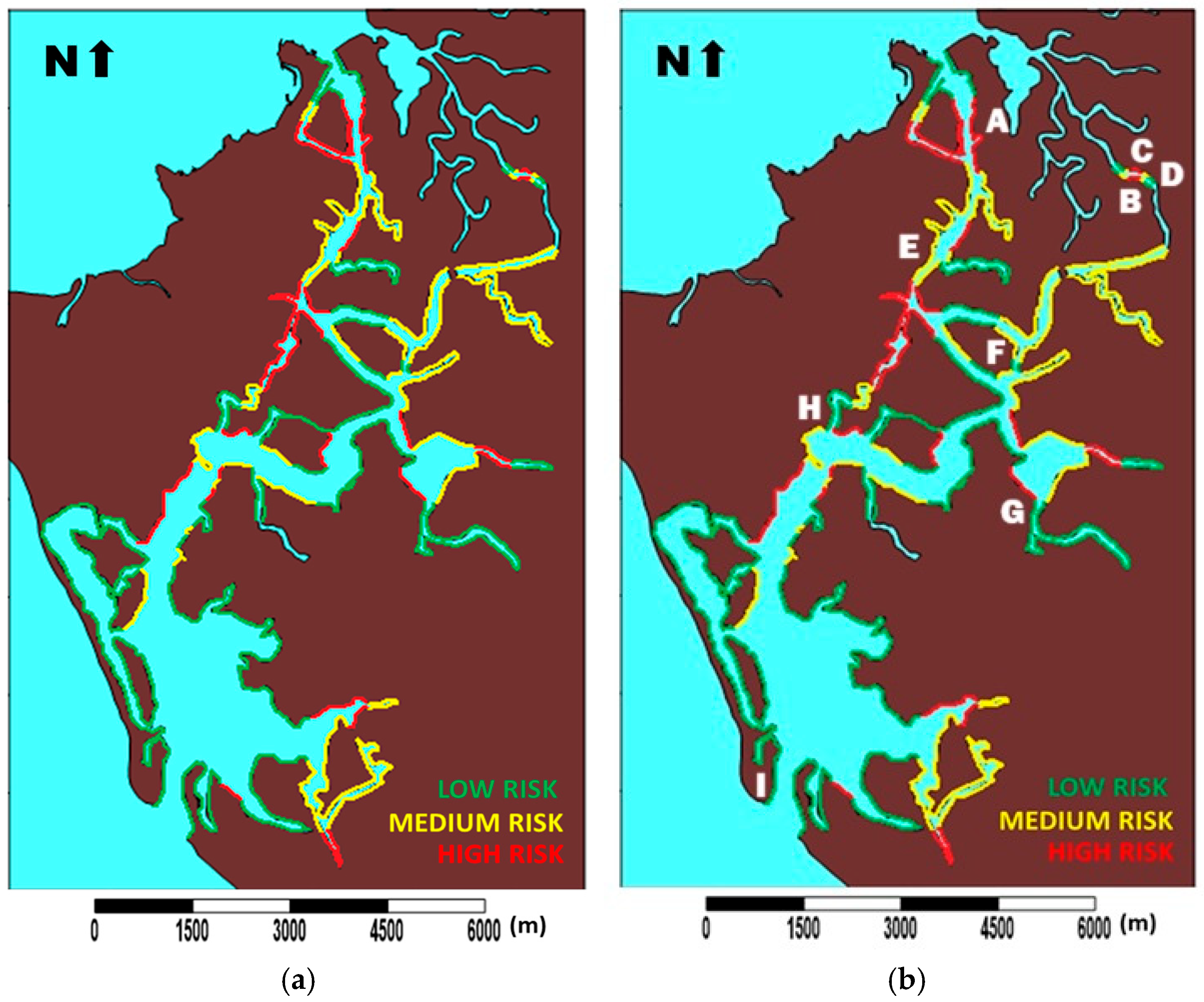
Referring to the results expressed in Figure 5, we selected three representative spill percentage ranges, based on the number of particles that were not dispersed: 0–30%, 30–60%, and 60–100% to divide the area based on contamination risk (low, medium, and high, respectively). The ranges were chosen based on concentration calculations, so the last range (60–100%) includes those quantities of particles that correspond to concentrations higher than the thresholds allowed in highly modified transition waters. So, high-risk areas for contaminant accumulation are highlighted in red, medium-risk areas in yellow, and low-risk areas in green (Figure 6).
The AEWA used this risk zone map to select nine checkpoints (green letters in Figure 1c) and do periodic water analysis control at these stations. The analyses carried out by AEWA show that points G, H and I (see Figure 1c) maintain a good water status, while points A to F (see Figure 1c) do not reach the good status according to the WFD regulations. Figure 6b shows the good agreement between water classification obtained from AEWA analysis and our risk map.
On 16 February 2022, the AEWA published, as a result of this collaboration, the report “Seguimiento de la red de investigación en la masa de agua marismas de Cádiz y San Fernando-ES063MSPF005200190-demarcación hidrográfica del Guadalete y Barbate” where they reported that the results obtained by the analysis are in accordance with the vulnerable areas predicted by the University of Cádiz.
Furthermore, during the course of our studies, the final version of the latest hydrological plan cycle of the Guadalete-Barbate Hydrographic Confederation was published. Regarding the data published in this latest report (PHGB 2021–2027), it is important to note that, for the studied water body, the Cádiz and San Fernando marshes, only three sampling points are defined as part of the transitional water monitoring networks. All three points are part of the surveillance monitoring program, the nitrate monitoring network, and the operational monitoring program. Furthermore, these three stations (62T6010, 62Y6015, and 62T6025) correspond to points 7, 15, and 17 in Figure 1c, respectively, which reinforces our results.
According to data published in the third planning cycle reports, the overall condition of the water body in question is currently poor, with deficient conditions in both ecological potential and chemical status. Furthermore, from the second cycle (2015–2021) to the third cycle (2021–2027) of the hydrological plans, there has been a general deterioration in the condition of the transitional waters, with two water bodies moving from “good” to “worse than good.” With this study, we wish to underscore the importance of implementing robust sampling programs that consider, above all, the physical characteristics of the system.
In this case, we have seen how the tide directly influences the dispersion of pollutants and how, in a complex environment such as the Cádiz and San Fernando salt marshes, both the number of spill points and their location can be crucial for water quality. Therefore, we would like to emphasize the importance of programming wastewater discharges after ebb tide, since maximum concentrations are reached during this time period, while there will be better dispersion during high tide. The land-use patterns surrounding the study area support our findings regarding the importance of discharge locations and timing, as the dominant land cover is non-agricultural, primarily consisting of tidal marshes (both vegetated and unvegetated) and traditional salt pans. The subbasin containing the Cádiz and San Fernando marshes covers approximately 16,500 ha. The land is predominantly non-agricultural (78%), including 24% urban areas, while agricultural lands account for 15%, and the remainder is divided among pastures (4%), permanent crops (2%), and forests (1%) [55].
According to the WFD, a water body is defined as an assessment and management unit that encompasses both surface and groundwater, considering their qualitative and quantitative characteristics, that is, a homogeneous and significant portion of water. In the case of the Cádiz and San Fernando salt marshes, it is identified as a single homogeneous water body, without taking into account the high hydrodynamic complexity of the system. Furthermore, this variability directly influences the concentration and accumulation of pollutants. In our opinion, it would be advisable to review the classification of this water body (for example, by classifying some points as “mixing zones,”) to facilitate discharge management and allow for economic or industrial activities that would otherwise be more restricted. The concept of a “mixing zone”, as defined in the Environmental Quality Standards Directive for Surface Waters (2008/105/EC and 2013/39/EU), allows point-source effluents (e.g., industrial discharges) to mix with receiving waters, permitting temporary exceedances of certain contaminant limits without compromising overall ecosystem protection. It must be demonstrated that the receiving water can dilute contaminants without affecting ecological health beyond the zone, ensuring no significant impacts on sensitive species or protected areas (e.g., Ramsar Sites). Establishing a mixing zone requires modification of discharge permits and approval from environmental authorities regarding its size, location, and contaminant levels. Limitations include potential restrictions on recreational use, fishing, or water abstraction, which may necessitate adjustments in spatial planning and water resource management. In addition, we suggest the possibility of expanding the sampling points, and frequency should be evaluated, especially with regard to chemical parameters in an environment as important (from an ecosystem perspective) as the Bay of Cádiz.
DIRECTIVE 2008/105/EC establishes that Member States may designate mixing zones adjacent to points of discharge. To aid the mixing zones determination, in December 2010, the European Commission published “Technical Background Document on the Identification of Mixing Zones” [56] and “Technical Guidelines for the identification of mixing zones in application pursuant to Art. 4(4) of the Directive 2008/105/EC”. Following these documents, coastal zones as the one we are dealing with in this manuscript, with complex hydrodynamic patterns, are classified into the tier 3 (complex assessments). In this sense, this study provides a methodology based on the use of a high-resolution hydrodynamic model and the associated Lagrangian experiments, which aids the identification of mixing zones in a tier 3 case and could be applied on other areas of similar behaviors.

4. Concluding Remarks

At present, no single management measure can address all water-related challenges, from quality to availability. Therefore, the implementation of decision-support systems is essential. The use of high-resolution models plays a key role in improving decision-making processes and in optimizing the use and protection of water resources. Model development and refinement should involve all stakeholders, from scientists and modelers to managers, decision-makers, and end users. In this context, effective communication is fundamental to achieving useful and applicable results.
This study highlights the importance of institutional collaboration and demonstrate how a modeling tools can help identify control points and vulnerable areas, supporting the design of monitoring and remediation plans and informing decisions on future discharge permits. Interaction between scientists and government authorities is essential within the framework of so-called “blue technologies,” enabling adaptive responses to current and future environmental changes. This is a crucial task for local governments in response to the EU and the WFD.
Complex systems such as salt marshes and wetlands are governed by numerous interdependent processes. These processes are influenced not only by measurable uncertainties but also by unpredictable actions. Despite the high environmental value of marshes, much attention has been paid to their ecological status and biodiversity conservation, while comparatively little focus has been given to their hydrological value, both in qualitative and quantitative terms, given their high complexity. Water pollution in salt marshes is a critical issue for achieving the environmental objectives of the WFD. A first and essential step toward meeting these objectives is the identification of pollution sources and the implementation of methodologies that account for system variability, which is necessary to restore its healthy state.
The methodology presented in this work can be used in other vulnerable areas, adapting and developing a new hydrodynamic model of the study area and modifying the characteristics of the spills used. Processes affecting non-conservative pollutants (e.g., decay and settling) were not included in the simulations and likely represent the main limiting factor, as they can substantially influence concentrations and spatial distribution. Despite these limitations, the results provide valuable insights into the general behavior of the system; however, future studies incorporating these processes would help refine predictions and enhance understanding of pollutant dynamics, particularly for substances such as heavy metals and organic contaminants, whose concentrations can be affected by chemical reactions, biological activity, or sedimentation. For future research, it would be valuable to couple the model with biogeochemical processes and to assess the potential impacts of climate change on hydrodynamics and pollutant transport. These steps would improve predictions and provide a forward-looking perspective on pollutant dynamics in transitional and coastal water systems.
Converting a HMWB into a “mixing zone” does not entail loosening regulations; rather, it represents a more flexible management approach, constrained in both space and time, and fully aligned with the WFD. Formal approval from European or national environmental authorities requires robust technical evidence, underscoring the need for continuous studies incorporating modeling, monitoring, and ecological impact assessments. The results of this study, based on hydrodynamic modeling, represent a significant advance in the characterization of the hydrological dynamics of the study area. However, it is considered essential, within the framework of future research, to develop a functional zoning proposal that allows for the spatial organization of different land uses according to conservation objectives. Likewise, there is a clear need to design an integrated environmental monitoring system based on key parameters such as water renewal rates, salinity, dissolved oxygen, and nutrient concentrations. This system would allow for model validation, the assessment of the ecological status of water bodies, and the facilitation of decision-making under an adaptive management approach. These elements are considered fundamental for moving toward an integrated and sustainable management model.

Author Contributions

Conceptualization: C.B., M.L.P.C. and J.J.G.-P.; Data curation: C.B., J.J.G.-P., A.G.F. and N.P.S.G.; Methodology: C.B., M.L.P.C. and J.J.G.-P.; Formal analysis and investigation: C.B. and J.J.G.-P.; Funding acquisition: M.B., A.G.F. and N.P.S.G.; Resources: C.B., M.L.P.C., R.M. and J.J.G.-P.; Supervision: M.L.P.C. and J.J.G.-P.; Visualization: C.B., M.L.P.C., R.M., M.B. and J.J.G.-P.; Writing—original draft preparation: C.B.; Writing—review and editing: C.B., M.L.P.C., R.M., M.B., J.J.G.-P., A.L.P., Ó.Á.E. and A.I.G. All authors have read and agreed to the published version of the manuscript.

Funding

This work has been supported by the OceanUCA Project (PCM_00032), funded through the Next Generation EU Recovery Fund under Spain’s Recovery, Transformation, and Resilience Plan, and co-financed by the Ministry of University, Research, and Innovation of the Andalusian Government. The views and opinions expressed are solely those of the authors and do not necessarily reflect those of the European Union or the European Commission. Neither the European Union nor the European Commission can be held responsible for them. This work has additionally been supported by the TRANSIT project (PID2023-150230NBC21).

Data Availability Statement

Data available on request from the authors.

Acknowledgments

We would like to acknowledge the AEWA and the Andalusian Government for the data given. We also would like to acknowledge the Regional Government of Andalusia (P11-RNM-7722 project); the Spanish Government (TRUCO project RTI2018-100865-B-C22; MAGO: RTI2018-100865-B-C22); and the European Union’s Interreg V-A-España–Portugal (POCTEP) 2014-2020 project OCASO (0223_OCASO_5_E).

Conflicts of Interest

The authors declare no conflicts of interest.

References

  1. Gell, A.P.; Finlayson, C.M.; Davidson, N.C. (Eds.) 1-An introduction to the Ramsar Convention on Wetlands. In Ramsar Wetlands, Values, Assessment, Management; Elsevier: Amsterdam, The Netherlands, 2023; pp. 1–36. [Google Scholar] [CrossRef]
  2. Boorman, L.A. Salt marshes-present functioning and future change. Mangroves Salt Marshes 1999, 3, 227–241. [Google Scholar] [CrossRef]
  3. Boorman, L.A. The functional role of salt marshes in linking land and sea. In British Saltmarshes; Sherwood, B.R., Gardiner, B.G., Harris, T., Eds.; Forrest Text for the Linnean Society: Ceredigion, UK, 2000; pp. 1–2. [Google Scholar]
  4. Aranda, M.; Peralta, G.; Montes, J.; Gracia, F.J.; Fivash, G.S.; Bouma, T.J.; van der Wal, D. Salt marsh fragmentation in a mesotidal estuary: Implications for medium to long-term management. Sci. Total Environ. 2022, 846, 157410. [Google Scholar] [CrossRef] [PubMed]
  5. Williams, P.; Faber, P. Salt marsh restoration experience in San Francisco Bay. J. Coast Res. 2001, 27, 203–211. [Google Scholar]
  6. Waltham, N.J.; Alcott, C.; Barbeau, M.A.; Cebrian, J.; Connolly, R.M.; Deegan, L.A.; Dodds, K.; Gaines, L.A.G.; Gilby, B.L.; Henderson, C.J. Tidal Marsh Restoration Optimism in a Changing Climate and Urbanizing Seascape. Estuaries Coasts 2021, 44, 1681–1690. [Google Scholar] [CrossRef]
  7. Twomey, A.J.; Nunez, K.; Carr, J.A.; Crooks, S.; Friess, D.A.; William Glamore, W.; Orr, M.; Reef, R.; Rogers, K.; Waltham, N.J.; et al. Planning hydrological restoration of coastal wetlands: Key model considerations and solutions. Sci. Total Environ. 2024, 915, 169881. [Google Scholar] [CrossRef]
  8. Winterwerp, J.; Erftemeijer, P.; Suryadiputra, N.; Van Eijk, P.; Zhang, L. Defining Eco-Morphodynamic Requirements for Rehabilitating Eroding Mangrove-Mud Coasts. Wetlands 2013, 33, 515–526. [Google Scholar] [CrossRef]
  9. Bayraktarov, E.; Saunders, M.I.; Abdullah, S.; Mills, M.; Beher, J.; Possingham, H.P.; Mumby, P.J.; Lovelock, C.E. The cost and feasibility of marine coastal restoration. Ecol. Appl. 2016, 26, 1055–1074. [Google Scholar] [CrossRef]
  10. Sheaves, M.; Brookes, J.; Coles, R.; Freckelton, M.; Groves, P.; Johnston, R.; Winberg, P. Repair and revitalisation of Australia’s tropical estuaries and coastal wetlands: Opportunities and constraints for the reinstatement of lost function and productivity. Mar. Pol. 2014, 47, 23–38. [Google Scholar] [CrossRef]
  11. Weinstein, M.P.; Litvin, S.Y. Macro-restoration of tidal wetlands: A whole estuary approach. Ecol. Restor. 2016, 34, 27–38. [Google Scholar] [CrossRef]
  12. Lovelock, C.E.; Brown, B.M. Land tenure considerations are key to successful mangrove restoration. Nat. Ecol. Evol. 2019, 3, 1135. [Google Scholar] [CrossRef]
  13. Adams, J.B.; Raw, J.L.; Riddin, T.; Wasserman, J.; Van Niekerk, L. Salt Marsh Restoration for the Provision of Multiple Ecosystem Services. Diversity 2021, 13, 680. [Google Scholar] [CrossRef]
  14. Vulliet, C.; Koci, J.; Sheaves, M.; Waltham, N. Linking tidal wetland vegetation mosaics to micro-topography and hydroperiod in a tropical estuary. Mar. Environ. Res. 2024, 197, 106485. [Google Scholar] [CrossRef]
  15. Environmental Agency. Saltmarsh Manual Management-R & D Technical Report SC030220. Joint Defra/Environment Agency Flood and Coastal Erosion Risk Management R & D Program,-Product Code: Scho0307BMKH-E-P; Environmental Agency: London, UK, 2007; ISBN 978-1-84432-714-0. Available online: www.environment-agency.gov.uk (accessed on 22 July 2025).
  16. Cruz de Carvalho, R.; Cardoso, J.; Carreiras, J.A.; Santos, P.; Palma, C.; Duarte, B. Persistent Organic Pollutants in Tagus Estuary Salt Marshes: Patterns of Contamination and Plant Uptake. J. Xenobiot. 2024, 14, 1165–1186. [Google Scholar] [CrossRef]
  17. Li, C.; Wang, H.; Liao, X.; Xiao, R.; Liu, K.; Bai, J.; Li, B.; He, Q. Heavy metal pollution in coastal wetlands: A systematic review of studies globally over the past three decades. J. Hazard. Mater. 2022, 424, 127312. [Google Scholar] [CrossRef] [PubMed]
  18. Azevedo, I.C.; Bordalo, A.A.; Duarte, P.M. Influence of river discharge patterns on the hydrodynamics and potential contaminant dispersion in the Douro estuary (Portugal). Water Res. 2010, 44, 3133–3146. [Google Scholar] [CrossRef]
  19. Balachandran, K.K.; Reddy, G.S.; Revichandran, C.; Srinivas, K.; Vijayan, P.R.; Thottam, T.J. Modelling of tidal hydrodynamics for a tropical ecosystem with implications for pollutant dispersion (Cohin Estuary, Southwest India). Ocean Dyn. 2008, 58, 259–273. [Google Scholar] [CrossRef]
  20. Deng, Y.; Zheng, B.; Fu, G.; Lei, K.; Li, Z. Study on the total water pollutant load allocation in the Changjiang (Yangtze River) Estuary and adjacent seawater area. Estuar. Coast. Shelf Sci. 2010, 86, 331–336. [Google Scholar] [CrossRef]
  21. Liu, W.C.; Huang, W.C. Modeling the transport and distribution of fecal coliform in a tidal estuary. Sci. Total Environ. 2012, 431, 1–8. [Google Scholar] [CrossRef]
  22. Ng, B.; Turner, A.; Tyler, A.O.; Falconer, R.A.; Millward, G.E. Modelling contaminant geochemistry in estuaries. Water Res. 1996, 30, 63–74. [Google Scholar] [CrossRef]
  23. Liu, W.C.; Chang, S.W.; Jiann, K.T.; Wen, L.S.; Liu, K.K. Modelling diagnosis of heavy metal (copper) transport in an estuary. Sci. Total Environ. 2007, 388, 234–249. [Google Scholar] [CrossRef]
  24. Shen, Z.; Wang, H.; Liang, D.; Yan, Y.; Zeng, Y. The fate of microplastics in estuary: A quantitative simulation approach. Water Res. 2022, 226, 119281. [Google Scholar] [CrossRef]
  25. Iglesias, I.; Almeida, C.M.R.; Teixeira, C.; Mucha, A.P.; Magalhães, A.; Bio, A.; Bastos, L. Linking contaminant distribution to hydrodynamic patterns in an urban estuary: The Douro estuary test case. Sci. Total Environ. 2020, 707, 135792. [Google Scholar] [CrossRef]
  26. Mestres, M.; Sánchez-Arcilla, A.; Sierra, J.P.; Mösso, C.; González Del Río, J.; Rodilla, M. Basis and tools for a sustainable development of estuaries and coastal areas: A case study from Cullera Bay. Manag. Environ. Qual. Int. J. 2004, 15, 25–32. [Google Scholar] [CrossRef]
  27. Gorito, A.M.; Ribeiro, A.R.L.; Ramos, S.; Silva, A.M.T.; Almeida, C.M.R. Occurrence of micropollutants in Surface waters: Monitoring of Portuguese Lima and Douro River estuaries and interconnecting northwest coast. Mar. Pollut. Bull. 2024, 209, 117140. [Google Scholar] [CrossRef]
  28. Uddin, G.; Jackson, A.; Nash, S.; Rahman, A.; Olbert, A.I. Comparison between the WFD approaches and newly developed water quality model for monitoring transitional and coastal water quality in Northern Ireland. Sci. Total Environ. 2023, 901, 165960. [Google Scholar] [CrossRef] [PubMed]
  29. Brennan, C.; Purdy, R.; Hjerp, P. Political, economic and environmental crisis in Northern Ireland: The true cost of environmental governance failures and opportunities for reform. North. Irel. Leg. Q. 2017, 68, 123–157. [Google Scholar] [CrossRef]
  30. Brennan, C.; Dobbs, M.; Gravey, V. Out of the Frying Pan, Into the fire? Environmental Governance Vulnerabilities in Post-Brexit Northern Ireland. Environ. Law Rev. 2019, 21, 84–110. [Google Scholar] [CrossRef]
  31. Turner, S. Transforming environmental governance in Northern Ireland. Part One: Process Policy renewal. J. Environ. Law 2006, 18, 55–87. [Google Scholar] [CrossRef]
  32. Diputación de Cádiz and IEDT, Instituto de Empleo y Desarrollo Socioeconómico y Tecnológico. Análisis de la Realidad Urbana y Territorial de la Provincia de Cádiz Conducente a la Definición de un Mapa de Áreas Urbanas Funcionales; Diputación de Cádiz and IEDT, Instituto de Empleo y Desarrollo Socioeconómico y Tecnológico: Cádiz, Spain, 2022; p. 80. [Google Scholar]
  33. Consejería de Sostenibilidad, Medio Ambiente y Economía Azul. Boletín Oficial de la Junta de Andalucía-Normativa Consolidada. BOJA núm. 146 de 29/7/2024. 2024. Available online: https://www.juntadeandalucia.es/eboja/2024/146/index.html (accessed on 30 January 2026).
  34. Speer, P.E.; Aubrey, D.G. A study of non-linear tidal propagation in shallow inlet/estuarine systems Part II: Theory. Estuar. Coast. Shelf Sci. 1985, 21, 207–224. [Google Scholar] [CrossRef]
  35. Vidal-Pérez, J.M. Caracterización Dinámica de la Marea y del Sedimento en el Sistema Intermareal del Caño de Sancti Petri. Doctoral Thesis, Universidad de Cádiz, Andalusia, Spain, 2002. [Google Scholar]
  36. Vidal, J.; Tejedor, B. Study Dyn. Behav. Sancti Petri Channel Southwest Coast Spain. Cienc. Mar. 2005, 31, 617–626. [Google Scholar] [CrossRef][Green Version]
  37. Álvarez, O.; Tejedor, B.; Tejedor, L.; Kagan, B.A. A note on sea-breeze-induced seasonal variability in the K1 tidal constants in Cádiz Bay, Spain. Estuar. Coast Shelf Sci. 2003, 58, 805–812. [Google Scholar] [CrossRef]
  38. Doodson, A.T. Perturbations of harmonic constants. Proc. R. Soc. 1924, A106, 513–526. [Google Scholar]
  39. Cartwright, D.E.; Tayler, R.J. New Computations of the Tide-generating Potential. Geophys. J. Int. 1971, 23, 45–73. [Google Scholar] [CrossRef]
  40. Godin, G. The Analysis of Tides; University of Toronto Press: Toronto, ON, Canada; Liverpool University Press: Liverpool, UK, 1972. [Google Scholar]
  41. Álvarez, O.; Izquierdo, A.; Tejedor, B.; Mañanes, R.; Tejedor, L.; Kagan, B.A. The influence of sediment load on tidal dynamics, a case study: Cadiz Bay. Estuar. Coast Shelf Sci. 1999, 48, 439–450. [Google Scholar] [CrossRef]
  42. González, C.J.; Álvarez, O.; Reyes, J.; Acevedo, A. Two-dimensional modeling of hydrodynamics and sediment transport in the San Pedro tidal creek (Cadiz Bay): Morphodynamical implications. Cienc. Mar. 2010, 36, 393–412. [Google Scholar] [CrossRef]
  43. González, C.J.; Izquierdo, I.; Álvarez, O.; Bruno, M.; Mañanes, R.; Czerwinskib, I.A.; Zurita, F.P. Hazard assessment of bacterial contamination in coastal waters using a metocean modeling system: Application to bivalve mollusk harvesting areas in Cadiz Bay (SW Spain). Ocean Coast. Manag. 2018, 166, 31–39. [Google Scholar] [CrossRef]
  44. Kagan, B.A.; Álvarez, O.; Izquierdo, A. Weak wind-wave/tide interaction over fixed and moveable bottoms: A formulation and some preliminary results. Continent. Shelf Res. 2005, 25, 753–773. [Google Scholar] [CrossRef]
  45. Defant, A. Physical Oceanography; Pergamon Press: Oxford, UK, 1961; 745p. [Google Scholar]
  46. Dronkers, J.J. Tidal Computations in Rivers and Coastal Waters; North-Holland Publishing Company: Amsterdam, The Netherlands, 1964; 518p. [Google Scholar]
  47. Wu, J. Wind stress and surface roughness at air-sea interface. J. Geophys. Res. 1969, 74, 444–455. [Google Scholar] [CrossRef]
  48. Kagan, B.A. Ocean–Atmosphere Interaction and Climate Modelling; Cambridge University Press: Cambridge, UK, 1995; 377p. [Google Scholar]
  49. Leendertse, J.J.; Gritton, E.C. A Water Quality Simulation Model for Well-Mixed Estuaries and Coastal Seas; Computation Procedures. R-708-NYC; The New York City Rand Institute: New York, NY, USA, 1971; Volume II. [Google Scholar]
  50. Gonzalez, C.J.; Reyes, E.; Alvarez, O.; Izquierdo, A.; Bruno, M.; Mañanes, R. Surface currents and transport processes in the Strait of Gibraltar: Implications for modeling and management of pollutant spills. Ocean Coast. Manag. 2019, 179, 104869. [Google Scholar] [CrossRef]
  51. Quaresma, L.S.; Pichon, A. Modelling the barotropic tide along the West-Iberian margin. J. Mar. Syst. 2013, 109–110, S3–S25. [Google Scholar] [CrossRef]
  52. Gomiz-Pascual, J.J.; Bolado-Penagos, M.; Gonzalez, C.J.; Vazquez, A.; Buonocore, C.; Romero-Cozar, J.; Perez-Cayeiro, M.L.; Izquierdo, A.; Alvarez, O.; Mañanes, R.; et al. The fate of Guadalquivir River discharges in the coastal strip of the Gulf of Cádiz. A study based on the linking of watershed catchment and hydrodynamic models. Sci. Total Environ. 2021, 795, 148740. [Google Scholar] [CrossRef] [PubMed]
  53. Csanady, G.T. Turbulent Diffusion in the Environment; D. Reidel Publishing Company: Dordrecht, The Netherlands; Holland, MI, USA; Springer: Dordrecht, The Netherlands, 1973; Volume XII, 249p. [Google Scholar] [CrossRef]
  54. Matsuzaki, Y.; Fujita, I. Horizontal turbulent diffusion at sea surface for oil transport simulation. Coast. Eng. Proc. 2014, 1, 8. [Google Scholar] [CrossRef]
  55. Junta de Andalucía, Consejería de Agricultura, Pesca, Agua y Desarrollo Rural. Demarcación Hidrográfica del Guadalete-Barbate, Plan Hidrológico 2022–2027-Anejo 0. 2023. Available online: https://www.juntadeandalucia.es/medioambiente/portal/areas-tematicas/agua/planificacion-hidrologica/2022-2027/guadalete-barbate (accessed on 19 January 2026).
  56. CIS-WFD. Technical Background Document on the Identification of Mixing Zones. 2010. Available online: https://circabc.europa.eu/sd/a/78ce94bb-6f1c-4379-87ac-88a18967c4c3/Technical%20Bacground%20Document%20on%20the%20Identification%20of%20Mixing%20Zones.doc (accessed on 23 September 2025).
Figure 1. (a): Map of Spain showing the national context of the study area, indicated by a black circle. (b): Map of the study area with calculation grids and the main locations of calibration points and boundary conditions with the black rectangle outlining the study area. (c): Study area with the red numbers indicating the positions of the 17 spill points. Numbers 1 to 13 represent the points in operation at the start of the study, and numbers 14 to 17 represent those eligible for licensing. The green letters represent the nine control points verified by AEWA. The red numbers represent the positions of the 17 spill points.
Hydrology 13 00055 g001
Figure 2. Schematic diagram summarizing the methodology adopted in this study. Green frames represent input data (with data sources in parentheses). Black arrow frames indicate model outputs required for the next step.
Hydrology 13 00055 g002
Figure 3. Distribution of elevation amplitude isolines (cm) and phase (˚Gree.) associated with the M2 constituent.
Hydrology 13 00055 g003
Figure 4. Map of current speeds (cm/s) with high tide (on the left), ebb tide (middle figures), and mean tide along the last cycle (on the right) along the Sancti Petri channel.
Hydrology 13 00055 g004
Figure 5. Evolution of spill percentage ranges for a tidal cycle in mean tide conditions. Each panel represent the time evolution.
Hydrology 13 00055 g005
Figure 6. (a) Map of areas at risk of accumulation of harmful substances. (b) Risk map with the 9 checkpoints (letters from A to I) selected from AEWA.
Hydrology 13 00055 g006
Table 1. Register of protected areas within the territory of the Cadiz and San Fernando salt marshes, including the areas that are part of them and the respective identification code.
Protected AreasCodeName
Production areas of mollusks and other
marine invertebrates
ESAND207Saco Bahía Cádiz
ESAND208Sancti Petri
Recreational use areasES063ZPROT207 Playa La Cachucha PM1
ES063ZPROT201 Playa Sancti Petri PM1
Vulnerable areasES61_Zona26Puerto Real–Conil
Sensitive areasESCA439Parque Natural de la Bahía de Cádiz
Areas protected by the Natura 2000
Network
ES0000140Bahía de Cádiz (ZEC * and ZEPA *)
ES0000502Espacio Marino de la Bahía de Cádiz (ZEPA *)
ES6120009Fondos Marinos de la Bahía de Cádiz (ZEC *)
Protection perimeters of mineral and
thermal waters
ES063ZPROT6312465AM01Balneario de Fuente Amarga
WetlandsES063ZPROTRAM45Bahía de Cádiz (the Ramsar, Convention on Wetlands)
ES063ZPROTIH612002-S1Bahía de Cádiz (national
inventory of wetlands)
ES063ZPROTIHA612002Bahía de Cádiz (inventory of Andalusian wetlands)
* ZEC: Special Conservation Zone; * ZEPA: Special Protection Zone for Birds.
Table 2. Amplitude (A, cm) and phase (φ, Greenwich degrees) of the elevation and velocity (cm/s) of the main astronomical constituents at the sites located on the open contour and at the mouth of the Sancti Petri channel.
M2S2N2O1K1
ElevationA, cmφ, grA, cmφ, grA, cmφ, grA, cmφ, grA, cmφ, gr
Cabezuelas102.954.135.182.325.933.95.1302.06.343.8
Cochinos103.253.135.281.326.032.95.0300.86.142.6
VelocityA, cm/sφ, grA, cm/sφ, grA, cm/sφ, grA, cm/sφ, grA, cm/sφ, gr
Cabezuelas7.0333.72.60.01.8318.01.4234.80.50.0
Cochinos8.7291.03.5320.02.1260.22.0222.10.43.0
Caño S. Petri40.0150.015.0179.010.0126.01.533.01.5134.0
Table 3. Amplitude (cm) and phase (Greenwich degrees), observed and predicted, of the elevation associated with the main diurnal and semidiurnal constituents at the indicated sites used to validate the model. The observed values associated with constituent K1, except in Carraca and Puerto Real, have been corrected for the effect of the breeze. δ represents the mean error.
StationM2S2N2O1K1
Amplitude, cmPhase, gr.Amplitude, cmPhase, gr.Amplitude, cmPhase, gr.Amplitude, cmPhase, gr.Amplitude, cmPhase, gr.
ObsPredObsPredObsPredObsPredObsPredObsPredObsPredObsPredObsPredObsPred
CARRACA (1)108.0108.460.058.934.737.385.886.226.827.240.736.25.55.2301.6303.17.06.347.444.0
PTO. REAL (2)106.5108.657.959.339.137.382.286.419.227.243.136.35.55.2301.6303.25.76.345.544.1
P. CARRANZA (3)107.2107.157.657.536.336.787.285.427.026.838.235.55.35.2302.6303.06.36.345.543.8
PTO. CADIZ (4)103.1104.355.153.136.335.583.782.325.726.037.232.85.25.1302.1301.96.76.741.142.7
PTO. SHERRY (5)103.2103.952.653.335.235.480.982.625.725.932.533.05.45.1299.9302.06.46.242.342.8
ROTA (6)101.4103.156.253.032.835.081.382.524.925.747.533.05.85.1301.7302.06.46.238.142.8
δ1.01.21.51.71.65.50.20.40.32.2
Disclaimer/Publisher’s Note: The statements, opinions and data contained in all publications are solely those of the individual author(s) and contributor(s) and not of MDPI and/or the editor(s). MDPI and/or the editor(s) disclaim responsibility for any injury to people or property resulting from any ideas, methods, instructions or products referred to in the content.