
Article

Daily and Monthly Scale Comparisons of Three Gridded Precipitation Datasets over the British Columbia Province, Canada
1
Department of Civil and Environmental Engineering, University of California, Davis, 1 Shields Ave., Davis, CA 95616, USA
2
Arid Land Research Center, International Platform for Dryland Research and Education, Tottori University, 1390 Hamasaka, Tottori 680-0001, Japan
3
Northwest Division, US Army Corps of Engineers, Portland, OR 97232, USA
*
Author to whom correspondence should be addressed.
Hydrology 2026, 13(2), 52; https://doi.org/10.3390/hydrology13020052
Submission received: 26 November 2025 / Revised: 26 January 2026 / Accepted: 28 January 2026 / Published: 1 February 2026

Abstract

Understanding the characteristics of precipitation datasets in a given region is crucial for hydrological studies. This study focuses on the British Columbia (BC) Province in Canada and evaluates the statistical characteristics of precipitation data from three gridded precipitation datasets: the Pacific Climate Impacts Consortium’s northwestern North America meteorological dataset (PNWNAmet), Global Precipitation Measurement (GPM), and Global Precipitation Climatology Centre (GPCC). These precipitation datasets at both daily and monthly scales were compared with point observation data from the Global Historical Climatology Network (GHCN). For the daily-scale comparison of three precipitation datasets, seven indices of extreme precipitation were computed at ten observation points. Out of eleven locations for the monthly analysis, GPCC showed the lowest RMSE at six locations (five of them were in the northern to central BC), and PNWNAmet showed the lowest RMSE at four locations (three of them were in the southern BC), suggesting GPCC’s superior agreements with GHCN at the northern and central part of BC and PNWNAmet’s better agreements with GHCN at the southern part of BC. The comparison of monthly precipitation averaged over BC showed that PNWNAmet offers higher monthly precipitation than GPCC and GPM, while the variability of annual precipitation among the three datasets is similar. Spatial analysis of precipitation–elevation relationships revealed the value of considering both elevation and distance from the coast in evaluating the precipitation–elevation relationships.

1. Introduction

Extreme precipitation events can have tremendous impacts on human societies and the natural environment. It has been observed that changes in extremes have been widespread over land since the 1950s, including increases in heavy precipitation in central and eastern America [1]. While the need for countermeasures against extreme heavy precipitation and the resulting floods is evident, it is also crucial to ensure a reliable water supply from precipitation. Therefore, deepening our understanding of precipitation variability is crucial for a more reliable water supply and flood protection. Various studies have analyzed precipitation variability [2,3,4], and global reanalysis data can be used to examine precipitation characteristics across various regions on Earth. However, the global reanalysis data are mostly at a coarse resolution and thus have limitations for watershed/regional-scale analysis of extreme hydrological events such as droughts and floods. Therefore, previous studies have carried out downscaling of meteorological data at regional and watershed scales [5,6,7,8,9].
When analyzing downscaled meteorological data, it is essential to validate them against observation data [10,11,12]. However, multiple precipitation datasets may be available for a given region of interest. Therefore, selecting the validation dataset is a critical step in regional- or watershed-scale hydrologic analysis and modeling. In this context, comparing multiple precipitation datasets to identify their statistical characteristics provides valuable information for hydrological studies in a target region or watershed. Satellite-based precipitation products (e.g., [13,14,15]) can provide precipitation datasets over extensive areas where the surface observation network is limited.
However, satellite-based precipitation products may exhibit biases relative to precipitation measurements from rain gauges. In fact, the validation of satellite-based precipitation products and/or global gridded precipitation has been conducted in numerous previous studies (e.g., [16,17,18,19,20,21,22]). On the other hand, station-based precipitation observation offers the advantage of accurate precipitation measurement. However, the spatial distribution of observation stations can be sparse, and observation stations may even be unavailable in a target watershed. Such a problem could be especially common when the target area is extremely large. The British Columbia province spans a vast area with diverse terrain. Though most regions of Canada have experienced droughts, interior British Columbia is particularly susceptible to droughts [23]. British Columbia province is also subject to destructive floods [24], and the climate change impact on floods in British Columbia watersheds has been investigated [25]. For such hydrological analysis, observed precipitation data, especially in the form of gridded precipitation data, are useful. For the British Columbia province in Canada, PNWNAmet [26] has been released as a gridded daily precipitation dataset compiled from gauge observations with consideration of precipitation outputs from the 20th Century Reanalysis V2 (20CR2) dataset. While PNWNAmet would be a promising precipitation dataset for British Columbia, there may be uncertainties in the data due to the gauge network, particularly in the northern part of the province. Therefore, it would be beneficial to compare several precipitation products for the British Columbia province to evaluate the uncertainty of those datasets. Such a comparative study of precipitation datasets for a specific region is helpful for hydrological analysis, because the performance of existing precipitation datasets can vary from region to region.
To this end, this study focused on the British Columbia province, Canada, and compared three gridded precipitation products with station-based precipitation data from the Global Historical Climate Network (GHCN). The discrepancies of precipitation from the three climate datasets of PNWNAmet, Global Precipitation Climatology Centre (GPCC), and Global Precipitation Measurement (GPM) were evaluated on both daily and monthly scales. The structure of this paper is as follows: Section 2 explains the data used in this study: three gridded precipitation datasets and the station-based precipitation data. Section 3 compares the three gridded precipitation datasets at both the daily (Section 3.1) and monthly (Section 3.2) scales. Section 4 is the discussion, and Section 5 concludes the study.

2. Materials and Methods

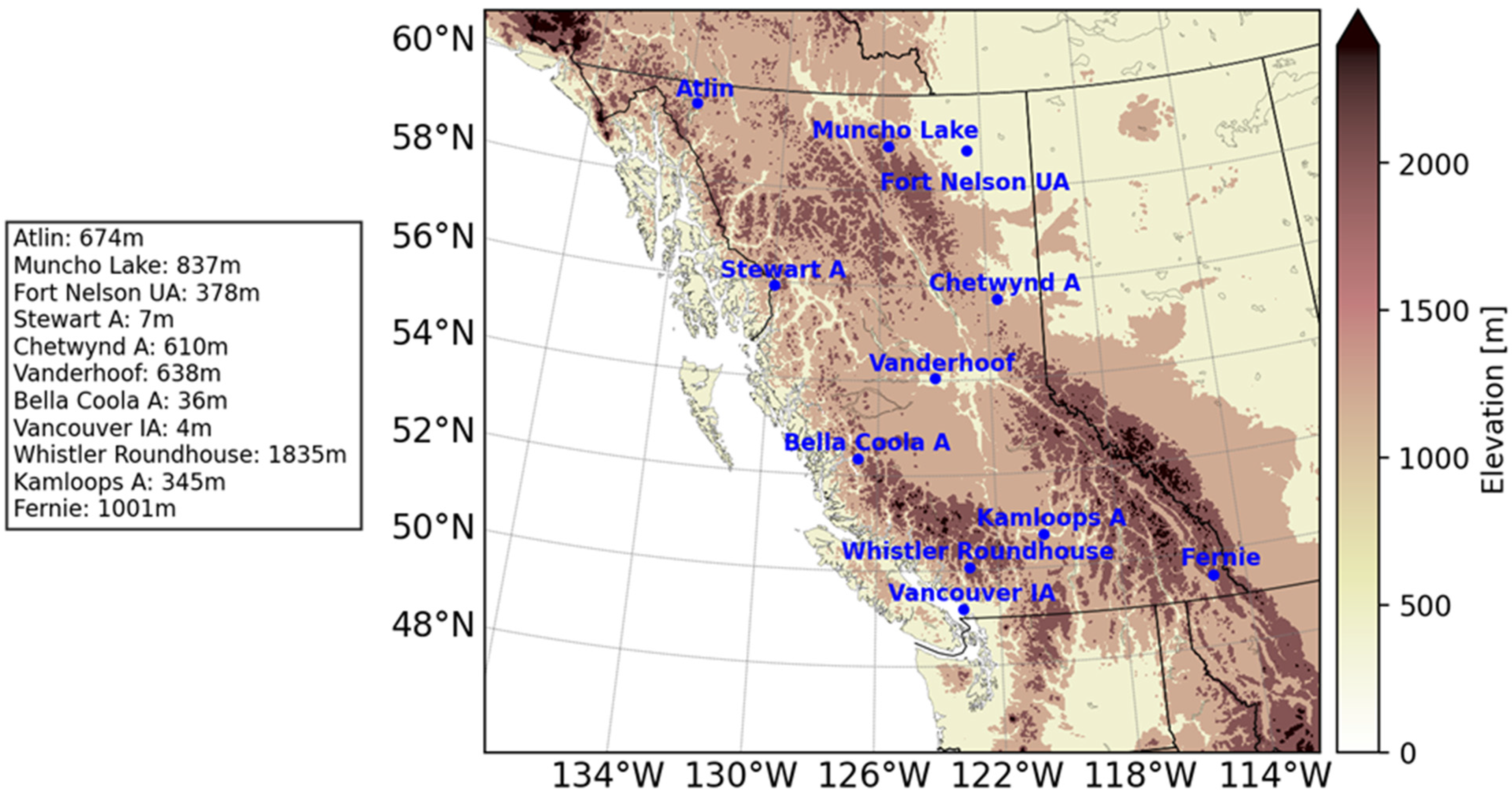
The primary focus of this study is the British Columbia province, which covers an area of 944,735 square kilometers. The target domain and elevation are depicted in Figure 1. The province’s geological landscape is predominantly characterized by mountain ranges, including the Canadian portion of the Rocky Mountains in the east, the Coast Mountains along the west, the Columbia Mountains in the southeast, and the Cassiar Mountains in the north. In British Columbia province, several significant rivers have extensive drainage areas. They include the northern portion of the Columbia River (102,000 square kilometers), the Peace River (128,800 square kilometers), and the Fraser River (232,300 square kilometers).
This study focused on three gridded precipitation datasets that cover the entire British Columbia province. These datasets were compared with point observation data from the Global Historical Climatology Network (GHCN) Daily [27]. The three gridded precipitation datasets are the Global Precipitation Climatology Centre (GPCC), the Global Precipitation Measurement (GPM), and the Pacific Climate Impacts Consortium’s Northwest North America meteorological dataset (PNWNAmet).
The comparison period spans from June 1, 2000, to December 31, 2012, encompassing a particularly disastrous storm year in 2006 [28]. The 2000/2001 winter experienced unusually low precipitation [29], and the Pacific Northwest experienced massive winter storms in January 2012 [30]. This data comparison period includes these hydrological events, offering multiple years of data for the comparison.
The Global Precipitation Climatology Centre (GPCC) Full Data Daily Version 2020 is a global precipitation dataset that provides gridded gauge analysis products derived from station data. The dataset has a 1.0 × 1.0 spatial resolution at a regular latitude/longitude grid and spans the period from January 1982 to December 2019. In this dataset, the SPHEREMAP scheme [31,32,33] was employed to interpolate anomalies of daily precipitation relative to monthly total precipitation. Subsequently, those anomalies on a regular grid were superimposed on the Full Data Monthly Version 2020 monthly precipitation totals. GPCC is often used as reference global daily precipitation data for the satellite precipitation products [33]. GPCC has also been used for analyzing extreme precipitation [34]. GPCC has reasonably consistent interannual variability with the other gauge-based datasets [35]. In this study, GPCC Full Data Daily Version 2020 [36] was downloaded at https://opendata.dwd.de/climate_environment/GPCC/full_data_daily_v2020/ (accessed on 11 April 2025), and GPCC Full Data Monthly Version 2020 [37] was downloaded at https://opendata.dwd.de/climate_environment/GPCC/full_data_monthly_v2020/025/ (accessed on 13 April 2025).
Precipitation data from the Global Precipitation Measurement (GPM) mission forms a satellite-based global precipitation dataset [38]. The GPM is a global precipitation measurement program led by the National Aeronautics and Space Administration (NASA) and the Japan Aerospace Exploration Agency (JAXA), in collaboration with other international space agencies. The GPM core observatory satellite is equipped with a Dual-frequency Precipitation Radar (DPR) and a multiple frequency Microwave Imager, which provide information to enhance the accuracy of precipitation observed by constellation satellites. The precipitation data utilized in this study (GPM_3IMERGDF) is a daily product with a spatial resolution of 0.1 degrees, produced by the NASA Goddard Earth Sciences Data and Information Center [15]. The IMERG V06 datasets (DOI:10.5067/GPM/IMERGDF/DAY/06) was used in this study. GPM instantaneous precipitation products, including IMERG, were used as input into hydrological and land-surface models [39]. GPM was also used to assess the timing of extreme rainfall [40].
The Pacific Climate Impacts Consortium (PCIC) meteorology for northwestern North America dataset, commonly referred to as PNWNAmet, is a gridded daily meteorological dataset covering northwestern North America [26]. The precipitation product for western Canada was assembled from daily precipitation station records derived from the second generation of Environment and Climate Change Canada’s (ECCC) Adjusted and Homogenized Canadian Climate Data (AHCCD) and the United States Historical Climatology Network-Daily (USHCN-Daily) station data for the contiguous United States. These station data were interpolated onto 1/16° grids using the trivariate thin plate spline interpolation method [41]. As a predictor for interpolation, ClimateWNA v5.10 monthly climate normals were employed [26]. A comparative analysis of PNWNAmet with two preceding gridded meteorological datasets developed by PCIC (NRCANmet and PBCmet) revealed comparably superior performance for PNWNAmet. However, PNWNAmet potentially exhibits a higher frequency of wet days compared to the other two gridded meteorological datasets [26]. Precipitation data from PNWNAmet was available at https://data.pacificclimate.org/portal/gridded_observations/map/ (accessed on 13 April 2025). PNWNAmet has been used as reference climate data for western Canada [42,43].
The Global Historical Climatology Network (GHCN) Daily [27], administered by the National Oceanic and Atmospheric Administration (NOAA), compiles a daily climate summary derived from station-based measurements in 180 countries and territories worldwide. While quality assurance checks were applied to the GHCN-Daily comprehensive dataset, the data were not homogenized. The variables reported in GHCN-Daily encompass maximum and minimum temperature, total daily precipitation, snowfall, and snow accumulation. For comparative purposes with three gridded precipitation datasets, eleven GHCN stations in British Columbia province were selected to be distributed as uniformly as possible across the province. Specifically, in selecting the target GHCN stations, we divided British Columbia into three regions based on the latitude: Southern region (latitude is less than or equal to 52° N), Central region (latitude is from 52° N to 56° N), and Northern region (latitude is greater than or equal to 56° N). Then, at least one location is extracted from the western (coastal) and the eastern (inland) parts of the region. In addition, two locations (Vanderhoof and Kamloops A) are selected from the Interior Plateau. As a result, eleven stations were extracted. The locations and elevations of the eleven GHCN stations are presented in Figure 1. As depicted in Figure 1, three observation sites (Atlin, Muncho Lake, and Fort Nelson UA) were selected from the northern region, four (Stewart A, Bella Coola A, Vanderhoof, and Chetwynd A) from the central region, and four (Vancouver Intl A, Kamloops A, Fernie, and Whistler Roundhouse) from the southern region. Notably, observation data from Whistler Roundhouse were largely unavailable during the summer season. Despite the limited availability of data at Whistler Roundhouse, the observation point’s high elevation (1835 m) necessitated comparison with this location to assess the differences among the three precipitation datasets in the high elevation area. Due to significant data gaps, Whistler Roundhouse is used only for monthly comparisons. Precipitation data from the GHCN-Daily dataset were available at https://www.ncei.noaa.gov/data/global-historical-climatology-network-daily (accessed on 20 December 2019).
For comparison with GHCN stations, the spatial resolution of the three gridded daily precipitation datasets was equated to 4 × 4 km2 by linear interpolation. The 4 × 4 km2 spatial resolution is chosen for interpolation to produce a precipitation product that can be used to validate the precipitation outputs from Weather Research and Forecasting (WRF) model simulations over a 4 × 4 km2 domain covering the British Columbia province. Subsequently, to compile monthly precipitation data for GPM and PNWNAmet, the 4 × 4 km2 daily precipitation data were summed at each grid point. The 4 × 4 km2 monthly precipitation data for GPCC were generated by applying linear interpolation to the monthly GPCC data. To compare the interpolated precipitation datasets with GHCN stations, each daily and monthly gridded precipitation dataset was further interpolated to the GHCN observation points using inverse distance weighting to the nearest four grids that encompassed the GHCN observation points. To avoid complications arising from the choice of interpolation method, we employed only simple interpolation methods (linear interpolation and inverse distance-weighted interpolation) to produce the 4 × 4 km2 precipitation product and point precipitation from the original precipitation products.
To assess the extremes of precipitation between three datasets and the GHCN-Daily observation, seven annual precipitation indices were derived from the daily datasets: annual maximum 5-day precipitation (RX5DAY), simple daily wet-day precipitation intensity index (SDII), number of days with precipitation ≥ 10 mm (R10MM), number of days with precipitation ≥ 1 mm (R01MM), number of consecutive dry days (CDD), annual total precipitation from days with precipitation exceeding the 95th percentile (R95PTOT), and annual total precipitation (PRCPTOT). The British Columbia province experiences both heavy precipitation and low precipitation, and thus we used indices that characterize extreme precipitation features, such as heavy precipitation (RX5DAY, R95PTOT), precipitation intensity (SDII), wet days (R01MM, R10MM), and dry days (CDD). These precipitation indices are identical to those employed in the previous study [26] for the validation of PNWNAmet.
In addition to the comparisons employing the extreme precipitation indices, the three precipitation datasets were evaluated on a monthly basis by computing Mean Absolute Error (MAE), Mean Bias Error (MBE), R2, and Root Mean Square Error (RMSE) between the GHCN monthly precipitation and the interpolated monthly precipitation of the three precipitation datasets.
After the comparisons at the stations, the spatial-average monthly precipitation over British Columbia was compared among the three precipitation datasets. The spatial average monthly precipitation was derived as the average of monthly precipitation across all grid points within British Columbia.

3. Results

This study compared three gridded precipitation datasets (GPCC, GPM, and PNWNAmet) with station-based observation data on both daily and monthly scales.

3.1. Daily Comparison to GHCN Observation Points

Table 1 presents four scores at the ten stations between the GHCN and daily precipitation by three gridded precipitation datasets. Out of ten locations for daily precipitation comparisons, PNWNAmet had the lowest RMSE at four locations in southern and central British Columbia, and GPCC showed the lowest RMSE at six locations (five of them are in northern and central British Columbia). GPCC also showed a superior performance in representing daily precipitation variability (the highest R2 at six locations), while PNWNAmet exhibited comparable performance (the highest R2 at four locations). The lowest biases are found at six locations by PNWNAmet, five by GPCC, and two by GPM, suggesting comparable performance by PNWNAmet and GPCC in terms of low biases.
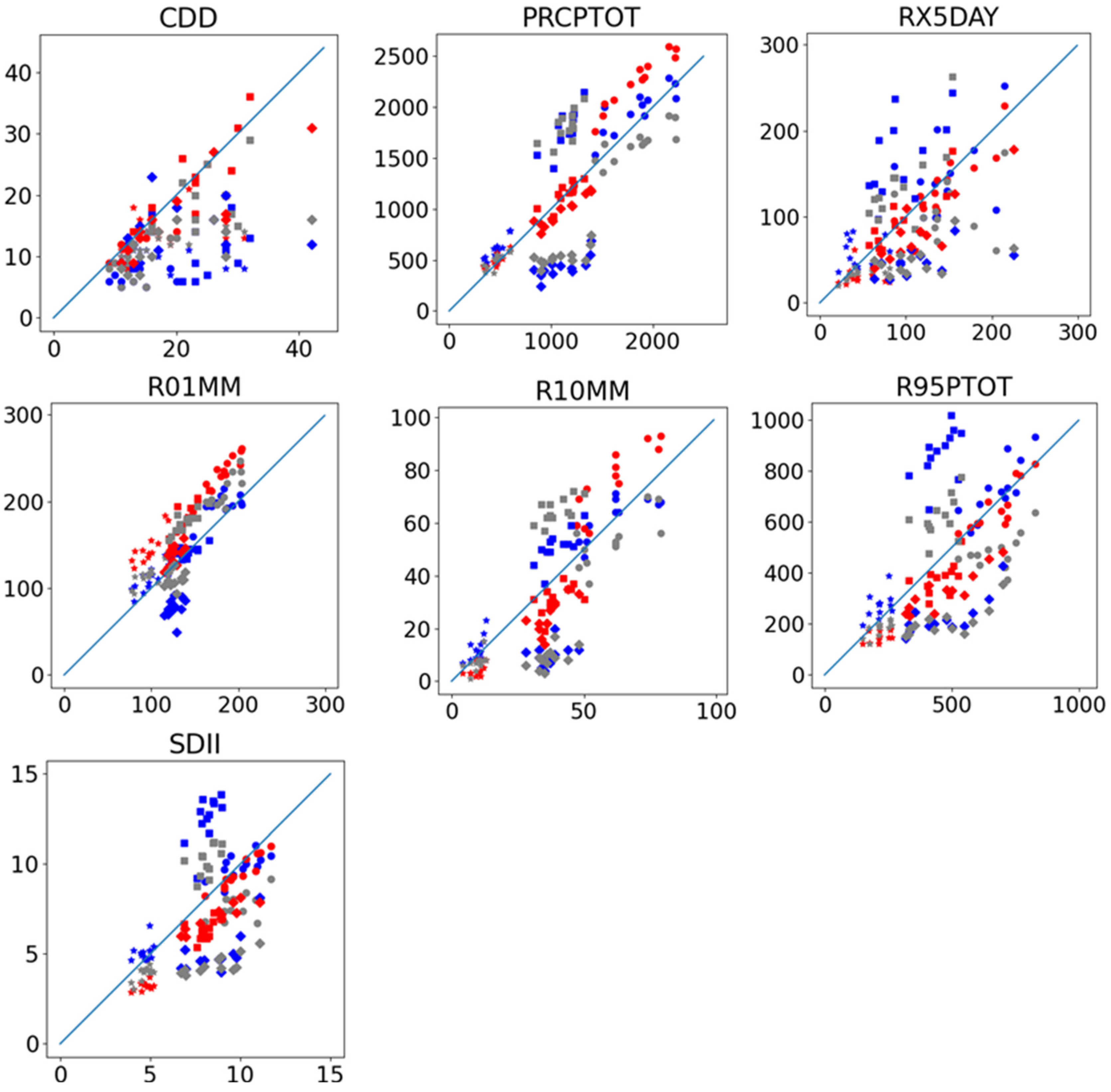
Subsequently, seven precipitation indices were computed at the ten stations to compare three gridded precipitation datasets with GHCN regarding extreme precipitation. Figure 2 presents the scatter plots of seven extreme precipitation indices for two coastal low-elevation stations (Stewart and Vancouver IA) and two inland high-elevation stations (Fernie and Vanderhoof). These stations are selected from the central to the southern regions of the province. The scatter plots of seven precipitation indices for ten stations are provided in Figures S1–S6. The scatter plots for PNWNAmet tend to converge on the 45-degree line, indicating superior agreement with the extreme precipitation indices derived from GHCN observations. The PNWNAmet’s tendency toward smaller deviations and biases against GHCN observations was especially evident at the southern stations, as also seen in Table 1. However, it should be noted that R01mm by PNWNAmet tended to be larger than the GHCN-daily. Overestimates of R01mm by PNWNAmet were common among the ten stations (Figure S4). The positive bias in PNWNAmet for the number of wet days (R01mm) is consistent with a previous study [26]. In Figure 2, precipitation indices, such as R95PTOT and SDII, calculated by the GPM and GPCC for Vancouver IA (square marker) are overestimated relative to GHCN. Conversely, the extreme precipitation indices calculated by GPM and GPCC tend to be underestimated at Fernie. These tendencies of overestimation at Vancouver IA and underestimation at Fernie are consistent with the daily data bias (i.e., MBE) observed in Table 1.
These findings collectively suggest that PNWNAmet demonstrates superior performance in daily precipitation, especially in the southern region, and that GPCC performs reasonably well in the central and northern regions of the British Columbia province.

3.2. Monthly Comparisons

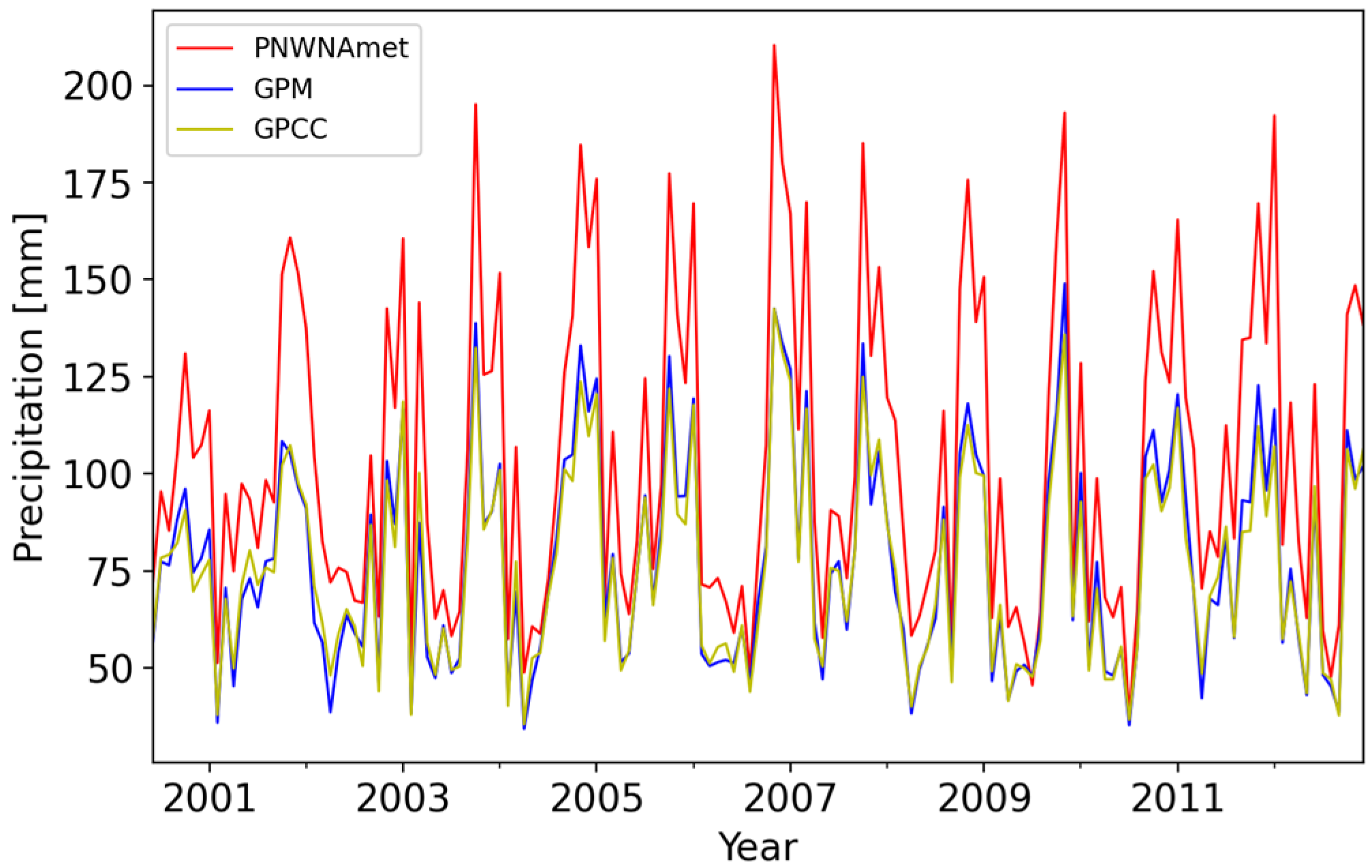
Spatially averaged monthly precipitation over British Columbia was computed for each of the three precipitation datasets. Figure 3 shows the time series of the spatial average monthly precipitation for three datasets from June 2000 to December 2012. The unusually low precipitation in the 2000/2001 winter, the extremely high precipitation in November 2006, and the high precipitation in January 2012 are seen in Figure 3. From Figure 3, the spatial average monthly precipitation from GPCC and GPM shows similar variability and amounts. In contrast, the spatial-average monthly precipitation from PNWNAmet was higher than that of GPCC and GPM. Then, using 12 years from January 2001 to December 2012, a Mann–Whitney test is applied to the spatial-average annual precipitation over British Columbia to investigate the relationships among the three precipitation datasets at the annual scale. The MW test indicated that the probability distribution of annual precipitation for PNWNAmet differs from GPCC and GPM at the 1% significance level. In contrast, the probability distribution of annual precipitation for GPCC and GPM is similar. On the other hand, Spearman’s rho and Kendall’s tau between any pair of the three precipitation datasets (i.e., PNWNAmet vs. GPCC, PNWNAmet vs. GPM, and GPCC vs. GPM) were significant at the 1% significance level, suggesting the similarity in the variations of annual precipitation time series of the three precipitation datasets. The rank correlation coefficients (i.e., Spearman’s rho and Kendall’s tau) for the spatial average annual precipitation time series over British Columbia are provided in Table S1.
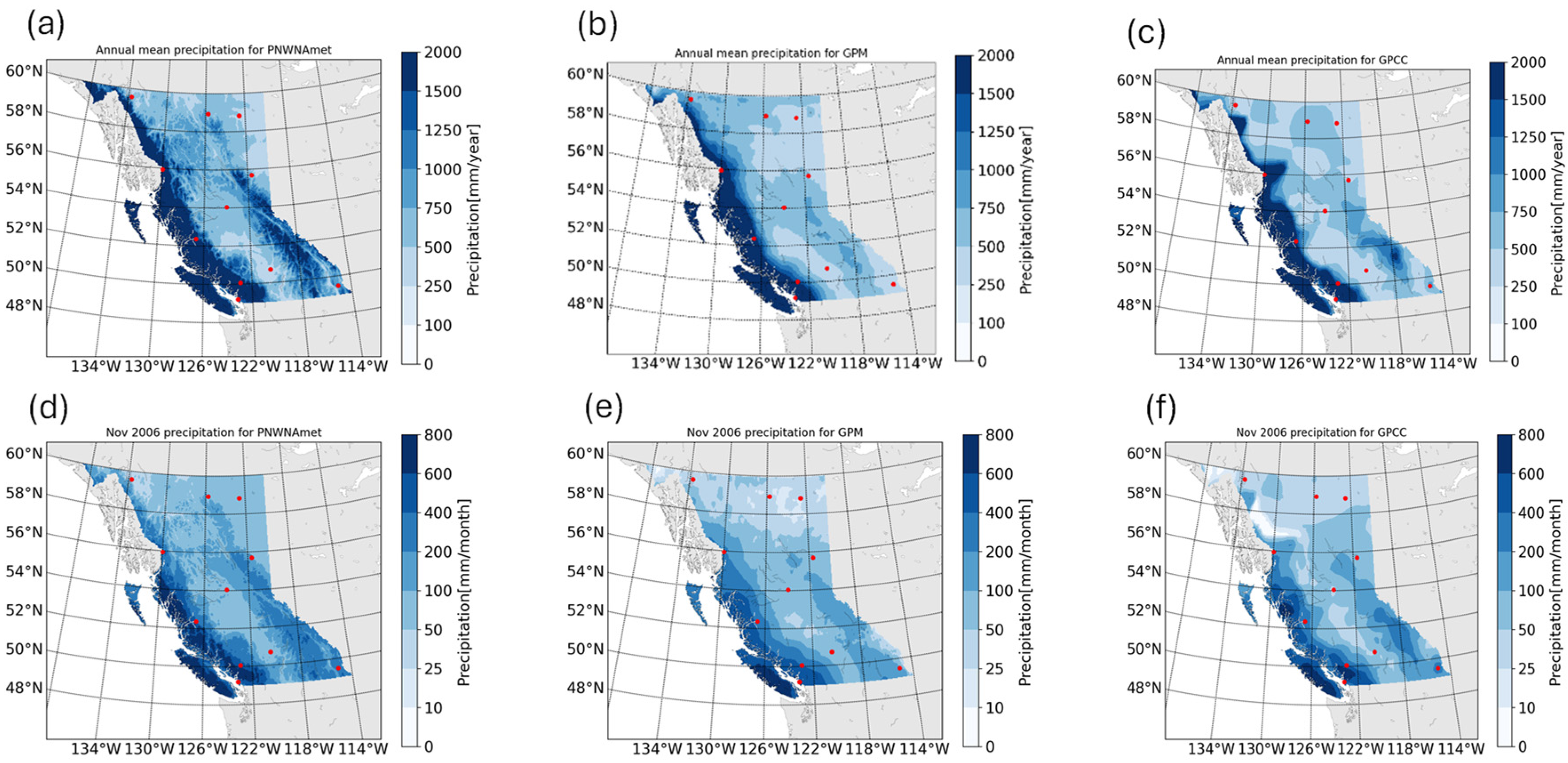
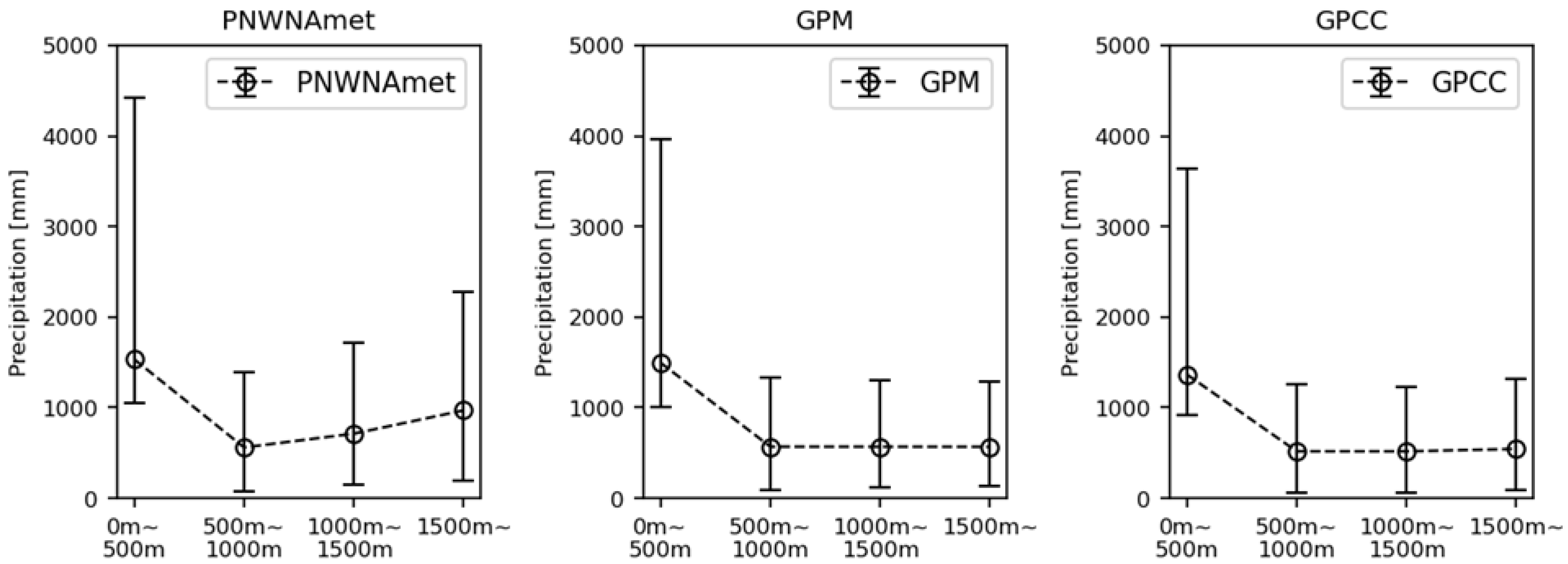
Figure 4a–c shows the spatial distribution of the annual mean precipitation of the three datasets. PNWNAmet exhibits higher precipitation in regions of high precipitation in the Coast Mountains in the west and the Rocky Mountains in the east. As depicted in Figure 4d–f, these tendencies are also observed in the historical high precipitation month (November 2006) of the British Columbia province. These results suggested that PNWNAmet’s precipitation in high-elevation areas is higher than the other two precipitation datasets. To further examine this feature, the relationships between elevation and annual mean precipitation for the three precipitation datasets are shown for four elevation bands (Figure 5). The comparison of annual mean precipitation for these elevation bands suggests that PNWNAmet shows higher precipitation than the other two precipitation datasets, especially at the highest elevation band. Furthermore, across all precipitation datasets, the annual mean precipitation in the lowest elevation band (0–500 m band) was the highest in each of the first, second, and third quartiles.
Subsequently, three precipitation datasets were evaluated on a monthly basis by computing MAE, MBE, R2, and RMSE between the GHCN and the three gridded precipitation datasets. Table 2 presents four scores for eleven GHCN stations (as in Figure 1) and each of the three precipitation datasets. At the northern stations (Atlin, Muncho Lake, and Fort Nelson), the GPCC had the best scores for MAE, R2, and RMSE. Among the four stations in the central region of British Columbia, two located in the eastern portion (Vanderhoof and Chetwynd) showed the best performance by GPCC when evaluated by MAE, R2, and RMSE. Bella Coola also showed GPCC’s superior performance to the other two datasets, although PNWNAmet exhibited comparable performance to GPCC.
However, at Stewart, which experiences high annual precipitation and is situated on the coastal side of British Columbia (as depicted in Figure 1 and Figure 4), PNWNAmet and GPM outperformed GPCC in terms of R2 and RMSE. In the southern region of British Columbia, PNWNAmet exhibited remarkably low MAE, MBE, and RMSE at three locations (Fernie, Vancouver IA, and Whistler Roundhouse) that have annual mean precipitation exceeding 1000 mm. At Kamloops, where the annual mean precipitation is the lowest (<300 mm) among the four stations in the south, GPCC performed best, followed by PNWNAmet and GPM.

4. Discussion

The comparisons based on monthly precipitation indicated that the GPCC exhibited superior performance in the northern and central regions of the province, while PNWNAmet performed best in the southern region. This tendency was also confirmed in statistical tests (Tables S2 and S3). Notably, PNWNAmet exhibited the highest agreement with GHCN at the two highest-elevation sites (Fernie and Whistler Roundhouse) among the eleven investigated locations. The PNWNAmet uses homogenized observation with climatology from PRISM, which is compiled from various parameters with elevation adjustments. Moreover, southern British Columbia had a high density of observation stations in compiling the PNWNAmet [26]. These methodological characteristics, with a high observation density in the southern region, may explain why PNWNAmet performed better in southern British Columbia, especially at high elevations. These findings suggest that PNWNAmet may be a more reliable gridded precipitation dataset in higher-elevation areas when observation density is not too sparse. The daily scale comparisons also suggested that PNWNAmet outperformed the other two precipitation datasets at the southern British Columbia stations, while GPCC performed better at the northern stations. The lower observation density in the northern region [26] may be related to PNWNAmet’s lower performance in the north.
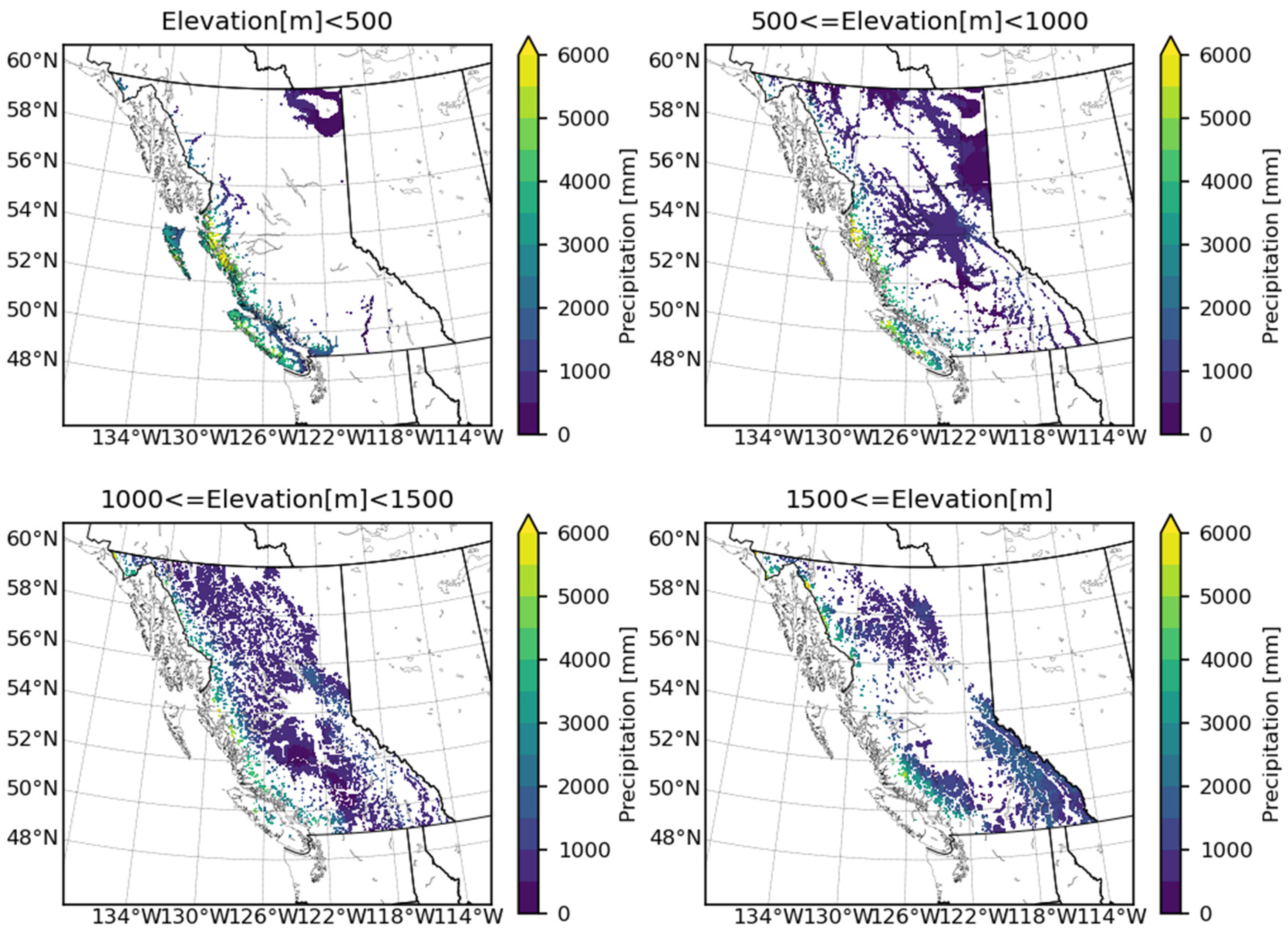
The precipitation–elevation dependency analysis across the three precipitation datasets (Figure 5) indicated the highest annual precipitation in the lowest elevation band. Though it could be assumed that precipitation increases from low elevation to high elevation, the precipitation–elevation dependencies in Figure 5 did not show this. To investigate the reason for this, the spatial distribution of PNWNAmet’s annual mean precipitation against the four elevation bands is examined (Figure 6). The spatial analysis of elevation and precipitation relations revealed that the high precipitation in the lowest elevation band (0–500 m) is due to the high precipitation zone in coastal low-elevation areas. Thus, although gradual increases in the annual mean precipitation from the 2nd to 4th elevation bands (500–1000 m, 1000 m–500 m, 1500 m–) were seen in the PNWNAmet, the highest precipitation was observed in the lowest elevation band. Considering the above, the precipitation elevation dependencies in Figure 5 can be partially explained by both elevation and the distance from the coast, includinging topograpy. This mixed effect of elevation and distance from the coast could explain why precipitation is not solely dependent on elevation. Such a tendency may also emerge when the analysis covers a broad area, such as the entire British Columbia province.
Figure 5 also showed that the PNWNAmet indicates higher precipitation than the other two datasets, especially in the areas exceeding 1500 m. PNWNAmet uses PRISM climatology as a predictor for the interpolation. The greater precipitation observed by PNWNAmet at high elevations may be attributed to the climatology-based interpolation method that incorporates elevation as a predictor to address the scarcity of climate stations in high-elevation regions. Furthermore, the spatial distribution of precipitation from PNWNAmet exhibited a stronger correlation with the terrain map (Figure 1) than that of the other two datasets.
It should be noted that although PNWNAmet and GPCC showed superior performance in comparisons with point observations, both precipitation products are based on gauge observations. In contrast, GPM is based on satellite observations. The satellite product may generally perform worse at high altitudes [35], which may partially explain the lower agreement between GPM and GHCN stations. Nevertheless, the annual precipitation averaged over a broad area (i.e., British Columbia) showed high agreement in precipitation variability among the three precipitation datasets. It was also seen that GPM precipitation at the monthly scale showed a reasonable agreement with a few observation stations in central British Columbia.
It was also seen that the GPCC and GPM showed a similarity in the time series of monthly precipitation averaged over British Columbia. The monthly GPCC precipitation gauge analysis is considered in the production of the IMERG product [44], which may partially explain the similarity in the BC average monthly and annual precipitation time series between GPM and GPCC. On the other hand, PNWNAmet uses PRISM climatology as a predictor for British Columbia [26], and the source observation data for PNWNAmet is AHCCD (Adjusted and Homogenized Canadian Climate Data), which is compiled by Environment and Climate Change Canada (ECCC). Furthermore, the good agreement in annual precipitation variability between PNWNAmet and the global precipitation dataset (GPCC) supports previous work [26] that compared the PNWNAmet annual precipitation time series with GPCC and VASClimO (Variability Analysis of Surface Climate Observations).
In general, high-resolution data is expected to show better agreement with point observations because the grid points of high-resolution precipitation data should be closer to the reference observation points than those of low-resolution precipitation data. However, the methodology used to compile the data, such as the interpolation method or the type of source observation data (e.g., gauge precipitation or satellite precipitation), also affects the performance of the precipitation data. Thus, the errors (i.e., deviations) to the point observations are considered to be affected by resolution, methodology, and source data in producing the grid precipitation data. Considering the above, although this study evaluated the performance of precipitation datasets by comparing them with point observations, it would also be valuable to further examine the features of different precipitation datasets in terms of the reproducibility of spatial distributions, which could be a value of satellite-based products such as GPM. Moreover, simple interpolation methods (linear interpolation and inverse distance weighted interpolation) are used for the comparisons in this study, but investigating other interpolation methods, such as the adaptive inverse distance method [45], would also be valuable.

5. Conclusions

In this study, three gridded precipitation datasets over the British Columbia province were compared with GHCN stations on a daily and monthly basis. The comparison of precipitation datasets using seven precipitation indices indicated that PNWNAmet and GPCC performed comparably, while PNWNAmet showed better agreement with GHCN at the southern British Columbia stations. The monthly scale comparison at eleven GHCN stations showed GPCC’s superior agreement with GHCN in the northern and central parts of the province. In contrast, PNWNAmet showed the best agreement with GHCN in the southern part of the province, especially at high-precipitation locations. Moreover, the comparisons implied PNWNAmet’s potential advantage in representing precipitation in regions of high precipitation and elevation. The intercomparisons of three precipitation datasets for spatially averaged monthly precipitation over British Columbia showed similar seasonal variations, while PNWNAmet showed higher monthly precipitation than the other two datasets.
In comparing extreme precipitation, this study used extreme precipitation indices. However, it would also be valuable to compare return periods when comparing the performances of different precipitation datasets. The comparison of precipitation datasets in this study was limited to three, but using additional gridded datasets (e.g., the CPC Merged Analysis of Precipitation (CMAP), Climate Hazards InfraRed Precipitation with Station data (CHIRPS), and Precipitation Estimation from Remotely Sensed Information using Artificial Neural Networks (PERSIANN)) would also be valuable. It should also be noted that the comparisons were performed against a limited number of observation points. Thus, comparisons with additional observation points in British Columbia would help further clarify the features of these gridded precipitation datasets. In addition, a spatial comparison on a monthly scale was performed for the extreme precipitation month in November 2006, but comparisons with the other months would also be beneficial for characterizing the features of these precipitation datasets.

Supplementary Materials

The following supporting information can be downloaded at: https://www.mdpi.com/article/10.3390/hydrology13020052/s1, Figure S1: Scatter plots of CDD for ten locations: Atlin, Muncho Lake, Fort Nelson UA, Stewart A, Bella Coola A, Vanderhoof, Chetwynd A, Vancouver IA, Kamloops A, and Fernie. The horizontal axis is for GHCN, and the vertical axis is for GPM (Blue), PNWNAmet (Red), and GPCC (Gray); Figure S2: Scatter plots of PRCPTOT for ten locations. The locations, axes, and markers are the same as Figure S1; Figure S3: Scatter plots of RX5DAY for ten locations. The locations, axes, and markers are the same as Figure S1; Figure S4: Scatter plots of R01MM for ten locations. The locations, axes, and markers are the same as Figure S1; Figure S5: Scatter plots of R10MM for ten locations. The locations, axes, and markers are the same as Figure S1; Figure S6: Scatter plots of R95PTOT for ten locations. The locations, axes, and markers are the same as Figure S1; Figure S7: Scatter plots of SDII for ten locations. The locations, axes, and markers are the same as Figure S1; Table S1: Spearman’s rho and Kendall’s tau for the British Columbia average annual precipitation between three precipitation datasets: PNWNAmet and GPCC, PNWNAmet and GPM, and GPCC and GPM. Data from January 2001 to December 2012 is used. p-values are based on two-tailed tests; Table S2: Mann-Whitney U statistic for monthly precipitation between ten GHCN stations and three precipitation datasets. U statistic satisfying the 5% significance level are in bold, and those satisfying the 1% significance level are in Italics. Data from January 2001 to December 2012 is used. p-values are based on two-tailed tests; Table S3: Welch’s t-statistic for monthly precipitation between ten GHCN stations and three precipitation datasets. t-statistics satisfying the 5% significance level are in bold, and those satisfying the 1% significance level are in Italics. Data from January 2001 to December 2012 is used. p-values are based on two-tailed tests.

Author Contributions

Conceptualization, R.O., Y.I., M.L.K. and A.M.D.; methodology, R.O. and Y.I.; validation, R.O. and Y.I.; formal analysis, R.O. and Y.I.; investigation, R.O. and Y.I.; data curation, R.O. and Y.I.; writing—original draft preparation, R.O. and Y.I.; writing—review and editing, M.L.K. and A.M.D.; visualization, R.O. and Y.I.; supervision, M.L.K.; project administration, M.L.K. and A.M.D.; funding acquisition, M.L.K. All authors have read and agreed to the published version of the manuscript.

Funding

This data development for this effort was funded by the U.S. Army Corps of Engineers, Northwestern Division, under the Columbia River Treaty program, under the University of California Cooperative Agreement, grant number W912HZ-22-2-0022.

Data Availability Statement

The data will be available upon reasonable request from the corresponding author.

Acknowledgments

We thank the anonymous reviewers for their constructive comments and valuable suggestions.

Conflicts of Interest

The authors declare no conflicts of interest.

References

  1. Arias, P.A.; Bellouin, E.; Coppola, N.; Jones, R.G.; Krinner, G.; Marotzke, J.; Naik, V.; Palmer, M.D.; Plattner, G.-K.; Rogelj, J.; et al. Technical Summary. In Climate Change 2021: The Physical Science Basis. Contribution of Working Group I to the Sixth Assessment Report of the Intergovernmental Panel on Climate Change; Masson-Delmotte, V., Zhai, P., Pirani, A., Connors, S.L., Péan, C., Berger, S., Caud, N., Chen, Y., Goldfarb, L., Gomis, M.I., et al., Eds.; Cambridge University Press: Cambridge, UK; New York, NY, USA, 2021; pp. 33–144. [Google Scholar] [CrossRef]
  2. Johnson, G.L.; Hanson, C.L. Topographic and atmospheric influences on precipitation variability over a mountainous watershed. J. Meteorol. Climatol. 1995, 34, 68–87. [Google Scholar] [CrossRef]
  3. Rodriguez-Puebla, C.; Enicinas, A.H.; Nieto, S.; Garmendia, J. Spatial and temporal patterns of annual precipitation variability over the Iberian Peninsula. Int. J. Climatol. 1998, 18, 299–316. [Google Scholar] [CrossRef]
  4. Chen, F.; Xu, Q.; Chen, J.; Birks, H.J.B.; Liu, J.; Zhang, S.; Jin, L.; An, C.; Telford, R.J.; Cao, X.; et al. East Asian summer monsoon precipitation variability since the last deglaciation. Sci. Rep. 2015, 5, 11186. [Google Scholar] [CrossRef]
  5. Anderson, M.L.; Chen, Z.-Q.; Kavvas, M.L.; Feldman, A. Coupling HEC-HMS with atmospheric models for prediction of watershed runoff. J. Hydrol. Eng. 2002, 7, 312–318. [Google Scholar] [CrossRef]
  6. Yoshitani, J.; Chen, Z.Q.; Kavvas, M.L.; Fukami, K. Atmospheric model-based streamflow forecasting at small, mountainous watersheds by a distributed hydrologic model: Application to a watershed in Japan. J. Hydrol. Eng. 2009, 14, 1107–1118. [Google Scholar] [CrossRef]
  7. Trinh, T.; Jang, S.; Ishida, K.; Ohara, N.; Chen, Z.Q.; Anderson, M.L.; Darama, Y.; Kavvas, M.L. Reconstruction of historical inflows into and water supply from Shasta dam by coupling physically based hydroclimate model with reservoir operation model. J. Hydrol. Eng. 2016, 21, 04016029. [Google Scholar] [CrossRef]
  8. Amin, M.Z.M.; Shaaban, A.J.; Ercan, A.; Ishida, K.; Kavvas, M.L.; Chen, Z.Q.; Jang, S. Future Climate Change Impact Assessment of Watershed Scale Hydrologic Processes in Peninsular Malaysia by a Regional Climate Model Coupled with a Physically-Based Hydrology Model. Sci. Total Environ. 2017, 575, 12–22. [Google Scholar] [CrossRef]
  9. Iseri, Y.; Diaz, A.J.; Trinh, T.; Kavvas, M.L.; Ishida, K.; Anderson, M.L.; Ohara, N.; Snider, E.D. Dynamical downscaling of global reanalysis data for high-resolution spatial modeling of snow accumulation/melting at the central/southern Sierra Nevada watersheds. J. Hydrol. 2021, 598, 126445. [Google Scholar] [CrossRef]
  10. Ruiz, J.J.; Saulo, C.; Nogués-Paegle, J. WRF Model Sensitivity to Choice of Parameterization over South America: Validation against Surface Variables. Mon. Weather Rev. 2010, 138, 3342–3355. [Google Scholar] [CrossRef]
  11. Martinho Marta-Almeida, M.; Teixeira, J.C.; Carvalho, M.J.; Melo-Gonçalves, P.; Rocha, A.M. High resolution WRF climatic simulations for the Iberian Peninsula: Model validation. Phys. Chem. Earth Parts A/B/C 2016, 94, 94–105. [Google Scholar] [CrossRef]
  12. Toride, K.; Iseri, Y.; Duren, A.M.; England, J.F.; Kavvas, M.L. Evaluation of physical parameterizations for atmospheric river induced precipitation and application to long-term reconstruction based on three reanalysis datasets in Western Oregon. Sci. Total Environ. 2019, 658, 570–581. [Google Scholar] [CrossRef] [PubMed]
  13. Joyce, R.J.; Janowiak, J.E.; Arkin, P.A.; Xie, P. CMORPH: A method that produces global precipitation estimates from passive microwave and infrared data at high spatial and temporal resolution. J. Hydrometeorol. 2004, 5, 487–503. [Google Scholar] [CrossRef]
  14. Behrangi, A.; Hsu K-l Imam, B.; Sorooshian, S.; Huffman, G.J.; Kuligowski, R.J. PERSIANN-MSA: A precipitation estimation method from satellite-based multispectral analysis. J. Hydrometeorol. 2019, 10, 1414–1429. [Google Scholar] [CrossRef]
  15. Huffman, G.J.; Stocker, E.F.; Bolvin, D.T.; Nelkin, E.J.; Tan, J. GPM IMERG Final Precipitation L3 1 Day 0.1 Degree × 0.1 Degree V06; Savtchenko, A., Ed.; Goddard Earth Sciences Data and Information Services Center (GES DISC): Greenbelt, MD, USA, 2019. [CrossRef]
  16. Nicholson, S.E.; Some, B.; McCollum, J.; Nelkin, E.; Klotter, D.; Berte, Y.; Diallo, B.M.; Gaye, I.; Kpabebe, G.; Ndiaye, O.; et al. Validation of TRMM and other rainfall estimates with a high-density gauge dataset for West Africa. Part I: Validation of GPCC rainfall product and Pre-TRMM satellite and blended products. J. Appl. Meteorol. Climatol. 2003, 42, 1337–1354. [Google Scholar] [CrossRef]
  17. Lee, J.; Lee, E.H.; Seol, K.H. Validation of integrated multisatellitE retrievals for GPM (IMERG) by using gauge-based analysis products of daily precipitation over East Asia. Theor. Appl. Clim. 2019, 137, 2497–2512. [Google Scholar] [CrossRef]
  18. Sorooshian, S.; Hsu, K.-L.; Gao, X.; Gupta, H.V.; Imam, B.; Braithwaite, D. Evaluation of PERSIANN system satellite-based estimates of tropical rainfall. Bull. Am. Meteorol. Soc. 2000, 81, 2035–2046. [Google Scholar] [CrossRef]
  19. Yu, Y.; Schneider, U.; Yang, S.; Becker, A.; Ren, Z. Evaluating the GPCC Full Data Daily Analysis Version 2018 through ETCCDI indices and comparison with station observations over mainland of China. Theor. Appl. Clim. 2020, 142, 835–845. [Google Scholar] [CrossRef]
  20. Moazami, S.; Najafi, M.R. A comprehensive evaluation of GPM-IMERG V06 and MRMS with hourly ground-based precipitation observations across Canada. J. Hydrol. 2021, 594, 125929. [Google Scholar] [CrossRef]
  21. Duisebek, B.; Senay, G.B.; Ojima, D.S.; Zhang, T.; Sagin, J.; Wang, X. Evaluating the performance of multiple precipitation datasets over the Transboundary Ili River Basin Between China and Kazakhstan. Sustainability 2025, 17, 7418. [Google Scholar] [CrossRef]
  22. Qi, W.; Wang, S.; Chen, J. Inter-comparison of multiple gridded precipitation datasets over different climates at global scale. Water 2024, 16, 1553. [Google Scholar] [CrossRef]
  23. Environment Canada. Treats to Water Availability in Canada; NWRI Scientific Assessment Report Series No. 3 and ACSD Science Assessment Series; National Water Research Institute: Burlington, ON, Canada, 2004; 128p. [Google Scholar]
  24. Richards-Thomas, T.S.; Déry, S.J.; Stewart, R.E.; Thériault, J.M. Climatological context of the mid-November 2021 floods in the province of British Columbia, Canada. Weather Clim. Extrem. 2024, 45, 100705. [Google Scholar] [CrossRef]
  25. Loukas, A.; Quick, M.C. The Effect of climate change on floods in British Columbia. Hydrol. Res. 1999, 30, 231–256. [Google Scholar] [CrossRef]
  26. Werner, A.T.; Schnorbus, M.A.; Shrestha, R.R.; Cannon, A.J.; Zweiers, F.W.; Dayon, G.; Anslow, F. A long-term, temporally consistent, gridded daily meteorological dataset for northwestern North America. Sci. Data 2019, 6, 180299. [Google Scholar] [CrossRef]
  27. Menne, M.J.; Durre, I.; Vose, R.S.; Gleason, B.E.; Houston, T.G. An overview of the Global Historical Climatology Network-Daily Database. J. Atmos. Ocean. Technol. 2012, 29, 897–910. [Google Scholar] [CrossRef]
  28. Septer, D. Flooding and Landslide Events Northern British Columbia 1820–2006; Ministry of Environment, Province of British Columbia: Victoria, BC, Canada, 2017. Available online: http://www.env.gov.bc.ca/wsd/public_safety/flood/pdfs_word/floods_landslides_north.pdf (accessed on 9 January 2026).
  29. Environment Canada. Winter 2000/2001 temperature and precipitation in historical perspective. In Climate Trends and Variations Bulletin for Canada; Environment and Climate Change Canada: Gatineau, QC, Canada, 2001; Available online: https://epe.lac-bac.gc.ca/100/202/301/climate-e/2001/winter/ (accessed on 9 January 2026).
  30. Weather Forecast Office Pendleton. Inland Northwest Informer Newsletter. 2012. Spring/Summer 2012, 10. Available online: https://www.weather.gov/media/pdt/Vol10-2012Spring.pdf (accessed on 9 January 2026).
  31. Becker, A.; Finger, P.; Meyer-Christoffer, A.; Rudolf, B.; Schamm, K.; Schneider, U.; Ziese, M. A description of the global land-surface precipitation data products of the Global Precipitation Climatology Centre with sample applications including centennial (trend) analysis from 1901–present. Earth Syst. Sci. Data 2013, 5, 71–99. [Google Scholar] [CrossRef]
  32. Schamm, K.; Ziese, M.; Becker, A.; Finger, P.; Meyer-Christoffer, A.; Schneider, U.; Schröder, M.; Stender, P. Global gridded precipitation over land: A description of the new GPCC First Guess Daily product. Earth Syst. Sci. Data 2014, 6, 49–60. [Google Scholar] [CrossRef]
  33. Schneider, U.; Finger, P.; Meyer-Christoffer, A.; Ziese, M.; Becker, A. Global Precipitation Climatology Centre (GPCC), “Global Precipitation Analysis Products of the GPCC”; Deutscher Wetterdienst: Offenbach, Germany, 2018. [Google Scholar]
  34. Zittis, G. Observed rainfall trends and precipitation uncertainty in the vicinity of the Mediterranean, Middle East and North Africa. Theor. Appl. Clim. 2018, 134, 1207–1230. [Google Scholar] [CrossRef]
  35. Sun, Q.; Miao, C.; Duan, Q.; Ashouri, H.; Sorooshian, S.; Hsu, K.-L. A review of global precipitation data sets: Data sources, estimation, and intercomparisons. Rev. Geophys. 2018, 56, 79–107. [Google Scholar] [CrossRef]
  36. Ziese, M.; Rauthe-Schöch, A.; Becker, A.; Finger, P.; Rustemeier, E.; Schneider, U. GPCC Full Data Daily Version 2020 at 1.0°: Daily Land-Surface Precipitation from Rain-Gauges Built on GTS-Based and Historic Data; Global Precipitation Climatology Centre: Main, Germany, 2020. [Google Scholar] [CrossRef]
  37. Schneider, U.; Becker, A.; Finger, P.; Rustemeier, E.; Ziese, M. GPCC Full Data Monthly Product Version 2020 at 0.25°: Monthly Land-Surface Precipitation from Rain-Gauges Built on GTS-Based and Historical Data; Global Precipitation Climatology Centre: Main, Germany, 2020. [Google Scholar] [CrossRef]
  38. Hou, A.Y.; Kakar, R.K.; Neeck, S.; Azarbarzin, A.A.; Kummerow, C.D.; Kojima, M.; Oki, R.; Nakamura, K.; Iguchi, T. The Global Precipitation Measurement Mission. Bull. Am. Meteorol. Soc. 2014, 95, 701–722. [Google Scholar] [CrossRef]
  39. Skofronick-Jackson, G.; Kirschbaum, D.; Petersen, W.; Huffmann, G.; Kidd, C.; Stoker, E.; Kakar, R. The Global Precipitation Measurement (GPM) mission’s scientific achievements and societal contributions: Reviewing four years of advanced rain and snow observations. Q. J. R. Meteorol. Soc. 2018, 144, 27–48. [Google Scholar] [CrossRef]
  40. Libertino, A.; Sharma, A.; Lakshmi, V.; Claps, P. A global assessment of the timing of extreme rainfall from TRMM and GPM for improving hydrologic design. Environ. Res. Lett. 2016, 11, 054003. [Google Scholar] [CrossRef]
  41. Nychka, D.; Furrer, R.; Paige, J.; Sain, S. Fields: Tools for Spatial Data; National Center for Atmospheric Research: Boulder, CO, USA, 2017. [Google Scholar] [CrossRef]
  42. Eum, H.-I.; Gupta, A. Hybrid climate datasets from a climate data evaluation system and their impacts on hydrologic simulations for the Athabasca River basin in Canada. Hydrol. Earth Syst. Sci. 2019, 23, 5151–5173. [Google Scholar] [CrossRef]
  43. Sobie, S.R.; Ouali, D.; Curry, C.L.; Zwiers, F.W. Multivariate canadian downscaled climate scenarios for CMIP6 (CanDCS-M6). Geosci. Data J. 2024, 11, 806–824. [Google Scholar] [CrossRef]
  44. Huffman, G.; Bolvin, D.T.; Braithwaite, D.; Hsu, K.; Joyce, R.; Kidd, C.; Nelkin, E.J.; Sorooshian, S.; Than, J.; Xie, P. Algorithm Theoretical Basis Document (ATBD) Version 06. In NASA Global Precipitation Measurement (GPM) Integrated Multi-Satellite Retrievals for GPM (IMERG); NASA Goddard Space Flight Center: Greenbelt, MD, USA, 2020. [Google Scholar]
  45. Lu, G.Y.; Wong, D.W. An adaptive inverse-distance weighting spatial interpolation technique. Comput. Geosci. 2008, 34, 1044–1055. [Google Scholar] [CrossRef]
Figure 1. A terrain map of the British Columbia province and eleven observation points (blue circles) from GHCN-Daily. The color scale shows the elevation [m]. GMTED2010 (Mean 30arc-sec) is used for the plot [https://topotools.cr.usgs.gov/gmted_viewer/viewer.htm (accessed on 15 September 2025)].
Hydrology 13 00052 g001
Figure 2. Seven precipitation indices: CDD [days], PRCPTOT [mm], RX5DAY [mm], R01MM [day], R10MM [day], R95PTOT [mm], and SDII [mm/day]. A circle for Stewart, a star for Vanderhoof, a square for Vancouver International Airport (IA), and a diamond for Fernie. The light blue line is a 45-degree line. The horizontal axis is for GHCN, and the vertical axis is for PNWNAmet (Red), GPM (Blue), and GPCC (Gray). The data period for the precipitation index calculation is 1 January 2001, to 31 December 2012.
Hydrology 13 00052 g002
Figure 3. Time series of monthly precipitation averaged over the British Columbia province. Red is PNWNAmet, blue is GPM, and yellow is GPCC.
Hydrology 13 00052 g003
Figure 4. Spatial distribution of annual mean precipitation for (a) PNWNAmet, (b) GPM, (c) GPCC, and November 2006 precipitation for (d) PNWNAmet, (e) GPM, and (f) GPCC. The data period for annual mean precipitation was from June 2000 to May 2012. Red circles are the observation points shown in Figure 1.
Hydrology 13 00052 g004
Figure 5. Annual mean precipitation by PNWNAmet (left), GPM (center), and GPCC (right), which are averaged for four elevation bands. The data period for the annual mean precipitation was from January 2001 to December 2012. The circle is the median and the lower and upper caps are the 1st (25%) and 3rd (75%) quantiles of annual mean precipitation. The x-axis tick labels are 0~500 m: less than 500 m; 500~1000 m: greater than or equal to 500 m and less than 1000 m; 1000–1500 m: greater than or equal to 1000 m and less than 1500 m; and 1500~: greater than or equal to 1500 m.
Hydrology 13 00052 g005
Figure 6. Spatial map of annual mean precipitation by PNWNAmet. The annual mean precipitation is shown for four elevation bands: 0~500 m: less than 500 m; 500~1000 m: greater than or equal to 500 m and less than 1000 m; 1000~1500 m: greater than or equal to 1000 m and less than 1500 m; and 1500~: greater than or equal to 1500 m.
Hydrology 13 00052 g006
Table 1. MAE [mm/day], MBE [mm/day], R2, and RMSE [mm/day] between GHCN daily precipitation at ten locations and daily precipitation by three gridded precipitation datasets.
RegionStation Name(a) MAE(b) MBE
GPCCGPMPNWNAmetGPCCGPMPNWNAmet
NorthernAtlin0.61 2.03 0.77 0.18 0.83 0.27
NorthernMuncho Lake0.77 2.04 1.67 −0.03 0.29 0.18
NorthernFort Nelson0.71 1.67 1.00 −0.13 −0.17 −0.11
CentralStewart2.92 5.37 2.18 −0.58 0.35 1.11
CentralBella Coola1.97 4.67 1.98 1.29 1.68 1.10
CentralVanderhoof0.82 1.93 1.17 0.09 0.37 0.09
CentralChetwynd0.88 1.67 1.40 0.25 0.16 0.40
SouthernVancouver IA2.64 3.49 1.48 1.81 1.76 0.04
SouthernKamloops0.54 1.03 0.62 0.35 0.38 0.13
SouthernFernie2.72 3.15 1.85 −1.65 −1.96 −0.36
RegionStation Name(c) R2(d) RMSE
GPCCGPMPNWNAmetGPCCGPMPNWNAmet
NorthernAtlin0.65 0.04 0.61 1.58 4.08 1.68
NorthernMuncho Lake0.61 0.11 0.21 2.23 4.23 3.22
NorthernFort Nelson0.79 0.25 0.64 1.90 4.06 2.52
CentralStewart0.62 0.23 0.85 6.01 10.27 3.92
CentralBella Coola0.81 0.24 0.83 4.18 10.26 3.67
CentralVanderhoof0.66 0.09 0.40 1.94 4.46 2.59
CentralChetwynd0.61 0.22 0.35 2.32 4.09 2.96
SouthernVancouver IA0.64 0.46 0.73 5.47 8.82 3.33
SouthernKamloops0.74 0.26 0.51 1.17 2.30 1.44
SouthernFernie0.27 0.10 0.65 6.64 7.42 4.50
Table 2. MAE [mm/month], MBE [mm/month], R2, and RMSE [mm/month] between GHCN monthly precipitation and monthly precipitation by three gridded precipitation datasets.
RegionStation Name(a) MAE(b) MBE
GPCCGPMPNWNAmetGPCCGPMPNWNAmet
NorthernAtlin5.6927.3311.03−1.2124.977.97
NorthernMuncho Lake6.5719.4217.39−1.288.315.18
NorthernFort Nelson7.7113.259.13−5.17−5.23−3.49
CentralStewart36.2032.8436.9311.0210.8233.66
CentralBella Coola30.9453.7837.7526.1851.0933.76
CentralVanderhoof7.6314.7212.01−3.1911.292.88
CentralChetwynd9.4612.4421.362.254.8912.11
SouthernVancouver IA21.9755.2412.3520.8353.631.25
SouthernKamloops4.3311.997.063.5111.484.04
SouthernFernie31.8758.5819.75−28.48−57.50−10.35
SouthernWhistler Roundhouse51.1957.0544.42−32.89−40.61−19.30
RegionStation Name(c) R2(d) RMSE
GPCCGPMPNWNAmetGPCCGPMPNWNAmet
NorthernAtlin0.800.320.7210.0535.5214.26
NorthernMuncho Lake0.810.390.4612.7428.0222.63
NorthernFort Nelson0.900.740.8611.5418.5513.11
CentralStewart0.660.770.9059.6748.4948.35
CentralBella Coola0.870.790.8639.969.5347.16
CentralVanderhoof0.800.700.5611.0918.9116.09
CentralChetwynd0.720.770.5117.4716.8625.77
SouthernVancouver IA0.960.90.9328.3670.8718.08
SouthernKamloops0.940.790.745.1513.778.89
SouthernFernie0.780.340.8546.5779.5229.51
SouthernWhistler Roundhouse0.740.690.7769.6077.6861.77
Disclaimer/Publisher’s Note: The statements, opinions and data contained in all publications are solely those of the individual author(s) and contributor(s) and not of MDPI and/or the editor(s). MDPI and/or the editor(s) disclaim responsibility for any injury to people or property resulting from any ideas, methods, instructions or products referred to in the content.