
Copula-Based Bayesian Inference Approaches for Uncertainty Quantification for Hydrological Simulation

 ,
, 

Abstract
1. Introduction
2. Methodology
2.1. Bayesian Inference
2.2. Metropolis–Hastings Algorithm
2.3. Modeling Multiple Dependence Through Copulas
2.4. MH and CopMH Algorithms
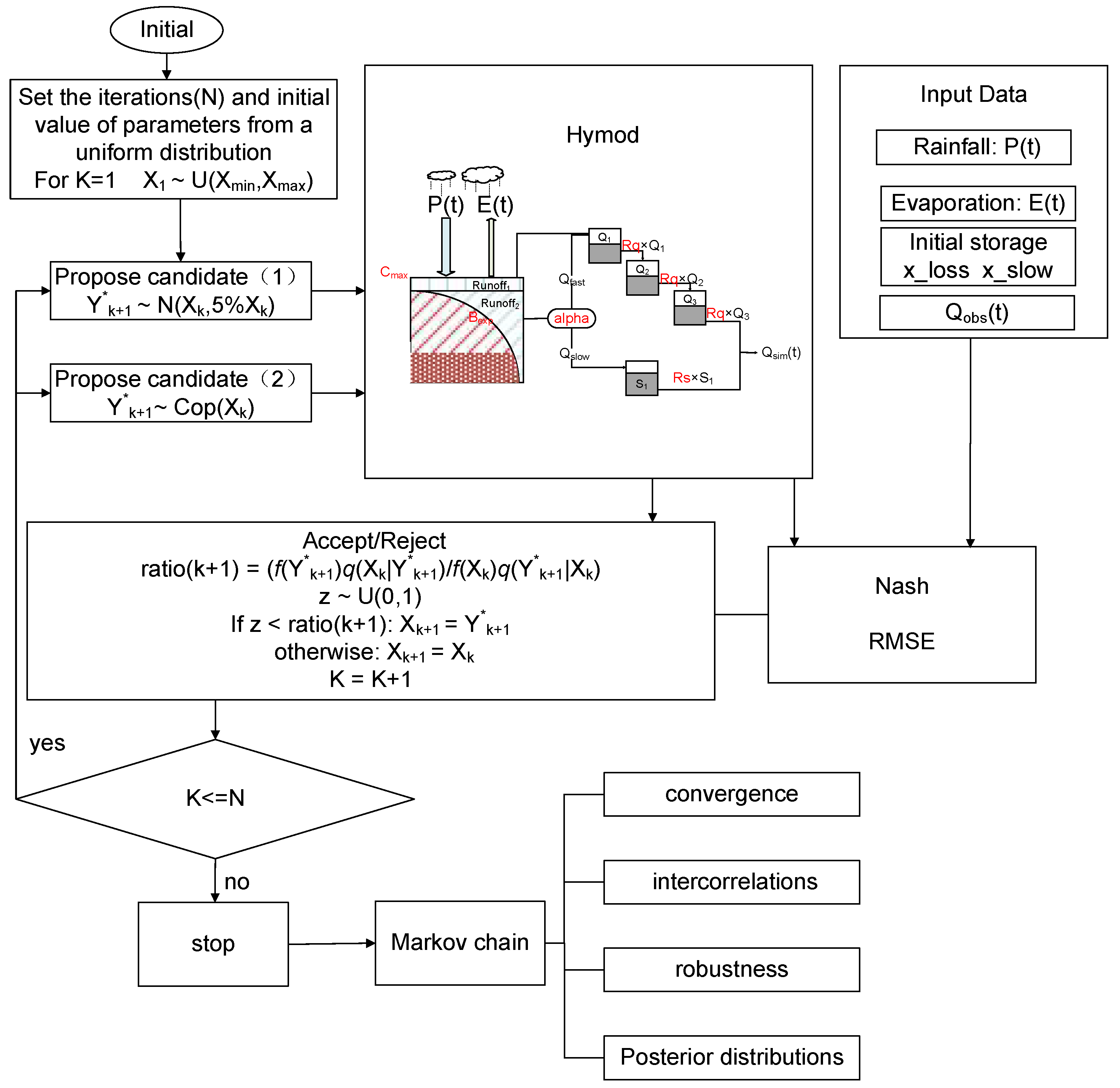
- Generate an initial Markov chain. At any step K + 1, the model parameters Xk+1 for the current step can be forecasted based on the prior parameters Xk in step K and the simulated observations Qsim in the current step. The simulated observations are obtained through Hymod with model parameters Xk+1. An initial Markov chain i = 1, …, 1000; were generated.
- Uniformization: Based on initial Markov chain , the marginal distributions of each parameter are assumed to be normally distributed with mean and variance . and are the mean value and variance value of the prior 1000 prerun samples. Depending on the cumulative probability density function of every Markov chain, each prerun sample can be transformed to in the range [0, 1] using the “pnorm” function in R.
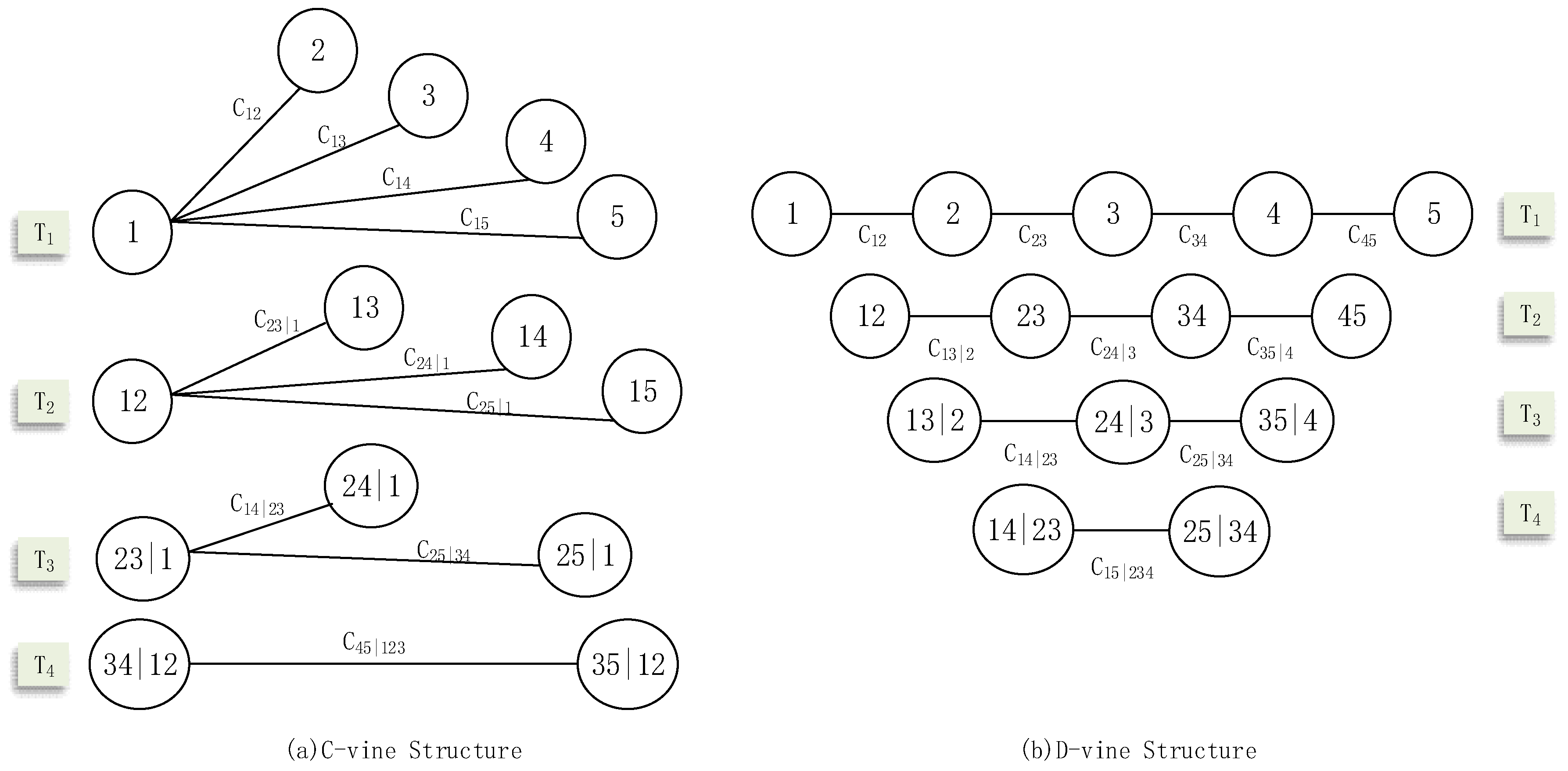
- Fitting the D-vine copula model. Using , we fit an η-parameterized D-vine copula density, assuming all of the D-vine pair-copula families were Frank copulas. The pair-copula parameters of 5-dimensional D-vine copula models were sequentially estimated using the “CDVineSeqEst” function in “CDVine Package”.
- Generate proposed candidate according to the D-vine copula model. A matrix of data y_copula was simulated from the above D-vine copula model using the “CDVineSim” function in “CDVine Package”. Then the proposed candidates were generated as a quantile function of the normal distribution based on inversion of pnorm using the “qnorm” function in R.
- Generate proposed candidates for the CopMH algorithm.Now, let y1 be a random MH algorithm proposed candidate of choice, and y2 be a CopMH algorithm proposed candidate.
- Generation of the Markov chain. Run Hymod with model parameters , and obtain the simulated observations . Then calculate according to Equation (7). Loop iterations until K = 20,000.
3. Case Study
3.1. Hydrologic Simulation and Model Calibration and Validation
3.1.1. Hydrologic Simulation
3.1.2. Model Performance Evaluation
3.2. Study Catchment and Data Acquisition
3.2.1. Study Catchment
3.2.2. Data Acquisition
3.2.3. Data Analysis
4. Results and Discussion
4.1. Convergence of Algorithm
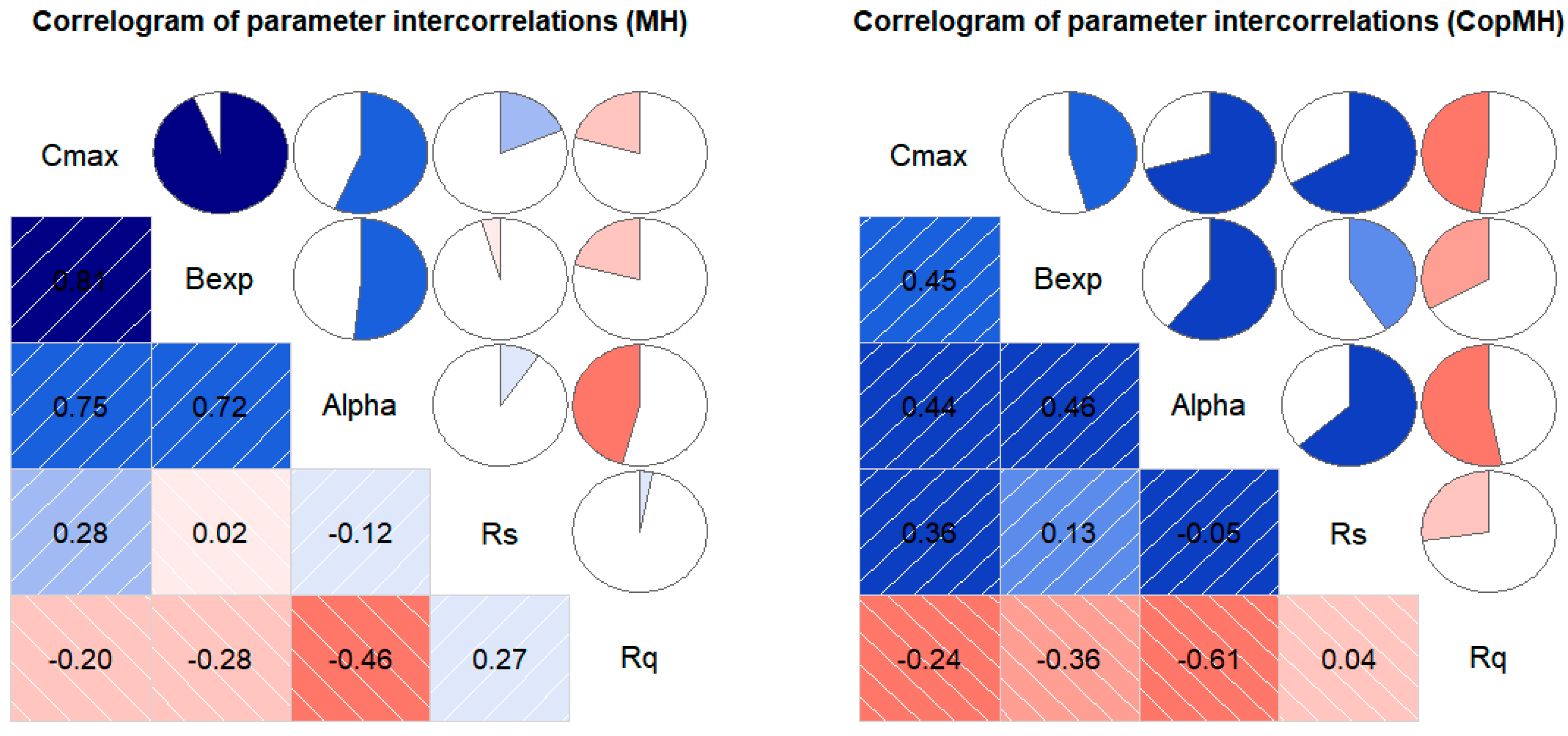
4.2. Intercorrelation Analysis Between Parameters
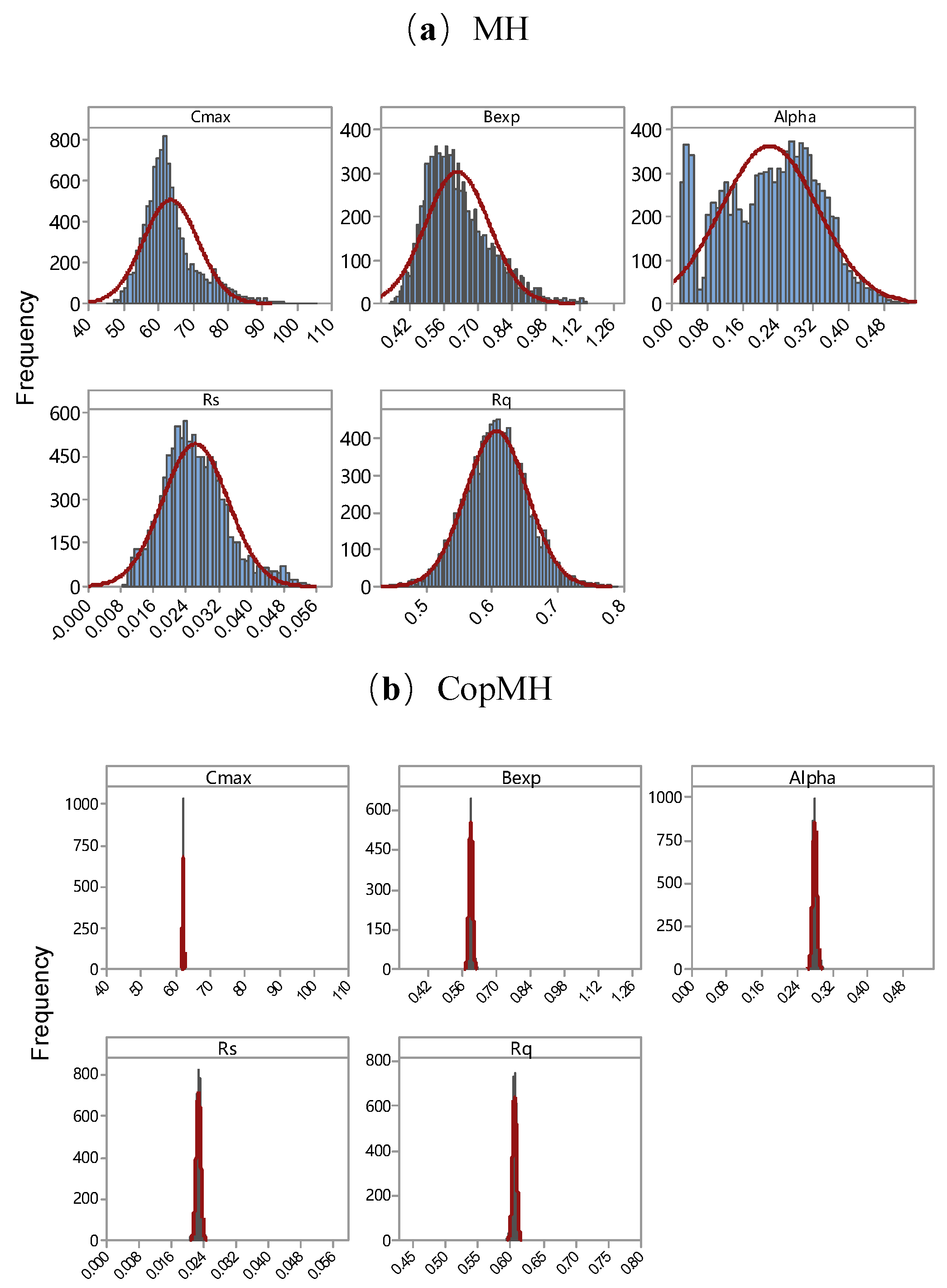
4.3. Bayesian Inference of Model Parameters
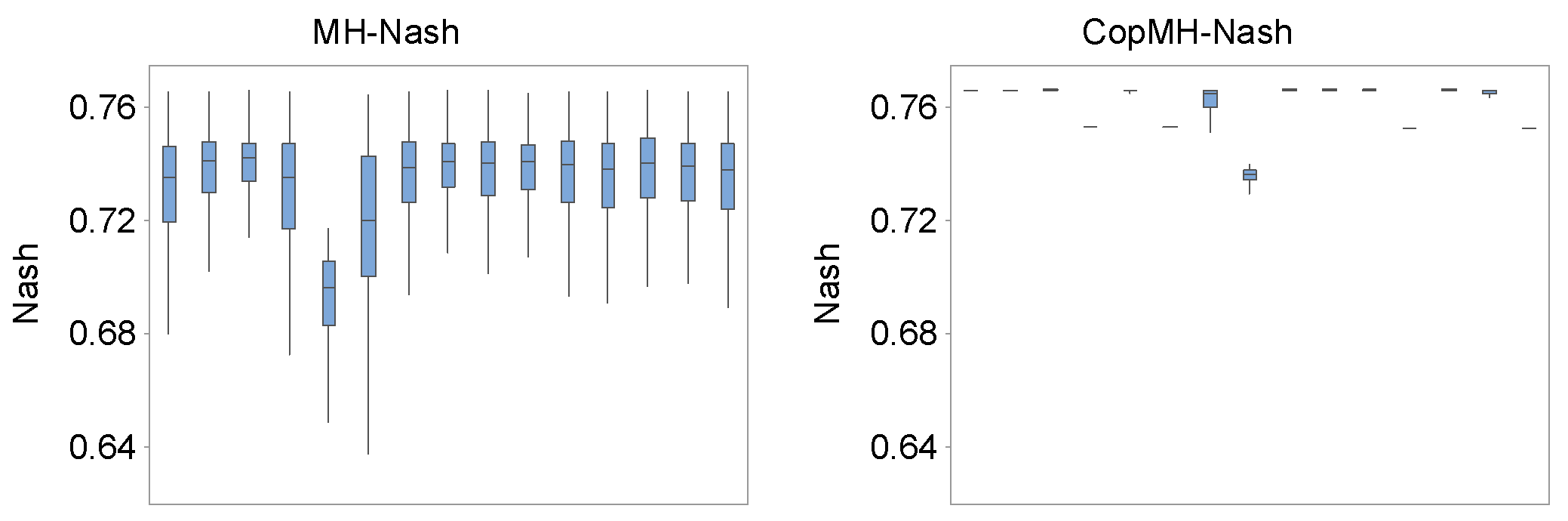
4.4. Robustness of Algorithm
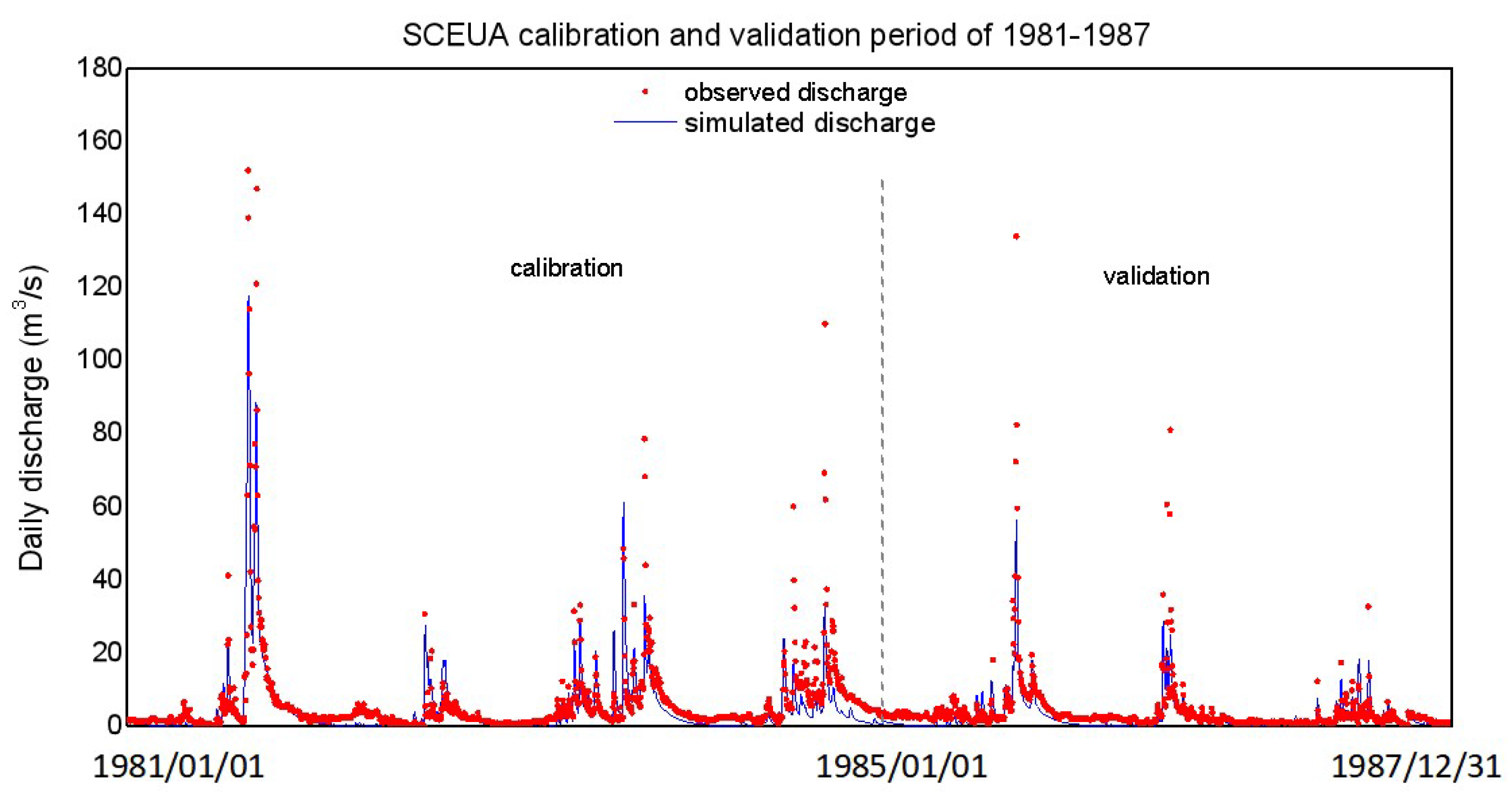
4.5. Calibration and Verification of the Hydrologic Model
5. Conclusions
Supplementary Materials
Author Contributions
Funding
Data Availability Statement
Acknowledgments
Conflicts of Interest
References
- Fan, Y.R.; Huang, G.H.; Baetz, B.W.; Li, Y.P.; Huang, K.; Li, Z.; Chen, X.; Xiong, L.H. Parameter uncertainty and temporal dynamics of sensitivity for hydrologic models: A hybrid sequential data assimilation and probabilistic collocation method. Environ. Model. Softw. 2016, 86, 30–49. [Google Scholar] [CrossRef]
- Solanki, H.; Vegad, U.; Kushwaha, A.; Mishra, V. Improving streamflow prediction using multiple hydrological models and machine learning methods. Water Resour. Res. 2025, 61, e2024WR038192. [Google Scholar] [CrossRef]
- Wang, F.; Huang, G.H.; Fan, Y.; Li, Y.P. Development of clustered polynomial chaos expansion model for stochastic hydrological prediction. J. Hydrol. 2021, 595, 126022. [Google Scholar] [CrossRef]
- Heidelberger, P.; Welch, P.D. Simulation Run Length Control in the Presence of an Initial Transient. Oper. Res. 1983, 31, 1109–1144. [Google Scholar] [CrossRef]
- Moradkhani, H.; Hsu, K.L.; Gupta, H.; Sorooshian, S. Uncertainty assessment of hydrologic model states and parameters: Sequential data assimilation using the particle filter. Water Resour. Res. 2005, 41, 237–246. [Google Scholar] [CrossRef]
- Nash, J.E.; Sutcliffe, J.V. River flow forecasting through conceptual models part I—A discussion of principles. J. Hydrol. 1970, 10, 282–290. [Google Scholar] [CrossRef]
- Yuan, Q.S.; Wang, P.F.; Wang, C.; Chen, J.; Wang, X.; Liu, S. Metal(loid) partitioning and transport in the Jinsha River, China: From upper natural reaches to lower cascade reservoirs-regulated reaches. J. Environ. Inform. 2024, 44, 126–139. [Google Scholar] [CrossRef]
- Fan, Y.R.; Huang, G.H.; Baetz, B.W.; Li, Y.P.; Huang, K. Development of a copula-based particle filter (CopPF) approach for hydrologic data assimilation under consideration of parameter interdependence. Water Resour. Res. 2017, 53, 4850–4875. [Google Scholar] [CrossRef]
- Vrugt, J.A.; Diks, C.G.H.; Gupta, H.V.; Bouten, W.; Verstraten, J.M. Improved Treatment of Uncertainty in Hydrologic Modeling: Combining the Strengths of Global Optimization and Data Assimilation; Pontifical Institute of Mediaeval Studies: Toronto, ON, Canada, 2005; pp. 407–412. [Google Scholar]
- Liu, Y.R.; Li, Y.P.; Huang, G.H.; Zhang, J.L.; Fan, Y.R. A Bayesian-based multilevel factorial analysis method for analyzing parameter uncertainty of hydrological model. J. Hydrol. 2017, 553, 750–762. [Google Scholar] [CrossRef]
- Bastola, S. The regionalization of a parameter of HYMOD, a conceptual hydrological model, using data from across the globe. HydroResearch 2022, 5, 13–21. [Google Scholar] [CrossRef]
- Zhang, K.; Wu, H.; Zhang, J.; Wu, S. Efficient Markov Chain Monte Carlo sampling for Bayesian inverse problems with covariance matrix adaptation. J. Hydrol. 2025, 663, 134235. [Google Scholar] [CrossRef]
- Abbas, S.A.; Bailey, R.T.; White, J.T.; Arnold, J.G.; White, M.J.; Čerkasova, N.; Gao, J. A framework for parameter estimation, sensitivity analysis, and uncertainty analysis for holistic hydrologic modeling using SWAT+. Hydrol. Earth Syst. Sci. 2024, 28, 21–48. [Google Scholar] [CrossRef]
- Gupta, A.; Govindaraju, R.S. Uncertainty quantification in watershed hydrology: Which method to use? J. Hydrol. 2023, 616, 128749. [Google Scholar] [CrossRef]
- Wang, G.Q.; Zhang, Q.Z.; Wang, P.Z.; Xue, B.L.; Gao, Z.Y.; Peng, Y.B. Water Quality Prediction Based on an Innovated Physical and Data Driving Hybrid Model at Basin Scale. J. Environ. Inform. 2024, 43, 141. [Google Scholar]
- Brooks, S. Markov chain Monte Carlo method and its application. J. R. Stat. Soc. 1998, 47, 69–100. [Google Scholar] [CrossRef]
- Li, L.; Xia, J.; Xu, C.Y.; Chu, J.J.; Wang, R.; Cluckie, I.D.; Chen, Y.; Babovic, V.; Konikow, L.; Mynett, A. Analyse the sources of equifinality in hydrological model using GLUE methodology, paper presented at Hydroinformatics in Hydrology, Hydrogeology and Water Resources. In Proceedings of the of Symposium Js.4 at the Joint Iahs & Iah Convention, Hyderabad, India, 6–12 September 2009. [Google Scholar]
- Wang, F.; Huang, G.H.; Fan, Y.; Li, Y.P. Development of a disaggregated multi-level factorial hydrologic data assimilation model. J. Hydrol. 2022, 610, 127802. [Google Scholar] [CrossRef]
- Kavetski, D.; Kuczera, G.; Franks, S.W. Bayesian analysis of input uncertainty in hydrological modeling: 1. Theory. Water Resour. Res. 2006, 42, W03407. [Google Scholar] [CrossRef]
- Mara, T.A.; Fajraoui, N.; Younes, A.; Delay, F. Inversion and uncertainty of highly parameterized models in a Bayesian framework by sampling the maximal conditional posterior distribution of parameters. Adv. Water Resour. 2015, 76, 1–10. [Google Scholar] [CrossRef]
- Gregory, P.C. Bayesian exoplanet tests of a new method for MCMC sampling in highly correlated model parameter spaces. Mon. Not. R. Astron. Soc. 2018, 410, 94–110. [Google Scholar] [CrossRef]
- Demirel, M.C.; Koch, J.; Rakovec, O.; Kumar, R.; Mai, J.; Müller, S.; Thober, S.; Samaniego, L.; Stisen, S. Tradeoffs between temporal and spatial pattern calibration and their impacts on robustness and transferability of hydrologic model parameters to ungauged basins. Water Resour. Res. 2024, 60, e2022WR034193. [Google Scholar] [CrossRef]
- De León Pérez, D.; Salazar-Galán, S.; Francés, F. Beyond Deterministic Forecasts: A Scoping Review of Probabilistic Uncertainty Quantification in Short-to-Seasonal Hydrological Prediction. Water 2025, 17, 2932. [Google Scholar] [CrossRef]
- Hastings, W.K. Monte Carlo sampling methods using Markov chains and their applications. Biometrika 1970, 57, 97–109. [Google Scholar] [CrossRef]
- Metropolis, N.; Rosenbluth, A.; Rosenbluth, M.; Teller, A.; Teller, E. Equation of state calculations by fast computing machines. J. Chem. Phys. 1953, 21, 1087–1096. [Google Scholar] [CrossRef]
- Deng, C.; Liu, P.; Wang, D.; Wang, W. Temporal variation and scaling of parameters for a monthly hydrologic model. J. Hydrol. 2018, 558, 290–300. [Google Scholar] [CrossRef]
- Vrugt, J.A.; Gupta, H.V.; Bouten, W.; Sorooshian, S. A Shuffled Complex Evolution Metropolis algorithm for optimization and uncertainty assessment of hydrologic model parameters. Water Resour. Res. 2003, 39, 113–117. [Google Scholar] [CrossRef]
- Zhang, J.; Li, Y.; Huang, G.; Chen, X.; Bao, A. Assessment of parameter uncertainty in hydrological model using a Markov-Chain-Monte-Carlo-based multilevel-factorial-analysis method. J. Hydrol. 2016, 538, 471–486. [Google Scholar] [CrossRef]
- Zhang, J.; Lin, G.; Li, W.; Wu, L.; Zeng, L. An Iterative Local Updating Ensemble Smoother for Estimation and Uncertainty Assessment of Hydrologic Model Parameters With Multimodal Distributions. Water Resour. Res. 2018, 54, 1716–1733. [Google Scholar] [CrossRef]
- Mattingly, J.C.; Pillai, N.S.; Stuart, A.M. Diffusion limits of the random walk Metropolis algorithm in high dimensions. Ann. Appl. Probab. 2010, 22, 881–930. [Google Scholar] [CrossRef]
- Vrugt, J.A. Markov chain Monte Carlo simulation using the DREAM software package: Theory, concepts, and MATLAB implementation. Environ. Model. Softw. 2016, 75, 273–316. [Google Scholar] [CrossRef]
- Haario, H.; Saksman, E.; Tamminen, J. An Adaptive Metropolis Algorithm. Bernoulli 2001, 7, 223. [Google Scholar] [CrossRef]
- Holden, L.; Hauge, R.; Holden, M. Adaptive Independent Metropolis-Hastings. Ann. Appl. Probab. 2009, 19, 395–413. [Google Scholar] [CrossRef]
- Sklar, M. Fonctions de repartition a N dimensions et leurs marges. Annales de l’ISUP 1959, 8, 223–231. [Google Scholar]
- Lei, X.H.; Tan, Q.F.; Wang, X.; Wang, H.; Wen, X.; Wang, C.; Zhang, J.W. Stochastic optimal operation of reservoirs based on copula functions. J. Hydrol. 2017, 557, 265–275. [Google Scholar] [CrossRef]
- Favre, A.C.; Adlouni, S.E.; Perreault, L.; Thiémonge, N.; Bobée, B. Multivariate hydrological frequency analysis using copulas. Water Resour. Res. 2004, 40, 290–294. [Google Scholar] [CrossRef]
- Fan, Y.R.; Huang, W.W.; Li, Y.P.; Huang, G.H.; Huang, K. A coupled ensemble filtering and probabilistic collocation approach for uncertainty quantification of hydrological models. J. Hydrol. 2015, 530, 255–272. [Google Scholar] [CrossRef]
- Brechmann, E.C.; Schepsmeier, U. Modeling Dependence with C- and D-Vine Copulas: The R Package CDVine. J. Stat. Softw. 2013, 52, 1–27. [Google Scholar] [CrossRef]
- Gordon, N.J.; Salmond, D.J.; Smith, A.F.M. Novel approach to nonlinear/non-Gaussian Bayesian state estimation. IEEE Proc. F Radar Signal Process. 2002, 140, 107–113. [Google Scholar] [CrossRef]
- Huang, K.; Fan, Y.R. Parameter uncertainty and sensitivity evaluation of copula-based multivariate hydroclimatic risk assessment. J. Environ. Inform. 2021, 38, 131–144. [Google Scholar] [CrossRef]
- Aas, K.; Czado, C.; Frigessi, A.; Bakken, H. Pair-copula constructions of multiple dependence. Insur. Math. Econ. 2009, 44, 182–198. [Google Scholar] [CrossRef]
- Moore, R.J. The probability-distributed principle and runoff production at point and basin scales. Int. Assoc. Sci. Hydrol. Bull. 1985, 30, 273–297. [Google Scholar] [CrossRef]
- Wang, F.; Huang, G.H.; Li, Y.P.; Cheng, G.H. Development of a stepwise-clustered multi-catchment hydrological model for quantifying interactions in regional climate-runoff relationships. Water Resour. Res. 2022, 58, e2021WR030035. [Google Scholar] [CrossRef]
- Hong, L.M.; Zhang, Z.C.; Huang, G.W. Characterization of flood risk in Japan in times of climate change and aging society. J. Environ. Inform. 2024, 44, 100–111. [Google Scholar] [CrossRef]
- Legates, D.R.; McCabe, G.J., Jr. Evaluating the use of “goodness-of-fit” Measures in hydrologic and hydroclimatic model validation. Water Resour. Res. 1999, 35, 233–241. [Google Scholar] [CrossRef]
- Ajami, N.K.; Duan, Q.; Sorooshian, S. An integrated hydrologic Bayesian multimodel combination framework: Confronting input, parameter, and model structural uncertainty in hydrologic prediction. Water Resour. Res. 2007, 45, 208–214. [Google Scholar] [CrossRef]
- Zhang, J.; Vrugt, J.A.; Shi, X.; Lin, G.; Wu, L.; Zeng, L. Improving simulation efficiency of MCMC for inverse modeling of hydrologic systems with a Kalman-inspired proposal distribution. Water Resour. Res. 2020, 56, e2019WR025474. [Google Scholar] [CrossRef]
- Her, Y.; Chaubey, I. Impact of the numbers of observations and calibration parameters on equifinality, model performance, and output and parameter uncertainty. Hydrol. Process. 2015, 29, 4220–4237. [Google Scholar] [CrossRef]
- Satoh, Y.; Yoshimura, K.; Pokhrel, Y.; Kim, H.; Shiogama, H.; Yokohata, T.; Oki, T. The timing of unprecedented hydrological drought under climate change. Nat. Commun. 2022, 13, 3287. [Google Scholar] [CrossRef]
- Sedighkia, M.; Datta, B.; Saeidipour, P. An environmental operation of reservoirs through linking ecological storage model and evolutionary optimization. J. Environ. Inform. 2024, 43, 105–117. [Google Scholar] [CrossRef]
- Vrugt, J.A.; Braak, C.J.F.T.; Clark, M.P.; Hyman, J.M.; Robinson, B.A. Treatment of input uncertainty in hydrologic modeling: Doing hydrology backward with Markov chain Monte Carlo simulation. Water Resour. Res. 2008, 44, 5121–5127. [Google Scholar] [CrossRef]


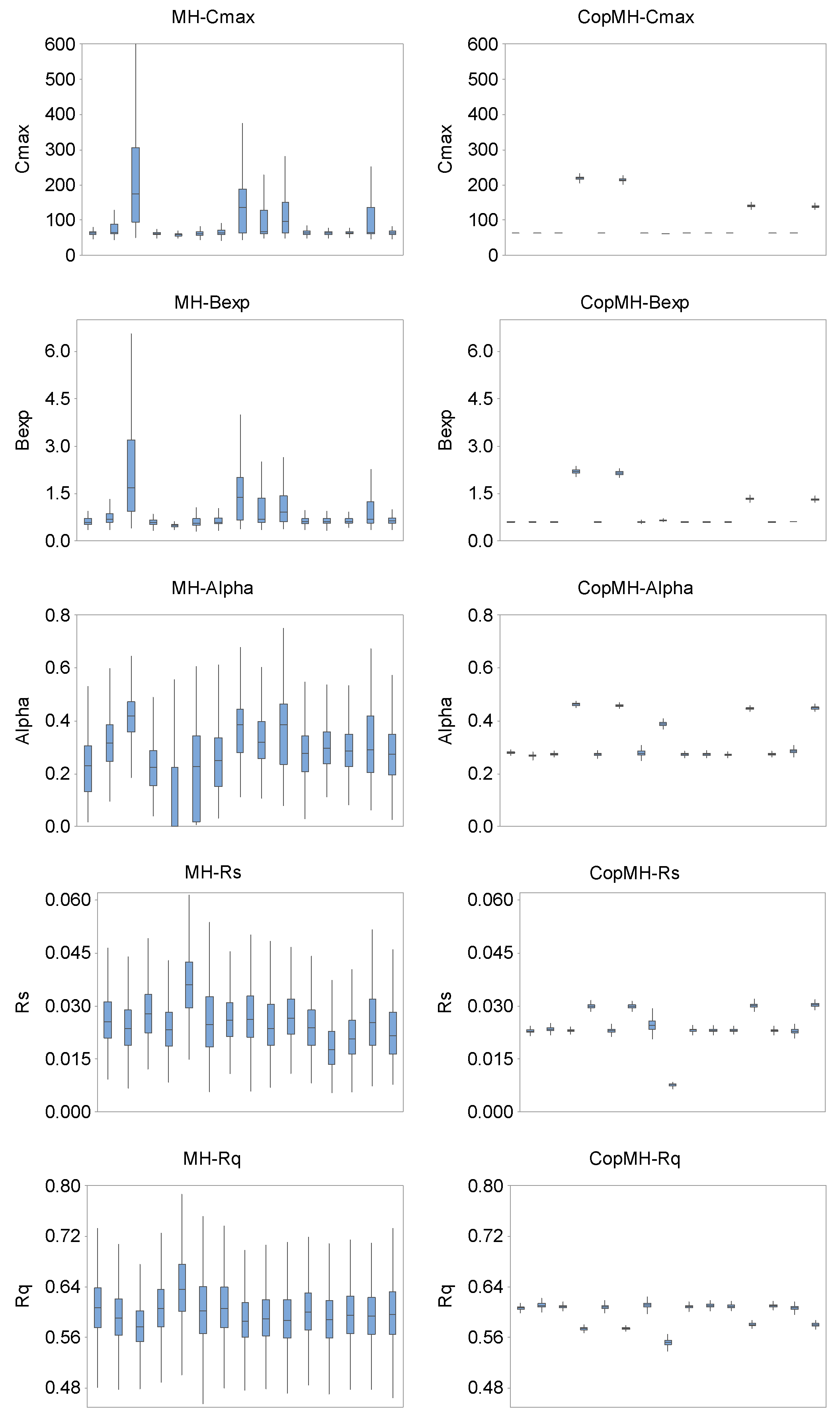

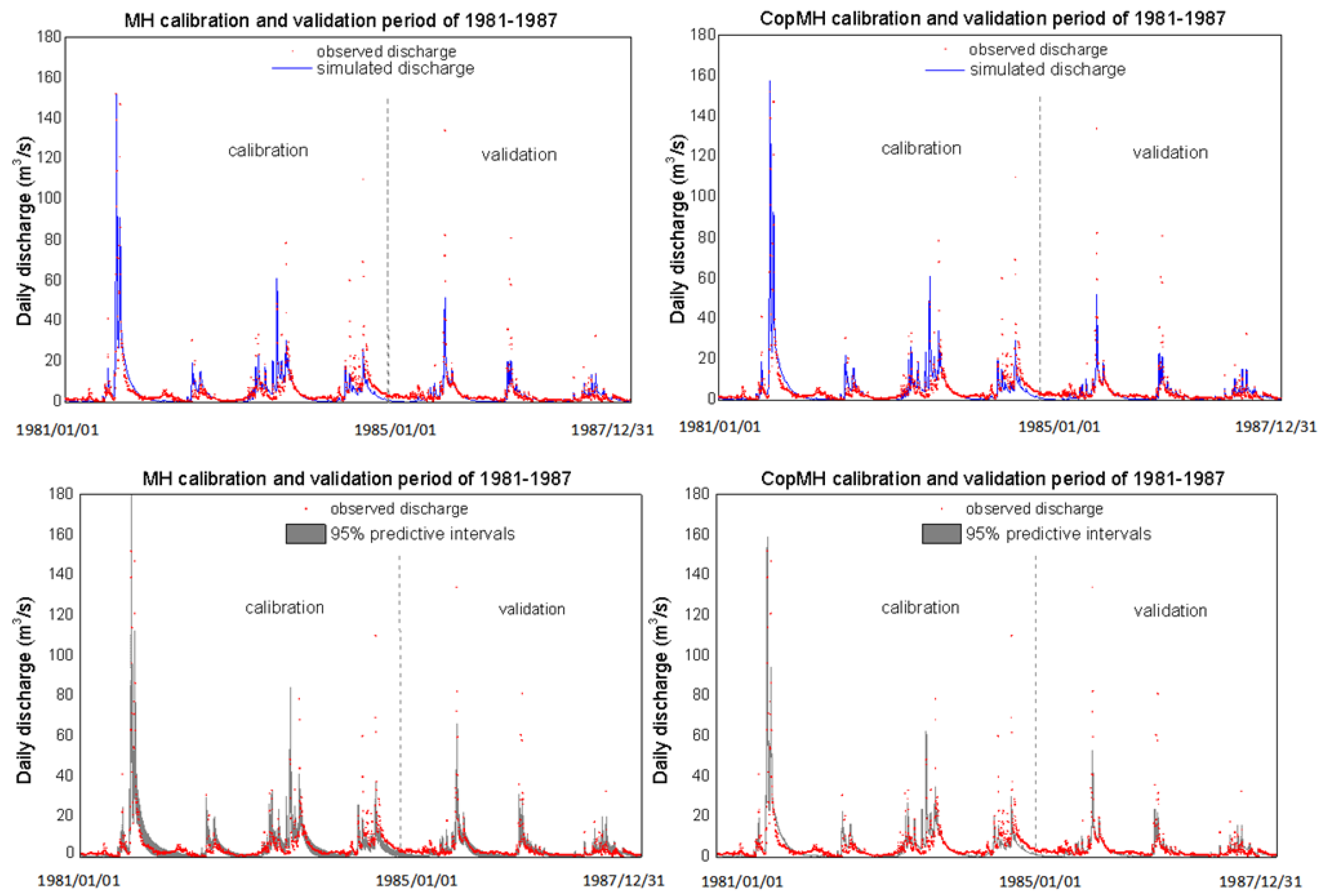


| Parameter | Description | Range | References |
|---|---|---|---|
| Cmax | Maximum soil moisture capacity within the catchment (mm) | [200, 500] | [4,11,12,43] |
| Bexp | Shape factor that is dependent on the degree of spatial variability in soil moisture capacities | [0.01, 2] | |
| Alpha | Fraction coefficient for distribution of water between slow and quick reservoirs | [0.5, 0.9] | |
| Rq, | Inverse of residence time in quick reservoirs (1/day) | [0.01, 0.2] | |
| Rs, | Inverse of residence time in a slow reservoir (1/day) | [0.3, 0.7] |
| Cmax | Bexp | Alpha | Rs | Rq | |
|---|---|---|---|---|---|
| MH | 0.333 | 0.190 | 0.270 | 0.558 | 0.009 |
| CopMH | 0.896 | 0.843 | 0.586 | 0.678 | 0.492 |
| Parameter | MH | CopMH | Variance Reduction (%) | ||
|---|---|---|---|---|---|
| Mean | Sd | Mean | Sd | ||
| Cmax | 63.68 | 7.90 | 62.14 | 0.15 | 99.96 |
| Bexp | 0.616 | 0.131 | 0.596 | 0.007 | 99.71 |
| Alpha | 0.219 | 0.109 | 0.279 | 0.005 | 99.79 |
| Rs | 0.0264 | 0.0081 | 0.0228 | 0.0006 | 99.45 |
| Rq | 0.6072 | 0.0473 | 0.6065 | 0.0031 | 99.57 |
| Nash | RMSE | ||||||
|---|---|---|---|---|---|---|---|
| 2.5% | 97.5% | mean | 2.5% | 97.5% | mean | ||
| MH | calibration | 0.673 | 0.663 | 0.761 | 6.946 | 7.051 | 5.937 |
| validation | 0.432 | 0697. | 0.635 | 5.834 | 4.261 | 4.678 | |
| CopMH | calibration | 0.766 | 0.765 | 0.766 | 5.871 | 5.884 | 5.872 |
| validation | 0.637 | 0.649 | 0.642 | 4.665 | 4.584 | 4.628 | |
Disclaimer/Publisher’s Note: The statements, opinions and data contained in all publications are solely those of the individual author(s) and contributor(s) and not of MDPI and/or the editor(s). MDPI and/or the editor(s) disclaim responsibility for any injury to people or property resulting from any ideas, methods, instructions or products referred to in the content. |
© 2026 by the authors. Licensee MDPI, Basel, Switzerland. This article is an open access article distributed under the terms and conditions of the Creative Commons Attribution (CC BY) license.
Share and Cite
Wang, F.; Duan, R.; Zhang, J.; Zhai, M.; Li, Y.; Fan, Y.; Xie, Y. Copula-Based Bayesian Inference Approaches for Uncertainty Quantification for Hydrological Simulation. Hydrology 2026, 13, 50. https://doi.org/10.3390/hydrology13020050
Wang F, Duan R, Zhang J, Zhai M, Li Y, Fan Y, Xie Y. Copula-Based Bayesian Inference Approaches for Uncertainty Quantification for Hydrological Simulation. Hydrology. 2026; 13(2):50. https://doi.org/10.3390/hydrology13020050
Chicago/Turabian StyleWang, Feng, Ruixin Duan, Jiannan Zhang, Mengyu Zhai, Yanfeng Li, Yurui Fan, and Yulei Xie. 2026. "Copula-Based Bayesian Inference Approaches for Uncertainty Quantification for Hydrological Simulation" Hydrology 13, no. 2: 50. https://doi.org/10.3390/hydrology13020050
APA StyleWang, F., Duan, R., Zhang, J., Zhai, M., Li, Y., Fan, Y., & Xie, Y. (2026). Copula-Based Bayesian Inference Approaches for Uncertainty Quantification for Hydrological Simulation. Hydrology, 13(2), 50. https://doi.org/10.3390/hydrology13020050