Article

Designing for the Past in a Nonstationary Climate: Evidence from Cyclone Ditwah’s Extreme Rainfall in Sri Lanka

by
Chamal Perera
1,2,*,
Nadee Peiris
1,2,
Luminda Gunawardhana
1,2,
Lalith Rajapakse
1,2,
Nimal Wijayaratna
1,2,
Binal Chatura Dissanayake
1,2 and
Kasun De Silva
1,2
1
Department of Civil Engineering, University of Moratuwa, Moratuwa 10400, Sri Lanka
2
UNESCO-Madanjeet Singh Centre for South Asia Water Management (UMCSAWM), University of Moratuwa, Moratuwa 10400, Sri Lanka
*
Author to whom correspondence should be addressed.
Hydrology 2026, 13(2), 47; https://doi.org/10.3390/hydrology13020047
Submission received: 28 December 2025 / Revised: 18 January 2026 / Accepted: 26 January 2026 / Published: 28 January 2026
(This article belongs to the Section Statistical Hydrology)

Abstract

The November 2025 extreme rainfall event associated with Tropical Cyclone Ditwah caused catastrophic flooding and landslides across Sri Lanka. This study presents a national-scale statistical and Intensity–Duration–Frequency (IDF)-based assessment of the event using long-term rain gauge observations, extreme value analysis, and climate scenario-based projections. The 24-h rainfall data from 46 stations were analyzed for 1-, 2-, and 3-day durations. Historical annual maximum series were extracted and compared with the 2025 event to identify record-breaking extremes. Rainfall volumes were also estimated and compared with the island’s Average Annual Rainfall (AAR) and volumes from major flood events in 2010 and 2016. The November 2025 event exceeded historical maxima at 14 stations, with estimated return periods frequently surpassing 1000 years. The cumulative rainfall volume from 26–28 November accounted for 15.8% of Sri Lanka’s AAR. Updated IDF curves incorporating the event showed marked upward shifts, with intensities at some locations matching or exceeding projections under high-emission climate scenarios. The results highlight the inadequacy of existing design standards in capturing emerging extremes and the need for urgent updates to Sri Lanka’s national IDF relationships to support climate-resilient flood risk management and infrastructure planning.

1. Introduction

According to the Intergovernmental Panel on Climate Change (IPCC) Sixth Assessment Report (AR6), there is high confidence that heavy precipitation and flooding events will intensify and occur more frequently across most regions in Asia as global warming continues to increase [1]. The underlying physical mechanism is well-explained by the Clausius–Clapeyron relationship, which states that the atmosphere’s water-holding capacity increases by approximately 7% per every 1 °C rise in temperature [2]. As a result, a warmer climate favors enhanced moisture availability, leading to extremely intense rain events lasting over several consecutive days. The IPCC AR6 also emphasizes that human-induced climate change has increased the likelihood of heavy rainfall associated with Tropical Cyclones (TCs) [1].
In the Asian monsoon region, a substantial fraction of extreme rainfall events is linked to TCs [3,4]. Disturbances such as TCs, Low-Pressure Systems (LPSs), monsoonal circulations, and mesoscale convective systems are predominantly thermodynamically driven, with their development sustained by the latent heat released during condensation of water vapor transported by trade winds [5]. These systems typically form over the warm tropical oceans, where heat and moisture supply are abundant [6]. With the observed warming trend in the Indian Ocean [7,8], it is expected that the Bay of Bengal (BoB) will experience more intense TCs capable of producing extreme precipitation.
The occurrence of TCs and LPSs in the BoB exhibits two seasonal peaks. The pre-monsoon season (March–May) is characterized by the formation of relatively weak disturbances and LPSs, whereas the post-monsoon season (October–December) typically produces high-intensity cyclonic systems which are often associated with pronounced heavy rainfall and extreme precipitation episodes across surrounding land areas [9,10]. Although this seasonal framing is widely used in the broader Asian monsoon literature, Sri Lanka’s climatology is more commonly described using a four-phase monsoon classification: the northeast monsoon (December–February), first inter-monsoon (March–April), southwest monsoon (May–September), and second inter-monsoon (October–November). The highest-intensity cyclonic systems in the BoB typically occur during Sri Lanka’s second inter-monsoon and early northeast monsoon periods.
Being a small island nation located close to the BoB, Sri Lanka has experienced several severe natural hazards associated with TCs in recent decades. Major flood events affecting multiple river basins were recorded in 2003, 2010, 2016, and 2017, with the 2016 and 2017 disasters linked to Cyclones Roanu and Mora, respectively. More recently, Cyclone Ditwah triggered catastrophic flooding, marking what may be Sri Lanka’s most severe flood disaster since the historic 1947 event. The widespread flooding and landslides associated with Ditwah are also considered the deadliest natural disaster in the country since the 2004 Indian Ocean tsunami.
A depression originated over the southeastern BoB near the coast of Sri Lanka on 26 November 2025, supported by favorable atmospheric conditions such as elevated sea surface temperatures and low mid-level vertical wind shear. The system subsequently intensified into Tropical Cyclone Ditwah (TCD) on 27 November 2025. The cyclone affected Sri Lanka from 26–29 November 2025, producing widespread and extreme rainfall. A maximum daily rainfall of 540.6 mm was recorded at Gammaduwa in the Central Province, while more than 15 meteorological stations reported over 300 mm of daily rainfall during the event [11]. All 25 administrative districts in Sri Lanka were impacted by this event. Water levels rose in 101 out of the country’s 103 major rivers, triggering severe flooding across several key basins, including the Mahaweli, Kelani, Kalu, Menik, Deduru Oya, Maha Oya, Kala Oya, and Malwathu Oya rivers. The intense and prolonged rainfall also led to the spillage of 48 major reservoirs and 56 medium reservoirs [12]. According to the Irrigation Department of Sri Lanka, major reservoirs have storage capacities exceeding 1000 acre-feet and are typically part of centrally managed schemes. Medium reservoirs serve more localized catchments and have capacities ranging from 200 to 1000 acre-feet [13]. These spillages further exacerbated downstream flooding and associated impacts. According to the preliminary estimates by the United Nations Development Programme (UNDP), approximately 20% of the island has been inundated due to flooding [14]. Furthermore, a total of more than 1200 landslides have occurred, including several large-scale landslides in highlands across the Central, Uva, and Sabaragamuwa provinces during the event [15]. According to the Disaster Management Center, flooding and landslides resulted in at least 643 fatalities and 203 missing persons as of 17 December [16]. In addition, more than 100,000 homes and other properties were either partially or fully damaged, and over 233,000 people were displaced [17]. Extensive damage was also reported across public infrastructure including hospitals, schools, road networks, religious sites, and large areas of agricultural land in many of the affected regions. The total economic loss nationwide is estimated to have exceeded USD 4 billion [18].
The torrential rainfall associated with TCD caused catastrophic social and economic impacts across Sri Lanka, highlighting a critical question: where does the November 2025 event lie in relation to Sri Lanka’s historical extremes, and how adequately do current hydrological design standards account for such events? Answering this question is essential not only for national resilience planning but also for other tropical island nations vulnerable to climate-exacerbated hydro-meteorological extremes.
To address this, the present study conducts a comprehensive national-scale hydrological and statistical assessment of the 26–28 November 2025 rainfall event. Using a dense rain gauge network and long-term daily rainfall records, the study applies Extreme Value Theory to evaluate return periods and design intensities through Intensity–Duration–Frequency (IDF) analysis. Updated IDF curves that incorporate the 2025 event are compared against historical design curves to assess the deviation introduced by this unprecedented rainfall. Additionally, the study uses climate projections under SSP2-4.5 and SSP5-8.5 scenarios to derive future IDF curves and evaluate how the magnitude of the Ditwah event aligns with projected rainfall extremes. By integrating observational data, statistical modeling, and climate scenario analysis, this study provides a policy-relevant benchmark for updating flood risk assessment, infrastructure design, and climate adaptation strategies in Sri Lanka and similarly vulnerable regions.

2. Materials and Methods

2.1. Study Area

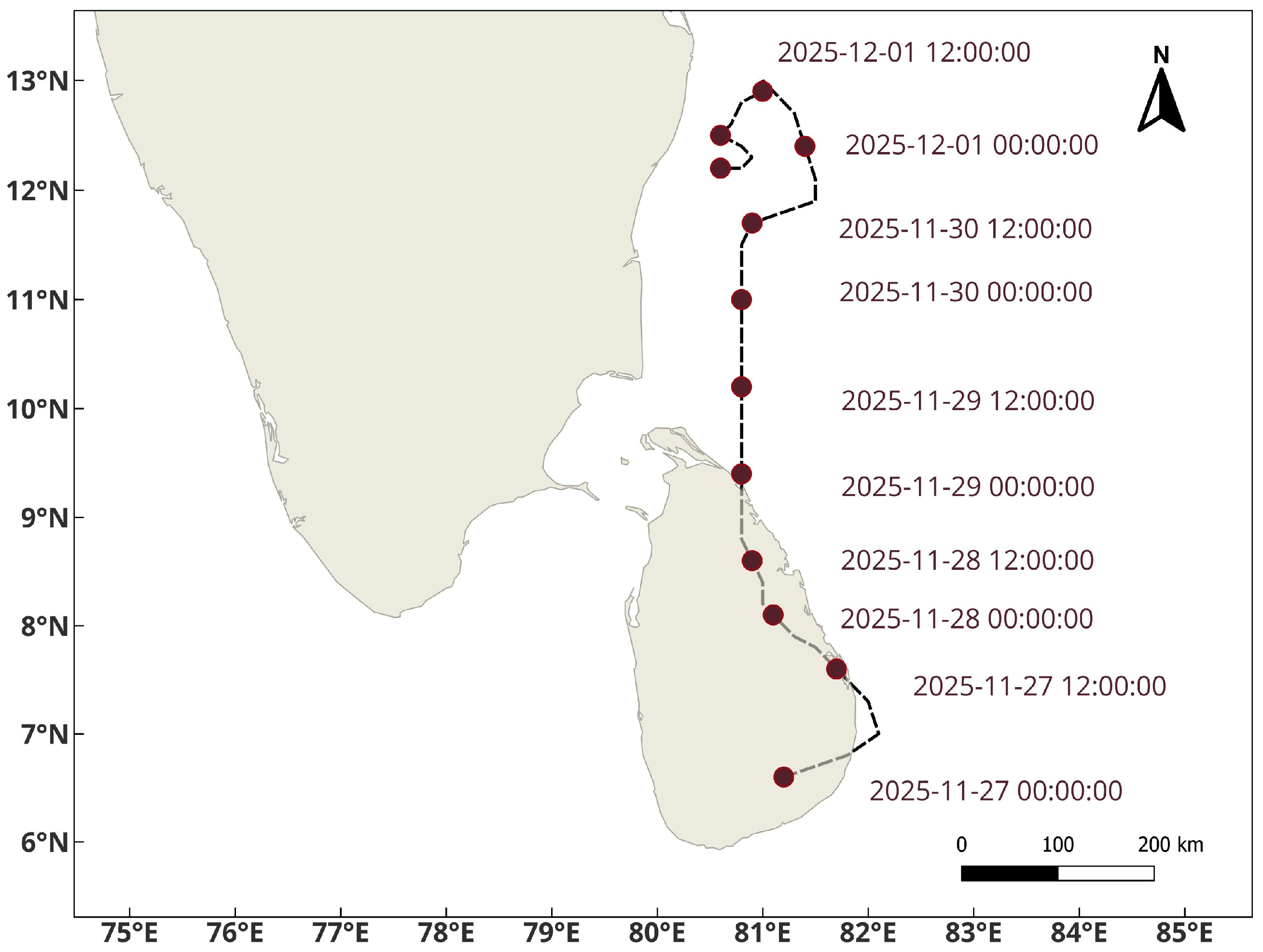
Sri Lanka is a tropical island country in the Northern Indian Ocean, situated directly south of the Indian subcontinent between latitudes 5°55′–9°51′ N and longitudes 79°41′–81°53′ E. Due to its location in proximity to the BoB and the main pathways of tropical cyclones and monsoonal systems, it is vulnerable to severe rainfall and flood hazards. Figure 1 shows the location of Sri Lanka in the Indian Ocean region, together with the track of TCD that impacted the country during the November 2025 event.
The island is characterized by a high hydro-climatic gradient over a short distance. The central highlands with elevations exceeding 2500 m above mean sea level are the hallmark of the inland area and play a critical role in orographic enhancement of rainfall. From this central highland, many river basins radiate out towards the coast, including major river systems such as the Mahaweli (10,266 km2), Kelani (2230 km2), Kalu (2816 km2), Deduru Oya (2622 km2), Kala Oya (2526 km2), and Malwathu Oya (3291 km2) [20]. These river basins are very sensitive to the impact of heavy rainfall due to steep upstream slopes and densely populated, low-lying floodplains downstream [21].
Climatically, the country is classified into wet, intermediate, and dry zones based on long-term rainfall patterns. The wet zone, located predominantly in the southwestern part of the island, typically receives annual rainfall exceeding 2500 mm, while the dry zone in the northern and eastern regions receives less than 1750 mm annually. Despite these climatological distinctions, extreme rainfall events associated with tropical cyclones and low-pressure systems can produce widespread precipitation across all zones, often overwhelming local hydrological thresholds [22].
Given its small size (65,610 km2), dense river network, high population exposure, and strong coupling between atmospheric drivers and hydrological response, Sri Lanka represents a highly sensitive study area for assessing extreme rainfall behaviour and its implications for flood risk under a changing climate.

2.2. Data Collection

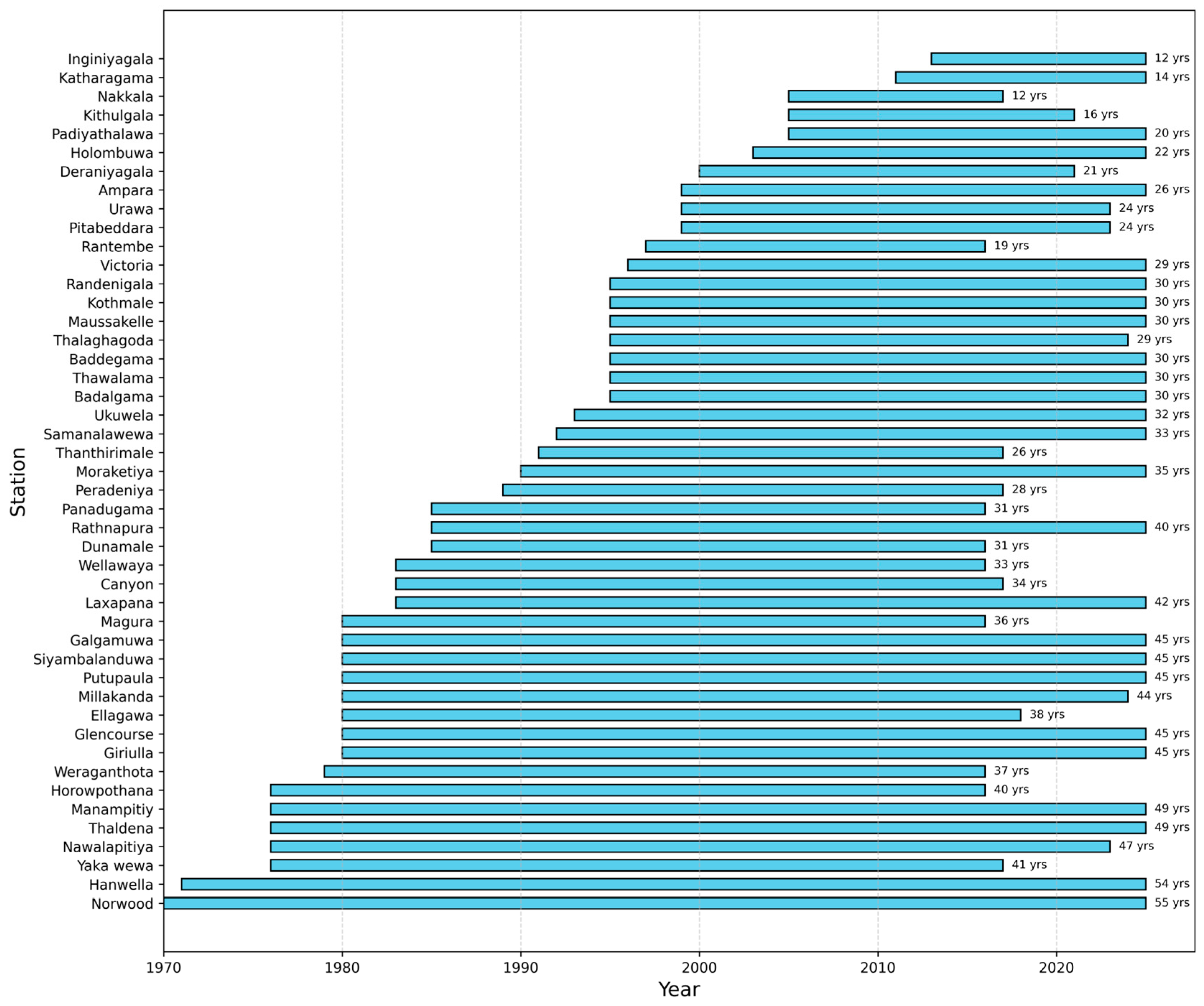
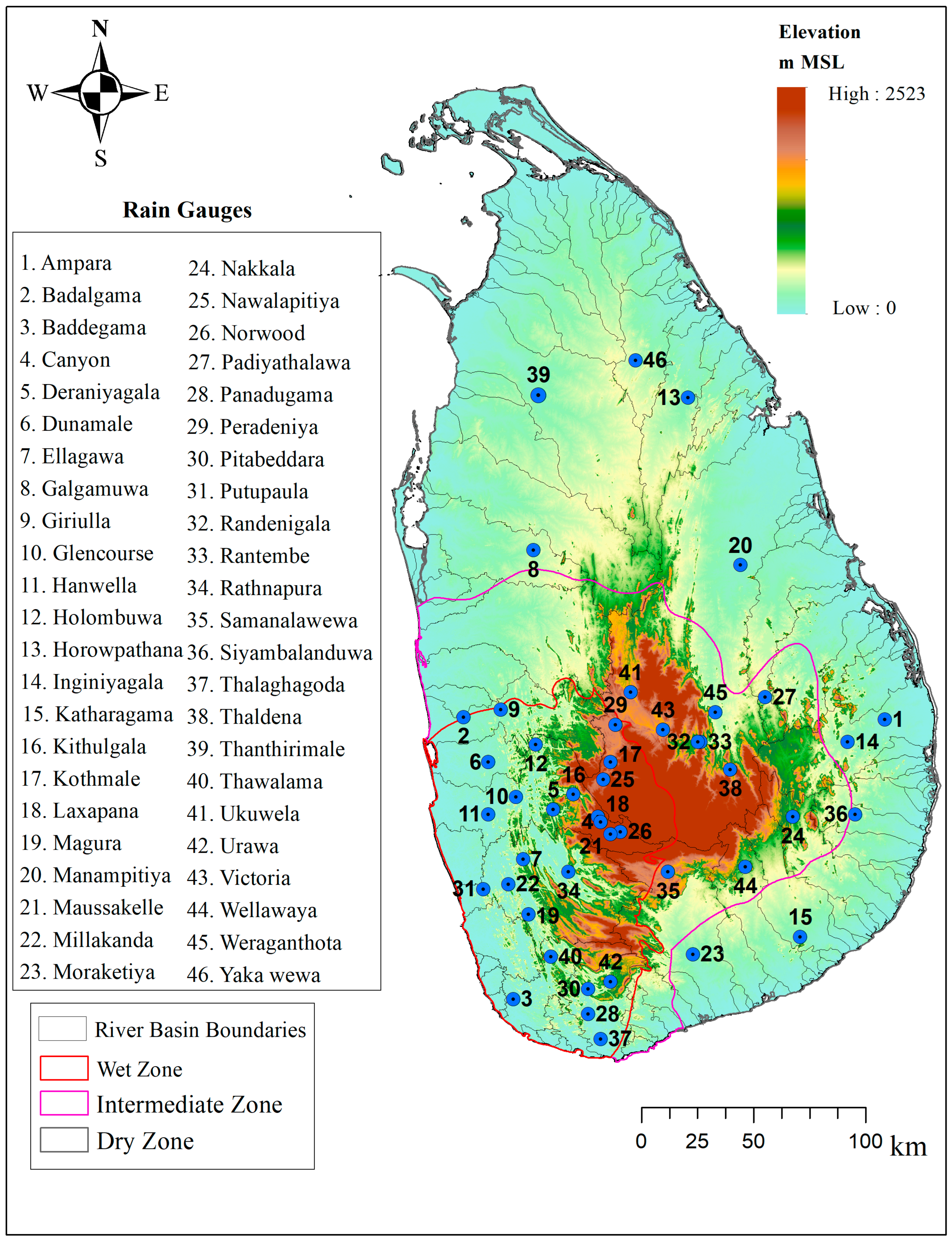
This study utilised rainfall observations from 46 stations distributed across Sri Lanka, comprising a combination of Department of Meteorology (DoM) rain gauges and Department of Irrigation (DoI) hydrometeorological monitoring stations. The DoI provided real-time hourly rainfall data during extreme rain events. Figure 2 illustrates the spatial distribution of the selected stations, while Figure 3 presents the length of the available historical records.

2.3. Methodology

2.3.1. Comparison of the November 2025 Event with Historical Records

Three rainfall durations were selected for the analysis, representing operationally relevant extreme rainfall metrics traditionally used for flood assessment in Sri Lanka: 1-day rainfall (24-h total), 2-day rainfall (48-h total), and 3-day rainfall (72-h total). For each station, the historical annual maxima for these durations were extracted, and the November 2025 extreme rainfall event was subsequently compared against the historical maxima to evaluate its relative magnitude and associated statistical return period.
In addition to point-based comparisons, the total volume of rainfall received over Sri Lanka during the event was estimated by spatially interpolating station rainfall observations across the island. Three widely used spatial interpolation techniques were employed to account for uncertainties associated with spatial rainfall variability: Thiessen Polygon, Inverse Distance Weighting (IDW), and Kriging interpolation. The use of multiple methods allows for a more robust estimation of areal rainfall and associated total volumes.
The Thiessen Polygon method assigns a weighting factor to each rain gauge based on the area of influence defined by polygon boundaries constructed midway between adjacent stations. In this method, the areal average rainfall (P), is calculated as:
P = i = 1 n W i P i
where Pi, Wi, and n represent the rainfall observed at the ith station, the fractional area of the Thiessen polygon associated with that station, and the number of stations, respectively. This method assumes uniform rainfall within each polygon and is commonly used for catchment and national-scale rainfall volume estimation.
The IDW method, which is one of the most popular deterministic methods, assigns weights based on the inverse of the distance, normalized so that their sum equals 1. The weight decreases as the distance from the sampled point to the target point increases. The weights are calculated as follows:
W k = 1 d k p i = 1 n 1 d i p   1   k     i              
where W k is the weight assigned to the kth sampled location, and d i p ,   d k p ,… d n p are the distances from each of the n sampled locations. The parameter p is the power exponent of the IDW function, which must be selected prior to interpolation. A lower exponent results in a more uniform contribution from all neighbours, whereas a higher exponent gives greater influence to the nearest neighbours [23].
The Kriging method accounts for the spatial dependence of environmental variables by assigning higher weights to proximal observations [24]. A key component of Kriging is the semi-variogram, which characterizes the spatial continuity of a variable by quantifying the degree of similarity between data points as a function of their separation distance. The empirical semi-variogram is calculated for all pairs of observations separated by a given lag distance and subsequently fitted with a theoretical model. It is mathematically expressed as:
γ h =   1 2 n i = 1 n z x i z x i + h 2
where n denotes the number of pairs of observations separated by a distance h. z(xi) is the observed value at location xi, and z(xi + h) is the observed value at a distance h from xi.
Theoretical models such as the spherical, Gaussian, and exponential functions are most commonly employed to fit the empirical semi-variogram [25]. These models provide mathematical representations of how spatial dependence diminishes with increasing distance, thereby enabling Kriging to generate statistically optimal and unbiased predictions of unsampled locations.
Using each interpolation technique, spatial rainfall fields were generated for the November 2025 event, and the corresponding total rainfall volume over Sri Lanka was calculated by integrating interpolated rainfall depths over the island area. The resulting rainfall volumes were then compared with those estimated for two recent major flood events in 2010 and 2016, both of which caused widespread flooding and significant socio-economic impacts. This comparison provides a quantitative national-scale perspective on how the November 2025 event ranks relative to recent historical flood-producing rainfall events.

2.3.2. Extreme Value Analysis

To quantify the extremity of the November 2025 rainfall event, two distributions, Gumbel and Generalized Extreme Value (GEV), were fitted to the annual maximum rainfall series. The Gumbel distribution is widely applied to precipitation extremes due to its simplicity and historical adoption in engineering designs [26,27]. The GEV distribution is a flexible three-parameter model that can represent a wide range of tail behaviours through its shape parameter, making it particularly suitable for modelling heavy-tailed rainfall extremes in long records or climatically variable regions [28].
For each station and rainfall duration (1-day, 2-day, and 3-day), the annual maxima series were first extracted and fitted with Gumbel and GEV distributions to develop Intensity–Duration–Frequency (IDF) curves for return periods ranging from 2 to 10,000 years. Based on these developed IDF curves, the return periods of the November 2025 1- to 3-day rainfall at each station were determined. After integrating the November 2025 event with the historical dataset, the revised IDF curves were developed and compared with the existing IDF curves.
For the Gumbel distribution, parameter estimation was performed using the maximum likelihood estimation (MLE) method via the scipy.stats.gumbel_r.fit() function in Python 3.10.4. For the GEV distribution, the same MLE approach was used, implemented through the scipy.stats.genextreme.fit() function. Both methods provide estimates of location and scale parameters (and shape in the case of GEV) based on the annual maxima series. These parameterizations form the basis for estimating return levels across durations and assessing sensitivity to the 2025 extreme rainfall.
To account for statistical uncertainty in the Gumbel-fitted IDF curves, 300 bootstrap resamples were drawn from each station’s annual maxima series. Gumbel parameters were refitted to each resample, and return levels were computed across the full range of return periods. The 95% confidence intervals were then derived from the 2.5th and 97.5th percentiles of the simulated return levels and visualized as shaded bands in the IDF plots. This approach allows a robust quantification of uncertainty arising from limited sample sizes and inherent data variability.
It is important to note that while the estimated return periods extend up to 10,000 years, the stations in this study had observational records spanning between 12 and 55 years. Estimating such long return periods from relatively short datasets introduces considerable uncertainty, particularly in the upper tail of the distribution. Previous studies have cautioned that extrapolations beyond 2–3 times the length of the observational record should be treated with care [29]. As such, the return periods above this range in the current analysis should be interpreted as indicative rather than definitive, highlighting the exceptional magnitude of the 2025 event rather than providing precise recurrence probabilities.

2.3.3. Comparison of IDF Curves with IDF Curves Developed with Climate Projections

Future climate projections were derived from the Coupled Model Intercomparison Project Phase 6 (CMIP6), following the Shared Socioeconomic Pathways (SSPs) framework adopted by the IPCC AR6. The SSPs describe alternative trajectories of socioeconomic development and corresponding greenhouse gas emissions [30]. This study considered two contrasting scenarios: SSP2-4.5 (an intermediate emissions pathway) and SSP5-8.5 (a high-emissions pathway). Together, these scenarios represent a wide range of radiative forcing levels by the end of the 21st century, supporting robust evaluation of future rainfall extremes under differing climate and socioeconomic conditions [31].
Observed daily rainfall records from five gauging stations with more than 30 years of continuous data were used as the baseline period for the downscaling model. Quality control of observed rainfall followed standard checks for consistency, missing data, and outliers before model calibration. Historical data served as the baseline for weather generator calibration, ensuring that statistical characteristics of local rainfall, including wet/dry spell lengths, monthly totals, and extremes, are accurately captured in synthetic series.
Downscaling of General Circulation Model (GCM) rainfall outputs to the local scale was performed using Long Ashton Research Station Weather Generator version 8.0 (LARS-WG8), a widely used stochastic weather generator for climate change impact assessments [32]. LARS-WG8 generates daily weather time series consistent with the statistical properties of observed records and perturbs them according to projected changes from GCM scenarios to produce future climate realizations. The downscaling model for each station was developed using the observed historical rainfall record. It involved estimating site-specific parameters of the weather generator that reproduce observed rainfall statistics, including: monthly probabilities of wet and dry days, distribution of daily rainfall amounts, and seasonal patterns and inter-annual variability.
Among the GCMs embedded within LARS-WG8, the HadGEM3-GC31-LL model was selected for this study due to its frequent use in regional climate assessments and its availability in the LARS-WG8 framework [33,34]. This model has also been successfully applied in several recent studies focused on Sri Lanka’s hydroclimatic assessments, where it demonstrated skill in simulating regional rainfall patterns and variability [35,36]. Four future time periods were defined, each spanning 20 years: 2021–2040, 2041–2060, 2061–2080, and 2081–2100. For the selected GCM and emissions scenario, changes in monthly precipitation statistics relative to the baseline were computed. These changes were applied to the developed LARS-WG parameters to generate long synthetic daily rainfall series representative of each future period. The generated data incorporate projected shifts in mean rainfall, variability, and extremes. By generating synthetic weather realizations for each scenario and period, the method captures uncertainty arising from the internal climate variability. For each station, scenario, and future period, daily rainfall outputs from LARS-WG were aggregated for use in the frequency analysis.
From these synthetic series, IDF curves were developed for each future period and scenario. These were then compared with both the historical IDF curves (pre–November 2025) and the updated curves that incorporate the November 2025 event.

3. Results

3.1. Comparison of the 2025 November Event with Historical Events

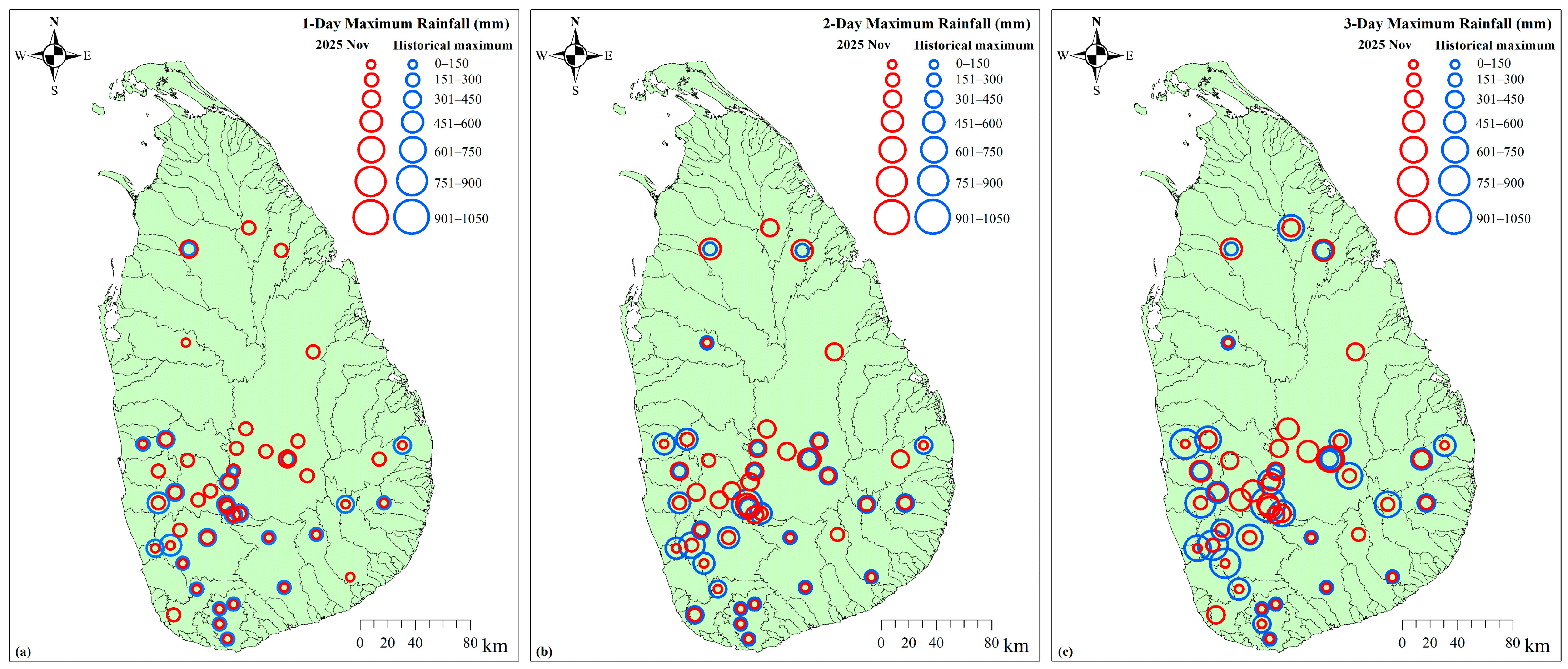
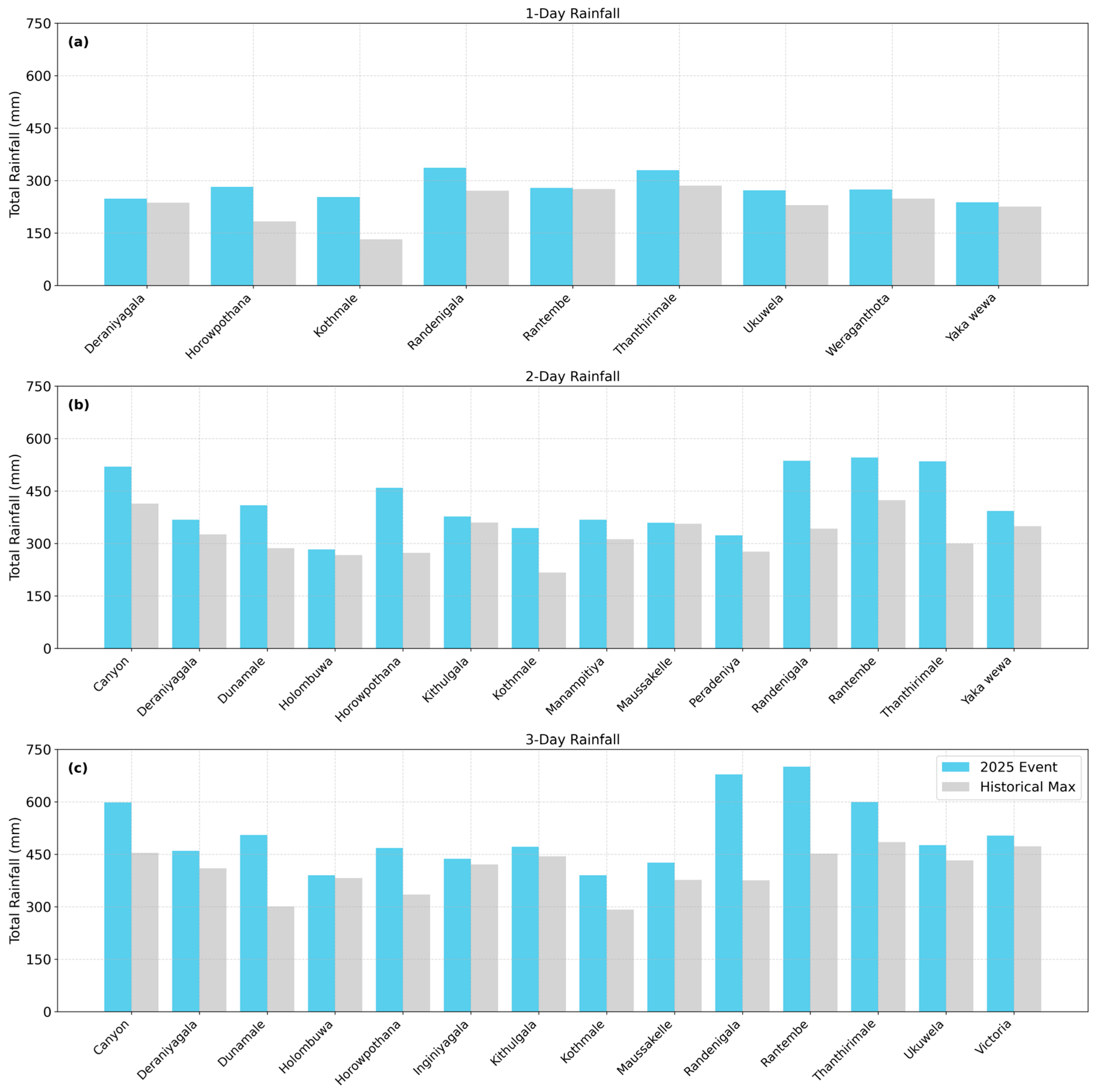
A comparison of the November 2025 rainfall totals against historical annual maxima across 46 stations reveals the extraordinary nature of this event. The 2025 storm exceeded previously recorded maxima at 9, 14, and 14 stations for the 1-day, 2-day, and 3-day durations, respectively. The magnitude of exceedance was substantial, with rainfall amounts surpassing prior records by factors ranging from 1.01 to 1.92.
Figure 4 illustrates the comparison between 2025 precipitation totals and historical maxima for the three durations, while Figure 5 highlights the subset of stations where the 2025 values exceeded historical records. Among 1-day extremes, Kothmale recorded the highest relative increase (92%), while Rantembe showed the lowest (1%). Thanthirimale exhibited the largest exceedance for 2-day (78%) and 3-day (86%) totals, underlining the exceptional intensity and persistence of rainfall at this location.
Stations such as Thanthirimale, Kothmale, Randenigala, Dunamale, and Horowpothana recorded values markedly outside the historical envelope of variability. Notably, some of the most extreme anomalies occurred outside Sri Lanka’s traditionally wet regions. Several dry-zone stations, including Horowpothana, Thanthirimale, Yaka Wewa, Manampitiya, and Inginiyagala, recorded unprecedented 1–3-day rainfall totals, indicating that the system produced anomalously high rainfall across multiple climatic zones.
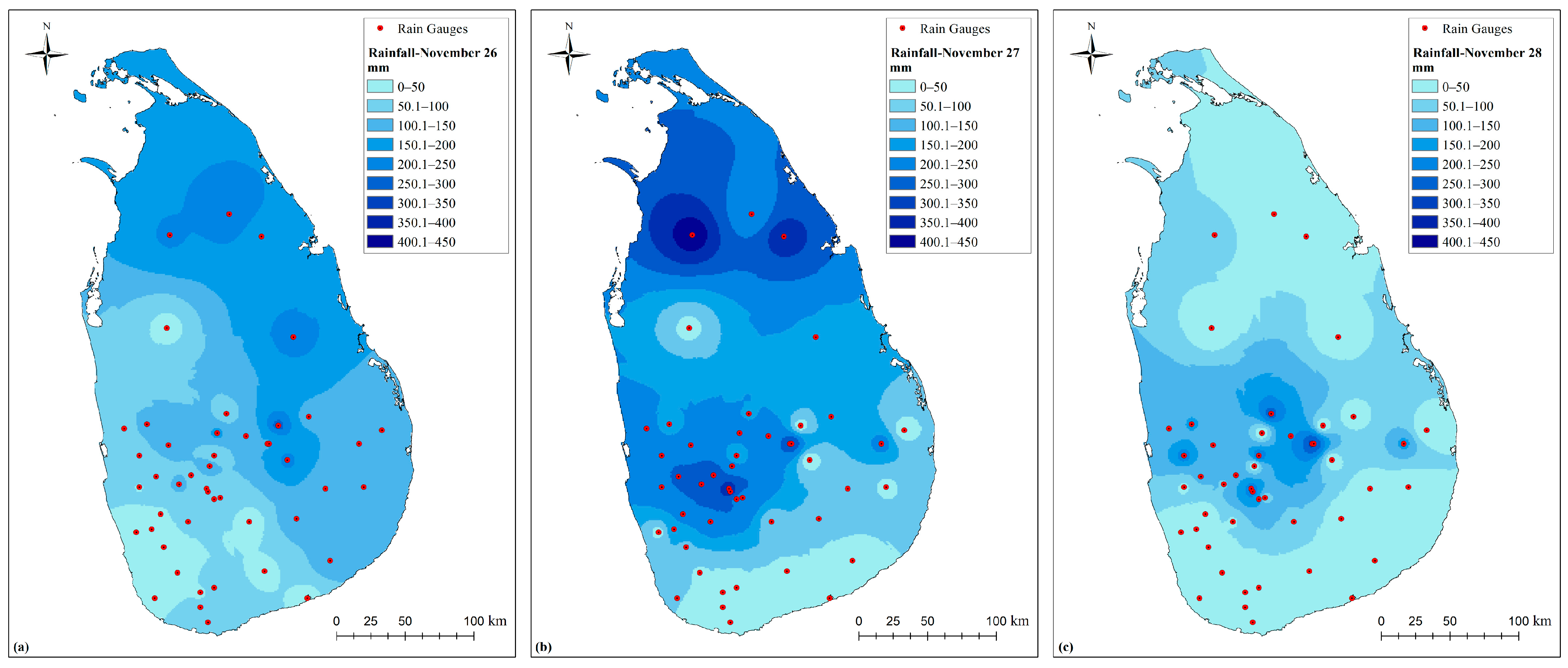
Figure 6 presents the areal distribution of rainfall from 26 to 28 November, interpolated using the Inverse Distance Weighting (IDW) method. The spatial pattern reinforces the widespread and severe nature of the event, with intense rainfall observed across both wet and dry zones of the island.
The severity of the November 2025 rainfall event is further underscored by the total volume of precipitation received across Sri Lanka during the core period of the storm (26–28 November). Table 1 summarizes the estimated daily rainfall volumes using three spatial interpolation techniques.
On each of the first two days of the event, Sri Lanka received over 8.5 billion cubic meters of rainfall, with even the third day surpassing 4 billion cubic meters. These are among the highest single-day rainfall volumes recorded in recent decades. When aggregated over the three-day period, the total rainfall volume was approximately 21.75 ± 1.26 billion cubic meters, which amounts to 15.8% of the country’s AAR. This means that within just three days, Sri Lanka received nearly one-sixth of the rainfall it typically experiences over an entire year, a volume unprecedented in the modern observational record.
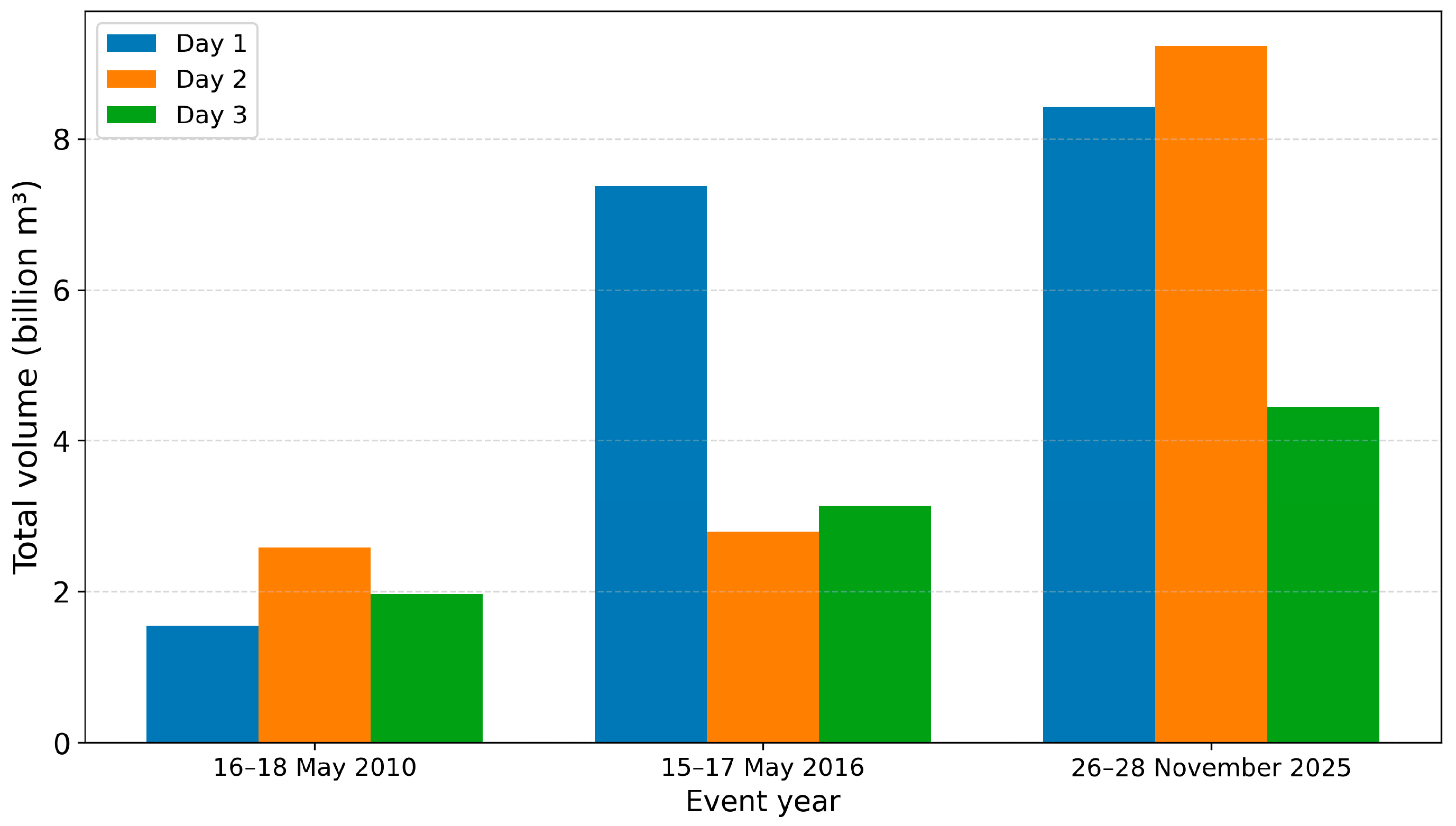
Figure 7 compares the 2025 event against two other major flood events: May 2010 and May 2016. The 2010 event yielded an average 3-day volume of around 2 billion cubic meters, while in 2016, a single day (Day 1) saw over 7 billion cubic meters of rainfall. In stark contrast, the 2025 event delivered more than 8.5 billion cubic meters on both Day 1 and Day 2. This exceptional accumulation of rainfall explains the widespread flooding, reservoir spillages, and downstream damage observed across multiple regions during the 2025 disaster. Not only was the intensity greater than previous events, but the spatial scale and persistence of rainfall were also unmatched in recent decades.

3.2. Comparison of the Position of the November 2025 Event in IDF Curves

3.2.1. Station-Specific Assessment

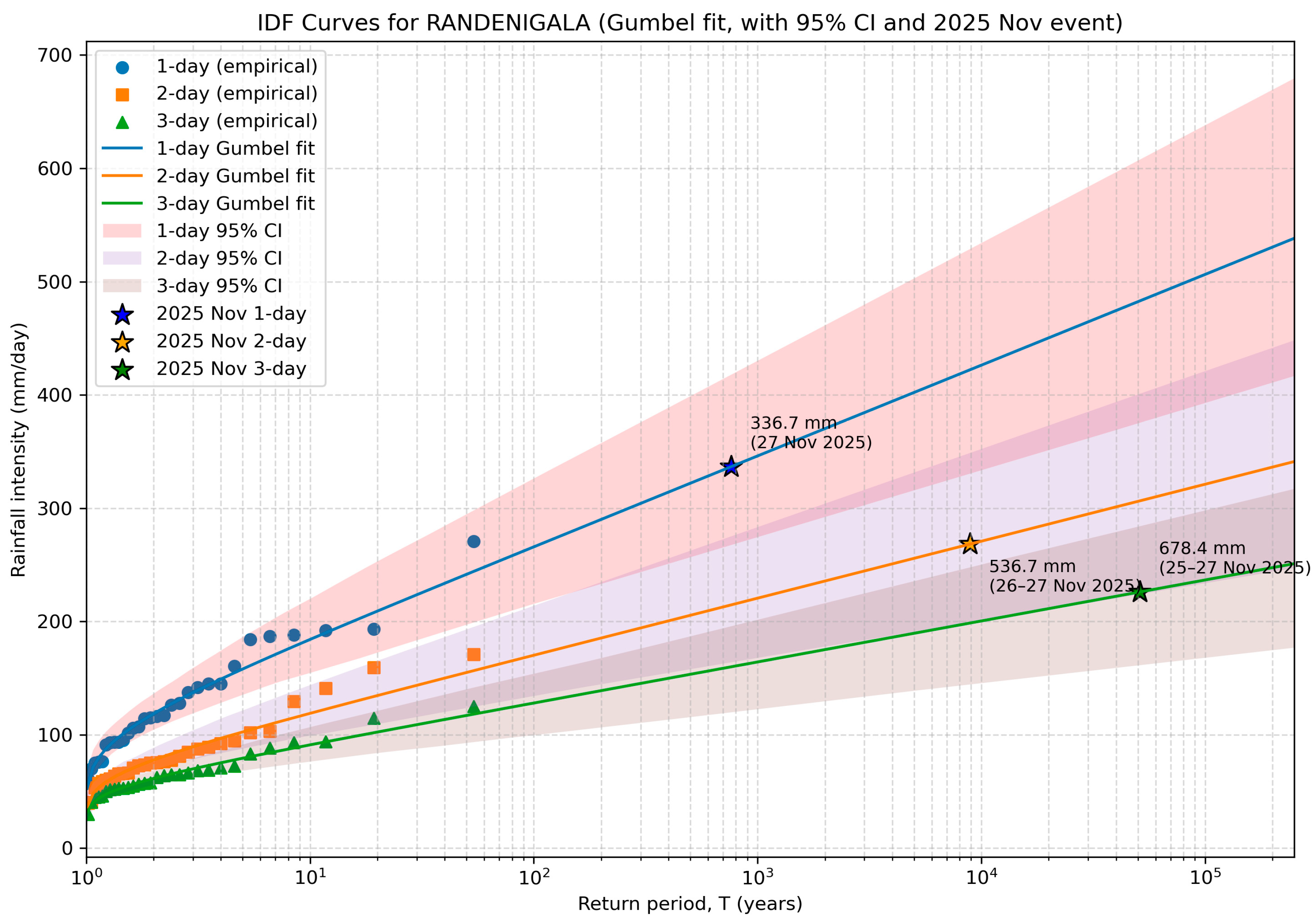
Intensity–Duration–Frequency (IDF) analysis offers a robust framework for evaluating the extremity of the November 2025 rainfall relative to statistically expected design rainfall. Figure 8 presents the IDF curves developed for the Randenigala station across 1-day, 2-day, and 3-day durations using the historical annual maximum rainfall series.
As shown in Figure 8, the 2025 rainfall values lie far above the long-term historical records. The magnitude of the 2025 event significantly exceeds the return periods supported by the existing observational envelope, highlighting the inability of conventional frequency-based models to accommodate such extremes. This deviation suggests that the statistical stationarity underlying traditional IDF estimation may no longer be valid under evolving climatic conditions.
The Randenigala case exemplifies how even well-instrumented stations with multi-decade records may underestimate the risk posed by emerging rainfall extremes. It underscores the critical need to revisit and update hydrological design standards to reflect new thresholds of intensity and frequency observed in recent years.

3.2.2. Shifts in IDF Curves Across Stations Following the 2025 Event

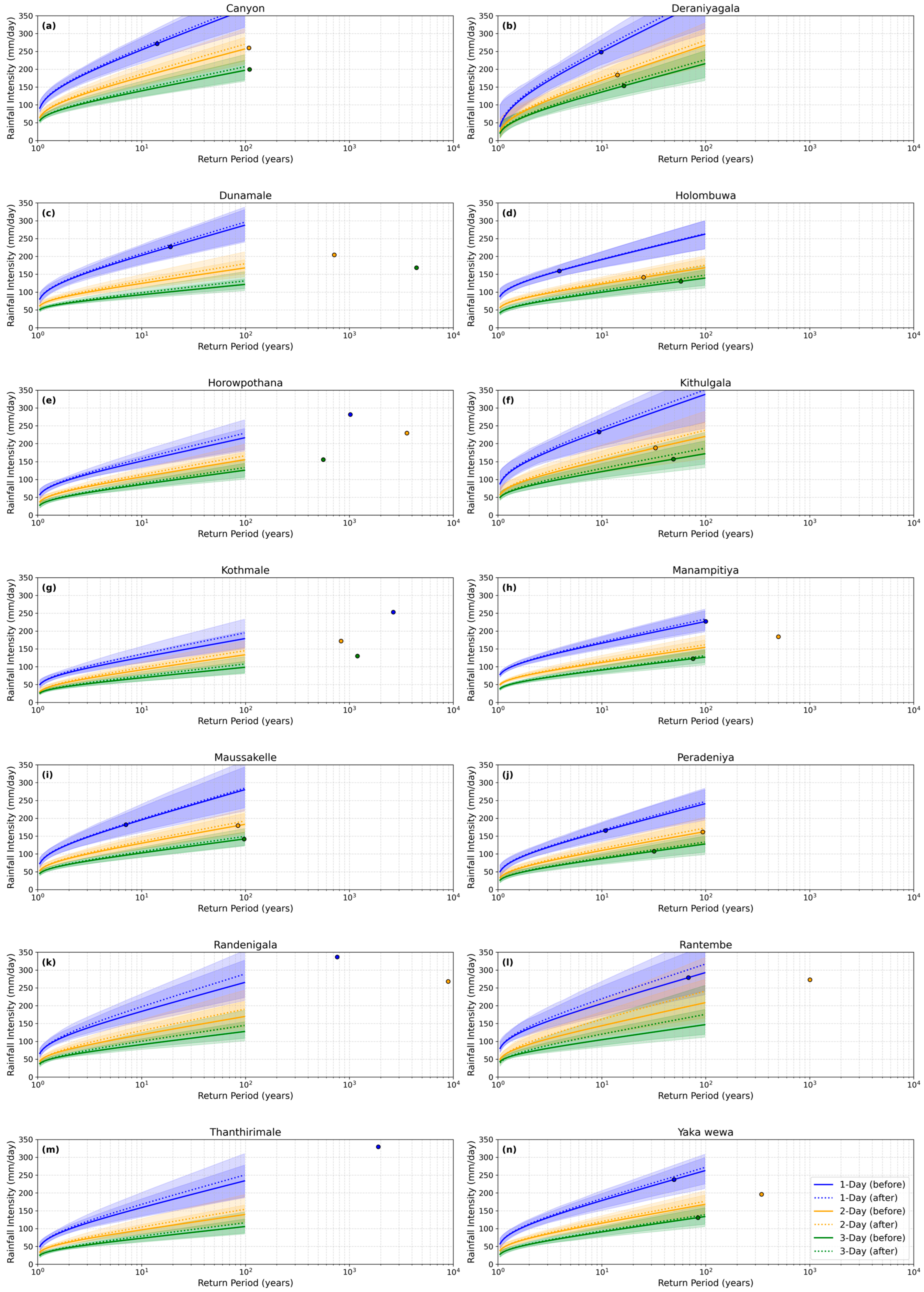
Figure 9 presents updated IDF curves for 14 stations that experienced significant rainfall extremes during the November 2025 event. Each plot displays the historical (pre-2025) IDF curves (solid lines) alongside the updated curves (dashed lines) that incorporate the 2025 event. The rainfall intensities observed during the 2025 event are shown for 1-day (blue), 2-day (orange), and 3-day (green) durations. To focus on the range commonly used for hydrological design and to avoid the increasing uncertainty associated with statistical extrapolation at very high return periods, the IDF curves are truncated at the 100-year return period.
Importantly, the confidence intervals surrounding the IDF curves illustrate the level of statistical uncertainty across return periods. For stations with shorter observational records (e.g., Deraniyagala, Kithulgala, and Rantembe), these confidence intervals become notably wider beyond the 50-year return period, reflecting reduced robustness in the tail estimates. This highlights the sensitivity of IDF curve projections to limited data availability and underscores the need to interpret long return period estimates with appropriate caution.
Despite the truncation, the 2025 rainfall values at many stations lie far above the plotted IDF envelopes, indicating a profound departure from historically expected design rainfall levels. In several locations such as Randenigala (intermediate zone), Rantembe (intermediate zone), and Thanthirimale (dry zone), the observed rainfall values exceed the plotted return-period axis entirely, implying recurrence intervals greater than 10,000 years under existing statistical models. This substantial divergence, even beyond the 100-year design threshold, underscores the extreme nature of the Ditwah event.
While the updated IDF curves incorporate the November 2025 event to provide a more current statistical benchmark, it is acknowledged that this approach still assumes a revised form of stationarity. As climate change accelerates, the underlying distribution of extreme rainfall may continue to evolve, rendering static updates increasingly inadequate. A shift toward nonstationary modeling frameworks—such as those incorporating time-varying location or scale parameters—may offer a more robust representation of changing risk. Although not applied in this study due to data and methodological constraints, future work should explore dynamic IDF modeling approaches to capture long-term trends and variability more explicitly.
The consistent and significant separation between the historical and updated IDF curves highlights the inadequacy of current design standards in representing the magnitude of emerging rainfall extremes. These findings underscore the urgent need to revise infrastructure design criteria and hydrological risk assessments to reflect the intensifying behaviour of extreme rainfall under ongoing climate change.

3.2.3. Return Period Estimates and Distributional Behaviour

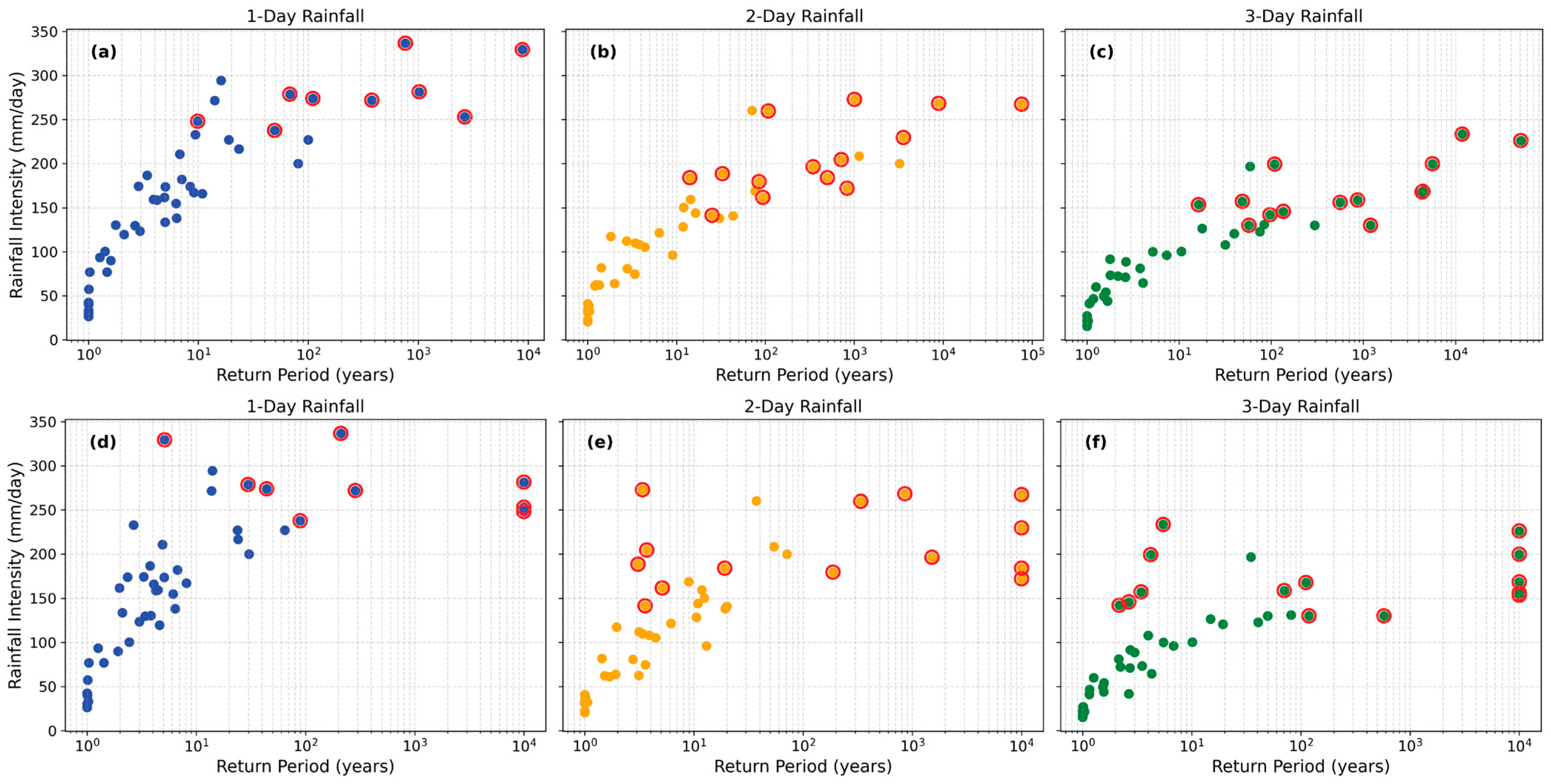
Figure 10 presents return period estimates for the November 2025 rainfall event at all selected 46 stations across Sri Lanka, based on both Gumbel (Figure 10a–c) and GEV (Figure 10d–f) distributions. The analysis reveals several consistent patterns. Under the Gumbel model, six stations recorded return periods exceeding 1000 years for at least one of the considered durations (1-day, 2-day, or 3-day), while the GEV model identified seven such stations. Notably, Thanthirimale exceeded the 1000-year threshold for all three durations under the Gumbel fit. Similarly, Randenigala, Rantembe, Kothmale, and Horowpothana exceeded 1000 years for two out of the three durations.
Extreme return periods exceeding 10,000 years were also observed. Under the Gumbel distribution, three stations surpassed this threshold: Thanthirimale (2-day), Randenigala (3-day), and Rantembe (3-day). In comparison, the GEV distribution yielded return periods above 10,000 years at six stations. Due to the numerical instability that can arise in tail fitting at such extremes, return periods were capped at 10,000 years to ensure analytical stability and provide a conservative yet meaningful representation. It is important to emphasize that these return periods should be interpreted as relative indicators of extremity, rather than precise recurrence intervals, particularly when they far exceed the available observational record. To aid interpretation, these values are best viewed as significantly exceeding standard design benchmarks, such as the 100-year envelope, rather than definitive probabilities of occurrence. These results underscore the extraordinary nature of the November 2025 event, which pushed many hydrological systems beyond their design limits. For instance, major reservoirs such as Kothmale located in the central highlands (Figure 2) experienced inflows well beyond capacity, forcing emergency spillway releases that contributed to severe downstream flooding. These consequences raise critical questions about the reliability of existing statistical models used in hydrological design.
The divergence between the Gumbel and GEV models further highlights the importance of distributional choice in extreme value analysis. The Gumbel distribution, characterized by a fixed, light tail (shape parameter ξ = 0), tends to underrepresent the frequency of extreme events. In contrast, the GEV distribution, particularly with positive shape parameters (ξ > 0) observed in many stations, allows for heavier tails, making it better suited for capturing high-magnitude rainfall extremes. Consequently, GEV tends to produce longer return periods for high-intensity events (Figure 10) and shorter return periods for more moderate rainfall levels compared to Gumbel.
These differences carry important implications for hydrological design and infrastructure planning. Reliance solely on Gumbel-based estimates may result in underdesign for rare, catastrophic events. However, it also raises a broader question: can lower-middle-income countries justify designing infrastructure to withstand events with return periods of 1000 years or more? Balancing the cost of resilient infrastructure with the growing risk of climate-induced extremes remains a critical challenge for policymakers and planners.

3.2.4. Evaluating Sensitivity of IDF Parameters to Recent Extremes

To evaluate how sensitive extreme value distributions are to the inclusion of the November 2025 event, a sensitivity analysis was conducted for both the Gumbel and GEV distributions using data from 14 stations where the 2025 rainfall exceeded historical maxima for at least one of the 1-day, 2-day, or 3-day durations.
For the Gumbel distribution, the analysis focused on changes in the location and scale parameters. For 1-day rainfall, the location parameter increased by 0.8% to 3.7%, while the scale parameter changes ranged from 0.4% to 13.5%. Stations with shorter data records—such as Kithulgala (16 years), Rantembe (19 years), and Deraniyagala (21 years)—showed comparatively larger shifts in location (2.5%, 3.0%, and 3.7%, respectively), reflecting greater influence from the 2025 outlier. However, even among stations with longer records (≥30 years), the average changes in location and scale parameters were 1.8% and 6.7%, respectively—only slightly lower than those with shorter records (2.3% and 5.6%). For 2-day rainfall, location parameters changed by 1.3% to 4.5%, and scale parameters by 5.1% to 22.3%, again with the largest shifts observed at short-record stations. Similarly, for 3-day rainfall, location changes ranged from 1.1% to 4.5%, with scale parameter changes reaching up to 31.1%. The two stations with the shortest records—Nakkala and Inginiyagala (12 years each)—did not surpass historical maxima, resulting in minimal parameter change in Nakkala. However, Inginiyagala exhibited notable sensitivity (up to 6.1% for location and 27.5% for scale), likely due to its 2025 rainfall being close to historical extremes. Overall, while shorter records displayed somewhat higher sensitivity, parameter shifts remained within a modest range, lending confidence to the robustness of the updated IDF curves under the Gumbel framework.
For the GEV distribution, which includes an additional shape parameter to account for tail behaviour, the sensitivity was markedly higher. Across the same 14 stations, the location parameter showed a broader range of variability: from −62% to +3% for 1-day, −2% to +66% for 2-day, and −66% to +125% for 3-day rainfall. Notably, short-record stations such as Deraniyagala, Kithulgala, and Rantembe experienced significant shifts, especially for 3-day rainfall, where Deraniyagala’s location parameter increased by 125%. The scale parameter was even more volatile, ranging from −98% to +210% (1-day), −70% to +9243% (2-day), and −99% to +2120% (3-day). The shape parameter was the most sensitive, with extreme fluctuations: from −4364% to +17,180% for 1-day rainfall alone. Even stations like Nakkala and Inginiyagala, which did not surpass historical maxima, exhibited substantial shape and scale changes—suggesting that GEV parameters are highly responsive even when events approach, rather than exceed, historical thresholds.
Compared to Gumbel, the GEV model displays significantly higher sensitivity to the addition of extreme outliers, particularly in its scale and shape parameters. This highlights the importance of applying caution when using GEV-based IDF curves with short observational records, as distribution parameters—and thus design estimates—can be disproportionately influenced by single extreme events.

3.3. Comparison of Updated IDF Curves with Climate Scenarios

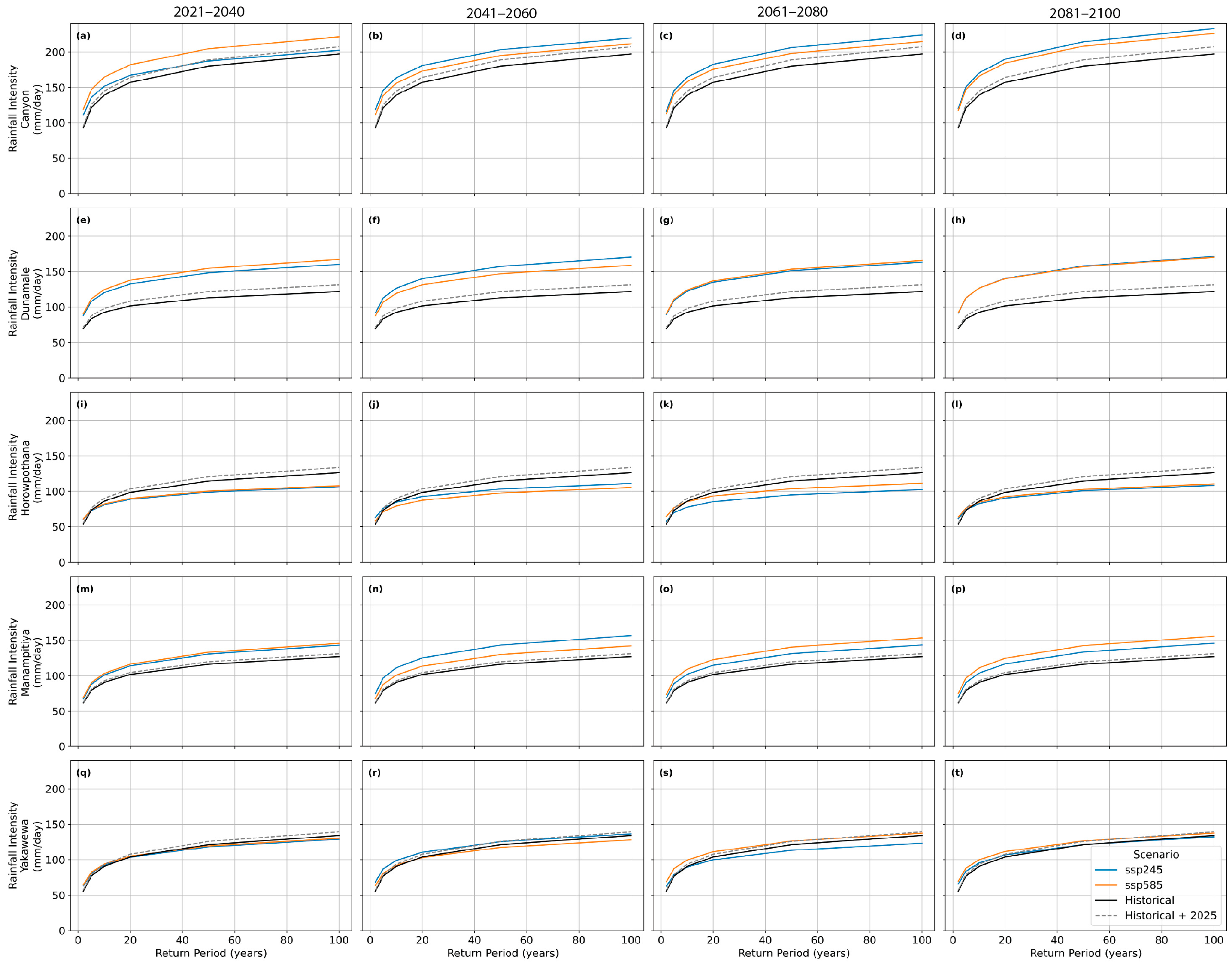
Across many stations and durations, the inclusion of the November 2025 rainfall event results in a systematic upward shift of the IDF curves relative to the historical baseline (Figure 9), with the effect becoming more pronounced at longer return periods. The baseline plus 2025 event consistently yields higher rainfall intensities for a given return period, underscoring the exceptional magnitude of this event. Climate projection-based IDF curves derived from both SSP2-4.5 and SSP5-8.5 scenarios also show clear increases compared to the historical baseline across all future periods (Figure 11). While the relative magnitude of intensification varies among stations and return periods, the projected curves frequently approach or exceed the intensities associated with the 2025 event, particularly for multi-day durations and higher return periods. This convergence between observed recent extremes and climate-projected intensities highlights a strong and consistent climate change signal in extreme rainfall behaviour over Sri Lanka.
Marked spatial variability is evident in the response of IDF curves to both the 2025 event and future climate projections. Dunamale station shows the largest relative increase (33.8%) under the SSP scenarios compared to the historical baseline, with projected intensities consistently exceeding baseline values across return periods and durations, indicating a strong climate sensitivity of extreme rainfall at this location. Canyon and Manampitiya stations also exhibit clear positive shifts in IDF curves under both SSP2-4.5 and SSP5-8.5 scenarios. However, the magnitude of increase relative to the baseline is more moderate (16.3% and 16.2%) than that observed at Dunamale. In contrast, Horowpathana and Yakawewa stations display comparatively limited changes (−4.2% and 5.4%) under the SSP scenarios, with projected intensities generally remaining close to, or in some cases lower than, those obtained from the baseline plus 2025 event. This suggests that future changes in extreme rainfall at these stations may be less pronounced, and that the 2025 event represents a more dominant driver of the updated extremes than long-term climate projections.
While the present study uses a single GCM (HadGEM3-GC31-LL), we acknowledge that this introduces limitations due to structural uncertainties and inter-model variability. However, to improve the robustness of future climate impact assessments, we recommend that subsequent studies incorporate multi-model ensemble approaches to capture a broader range of projected extremes and associated uncertainties.

4. Conclusions

This study presents a comprehensive statistical assessment of the extreme rainfall associated with Cyclone Ditwah and the resulting flooding in Sri Lanka in November 2025. Overall, the comparison of historical, event-augmented, and climate projection-based IDF curves demonstrates that the November 2025 rainfall event represents a critical benchmark for extreme rainfall assessment in Sri Lanka. The incorporation of this event leads to systematic upward shifts in IDF curves at several stations, highlighting the sensitivity of design-level rainfall estimates to recent extremes. Climate projections under both SSP2-4.5 and SSP5-8.5 indicate further modifications to extreme rainfall characteristics; however, the magnitude and direction of change vary spatially, with some stations exhibiting strong projection-driven increases and others showing more limited departures from the baseline. In several cases, the 2025 event produced rainfall intensities that are comparable to, or even exceed, those projected for future high-emission scenarios, underscoring the importance of integrating observed extreme events alongside climate projections when reassessing IDF relationships.
While this study is limited to a rainfall-based analysis, future research should evaluate how these shifts in IDF relationships translate into changes in catchment hydrological responses, reservoir operations, and flood dynamics under varying conditions.
Overall, the findings emphasize that continued reliance on stationary, historically based IDF curves is likely to underestimate future flood risks. The study supports the urgent need for station- and region-specific revisions to hydrological design criteria to enhance climate resilience in flood risk management. At the same time, appropriate design precautions should be incorporated through planning and policy guidance, supported by sound engineering judgement and risk analysis. It is important to strike a balance, as overly conservative assumptions or updates may lead to uneconomical and inefficient infrastructure designs, without proportionate environmental or operational benefits.
Taken together, the results of this study can be summarized as follows:
  • Unprecedented Rainfall Magnitudes:
The 1-day, 2-day, and 3-day rainfall totals recorded in November 2025 significantly exceeded historical maxima across many stations, often by large margins.
2.
Extremely High Return Periods:
The estimated return periods frequently fall between 1000 and 10,000 years, and in several stations the 2025 event lies beyond the statistical extrapolation limit of both Gumbel and GEV distributions. This indicates that the event is far rarer than anything captured in existing observational datasets.
3.
IDF Curves Require Urgent Revision:
The November 2025 rainfall totals lie well above the historical IDF envelopes across 14 of the assessed stations. This demonstrates that current design standards severely underestimate the intensity of emerging extreme rainfall events.
4.
Implications for Flood Risk Management:
With rainfall magnitudes far outside the previously expected range, the 2025 event underscores the need to revise hydrological design criteria, flood forecasting frameworks, reservoir operation rules, and infrastructure design standards under future climate conditions.
5.
National-Level Urgency:
The widespread and cross-climatic nature of the extreme rainfall suggests that national hazard preparedness must adapt to a new class of extremes, events far exceeding the historical baseline used in planning and engineering.


Author Contributions

Conceptualization, C.P. and L.G.; methodology, C.P. and L.G.; software, C.P. and N.P.; validation, C.P., N.P. and N.W.; formal analysis, C.P. and N.P.; investigation, C.P. and N.P.; resources, L.R.; data curation, C.P. and N.P.; writing—original draft preparation, C.P., N.P. and L.G.; writing—review and editing, C.P., N.W., L.R., L.G., B.C.D. and K.D.S.; visualization, C.P., N.P. and B.C.D.; supervision, C.P.; project administration, C.P. and L.R.; funding acquisition, L.R. and C.P. All authors have read and agreed to the published version of the manuscript.

Funding

This research was financially supported by the Climate Action for Advanced Inclusive Education (CAFIED) Project, funded under the UNESCO Participation Programme 2024–2025, whose support made this work possible.

Data Availability Statement

The raw data supporting the conclusions of this article can be obtained by contacting the corresponding author at chamalp@uom.lk. All data will be made available without undue restriction to any qualified researcher. To ensure efficient processing, monitoring, and record-keeping, all data requests are encouraged to be copied (CC) to umcsawm.research@gmail.com.

Acknowledgments

The authors gratefully acknowledge the Irrigation Department and the Department of Meteorology, Sri Lanka, for providing essential data that made this research possible. We also extend our sincere thanks to the Department of Civil Engineering, University of Moratuwa, and the UNESCO Madanjeet Singh Centre for South Asia Water Management (UMCSAWM) at the University of Moratuwa for their generous institutional and logistical support throughout the study. During the preparation of this manuscript, the authors used ChatGPT (version 5, OpenAI) to refine English grammar and sentence structure. All text generated or edited by the tool was carefully reviewed and revised by the authors, who take full responsibility for the content of this publication.

Conflicts of Interest

The authors declare no conflicts of interest.

Abbreviations

The following abbreviations are used in this manuscript:
IPCCIntergovernmental Panel on Climate Change
AR6Sixth Assessment Report
LPSLow-Pressure Systems
TCTropical cyclone
BoBBay of Bengal
UNDPUnited Nations Development Programme
IDFIntensity–Duration–Frequency
TCDTropical Cyclone Ditwah
DoMDepartment of Meteorology
DoIDepartment of Irrigation
IDWInverse Distance Weighting
GEVGeneralized Extreme Value
CMIP6Coupled Model Intercomparison Project Phase 6
SSPShared Socioeconomic Pathway
GCMGeneral Circulation Model
LARS-WG8Long Ashton Research Station Weather Generator version 8.0
AARAverage Annual Rainfall

References

  1. Intergovernmental Panel on Climate Change (IPCC). Climate Change 2021—The Physical Science Basis: Working Group I Contribution to the Sixth Assessment Report of the Intergovernmental Panel on Climate Change, 1st ed.; Cambridge University Press: Cambridge, UK, 2023. [Google Scholar]
  2. Tradowsky, J.S.; Philip, S.Y.; Kreienkamp, F.; Kew, S.F.; Lorenz, P.; Arrighi, J.; Bettmann, T.; Caluwaerts, S.; Chan, S.C.; De Cruz, L.; et al. Attribution of the Heavy Rainfall Events Leading to Severe Flooding in Western Europe during July 2021. Clim. Change 2023, 176, 90. [Google Scholar] [CrossRef]
  3. Fan, X.; Li, Y.; Liu, Y. Characteristics of Precipitation in China Associated with Tropical Cyclones over the Bay of Bengal. J. Meteorol. Res. 2023, 37, 417–430. [Google Scholar] [CrossRef]
  4. Uddin, M.J.; Li, Y.; Cheung, K.K.; Nasrin, Z.M.; Wang, H.; Wang, L.; Gao, Z. Rainfall Contribution of Tropical Cyclones in the Bay of Bengal between 1998 and 2016 Using TRMM Satellite Data. Atmosphere 2019, 10, 699. [Google Scholar] [CrossRef]
  5. Koralegedara, S.B.; Lin, C.-Y.; Sheng, Y.-F. Numerical Analysis of the Mesoscale Dynamics of an Extreme Rainfall and Flood Event in Sri Lanka in May 2016. J. Meteorol. Soc. Jpn. 2019, 97, 821–839. [Google Scholar] [CrossRef]
  6. Hansen, J.E.; Kharecha, P.; Sato, M.; Tselioudis, G.; Kelly, J.; Bauer, S.E.; Ruedy, R.; Jeong, E.; Jin, Q.; Rignot, E.; et al. Global Warming Has Accelerated: Are the United Nations and the Public Well-Informed? Environ. Sci. Policy Sustain. Dev. 2025, 67, 6–44. [Google Scholar] [CrossRef]
  7. Dalpadado, P.; Arrigo, K.R.; van Dijken, G.L.; Gunasekara, S.S.; Ostrowski, M.; Bianchi, G.; Sperfeld, E. Warming of the Indian Ocean and Its Impact on Temporal and Spatial Dynamics of Primary Production. Prog. Oceanogr. 2021, 198, 102688. [Google Scholar] [CrossRef]
  8. Sharma, S.; Ha, K.-J.; Yamaguchi, R.; Rodgers, K.B.; Timmermann, A.; Chung, E.-S. Future Indian Ocean Warming Patterns. Nat. Commun. 2023, 14, 1789. [Google Scholar] [CrossRef] [PubMed]
  9. Chand, R.; Singh, C. Relation of Frequency of Tropical Cyclones Over North Indian Ocean and North West Pacific Ocean with Sea Surface Temperature Anomaly Over Nino 3.4 Region and Indian Ocean Dipole. In Tropical Cyclone Activity over the North Indian Ocean; Springer International Publishing: Cham, Switzerland, 2017; pp. 233–243. [Google Scholar]
  10. Pattanaik, D.R.; Mohapatra, M. Seasonal Forecasting of Tropical Cyclogenesis over the North Indian Ocean. J. Earth Syst. Sci. 2016, 125, 231–250. [Google Scholar] [CrossRef]
  11. Department of Meteorology. Available online: https://meteo.gov.lk/ (accessed on 3 December 2025).
  12. Irrigation Department in Sri Lanka. Available online: https://www.irrigation.gov.lk/web/index.php?lang=en (accessed on 3 December 2025).
  13. Shand, R.T. Irrigation and Agriculture in Sri Lanka; Institute of Policy Studies: Colombo, Sri Lanka, 2002. [Google Scholar]
  14. One-Fifth of Sri Lanka Inundated by Cyclone Ditwah, UNDP Analysis. Available online: https://www.undp.org/asia-pacific/press-releases/one-fifth-sri-lanka-inundated-cyclone-ditwah-undp-analysis (accessed on 25 December 2025).
  15. National Building Research Organisation, Sri Lanka. Available online: https://www.nbro.gov.lk/index.php?option=com_content&view=featured&Itemid=101&lang=en (accessed on 25 December 2025).
  16. Disaster Information Management System in Sri Lanka. Available online: https://www.desinventar.lk/ (accessed on 9 December 2025).
  17. Sri Lanka: Cyclone Ditwah—Situation Report (16 December 2025)—Sri Lanka|ReliefWeb. Available online: https://reliefweb.int/report/sri-lanka/sri-lanka-cyclone-ditwah-situation-report-16-december-2025 (accessed on 25 December 2025).
  18. World Bank; Global Facility for Disaster Reduction and Recovery (GFDRR). Global Rapid Post-Disaster Damage Estimation (GRADE) Report: Cyclone Ditwah 2025—Sri Lanka (English); World Bank Group: Washington, DC, USA, 2025. [Google Scholar]
  19. Gahtan, J.; Knapp, K.R.; Schreck, C.J.; Diamond, H.J.; Kossin, J.P.; Kruk, M.C. International Best Track Archive for Climate Stewardship (IBTrACS) Project, Version 4r01; NOAA National Centers for Environmental Information: Asheville, NC, USA, 2024.
  20. Department of Irrigation, Sri Lanka. Hydrological Annual 2021–2022; Department of Irrigation: Colombo, Sri Lanka, 2022.
  21. Felnerova, B. Hydrology in Sri Lanka: Mapping River Networks on the “Pearl of the Indian Ocean.” Blue Water Intelligence (BWI). 2024. Available online: https://bwi.earth/hydrology-in-sri-lanka/ (accessed on 25 December 2025).
  22. Jayasekara, S.; Ushiyama, T.; Rasmy, M.; Kamae, Y. Investigation of Tropical Cyclones in the North Indian Ocean and the Linkage to Extreme Weather Events over Sri Lanka. Atmosphere 2024, 15, 390. [Google Scholar] [CrossRef]
  23. Caloiero, T.; Pellicone, G.; Modica, G.; Guagliardi, I. Comparative Analysis of Different Spatial Interpolation Methods Applied to Monthly Rainfall as Support for Landscape Management. Appl. Sci. 2021, 11, 9566. [Google Scholar] [CrossRef]
  24. Webster, R.; Oliver, M.A. Geostatistics for Environmental Scientists; John Wiley & Sons, Ltd.: Hoboken, NJ, USA, 2007. [Google Scholar]
  25. Ly, S.; Charles, C.; Degre, A. Different Methods for Spatial Interpolation of Rainfall Data for Operational Hydrology and Hydrological Modeling at Watershed Scale. A Review. Biotechnol. Agron. Soc. Environ. 2013, 17, 392–406. [Google Scholar]
  26. Dutta, P.; Deka, S. Reckoning Flood Frequency and Susceptibility Area in the Lower Brahmaputra Floodplain Using Geospatial and Hydrological Approach. River 2023, 2, 384–401. [Google Scholar] [CrossRef]
  27. Anghel, C.G. Revisiting the Use of the Gumbel Distribution: A Comprehensive Statistical Analysis Regarding Modeling Extremes and Rare Events. Mathematics 2024, 12, 2466. [Google Scholar] [CrossRef]
  28. Hossain, I.; Khastagir, A.; Aktar, M.; Imteaz, M.; Huda, D.; Rasel, H.M. Comparison of Estimation Techniques for Generalised Extreme Value (GEV) Distribution Parameters: A Case Study with Tasmanian Rainfall. Int. J. Environ. Sci. Technol. 2021, 19, 7737–7750. [Google Scholar] [CrossRef]
  29. Kangieser, P.C.; Blackadar, A. Estimating the Likelihood of Extreme Events. Weatherwise 1994, 47, 38–40. [Google Scholar]
  30. O’Neill, B.C.; Kriegler, E.; Ebi, K.L.; Kemp-Benedict, E.; Riahi, K.; Rothman, D.S.; van Ruijven, B.J.; van Vuuren, D.P.; Birkmann, J.; Kok, K.; et al. The Roads Ahead: Narratives for Shared Socioeconomic Pathways Describing World Futures in the 21st Century. Glob. Environ. Change 2017, 42, 169–180. [Google Scholar] [CrossRef]
  31. Jahangiri, M.; Asghari, M.; Niksokhan, M.H.; Nikoo, M.R. BiLSTM-Kalman Framework for Precipitation Downscaling under Multiple Climate Change Scenarios. Sci. Rep. 2025, 15, 24354. [Google Scholar] [CrossRef] [PubMed]
  32. Semenov, M.A.; Stratonovitch, P. Use of Multi-Model Ensembles from Global Climate Models for Assessment of Climate Change Impacts. Clim. Res. 2010, 41, 1–14. [Google Scholar] [CrossRef]
  33. Kamangar, M.; Shadman, H. The Changes in the Frequency of Warm Nights in Asia and the New Climatic Norms. Theor. Appl. Clim. 2022, 150, 663–676. [Google Scholar] [CrossRef]
  34. Disasa, K.N.; Yan, H.; Bao, R.; Zhang, J.; Zhang, C.; Wang, B.; Wang, G. Projection of Temperatures and Precipitation Using the LARS-WG Model in Eastern China Under the CMIP6 Scenarios. Int. J. Climatol. 2025, 45, e8929. [Google Scholar] [CrossRef]
  35. Punchihewa, T.; Gunawardhana, L.; Sirisena, J. Assessing Uncertainty in Climate Change Effects on Design Hydrographs: A Case Study in the Kalu River Basin, Sri Lanka. In Proceedings of the 2024 Moratuwa Engineering Research Conference (MERCon), Moratuwa, Sri Lanka, 8–10 August 2024; IEEE: New York, NY, USA, 2024; pp. 236–241. [Google Scholar] [CrossRef]
  36. Gunasinghe, L.; Gunawardhana, L.; Rajapakse, L. Predictive Analysis of Landslide Susceptibility under Hydrological Aspects of Climate Change in Kegalle District, Sri Lanka. In Proceedings of the 2023 Moratuwa Engineering Research Conference (MERCon), Moratuwa, Sri Lanka, 9–11 November 2023; IEEE: New York, NY, USA, 2023; pp. 119–124. [Google Scholar] [CrossRef]
Figure 1. Track of Cyclone Ditwah based on the IBTrACS V. 4.01 dataset [19].
Hydrology 13 00047 g001
Figure 2. Locations of rainfall stations used in the study.
Hydrology 13 00047 g002
Figure 3. Duration of the rainfall stations used in the study.
Hydrology 13 00047 g003
Figure 4. Comparison of (a) 1-day, (b) 2-day, and (c) 3-day maximum rainfall during the November 2025 event with historical maximum values.
Hydrology 13 00047 g004
Figure 5. Comparison of stations that recorded the highest (a) 1-day, (b) 2-day, and (c) 3-day rainfall totals (mm) during the November 2025 event with historical maximums at each respective location.
Hydrology 13 00047 g005
Figure 6. Rainfall distribution on (a) 26th, (b) 27th, and (c) 28th November across the country (Based on IDW method).
Hydrology 13 00047 g006
Figure 7. Comparison of total rainfall volumes received across the entire country during recent major flood events.
Hydrology 13 00047 g007
Figure 8. Deviation of the November 2025 event from the historical records at Randenigala Station fitted with the Gumbel Distribution with Gumbel best fit curve and 95% confidence interval ranges.
Hydrology 13 00047 g008
Figure 9. IDF curves of 14 stations (an) before and after the November 2025 event, with observed rainfall intensities for 1-day (blue), 2-day (orange), and 3-day (green) durations.
Hydrology 13 00047 g009
Figure 10. Estimated return periods of the November 2025 Cyclone Ditwah rainfall at 46 stations across Sri Lanka, calculated using Gumbel (ac) and GEV (df) distributions for 1-day (blue), 2-day (orange), and 3-day (green) durations. Red circles indicate stations where the 2025 event exceeded the historical maximum recorded at that location.
Hydrology 13 00047 g010
Figure 11. Comparison of existing IDF curves and updated curves (including the November 2025 event) with future IDF projections developed using the HadGEM3-GC31-LL model under SSP2-4.5 and SSP5-8.5 scenarios for five stations: Canyon (ad), Dunamale (eh), Horowpothana (il), Manampitiya (mp), and Yakawewa (qt).
Hydrology 13 00047 g011
Table 1. Total rainfall volume received by Sri Lanka during 26–28 November 2025 (in billion cubic meters), compared with the average annual rainfall.
Calculation MethodNovember 26
Rainfall
November 27
Rainfall
November
28
Rainfall
Total Rainfall Received (26–28 November)Average Annual Rainfall (AAR)Total Rainfall Received on 26–28 November as a % of AAR
Thiessen Polygon 8.598.742.7320.07131.7815.23%
Kriging Interpolation8.629.115.3623.09141.3616.33%
Inverse Distance Weighting8.439.234.4522.11139.6215.83%
Average Value ± SD8.55 ± 0.089.03 ± 0.214.18 ± 1.0921.75 ± 1.26137.59 ± 4.1715.8% ± 0.00
SD: Standard Deviation.
Disclaimer/Publisher’s Note: The statements, opinions and data contained in all publications are solely those of the individual author(s) and contributor(s) and not of MDPI and/or the editor(s). MDPI and/or the editor(s) disclaim responsibility for any injury to people or property resulting from any ideas, methods, instructions or products referred to in the content.