
Hydrodynamic Parameter Estimation for Simulating Soil-Vegetation-Atmosphere Hydrology Across Forest Stands in the Strengbach Catchment

Abstract
1. Introduction
2. Materials and Methods
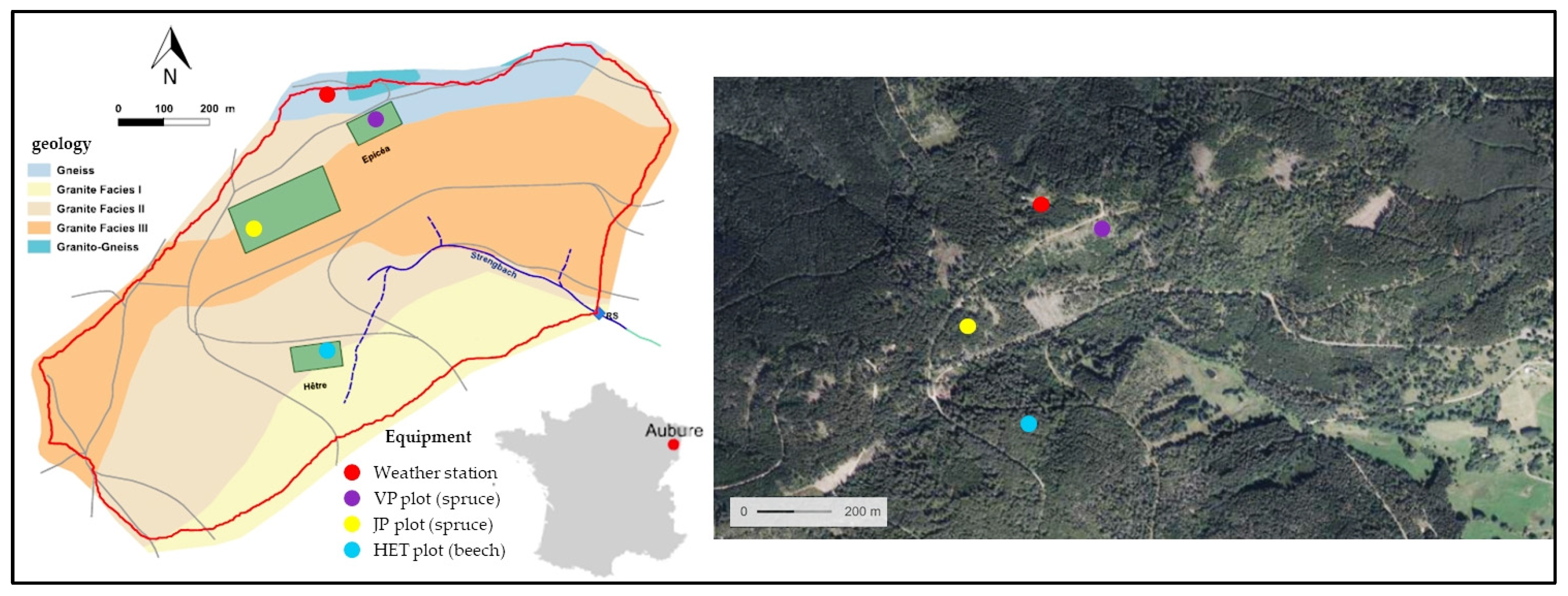
2.1. General Description of the Site
2.2. Monitoring Devices and Associated Measurements
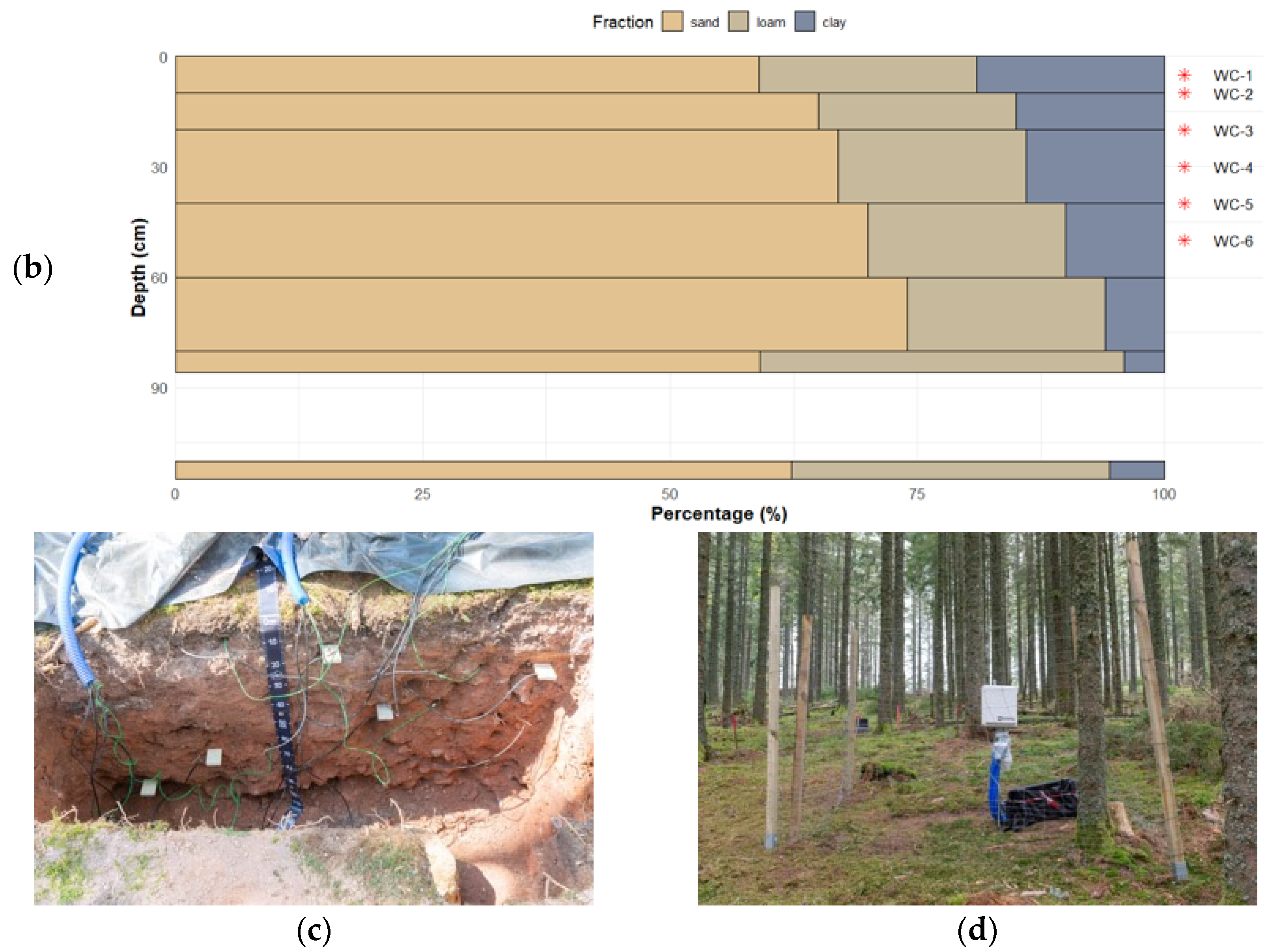
2.3. Vertical Profiles and Soil Properties
2.4. Numerical Methods
2.4.1. Potential and Actual Evapotranspiration
2.4.2. Vadose Zone Model
2.4.3. Simulations Achieved
2.5. Methodology Investigated for the Model Calibration
- 1.
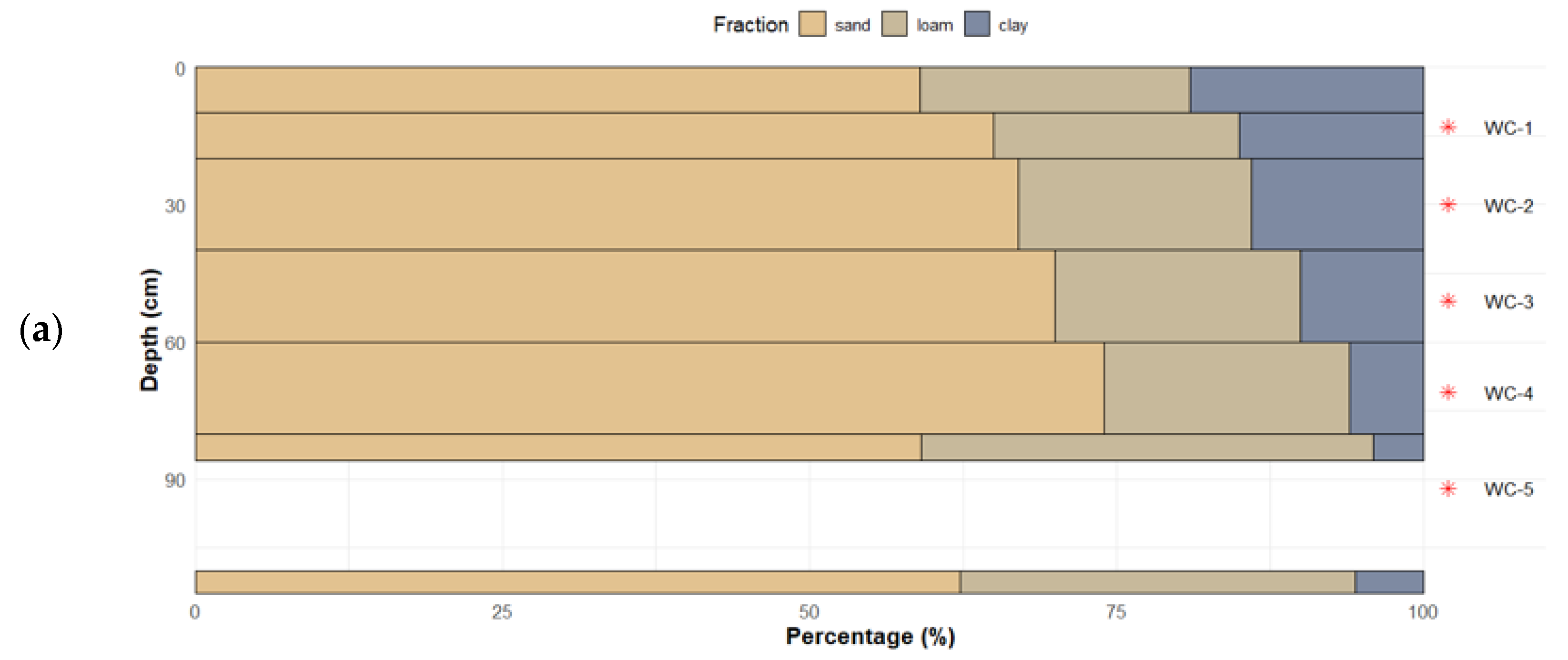
- Definition of homogeneous soil layersThe first step consisted of subdividing the soil profile into homogeneous layers, each containing at least one sensor. Two different configurations to describe the 110 cm deep profile in the JP stand were set, while only one was used for the 100 cm deep HET profile.
- 2.
- Initialization of hydrodynamic parametersField sampling and subsequent laboratory analyses enabled the determination of soil texture and composition for the different configurations described previously. Table 1 presents the configurations for the JP and HET stands. Although the uncertainty associated with the granulometric measurements was not provided, standard deviations are reported in Table 1, as the layer characterization was based on the aggregation of multiple samples. Following [22], initial estimates of the soil hydraulic parameters were obtained using the ROSETTA software based on PTFs [18], which derives parameters from measured soil texture data (Rosetta 1, https://www.handbook60.org/rosetta/, accessed on 10 March 2025).
- 3.
- Adjustments to account for stoninessThe granulometric analyses performed on disturbed soil samples were considered representative of the fine soil fraction. In contrast, both simulated and measured water contents represent the global bulk soil response. Consequently, the initial hydraulic parameters were corrected using the volumetric stone fraction (Rv) reported in Table 1 to account for the influence of stoniness on the soil water dynamics and the referring properties detailed in Equations (10) and (11).
- 4.
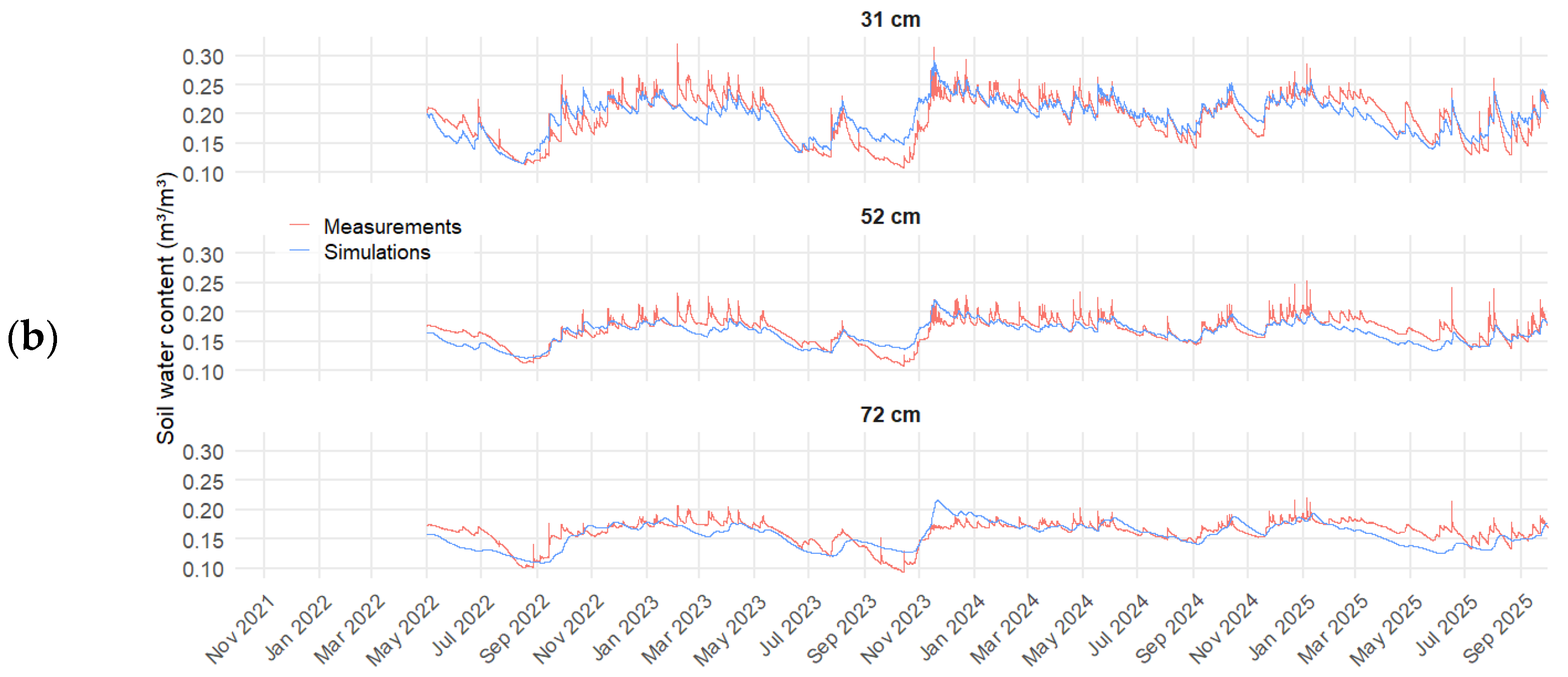
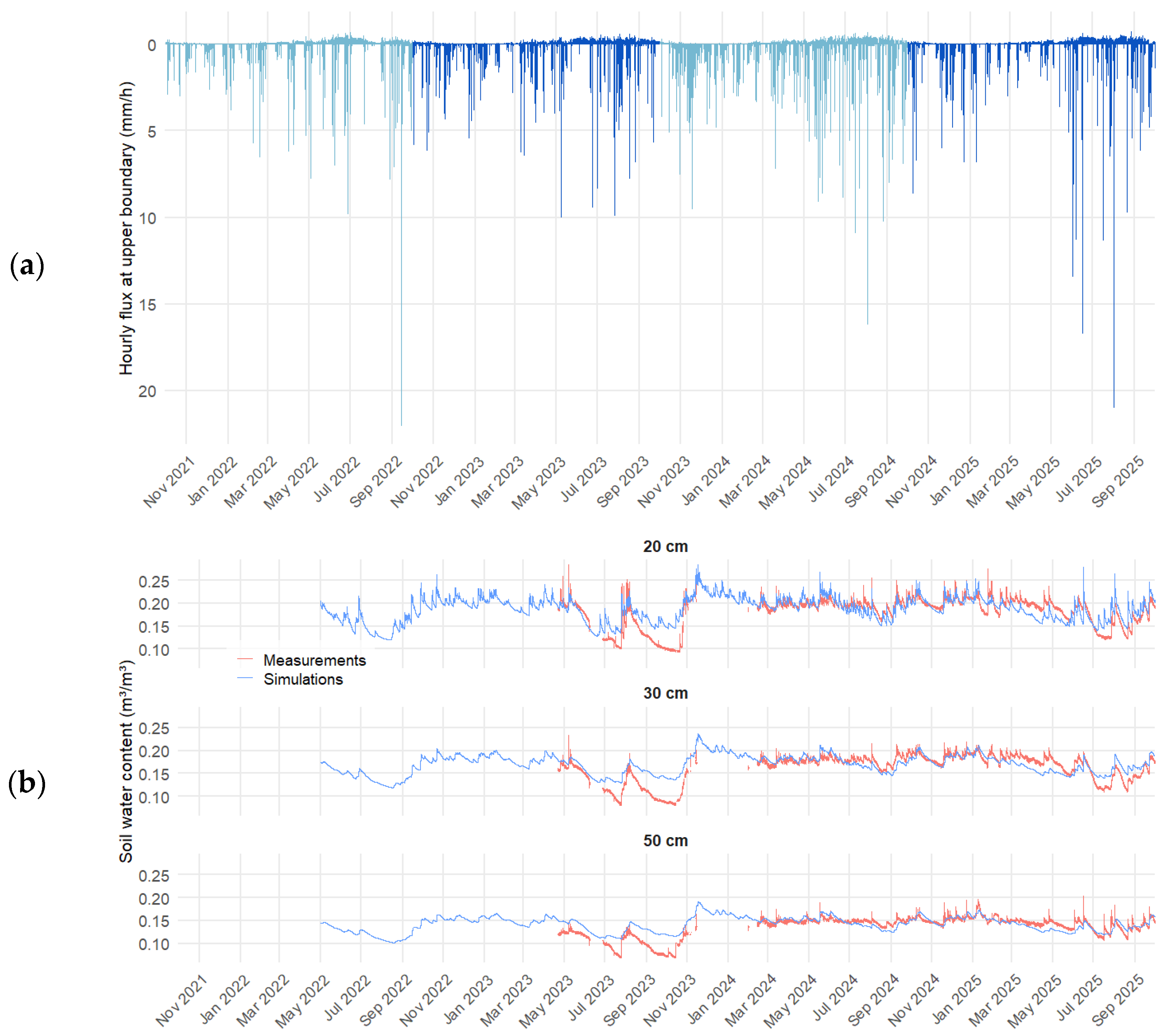
- Calibration and validation simulationsGiven the available measurement ranges (which differ between the two sites), parameter inverse estimation was conducted using the WaMoS-IPE-1D model. The optimization procedure minimized an objective function defined as the mean squared error between observed and simulated water contents (θmeas and θsim, respectively):
- Calib.1: from 1 May 2022 to 30 September 2022 (no data available for HET),
- Calib.2: from 1 April 2023 to 31 December 2023,
- Calib.3: from 1 April 2024 to 31 December 2024,
- Calib.4: from 1 October 2024 to 30 September 2025.
3. Results
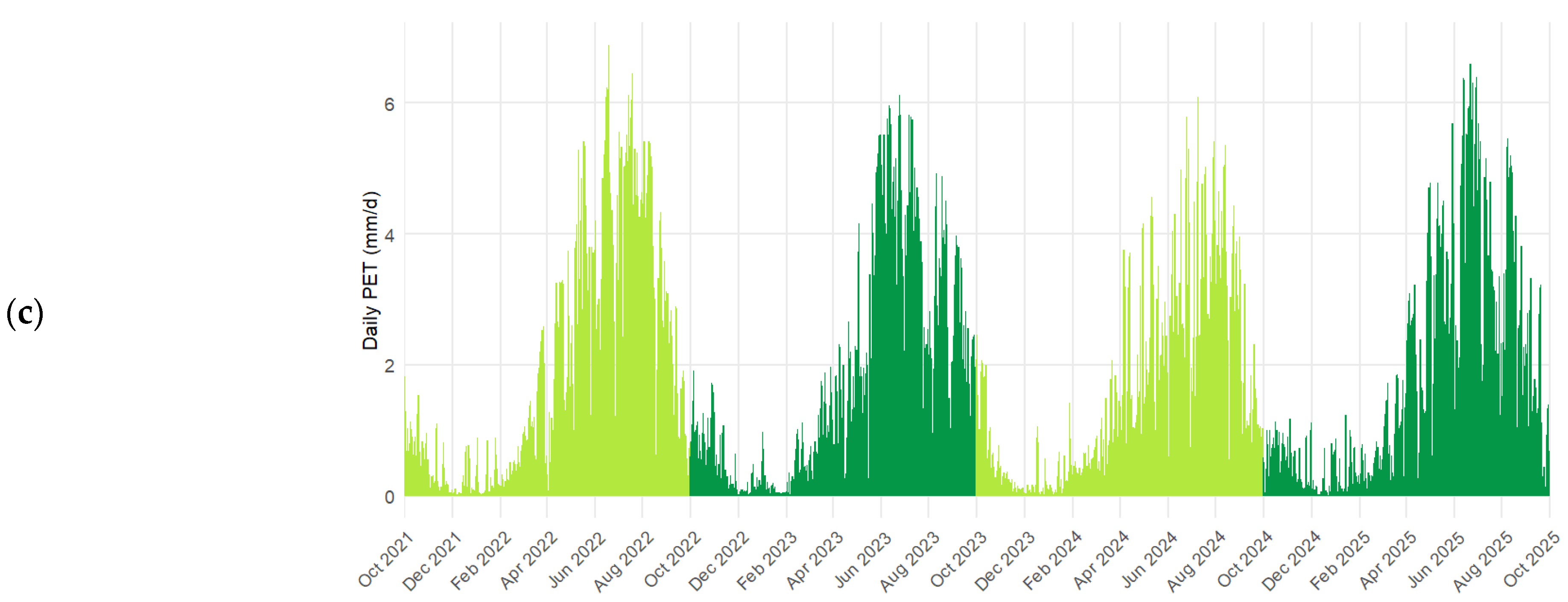
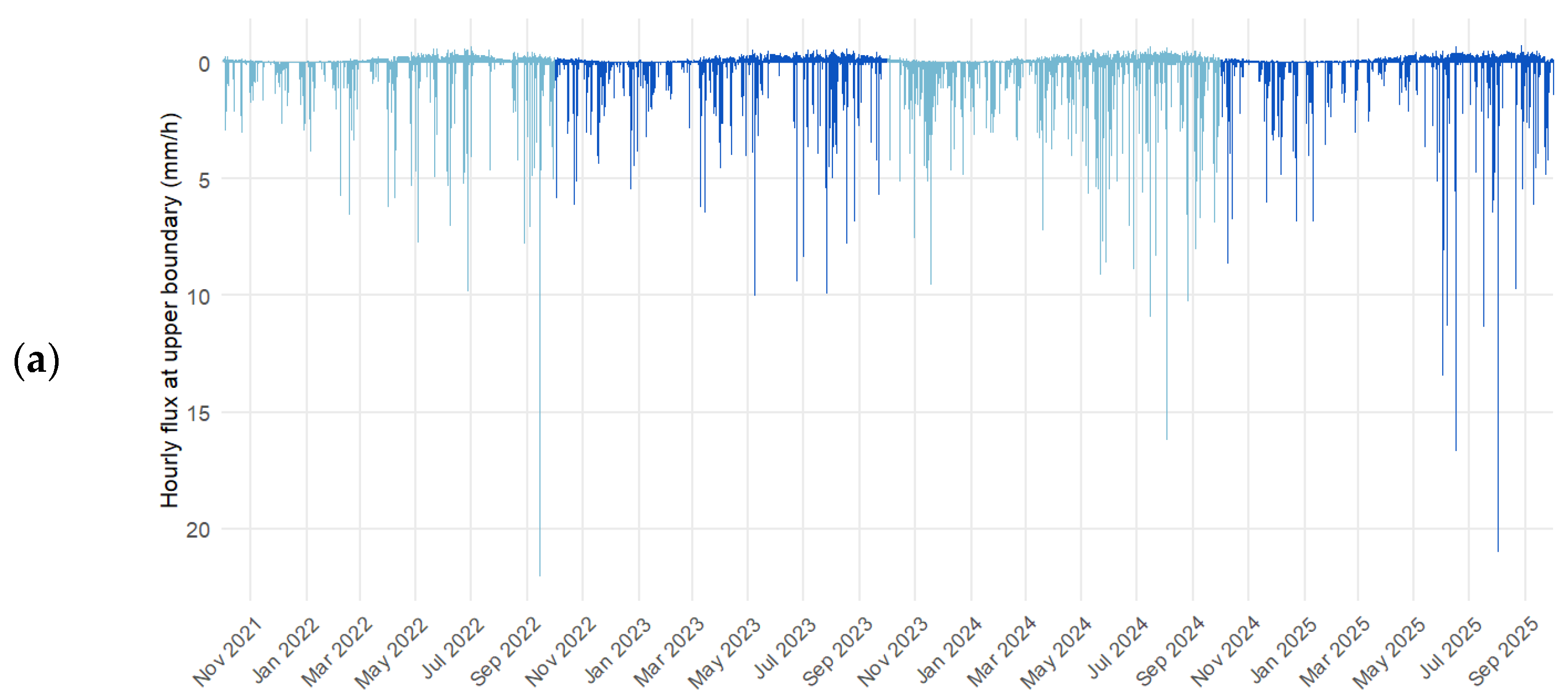
3.1. Time Series of Climatic Forcing and PET
3.2. Results at JP Plot
3.3. Results at HET Plot
3.4. Analysis of Selected Calibration Periods, Efficiency Criterion and Estimated Parameters
4. Discussion
5. Conclusions
- Regarding calibration period selection: When calibration is performed over a limited time period, it is essential to assess the robustness of the selected parameter set over an extended period. In general, multi-period calibration is recommended, as it improves parameter transferability and model resilience under contrasting hydrological conditions. However, in strongly data-limited configurations, calibration using time periods that include a balanced range of moisture conditions (neither the driest nor the wettest period) may yield better performance. Conventional performance criteria should also be interpreted with caution, as they are not always consistent with one another.
- Concerning ROSETTA and PTF applications: ROSETTA remains an acceptable first guess when calibration data are scarce, but it should ideally be supplemented with site-specific corrections or ancillary soil information. Accounting for the presence of stones and gravel to correct conductivity and water content has shown clear benefits in properly simulating water content time series, confirming findings from earlier studies on the subject [42,43]. Additionally, other PTFs better suited to European soils (see [60]), as well as integration of complementary information such as bulk density or field capacity, could further enhance model reliability.
- Regarding parameter identifiability from inverse modeling: Our calibration targeted three parameters: α, Ksat, and n. It appears that including the estimation of θs did not improve model performance when a stoniness correction had already been implemented.
Supplementary Materials
Author Contributions
Funding
Data Availability Statement
Acknowledgments
Conflicts of Interest
Abbreviations
| AET | Actual evapotranspiration |
| BC | Boundary condition(s) |
| BILHYDAY | Daily water mass balance model |
| CC | Climate change |
| HET | Beech plot in the Strengbach catchment (stands for Hêtraie in French) |
| JP | Young Norway spruce plot in the Strengbach catchment (stands for Jeune Peuplement in French) |
| KGE | Kling-Gupta efficiency criterion |
| LAI | Leaf area index |
| MvG | Mualem-van Genuchten hydrodynamic model |
| NSE | Nash–Sutcliffe efficiency criterion |
| OHGE | Observatoire Hydro-Géochimique de l’Environnement (https://ohge.unistra.fr/) |
| PET | Potential evapotranspiration |
| PTFs | Pedotransfer functions |
| RE | Richards’ Equation |
| TDR | Time-Domain Reflectometry |
| WaMoS-IPE-1D | Water movement in soil–inverse parameters estimation–1-dimensional |
| WC | Water content |
References
- Aznar-Sánchez, J.A.; Belmonte-Ureña, L.J.; López-Serrano, M.J.; Velasco-Muñoz, J.F. Forest Ecosystem Services: An Analysis of Worldwide Research. Forests 2018, 9, 453. [Google Scholar] [CrossRef]
- Nolander, C.; Lundmark, R. A Review of Forest Ecosystem Services and Their Spatial Value Characteristics. Forests 2024, 15, 919. [Google Scholar] [CrossRef]
- FAO. The State of the World’s Forests 2024; FAO: Rome, Italy, 2024; ISBN 978-92-5-138867-9. [Google Scholar]
- Forzieri, G.; Dakos, V.; McDowell, N.G.; Ramdane, A.; Cescatti, A. Emerging Signals of Declining Forest Resilience under Climate Change. Nature 2022, 608, 534–539. [Google Scholar] [CrossRef]
- Hammond, W.M.; Williams, A.P.; Abatzoglou, J.T.; Adams, H.D.; Klein, T.; López, R.; Sáenz-Romero, C.; Hartmann, H.; Breshears, D.D.; Allen, C.D. Global Field Observations of Tree Die-off Reveal Hotter-Drought Fingerprint for Earth’s Forests. Nat. Commun. 2022, 13, 1761. [Google Scholar] [CrossRef] [PubMed]
- Hlásny, T.; Zimová, S.; Merganičová, K.; Štěpánek, P.; Modlinger, R.; Turčáni, M. Devastating Outbreak of Bark Beetles in the Czech Republic: Drivers, Impacts, and Management Implications. For. Ecol. Manag. 2021, 490, 119075. [Google Scholar] [CrossRef]
- Richardson, D.; Black, A.S.; Irving, D.; Matear, R.J.; Monselesan, D.P.; Risbey, J.S.; Squire, D.T.; Tozer, C.R. Global Increase in Wildfire Potential from Compound Fire Weather and Drought. npj Clim. Atmos. Sci. 2022, 5, 23. [Google Scholar] [CrossRef]
- Tromp-van Meerveld, H.J.; McDonnell, J.J. On the Interrelations between Topography, Soil Depth, Soil Moisture, Transpiration Rates and Species Distribution at the Hillslope Scale. Adv. Water Resour. 2006, 29, 293–310. [Google Scholar] [CrossRef]
- Sabater, A.M.; Valiente, J.A.; Bellot, J.; Vilagrosa, A. Climatic Factors Influencing Aleppo Pine Sap Flow in Orographic Valleys Under Two Contrasting Mediterranean Climates. Hydrology 2025, 12, 6. [Google Scholar] [CrossRef]
- Vorobevskii, I.; Luong, T.T.; Kronenberg, R.; Petzold, R. High-Resolution Operational Soil Moisture Monitoring for Forests in Central Germany. Hydrol. Earth Syst. Sci. 2024, 28, 3567–3595. [Google Scholar] [CrossRef]
- Singh, A.; Gaurav, K. Deep Learning and Data Fusion to Estimate Surface Soil Moisture from Multi-Sensor Satellite Images. Sci. Rep. 2023, 13, 2251. [Google Scholar] [CrossRef] [PubMed]
- Cosh, M.H.; Caldwell, T.G.; Baker, C.B.; Bolten, J.D.; Edwards, N.; Goble, P.; Hofman, H.; Ochsner, T.E.; Quiring, S.; Schalk, C.; et al. Developing a Strategy for the National Coordinated Soil Moisture Monitoring Network. Vadose Zone J. 2021, 20, e20139. [Google Scholar] [CrossRef]
- Braud, I.; Chaffard, V.; Coussot, C.; Galle, S.; Juen, P.; Alexandre, H.; Baillion, P.; Battais, A.; Boudevillain, B.; Branger, F.; et al. Building the Information System of the French Critical Zone Observatories Network: Theia/OZCAR-IS. Hydrol. Sci. J. 2022, 67, 2401–2419. [Google Scholar] [CrossRef]
- Meyer, S.; Blaschek, M.; Duttmann, R.; Ludwig, R. Improved Hydrological Model Parametrization for Climate Change Impact Assessment under Data Scarcity—The Potential of Field Monitoring Techniques and Geostatistics. Sci. Total Environ. 2016, 543, 906–923. [Google Scholar] [CrossRef]
- Koohbor, B.; Fahs, M.; Hoteit, H.; Doummar, J.; Younes, A.; Belfort, B. An Advanced Discrete Fracture Model for Variably Saturated Flow in Fractured Porous Media. Adv. Water Resour. 2020, 140, 103602. [Google Scholar] [CrossRef]
- Camporese, M.; Daly, E.; Paniconi, C. Catchment-Scale Richards Equation-Based Modeling of Evapotranspiration via Boundary Condition Switching and Root Water Uptake Schemes. Water Resour. Res. 2015, 51, 5756–5771. [Google Scholar] [CrossRef]
- Chaguer, M.; Weill, S.; Ackerer, P.; Delay, F. Implementation of Subsurface Transport Processes in the Low-Dimensional Integrated Hydrological Model NIHM. J. Hydrol. 2022, 609, 127696. [Google Scholar] [CrossRef]
- Schaap, M.G.; Leij, F.J.; Van Genuchten, M.T. Rosetta: A Computer Program for Estimating Soil Hydraulic Parameters with Hierarchical Pedotransfer Functions. J. Hydrol. 2001, 251, 163–176. [Google Scholar] [CrossRef]
- Graham, S.L.; Srinivasan, M.S.; Faulkner, N.; Carrick, S. Soil Hydraulic Modeling Outcomes with Four Parameterization Methods: Comparing Soil Description and Inverse Estimation Approaches. Vadose Zone J. 2018, 17, 170002. [Google Scholar] [CrossRef]
- Lesparre, N.; Pasquet, S.; Ackerer, P. Impacts of Hydrofacies Geometry Designed from Seismic Refraction Tomography on Estimated Hydrogeophysical Variables. Hydrol. Earth Syst. Sci. 2024, 28, 873–897. [Google Scholar] [CrossRef]
- Moua, R.; Lesparre, N.; Girard, J.-F.; Belfort, B.; Lehmann, F.; Younes, A. Coupled Hydrogeophysical Inversion of an Artificial Infiltration Experiment Monitored with Ground-Penetrating Radar: Synthetic Demonstration. Hydrol. Earth Syst. Sci. 2023, 27, 4317–4334. [Google Scholar] [CrossRef]
- Belfort, B.; Toloni, I.; Ackerer, P.; Cotel, S.; Viville, D.; Lehmann, F. Vadose Zone Modeling in a Small Forested Catchment: Impact of Water Pressure Head Sampling Frequency on 1D-Model Calibration. Geosciences 2018, 8, 72. [Google Scholar] [CrossRef]
- Novák, V.; Kňava, K. The Influence of Stoniness and Canopy Properties on Soil Water Content Distribution: Simulation of Water Movement in Forest Stony Soil. Eur. J. For. Res. 2012, 131, 1727–1735. [Google Scholar] [CrossRef]
- Naseri, M.; Joshi, D.C.; Iden, S.C.; Durner, W. Rock Fragments Influence the Water Retention and Hydraulic Conductivity of Soils. Vadose Zone J. 2023, 22, e20243. [Google Scholar] [CrossRef]
- Pierret, M.-C.; Cotel, S.; Ackerer, P.; Beaulieu, E.; Benarioumlil, S.; Boucher, M.; Boutin, R.; Chabaux, F.; Delay, F.; Fourtet, C.; et al. The Strengbach Catchment: A Multidisciplinary Environmental Sentry for 30 Years. Vadose Zone J. 2018, 17, 180090. [Google Scholar] [CrossRef]
- Beaulieu, E.; Pierret, M.-C.; Legout, A.; Chabaux, F.; Goddéris, Y.; Viville, D.; Herrmann, A. Response of a Forested Catchment over the Last 25 Years to Past Acid Deposition Assessed by Biogeochemical Cycle Modeling (Strengbach, France). Ecol. Model. 2020, 430, 109124. [Google Scholar] [CrossRef]
- Oursin, M.; Pierret, M.-C.; Beaulieu, É.; Daval, D.; Legout, A. Is There Still Something to Eat for Trees in the Soils of the Strengbach Catchment? For. Ecol. Manag. 2023, 527, 120583. [Google Scholar] [CrossRef]
- Strohmenger, L.; Ackerer, P.; Belfort, B.; Pierret, M.C. Local and Seasonal Climate Change and Its Influence on the Hydrological Cycle in a Mountainous Forested Catchment. J. Hydrol. 2022, 610, 127914. [Google Scholar] [CrossRef]
- Ackerer, J.; Jeannot, B.; Delay, F.; Weill, S.; Lucas, Y.; Fritz, B.; Viville, D.; Chabaux, F. Crossing Hydrological and Geochemical Modeling to Understand the Spatiotemporal Variability of Water Chemistry in a Headwater Catchment (Strengbach, France). Hydrol. Earth Syst. Sci. 2020, 24, 3111–3133. [Google Scholar] [CrossRef]
- Weill, S.; Lesparre, N.; Jeannot, B.; Delay, F. Variability of Water Transit Time Distributions at the Strengbach Catchment (Vosges Mountains, France) Inferred Through Integrated Hydrological Modeling and Particle Tracking Algorithms. Water 2019, 11, 2637. [Google Scholar] [CrossRef]
- Lesparre, N.; Girard, J.-F.; Jeannot, B.; Weill, S.; Dumont, M.; Boucher, M.; Viville, D.; Pierret, M.-C.; Legchenko, A.; Delay, F. Magnetic Resonance Sounding Dataset of a Hard-Rock Headwater Catchment for Assessing the Vertical Distribution of Water Contents in the Subsurface. Data Brief 2020, 31, 105708. [Google Scholar] [CrossRef] [PubMed]
- De Vos, B.; Cools, N.; Verstraeten, A.; Neirynck, J. Accurate Measurements of Forest Soil Water Content Using FDR Sensors Require Empirical In Situ (Re)Calibration. Appl. Sci. 2021, 11, 11620. [Google Scholar] [CrossRef]
- Dong, Y.; Miller, S.; Kelley, L. Performance Evaluation of Soil Moisture Sensors in Coarse- and Fine-Textured Michigan Agricultural Soils. Agriculture 2020, 10, 598. [Google Scholar] [CrossRef]
- Thakur, V.; Markonis, Y.; Kumar, R.; Thomson, J.R.; Vargas Godoy, M.R.; Hanel, M.; Rakovec, O. Unveiling the Impact of Potential Evapotranspiration Method Selection on Trends in Hydrological Cycle Components across Europe. Hydrol. Earth Syst. Sci. 2025, 29, 4395–4416. [Google Scholar] [CrossRef]
- Biron, P. Le Cycle de l’eau En Forêt de Moyenne Montagne: Flux de Sêve et Bilans Hydriques Stationnels: Bassin Versant Du Strengbach à Aubure, Hautes Vosges. Ph.D. Thesis, Université Louis Pasteur (1971–2008), Strasbourg, France, 1994. [Google Scholar]
- Brochet, P.; Gerbier, N. L’Evapotranspiration: Aspect Agrométéorologique, Evaluation Pratique de l’Evapotranspiration Potentielle; Monographie n°65 de la Météorologie nationale; Edition revue et complétée; Edition revue et complétée; Direction de la Météorologie Nationale: Paris, France, 1975. [Google Scholar]
- Granier, A.; Bréda, N.; Biron, P.; Villette, S. A Lumped Water Balance Model to Evaluate Duration and Intensity of Drought Constraints in Forest Stands. Ecol. Model. 1999, 116, 269–283. [Google Scholar] [CrossRef]
- Viville, D.; Biron, P.; Granier, A.; Dambrine, E.; Probst, A. Interception in a Mountainous Declining Spruce Stand in the Strengbach Catchment (Vosges, France). J. Hydrol. 1993, 144, 273–282. [Google Scholar] [CrossRef]
- Richards, L.A. Capillary Conduction of Liquids through Porous Mediums. Physics 1931, 1, 318–333. [Google Scholar] [CrossRef]
- Van Genuchten, M.T. A Closed-Form Equation for Predicting the Hydraulic Conductivity of Unsaturated Soils. Soil Sci. Soc. Am. J. 1980, 44, 892–898. [Google Scholar] [CrossRef]
- Mualem, Y. A New Model for Predicting the Hydraulic Conductivity of Unsaturated Porous Media. Water Resour. Res. 1976, 12, 513–522. [Google Scholar] [CrossRef]
- Bouwer, H.; Rice, R.C. Hydraulic Properties of Stony Vadose Zones. Groundwater 1984, 22, 696–705. [Google Scholar] [CrossRef]
- Hlaváčiková, H.; Novák, V.; Holko, L. On the Role of Rock Fragments and Initial Soil Water Content in the Potential Subsurface Runoff Formation. J. Hydrol. Hydromech. 2015, 63, 71–81. [Google Scholar] [CrossRef][Green Version]
- Lehmann, F.; Ackerer, P. Comparison of Iterative Methods for Improved Solutions of the Fluid Flow Equation in Partially Saturated Porous Media. Transp. Porous Media 1998, 31, 275–292. [Google Scholar] [CrossRef]
- Belfort, B.; Carrayrou, J.; Lehmann, F. Implementation of Richardson Extrapolation in an Efficient Adaptive Time Stepping Method: Applications to Reactive Transport and Unsaturated Flow in Porous Media. Transp. Porous Media 2007, 69, 123–138. [Google Scholar] [CrossRef]
- van Dam, J.C.; Feddes, R.A. Numerical Simulation of Infiltration, Evaporation and Shallow Groundwater Levels with the Richards Equation. J. Hydrol. 2000, 233, 72–85. [Google Scholar] [CrossRef]
- Marquardt, D.W. An Algorithm for Least-Squares Estimation of Nonlinear Parameters. J. Soc. Ind. Appl. Math. 1963, 11, 431–441. [Google Scholar] [CrossRef]
- Lehmann, F.; Ackerer, P. Determining soil hydraulic properties by inverse method in one-dimensional unsaturated flow. J. Environ. Qual. 1997, 26, 76–81. [Google Scholar] [CrossRef]
- Zhou, H.; Gómez-Hernández, J.J.; Li, L. Inverse Methods in Hydrogeology: Evolution and Recent Trends. Adv. Water Resour. 2014, 63, 22–37. [Google Scholar] [CrossRef]
- Gupta, H.V.; Kling, H.; Yilmaz, K.K.; Martinez, G.F. Decomposition of the Mean Squared Error and NSE Performance Criteria: Implications for Improving Hydrological Modelling. J. Hydrol. 2009, 377, 80–91. [Google Scholar] [CrossRef]
- Nash, J.E.; Sutcliffe, J.V. River Flow Forecasting through Conceptual Models Part I—A Discussion of Principles. J. Hydrol. 1970, 10, 282–290. [Google Scholar] [CrossRef]
- Scharnagl, B.; Vrugt, J.A.; Vereecken, H.; Herbst, M. Inverse Modelling of in Situ Soil Water Dynamics: Investigating the Effect of Different Prior Distributions of the Soil Hydraulic Parameters. Hydrol. Earth Syst. Sci. 2011, 15, 3043–3059. [Google Scholar] [CrossRef]
- Hajizadeh Javaran, M.R.; Rajabi, M.M.; Kamali, N.; Fahs, M.; Belfort, B. Encoder–Decoder Convolutional Neural Networks for Flow Modeling in Unsaturated Porous Media: Forward and Inverse Approaches. Water 2023, 15, 2890. [Google Scholar] [CrossRef]
- Latorre, B.; Moret-Fernández, D. Simultaneous Estimation of the Soil Hydraulic Conductivity and the van Genuchten Water Retention Parameters from an Upward Infiltration Experiment. J. Hydrol. 2019, 572, 461–469. [Google Scholar] [CrossRef]
- He, Y.; Mao, H.; Wang, C.; Hu, J.; Ninsawat, S.; Song, X.; Jing, G.; Li, R.; Wang, M.; Duan, Z. Advancing Hydrological Modeling through Multivariate Calibration of Multi-Layer Soil Moisture Dynamics. J. Hydrol. Reg. Stud. 2025, 57, 102125. [Google Scholar] [CrossRef]
- Knoben, W.J.M.; Freer, J.E.; Woods, R.A. Technical Note: Inherent Benchmark or Not? Comparing Nash–Sutcliffe and Kling–Gupta Efficiency Scores. Hydrol. Earth Syst. Sci. 2019, 23, 4323–4331. [Google Scholar] [CrossRef]
- Schwemmle, R.; Demand, D.; Weiler, M. Technical Note: Diagnostic Efficiency—Specific Evaluation of Model Performance. Hydrol. Earth Syst. Sci. 2021, 25, 2187–2198. [Google Scholar] [CrossRef]
- Zhang, Z.F.; Ward, A.L.; Gee, G.W. Estimating Soil Hydraulic Parameters of a Field Drainage Experiment Using Inverse Techniques. Vadose Zone J. 2003, 2, 201–211. [Google Scholar] [CrossRef]
- Carsel, R.F.; Parrish, R.S. Developing Joint Probability Distributions of Soil Water Retention Characteristics. Water Resour. Res. 1988, 24, 755–769. [Google Scholar] [CrossRef]
- Tóth, B.; Weynants, M.; Nemes, A.; Makó, A.; Bilas, G.; Tóth, G. New Generation of Hydraulic Pedotransfer Functions for Europe. Eur. J. Soil Sci. 2015, 66, 226–238. [Google Scholar] [CrossRef]
- Corvi, O. Développement d’un Nouveau Modèle à Base Physique de Représentation Du Continuum Sol-Plante-Atmosphère Incluant l’Hydraulique des Plantes. Ph.D. Thesis, Université de Strasbourg, Strasbourg, France, 27 May 2025. [Google Scholar]





| Config. | Layer Min–Max Depth (cm) | Clay (%) | Loam (%) | Sand (%) | Rv (−) |
|---|---|---|---|---|---|
| JP-1 | 0–40 | 10.25 (±1.65) | 51.81 (±7.08) | 37.94 (±8.51) | 0 |
| 40–75 | 10.62 (±2.50) | 48.61 (±11.33) | 40.77 (±13.83) | 0.1 | |
| 75–110 | 12.75 | 61.52 | 25.73 | 0.5 | |
| JP-2 | 0–35 | 10.25 (±1.65) | 51.81 (±7.08) | 37.94 (±8.51) | 0 |
| 35–65 | 9.77 (±2.84) | 44.65 (±12.76) | 45.58 (±15.61) | 0.1 | |
| 65–110 | 12.54 (±0.30) | 59.02 (±3.53) | 28.44 (±3.83) | 0.2 | |
| HET-1 | 0–25 | 17 (±2.83) | 21 (±1.41) | 62 (±4.24) | 0.1 |
| 25–45 | 14 | 19 | 67 | 0.2 | |
| 45–100 | 10 (±3.01) | 25.6 (±9.70) | 67.7 (7.71) | 0.4 |
| Config. | Layer 1. | Ksat (cm.d−1) | θr (cm3.cm−3) | θs (cm3.cm−3) | α (cm−1) | n (−) |
|---|---|---|---|---|---|---|
| JP-1 | 0–40 | 36.42 | 0.046 | 0.407 | 0.006 | 1.613 |
| 40–75 | 28.94 | 0.046 | 0.403 | 0.007 | 1.576 | |
| 75–110 | 28.21 | 0.056 | 0.425 | 0.004 | 1.693 | |
| JP-2 | 0–35 | 36.419 | 0.046 | 0.407 | 0.006 | 1.613 |
| 35–65 | 26.756 | 0.043 | 0.398 | 0.010 | 1.552 | |
| 65–110 | 29.598 | 0.005 | 0.420 | 0.005 | 1.682 | |
| HET-1 | 0–25 | 18.356 | 0.065 | 0.403 | 0.005 | 1.668 |
| 25–45 | 23.378 | 0.061 | 0.437 | 0.004 | 1.692 | |
| 45–100 | 35.370 | 0.054 | 0.446 | 0.004 | 1.714 |
| Config. | Layer Min–Max Depth (cm) | Ksat (cm.d−1) | θr (cm3.cm−3) | θs (cm3.cm−3) | α (cm−1) | n (−) | KGE (−) | NSE (−) |
|---|---|---|---|---|---|---|---|---|
| JP2-3 | 0–35 | 110.755 | 0.0461 | 0.4074 | 0.0064 | 1.6530 | 0.76 | 0.68 |
| 35–65 | 28.957 | 0.0384 | 0.358 | 0.0089 | 1.5329 | 0.75 | 0.55 | |
| 65–110 | 28.853 | 0.0036 | 0.336 | 0.0043 | 1.6483 | 0.69 | 0.31 | |
| Global | All depths | 0.83 | 0.67 |
| Config. | Layer Min–Max Depth (cm) | Ksat (cm.d−1) | θs (cm3.cm−3) | θr (cm3.cm−3) | α (cm−1) | n (−) | KGE (−) | NSE (−) |
|---|---|---|---|---|---|---|---|---|
| HET1-4 | 0–25 | 19.684 | 0.3872 | 0.0581 | 0.0050 | 1.6982 | 0.60 | 0.54 |
| 25–45 | 40.9050 | 0.3498 | 0.0487 | 0.0045 | 1.7085 | 0.50 | 0.51 | |
| 45–100 | 27.46861 | 0.2675 | 0.0322 | 0.0039 | 1.6472 | 0.51 | 0.48 | |
| Global | All depths | 0.69 | 0.65 |
Disclaimer/Publisher’s Note: The statements, opinions and data contained in all publications are solely those of the individual author(s) and contributor(s) and not of MDPI and/or the editor(s). MDPI and/or the editor(s) disclaim responsibility for any injury to people or property resulting from any ideas, methods, instructions or products referred to in the content. |
© 2025 by the authors. Licensee MDPI, Basel, Switzerland. This article is an open access article distributed under the terms and conditions of the Creative Commons Attribution (CC BY) license.
Share and Cite
Belfort, B.; Alzein, A.; Cotel, S.; Julien, A.; Weill, S. Hydrodynamic Parameter Estimation for Simulating Soil-Vegetation-Atmosphere Hydrology Across Forest Stands in the Strengbach Catchment. Hydrology 2026, 13, 11. https://doi.org/10.3390/hydrology13010011
Belfort B, Alzein A, Cotel S, Julien A, Weill S. Hydrodynamic Parameter Estimation for Simulating Soil-Vegetation-Atmosphere Hydrology Across Forest Stands in the Strengbach Catchment. Hydrology. 2026; 13(1):11. https://doi.org/10.3390/hydrology13010011
Chicago/Turabian StyleBelfort, Benjamin, Aya Alzein, Solenn Cotel, Anthony Julien, and Sylvain Weill. 2026. "Hydrodynamic Parameter Estimation for Simulating Soil-Vegetation-Atmosphere Hydrology Across Forest Stands in the Strengbach Catchment" Hydrology 13, no. 1: 11. https://doi.org/10.3390/hydrology13010011
APA StyleBelfort, B., Alzein, A., Cotel, S., Julien, A., & Weill, S. (2026). Hydrodynamic Parameter Estimation for Simulating Soil-Vegetation-Atmosphere Hydrology Across Forest Stands in the Strengbach Catchment. Hydrology, 13(1), 11. https://doi.org/10.3390/hydrology13010011