
Article

Revealing Emerging Hydroclimatic Shifts: Advanced Trend Analysis of Rainfall and Streamflow in the Navasota River Watershed

1
College of Agriculture, Food, and Natural Resources, Prairie View A&M University, Prairie View, TX 77446, USA
2
Department of Natural Resources Management, College of Agriculture and Environmental Sciences, Bahir Dar University, Bahir Dar P.O. Box 79, Ethiopia
3
Institut National de la Recherche Scientifique, Centre Eau Terre Environnement, 490 de la Couronne, Québec, QC G1K 9A9, Canada
4
The Institute for a Disaster Resilient Texas, Texas A&M University at Galveston, Galveston, TX 77553, USA
5
Civil, Environmental and Ocean Engineering Department, Stevens Institute of Technology, Hoboken, NJ 07030, USA
*
Author to whom correspondence should be addressed.
Hydrology 2026, 13(1), 12; https://doi.org/10.3390/hydrology13010012 (registering DOI)
Submission received: 10 November 2025 / Revised: 13 December 2025 / Accepted: 22 December 2025 / Published: 25 December 2025
(This article belongs to the Special Issue Trends and Variations in Hydroclimatic Variables: 2nd Edition)

Abstract

Rainfall and streamflow analyses have long been central to hydrological research, yet traditional approaches often overlook the complexity introduced by changing climate signals, land-use dynamics, and human infrastructure. This study applies an integrated, data-driven framework to explore emerging hydroclimatic shifts in the Navasota River Watershed of east-central Texas. By combining autocorrelation analysis, Mann–Kendall and modified Mann–Kendall trend tests, and Pettitt’s change-point detection, we examine more than a century of precipitation and streamflow records alongside post-1978 reservoir operations. Results reveal an accelerating wetting tendency, particularly evident in decadal rolling averages and early-summer precipitation, accompanied by a statistically significant increase in 10-year moving averages of annual peak streamflow. While abrupt regime shifts were not detected, subtle but persistent changes point to evolving watershed memory and heightened flood risk in the post-dam era. This study reframes rainfall and streamflow trend analysis as a dynamic tool for anticipating hydrologic regime shifts, highlighting the urgent need for adaptive water infrastructure and flood management strategies in rapidly urbanizing and climate-sensitive watersheds.

1. Introduction

In the US, extreme weather events have become more frequent and intense, posing increasing risks to ecosystems, infrastructure, and public safety [1,2]. Storms and floods accounted for 72 of the 84 extreme weather events in the United States between 2011 and 2017 alone, each of which caused at least $1 billion in losses [3]. Texas is particularly susceptible to a wide range of extreme occurrences, including hurricanes, droughts, wildfires, severe storms, and floods, due to its large geographic area and varied climate zones. The state’s vulnerability to both acute and chronic climate-related hazards is highlighted by recent disasters such as Hurricane Harvey in 2017, which caused damages exceeding $125 billion [4], the prolonged drought in Central Texas in the early 2010s, and Winter Storm Uri in 2021.
The Continental United States (CONUS) is susceptible to floods, and according to Montz and Gruntfest [5] Texas is particularly vulnerable because of its physiographic diversity, heavy rainfall events, fluctuating precipitation patterns, and quick changes in land use [6]. Historically, major flood events, such as the devastating Thrall flood of 1921, the widespread Central Texas floods in 2015, and the catastrophic inundation during Hurricane Harvey, have resulted in substantial loss of life and extensive property damage across the region [7,8]. The United States saw 16 distinct billion-dollar disasters in 2017 alone, including two inland floods, eight severe storms, and three tropical cyclones [4]. In Texas, floods continue to be the most common cause of deaths from natural disasters. Climate unpredictability, urbanization, and the natural characteristics of the state’s river basins all contribute to the state’s increased vulnerability to flooding.
The basins of the Brazos and Navasota rivers are especially vulnerable to frequent floods. Recent years have seen significant flooding in the Navasota River Watershed (NRW), a tributary of the Brazos River in eastern Texas, especially in the counties of Brazos and Grimes [9]. The NRW encompasses approximately 4073 km2 downstream of Lake Limestone, referring to the total watershed area that drains below the dam [10]. This lower portion of the watershed is characterized by strong surface runoff potential, slowly permeable soils, and extensive floodplains [10]. The watershed has experienced an estimated 77 km2 of new development since 2001, especially surrounding the rapidly expanding Bryan–College Station region [11]. Even though regulations like retention pond requirements have been implemented, they might not be enough to offset the effects of growing impermeable surfaces and stormwater runoff. Furthermore, drone inspections showed debris collection in the Navasota River, which has been demonstrated to produce blockages that worsen localized flooding [11].
Multiple hypotheses have been proposed to explain why floods in the NRW and nearby watersheds are becoming more frequent and severe. Among these are: (1) increased frequency of high-intensity rainfall events that may be influenced by climate change; (2) infrastructure changes like reservoir operations that may unintentionally affect downstream flow regimes; and (3) changes in land use and urbanization that increase runoff and change the hydrological response. Given its central role in local hydrology, Lake Limestone Dam, constructed in 1978 by the Brazos River Authority, has been a major point of concern among stakeholders. The dam has a total storage capacity of approximately 251.36 million m3 and serves multiple purposes, including water supply, recreation, and flow regulation [12]. Although not designed primarily for flood control, the dam can influence downstream discharge through controlled water releases. Consequently, streamflow conditions in the lower NRW can be partially dependent on operational decisions, especially during high inflow periods or reservoir drawdown events. Stakeholders and local landowners have expressed concerns that the operation of the Lake Limestone dam could lead to longer-lasting or more severe flooding in the lower NRW. Although these arguments are being investigated, empirical research indicates that watershed urbanization and changed rainfall patterns are probably more significant factors [11].
Significant research gaps remain, despite increasing access to sophisticated analytical techniques and heightened awareness of flood risk [13,14]. New developments in statistical analysis and hydrological modeling offer practical methods for understanding flood behavior and its underlying causes. Mann–Kendall test and Sen’s slope estimator are popular trend identification techniques for assessing long-term variations in streamflow and precipitation [15]. Regime shifts in hydrological series can be identified using change point detection procedures, such as the Pettitt test and Bayesian models [16]. Additionally, autocorrelation analysis provides insights into the seasonality, lag structures, and temporal persistence of variables associated with floods [17]. Together, these techniques can provide solid and complex insights into changing flood hazards.
This study is part of a broader research project aimed at investigating the flooding dynamics of the NRW over time, with particular emphasis on understanding the potential influence of the Lake Limestone dam on these dynamics. The primary goal is to determine whether there have been significant changes in streamflow and rainfall intensity, distribution, and frequency throughout the watershed’s recent history. To achieve this, the study pursues the following specific objectives: (i) analyze autocorrelation in streamflow data to explore the seasonality and persistence of flooding events; (ii) evaluate long-term trends in both streamflow and precipitation using the standard and modified Mann–Kendall trend test; and (iii) identify potential shifts in the hydrological regime through change point detection, employing the Pettitt test. By integrating these advanced statistical techniques with extensive historical hydrological records, the study seeks to fill critical knowledge gaps related to flood trend analysis in the NRW. The findings are expected to support more informed policy development, infrastructure planning, and flood mitigation strategies, particularly in a region recognized as one of the most flood-prone areas in Texas.

2. Methodology

2.1. Navasota River Watershed

The Navasota River Watershed encompasses an area of 5822 km2, representing the entire watershed, including both the upstream and downstream areas of Lake Limestone Dam, while the 4073 km2 reported earlier refers specifically to the downstream portion of the watershed. The basin stretches between 30°29′51″ N and 31°48′52″ N latitude and 95°53′57″ W and 96°54′9″ W longitude (Figure 1). The Navasota River is the largest perennial tributary of the lower Brazos River, flowing 200 km before joining the Brazos [18]. This watershed is shared by eight counties: Brazos, Freestone, Grimes, Hill, Leon, Limestone, Madison, and Robertson (Figure 1). It experiences a humid subtropical climate, with cool, wet winters and hot, dry summers, and an average annual rainfall between 863 and 1118 mm [19]. The Navasota rural-dominated River watershed, characterized by pasture, woodland, and some farming near the Brazos River confluence, also includes the rapidly urbanizing cities of College Station and Bryan [10]. The southern portion along the eastern edge of Brazos County is characterized by marshland [10]. The watershed’s primary surface water resources are Lake Limestone (50.5 km2), Gibbons Creek Reservoir (10.4 km2), and Twin Oaks Reservoir (9.4 km2), impounded in 1978, 1981, and 1982, respectively [19]. Key aquifers include the Carrizo-Wilcox and Gulf Coast, as well as minor aquifers like the Yegua Jackson, Sparta, Queen City, and Brazos River Alluvium, providing water for irrigation, livestock, and drinking [19].

2.2. Dataset

2.2.1. Precipitation Data

The station precipitation data were collected from the National Centers for Environmental Information (NCEI). However, many stations had missing precipitation records, and this study analyzed data from the Navarro Mills Dam (NMD) and College Station Eastwood Field (CSTN) stations between 1981 and 2021 to check the rainfall trends. We also compared the performance of Parameter-Elevation Regressions on Independent Slopes Model (PRISM) data with the station records to check the consistency of PRISM data with station records. This study used more than 30 years of rainfall records for trend analysis to identify the long-term pattern [20]. In addition to the observed weather data, this study utilized PRISM gridded precipitation data, verifying its consistency through comparison with ground observations from NMD and CSTN. PRISM employs a regression analysis to derive approximately 15,000 surface precipitation measurements across the conterminous United States, producing a 4 km resolution daily precipitation product.

2.2.2. Streamflow Data

Streamflow data were downloaded from the four United States Geological Survey (USGS) streamflow gauging stations (Table 1). Among these stations, the Navasota River near Easterly, situated in the central part of the watershed (Figure 1), was selected for analysis due to its long-term and high-quality data record. This streamflow data was then used to evaluate trends and detect potential change points.

2.2.3. Land Cover Data

The National Land Cover Database (NLCD) provides nationwide data on land characteristics at 30 m resolution, including thematic classes. NLCD includes nine epochs from 2001 to 2021 (2001, 2004, 2006, 2008, 2011, 2013, 2016, 2019, and 2021) for the conterminous US. The 2021 suite of NLCD products follows the protocols and procedures of the previously released NLCD epochs (2001–2019), but it requires re-acquisition for the additional 2021 change information. This study used the eight epochs of the NLCD, except 2021, to assess land cover change dynamics of the Navasota River Watershed. The NLCD classifies land cover into 15 distinct categories. Within these 15 primary classes, the database further identifies sub-classes for developed forests, wetlands, and grasslands. The detailed methodology for map production of the NLCD is described by Homer et al. [21], Jin et al. [22], and Yang et al. [23]. The accuracy of the 2016 and 2019 NLCD land cover data was evaluated by Wickham et al. [24], who reported an overall accuracy of more than 80%.

2.3. Data Analysis

2.3.1. Performance of PRISM Data

The accuracy of PRISM precipitation data was assessed by comparing it with observed data using evaluation metrics, including the Coefficient of Determination (R2), Root Mean Square Error (RMSE), and Bias. R2 indicates the degree of co-linearity between the PRISM and observed precipitation data that describes the proportion of the variance in observed data explained by the model (Equation (1)). R2 ranges from 0 to 1, with higher values indicating less error variance, and typically, values greater than 0.5 are considered acceptable [25]. The RMSE measures the average magnitude of the estimated errors between the PRISM rainfall and the observed rainfall (Equation (2)). A lower RMSE value means greater central tendencies and minor extreme errors. A root mean square error value of zero is the perfect score. Bias reflects how well the meaning of the PRISM rainfall corresponds with the average of the observed rainfall (Equation (3)). A Bias value closer to one indicates the cumulative PRISM rainfall estimate is closer to the cumulative observed rainfall. The bias value of one is the perfect score.
R 2 = i = 1 n ( O i O ¯ ) ( P i P ¯ ) i = 1 n ( O i O ¯ ) 2 i = 1 n ( P i P ¯ ) 2 2  
R M S E = 1 n i = 1 n ( O i P i ) 2
B i a s = i = 1 n P i i = 1 n O i
where n is the number of data recordings, O represents observed rainfall, P is PRISM rainfall, O ¯ and P ¯ denotes the observed and PRISM rainfall mean for the entire evaluation period.

2.3.2. Spatiotemporal Precipitation Changes Before and After Dam Construction

Lake Limestone Dam, also known as the Sterling C. Robertson Dam, was completed in 1978. It is approximately seven miles northwest of Marquez, spanning the border between Leon and Robertson Counties. To analyze changes in precipitation patterns before and after the dam’s construction, we calculated the percentage (P) difference between the precipitation before dam construction (PBDC) and the precipitation after dam construction (PADC) for various periods, using the following equation.
P = P B D C P A D C × 100 %
“Precipitation Before Constructing the Dam (PBDC)” refers to the average annual precipitation from 1900 to 1978. To analyze the precipitation patterns after dam construction, we considered the annual average rainfall for four separate decades: the 1980s (1979–1988), the 1990s (1989–1998), the 2000s (1999–2008), and the 2010s (2009–2018). Additionally, we calculated the average rainfall over the entire 1979–2020 period and the average for the 1989–2020 period. Finally, we identified the year with the highest recorded rainfall during this time, which was 2015. This allows us to compare the period before dam construction (1900–1978) against three distinct post-dam timeframes: the entire period following dam completion (1979–2020), a more contemporary phase (1989–2020), and a single representative year (2015). This multi-faceted approach examines the evolution of precipitation patterns since the dam’s inception, offering a comprehensive view of enduring trends and short-term fluctuations. This multi-faceted approach examines the evolution of precipitation patterns since the dam’s inception. Importantly, the percentage-change calculation was applied to each PRISM rainfall pixel individually, enabling a spatially explicit assessment of how precipitation has changed across the watershed.

2.3.3. Autocorrelation Analysis

Autocorrelation analysis evaluated the temporal dependency for all datasets, including precipitation (monthly, yearly, and decadal rolling averages) and streamflow (the average annual, annual peaks, and a 10-year moving average). This method assesses the correlation between precipitation and streamflow values, as well as their lagged counterparts, over various time intervals (lags), helping to identify persistence, periodicity, or oscillation in the hydro-meteorological time series. The analysis was conducted on the time series data using lag intervals up to 20 years.
The autocorrelation coefficient r k at lag k was calculated using the following equation:
r k = t = 1 N k Q t Q ¯ ( Q t + k Q ¯ ) t = 1 N ( Q t Q ¯ ) 2
where r k is the autocorrelation coefficient at lag k, Q t is the precipitation or streamflow value at time t, Q ¯ is the mean of the precipitation or streamflow time series, N is the total number of observations, and k is the time lag in years.
Positive values of r k indicate that high (or low) flows are likely to be followed by similarly high (or low) flows, suggesting persistence. Negative values, on the other hand, imply an inverse relationship, where low flows tend to follow high flows and vice versa, indicating a shift rather than continuity.
The significance of autocorrelation values was assessed using the confidence bounds:
r k = ± 1.96 N
Autocorrelation values falling outside the 95% confidence interval were considered statistically significant at the 95% confidence level. When a statistically significant autocorrelation was detected at a 1-year lag, the modified Mann–Kendall trend test was employed instead of the standard Mann–Kendall test to account for the effect of autocorrelation on trend significance. See Section 2.3.4 for details of the standard and modified Mann–Kendall trend test.
This method benefits streamflow data in watersheds like the Navasota River, where climatic variability and watershed memory may influence flood frequency, duration, and intensity over time. The findings help characterize temporal structures in hydrologic behavior and inform predictive modeling and flood risk assessments.

2.3.4. Standard Mann–Kendall and Modified Mann–Kendall Trend Tests

The nonparametric Mann–Kendall (MK) trend test was employed to determine the statistical significance of trends in rainfall and streamflow data [26,27]. This test helps analyze temporal variation trends based on the significance of differences between data points rather than directly on the random values themselves. Consequently, the identified trends are less affected by outliers in the data. The Mann–Kendall trend test has been widely applied in hydro-meteorological studies to detect the existence of monotonic (i.e., consistently increasing or decreasing) trends in variables such as temperature, rainfall, and streamflow [28]. Unlike linear trends, monotonic trends may or may not exhibit a linear pattern over time. The Mann–Kendall statistic, S, is calculated using the equation provided by Kendall [29] to quantify the strength and direction of the detected trend.
S = i = 1 N 1 j = i + 1 N s g n ( x j x i ) , s g n ( x j x i ) = + 1 x i x j > 0 0 x i x j = 0 1 x i x j < 0
where xj and xi are the sequential data values, j is greater than i, and N is the length of the data set.
As indicated in Mann [30] and Kendall and Stuart [31], when N ≥ 8, the distribution of S approaches the Gaussian form with mean E(S) = 0 and variance Var(S) given by:
V a r S = N N 1 2 N + 5 p = 1 q t p t p 1 2 t p + 5 18  
where N is the length of the series, q is the number of groups of tied values, and tp is the size (count) of the p-th tie group.
Statistics S is standardized into the Z-score, and its statistical significance can then be estimated by referencing the normal cumulative distribution function.
Z = S 1 V s S > 0 0 S = 0 S + 1 V s S < 0
The positive Z-value indicates an increasing trend, while a negative Z-value indicates a decreasing trend. To test for two-sided trends at a selected significance level α , the null hypothesis of no trend ( H 0 ) is rejected if the absolute value of Z exceeds the critical value Zα/2, where α represents the chosen significance level (e.g., 5% with Z 0.025 = 1.96).
Autocorrelation, the correlation of a variable with its historical values, occurs frequently in time series data, especially hydro-meteorological measurements, and it can inflate the Type I error rate of the Mann–Kendall test. When considerable positive autocorrelation was found at a one-year lag, the Modified Mann–Kendall test was used.
The Modified Mann–Kendall test adjusts the variance of the S statistics by incorporating an adequate sample size, n′, calculated as:
n = n 1 + 2 k = 1 n 1 1 k n r k  
where r k is the autocorrelation coefficient at lag k . Using this, the corrected variance is computed as:
V S = V S · n n
The standardized Z-statistic is then recalculated using the adjusted variance V S :
Z = S 1 V S S > 0 0 S = 0 S + 1 V S S < 0
By adjusting for autocorrelation, the Modified Mann–Kendall test enhances the reliability of trend detection in serially correlated time series and reduces the likelihood of overestimating trend significance.
In addition to the Mann–Kendall (MK) test statistic, we report Kendall’s Tau (τ), a rank-based correlation coefficient originally introduced by Kendall [32] to measure the strength and direction of monotonic association between two variables. In contrast to the standardized MK Z-statistic, which assesses the statistical significance of a trend [30,33], τ measures the strength of the monotonic relationship between time and the variable of interest. Values of τ range from −1 (indicating a strong decreasing monotonic trend) to +1 (indicating a strong increasing monotonic trend), with values near zero suggesting little or no monotonic association. Although related to the MK framework, τ is not the MK test statistic itself; rather, it is routinely reported alongside MK results in hydrological and climatological studies to provide additional interpretive context about trend magnitude [34,35].

2.3.5. Change Point Detection

The Pettitt test, a nonparametric method developed by Pettitt [36], is commonly employed in hydrology, climate studies, and environmental sciences to detect change points within time series data [37]. This study used the test to identify shifts in long-term streamflow trends.
The Pettitt test is based on the Mann–Whitney test and detects a single change point ( t * ) in a time series X 1 ,   X 2 ,   ,   X n . The test statistic is defined as:
U t = 2 i = 1 t j = t + 1 n s g n ( X j X i )
where the sign function (sgn) is given by:
s g n X j X i = 1 , i f   X j > X i 0 ,   i f   X j = X i 1 ,   i f   X j < X i
The test statistic K t is then computed as:
K t = m a x U t
The null hypothesis ( H 0 ) assumes the time series is homogeneous, with no detectable change points. Conversely, the alternative hypothesis ( H 1 ) posits the existence of a change point t * , indicating a shift in the data median.
The probability ( p -value) of observing K t under the null hypothesis is approximated as:
p 2   e x p 6 K t 2 n 3 + n 2
If p is smaller than a chosen significance level (e.g., α = 0.05 ), the null hypothesis is rejected, and the presence of a change point is confirmed.

3. Results

3.1. Performance of PRISM Data

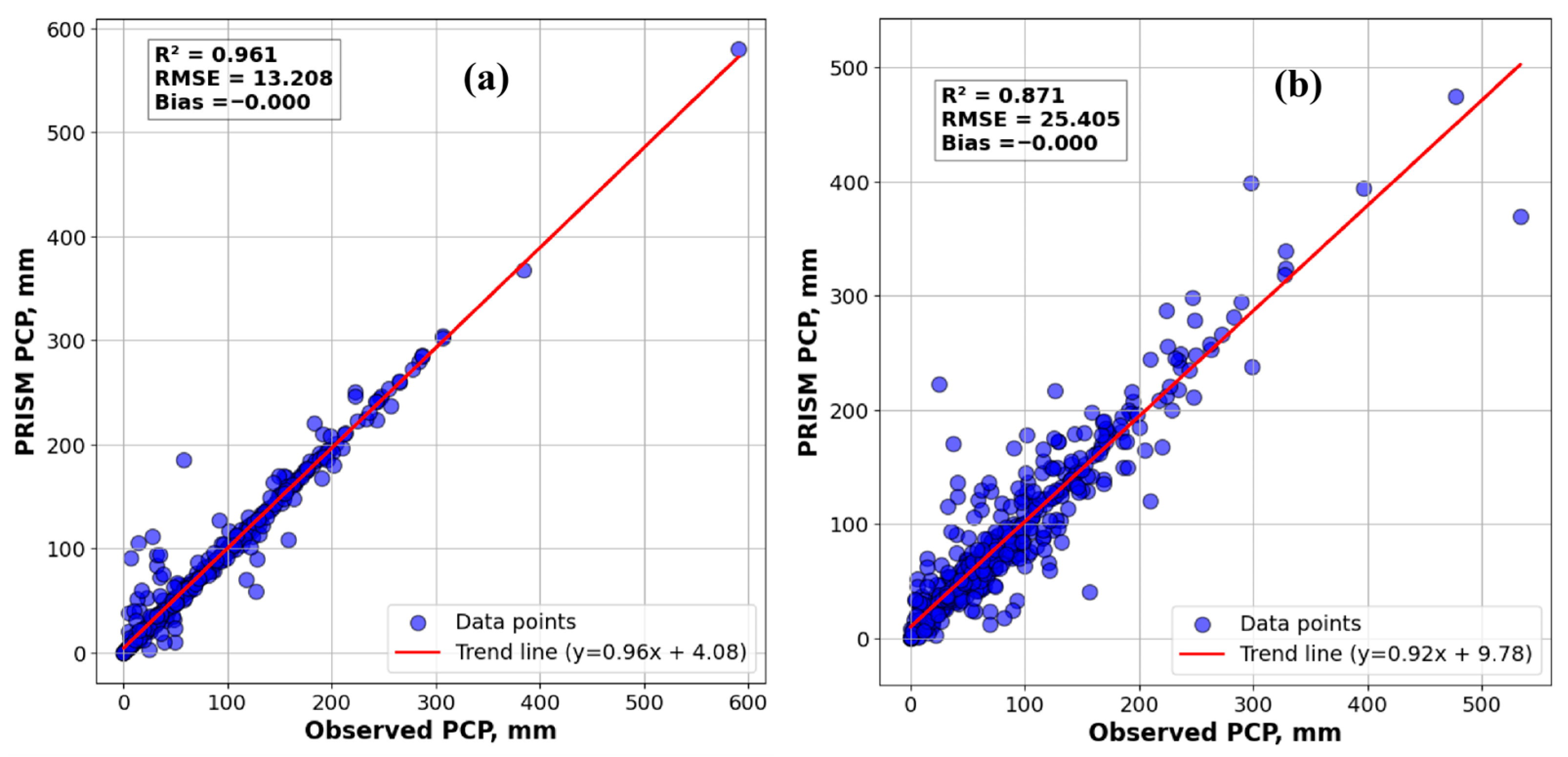
The observed monthly precipitation at the Navarro Mills Dam (NMD) and College Station Eastwood Field (CST) gaging locations, along with PRISM precipitation estimates (Figure 2a,b), provided an insight into the consistency and reliability of the PRISM data. At NMD, PRISM demonstrated excellent performance, with a high coefficient of determination (R2 = 0.961). Its low RMSE (13.208 mm) reflects minor average prediction errors, and the near-zero bias (−0.000) confirms no systematic over- or under-estimation. PRISM also performed well with the CSTN data, yielding an R2 of 0.871 and a higher RMSE (25.405 mm), indicating larger prediction errors than at NMD but still within an acceptable range. While both plots show negligible bias, PRISM’s performance was better for NMD than CSTN. Overall, the PRISM data is highly correlated with the observed data, making it acceptable for further analysis, such as seasonal precipitation trends and annual average change analyses. Similar research conducted in Texas, evaluating the performance of PRISM data, found that PRISM outperformed other gridded and satellite-based precipitation products in approximating ground observations [38,39,40].

3.2. Spatiotemporal Precipitation Changes

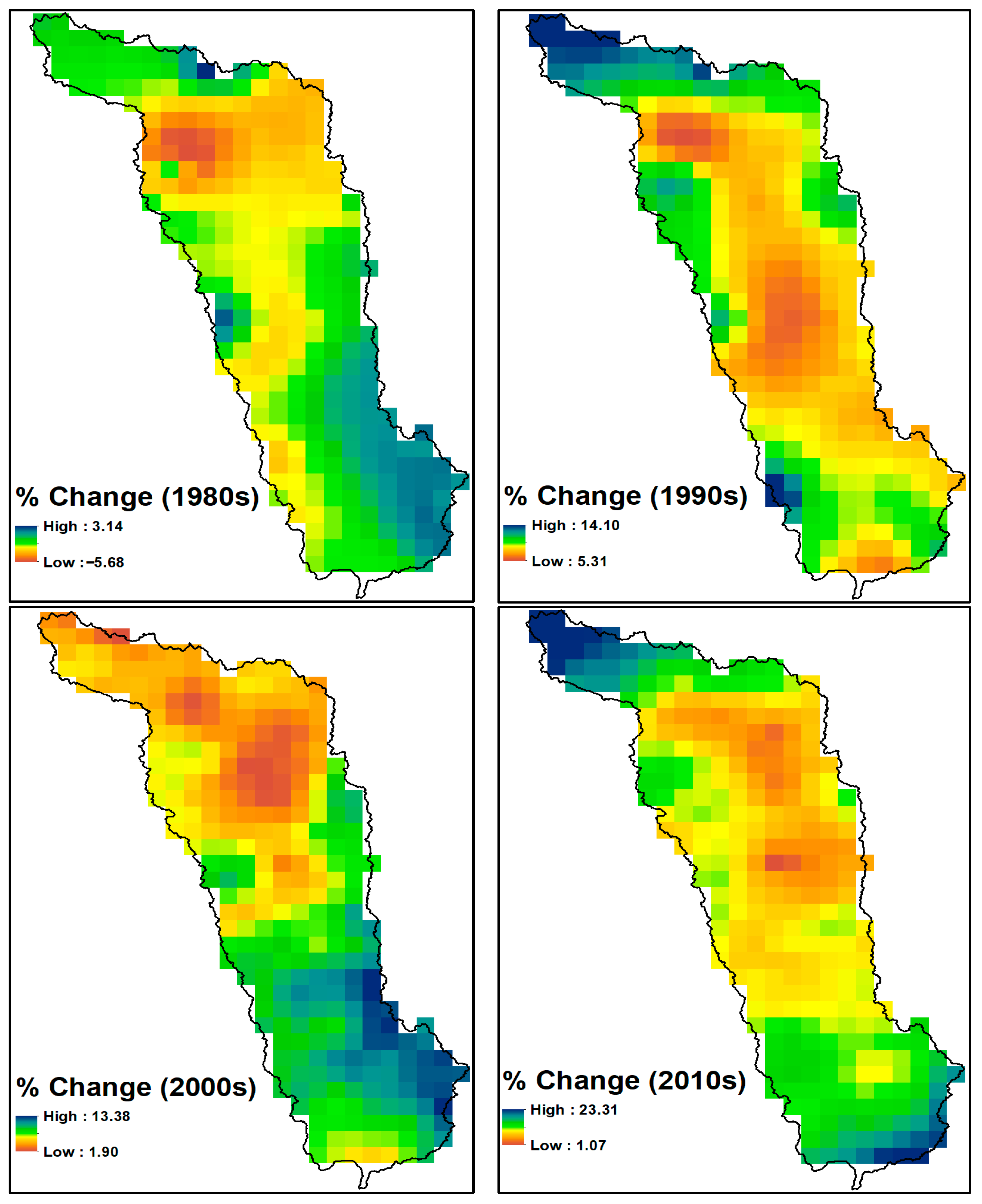
The percentage change in precipitation across NRW was compared between the pre-dam construction period and each subsequent decade following the dam’s construction (Figure 3). These analyses were performed for each individual rainfall pixel, allowing the maps to depict pixel-level changes across space. The resulting spatially explicit maps tracked the evolution of precipitation patterns from the 1980s through the 2010s. In the 1980s, precipitation changes were relatively minor, with localized increases up to 3.14% and reductions down to −5.68%, indicating an uneven spatial distribution of slight drying in some areas and modest increases in others. Precipitation increased in the 1990s, reaching as high as 14.1% in the central and northern watershed, although a few smaller regions still saw slight reductions down to −5.31%. The 2000s presented a more balanced spatial pattern, with increases up to 13.38% and reductions limited to −1.9%, suggesting a narrowing range of variability and relatively stable precipitation conditions compared to the previous decade. By the 2010s, the watershed experienced the most substantial increases, with some areas showing changes as high as 23.31% and even the slightest change during this period being a positive 1.07%, highlighting a clear watershed-wide wetting trend compared to the pre-dam baseline.
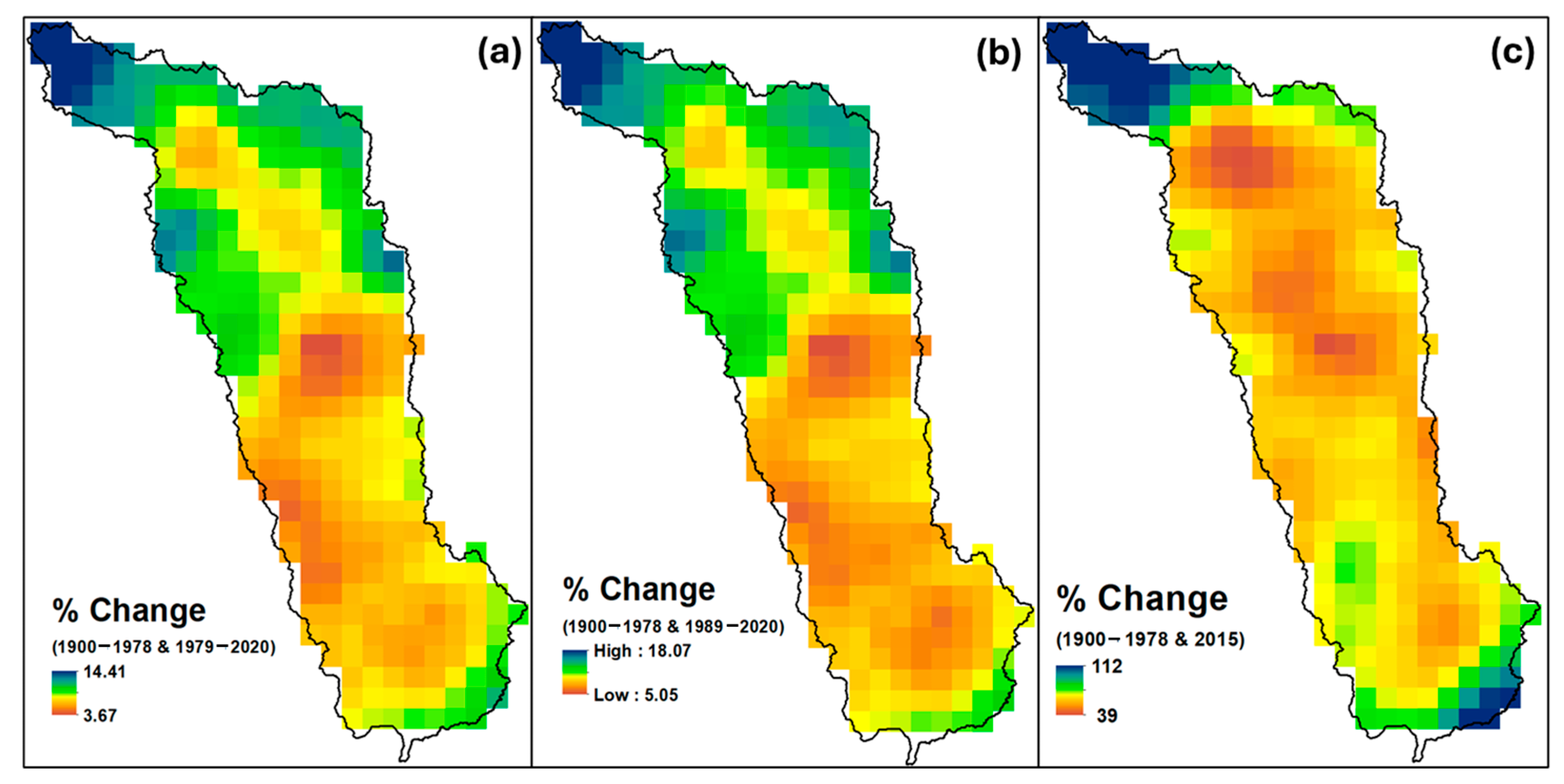
The spatial and temporal variations in percentage changes in precipitation across NRW are illustrated in Figure 4. Comparing the pre-dam period (1900–1978) to the post-dam period (1979–2020) reveals an increase in precipitation, ranging from 3.67% to 14.41% across the watershed, with the largest increases occurring in the northern portions and more modest increases in the central and southern areas. A similar spatial pattern is observed when comparing the period from 1900 to 1978 to the period from 1989 to 2020, during which precipitation increased by 5.05% to 18.07% (Figure 4b). These multi-decadal comparisons suggest a gradual wetting tendency across much of the watershed. In contrast, the comparison between 1900 and 1978 and the single year 2015 shows much larger increases (39% to 112%; Figure 4c). However, this reflects the influence of the exceptionally strong 2015 El Niño event rather than a long-term shift, as ENSO-driven atmospheric patterns played a dominant role in producing extreme rainfall across Texas during that year [41]. Thus, while the long-term maps (Figure 4a,b) indicate a general basin-wide wetting trend, the 2015 map represents an extreme climate anomaly.

3.3. Autocorrelation of Streamflow

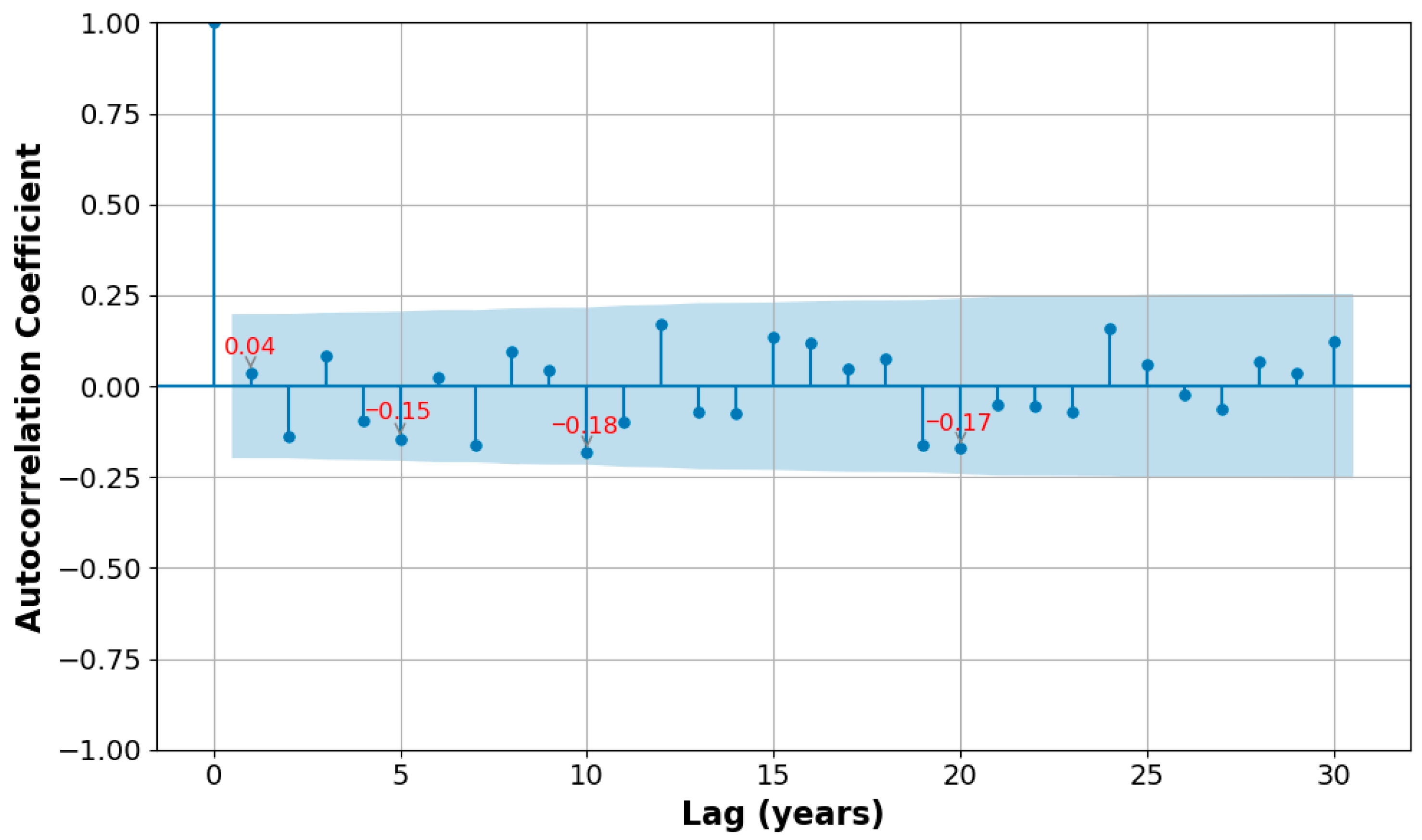
Statistical analysis did not reveal any significant positive autocorrelation at one-year lag in the monthly, yearly, and decadal rolling averages of precipitation, nor in the 10-year moving averages of streamflow. Similarly, for the annual streamflow of the Navasota River near Easterly (1925–2021), the lag-1 autocorrelation coefficient (r = 0.04) was well within the confidence bounds, indicating no statistically significant autocorrelation at a one-year lag. The autocorrelation function instead displayed a mixture of weak positive and negative values across different lags (Figure 5), none of which exceeded the significance threshold. This pattern suggests limited persistence in year-to-year streamflow behavior and does not support the presence of temporal memory in the watershed. Because the data showed no significant serial correlation, the standard Mann–Kendall test was applied for trend analysis rather than the modified version that adjusts for autocorrelation.

3.4. Precipitation Trend

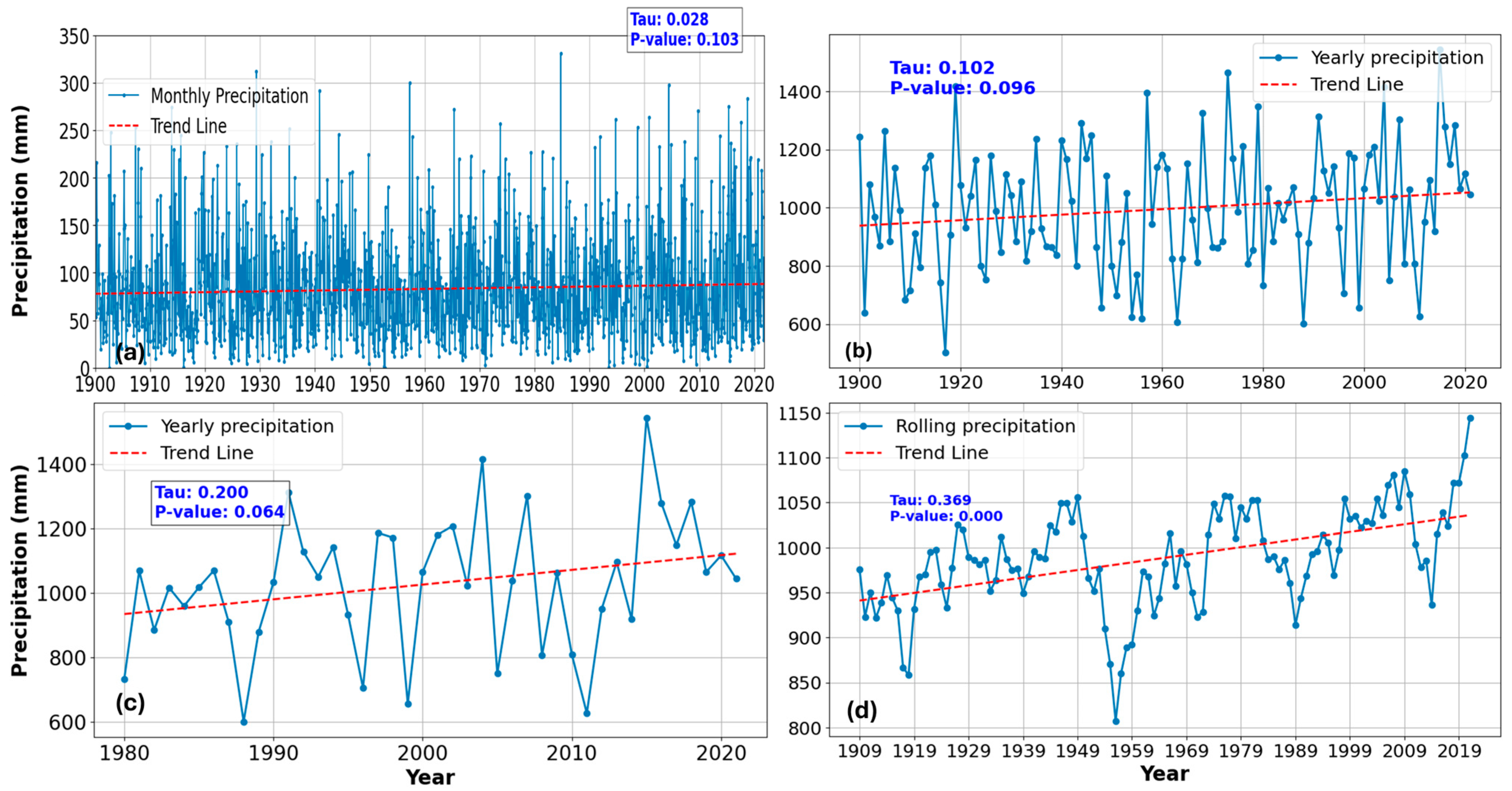
The Mann–Kendall trend test results in the monthly precipitation data from 1900 to 2020 showed that there is no statistically significant trend (Figure 6a) The test statistic, Kendall’s tau (τ), is 0.028, showing a very weak positive correlation between time and precipitation levels, with a p-value greater than 0.05, which suggests the pattern observed is not statistically significant. Graphically, the time series plot of monthly precipitation over time is highly variable, with frequent points in the precipitation rate but no clear upward or downward trend over time (Figure 6a). The red-dashed trend line indicated a near-level slope, confirming the lack of a significant long-run trend. This result indicates that, although natural cycles and periodic heavy precipitation events exist, no systematic rise or fall in monthly precipitation is observed throughout a century.
At the monthly scale, the results of the Mann–Kendall trend test showed an uneven trend, with some showing no considerable change and others suggesting a possible increase or decrease trend (Table 2). The months that showed statistically significant trends at p < 0.05 levels were April (p = 0.04, Kendall’s tau = −0.12) and June (p = 0.033, Kendall’s tau = 0.13). The negative tau value for April suggested that precipitation has decreased over time. On the other hand, the positive tau value suggests that rainfall increased during June, indicating a strong increasing trend this month.
The Mann–Kendall trend test applied to annual precipitation data over time found no statistically significant trend with Kendall’s tau = 0.102 and a p-value of 0.096 (Figure 6b). Kendall’s tau (τ) value indicated a weak, increasing precipitation trend over the observation period. The p-value suggested that the increasing trend is not statistically significant at the 95% confidence level but is at the 90% confidence level. This suggests that, although a rising trend in precipitation is evident, there is insufficient statistical evidence to reject the null hypothesis (i.e., the hypothesis of no trend) at the traditional 5% significance level.
The Mann–Kendall trend test for the post-dam period (1980–2021) showed a weak to moderate increasing trend in precipitation during the study duration (τ = 0.2 and p = 0.064) (Figure 6c). For example, the p-value of 0.064 suggests that the trend is nearly statistically significant. This 41-year trend analysis indicated an increase in precipitation over pre-dam conditions, which may have been impacted by climate change and the watershed modification effects of dam operations. The increased trend characterizes how infrastructure construction can amplify regional hydroclimatic changes.
The Mann–Kendall trend test for the 10-year running mean precipitation revealed a significant upward trend over the study period (Figure 6d) with a tau value of 0.369, indicating a moderate positive correlation between time and precipitation amount. More importantly, the p-value is zero, suggesting that the observed trend is highly significant. With this small p-value (at α ≤ 0.05), we can reject the null hypothesis of no trend and conclude that the increase in precipitation is statistically significant. The plotted data also supported this fact, with the rolling precipitation values displaying an increasing trend over time, as indicated by the red-dashed trend line, which further supports the increasing trend (Figure 6d).

3.5. Streamflow Trend

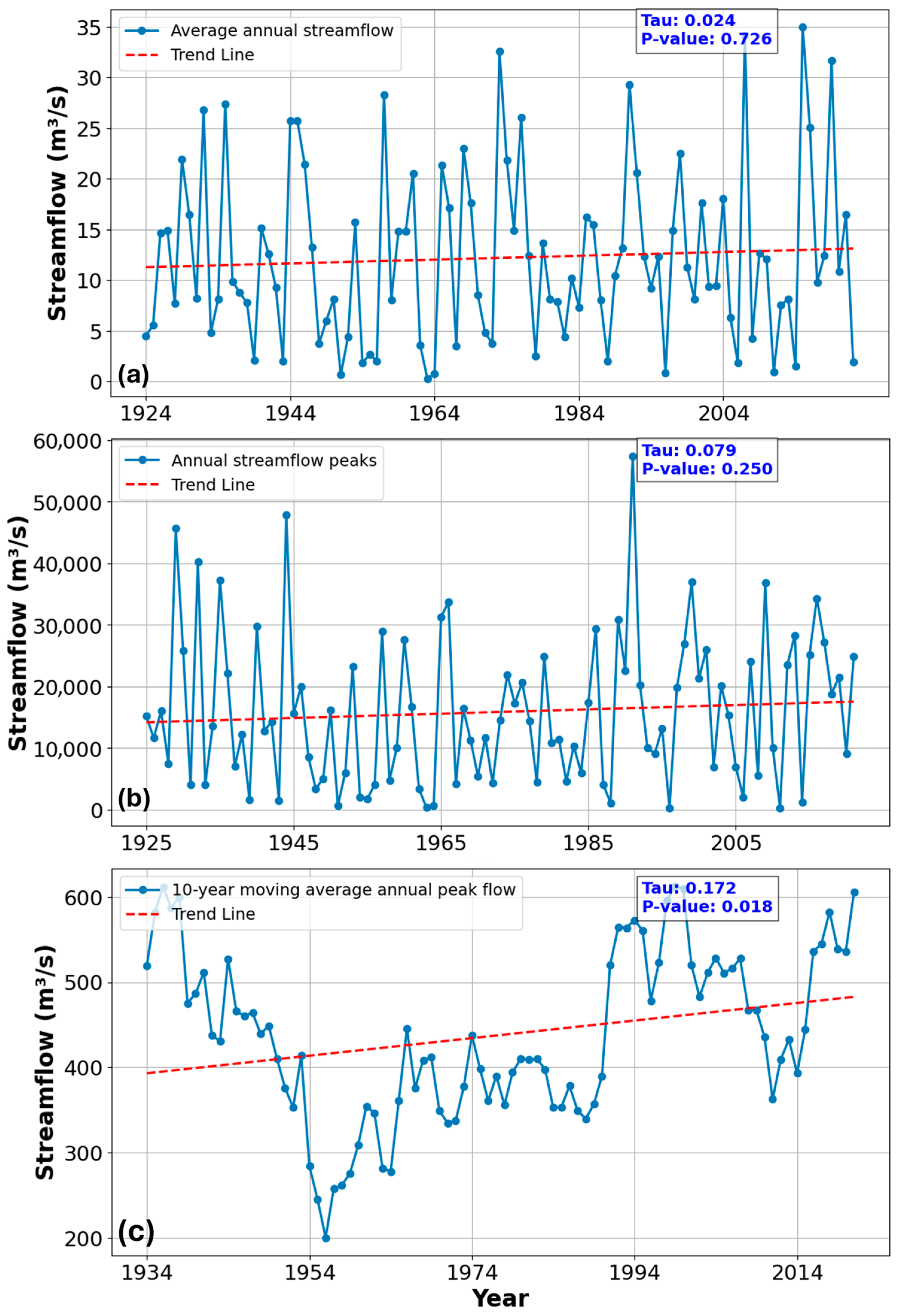
A non-significant growing trend is revealed by the Standard Mann–Kendall trend analysis of the annual streamflow for the Navasota River near Easterly, Texas, from 1924 to 2021 (Figure 7a) The calculated Tau value of 0.024 and p-value of 0.726 showed that, despite the red dashed line’s indication of a minor upward trend in streamflow over time, this trend is not statistically significant at the 95% confidence level. The time series plot in Figure 7b displays interannual fluctuations in annual maximum streamflow characterized by numerous high peaks and low troughs. This reflects the random nature of hydrologic systems, which are controlled by changing climatic conditions, such as rainfall intensity and frequency. Although a red dashed line is included in the figure for visual reference, Kendall’s Tau (τ = 0.079) and the corresponding p-value (0.250) indicate that the trend is statistically non-significant (Figure 7b). In a scientific context, this indicates the absence of an adequate body of evidence to reject the null hypothesis that there is no trend in the streamflow data. In effect, although the graph trend line might indicate a possible rise, that rise is likely due to random variability of the data over time rather than a genuine shift in long-term hydrological patterns.
Figure 7c illustrates the variability in a 10-year moving average of streamflow, which represents the hydrologic response of the watershed to storm intensity, extreme event precipitation, and other episodic factors. Although there is substantial year-to-year variability, an evident increasing trend is evident from the red dashed line, and the provided statistical metrics support this visual indication. Kendall’s Tau coefficient (τ = 0.172) shows a weak to moderate positive monotonic trend in the maximum streamflow over the observation period (Figure 7c). This shows that, although not steep, there has been a consistent rise in peak flow over the years. This trend may be driven by various natural and human-induced factors, including increased precipitation extremes, land use changes (e.g., urbanization), and potential shifts in the climate regime. More importantly, the p-value of 0.018 indicates that the trend is statistically significant at the 5% significance level (α = 0.05). This indicates a noticeable historical trend of increasing movement in the greater monthly average downstream of Lake Limestone.

3.6. Streamflow Change-Point Detection

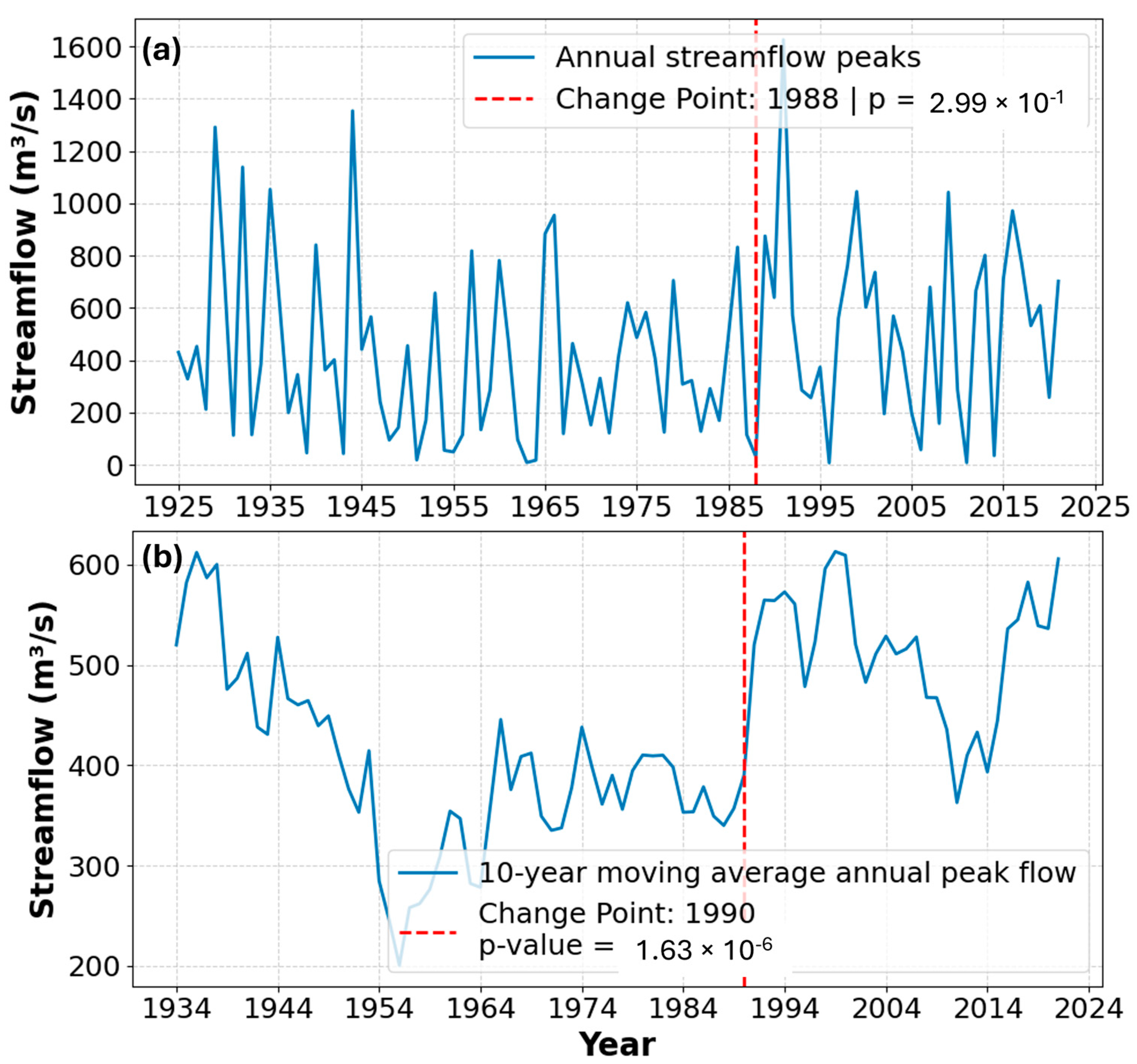
The results of Pettitt’s test detected a single change point in a time series of annual peak flow and for a 10-year moving average (Figure 8a). This test identified the shifts in the central tendency (e.g., median) in the streamflow data. For example, the test has been applied to a streamflow time series for several decades. The change point was identified in 1988, indicated by the vertical red dashed line (Figure 8a). This implies that the statistical properties of the streamflow data have shifted around this year. However, the p-value was higher than 0.05, suggesting that the null hypothesis (i.e., no change in the distribution of streamflow over time) cannot be rejected. In simpler terms, although the test algorithm flagged 1988 as a potential year of change, the statistical evidence supporting that there is an actual, significant shift in the streamflow regime at that time is very weak or even negligible.
The application of Pettitt’s test to the 10-year moving average streamflow series identified 1990 as the most likely change point, as shown by the vertical red dashed line on the plot. The time series exhibits substantial variability, with relatively high flows in the 1930s and 1940s, followed by a pronounced decline through the mid-20th century. Beginning in the early 1990s, streamflow values rose noticeably, marking a shift to a higher-flow regime. The p-value associated with Pettitt’s test (p ≈ 1.63 × 10⁻⁶) indicates that this change is highly statistically significant, providing strong evidence against the null hypothesis of no shift in the median. Thus, the change detected around 1990 reflects a genuine structural shift in streamflow behavior rather than an artifact of end-window smoothing or natural short-term variability.

4. Discussions

4.1. Spatiotemporal Changes in Precipitation and Implications for Flooding

According to the spatiotemporal analysis of precipitation changes, there was a noticeable wetting trend in the Navasota River Watershed after the construction of Lake Limestone Dam in 1978. While large reservoirs can modify localized microclimates through increased surface water availability, altered land–atmosphere feedbacks, and enhanced humidity [42], these local effects occur alongside broader climate oscillations that operate at multi-decadal scales. Teleconnection patterns, particularly the El Niño–Southern Oscillation (ENSO) and the Pacific Decadal Oscillation (PDO), are well documented as major drivers of precipitation variability across Texas, influencing the frequency and magnitude of wet and dry periods [43]. Thus, the observed post-1978 wetting trend is likely shaped by the combined influence of local land–atmosphere interactions near the reservoir, watershed-scale land cover characteristics, and large-scale climate oscillations. Changes in elevation, vegetation cover, and land use continue to affect orographic lifting, air mass movement, moisture recycling, and surface energy balance, further contributing to spatial differences in precipitation across the watershed.
In this study, the dominance of natural climate variability is reflected in the modest and spatially inconsistent changes in precipitation during the first decade after the dam was constructed (1980s). Nevertheless, precipitation increased more consistently and widely as the reservoir and surrounding landscape stabilized, especially in the 1990s and 2010s (Figure 3). Flood risk is directly increased by this increase in precipitation, particularly in areas downstream of the dam where stormwater retention capacity may be constrained. The precipitation change pattern is further supported by spatial comparisons between post-dam periods and the pre-dam baseline (1900–1978). For instance, from 1900–1978 to 1989–2020, precipitation increased by 18% and more than 100% in 2015 alone (a year marked by extreme flooding throughout Texas). Thus, while long-term datasets indicate a gradual wetting tendency, extreme years like 2015 must be understood primarily as outcomes of ENSO-related atmospheric variability rather than indicators of sustained post-dam change.

4.2. Precipitation Trends and Seasonal Flood Risk

Although the trend analysis yielded statistically insignificant results, the rolling decadal average precipitation revealed a significant and accelerating upward trend, particularly after dam construction. This suggests that although there is variation from year to year, the long-term trend is one of increasing precipitation, which is important for assessing the risk of flooding over time [44]. The monthly analysis indicated that the precipitation decreased significantly in April (p = 0.04), suggesting a possible increase in early-season drought stress. Conversely, June displayed a substantial increase (p = 0.033), indicating that the early summer, typically a time of high runoff, may now be seeing more extreme rainfall events. This seasonal shift is crucial for reservoir management [45] because more rainfall in June might increase the risk of rapid reservoir filling, possible overflows, and emergency outflows.
A weak to moderate positive precipitation trend was also observed throughout the post-dam period (1980–2021), nearing significance (p = 0.064). This further supported the watershed’s shift toward a wetter regime since the dam’s construction. These trends underscore the need for flexible reservoir operation procedures, particularly in light of rising summer precipitation and increased interannual variability. Georgakakos et al. [46] and Long et al. [47] suggest that flexible reservoir operation procedures are crucial for regions experiencing climate variability.

4.3. Streamflow Trends and Flooding Dynamics

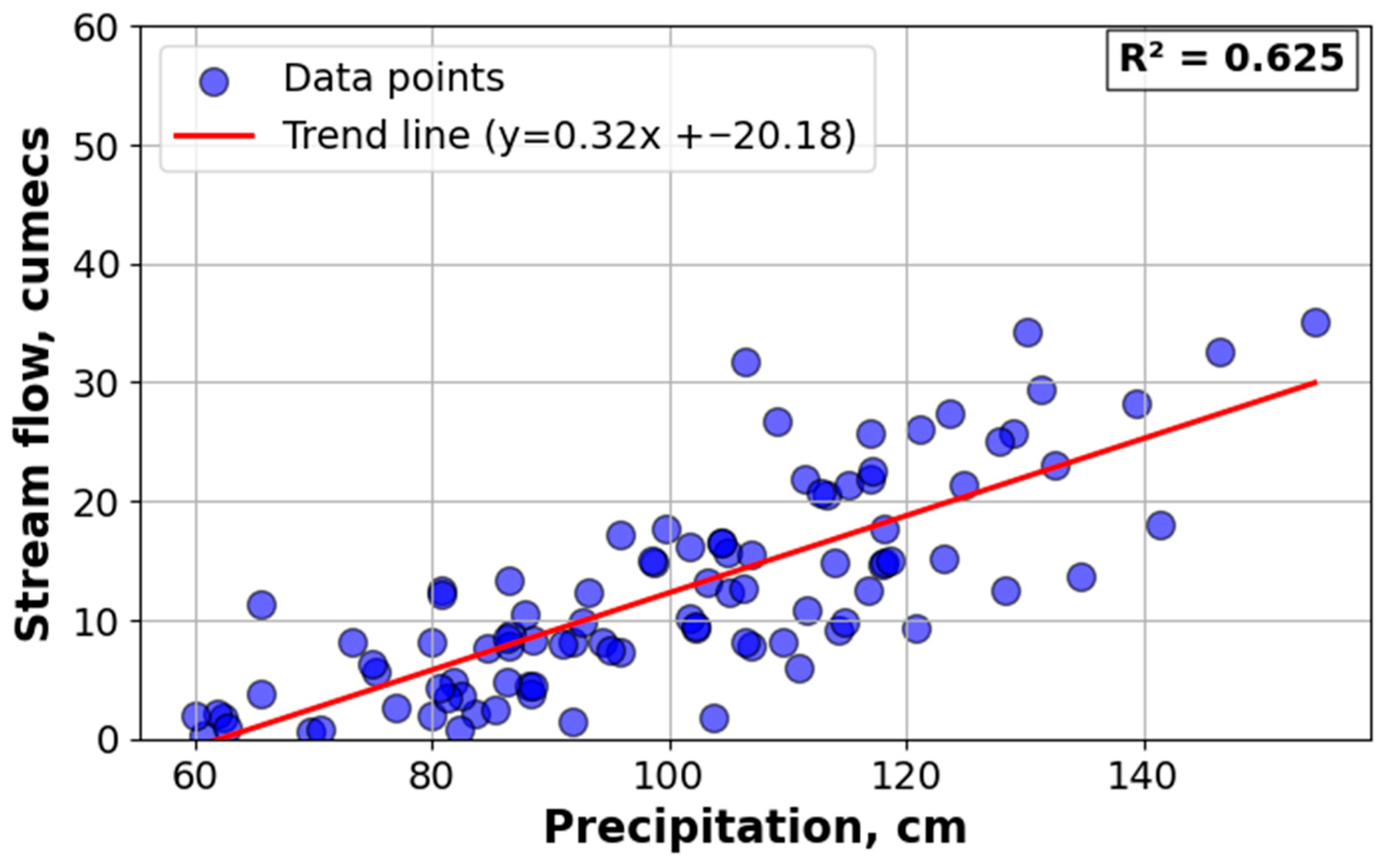
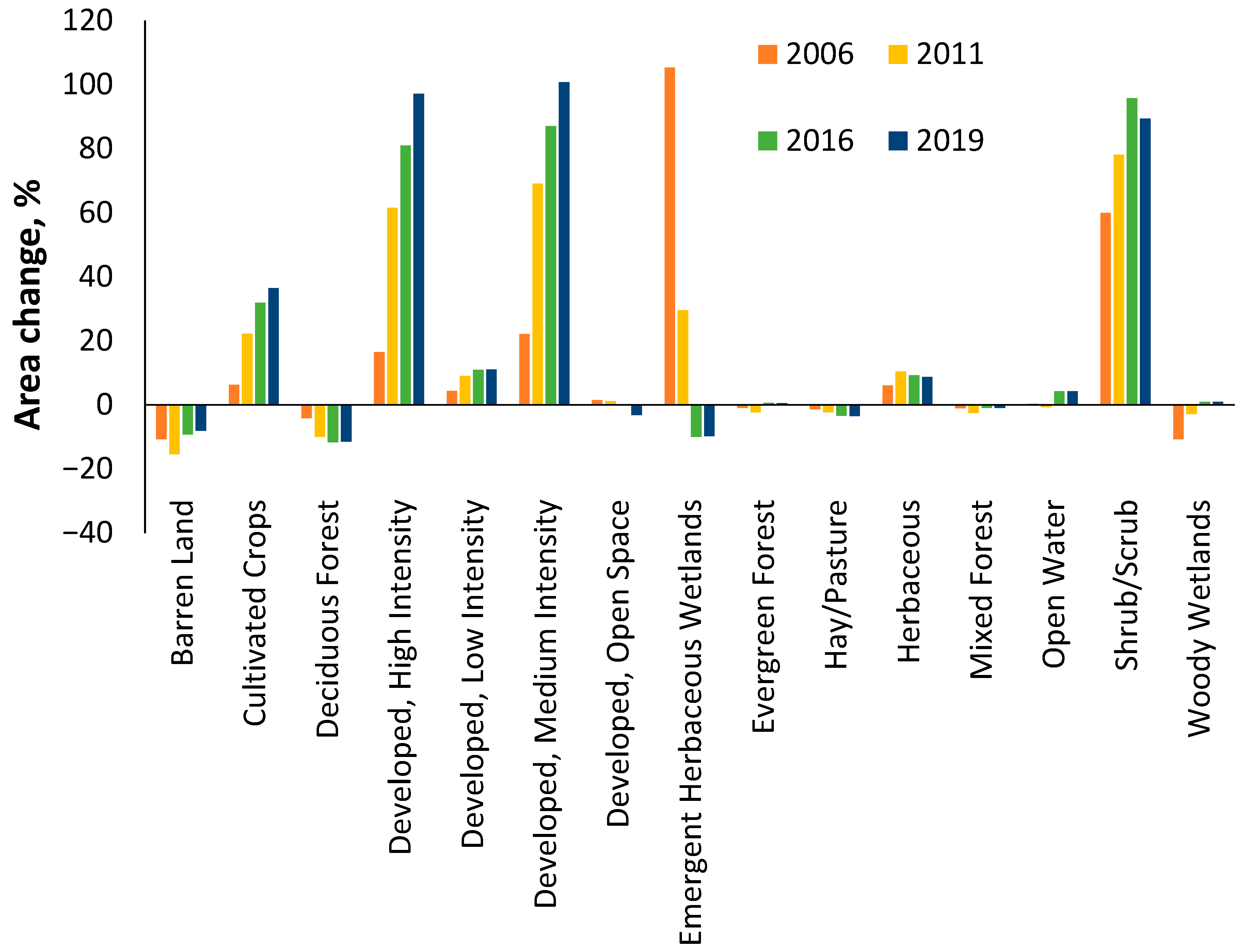
The positive correlation between precipitation and streamflow (R2 = 0.625) reinforces the linkage between increasing rainfall and elevated streamflow volumes in the NRW (Figure 9). When interpreted together with the 10-year moving-average analysis, showing a weak to moderate but statistically significant upward trend in streamflow (τ = 0.172, p = 0.018), the findings indicate a gradual long-term intensification of streamflow despite the absence of a significant monotonic trend in annual peak flows (p = 0.25) (Figure 7). This intensification is likely influenced by both climate variability associated with ENSO/PDO cycles and land cover changes that amplify hydrologic responses [43,48]. Between 2006 and 2019, extensive land cover change occurred in the watershed, marked by a surge in high- and medium-intensity urban development and the expansion of cultivated land, alongside reductions in natural ecosystems such as wetlands and forests (Figure 10). These transformations reduce the landscape’s capacity to retain and infiltrate water, thereby increasing surface runoff and streamflow responsiveness to rainfall [49]. As urbanization and deforestation progress, the watershed becomes more prone to flooding, especially during compound storm events. The elevated streamflow magnitude, as captured in the precipitation-streamflow relationship, underscores the urgency of revisiting flood risk assessments, updating infrastructure design criteria, such as those for the Lake Limestone Dam, and enhancing early warning systems to accommodate the evolving hydrologic regime influenced by both climate and land-use changes.

4.4. Change-Point Detection and Hydrologic Regime Shifts

Pettitt’s test applied to the annual peak streamflow series (Figure 8a) identified 1988 as a potential change point; however, the relatively high p-value (p ≈ 0.30) indicates that this shift is not statistically significant. The annual peaks remain highly variable throughout the period of record, and the lack of significance suggests that the raw annual data do not exhibit an abrupt or statistically defensible hydrologic regime shift. This high interannual variability is typical of unmanaged or partially managed river systems and makes it difficult to detect subtle human-induced changes in annual extremes. In contrast, the 10-year moving average of annual peak streamflow (Figure 8b) reveals a highly significant change point around 1990, supported by a very low p-value (p ≈ 1.63 × 10⁻⁶). The moving-average series highlights clear multi-decadal patterns: relatively high flows in the 1930s–1940s, a sustained decline through the mid-20th century, and a pronounced upward shift beginning around 1990. Because this change point occurs roughly 12 years after the construction of Lake Limestone Dam in 1978, it is reasonable to associate the hydrologic transition with the dam’s influence on downstream flow regulation.
The contrasting outcomes between the annual and moving-average analyses emphasize the importance of temporal scale in detecting hydrologic responses to anthropogenic modifications. Although annual peaks do not exhibit abrupt, discrete changes, the long-term smoothed behavior suggests that Lake Limestone Dam likely played a central role in reshaping the flow regime from the late 1980s to the early 1990s. Future studies should employ more sensitive analytical techniques, such as wavelet decomposition, segmented trend analysis, and Bayesian change-point models, to better identify and anticipate these changes. These techniques facilitate the identification of complex, multi-phase shifts that more effectively capture the evolving flood dynamics in the Navasota River Watershed.

4.5. Implications of Autocorrelation Patterns on Flood Risk

The streamflow series at the Navasota River near Easterly does not exhibit a substantial memory effect at a one-year lag, as the lag-1 autocorrelation coefficient was weak and statistically insignificant. This suggests that antecedent streamflow conditions have a limited influence on flow in subsequent years, and there is no strong evidence of persistence or clustering of flood events driven by year-to-year carryover. Across longer lags (e.g., 5, 10, and 20 years), the autocorrelation function shows a mixture of weak positive and negative values; however, none exceed the significance threshold. These insignificant oscillatory patterns likely reflect natural climate variability and typical fluctuations between wetter and drier periods rather than a systematic compensatory hydrologic response.

5. Conclusions

The study examined the long-term trends in precipitation and streamflow within the Navasota River Watershed (NRW), focusing on the impact of Lake Limestone Dam and climate variability on flood risk. The findings indicated a statistically significant increase in precipitation at the decadal timescale since 1978. While annual peak-flow trends were not consistently significant across the watershed, the 10-year moving average of annual peak streamflow revealed a highly significant change point around 1990, marking a clear multi-decadal shift in downstream hydrologic conditions. This structural change, occurring approximately twelve years after dam construction, suggests that reservoir operations, combined with evolving climate signals, have played a significant role in shaping long-term flow behavior. Autocorrelation analysis showed no significant temporal memory in annual streamflow, indicating that year-to-year variability is not strongly influenced by antecedent conditions. Alongside local drivers such as increased urbanization and loss of natural land cover, large-scale climate oscillations, including ENSO and PDO, likely contributed to the observed hydrologic variability, especially during years with extreme precipitation anomalies. Collectively, these findings underscore the need to revise flood risk assessments and develop adaptive water-infrastructure management strategies that account for both climate change and the combined effects of teleconnections and local watershed alterations. Future research should also assess whether the timing of extreme precipitation and peak discharge events is shifting over time and apply more sensitive analytical approaches, such as wavelet decomposition, segmented trend analysis, and Bayesian change-point models, to better capture complex, multi-phase hydrologic changes in the Navasota River Watershed.

Author Contributions

Conceptualization, Investigation, Methodology, Validation, Funding acquisition, Project administration, Resources, Supervision, Writing—review and editing: A.F. and R.A.; Data curation, Formal analysis, Investigation, Methodology, Software, Validation, Visualization, Writing—original draft, and Writing—review and editing: A.A.A.; Data curation, Formal analysis, Methodology, Validation, and Writing—review and editing: A.V.V.; Methodology, Writing—review and editing: T.B.M.J.O.; Funding acquisition, Project administration, and Resources: S.B.; Writing—review and editing: M.T. All authors have read and agreed to the published version of the manuscript.

Funding

This project is supported by the Texas A&M University System through the Institute for a Disaster Resilient Texas. This work is partially supported by the Evans-Allen project 7007152 from the USDA National Institute of Food and Agriculture.

Data Availability Statement

The raw data required to reproduce the above findings are available to the corresponding author, Dr. Anwar A. Adem (aaadem@pvamu.edu or anwarasefa@gmail.com), on reasonable request.

Acknowledgments

We gratefully acknowledge the support of the Texas A&M University System (TAMUS) Chancellor’s Office for making this study possible. The authors are also grateful to Prairie View A&M University and the Evans-Allen project for the facilities and support provided during this research work. Special thanks are extended to Nigus Melaku, Atikur Rahman, and Almoutaz Elhassan for their valuable input and insightful discussions on key aspects of the project.

Conflicts of Interest

The authors declare no conflicts of interest.

References

  1. Ahmadiani, M.; Ferreira, S. Well-being effects of extreme weather events in the United States. Resour. Energy Econ. 2021, 64, 101213. [Google Scholar] [CrossRef]
  2. Schultz, J.; Elliott, J.R. Natural disasters and local demographic change in the United States. Popul. Environ. 2013, 34, 293–312. [Google Scholar] [CrossRef]
  3. Costa, K.; Peterson, M.; Marano, H. Extreme Weather, Extreme Costs: The Rising Financial Toll of Climate Change in the United States. Available online: https://www.americanprogress.org/article/extreme-weather-extreme-costs/ (accessed on 15 May 2025).
  4. NOAA-NCEI. 2017 U.S. Billion-Dollar Weather and Climate Disasters: A Historic Year in Context. Available online: https://www.climate.gov/disasters-2017 (accessed on 15 May 2025).
  5. Montz, B.E.; Gruntfest, E. Flash flood mitigation: Recommendations for research and applications. Glob. Environ. Change Part B Environ. Hazards 2002, 4, 15–22. [Google Scholar] [CrossRef]
  6. Statkewicz, M.D.; Talbot, R.; Rappenglueck, B. Changes in precipitation patterns in Houston, Texas. Environ. Adv. 2021, 5, 100073. [Google Scholar] [CrossRef]
  7. Ellsworth, C.E. The Floods in Central Texas in September, 1921; U.S. Geological Survey; Goyernment Printing Office: Washington, DC, USA, 1923.
  8. NCTCOG. North Central Texas floods: May–June 2015; North Central Texas Council of Governments: Tarrant, TX, USA, 2016; pp. 1–25.
  9. Lewis, J. Navasota River Flooding Caused by Rainfall, Water Release from Lake Limestone. Available online: https://www.kbtx.com/2024/05/08/navasota-river-flooding-caused-by-rainfall-water-release-lake-limestone/ (accessed on 18 May 2024).
  10. Rhodes, E.C.; Talchabhadel, R.; Jordan, T. A changing river: Long-term changes of sinuosity and land cover in the Navasota River Watershed, Texas. River 2024, 3, 152–165. [Google Scholar] [CrossRef]
  11. TWRI. Navasota River Flood Project Final Report; Texas Water Resources Institute: College Station, TX, USA, 2023.
  12. TWDB. Volumetric and Sedimentation Survey of Lake Limestone: March–April 2012 Survey; TWDB: Austin, TX, USA, 2014; pp. 1–32.
  13. Mishra, A.K.; Singh, V.P.; Özger, M. Seasonal streamflow extremes in Texas river basins: Uncertainty, trends, and teleconnections. J. Geophys. Res. Atmos. 2011, 116, D08108. [Google Scholar] [CrossRef]
  14. Thomas, E.D.; Venkataraman, K.; Chraibi, V.; Kannan, N. Hydrologic Trends in the Upper Nueces River Basin of Texas—Implications for Water Resource Management and Ecological Health. Hydrology 2019, 6, 20. [Google Scholar] [CrossRef]
  15. Hamed, K.H. Trend detection in hydrologic data: The Mann–Kendall trend test under the scaling hypothesis. J. Hydrol. 2008, 349, 350–363. [Google Scholar] [CrossRef]
  16. Ryberg, K.R.; Hodgkins, G.A.; Dudley, R.W. Change points in annual peak streamflows: Method comparisons and historical change points in the United States. J. Hydrol. 2020, 583, 124307. [Google Scholar] [CrossRef]
  17. Najibi, N.; Devineni, N. Recent trends in the frequency and duration of global floods. Earth Syst. Dynam. 2018, 9, 757–783. [Google Scholar] [CrossRef]
  18. Phillips, J.D. Geomorphic Context, Constraints, and Change in the Lower Brazos and Navasota Rivers, Texas; Texas Water Development Board: Austin, TX, USA, 2006.
  19. Gregory, L.; Lazar, K.; Gitter, A. Navasota River Below Lake Limestone Watershed Protection Plan; Texas Water Resources Institute: College Station, TX, USA, 2017; p. 69.
  20. Marie, M.; Yirga, F.; Haile, M.; Ehteshammajd, S.; Azadi, H.; Scheffran, J. Time-series trend analysis and farmer perceptions of rainfall and temperature in northwestern Ethiopia. Environ. Dev. Sustain. 2021, 23, 12904–12924. [Google Scholar] [CrossRef]
  21. Homer, C.; Dewitz, J.; Jin, S.; Xian, G.; Costello, C.; Danielson, P.; Gass, L.; Funk, M.; Wickham, J.; Stehman, S.; et al. Conterminous United States land cover change patterns 2001–2016 from the 2016 National Land Cover Database. ISPRS J. Photogramm. Remote Sens. 2020, 162, 184–199. [Google Scholar] [CrossRef]
  22. Jin, S.; Homer, C.; Yang, L.; Danielson, P.; Dewitz, J.; Li, C.; Zhu, Z.; Xian, G.; Howard, D. Overall Methodology Design for the United States National Land Cover Database 2016 Products. Remote Sens. 2019, 11, 2971. [Google Scholar] [CrossRef]
  23. Yang, L.; Jin, S.; Danielson, P.; Homer, C.; Gass, L.; Bender, S.M.; Case, A.; Costello, C.; Dewitz, J.; Fry, J.; et al. A new generation of the United States National Land Cover Database: Requirements, research priorities, design, and implementation strategies. ISPRS J. Photogramm. Remote Sens. 2018, 146, 108–123. [Google Scholar] [CrossRef]
  24. Wickham, J.; Stehman, S.V.; Sorenson, D.G.; Gass, L.; Dewitz, J.A. Thematic accuracy assessment of the NLCD 2019 land cover for the conterminous United States. GISci. Remote Sens. 2023, 60, 2181143. [Google Scholar] [CrossRef] [PubMed]
  25. Santhi, C.; Arnold, J.G.; Williams, J.R.; Dugas, W.A.; Srinivasan, R.; Hauck, L.M. Validation of the SWAT Model on a Large Rwer Basin with Point and Nonpoint Sources. JAWRA J. Am. Water Resour. Assoc. 2001, 37, 1169–1188. [Google Scholar] [CrossRef]
  26. Suhaila, J.; Deni, S.M.; Zin, W.Z.W.; Jemain, A.A. Trends in peninsular Malaysia rainfall data during the southwest monsoon and northeast monsoon seasons: 1975–2004. Sains Malays. 2010, 39, 533–542. [Google Scholar]
  27. Hamed, K.H.; Ramachandra Rao, A. A modified Mann-Kendall trend test for autocorrelated data. J. Hydrol. 1998, 204, 182–196. [Google Scholar] [CrossRef]
  28. Sulaiman, N.H.; Kamarudin, M.K.A.; Mustafa, A.D.; Amran, M.A.; Azaman, F.; Abidin, I.Z.; Hairoma, N. Trend analysis of Pahang river using non-parametric analysis: Mann Kendall’s trend test. Malays. J. Anal. Sci. 2015, 19, 1327–1334. [Google Scholar]
  29. Kendall, M.G. Rank correlation methods. Br. J. Stat. Psychol. 1948, 9, 68. [Google Scholar] [CrossRef]
  30. Mann, H.B. Nonparametric tests against trend. Econometrica 1945, 13, 245–259. [Google Scholar] [CrossRef]
  31. Kendall, M.G.; Stuart, A. The Advanced Theory of Statistics; Hafner Publishing Company: Maple Grove, MN, USA, 1963. [Google Scholar]
  32. Kendall, M.G. A New Measure of Rank Correlation. Biometrika 1938, 30, 81–93. [Google Scholar] [CrossRef]
  33. Kendall, M.G. Rank Correlation Methods, 5th ed.; Oxford University Press: Oxford, UK, 1990. [Google Scholar]
  34. Hipel, K.W.; McLeod, A.I. Time Series Modelling of Water Resources and Environmental Systems; Elsevier: Amsterdam, The Netherlands, 1994; Volume 45. [Google Scholar]
  35. Yue, S.; Wang, C. The Mann-Kendall Test Modified by Effective Sample Size to Detect Trend in Serially Correlated Hydrological Series. Water Resour. Manag. 2004, 18, 201–218. [Google Scholar] [CrossRef]
  36. Pettitt, A.N. A Non-Parametric Approach to the Change-Point Problem. J. R. Stat. Soc. Ser. C (Appl. Stat.) 1979, 28, 126–135. [Google Scholar] [CrossRef]
  37. Fooladi, M.; Golmohammadi, M.H.; Safavi, H.R.; Mirghafari, R.; Akbari, H. Trend analysis of hydrological and water quality variables to detect anthropogenic effects and climate variability on a river basin scale: A case study of Iran. J. Hydro-Environ. Res. 2021, 34, 11–23. [Google Scholar] [CrossRef]
  38. Ray, R.L.; Sishodia, R.P.; Tefera, G.W. Evaluation of Gridded Precipitation Data for Hydrologic Modeling in North-Central Texas. Remote Sens. 2022, 14, 3860. [Google Scholar] [CrossRef]
  39. Mei, X.; Smith, P.K.; Li, J.; Li, B. Hydrological evaluation of gridded climate datasets in a texas urban watershed using soil and water assessment tool and artificial neural network. Front. Environ. Sci. 2022, 10, 905774. [Google Scholar] [CrossRef]
  40. Aboutalebi, M.; Torres-Rua, A.F.; Allen, N. Spatial and Temporal Analysis of Precipitation and Effective Rainfall Using Gauge Observations, Satellite, and Gridded Climate Data for Agricultural Water Management in the Upper Colorado River Basin. Remote Sens. 2018, 10, 2058. [Google Scholar] [CrossRef]
  41. Chen, M.; Kumar, A. Winter 2015/16 Atmospheric and Precipitation Anomalies over North America: El Niño Response and the Role of Noise. Mon. Weather. Rev. 2018, 146, 909–927. [Google Scholar] [CrossRef]
  42. Wang, S.; Qian, X.; Han, B.-P.; Luo, L.-C.; Hamilton, D.P. Effects of local climate and hydrological conditions on the thermal regime of a reservoir at Tropic of Cancer, in southern China. Water Res. 2012, 46, 2591–2604. [Google Scholar] [CrossRef] [PubMed]
  43. Murgulet, D.; Valeriu, M.; Hay, R.R.; Tissot, P.; Mestas-Nuñez, A.M. Relationships between sea surface temperature anomalies in the Pacific and Atlantic Oceans and South Texas precipitation and streamflow variability. J. Hydrol. 2017, 550, 726–739. [Google Scholar] [CrossRef]
  44. Salman Abdullahi, M.; Li, Y. Flood Risk Assessment, Future Trend Modeling, and Risk Communication: A Review of Ongoing Research. Nat. Hazards Rev. 2018, 19, 04018011. [Google Scholar] [CrossRef]
  45. Jiang, Y.; Zhang, R.; Wang, B. Scenario-based approach for emergency operational response: Implications for reservoir management decisions. Int. J. Disaster Risk Reduct. 2022, 80, 103192. [Google Scholar] [CrossRef]
  46. Georgakakos, A.P.; Yao, H.; Kistenmacher, M.; Georgakakos, K.P.; Graham, N.E.; Cheng, F.Y.; Spencer, C.; Shamir, E. Value of adaptive water resources management in Northern California under climatic variability and change: Reservoir management. J. Hydrol. 2012, 412–413, 34–46. [Google Scholar] [CrossRef]
  47. Long, Y.; Wang, H.; Jiang, C.; Ling, S. Seasonal Inflow Forecasts Using Gridded Precipitation and Soil Moisture Information: Implications for Reservoir Operation. Water Resour. Manag. 2019, 33, 3743–3757. [Google Scholar] [CrossRef]
  48. Brody, S.; Blessing, R.; Ross, A.; Fares, A.; Awal, R.; Murphy, R.R.; Juan, A.; Talchabhadel, R.; Rhodes, E.C.; Adams, J. Navasota River Flooding Project Report: Findings & Recommendations; Prairie View A&M University: Prairie View, TX, USA, 2022; pp. 1–51. [Google Scholar]
  49. Fiener, P.; Auerswald, K.; Van Oost, K. Spatio-temporal patterns in land use and management affecting surface runoff response of agricultural catchments—A review. Earth-Sci. Rev. 2011, 106, 92–104. [Google Scholar] [CrossRef]
Figure 1. Map showing the location of the Navasota River Watershed, including the rainfall stations at Navarro Mills Dam (NMD) and College Station Eastwood Field (CSTN) (green circles), as well as the streamflow gauging station of the Navasota River near Easterly (red circle).
Hydrology 13 00012 g001
Figure 2. Correlation between the monthly PRISM and observed precipitation data (1981–2020) at the gaging locations (a) Navarro Mills Dam and (b) College Station Eastwood Field.
Hydrology 13 00012 g002
Figure 3. Decadal percentage change in the Navasota River Watershed precipitation after dam construction.
Hydrology 13 00012 g003
Figure 4. Spatial distribution of change in precipitation after and before constructing the dam: (a) from 1900–1978 to 1979–2020, (b) from 1900–1978 to 1989–2020, and (c) from 1900–1978 to 2015.
Hydrology 13 00012 g004
Figure 5. Autocorrelation between 1925 and 2021 for yearly streamflow at the Navasota River near Easterly, TX. The shaded blue region denotes the 95% confidence interval for the autocorrelation coefficients, representing the bounds expected under the null hypothesis of no serial correlation. Autocorrelation values outside this interval indicate statistically significant correlation at the corresponding lag.
Hydrology 13 00012 g005
Figure 6. Watershed average precipitation trend (a) at a monthly time step from 1900 to 2021, (b) yearly time step from 1900 to 2021, (c) yearly time step after dam construction from 1980 to 2021, and (d) decadal rolling average trend from 1900 to 2021.
Hydrology 13 00012 g006
Figure 7. Streamflow trend for (a) the average annual streamflow, (b) annual streamflow peaks, and (c) a 10-year moving average trend for annual peak streamflow at the Navasota River near Easterly, TX.
Hydrology 13 00012 g007
Figure 8. Pettitt’s test change-point detection for (a) the annual peak streamflow and (b) 10-year moving average annual peak streamflow at the Navasota River near Easterly, TX.
Hydrology 13 00012 g008
Figure 9. Correlation between annual average flow and watershed average annual precipitation.
Hydrology 13 00012 g009
Figure 10. Land cover change dynamics of the Navasota River Watershed from 2006 to 2019.
Hydrology 13 00012 g010
Table 1. United States Geological Survey (USGS) streamflow gauging stations, their station code, and data duration.
IDStation NameDuration
TX-08110325Navasota River above Groesbeck1 June 1978–7 December 2021
TX-08110325Navasota River near Groesbeck1 March 1965–30 April 1979
TX-08110500Navasota River near Easterly27 March 1924–7 December 2021
TX-08110800Navasota River near Bryan1 October 1996–7 December 2021
Table 2. Mann–Kendall trend test results for the watershed average precipitation.
Monthp-ValueKendall’s Tau
January0.0950.102
February0.83−0.012
March0.2300.07
April0.04−0.12 *
May0.0670.025
June0.0330.13 **
July0.39−0.05
August0.740.02
September0.230.07
October0.150.08
November0.450.04
December0.46−0.04
* Significantly decreasing and ** Significantly increasing.
Disclaimer/Publisher’s Note: The statements, opinions and data contained in all publications are solely those of the individual author(s) and contributor(s) and not of MDPI and/or the editor(s). MDPI and/or the editor(s) disclaim responsibility for any injury to people or property resulting from any ideas, methods, instructions or products referred to in the content.