Article

A Machine Learning Approach to Map the Vulnerability of Groundwater Resources to Agricultural Contamination


by
Victor Gómez-Escalonilla
* and
Pedro Martínez-Santos
Departamento de Geodinámica, Estratigrafía y Paleontología, Facultad de Ciencias Geológicas, Universidad Complutense de Madrid, C/José Antonio Novais 12, 28040 Madrid, Spain
*
Author to whom correspondence should be addressed.
Hydrology 2024, 11(9), 153; https://doi.org/10.3390/hydrology11090153

Submission received: 29 July 2024 / Revised: 10 September 2024 / Accepted: 12 September 2024 / Published: 13 September 2024
(This article belongs to the Section Surface Waters and Groundwaters)

Abstract

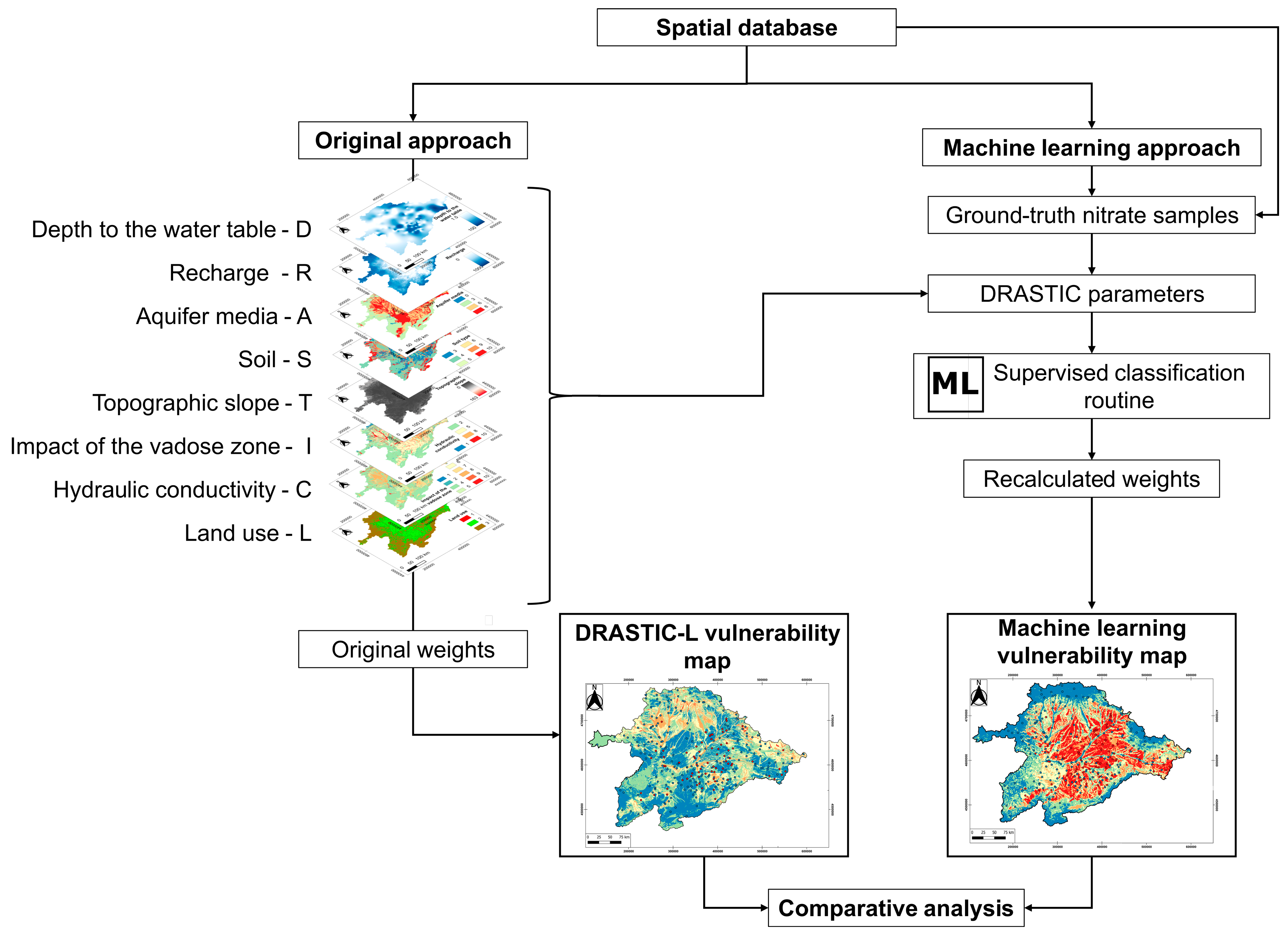
Groundwater contamination poses a major challenge to water supplies around the world. Assessing groundwater vulnerability is crucial to protecting human livelihoods and the environment. This research explores a machine learning-based variation of the classic DRASTIC method to map groundwater vulnerability. Our approach is based on the application of a large number of tree-based machine learning algorithms to optimize DRASTIC’s parameter weights. This contributes to overcoming two major issues that are frequently encountered in the literature. First, we provide an evidence-based alternative to DRASTIC’s aprioristic approach, which relies on static ratings and coefficients. Second, the use of machine learning approaches to compute DRASTIC vulnerability maps takes into account the spatial distribution of groundwater contaminants, which is expected to improve the spatial outcomes. Despite offering moderate results in terms of machine learning metrics, the machine learning approach was more accurate in this case than a traditional DRASTIC application if appraised as per the actual distribution of nitrate data. The method based on supervised classification algorithms was able to produce a mapping in which about 45% of the points with high nitrate concentrations were located in areas predicted as high vulnerability, compared to 6% shown by the original DRASTIC method. The main difference between using one method or the other thus lies in the availability of sufficient nitrate data to train the models. It is concluded that artificial intelligence can lead to more robust results if enough data are available.
Keywords: groundwater vulnerability; artificial intelligence; DRASTIC; MLMapper; Duero groundwater vulnerability; artificial intelligence; DRASTIC; MLMapper; Duero