Article

Advanced Sustainable Process Integration and Comprehensive Techno-Economic Evaluation of Polystyrene Waste Upcycling into Methanol as a Clean Alternative Fuel


1
Chemical Engineering Department, King Fahd University of Petroleum and Minerals, Dhahran 31261, Saudi Arabia
2
Interdisciplinary Research Center for Hydrogen Technologies and Carbon Management (IRC-HTCM), KFUPM University, Dhahran 31261, Saudi Arabia
ChemEngineering 2026, 10(8), 101; https://doi.org/10.3390/chemengineering10080101
Submission received: 4 July 2026 / Revised: 6 August 2026 / Accepted: 11 August 2026 / Published: 14 August 2026

Abstract

This study presents an integrated and sustainable approach for the valorization of polystyrene (PS) plastic waste into methanol, contributing to circular carbon utilization and waste-to-fuel strategies. Two simulation models were developed in Aspen plus. In Case 1, PS is converted to syngas through steam gasification, followed by its conversion into methanol. In Case 2, a steam methane reforming (SMR) unit is integrated with the gasification unit, using the heat from the gasifier-derived syngas to boost hydrogen production and overall methanol yield. This integration boosts the hydrogen-to-carbon ratio, doubling methanol production in Case 2 compared to Case 1. In terms of energy performance, Case 2 exhibits a process efficiency of 81% and exergy efficiency of 73%, both significantly higher than 48% and 60%, compared to Case 1. From an economic standpoint, Case 2 requires greater capital investment and annual operational expenditure, yet it proves to be more cost-effective in the long run compared to Case 1 due to the higher methanol production. The methanol production cost is reduced by 50%, from $1.001/kg in Case 1 to $0.505/kg in Case 2. These improvements are driven by increased throughput and process integration that supports sustainable and circular carbon management.

1. Introduction

The world’s need for energy is increasing because of rapid industrialization, population growth and more energy being used by individuals. At present, coal, oil and natural gas, which are all fossil fuels, make up about 80% of the world’s total energy use [1,2]. Relying so heavily on fossil fuels has caused the build-up of greenhouse gases, which has made the climate problem worse and caused international worry. The Intergovernmental Panel on Climate Change (IPCC) has pointed out that offering sustainable energy is necessary for both protecting the environment and meeting the world’s increased demands for energy. Recently, significant attention has been devoted to the efficient thermo-chemical upcycling of waste plastics into higher-value products like gasoline, aromatic compounds, surfactants, diesel-range olefins, methane, syngas, and hydrogen [3,4,5,6,7]. However, the current interest is specifically focused on hydrogen generation from a variety of different types of plastic wastes, with this being primarily due to their relatively high hydrogen content (8–14 wt%) in many common polymer types [8] and, therefore, their potential as excellent feedstocks for hydrogen energy generation. Additionally, techno-economic analysis provides further insight into the technical and economic feasibility of converting waste plastics into value-added fuels [9,10,11,12,13].
Among various clean energy and sustainable chemical strategies, methanol has emerged as a promising candidate. Methanol is an essential platform chemical and an increasingly important alternative fuel with applications spanning transportation, energy storage, and the chemical industry. It is widely utilized in the production of formaldehyde, acetic acid, and methyl tert-butyl ether (MTBE), and can be further converted into gasoline-equivalent fuels through methanol-to-gasoline (MTG) processes. In addition, methanol is increasingly explored as a hydrogen carrier and a fuel for internal combustion engines. Despite its broad utility, approximately 90% of global methanol production remains fossil-based, relying on syngas derived from natural gas [1]. This underscores the urgency of identifying alternative, renewable, and waste-based feedstocks for methanol production.
In recent years, the concept of waste-to-energy and waste-to-chemicals has gained momentum as a dual-purpose approach to addressing both the energy crisis and mounting waste management issues. In particular, plastic waste has become a focal point of concern and opportunity. Global plastic production reached 368 million tons in 2021 and is expected to grow further [14]. A considerable amount of plastic waste comes from packaging, even though packaging makes up only 36% of all plastic but 47% of the waste [15]. Almost all plastic products, around 90%, end up being discarded after a single use and this causes increasing environmental and policy problems [16]. Among various polymers, polystyrene (PS) is of special interest due to its prevalence, persistence, and potential for chemical upcycling. PS accounts for approximately 8.5 wt% of global plastic waste [17] and is widely used in consumer products such as food packaging, cups, trays, insulation, and toys [18]. It is a thermoplastic polymer derived from styrene; an aromatic hydrocarbon commercially produced via the dehydrogenation of ethylbenzene [19]. The chemical composition of PS—rich in carbon and hydrogen—makes it a compelling candidate for thermochemical conversion into fuels and high-value chemicals. Recent studies have also highlighted the importance of advanced thermal management and heat transfer optimization in improving the performance of integrated energy systems and thermochemical conversion processes [20,21]. Thermal processes such as pyrolysis and gasification have been extensively studied for converting plastic waste into syngas, which serves as a precursor for fuels like methanol. Pyrolysis, typically conducted between 300 and 650 °C in the absence of oxygen, produces liquid fuels and waxes [22]. Gasification, operating at higher temperatures (500–1300 °C) in the presence of air, steam, or oxygen, yields syngas—a mixture primarily composed of CO, H2, and light hydrocarbons—suitable for downstream synthesis. This makes gasification a promising route for both energy recovery and chemical production, particularly in waste management contexts.
Numerous studies have explored the gasification of biomass and plastic waste to generate syngas and synthesize methanol. Hamaidi et al. [23] demonstrated high hydrogen yields in date palm waste gasification using steam at 800 °C, producing syngas with 58.38% H2 and 24.21% CO. Afzal et al. [24] conducted a techno-economic and life cycle analysis on plastic-derived methanol, reporting 52–56% reductions in energy consumption compared to fossil-based processes. Similar simulation studies using Aspen Plus® have investigated the effect of operating parameters—such as temperature, catalyst type, and steam-to-feed ratios—on methanol yield, with CaCO3-based systems yielding up to 12.19 mol methanol/kg biomass at around 750 °C [25]. More complex system integrations have also been proposed. For instance, Hosseini et al. [26,27] designed a process coupling a molten carbonate fuel cell with a methanol synthesis unit, achieving high energy (58.4%) and exergy (83.7%) efficiencies. Other researchers have examined reforming, water–gas shift, and co-gasification strategies to improve hydrogen yields and syngas composition [28,29,30]. These approaches highlight the potential for optimizing waste-to-fuel conversion systems using advanced process integration. The feasibility of methanol production from municipal solid waste (MSW) and mixed plastic waste (MPW) has also been extensively modeled. Many studies on MPW gasification have focused on laboratory or pilot scales, with experimental data often limited to gasifier performance [31]. For example, Midilli et al. [32] reviewed experimental investigations involving fluidized bed gasifiers processing plastics at 850 °C and feed rates between 0.04 and 31.4 kg/h. Lopez et al. [31] emphasized how gasifying agent selection (air, steam, oxygen) significantly influences syngas yield and composition. Despite these advances, systematic and stand-alone techno-economic assessment (TEA) studies on single plastic streams, such as PS, remain rare [33]. Bai et al. [34] examined the supercritical water gasification of PS, evaluating the impact of process variables such as temperature, pressure, and reaction time. They found that higher temperatures and extended reaction durations significantly improved hydrogen yields and carbon conversion rates, demonstrating PS’s potential for energy-efficient gasification. Recognizing the unique properties and abundance of PS in waste streams, there is an urgent need to explore dedicated PS-to-methanol conversion pathways. Single-stream PS offers more predictable gasification behavior, which can enhance process modeling, optimization, and system control. Moreover, due to its aromatic structure and high heating value, PS has the potential to generate high-quality syngas suitable for downstream methanol synthesis.
In this study, a process simulation approach using Aspen Plus® is adopted due to the complexity of integrated thermochemical conversion systems and the need for preliminary evaluation prior to experimental scale-up. Such simulation-based frameworks are widely used to analyze process performance, optimize operating conditions, and assess techno-economic feasibility at early stages. Accordingly, this work develops and evaluates a polystyrene-to-methanol conversion pathway via steam gasification, incorporating syngas upgrading and process integration strategies. The novelty of this study lies in the development of a dedicated single-feedstock polystyrene (PS)-based system, combined with the integration of steam methane reforming (SMR) and a comprehensive comparative assessment of energy, exergy, and economic performance. Unlike mixed plastic waste, polystyrene (PS) has a uniform composition. This results in more predictable gasification behavior and syngas composition. The integration of SMR uses the heat available from the gasification process to increase hydrogen production. This improves syngas quality, enhances methanol yield, and increases overall process performance. Despite the growing interest in plastic-to-methanol conversion, only a limited number of studies have specifically investigated stand-alone PS-to-methanol conversion with a comprehensive energy, exergy, and techno-economic assessment. This research aims to address the existing gap instand-alonee PS valorization studies while contributing to circular economy, clean fuel production, and sustainable waste management.

2. Process Simulation Models

2.1. Aspen Plus Modeling Setup

Aspen Plus® V14 software is commonly used to model and improve chemical and thermochemical systems like waste plastic gasification [29,35,36,37]. For this study, two models (designated Case 1 and Case 2) were developed with Aspen Plus V14® to examine methanol production by steam gasification of PS plastic and subsequent methanol synthesis. These models primarily consist of two integrated sections: (i) syngas generation through gasification (and optionally reforming), and (ii) syngas conversion into methanol, including product purification and unreacted gas recycling. To accurately simulate both non-conventional components (e.g., PS, ash) and conventional components (e.g., H2, CO, CH4, methanol), the METSOLID unit set and MIXNCPSD stream class were used. The “MIXED” stream class was employed for conventional fluids, while “NCPSD” handled the non-conventional solids like PS and inert ash residues. Like unconventional components, PS was defined as a non-conventional component, characterized by its ultimate and proximate analyses, as shown in Table 1.
PS was modeled to accurately represent its thermal and physical properties using the data obtained from the HCOALGEN and DCOALGEN models for its enthalpy and density. During the simulation, the PR-BM (Peng–Robinson with Boston–Mathias) equation of state was used to handle liquid and gas properties at all stages. This model is particularly well-suited for processes involving hydrocarbons, hydrogen, CO, CO2, and other gas-phase reactions, including gasification, reforming, and methanol synthesis [38,39]. The gasification process in both models was modeled using the RGibbs reactor in Aspen Plus®, which minimizes the Gibbs free energy to predict the equilibrium composition of the syngas stream [39]. The methanol synthesis reactor was modeled using the Equilibrium (REquil) module, which includes user-defined kinetic expressions based on the Arrhenius equation for methanol-forming reactions, such as CO and CO2 hydrogenation and the water–gas shift reaction [40,41]. Some of the key modeling assumptions adopted in this study are provided in Table 1 [42], adapted from widely accepted thermochemical simulation practices.
Table 1. Unit operations and Aspen models used [36,38,39,43,44,45,46].
Process UnitAspen ModelDescription and Parameters
CrusherCrusherPolystyrene size reduction
Energy: 180 kWh/ton
BoilerHeaterSteam generation from water
DistributorMixerSteam distribution to gasifier
GasifierRYield, RGibbsEntrained Flow Gasification;
Temp = 1500 °C; Pressure = 25 bar
Syngas CoolerHeatXCooling of hot syngas
ReformerRGibbsTemp = 900 °C; Pressure = 25 bar; Steam flow rate: 240 kg/h; Natural gas (NG) flow rate: 150 kg/h Steam/NG = 1.6
MixerMixerCombines syngas from gasifier and reformer
CompressorCompressorNatural gas compression
Methanol ReactorRPlugCu/ZnO/Al2O3 catalyst; kinetic model;
Temp = 250 °C; P = 25–50 bar
Flash DrumFlashSeparation of unreacted gases and crude methanol
Methanol Purification ColumnRadFracTemp: 50 °C, 1 bar

2.2. Modeling Assumptions:

The Aspen Plus® simulations were conducted under steady-state and isothermal conditions. Gasification and reforming processes were modeled using Gibbs free energy minimization, assuming thermodynamic equilibrium, while methanol synthesis was modeled using kinetic expressions. All gases were treated as ideal, and tar formation was neglected with ash assumed to be inert. PS has been modeled as a non-conventional component on dry basis [47], where the composition is provided in Table 2.
The gasifier was considered adiabatic with no external heat losses, and all sulfur in PS was assumed to convert to H2S. The PR-BM property method was used for all gas and hydrocarbon modeling. The METSOLID unit set and MIXNCPSD stream class were employed to handle the PS and ash streams, while HCOALGEN and DCOALGEN models were used to define the thermal and physical properties of PS. The developed Aspen Plus® model for PS gasification was validated by comparing the hydrogen yield results with the literature data reported by Ahmed and Gupta [48]. As shown in Table 3, the model closely reproduces hydrogen concentrations across different gasification temperatures. At 700 °C, the model prediction of hydrogen content (46 mol%) exactly matches the literature value, while at 800 °C and 900 °C, the deviations are within 3%, confirming strong agreement with experimental trends.
Furthermore, the SMR [49] and methanol synthesis [45] sub-models were also validated independently against data available. The reforming model accurately predicted syngas composition trends with variations in steam-to-carbon ratios and reforming temperature, while the methanol synthesis reactor, modeled using a kinetic-based Requil approach, produced methanol concentrations consistent with experimentally observed values under industrially relevant conditions as shown in Table 4.

3. Process Topology and Model Development

3.1. Main Processes Involved in Modeling

Gasification helps turn solid waste such as PS into syngas, which is a combination of hydrogen (H2), carbon monoxide (CO), carbon dioxide (CO2) and methane (CH4). Hydrogen production is encouraged by endothermic reactions involving steam as the gasifying agent. With Aspen Plus®, the RYield reactor is used for breaking PS into its elements, and then the RGibbs reactor predicts the product composition according to Gibbs free energy. This approach enables reactors to operate at the same high temperature as in authentic syngas production. Tar formation is not included here, and it is assumed that ash is inactive. The main gasification reactions [49] are presented below:
H2 + ½ O2 → H2O   ΔH = −242 MJ/kmol
C(s) + CO2 ← → 2CO  ΔH = +172 MJ/kmol
C(s) + ½ O2 → CO   ΔH = −111 MJ/kmol
C(s) + H2O ← → CO + H2   ΔH = +131 MJ/kmol
CO + ½ O2 → CO2  ΔH = −283 MJ/kmol
In selected process configurations, SMR is integrated as a supplementary route to boost hydrogen generation. This approach leverages the conversion of methane and other light hydrocarbons in the presence of steam into syngas components, primarily hydrogen and carbon monoxide. The reforming setup includes a pre-reforming step for heavier hydrocarbons, modeled using the RStoic reactor, followed by high-temperature methane reforming using an RGibbs reactor. The reformer operates at 900 °C with a steam-to-methane ratio of 1.5. The key reforming reactions are presented below [49]:
CH4 + 2 O2 → CO2 + 2 H2O   ΔH = −802.54 MJ/kmol
CH4 + H2O → CO + 3 H2   ΔH = +206.12 MJ/kmol
Methanol production typically involves four main stages: syngas generation, syngas conditioning, catalytic methanol synthesis, and product purification. The syngas used in this process can be derived from various feedstocks through thermal processes such as gasification and reforming. In the present study, syngas is produced via polystyrene gasification and optionally enhanced through SMR to optimize its composition for methanol synthesis. The conversion of syngas to methanol is carried out through a catalytic reaction over a Cu/ZnO/Al2O3 catalyst, where the hydrogen and carbon oxides in the syngas are selectively transformed into methanol and water. The key chemical reactions (Equations (8)–(14)) governing the methanol synthesis process [50,51] are shown as follows:
C O + 2 H 2 C H 3 O H H = 90.55   k J m o l
C O 2 + 3 H 2 C H 3 O H + H 2 O H = 49.47   k J m o l
C O 2 + H 2 C O + H 2 O H = + 41.47   k J m o l
The information about the reaction kinetics and the rate of reaction and equilibrium constants were calculated and used in the RPlug reactor module. The corresponding equations are given below [38] in Equations (11)–(14). Moreover, the Supplementary Files (Tables S1–S4) provide the detailed reaction kinetics and the information required for Aspen Plus modeling.
r C H 3 O H = k 1 P C O 2 P H 2 1 1 K 1 e q P H 2 O P C H 3 O H P H 2 3 P C O 2 1 + K 3 P H 2 O P H 2 + K 4 P H 2 + K 5 P H 2 O 3
r R W G S = k 2 p C O 2 1 K 2 e q P H 2 O P C O P H 2 3 P C O 2 1 + K 3 P H 2 O P H 2 + K 4 P H 2 + K 5 P H 2 O 3
l o g 10 K 1 e q = 3066 T 10.592
l o g 10 1 / K 2 e q = 2073 T 2.029

3.2. Process Models for Polystyrene Conversion to Methanol

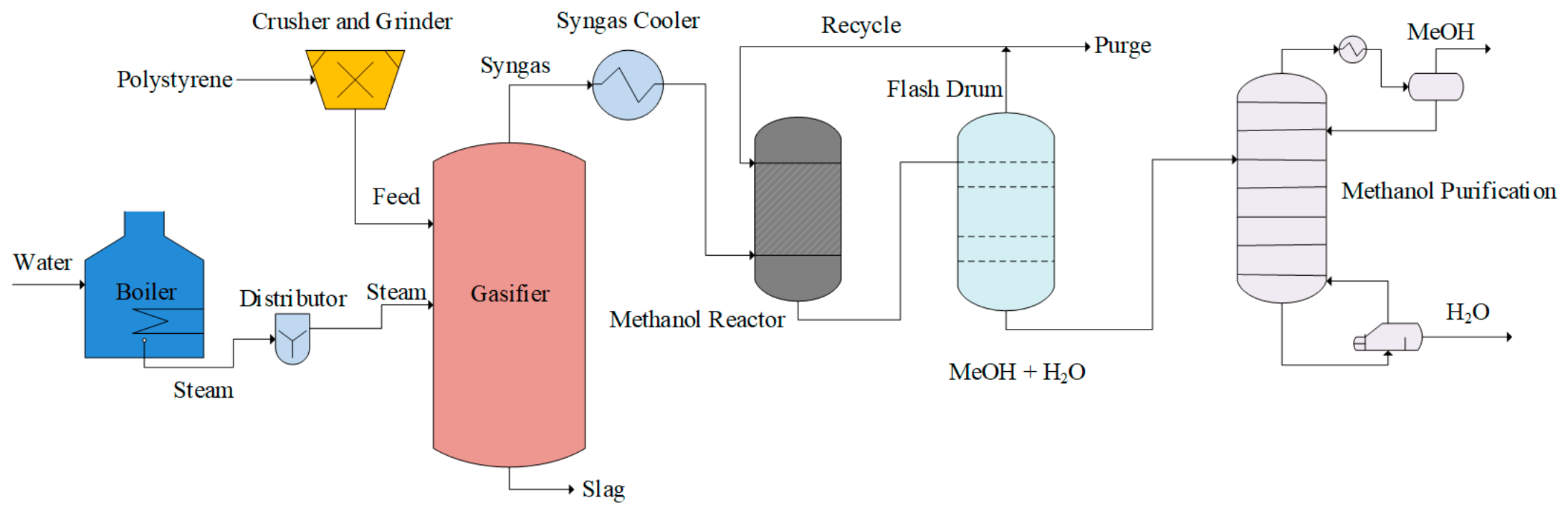
In this study, two process models were developed using Aspen Plus to convert PS plastic waste into methanol. The first model, referred to as Case 1 (Figure 1), involves stand-alone polystyrene gasification followed by methanol synthesis. In this process, polystyrene is initially crushed and ground to a fine feed, which is then fed into a gasifier along with steam generated in a boiler. Inside the gasifier, the polystyrene undergoes thermochemical conversion, producing a syngas mixture primarily composed of CO, H2, and CO2, while slag is removed as a by-product. The hot syngas is then cooled and directed into a methanol synthesis reactor where it reacts to form methanol and water. The reactor effluent is sent to a flash drum, which separates the unreacted syngas gases from the liquid methanol–water mixture. The gaseous stream is partially recycled back to the methanol reactor to improve conversion, while a purge stream removes excess gases. The liquid stream from the flash drum is further purified in a methanol purification column to obtain high-purity methanol as the top product and water as the bottom product.
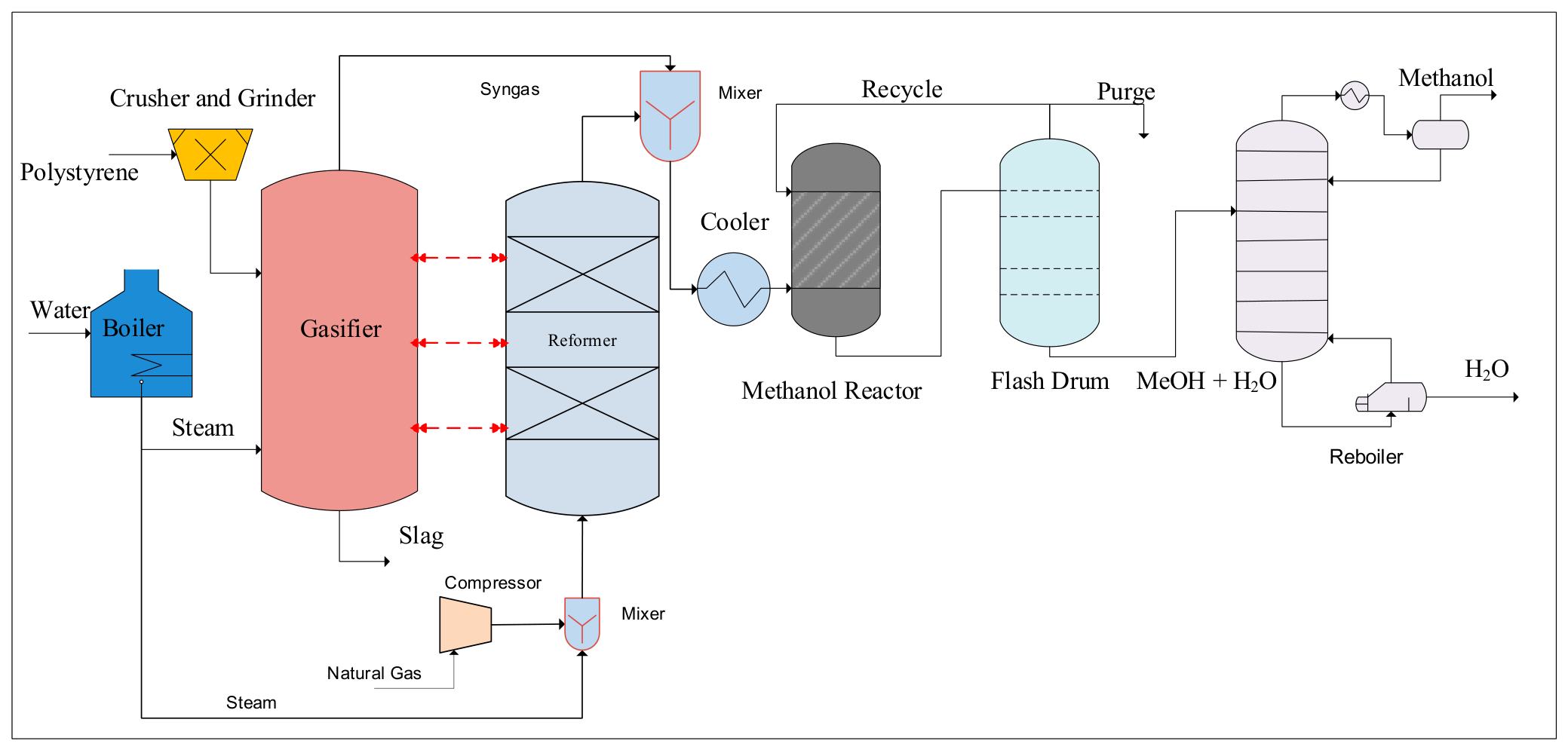
The second model, Case 2, is an enhanced version of the base configuration, in which the polystyrene gasification process is integrated with a SMR unit as represented in Figure 2. The key improvement lies in the utilization of the thermal energy available in the hot syngas exiting the gasifier to drive the endothermic reforming reactions, thereby eliminating the need for an external heat source. In this configuration, natural gas and steam are introduced into the reformer, where the heat from the gasifier-derived syngas is used to facilitate the reforming reactions and generate additional syngas. The reformer operates without a separate furnace or combustion unit, relying entirely on heat exchange from the gasification stream. The syngas produced from the gasifier and the syngas generated in the reformer are then mixed and sent together to the methanol synthesis reactor. This integration results in an overall increase in syngas availability, thereby enhancing methanol production while maintaining high thermal efficiency. The subsequent process steps—including syngas cooling, methanol synthesis, flash separation, syngas recycling and purging, and methanol purification—remain identical to those in Case 1. This integrated design not only improves resource utilization but also enhances process sustainability by minimizing external energy demand.

4. Results and Discussion

4.1. Process Analysis in Terms of Composition and Flow Rates

A detailed comparative analysis between Case 1 and Case 2 highlights the significant advantages of integrating SMR with polystyrene gasification, where the stream composition results are presented in Table 5. In Case 1, the process begins with polystyrene and steam entering the gasifier at 100 kg/h and 150 kg/h, respectively. This results in a syngas stream from the gasification unit with a total mass flow of 250 kg/h and mole flow of 22.34 kmol/h, comprising mainly hydrogen (63.3 mol%), carbon monoxide (31.3 mol%), and minor fractions of CO2 (0.6 mol%) and H2O (4.7 mol%). This syngas is cooled and processed in the methanol reactor, generating methanol of almost 85% (mole basis), and the stream is directed to a purification unit where the methanol purity further increases above 99%. In contrast, Case 2 employs the same gasifier but introduces a reforming section that utilizes the thermal energy from the hot syngas to reform methane, significantly boosting syngas output. Here, the combined gasification-reforming section outputs a stream with mass flow of 639.29 kg/h and a mole flow of 62.65 kmol/h. This stream contains slightly enriched hydrogen (66.0 mol%) and reduced CO (24.8 mol%), with higher steam content (7.8 mol%), indicating more complete hydrocarbon conversion. This higher-volume, reformer-enriched syngas enters the methanol synthesis unit, producing a stream of around 75% methanol and 25% of water. After purification, the methanol product reaches 0.996 mole fraction purity with a total output of 16.03 kmol/h, more than double the yield in Case 1. This comparison underscores the impact of process intensification in Case 2, where integrating SMR not only improves syngas volume and composition but also significantly increases methanol throughput. The system maintains high product purity while optimizing internal heat utilization, eliminating the need for external energy inputs in the reformer. As such, Case 2 proves to be a more efficient and productive route for converting polystyrene waste into methanol, offering considerable advantages in terms of process efficiency and material conversion.

4.2. Impact of Gasification Temperature on Syngas Composition for Case 1 and Case 2

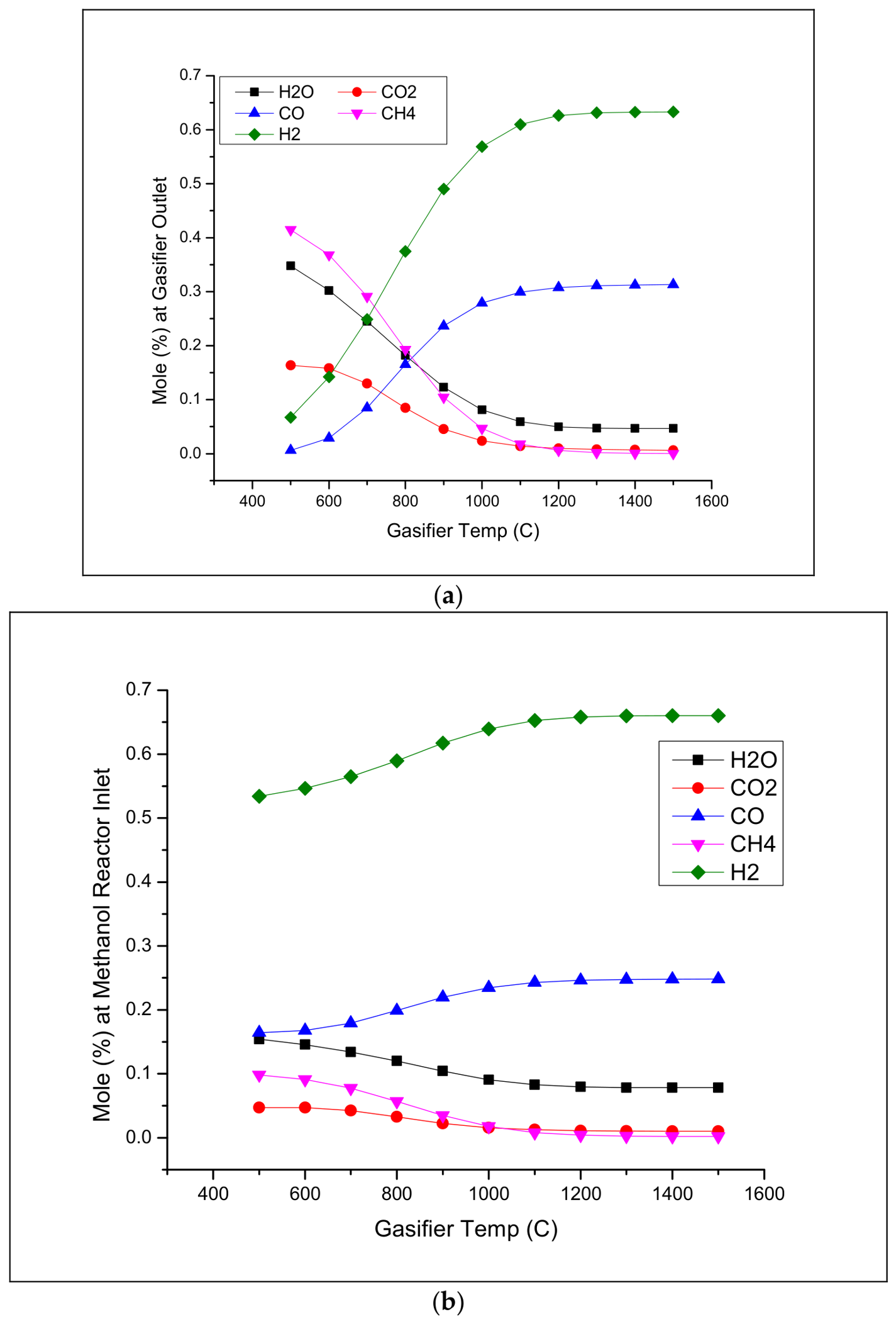
Figure 3a,b reveal how changes in gasification temperature influence the syngas fed into the methanol synthesis stage for both cases. In Case 1, which involves stand-alone steam gasification of polystyrene, the composition trends reflect the thermal decomposition behavior of the feedstock and subsequent gas-phase reactions. As gasifier temperature increases from 600 °C to around 1000 °C, there is a sharp increase in H2 mole fraction, reaching a plateau of approximately 0.65, indicating enhanced steam–carbon and water–gas shift reactions. Simultaneously, CH4 content initially increases but declines significantly beyond 800–900 °C due to thermal cracking and reforming reactions. CO concentration shows a steady rise before plateauing, while CO2 and H2O mole fractions drop as they are consumed in endothermic reactions favoring H2 and CO production. In Case 2, the overall trends remain similar, but the mole fractions of key components at the methanol reactor inlet are notably affected by the integration of the SMR unit. Due to additional syngas generated from methane and higher hydrocarbon reforming, hydrogen content is slightly higher across all temperatures, and stabilizes around 0.67 at higher temperatures. The CO mole fraction, although slightly lower than in Case 1, remains relatively steady due to its consumption in reforming and water–gas shift reactions, while the higher H2O content reflects increased steam input for reforming. CH4 levels in Case 2 drop more gradually with temperature, due to its direct consumption in the SMR unit.
The enhanced performance of Case 2 is directly attributed to the SMR unit’s ability to utilize excess thermal energy from gasification to drive additional endothermic reforming reactions, thereby increasing the overall syngas volume and H2:CO ratio. This not only improves the reactant availability for methanol synthesis but also leads to a more thermodynamically favorable feed composition, particularly at higher gasifier temperatures. Overall, the graphs confirm that higher gasification temperatures benefit both process configurations, but Case 2 consistently yields a richer and more voluminous syngas stream, leading to superior methanol production performance.

4.3. Heating Value of Syngas and Its Impact on Overall Methanol Production

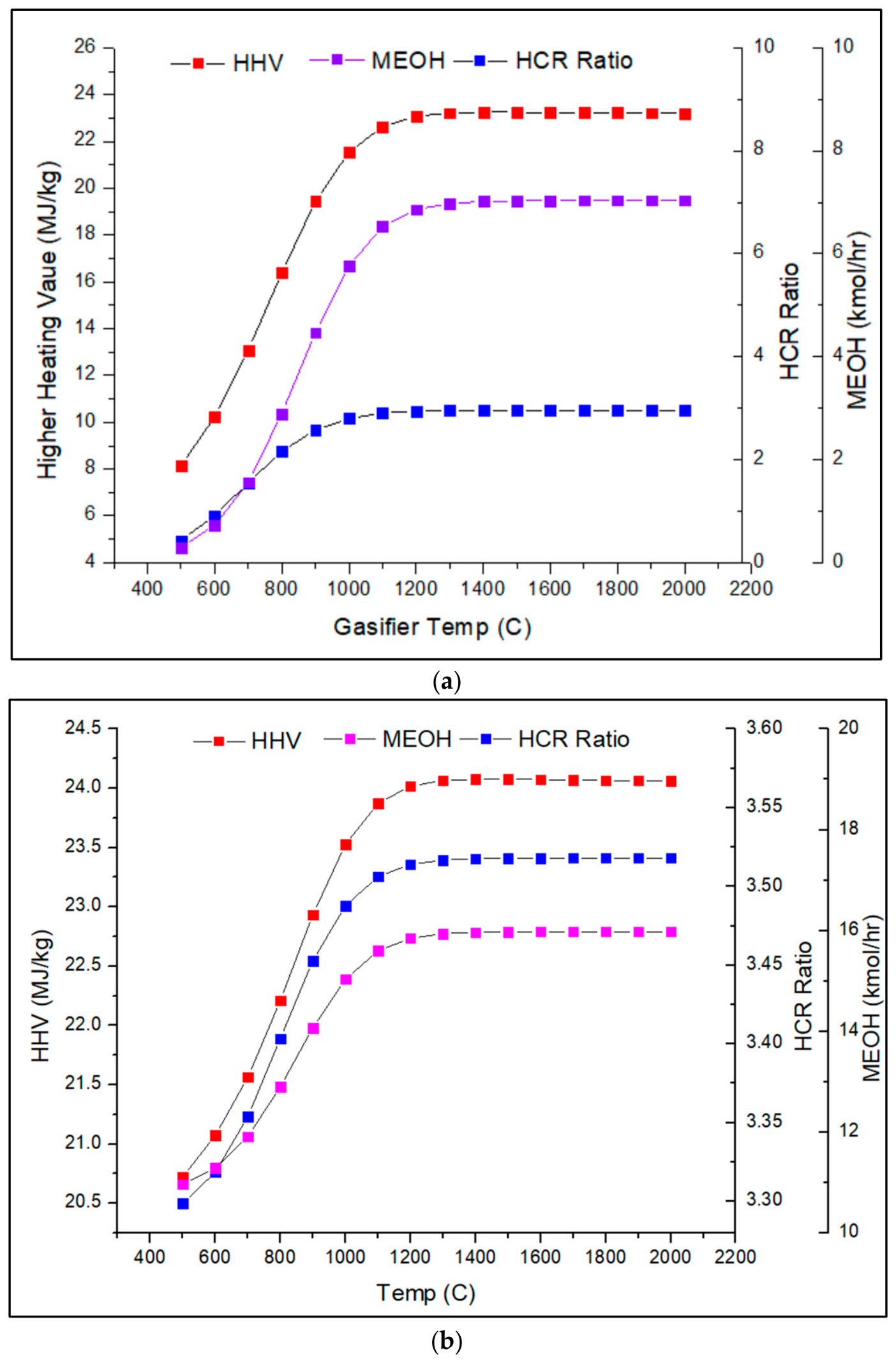
The graphs in Figure 4a,b for Case 1 and Case 2 illustrate how gasification temperature affects the higher heating value (HHV) of syngas and the synthesis rate for methanol. The hydrogen-to-carbon ratio (HCR) is used as an indicator of syngas quality and hydrogen availability for methanol production. In Case 1, which involves only polystyrene gasification, all three parameters increase with gasification temperature up to around 1000 °C, beyond which they become nearly constant. The HHV increases with gasification temperature and reaches a nearly constant value at higher temperatures. This trend is attributed to the increased production of hydrogen and carbon monoxide, which enhances the quality of the produced syngas. Similarly, the HCR ratio rises steadily, reaching a maximum HCR of about 2.6, indicating better suitability of the syngas for methanol synthesis. Methanol production follows a parallel trend, reaching a maximum of around 9.5 kmol/h, as the syngas composition becomes more reactive at elevated temperatures.
In Case 2, where SMR is integrated with the gasification process, the enhancements are even more pronounced. The integrated SMR process produces a slightly higher syngas HHV than Case 1, together with a higher hydrogen-to-carbon ratio and methanol production. The HCR ratio increases more significantly than in Case 1, reaching an HCR of approximately 3.5, due to the substantial addition of hydrogen via SMR. The higher HCR indicates improved syngas quality and contributes to enhanced methanol production. Consequently, methanol production in Case 2 surpasses 16 kmol/h, far exceeding that of Case 1, confirming the benefits of process intensification.
Overall, while both cases benefit from higher gasification temperatures, Case 2 clearly outperforms Case 1 across all metrics due to the thermal integration with SMR. The combined process not only boosts the heating value of the syngas but also significantly improves its hydrogen richness and reactivity, resulting in superior methanol yield. These trends validate the effectiveness of incorporating reforming as a strategy to enhance syngas quality and process efficiency in waste-to-chemical systems.

4.4. Impact of Thermodynamic Parameters on Methanol Synthesis

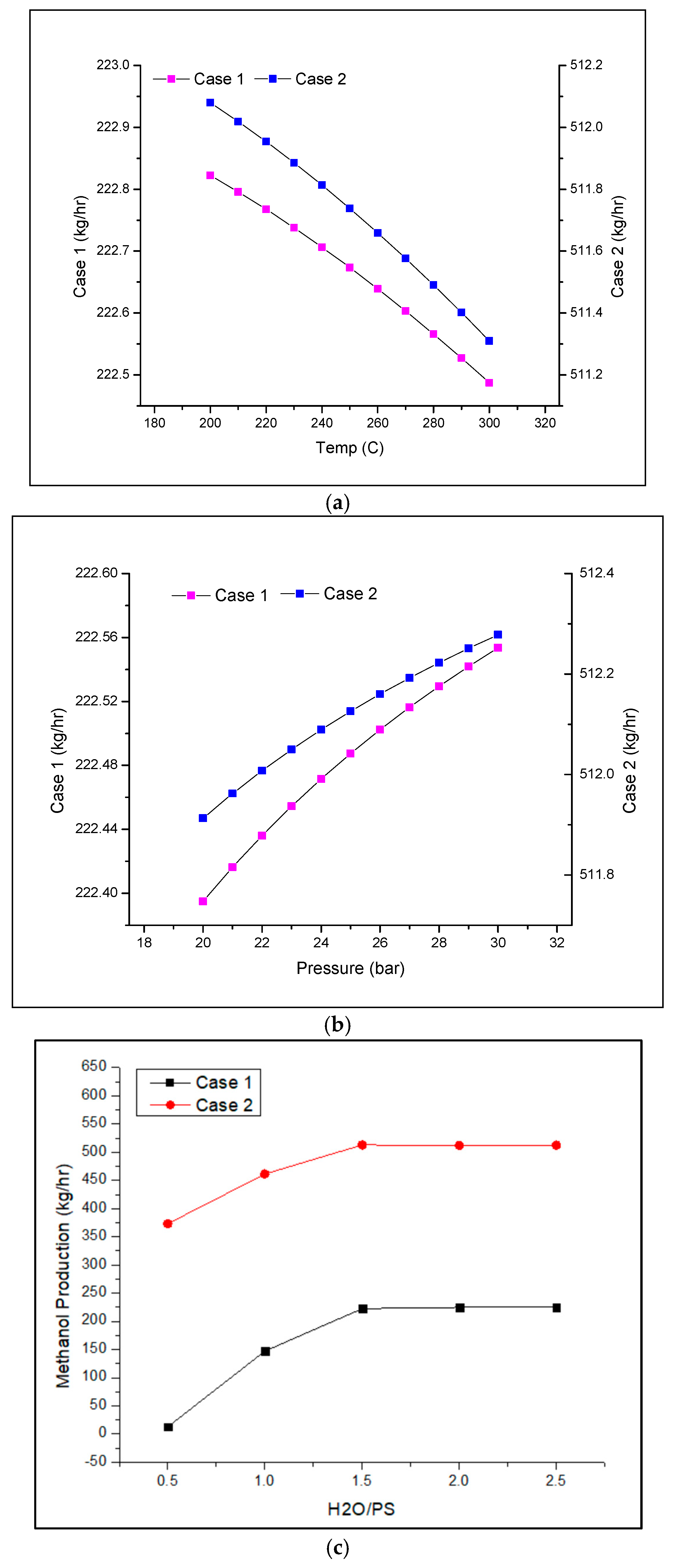
The effects of temperature and pressure on methanol production were evaluated for Case 1 and Case 2 as shown in Figure 5a and Figure 5b, respectively. It has been found that the methanol synthesis rates decline with increasing temperature from 200 °C to 300 °C in both systems because the methanol synthesis reaction is exothermic and thus favors lower temperatures. In contrast, increasing the pressure in the reactor from 20 bar to 30 bar results in increased methanol synthesis by forcing the reaction equilibrium towards the products. Overall, methanol synthesis rates are higher in Case 2 than in Case 1 over all of the investigated operating ranges; this confirms that the presence of an integrated reforming stage has resulted in a greater concentration of hydrogen in the syngas and improved overall conversion efficiencies.
Figure 5c shows the influence of the steam-to-polystyrene (H2O/PS) ratio on methanol production for both of the two studied processes. For each of these processes, increasing the H2O/PS ratio is expected to increase methanol production because it will encourage the steam gasification reaction; this will lead to increased hydrogen availability and better syngas for methanol synthesis. The increase in methanol production with respect to the H2O/PS ratio from 0.5 to 1.5 is significant. Further increases in steam supply beyond an H2O/PS ratio of 1.5 are found to be negligible; therefore, the gasification reaction has reached equilibrium and excess steam is not expected to improve syngas quality. Consequently, throughout the entire examined range of ratios, Case 2 produces more methanol than Case 1 due to the additional hydrogen generated via the SMR unit.

5. Technical and Economic Assessment

5.1. Technical Analysis (Energy and Exergy)

The technical comparison between Case 1 (base case) and Case 2 (integrated reforming case) reveals substantial improvements in overall performance with process integration. Both cases utilize the same amount of polystyrene feedstock (100 kg/h), but Case 2 incorporates an additional 150 kg/h of natural gas into the reformer, enabling a significant increase in product output. As a result, methanol production in Case 2 reaches 512.96 kg/h, more than double that of Case 1 (222.53 kg/h). The major thermal duties associated with the gasification, reforming, and methanol synthesis sections are summarized in Table 6. These duties were evaluated using Aspen Energy Analyzer during the utility analysis, where the thermal energy available within the process streams was accounted for in the estimation of heating and cooling requirements. Consequently, the reported utility demands reflect the process-level heat integration considered in the present study.
The following Equations (15)–(18) present the energy characteristics of the gasification and methanol synthesis processes [39]. Cold gas efficiency (Equation (15)) describes how much of the feedstock’s chemical energy is converted into product gas; it is an indication of the gasifier’s conversion efficiency.
C o l d   G a s   E f f i c i e n c y   ( % ) = H e a t i n g   V a l u e   o f   P r o d u c e d   G a s   ( M J / k g ) H e a t i n g   V a l u e   o f   F e e d s t o c k s   ( M J / k g )   ( % )
Gas thermal energy (Equation (16)) defines the amount of thermal energy in the produced syngas as the LHV (lower heating value) times the mass flow rate of the syngas.
G a s   T h e r m a l   E n e r g y = G a s   L H V k J k g × P r o d u e d   S y n g a s k g s
The total energy input (Equation (17)) indicates the total amount of energy required for the entire process (hot and cold) to operate.
T o t a l   C o n s u m e d   E n e r g y k W t h = H o t   U t i l i t y k W t h + C o l d   U t i l i t y   ( k W t h )
Process efficiency (Equation (18)) is the ratio of the thermal energy in the methanol to the sum of the energy in the feedstocks plus the utility energy input; this equation provides a comprehensive measure of the entire system’s ability to convert energy. The reported process efficiencies represent the overall process performance. The total energy input includes the energy from all feedstocks, including natural gas in Case 2, together with the utility requirements.
P r o c e s s   E f f i c i e n c y M e O H n e t = M e O H   T h e r m a l   E n e r g y k W t h F e e d   T h e r m a l   E n e r g y k W t h + E n e r g y   C o n s u m e d   ( k W t h ) × 100 %
This is directly linked to the enhanced syngas yield and composition resulting from the integration of steam methane reforming. The HHV of the syngas also improves from 24.33 MJ/kg in Case 1 to 25.92 MJ/kg in Case 2, indicating a higher energy content available for downstream chemical conversion. However, this improvement is accompanied by a higher purge stream (22.00 kg/h in Case 2 vs. 4.00 kg/h in Case 1), due to increased inert and unconverted gases from the reformer. Utility consumption also increases, with net utilities rising from 1.40 MWth to 2.88 MWth, and both hot and cold utility demands nearly doubling. Despite this, overall process efficiency improves significantly, from 48% in Case 1 to 81% in Case 2, highlighting the energy integration benefits and improved conversion efficiency in the reforming-assisted design. Table 7 provides the detailed technical analysis for both cases in terms of process efficiency and exergy efficiency. Although steam methane reforming improves methanol yield and process efficiency, it also introduces additional carbon through natural gas consumption. Therefore, this study focuses on process performance and waste valorization. A detailed life cycle and carbon footprint assessment is beyond the scope of this work and will be considered in future studies.
The exergy analysis offers critical insight into the thermodynamic performance of both configurations. Equations (19)–(25) provide a definition of the exergy analysis methodology, which evaluates the quality and potential usefulness of energy within the system. Physical exergy (Equation (19)) represents the portion of energy that deviates from the environment in terms of temperature and pressure.
P h y s i c a l   E x e r g y = E X p h = h h 0 T 0 s s 0
Chemical exergy (Equation (20)) quantifies the inherent chemical potential of each species; this can be calculated based on the mole fractions and the standard state exergies.
C h e m i c a l   E x e r g y = E X c h = i x i E X c h , i + R T 0 i x i l n x i
Kinetic and potential exergies (Equations (12)–(21)), are typically negligible; however, they are included for completeness.
K i n e t i c   E x e r g y = E X k = v 2 2
P o t e n t i a l   E x e r g y = E X p = g z
Total exergy (Equation (23)) is the sum of all the individual exergy components. Exergy destruction (Equation (24)) is a representation of the irreversibility in the process. Lastly, the exergy efficiency (Equation (25)) is the ratio of the useful exergy output to the total exergy input; this provides a primary measure of the overall thermodynamic performance and the effectiveness of resource use.
T o t a l   e x e r g y = E X p h + E X c h + E X k + E X p E X p h + E X c h
E X d = i E X i , i n i E X i , o u t + i 1 T 0 T i Q i i W i
E x e r g y   E f f e c i e n c y = i E X i , o u t i E X i , i n + i 1 T 0 T i Q i i W i × 100 %
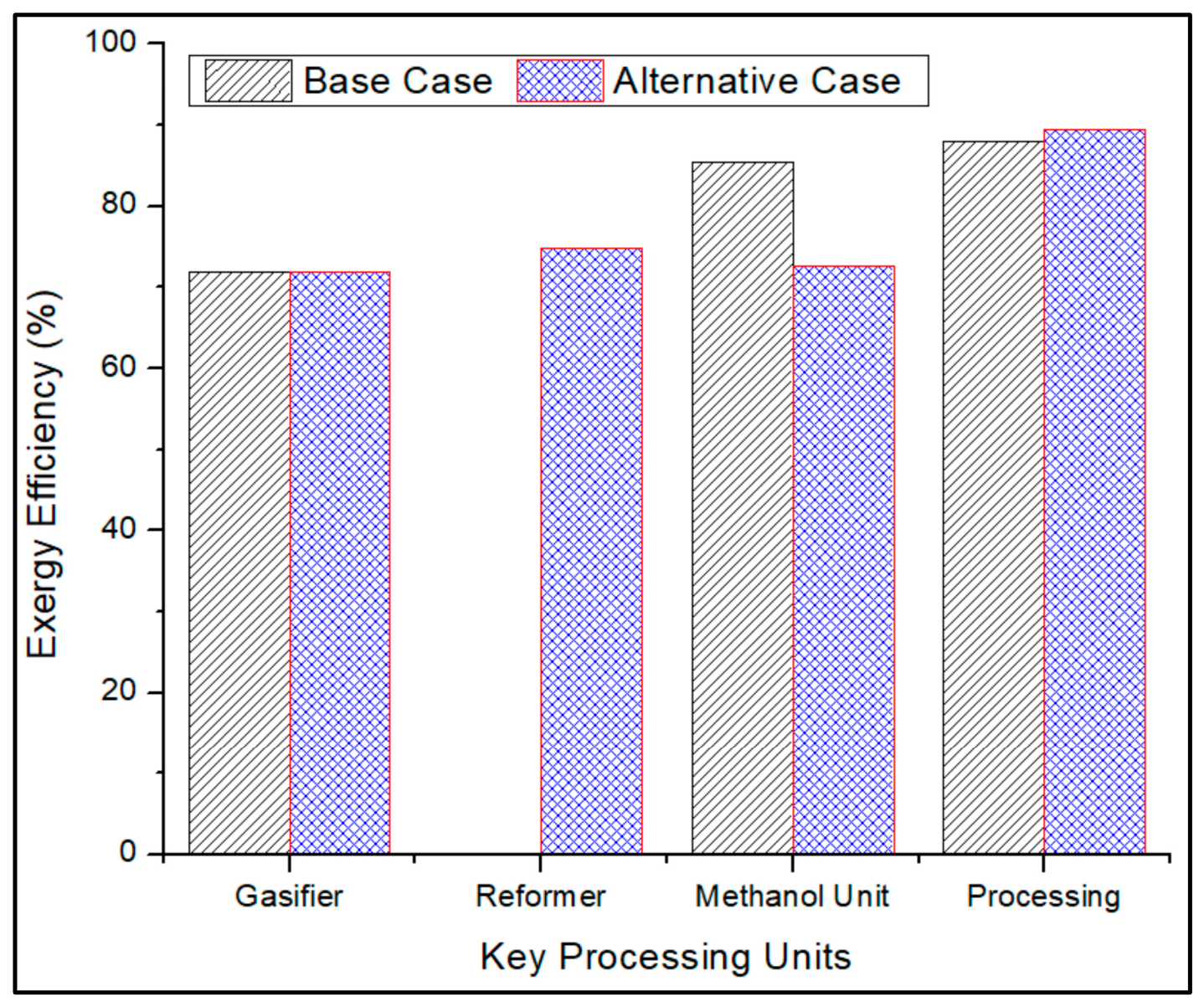
In Case 2, the total exergy input increases to 4438.13 kW due to the addition of natural gas and higher thermal loads, compared to 2350.16 kW in Case 1. However, the exergy output in Case 2 also rises to 3250.93 kW, from 1409.36 kW in Case 1, leading to a marked improvement in overall exergy efficiency from 60% (Case 1) to 73% (Case 2). This clearly indicates more effective utilization of input exergy in the integrated system, despite higher energy demands. As illustrated in Figure 6, the reformer in Case 2 exhibits higher exergy efficiency than the gasifier, reflecting its better thermodynamic performance and cleaner reaction pathway. While the methanol synthesis unit in Case 2 shows a slight drop in exergy efficiency compared to Case 1, due to larger gas volumes and associated irreversibility, the overall processing efficiency is highest in Case 2, confirming the benefit of thermal integration and reforming. These findings validate that the inclusion of a reformer not only enhances chemical conversion but also improves the second-law (exergy) efficiency of the entire system.

5.2. Carbon Conversion and CO2 Emissions

The Carbon Conversion Efficiency (CCE), the efficiency at which carbon from waste is converted into methanol for each configuration, was also used to compare the two configurations. The CCE is defined as the amount of carbon recovered in methanol divided by the total amount of carbon supplied via the feedstock as represented in Equation (26).
C C E = C a r b o n   i n   M e t h a n o l   P r o d u c t C a r b o n   i n   C a r b o n a c e o u s   F e e d   × 100
Table 8 presents a summary of the results for the conversion of carbon as well as the amount of CO2 emitted. The increase in carbon conversion rate, from 90.4% (Case 1) to 94.0% (Case 2), shows that the combined system is more efficient with regard to carbon utilization. The hydrogen generated through the SMR, in addition to being utilized for methanol synthesis, therefore enables an improvement in carbon conversion. Nevertheless, due to the consumption of natural gas in Case 2, there will be a greater amount of specific CO2 emissions. Overall, Case 2 has both a better carbon utilization and improved overall efficiency of the process; however, this comes at the price of an increase in CO2 emissions.

5.3. Process Economic Analysis

The overall investment needed to set up a chemical process plant is categorized into two main segments: capital expenditure (CAPEX) and operating expenditure (OPEX). CAPEX refers to the initial financial outlay required to construct the plant, covering the cost of acquiring and installing equipment along with the development of necessary infrastructure such as material handling systems, utility networks, control instrumentation, and safety mechanisms. These costs are influenced by several factors, including the plant size and capacity, feedstock type, process complexity, and target efficiency. Some of the economic assumptions considered in this study are listed in Table 9.
In this study, individual equipment costs were estimated using the power law of capacity, as described in Equation (27), where the capacity factor is assumed to be 0.9. The updated equipment costs were further adjusted using the Chemical Engineering Plant Cost Index (CEPCI), with a base year index of 850 (2025).
C o s t N e w = C o s t O l d × C a p a c i t y N e w C a p a c i t y O l d x × C E P C I N e w C E P C I O l d
Equation (28) empirically relates the estimated number of operating laborers (NOL) to the total number of major process units (Nnp) in the plant. This correlation helps to estimate the number of people required to perform work, considering both the size of the plant and its operational complexity.
N O L = 6.29 + 0.23 N n p 0.5
Equation (29) calculates the methanol production cost ($/kg) by dividing the total annualized costs, consisting of CAPEX and OPEX, by the hydrogen output. By providing a normalized unit-cost metric, it enables comparisons of the relative economic merits of different process configurations or technologies.
M e t h a n o l   P r o d u c t i o n   C o s t $ k g = D i s t r i b u t e d   C A P E X   a n d   O P E X $ / y e a r M e t h a n o l   P r o d u c t i o n k g / y e a r
This method allows cost scaling based on changes in equipment size and inflation-adjusted indices: on the other hand, OPEX refers to the annual recurring costs required to operate the plant. This includes raw material consumption (e.g., natural gas, water, catalyst), utilities (hot and cold energy services), labor, maintenance, waste disposal, and logistics such as feedstock handling or transport. These operational costs are typically estimated on an annual basis and directly impact the economic feasibility and payback period of the project. In this study, OPEX accounts for variations in resource demands and process scale between Case 1 and Case 2, providing a realistic assessment of long-term plant performance. The economic analysis highlights the trade-offs between investment cost and production efficiency for both cases. The results of the economic analysis for both cases are provided in Table 10. Case 1, which utilizes only polystyrene gasification, has a lower CAPEX of 1.836 million USD, while Case 2, incorporating a reforming unit, has a higher CAPEX of 2.534 million USD. This increase is primarily attributed to the additional reforming unit cost (0.503 million USD) and expanded methanol synthesis capacity (0.408 vs. 0.213 million USD). After accounting for contingency (15%) and permitting (5%), the total CAPEX rises to 2.534 million USD for Case 2, compared to 1.836 million USD for Case 1.
In terms of OPEX, Case 2 incurs higher annual costs of 2.055 million USD, versus 1.780 million USD in Case 1. This increase is driven by the consumption of natural gas (0.189 million USD/year) and the cost of the SMR catalyst (0.062 million USD/year) in Case 2. Water consumption and maintenance costs also increase slightly due to higher processing loads, while other items such as waste disposal, palm waste collection, and labor remain consistent across both cases. Despite the higher capital and operating costs, Case 2 demonstrates a significantly better economic performance in terms of methanol output and unit production cost. The methanol production rate more than doubles, increasing from 222.53 kg/h in Case 1 to 512.96 kg/h in Case 2. This results in a dramatic reduction in production cost from 1.001 USD/kg in Case 1 to 0.505 USD/kg in Case 2, making the integrated process not only more productive but also more cost-efficient. The annualized cost of CAPEX and OPEX, though higher in Case 2 (2.156 million USD vs. 1.853 million USD), is offset by the substantial increase in methanol yield, improving the overall economic viability.
A sensitivity analysis was conducted using a ±20% variation for the natural gas price, electricity costs and CEPCI to assess the robustness of the economic evaluation. The results in Table 11 indicate that the natural gas price has the largest effect on methanol production cost in Case 2 with an integrated SMR unit, as compared to electricity costs and CEPCI. In general, both the integrated and stand-alone gasification processes remain economically viable. However, when comparing the two methods, it is apparent that the integrated process is less expensive than the stand-alone method.

6. Comparison of Current Study with the Literature

Table 12 provides a comparison of the current work with other processes for methanol and hydrogen production based on different feedstock materials and also using different gasification technologies, as well as how the current polystyrene gasification and SMR hybridized technology compares to others. It is clear that the hybridized polystyrene gasification and SMR technology studied here demonstrates one of the most efficient processes and least expensive ways to produce methanol (0.505 $/kg) when compared to recent studies. In contrast, the use of polystyrene gasification alone produced an overall efficiency of 48% and had a cost of 1.001 $/kg to produce methanol. Overall efficiencies for plastic feedstock systems, including polyethylene/polypropylene co-gasification, are around 64–76%, and production costs are between 0.30 and 0.70 $/kg. Also, the natural gas reforming to methanol processes have an efficiency of around 71% and production cost of 0.31 $/kg. As indicated in these comparisons, the integration of SMR and polystyrene gasification can significantly improve hydrogen generation, enhance syngas quality, and provide better thermal and economic performance than either of the stand-alone systems.

Barriers and Way Forward

Despite promising results, this work represents a preliminary steady state techno-economic and thermodynamic assessment based on equilibrium modeling assumptions. Aspen Plus models have been validated against published experimental and industrial data, but practical systems may face kinetic limitations, catalyst deactivation and deviations from ideal equilibrium behavior too. Impurities and contaminants in waste polystyrene feedstock can also affect performance and quality of syngas. Operational challenges such as handling feedstock, reactor stability and heat management are important for implementation at the industrial scale. Startup/shutdown details, load fluctuations, mixed-feed variability, optimization of heat exchanger networks, recovery of byproducts and life cycle environmental assessment were beyond the scope of this study. Nevertheless, this work lays a strong foundation for future laboratory, pilot and industrial studies that will optimize processes, evaluate environments, and upscale towards commercialization.

7. Conclusions

The comparative study between Case 1 (gasification only) and Case 2 (gasification integrated with steam methane reforming) highlights several key distinctions in technical and economic performance. Some of the key outcomes are listed as follows:
  • Case 2 demonstrated significantly enhanced syngas production, increasing the flow from 22.34 kmol/h in Case 1 to 62.65 kmol/h. This improvement is attributed to the addition of a steam methane reforming unit, which effectively utilized waste heat from the gasifier to generate extra syngas without external heating.
  • The methanol production rate in Case 2 more than doubled, rising from 222.53 kg/h in Case 1 to 512.96 kg/h. This increase was a direct result of the higher availability of hydrogen and improved syngas quality.
  • Process efficiency improved markedly, with Case 2 achieving 81% efficiency compared to 48% in Case 1. Similarly, exergy efficiency rose from 60% to 73%, reflecting better energy utilization and lower system irreversibility.
  • Although Case 2 required more utilities and natural gas input, leading to a higher total energy demand (2.88 MWth vs. 1.40 MWth), the output gains justified the increase, making the system more productive and thermodynamically favorable.
  • The capital expenditure (CAPEX) for Case 2 was higher at 2.534 M$ compared to 1.836 M$ in Case 1, due to additional equipment like the reformer and larger methanol synthesis capacity. Likewise, OPEX increased slightly due to natural gas and catalyst costs.
  • Despite the higher investment, Case 2 delivered a significantly lower methanol production cost of 0.505$/kg, compared to 1.001$/kg in Case 1, proving to be more economically viable in terms of long-term operation and product value.
The integration of SMR with gasification not only increased process outputs but also improved energy integration by using internal heat, reducing the need for external energy and making the overall system more sustainable and scalable. These results confirm that integrating steam methane reforming with polystyrene gasification is a highly effective strategy to enhance methanol production, offering substantial technical and economic benefits over conventional gasification-based configurations.

Supplementary Materials

The following supporting information can be downloaded at: https://www.mdpi.com/article/10.3390/chemengineering10080101/s1.

Funding

The author would like to acknowledge the Interdisciplinary Research Center for Hydrogen Technologies and Carbon Management (IRC-HTCM) at KFUPM for funding this work through project No. INHT2610. The authors have used the ChatGPT for language editing and grammar correction.

Institutional Review Board Statement

Not applicable.

Data Availability Statement

The data is not generated in this study and the modeling is done using simulation tools.

Conflicts of Interest

The author declares no conflicts of interest.

Abbreviations

AbbreviationDetails
CAPEXCapital expenditure
CEPCIChemical Engineering Plant Cost Index
GHGGreenhouse gas
HCRHydrogen to Carbon Ratio
HHVHeating value of the syngas
IPCCIntergovernmental Panel on Climate Change
MEOHMethanol
MPWMixed Plastic Waste
MSWMunicipal solid waste
MTBEMethyl tert-butyl ether
MTGMethanol-to-gasoline
MWMunicipal waste
OPEXOperational expenditure
PRPeng Robinson
PSPolystyrene
REQUILEquilibrium Reactor in Aspen
SMRSteam Methane Reforming
TEATechno-Economic Assessment
USDUnited States Dollar

References

  1. Yusuf, M.; Beg, M.; Ubaidullah, M.; Shaikh, S.F.; Keong, L.K.; Hellgardt, K.; Abdullah, B. Kinetic studies for DRM over high-performance Ni–W/Al2O3–MgO catalyst. Int. J. Hydrogen Energy 2022, 47, 42150–42159. [Google Scholar] [CrossRef] [Scilit]
  2. Neupane, D. Biofuels from renewable sources, a potential option for biodiesel production. Bioengineering 2022, 10, 29. [Google Scholar] [CrossRef] [Scilit] [PubMed]
  3. Xu, Z.; Munyaneza, N.E.; Zhang, Q.; Sun, M.; Posada, C.; Venturo, P.; Rorrer, N.A.; Miscall, J.; Sumpter, B.G.; Liu, G. Chemical upcycling of polyethylene, polypropylene, and mixtures to high-value surfactants. Science 2023, 381, 666–671. [Google Scholar] [CrossRef] [Scilit] [PubMed]
  4. Cen, Z.; Han, X.; Lin, L.; Yang, S.; Han, W.; Wen, W.; Yuan, W.; Dong, M.; Ma, Z.; Li, F.; et al. Upcycling of polyethylene to gasoline through a self-supplied hydrogen strategy in a layered self-pillared zeolite. Nat. Chem. 2024, 16, 871–880. [Google Scholar] [CrossRef] [Scilit] [PubMed]
  5. Lahafdoozian, M.; Khoshkroudmansouri, H.; Zein, S.H.; Jalil, A.A. Hydrogen production from plastic waste: A comprehensive simulation and machine learning study. Int. J. Hydrogen Energy 2024, 59, 465–479. [Google Scholar] [CrossRef] [Scilit]
  6. Dai, H.; Gao, X. Development of integrated reactive system based on co-combustion of wood biomass and plastic: Efficient hydrogen and methane production. J. Clean. Prod. 2024, 452, 142100. [Google Scholar] [CrossRef] [Scilit]
  7. Yue, S.; Zhao, Z.; Zhang, T.; Li, F.; Liu, K.; Zhan, S. Selective photoreforming of waste plastics into diesel olefins via single reactive oxygen species. Angew. Chem. 2024, 136, e202406795. [Google Scholar] [CrossRef] [Scilit]
  8. Lin, J.; Hu, K.; Wang, Y.; Tian, W.; Hall, T.; Duan, X.; Sun, H.; Zhang, H.; Cortés, E.; Wang, S. Tandem microplastic degradation and hydrogen production by hierarchical carbon nitride-supported single-atom iron catalysts. Nat. Commun. 2024, 15, 8769. [Google Scholar] [CrossRef] [Scilit] [PubMed]
  9. Al-Ghussain, L.; Alrbai, M.; Al-Dahidi, S. Comprehensive techno-economic and life cycle greenhouse gases analysis of green ammonia production utilizing PV and wind energy: Jordan as a case study. Renew. Energy 2025, 249, 123249. [Google Scholar] [CrossRef] [Scilit]
  10. Al-Ghussain, L.; Alrbai, M.; Al-Dahidi, S.; Lu, Z. Integrated assessment of green hydrogen production in California: Life cycle Greenhouse gas Emissions, Techno-Economic Feasibility, and resource variability. Energy Convers. Manag. 2024, 311, 118514. [Google Scholar] [CrossRef] [Scilit]
  11. Al-Ghussain, L.; Hassan, M.A.; Lu, Z.; Alrbai, M.; Al-Dahidi, S.; Wang, M.; Araji, M.T. Renewable hydrogen horizon: Geospatial techno-economic feasibility and life cycle greenhouse gas analysis in the Middle East and North Africa. Int. J. Hydrogen Energy 2025, 146, 149933. [Google Scholar] [CrossRef] [Scilit]
  12. Alrbai, M.; Al-Dahidi, S.; Al-Ghussain, L.; Shboul, B.; Hayajneh, H.; Alahmer, A. Assessment of the polygeneration approach in wastewater treatment plants for enhanced energy efficiency and green hydrogen/ammonia production. Process Saf. Environ. Prot. 2024, 192, 803–821. [Google Scholar] [CrossRef] [Scilit]
  13. Alrbai, M.; Al-Dahidi, S.; Alahmer, H.; Shboul, B.; Rinchi, B.; Al-Ghussain, L.; Abusorra, M.; Ayadi, O.; Alahmer, A. Applications of machine learning and multi-objective optimization in agricultural waste management: A techno-economic study of hydrogen production from olive waste via combined air-steam gasification. Bioresour. Technol. 2025, 434, 132844. [Google Scholar] [CrossRef] [Scilit] [PubMed]
  14. Plastics Europe. An Analysis of European Plastics Production, Demand and Waste Data; Plastics Europe: Brussels, Belgium, 2019. [Google Scholar]
  15. MacArthur, E. Beyond plastic waste. Science 2017, 358, 843. [Google Scholar] [CrossRef] [Scilit] [PubMed]
  16. Rhodes, C.J. Solving the plastic problem: From cradle to grave, to reincarnation. Sci. Prog. 2019, 102, 218–248. [Google Scholar] [CrossRef] [Scilit] [PubMed]
  17. Al-Qadri, A.A.; Ahmed, U.; Ahmad, N.; Abdul Jameel, A.G.; Zahid, U.; Naqvi, S.R. A review of hydrogen generation through gasification and pyrolysis of waste plastic and tires: Opportunities and challenges. Int. J. Hydrogen Energy 2024, 77, 1185–1204. [Google Scholar] [CrossRef] [Scilit]
  18. Gautam, B.; Tsai, T.H.; Chen, J.T. Towards sustainable solutions: A review of polystyrene upcycling and degradation techniques. Polym. Degrad. Stab. 2024, 225, 110779. [Google Scholar] [CrossRef] [Scilit]
  19. Fan, Y.; Qin, C.; Zhao, K.; Xiong, Y.; Shi, Y. Conversion of lignin with polystyrene into high-value aromatics through co-pyrolysis and post-plasma refining. Energy 2025, 318, 134893. [Google Scholar] [CrossRef] [Scilit]
  20. Cheng, P.; Li, Z.; Zheng, Y.; Meng, Q.; Yu, Y.; Jin, Y.; Gao, X.F.; Guo, X.M.; Jia, L. Study on the regulation of performance and Hg0 removal mechanism of MIL-101 (Fe)-derived carbon materials. Sep. Purif. Technol. 2025, 379, 134939. [Google Scholar] [CrossRef] [Scilit]
  21. Li, Z.; Yu, Y.; Jia, L.; Wu, Y.; Cheng, P.; Zhang, Z.; Li, Z.K.; Fan, C.H.; Guo, X.M. Thermal characteristic analysis and performance optimization of a novel heating boiler based on a porous media model. Appl. Therm. Eng. 2026, 289, 130035. [Google Scholar] [CrossRef] [Scilit]
  22. Zare, A.A.D.; Yari, M. Techno economic analysis of efficient and environmentally friendly methods for hydrogen, power, and heat production using chemical looping combustion integrating plastic waste gasification and thermochemical copper chlorine cycles. Energy 2024, 289, 129941. [Google Scholar] [CrossRef] [Scilit]
  23. Hamaidi, B.E.; Boumeddane, B.; Benarous, A.; Vera, D. Unlocking the potential of date palm waste for syngas and methanol production: Process simulation and optimization. Process Saf. Environ. Prot. 2024, 182, 98–108. [Google Scholar] [CrossRef] [Scilit]
  24. Afzal, S.; Singh, A.; Nicholson, S.R.; Uekert, T.; DesVeaux, J.S.; Tan, E.C.D.; Dutta, A.; Carpenter, A.C.; Baldwin, R.M.; Beckham, G.T. Techno-economic analysis and life cycle assessment of mixed plastic waste gasification for production of methanol and hydrogen. Green Chem. 2023, 25, 5068–5085. [Google Scholar] [CrossRef] [Scilit]
  25. Zhang, Y.; Xiao, J.; Shen, L. Simulation of methanol production from biomass gasification in interconnected fluidized beds. Ind. Eng. Chem. Res. 2009, 48, 5351–5359. [Google Scholar] [CrossRef] [Scilit]
  26. Amirhaeri, Y.; Hadavi, H.; Kasaeian, A. Exergy and energy analysis of a hybrid natural Gas/Hydrogen liquefaction cycle combined with methanol production plant. Energy Convers. Manag. 2024, 299, 117834. [Google Scholar] [CrossRef] [Scilit]
  27. Hosseini, S.S.; Mehrpooya, M.; Alsagri, A.S.; Alrobaian, A.A. Introducing, evaluation and exergetic performance assessment of a novel hybrid system composed of MCFC, methanol synthesis process, and a combined power cycle. Energy Convers. Manag. 2019, 197, 111878. [Google Scholar] [CrossRef] [Scilit]
  28. Han, D.G.; Erdem, K.; Midilli, A. Investigation of hydrogen production via waste plastic gasification in a fluidized bed reactor using Aspen Plus. Int. J. Hydrogen Energy 2023, 48, 39315–39329. [Google Scholar] [CrossRef] [Scilit]
  29. Singh, M.; Salaudeen, S.A.; Gilroyed, B.H.; Dutta, A. Simulation of biomass-plastic co-gasification in a fluidized bed reactor using Aspen plus. Fuel 2022, 319, 123708. [Google Scholar] [CrossRef] [Scilit]
  30. Safarian, S.; Unnthorsson, R.; Richter, C. Performance investigation of biomass gasification for syngas and hydrogen production using Aspen Plus. Open J. Model. Simul. 2022, 10, 71–87. [Google Scholar]
  31. Lopez, G.; Artetxe, M.; Amutio, M.; Alvarez, J.; Bilbao, J.; Olazar, M. Recent advances in the gasification of waste plastics. A critical overview. Renew. Sustain. Energy Rev. 2018, 82, 576–596. [Google Scholar] [CrossRef] [Scilit]
  32. Midilli, A.; Kucuk, H.; Haciosmanoglu, M.; Akbulut, U.; Dincer, I. A review on converting plastic wastes into clean hydrogen via gasification for better sustainability. Int. J. Energy Res. 2022, 46, 4001–4032. [Google Scholar] [CrossRef] [Scilit]
  33. Nicholson, S.R.; Rorrer, J.E.; Singh, A.; Konev, M.O.; Rorrer, N.A.; Carpenter, A.C.; Jacobsen, A.J.; Román-Leshkov, Y.; Beckham, G.T. The critical role of process analysis in chemical recycling and upcycling of waste plastics. Annu. Rev. Chem. Biomol. Eng. 2022, 13, 301–324. [Google Scholar] [CrossRef] [Scilit] [PubMed]
  34. Bai, B.; Liu, Y.; Wang, Q.; Zou, J.; Zhang, H.; Jin, H.; Li, X. Experimental investigation on gasification characteristics of plastic wastes in supercritical water. Renew. Energy 2019, 135, 32–40. [Google Scholar] [CrossRef] [Scilit]
  35. Carmo-Calado, L.; Hermoso-Orzáez, M.J.; Mota-Panizio, R.; Guilherme-Garcia, B.; Brito, P. Co-combustion of waste tires and plastic-rubber wastes with biomass technical and environmental analysis. Sustainability 2020, 12, 1036. [Google Scholar] [CrossRef] [Scilit]
  36. Al-Qadri, A.A.; Ahmed, U.; Hossain, M.M.; Ahmad, N.; Jameel, A.G.A.; Zahid, U.; Zein, S.H. Technoeconomic feasibility of producing clean fuels from waste plastics: A novel process model. Energy Convers. Manag. 2024, 316, 118822. [Google Scholar] [CrossRef] [Scilit]
  37. Wu, C.; Williams, P.T. Pyrolysis–gasification of post-consumer municipal solid plastic waste for hydrogen production. Int. J. Hydrogen Energy 2010, 35, 949–957. [Google Scholar] [CrossRef] [Scilit]
  38. Ahmed, U. Techno-economic feasibility of methanol synthesis using dual fuel system in a parallel process design configuration with control on green house gas emissions. Int. J. Hydrogen Energy 2020, 45, 6278–6290. [Google Scholar] [CrossRef] [Scilit]
  39. Kim, S.; Kim, M.; Kim, Y.T.; Kwak, G.; Kim, J. Techno-economic evaluation of the integrated polygeneration system of methanol, power and heat production from coke oven gas. Energy Convers. Manag. 2011, 52, 240–250. [Google Scholar]
  40. Panahi, P.N.; Mousavi, S.M.; Niaei, A.; Farzi, A.; Salari, D. Simulation of methanol synthesis from synthesis gas in fixed bed catalytic reactor using mathematical modeling and neural networks. Int. J. Sci. Eng. Res. 2012, 3, 1–7. [Google Scholar]
  41. Puig-Gamero, M.; Argudo-Santamaria, J.; Valverde, J.L.; Sánchez, P.; Sánchez-Silva, L. Simulation of methanol synthesis from syngas obtained through biomass gasification using Aspen Plus®. In Proceedings of the 6th International Conference on Sustainable Solid Waste Management (NAXOS 2018), Naxos Island, Greece, 13–16 June 2018. [Google Scholar]
  42. AlNouss, A.; Shahbaz, M.; Mckay, G.; Al-Ansari, T. Bio-methanol production from palm wastes steam gasification with application of CaO for CO2 capture: Techno-economic-environmental analysis. J. Clean. Prod. 2022, 341, 130849. [Google Scholar] [CrossRef] [Scilit]
  43. Al-Qadri, A.A.; Ahmed, U.; Jameel, A.G.A.; Ahmad, N.; Zahid, U.; Zein, S.H.; Naqvi, S.R. Process design and techno-economic analysis of dual hydrogen and methanol production from plastics using energy integrated system. Int. J. Hydrogen Energy 2023, 48, 10797–10811. [Google Scholar] [CrossRef] [Scilit]
  44. Al-Rowaili, F.N.; Khalafalla, S.S.; Al-Yami, D.S.; Jamal, A.; Ahmed, U.; Zahid, U.; Al-Mutairi, E.M. Techno-economic evaluation of methanol production via gasification of vacuum residue and conventional reforming routes. Chem. Eng. Res. Des. 2022, 177, 365–375. [Google Scholar] [CrossRef] [Scilit]
  45. Ahmed, U.; Zahid, U.; Onaizi, S.A.; Abdul Jameel, A.G.; Ahmad, N.; Ahmad, N.; AlMohamadi, H. Co-production of hydrogen and methanol using fuel mix systems: Technical and economic assessment. Appl. Sci. 2021, 11, 6577. [Google Scholar] [CrossRef] [Scilit]
  46. Martín-Lara, M.A.; Moreno, J.A.; Garcia-Garcia, G.; Arjandas, S.; Calero, M. Life cycle assessment of mechanical recycling of post-consumer polyethylene flexible films based on a real case in Spain. J. Clean. Prod. 2022, 365, 132625. [Google Scholar] [CrossRef] [Scilit]
  47. Janajreh, I.; Adeyemi, I.; Elagroudy, S. Gasification feasibility of polyethylene, polypropylene, polystyrene waste and their mixture: Experimental studies and modeling. Sustain. Energy Technol. Assess. 2020, 39, 100684. [Google Scholar] [CrossRef] [Scilit]
  48. Ahmed, I.I.; Gupta, A.K. Hydrogen production from polystyrene pyrolysis and gasification: Characteristics and kinetics. Int. J. Hydrogen Energy 2009, 34, 6253–6264. [Google Scholar] [CrossRef] [Scilit]
  49. Hamid, U.; Rauf, A.; Ahmed, U.; Shah, M.S.A.S.; Ahmad, N. Techno-economic assessment of process integration models for boosting hydrogen production potential from coal and natural gas feedstocks. Fuel 2020, 266, 117111. [Google Scholar] [CrossRef] [Scilit]
  50. Graaf, G.H.; Scholtens, H.; Stamhuis, E.J.; Beenackers, A. Intra-particle diffusion limitations in low-pressure methanol synthesis. Chem. Eng. Sci. 1990, 45, 773–783. [Google Scholar] [CrossRef] [Scilit]
  51. Graaf, G.H.; Sijtsema, P.; Stamhuis, E.J.; Joosten, G.E.H. Chemical equilibria in methanol synthesis. Chem. Eng. Sci. 1986, 41, 2883–2890. [Google Scholar] [CrossRef] [Scilit]
  52. Zhang, H.; Wang, L.; Maréchal, F.; Desideri, U. Techno-economic comparison of green ammonia production processes. Appl. Energy 2020, 259, 114135. [Google Scholar] [CrossRef] [Scilit]
  53. Ahmed, U. Techno-economic analysis of dual methanol and hydrogen production using energy mix systems with CO2 capture. Energy Convers. Manag. 2021, 228, 113663. [Google Scholar] [CrossRef] [Scilit]
  54. Ahmed, U. Sustainable framework of hydrogen production from date palm waste with CO2 capture: An energy, exergy and economic analysis. Int. J. Hydrogen Energy 2025, 179, 151676. [Google Scholar] [CrossRef] [Scilit]
  55. Turton, R.; Bailie, R.C.; Whiting, W.B.; Shaeiwitz, J.A. Analysis, Synthesis and Design of Chemical Processes; Pearson Education: London, UK, 2008. [Google Scholar]
  56. Choi, D.; Park, J.; Lee, J.; Kwon, E.E.; Cho, H. Sustainable production of methanol from waste expanded polystyrene via CO2-assisted catalytic pyrolysis-based process: Techno-economic analysis and life cycle assessment. Chem. Eng. J. 2025, 525, 170031. [Google Scholar] [CrossRef] [Scilit]
  57. Zare, A.A.D.; Yari, M. Comprehensive analysis of energy, exergy, and economic aspects in a multi-generation system: Power, methanol, and heat generation through plastic waste gasification. Int. J. Hydrogen Energy 2024, 95, 129–143. [Google Scholar] [CrossRef] [Scilit]
  58. Zsiborács, H.; Pintér, G.; Baranyai, N.H.; Vincze, A. Production of hydrogen and methanol from mixed plastic waste: Potential for the European Union. MRS Energy Sustain. 2024, 11, 501–514. [Google Scholar] [CrossRef] [Scilit]
  59. Del Pozo, C.A.; Cloete, S.; Álvaro, Á.J. Techno-economic assessment of long-term methanol production from natural gas and renewables. Energy Convers. Manag. 2022, 266, 115785. [Google Scholar] [CrossRef] [Scilit]
  60. Li, Q.; Khosravi, A.; Farsaei, A.; Sun, L. Thermodynamics, economic and carbon emission analysis of power-to-methanol process through alkaline electrolysis and monoethanolamine (MEA) carbon capture. Chem. Eng. Sci. 2024, 293, 120029. [Google Scholar] [CrossRef] [Scilit]
Figure 1. Polystyrene gasification model for methanol production (Case 1).
Chemengineering 10 00101 g001
Figure 2. Integrated polystyrene gasification and reforming models for methanol production (Case 2).
Chemengineering 10 00101 g002
Figure 3. (a) Syngas composition as a function of gasifier temperature (Case 1). (b) Syngas composition as a function of gasifier temperature (Case 2).
Chemengineering 10 00101 g003
Figure 4. (a) Case 1: Impact of gasifier temp on HHV, HCR and MeOH production. (b) Case 2: Impact of gasifier temp on HHV, HCR and MeOH production.
Chemengineering 10 00101 g004
Figure 5. (a) Impact of methanol reactor temperature on MeOH production for Case 1 and Case 2. (b) Impact of methanol reactor pressure on MeOH production for Case 1 and Case 2. (c) Impact of steam to PS ratio on MeOH production for Case 1 and Case 2.
Chemengineering 10 00101 g005
Figure 6. Exergy efficiency of main processing units for both cases.
Chemengineering 10 00101 g006
Table 2. Composition of polystyrene.
Polystyrene Composition (wt%)
Proximate analysis (as-received basis)
Moisture0.09
Volatile99.814
Fixed carbon0.071
Ash0.025
HHV (MJ/kg)40.985
Ultimate analysis (ash-free basis)
C92.285
H7.715
N0.0
O0.0
Ash0.0
Table 3. Validation of polystyrene gasification.
Temperature (°C)H2 (mol%) [48]H2 (mol%)—ModelDifference
70046%46%0%
80056%53%3.0%
90056%54%2.0%
Table 4. Validation of reforming and methanol models.
Reformer
Reference [49]Simulation
T [°C]10401040
P [Mpa]3.23.2
CH40.010.02
H2O0.070.08
CO0.470.46
H20.380.37
CO20.060.05
Others0.010.02
Methanol
Reference [45]Simulation
T [°C]255255
P [bar]8282
Flow Rate (kmol/h)36,47736,456
CH3OH0.080.08
H2O0.020.02
CO20.020.02
H20.870.87
CO0.010.01
Table 5. Stream composition for PS conversion to methanol.
Case 1/2Case 1/2Case 1/2Case 2Case 1Case 2Case 1Case 2
PSSteamGasification UnitGasification and ReformingMethanol UnitMethanol UnitPurification UnitPurification Unit
Temp (ºC)25.00300.001500.00565.0025.0025.0035.0035.00
Pressure (bar)1.001.0025.0025.0025.0025.001.001.00
Mass Flow (kg/h)100.00150.00250.00639.29249.85616.72222.53512.96
Mole Flow (kmol/h)-8.0022.3462.658.2821.686.9916.03
Mole Fraction
H20.0000.0000.6330.6600.0060.0010.0000.000
CO0.0000.0000.3130.2480.0000.0000.0000.000
CO20.0000.0000.0060.0100.0130.0000.0000.000
H2O0.0001.0000.0470.0780.1300.2550.0020.004
N20.0000.0000.0000.0010.0000.0000.0000.000
MeOH0.0000.0000.0000.0000.8490.7450.9930.996
Solids1.0000.0000.0000.0000.0000.0000.0000.000
Others0.0000.0000.0000.0020.0020.0000.0050.000
Table 6. Process-level thermal integration strategy.
Process UnitThermal CharacteristicThermal Duty (kWth)Description
Gasification SectionMajor High-Temperature Energy Zone661.064High-temperature syngas generation
Reformer SectionMajor Heat Demand Zone450.607Endothermic reforming reactions
Methanol SectionRecoverable Heat Source438.566Exothermic methanol synthesis
Table 7. Technical assessment of processes.
Technical Analysis
UnitCase 1Case 2
Polystyrenekg/h100100
Natural Gaskg/h0150
Methanol Productionkg/h222.53512.96
HHV SyngasMJ/kg24.3325.92
Purge Streamkg/h4.0022.00
Hot UtilitiesMWth0.762.06
Cold UtilitiesMWth0.640.82
Net UtilitiesMWth1.402.88
Process Efficiency%48%81%
Exergy InkWth2350.164438.13
Exergy OutkWth1409.363250.93
Exergy Efficiency%60%73%
Table 8. Carbon conversion for Case 1 and Case 2.
ParameterUnitCase 1Case 2
Carbon in feedkmol C/h7.6917.04
Carbon in methanolkmol C/h6.9516.01
Carbon Conversion Efficiency%90.494.0
Specific Carbon Emissionskg CO2/kg Methanol3.537.52
Table 9. The assumptions for economic analysis [36,38,43,52,53,54,55].
Economic Assumptions
Waste Plastics Collection ($/kg)0.05
Natural Gas ($/GJ)~5
Waste Disposal ($/ton)10
Plant Life (Years)30
Electricity Cost0.05 $/kWh
Maintenance (% from Equipment cost)3.5
Offsite Unit and Utilities (25% from Equipment cost)25
Contingency Cost (15% from Equipment cost)15
Permitting (5% from Equipment cost)5
Labor Cost $/Person45,000
Taxation Rate (%)0.15
CEPCI850
x0.90
Table 10. CAPEX and OPEX estimation.
CAPEX
EquipmentUnitCase 1Case 2
Solid Handling FacilityMM$0.0780.078
Gasification UnitMM$1.5451.545
ReformingMM$0.0000.503
Methanol UnitMM$0.2130.408
TotalMM$1.8362.534
Contingency (15%)MM$0.2750.380
Permitting (5%)MM$0.0920.127
OPEX
Natural GasMM$/yr0.0000.189
WaterMM$/yr0.0030.008
Reforming (SMR) CatalystMM$/yr0.0000.062
Waste DisposalMM$/yr0.0090.009
Polystyrene Waste (Collection)MM$/yr0.0420.042
Maintenance (2%)MM$/yr0.0370.051
LaborMM$/yr1.6891.694
TotalMM$/yr1.7802.055
Key Economic Indicators
Methanol Productionkg/h222.527512.961
Life of Plant (years)yr3030
Annual Cost for CAPEX and OPEX MM$/yr1.8532.156
Taxation%1515
Production cost ($/kg)USD/kg1.0010.505
Economic Indicator
Annual RevenueMM$/yr2.1364.925
Annual Cash FlowMM$/yr0.3122.452
NPVMM$1.1114
IRR%16.355
Payback Periodyr5.882.0
Table 11. Impact of some economic parameters on the methanol production cost.
ParameterVariationCase 1 ($/kg)Case 2 ($/kg)
Base Case1.0010.505
Natural gas price−20%1.0010.497
Natural gas price+20%1.0010.513
Electricity cost−20%0.9970.503
Electricity cost+20%1.0050.507
CEPCI−20%0.9930.501
CEPCI+20%1.0090.509
Table 12. Comparison of this study with the literature.
Feedstock and Process DescriptionProductEfficiency (%)Cost ($/kg)Reference
Polystyrene gasification Methanol48%1.001This study
Polystyrene gasification and Methane Reforming IntegrationMethanol81%0.505This study
Polyethylene and Polypropylene Co-Gasification Methanol and Hydrogen73%0.62[43]
Polyethylene and Polypropylene Co-Gasification and Integration with SMRMethanol and Hydrogen76%0.30[43]
Waste Expanded Polystyrene (EPS)Methanol-0.51–2.31[56]
Mixed Plastic WasteMethanol64.2%0.70[24]
Polyethylene Plastic WasteMethanol, Heat and Power64.2%0.7[57]
Mixed Plastic WasteMethanol-0.7[58]
Coal with steam gasification Methanol and Hydrogen63.2%0.33[38]
Coal with steam gasification and integration with SMRMethanol and Hydrogen70%0.27[38]
Vacuum Residue (Sweet Shift)Methanol47.9%0.37[44]
Vacuum Residue (Sour Shift)Methanol49.5%0.40[44]
Natural GasMethanol71.0%0.31[59]
Electrolysis and Mono-ethanol amine for CO2 captureMethanol36%0.84[60]
Disclaimer/Publisher’s Note: The statements, opinions and data contained in all publications are solely those of the individual author(s) and contributor(s) and not of MDPI and/or the editor(s). MDPI and/or the editor(s) disclaim responsibility for any injury to people or property resulting from any ideas, methods, instructions or products referred to in the content.