Article

Computational Modeling of the Thermodynamics of Non-Covalent Host–Guest Inclusion Complexes

by
Giulia Ciattaglia
1,
Paolo Di Gianvincenzo
2,
Sergio E. Moya
2,
Isabelle Navizet
3 and
Marco D’Abramo
1,*
1
Department of Chemistry, Sapienza University of Rome, P.le Aldo Moro 5, 00185 Rome, Italy
2
Soft Matter Nanotechnology Lab, CIC biomaGUNE, Paseo Miramón 182, 20014 Donostia-San Sebastián, Spain
3
University Gustave Eiffel, University Paris Est Creteil, CNRS, UMR 8208, MSME, F-77454 Marne-la-Vallée, France
*
Author to whom correspondence should be addressed.
ChemEngineering 2026, 10(6), 70; https://doi.org/10.3390/chemengineering10060070

Submission received: 25 March 2026 / Revised: 29 April 2026 / Accepted: 18 May 2026 / Published: 1 June 2026

Abstract

Here, we present a general statistical-mechanical model able to reconstruct the temperature dependence of the thermodynamic properties of non-covalent host–guest inclusion complexes using a set of molecular dynamics simulations along an isobar. Our approach, applied to β -cyclodextrin in interaction with E- and Z-dimethomorph as well as a bisphenol A derivative, provides a robust description of the in silico data, able to well reproduce the host–guest binding thermodynamics at every temperature.

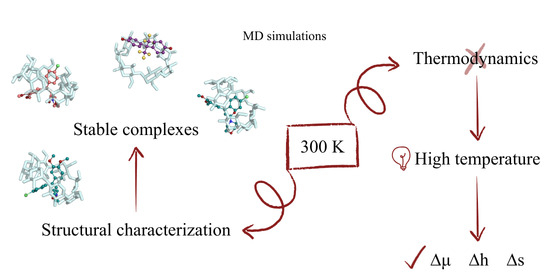
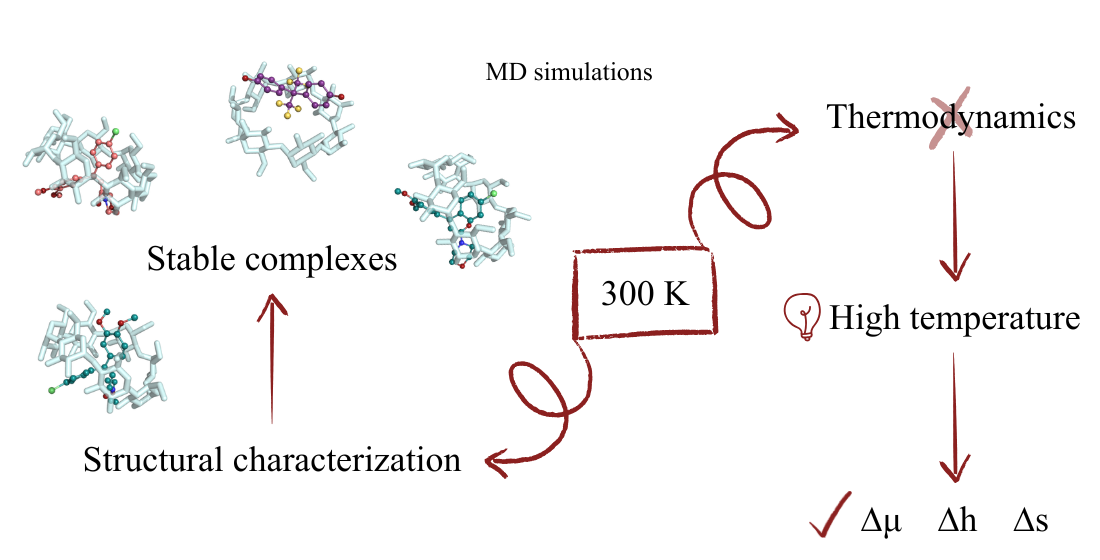
Graphical Abstract

1. Introduction

The development of sustainable and efficient materials for water remediation is one of the main goals of current scientific research [1]. The increase in organic pollutants in natural waters has become a huge environmental problem. Dimethomorph (DMM), a morpholine-based fungicide made of a mixture of E and Z isomers and commonly used in agriculture, is frequently detected in surface and groundwater systems as a consequence of its extensive use and moderate persistence [2,3]. Its presence in the environment has been associated with potential ecotoxicological effects, underlining the need for efficient strategies for its removal [4,5,6]. Additionally, bisphenol A (BPA) and its derivatives are commonly found in food and beverage containers, thermal paper, electronic components, and protective coatings [7]. Due to the large-scale use of these materials, these molecules are continuously released into the environment during production, use, and disposal, resulting in their accumulation in surface waters, groundwater, sediments, and wastewater. These compounds are well known for their endocrine-disrupting activity, since they can interfere with hormonal signal pathways even at low concentrations [8,9].
In recent years, increasing attention has been directed towards the development of sustainable materials for water remediation, due to the growing water pollution and its impact on human health and ecosystems [10]. In this context cyclodextrins and their derivatives have emerged as versatile and highly effective materials, thanks to their ability to form inclusion complexes with a wide variety of toxic pollutants, including dyes, pesticides and pharmaceutical compounds.
Cyclodextrins (CDs) are naturally occurring cyclic oligosaccharides composed of six, seven or eight D-(+)-glucopyranose units, referred to as α -, β - or γ -CDs, respectively, linked through α -(1-4)-glycosidic bonds [11]. They are obtained from the enzymatic degradation of starch and are widely used in several fields, such as the pharmaceutical industry [12] or environmental remediation [13], due to their biodegradability and low toxicity [11,14]. CDs are characterized by a hydrophobic internal core and hydrophilic external surface, which enable the formation of inclusion complexes with a wide range of organic molecules [15].
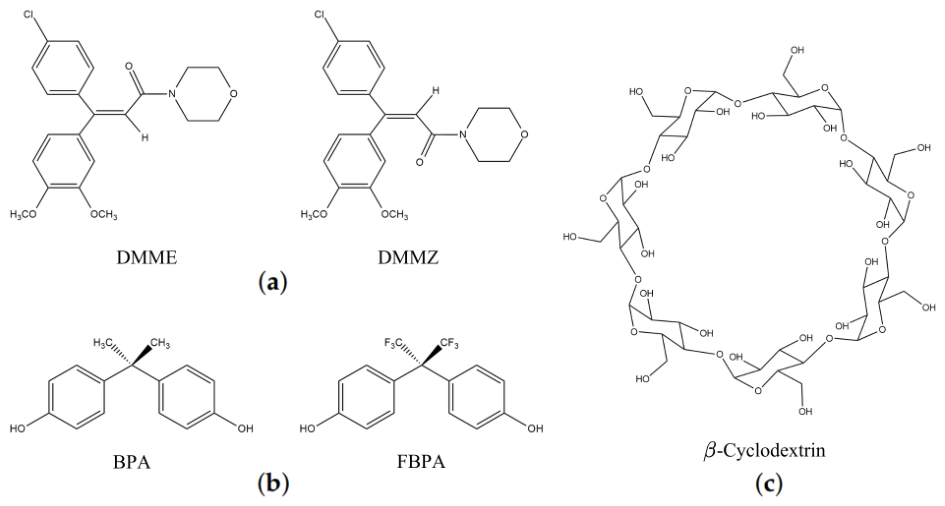
In this work, we carried out a structural and thermodynamic investigation of the host–guest complexes that β -CDs (the most structurally stable native cyclodextrin due to its ring size and intramolecular hydrogen bond network) form with both E and Z isomers of DMM and the fluorinated derivative of BPA, FBPA (fluorinated bisphenol A) (Figure 1). The aim is to understand the binding behavior and the stability of these complexes, contributing to the understanding of β -cyclodextrin-based systems as green materials for water remediation.
Common experimental techniques used to characterize host–guest processes include nuclear magnetic resonance (NMR) [16,17], electrospray mass spectrometry [18], isothermal titration calorimetry (ITC) [17] and fluorescence measurements [16,19]. Since these techniques can be time-consuming and expensive, an accurate molecular-level description of the process can help to predict the interactions that govern host–guest binding.
To this end, molecular dynamics simulations represent one of the most common methods to describe these kinds of processes. However, as the time scale is limited to microseconds, the treatment of the binding processes occurring on longer time scales is virtually inaccessible by such kinds of calculations. To overcome this limitation, we have recently developed and applied a statistical-mechanical approach able to provide the difference between two different thermodynamic states of a system. In that work [20], the two states were the folded and the unfolded states of a small protein, but the same principles can be applied to describe host–guest systems, where the two thermodynamic states are represented by the bound and unbound states. Using such an approach, we reconstructed the thermodynamics along an isobar of the binding behavior of the CD with the two DMM isomers and the FBPA using high-temperature molecular dynamics simulations able to sample several binding–unbinding events, thus giving reliable estimates of the equilibrium populations of the two states.

2. Theory

The thermodynamics of binding have been calculated using our statistical-mechanical approach, which was successfully applied to describe different conformational states of a small protein. Briefly, the differences in the thermodynamic properties between two states (bound and unbound in our case) can be expressed by the following equations:
Δ μ ( T ) = μ ( T ) bound μ ( T ) unbound
Δ μ ( T ) Δ μ 0 + ( T T 0 ) ( Δ c p 0 Δ s 0 ) + T Δ c p 0 ln T 0 T
Δ h ( T ) Δ h 0 + Δ c p 0 ( T T 0 )
Δ s ( T ) Δ h 0 T 0 Δ c p 0 ln T 0 T
Δ c p ( T ) Δ c p 0
The subscript 0 indicates the value of the thermodynamic quantity at a reference temperature T 0 and μ , h, s, and c p are the chemical potential, enthalpy, entropy, and heat capacity, respectively. Now, from the knowledge of the free energy differences at (at least) three different temperatures, it is possible to estimate Δ h 0 , Δ c p 0 , Δ s 0 , and thus reconstruct the thermodynamics in terms of temperature along the selected isobar. In this way, exploiting the fast kinetics of the binding and unbinding processes at high temperatures, reliable estimates of the bound and unbound populations can be easily obtained by means of MD simulations on the order of microseconds and an estimation of Δ μ ( T ) (see Section 3). The thermodynamics at standard temperature can then be calculated using Equations (2)–(5). More details on the mathematical treatment used to derive the above expression can be found in our previous work [20].

3. Materials and Methods

The following host–guest reaction
Host + Guest Complex
between β -cyclodextrin and the two DMM isomers or FBPA was studied by means of molecular dynamics simulations. As stated before, reaction (6) at room temperature is not compatible with the molecular dynamics time scale. However, the thermodynamics at every temperature can be estimated using the statistical-mechanical-based approach briefly outlined in the Theory Section. To apply such an approach, MD simulations at high temperatures are required in order to get the difference in free energy between the bound and the unbound states for at least three temperatures. One molecule of β -cyclodextrin and one molecule of the guest molecule were placed in a cubic box at random relative orientations, separated by at least 1.5 nm. The box was then filled with water molecules (using the Simple Point Charge model (SPC) water model [21]). Energy minimization was performed using the steepest descent algorithm. After thermalization, the box size was adjusted to achieve a pressure of 560 bar, the pressure at which the SPC model has a density corresponding to the experimental density of water [22]. MD simulations of 3 microseconds were performed at different temperatures (in the range of 440–500 K) in an NVT ensemble under periodic boundary conditions. The temperature was kept constant using the V-rescale thermostat [23]. The stochastic velocity-rescaling (Bussi) algorithm was used as it has a smaller cost than Nosé–Hoover and better temperature control than the Langevin algorithm [24]. The topology files were obtained through the CHARMM-GUI [25] platform, and the MD simulations were performed using the GROMACS-2019 [26] software package and CHARMM36 [27] as the force field, using a 2 fs time step integration. The C-H bonds were constrained using the LINCS algorithm [28]. The cutoff for electrostatic and van der Waals interactions was 1.1 nm and cross-interaction parameters were determined using the Lorentz–Berthelot combining rules. Long-range interactions were evaluated with the particle mesh Ewald method [29,30]. The partial molecular free energy variation at high temperatures (440, 460, 480, and 500 K) was calculated using the relation
Δ μ ( T ) = R T ln K e q ( T )
where K e q is given by
K e q = P b P n b
and P b and P n b are the populations of the bound and unbound states sampled at each temperature. The statistical errors on Δ μ were estimated by dividing the trajectory into three independent blocks (1 μ s each) and computing the standard deviation ( σ ) of the resulting Δ μ values. The value of Δ μ at 300 K was obtained independently for each block, and the associated uncertainty was estimated as the standard deviation of these values. The values reported in the tables are given as mean ± σ corresponding to an approximate 68% confidence interval. All the σ values are reported in the Supplementary Information.

4. Results and Discussion

A set of molecular dynamics simulations performed at different temperatures (300, 440, 460, 480 and 500 K) combined with the thermodynamic equations described in the previous section allowed us to completely characterize the binding behavior of β -cyclodextrin with bimethomorph and the bisphenol A derivative (FBPA). The distance between the β -CD center of geometry (cog) and the center (cog) of DMM or FBPA along the MD trajectories has been used to distinguish between the bound and unbound states, allowing us to determine the formation of the complexes.

4.1. Dimethomorph

4.1.1. Structural Characterization

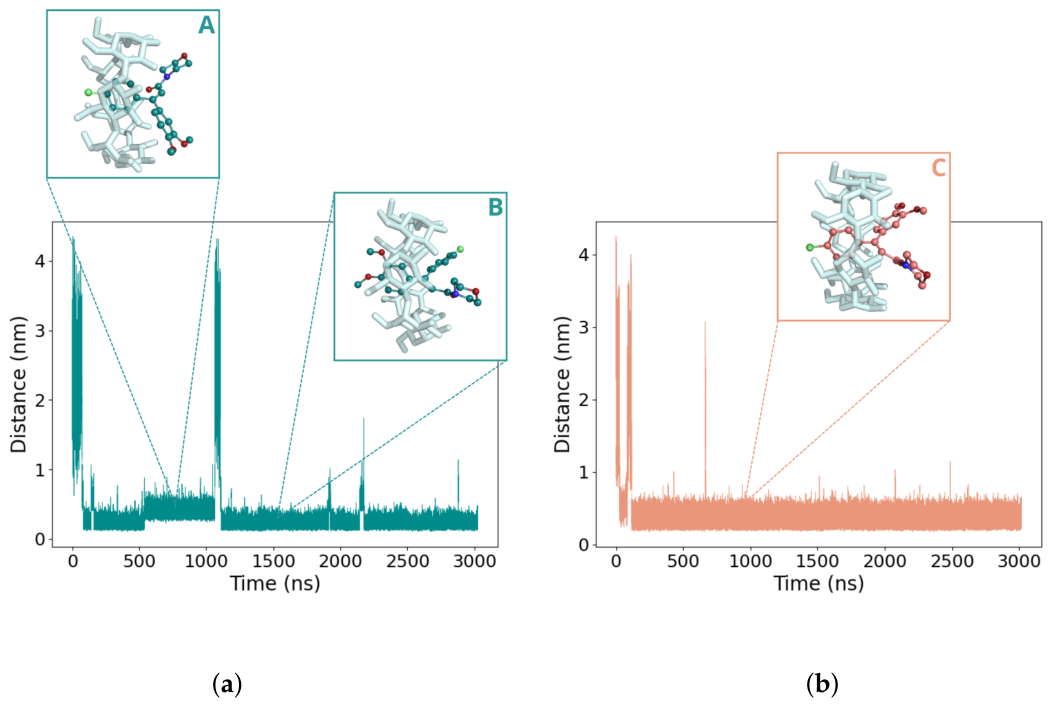
To characterize the structure of the complexes between DMM E and Z isomers and β -CD, MD simulations at 300 K were performed and analyzed. Interestingly, the structural analysis of the β -CD-DMME and β -CD-DMMZ showed a different binding behavior between the E and Z isomers (Figure 2). For the DMME isomer, two complexes were observed: one characterized by the interaction between the β -CD core and the chlorophenyl ring (A complex) and the other by the interaction between the β -CD core and the dimethoxyphenyl group (B complex). For the DMMZ isomer, only the A complex was observed. A threshold value of 0.8 nm has been used to discriminate between the bound and the unbound states.

4.1.2. Thermodynamics

At room temperature, the molecular dynamics time scale does not allow for describing the host–guest process correctly, as few transitions between the bound and unbound states are observed (see Figure 2). Therefore, this binding behavior does not allow the estimation of the bound and unbound populations needed for the calculation of the equilibrium binding constant K e q . Hence, a series of MD simulations were performed at higher temperatures, where the binding kinetics is faster and thus a reliable estimate of the populations of the bound and unbound state is possible (see the number of transitions in Table 1 and the distance between cog in the Supplementary Information).
The distances between the β -CD-DMM cog along the MD trajectories at 440, 460, 480, 500 K were monitored (see figures in the Supplementary Information) and a threshold value of 0.8 nm was used to discriminate the bound and unbound states of the complexes, respectively, for both the E and Z isomers. The populations of bound and unbound states were used to calculate the K e q reported in Table 1.
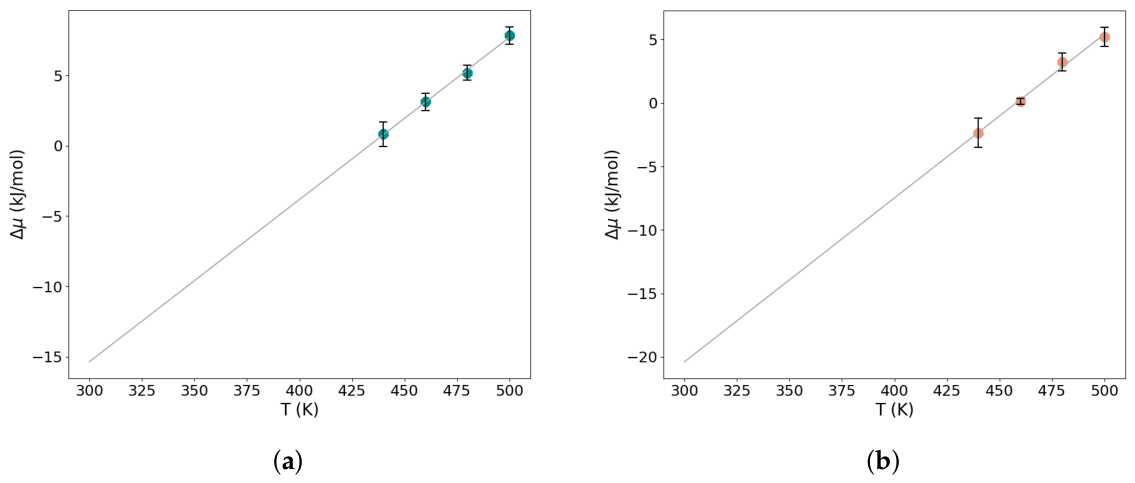
The binding free energy Δ μ was calculated for the host–guest binding reaction using Equation (7) and is reported in Table 1. The dependency of Δ μ on T is quasi-linear (see Figure 3) as described by Equation (2) under the condition that Δ c p 0 .
By means of this model, the Δ μ , Δ s , and Δ h at T = 300 K were estimated for both the DMME and DMMZ isomers. In Table 2 we report the thermodynamic properties of the two complexes. Our results, in line with the experimental estimates [31], confirm that the binding process is driven by the favorable interactions taking place when the DMM is in the cavity of the host molecules, resulting in an enthalpic gain, which overcompensates the unfavorable entropy loss. Note that in the fitting procedure, we considered the Δ c p = 0 for the estimation of the delta free energy of the reaction at T = 300 K. Our results, reported in Table 2, are in good agreement with the experimental values [31].
It is worth noting that the experimental thermodynamic values represent an average of the two isomers, whereas our computational approach provides a thermodynamic characterization of both β -CD-DMME and β -CD-DMMZ complexes.

4.2. Fluorinated Bisphenol A

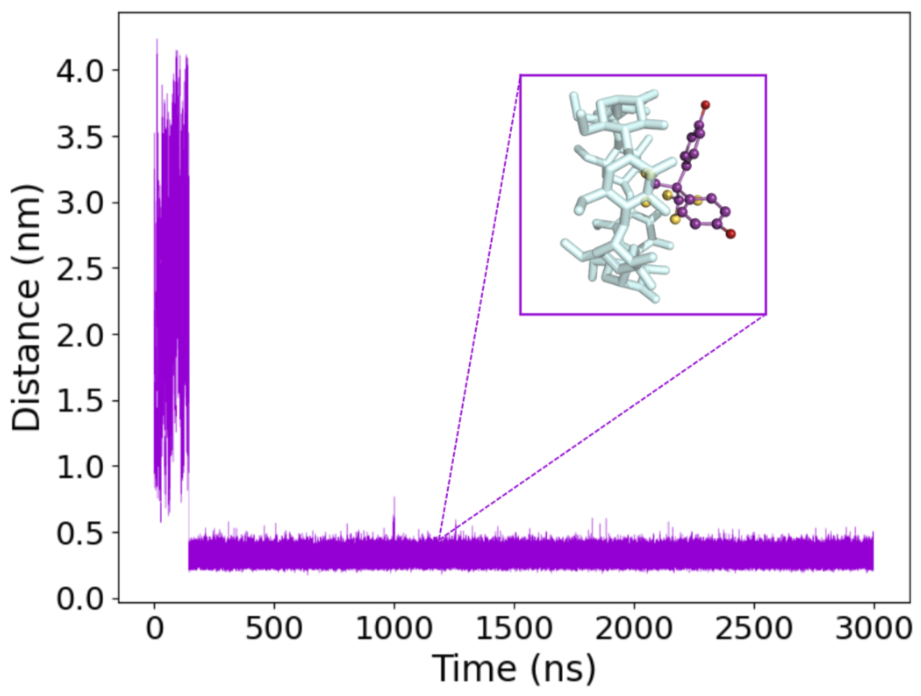
At 300 K, the FBPA molecule is able to form only a single type of complex with β C D , as shown in Figure 4.
Similarly to β -CD-DMM complexes, we performed a set of MD simulations to investigate the thermodynamics of the reaction. Since the host–guest binding process is not compatible with the molecular dynamics time scale at room temperature, a series of MD simulations in the same range as DMM were performed. As seen in Table 3, this set of temperatures provides a reasonable number of transitions, thus allowing us to estimate the binding constant K e q .
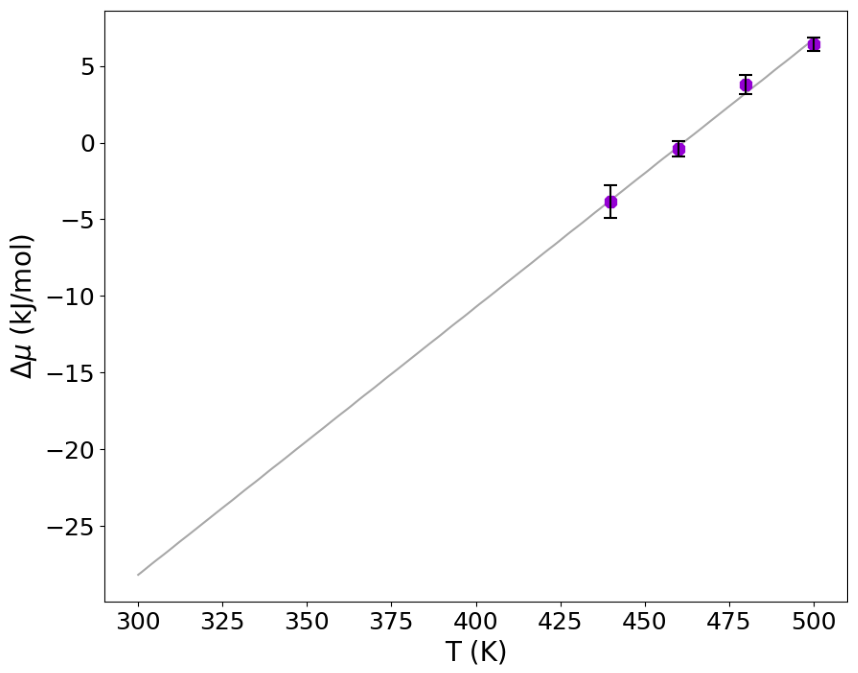
We used the same protocol as for DMM isomers to estimate the entire thermodynamic behavior of the complex, considering Δ c p = 0 (Figure 5).
Similarly to the DMM complexes, the β -CD-FBPA binding behavior is also driven by the enthalpy, which overcompensates for the entropic loss due to the formation of the complex.
However, as shown in Table 4, our delta free energy values are in good agreement with the experimental ones available in the literature [32].

5. Conclusions

In this work, we entirely characterized the host–guest interaction at 300 K of β -cyclodextrins and two pollutant molecules (DMM and FBPA) using a statistical-mechanics-based model applied to an extended set of all-atom molecular dynamics simulations. Our results, in line with the available experimental data, underlined the possibility of studying the thermodynamics of slow processes (such as the host–guest interaction) at a reference temperature, where it is not possible to achieve several binding–unbinding transitions.

Supplementary Materials

The following supporting information can be downloaded at https://www.mdpi.com/article/10.3390/chemengineering10060070/s1. Figure S1: Distances between the geometrical center (cog) of the DMMZ isomer and the cog of β -CD along the dynamics at high temperature (440, 460, 480, 500 K); Figure S2: Distances between the geometrical center (cog) of the DMMZ isomer and the cog of β -CD along the dynamics at high temperature (440, 460, 480, 500 K); Figure S3: Distances between the geometrical center (cog) of the FBPA molecule and the cog of β -CD along the dynamics at high temperature (440, 460, 480, 500 K); Figure S4: Histogram of the distances between the geometrical center (cog) of the chlorophenyl group of the DMME molecule and the cog of β -CD along the dynamics at 300 K; Figure S5: Histogram of the distances between the geometrical center (cog) of the chlorophenyl group of the DMMZ molecule and the cog of β -CD along the dynamics at 300 K; Figure S6: Histogram of the distances between the geometrical center (cog) of the FBPA molecule and the cog of β -CD along the dynamics at 300 K; Table S1: Here we report the results of the block analysis that was performed to estimate the error on Δ μ values.

Author Contributions

Conceptualization, S.E.M., P.D.G., I.N. and M.D.; methodology, P.D.G. and G.C.; formal analysis, G.C.; investigation, G.C.; resources, S.E.M.; data curation, I.N.; writing—original draft, G.C. and M.D.; writing—review and editing, G.C., I.N. and M.D.; supervision, M.D. All authors have read and agreed to the published version of the manuscript.

Funding

S.E.M. thanks Sapienza for the Visiting Professor fellowship. I.N. thanks the French National Research Agency (ANR) through the France 2030 program [Reference: ANR-16-IDEX-003]. Funded by the European Union—NextGenerationEU, Mission 4, Component 1, CUP B53C23002160006.

Data Availability Statement

The original contributions presented in this study are included in the article/Supplementary Material. Further inquiries can be directed to the corresponding author.

Conflicts of Interest

The authors declare no conflicts of interest.

References

  1. Elgarahy, A.M.; Elwakeel, K.Z.; Akhdhar, A.; Hamza, M.F. Recent advances in greenly synthesized nanoengineered materials for water/wastewater remediation: An overview. Nanotechnol. Environ. Eng. 2021, 6, 9. [Google Scholar] [CrossRef]
  2. Zhang, Y.; Zhou, L.; Wang, C.; Liu, S. Synergistic antifungal effect and potential mechanism of Dimethomorph combined with Pyrimethanil against Phytophthora capsici. Food Chem. 2024, 457, 140158. [Google Scholar] [CrossRef] [PubMed]
  3. Liang, H.; Li, L.; Li, W.; Wu, Y.; Zhou, Z.; Liu, F. Dissipation and residue of dimethomorph in pepper and soil under field conditions. Ecotoxicol. Environ. Saf. 2011, 74, 1331–1335. [Google Scholar] [CrossRef]
  4. Fan, R.; Zhang, W.; Jia, L.; Li, L.; Zhao, J.; Zhao, Z.; Peng, S.; Chen, Y.; Yuan, X. Combined developmental toxicity of the pesticides difenoconazole and dimethomorph on embryonic zebrafish. Toxins 2021, 13, 854. [Google Scholar] [CrossRef] [PubMed]
  5. European Food Safety Authority (EFSA); Alvarez, F.; Arena, M.; Auteri, D.; Binaglia, M.; Castoldi, A.F.; Chiusolo, A.; Colagiorgi, A.; Colas, M.; Crivellente, F.; et al. Peer review of the pesticide risk assessment of the active substance dimethomorph. EFSA J. 2023, 21, e08032. [Google Scholar] [CrossRef]
  6. Wang, C.; Zhang, Q.; Wang, F.; Liang, W. Toxicological effects of dimethomorph on soil enzymatic activity and soil earthworm (Eisenia fetida). Chemosphere 2017, 169, 316–323. [Google Scholar] [CrossRef] [PubMed]
  7. Eladak, S.; Grisin, T.; Moison, D.; Guerquin, M.J.; N’Tumba-Byn, T.; Pozzi-Gaudin, S.; Benachi, A.; Livera, G.; Rouiller-Fabre, V.; Habert, R. A new chapter in the bisphenol A story: Bisphenol S and bisphenol F are not safe alternatives to this compound. Fertil. Steril. 2015, 103, 11–21. [Google Scholar] [CrossRef]
  8. Rubin, B.S. Bisphenol A: An endocrine disruptor with widespread exposure and multiple effects. J. Steroid Biochem. Mol. Biol. 2011, 127, 27–34. [Google Scholar] [CrossRef]
  9. Moreman, J.; Lee, O.; Trznadel, M.; David, A.; Kudoh, T.; Tyler, C.R. Acute toxicity, teratogenic, and estrogenic effects of bisphenol A and its alternative replacements bisphenol S, bisphenol F, and bisphenol AF in zebrafish embryo-larvae. Environ. Sci. Technol. 2017, 51, 12796–12805. [Google Scholar] [CrossRef]
  10. Syeda, S.E.Z.; Nowacka, D.; Khan, M.S.; Skwierawska, A.M. Recent advancements in cyclodextrin-based adsorbents for the removal of hazardous pollutants from waters. Polymers 2022, 14, 2341. [Google Scholar] [CrossRef]
  11. Del Valle, E.M. Cyclodextrins and their uses: A review. Process Biochem. 2004, 39, 1033–1046. [Google Scholar] [CrossRef]
  12. Loftsson, T.; Jarho, P.; Másson, M.; Järvinen, T. Cyclodextrins in drug delivery. Expert Opin. Drug Deliv. 2005, 2, 335–351. [Google Scholar] [CrossRef]
  13. Tian, B.; Hua, S.; Tian, Y.; Liu, J. Cyclodextrin-based adsorbents for the removal of pollutants from wastewater: A review. Environ. Sci. Pollut. Res. 2021, 28, 1317–1340. [Google Scholar] [CrossRef]
  14. Kurkov, S.V.; Loftsson, T. Cyclodextrins. Int. J. Pharm. 2013, 453, 167–180. [Google Scholar] [CrossRef] [PubMed]
  15. Loftsson, T.; Duchene, D. Cyclodextrins and their pharmaceutical applications. Int. J. Pharm. 2007, 329, 1–11. [Google Scholar] [CrossRef]
  16. Schneider, H.J.; Blatter, T.; Simova, S. Host guest chemistry. 26. NMR and fluorescence studies of cyclodextrin complexes with guest molecules containing both phenyl and naphthyl units. J. Am. Chem. Soc. 1991, 113, 1996–2000. [Google Scholar] [CrossRef]
  17. Xing, S.; Zhang, Q.; Zhang, C.; Zhao, Q.; Ai, H.; Sun, D. Isothermal Titration Calorimetry and Theoretical Studies on Host-guest Interaction of Ibuprofen with α-, β-and γ-Cyclodextrin. J. Solut. Chem. 2009, 38, 531–543. [Google Scholar] [CrossRef]
  18. Blair, S.M.; Kempen, E.C.; Brodbelt, J.S. Determination of binding selectivities in host-guest complexation by electrospray/quadrupole ion trap mass spectrometry. J. Am. Soc. Mass Spectrom. 1998, 9, 1049–1059. [Google Scholar] [CrossRef]
  19. Novo, M.; Granadero, D.; Bordello, J.; Al-Soufi, W. Host–guest association studied by fluorescence correlation spectroscopy. J. Incl. Phenom. Macrocycl. Chem. 2011, 70, 259–268. [Google Scholar] [CrossRef]
  20. D’Abramo, M.; Del Galdo, S.; Amadei, A. Theoretical–computational modelling of the temperature dependence of the folding–unfolding thermodynamics and kinetics: The case of a Trp-cage. Phys. Chem. Chem. Phys. 2019, 21, 23162–23168. [Google Scholar] [CrossRef]
  21. Berendsen, H.J.; Grigera, J.R.; Straatsma, T.P. The missing term in effective pair potentials. J. Phys. Chem. 1987, 91, 6269–6271. [Google Scholar] [CrossRef]
  22. Del Galdo, S.; Marracino, P.; D’Abramo, M.; Amadei, A. In silico characterization of protein partial molecular volumes and hydration shells. Phys. Chem. Chem. Phys. 2015, 17, 31270–31277. [Google Scholar] [CrossRef] [PubMed]
  23. Bussi, G.; Donadio, D.; Parrinello, M. Canonical sampling through velocity rescaling. J. Chem. Phys. 2007, 126, 014101. [Google Scholar] [CrossRef]
  24. Shiraishi, K.; Minamitani, E.; Kim, K. Benchmarking thermostat algorithms in molecular dynamics simulations of a binary Lennard-Jones glass-former model. J. Chem. Phys. 2026, 164, 164501. [Google Scholar] [CrossRef]
  25. Jo, S.; Kim, T.; Iyer, V.G.; Im, W. CHARMM-GUI: A web-based graphical user interface for CHARMM. J. Comput. Chem. 2008, 29, 1859–1865. [Google Scholar] [CrossRef] [PubMed]
  26. Abraham, M.J.; Murtola, T.; Schulz, R.; Páll, S.; Smith, J.C.; Hess, B.; Lindahl, E. GROMACS: High performance molecular simulations through multi-level parallelism from laptops to supercomputers. SoftwareX 2015, 1–2, 19–25. [Google Scholar] [CrossRef]
  27. Huang, J.; MacKerell, A.D., Jr. CHARMM36 all-atom additive protein force field: Validation based on comparison to NMR data. J. Comput. Chem. 2013, 34, 2135–2145. [Google Scholar] [CrossRef]
  28. Hess, B.; Bekker, H.; Berendsen, H.J.; Fraaije, J.G. LINCS: A linear constraint solver for molecular simulations. J. Comput. Chem. 1997, 18, 1463–1472. [Google Scholar] [CrossRef]
  29. Essmann, U.; Perera, L.; Berkowitz, M.L.; Darden, T.; Lee, H.; Pedersen, L.G. A smooth particle mesh Ewald method. J. Chem. Phys. 1995, 103, 8577–8593. [Google Scholar] [CrossRef]
  30. Darden, T.; York, D.; Pedersen, L. Particle mesh Ewald: An N log (N) method for Ewald sums in large systems. J. Chem. Phys. 1993, 98, 10089–10092. [Google Scholar] [CrossRef]
  31. Xiao, Y.-M.; Wang, J.; Wang, M.-A.; Liu, J.-P.; Yuan, H.-Z.; Qin, Z.-H. Study on the inclusion complexes of flumorph and dimethomorph with β-cyclodextrin to improve fungicide formulation. J. Chem. Soc. Pak. 2010, 32, 363–369. [Google Scholar]
  32. Chelli, S.; Majdoub, M.; Jouini, M.; Aeiyach, S.; Maurel, F.; Chane-Ching, K.I.; Lacaze, P.C. Host–guest complexes of phenol derivatives with β-cyclodextrin: An experimental and theoretical investigation. J. Phys. Org. Chem. 2007, 20, 30–43. [Google Scholar] [CrossRef]
Figure 1. Molecular structures of the E/Z isomers of dimethomorph (DMME and DMMZ, respectively; chemical formula: C21H22ClNO4) (a), bisphenol A (BPA, chemical formula: C15H16O2) and its fluorinated derivative (FBPA, chemical formula: C15H10F6O2) (b) and β -cyclodextrin ( β -CD, chemical formula: C42H70O35) (c).
Chemengineering 10 00070 g001
Figure 2. Distances between the geometrical center (cog) of DMME (green) and DMMZ (orange) isomers and the cog of β -CD along the dynamics at T = 300 K . The figure shows a schematic representation of the complexes with the E and Z isomers, respectively. Two different orientations for DMME are observed, where the cyclodextrin forms the host–guest binding with the chlorophenyl group (A) and the dimethoxyphenyl group (B), respectively (a), whereas the interaction between β -CD and DMMZ occurs only through the chlorophenyl group (C) (b).
Chemengineering 10 00070 g002
Figure 3. Binding free energies of the β -CD–DMME (a) and β -CD–DMMZ (b) host–guest complexes. The Δ μ values were fitted as a function of temperature by least-squares regression as implemented in SciPy. The line represents the binding free energy values predicted by our model (considering Δ c p = 0 ) along the isobar. The points are obtained from the populations of the bound and unbound forms as obtained by MD simulations.
Chemengineering 10 00070 g003
Figure 4. Distances between the geometrical center (cog) of FBPA and the cog of β -CD along the dynamics at T = 300 K . The complex is considered bound when the distance between the centers of geometry of the two molecules is below the threshold value of 0.8 nm.
Chemengineering 10 00070 g004
Figure 5. Binding free energies of the β -CD–FBPA host–guest complex. The Δ μ values were fitted as a function of temperature by least-squares regression as implemented in SciPy. The line represents the binding free energy values predicted by our model (considering Δ c p = 0 ) along the isobar. The points are obtained from the populations of the bound and unbound forms as obtained by MD simulations.
Chemengineering 10 00070 g005
Table 1. Equilibrium constants ( K e q ) and binding free energy ( Δ μ ) of the reaction for both the E and Z isomers of dimethomorph and the number of binding/unbinding transitions (n) observed along the MD trajectories.. The statistical error on Δ μ is ≈1 kJ/mol.
DMMEDMMZ
T (K)n K eq Δ μ   (kJ/mol)n K eq Δ μ   (kJ/mol)
44028100.790.8418031.91−2.36
46028490.443.1324840.970.12
48033230.273.2426630.443.24
50030100.157.8427960.295.20
Table 2. Comparison of the theoretical-computational model with the corresponding experimental data for DMM.
DMM Δ μ (kJ/mol) Δ h (kJ/mol) Δ s (kJ/mol K)
DMME (300 K)−15.4 ± 3.1−49.9−0.12
DMMZ (300 K)−20.4 ± 4.8−59.1−0.13
Experimental values [31]
DMM (298 K)−14.3−49.3−0.12
Table 3. Equilibrium constants ( K e q ) for FBPA, calculated from the number of binding/unbinding transitions (n). The statistical error on Δ μ is ≈1 kJ/mol.
T (K)n K eq Δ μ (kJ/mol)
4407912.85−3.83
46013991.11−0.41
48016410.393.79
50018310.216.40
Table 4. Comparison of the theoretical-computational model with the corresponding experimental data for FBPA.
Δ μ (kJ/mol) Δ h (kJ/mol) Δ s (kJ/mol K)
FBPA (300 K)−28.2 ± 2.3−80.5−0.17
Experimental values [32]
FBPA (298 K)−25.6 ± 0.7−100.1−0.25
Disclaimer/Publisher’s Note: The statements, opinions and data contained in all publications are solely those of the individual author(s) and contributor(s) and not of MDPI and/or the editor(s). MDPI and/or the editor(s) disclaim responsibility for any injury to people or property resulting from any ideas, methods, instructions or products referred to in the content.