Standardization of an Effective Disinfection Methodology Against Microorganisms Isolated from a Pharmaceutical Industry Facility as a Contamination Control Strategy

 , , and
Abstract
1. Introduction
2. Materials and Methods
2.1. Bacterial and Fungal Strain Selection and Culture Conditions
2.2. Strains Characterization
2.3. Chemical Agents Tested in Efficacy Test
2.3.1. Carriers’ Preparation
2.3.2. Preparation and Enumeration of Suspension Tests
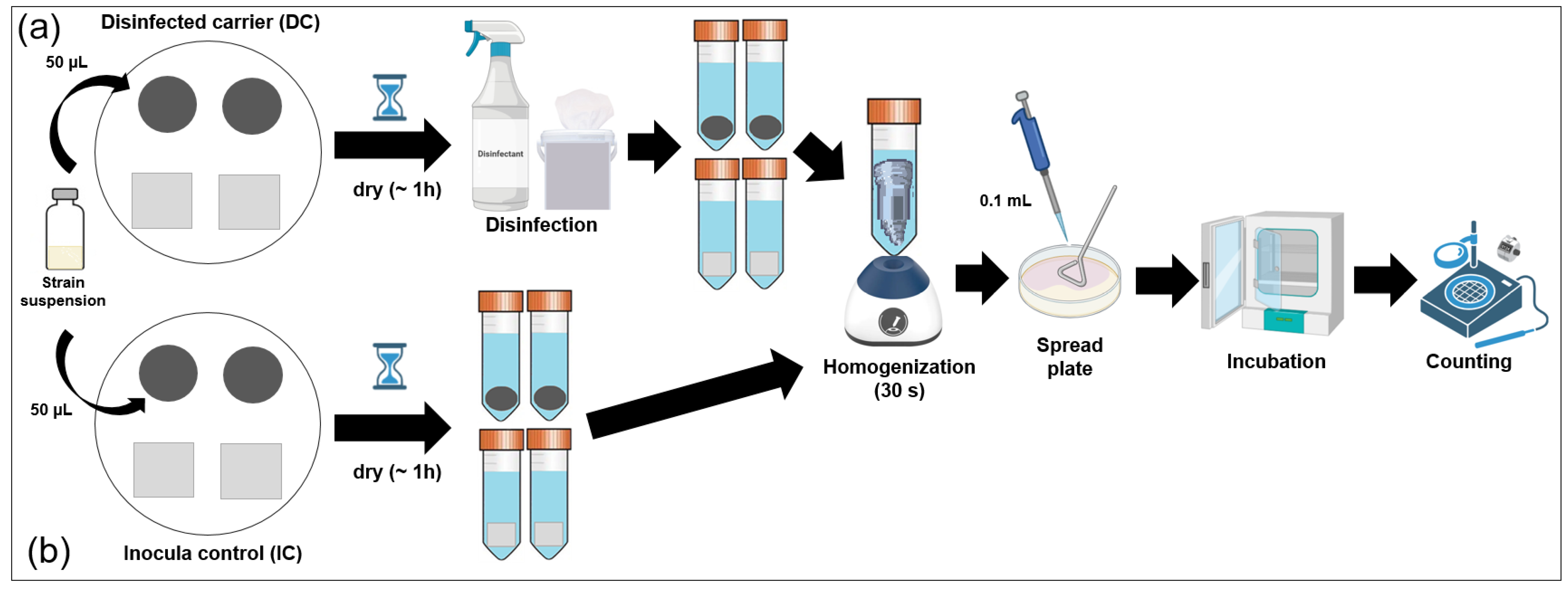
2.3.3. Evaluation of Residue Effect and Efficacy Test
2.3.4. Calculation and Interpretation of the Results
3. Results
3.1. Bacterial and Fungal Strain Selection and Characterization
3.2. Efficacy Test
4. Discussion
5. Conclusions
Author Contributions
Funding
Data Availability Statement
Acknowledgments
Conflicts of Interest
Abbreviations
| CCS | Contamination control strategy |
| EMA | European Medicines Agency |
| EU | European Union |
| GMP | Good Manufacturing Practice |
| LDP | Low-density polyethylene |
| PDA | Parenteral Drug Association |
| SS | Stainless steel |
| USP | United States Pharmacopeia |
References
- United States Pharmacopeia (USP). General Chapter, <1072> Disinfectants and Antiseptics; USP-NF, United States Pharmacopeia: Rockville, MD, USA, 2023. [Google Scholar]
- European Medicines Agency—Science Medicines Health (EMA); European Commission. Guidelines. The Rules Governing Medicinal. Products in the European Union Volume 4 EU. Guidelines for Good Manufacturing Practice for Medicinal Products for Human and Veterinary Use—Annex 1—Manufacture of Sterile Medicinal Products; European Commission: Bruxelles, Belgium, 2022. [Google Scholar]
- World Health Organization. Good Manufacturing Practices for Pharmaceutical Products: Main Principles; Annex 3. WHO Technical Report Series; World Health Organization: Geneva, Switzerland, 2011. [Google Scholar]
- Food and Drug Administration (FDA). Guidance for Industry Sterile Drug Products Produced by Aseptic Processing—Current Good Manufacturing Practice; U.S. Food and Drug Administration: Bethesda, MD, USA, 2004. [Google Scholar]
- Agência Nacional de Vigilância Sanitária (ANVISA). Resolução da Diretoria Colegiada—RDC nº 658, de 30 de Março de 2022. Dispõe Sobre as Boas Práticas de Fabricação de Medicamentos; Diário Oficial da União: Brasília, Brasil, 2022. [Google Scholar]
- Ceccanti, S.; Giampieri, S.; Burgalassi, S. Carrier tests to assess the effective sporicidal concentration of a liquid chemical disinfectant for a sanitization program. PDA J. Pharm. Sci. Technol. 2011, 65, 372–379. [Google Scholar] [CrossRef] [PubMed]
- Ajorio, A.C.F.B.; Rhodes, V.P.; Rodrigues, A.P.; Diniz, V.A.; Mattoso, J.M.V.; da Silva, I.B.; D Aiuto, D.M.M.; Brandão, M.L.L. Evaluation of hydrogen peroxide efficacy against AZD1222 chimpanzee adenovirus strain in the recombinant COVID-19 vaccine for application in cleaning validation in a pharmaceutical manufacturing industry. Lett. Appl. Microbiol. 2022, 74, 536–542. [Google Scholar] [CrossRef] [PubMed]
- Sandle, T. A review of cleanroom microflora: Types, trends, and patterns. PDA J. Pharm. Sci. Technol. 2011, 65, 392–403. [Google Scholar] [CrossRef] [PubMed]
- Kremer, T.; Singer, D.C. Ode to a Sporicide—Can we do better? PDA J. Pharm. Sci. Technol. 2026, 80, 71–76. [Google Scholar] [CrossRef] [PubMed]
- Parenteral Drug Association (PDA). Fundamentals of Cleaning and Disinfection Programs for Aseptic Manufacturing Facilitie; Technical Report No. 70; Parenteral Drug Association (PDA): Bethesda, MD, USA, 2015. [Google Scholar]
- Chalita, M.; Kim, Y.O.; Park, S.; Oh, H.S.; Cho, J.H.; Moon, J.; Baek, N.; Moon, C.; Lee, K.; Yang, J.; et al. EzBioCloud: A genome-driven database and platform for microbiome identification and discovery. Int. J. Syst. Evol. Microbiol. 2024, 74, 6. [Google Scholar] [CrossRef] [PubMed]
- Vu, D.; Groenewald, M.; De Vries, M.; Gehrmann, T.; Stielow, B.; Eberhardt, U.; Al-Hatmi, A.; Groenewald, J.Z.; Cardinali, G.; Houbraken, J.; et al. Large-scale generation and analysis of filamentous fungal DNA barcodes boosts coverage for kingdom Fungi and reveals thresholds for fungal species and higher taxon delimitation. Stud. Mycol. 2019, 92, 135–154. [Google Scholar] [CrossRef] [PubMed]
- NF T 72-281; L’Association Francaise de Normalisation. Procedes de Disinfection des Surfaces par Voie Aerienneedetermination de l’activite Bactericide, Fongicide, Levuricide, Mycobactericide, Tuberculocide, Sporicide et Virucide Incluant les Bacteriophages. AFNOR: Paris, France, 2014.
- Reza, N.; Dubey, V.; Sharland, M.; Hope, W. Antimicrobial use and resistance. BMJ 2025, 391, e082681. [Google Scholar] [CrossRef] [PubMed]
- de Miranda, R.V.D.S.L.; da Costa, L.V.; Albuquerque, L.S.; Dos Reis, C.M.F.; Braga, L.M.P.D.S.; de Andrade, J.M.; Ramos, J.N.; Mattoso, J.M.V.; Forsythe, S.J.; Brandão, M.L.L. Identification of Sutcliffiella horikoshii strains in an immunobiological pharmaceutical industry facility. Lett. Appl. Microbiol. 2023, 76, ovad056. [Google Scholar] [CrossRef] [PubMed]
- Caldeira, N.G.S.; de Souza, M.L.S.; de Miranda, R.V.D.S.L.; da Costa, L.V.; Forsythe, S.J.; Zahner, V.; Brandão, M.L.L. Characterization by MALDI-TOF MS and 16S rRNA Gene Sequencing of Aerobic Endospore-Forming Bacteria Isolated from Pharmaceutical Facility in Rio de Janeiro, Brazil. Microorganisms 2024, 12, 724. [Google Scholar] [CrossRef] [PubMed]
- Costa, L.V.D.; Ramos, J.N.; Albuquerque, L.S.; Miranda, R.V.D.S.L.; Valadão, T.B.; Veras, J.F.C.; Vieira, E.M.D.; Forsythe, S.; Brandão, M.L.L.; Vieira, V.V. Bacillus lumedeiriae sp. nov., a Gram-Positive, Spore-Forming Rod Isolated from a Pharmaceutical Facility Production Environment and Added to the MALDI Biotyper® Database. Microorganisms 2024, 12, 2507. [Google Scholar] [CrossRef] [PubMed]
- Carroll, L.M.; Cheng, R.A.; Wiedmann, M.; Kovac, J. Keeping up with the Bacillus cereus group: Taxonomy through the genomics era and beyond. Crit. Rev. Food Sci. Nutr. 2022, 62, 7677–7702. [Google Scholar] [CrossRef] [PubMed]
- Klugherz, I.; Kölli, B.; Reinmüller, M.; Willinger, B.; Leitner, E.; Steinmetz, I.; Dichtl, K. Identification of Filamentous Fungi: An Evaluation of Three MALDI-TOF Mass Spectrometry Systems. Mycoses 2025, 68, e70078. [Google Scholar] [CrossRef] [PubMed]
- Moreira, F.M.; Pereira, P.A.; Miranda, R.V.D.S.L.; Reis, C.M.F.D.; Braga, L.M.P.D.S.; de Andrade, J.M.; do Nascimento, L.G.; Mattoso, J.M.V.; Forsythe, S.J.; da Costa, L.V.; et al. Evaluation of MALDI-TOF MS, sequencing of D2 LSU rRNA and internal transcribed spacer regions (ITS) for the identification of filamentous fungi isolated from a pharmaceutical facility. J. Pharm. Biomed. Anal. 2023, 234, 115531. [Google Scholar] [CrossRef] [PubMed]
- Leggett, M.J.; McDonnell, G.; Denyer, S.P.; Setlow, P.; Maillard, J.Y. Bacterial spore structures and their protective role in biocide resistance. J. Appl. Microbiol. 2012, 113, 485–498. [Google Scholar] [CrossRef] [PubMed]
- Setlow, P. Spores of Bacillus subtilis: Their resistance to and killing by radiation, heat and chemicals. J. Appl. Microbiol. 2006, 101, 514–525. [Google Scholar] [CrossRef] [PubMed]
- André, S.; Hédin, S.; Remize, F.; Zuber, F. Evaluation of peracetic acid sanitizers efficiency against spores isolated from spoiled cans in suspension and on stainless steel surfaces. J. Food Prot. 2012, 75, 371–375. [Google Scholar] [CrossRef] [PubMed]



| Classification 1 | Chemical Agents | Concentration (%) | Contact Time (min) | Test |
|---|---|---|---|---|
| Sanitizer | Alcohol | 70 | 15 | Bactericidal and yeasticidal activity |
| Disinfectant | Sodium hypochlorite | 0.5 | 15 | Bactericidal and yeasticidal activity |
| Disinfectant | Quaternary ammonium | 0.05 | 20 | Bactericidal and yeasticidal activity |
| Sporicide | Peracetic acid | 0.5 | 10 | Sporicidal and fungicidal activity |
| Sporicide | Oxivir TB Wipes containing accelerated hydrogen peroxide | 0.52 | 5 | Bactericidal, yeasticidal, fungicidal, and sporicidal activity |
| Reference | Application | Microorganisms | Recommended Initial Inoculum (log) | Recommended Reduction (log) |
|---|---|---|---|---|
| NF T 72-281:2014 [13] | Evaluation of airborne surface disinfection in the following sectors: human health; veterinary; and agriculture, food, and industry by physical and/or chemical processes | Vegetative bacteria | ≥6 | ≥5 |
| Bacterial spores | ≥4 | ≥3 | ||
| Yeasts and fungi | ≥5 | ≥4 | ||
| Parenteral Drug Association Technical Report No. 70 [10] | Evaluation of surface disinfection efficacy in production areas of pharmaceutical industries | Non-spore-forming | 3 to 5 | >1 |
| bacteria and fungi spores | ||||
| United States Pharmacopeia [1] | Vegetative bacteria | Not informed | ≥3 | |
| Bacterial spores | ≥2 |
| Microorganisms and Characteristics | Id. | VITEK®2 (%) | VITEK®MS (%) | Molecular Characterization | ||
|---|---|---|---|---|---|---|
| 16S rRNA (Bacteria) or D2 (Fungi) (%) | Size (bp 1) | NCBI Number 2 | ||||
| Bacterial strains | ||||||
| Gram-negative bacilli | B0380/16 | Pseudomonas aeruginosa (99.0) | Pseudomonas aeruginosa (99.0) | Pseudomonas aeruginosa (99.93) | 1433 | OR656695 |
| Gram-negative bacilli | B0747/20 | Acinetobacter baumannii complex (98.0) | Acinetobacter haemolyticus (99.9) | Acinetobacter haemolyticus (99.86)/A. beijerinckii (98.82) | 1470 | OR656731 |
| Gram-positive cocci | B1464/15 | Micrococcus luteus (99.9) | Micrococcus luteus (99.9) | Micrococcus luteus (99.52)/M. porci (98.96)/M. endophyticus (98.94) | 1483 | OR656739 |
| Gram-positive cocci | B1472/15 | Kocuria rosea (99.0) | NI 3 | Kocuria turfanensis (99.52)/K. oceani (98.90) | 1484 | OR656740 |
| Gram-positive bacilli | B1342/15 | Bacillus cereus/thurigiensis/mycoides (88.0) | Bacillus cereus group (99.9) | Bacillus cereus (99.93)/B. paranthracis (99.86)/B. albus (99.86)/B. luti (99.86)/B. nitratireducens (99.86)/B. sanguinis (99.86)/B. dicomae (99.86)/B. basilensis (99.86)/B. wiedmannii (99.79)/B. paramycoides (99.79)/B. tropicus (99.79)/B. anthracis (99.79)/B. proteolyticus (99.73)/B. fungorum (99.73)/B. mobilis (99.66)/B. pacificus (99.66)/B. paramobilis (99.65)/B. toyonensis (99.59)/B. arachidis (99.57)/B. pseudomycoides (99.52)/B. hominis (99.51)/B. mycoides (99.38)/B. gaemokensis (98.90) | 1478 | OR656749 |
| Gram-positive bacilli | B0284/17 | Bacillus pumilus (85.0) | Bacillus pumilus (99.9) | Bacillus safensis subsp. safensis (99.86)/B. safensis subsp. osmophilus (99.86)/B. australimaris (99.71)/B. pumilus (99.64)/B. zhangzhouensis (99.64)/B. altitudinis (99.43)/B. xiamenensis (99.36) | 1403 | OR656689 |
| Fungal strains | ||||||
| Yeast | L-11 | Candida parapsilosis (95.0) | Candida parapsilosis (99.9) | Candida parapsilosis (99.69)/Nakaseomyces glabratus (Candida glabrata) (99.69) | 320 | OR731399 |
| Yeast | L-51 | Cryptococcus laurentii/Rhodotorula mucilaginosa/glutinis (95.0) | Rhodotorula mucilaginosa (99.9) | Rhodotorula mucilaginosa (99.38) | 320 | OR731402 |
| Filamentous fungi | F-21/18 | NA 4 | NI | Penicillium lanosocoeruleum (100)/P. chrysogenum (100)/P. goetzii (100)/P. rubens (100)/P. nalgiovense (100)/P. tardochrysogenum (100)/P. westlingii (100)/P. aurantiogriseum (100) | 324 | OR734960 |
| Strain | Product (Contact Time) | Surface | Log10 CFU 1 (IC 2 Carrier) | Reduction Log10 (CFU/Carrier) |
|---|---|---|---|---|
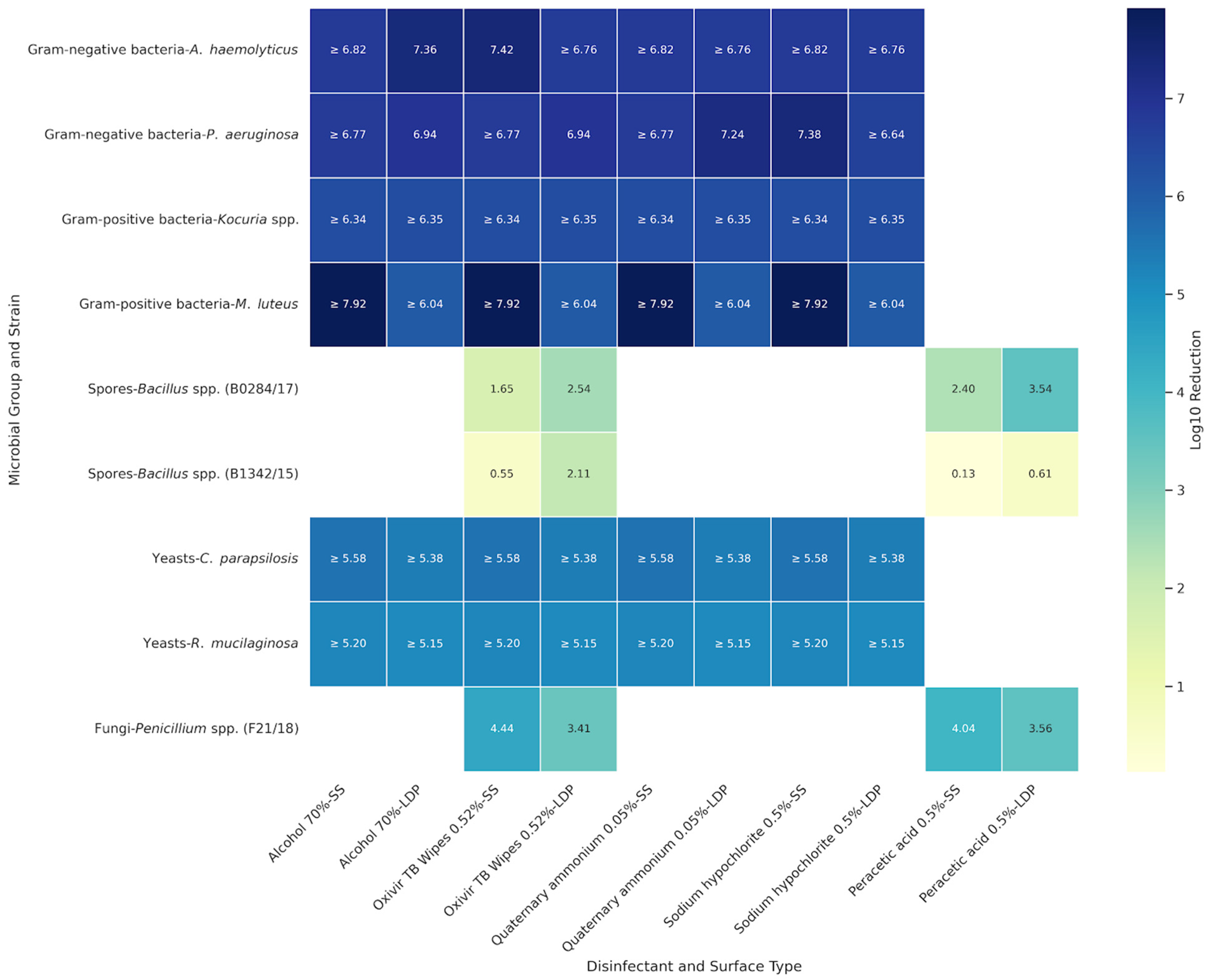
| Pseudomonas aeruginosa (B0380/16) | Alcohol 70% (15 min) | SS 3 | 7.77 | ≥6.77 |
| LDP 4 | 7.64 | 6.94 | ||
| Sodium hypochlorite 0.5% (15 min) | SS | 7.77 | 7.38 | |
| LDP | 7.64 | ≥6.64 | ||
| Quaternary ammonium 0.05% (15 min) | SS | 7.77 | ≥6.77 | |
| LDP | 7.64 | 7.24 | ||
| Oxivir TB Wipes 0.52% (5 min) | SS | 7.77 | ≥6.77 | |
| LDP | 7.64 | 6.94 | ||
| Acinetobacter haemolyticus (B0747/20) | Alcohol 70% (15 min) | SS | 7.82 | ≥6.82 |
| LDP | 7.76 | 7.36 | ||
| Sodium hypochlorite 0.5% (15 min) | SS | 7.82 | ≥6.82 | |
| LDP | 7.76 | ≥6.76 | ||
| Quaternary ammonium 0.05% (15 min) | SS | 7.82 | ≥6.82 | |
| LDP | 7.76 | ≥6.76 | ||
| Oxivir TB Wipes 0.52% (5 min) | SS | 7.82 | 7.42 | |
| LDP | 7.76 | ≥6.76 | ||
| Micrococcus luteus (B1464/15) | Alcohol 70% (15 min) | SS | 8.92 | ≥7.92 |
| LDP | 7.04 | ≥6.04 | ||
| Sodium hypochlorite 0.5% (15 min) | SS | 8.92 | ≥7.92 | |
| LDP | 7.04 | ≥6.04 | ||
| Quaternary ammonium 0.05% (15 min) | SS | 8.92 | ≥7.92 | |
| LDP | 7.04 | ≥6.04 | ||
| Oxivir TB Wipes 0.52% (5 min) | SS | 8.92 | ≥7.92 | |
| LDP | 7.04 | ≥6.04 | ||
| Kocuria spp. (B1472/15) | Alcohol 70% (15 min) | SS | 7.34 | ≥6.34 |
| LDP | 7.21 | ≥6.35 | ||
| Sodium hypochlorite 0.5% (15 min) | SS | 7.34 | ≥6.34 | |
| LDP | 7.21 | ≥6.35 | ||
| Quaternary ammonium 0.05% (15 min) | SS | 7.34 | ≥6.34 | |
| LDP | 7.21 | ≥6.35 | ||
| Oxivir TB Wipes 0.52% (5 min) | SS | 7.34 | ≥6.34 | |
| LDP | 7.21 | ≥6.35 | ||
| Bacillus spp. (B1342/15) | Peracetic acid 0.5% (10 min) | SS | 4.55 | 0.13 |
| LDP | 4.91 | 0.61 | ||
| Oxivir TB Wipes 0.52% (5 min) | SS | 4.55 | 0.55 | |
| LDP | 4.91 | 2.11 | ||
| Bacillus spp. (B0284/17) | Peracetic acid 0.5% (10 min) | SS | 4.50 | 2.40 |
| LDP | 4.54 | 3.54 | ||
| Oxivir TB Wipes 0.52% (5 min) | SS | 4.50 | 1.65 | |
| LDP | 4.54 | 2.54 | ||
| LDP | 4.41 | 3.41 |
| Strain | Product (Contact Time) | Surface | Log10 CFU 1 (IC 2 Carrier) | Reduction Log10 (CFU/Carrier) |
|---|---|---|---|---|
| Candida parapsilosis (L-11) | Alcohol 70% (15 min) | SS 3 | 6.58 | ≥5.58 |
| LDP 4 | 6.38 | ≥5.38 | ||
| Sodium hypochlorite 0.5% (15 min) | SS | 6.58 | ≥5.58 | |
| LDP | 6.38 | ≥5.38 | ||
| Quaternary ammonium 0.05% (15 min) | SS | 6.58 | ≥5.58 | |
| LDP | 6.38 | ≥5.38 | ||
| Oxivir TB Wipes 0.52% (5 min) | SS | 6.58 | ≥5.58 | |
| LDP | 6.38 | ≥5.38 | ||
| Rhodotorula mucilaginosa (L-51) | Alcohol 70% (15 min) | SS | 6.20 | ≥5.20 |
| LDP | 6.15 | ≥5.15 | ||
| Sodium hypochlorite 0.5% (15 min) | SS | 6.20 | ≥5.20 | |
| LDP | 6.15 | ≥5.15 | ||
| Quaternary ammonium 0.05% (15 min) | SS | 6.20 | ≥5.20 | |
| LDP | 6.15 | ≥5.15 | ||
| Oxivir TB Wipes 0.52% (5 min) | SS | 6.20 | ≥5.20 | |
| LDP | 6.15 | ≥5.15 | ||
| Penicillium spp. (F21/18) | Peracetic acid 0.5% (10 min) | SS | 5.44 | 4.04 |
| LDP | 4.41 | 3.56 | ||
| Oxivir TB Wipes 0.52% (5 min) | SS | 5.44 | 4.44 | |
| LDP | 4.41 | 3.41 |
| Standardization Parameter | Recommendation | Rationale |
|---|---|---|
| Selection of isolates | Use “in-house” environmental strains alongside culture collection strains (e.g., ATCC) | Reflects the actual microbiota and potential resistance patterns within the facility |
| Surface representation | Test on different surface types that exist in the pharmaceutical facility | Accounts for surface-specific challenges in disinfectant contact and microbial recovery |
| Carrier-based method | Adopt a standardized inoculum drying time (e.g., 30–60 min) and specific volume (e.g., 10 µL) | Ensures reproducibility and simulates real-world surface contamination |
| Evaluation of residue effect | Mandatory verification of the residue effect on each surface tested | Prevents false-positive results caused by residual effect activity during recovery |
| Microbial loading | Initial inoculum should be similar to the real conditions and should not exceed 105 CFU/mL | The inoculum levels for testing would ideally depict levels seen in the controlled area. However, as this would not be practical in a test environment, a higher inoculum level should be used |
| Acceptance criteria | It varies depending on the standard used | The pharmaceutical industry must apply these criteria in accordance with the standards required to meet regulatory requirements |
Disclaimer/Publisher’s Note: The statements, opinions and data contained in all publications are solely those of the individual author(s) and contributor(s) and not of MDPI and/or the editor(s). MDPI and/or the editor(s) disclaim responsibility for any injury to people or property resulting from any ideas, methods, instructions or products referred to in the content. |
© 2026 by the authors. Licensee MDPI, Basel, Switzerland. This article is an open access article distributed under the terms and conditions of the Creative Commons Attribution (CC BY) license.
Share and Cite
Costa, A.S.; da Costa, L.V.; de Miranda, R.V.d.S.L.; Valadão, T.B.; Forsythe, S.J.; Brandão, M.L.L. Standardization of an Effective Disinfection Methodology Against Microorganisms Isolated from a Pharmaceutical Industry Facility as a Contamination Control Strategy. Standards 2026, 6, 22. https://doi.org/10.3390/standards6020022
Costa AS, da Costa LV, de Miranda RVdSL, Valadão TB, Forsythe SJ, Brandão MLL. Standardization of an Effective Disinfection Methodology Against Microorganisms Isolated from a Pharmaceutical Industry Facility as a Contamination Control Strategy. Standards. 2026; 6(2):22. https://doi.org/10.3390/standards6020022
Chicago/Turabian StyleCosta, Amanda Silva, Luciana Veloso da Costa, Rebeca Vitória da Silva Lage de Miranda, Talita Bernardo Valadão, Stephen James Forsythe, and Marcelo Luiz Lima Brandão. 2026. "Standardization of an Effective Disinfection Methodology Against Microorganisms Isolated from a Pharmaceutical Industry Facility as a Contamination Control Strategy" Standards 6, no. 2: 22. https://doi.org/10.3390/standards6020022
APA StyleCosta, A. S., da Costa, L. V., de Miranda, R. V. d. S. L., Valadão, T. B., Forsythe, S. J., & Brandão, M. L. L. (2026). Standardization of an Effective Disinfection Methodology Against Microorganisms Isolated from a Pharmaceutical Industry Facility as a Contamination Control Strategy. Standards, 6(2), 22. https://doi.org/10.3390/standards6020022