Article

Toward Standardized UV-C Exposure Methods for Polymeric Materials: Coordinated Multi-Laboratory Evaluation and Material Response


1
Seal Shield, 2240 Lane Avenue North, Suite 106, Jacksonville, FL 32254, USA
2
Department of Environmental Health Sciences, University at Albany, Albany, NY 12222, USA
3
Department of Environmental and Sustainable Engineering, University at Albany, Albany, NY 12222, USA
4
Syensqo SA, Rue de la Fusée 98, 1130 Brussels, Belgium
5
Center for Lighting Enabled Systems & Applications, Rensselaer Polytechnic Institute, Troy, NY 12180, USA
6
Department of Civil and Environmental Engineering, Vancouver Campus, University of British Columbia, Vancouver, BC V6T1Z2, Canada
7
Uniphy Ltd., Unit 11 Bowman Ct, Whitehill Ln, Royal Wootton Bassett, Swindon SN4 7DB, UK
8
A3 Lighting Consulting, Lake Forest, CA 92630, USA
9
The Lighting Industry Association, Stafford Park 7, Telford TF3 3BQ, UK
10
The Boeing Company, Seattle, WA 98124, USA
11
LANXESS Corporation, 2 Armstrong Road, Shelton, CT 06484, USA
12
RTP Company, 580 East Front Street, Winona, MN 55987, USA
13
Ushio America, Inc., 5440 Cerritos Avenue, Cypress, CA 90630, USA
14
Aquisense Technologies, 4400 Olympic Blvd., Erlanger, KY 41018, USA
15
Royal Philips, Tussendiepen 4, 9206 AD Drachten, The Netherlands
16
Solenis, 1300 Altura Road, Suite 125, Fort Mill, SC 29708, USA
17
Uglum Consulting, LLC, Indianapolis, IN 46202, USA
*
Author to whom correspondence should be addressed.
Standards 2026, 6(2), 23; https://doi.org/10.3390/standards6020023
Submission received: 9 December 2025 / Revised: 22 February 2026 / Accepted: 5 March 2026 / Published: 1 June 2026

Abstract

Germicidal UV (GUV) technology, which utilizes light in the UV-C portion of the electromagnetic spectrum, has become a viable alternative to traditional chemical disinfectants to sanitize surfaces in the built environment. However, the degradation of polymers that have been exposed to UV-C light is a concern due to the potential change in structural integrity and visual appearance. The resistance to UV-C degradation is often tabulated in relative qualitative terms, making it rather difficult for designers to understand the implications of the choice of a material of construction. This study was initiated to develop a systematic, standardized method of exposing polymeric materials to UV-C light to ensure that the subsequent property measurements can be compared quantitatively. The exposure method is based on an apparatus that can be readily duplicated using commercially available materials and equipment. To demonstrate the proposed exposure framework, samples of six formulated polymer resins were exposed to three UV-C light sources with different peak wavelengths (KrCl excimer lamp [222 nm], low-pressure mercury lamp [254 nm], and LED lamp [280 nm]). Exposures were conducted at five independent laboratories, and subsequent property testing was performed at multiple facilities using established materials-characterization methods. This coordinated approach enables comparative evaluation of material responses across UV-C source types, wavelengths, and dose levels, providing a practical foundation for developing standardized exposure methodologies and informing future formulation development efforts. Post-exposure testing included quantifying changes in optical, mechanical, and physical properties, including color, gloss, reflectivity, spectral transmittance (haze), flammability, tensile strength, and elastic modulus. These measurements were conducted using established laboratory methods commonly employed throughout the polymer and materials industries. Together, these results provide a comparative dataset illustrating how polymer properties respond to coordinated UV-C exposure conditions, supporting the development of standardized approaches for evaluating material durability in germicidal UV applications.

Graphical Abstract

1. Introduction

The COVID-19 pandemic revitalized public interest in germicidal ultraviolet (GUV) technology as an effective means of disinfecting the air and surfaces with which the public comes into contact [1,2]. The healthcare industry is now adopting GUV technology for use in public spaces, patient rooms, and operating rooms [3]. GUV units can be applied in air recirculation systems and in the headspace of a room to inactivate airborne pathogens [4,5]. These units were historically used in hospitals with significant success [6]. Whole-room GUV units can also be used as part of terminal cleaning protocols [7] to replace manual chemical disinfection procedures, which are by nature both time and labor intensive. Additionally, GUV cabinets are commonly used to sanitize or disinfect smaller high-touch devices to reduce the potential effects of cross-contamination [8]. Applications of GUV technology outside of healthcare facilities include schools, universities and colleges, aircraft, office buildings, food-service establishments, factories, and more throughout the built environment. The market for GUV technology is expected to grow steadily for the next several years as employers and building managers attempt to reduce the lingering effects of the pandemic and to mitigate the impact of absences due to SARS-CoV-2, flu viruses, rhinoviruses, and other airborne pathogens [9]. Facilities provided for public access such as hospitals, public transportation terminals and vehicles, shopping malls, and indoor water theme parks can facilitate the transmission of a variety of air and surface borne pathogens. Many of these facilities have complex designs that preclude the use of overhead illumination due to the production of shadows. To address this, some facility managers utilize manual application methods that are both time consuming and labor intensive. They can also result in chemical exposures to the employees engaged in these activities. In response, the technology sector has developed UV disinfection robots that can roam the layout of a facility to apply UV light to locations that would otherwise not be possible [10,11].
This renewed interest in UV-C disinfection has raised questions regarding the broader effects of UV light on materials, particularly those materials commonly found in the built environment. Ultraviolet light in general has the potential to degrade polymers and other organic materials with the effects that are dependent on the UV-C source (and the corresponding portion of the UV spectrum) used, light intensity, exposure time, and the chemical characteristics of the material [12]. The degradation of polymers is important from a material longevity perspective, as it affects the service life of structures and equipment. The visual characteristics of materials are also important, as perceptions of structural integrity, safety, and even cleanliness are often based on appearance alone. However, whether those changes in appearance correspond to an effect on the structural/mechanical integrity is not immediately obvious.
As GUV equipment is applied in the built environment, there will be a commensurate interest in specifying construction/manufacturing materials that resist the effects of UV-C degradation. Previous studies have provided an understanding regarding certain aspects of UV-C degradation phenomena [13]. However, they do not provide a standard method by which materials are to be exposed to UV-C so that the effects of their degradation can be quantitatively compared among the wide variety of materials that are available. Currently, many vendor publications provide only qualitative descriptions of UV compatibility. The lack of a standard testing method for quantifying and comparing UV-C exposure conditions has made choosing appropriate materials for new construction difficult [3]. Therefore, a standardized method of exposing, testing, and reporting the effects of UV-C on materials will provide designers with a rational means of making material choices for both product development and construction.
To address this, a collaborative study was initiated by a working group within the International Ultraviolet Association (IUVA), which is a group of industrial, government, and academic organizations with the mission of sharing the goal of advancing the science, engineering, and applications of ultraviolet technologies to enhance the quality of human life and to protect the environment. During the COVID-19 pandemic, the IUVA supported research into the application of UV-C light to reduce the risk of SARS-CoV-2 transmission and understand the secondary effects of UV-C light on materials.
This study is concerned with the foundational work required for the development and demonstration of a standard method of exposing polymer samples to UV-C, resulting in a means of producing reproducible, analytical, and quantitative results to determine the effects of UV-C exposure. The method will be demonstrated on several commercially formulated polymeric materials. The effects that will be quantified for comparison include changes in color, gloss, reflectivity, spectral transmittance (haze), flammability, tensile strength, and elasticity modulus.

2. Fundamentals of UV-C Disinfection

2.1. Historical Context

The UV-C band of light consists of wavelengths from 200 nm to 280 nm, and is adjacent to the UV-B and -A ranges that together extend from 280 nm to 400 nm. UV light was first used as a disinfectant in medical practice over 120 years ago, and won Niels Finsen the 1903 Nobel Prize for his work treating Lupus vulgaris [14]. In the first half of the 20th century, UV-C light sources were used in hospitals and schools in the United States to combat airborne pathogens [15,16]. However, widespread use of antibiotics and vaccinations in the 1960s and 70s resulted in the declining use of GUV technology [16]. More recently, the most common application of UV disinfection has been in the water treatment industry for both drinking and recreational water. In 2006, the US EPA published the Long Term 2 Enhanced Surface Water Treatment Rule (LT2) [17] to address organisms such as Cryptosporidium oocysts, which are highly resistant to traditional chemical disinfection practices.
The New York State Department of Health was the first regulatory agency in the United States to promulgate regulations that mandate the use of GUV technology to address chlorine-resistant microorganisms in recreational water spray grounds [18]. This was in response to a literature review and an outbreak of cryptosporidiosis that was associated with a spray ground [19]. An additional benefit of treating recreational water with UV-C is that it decomposes eye and skin irritating disinfection byproducts such as mono-, di-, and, trichloramine [20].
GUV technology has provided some water treatment plant operators with a ready means for complying with LT2 for their systems, allowing operators to reduce or eliminate the use of chlorine as the primary disinfectant at the plant. However, chlorine is still required in the distribution system piping to suppress the regrowth of microorganisms in the water and the development of biofilm on the pipe walls. Eliminating chlorine as the primary disinfectant may also reduce the formation of disinfection byproducts (DBPs) which are also a potential health risk [21,22]. Drawbacks to UV-C disinfection of water include increased energy costs for treatment, significant capital and maintenance costs, additional monitoring requirements, and greater engineering involvement. Data suggest that medium pressure UV-C lamps cause radical side reactions that increase the quantity of active chlorine in the water, thereby increasing the concentration of chloroform and bromodichloromethane byproducts [23].
A significant barrier to widespread adoption of GUV technology for water disinfection was the need for standardized methods for process validation, equipment installation, and monitoring. The US EPA made a significant contribution to the industry by providing a standardized framework for validating UV-C reactors, which provides a means of determining the operating conditions under which the equipment will deliver various degrees of disinfection performance [24,25]. Overall, GUV technology has several benefits when used in drinking and recreational water applications including few known disinfection byproducts, rapid disinfection kinetics, the ready implementation of equipment into new and existing treatment processes, high efficacy, and quantifiable treatment using readily measured process parameters [24]. Some of these same attributes can be recognized for the treatment of air and surfaces in the built environment. However, there exist other barriers to implementation that do not exist in the treatment of water.

2.2. UV-C Mechanism of Action

The mechanism by which UV-C inactivates microorganisms is through damage of the genetic material and proteins [26]. Absorbed UV-C light causes six types of damage to the thymine and cytosine DNA bases [27,28,29]. The most common form of damage occurs when dimers are formed between adjacent pyrimidines (thymine or cytosine bases) on the same DNA or RNA strand [24]. Protein and DNA crosslinks also occur due to UV-C exposure [30]. UV-C light also damages the genetic material of a microorganism via the dimerization of thymine and uracil bases. This renders the microorganism unable to transcribe some proteins or replicate its genetic material. In this condition, the organism is considered to be inactivated, as it continues to live, but it cannot reproduce or cause an infection and ultimately dies. Inactivation occurs after around 100 dimers are formed [31].
Ultraviolet light in the wavelength range of 200 to 300 nm is considered germicidal, and the peak energy absorption of DNA and RNA occurs around 265 nm [24,32,33]. Microorganisms have varying sensitivities to UV-C light depending on their structural and chemical makeup [24,34]. In some cases, the process of disinfection is complicated by the repair mechanisms performed by some microorganisms where they selectively undo the UV-C-induced genetic damage [35,36,37]. For this reason some organisms and viruses require a large dose in order to effect sufficient genetic damage for which the repair mechanisms cannot compensate [24,38]. Additional data demonstrate how some organisms and surrogates have sensitivity to wavelengths below the values where DNA/RNA absorb most effectively [26,39,40]. The response of microorganisms to the so-called “far UV-C” area of the spectrum generated by excimer lamps, which have a peak output at 222 nm, is not as well-understood, though the mechanisms are expected to be relatively similar. Far UV-C disinfection is an ongoing field of study [3,31,41].

2.3. Material Degradation Effects from UV Exposure

The effects of UV light on polymeric materials occur via several mechanisms including the initiation of reactions, cross-linking, or breaking chemical bonds thereby leading to material damage. These processes are generally well-understood [42,43]. However, mid- and long-term material degradation effects from photons in the UV-C band are not well-known. Since Earth’s atmosphere filters out photons from the UV-C band, material degradation from these photons is often not relevant compared to other modes of aging or degradation.
The mechanism of material degradation occurs at the molecular level via the absorption of UV-C photons and electron excitation. With sufficient energy, the result is the production of free radicals, breakdown of molecular bonds, and reduction of the average molecular weight of the polymer chains in the substrate. The photochemical reaction in a polymer proceeds by a free radical process where the absorption of a photon initiates a chain reaction mechanism that is determined in part by the duration and intensity of exposure to UV light [44].
Several studies have examined UV-C degradation mechanisms and the rate of decomposition. Yates et al. studied the effects of UV-C on various aircraft materials to determine whether UV-C disinfection would affect aircraft cabins, concluding that there was little risk of degradation given the expected exposure conditions [45]. Mitxelena-Iribarren et al. considered the possible effects of UV degradation from whole-room disinfection equipment, concluding that while appearance was affected, the mechanical strength loss was not substantial given their protocols [46]. Kaewkam et al. studied the effects of UV degradation on LDPE films infused with TiO2 as a photocatalytic initiator [47]. Their work demonstrated how the photocatalytic process due to the presence of TiO2 assisted in the degradation of plastic film. Askola et al. and Kwon et al. observed degradation of LED and OLED performance, due to damage from UV-C sources [48,49]. Akbay and Ozdemir noted the degradation of polycarbonate from UV exposure in consumer products [50]. Various groups have studied the use of GUV technology for disinfecting and reusing N95 and K95 respirators with attention given to material degradation [51,52,53,54].
There are some growing concerns about the secondary chemistry effects from prolonged far UV-C exposure (222 nm sources) in the built environment. Graeffe et al. found that high-intensity UV-C sources substantially increased the concentration of air particulates and evolved gas species [55]. Ozone production and resultant byproducts of secondary chemistries remain another cause for concern, and ongoing work from other groups is investigating these effects [56,57,58].
Existing measurements are informative from a qualitative perspective. However, they cannot be compared readily, as they are typically not obtained using a systematic, standardized, and reproducible exposure method that produces readily comparable results for UV-C sources. Moreover, only recently has GUV technology been considered for widespread, persistent use in the modern built environment, rendering it a newly relevant concern for material selection. Among the problems with choosing a construction material is the unqualified method of characterizing UV-C resistance. Many material specifications provide a qualitative/relative listing of general UV resistance with little detail regarding the conditions under which this characterization was made.

3. Materials and Methods

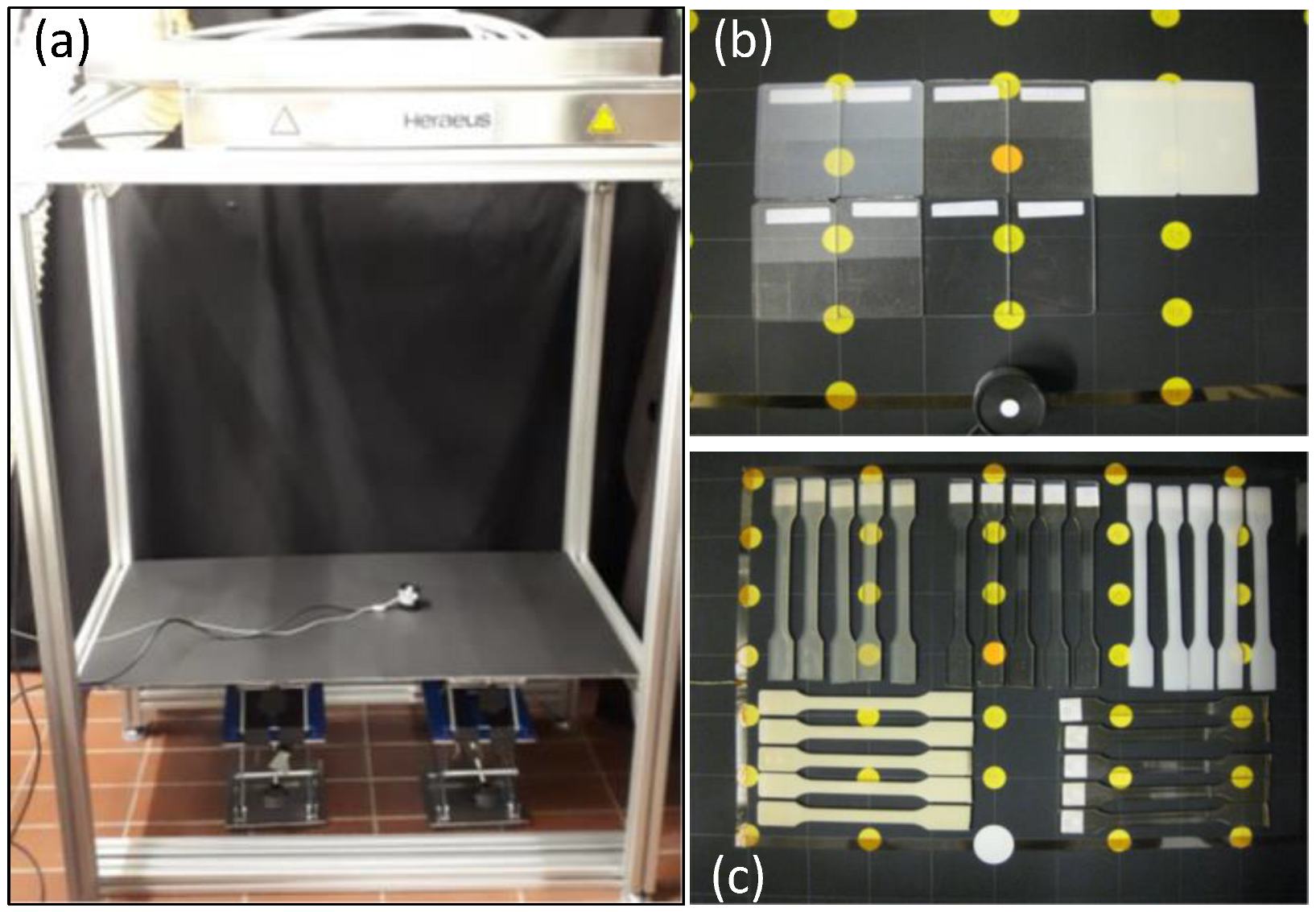
The effects of UV-C light on polymeric materials are determined by their chemical properties, the UV spectrum of the radiation, and the dose provided to the sample. A standardized exposure method/apparatus has been developed using readily available materials and components as shown in Figure 1a. A schematic of the apparatus is also shown in Figure S1 of the Supplementary Material. The exposure apparatus consisted of a lower platform of adjustable elevation on which samples were placed for UV-C exposure. A UV-C source was fixed to an upper structural member above the platform to allow the UV-C source to produce light normal to the sample surface. Using a radiometer, the irradiance (intensity) was recorded on the coupon platform surface directly under the center of the UV-C source with this spot marked as the center of the template. Irradiance was measured at the sample plane using radiometers equipped with cosine-corrected photodiode sensors. All instruments used by participating laboratories were NIST-traceable at the relevant UV-C wavelength and had been calibrated within the preceding two years.
While monitoring the irradiance, the elevation of the platform was raised or lowered until the value fell in the acceptable range of 1.0 mW/cm2 (1.0 mJ/cm2 per second) ± 10%. The height between the UV-C source and the sample surface was measured and recorded. A 3 × 3 grid was established to allow for nine sample coupons to be exposed at one time without overlap (see Figure 1b).
Next, dosimeter cards (Intellego Technologies, Stockholm, Sweden) were placed across the exposure area and exposed to the UV source for 50 s for a dose of 50 mJ/cm2 to assess exposure uniformity. An alternative embodiment of the exposure apparatus may include the use of a collimated beam apparatus to further improve the uniformity of the UV-C irradiance on the sample platform. The stated irradiance of 1.0 mW/cm2 ± 10% was used for all exposures regardless of the UV-C wavelength. This ±10% range served as the practical uniformity criterion for the exposure field. The dosimeter cards were removed and compared to the color chart to validate the radiometer measurements and exposure uniformity.
The UV-C exposure platform was divided into a 3 × 3 grid pattern, allowing for a total of nine sample coupons to be exposed at the same time. Eight samples were placed around the center sample where the radiometry was validated as shown in Figure 1b,c. A fan was installed to maintain a constant sample surface temperature and to convey away any evolved chemicals such as ozone. The method/apparatus was reproduced at five independent exposure laboratories as listed in Table S1 in the Supplementary Material. Subsequent to exposure, the samples were tested at several external facilities (as listed in Table S2 in the Supplementary Material) for quantitative comparison.
The materials evaluated in this study are summarized in Table 1, which serves as the primary reference for material designations and identifiers. Six formulated polymer resins were selected for this study based on their common use in cabinetry and furnishings found in a wide range of commercial facilities, including healthcare, hospitality, transportation, and retail stores, where there would be a high potential for UV-C exposure during disinfection. The materials include three formulations of polycarbonate (Lexan FST9705, Lexan ML 4539, and Makrolon 2558), two formulations of PVC (PVC and Kydex 6565) and one formulation of acrylic (PMMA). Of the materials tested, polyvinyl chloride (PVC) is found ubiquitously throughout the drinking water, recreational water, and wastewater environments [59]. The details and sources of the tested materials are listed in Table 1.
The material samples were exposed to commonly used or emerging UV-C radiation sources including a KrCl excimer lamp (peak wavelength 222 nm [60]), low-pressure mercury lamps (peak wavelength 254 nm [17,24,61]), and an LED source (peak wavelength 280 nm [62]). Five laboratories exposed the samples to varying doses (see Table S1 in the Supplementary Material). All irradiance measurements were obtained using the calibrated radiometric systems described above. All radiometers had a NIST-traceable calibration at the peak UV-C wavelength and had been calibrated in the prior two years.
UV-C doses of 30 J/cm2, 150 J/cm2, and 500 J/cm2 were employed by exposing the samples with an irradiance of 1.0 mW/cm2 and exposure times of 8.33 h, 41.7 h, and 139 h, respectively. These doses were based on several factors, including typical “frequency of use” patterns, dosages necessary to kill/inactivate common human pathogens on environmental surfaces with an appropriate log reduction, daily disinfection protocols, and a reasonable estimate of material product life [34]. For example, a UV-C dose of 0.01 J/cm2 (10 mJ/cm2) should provide a 3-log reduction (99.9%) of SARS-CoV-2 [1,2] or Staphylococcus aureus [34]. Estimating 300 uses per year and an expected asset life of 10 years, a cumulative dose of approximately 30 J/cm2 would be anticipated. At the other extreme, greater UV-C exposure over time might be encountered for the dose necessary to inactivate/kill more resistant organisms, such as Clostridioides difficile, with exposure occurring several times per day over a longer time period, so testing was also performed at a dose of 500 J/cm2 [34]. The organisms that a facility expects to face significantly influence the choice of UV-C source and total dose and therefore the material degradation that can incur during the disinfection process. This emphasizes the importance of properly understanding the range of doses and potential degradation effects.
All material samples were fabricated by a task force participant (RTP Company, Winona, MN, USA) into either rectangular sample coupons ( L × W × D , 3 in × 2 in × 0.125 in) or tensile bars ( L × W × D , 170 mm × 20 mm × 4 mm), as described in ISO 527-1 [63] type 1a, which were then sent to separate exposure laboratories [63]. Technical staff wore gloves when handling samples before and after UV-C exposure, consistent with ASTM G147 [64]. An electronic thermometer with a fine gauge thermocouple was used to measure temperature during the test exposure. One thermocouple was attached to the surface of the center sample with polyimide tape. Another thermocouple was affixed to a sample of the same material being tested adjacent to the center piece to monitor the temperature and to ensure isothermal conditions existed across the exposed surface. During exposure, cooling fans were used as needed to maintain a temperature of 25 °C ± 5 °C. The cooling fans also provided sufficient airflow to sweep any ozone away from the test coupons. During exposure, a hygrometer was used to monitor and record the relative humidity to verify that conditions were comparable among laboratories. Relative humidity was not specified as a controlled parameter, and exposures were conducted under typical indoor laboratory conditions at each site. After exposure, each sample coupon was placed in a polyethylene or polypropylene zip-top bag and stored in a climate-controlled space before being shipped to the designated testing facilities. Efforts were made to minimize sample abrasion during handling, storage, and shipping.
The sample coupons were run in duplicate for each material at each facility for the three UV-C dosages of 30 J/cm2, 150 J/cm2, and 500 J/cm2. Unexposed samples were kept for comparison as controls. This process was repeated for each UV-C source (KrCl excimer, low-pressure Hg, and UV LED). The sample exposure platform had sufficient space to expose nine samples at a time. Therefore, the samples were run in batches of nine. A set of five tensile bars from each material type was tested at a cumulative exposure of 500 J/cm2 along with a set of unexposed control samples for baseline comparison.
All exposed and control samples were sent to the testing laboratories listed in Table S2 for testing and analysis as described below. Additional notes on UV-C exposure method/apparatus construction and use are available in this paper’s Supplementary Material. Unexposed control samples were included in the testing analysis to establish baseline material properties and to enable the interpretation of exposure-induced changes, rather than to assess interlaboratory measurement variability.

3.1. Color Change

Polymers exposed to UV-C light often manifest a change in color due to degradation. Color change has been associated with the absorption of UV-C light by chemical bonds, which initiates surface oxidation and some degree of photo-oxidative degradation [42]. Color measurements were made at Syensqo (Testing Lab 1) using a X-Rite (Grand Rapids, MI, USA) Color i7800 spectrophotometer in the CIELAB color scale with 10° standard observer, specular component included under illuminant A. At Boeing (Testing Lab 4), color measurements were made using a Konica Minolta (Ramsey, NJ, USA) CM3700A integrating sphere spectrophotometer, in the CIELAB [65] color space with 10° standard observer and the specular component included under illuminant A. Readings were taken using the standard L * C * H notation specified by CIELAB. The color difference ( Δ E C M C * ) was calculated using the equation specified in ASTM D2244 [66] where
Δ E C M C * = Δ L * l S L 2 + Δ C * c S C 2 + Δ H * S H 2
and the color parameters S L , S c , and S H were defined using values that are within the industrially accepted ranges. The values of Δ E C M C * were then obtained from the measured L * C * H values of the sample and reference materials. The calculated quantity Δ E C M C * is a dimensionless quantity. The average person will not notice a Δ E C M C * of less than approximately two to three and, depending upon the application, changes of less than six may be acceptable. For more information, the interested reader is referred to Delgado-González et al. [67].

3.2. Gloss Change

Specular gloss changes are typically the result of a change in the surface roughness of a material. In traditional weathering studies, this can be caused by erosion, hydrolysis from exposure to light and water, or mechanical degradation such as crazing, micro-cracking, or pitting. Similarly, UV-C degradation can cause reduction in gloss via crazing, micro-cracking, and pitting but can also result in powdery degradation byproducts. The type of UV-C mediated damage and the mechanism by which it occurs is dependent upon the polymer formulation. Surfaces can be examined microscopically to determine which type of surface degradation is causing the gloss change; however, this analysis was beyond the scope of this study.
In this study, gloss change was characterized using ASTM D523 [68]. Gloss (reported in spectral gloss units, GLU) is measured using an arbitrary scale, with zero being a surface with no reflected light, and 100 set as the reflection from a defined standard surface. The standard allows for measurements of specular reflectance at three different angles (20°, 60°, and 85°), although in this study, only 60° was used.

3.3. Reflectivity

Reflectivity, or reflectance, is a measure of the ability of a surface to reflect radiation. In this study, reflectivity (of visible wavelengths) provides an additional indication of the surface changes of a material after they have been exposed to UV-C. Reflectivity was characterized using ASTM F1252, [69] which measures reflected light from substantially flat samples made from transparent materials.

3.4. Spectral Transmittance

Light transmittance describes the amount of light energy that a material absorbs, reflects, and scatters, which is the ratio of the amount of light energy incident on a surface to that transmitted through it. When this quantity is measured with respect to the wavelength, it is referred to as spectral transmittance. Variations in the spectral transmittance due to UV-C exposure can be due to changes in surface roughness or volume scattering. Since UV-C penetration depth in polymers is relatively low, changes in light transmittance are mainly attributed to changes in surface roughness. Spectral transmittance was characterized in this study using ASTM E903 [70]. The Lexan ML 4539 samples were omitted from transmittance studies due to a limitation of laboratory capacity.

3.5. Flammability

Flame spread or propagation across a surface is an important property, as there are many commercial applications where it must be demonstrated that materials continue to meet the flammability requirements over their expected lifetime. The impact of UV-C light on the flammability properties of polymers is not well-known [71]. Commercial suppliers provided fully formulated thermoplastic sheets for our study, which were then cut to standard test coupon sizes. Testing Lab 4 created test coupons measuring 3.0 in × 12.0 in × 0.125 in from each sample sheet for UV-C exposure. Of the six previously noted polymers in this study, Lexan FST9705 was omitted from the flammability test due to exposure space constraints. The minimum UV-C dose for test coupons was 500 J/cm2 from a 222 nm light source. After exposure, the test specimens were conditioned at 70° ± 5° F and 50% ± 5% relative humidity for a minimum of 24 h prior to flammability testing. Control samples were stored inside a dark cabinet at ambient temperature and pressure prior to testing.
Flammability is measured using the 60-s vertical Bunsen burner (VBB) test as defined in 14 CFR 25.853(a) [72]. This test method measures the propensity of a material to self-extinguish or to allow flames to spread once it has been ignited. The test procedure entails placing a sample in a Bunsen burner flame in a vertically aligned position at the central bottom edge of the sample’s front face. The flame is applied for 60 s and then pulled away from the sample. The three burn test parameters include burn length (BL), self-extinguishing time (SET), and drip. The burn length represents the amount of time required for the flame to travel six inches. The self-extinguishing time represents the amount of time the test coupon continues to burn after the sample is removed from the Bunsen burner flame. The drip observations record whether or not the material drips as it burns.

3.6. Tensile Strength and Modulus of Elasticity

The effect of UV-C induced polymer degradation on mechanical properties is important from health and safety and equipment service life perspectives. For this reason, tensile strength and modulus of elasticity were determined to be the most relevant mechanical properties that determine the structural integrity of a piece of equipment manufactured from a polymer that is exposed to UV-C.
The quantitative mechanical stress–strain response was characterized using ISO 527-2 [73] (with a type 1a tensile bar, see Figure 1c). To perform these tensile tests, the “dumbbell-shaped”, which are also called, “dog bones” test specimens were placed in the grips of a universal testing machine (UTM) and subjected to controlled stress until they failed. The applied stress was varied by specimen type to achieve a 1%/min strain rate, and an extensometer was used to measure the stress–strain parameters. The resulting tensile test data were used to report both tensile strength and modulus of elasticity. The modulus of elasticity is the rate of the stress to the amount of strain at the failure point where
λ M E = stress strain

4. Results and Discussion

This study used the aforementioned quantitative techniques to analyze the effects of UV-C exposure on several visual and mechanical properties of six polymer formulations. The effects of UV-C on each of the measured properties is discussed individually below.
The results presented here are discussed primarily in terms of material-response behavior under coordinated UV-C exposure conditions, rather than as a formal assessment of interlaboratory quality-control performance. This emphasis highlights differences in polymer response across UV-C wavelength, source type, and dose, and demonstrates the need for standardized exposure methodologies. The present work therefore focuses on identifying response trends and practical considerations that inform ongoing efforts toward standard development, while comprehensive interlaboratory variance analysis remains a subject for future study. Please note that a significant number of tables and figures are contained in the Supplementary Section.

4.1. Color Change

Color change has been determined to be an early indicator of surface degradation due to UV-C. The parameter Δ E C M C * (Equation (1)) provides a quantitative measurement of the relative change in color among the materials tested and the applied doses. A summary of the data is provided in Table 2 and is shown plotted in Figure S2. The values of Δ E C M C * are expressed in color change “units” and represent the averages of the measurements that were made at both laboratories (Testing Lab 1, Syensqo and Testing Lab 4, Boeing). These comparisons are presented to illustrate relative material sensitivities under coordinated exposure conditions, rather than to rank exposure laboratories or quantify interlaboratory variability. The measured values were consistent and therefore the presented values are representative of the measurements that were made. They are tabulated in Table 2 and visualized in Figure S2.
The measured values of Δ E C M C * for the tested materials ranged between 1.5 and 48 color units. As noted previously, a color change is noticeable for values of Δ E C M C * of greater than approximately 2 or 3. As shown in Table 2 and Figure S2, the majority of the exposed samples would have changed color a sufficient amount to be visually apparent. However, the samples of Makrolon 2558 and PMMA that were given doses of 30 and 150 J/cm2 exhibited color changes that would be barely noticeable.
For most samples, the relative color change increased with dose, except for Lexan ML 4539, which exhibited a decrease in the value of Δ E C M C * between the applied doses of 150 and 500 J/cm2. The change in color for all of the materials tested was not linearly proportional to the applied dose of UV-C. More specifically, the magnitude of the color change corresponding to an applied dose of 30 J/cm2 was followed by a smaller incremental change for the 150 and 500 J/cm2 doses. The precise reason for the decreasing color change with dose has yet to be determined conclusively. One theory is that this effect is most pronounced in a thin surface layer due to the low penetration depth of the UV-C photons. An alternative theory is that the degradation products protect the material underneath thereby reducing the amount of color change due to degradation.
The color change experienced by the PVC samples was by far the most significant, where the values of Δ E C M C * were between five and ten times the values for most of the other samples. The significant change in color of exposed PVC, relative to the other materials tested, is consistent with field experience with UV reactors (water disinfection units). Engineers have noted Sch 40 PVC pipe (typically white in color) changes color soon after system startup and that the plastic becomes brittle and “chalky”. Pipe bursts have been known to occur due to degraded pipe material. This results in the need for the Sch 40 PVC piping to be replaced within a couple of years of its installation [74].

4.2. Gloss Change

Surface degradation manifests as a change in the specular gloss of a surface, which can represent several different decomposition mechanisms. The gloss retention was calculated by dividing the gloss value for an exposed sample by the value that corresponds to an unexposed sample. Gloss retention values of approximately 90% or higher would typically not be discernible to the human eye. Although gloss was measured at the dose intervals of 30, 150, and 500 J/cm2, only the gloss value that corresponds to 500 J/cm2 is shown in Table 3 for the sake of brevity. The specular gloss of the exposed samples did not change significantly. A gloss retention of >85% was measured for all of the samples tested with the exception of PVC, which exhibited a gloss retention as low as 57%. Contrary to our expectations, some samples exhibited an increase in specular gloss for some of the samples of polycarbonate (Lexan FST9705 & Macrolon 2558) and acrylic (PMMA). The observed increases in gloss for some materials may reflect changes in surface roughness, cleaning effects, or other surface phenomena; additional surface characterization would be required to determine the underlying mechanism.
Of the combinations of material and light sources tested, PVC exhibited the greatest reduction in gloss for exposure to 222 nm UV-C (UV-C Lab 3 and Lab 4) and 254 nm (UV-C Lab 2). There is a single inconsistency in the change in gloss for PVC for the exposure to 222 nm UV-C between the two exposure facilities (Lab 3 and Lab 4). Further measurements will be needed to resolve this discrepancy.
In summary, the majority of samples either lost very little or gained a small amount of gloss between the unexposed and exposed conditions. PVC appears to be the most sensitive to specular gloss change after exposure to UV-C. This is consistent with the findings of color change for PVC.

4.3. Reflectivity

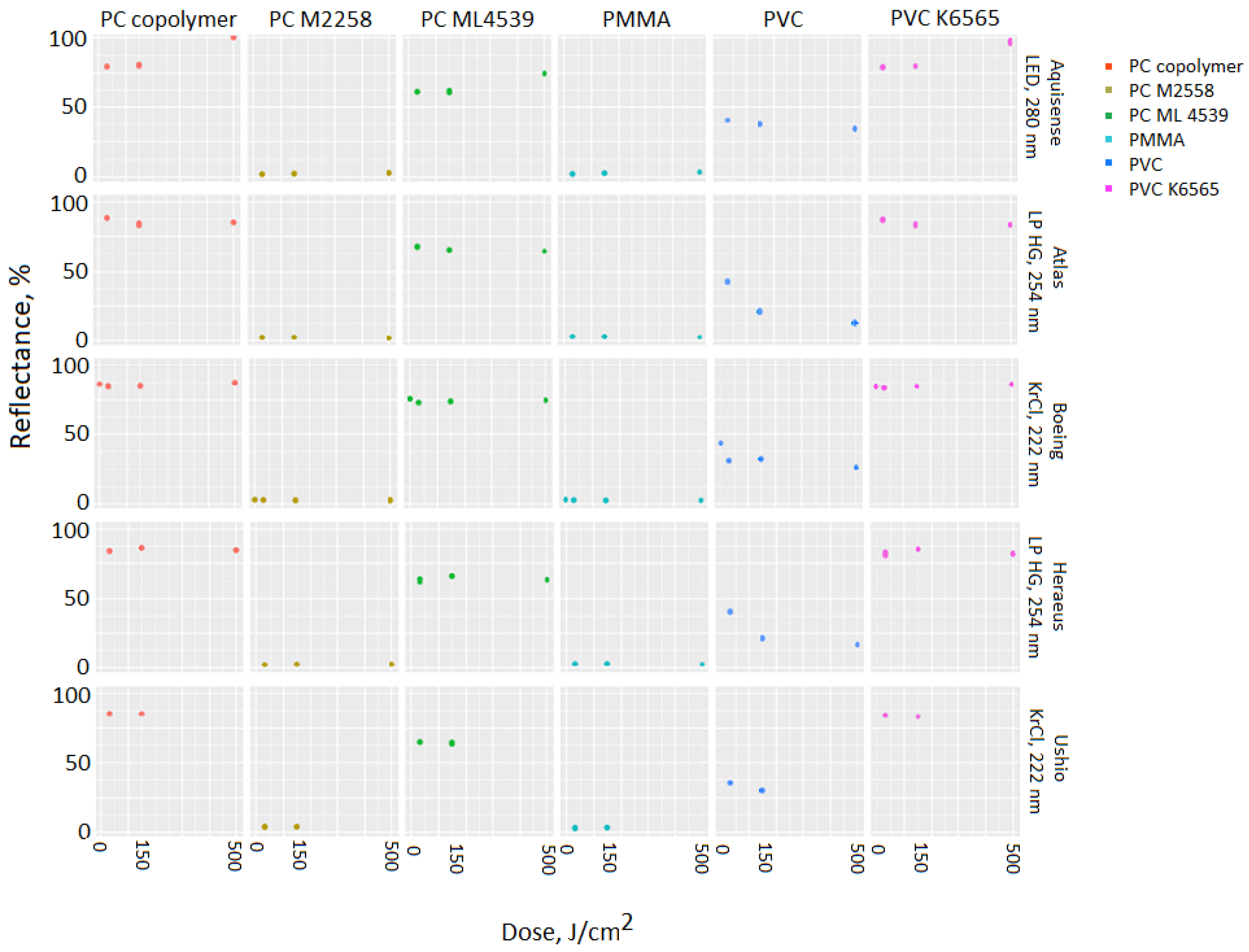
The effect on reflectivity of visible light by exposing polymer samples to UV-C was found to be dependent on material/formulation, UV-C source, and dose. Figure 2 summarizes the measured reflectivity of each material as a function of UV-C source and dose across participating laboratories. For most materials, reflectivity remained relatively stable over the tested dose range, indicating that the exposures did not strongly alter bulk reflectivity within the studied interval. Instead, the dominant differences observed were associated with material formulation, with the various polycarbonate and PVC formulations exhibiting distinct reflectivity levels that were largely preserved across dose and laboratory.
The three polycarbonate formulations (Lexan FST, M2558, and ML 4539) showed measurable differences in reflectivity relative to one another, but each formulation exhibited only modest variation with increasing UV-C dose. The two PVC formulations behaved similarly to one another, suggesting that formulation differences within that polymer family had limited influence on reflectivity response under the tested conditions. PMMA, as the only acrylic tested, cannot be directly compared to a second acrylic material, but its reflectivity values were similar to those observed for PC Makrolon 2558.
Some source-dependent effects were observed. For the exposure to UV-C produced by LEDs (peak wavelength 280 nm), three materials (PC copolymer FST9705, PC ML4539, and PVC K6565) showed increased reflectance at the highest dose of 500 J/cm2. The mechanism underlying this behavior is not yet understood and warrants further investigation, but the observation highlights some potential for wavelength-dependent optical responses. Overall, the relatively tight clustering of values for a given material/source combination suggests that the coordinated exposure approach produced comparable reflectivity measurements across laboratories.

4.4. Spectral Transmittance

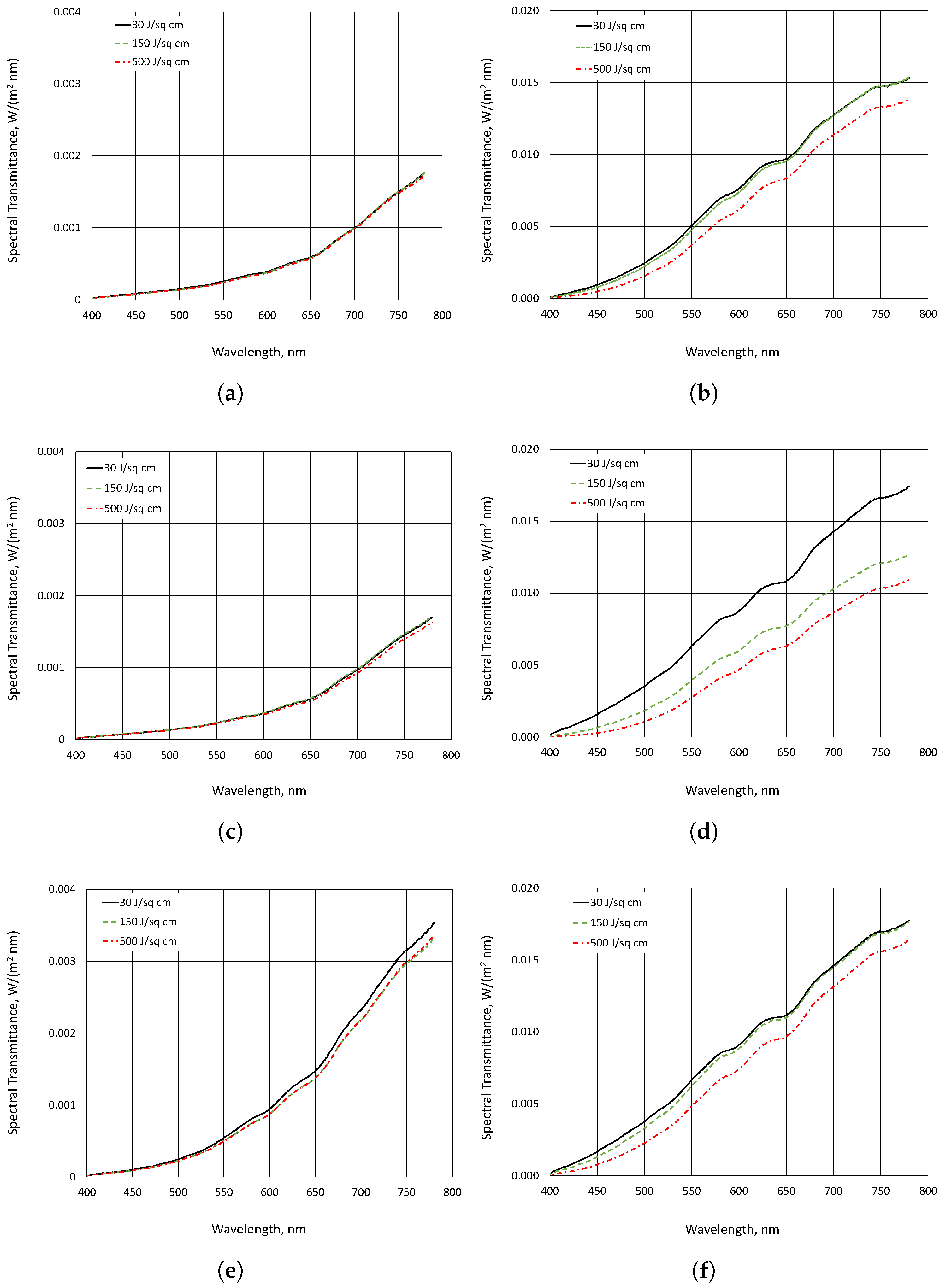
Polymer samples were exposed to the three specified UV-C doses (30, 150, and 500 J/cm2) as capacity allowed and tested subsequently for spectral transmittance (haze), which is the ratio of the amount of light passing through a sample to the incident light on its surface. The data supply convincing evidence that the standard method provided a means for independent laboratories to produce consistent results for a given material, UV-C source, and the three doses (30, 150, and 500 J/cm2) as shown in Figure 3. A plot of a subset of the entire dataset is shown in Figure 3, and the entire set is shown in the Supplementary Figures (Figures S3–S7).
The results of exposing the polymer samples to 30, 150, and 500 J/cm2 of UV-C and subsequently measuring the change in transmittance (haze) demonstrated consistency and repeatability for the exposure method/apparatus that was used in this work. Figure 3a,c,e and Figure S3a–f show the plotted results of transmittance measurements for Lexan FST9705. The data indicate how the transmittance corresponding to exposed samples does not change significantly for those coupons exposed to UV-C generated by KrCl, low-pressure Hg, and LED sources. However, the maximum change in transmittance was observed for those samples that were exposed to LED sources. An unexpected outcome of plotting the data is the difference between the response curves for the samples exposed to KrCl sources ( λ peak = 222 nm) UV-C at Boeing and Ushio. The shapes of the transmittance curves are similar, but the maximum scaled values differ between the two facilities. However, the response curves obtained at Ushio ( λ peak = 222 nm) are similar in both shape and magnitude. Otherwise, it is clear that transmittance changes for Lexan FST9705 are small and that the maximum effect occurred for the UV-LED sources that have a peak wavelength of 280 nm.
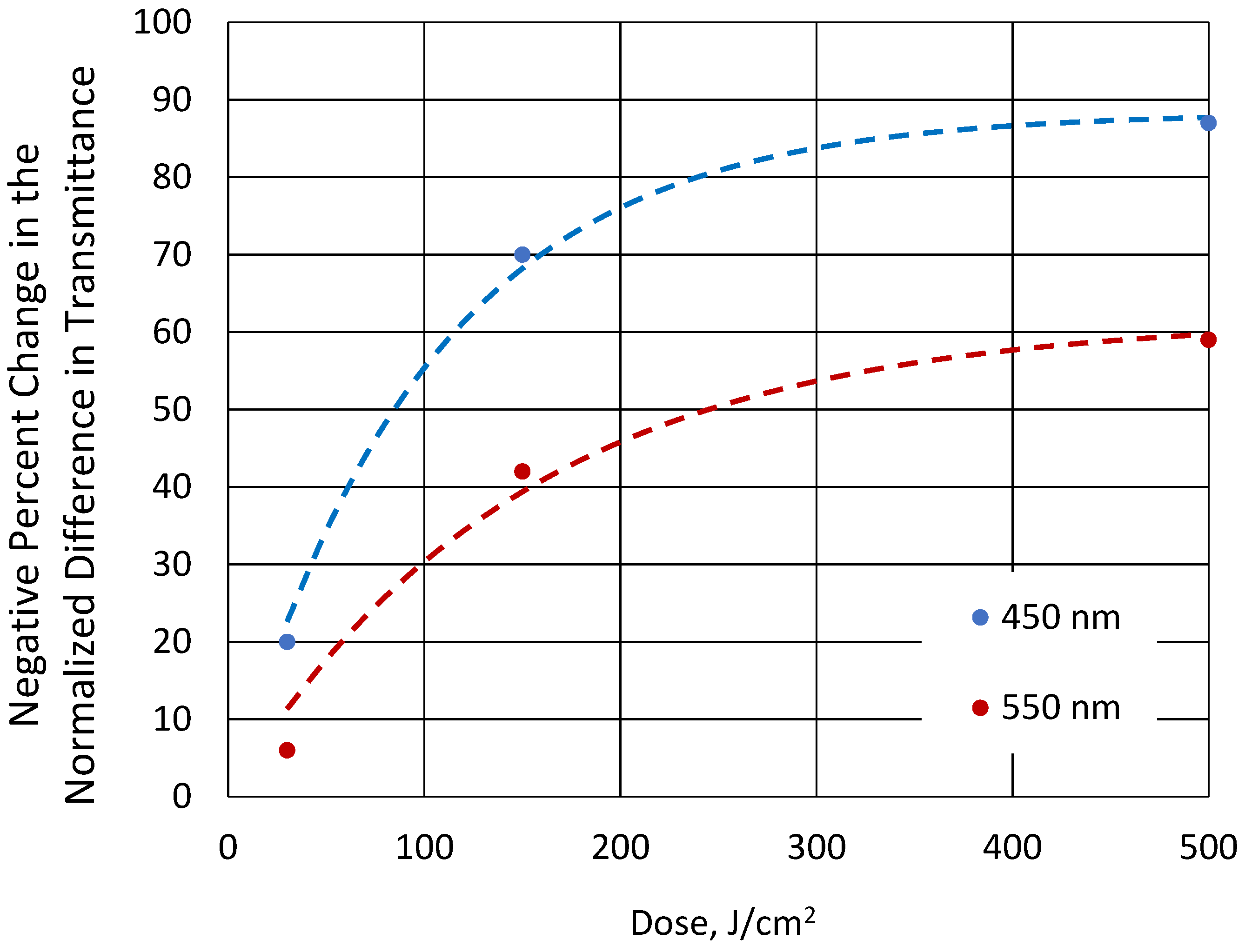
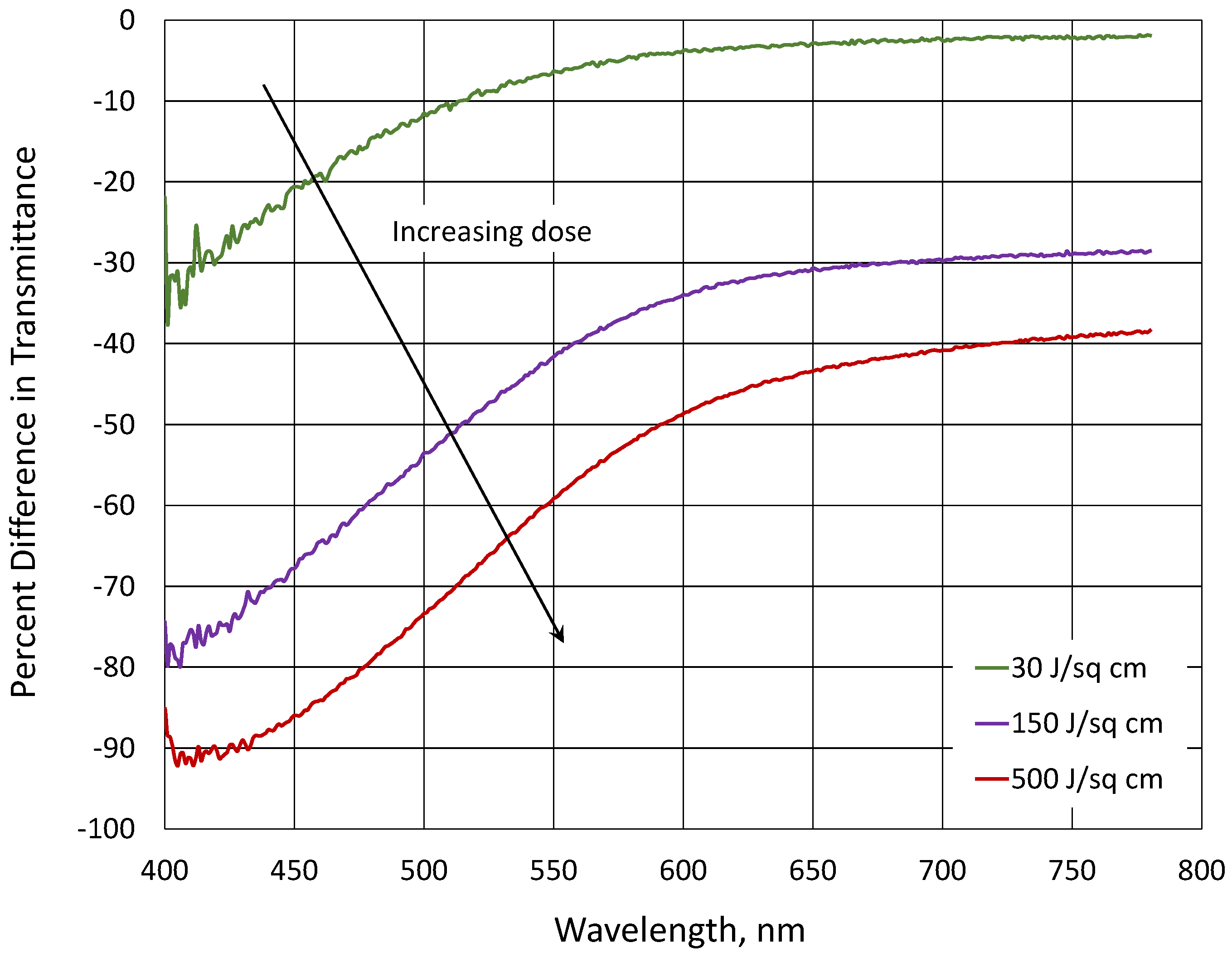
The effects of exposing PVC to UV-C varied by both light source and dose as shown in Figure 3b,d,f, and Figure S4a–f. Similar in behavior to the Lexan FST9705, there is a significant consistency among the various exposure and testing laboratories. The most significant effects correspond to PVC exposed to the low-pressure Hg UV-C source. However, the transmittance values change more significantly for PVC than for Lexan FST9705. It is important to note how Figure 3 plots the difference in transmittance relative to the unexposed condition. An interesting conclusion that can be drawn from the data in this plot is that the change in transmittance of the PVC follows a near exponential law, where the change in transmittance can be described empirically with
% Δ T A ( 1 e x p ( B · Dose ) )
where the values of A and B are determined empirically (see Figure 4). The decelerating effect of UV-C dose on the percent transmittance change suggests a surface phenomenon because UV-C penetration is low and/or the decomposition products provide a degree of protection to the layers beneath the decomposed material. Further investigation is needed to determine the cause of this effect.
The effects of exposure of PMMA, Makrolon 2558, and Kydex 6565 will be summarized and discussed together because the effects of UV-C exposure on transmittance are similar regardless of the source, exposure facility, or testing laboratory. Although the transmittance curves varied in shape among the tested materials, it can be readily seen in Figures S3–S7 that the changes in transmittance are small irrespective of the source and dose. Therefore, based on the testing performed, it can be concluded that the transmittance of Lexan FST9705, PMMA, Makrolon 2558, and Kydex 6565 changed little for the applied doses of 30, 150, and 500 J/cm2. However, the transmittance of PVC changed significantly for the applied doses, and the effects of exposure decelerate with advancing UV-C dose as shown in Figure 4 and Figure 5.

4.5. Flammability

One of the concerns regarding the exposure of polymers to UV-C is that the degradation products are lower in molecular weight and as a result may also be more flammable because their combustion kinetics are more rapid. To determine the importance of this effect, the exposed samples were subjected to flame testing. The results from vertical Bunsen burner testing do not suggest a significant impact on flame spread from UV-C exposures of 500 J/cm2 or less for the materials tested in this study as shown in Table 4. This is to be expected since flammability is largely a bulk property, and UV-C exposure to the doses used in this work primarily impacts the surface of the test sample. We suspect that the mass of material degraded on the surface of the samples is small relative to the bulk sample, and any effect is either not measurable by this method, or the degradation products behave similarly to the parent material. Investigation of the identity of degradation byproducts will help resolve these questions. Additional effort to isolate the surface material may be needed to determine how combustion kinetics vary between degraded and unexposed material. Table 4 shows how polycarbonate (Lexan 4539) increased in flammability approximately 30–40% but still passed the flammability threshold requirement. This is inconsistent with the results obtained for other materials. The increase in flammability is also inconsistent with the theory that the effects of UV-C are limited primarily to the surface. Further analysis is needed to clarify this inconsistency, as the phenomenon is not well understood. Average burn length and self-extinguishing times for all test samples for both before and after UV-C exposure met the parameters of 15 s for self-extinguishing time and six inches for burn length, except for PMMA. However, PMMA failed to meet standards prior to UV-C exposure, and the burn length time did not change.

4.6. Tensile Strength and Modulus of Elasticity

The tensile strength and modulus of elasticity represent the mechanical properties that are relevant to the structural integrity of construction materials and are manifestations of the bulk material. As discussed previously, UV-C exposure affects the integrity of the surface of the sample materials for the doses applied in this work. Therefore, it is quite reasonable that both the tensile strength and modulus of elasticity values were not affected significantly, which can be seen in Table 5 and Supplementary Figures S8–S11.
Comparing the UV-C exposed samples to the controls, there were no substantial differences in the tensile strength and modulus of elasticity observed for PMMA, Lexan ML 4539, Kydex 6565 and Lexan FST9705. For Makrolon 2558 the tensile strength of the exposed samples was not affected by the exposure. However, for the modulus, three of the five Makrolon test samples exhibited a higher modulus than the five control samples, leading to a 13% increased average modulus of 2903 MPa ( σ = 290) as compared to the unexposed samples which measured 2565 MPa ( σ = 69). However, a statistical 2-sample t-test shows this difference not to be statistically significant with a 95% confidence interval. The results, in duplicate, for 254 nm exposure are shown in Table 5 and plotted in Figures S8–S11 in the Supplementary Material.
The initial properties are labeled as “control” in Table 5. Figures S8–S11 plot the tensile strength and modulus of both exposed and unexposed (control) samples for the five materials. The consistency of the tensile strength and modulus measurements of the materials that were exposed to UV-C demonstrates that the bulk of the material did not degrade significantly because the decomposition was limited to thin cross-sections adjacent to the surface. Overall, these results also indicate that greater exposure levels or thinner samples, where a greater fraction of the volume of the entire sample is affected by UV-C damage, may be required to observe more significant tensile strength changes. Our testing and analysis did not include PVC, which is of interest from a commercial perspective and will be a topic of future work.

5. Conclusions

The focus of this work was the development and demonstration of a standardized method for exposing samples of common polymeric construction materials to UV-C. The purpose of the method is to provide a means of obtaining reliable, repeatable, and quantitative data for ready comparison among candidate materials for construction and equipment fabrication. The exposure test equipment was developed to standardize the method of exposing the samples to UV-C light and to ensure the irradiance across the exposure field was even. The exposure test equipment is both reproducible and readily constructed using subcomponents that are commercially available. To ensure the effects were limited to UV exposure alone, an air circulation/management system was included as a means of minimizing the effects of both temperature and ozone produced by the UV-C lamps and any evolved gases due to polymer decomposition. The maximum dose to which the samples were exposed was 500 J/cm2, which represents the amount of energy that a construction material will receive over its anticipated lifetime.
In this study, the standardized exposure method was demonstrated by exposing several types of commonly used polymers to three different UV-C sources including KrCl excimer lamps, low-pressure mercury lamps, and LEDs, corresponding to peak wavelengths of 222 nm, 254 nm, and 280 nm, respectively. These sources and wavelengths were chosen because they are the most commonly used UV-C sources in industry, spanning applications such as the curing of food [75], disinfection of water, whole-room and surface disinfection, and analysis of proteins [76]. However, this same method can be used with other wavelengths if it is determined, for example, that a specific material has a sensitivity or resistance to a specific wavelength. The result of this work, to our knowledge, is the largest and most quantitative and systematic study published to date on the analysis of damage to common polymeric materials from germicidal UV technology.
Several aspects of surface and bulk physical properties were measured to evaluate the impact of UV-C exposure, including color change, gloss change, reflectivity, spectral transmittance (or haze), flammability, tensile strength, and elasticity modulus. Visual characteristics are important because a material’s visual appearance is often used as a determining factor for material integrity even if the mechanical characteristics are not affected significantly. For the materials tested and the doses applied, the data indicate the changes in the mechanical properties were mostly statistically insignificant. However, the effects of UV-C on the mechanical properties of PVC were not measured in this study.
This study demonstrates several ways in which polymeric materials are affected when exposed to UV-C light sources. Some materials exhibited mild appearance changes, and others reacted with severe change. In fully formulated systems, the added components in the formulation increase complexity due to the potential additional reactions caused by the UV-C light. We can conclude that determining the stability of materials when exposed to UV-C light will continue to be important for product and environmental designs, considering carefully what tests and conditions will faithfully represent the intended application (polymer, formulation, UV-C source type, temperature, exposure energy, measure critical properties, etc.).

6. Future Work Considerations

The collaborative team within IUVA has envisioned multiple opportunities for further research in view of this project’s primary goal to develop a standardized method for exposing polymer materials to UV-C for the subsequent testing of physical and optical properties to determine the degree of degradation. First, honing a proper ASTM and ISO standard should be a priority for the UV products industry. As a related topic, understanding the UV-C degradation mechanism at a molecular level will assist in designing new materials and additives to inhibit the reaction pathways. Observing the depth profile of degradation at surfaces and correlations for material lifetime can inform device manufacturers during design and product development. Obtaining scanning electron microscopy and transmission electron microscopy imagery to view potential crazing regions and particulate byproduct formation will be crucial to that end. Determining the identity and composition of degradation products will be important for protecting human and environmental health. Finally, efforts should be taken to understand dose reciprocity, that is, the comparative impact of cumulative dose at commercially relevant fluence rates versus short-term high doses used for accelerated studies.

Supplementary Materials

The following supporting information can be downloaded at: https://www.mdpi.com/article/10.3390/standards6020023/s1.

Author Contributions

Conceptualization, X.L.; Methodology, J.P.; Formal analysis, J.D.P.; Investigation, L.A., H.C., J.E., J.H., R.O., J.P., S.S. (Sari Samuels), S.S. (Sepas Setayesh), P.T. and P.A.U.; Resources, S.P., R.K., M.B., H.C., J.E., G.J., J.H., C.M., R.O., J.P., S.S. (Sari Samuels), S.S. (Sepas Setayesh), P.T. and P.A.U.; Data curation, M.B., J.H., C.M., P.T. and P.A.U.; Writing—original draft, N.H. and J.D.P.; Writing—review & editing, N.H. and J.D.P.; Visualization, N.H. and J.D.P.; Supervision, S.P., R.K., L.A., H.C., X.L., C.M., R.O., J.P., S.S. (Sari Samuels), S.S. (Sepas Setayesh) and P.A.U.; Project administration, S.P., R.K., L.A. and S.S. (Sepas Setayesh). All authors have read and agreed to the published version of the manuscript.

Funding

This research received no external funding.

Data Availability Statement

All relevant data have been included in this work. Any information or data that are not included in this work are proprietary or not available to the public.

Acknowledgments

IUVA provided support for this study and a forum for expert discussions. The member companies participating in this study provided financial support, including the materials used for the samples, the UV-C light sources, testing equipment, and their employees’ time. The authors thank Matthew McGreer and Henri Jagt (ASML) for their contributions to this work.

Conflicts of Interest

Author Norman Horn was employed by the company Seal Shield, Author Sophie Poelmans, Jerry Eng and Sari Samuels was employed by the company Syensqo SA. Author Michael Bean was employed by the company Uniphy Ltd. Author Holger Claus was employed by the company A3 Lighting Consulting. Author John Harris was employed by the company The Boeing Company. Author Xin Li was employed by the company LANXESS Corporation. Author Colin Mikulec was employed by the company RTP. Author Ryan Olsen was employed by the company Ushio America, Inc. Author Jennifer Pagán was employed by the company Aquisense Technologies. Author Sepas Setayesh was employed by the company Royal Philips. Author Peter Teska was employed by the company Solenis. Author Paul A. Uglum was employed by the company Uglum Consulting. The remaining authors declare that the research was conducted in the absence of any commercial or financial relationships that could be construed as a potential conflict of interest.

Nomenclature

Variables
A & B correlating coefficients, see Equation (3)
c , C * , S c chroma parameters, see Equation (1)
Dsample depth, in or mm 
Δ E C M C * Color difference measure
H * , S H hue parameters
l , L * , S L lightness parameters, see Equation (1)
Lsample length, in or mm 
% T the ratio of the light energy falling on a body to that transmitted through it
Wsample width, in or mm 
x ¯ mean value
Abbreviations
BLBurn length
CFRCode of Federal Regulations
CMCColor measurement committee
IUVAInternational Ultraviolet Association
LEDlight emitting diode
LCH notationLightness, chroma, hue
PMMAPolymethyl methacrylate
PCPolycarbonate
PVCPolyvinyl chloride
SETSelf-extinguishing time
UV-CPortion of the UV spectrum between 200 and 280 nm
VBBVertical Bunsen burner
Symbols
λ ME modulus of elasticity, MPa
λ peak peak wavelength, nm
σ standard deviation

References

  1. Blatchley, E.R., III; Petri, B.; Sun, W. SARS-CoV-2 ultraviolet radiation dose-response behavior. J. Res. Natl. Inst. Stand. Technol. 2021, 126, 126018. [Google Scholar]
  2. Maquart, M.; Marlet, J. Rapid SARS-CoV-2 inactivation by mercury and LED UV-C lamps on different surfaces. Photochem. Photobiol. Sci. 2022; online ahead of print. [CrossRef]
  3. Poster, D.L.; Miller, C.C.; Martinello, R.; Horn, N.; Postek, M.; Cowan, T.; Obeng, Y.S.; Kasianowicz, J. Ultraviolet Radiation Technologies and Healthcare Associated Infections: Standards and Metrology Needs. J. Res. Natl. Inst. Stand. Technol. 2021, 126, 126014. [Google Scholar] [CrossRef]
  4. Sarcia, S.R. Capacity Models and Transmission Risk Mitigation: An Engineering Framework to Predict the Effect of Air Disinfection by Germicidal Ultraviolet Radiation. J. Res. Natl. Inst. Stand. Technol. 2021, 126, 126057. [Google Scholar] [CrossRef] [PubMed]
  5. Allen, G.R.; Benner, K.J.; Bahnfleth, W.P. Inactivation of pathogens in air using ultraviolet direct irradiation below exposure limits. J. Res. Natl. Inst. Stand. Technol. 2021, 126, 126052. [Google Scholar] [CrossRef]
  6. Hart, D. Bactericidal Ultraviolet Radiation in the Operating Room: Twenty-Nine-Year Study for Control of Infections. J. Am. Med. Assoc. 1960, 172, 1019–1028. [Google Scholar] [CrossRef] [PubMed]
  7. Casini, B.; Tuvo, B.; Cristina, M.L.; Spagnolo, A.; Totaro, M.; Baggiani, A.; Privitera, G. Evaluation of an Ultraviolet C (UVC) Light-Emitting Device for Disinfection of High Touch Surfaces in Hospital Critical Areas. Int. J. Environ. Res. Public Health 2019, 16, 3572. [Google Scholar] [CrossRef]
  8. Claytor, S.; Campbell, R.; Hattori, A.; Brown, E.; Hollis, C.; Schureck, M.; Atchley, H.; Stone, J.; Grady, M.; Yang, B.; et al. Portable ultraviolet-C chambers for inactivation of SARS-CoV-2. J. Res. Natl. Inst. Stand. Technol. 2021, 126, 126056. [Google Scholar] [CrossRef] [PubMed]
  9. Poster, D.L.; Postek, M.T.; Obeng, Y.S.; Kasianowicz, J.J.; Cowan, T.E.; Horn, N.R.; Miller, C.C.; Martinello, R.A. Models for an ultraviolet-C research and development consortium. J. Res. Natl. Inst. Stand. Technol. 2021, 126, 126055. [Google Scholar] [CrossRef]
  10. Mehta, I.; Hsueh, H.Y.; Taghipour, S.; Li, W.; Saeedi, S. UV Disinfection Robots: A Review. Robot. Auton. Syst. 2023, 161, 104332. [Google Scholar] [CrossRef]
  11. Gambetá-Leite, M.R.S.; Real, R.A.; das Dores do Nascimento, C.; Souza, E.G. Dosimetry Strategies for Non-Autonomous UV-C Robots. IEEE Lat. Am. Trans. 2025, 23, 619–627. [Google Scholar] [CrossRef]
  12. Andrady, A.L.; Hamid, S.; Hu, X.; Torikai, A. Effects of increased solar ultraviolet radiation on materials. J. Photochem. Photobiol. B Biol. 1998, 46, 96–103. [Google Scholar] [CrossRef]
  13. Suh, D.; Hockett Sherlock, S.; Dukes, K.C.; Perencevich, E.N.; Marra, A.R. Impact of UV-C on material degradation: A scoping literature review. Antimicrob. Steward. Healthc. Epidemiol. 2025, 5, e199. [Google Scholar] [CrossRef]
  14. Gotzsche, P.C. Niels Finsen’s treatment for lupus vulgaris. J. R. Soc. Med. 2011, 104, 41–42. [Google Scholar] [CrossRef] [PubMed]
  15. Perkins, J.E.; Bahlke, A.M.; Silverman, H.F. Effect of Ultra-Violet Irradiation of Classrooms on Spread of Measles in Large Rural Central Schools. Preliminary Report. Am. J. Public Health 1947, 37, 529–537. [Google Scholar] [CrossRef]
  16. Reed, N.G. The History of Ultraviolet Germicidal Irradiation for Air Disinfection. Public Health Rep. 2010, 125, 15–27. [Google Scholar] [CrossRef] [PubMed]
  17. United States Environmental Protection Agency. Long Term 2 Enhanced Surface Water Treatment Rule; United States Environmental Protection Agency: Harrisburg, PA, USA, 2006.
  18. New York State Department of Health. 10 NYCRR Subpart 6-3 Recreational Aquatic Spray Grounds, 2007th ed.; New York State Department of Health: Slingerlands, NY, USA, 2007.
  19. Paccione, J.D.; Dziewulski, D.M.; Young, P.L. Development of recreational water spray ground design regulations in New York State, an engineering approach. J. Water Health 2017, 15, 718–728. [Google Scholar] [CrossRef]
  20. Soltermann, F.; Widler, T.; Canonica, S.; von Gunten, U. Photolysis of inorganic chloramines and efficiency of trichloramine abatement by UV treatment of swimming pool water. Water Res. 2014, 56, 280–291. [Google Scholar] [CrossRef] [PubMed]
  21. Hrudey, S.E. Chlorination disinfection by-products, public health risk tradeoffs and me. Water Res. 2009, 43, 2057–2092. [Google Scholar] [CrossRef]
  22. Ashbolt, N.J. Risk analysis of drinking water microbial contamination versus disinfection by-products (DBPs). Toxicology 2004, 198, 255–262. [Google Scholar] [CrossRef]
  23. Cassan, D.; Mercier, B.; Castex, F.; Rambaud, A. Effects of medium-pressure UV lamps radiation on water quality in a chlorinated indoor swimming pool. Chemosphere 2006, 62, 1507–1513. [Google Scholar] [CrossRef] [PubMed]
  24. US Environmental Protection Agency, Office of Water. Ultraviolet Disinfection Guidance Manual for the Final Long Term 2 Enhanced Surface Water Treatment Rule; United States Environmental Protection Agency: Harrisburg, PA, USA, 2006.
  25. Wright, H.; Brooks, T.; Heath, M.; Adams, J.; Townsend, B. Innovative Approaches for Validation of UV Disinfection Reactors for Drinking Water Systems; United States Environmental Protection Agency: Harrisburg, PA, USA, 2020.
  26. Beck, S.E.; Hull, N.M.; Poepping, C.; Linden, K.G. Wavelength-Dependent Damage to Adenoviral Proteins Across the Germicidal UV Spectrum. Environ. Sci. Technol. 2018, 52, 223–229. [Google Scholar] [CrossRef] [PubMed]
  27. Setlow, J.K. Chapter V—The Effects of Ultraviolet Radiation and Photoreactivation. In Photobiology, Ionizing Radiations; Comprehensive Biochemistry; Florkin, M., Stoltz, E.H., Eds.; Elsevier: Amsterdam, The Netherlands, 1967; Volume 27, pp. 157–209. [Google Scholar] [CrossRef]
  28. Snowball, M.; Hornsey, I. Purification of water supplies using ultraviolet light. Dev. Food Microbiol. 1988, 3, 171–191. [Google Scholar]
  29. Pfeifer, G.P. Formation and Processing of UV Photoproducts: Effects of DNA Sequence and Chromatin Environment. Photochem. Photobiol. 1997, 65, 270–283. [Google Scholar] [CrossRef]
  30. Smith, K.; Hodgkins, B.; O’Leary, M.E. The biological importance of ultraviolet light induced DNA-protein crosslinks in Escherichia coli 15 TAU. Biochim. Et Biophys. Acta (BBA)—Nucleic Acids Protein Synth. 1966, 114, 1–15. [Google Scholar] [CrossRef]
  31. Spicer, D.B. Methods and mechanisms of photonic disinfection. J. Res. Natl. Inst. Stand. Technol. 2021, 126, 126016. [Google Scholar] [CrossRef]
  32. Kowalski, W. Ultraviolet Germicidal Irradiation Handbook: UVGI for Air and Surface Disinfection; Springer Science & Business Media: Berlin/Heidelberg, Germany, 2010. [Google Scholar]
  33. Bolton, J.R.; Cotton, C.A. The Ultraviolet Disinfection Handbook; American Water Works Association: Denver, CO, USA, 2011. [Google Scholar]
  34. Masjoudi, M.; Mohseni, M.; Bolton, J.R. Sensitivity of bacteria, protozoa, viruses, and other microorganisms to ultraviolet radiation. J. Res. Natl. Inst. Stand. Technol. 2021, 126, 126021. [Google Scholar] [CrossRef]
  35. Sinha, R.P.; Häder, D.P. UV-induced DNA damage and repair: A review. Photochem. Photobiol. Sci. 2002, 1, 225–236. [Google Scholar] [CrossRef] [PubMed]
  36. Kciuk, M.; Marciniak, B.; Mojzych, M.; Kontek, R. Focus on UV-induced DNA damage and repair—disease relevance and protective strategies. Int. J. Mol. Sci. 2020, 21, 7264. [Google Scholar] [CrossRef]
  37. Goosen, N.; Moolenaar, G.F. Repair of UV damage in bacteria. DNA Repair 2008, 7, 353–379. [Google Scholar] [CrossRef]
  38. Rodríguez, R.A.; Navar, C.; Sangsanont, J.; Linden, K.G. UV inactivation of sewage isolated human adenovirus. Water Res. 2022, 218, 118496. [Google Scholar] [CrossRef] [PubMed]
  39. Beck, S.E.; Wright, H.B.; Hargy, T.M.; Larason, T.C.; Linden, K.G. Action spectra for validation of pathogen disinfection in medium-pressure ultraviolet (UV) systems. Water Res. 2015, 70, 27–37. [Google Scholar] [CrossRef]
  40. Tanaka, T.; Nogariya, O.; Shionoiri, N.; Maeda, Y.; Arakaki, A. Integrated molecular analysis of the inactivation of a non-enveloped virus, feline calicivirus, by UV-C radiation. J. Biosci. Bioeng. 2018, 126, 63–68. [Google Scholar] [CrossRef]
  41. Lorenzo Leal, A.; Tam, W.; Kheyrandish, A.; Mohseni, M.; Bach, H. Antimicrobial Activity of Filtered Far-UVC Light (222 nm) against Different Pathogens. BioMed Res. Int. 2023, 2023, 2085140. [Google Scholar] [CrossRef]
  42. Yousif, E.; Haddad, R. Photodegradation and photostabilization of polymers, especially polystyrene. SpringerPlus 2013, 2, 398. [Google Scholar] [CrossRef] [PubMed]
  43. Zhang, K.; Hamidian, A.H.; Tubić, A.; Zhang, Y.; Fang, J.K.; Wu, C.; Lam, P.K. Understanding plastic degradation and microplastic formation in the environment: A review. Environ. Pollut. 2021, 274, 116554. [Google Scholar] [CrossRef]
  44. Gogotov, I.; Barazov, S. The Effect of Ultraviolet Light and Temperature on the Degradation of Composite Polypropylene. Int. Polym. Sci. Technol. 2014, 41, 55–58. [Google Scholar] [CrossRef]
  45. Yates, S.F.; Isella, G.; Rahislic, E.; Barbour, S.; Tiznado, L. Effects of ultraviolet-C radiation exposure on aircraft cabin materials. J. Res. Natl. Inst. Stand. Technol. 2021, 126, 126019. [Google Scholar] [CrossRef] [PubMed]
  46. Mitxelena-Iribarren, O.; Mondragon, B.; Pérez-Lorenzo, E.; Smerdou, C.; Guillen-Grima, F.; Sierra-Garcia, J.E.; Rodriguez-Merino, F.; Arana, S. Evaluation of the degradation of materials by exposure to germicide UV-C light through colorimetry, tensile strength and surface microstructure analyses. Mater. Today Commun. 2022, 31, 103690. [Google Scholar] [CrossRef]
  47. Kaewkam, P.; Kanchanapaetnukul, A.; Khamyan, J.; Phadmanee, N.; Lin, K.Y.A.; Kobwittaya, K.; Sirivithayapakorn, S. UV-assisted TiO2 photocatalytic degradation of virgin LDPE films: Effect of UV-A, UV-C, and TiO2. J. Environ. Chem. Eng. 2022, 10, 108131. [Google Scholar] [CrossRef]
  48. Askola, J.; Calkin, Y.; Vaskuri, A.; Poikonen, T.; Ikonen, E. Accelerated ageing of organic LED panels using ultraviolet exposure. Light. Res. Technol. 2019, 51, 1263–1274. [Google Scholar] [CrossRef]
  49. Kwon, S.K.; Baek, J.H.; Choi, H.C.; Kim, S.K.; Lampande, R.; Pode, R.; Kwon, J.H. Degradation of OLED performance by exposure to UV irradiation. RSC Adv. 2019, 9, 42561–42568. [Google Scholar] [CrossRef]
  50. Akbay, İ.K.; Özdemir, T. Monomer migration and degradation of polycarbonate via UV-C irradiation within aquatic and atmospheric environments. J. Macromol. Sci. Part A 2016, 53, 340–345. [Google Scholar] [CrossRef]
  51. Bernardy, C.; Elardo, N.; Trautz, A.; Malley, J.; Wang, D.; Ducoste, J. Effects of UV-C Disinfection on N95 and KN95 Filtering Facepiece Respirator Reuse. Appl. Environ. Microbiol. 2022, 88, e01221-22. [Google Scholar] [CrossRef] [PubMed]
  52. Poster, D.L.; Hardwick, M.; Miller, C.C.; Riley, M.A.; Rodrigo, W.S.I.; Vladar, A.E.; Wright, J.D.; Zangmeister, C.D.; Zarobila, C.; Starkweather, J.; et al. Disinfection of respirators with ultraviolet radiation. J. Res. Natl. Inst. Stand. Technol. 2021, 126, 126058. [Google Scholar] [CrossRef]
  53. Chandran, K.M.; Ramamurthy, P.C.; Kanjo, K.; Narayan, R.; Menon, S.R. Efficacy of ultraviolet-C devices for the disinfection of personal protective equipment fabrics and N95 respirators. J. Res. Natl. Inst. Stand. Technol. 2021, 126, 126023. [Google Scholar] [CrossRef]
  54. Geldert, A.; Balch, H.B.; Gopal, A.; Su, A.; Grist, S.M.; Herr, A.E. Best practices for germicidal ultraviolet-C dose measurement for N95 respirator decontamination. J. Res. Natl. Inst. Stand. Technol. 2021, 126, 126020. [Google Scholar] [CrossRef]
  55. Graeffe, F.; Luo, Y.; Guo, Y.; Ehn, M. Unwanted indoor air quality effects from using ultraviolet C lamps for disinfection. Environ. Sci. Technol. Lett. 2023, 10, 172–178. [Google Scholar] [CrossRef]
  56. Ma, B.; Burke-Bevis, S.; Tiefel, L.; Rosen, J.; Feeney, B.; Linden, K.G. Reflection of UVC wavelengths from common materials during surface UV disinfection: Assessment of human UV exposure and ozone generation. Sci. Total Environ. 2023, 869, 161848. [Google Scholar] [CrossRef] [PubMed]
  57. Link, M.F.; Shore, A.; Hamadani, B.H.; Poppendieck, D. Ozone Generation from a Germicidal Ultraviolet Lamp with Peak Emission at 222 nm. Environ. Sci. Technol. Lett. 2023, 10, 675–679. [Google Scholar] [CrossRef]
  58. Peng, Z.; Day, D.A.; Symonds, G.; Jenks, O.; Stark, H.; Handschy, A.V.; de Gouw, J.; Jimenez, J.L. Significant Production of Ozone from Germicidal UV Lights at 222 nm. Environ. Sci. Technol. Lett. 2023, 10, 668–674. [Google Scholar] [CrossRef]
  59. Folkman, S. Validation of the long life of PVC pipes. In Proceedings of the 17th International Conference on Plastics Pipes, Chicago, IL, USA, 22–24 September 2014; pp. 1–7. [Google Scholar]
  60. Zhang, J.; Boyd, I.W. Efficient excimer ultraviolet sources from a dielectric barrier discharge in rare-gas/halogen mixtures. J. Appl. Phys. 1996, 80, 633–638. [Google Scholar] [CrossRef]
  61. Rajkhowa, S. Heat, solar pasteurization, and ultraviolet radiation treatment for removal of waterborne pathogens. In Waterborne Pathogens; Vara Prasad, M.N., Grobelak, A., Eds.; Butterworth-Heinemann: Waltham, MA, USA, 2020; Chapter 9; pp. 169–187. [Google Scholar] [CrossRef]
  62. MacIsaac, S.; Rauch, K.; Prest, T.; Simons, R.; Gagnon, G.; Stoddart, A. Improved disinfection performance for 280 nm LEDs over 254 nm low-pressure UV lamps in community wastewater. Sci. Rep. 2023, 13, 7576. [Google Scholar] [CrossRef]
  63. ISO 527-1:2019; Plastics—Determination of Tensile Properties—Part 1: General Principles. International Organization for Standardization: Geneva, Switzerland, 2019.
  64. ASTM Subcommittee: G03.01; Standard Practice for Conditioning and Handling of Materials for Natural and Artificial Weathering Tests. ASTM International: West Conshohocken, PA, USA, 2024. [CrossRef]
  65. Proceedings of the CIE Expert Symposium ’97 on Colour Standards for Imaging Technology; Number CIE x014-1998; CIE (International Commission on Illumination): Scottsdale, AZ, USA, 1997.
  66. ASTM Subcommittee: E12.04; Standard Practice for Calculation of Color Tolerances and Color Differences from Instrumentally Measured Color Coordinates. ASTM International: West Conshohocken, PA, USA, 2025. [CrossRef]
  67. Delgado-González, M.J.; Carmona-Jiménez, Y.; Rodríguez-Dodero, M.C.; García-Moreno, M.V. Color Space Mathematical Modeling Using Microsoft Excel. J. Chem. Educ. 2018, 95, 1885–1889. [Google Scholar] [CrossRef]
  68. ASTM Subcommittee: E12.03; Standard Test Method for Specular Gloss. ASTM International: West Conshohocken, PA, USA, 2025. [CrossRef]
  69. ASTM Subcommittee: F07.08; Standard Test Method for Measuring Optical Reflectivity of Transparent Materials. ASTM International: West Conshohocken, PA, USA, 2021. [CrossRef]
  70. ASTM Subcommittee: E44.20; Standard Test Method for Solar Absorptance, Reflectance, and Transmittance of Materials Using Integrating Spheres. ASTM International: West Conshohocken, PA, USA, 2020. [CrossRef]
  71. Farris, S.; Pozzoli, S.; Biagioni, P.; Duó, L.; Mancinelli, S.; Piergiovanni, L. The fundamentals of flame treatment for the surface activation of polyolefin polymers—A review. Polymer 2010, 51, 3591–3605. [Google Scholar] [CrossRef]
  72. United States Environmental Protection Agency. Title 14, Chapter 1, Subchapter C, Part 25, Subpart D, Fire Protection, Compartment Interiors. Federal Register, 2026. Available online: https://www.ecfr.gov/current/title-14/chapter-I/subchapter-C/part-25/subpart-D (accessed on 4 March 2026).
  73. ISO/TC 61/SC 2; Plastics—Determination of Tensile Properties Part 2: Test Conditions for Moulding and Extrusion Plastics. ISO: Geneva, Switzerland, 2025.
  74. Savage, D.J. (Saratoga County Department of Health, Saratoga Springs, NY, USA). Private communication, 2025.
  75. Wang, Q.; Cao, Y.; Zhou, L.; Jiang, C.Z.; Feng, Y.; Wei, S. Effects of postharvest curing treatment on flesh colour and phenolic metabolism in fresh-cut potato products. Food Chem. 2015, 169, 246–254. [Google Scholar] [CrossRef] [PubMed]
  76. Anthis, N.J.; Clore, G.M. Sequence-specific determination of protein and peptide concentrations by absorbance at 205 nm. Protein Sci. 2013, 22, 851–858. [Google Scholar] [CrossRef] [PubMed]
Figure 1. (a) The exposure box at one of the exposure laboratories (Heraeus), (b) the layout for sample testing with dosimeter cards for determining irradiance uniformity, and (c) the layout for testing tensile bars.
Standards 06 00023 g001
Figure 2. Effect of exposure dose and UV-C source on reflectance.
Standards 06 00023 g002
Figure 3. Spectral transmittance of Lexan FST9705 and PVC post UV-C exposure. (a) Samples of Lexan FST9705 exposed at Boeing using a 222 nm KrCl excimer lamp. (b) Samples of PVC exposed at Boeing using a 222 nm KrCl excimer lamp. (c) Samples of Lexan FST9705 exposed at Atlas using a 254 nm low-pressure mercury vapor lamp. (d) Samples of PVC exposed at Atlas using a 254 nm KrCl excimer lamp. (e) Samples of Lexan FST9705 exposed at Aquasense using a 280 nm LED lamp. (f) Samples of PVC exposed at Aquasense using a 280 nm LED lamp.
Standards 06 00023 g003
Figure 4. The relative change in the difference in transmittance values for PVC exposed to 30, 150, and 500 J/cm2 of UV-C radiation produced by a low-pressure mercury lamp (peak wavelength, 254 nm).
Standards 06 00023 g004
Figure 5. Relative change of transmittance for PVC for wavelengths 400 nm λ 780 nm after exposure to 30, 150, and 500 J/cm2 of UV-C radiation produced by a low-pressure mercury lamp (peak wavelength, 254 nm).
Standards 06 00023 g005
Table 1. Description of materials tested.
MaterialPolymerMaterial GradeSupplier
Kydex 6565Acrylic-PVCFlame retardant gradeSekisui Kydex *
Lexan FST9705PC copolymer: polycarbonate esterFlame retardant gradeSabic/Polyvantis **
Lexan ML 4539Polycarbonate (PC)Aircraft gradeSabic/Polyvantis **
Makrolon 2558Polycarbonate (PC)Medical gradeCovestro †
Polymethyl methacrylatePolymethyl methacrylate (PMMA)Industrial (Inhaler box)Proprietary ‡
Polyvinyl chloridePolyvinyl chloride (PVC)Commercial ProprietaryProprietary ‡
* Weiterstadt, Germany; ** Coldwater, MI; † Baytown, TX; ‡ Proprietary.
Table 2. Summary of color change as determined using the value of Δ E C M C * as defined in Equation (1). The color change values are the averages of the readings taken.
Wavelength, nmKrCl Excimer LampLow-Pressure Hg LampUV-LED
Dose, (J/cm2)301505003015050030150500
Material Δ E C M C *
Kydex 65655.85.66.56.38.49.34.78.39.8
Lexan FST5.55.56.76.58.39.14.38.19.2
Lexan ML 453917178.14.68.7114.110.14
Makrolon 25582.33.23.71.73.85.22.65.48.1
PMMA1.52.94.51.02.34.60.802.14.0
PVC3141451340.48112439
Table 3. Gloss values from samples exposed to UV-C light.
Sample IDUV-C Lab 3 (222 nm)UV-C Lab 4 (222 nm)
Gloss (Control), %Gloss (500 J/cm2), %Gloss Retention, %Gloss (Control), %Gloss (500 J/cm2), %Gloss Retention, %
Kydex 656595.065.068.095.089.094.0
Lexan FST110.10797.0110.10696.0
ML 453996.095.099.010397.094.0
Makrolon108110.102103105102
PMMA82.084.010281.088.0109
PVC73.043.059.073.042.058.0
Sample ID  UV-C Lab 1 (254 nm)UV-C lab 2 (254 nm)
Gloss (Control), %Gloss (500 J/cm2), %Gloss Retention (%)Gloss (Control), %Gloss (500 J/cm2), %Gloss Retention, %
Kydex 656595.086.091.098.093.095.0
Lexan FST110.110.100.110.112102
Lexan ML 453910398.095.099.097.098.0
Makrolon102110.108103110.107
PMMA81.083.010283.082.099.0
PVC73.066.090.075.064.085.0
Sample ID   UV-C lab 5 (280 nm)
Gloss (Control), %Gloss (500 J/cm2), %Gloss Retention, %
Kydex 6565 94.081.086.0
Lexan FST 110.100.91.0
Lexan ML 4539 94.090.096.0
Makrolon 112110.98.0
PMMA 81.076.094.0
PVC 73.074.0101
Table 4. Summary of the flammability test (VBB-14 CFR 25.853(a)). The minimum energy dose was 500 J/cm2 using a KrCl UV-C source, λ peak = 222 nm.
MaterialPVCPolycarbonateKydex 6565PMMA
Makrolon 2558Lexan ML 4539 PVC Blend(Acrylic)
Burn
ParameterSET *BL **SET *BL **SET *BL **SET *BL **SET *BL **
Coupon No.Test sample/Control sample
10/02.3/2.50/00.80/1.00/01.0/1.50/00.90/0.80-/-12/12
20/02.3/2.20/01.0/1.00/01.1/1.40/01.0/1.0-/-12/12
30/02.5/2.00/01.0/1.10/01.1/1.50/01.0/1.0-/-12/12
40/02.0/2.10/01.0/1.20/01.0/1.50/01.0/1.0-/-12/12
50/02.3/3.00/01.2/1.10/01.0/1.50/00.90/1.2-/-12/12
Test sample
x ¯ 0/02.401.001.101.0-12
σ 00.1800.1400.0500.05n/an/a
Control sample
x ¯ 02.301.101.501.0-12
σ 00.4000.0800.0400.14n/an/a
Sample rating
control/exposedPass/PassPass/PassPass/PassPass/PassPass/PassPass/PassPass/PassPass/PassFail/FailFail/Fail
* Self-extinguishing time (SET) requirement = 15 s, ** Burn length (BL) requirement = 6 inches. The data are reported as the value for the unexposed condition followed by the value corresponding to the exposed condition. Note: Lexan FST9705 was omitted from this test.
Table 5. Effect on tensile strength by the exposure to UV-C light.
Lamp: KrCl Excimer, λ peak = 222 nm, Exposure Dose 500 J/cm2 at UV-C Lab 3, Evaluation at Test Lab 4.
MaterialControl Exposed % Change (Relative to Control)
No. of Samples Tensile Strength, MPa σ Modulus σ No. of Samples Tensile Strength, MPa σ Modulus σ Tensile Strength Modulus
Kydex 6565567.71.22648120568.40.462620831.1−1.1
Lexan FST970S564.10.912586190563.70.262648160−0.672.4
Lexan ML 4539359.30.46259914559.30.58255828.0.051−1.6
Makrolon 2558559.70.14256569559.30.432903290−0.5513
PMMA236.00.0701696160436.10.31169634.0.310.00
Lamp: low-pressure Hg, λ peak = 254 nm, exposure dose 500 J/cm2 at UV-C lab 1, evaluation at test lab 4.
MaterialControlExposed% Change (relative to control)
Number of samplesTensile Strength, MPa σ Modulus σ Number of samplesTensile Strength, Mpa σ Modulus σ Tensile strengthModulus
Kydex 6565567.60.39252383.567.70.47251748.0.10−0.24
Lexan FST970S566.30.182751150566.60.010268255.0.50−2.5
Lexan ML 4539560.20.60248234.559.51.0243428.−1.28−1.9
Makrolon 2558561.20.432717170561.00.272703120−0.31−0.52
PMMA436.90.371917120425.13.2184169.−32.−4.0
Lamp: low-pressure Hg, λ peak = 254 nm, exposure dose 500 J/cm2 at UV-C lab 2, evaluation at test lab 5.
MaterialControlExposed% Change (relative to control)
Number of samplesTensile Strength, MPa σ Modulus σ Number of samplesTensile Strength, MPa σ Modulus σ Tensile strengthModulus
Kydex 6565565.40.34244427.564.30.43234024.−1.7−4.3
Lexan FST970S565.50.1025184.0565.40.1525245.0−0.180.24
Lexan ML 4539558.40.67245027.557.40.17242619−1.6−1.0
Makrolon 2558559.30.1024284.0559.40.1324265.00.067−0.082
PMMA433.40.15165819.431.71.1168313.−5.21.5
Lamp: UV-C LED, λ peak = 280 nm, Exposure dose 500 J/cm2 at UV-C lab 5, evaluation at test lab 5.
MaterialControlExposed% Change (relative to control)
Number of samplesTensile Strength, MPa σ Modulus σ Number of samplesTensile Strength, MPa σ Modulus σ Tensile strengthModulus
Kydex 6565565.00.632414110555.00.42236655.−15.−2.0
Lexan FST970S565.40.21252414.565.60.08025287.00.310.16
Lexan ML 4539559.31.5252442.561.01.3258052.2.82.2
Makrolon 2558559.40.1624165.0559.40.1224265.0−0.100.41
PMMA233.60.1016738.0433.50.18167511.−0.360.12
Disclaimer/Publisher’s Note: The statements, opinions and data contained in all publications are solely those of the individual author(s) and contributor(s) and not of MDPI and/or the editor(s). MDPI and/or the editor(s) disclaim responsibility for any injury to people or property resulting from any ideas, methods, instructions or products referred to in the content.