Article

Standardization of an Effective Disinfection Methodology Against Microorganisms Isolated from a Pharmaceutical Industry Facility as a Contamination Control Strategy


by
Amanda Silva Costa
1,
Luciana Veloso da Costa
1,
Rebeca Vitória da Silva Lage de Miranda
1,
Talita Bernardo Valadão
1,
Stephen James Forsythe
2 and
Marcelo Luiz Lima Brandão
1,*
1
Oswaldo Cruz Foundation, Fiocruz, Avenida Brasil 4365, Manguinhos, Rio de Janeiro 21040-900, RJ, Brazil
2
Foodmicrobe.com Ltd., Adams Hill, Keyworth, Nottinghamshire NG12 5GY, UK
*
Author to whom correspondence should be addressed.
Standards 2026, 6(2), 22; https://doi.org/10.3390/standards6020022
Submission received: 27 February 2026 / Revised: 30 April 2026 / Accepted: 18 May 2026 / Published: 1 June 2026
(This article belongs to the Section Drugs Standards)

Abstract

Inadequate surface sanitization represents a significant risk to sterility assurance and regulatory compliance. Therefore, an effective cleaning and disinfection program is a critical component of contamination control strategies in pharmaceutical facilities manufacturing sterile medicinal products. This study aimed to standardize a carrier-based methodology for evaluating the efficacy of disinfectants against in-house environmental isolates recovered from a pharmaceutical industry facility. Nine representative strains were selected from five different groups—Gram-positive non-spore-forming bacteria (Micrococcus luteus and Kocuria spp.), Gram-positive spore-forming bacteria (two Bacillus spp. strains), Gram-negative bacteria (Pseudomonas aeruginosa and Acinetobacter haemolyticus), yeasts (Candida parapsilosis and Rhodotorula mucilaginosa), and filamentous fungus (Penicillium spp.)—based on historical environmental monitoring data (2012–2022), and were characterized using matrix-assisted laser desorption/ionization-time-of-flight/mass spectrometry (MALDI-TOF MS) and molecular sequencing (16S rRNA or D2 LSU rDNA). Disinfectant efficacy was assessed on stainless-steel and low-density polyethylene surfaces using NF T 72-281:2014 with adaptations, testing alcohol 70%, sodium hypochlorite 0.5%, quaternary ammonium 0.05%, peracetic acid 0.5%, and accelerated hydrogen peroxide wipes. All agents demonstrated ≥5 log10 reductions against vegetative bacteria and fungi on both surfaces. However, variable sporicidal performance was observed, particularly for one Bacillus cereus group strain (B1342/15), which showed limited viability reduction on stainless steel. These findings highlight inter-strain variability and the greater tolerance of surface-associated spores. The study reinforces the importance of carrier-based testing using in-house isolates to ensure realistic validation of disinfectants and to strengthen microbiological risk management within pharmaceutical contamination control strategies.

1. Introduction

An effective cleaning and disinfecting program is essential in controlled environments dedicated to the manufacture of pharmaceutical products in order to minimize the risk of microbial contamination [1]. Sterile medicinal products may be exposed to contamination from multiple sources, including raw materials, process water, primary packaging components, the manufacturing environment, production equipment, and personnel involved in manufacturing activities. To facilitate efficient cleaning, maintenance, and compliant manufacturing operations, current Good Manufacturing Practice (GMP) guidelines place strong emphasis on the appropriate design, construction, and layout of facilities, as well as on material and personnel flows [1,2,3,4].
The cleaning and disinfection of surfaces represent a fundamental pillar of the contamination control strategy (CCS) in pharmaceutical industries manufacturing sterile medicinal products [1,2,3,4]. A robust cleaning and disinfection program should therefore ensure compliance with predefined cleanliness criteria and effectively control microbial contamination. This is essential to ensure product manufacturing and, consequently, quality and safety, and compliance with GMP as required by regulatory authorities [2,3,4,5]. Current regulatory frameworks, including European Medicines Agency (EMA) Annex 1 [2], World Health Organization [3], and Food and Drug Administration [4] GMP guidelines on aseptic processing, emphasize that inadequate control of environmental and surface microbiota constitutes a significant risk to aseptic manufacturing and sterility assurance. In this context, cleaning and disinfection programs must be scientifically justified, risk-based, and supported by documented evidence of effectiveness [6,7,8]. Consequently, the selection of suitable chemical disinfectants and antiseptics, the demonstration of their bactericidal, fungicidal, and sporicidal efficacy, and the application of disinfectants in the sterile pharmaceutical manufacturing area must be evaluated [1,9,10].
The validation of cleaning and disinfection processes aims to demonstrate the consistent performance of sanitization procedures under actual manufacturing conditions. According to EMA Annex 1 [2] and United States Pharmacopeia (USP) Chapter 〈1072〉 Disinfectants and Antiseptics [1], validation studies should consider the disinfectant type, contact time, application method, and the nature of the surfaces treated. Surfaces commonly found in pharmaceutical facilities, such as stainless steel (SS) and low-density polymeric materials, present distinct physicochemical properties that may influence disinfectant efficacy. Furthermore, both the USP [1] and Parenteral Drug Association (PDA) Technical Report No. 70 [10] highlight the importance of incorporating environmental isolates into efficacy testing, as these in-house strains more accurately reflect the resident microbiota of a given facility and may exhibit increased tolerance or adaptive responses to biocidal agents when compared to standard reference strains [10].
Despite the regulatory emphasis on the use of in-house microorganisms [1,10], the implementation of such cleaning and disinfection validation studies remains challenging for many pharmaceutical quality control laboratories. In practice, numerous facilities do not maintain cryopreserved collections of environmental isolates or lack the specialized expertise, validated methods, and infrastructure required to perform these assays in accordance with regulatory expectations. Consequently, efficacy testing is frequently outsourced to specialized service providers, leading to increased costs and reduced internal control over contamination management strategies [9]. These constraints reveal a persistent gap between regulatory guidance and routine industrial practice, underscoring the need for standardized, accessible, and reproducible methodologies that enable in-house validation of cleaning and disinfection processes while strengthening microbiological risk management and regulatory compliance in sterile pharmaceutical manufacturing environments.
The aim of this study was to describe a methodology for efficacy testing of different chemical agents against selected in-house microorganisms isolated from a pharmaceutical industry facility.

2. Materials and Methods

2.1. Bacterial and Fungal Strain Selection and Culture Conditions

Bacterial and fungal strains were selected according to their frequency of isolation in a pharmaceutical facility producing immunobiologicals, located in Rio de Janeiro State, Brazil, between 2012 and 2022. Based on this analysis, nine strains were selected from five different groups: Gram-positive non-spore-forming bacteria (n = 2), Gram-positive spore-forming bacteria (n = 2), Gram-negative bacteria (n = 2), yeasts (n = 2), and filamentous fungi (n = 1). The strains were numbered according to the current numbering system of the location from which they were isolated.
Bacterial and yeast stock cultures were prepared and maintained at <−70 °C in Difco™ skim milk 30% (BD Biosciences, Le Pont de Claix, France), containing 30% glycerol (Merck KGaA, Darmstadt, Germany). The filamentous fungus was maintained at 5 ± 3 °C in phosphate-buffered saline pH 7.2 (PBS; Sigma-Aldrich, Saint Louis, MO, USA).

2.2. Strains Characterization

The strains were identified by matrix-assisted laser desorption/ionization-time-of-flight/mass spectrometry (MALDI-TOF/MS). Bacterial strains were seeded on Sheep Blood Agar (SBA) plates (BioCen do Brasil, São Paulo, Brazil) and incubated at 32.5 ± 2.5 °C for 48 h. Yeast and filamentous fungus strains were seeded on potato dextrose agar (PDA) and incubated at 22.5 ± 2.5 °C for 6–7 days. A portion of a colony of each strain was applied to a slide in triplicate together with 0.5 μL of formic acid 70% and, after drying, 1 μL of alpha-cyano-4-hydroxycinnamic acid matrix solution (VITEK MS-CHCA, bioMérieux, Craponne, France). Escherichia coli American Type Culture Collection (ATCC) 8739 was used as the control culture according to the manufacturer’s instructions. The slides were analyzed using the VITEK® MS RUO equipment (bioMérieux, Craponne, France), and the results were analyzed by SARAMIS Premium software v. 4.0.0.14. Strains with ≥75% match to entries in the database were considered identified.
The bacterial strains were also identified by 16S rRNA gene Sanger sequencing analysis using MicroSEQ™ Full Gene 16S rDNA kit (Thermo Fisher Scientific, Waltham, MA, USA), followed by analysis on the 3500 Series Genetic Analyzer (Applied Biosystems, Waltham, MA, USA). DNA extraction was performed using PrepMan® Ultra Sample Preparation Reagent (Applied Biosystems, Waltham, MA, USA), according to the manufacturer’s instructions. The sequences were processed using DNA Star LaserGene SeqMan software v. 7.0.0, and identification results were obtained from the website https://www.ezbiocloud.net/ (accessed on 17 May 2026) (EzBioCloud Database Update 21 April 2025). All sequences were deposited at https://www.ncbi.nlm.nih.gov/ (accessed on 17 May 2026). For identification of bacteria by the 16S RNA gene, the results showing an identification percentage of ≥98.7% were considered as species [11].
The fungal strains were seeded on PDA and incubated at 22.5 ± 2.5 °C for 3 days. DNA extraction was performed using PrepMan® Ultra Sample Preparation Reagent (Applied Biosystems, Waltham, MA, USA), according to the manufacturer’s instructions. For amplification of the D2 LSU rDNA domain, the MicroSEQ® D2 rDNA Fungal kit (ThermoFisher Scientific™, Waltham, MA, USA) was used, according to the manufacturer’s protocol, followed by analysis on the 3500 Series Genetic Analyzer (Applied Biosystems, Waltham, MA, USA). The sequences were processed using DNA Star LaserGene SeqMan v. 7.0.0 software, and the contig sequencing data was analyzed in the public databases GenBank (https://blast.ncbi.nlm.nih.gov/) (accessed on 17 May 2026) and MycoBank (https://www.mycobank.org/) (accessed on 17 May 2026). All sequences were deposited at https://www.ncbi.nlm.nih.gov/ (accessed on 17 May 2026). Identification percentages ≥ 99.8%, ≥98.2%, and ≥96.2% for D2 sequences were considered for species, genus, and family, respectively [12].

2.3. Chemical Agents Tested in Efficacy Test

Antimicrobial activity was performed using the methodology described in the standard NF-T-72-281:2014 [13], simulating conditions of cleanliness used in the industrial sectors, with modifications.
The classification of the chemical agents tested was performed according to PDA [10] and were as follows: 70% alcohol for 15 min (Merck, Darmstadt, Germany), 0.5% sodium hypochlorite for 15 min (Brasquímica, Belo Horizonte, Brazil), 0.05% quaternary ammonium for 20 min, peracetic acid 0.5% for 10 min (Divosan Forte VT6, Diversey®, Peróxidos do Brasil Ltda, Curitiba, Brazil), and Oxivir TB Wipes (OTW)—wipes containing 0.52% accelerated hydrogen peroxide (Diversey, ON, Canada) for 5 min, as listed in Table 1.

2.3.1. Carriers’ Preparation

Two-centimeter diameter stainless steel (SS) disks were used as carriers to simulate an SS surface. For the simulation of a plastic surface, low-density-polyethylene (LDP) bags (Pall, CA, USA) were cut into squares of 3 ± 0.5 cm2.
In a biological safety cabinet (BSC), LDP carriers were immersed in a flask containing 70%(v/v) isopropanol solution (Merck, Darmstadt, Germany) for 15 min. Afterwards, the carriers were placed in Petri dishes (Interlab, São Paulo, Brazil) until they were completely dried by evaporation. The SS carriers were sterilized by autoclaving at 121 °C/30 min. To verify the efficacy of the sterilization procedure, two carriers of each type (LDP and SS) were added to tubes containing 20 mL of brain heart infusion broth (BHI; Merck KGaA, Darmstadt, Germany) and incubated at 32.5 ± 2.5 °C for 14 days.

2.3.2. Preparation and Enumeration of Suspension Tests

Bacterial strains used for bactericidal activity evaluation were cultured on Tryptic Soy Agar (TSA, Biocen, São Paulo, Brazil) and incubated at 37.0 ± 1.0 °C for 18–24 h, followed by a second subculture under the same conditions. A portion of the overnight culture was suspended in 10 mL of PBS and homogenized. The suspensions were adjusted to a final concentration of 5 × 10⁷ to 5 × 10⁹ colony-forming units (CFU)/mL (Gram-negative bacteria) and 5 × 10⁷ to 2 × 10⁹ CFU/mL (Gram-positive non-spore forming bacteria) using a VITEK® DENSICHEK® (bioMérieux, Craponne, France). To confirm the inoculum density, the suspension was diluted in PBS and 0.1 mL spread on TSA, followed by incubation at 37.0 ± 1.0 °C for 18–24 h.
For bacterial spore suspension preparation, the strain was cultured on TSA and incubated at 30.0 ± 1.0 °C for 7–12 days. A second cultivation was prepared and incubated under the same conditions. A Wirtz–Conklin coloration was performed to confirm that sporulation had started. A portion of the bacterial growth was suspended in 10 mL of sterilized Milli-Q water and homogenized. The suspension was submitted to serial dilution in PBS, and 0.1 mL was spread on TSA and incubated at 30.0 ± 1 °C for 18–24 h for inoculum confirmation. The spore stock suspension was maintained at 5 ± 3 °C until the day of the test. Then, the suspension was diluted to a final concentration of 2 × 10⁵ to 5 × 10⁵ CFU/mL and 0.5%(v/v) of skim milk in PBS. The suspension was serially diluted in Milli-Q water, and 0.1 mL was spread on TSA and incubated at 30.0 ± 1 °C for 18–24 h for inoculum confirmation.
For yeast suspension preparation, the strain was cultured on PDA and incubated at 22.5 ± 2.5 °C for 42–48 h. A second cultivation was prepared in the same conditions. A portion of the yeast grown was suspended in 10 mL of PBS and homogenized. The suspensions were adjusted to a final concentration of 2 × 10⁷ to 1 × 10⁸ CFU/mL using a VITEK® DENSICHEK®. The suspension was submitted to serial dilution in PBS, and 0.1 mL was spread on PDA and incubated at 22.5 ± 2.5 °C for 42–48 h for inoculum confirmation.
For fungal conidia suspension preparation, the strain was cultured on PDA and incubated at 22.5 ± 2.5 °C for 7–9 days. A second cultivation was prepared in the same conditions. A portion of the fungi grown was suspended in a tube with 10 mL of PBS containing 0.05%(v/v) polysorbate 80 and sterile glass beads. The suspension was vigorously homogenized and filtered through a glass funnel containing hydrophobic cotton. The number of conidia was determined using a Neubauer chamber and the stock suspension was stored at 5 ± 3 °C (not more than two days). On the day of the test, the suspension was diluted to a final concentration of 5 × 10⁶ to 1 × 10⁷ CFU/mL in 0.5%(v/v) skim milk–PBS. The suspension was serially diluted in PBS, and 0.1 mL was spread on PDA and incubated at 22.5 ± 2.5 °C for 7–9 days for inoculum size confirmation.

2.3.3. Evaluation of Residue Effect and Efficacy Test

Initially, a preliminary test was conducted to assess the presence of inhibitory activity due to possible residues of chemical agents in the test.
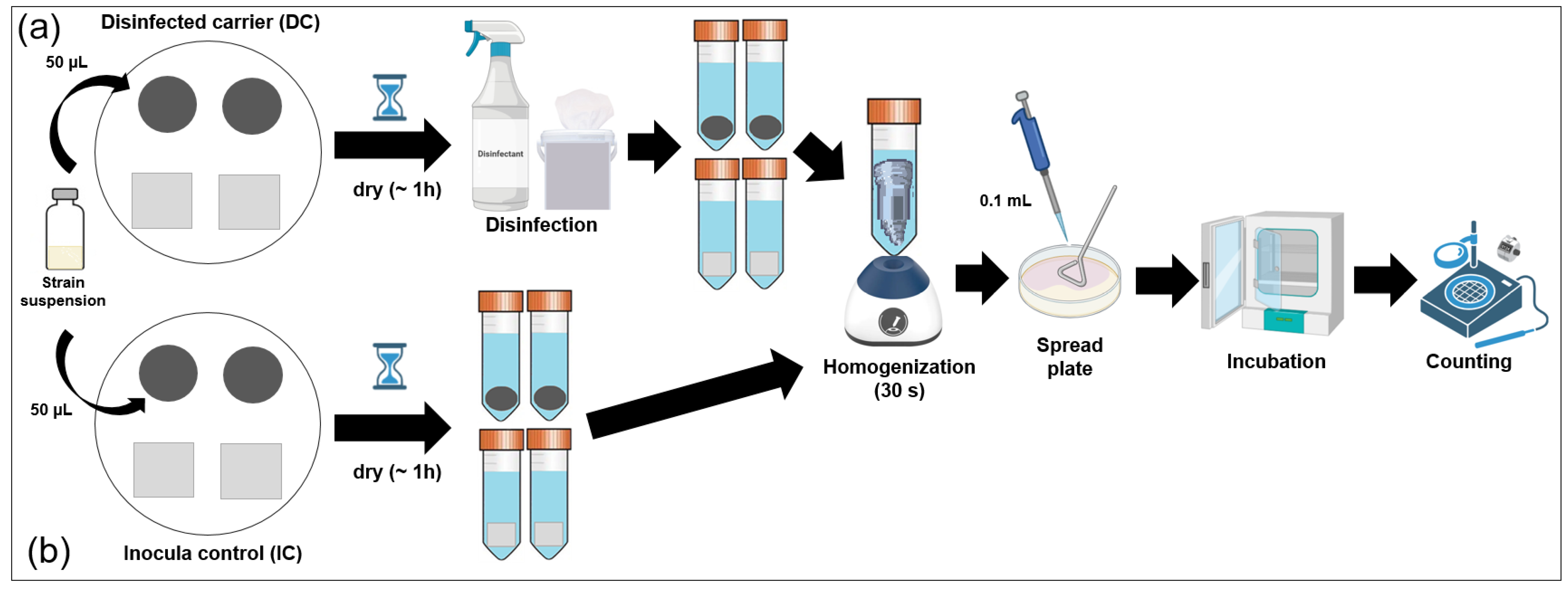
Four carriers of each type (SS and LDP) were placed in one Petri dish and spiked with 50 µL of PBS. After 1 h, the spiking inocula were completely dried and the two carriers of each type were disinfected according to the procedures described in Table 1. Each carrier was added to tubes containing 10 mL of PBS and homogenized for 30 s. For evaluation of residue effect, the inoculum (0.1 mL) of RE carriers for each strain was mixed with the residue (0.1 mL) of each corresponding chemical agent tested and spread on agar plating. For all strains tested, absence of a residual effect was considered to be when the viable count found in the presence of each specific residue was 50–200% of the inoculum control. A schematic diagram of residue preparation is shown in Figure 1a.
For each strain, eight carriers (four of each type) were spiked with 50 µL of each suspension, spread with a bacteriological loop (Inlab, São Paulo, Brazil), and then left with the plates opened inside the BSC until completely dry (~1 h).
For each surface (SS and LDP), two carriers were used as inoculum controls (ICs) and two were the disinfected controls (DCs) (Figure 1b). The DCs were disinfected according to the procedures described in Table 1. Afterwards, each IC and DC carrier was transferred to a tube containing 10 mL of PBS and homogenized for 30 s. The number of colony-forming units (CFU)/carrier was determined by agar plating (TSA for bacteria and PDA for fungi) after serial dilution. Plates were incubated at 37.0 ± 1.0 °C for 18–24 h for bacterial suspensions, 30.0 ± 1 °C for 18–24 h for bacterial spore suspensions, 22.5 ± 2.5 °C for 42–48 h for yeast suspensions, and 22.5 ± 2.5 °C for 7–9 days for fungal conidia suspensions.
When no colonies were found in any dilution, the assay detection limit was calculated as one CFU in the total volume of the lowest dilution inoculated.

2.3.4. Calculation and Interpretation of the Results

The average of the two carriers was calculated. The log10 CFU percent of viability reduction was calculated by comparing the number of CFU of the non-disinfected (IC) with the disinfected samples (DC), using the following equation:
% reduction (log10 CFU/carrier) = 100 − [(average of disinfected carriers × 100)/(average of inoculum controls carriers)]
The results obtained were compared to the criteria described in NF-T-72-281:2014 [13], in PDA Technical Report No. 70 [10], and in the USP [1], as described in Table 2.

3. Results

3.1. Bacterial and Fungal Strain Selection and Characterization

Between 2012 and 2022, 114 bacterial strains were isolated from cleaning validation tests. The most prevalent genera were Micrococcus (n = 12; 10.5%), Sphingomonas (n = 12; 10.5%), Pseudomonas (n = 11; 9.6%), and Acinetobacter (n = 11; 9.6%). Regarding spore-producing bacteria, at least one strain from the following genera was identified: Paenibacillus, Alicyclobacillus, Bacillus, Brevibacillus, and Lysinibacillus. Thirty-nine yeast strains were identified, and the most prevalent genera were Candida (n = 5; 12.8%) and Rhodotorula (n = 3; 7.7%). Thirty-three filamentous fungal strains were identified, and the most prevalent genera were Penicillium (n = 15; 44.5%) and Cladosporium (n = 5; 15.1%). Based on these results, nine strains were selected from this collection and characterized as described in Table 3.

3.2. Efficacy Test

All strains were within the acceptance range for evaluation of residual effect (50–200%), except for M. luteus (B1464/15) with the use of 0.5% hypochlorite on SS (recuperation of 11.7%) and C. parapsilosis (L-11) with the use of Oxivir TB Wipes on the PBD surface (recuperation of 600%). However, since these results were only obtained on these surfaces, for these disinfectants and only with these strains, and not as a systemic effect per strain or type of surface, it was decided to proceed with the efficacy test on those surfaces.
The efficacy test results for bacterial strains are presented in Table 4. For non-spore-forming bacteria, a reduction of ≥6.04 log10 was observed in all chemical agents and surfaces tested, meeting the recommendations in all standards (Table 2). For bacterial spores, the reduction in the Bacillus spp. strain B1342/15 ranged from 0.13 to 2.11 log10. Consequently, it only complied with the recommendation of PDA Technical Report No. 70 [10] on the PBD surface using Oxivir TB Wipes. The Bacillus spp. strain B0284/17 showed a reduction of ≥1.65 log10, meeting the recommendation of PDA Technical Report No. 70 [10]. Using the recommendation of the USP [1], the Oxivir TB Wipes on the SS surfaces did not meet the recommended reduction (≥2 log10). Compared to the recommendations in NF T 72-281:2014 [13], the only disinfectant that showed sporicidal activity was 0.5% peracetic acid on PBD.
The results obtained in the efficacy tests for yeasts and filamentous fungi strains are presented in Table 5. For yeasts, a reduction of ≥5.15 log10 was observed in all chemical agents and surfaces tested, meeting the recommendations in all standards (Table 2). For the evaluation of the fungicidal activity of the Penicillium spp. strain F21/18, there was a reduction in SS of 4.04 and 4.44 log10 with the sporicides peracetic acid and Oxivir TB Wipes, respectively, meeting the standards of NF T 72-281:2014 [13] and PDA Technical Report No. 70 [10]. In the PBD surface, a reduction of 3.41 and 3.56 log10 with peracetic acid and Oxivir TB Wipes, respectively, was observed, meeting only the PDA Technical Report No. 70 [10] standard for fungicidal evaluation.
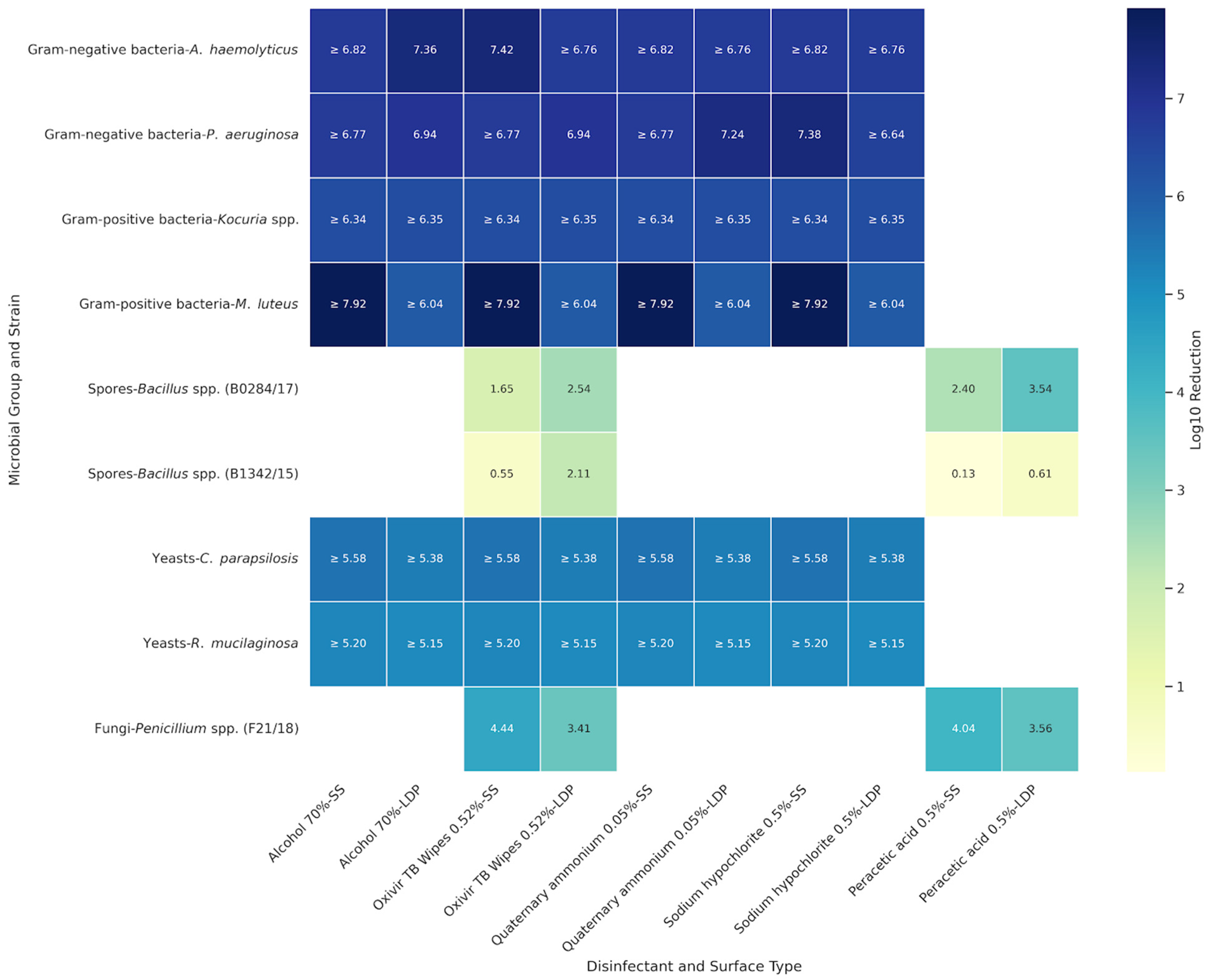
A heatmap of log10 (CFU/carrier) reduction in the different surfaces tested for the strains is shown in Figure 2.

4. Discussion

The purpose of an industrial cleaning and disinfection program is not only to control microbial contamination, but also to serve as corrective action [10]. Many aspects need to be considered when selecting a chemical agent for use in a pharmaceutical manufacturing area. These include the number and types of microorganisms to be controlled; the spectrum of activity of commercially available chemical agents; and the concentration, application method, and contact time of the disinfectant. The nature of the surface material being disinfected and its compatibility with the disinfectant are also important due to the corrosiveness of the chemical agents to equipment with repeated application. Planned disinfectant rotation and the steps that need to be taken to avoid the contamination of pharmaceutical products by a chemical agent must also be considered [1]. In this study, five chemical agents with different classifications were tested, using the concentrations and contact time prescribed in the cleaning and disinfecting program of the pharmaceutical facility (Table 1).
The emergence of antimicrobial resistance to antibiotics is a well-established and extensively documented phenomenon [14]. In contrast, the development of resistance to disinfectants is generally considered less probable at clinically or industrially relevant levels, given that disinfectants act as broad-spectrum biocidal agents with greater lethality than antibiotics. Moreover, these agents are typically applied at high concentrations to relatively low numbers of microorganisms, mainly in classified (grade A, B, or C areas) that are often in a metabolically inactive state, thereby reducing the selective pressure that drives antimicrobial resistance development [1]. Nevertheless, microorganisms most frequently recovered through environmental monitoring programs should be periodically evaluated through susceptibility testing against the disinfectants employed in the CCS. This practice is necessary due to the interspecies variability in tolerance to different biocidal agents. It also supports ongoing verification of disinfectant efficacy against the resident microbiota in each specific manufacturing environment and should include various surface types [1].
In the present study, six bacterial and three fungal strains isolated from cleaning validation tests at a pharmaceutical facility were selected as representing the most persistent strains in this environment. These strains were characterized using a polyphasic approach, including molecular characterization (Table 3), in order to ensure the strains’ identity. However, some strains, such as B1342/15 (Bacillus spp.) and F-21/18 (Penicillium spp.), could not be identified until the species level. The difficulty in identifying Bacillus and related genus strains isolated from pharmaceutical environments was already reported in other studies [15,16,17]. This is due to high similarity in phenotypical characteristics and 16S rRNA sequence within the Bacillus cereus group. [18]. Identification of filamentous fungi is also laborious and is not performed in many laboratories [19]. Phenotypic characterization methods, based mainly on macroscopic features of the culture and microscopic features of the reproductive structures, are subjective and need a mycologist with experience for analysis. The alternative automated commercial systems, such as MALDI-TOF MS and internal transcribed spacer regions and/or D2 LSU rDNA domain sequencing, can be used, but they generally also do not achieve a species identification result due to database limitations [20].
The efficacy test must have realistic acceptance criteria [1]. According to PDA Technical Report No. 70 [10], as the normal clean-room bioburden level is very low, the inoculum levels for testing would ideally depict levels seen in the controlled area. However, as this would not be practical in a test environment, a higher inoculum level should be used, though it should not exceed 105 CFU/mL. In this study, in-house micro-organisms with high inocula (4.55 to 8.92 log10 CFU) were tested, but these cannot represent the real scenario in clean rooms. However, even using high levels, all disinfectants tested for their respective contact times showed bactericidal and yeasticidal activity (reduction ≥ 5.15 log10 CFU), and sporicidal activity (reduction ≥ 3.41 log10 CFU) against fungal spores (Figure 2). The suggested minimum log reduction recommended by PDA [10] is >1 log (Table 2). This was achieved against Bacillus spp. strain B0284/17 (reduction ≥ 1.65 log10 CFU) but not for Bacillus spp. B1342/15 using peracetic acid 0.5% and Oxivir TB Wipes 0.52% on SS surface (Table 4).
A sporicide is a compound that destroys all vegetative micro-organisms and bacterial and fungal spores [9,10]. Bacterial spore structures are important for their protective role in biocide resistance [21,22]. In the present study, the sporicidal efficacy of peracetic acid 0.5% and Oxivir TB Wipes was tested (Table 1) against bacterial and fungal spores. Peracetic acid 0.5%/10 min was not sufficient for elimination of Bacillus B1342/15 spores (reduction of 0.13 to 2.11 log10 CFU), but was more effective against Bacillus B0284/17 (reduction of 1.65 to 3.54 log10 CFU) (Table 4). These results may be due to interspecies variation in the disinfectants [21]. Ceccanti et al. [6] evaluated the sporicidal effect against B. subtilis ATCC 6633, B. cereus ABIO 845, and B. sphaericus ABIO 229 (environmental in-house isolates). The authors reported that a 70% suitable dilution of the ready-to-use peracetic acid solution (commercially available 0.08% peracetic acid and 1.0% hydrogen peroxide solution) with a contact time of 10 min was effective (>2 log spore reduction) in both clean and dirty conditions on Teflon, linoleum, polycarbonate, and SS surfaces. The findings of the present study are consistent with those reported by André et al. [23], who demonstrated that sporicidal efficacy may significantly differ between planktonic and surface-adhered spores. Similarly, the results from this study showed limited viability log reductions by Oxivir TB Wipes, 0.52% for Bacillus spp. spores, despite adequate performance against vegetative cells and yeasts (Table 4). This fact showed that surface-associated spores may demonstrate enhanced tolerance due to limited disinfectant penetration, reduced metabolic activity, and potential protective surface interactions [21].
These data reinforce that cleaning and disinfection validation protocols based solely on suspension tests (not using carriers to simulate surfaces) may overestimate real-world efficacy. Furthermore, the inter-strain variability observed among Bacillus strains highlights the importance of incorporating in-house environmental strains into disinfectant efficacy studies, as recommended by USP [1] and PDA Technical Report 70 [10].
A standardized carrier-based framework for pharmaceutical manufacturing was proposed, bridging the gap between general standards like NF T 72-281:2014 [13] and the specific needs of a CCS [2]. The methodology standardizes three critical pillars: (1) the selection of “in-house” isolates based on long-term (10-year) environmental monitoring data, (2) the use of site-specific carriers (SS and LDP) that represent the facility, and (3) the harmonization of acceptance criteria across different regulatory references, such as the USP [1] and PDA Technical Report 70 [10]. Table 6 provides clear, actionable guidelines for quality control laboratories seeking to implement this standardized approach. By integrating these parameters into a unified protocol, this study provides a specific framework for the standardization of disinfectant evaluation, directly supporting the implementation of a robust CCS as required by Annex 1 [2].

5. Conclusions

In conclusion, all disinfectants tested showed bactericidal and yeasticidal activity against in-house strains (n = 6) on SS and LDP surfaces. Disinfection with peracetic acid 0.5% for 10 min was not sufficient to eliminate bacterial spores of one Bacillus strain on both surfaces. Oxivir TB Wipes were not effective in eliminating bacterial spores on the SS surface. For these cases, other studies are necessary for determination of the optimum concentration and contact time. These data are important to complement individual risk assessments of biological production processes and contribute to CCS in the industry facility.
The findings of the present study emphasize that chemical agents’ efficacy must be demonstrated under conditions representative of actual manufacturing environments. In alignment with these recommendations, the current study employed carrier-based testing on SS and LDP surfaces, thereby simulating real environmental conditions. The viability reductions observed for Bacillus spp. B1342/15 strain highlights that spore-forming microorganisms can exhibit increased tolerance when attached to surfaces.

Author Contributions

Conceptualization, A.S.C., L.V.d.C. and M.L.L.B.; methodology, A.S.C., R.V.d.S.L.d.M., T.B.V., L.V.d.C. and M.L.L.B.; validation, A.S.C., R.V.d.S.L.d.M., T.B.V. and L.V.d.C.; formal analysis, A.S.C., R.V.d.S.L.d.M., L.V.d.C., S.J.F. and M.L.L.B.; investigation, A.S.C., R.V.d.S.L.d.M., T.B.V. and L.V.d.C.; resources, M.L.L.B.; writing—original draft preparation, A.S.C. and M.L.L.B.; writing—review and editing, L.V.d.C. and S.J.F.; supervision, L.V.d.C. and M.L.L.B.; project administration, M.L.L.B.; funding acquisition, M.L.L.B. All authors have read and agreed to the published version of the manuscript.

Funding

This work was supported by the Fundação de Amparo à Pesquisa do Estado do Rio de Janeiro (FAPERJ)–Finance Code E-26/204.636/2022.

Data Availability Statement

The sequencing data for the 16S rRNA and ITS genes, which support the findings of this study, have been deposited in the National Center for Biotechnology Information (NCBI) repository. Accession numbers are listed in Table 3. All other data are included within this article.

Acknowledgments

The authors are grateful to the Instituto de Tecnologia em Imunobiológicos (Bio-Manguinhos).

Conflicts of Interest

Author Stephen James Forsythe was employed by Foodmicrobe.com Ltd. The remaining authors declare that the research was conducted in the absence of any commercial or financial relationships that could be construed as a potential conflict of interest.

Abbreviations

The following abbreviations are used in this manuscript:
CCSContamination control strategy
EMAEuropean Medicines Agency
EUEuropean Union
GMPGood Manufacturing Practice
LDPLow-density polyethylene
PDAParenteral Drug Association
SSStainless steel
USPUnited States Pharmacopeia

References

  1. United States Pharmacopeia (USP). General Chapter, <1072> Disinfectants and Antiseptics; USP-NF, United States Pharmacopeia: Rockville, MD, USA, 2023. [Google Scholar]
  2. European Medicines Agency—Science Medicines Health (EMA); European Commission. Guidelines. The Rules Governing Medicinal. Products in the European Union Volume 4 EU. Guidelines for Good Manufacturing Practice for Medicinal Products for Human and Veterinary Use—Annex 1—Manufacture of Sterile Medicinal Products; European Commission: Bruxelles, Belgium, 2022. [Google Scholar]
  3. World Health Organization. Good Manufacturing Practices for Pharmaceutical Products: Main Principles; Annex 3. WHO Technical Report Series; World Health Organization: Geneva, Switzerland, 2011. [Google Scholar]
  4. Food and Drug Administration (FDA). Guidance for Industry Sterile Drug Products Produced by Aseptic Processing—Current Good Manufacturing Practice; U.S. Food and Drug Administration: Bethesda, MD, USA, 2004. [Google Scholar]
  5. Agência Nacional de Vigilância Sanitária (ANVISA). Resolução da Diretoria Colegiada—RDC nº 658, de 30 de Março de 2022. Dispõe Sobre as Boas Práticas de Fabricação de Medicamentos; Diário Oficial da União: Brasília, Brasil, 2022. [Google Scholar]
  6. Ceccanti, S.; Giampieri, S.; Burgalassi, S. Carrier tests to assess the effective sporicidal concentration of a liquid chemical disinfectant for a sanitization program. PDA J. Pharm. Sci. Technol. 2011, 65, 372–379. [Google Scholar] [CrossRef] [PubMed]
  7. Ajorio, A.C.F.B.; Rhodes, V.P.; Rodrigues, A.P.; Diniz, V.A.; Mattoso, J.M.V.; da Silva, I.B.; D Aiuto, D.M.M.; Brandão, M.L.L. Evaluation of hydrogen peroxide efficacy against AZD1222 chimpanzee adenovirus strain in the recombinant COVID-19 vaccine for application in cleaning validation in a pharmaceutical manufacturing industry. Lett. Appl. Microbiol. 2022, 74, 536–542. [Google Scholar] [CrossRef] [PubMed]
  8. Sandle, T. A review of cleanroom microflora: Types, trends, and patterns. PDA J. Pharm. Sci. Technol. 2011, 65, 392–403. [Google Scholar] [CrossRef] [PubMed]
  9. Kremer, T.; Singer, D.C. Ode to a Sporicide—Can we do better? PDA J. Pharm. Sci. Technol. 2026, 80, 71–76. [Google Scholar] [CrossRef] [PubMed]
  10. Parenteral Drug Association (PDA). Fundamentals of Cleaning and Disinfection Programs for Aseptic Manufacturing Facilitie; Technical Report No. 70; Parenteral Drug Association (PDA): Bethesda, MD, USA, 2015. [Google Scholar]
  11. Chalita, M.; Kim, Y.O.; Park, S.; Oh, H.S.; Cho, J.H.; Moon, J.; Baek, N.; Moon, C.; Lee, K.; Yang, J.; et al. EzBioCloud: A genome-driven database and platform for microbiome identification and discovery. Int. J. Syst. Evol. Microbiol. 2024, 74, 6. [Google Scholar] [CrossRef] [PubMed]
  12. Vu, D.; Groenewald, M.; De Vries, M.; Gehrmann, T.; Stielow, B.; Eberhardt, U.; Al-Hatmi, A.; Groenewald, J.Z.; Cardinali, G.; Houbraken, J.; et al. Large-scale generation and analysis of filamentous fungal DNA barcodes boosts coverage for kingdom Fungi and reveals thresholds for fungal species and higher taxon delimitation. Stud. Mycol. 2019, 92, 135–154. [Google Scholar] [CrossRef] [PubMed]
  13. NF T 72-281; L’Association Francaise de Normalisation. Procedes de Disinfection des Surfaces par Voie Aerienneedetermination de l’activite Bactericide, Fongicide, Levuricide, Mycobactericide, Tuberculocide, Sporicide et Virucide Incluant les Bacteriophages. AFNOR: Paris, France, 2014.
  14. Reza, N.; Dubey, V.; Sharland, M.; Hope, W. Antimicrobial use and resistance. BMJ 2025, 391, e082681. [Google Scholar] [CrossRef] [PubMed]
  15. de Miranda, R.V.D.S.L.; da Costa, L.V.; Albuquerque, L.S.; Dos Reis, C.M.F.; Braga, L.M.P.D.S.; de Andrade, J.M.; Ramos, J.N.; Mattoso, J.M.V.; Forsythe, S.J.; Brandão, M.L.L. Identification of Sutcliffiella horikoshii strains in an immunobiological pharmaceutical industry facility. Lett. Appl. Microbiol. 2023, 76, ovad056. [Google Scholar] [CrossRef] [PubMed]
  16. Caldeira, N.G.S.; de Souza, M.L.S.; de Miranda, R.V.D.S.L.; da Costa, L.V.; Forsythe, S.J.; Zahner, V.; Brandão, M.L.L. Characterization by MALDI-TOF MS and 16S rRNA Gene Sequencing of Aerobic Endospore-Forming Bacteria Isolated from Pharmaceutical Facility in Rio de Janeiro, Brazil. Microorganisms 2024, 12, 724. [Google Scholar] [CrossRef] [PubMed]
  17. Costa, L.V.D.; Ramos, J.N.; Albuquerque, L.S.; Miranda, R.V.D.S.L.; Valadão, T.B.; Veras, J.F.C.; Vieira, E.M.D.; Forsythe, S.; Brandão, M.L.L.; Vieira, V.V. Bacillus lumedeiriae sp. nov., a Gram-Positive, Spore-Forming Rod Isolated from a Pharmaceutical Facility Production Environment and Added to the MALDI Biotyper® Database. Microorganisms 2024, 12, 2507. [Google Scholar] [CrossRef] [PubMed]
  18. Carroll, L.M.; Cheng, R.A.; Wiedmann, M.; Kovac, J. Keeping up with the Bacillus cereus group: Taxonomy through the genomics era and beyond. Crit. Rev. Food Sci. Nutr. 2022, 62, 7677–7702. [Google Scholar] [CrossRef] [PubMed]
  19. Klugherz, I.; Kölli, B.; Reinmüller, M.; Willinger, B.; Leitner, E.; Steinmetz, I.; Dichtl, K. Identification of Filamentous Fungi: An Evaluation of Three MALDI-TOF Mass Spectrometry Systems. Mycoses 2025, 68, e70078. [Google Scholar] [CrossRef] [PubMed]
  20. Moreira, F.M.; Pereira, P.A.; Miranda, R.V.D.S.L.; Reis, C.M.F.D.; Braga, L.M.P.D.S.; de Andrade, J.M.; do Nascimento, L.G.; Mattoso, J.M.V.; Forsythe, S.J.; da Costa, L.V.; et al. Evaluation of MALDI-TOF MS, sequencing of D2 LSU rRNA and internal transcribed spacer regions (ITS) for the identification of filamentous fungi isolated from a pharmaceutical facility. J. Pharm. Biomed. Anal. 2023, 234, 115531. [Google Scholar] [CrossRef] [PubMed]
  21. Leggett, M.J.; McDonnell, G.; Denyer, S.P.; Setlow, P.; Maillard, J.Y. Bacterial spore structures and their protective role in biocide resistance. J. Appl. Microbiol. 2012, 113, 485–498. [Google Scholar] [CrossRef] [PubMed]
  22. Setlow, P. Spores of Bacillus subtilis: Their resistance to and killing by radiation, heat and chemicals. J. Appl. Microbiol. 2006, 101, 514–525. [Google Scholar] [CrossRef] [PubMed]
  23. André, S.; Hédin, S.; Remize, F.; Zuber, F. Evaluation of peracetic acid sanitizers efficiency against spores isolated from spoiled cans in suspension and on stainless steel surfaces. J. Food Prot. 2012, 75, 371–375. [Google Scholar] [CrossRef] [PubMed]
Figure 1. Schematic diagram for preparation of stainless-steel (2.0 cm diameter) and low-density-polyethylene (square pieces of 3.0 cm2) residue for evaluation of residual effect (a), and of sample spiking in the stainless-steel disks and low-density polyethylene for disinfectant evaluation (b). PBS: phosphate-buffered saline, pH 7.2.
Standards 06 00022 g001
Figure 2. Heatmap of log10 (CFU/carrier) reduction in stainless-steel (SS) and low-density-polyethylene (LDP) surfaces for bacteria, yeast, and filamentous fungi strains.
Standards 06 00022 g002
Table 1. Antimicrobial chemical agents tested for efficacy.
Classification 1Chemical AgentsConcentration (%)Contact Time (min)Test
SanitizerAlcohol7015Bactericidal and yeasticidal activity
DisinfectantSodium hypochlorite0.515Bactericidal and yeasticidal activity
DisinfectantQuaternary ammonium0.0520Bactericidal and yeasticidal activity
SporicidePeracetic acid0.510Sporicidal and fungicidal activity
SporicideOxivir TB Wipes containing accelerated hydrogen peroxide0.525Bactericidal, yeasticidal, fungicidal, and sporicidal activity
1 Classification according to Parenteral Drug Association Technical Report No. 70 [10].
Table 2. Description of applications and criteria for evaluating the chemical agent efficacy test on stainless-steel and low-density polyethylene surfaces.
ReferenceApplicationMicroorganismsRecommended Initial Inoculum (log)Recommended Reduction (log)
NF T 72-281:2014 [13]Evaluation of airborne surface disinfection in the following sectors: human health; veterinary; and agriculture, food, and industry by physical and/or chemical processesVegetative bacteria≥6≥5
Bacterial spores≥4≥3
Yeasts and fungi≥5≥4
Parenteral Drug Association Technical Report No. 70 [10]Evaluation of surface disinfection efficacy in production areas of pharmaceutical industriesNon-spore-forming3 to 5>1
bacteria and fungi spores
United States Pharmacopeia [1]Vegetative bacteriaNot informed≥3
Bacterial spores≥2
Table 3. Characterization of bacterial (n = 6), yeast (n = 2), and filamentous fungi (n = 1) strains selected for the efficacy tests.
Microorganisms and CharacteristicsId.VITEK®2 (%)VITEK®MS (%)Molecular Characterization
16S rRNA (Bacteria) or D2 (Fungi) (%)Size (bp 1)NCBI Number 2
Bacterial strains
Gram-negative bacilliB0380/16Pseudomonas aeruginosa (99.0)Pseudomonas aeruginosa (99.0)Pseudomonas aeruginosa (99.93)1433OR656695
Gram-negative bacilliB0747/20Acinetobacter baumannii complex (98.0)Acinetobacter haemolyticus (99.9)Acinetobacter haemolyticus (99.86)/A. beijerinckii (98.82)1470OR656731
Gram-positive cocciB1464/15Micrococcus luteus (99.9)Micrococcus luteus (99.9)Micrococcus luteus (99.52)/M. porci (98.96)/M. endophyticus (98.94)1483OR656739
Gram-positive cocciB1472/15Kocuria rosea (99.0)NI 3Kocuria turfanensis (99.52)/K. oceani (98.90)1484OR656740
Gram-positive bacilliB1342/15Bacillus cereus/thurigiensis/mycoides (88.0)Bacillus cereus group (99.9)Bacillus cereus (99.93)/B. paranthracis (99.86)/B. albus (99.86)/B. luti (99.86)/B. nitratireducens (99.86)/B. sanguinis (99.86)/B. dicomae (99.86)/B. basilensis (99.86)/B. wiedmannii (99.79)/B. paramycoides (99.79)/B. tropicus (99.79)/B. anthracis (99.79)/B. proteolyticus (99.73)/B. fungorum (99.73)/B. mobilis (99.66)/B. pacificus (99.66)/B. paramobilis (99.65)/B. toyonensis (99.59)/B. arachidis (99.57)/B. pseudomycoides (99.52)/B. hominis (99.51)/B. mycoides (99.38)/B. gaemokensis (98.90)1478OR656749
Gram-positive bacilliB0284/17Bacillus pumilus (85.0)Bacillus pumilus (99.9)Bacillus safensis subsp. safensis (99.86)/B. safensis subsp. osmophilus (99.86)/B. australimaris (99.71)/B. pumilus (99.64)/B. zhangzhouensis (99.64)/B. altitudinis (99.43)/B. xiamenensis (99.36)1403OR656689
Fungal strains
YeastL-11Candida parapsilosis (95.0)Candida parapsilosis (99.9)Candida parapsilosis (99.69)/Nakaseomyces glabratus (Candida glabrata) (99.69)320OR731399
YeastL-51Cryptococcus laurentii/Rhodotorula mucilaginosa/glutinis (95.0)Rhodotorula mucilaginosa (99.9)Rhodotorula mucilaginosa (99.38)320OR731402
Filamentous fungiF-21/18NA 4NIPenicillium lanosocoeruleum (100)/P. chrysogenum (100)/P. goetzii (100)/P. rubens (100)/P. nalgiovense (100)/P. tardochrysogenum (100)/P. westlingii (100)/P. aurantiogriseum (100)324OR734960
1—base pairs; 2—National Center for Biotechnology Information; 3—not identified (≤75%); 4—not applied.
Table 4. Efficacy of chemical agents in bacterial strains on stainless-steel and low-density-polyethylene surfaces.
StrainProduct (Contact Time)SurfaceLog10 CFU 1 (IC 2 Carrier)Reduction Log10 (CFU/Carrier)
Pseudomonas
aeruginosa
(B0380/16)
Alcohol 70%
(15 min)
SS 37.77≥6.77
LDP 47.646.94
Sodium hypochlorite 0.5%
(15 min)
SS7.777.38
LDP7.64≥6.64
Quaternary ammonium 0.05%
(15 min)
SS7.77≥6.77
LDP7.647.24
Oxivir TB Wipes 0.52%
(5 min)
SS7.77≥6.77
LDP7.646.94
Acinetobacter
haemolyticus
(B0747/20)
Alcohol 70%
(15 min)
SS7.82≥6.82
LDP7.767.36
Sodium hypochlorite 0.5%
(15 min)
SS7.82≥6.82
LDP7.76≥6.76
Quaternary ammonium 0.05%
(15 min)
SS7.82≥6.82
LDP7.76≥6.76
Oxivir TB Wipes 0.52%
(5 min)
SS7.827.42
LDP7.76≥6.76
Micrococcus
luteus
(B1464/15)
Alcohol 70%
(15 min)
SS8.92≥7.92
LDP7.04≥6.04
Sodium hypochlorite 0.5%
(15 min)
SS8.92≥7.92
LDP7.04≥6.04
Quaternary ammonium 0.05%
(15 min)
SS8.92≥7.92
LDP7.04≥6.04
Oxivir TB Wipes 0.52%
(5 min)
SS8.92≥7.92
LDP7.04≥6.04
Kocuria spp.
(B1472/15)
Alcohol 70%
(15 min)
SS7.34≥6.34
LDP7.21≥6.35
Sodium hypochlorite 0.5%
(15 min)
SS7.34≥6.34
LDP7.21≥6.35
Quaternary ammonium 0.05%
(15 min)
SS7.34≥6.34
LDP7.21≥6.35
Oxivir TB Wipes 0.52%
(5 min)
SS7.34≥6.34
LDP7.21≥6.35
Bacillus spp.
(B1342/15)
Peracetic acid 0.5%
(10 min)
SS4.550.13
LDP4.910.61
Oxivir TB Wipes 0.52%
(5 min)
SS4.550.55
LDP4.912.11
Bacillus spp.
(B0284/17)
Peracetic acid 0.5%
(10 min)
SS4.502.40
LDP4.543.54
Oxivir TB Wipes 0.52%
(5 min)
SS4.501.65
LDP4.542.54
LDP4.413.41
1—colony-forming units; 2—inoculum control; 3—stainless-steel; 4—low-density polyethylene.
Table 5. Efficacy of chemical agents in yeast and filamentous fungi strains on stainless-steel and low-density polyethylene surfaces.
StrainProduct (Contact Time)SurfaceLog10 CFU 1 (IC 2 Carrier)Reduction Log10 (CFU/Carrier)
Candida
parapsilosis
(L-11)
Alcohol 70%
(15 min)
SS 36.58≥5.58
LDP 46.38≥5.38
Sodium hypochlorite 0.5%
(15 min)
SS6.58≥5.58
LDP6.38≥5.38
Quaternary ammonium 0.05%
(15 min)
SS6.58≥5.58
LDP6.38≥5.38
Oxivir TB Wipes 0.52%
(5 min)
SS6.58≥5.58
LDP6.38≥5.38
Rhodotorula
mucilaginosa
(L-51)
Alcohol 70%
(15 min)
SS6.20≥5.20
LDP6.15≥5.15
Sodium hypochlorite 0.5%
(15 min)
SS6.20≥5.20
LDP6.15≥5.15
Quaternary ammonium 0.05%
(15 min)
SS6.20≥5.20
LDP6.15≥5.15
Oxivir TB Wipes 0.52%
(5 min)
SS6.20≥5.20
LDP6.15≥5.15
Penicillium spp.
(F21/18)
Peracetic acid 0.5%
(10 min)
SS5.444.04
LDP4.413.56
Oxivir TB Wipes 0.52%
(5 min)
SS5.444.44
LDP4.413.41
1—colony-forming units; 2—inoculum control; 3—stainless-steel; 4—low-density polyethylene.
Table 6. Proposed guidelines for the standardization of disinfectant efficacy testing in pharmaceutical facilities.
Standardization ParameterRecommendationRationale
Selection of isolatesUse “in-house” environmental strains alongside culture collection strains (e.g., ATCC)Reflects the actual microbiota and potential resistance patterns within the facility
Surface representationTest on different surface types that exist in the pharmaceutical facilityAccounts for surface-specific challenges in disinfectant contact and microbial recovery
Carrier-based methodAdopt a standardized inoculum drying time (e.g., 30–60 min) and specific volume (e.g., 10 µL)Ensures reproducibility and simulates real-world surface contamination
Evaluation of residue effectMandatory verification of the residue effect on each surface testedPrevents false-positive results caused by residual effect activity during recovery
Microbial loadingInitial inoculum should be similar to the real conditions and should not exceed 105 CFU/mLThe inoculum levels for testing would ideally depict levels seen in the controlled area. However, as this would not be practical in a test environment, a higher inoculum level should be used
Acceptance criteriaIt varies depending on the standard usedThe pharmaceutical industry must apply these criteria in accordance with the standards required to meet regulatory requirements
ATCC—American Type Culture Collection; CFU—colony-forming units.
Disclaimer/Publisher’s Note: The statements, opinions and data contained in all publications are solely those of the individual author(s) and contributor(s) and not of MDPI and/or the editor(s). MDPI and/or the editor(s) disclaim responsibility for any injury to people or property resulting from any ideas, methods, instructions or products referred to in the content.