Article

Occurrence of Contaminants in Groundwater from the Central–Northeastern Part of the Romanian Plain and the Associated Risk Assessment

by
Crinela Dumitrescu
1,*,
Claudia Stihi
1,2,*,
Roxana Elena Ionete
3,
Elisabeta-Irina Geană
3,
Corina Teodora Ciucure
3 and
Petre Brețcan
4
1
Faculty of Sciences and Arts, Valahia University of Targoviste, 13 Aleea Sinaia St., 130004 Targoviste, Romania
2
Academy of Romanian Scientists, 3 Ilfov St., 050044 Bucharest, Romania
3
National Research and Development Institute for Cryogenic and Isotopic Technologies, 4 Uzinei St., 240050 Ramnicu-Valcea, Romania
4
Faculty of Humanities, Valahia University of Targoviste, 35 Stancu Ion St., 130105 Targoviste, Romania
*
Authors to whom correspondence should be addressed.
Toxics 2026, 14(7), 638; https://doi.org/10.3390/toxics14070638
Submission received: 29 June 2026 / Revised: 15 July 2026 / Accepted: 17 July 2026 / Published: 21 July 2026

Highlights

What are the main findings?
  • This is the first integrated assessment of PAHs in groundwater from the Titu-Sarata Plain, combining chemical analysis with source apportionment and ecological and human health risk assessment.
  • Groundwater PAHs concentrations were low and complied with European drinking water quality standards.
  • PAHs originated predominantly from pyrogenic and mixed pyrogenic-petrogenic sources, with generally low ecological and human health risks.
What is the implication of the main findings?
  • The study provides baseline data for groundwater PAHs contamination in rural Romania and supports integrated groundwater monitoring and sustainable groundwater management.

Abstract

Groundwater is a vital resource for drinking water supply, agriculture, and industrial activities. However, contamination by organic pollutants may pose significant threats to both ecosystem integrity and human health. This study assessed the environmental and human health risks associated with polycyclic aromatic hydrocarbons (PAHs) in groundwater collected from 27 localities in the central–northeastern Romanian Plain. The concentrations of naphthalene, acenaphthene, fluorene, phenanthrene, anthracene, fluoranthene, pyrene, benzo[a]anthracene, chrysene, benzo[b]fluoranthene, benzo[k]fluoranthene, benzo[a]pyrene, dibenzo[a,h]anthracene, benzo[g,h,i]perylene, and indeno [1,2,3-cd]pyrene were determined using high-performance liquid chromatography coupled with fluorescence detection. Benzo[a]pyrene concentrations ranged from <LOD to 0.08 ng/L, while total concentrations varied between 2.56 to 11.2 ng/L. The environmental risk associated with groundwater contamination was classified as low to moderate, with total risk coefficients ranged from 0.2 to 2.3. Potential contamination sources were identified using the diagnostic ratio method, complemented by multivariate statistical analysis, indicating predominantly pyrogenic and mixed pyrogenic–petrogenic sources. Human health risk assessment indicated that groundwater ingestion posed neither non-carcinogenic risks (Hazard Index, HI < 1) nor unacceptable carcinogenic risks. The Incremental Lifetime Cancer Risk (ILCR) values ranged from 5.7 × 10⁻⁹ to 2.2 × 10⁻⁸ for infants, 2.7 × 10⁻⁹ to 1.0 × 10⁻⁸ for children, and 1.5 × 10⁻⁹ to 6.1 × 10⁻⁹ for adults.

1. Introduction

Polycyclic aromatic hydrocarbons (PAHs) are ubiquitous environmental contaminants composed of two or more fused aromatic rings and are recognized among the most important classes of persistent organic pollutants. They are generated primarily through the incomplete combustion of organic materials, including coal, petroleum, natural gas, wood, waste, biomass, tobacco, and charbroiled food, but are also emitted from vehicle emissions, cigarette smoke, and natural processes such as wildfires and volcanic eruptions [1,2,3,4,5,6].
PAHs are characterized by low aqueous solubility, pronounced lipophilicity, and remarkable chemical and thermal stability [2,3,4,5,6,7,8,9,10,11,12,13,14,15,16]. Some low-molecular-weight PAHs are semi-volatile and may occur in both gaseous and particulate phases, enabling long-range atmospheric transport before deposition onto soils, vegetation, and aquatic environments [4,5,7,17]. These physicochemical properties account for their persistence, widespread distribution, and accumulation in environmental compartments, resulting in extensive environmental contamination [18]. Although hydrophobic, PAHs can contaminate groundwater, particularly in urbanized and industrialized areas. Benzo[a]pyrene, for example, readily penetrates soil and may subsequently reach groundwater or adjacent surface waters [4].
PAHs enter aquifers through several pathways, including the slow dissolution of contaminated materials, infiltration from polluted soils, and transport mediated by dissolved organic matter and colloidal particles [19,20]. Organic-rich soils frequently act as long-term reservoirs, gradually releasing PAHs into groundwater, particularly under acidic or anaerobic conditions [21]. Historical industrial activities represent the principal sources of groundwater contamination, including former gasworks, coking plants, petroleum refineries [22], wood-treatment facilities using creosote [23,24], contaminated landfills and polluted soils [21], and infiltration of contaminated surface waters into aquifers [25]. In addition, tar and creosote residues may persist below the water table for decades as secondary contamination sources. Low-molecular-weight PAHs, especially naphthalene and phenanthrene, are the compounds most frequently detected in groundwater. Their mobility may be further enhanced through interactions with humic substances and organic colloids, resulting in groundwater concentrations up to 20–50 times higher than those predicted solely from their aqueous solubility [22].
Because of their persistence, bioaccumulation potential, toxicity, and carcinogenicity, PAHs are among the most intensively regulated classes of organic contaminants. Within the European Union, eight PAHs (BaP, DahA, BaA, Chry, BjF, BbF, BkF, and BeP) are regulated under the REACH Regulation (Registration, Evaluation, Authorisation and Restriction of Chemicals) [26], whereas the U.S. Environmental Protection Agency (EPA) has designated sixteen PAHs as priority pollutants for environmental monitoring and risk assessment [27,28].
Human exposure to PAHs occurs primarily through ingestion, inhalation, and dermal contact [18,28,29]. Ingestion represents one of the major exposure pathways for the general population through the consumption of thermally processed foods (e.g., grilled, smoked, baked, fried, and charred products), contaminated cereals, and polluted drinking water [18]. Owing to their pronounced lipophilicity, PAHs are readily absorbed through the gastrointestinal tract [30]. Inhalation exposure occurs mainly in urban and industrial environments through fine particulate matter (PM2.5 and PM10), to which PAHs are readily adsorbed. Major emission sources include road traffic, industrial activities, residential heating, and cigarette smoke [18]. Dermal exposure is particularly relevant in occupational settings, such as the coke industry and facilities involved in the production or handling of tar, asphalt, and creosote, but may also occur through contact with contaminated water, soil, dust, and other polluted materials [23,31].
Following absorption, PAHs undergo extensive hepatic biotransformation, generating highly reactive metabolites, including epoxides, dihydrodiols, phenols, quinones, and related derivatives, which are capable of forming covalent adducts with DNA and other cellular macromolecules [17,18,30]. Their binding to plasma proteins, particularly albumin, facilitates systemic distribution to various organs [18]. These metabolites induce oxidative stress [8], chronic inflammation, and disturbances in cellular homeostasis [30], thereby contributing to mutagenesis and carcinogenesis.
Most biologically active PAHs contain between two and six fused aromatic rings. Several of the sixteen EPA priority PAHs have been classified by the International Agency for Research on Cancer (IARC) as carcinogenic, probably carcinogenic, or possibly carcinogenic to humans [32], with benzo[a]pyrene (BaP) serving as the reference compound for carcinogenic risk assessment. In addition to their carcinogenic potential [2,3,4,8,9], PAH exposure has been associated with chronic respiratory diseases, cardiovascular disorders, endocrine disruption, impaired liver function, reproductive toxicity, adverse neurodevelopmental outcomes, and digestive tract cancers [1,4,18,30,32]. Prenatal exposure has been linked to reduced birth weight and impaired neurocognitive development [4], whereas phenanthrene exposure has also been associated with hyperuricemia [11]. Acute and chronic dermal exposure may cause irritant dermatitis, photosensitization, precancerous skin lesions, and skin cancer, while compounds such as acenaphthene and pyrene have been associated with skin irritation and other adverse dermatological effects [7,13,17,32].
Despite the environmental and public health relevance of PAHs, studies investigating their occurrence, distribution, sources, and associated environmental and human health risks in groundwater remain relatively scarce, particularly in Europe [20,33,34,35]. Most investigations have focused on contaminated industrial sites or specific hydrogeological settings rather than providing comprehensive regional assessments of groundwater quality.
The occurrence of PAHs in groundwater has been documented in several European countries. For example, investigations conducted at tar-contaminated sites in Germany (Stuttgart, Wülknitz, Castrop-Rauxel, and Lünen) reported naphthalene concentrations of up to 8071.2 μg/L, highlighting the long-term persistence of PAHs in aquifer systems [33]. In Italy, Montuori et al. [20] detected several PAHs, including benzo[g,h,i]perylene, phenanthrene, and naphthalene, in groundwater from the Campania Plain, whereas Riccardi et al. [34] identified eighteen PAHs, ranging from naphthalene to coronene, in groundwater collected from petroleum storage facilities located in northern, central, and southern Italy. Similarly, Llamas et al. [35] investigated organic contaminants in groundwater from the Guadiaro River watershed (southern Spain), reporting pyrene concentrations between 0.001 and 0.015 μg/L. Collectively, these studies demonstrate that PAH occurrence in groundwater is strongly influenced by historical industrial activities, petroleum contamination, land use, and local hydrogeological conditions. However, most of these investigations were performed at contaminated sites and therefore provide limited information on groundwater quality in rural aquifers serving as drinking water resources.
Compared with other European countries, information regarding the occurrence, distribution, and environmental significance of PAHs in Romanian environmental compartments remains limited [36,37,38,39,40,41,42]. Existing studies have mainly focused on sediments, surface waters, marine ecosystems, fish, and drinking water, whereas groundwater has received considerably less attention. In sediments collected from the Begej International Canal (Romania–Serbia), dibenz[a,h]anthracene was identified as the predominant PAH and considered a potential threat to aquatic biota [36]. Ciucure et al. [37] investigated the occurrence, sources, and ecological risks of PAHs in surface waters and sediments from reservoirs along the middle and lower reaches of the Olt River, reporting total PAH concentrations ranging from 1.3 to 46.2 ng/L in water and from 1.78 to 614.04 μg/kg in sediments. Mihaly et al. [38] determined PAH concentrations in scales, gills, liver, and muscle tissues of four farmed fish species from eastern Romania and proposed a rapid approach for evaluating potential human health risks associated with fish consumption. Maldonado et al. [39] reported that PAH contamination in surface waters of the western Black Sea was more pronounced in coastal and estuarine areas, reflecting predominantly petrogenic sources. In rural communities from eastern Romania, Dirtu et al. [40] detected benzo[a]pyrene concentrations of up to 21.78 ng/L in drinking water, while total PAH concentrations ranged from 5.79 to 96.31 ng/L.
Despite these investigations, groundwater contamination by PAHs has received very limited attention in Romania [41,43,44]. Existing studies have been conducted near urban landfills in northern Romania [43], the Bucharest area [41], as well as adjacent to a former petroleum products storage facility in Titu [44]. For example, one study has evaluated PAHs in groundwater affected by leachate migration from the Vidra municipal landfill near Bucharest [41]. Fluorene, phenanthrene, anthracene, fluoranthene, and pyrene were detected at concentrations ranging from 0.0010 to 0.0065 μg/L, whereas all remaining target PAHs were below the analytical detection limits. Overall, available evidence indicates that information regarding the occurrence, distribution, sources, environmental and potential human health risks of PAHs in Romanian groundwater remains fragmentary [36,37,38,39,40,41,42,43,44].
A comprehensive assessment of PAHs occurrence in groundwater requires not only the determination of contaminant concentrations but also the identification of their potential sources and the evaluation of the associated environmental and human health risks. Integrating these complementary approaches provides a robust framework for evaluating groundwater quality and supports the development of effective monitoring and management strategies. To address this knowledge gap, the present study presents the first integrated assessment of PAHs occurrence in groundwater from the central–eastern Romanian Plain, based on the determination of the sixteen EPA priority PAHs. Specifically, the study aimed to (i) determine the occurrence and concentrations of PAHs in groundwater, (ii) identify their potential sources using diagnostic molecular ratios supported by multivariate statistical analysis, (iii) assess the associated environmental risks, and (iv) evaluate the potential non-carcinogenic and carcinogenic health risks related to groundwater consumption. The findings provide baseline data for future groundwater quality monitoring, support evidence-based environmental management, and contribute to a better understanding of PAH occurrence and associated risks in Romanian groundwater.

2. Materials and Methods

2.1. Sampling and Study Area

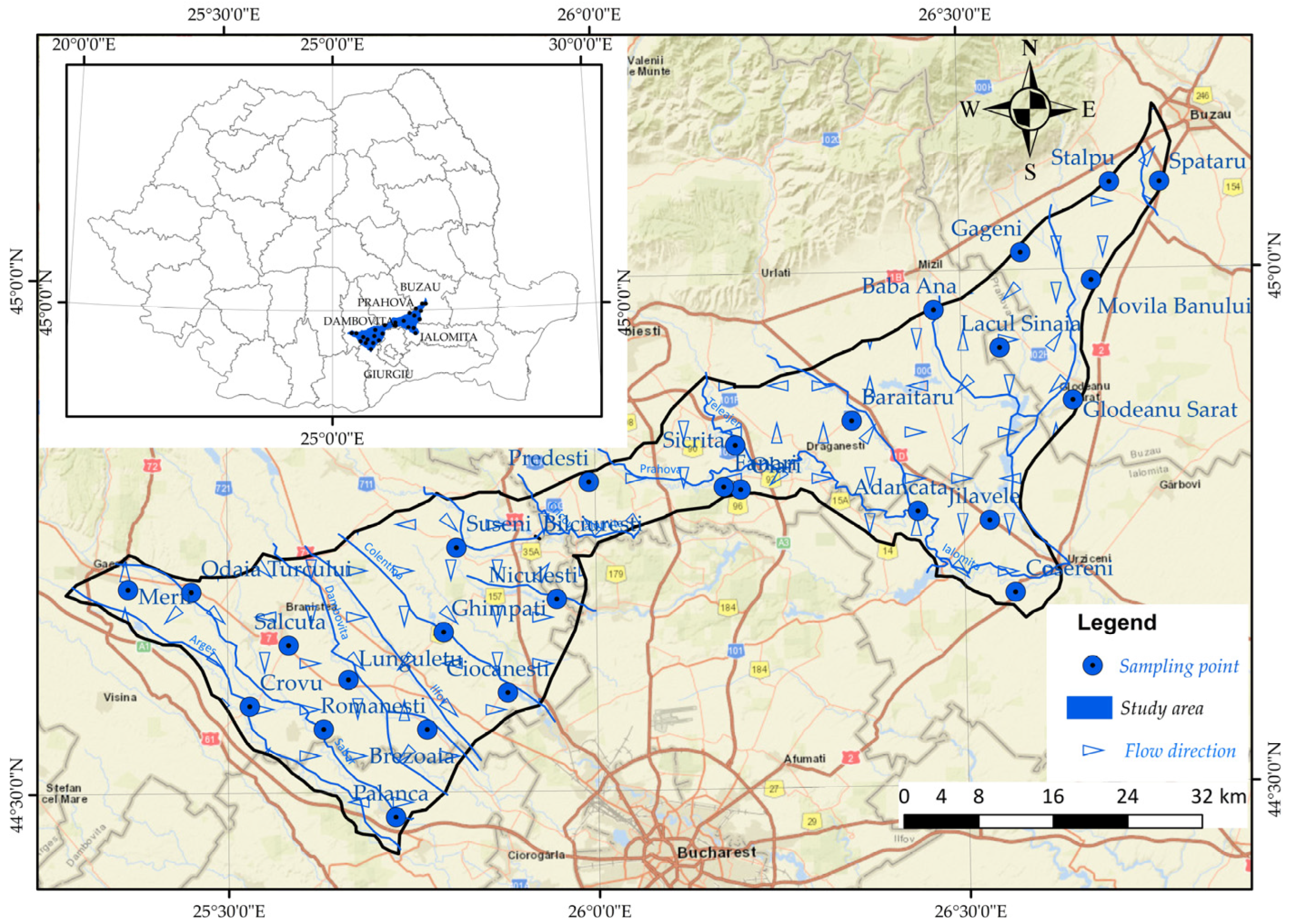
The Titu-Sarata Plain, located in the central–eastern part of the Romanian Plain (Figure 1), is a typical subsidence plain, characterized by distinctive morphohydrological features. The region has a temperate continental climate, with a mean annual air temperature of 10–11 °C, and an average annual precipitation of 550–600 mm. Although precipitation is relatively uniformly distributed throughout the year, the overall rainfall amount is sufficiently low to favour the development of steppe vegetation.
The hydrographic network is dominated by a northwest–southeast drainage pattern and includes the Arges, Dambovita, Ialomita, and Cricovul Sarat rivers, together with several smaller tributaries. In addition, several natural and artificial lakes contribute to the ecological diversity of the region. Groundwater occurs at relatively shallow depths (5–10 m), exerting a strong influence on soil moisture conditions and agricultural land use.
The landscape is dominated by agricultural land, primarily arable fields, interspersed with secondary steppe grasslands and fragmented oak forests. This land-cover pattern is reflected in the spatial distribution of soils, with Chernozems and halomorphic soils prevailing in the eastern part of the plain, whereas the Luvisols and Cambisols are predominant in the western part [45]. The region has a population density of approximately 130 inhabitants/km2, exceeding the national average [45,46]. Population distribution is heterogeneous, with higher densities in the southwestern sector and lower densities in the eastern part of the plain. Apart from the towns of Titu, Bolintin Vale, and Racari, the area is predominantly rural, with agriculture representing the principal economic activity. Wheat and maize are the dominant crops, while several localities including Brezoaia, Lunguletu, Potlogi, and Poiana, are well known for intensive potatoes and vegetables cultivation.
Shallow groundwater is located in porous-permeable deposits belonging to the Upper Pleistocene and Holocene, consisting of alternating sands and gravels. The granulometry of these deposits varies from fine sands interspersed with clays in the southern area to coarse gravel and boulders towards the contact area with the piedmont hills in the northwest. Hydraulic conductivity is heterogeneous, being influenced by the granulometry of the deposits, and varies between 2.9 × 10⁻² cm/s and 4 × 10⁻² cm/s. In the fine deposits consisting of sandy-clayey silts, water circulation is reduced, which favors intense evapotranspiration processes and increased mineralization. Shallow groundwater is recharged by precipitation (in the central and southern parts), and locally, a balance exists between the aquifer and the hydrographic network in small areas. The general direction of groundwater flow is NW–SE [45,47].
Groundwater samples were collected from 27 rural localities distributed throughout the Titu–Sarata Plain. The sampling sites were selected to ensure representative spatial coverage of the study area [48] (Figure 1).
Figure 1. Location of the Titu-Sarata Plain: groundwater flow direction [45,47] and distribution of sampling sites.
Toxics 14 00638 g001
The map was produced using ArcGIS 10.8 (Esri, Redlands, CA, USA), while the digital terrain model (DTM) was generated from Shuttle Radar Topography Mission (SRTM) data obtained from the U.S. Geological Survey EarthExplorer platform (https://earthexplorer.usgs.gov/) (accesed on 15 June 2026).
Sampling was carried out during a single campaign in October 2023. Water samples were collected from public dug wells with groundwater depths ranging from 2 to 20 m. In small rural settlements where there is no water supply network, groundwater from dug wells is used by residents for drinking water, domestic consumption, or irrigation. In settlements with a drinking water supply system, the groundwater source is represented by medium and deep aquifers.
Sample collection, handling, transportation, and storage were performed in accordance with EPA regulations [48,49]. Water was collected in sterile amber glass bottles previously rinsed with the sampled water and transported to the laboratory under refrigerated conditions (<4 °C), avoiding freezing prior to analysis.

2.2. Analytical Determination of PAHs by UHPLC-FLD

All solvents and reagents used for PAHs analysis, including n-hexane, acetonitrile, ultrapure water, and anhydrous sodium sulfate, were of HPLC grade (Merck, Darmstadt, Germany). The certified reference material PAH-Mix 18 (10 mg/L in acetonitrile), containing the sixteen U.S. EPA priority PAHs, was purchased from LGC Standards (Teddington Middlesex, London, United Kingdom).
PAHs were determined according to the international standard [50] which describes the determination of 15 PAHs in water by high-performance liquid chromatography with fluorescence detection (HPLC-FLD) following liquid–liquid extraction. To determine total PAH concentrations, water samples were extracted without prior filtration, thereby including both dissolved and particle-associated PAH fractions in the analysis. Briefly, 1 L of water sample was transferred into a separatory funnel and extracted three consecutive times with 25 mL of n-hexane by vigorous shaking for 5 min during each extraction. The organic extracts were passed successively through anhydrous sodium sulfate to remove traces of water contents and subsequently combined and concentrated to approximately 5 mL using a vacuum solvent concentrator (Multivapor P-6 Professional, Büchi, Sweden). The extract was then evaporated to dryness under a gentle stream of nitrogen using a TurboVap LV system (Biotage, Uppsala, Sweden). Finally, the residue was reconstituted in 1.0 mL of acetonitrile, filtered through a 0.45 μm membrane filter, and subjected to HPLC analysis.
Quantitative determination of fifteen of the sixteen U.S. EPA priority PAHs (Nap, Ace, Flu, Phe, Ant, Flt, Pyr, BaA, Chry, BbF, BkF, BaP, DahA, BghiP, and IcdP) was performed using a Dionex UHPLC system coupled with a fluorescence detector (UHPLC-FLD; Thermo Fisher Scientific, Bremen, Germany). Acenaphthylene was not included because it does not exhibit native fluorescence and therefore cannot be determined by fluorescence detection. Chromatographic separation was performed on a Hypersil Green PAH analytical column (250 × 4.6 mm, 5 μm particle size) fitted with a matching guard column (10 × 4 mm, 5 μm) from Thermo Fisher Scientific. Gradient elution was performed using water (mobile phase A) and acetonitrile (mobile phase B). The optimized gradient program (0 min 50% B, 35 min 100% B, 55 min 100% B, 60 min 50% B, 65 min 50% B), together with time-programmed excitation (Ex) and emission (Em) wavelengths, was adopted from our previously validated method [37]. The fluorescence detector was operated at the following wavelength pairs: 0.1–19.0 min, Ex 224 nm, and Em 330 nm; 19.0–25.0 min, Ex 275 nm, and Em 350 nm; 25.0–29.0 min, Ex 290 nm, and Em 430 nm; 29.0–34.0 min, Ex 270 nm, and Em 430 nm; 34.0–39.5 min, Ex 260 nm, and Em 420 nm; 39.5–52.5 min, Ex 290 nm, and Em 430 nm; and 52.5–60.0 min, Ex 305 nm, and Em 480 nm. The injection volume was 25 μL.
Quantification was performed using the external standard method with calibration solutions in the range of 0.1–25 μg/L for each compound. Method validation and quality assurance/quality control (QA/QC) procedures were carried out in accordance with the international standard [51] and our previously validated analytical protocol [37]. Method detection limits (LODs) ranged from 0.06 to 0.42 ng/L, while limits of quantification (LOQs) ranged from 0.15 to 0.99 ng/L. Method precision varied between 0.3 and 4.4%, and recovery experiments performed on spiked water samples using the certified reference material PAH-Mix 18 yielded recoveries between 86.9 and 108.9%, indicating negligible matrix effects and satisfactory method performance. Method blanks and quality control (QC) standard solutions were analyzed with each batch of 10 samples as part of the quality assurance/quality control (QA/QC) protocol to assess potential contamination and verify instrument performance. No target analytes were detected in the method blanks above the method detection limits, confirming the absence of significant laboratory contamination. The concentrations measured in the QC standard solutions were within the established control limits for each individual PAH, demonstrating satisfactory analytical performance and method stability throughout the analysis. All samples underwent duplicate measurements, and the results are reported as mean values expressed in ng/L.

2.3. Diagnostic Ratio Method

Potential sources of PAHs in groundwater were identified using the molecular diagnostic ratio approach, one of the most widely applied methods for distinguishing between petrogenic and pyrogenic inputs [37,52,53,54,55,56,57]. The method is based on comparing the concentration ratios of selected pairs of PAH isomers measured in the samples with characteristic threshold values reported for different contamination sources (Table 1) [37,52,53,54,55,56,57].
The diagnostic ratios are based on the different thermodynamic stability of PAH isomers formed during low- and high-temperature processes. Low-temperature petrogenic processes preferentially generate less thermodynamically stable isomers, whereas high-temperature pyrogenic processes favour the formation of more thermodynamically stable isomers [57]. Low-molecular-weight PAHs (LMW-PAHs) comprise compounds containing two or three aromatic rings, whereas high-molecular-weight PAHs (HMW-PAHs) contain four to six aromatic rings [37,52,58].
Because individual diagnostic ratios may occasionally provide inconsistent source assignments owing to environmental weathering and transformation processes [52,56,57], an integrated Total Index (TI) was also calculated according to Equation (1), providing a more robust classification of PAH sources:
Total Index = Ant/Ant+Phe/0.1 + Flt/Flt+Pyr/0.4 + BaA/BaA+Chry/0.2 + IcdP/IcdP+BghiP/0.5

2.4. Assessment of Individual and Total Environmental Risk Coefficients

The ecological risks associated with the occurrence of PAHs in groundwater were evaluated using the individual risk quotient (RQi) and the cumulative risk quotient (RQtot) approaches [46,59,60]. The individual risk quotient for each PAH was calculated as the ratio between its measured concentration in groundwater (Cwi) and the corresponding predicted no-effect concentration (PNEC), according to Equation (2):
RQi = Cwi/PNEC,
The PNEC values were selected from the NORMAN Ecotoxicology Database [46,59,61,62], using experimentally derived values whenever available and QSAR-predicted values when experimental data were unavailable.
The cumulative ecological risk for each sampling site was expressed as the total risk quotient (RQtot), calculated as the sum of the individual risk quotients of all detected PAHs (Equation (3)):
RQtot = ΣRQi,
The ecological risk was classified according to both individual (RQi) and cumulative (RQtot) risk quotients as follows: values <0.1 indicate negligible ecological risk, values between 0.1 and 1 indicate low ecological risk, values between 1 and 10 indicate moderate ecological risk, and values >10 indicate high ecological risk [52,59].
The additive risk model provides an integrated assessment of the potential ecological effects associated with the simultaneous occurrence of multiple contaminants in groundwater. However, this approach assumes concentration additivity and does not account for potential unpredictable synergistic or antagonistic interactions among co-occurring contaminants, which may influence the overall ecotoxicological response [59,61].

2.5. Human Health Risk Assessment

2.5.1. Hazard Quotient and Hazard Index

The potential non-carcinogenic health risks associated with PAH exposure through groundwater ingestion were evaluated using the Hazard Quotient (HQ) and Hazard Index (HI) approaches [63,64,65,66,67,68,69,70]. The Hazard Quotient for each individual PAH (HQi) was calculated according to Equation (4):
HQi = Cwi × IR × ED × EF/BW × AT × RfDi,
where Cwi is the concentration of the individual PAH in groundwater (mg/L); IR is the daily water ingestion rate (L/day); EF is the exposure frequency (days/year); ED is the exposure duration (years); AT is the averaging time (days); BW is the average body weight (kg) for each age group of consumers; RfDi is the oral Reference Dose for the corresponding PAH (mg/kg/day).
The cumulative non-carcinogenic risk associated with simultaneous exposure to multiple PAHs was estimated using Hazard Index (HI) calculated as the sum of the individual Hazard Quotients (Equation (5)) [71]:
HI = ΣHQi,
According to U.S. EPA risk assessment guidelines [64,70], HQ or HI values <1 indicate no appreciable non-carcinogenic risk, values between 1 and 10 indicate potential non-carcinogenic health effects, whereas values >10 indicate a high non-carcinogenic risk for the exposed population.

2.5.2. Incremental Lifetime Cancer Risks Assessment

For mixtures of PAHs, the carcinogenic potency of individual compounds was expressed relative to benzo[a]pyrene (BaP), which is widely used as the reference carcinogen for PAH risk assessment [72]. Because toxicological data are not available for all PAHs, individual concentrations were converted into benzo[a]pyrene equivalent concentrations (BaPeq) using potency equivalency factors (PEFs), according to Equation (6) [72]:
BaPeq = ∑(Cwi × PEFi),
where Cwi is the individual concentration of PAH in water samples (µg/L) and PEFi is the potency equivalency factor of the ith individual contaminant.
The carcinogenic risk associated with oral exposure to PAHs through groundwater ingestion was estimated using the Incremental Lifetime Cancer Risk (ILCR) model, calculated according to Equation (7) [46]:
ILCRingestion = BaPeq × IR × ED × EF × CSF/BW × AT,
where IR is the daily water ingestion rate (L/day); EF is the exposure frequency (days/year); ED is the exposure duration (years); AT is the averaging time (days); CSF is cancer slope factor (mg/kg/day)−1; BW is the average body weight (kg) for each age group of consumers.
According to the U.S. EPA risk assessment framework [65,73,74,75], ILCR values below 10−6 are generally considered to represent negligible or acceptable carcinogenic risk, values between 10−6 and 10−4 indicate a potential carcinogenic risk, whereas values exceeding 10−4 are considered to represent a high carcinogenic risk.

3. Results

3.1. Level of PAHs in Water Samples

Thirteen of the sixteen U.S. EPA priority PAHs were detected in the analyzed groundwater samples (Table 2). Dibenzo[a,h]anthracene (DahA) and indeno [1,2,3-cd]pyrene (IcdP) were not detected in any sample.
Total PAH concentrations ranged from 2.56 to 11.2 ng/L, indicating generally low levels of groundwater contamination throughout the study area. Benzo[a]pyrene (BaP), the reference carcinogenic PAH regulated in drinking water, was detected at concentrations ranging from <LOD to 0.08 ng/L, while the sum of the four regulated PAHs (Σ4PAHs) ranged from <LOD to 1.81 ng/L.
All measured concentrations were substantially below the maximum permissible limits established by the European Drinking Water Directive [76,77,78,79] and Romanian legislation (0.010 μg/L for BaP and 0.10 μg/L for Σ4PAHs) [80], indicating that all groundwater samples complied with the current regulatory standards.
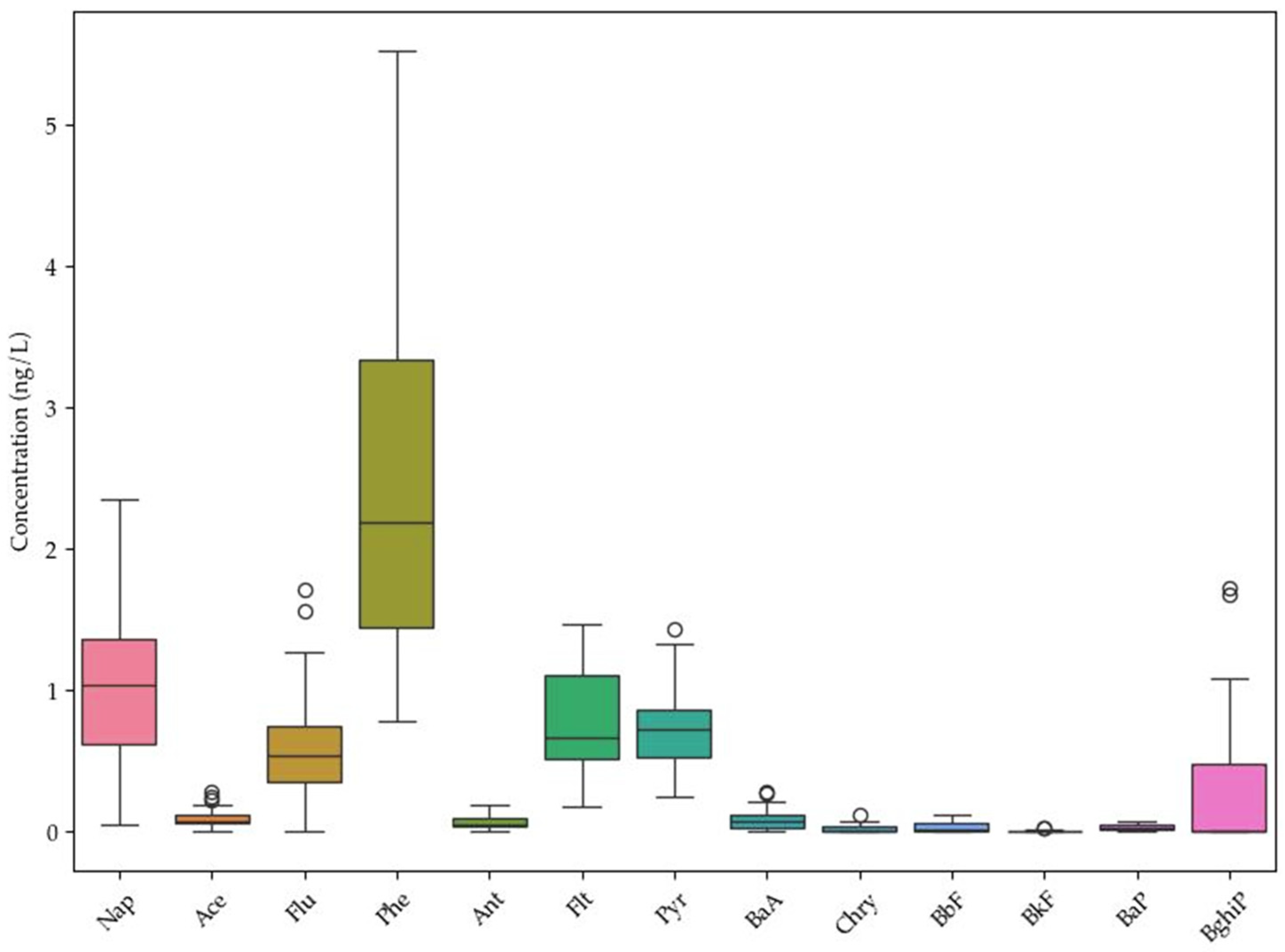
Among the detected compounds, phenanthrene was consistently the predominant PAH, reaching a maximum concentration of 5.53 ng/L, followed by naphthalene (2.35 ng/L), fluorene (1.71 ng/L), fluoranthene (1.47 ng/L), and pyrene (1.43 ng/L). In contrast, high-molecular-weight PAHs, including benzo[k]fluoranthene, benzo[a]pyrene, chrysene, and benzo[b]fluoranthene, were detected only at trace concentrations or were absent from many sampling locations. The predominance of low- and medium-molecular-weight PAHs suggests a greater environmental mobility of these compounds and is consistent with their higher aqueous solubility compared with higher-ring PAHs.
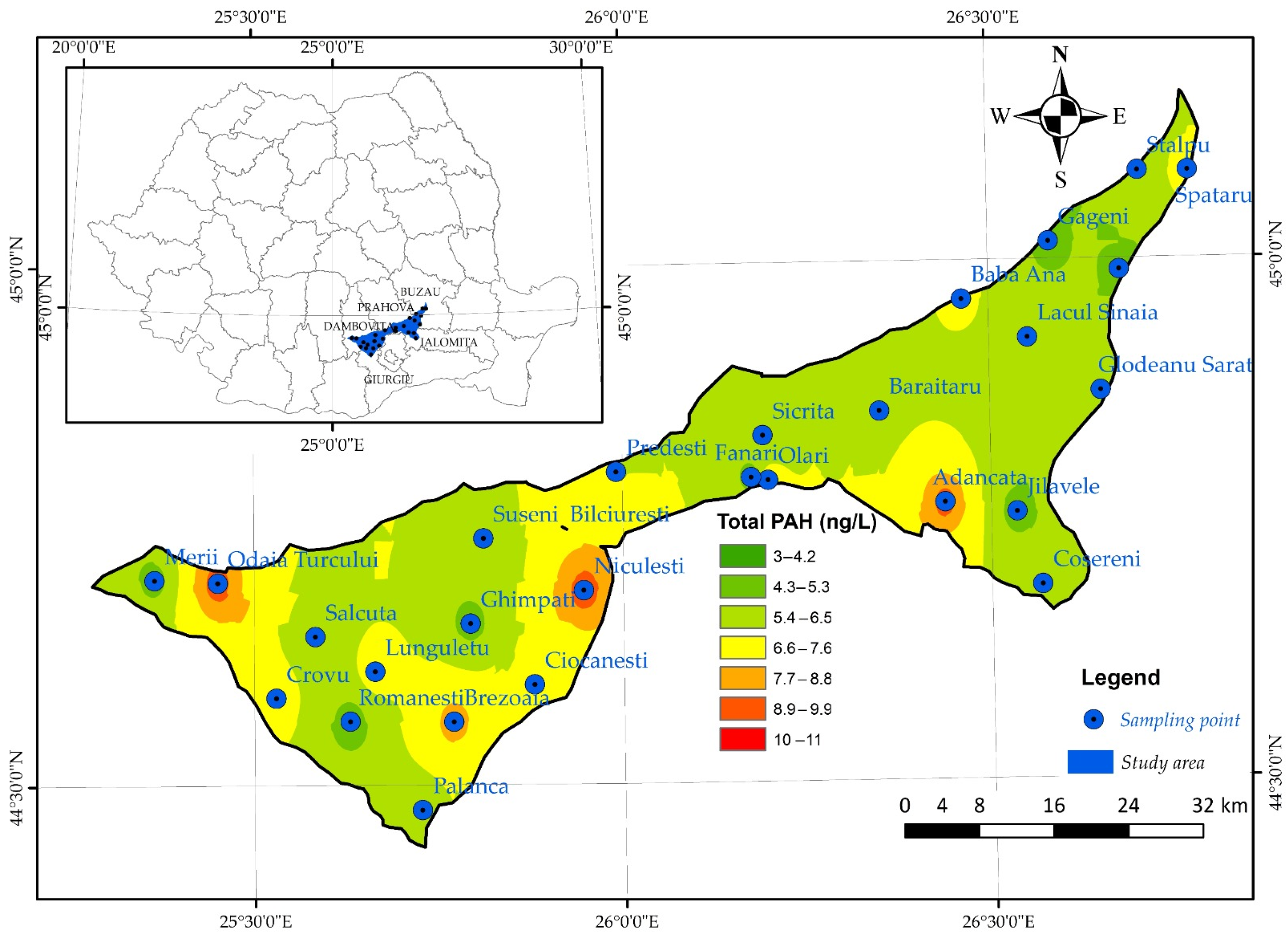
The spatial distribution of total PAHs is presented in Figure 2. The highest total PAH concentration (11.2 ng/L) was recorded in Adancata, Niculesti, and Odaia Turcului, whereas lower concentrations were observed in the remaining localities. According to the classification proposed by Moisés Canle [52], all groundwater samples fall within the category of low PAH contamination (0–100 ng/L), confirming the overall good chemical quality of the investigated groundwater with respect to PAHs.
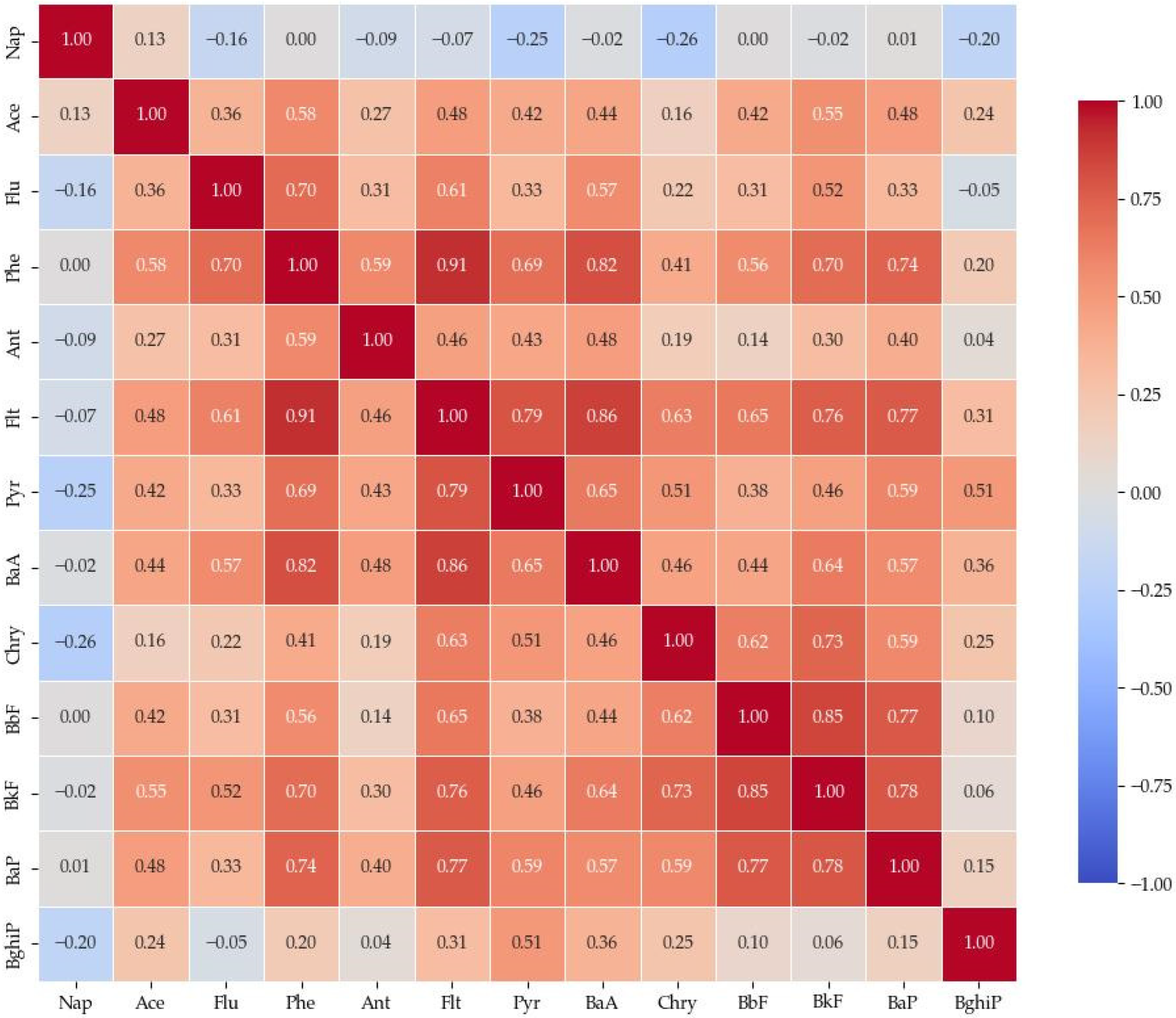
The correlation matrix (Figure 3), performed using the Python-based Library scikit-learn, version 1.8.0 (The scikit-learn Developers, Open-Source Community, International), revealed several significant positive relationships among the detected PAHs, suggesting common emission sources and similar environmental behaviour within the aquifer. The strongest correlations (r > 0.80) were observed for Phe–Flt (r = 0.91), Flt–BaA (r = 0.86), BbF–BkF (r = 0.85), and Phe–BaA (r = 0.82). Additional strong associations were found for BkF–BaP (r = 0.78) and Flt–BaP (r = 0.77). These relationships indicate that these compounds tend to co-occur in groundwater and likely share common contamination sources, transport pathways, and attenuation processes, reflecting their similar physicochemical properties.
In contrast, benzo[g,h,i]perylene exhibited predominantly weak correlations with the remaining PAHs, except for moderate relationships with pyrene (r = 0.51) and benzo[a]anthracene (r = 0.36), suggesting differences in source contributions or environmental behaviour. Naphthalene also displayed a distinct correlation pattern, showing weak or negative correlations with most higher-molecular-weight PAHs, particularly chrysene (r = −0.26), and pyrene (r = −0.25). This behaviour is consistent with the higher volatility, greater aqueous solubility, and lower molecular weight of naphthalene, which influence its transport and degradation differently from those of heavier PAHs. Overall, the correlation analysis indicates that the distribution of PAHs in groundwater is controlled by both common contamination sources and compound-specific physicochemical properties.

3.2. Identification of PAHs Contamination Sources

To identify the potential sources of PAHs in groundwater, the molecular diagnostic ratios Ant/(Ant+Phe), Flt/(Flt+Pyr), BaA/(BaA+Chry), and the integrated Total Index (TI) were calculated for all sampling locations (Table 3). The combined interpretation of these diagnostic indicators revealed that PAH contamination in the investigated groundwater originates predominantly from pyrogenic and mixed pyrogenic–petrogenic sources, while purely petrogenic signatures were identified only in a limited number of localities.
Based on the diagnostic ratios and Total Index values, groundwater from Baba Ana, Cosereni, Niculesti, Palanca, Sinaia Lac, Suseni Bilciuresti, and Salcuta exhibited predominantly pyrogenic signatures. In Baba Ana, Cosereni, Suseni Bilciuresti, and Salcuta, the PAH profile is consistent with the combustion of fossil and liquid fuels, whereas in Niculesti, Palanca, and Sinaia Lac, the diagnostic ratios suggest a greater contribution from biomass combustion, including wood and agricultural residues. Petrogenic signatures were identified only in Ghimpati and Romanesti, while the remaining localities showed mixed contamination patterns with a predominance of pyrogenic inputs.
The predominance of pyrogenic signatures is consistent with the socio-economic characteristics of the investigated rural area. Because centralized heating systems are generally absent, households rely primarily on wood, coal, and liquid fuels for domestic heating. In addition, the open burning of agricultural residues and household plant waste, although prohibited by Romanian legislation, remains a common practice and represents an important local source of atmospheric PAHs. This interpretation is supported by reports from the Dambovița County Environmental Guard, which documented 520 vegetation and agricultural waste fires in 2024 [81] and a further 289 similar events in 2025 [82].
The diagnostic ratio values indicate that the sources of PAH pollution in the localities of Ghimpati and Romanesti are petrogenic. Mixed pollution sources, predominantly pyrogenic, are identified in the localities of Adancata, Brezoaia, Baraitaru, Ciocanesti, Crovu, Fanari, Gageni, Glodeanu Sarat, Lunguletu, Movila Banului, Odaia Turcului, Olarii Vechi, Predesti, Stalpu, Spataru, and Sicrita; and mixed, predominantly petrogenic, in the localities of Jilavele and Merii. Petrogenic PAHs are typically associated with crude oil and refined petroleum products released through accidental spills, leaking underground storage tanks, or illegal fuel extraction activities. Several such incidents have been reported over recent years along the oil transportation infrastructure operated by Conpet S.A. and within oil-producing areas of Prahova and Dambovita counties. Documented cases in Gageni [83], Brezoaia [84], Spataru, and Stalpu provide plausible local sources for the petrogenic contribution identified in some groundwater samples.
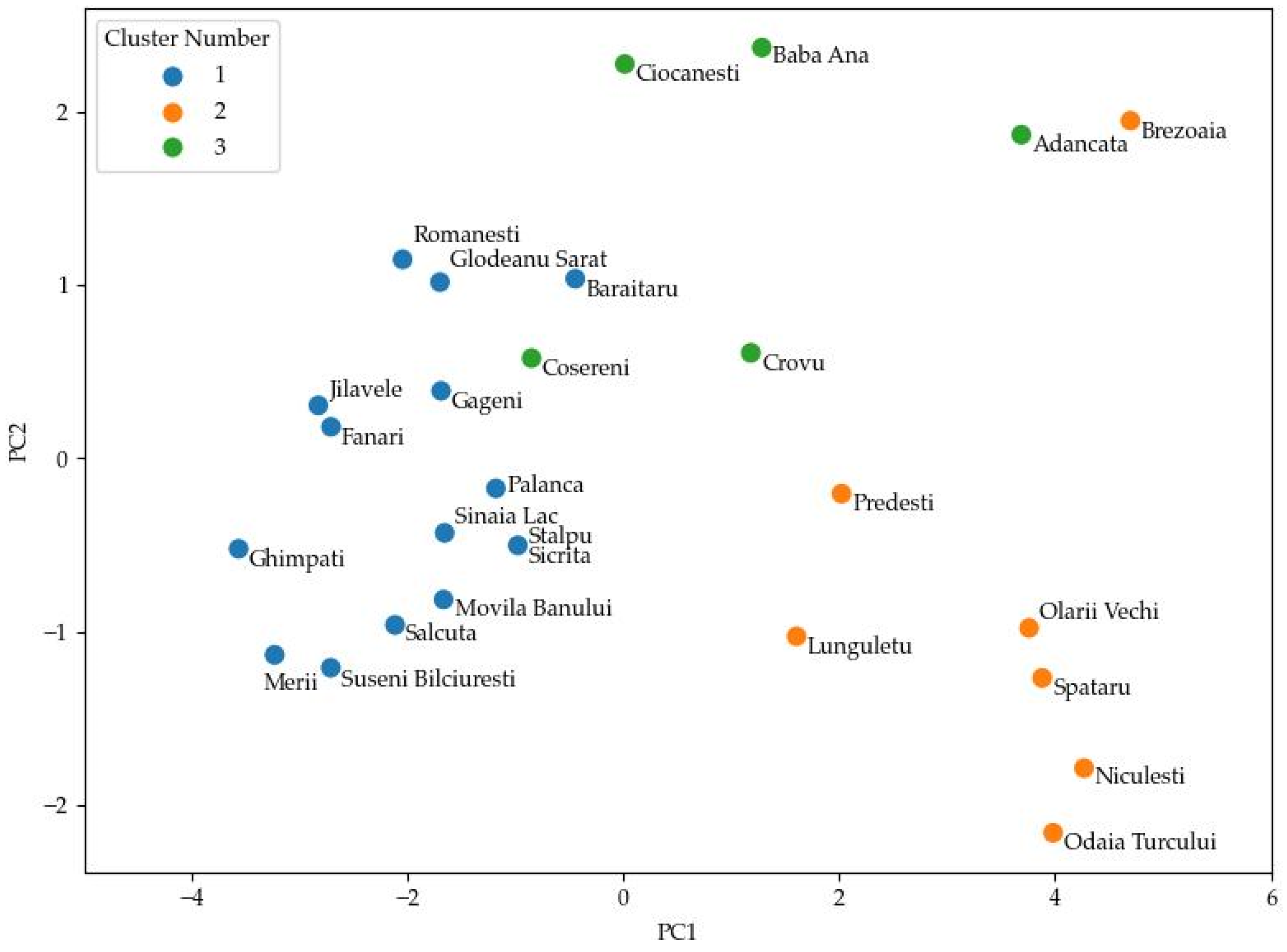
To further evaluate the consistency of the source apportionment results, multivariate statistical analysis was performed using boxplot visualization (Figure 4) and Principal Component Analysis (PCA), performed with the Python-based Library scikit-learn, version 1.8.0 (Figure 5). For PCA, concentrations below the LOD were substituted with LOD/2, a commonly applied approach for handling left-censored environmental data, to allow the inclusion of all samples in the multivariate statistical analysis. These complementary approaches provided an independent assessment of the variability of PAH concentrations and the similarity among sampling locations.
The boxplot presented in Figure 4 shows a heterogeneous distribution of PAHs concentrations, with Phe and Nap standing out due to higher concentrations in central areas, while high-molecular-weight compounds such as BaA, Chry, BbF, BkF, and BaP generally exhibit low concentrations. The marked variability observed for Phe, as well as the moderate dispersion of Flu, Flt, and Pyr, suggests significant spatial differences between sampling localities and an uneven distribution of sources or transport processes within the aquifer. The presence of extreme values for certain compounds indicates localized point sources, and the relative predominance of light and intermediate PAHs may reflect higher mobility in the subsurface and a possible petrogenic or mixed influence on the contamination profile.
The results of the PCA analysis, highlighting the distribution of sampling locations of groundwater samples, are presented in Figure 5, and reveal the existence of three distinct groups, based on their PAHs concentration profiles. An uneven distribution of localities within the PCA space is evident, with a clear grouping of some sampling localities—such as Romanesti, Glodeanu Sarat, and Baraitaru—in cluster 1, the separation of the sampling localities Brezoaia, Olarii Vechi, Spataru, Niculesti, and Odaia Turcului in Cluster 2, and the distinct positioning of the sampling localities Ciocanesti, Baba Ana, Adancata, Crovu, and Cosereni in Cluster 3, which reflects the existence of distinct PAH compositional profiles in the investigated groundwater. The clustering pattern supports the diagnostic ratio analysis, indicating that groundwater contamination is controlled by multiple local emission sources and that the relative contribution of low- and high-molecular-weight PAHs varies considerably across the investigated area. The identified clusters exhibit only a partial geographical pattern, indicating that the distribution of PAHs is not controlled solely by the spatial location of the sampling sites. Cluster 1 is mainly concentrated in the central and eastern sectors of the Titu-Sarata Plain, whereas cluster 2 is predominantly associated with the western and southwestern sectors, although it also includes several eastern localities. Cluster 3 is mainly distributed in the central and northeastern part of the studied area. This spatial arrangement suggests that, besides geographical proximity, the heterogeneous hydrogeological conditions of the shallow aquifer, such as lithological variability, differences in hydraulic conductivity and the regional northwest-southeast groundwater flow, together with local anthropogenic activities, play an important role in shaping the identified PAHs.

3.3. Ecological Risk Assessment

The ecological risk associated with PAHs in groundwater was evaluated using individual risk quotients (RQi) and cumulative risk quotients (RQtot). Overall, the results indicate negligible ecological risks for most detected PAHs, whereas fluoranthene (Flt) was identified as the principal contributor to the overall ecological risk. Depending on the sampling location, the cumulative ecological risk ranged from low to moderate, with RQtot values between 0.2 and 2.3 (Table 4).
The lowest freshwater predicted no-effect concentrations (PNECs) available in the NORMAN Ecotoxicology Database [62] were used for ecological risk assessment. The adopted PNEC values (μg/L) were 2.0 for naphthalene (Nap), 3.7 for acenaphthene (Ace), 0.25 for fluorene (Flu), 0.00076 for fluoranthene (Flt), 0.0046 for pyrene (Pyr), 0.07 for chrysene (Chry), 0.017 for benzo[b]fluoranthene (BbF), 0.017 for benzo[k]fluoranthene (BkF), 0.27 for benzo[a]pyrene (BaP), and 0.0082 for benzo[g,h,i]perylene (BghiP) [62]. Because of their relatively high PNEC values and the low concentrations measured in groundwater, naphthalene, acenaphthene, fluorene, chrysene, benzo[b]fluoranthene, benzo[k]fluoranthene, and benzo[a]pyrene exhibited RQ values below 0.01 in all samples and therefore made only a negligible contribution to the overall ecological risk.
As shown in Table 4, fluoranthene was the dominant contributor to the ecological risk, with individual RQ values ranging from 0.2 to 1.9. Moderate ecological risk associated with fluoranthene (RQ > 1) was identified in eleven sampling locations, whereas pyrene and benzo[g,h,i]perylene exhibited considerably lower RQ values, generally below 0.2. Consequently, variations in the cumulative ecological risk among sampling sites were controlled primarily by differences in fluoranthene concentrations.
Based on the cumulative risk quotient, most groundwater samples were classified as presenting either low (RQtot = 0.1–1) or moderate (RQtot = 1–10) ecological risk, while no location reached the threshold for high ecological risk. The highest cumulative risk (RQtot = 2.3) was observed in Brezoaia, followed by Adancata (2.2), Odaia Turcului (1.8), Niculesti (1.7), and Olarii Vechi (1.6). Although these values indicate only moderate ecological risk, they suggest that fluoranthene should be considered a priority compound for future groundwater monitoring within the investigated area.

3.4. Human Health Risks Assessment

Although the concentrations of individual PAHs measured in groundwater were well below the maximum permissible limits for drinking water, simultaneous exposure to multiple compounds may result in cumulative non-carcinogenic and carcinogenic health effects. Therefore, human health risks associated with groundwater ingestion were evaluated separately for infants, children, and adults using age-specific exposure parameters (Table 5) [46,63,67,69]:

3.4.1. Non-Carcinogenic Risk Assessment

The oral reference dose (RfD) values used for the calculation of the individual Hazard Quotients (HQi) were 2 × 10⁻² mg/kg/day for naphthalene (Nap) [7], 2 × 10⁻¹ mg/kg/day for acenaphthene (Ace) [10], 8 × 10⁻⁴ mg/kg/day for fluorene (Flu) [12], 1 mg/kg/day for anthracene (Ant) [8], 4 × 10⁻² mg/kg/day for fluoranthene (Flt) [2], 3 × 10⁻² mg/kg/day for pyrene (Pyr) [13], and 3 × 10⁻⁴ mg/kg/day for benzo[a]pyrene (BaP) [85].
The calculated HQi values for individual PAHs are presented in Supplementary Data (Tables S1–S3). For all age groups, fluorene and benzo[a]pyrene exhibited the highest individual HQ values whereas anthracene and acenaphthene showed the lowest contributions to the overall non-carcinogenic risk. Although infants consistently showed higher HQ values than children and adults because of their lower body weight and higher water intake relative to body mass, all calculated HQ values remained several orders of magnitude below the threshold value of 1.
The cumulative non-carcinogenic risk, expressed as the Hazard Index (HI), ranged from 1.0 × 10⁻⁵ to 2.6 × 10⁻⁴ for infants, from 0.8 × 10⁻⁵ to 1.17 × 10⁻⁴ for children, and from 0.4 × 10⁻⁵ to 6.6 × 10⁻⁵ for adults (Table 6). The highest HI values were recorded in Adancata and Niculesti for all three age groups, whereas the lowest values were observed in Cosereni, Suseni Bilciuresti, and Romanesti. Nevertheless, all HI values were substantially lower than the safety threshold (HI = 1), indicating that groundwater consumption does not pose appreciable non-carcinogenic health risks for infants, children, or adults in the investigated area. Similar findings have previously been reported for groundwater affected by the Vidra landfill (Romania) [41].

3.4.2. Carcinogenic Risk Assessment

The carcinogenic potency of the detected PAHs was expressed as benzo[a]pyrene equivalent concentrations (BaPeq) using the potency equivalency factors (PEFs) recommended by the Guidance for Calculating Benzo[a]pyrene Equivalents for Cancer Evaluations of Polycyclic Aromatic Hydrocarbons [72]. The applied PEF values were 1 for benzo[a]pyrene, 0.1 for benzo[a]anthracene, benzo[b]fluoranthene, benzo[k]fluoranthene, and indeno [1,2,3-cd]pyrene, 0.01 for chrysene, and 2.4 for dibenzo[a,h]anthracene. The calculated BaP concentrations together with the corresponding Incremental Lifetime Cancer Risk (ILCR) values for infants, children, and adults are presented in Table 7.
BaPeq concentrations ranged from 3.0 × 10⁻⁸ to 1.1 × 10⁻⁷ mg/L. The highest BaPeq values were observed in Odaia Turcului and Spataru (1.1 × 10⁻⁷ mg/L), followed by Brezoaia and Niculesti (9.0 × 10⁻⁸ mg/L), whereas no carcinogenic PAHs were detected in Ghimpati, Jilavele, and Merii. Consequently, no ILCR values were calculated for these localities.
The calculated ILCR values ranged from 5.7 × 10⁻⁹ to 2.2 × 10⁻⁸ for infants, from 2.7 × 10⁻⁹ to 1.0 × 10⁻⁸ for children, and from 1.5 × 10⁻⁹ to 6.1 × 10⁻⁹ for adults (Table 7). For all sampling locations and age groups, ILCR values remained well below the generally accepted carcinogenic risk threshold of 10−6, indicating that groundwater ingestion does not pose an appreciable lifetime carcinogenic risk to the exposed population. As observed for the non-carcinogenic risk assessment, infants exhibited the highest estimated carcinogenic risk because of their lower body weight and higher water intake relative to body mass, whereas adults showed the lowest ILCR values.

4. Discussion

Total PAH concentrations measured in groundwater from the Titu–Sarata Plain ranged from 2.56 to 11.29 ng/L, with a mean value of 6.28 ng/L. These levels were lower than those reported for groundwater from the Campania Plain, Italy, where total PAH concentrations ranged from 0.65 to 34.1 ng/L [20]. They were also substantially lower than concentrations reported in groundwater from a coal-mining area in northern Anhui Province, China (15.04–449.13 ng/L) [58], and from tube wells in Belém, Brazil (20.4–91.1 µg/L) [86]. Moreover, the concentrations observed in the present study were several orders of magnitude lower than those reported near the Ruseifa landfill, Jordan (7.1–12.6 mg/L; mean: 9.1 mg/L) [87]. The very high levels recorded in Jordan are due to the direct impact of leachate from the landfill.
Although our study focuses on a rural region with no obvious sources of pollution, the individual PAH concentrations were generally comparable to those reported by Balint et al. [41] for groundwater samples collected near the Vidra landfill in Romania, which represents a local source of contamination. For example, phenanthrene concentrations ranged from 0.79 to 5.53 ng/L in the present study, compared with 1.4–6.5 ng/L in the Vidra area. Similar concentration ranges were also observed for fluorene (<LOD–1.71 ng/L vs. 1.0–3.7 ng/L) and fluoranthene (0.18–1.47 ng/L vs. 1.0–1.1 ng/L). In contrast, lower concentrations were recorded in the Titu–Sarata Plain for anthracene (<LOD–0.19 ng/L vs. 1.0–1.3 ng/L) and pyrene (0.25–1.43 ng/L vs. 3.0–3.2 ng/L), suggesting a lower contribution of some higher-molecular-weight PAHs compared with the landfill-affected groundwater system.
The ecological risk assessment showed that most individual PAHs posed negligible risk, particularly Nap, Ace, Flu, Chry, BbF, BkF, and BaP. Pyrene was associated with low ecological risk, whereas fluoranthene represented the main contributor to ecological risk, with values ranging from low to moderate. For BghiP, negligible risk was observed in most localities, although low-risk levels were identified in Glodeanu Sarat, Crovu, Ciocanesti, Brezoaia, Baba Ana, and Adancata. Based on the cumulative risk quotient, low ecological risk (RQtot = 0.2–0.9) was identified in Baraitaru, Cosereni, Gageni, Ghimpati, Jilavele, Merii, Movila Banului, Palanca, Romanesti, Sinaia Lac, Suseni Bilciuresti, and Salcuta. Moderate ecological risk (RQtot = 1.0–2.3) was observed in Adancata, Baba Ana, Brezoaia, Ciocanesti, Crovu, Lunguletu, Niculesti, Odaia Turcului, Olarii Vechi, Predesti, Stalpu, Spataru, and Sicrita. These values are comparable to those reported by Jiang et al. [58] for groundwater from a coal-mining area in northern Anhui Province, China.
The human health risk assessment indicated that exposure to PAHs through groundwater ingestion does not pose appreciable non-carcinogenic risk for any of the investigated population groups. In all localities, both HQi and HI values were several orders of magnitude below the threshold value of 1, indicating negligible non-carcinogenic risk for infants, children, and adults. Similarly, the calculated ILCR values remained well below the commonly accepted carcinogenic risk threshold. Although the ILCR values obtained in the present study were higher than those reported by Montuori et al. [20] for the Campania Plain, Italy (7.3 × 10⁻²⁰–4.96 × 10⁻¹⁹), they were still extremely low, ranging from 5.7 × 10⁻⁹ to 2.2 × 10⁻⁸ for infants, 2.7 × 10⁻⁹ to 1.0 × 10⁻⁸ for children, and 1.5 × 10⁻⁹ to 6.1 × 10⁻⁹ for adults. These results indicate negligible lifetime carcinogenic risk associated with groundwater ingestion in the investigated area.
The findings highlight the importance of continued groundwater quality monitoring in the Titu–Sarata Plain. Previous evidence of pesticide contamination in the same region [46], together with the occurrence of PAHs reported in the present study, indicates that groundwater quality may be influenced by multiple classes of organic contaminants. Future investigations should therefore expand the analytical scope to include other contaminant groups, such as heavy metals and additional organic micropollutants, in order to provide a more comprehensive assessment of groundwater quality and potential cumulative risks in this rural area.
A limitation of this study is that groundwater was sampled during a single campaign, preventing the evaluation of seasonal variability and temporal changes in PAHs concentrations.

5. Conclusions

This study provides the first integrated assessment of polycyclic aromatic hydrocarbons (PAHs) in groundwater from the Titu–Sarata Plain, combining chemical determination with source apportionment, ecological risk assessment, and human health risk evaluation. Thirteen of the sixteen U.S. EPA priority PAHs were detected, while overall PAH concentrations remained low (2.56–11.29 ng/L) and complied with current European drinking water quality standards.
The combined interpretation of molecular diagnostic ratios, correlation analysis, and principal component analysis demonstrated that groundwater PAHs originate predominantly from pyrogenic and mixed pyrogenic–petrogenic sources. The observed spatial heterogeneity reflects the influence of multiple local contamination sources together with differences in the environmental behaviour and mobility of individual PAHs within the aquifer. Low-molecular-weight PAHs were generally more abundant than higher-molecular-weight compounds, consistent with their greater mobility in groundwater.
Ecological risk assessment indicated predominantly low ecological risk throughout the investigated area, although moderate cumulative ecological risk was identified at several sampling locations. Fluoranthene was the principal contributor to the ecological risk, whereas most of the remaining PAHs exhibited negligible individual ecological risks.
The human health risk assessment demonstrated that groundwater ingestion does not pose appreciable non-carcinogenic or carcinogenic risks for infants, children, or adults. Both Hazard Index (HI) and Incremental Lifetime Cancer Risk (ILCR) values remained well below the internationally accepted safety thresholds for all investigated groundwater samples.
Although the current results indicate a favourable groundwater quality with respect to PAHs, the occurrence of these contaminants, together with previously reported pesticide residues in the same region, highlights the importance of integrated groundwater quality monitoring. Future investigations should extend the range of monitored contaminants to include additional organic micropollutants and heavy metals, as well as repeated sampling campaigns to assess seasonal variability and temporal chances, thereby providing a more comprehensive assessment of groundwater quality and supporting sustainable groundwater resource management in rural areas.


Supplementary Materials

The following supporting information can be downloaded at https://www.mdpi.com/article/10.3390/toxics14070638/s1, Table S1: The Hazard Quotient (HQi) values individual PAHs for infants; Table S2: The Hazard Quotient (HQi) values individual PAHs for children; Table S3: The Hazard Quotient (HQi) values individual PAHs for adults.

Author Contributions

Conceptualization, C.D. and C.S.; methodology, C.D., C.S. and E.-I.G.; software, C.S. and P.B.; validation, C.D. and R.E.I.; formal analysis, E.-I.G. and C.T.C.; investigation, C.D. and C.S.; data curation, C.D. and C.S.; visualization, C.S. and P.B.; writing—original draft preparation, C.D., C.S. and R.E.I.; writing—review and editing, C.D., C.S., P.B., E.-I.G. and R.E.I. All authors have read and agreed to the published version of the manuscript.

Funding

This research was funded by the Romanian Ministry of Education and Research, through Project PN 23 15 03 01—“The implementation of integrated isotopic-chemical-nuclear analytical methodologies for the authentication of traditional Romanian food products—IsoPRod, and by Valahia University of Targoviste, Romania, through its internal research funding program.

Institutional Review Board Statement

Not applicable.

Informed Consent Statement

Not applicable.

Data Availability Statement

The raw data supporting the conclusions of this article will be made available by the authors on request.

Conflicts of Interest

The authors declare no conflicts of interest.

Abbreviations

The following abbreviations are used in this manuscript:
PAHsPolycyclic Aromatic Hydrocarbons
LMW-PAHsLow-Molecular-Weight PAHs
HMW-PAHsHigh Polycyclic Aromatic Hydrocarbons
IARCThe International Agency for Research on Cancer
USEPAThe U.S. Environmental Protection Agency
ECHAThe European Chemicals Agency
REACHRegistration, Evaluation, Authorisation and Restriction of Chemicals
ATDSRThe Agency for Toxic Substances and Disease Registry
UHPLC-FLDHigh-Performance Liquid Chromatography coupled with Fluorescence Detection
PNECThe lowest predicted no-effect concentrations
RQiIndividual risk quotients
RQtotCumulative risk quotients
RfDOral reference dose
HQiIndividual Hazard Quotients
HIHazard Index
PEFsPotency equivalency factors
BaPeqBenzo[a]pyrene equivalent concentrations
ILCRIncremental Lifetime Cancer Risk
NapNaphthalene
AcyAcenaphthylene
AceAcenaphthene
FluFluorene
PhePhenanthrene
AntAnthracene
FltFluoranthene
PyrPyrene
BaABenz[a]anthracene
ChryChrysene
BbFBenzo[b]fluoranthene
BkFBenzo[k]fluoranthene
BaPBenzo[a]pyrene
IcdPIndeno [1,2,3-cd]pyrene
DahADibenz[a,h]anthracene
BghiPBenzo[g,h,i]perylene
∑4PAHThe sum of the concentrations BbF, BkF, BghiP and IcdP ompounds
QAThe quality assurance
QCThe quality control

References

  1. Human Health Effects of Polycyclic Aromatic Hydrocarbons as Ambient Air Pollutants—Report of the Working Group on Polycyclic Aromatic Hydrocarbons of the Joint Task Force on the Health Aspects of Air Pollution. Available online: https://www.who.int/europe/publications/i/item/9789289056533 (accessed on 17 April 2026).
  2. National Center for Biotechnology Information. PubChem Compound Summary for CID 9154, Fluoranthene. Available online: https://pubchem.ncbi.nlm.nih.gov/compound/Fluoranthene (accessed on 20 April 2026).
  3. National Center for Biotechnology Information. PubChem Compound Summary for CID 5954, Benz(a)anthracene. Available online: https://pubchem.ncbi.nlm.nih.gov/compound/BENZ_a_ANTHRACENE (accessed on 20 April 2026).
  4. National Center for Biotechnology Information. PubChem Compound Summary for CID 2336, Benzo[a]pyrene. Available online: https://pubchem.ncbi.nlm.nih.gov/compound/Benzo_a_pyrene (accessed on 20 April 2026).
  5. National Center for Biotechnology Information. PubChem Compound Summary for CID 9117, Benzo(ghi)perylene. Available online: https://pubchem.ncbi.nlm.nih.gov/compound/Benzo_ghi_perylene (accessed on 20 April 2026).
  6. National Center for Biotechnology Information. PubChem Compound Summary for CID 9153, Benzo(B)Fluoranthene. 2026. Available online: https://pubchem.ncbi.nlm.nih.gov/compound/Benzo_B_Fluoranthene (accessed on 12 June 2026).
  7. National Center for Biotechnology Information. PubChem Compound Summary for CID 931, Naphthalene. Available online: https://pubchem.ncbi.nlm.nih.gov/compound/Naphthalene (accessed on 20 April 2026).
  8. National Center for Biotechnology Information. PubChem Compound Summary for CID 8418, Anthracene. Available online: https://pubchem.ncbi.nlm.nih.gov/compound/Anthracene (accessed on 20 April 2026).
  9. National Center for Biotechnology Information. PubChem Compound Summary for CID 9171, Chrysene. Available online: https://pubchem.ncbi.nlm.nih.gov/compound/Chrysene (accessed on 20 April 2026).
  10. National Center for Biotechnology Information. PubChem Compound Summary for CID 6734, Acenaphthene. Available online: https://pubchem.ncbi.nlm.nih.gov/compound/Acenaphthene (accessed on 20 April 2026).
  11. National Center for Biotechnology Information. PubChem Compound Summary for CID 995, Phenanthrene. Available online: https://pubchem.ncbi.nlm.nih.gov/compound/Phenanthrene (accessed on 20 April 2026).
  12. National Center for Biotechnology Information. PubChem Compound Summary for CID 6853, Fluorene. Available online: https://pubchem.ncbi.nlm.nih.gov/compound/Fluorene (accessed on 20 April 2026).
  13. National Center for Biotechnology Information. PubChem Compound Summary for CID 31423, Pyrene. Available online: https://pubchem.ncbi.nlm.nih.gov/compound/Pyrene (accessed on 20 April 2026).
  14. National Center for Biotechnology Information. PubChem Compound Summary for CID 9158, Benzo(K)Fluoranthene. 2026. Available online: https://pubchem.ncbi.nlm.nih.gov/compound/Benzo_K_Fluoranthene (accessed on 12 June 2026).
  15. National Center for Biotechnology Information. PubChem Compound Summary for CID 9131, Indeno(1,2,3-cd)pyrene. 2026. Available online: https://pubchem.ncbi.nlm.nih.gov/compound/Indeno_1_2_3-cd_pyrene (accessed on 12 June 2026).
  16. National Center for Biotechnology Information. PubChem Compound Summary for CID 5889, DIBENZ(a,h)ANTHRACENE. Available online: https://pubchem.ncbi.nlm.nih.gov/compound/DIBENZ_a_h_ANTHRACENE (accessed on 12 June 2026).
  17. Jameson, C.W. Chapter 7 Polycyclic Aromatic Hydrocarbons and Associated Occupational Exposures. In Tumour Site Concordance and Mechanisms of Carcinogenesis; IARC Scientific Publications; No. 165; Baan, R.A., Stewart, B.W., Straif, K., Eds.; International Agency for Research on Cancer: Lyon, France, 2019. [Google Scholar]
  18. Feng, Y.; Li, Z.; Li, W. Polycyclic Aromatic Hydrocarbons (PAHs): Environmental Persistence and Human Health Risks. Nat. Prod. Commun. 2025, 20, 1–8. [Google Scholar] [CrossRef] [Scilit]
  19. Dewali, S.; Sharma, N.P.; Bhatt, P.; Melkani, D.C.; Arya, M.K.; Bisht, H.C.S. Polycyclic Aromatic Hydrocarbons in the Surface and Groundwater. In Ubiquitous Polycyclic Aromatic Hydrocarbon Contamination. Emerging Contaminants and Associated Treatment Technologies.; Gupta, H., Madhav, S., Dhiman, S., Kumar, P., Eds.; Springer: Cham, Switzerland, 2026. [Google Scholar] [CrossRef] [Scilit]
  20. Montuori, P.; De Rosa, E.; Cerino, P.; Pizzolante, A.; Nicodemo, F.; Gallo, A.; Rofrano, G.; De Vita, S.; Limone, A.; Triassi, M. Estimation of Polycyclic Aromatic Hydrocarbons in Groundwater from Campania Plain: Spatial Distribution, Source Attribution and Health Cancer Risk Evaluation. Toxics 2023, 11, 435. [Google Scholar] [CrossRef] [Scilit] [PubMed]
  21. Akbari, Z.; Ghiassi, R. Remediation of Soil and Groundwater Polluted by Polycyclic Aromatic Hydrocarbons: A Review. Am. J. Civ. Environ. Eng. 2017, 2, 8–20. [Google Scholar]
  22. Allison, A.; Mackay, M.; Gschwend, P.M. Enhanced Concentrations of PAHs in Groundwater at a Coal Tar Site. Environ. Sci. Technol. 2001, 35, 1320–1328. [Google Scholar] [CrossRef] [Scilit]
  23. Creosote. Chapter 5. Potential for Human Exposure. Available online: https://www.atsdr.cdc.gov/toxprofiles/tp85-c5.pdf (accessed on 19 April 2026).
  24. Washington State Department of Natural Resources. Aquatic Resources. Science of Creosote. 2019. Available online: https://dnr.wa.gov/sites/default/files/2025-03/aqr_rest_creosote_science_brief.pdf (accessed on 19 April 2026).
  25. Pan, Z.; Li, B.; Yang, J.; Zhang, D.; Yang, Y.; Zhang, S. Study on the Spatial and Temporal Distribution and Risk Assessment of PAHs between River and Groundwater—Take the Typical Section of Beijing North Canal as an Example. J. Coast. Res. 2020, 115, 361–366. [Google Scholar] [CrossRef] [Scilit]
  26. ECHA European Chemicals Agency. Substances restricted under REACH. 2007. Available online: https://echa.europa.eu/substances-restricted-under-reach/-/dislist/details/0b0236e1807e2cba (accessed on 24 April 2026).
  27. U.S. EPA. Code of Federal Regulations. Available online: https://www.ecfr.gov/current/title-40/chapter-I/subchapter-D/part-136 (accessed on 24 April 2026).
  28. EPA. Stormwater Best Management Practice Polycyclic Aromatic Hydrocarbons, Coal Tar Sealcoat, and Stormwater Pollution. 2019. Available online: https://www.epa.gov/sites/default/files/2018-02/documents/pah_-coal-tar_sealcoat-swpoll.pdf (accessed on 19 April 2026).
  29. ACGIH (American Conference of Governmental Industrial Hygienists). Polycyclic Aromatic Hydrocarbons (PAHs) Biologic Exposure Indices (BEI); American Conference of Governmental Industrial Hygienists: Cincinnati, OH, USA, 2005. [Google Scholar]
  30. Montano, L.; Baldini, G.M.; Piscopo, M.; Liguori, G.; Lombardi, R.; Ricciardi, M.; Esposito, G.; Pinto, G.; Fontanarosa, C.; Spinelli, M.; et al. Polycyclic Aromatic Hydrocarbons (PAHs) in the Environment: Occupational Exposure, Health Risks and Fertility Implications. Toxics 2025, 13, 151. [Google Scholar] [CrossRef] [Scilit] [PubMed]
  31. Wang, Y.; Tian, Z.; Zhu, H. Polycyclic aromatic hydrocarbons (PAHs) in soils and vegetation near an e-waste recycling site in South China: Concentration, distribution, source, and risk assessment. Sci. Total Environ. 2012, 439, 187–193. [Google Scholar] [CrossRef] [Scilit] [PubMed]
  32. IARC. Some Non-Heterocyclic Polycyclic Aromatic Hydrocarbons and Some Related Exposures. In IARC Monographs on the Evaluation of Carcinogenic Risks to Humans; IARC: Lyon, France, 2010; Volume 92, pp. 1–853. Available online: http://publications.iarc.fr/110 (accessed on 20 April 2026).
  33. Schlanges, I.; Meyer, D.; Palm, W.U.; Ruck, W. Identification, Quantification and Distribution of PAC Metabolites, Heterocyclic PAC and Substituted PAC In Groundwater Samples of Tar-Contaminated Sites from Germany. Polycycl. Aromat. Compd. 2008, 28, 320–338. [Google Scholar] [CrossRef] [Scilit]
  34. Riccardi, C.; Filippo, P.; Pomata, D.; Incoronato, F.; Basilio, M.; Papini, P.; Spicaglia, S. Characterization and distribution of petroleum hydrocarbons and heavy metals in groundwater from three Italian tank farms. Sci. Total Environ. 2008, 393, 50–63. [Google Scholar] [CrossRef] [Scilit] [PubMed]
  35. Llamas, M.I.; Fernández-Valenzuela, P.J.; Vadillo, I.; Sanmiguel-Martí, M.; Rambla-Nebot, J.; Aranda-Mares, J.L.; Jiménez-Gavilán, P. Study of the presence and environmental risk of organic contaminants policed by the European Union and other organic compounds in the water resources of a region overlapping protected areas: The Guadiaro River basin (southern Spain). J. Environ. Manag. 2023, 345, 118903. [Google Scholar] [CrossRef] [Scilit] [PubMed]
  36. Dubovina, M.; Krčmar, D.; Grba, N.; Watson, M.A.; Rađenović, D.; Tomašević-Pilipović, D.; Dalmacija, B. Distribution and ecological risk assessment of organic and inorganic pollutants in the sediments of the transnational Begej canal (Serbia-Romania). Environ. Pollut. 2018, 236, 773–784. [Google Scholar] [CrossRef] [Scilit] [PubMed]
  37. Ciucure, C.T.; Geana, E.I.; Chitescu, C.L.; Badea, S.L.; Ionete, R.E. Distribution, sources and ecological risk assessment of polycyclic aromatic hydrocarbons in waters and sediments from Olt River dam reservoirs in Romania. Chemosphere 2023, 311, 137024. [Google Scholar] [CrossRef] [Scilit] [PubMed]
  38. Mihaly, M.; Niculae, G.; Stefan, S.; Meghea, A. Transfer and Translocation of Polycyclic Aromatic Hydrocarbons within Some Aquaculture Bio-systems in Romania. Rev. Chim. 2010, 61, 1009–1016. [Google Scholar]
  39. Maldonado, C.; Bayona, J.M.; Bodineau, L. Sources, Distribution, and Water Column Processes of Aliphatic and Polycyclic Aromatic Hydrocarbons in the Northwestern Black Sea Water. Environ. Sci. Technol. 1999, 33, 2693–2702. [Google Scholar] [CrossRef] [Scilit]
  40. Dirtu, D.; Pancu, M.; Minea, L. Occurrence of Selected Anthropogenic Organic Contaminants in Drinking Water from Rural Areas of Eastern Romania. Acta Chem. 2021, 29, 166–182. [Google Scholar] [CrossRef] [Scilit]
  41. Balint, A.I.; Matei, E.; Râpă, M.; Șăulean, A.; Mateș, I.M. Human Exposure Estimation of Polycyclic Aromatic Hydrocarbons (PAHs) Resulting from Bucharest Landfill Leakages. Sustainability 2025, 17, 1356. [Google Scholar] [CrossRef] [Scilit]
  42. Neamtu, M.; Ciumasu, I.M.; Costica, N.; Costica, M.; Bobu, M.; Nicoara, M.N.; Catrinescu, C.; Becker van Slooten, K.; De Alencastro, L.F. Chemical, biological, and ecotoxicological assessment of pesticides and persistent organic pollutants in the Bahlui River, Romania. Environ. Sci. Pollut. Res. 2009, 16, 76–85. [Google Scholar] [CrossRef] [Scilit] [PubMed]
  43. Zaharia, C.; Suteu, D. Analytical control of soil and ground water quality on a northern Romanian landfill. Environ. Eng. Manag. 2011, 10, 1693–1701. [Google Scholar] [CrossRef] [Scilit]
  44. Hening, H.; Vidican, R. Researches about the Decontamination Process of Soils Polluted with Hydrocarbons by Applying the Bioremediation Method—Partial Results. Vet. Med. 2014, 71, 67–75. [Google Scholar] [CrossRef] [Scilit]
  45. Grecu, F. Geografia Câmpiilor României. Note de Curs; Universitatea din București, Facultatea de Geografie: Bucharest, Romania, 2010; pp. 60–85. Available online: https://www.researchgate.net/profile/Florina-Grecu/publication/336676706_Geografia_campiilor_Romaniei/links/5dac149d92851c577eb9293c/Geografia-campiilor-Romaniei.pdf (accessed on 17 February 2026).
  46. Dumitrescu, C.; Stihi, C.; Costinel, D.; Geana, E.I.; Ciucure, C.T.; Popescu, D.I.; Tanislav, D.; Bretcan, P. Assessment of Pesticide Contamination of Groundwater from Titu-Sarata Plain, Romania. Appl. Sci. 2025, 15, 5880. [Google Scholar] [CrossRef] [Scilit]
  47. Grecu, F.; Gherghina, A.; Ghita, C.; Comănescu, L. Environmental synergy in the Romanian Plain (to the East of Olt River). Geol. Balc. 2010, 39, 142. [Google Scholar]
  48. EPA Groundwater Sampling-Operating Procedure. U.S. Environmental Protection Agency. Science and Ecosystem Support Division, Operating Procedure—Groundwater Sampling. 2017. Available online: https://www.epa.gov/sites/default/files/2017-07/documents/groundwater_sampling301_af.r4.pdf (accessed on 7 May 2026).
  49. EPA Quick Guide to Drinking Water Sample Collection. September 2016. Available online: https://www.epa.gov/sites/default/files/2015-11/documents/drinking_water_sample_collection.pdf (accessed on 7 May 2026).
  50. SR EN ISO 17993; Water Quality—Determination of 15 Polycyclic Aromatic Hydrocarbons (PAH) in Water by HPLC with Fluorescence Detection After Liquid-Liquid Extraction. International Organization for Standardization: Geneva, Switzerland, 2004; Version 2002. Available online: http://www.iso.org/iso/iso_catalogue/catalogue_tc/catalogue_detail.htm?csnumber=31666 (accessed on 27 April 2026).
  51. SR EN ISO/IEC 17025:2018; General Requirements for the Competence of Testing and Calibration Laboratories. International Organization for Standardization: Geneva, Switzerland, 2018. Available online: https://www.studocu.com/ro/document/universitatea-politehnica-din-bucuresti/sisteme-de-productie-tehnologie-de-grup/sr-en-iso-iec-17025-2018/66338046 (accessed on 27 April 2026).
  52. Canle, M.; Antão-Geraldes, A.M. A Snapshot on the Occurrence and Risk Assessment of Organic Pollutants in an Urban River. Appl. Sci. 2023, 13, 146. [Google Scholar] [CrossRef] [Scilit]
  53. Tobiszewski, M.; Namiesnik, J. PAH Diagnostic Ratios for the Identification of Pollution Emission Sources. Environ. Pollut. 2012, 162, 110–119. [Google Scholar] [CrossRef] [Scilit] [PubMed]
  54. Kanzari, F.; Syakti, A.D.; Asia, L.; Malleret, L.; Piram, A.; Mille, G.; Doumenq, P. Distributions and Sources of Persistent Organic Pollutants (Aliphatic Hydrocarbons, PAHs, PCBs and Pesticides) in Surface Sediments of an Industrialized Urban River (Huveaune), France. Sci. Total Environ. 2014, 478, 141–151. [Google Scholar] [CrossRef] [Scilit] [PubMed]
  55. Kanzari, F.; Asia, L.; Syakti, A.D.; Piram, A.; Malleret, L.; Mille, G.; Doumenq, P. Distribution and Risk Assessment of Hydrocarbons (Aliphatic and PAHs), Polychlorinated Biphenyls (PCBs), and Pesticides in Surface Sediments from an Agricultural River (Durance) and an Industrialized Urban Lagoon (Berre Lagoon), France. Environ. Monit. Assess. 2015, 187, 591. [Google Scholar] [CrossRef] [Scilit] [PubMed]
  56. Škrbić, B.; Marinković, V.; Spaić, S.; Milanko, V.; Branovacki, S. Profiles of Polycyclic Aromatic Hydrocarbons in Smoke from Combustion and Thermal Decomposition of Popular Wood Pellets and Sawdust. Microchem. J. 2018, 139, 9–17. [Google Scholar] [CrossRef] [Scilit]
  57. Barreca, S.; Bastone, S.; Caponetti, E.; Martino, D.F.C.; Orecchio, S. Determination of Selected Polyaromatic Hydrocarbons by Gas Chromatography–Mass Spectrometry for the Analysis of Wood to Establish the Cause of Sinking of an Old Vessel (Scauri Wreck) by Fire. Microchem. J. 2014, 117, 116–121. [Google Scholar] [CrossRef] [Scilit]
  58. Jiang, C.; Zhao, D.; Chen, X.; Zheng, L.; Li, C.; Ren, M. Distribution, source and ecological risk assessment of polycyclic aromatic hydrocarbons in groundwater in a coal mining area, China. Ecol. Indic. 2022, 136, 108683. [Google Scholar] [CrossRef] [Scilit]
  59. Khezami, F.; Gómez-Navarro, O.; Barbieri, M.V.; Khiari, N.; Chkirbene, A.; Chiron, S.; Khadhar, S.; Pérez, S. Occurrence of contaminants of emerging concern and pesticides and relative risk assessment in Tunisian groundwater. Sci. Total Environ. 2024, 906, 167319. [Google Scholar] [CrossRef] [Scilit] [PubMed]
  60. Yuan, L.; Wu, Y.; Shi, L.; Song, J.; Jiang, Y. Organochlorine pesticides and polychlorinated biphenyls in sediments of the Lanzhou reach of Yellow River (China): Spatial distribution, sources and risk assessment. Mar. Pollut. Bull. 2024, 208, 116962. [Google Scholar] [CrossRef] [Scilit] [PubMed]
  61. Barbieri, M.V.; Peris, A.; Postigo, C.; Moya-Garcés, A.; Monllor-Alcaraz, L.S.; Rambla-Alegre, M.; Eljarrat, E.; de Alda, M.L. Evaluation of the occurrence and fate of pesticides in a typical Mediterranean delta ecosystem (Ebro River Delta) and risk assessment for aquatic organisms. Environ. Pollut. 2021, 274, 115813. [Google Scholar] [CrossRef] [Scilit] [PubMed]
  62. NORMAN Ecotoxicology Database. Available online: https://www.norman-network.com/nds/ecotox/ (accessed on 10 April 2026).
  63. Ebrahimzadeh, G.; Alimohammadi, M.; Rezaei Kahkha, M.R.; Mahvi, A.H. Contamination level and human non-carcinogenic risk assessment of diazinon pesticide residue in drinking water resources—A case study, Iran. Int. J. Environ. Anal. Chem. 2020, 102, 4726–4737. [Google Scholar] [CrossRef] [Scilit]
  64. Ravanipour, M.; Nabipour, I.; Yunesian, M.; Rastkari, N.; Mahvi, A.H. Exposure sources of polychlorinated biphenyls (PCBs) and health risk assessment: A systematic review in Iran. Environ. Sci. Pollut. Res. 2022, 29, 1–20. [Google Scholar] [CrossRef] [Scilit]
  65. USEPA. Risk Assessment Guidance for Superfund Volume I Human Health Evaluation Manual (Part A). 1989. Available online: https://www.epa.gov/sites/default/files/2015-09/documents/rags_a.pdf (accessed on 10 April 2026).
  66. Wu, B.; Zhao, D.Y.; Jia, H.Y.; Zhang, Y.; Zhang, X.X.; Cheng, S.P. Preliminary risk assessment of trace metal pollution in surface water from Yangtze River in Nanjing Section, China. Bull. Environ. Contam. Toxicol. 2009, 82, 405–409. [Google Scholar] [CrossRef] [Scilit] [PubMed]
  67. Hubal, E.A.C.; de Wet, T.; Du Toit, L.; Firestone, M.P.; Ruchirawat, M.; van Engelen, J.; Vickers, C. Identifying important life stages for monitoring and assessing risks from exposures to environmental contaminants: Results of a World Health Organization review. Regul. Toxicol. Pharmacol. 2014, 69, 113–124. [Google Scholar] [CrossRef] [Scilit]
  68. Mekonen, S.; Argaw, R.; Simanesew, A.; Houbraken, M.; Senaeve, D.; Ambelu, A.; Spanoghe, P. Pesticide residues in drinking water and associated risk to consumers in Ethiopia. Chemosphere 2016, 162, 252–260. [Google Scholar] [CrossRef] [Scilit] [PubMed]
  69. Tinning, K.; Acworth, J. Make your Best Guess: An updated method for paediatric weight estimation in emergencies. Emerg. Med. Australas. 2007, 19, 528–534. [Google Scholar] [CrossRef] [Scilit] [PubMed]
  70. USEPA. Chapter 7: Characterizing Risk and Hazard. U.S. EPA Region 6. 2005. Available online: https://archive.epa.gov/epawaste/hazard/tsd/td/web/pdf/05hhrap7.pdf (accessed on 10 April 2026).
  71. Canbolat, F. Analysis of non-carcinogenic health risk assessment of elemental impurities in vitamin C supplements. Iran. J. Basic Med. Sci. 2023, 26, 216–227. [Google Scholar] [CrossRef] [Scilit] [PubMed]
  72. ATSDR. Guidance for Calculating Benzo(a)pyrene Equivalents for Cancer Evaluations of Polycyclic Aromatic Hydrocarbons. 2022. Available online: https://www.atsdr.cdc.gov/pha-guidance/resources/ATSDR-PAH-Guidance-508.pdf (accessed on 10 April 2026).
  73. Kalantary, R.R.; Barzegar, G.; Jorfi, S. Monitoring of pesticides in surface water, pesticides removal efficiency in drinking water treatment plant and potential health risk to consumers using Monte Carlo simulation in Behbahan City, Iran. Chemosphere 2022, 286, 131667. [Google Scholar] [CrossRef] [Scilit]
  74. Sultana, M.S.; Rana, S.; Yamazaki, S.; Aono, T.; Yoshida, S. Health risk assessment for carcinogenic and non-carcinogenic heavy metal exposures from vegetables and fruits of Bangladesh. Cogent Environ. Sci. 2017, 3, 1291107. [Google Scholar] [CrossRef] [Scilit]
  75. Stihi, C.; Dumitrescu, C. Assessment of the Impact of Metals in Wild Edible Mushrooms from Dambovita County, Romania, on Human Health. Foods 2025, 14, 3540. [Google Scholar] [CrossRef] [Scilit] [PubMed]
  76. Directive 2006/118/EC of the European Parliament and of the Council of 12 December 2006 on the Protection of Groundwater Against Pollution and Deterioration. Off. J. Eur. Union 2006, 372, 19–31. Available online: https://eur-lex.europa.eu/eli/dir/2006/118/oj/eng (accessed on 27 April 2026).
  77. Directiva 2000/60/CE a Parlamentului European și a Consiliului din 23 Octombrie 2000 de Stabilire a Unui Cadru de Politică Comunitară în Domeniul Apei. Off. J. Eur. Union 2000, 327, 1–73. Available online: https://eur-lex.europa.eu/legal-content/RO/ALL/?uri=celex:32000L0060 (accessed on 27 April 2026).
  78. Directiva (UE) 2026/805 a Parlamentului European și a Consiliului din 30 Martie 2026 de Modificare a Directivei 2000/60/CE de Stabilire a Unui Cadru de Politică Comunitară în Domeniul Apei, a Directivei 2006/118/CE Privind Protecția Apelor Subterane Împotriva Poluării și a Deteriorării și a Directivei 2008/105/CE Privind Standardele de Calitate a Mediului în Domeniul Apei (Text cu Relevanță Pentru SEE). PE/18/2026/INIT. Off. J. Eur. Union 2026, 805. Available online: http://data.europa.eu/eli/dir/2026/805/oj (accessed on 27 April 2026).
  79. European Commission. Directive (EU) 2020/2184 of the European Parliament and of the council of 16 December 2020 on the quality of water intended for human consumption (recast). Off. J. Eur. Union 2020, 435, 1–62. Available online: https://www.fao.org/faolex/results/details/en/c/LEX-FAOC201243/ (accessed on 27 April 2026).
  80. Guvernul României—Ordonanţa nr. 7/2023 Privind Calitatea Apei Destinate Consumului Uman. Available online: https://anpc.ro/wpfd_file/ordonanta-nr-7-2023-privind-calitatea-apei-destinate-consumului-uman/ (accessed on 27 April 2026).
  81. Raport de Activitate al Comisariatului Judetean Dambovita al Garzii Nationale de Mediu Pentru Anul 2024. Available online: https://db.prefectura.mai.gov.ro/wp-content/uploads/sites/43/2025/01/244-Informare-GNM-Colegiu-Prefectural.pdf (accessed on 20 April 2026).
  82. Raport de Activitate al Comisariatului Judetean Dambovita al Garzii Nationale de Mediu Pentru Anul 2025. Available online: https://db.prefectura.mai.gov.ro/wp-content/uploads/sites/43/2026/04/informare-GNM.pdf (accessed on 20 April 2026).
  83. DIGI24.ro. Furt de Petrol Fara Precedent. Available online: https://www.digi24.ro/stiri/externe/mapamond/furt-de-petrol-fara-precedent-hotii-au-construit-o-conducta-de-4-kilometri-in-mare-prin-care-au-sifonat-titei-timp-de-9-ani-2107727 (accessed on 20 April 2026).
  84. CONPET. Raport Current nr. 9/2013. Available online: https://www.conpet.ro/Actionariat/Document/RaportCurent/2013/RC%209%20din%2026.04.2013.pdf (accessed on 20 April 2026).
  85. USEPA. Benzo[a]pyrene (BaP). Available online: https://iris.epa.gov/ChemicalLanding/&substance_nmbr%3D136 (accessed on 14 May 2026).
  86. Carvalho, F.I.M.; Filho, D.H.A.; Dantas, K.G.F. Simultaneous determination of 16 polycyclic aromatic hydrocarbons in groundwater by GC-FID after solid-phase extraction. SN Appl. Sci. 2019, 1, 804. [Google Scholar] [CrossRef] [Scilit]
  87. Jiries, A.; Rimawi, O.; Lintelmann, J.; Mufeed Batarseh, M. Polycyclic aromatic hydrocarbons (PAH) in top soil, leachate and groundwater from Ruseifa solid waste landfill, Jordan. Int. J. Environ. Pollut. 2005, 23, 179–188. [Google Scholar] [CrossRef] [Scilit]
Figure 2. Spatial distribution of total PAH concentrations (ng/L) in the analyzed water samples.
Toxics 14 00638 g002
Figure 3. Correlation matrix for the PAHs determined in the groundwater samples.
Toxics 14 00638 g003
Figure 4. Boxplot representation of the distribution of PAHs concentrations in groundwater samples.
Toxics 14 00638 g004
Figure 5. PCA projection of the sampling locations based on PAH concentrations determined in groundwater samples.
Toxics 14 00638 g005
Table 1. Threshold values of PAH diagnostic ratios used for source identification [37,52,53,54,55,56,57].
Diagnostic RatioPetrogenic SourcePyrogenic SourceIntermediate RangeInterpretation
Ant/(Ant+Phe)<0.10>0.10--
Flt/(Flt+Pyr)<0.40>0.500.40–0.50petroleum combustion
BaA/(BaA+Chry)<0.20>0.350.20–0.35mixed combustion
IcdP/(IcdP+Bghi)<0.20>0.50.20–0.50petroleum combustion
LMW-PAHs/HMW-PAHs>1<1--
Total index<4>4--
Table 2. Concentrations (ng/L) of identified PAHs in water samples.
LocationNapAceFluPheAntFltPyrBaAChryBbFBkFBaPBghiP
Adancata0.580.121.714.810.11.471.150.290.05nd0.010.030.89
Baba Ana0.45nd0.673.580.180.961.00.190.04ndnd0.040.78
Brezoaia0.660.250.453.430.051.381.430.220.080.110.020.061.68
Baraitaru0.40.030.952.490.050.680.820.08nd0.05nd0.030.5
Ciocanesti0.790.070.522.310.080.811.330.040.03ndnd0.030.96
Cosereni1.250.13nd2.40.190.660.740.07ndndnd0.020.43
Crovu1.560.190.262.710.060.80.690.120.040.060.010.051.73
Fanari0.66nd0.331.090.030.50.460.01ndndnd0.03nd
Gageni0.630.080.61.440.050.50.530.04ndndnd0.040.31
Glodeanu Sarat0.82nd0.271.63nd0.650.570.03nd0.06nd0.031.09
Ghimpati1.130.130.330.79nd0.180.28ndndndndnd0.16
Jilavele0.490.050.751.08nd0.510.41nd0.02ndndndnd
Lunguletu1.410.090.613.740.041.120.840.060.070.070.010.06nd
Merii1.540.080.731.160.030.310.25ndndndndndnd
Movila Banului1.250.060.411.50.040.550.530.030.010.06nd0.03nd
Niculesti1.230.291.565.530.141.21.060.1nd0.090.020.07nd
Odaia Turcului1.820.231.055.050.11.30.870.27nd0.080.020.07nd
Olarii Vechi0.620.11.273.860.111.160.740.20.070.120.030.05nd
Predesti0.620.060.52.690.081.060.880.110.080.10.020.05nd
Palanca0.940.060.452.070.130.620.530.040.010.03nd0.03nd
Romanesti0.050.12nd1.130.040.380.780.010.02ndnd0.03nd
Stalpu1.380.090.691.990.050.780.720.07nd0.04nd0.020.09
Spataru1.150.10.843.060.11.120.870.120.120.120.030.080.11
Sinaia Lac1.310.070.551.580.080.630.60.04ndndnd0.03nd
Suseni Bilciuresti2.35nd *nd1.47nd0.550.640.07ndndnd0.02nd
Salcuta1.80.080.51.20.070.480.530.07ndndnd0.02nd
Sicrita1.310.030.162.260.060.760.670.070.010.05nd0.04nd
* nd = not detected.
Table 3. Values of the PAH diagnostic ratios calculated for the analyzed water samples.
LocationAnt/Ant+PheFlt/Flt+PyrBaA/BaA+ChryTotal Index
Adancata0.060.560.856.30
Baba Ana0.160.490.836.93
Brezoaia0.030.490.735.24
Baraitaru0.070.451.006.82
Ciocanesti0.090.380.574.70
Cosereni0.220.471.008.41
Crovu0.070.540.755.79
Fanari0.060.521.006.87
Gageni0.090.491.007.12
Glodeanu Saratna0.531.006.33
Ghimpatina0.39na0.98
Jilavele* na0.55na1.39
Lunguletu0.030.570.464.08
Merii0.090.55na2.27
Movila Banului0.070.510.755.70
Niculesti0.100.531.007.37
Odaia Turcului0.070.601.007.21
Olarii Vechi0.090.610.746.10
Predesti0.070.550.584.96
Palanca0.170.540.807.08
Romanesti0.100.330.333.44
Stalpu0.060.521.006.90
Spataru0.080.560.504.73
Sinaia Lac0.110.511.007.41
Suseni Bilciurestina0.461.006.16
Salcuta0.130.481.007.46
Sicrita0.070.530.886.44
* na = not applicable.
Table 4. Values of individual environmental risk coefficients (RQ) and total risk coefficients (RQtot) associated with PAHs.
LocationRQ FltRQ PyrRQ BghiPRQtot
Adancata1.90.20.12.2
Baba Ana1.20.20.11.5
Brezoaia1.80.30.22.3
Baraitaru0.80.1<0.010.9
Ciocanesti1.00.20.11.3
Cosereni0.80.1<0.010.9
Crovu1.00.10.21.3
Fanari0.60.1* na0.7
Gageni0.60.1<0.010.7
Glodeanu Sarat0.80.10.11.0
Ghimpati0.20.0<0.010.2
Jilavele0.60.0na0.6
Lunguletu1.40.1na1.5
Merii0.40.0na0.4
Movila Banului0.70.1na0.8
Niculesti1.50.2na1.7
Odaia Turcului1.70.1na1.8
Olarii Vechi1.50.1na1.6
Predesti1.30.1na1.4
Palanca0.80.1na0.9
Romanesti0.50.1na0.6
Stalpu1.00.1<0.011.1
Spataru1.40.1<0.011.5
Sinaia Lac0.80.1na0.9
Suseni Bilciuresti0.70.1na0.8
Salcuta0.60.1na0.7
Sicrita1.00.1na1.1
* na = not applicable.
Table 5. The parameters values used for the health risk assessment for each age group.
ParameterInfantsChildrenAdults
Age21170
IR (L/day)0.7512
ED (year)21170
EF (days/year)365365365
AT (ED × EF) (days)2 × 36511 × 36570 × 365
BW (kg)72070
Table 6. HI values for infants, children, and adults.
LocationHI InfantsHI ChildrenHI Adults
Adancata2.5 × 10−411.7 × 10−56.6 × 10−5
Baba Ana1.1 × 10−45.2 × 10−53.0 × 10−5
Brezoaia0.9 × 10−44.3 × 10−52.5 × 10−5
Baraitaru1.4 × 10−46.7 × 10−53.8 × 10−5
Ciocanesti0.9 × 10−44.2 × 10−52.4 × 10−5
Cosereni0.2 × 10−40.8 × 10−50.4 × 10−5
Crovu0.7 × 10−43.0 × 10−51.7 × 10−5
Fanari0.6 × 10−42.8 × 10−51.6 × 10−5
Gageni1.0 × 10−44.7 × 10−52.7 × 10−5
Glodeanu Sarat0.6 × 10−42.5 × 10−51.4 × 10−5
Ghimpati0.5 × 10−42.4 × 10−51.3 × 10−5
Jilavele1.1 × 10−44.9 × 10−52.8 × 10−5
Lunguletu1.2 × 10−45.4 × 10−53.1 × 10−5
Merii1.1 × 10−45.0 × 10−52.8 × 10−5
Movila Banului0.8 × 10−43.5 × 10−52.0 × 10−5
Niculesti2.6 × 10−411.6 × 10−56.6 × 10−5
Odaia Turcului1.8 × 10−48.5 × 10−54.8 × 10−5
Olarii Vechi2.0 × 10−49.2 × 10−55.2 × 10−5
Predesti0.9 × 10−44.3 × 10−52.5 × 10−5
Palanca0.8 × 10−43.7 × 10−52.1 × 10−5
Romanesti0.1 × 10−46.9 × 10−50.3 × 10−5
Stalpu1.1 × 10−45.2 × 10−52.9 × 10−5
Spataru1.5 × 10−47.1 × 10−54.0 × 10−5
Sinaia Lac1.0 × 10−44.4 × 10−52.5 × 10−5
Suseni Bilciuresti0.2 × 10−41.0 × 10−50.6 × 10−5
Salcuta0.9 × 10−44.0 × 10−52.3 × 10−5
Sicrita0.5 × 10−42.2 × 10−51.2 × 10−5
Table 7. BaPeq (mg/L) and ILCR values for the three age groups.
LocationBaPeq mg/LILCR InfantsILCR ChildrenILCR Adults
Adancata6.0 × 10−81.2 × 10−85.9 × 10−93.4 × 10⁻⁹
Baba Ana6.0 × 10−81.2 × 10−85.8 × 10−93.3 × 10⁻⁹
Brezoaia9.0 × 10−82.0 × 10−89.4 × 10−95.3 × 10⁻⁹
Baraitaru4.0 × 10−89.2 × 10−94.3 × 10−92.4 × 10⁻⁹
Ciocanesti3.0 × 10−87.2 × 10−93.3 × 10−91.9 × 10⁻⁹
Cosereni3.0 × 10−85.7 × 10−92.7 × 10−91.5 × 10⁻⁹
Crovu7.0 × 10−81.4 × 10−86.8 × 10−93.9 × 10⁻⁹
Fanari3.0 × 10−86.6 × 10−93.1 × 10−91.7 × 10⁻⁹
Gageni4.0 × 10−89.4 × 10−94.4 × 10−92.5 × 10⁻⁹
Glodeanu Sarat4.0 × 10−88.3 × 10−93.9 × 10−92.2 × 10⁻⁹
Ghimpati* nananana
Jilavelenananana
Lunguletu7.0 × 10−81.5 × 10−87.3 × 10−94.1 × 10⁻⁹
Meriinananana
Movila Banului4.0 × 10−88.3 × 10−93.8 × 10−92.2 × 10⁻⁹
Niculesti9.0 × 10−81.9 × 10−89.1 × 10−95.2 × 10⁻⁹
Odaia Turcului11.0 × 10−82.2 × 10−81.0 × 10−86.1 × 10⁻⁹
Olarii Vechi8.0 × 10−81.8 × 10−88.4 × 10−94.8 × 10⁻⁹
Predesti7.0 × 10−81.5 × 10−87.2 × 10−94.1 × 10⁻⁹
Palanca4.0 × 10−87.9 × 10−93.6 × 10−92.1 × 10⁻⁹
Romanesti3.0 × 10−86.6 × 10−93.0 × 10−91.7 × 10⁻⁹
Stalpu3.0 × 10−86.6 × 10−93.1 × 10−91.7 × 10⁻⁹
Spataru11.0 × 10−82.2 × 10−81.0 × 10−86.0 × 10⁻⁹
Sinaia Lac3.0 × 10−87.2 × 10−93.4 × 10−91.9 × 10⁻⁹
Suseni Bilciuresti3.0 × 10−85.7 × 10−92.7 × 10−91.5 × 10⁻⁹
Salcuta3.0 × 10−85.7 × 10−92.7 × 10−91.5 × 10⁻⁹
Sicrita5.0 × 10−81.1 × 10−85.1 × 10−92.9 × 10⁻⁹
* na = not applicable.
Disclaimer/Publisher’s Note: The statements, opinions and data contained in all publications are solely those of the individual author(s) and contributor(s) and not of MDPI and/or the editor(s). MDPI and/or the editor(s) disclaim responsibility for any injury to people or property resulting from any ideas, methods, instructions or products referred to in the content.