This is an early access version, the complete PDF, HTML, and XML versions will be available soon.
Article

The Particle Size Effect: Cytotoxicity and Cellular Uptake of Polystyrene Nanoplastics in Human Keratinocytes


1
Department of Cosmetics, School of Light Industry Science and Engineering, Beijing Technology and Business University, Beijing 100048, China
2
Beijing Key Laboratory of Plant Research and Development, Beijing 100048, China
3
Academy for Interdisciplinary Studies, Beijing Technology and Business University, Beijing 100048, China
4
National Medical Products Administration Cosmetics Innovation and Research Base, Beijing 100048, China
*
Author to whom correspondence should be addressed.
Toxics 2026, 14(6), 507; https://doi.org/10.3390/toxics14060507

Submission received: 27 May 2026 / Accepted: 6 June 2026 / Published: 10 June 2026
(This article belongs to the Section Emerging Contaminants)

Abstract

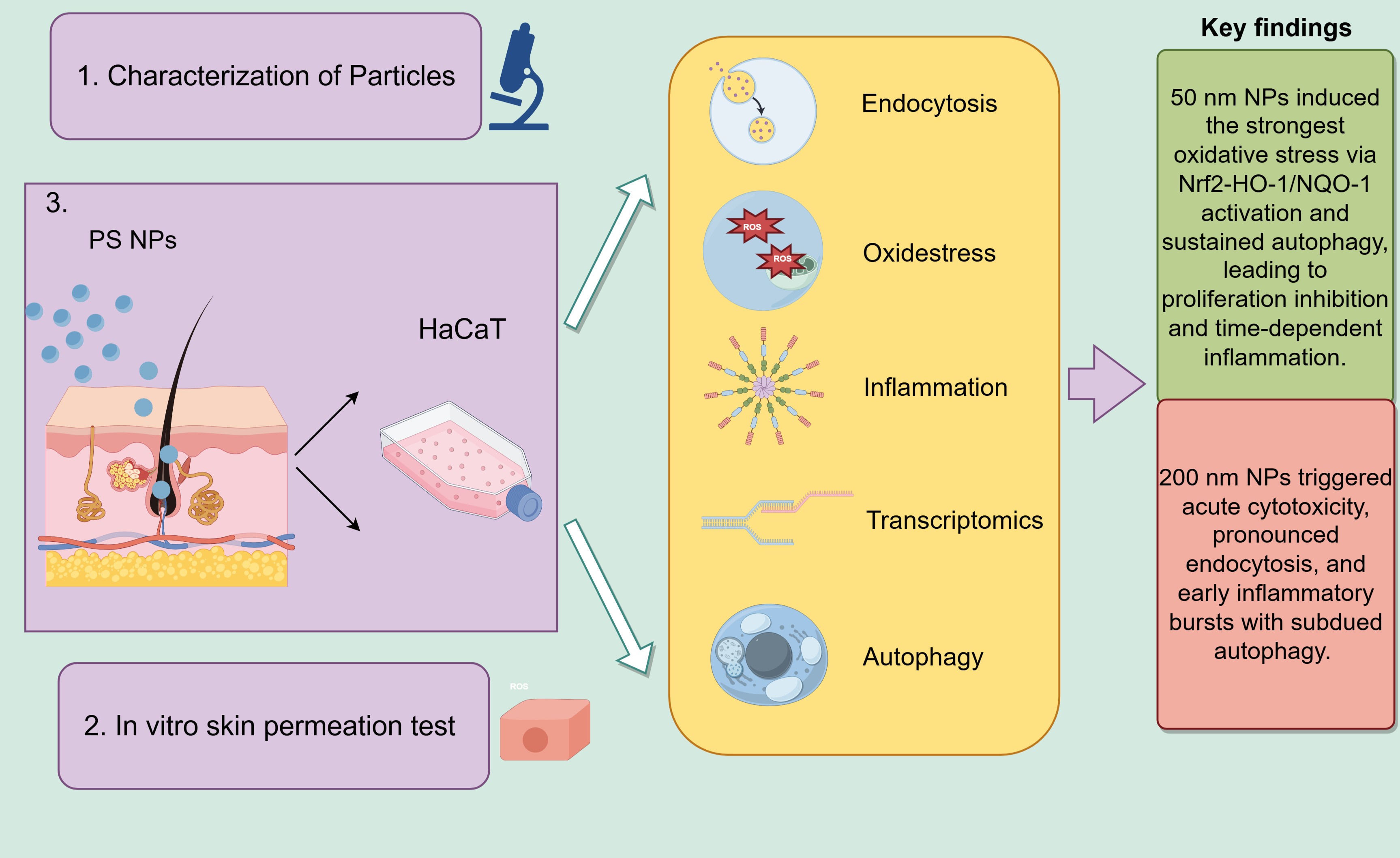
Nanoplastics from plastic waste degradation pose a growing environmental health risk, yet size-dependent dermal effects remain poorly understood. This study investigated polystyrene nanoplastics of 50, 100, and 200 nm using ex vivo porcine skin and in vitro human keratinocyte models. Skin permeation, cellular uptake, viability, oxidative stress, inflammation, autophagy, and transcriptomic pathways were assessed. Enhanced nanoparticle penetration was observed in barrier-disrupted skin, primarily via hair follicles, with smaller particles showing greater intracellular accumulation. Transcriptomics revealed disruptions in oxidative stress, inflammation, endocytosis, and autophagy pathways. Specifically, 50 nm particles induced the strongest oxidative stress via Nrf2 activation and triggered sustained autophagy, leading to proliferation inhibition and time-dependent inflammation. In contrast, 100 nm particles caused moderate oxidative and inflammatory effects, whereas 200 nm particles provoked acute cytotoxicity, pronounced endocytosis, and an early inflammatory burst with subdued autophagy. These findings demonstrate that sub-100 nm PS NPs exhibit enhanced skin penetration in barrier-disrupted ex vivo models and induce pronounced oxidative stress, sustained autophagy, and proliferation inhibition in human keratinocytes. While these results suggest potential cellular mechanisms that may contribute to dermal toxicity, they do not directly demonstrate systemic absorption or long-term damage in vivo. Our observations provide a mechanistic basis for future in vivo investigations and highlight the need for caution when extrapolating in vitro findings to human health risks.
Keywords: polystyrene nanoplastics; skin toxicity; oxidative stress; autophagy; particle size effect polystyrene nanoplastics; skin toxicity; oxidative stress; autophagy; particle size effect
Graphical Abstract