Article

A High-Resolution VOC Emission Inventory for Gas Stations in a Typical Yangtze River Delta City: Implications for Ozone Formation, Secondary Organic Aerosol Formation, and Health Risks


1
Collaborative Innovation Center of Atmospheric Environment and Equipment Technology, Jiangsu Key Laboratory of Atmospheric Environment Monitoring and Pollution Control, School of Environmental Science and Engineering, Nanjing University of Information Science & Technology, Nanjing 210044, China
2
Nanjing Municipal Academy of Ecological and Environmental Protection Sciences, Nanjing 210046, China
3
Institute of Child and Adolescent Health, School of Public Health, Peking University, Beijing 100871, China
*
Author to whom correspondence should be addressed.
Toxics 2026, 14(6), 486; https://doi.org/10.3390/toxics14060486
Submission received: 21 April 2026 / Revised: 27 May 2026 / Accepted: 28 May 2026 / Published: 1 June 2026
(This article belongs to the Special Issue Volatile Organic Compounds (VOCs) Exposure and Human Health)

Abstract

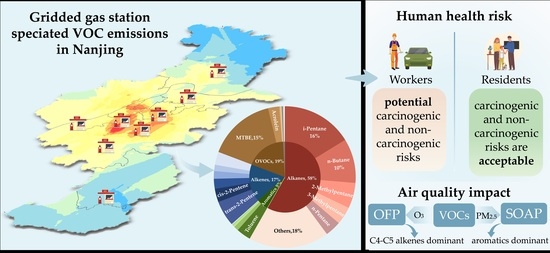
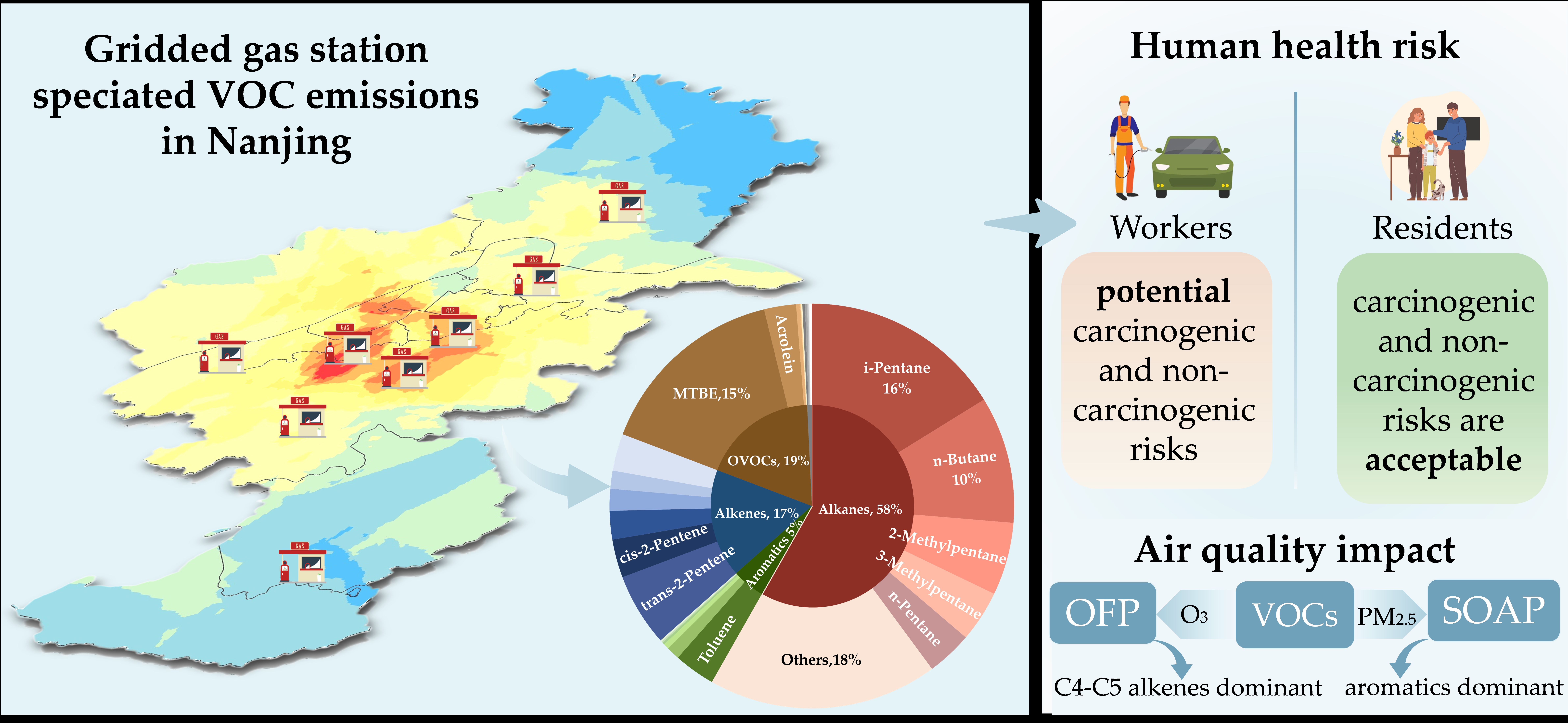
Gasoline evaporation is a significant source of urban volatile organic compounds (VOCs). In this study, we selected Nanjing, a major city in the Yangtze River Delta of China, and developed a high-resolution (1 km × 1 km) gridded VOC species emission inventory for gas stations based on measured VOC emission characteristics and statistical data on gasoline and diesel sales. The results show that VOC emissions from gas stations were correlated with population density and road networks, and were mainly concentrated in the downtown area. The emitted VOCs were dominated by alkanes (58%) and oxygenated VOCs (19%), with i-pentane, n-butane, and methyl tert-butyl ether (MTBE) as the major components. C4–C5 alkenes were identified as the key contributors to ozone (O3) formation, while aromatics contributed most to secondary organic aerosol (SOA) formation. Health risk assessment indicates that, for gas station workers, both carcinogenic and non-carcinogenic risks associated with gasoline and diesel VOC evaporation exceed acceptable thresholds. Benzene, 1,2-dichloroethane, and 1,2-dibromoethane posed the highest carcinogenic risks, whereas acrolein, benzene, and 1,3-butadiene contributed most to non-carcinogenic risks. For urban residents, the health risks from gas station VOC emissions were generally within acceptable levels; however, under unfavorable meteorological conditions, residents living near gas stations may still face elevated health risks. This study highlights the significant impacts of gas station-related VOC emissions on air quality and human health, and informs targeted control and mitigation strategies for gasoline evaporation.

Graphical Abstract

1. Introduction

Ambient volatile organic compounds (VOCs) are key precursors to both ozone (O3) and fine particles (PM2.5) [1], which have become major barriers to further air quality improvement in China [2,3]. Urban atmospheric VOCs arise mainly from anthropogenic sources, such as industrial processes, solvent use, vehicular exhaust, and fuel evaporation [4]. Previous studies have shown that traffic-related sources, particularly vehicular exhaust and gasoline and diesel evaporation [5,6], are important contributors to urban VOCs in China [7]. Over the past two decades, China has implemented stringent vehicle emission controls [8]. Since July 2023, the China VI Stage 6b emission standard has been fully implemented nationwide [9]. Under this standard, the non-methane hydrocarbon (NMHC) emission limit is 35 mg·km−1, corresponding to reductions of 97% relative to the China I standard and 42% relative to Stage 6a [10], thereby substantially lowering VOC emissions from vehicular exhaust [11]. In parallel, China has issued the Technical Requirements for Online Monitoring Systems of Vapor Recovery at Gas Stations [12], which require gas stations to install vapor recovery systems for refueling and tank breathing losses, with recovery efficiencies exceeding 80% [13]. However, the actual control efficiency of these vapor recovery systems ranged from 63% to 85% [14]. Existing studies suggest that evaporative emissions from gas stations still account for approximately 10–20% of urban atmospheric VOCs [15,16,17], and this contribution may be even higher in densely populated urban centers [18]. Therefore, accurately quantifying VOC emissions from gas stations is essential for assessing their impacts on ambient air quality and human health [19,20,21].
VOC emissions from gas stations are characterized by complex chemical compositions [22] and widespread spatial distribution. Previous studies have investigated the chemical profiles of gasoline evaporative VOCs through headspace experiments [23,24] and on-site sampling at gas stations [25,26]. These studies showed that C4–C5 alkanes were the dominant components in gasoline headspace vapors, while alkenes, oxygenated volatile organic compounds (OVOCs), and aromatics also contributed substantially. Although several studies have developed VOC emission inventories for gas stations in cities such as Beijing, China [27], and Mashhad, Iran [28], based on the U.S. Environmental Protection Agency (EPA) Compilation of Air Pollutant Emission Factors (AP-42), most studies focused on total VOC emissions at the city scale [29,30]. Given the widespread distribution of gas stations, their VOC emissions would exhibit considerable spatial heterogeneity. Therefore, it is essential to establish high-spatial-resolution speciated VOC emission inventories and quantitatively assess their contributions to O3 and secondary organic aerosol (SOA) formation, as well as their potential impacts on human health.
This study focuses on Nanjing, a major city in the Yangtze River Delta region, to quantify VOC emissions from individual gas stations by integrating site-specific gasoline and diesel sales data with measured VOC chemical compositions. A high spatial resolution gridded (1 km × 1 km) emission inventory of speciated VOCs for gas stations was developed using the Kriging interpolation method. Based on this inventory, the O3 formation potential (OFP) and secondary organic aerosol formation potential (SOAP) of gas station VOC emissions were evaluated, and the carcinogenic and non-carcinogenic health risks to gas station workers and nearby residents were assessed. These results improve understanding of the environmental and health impacts of gas station VOC emissions and inform targeted control and mitigation strategies for gasoline evaporation.

2. Materials and Methods

2.1. VOC Sampling and Chemical Analysis at Gas Stations

VOC sampling was conducted from July to September 2024 at three large gas stations located in densely populated urban areas, each with an annual fuel sales volume of approximately 10,000 tons. Large stations also generally have more stable and continuous fuel turnover, reducing the influence of fuel aging or storage-related variability. The summer sampling period was selected because high ambient temperatures during summer can enhance gasoline and diesel evaporation, resulting in elevated emission factors [31].
Air samples influenced by gasoline or diesel evaporation were collected about 20 cm downwind of the fuel nozzle using pre-cleaned and evacuated 3.2 L fused silica-lined stainless-steel canisters (Entech Instruments, Inc., Simi Valley, CA, USA). This distance was selected to approximate the worker’s personal breathing zone during refueling, which is generally defined as the area within approximately 25 cm of the nose and mouth according to the standard occupational hygiene protocols established by the U.S. National Institute for Occupational Safety and Health [32]. Therefore, the selected distance can better represent near-field inhalation exposure while reducing dilution from ambient air. Sampling was conducted at approximately 1.5 m above ground, within the typical human breathing zone, to better represent the breathing-zone exposure during refueling. Similar to industrial hygiene and occupational exposure assessments for short-term peak exposures [33], instantaneous sampling (lasting approximately 2 min) was adopted because vehicle refueling is a short, episodic process, typically lasting about 3–5 min.
Before field deployment, all canisters were cleaned and evacuated to <20 mTorr using high-purity nitrogen through three repeated cycles using the canister cleaner (Entech 3100, Entech Instruments, Simi Valley, CA, USA). Canister cleanliness was verified by randomly selecting one canister from each batch, filling it with high-purity nitrogen, and confirming that the concentrations of target VOCs were below the method detection limits (MDLs). The vacuum integrity of the canisters was also checked before sampling to prevent leakage. After sample collection, the canisters were transported to the laboratory and analyzed within one week. A total of ten samples were collected, including three from No. 92 gasoline, two from No. 95 gasoline, two from No. 98 gasoline, and three from diesel.
VOCs were pre-concentrated using a low-temperature pre-concentration system (7200, Entech Instruments, Inc., Simi Valley, CA, USA) and subsequently analyzed using gas chromatography coupled with flame ionization detection and mass spectrometry (GC-FID/MS, 7890B-5977A, Agilent, Santa Clara, CA, USA) [34]. Briefly, the Entech 7200 pre-concentrator enriches VOCs from canister air samples using a three-stage cryogenic trapping process. The first two stages remove major matrix components such as water vapor and CO2 while concentrating the target VOCs, and the final cryogenic focusing stage further narrows the analyte band before thermal desorption and transfer to the GC–FID/MS system for chromatographic separation and detection of VOCs. Using a Dean’s switch, C2–C3 hydrocarbons were separated using a PLOT (Al2O3/KCl) column (30 m × 0.25 mm × 3.0 µm, J&W Scientific, Folsom, CA, USA) and detected by FID, whereas the remaining VOC species were separated using a DB-624 column (60 m × 0.25 mm × 1.8 µm, J&W Scientific, Folsom, CA, USA) and detected by MS. Two commercial VOC standard gas mixtures (55-NMHC and TO-15; Spectra Gases Inc., Branchburg, NJ, USA) were used to calibrate target VOCs. A total of 101 species were quantified, including 28 alkanes, 12 alkenes and alkynes, 17 aromatics, 34 halocarbons, and 10 oxygenated VOCs. To ensure data quality, routine quality assurance and quality control (QA/QC) procedures were implemented, including regular instrument maintenance; hourly checks of internal standard responses using bromochloromethane, 1,4-difluorobenzene, and 1-bromo-3-fluorobenzene for internal calibration; and daily analyses of 2 ppb standard gas mixtures for routine calibration. The five-point calibration curve (0.5, 2, 4, 8, and 16 ppbv) showed good linearity for all target species (R2 > 0.99). The MDLs of individual VOCs were determined as the concentrations corresponding to a signal-to-noise ratio of 5, and ranged from 0.009 to 0.059 ppbv.

2.2. Calculation of VOC Emissions from Gas Stations

2.2.1. Calculation of Total VOC Emissions

In this study, VOC emissions from gasoline at gas stations were calculated using the emission factor (EF) method (Equation (1)). Five emission sources were considered: (1) emissions from tanker unloading, (2) emissions from vehicle refueling, (3) emissions from storage tank breathing, (4) emissions from fuel nozzle dripping, and (5) emissions from fuel hose permeation.
E = A ρ × [ i = 1 5 U E F i × ( 1 η i ) ] / 1000
where E represents the total VOC emissions from gasoline (kg); i denotes a specific VOC emission source; A is the gasoline sales volume (kg); ρ is the gasoline density, assumed to be 0.75 g·mL−1 [35]; UEFi is the uncontrolled emission factor of source i without control measures (mg·L−1); and ηi is the VOC emission control efficiency for source i.
Gas stations were classified into three types based on annual gasoline sales volume. Type I stations have annual sales below 2000 tons and are equipped with Stage I (S1, vapor recovery during tanker unloading) and Stage II (S2, vapor recovery during vehicle refueling) systems. Type II stations have annual sales of 2000–5000 tons and, in addition to S1 and S2 systems, are equipped with an online VOC monitoring system (OMS). Type III stations have annual sales exceeding 5000 tons and, besides the configurations of Type II stations, are further equipped with a tertiary vapor recovery device (VRD).
Table 1 summarizes the UEF, η, and EF (i.e., UEF × (1 − η)) values for each source for the three types of gas stations. For gasoline evaporation sources (1), (3), (4), and (5), the UEF values were taken from the recommendations by the California Air Resources Board (CARB) [36], while the η values were updated according to actual conditions in Nanjing [37]. For source (2) (vehicle refueling), the UEF depends on both the vapor recovery system installed at the station and the penetration of onboard refueling vapor recovery (ORVR) systems in vehicles. Given that ORVR has been required for light-duty gasoline vehicles in Nanjing since 2019, the ORVR penetration rate was adjusted from 15% [37] to 25% in this study, resulting in a UEF of 768 mg·L−1 for vehicle refueling. As shown in Table 1, Type I stations exhibited the highest VOC EF (311 mg·L−1), which is 1.7 and 2.2 times those of Type II and Type III stations, respectively. At Type I stations, the vehicle refueling process exhibited the highest EF (179 mg·L−1), approximately three times that of nozzle dripping and tanker unloading. For Type II stations, the vehicle refueling process also shows the highest EF (90.9 mg·L−1), about 1.6 and 3.3 times those of the nozzle dripping and tanker unloading, respectively. At Type III stations, the EF values for vehicle refueling and nozzle dripping were comparable, with both at around 50 mg·L−1.
Diesel has a lower vapor pressure than gasoline, and studies on evaporative VOC emissions from diesel remain limited. In this study, the VOC emissions from diesel evaporation were estimated by multiplying diesel sales volume by the EF reported in the literature (0.08 kg·t−1) [38].
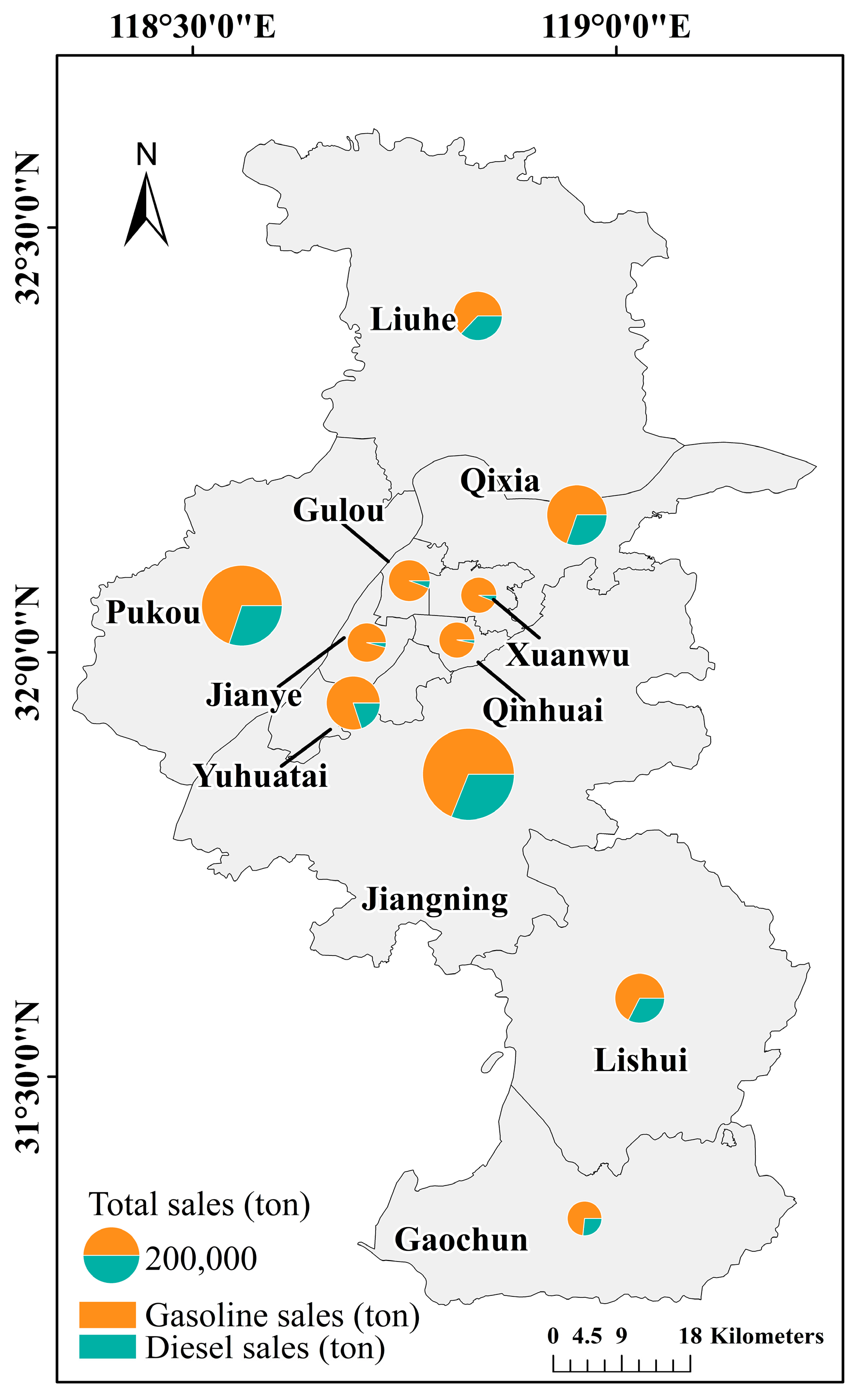
In 2023, 321 gas stations were operating in Nanjing, with total gasoline and diesel sales of 1.61 × 10⁶ tons and 5.40 × 10⁵ tons, respectively. Type I, Type II, and Type III stations accounted for 15%, 28%, and 57% of all stations, respectively. Figure 1 shows gasoline and diesel sales at individual stations. Based on the 2023 sales data, station-level VOC emissions from gasoline and diesel were estimated. These emissions were subsequently allocated to 1 km × 1 km grids according to station coordinates, and the spatial distribution of VOC emissions from gas stations was derived using Kriging interpolation.

2.2.2. Calculation of VOC Emissions for Individual Species

Emissions of individual VOC species were estimated from the total VOC emissions of gas stations (E) using the measured chemical composition profiles of gasoline and diesel VOCs obtained in this study:
E i = E × P i
where Ei represents the emissions of VOC species i (kg), and Pi is the mass fraction of species i in the total VOCs, which was calculated by first converting the observed mixing ratio (ppbv) of each species to mass concentration (μg m−3), and then dividing the mass concentration of species i by the total VOC mass concentration.

2.3. Estimating O3 and SOA Formation Potential

The potential impacts of VOC emissions from gas stations on O3 and SOA were evaluated using O3 formation potential (OFP) and SOA formation potential (SOAP):
O F P = i = 1 n E i × M I R i
where MIRi is the maximum incremental reactivity of VOC species i (kg O3·kg−1 VOC). The values were obtained from the previous literature [39].
S O A P = i = 1 n E i × F A C i
where FACi is the SOA formation coefficient of VOC species i (kg SOA·kg−1 VOC). The values were obtained from previous literature [40,41].

2.4. Health Risk Assessment

The potential health impacts of VOC emissions from gas stations to both station workers and nearby residents were evaluated using the excess lifetime cancer risk (ELCR) and hazard quotient (HQ) for individual species. The total ELCR (TELCR) and hazard index (HI) were calculated as follows:
T E L C R = i = 1 n E L C R i = i = 1 n E C i × U R i
H I = i = 1 n H Q i = i = 1 n E C i R f C i
where URi represents the unit inhalation cancer risk of VOC species i (mg−1·m3), with values obtained from the U.S. EPA Integrated Risk Information System (IRIS) [42] and the California Office of Environmental Health Hazard Assessment (OEHHA) [43]; and RfCi is the reference concentration for VOC species i (mg·m−3), with values taken from the IRIS [42] and the Agency for Toxic Substances and Disease Registry (ATSDR) [44]. The specific URi and RfCi values used for the health risk assessment are presented in Table S1 of the Supplementary Materials. ECi is the exposure concentration of VOC species i (mg·m−3), which was calculated based on the U.S. EPA exposure model [45]:
E C i = C A i × E T × A D × E D A T
where CAi represents the concentration of VOC species i resulting from gasoline or diesel evaporation at the station (mg·m−3). ET, AD, and ED denote the daily exposure hours, annual exposure days, and exposure duration years, respectively, while AT is the averaging time (hours), corresponding to the expected lifetime.
For gas station workers, CAi was taken as the mean measured concentrations at the station. ET values were estimated based on typical working hours, fuel consumption structure, and refueling frequency. The ET for gasoline was set to 1–8 h, with the upper limit corresponding to the standard 8 h working shift used in occupational exposure assessment in China [46]. For diesel, a lower ET range of 0.5–4 h was adopted because diesel refueling occurs less frequently at urban gas stations, as diesel is mainly used by heavy-duty vehicles [47] and is affected by daytime traffic restrictions. AD and ED were set at 250 days and 35 years, respectively, for both fuel types [48]. For Nanjing residents, considering continuous VOC emissions from gas stations, ECi was assumed to be equal to CAi, which was estimated using a box model assuming Nanjing to be a well-mixed box [49]:
C A i = L × τ i ( u τ i + L ) × H × E i S
where L is the box length (m), determined by the geographic setting of Nanjing and the prevailing annual wind direction (southeast–northwest) [50], and set to 1 × 10⁵ m; u is the average wind speed in Nanjing, taken as 2.20 m·s−1, obtained from the Environmental Meteorological Data Service Platform (http://eia-data.com (accessed on 1 March 2025)); H is the mixing-layer height, set to 1490 m in summer and 290 m in winter based on observation studies [51]; and Ei is the emission rate of VOC species i from gasoline or diesel evaporation (mg·s−1). Assuming no significant seasonal variation in fuel consumption, the Ei values for summer and winter in 2023 were estimated according to the seasonal variation in VOC emission factors for gas stations [31]. S is the area of the study region (m2), set to 6.59 × 10⁹ m2 for Nanjing and 3.95 × 10⁸ m2 for the central urban area. Assuming that reaction with hydroxyl radical (OH) is the dominant removal pathway for VOCs, the atmospheric lifetime (τ, s) can be calculated as follows:
τ = 1 k O H × [ O H ]
where kOH is the reaction rate constant of VOCs with OH (cm3·molecule−1·s−1), with values obtained from the Master Chemical Mechanism (MCM); and [OH] denotes the average OH concentration, which was assumed to be 5 × 10⁶ molecule·cm−3 in summer and 1 × 10⁶ molecule·cm−3 in winter according to the published literature [52].

3. Results

3.1. Chemical Composition of VOC Emissions from Gasoline and Diesel Evaporation

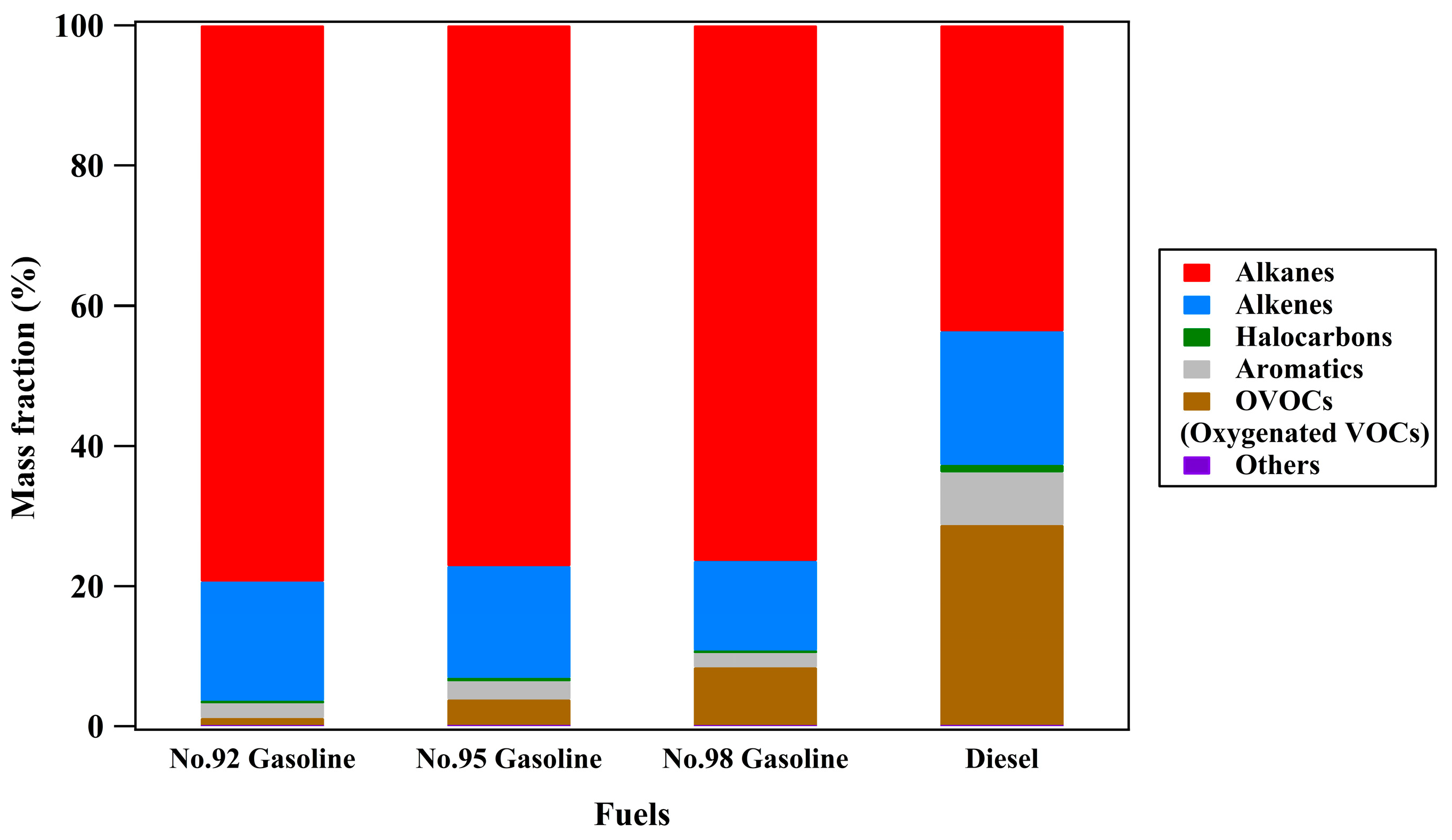
Figure 2 shows the relative contributions of different VOC classes to the measured mass concentration of VOC emissions from gasoline and diesel at gas stations. Alkanes dominate gasoline evaporative VOCs, accounting for more than 75% of total VOC mass in No. 92, No. 95, and No. 98 gasoline, followed by alkenes (13–17%), aromatics (2–3%), OVOCs (1–8%), and halocarbons (0.34–0.46%). These results are generally consistent with previous studies on refueling emissions [53], with a composition ratio of approximately 70:14:1:13 for alkanes, alkenes, aromatics, and OVOCs. However, some differences were observed compared with gasoline vapors measured in headspace experiments, with 59–72% reported for alkanes, 18–28% for alkenes, and 4–10% for aromatics [24]. Compared with the refueling emissions reported in Japan in 2015 [54], which consisted mainly of alkanes (80%) and alkenes (20%), the results of this study indicate higher contributions of aromatics and OVOCs in China. The low contributions of halocarbons observed in this study have also been reported in other gas station measurements in China. For example, Zeng et al. (2022) reported halocarbons in evaporative VOC source profiles from gas stations in Guangzhou, with a higher contribution of 5.5 ± 1.2% [55]. Sun et al. (2024) also detected halogenated VOCs in source profiles from gas stations in Zhengzhou [56].
The chemical composition of VOCs from diesel evaporation differed significantly from that of gasoline. In diesel VOC emissions, alkanes accounted for 44%, lower than in gasoline, whereas the contributions of OVOCs and aromatics were substantially higher, reaching 29% and 8%, respectively. The alkene contribution (19%) was also slightly higher than that in gasoline. The diesel VOC composition observed in this study differed from previous reports on diesel evaporative VOCs [57], in which aromatics and alkanes dominated diesel evaporative VOCs, together accounting for 89%, with aromatics alone contributing 42%, while alkenes accounted for only 1%. These differences may be the result of variations in diesel refining processes.
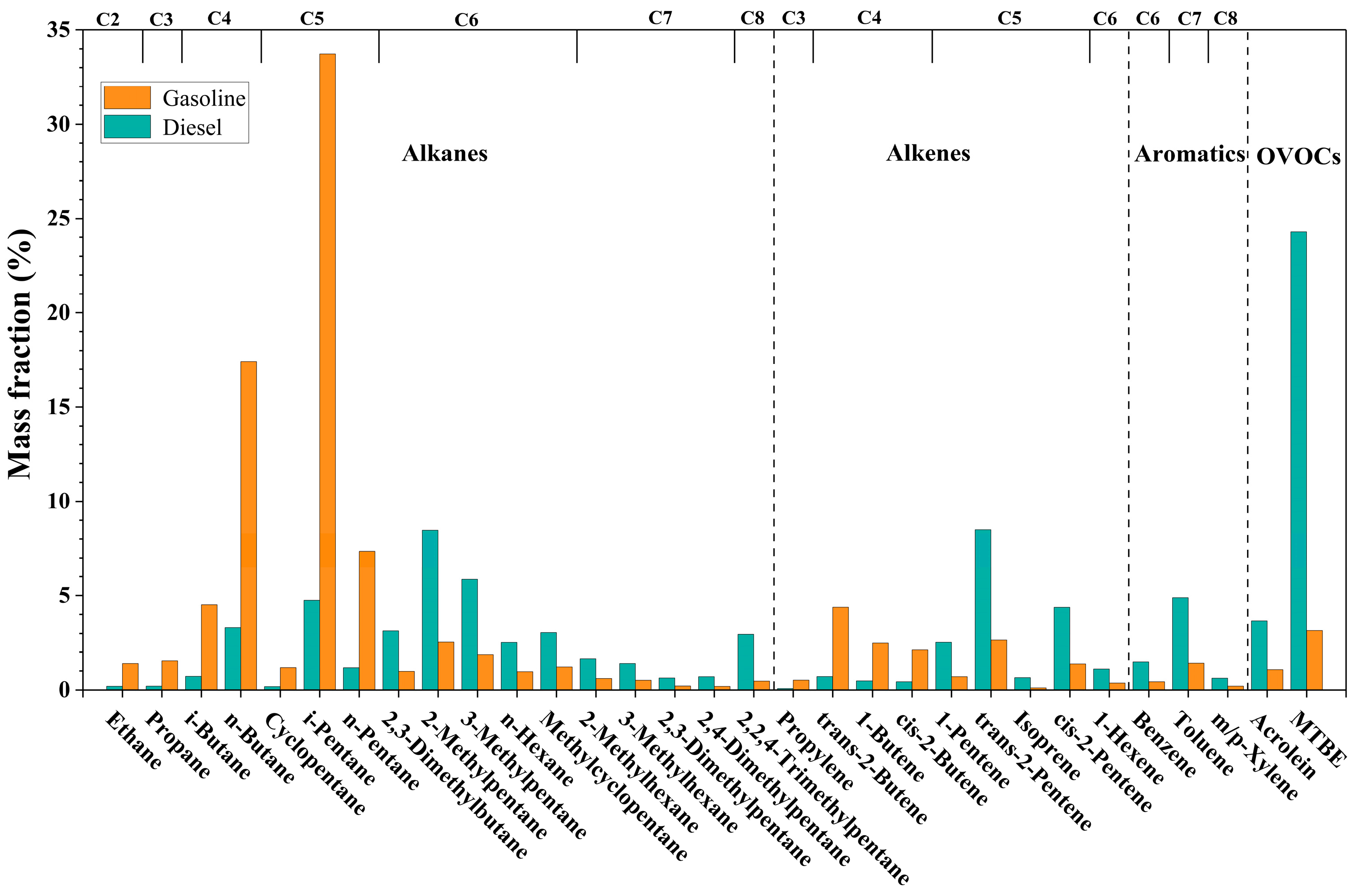
Figure 3 shows the contributions of individual VOC species to the total measured VOC concentration from gasoline and diesel emissions. Gasoline VOC emissions were dominated by C4–C6 alkanes, with i-pentane as the largest contributor (27%), followed by n-butane (14%). In diesel VOC emissions, methyl tert-butyl ether (MTBE) was the largest contributor (24%), followed by trans-2-pentene (9%). These findings are consistent with those reported for gas stations in Guangzhou [55], where MTBE was also identified as a key component in both gasoline and diesel evaporative VOCs. The higher alkene contribution in diesel VOCs than in gasoline may be related to the strict alkene content limits in the China VI gasoline standard. Comparing the gasoline and diesel evaporative source profiles obtained in this study with those reported in U.S. and Europe revealed several differences. In the headspace vapor of U.S. reformulated gasoline, VOCs were mainly dominated by ethanol and alkanes, while MTBE was rarely detected because it had been phased out due to its high potential for groundwater contamination [58]. However, MTBE is still widely used in Chinese gasoline as an oxygenated additive to improve octane number and combustion efficiency [59]. In contrast, consistent with our results, recent observations at an Italian gasoline station also found that MTBE and toluene remained important contributors to VOCs from gasoline evaporation, whereas the benzene contribution was lower than that in our study, possibly due to the stricter benzene limits imposed by the European Union [60]. In this study, the mass fractions of acrolein for gasoline and diesel evaporation were 1.07% and 3.67%, respectively. Another study in China also reported trace acrolein in ambient air surrounding gas stations [61]. However, acrolein was not detected in the U.S. gasoline headspace study [58].

3.2. VOC Emission from Gas Stations and Its Spatial Distribution

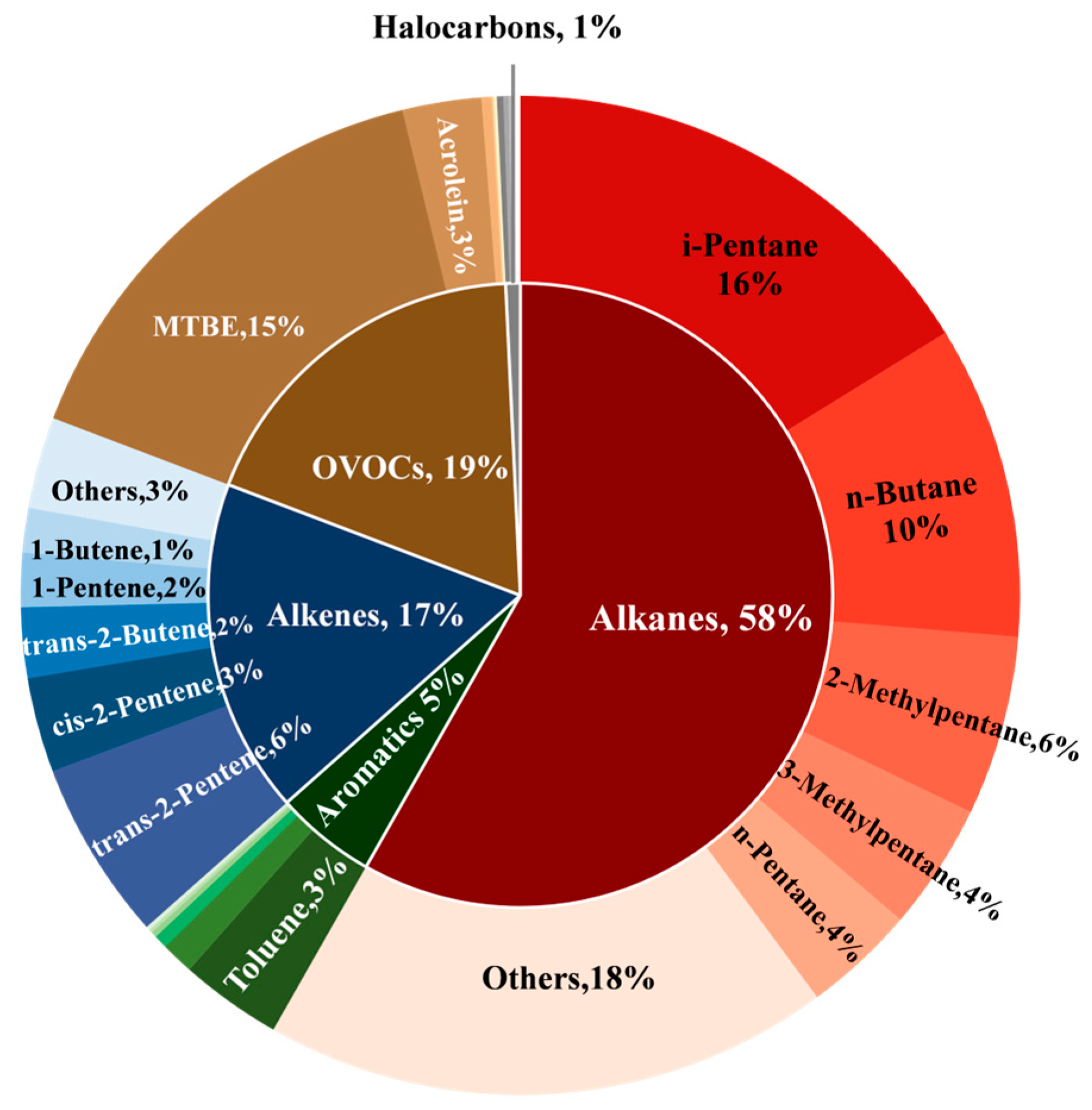
In 2023, total VOC emissions from gasoline and diesel evaporation at gas stations in Nanjing comprised 387 tons, including 344 tons from gasoline and 43.2 tons from diesel. As shown in Figure 4, alkanes were the dominant contributor to total VOC emissions (59%), followed by OVOCs (19%), alkenes (17%), aromatics (5%), and halocarbons (1%). The major species included i-pentane (16%), MTBE (15%), n-butane (10%), trans-2-pentene (6%), 2-methylpentane (6%), n-pentane (4%), cis-2-pentene (3%), and toluene (3%).
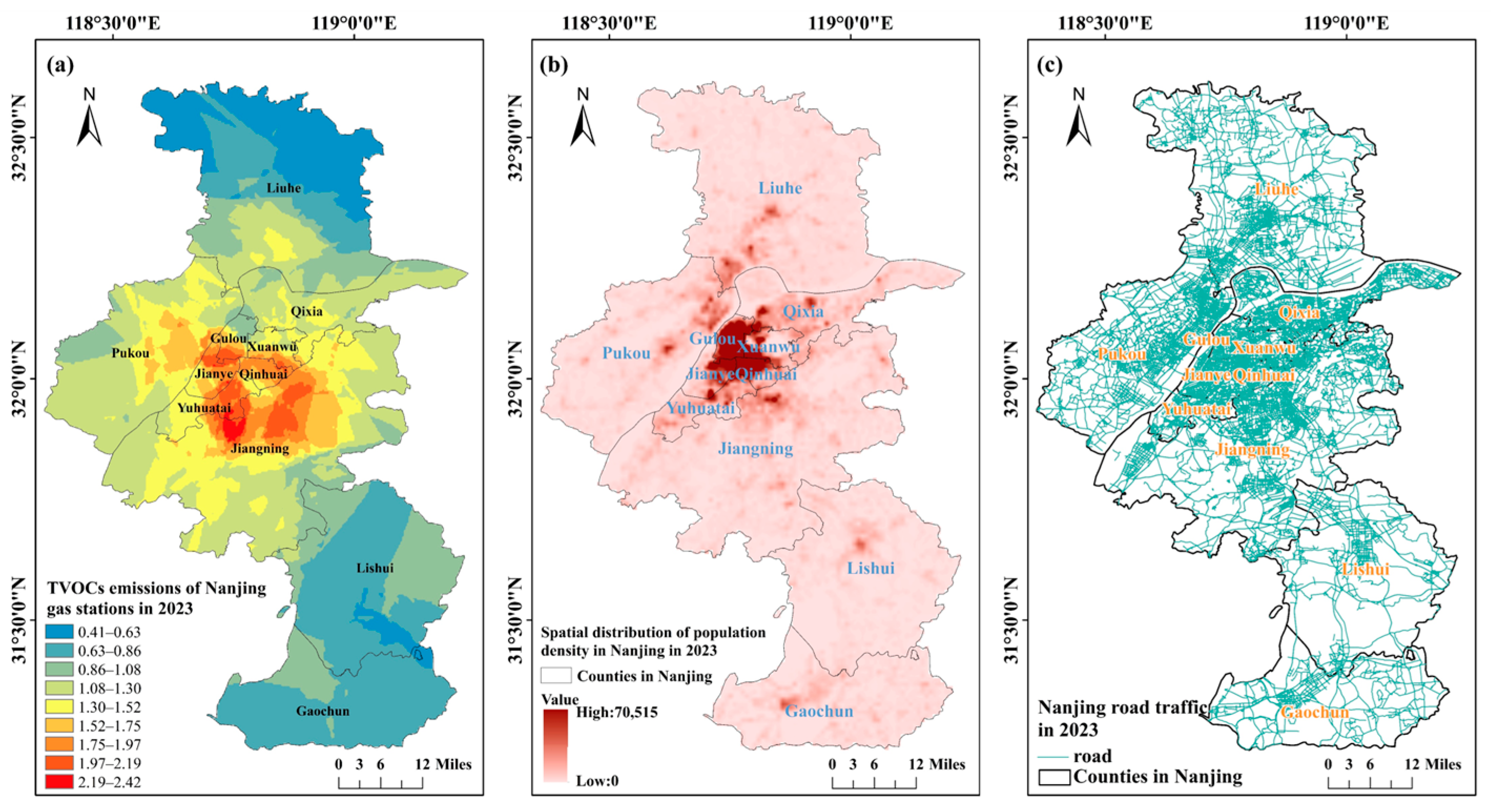
Figure 5 shows the spatial distribution of total VOC emissions from gas stations, population density (obtained from the LandScan Global Population Database developed by Oak Ridge National Laboratory), and road network (sourced from OpenStreetMap) in Nanjing in 2023. High VOC emissions were mainly concentrated in the central urban districts, including Gulou, Xuanwu, Qinhuai, and Jianye, and decreased toward suburban areas. This spatial pattern is consistent with the distributions of population density and the road network, with VOC emissions showing a significant positive correlation with population density at the 1 km grid scale (p < 0.01). The co-location of high VOC emissions and densely populated areas may increase potential health risks, while proximity to major road networks may promote interactions with traffic-related emissions, therefore enhancing the formation of O3 and PM2.5.

4. Discussion

4.1. Formation Potential of O3 and SOA from Gas Station VOC Emissions

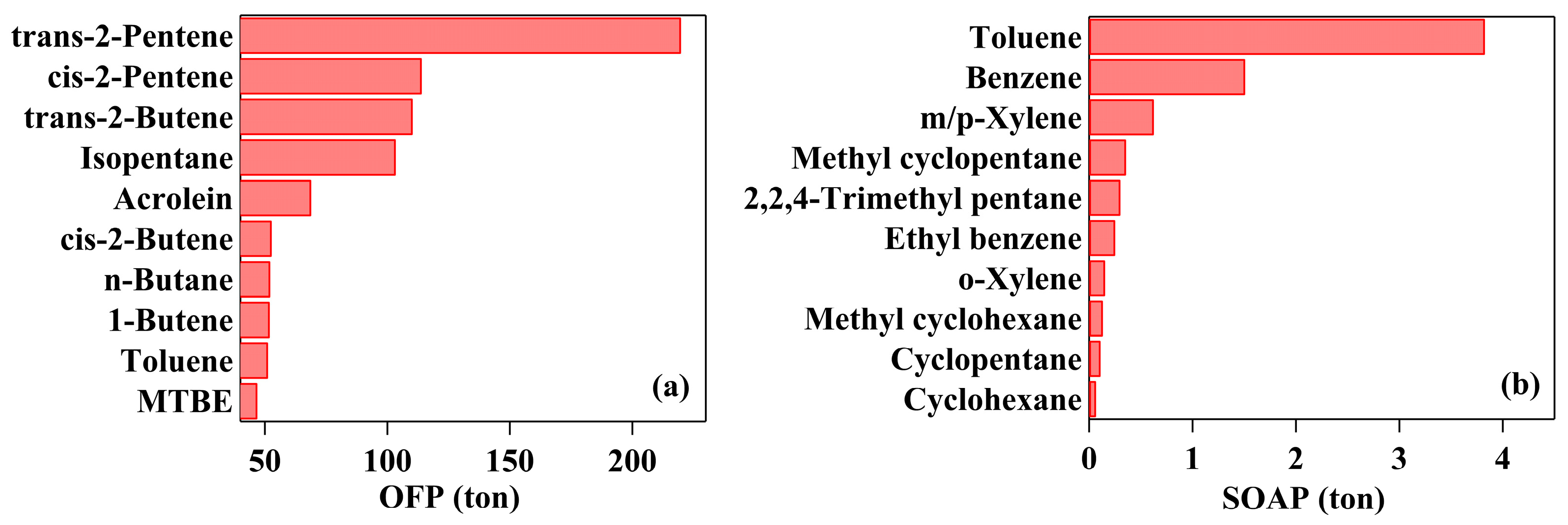
The OFP and SOAP of VOC emissions from gas stations comprised 1203 tons and 7.73 tons, respectively. Figure 6a shows the top ten VOC species contributing to the total OFP from gas station emissions. The major contributors were C4–C5 alkenes (e.g., trans-2-pentene, cis-2-pentene, trans-2-butene), C4–C5 alkanes (e.g., i-pentane, n-butane), and OVOCs (e.g., acrolein, MTBE). This is highly consistent with the key contributing species identified in a recent study [56]. However, the OFP results from gas station emissions also differed from those for urban atmospheric VOCs in Nanjing [62], which identified toluene, ethylene, and m/p-xylene as major contributors. This discrepancy likely reflects additional contributions from petrochemical activities (e.g., ethylene, propylene) and solvent/coating use (e.g., toluene, xylenes).
Figure 6b presents the top ten VOC species contributing to SOAP from gas station emissions. The major contributors were aromatics (e.g., toluene, benzene, and m/p-xylene) and C5–C8 alkanes (e.g., methylcyclopentane, 2,2,4-trimethylpentane, and methylcyclohexane). These results are consistent with those reported for gas stations in Beijing [63], where aromatics and higher-carbon-number alkanes were also key contributors to SOAP.

4.2. Health Risk Assessment of VOC Emissions from Gas Stations

4.2.1. Health Risk Assessment for Gas Station Workers

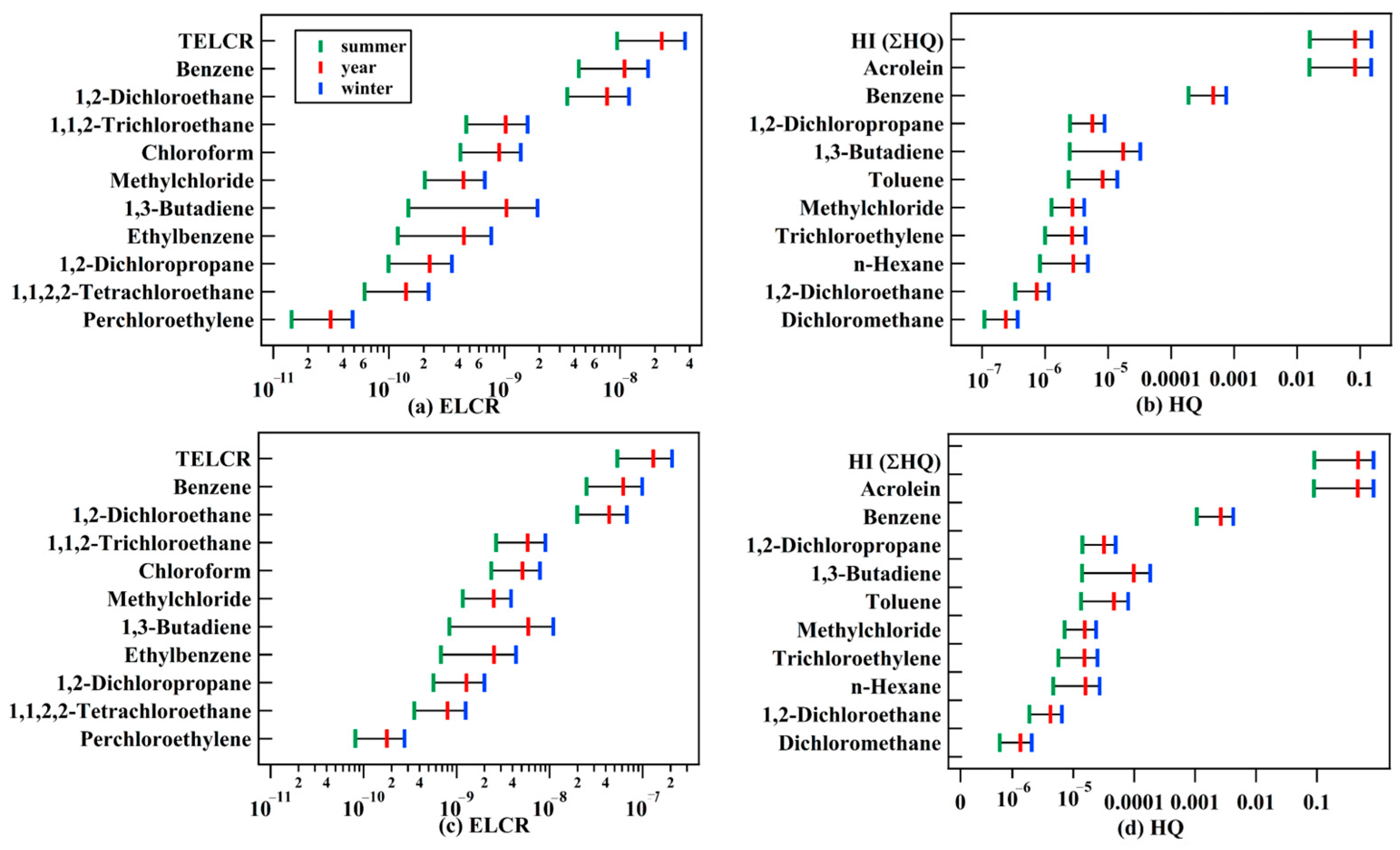
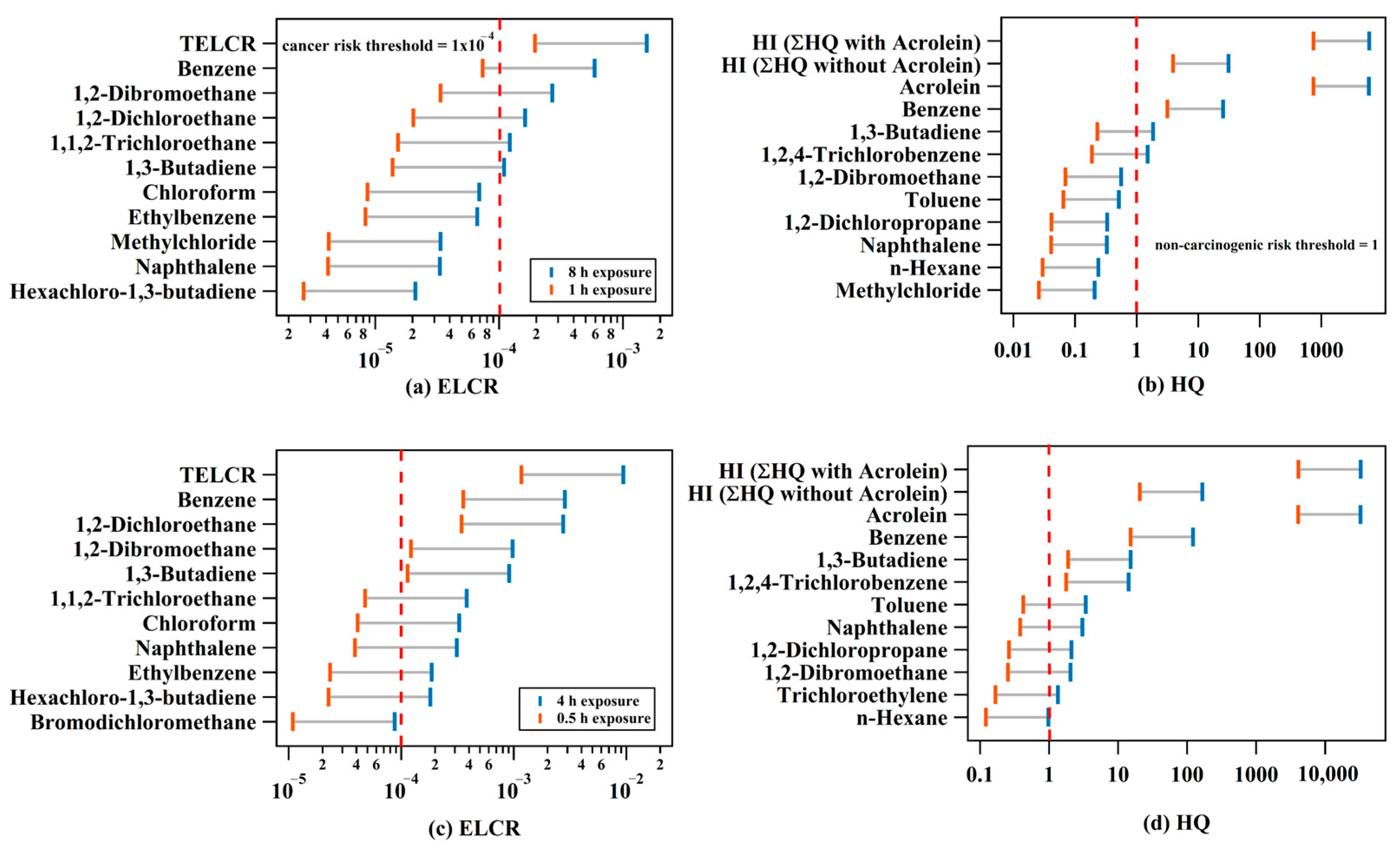
Figure 7 presents the calculated ELCR and HQ values for gas station workers exposed to VOCs from gasoline and diesel evaporation. The TELCR values ranged from 1.95 × 10⁻⁴ to 1.56 × 10⁻³ for VOCs from gasoline and 1.17 × 10⁻³ to 9.40 × 10⁻³ for VOCs from diesel, exceeding the acceptable cancer risk threshold of 1 × 10⁻⁴ [64], indicating potential carcinogenic risks for gas station workers. Among VOCs from gasoline, benzene exhibited the highest ELCR, followed by 1,2-dibromoethane, 1,2-dichloroethane, 1,1,2-trichloroethane, and 1,3-butadiene, all of which exhibited ELCR values exceeding the 1 × 10⁻⁴ threshold. For VOCs from diesel, ELCRs for nine species exceeded the 1 × 10⁻⁴ threshold, with benzene remaining the dominant contributor, followed by 1,2-dichloroethane, 1,2-dibromoethane, 1,3-butadiene, 1,1,2-trichloroethane, chloroform, naphthalene, ethylbenzene, and hexachloro-1,3-butadiene.
For non-carcinogenic risk, the HI values ranged from 7.45 × 10² to 5.96 × 10³ for gasoline VOCs and from 4.08 × 10³ to 3.26 × 10⁴ for diesel VOCs. Given the much higher HQ of acrolein, HI was recalculated after excluding acrolein to better show the contributions of other VOCs. Even after this exclusion, the HI values remained at 3.90–31.2 for gasoline and 20.7–166 for diesel, still far exceeding the acceptable threshold of 1, indicating substantial non-carcinogenic risks. Acrolein exhibited the highest HQ in both gasoline and diesel VOCs (7.41 × 10²–5.93 × 10³ and 4.06 × 10³–3.25 × 10⁴, respectively), followed by benzene, 1,3-butadiene, 1,2,4-trichlorobenzene, 1,2-dibromoethane, toluene, 1,2-dichloropropane, and naphthalene.
Similar to the present study, previous studies in Zhengzhou [56] and Guangzhou [55] reported that VOC exposure from fuel vapors resulted in TELCR values of 4.6 × 10⁻⁴ and 1.3 × 10⁻⁴, and HI values of 5.9 and 3.1 for gas station workers, respectively, both exceeding the corresponding acceptable risk thresholds, indicating potential carcinogenic and non-carcinogenic risks to workers. Previous studies identified 1,3-butadiene and 1,2-dichloropropane as the main contributors to health risks [55,56]. Similarly, this study also found elevated risks associated with these species. However, unlike previous studies, benzene contributed most to carcinogenic risk, while acrolein contributed most to non-carcinogenic risk.

4.2.2. Health Risk Assessment for Residents

Figure 8 presents the calculated ELCR and HQ values for Nanjing residents exposed to VOC emissions from gas stations under annual average, summer, and winter conditions, for both the entire city and the central urban area. As shown in Figure 8a, the annual average, summer, and winter TELCR for Nanjing residents ranged from 9.43 × 10⁻⁹ to 3.64 × 10⁻⁸, all below the U.S. EPA-recommended minimum cancer risk threshold of 1 × 10⁻⁶ [64]. The corresponding HI values ranged from 0.016 to 0.150, also below the threshold of 1 [45]. These results suggest that, assuming VOCs were uniformly distributed across Nanjing, gas station emissions resulted in negligible health risks to residents. Similar findings were reported for Zhengzhou, where HI values were also below 1 and TELCR values were in the order of 10−6 [65].
For residents in the central urban area, TELCR increased to 5.36 × 10⁻⁸–2.07 × 10⁻⁷, while HI increased to 0.09–0.854. Although these values remain below health risk thresholds, the co-location of gas stations and densely populated areas suggests that health risks to nearby residents should not be overlooked. Additionally, the box model used in this study assumes instantaneous and uniform mixing of VOCs over the large study area and neglects spatial heterogeneity in gas station emissions. As a result, VOC concentrations and the associated health risks for residents near gas stations may be underestimated. Under unfavorable meteorological conditions, such as low wind speed, stable atmospheric stratification, and a reduced mixing-layer height, local accumulation of VOCs may further increase health risks for nearby residents.

4.3. Study Limitations and Uncertainties

In this study, VOC sampling at gas stations was conducted from July to September and included only three large gas stations. Evaporative VOC profiles may vary with temperature, fuel formulation, refueling activity, and station operating conditions. Therefore, the VOC chemical profiles of gasoline evaporation obtained in this study should be regarded as representative of summer evaporation conditions rather than year-round averages. This limitation may introduce uncertainty when extrapolating the source profiles and emission estimates to other seasons. Future studies with more sampling gas stations, broader seasonal coverage, and larger sample sizes are needed to further improve the representativeness and robustness of the results. In addition, because the gasoline and diesel evaporation samples were collected during actual refueling, the observed VOCs at gas stations may be influenced by ambient air mixing, nearby combustion emissions, or other background sources. Considering that halocarbons and acrolein are not typical constituents of gasoline or diesel evaporation, their trace detection in this study may be associated with minor fuel impurities, ambient air mixing, or interference from nearby sources.

5. Conclusions

This study established a 1 km × 1 km grid-based VOC emission inventory for gas stations by calculating VOC emissions from individual stations and applying Kriging spatial interpolation. The results show that VOC emissions from gasoline and diesel evaporation in Nanjing in 2023 were 344 tons and 43.2 tons, respectively. Emission profiles were characterized based on measured VOC compositions. Gasoline VOC emissions were dominated by alkanes (77%), with i-pentane and n-butane as the major contributors, together comprising 48%. In contrast, diesel VOCs exhibited a lower alkane fraction (44%) and higher fractions of OVOCs and aromatics, with MTBE as the largest contributor (24%). VOC emissions from gas stations were mainly concentrated in traffic-intensive central urban areas and exhibited a significant positive correlation with population density. Alkenes (particularly trans-2-pentene, trans-2-butene, and cis-2-pentene) contributed most to OFP, whereas aromatics (especially toluene, benzene, and m/p-xylene) dominated SOAP. Health risk assessment indicates that gasoline and diesel VOC emissions showed potential carcinogenic and non-carcinogenic risks to gas station workers. Benzene exhibited the highest carcinogenic risk, and acrolein contributed most to the non-carcinogenic risk. For residents, the overall carcinogenic and non-carcinogenic risks associated with gas station VOC emissions remained within acceptable levels, although elevated risks may still occur in densely populated areas or under unfavorable meteorological conditions.

Supplementary Materials

The following supporting information can be downloaded at: https://www.mdpi.com/article/10.3390/toxics14060486/s1, Table S1: The UR and RfC values used for health risk assessment of individual VOC species; Table S2: The average mixing ratios (ppbv) of VOC species with relatively high health risks from gasoline and diesel evaporation.

Author Contributions

Conceptualization, M.W. and X.Z.; methodology, T.C. and M.W.; software, T.C.; validation, M.W., X.Z. and F.X.; formal analysis, T.C.; investigation, J.L.; resources, F.X.; data curation, X.Z. and C.L.; writing—original draft preparation, T.C.; writing—review and editing, M.W., X.Z. and J.L.; visualization, T.C.; supervision, F.X.; funding acquisition, M.W. All authors have read and agreed to the published version of the manuscript.

Funding

This research was funded by the National Natural Science Foundation of China, grant number 42477108, and the Jiangsu Province University Innovation Training Program, grant number 202410300180Y.

Institutional Review Board Statement

Not applicable.

Informed Consent Statement

Not applicable.

Data Availability Statement

Researchers wishing to access the data used in this study can make a request to the corresponding author: wangming@nuist.edu.cn.

Conflicts of Interest

The authors declare no conflicts of interest.

References

  1. Jeon, W.-B.; Lee, S.-H.; Lee, H.; Park, C.; Kim, D.-H.; Park, S.-Y. A study on high ozone formation mechanism associated with change of NO/VOCs ratio at a rural area in the Korean Peninsula. Atmos. Environ. 2014, 89, 10–21. [Google Scholar] [CrossRef]
  2. Wei, J.; Li, Z.; Li, K.; Dickerson, R.R.; Pinker, R.T.; Wang, J.; Liu, X.; Sun, L.; Xue, W.; Cribb, M. Full-coverage mapping and spatiotemporal variations of ground-level ozone (O3) pollution from 2013 to 2020 across China. Remote Sens. Environ. 2022, 270, 112775. [Google Scholar] [CrossRef]
  3. Lu, D.; Mao, W.; Xiao, W.; Zhang, L. Non-linear response of PM2.5 pollution to land use change in China. Remote Sens. 2021, 13, 1612. [Google Scholar] [CrossRef]
  4. Simayi, M.; Hao, Y.; Li, J.; Wu, R.; Shi, Y.; Xi, Z.; Zhou, Y.; Xie, S. Establishment of county-level emission inventory for industrial NMVOCs in China and spatial-temporal characteristics for 2010–2016. Atmos. Environ. 2019, 211, 194–203. [Google Scholar] [CrossRef]
  5. Zhao, Q.; Bi, J.; Liu, Q.; Ling, Z.; Shen, G.; Chen, F.; Qiao, Y.; Li, C.; Ma, Z. Sources of volatile organic compounds and policy implications for regional ozone pollution control in an urban location of Nanjing, East China. Atmos. Chem. Phys. 2020, 20, 3905–3919. [Google Scholar] [CrossRef]
  6. Li, C.; Liu, Y.; Cheng, B.; Zhang, Y.; Liu, X.; Qu, Y.; An, J.; Kong, L.; Zhang, Y.; Zhang, C.; et al. A comprehensive investigation on volatile organic compounds (VOCs) in 2018 in Beijing, China: Characteristics, sources and behaviours in response to O3 formation. Sci. Total Environ. 2022, 806, 150247. [Google Scholar] [CrossRef] [PubMed]
  7. Gu, C.; Zhang, L.; Xu, Z.; Xia, S.; Wang, Y.; Li, L.; Wang, Z.; Zhao, Q.; Wang, H.; Zhao, Y. High-resolution regional emission inventory contributes to the evaluation of policy effectiveness: A case study in Jiangsu Province, China. Atmos. Chem. Phys. 2023, 23, 4247–4269. [Google Scholar] [CrossRef]
  8. Huo, S.; Zhang, X.; Xu, W.; Dang, J.; Xu, F.; Xie, W.; Tao, C.; Han, Y.; Liu, X.; Teng, Z.; et al. Updating vehicle VOCs emissions characteristics under clean air actions in a tropical city of China. Sci. Total Environ. 2024, 930, 172733. [Google Scholar] [CrossRef]
  9. Liu, X.; Xu, L.; Wu, X.; Wen, H. Can China’s vehicular emissions regulation reduce air pollution?—A quasi-natural experiment based on the latest national vehicular emissions standard (Stage-VI). Environ. Sci. Pollut. Res. 2023, 30, 112474–112489. [Google Scholar] [CrossRef]
  10. GB 18352.6-2016; Limits and Measurement Methods for Emissions from Light-Duty Vehicles (China VI). Standardization Administration of China: Beijing, China, 2016.
  11. Wang, A.; Wang, M.; Yuan, Z.; Liu, X.; Sha, Q. Vehicular VOC speciation dynamics under China’s progressive emission standards: Mechanistic drivers from real-time monitoring. J. Clean. Prod. 2026, 538, 147350. [Google Scholar] [CrossRef]
  12. Ministry of Ecology and Environment of the People’s Republic of China. Technical Requirements for Online Monitoring Systems for Gasoline Station Vapor Recovery (Draft for Comments). Available online: https://www.mee.gov.cn/xxgk2018/xxgk/xxgk06/201808/t20180813_629813.html (accessed on 20 April 2026).
  13. GB 20950-2020; Emission Standard of Air Pollutants for Gasoline Storage Terminals. China Standards Press: Beijing, China, 2020.
  14. Man, H.; Shao, X.; Cai, W.; Wang, K.; Cai, Z.; Xue, M.; Liu, H. Utilizing an optimized method for evaluating vapor recovery equipment control efficiency and estimating evaporative VOC emissions from urban oil depots via an extensive survey. J. Hazard. Mater. 2024, 479, 135710. [Google Scholar] [CrossRef] [PubMed]
  15. Baghani, A.N.; Dana, E.; Sorooshian, A.; Jafari, A.J.; Aalamolhoda, A.A.; Sheikhi, R.; Jajarmi, F.; Shahsavani, A.; Delikhoon, M.; Ebrahimzade, G.; et al. Sensitivity of BTEX pollution and health effects to traffic restrictions: A case study in an urban center of Tehran, Iran. Sustain. Cities Soc. 2024, 104, 105281. [Google Scholar] [CrossRef]
  16. Wu, Y.; Liu, B.; Meng, H.; Dai, Q.; Shi, L.; Song, S.; Feng, Y.; Hopke, P.K. Changes in source apportioned VOCs during high O3 periods using initial VOC-concentration-dispersion normalized PMF. Sci. Total Environ. 2023, 896, 165182. [Google Scholar] [CrossRef] [PubMed]
  17. Zhang, C.; Liu, X.; Zhang, Y.; Tan, Q.; Feng, M.; Qu, Y.; An, J.; Deng, Y.; Zhai, R.; Wang, Z.; et al. Characteristics, source apportionment and chemical conversions of VOCs based on a comprehensive summer observation experiment in Beijing. Atmos. Pollut. Res. 2021, 12, 230–241. [Google Scholar] [CrossRef]
  18. Yang, M.; Li, F.; Huang, C.; Tong, L.; Dai, X.; Xiao, H. VOC characteristics and their source apportionment in a coastal industrial area in the Yangtze River Delta, China. J. Environ. Sci. 2023, 127, 483–494. [Google Scholar] [CrossRef]
  19. Xiong, Y.; Du, K.; Huang, Y. One-third of global population at cancer risk due to elevated volatile organic compounds levels. npj Clim. Atmos. Sci. 2024, 7, 54. [Google Scholar] [CrossRef]
  20. Zhang, M.; Chen, C.; Sun, Y.; Wang, Y.; Du, P.; Ma, R.; Li, T. Association between ambient volatile organic compounds exposome and emergency hospital admissions for cardiovascular disease. Environ. Sci. Technol. 2024, 58, 5695–5704. [Google Scholar] [CrossRef]
  21. Chen, W.-H.; Chang, C.-F.; Lai, C.-H.; Peng, Y.-P.; Su, Y.-J.; Chen, G.-F. Multivariate analysis of carcinogenic equivalence (CEQ) to characterize carcinogenic VOC emissions in a typical petrochemical industrial park in Taiwan. Environ. Int. 2024, 186, 108548. [Google Scholar] [CrossRef]
  22. He, Q.; Yan, Y.; Li, H.; Zhang, Y.; Chen, L.; Wang, Y. Characteristics and reactivity of volatile organic compounds from non-coal emission sources in China. Atmos. Environ. 2015, 115, 153–162. [Google Scholar] [CrossRef]
  23. Sun, Y.; Cao, J.; Wang, M.; Yang, Z.; Wu, H.; Shang, J.; Ma, J. Chemical composition of headspace vapor from volatilization of ten petroleum samples. Fuel 2025, 396, 135299. [Google Scholar] [CrossRef]
  24. Zhang, Y.; Wang, X.; Zhang, Z.; Lü, S.; Shao, M.; Lee, F.S.C.; Yu, J. Species profiles and normalized reactivity of volatile organic compounds from gasoline evaporation in China. Atmos. Environ. 2013, 79, 110–118. [Google Scholar] [CrossRef]
  25. Zheng, H.; Kong, S.; Xing, X.; Mao, Y.; Hu, T.; Ding, Y.; Li, G.; Liu, D.; Li, S.; Qi, S. Monitoring of volatile organic compounds (VOCs) from an oil and gas station in Northwest China for 1 Year. Atmos. Chem. Phys. 2018, 18, 4567–4595. [Google Scholar] [CrossRef]
  26. Jia, C.; Fu, X.; Chauhan, B.; Xue, Z.; Kedia, R.J.; Mishra, C.S. Exposure to volatile organic compounds (VOCs) at gas stations: A probabilistic analysis. Air Qual. Atmos. Health 2021, 15, 465–477. [Google Scholar] [CrossRef]
  27. Liu, X.; Zhang, H.; Lv, Z.; Bai, H.; Li, G. Characterization identification and speciated emission inventory construction of Anthropogenic volatile organic compounds (VOCs) in Beijing, China. Atmos. Pollut. Res. 2025, 16, 102452. [Google Scholar] [CrossRef]
  28. Heidari, E.A.; Sarkhosh, M.; Alidadi, H.; Najafpoor, A.A.; Esmaily, H.; Shamsara, E. Assessing VOC emissions from different gas stations: Impacts, variations, and modeling fluctuations of Air Pollutants. Sci. Rep. 2024, 14, 16617. [Google Scholar] [CrossRef]
  29. Kanayankottupoyil, J.; John, K. Characterization and source apportionment of ambient VOC concentrations: Assessing ozone formation potential in the Barnett Shale oil and gas region. Atmos. Pollut. Res. 2025, 16, 102327. [Google Scholar] [CrossRef]
  30. Zhao, N.; Zhang, H.; Wang, G. Revealing the nonlinear responses of PM2.5 and O3 to VOC and NOx emissions from various sources in Shandong, China. J. Hazard. Mater. 2025, 489, 137655. [Google Scholar] [CrossRef]
  31. Wang, Y.; Li, Z.; Zhang, H.; Wang, Y.; Zu, L.; Yang, X. Monthly Changes in VOCs Emissions from Gas Stations in China from 2019 to 2021. Res. Environ. Sci. 2023, 36, 2306. (In Chinese) [Google Scholar] [CrossRef]
  32. National Institute for Occupational Safety and Health (NIOSH). NIOSH Manual of Analytical Methods (NMAM), 4th ed.; National Institute for Occupational Safety and Health (NIOSH): Cincinnati, OH, USA, 2003.
  33. Virji, M.A.; Kurth, L. Peak Inhalation Exposure Metrics Used in Occupational Epidemiologic and Exposure Studies. Front. Public Health 2021, 8, 611693. [Google Scholar] [CrossRef]
  34. Wang, B.; Shao, M.; Lu, S.H.; Yuan, B.; Zhao, Y.; Wang, M.; Zhang, S.Q.; Wu, D. Variation of ambient non-methane hydrocarbons in Beijing city in summer 2008. Atmos. Chem. Phys. 2010, 10, 5911–5923. [Google Scholar] [CrossRef]
  35. International Agency for Research on Cancer (IARC). Occupational Exposures in Petroleum Refining; Crude Oil and Major Petroleum Fuels. In IARC Monographs on the Evaluation of Carcinogenic Risks to Humans; IARC: Lyon, France, 1989; Volume 45. [Google Scholar]
  36. California Air Resources Board (CARB). Revised Emission Factor for Gasoline Marketing Operations at California Gasoline Dispensing Facilities; Technical Report; CARB: Sacramento, CA, USA, 2013.
  37. Xu, L.-F.; Li, T.-Z.; Jiang, Y.; Zhang, X.-M.; Gao, X.; Zhu, Z.-J.; Zhang, L.-Y. VOCs emission inventory of gas stations in Nanjing. Adm. Tech. Environ. Monit. 2022, 34, 72–75. (In Chinese) [Google Scholar] [CrossRef]
  38. Hu, W.; Huang, Y.-H.; Liang, W.-J.; Liu, M.-Y.; Yang, T.-Y.; Ren, B.-Q. Chemical composition of VOCs from service stations vapor processing device and associated contributions to secondary pollution. Environ. Sci. 2023, 44, 709–718. (In Chinese) [Google Scholar] [CrossRef]
  39. Venecek, M.A.; Carter, W.P.L.; Kleeman, M.J. Updating the SAPRC Maximum Incremental Reactivity (MIR) scale for the United States from 1988 to 2010. J. Air Waste Manag. Assoc. 2018, 68, 1301–1316. [Google Scholar] [CrossRef]
  40. Grosjean, D. In situ organic aerosol formation during a smog episode: Estimated production and chemical functionality. Atmos. Environ. Part A 1992, 26, 953–963. [Google Scholar] [CrossRef]
  41. Grosjean, D.; Seinfeld, J. Parameterization of the formation potential of secondary organic aerosols. Atmos. Environ. 1989, 23, 1733–1747. [Google Scholar] [CrossRef]
  42. U.S. Environmental Protection Agency (USEPA). Integrated Risk Information System (IRIS): Chemical Assessment Summaries. Available online: https://iris.epa.gov/ (accessed on 20 April 2026).
  43. Office of Environmental Health Hazard Assessment (OEHHA). Air Toxics Hot Spots Program: Guidance Manual for Preparation of Health Risk Assessments; Appendix A-1; OEHHA: Sacramento, CA, USA, 2015.
  44. Agency for Toxic Substances and Disease Registry (ATSDR). Toxicological Profiles. Available online: https://wwwn.cdc.gov/TSP/ToxProfiles/ToxProfiles.aspx (accessed on 20 April 2026).
  45. U.S. Environmental Protection Agency (USEPA). Risk Assessment Guidance for Superfund (RAGS): Volume I—Human Health Evaluation Manual (Part F, Supplemental Guidance for Inhalation Risk Assessment); EPA No. 540-R-070-002; USEPA: Washington, DC, USA, 2009.
  46. GBZ 2.1-2019; Occupational Exposure Limits for Hazardous Agents in the Workplace—Part 1: Chemical Hazardous Agents. National Health Commission of the People’s Republic of China: Beijing, China, 2019.
  47. Wu, Y.; Zhang, S.; Hao, J.; Liu, H.; Wu, X.; Hu, J.; Walsh, M.P.; Wallington, T.J.; Zhang, K.M.; Stevanovic, S. On-road vehicle emissions and their control in China: A review and outlook. Sci. Total Environ. 2017, 574, 332–349. [Google Scholar] [CrossRef] [PubMed]
  48. U.S. Environmental Protection Agency (USEPA). Exposure Factors Handbook: 2011 Edition; EPA/600/R-09/052F; U.S. EPA: Washington, DC, USA, 2011.
  49. Mo, Z.; Shao, M.; Liu, Y.; Xiang, Y.; Wang, M.; Lu, S.; Ou, J.; Zheng, J.; Li, M.; Zhang, Q.; et al. Species-specified VOC emissions derived from a gridded study in the Pearl River Delta, China. Sci. Rep. 2018, 8, 2963. [Google Scholar] [CrossRef]
  50. Xu, Q.; Xu, Z.; Sun, C. Evaluation Schoolyard Wind Comfort Changes Due to Rapid Developments: Case Study of Nanjing, China. Atmosphere 2021, 13, 43. [Google Scholar] [CrossRef]
  51. Huang, X.; Wang, Y.; Shang, Y.; Song, X.; Zhang, R.; Wang, Y.; Li, Z.; Yang, Y. Contrasting the effect of aerosol properties on the planetary boundary layer height in Beijing and Nanjing. Atmos. Environ. 2023, 308, 119861. [Google Scholar] [CrossRef]
  52. Wang, M.; Qin, W.; Chen, W.; Zhang, L.; Zhang, Y.; Zhang, X.; Xie, X. Seasonal variability of VOCs in Nanjing, Yangtze River delta: Implications for emission sources and photochemistry. Atmos. Environ. 2020, 223, 117254. [Google Scholar] [CrossRef]
  53. Man, H.; Liu, H.; Niu, H.; Wang, K.; Deng, F.; Wang, X.; Xiao, Q.; Hao, J. VOCs evaporative emissions from vehicles in China: Species characteristics of different emission processes. Environ. Sci. Ecotechnol. 2020, 1, 100002. [Google Scholar] [CrossRef]
  54. Yamada, H.; Inomata, S.; Tanimoto, H. Refueling emissions from cars in Japan: Compositions, temperature dependence and effect of vapor liquefied collection system. Atmos. Environ. 2015, 120, 455–462. [Google Scholar] [CrossRef]
  55. Zeng, L.; Yang, B.; Xiao, S.; Yan, M.; Cai, Y.; Liu, B.; Zheng, X.; Wu, Y. Species profiles, in-situ photochemistry and health risk of volatile organic compounds in the gasoline service station in China. Sci. Total Environ. 2022, 842, 156813. [Google Scholar] [CrossRef]
  56. Sun, W.; Zhu, R.; Wang, M.; Chen, H.; Zhang, B.; Xie, P.; Zhang, R.; Liu, X.; Wei, P.; Zhang, R. Evaporative volatile organic compounds from the actual vehicle refueling emissions: Characteristics, secondary transformation, and health effects in winter and summer seasons. Atmos. Environ. 2024, 338, 120811. [Google Scholar] [CrossRef]
  57. Niu, Z.; Kong, S.; Zheng, H.; Hu, Y.; Zheng, S.; Cheng, Y.; Yao, L.; Liu, W.; Ding, F.; Liu, X.; et al. Differences in compositions and effects of VOCs from vehicle emission detected using various methods. Environ. Pollut. 2023, 333, 122077. [Google Scholar] [CrossRef] [PubMed]
  58. Chin, J.Y.; Batterman, S.A. VOC composition of current motor vehicle fuels and vapors, and collinearity analyses for receptor modeling. Chemosphere 2012, 86, 951. [Google Scholar] [CrossRef]
  59. Kong, L.; Li, X.; Wang, Y.; Lu, S.; Liu, Y.; Lou, S.; Zhou, W.; Yang, X.; Ding, Y.; Liu, Y.; et al. Speciated volatile organic compounds and hydroxyl radical reactivity characteristics of evaporation emissions from China VI and China V in-use light-duty gasoline vehicles. Atmos. Chem. Phys. 2025, 25, 13311–13326. [Google Scholar] [CrossRef]
  60. Palmisani, J.; Dileo, F.; Marzocca, A.; De Vietro, N.; de Gennaro, G.; Di Gilio, A. Investigations around a gasoline service station to assess Volatile Organic Compounds (VOCs) evaporative processes and related impact on air quality at nearby residential buildings. Atmos. Environ. 2026, 376, 122023. [Google Scholar] [CrossRef]
  61. Li, M.; Li, Q.; Nantz, M.H.; Fu, X.A. Analysis of Carbonyl Compounds in Ambient Air by a Microreactor Approach. ACS Omega 2018, 3, 6764–6769. [Google Scholar] [CrossRef] [PubMed]
  62. Ahsan, M.; Zhang, Y.-L.; Fan, M.; Cao, F.; Lin, Y. Characteristics of summertime ambient VOCs and their contributions to O3 and SOA formation in a suburban area of Nanjing, China. Atmos. Res. 2020, 240, 104923. [Google Scholar] [CrossRef]
  63. Hu, W.; Liang, W.; Huang, Y.; Liu, M.; Yang, H.; Ren, B.; Yang, T. Emission of VOCs from service stations in Beijing: Species characteristics and pollutants co-control based on SOA and O3. J. Environ. Manag. 2023, 336, 117614. [Google Scholar] [CrossRef]
  64. Agency for Toxic Substances and Disease Registry (ATSDR). Evaluate the Evidence to Examine Cancer Effects. Available online: https://www.atsdr.cdc.gov/pha-guidance/conducting_scientific_evaluations/indepth_toxicological_analysis/EvaluateEvidenceCancerEffects.html (accessed on 20 April 2026).
  65. Jia, J.; Wang, J.; Jin, W.; Yu, N.; Gong, S.; Ni, J.; Zhang, X.; Zhou, L. Inter-annual variability and health risk assessment of summer VOCs in a Plain City of China. Atmos. Environ. 2024, 337, 120790. [Google Scholar] [CrossRef]
Figure 1. Spatial distribution of gasoline and diesel sale volumes across districts in Nanjing during 2023.
Toxics 14 00486 g001
Figure 2. Mass fractions of different VOC categories to total measured VOC concentrations for No. 92, No. 95, and No. 98 gasoline, and diesel.
Toxics 14 00486 g002
Figure 3. Chemical profiles of VOCs from gasoline and diesel evaporation. Only the 31 major species with mass fractions above 0.5% were shown, including 17 alkanes, 9 alkenes, 3 aromatics, and 2 oxygenated VOCs (OVOCs).
Toxics 14 00486 g003
Figure 4. Contributions of VOC species to total VOC emissions from gas stations in Nanjing in 2023.
Toxics 14 00486 g004
Figure 5. Spatial distributions of (a) VOC emissions from gasoline and diesel evaporation at gas stations, (b) population density, and (c) the road network in Nanjing in 2023.
Toxics 14 00486 g005
Figure 6. (a) Ozone formation potential (OFP) and (b) secondary organic aerosol formation potential (SOAP) of VOCs from gas stations in Nanjing in 2023.
Toxics 14 00486 g006
Figure 7. Excess lifetime cancer risk (ELCR) and hazard quotient (HQ) of VOCs for gas station workers: (a,b) gasoline; (c,d) diesel.
Toxics 14 00486 g007
Figure 8. Excess lifetime cancer risk (ELCR) and hazard quotient (HQ) of VOCs from gas stations for residents: (a,b) entire city; (c,d) downtown area.
Toxics 14 00486 g008
Table 1. VOC emission control efficiency (η, %) and emission factors (EF, mg·L−1) for different emission sources at gas stations.
Emission SourcesUEFType I
S1 + S2
Type II
S1 + S2 + OMS
Type III
S1 + S2 + OMS + VRD
ηEFηEFηEF
(1) Tanker unloading92494.154.597.027.797.225.9
(2) Vehicle refueling *76876.517988.190.993.053.5
(3) Tank breathing91.091.28.0195.54.1097.22.55
(4) Nozzle dripping73.014.762.322.456.630.151.0
(5) Hose permeation7.0007.0007.0007.00
Total195982.931189.918692.5140
* Vehicle refueling UEF = UEF without ORVR systems (1008) × 0.75 + UEF with ORVR systems (50) × 0.25 = 768 mg·L−1. Notes: OMS, Online Monitoring System; VRD, Vapor Recovery Device; ORVR, Onboard Refueling Vapor Recovery.
Disclaimer/Publisher’s Note: The statements, opinions and data contained in all publications are solely those of the individual author(s) and contributor(s) and not of MDPI and/or the editor(s). MDPI and/or the editor(s) disclaim responsibility for any injury to people or property resulting from any ideas, methods, instructions or products referred to in the content.