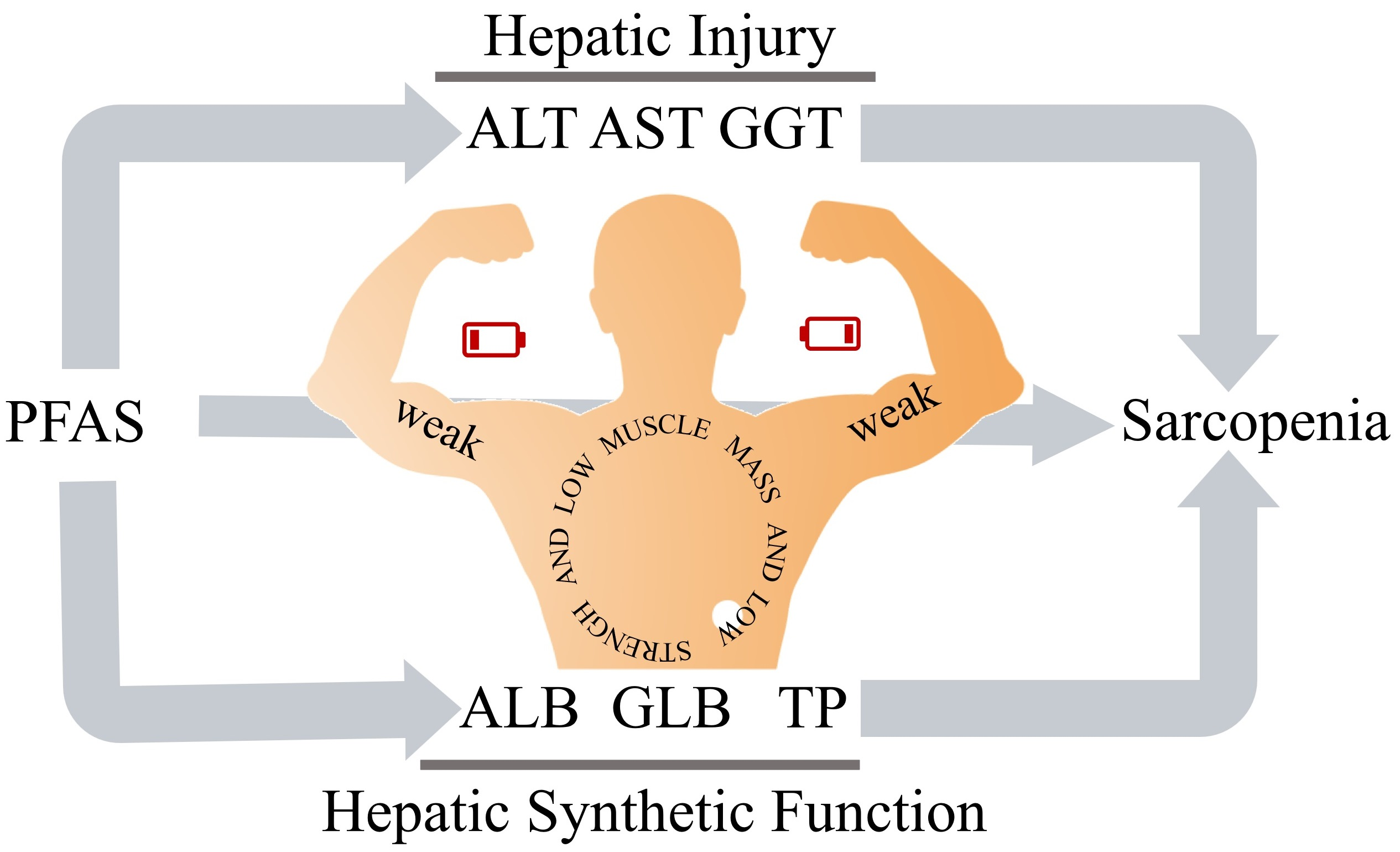
Exposure to Per- and Polyfluoroalkyl Substances and the Risk of Sarcopenia: The Mediating Role of Serum Albumin

 , , , ,
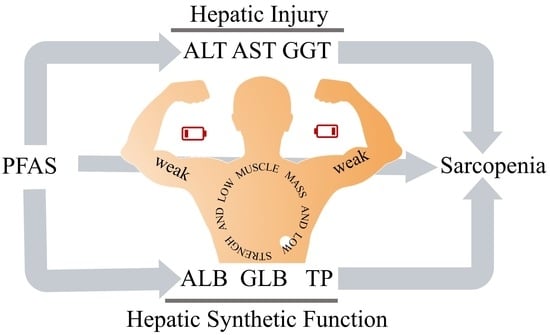
Abstract
1. Introduction
2. Methods
2.1. Study Population
2.2. Liver Function Measurement
2.3. Serum PFAS Measurement
2.4. Outcomes, Definition and Measurement
2.5. Covariates
2.6. Statistical Analysis
2.6.1. Descriptive Analysis
2.6.2. Single PFAS Model Analysis
2.6.3. PFAS Mixture Model Analysis
2.6.4. Mediation Analysis
2.6.5. Sensitivity Analysis
3. Results
3.1. Population Characteristics
3.2. Serum PFAS Concentrations
3.3. Associations Between Individual PFAS Exposure and Sarcopenia
3.4. Association Between PFAS Mixture Exposure and Sarcopenia
3.5. Mediating Pathways Between PFAS Exposure and Sarcopenia
3.6. Sensitivity Analysis Results Between PFAS Exposure and Sarcopenia
4. Discussion
5. Conclusions
Supplementary Materials
Author Contributions
Funding
Institutional Review Board Statement
Informed Consent Statement
Data Availability Statement
Conflicts of Interest
References
- Evich, M.G.; Davis, M.J.; McCord, J.P.; Acrey, B.; Awkerman, J.A.; Knappe, D.R.; Lindstrom, A.B.; Speth, T.F.; Tebes-Stevens, C.; Strynar, M.J.; et al. Per- and polyfluoroalkyl substances in the environment. Science 2022, 375, eabg9065. [Google Scholar] [CrossRef]
- Panieri, E.; Baralic, K.; Djukic-Cosic, D.; Buha Djordjevic, A.; Saso, L. PFAS Molecules: A Major Concern for the Human Health and the Environment. Toxics 2022, 10, 44. [Google Scholar] [CrossRef]
- Dong, G.-H. Environmental epidemiology in environmental health research: Opportunities and challenges for a new era. Int. J. Environ. Epidemiol. 2026, 1, 1. [Google Scholar] [CrossRef]
- Wu, Y.; Sun, K.; Xue, J. Trifluoroacetic acid: A pressing need for human biomonitoring, chronic toxicity assessment, and epidemiological research. Int. J. Environ. Epidemiol. 2026, 1, 4. [Google Scholar] [CrossRef]
- Nielsen, F.; Fischer, F.C.; Leth, P.M.; Grandjean, P. Occurrence of Major Perfluorinated Alkylate Substances in Human Blood and Target Organs. Environ. Sci. Technol. 2024, 58, 143–149. [Google Scholar] [CrossRef]
- Maestri, L.; Negri, S.; Ferrari, M.; Ghittori, S.; Fabris, F.; Danesino, P.; Imbriani, M. Determination of perfluorooctanoic acid and perfluorooctanesulfonate in human tissues by liquid chromatography/single quadrupole mass spectrometry. Rapid Commun. Mass Spectrom. RCM 2006, 20, 2728–2734. [Google Scholar] [CrossRef] [PubMed]
- Zhou, A.; Wang, L.; Pi, X.; Fan, C.; Chen, W.; Wang, Z.; Rong, S.; Wang, T. Effects of perfluorooctane sulfonate (PFOS) on cognitive behavior and autophagy of male mice. J. Toxicol. Sci. 2023, 48, 513–526. [Google Scholar] [CrossRef]
- Solan, M.E.; Senthilkumar, S.; Aquino, G.V.; Bruce, E.D.; Lavado, R. Comparative cytotoxicity of seven per- and polyfluoroalkyl substances (PFAS) in six human cell lines. Toxicology 2022, 477, 153281. [Google Scholar] [CrossRef] [PubMed]
- Eccles-Miller, J.A.; Williams, L.A.; Leonard, E.; Tharayil, N.; Buslee, E.L.; Fiddler, J.; Baldwin, W.S. Perfluorooctane sulfonic acid (PFOS) perturbs skeletal muscle oxidative phosphorylation by a different mechanism than liver. Chemosphere 2026, 394, 144815. [Google Scholar] [CrossRef]
- Onishchenko, N.; Fischer, C.; Wan Ibrahim, W.N.; Negri, S.; Spulber, S.; Cottica, D.; Ceccatelli, S. Prenatal exposure to PFOS or PFOA alters motor function in mice in a sex-related manner. Neurotox. Res. 2011, 19, 452–461. [Google Scholar] [CrossRef]
- Christou, M.; Ropstad, E.; Brown, S.; Kamstra, J.H.; Fraser, T.W.K. Developmental exposure to a POPs mixture or PFOS increased body weight and reduced swimming ability but had no effect on reproduction or behavior in zebrafish adults. Aquat. Toxicol. 2021, 237, 105882. [Google Scholar] [CrossRef] [PubMed]
- Lind, P.M.; Lind, L.; Salihovic, S.; Ahlström, H.; Michaelsson, K.; Kullberg, J.; Strand, R. Serum levels of perfluoroalkyl substances (PFAS) and body composition—A cross-sectional study in a middle-aged population. Environ. Res. 2022, 209, 112677. [Google Scholar] [CrossRef]
- Tao, J.; Zhai, J.; Yang, J.; Niu, Q.; Hu, Y.; Yan, Y. Exposure to persistent organic pollutants and sarcopenia: Revealing associations, mediated modifications, and potential mechanisms. Ecotoxicol. Environ. Saf. 2025, 303, 118783. [Google Scholar] [CrossRef]
- Cruz-Jentoft, A.J.; Sayer, A.A. Sarcopenia. Lancet 2019, 393, 2636–2646. [Google Scholar] [CrossRef] [PubMed]
- Sayer, A.A.; Cooper, R.; Arai, H.; Cawthon, P.M.; Ntsama Essomba, M.J.; Fielding, R.A.; Grounds, M.D.; Witham, M.D.; Cruz-Jentoft, A.J. Sarcopenia. Nat. Rev. Dis. Primers 2024, 10, 68. [Google Scholar] [CrossRef]
- Petermann-Rocha, F.; Balntzi, V.; Gray, S.R.; Lara, J.; Ho, F.K.; Pell, J.P.; Celis-Morales, C. Global prevalence of sarcopenia and severe sarcopenia: A systematic review and meta-analysis. J. Cachexia Sarcopenia Muscle 2022, 13, 86–99. [Google Scholar] [CrossRef]
- Yeung, S.S.Y.; Reijnierse, E.M.; Pham, V.K.; Trappenburg, M.C.; Lim, W.K.; Meskers, C.G.M.; Maier, A.B. Sarcopenia and its association with falls and fractures in older adults: A systematic review and meta-analysis. J. Cachexia Sarcopenia Muscle 2019, 10, 485–500. [Google Scholar] [CrossRef] [PubMed]
- Jauffret, C.; Périchon, R.; Lamer, A.; Cortet, B.; Chazard, E.; Paccou, J. Association Between Sarcopenia and Fracture Risk in a Population From the UK Biobank Database. J. Bone Miner. Res. 2023, 38, 1422–1434. [Google Scholar] [CrossRef]
- Global incidence, prevalence, years lived with disability (YLDs), disability-adjusted life-years (DALYs), and healthy life expectancy (HALE) for 371 diseases and injuries in 204 countries and territories and 811 subnational locations, 1990-2021: A systematic analysis for the Global Burden of Disease Study 2021. Lancet 2024, 403, 2133–2161. [CrossRef]
- Zhang, F.; Li, T.; Chen, B.; Li, N.; Zhang, X.; Zhu, S.; Zhao, G.; Zhang, X.; Ma, T.; Zhou, F.; et al. Air pollution weaken your muscle? Evidence from a cross-sectional study on sarcopenia in central China. Ecotoxicol. Environ. Saf. 2023, 258, 114962. [Google Scholar] [CrossRef] [PubMed]
- Huang, Q.; Wan, J.; Nan, W.; Li, S.; He, B.; Peng, Z. Association between manganese exposure in heavy metals mixtures and the prevalence of sarcopenia in US adults from NHANES 2011-2018. J. Hazard. Mater. 2024, 464, 133005. [Google Scholar] [CrossRef]
- Younossi, Z.M.; Kalligeros, M.; Henry, L. Epidemiology of Metabolic Dysfunction-Associated Steatotic Liver Disease. Clin. Mol. Hepatol. 2024, 31, S32–S50. [Google Scholar] [CrossRef] [PubMed]
- Tandon, P.; Montano-Loza, A.J.; Lai, J.C.; Dasarathy, S.; Merli, M. Sarcopenia and frailty in decompensated cirrhosis. J. Hepatol. 2021, 75, S147–S162. [Google Scholar] [CrossRef] [PubMed]
- Chen, M.; Liu, J.; Xia, X.; Wang, Y.; Zheng, H. Causal relationship between non-alcoholic fatty liver disease and sarcopenia: A bidirectional Mendelian randomization study. Front. Med. 2024, 11, 1422499. [Google Scholar] [CrossRef]
- Noda, T.; Kamiya, K.; Hamazaki, N.; Nozaki, K.; Ichikawa, T.; Yamashita, M.; Uchida, S.; Maekawa, E.; Terada, T.; Reed, J.L.; et al. Prognostic value of liver damage assessed through direct bilirubin levels and skeletal muscle weakness in patients with heart failure. Heart Lung J. Crit. Care 2023, 60, 87–94. [Google Scholar] [CrossRef]
- Lipshitz, M.; Visser, J.; Anderson, R.; Nel, D.G.; Smit, T.; Steel, H.C.; Rapoport, B. Emerging markers of cancer cachexia and their relationship to sarcopenia. J. Cancer Res. Clin. Oncol. 2023, 149, 17511–17527. [Google Scholar] [CrossRef]
- Laufer, M.; Perelman, M.; Segal, G.; Sarfaty, M.; Itelman, E. Low Alanine Aminotransferase as a Marker for Sarcopenia and Frailty, Is Associated with Decreased Survival of Bladder Cancer Patients and Survivors-A Retrospective Data Analysis of 3075 Patients. Cancers 2023, 16, 174. [Google Scholar] [CrossRef]
- Liu, J.J.; Cui, X.X.; Tan, Y.W.; Dong, P.X.; Ou, Y.Q.; Li, Q.Q.; Chu, C.; Wu, L.Y.; Liang, L.X.; Qin, S.J.; et al. Per- and perfluoroalkyl substances alternatives, mixtures and liver function in adults: A community-based population study in China. Environ. Int. 2022, 163, 107179. [Google Scholar] [CrossRef] [PubMed]
- Attema, B.; Janssen, A.W.F.; Rijkers, D.; van Schothorst, E.M.; Hooiveld, G.; Kersten, S. Exposure to low-dose perfluorooctanoic acid promotes hepatic steatosis and disrupts the hepatic transcriptome in mice. Mol. Metab. 2022, 66, 101602. [Google Scholar] [CrossRef]
- Zhang, Y.; Zhang, M.; Jiang, S.; Hu, H.; Wang, X.; Yu, F.; Huang, Y.; Liang, Y. Associations of perfluoroalkyl substances with metabolic-associated fatty liver disease and non-alcoholic fatty liver disease: NHANES 2017-2018. Cancer Causes Control CCC 2024, 35, 1271–1282. [Google Scholar] [CrossRef]
- Chen, C.P.; Qian, Y.F. Association and Mechanism of Coexposure to Perfluoroalkyl and Polyfluoroalkyl Substances and Blood Heavy Metals in Metabolic Dysfunction-Associated Steatotic Liver Disease. Clin. Transl. Gastroenterol. 2026, 17, e00932. [Google Scholar] [CrossRef]
- Fan, Y.Y.; Chu, C.; Zhang, Y.T.; Zhao, K.; Liang, L.X.; Huang, J.W.; Zhou, J.X.; Guo, L.H.; Wu, L.Y.; Lin, L.Z.; et al. Environmental pollutant pre- and polyfluoroalkyl substances are associated with electrocardiogram parameters disorder in adults. J. Hazard. Mater. 2023, 458, 131832. [Google Scholar] [CrossRef]
- Li, Q.Q.; Liu, J.J.; Su, F.; Zhang, Y.T.; Wu, L.Y.; Chu, C.; Zhou, Y.; Shen, X.; Xiong, S.; Geiger, S.D.; et al. Chlorinated Polyfluorinated Ether Sulfonates and Thyroid Hormone Levels in Adults: Isomers of C8 Health Project in China. Environ. Sci. Technol. 2022, 56, 6152–6161. [Google Scholar] [CrossRef] [PubMed]
- Astegiano, M.; Sapone, N.; Demarchi, B.; Rossetti, S.; Bonardi, R.; Rizzetto, M. Laboratory evaluation of the patient with liver disease. Eur. Rev. Med. Pharmacol. Sci. 2004, 8, 3–9. [Google Scholar]
- Thapa, B.R.; Walia, A. Liver function tests and their interpretation. Indian J. Pediatr. 2007, 74, 663–671. [Google Scholar] [CrossRef]
- Kawakami, R.; Tanisawa, K.; Ito, T.; Usui, C.; Miyachi, M.; Torii, S.; Midorikawa, T.; Ishii, K.; Muraoka, I.; Suzuki, K.; et al. Fat-Free Mass Index as a Surrogate Marker of Appendicular Skeletal Muscle Mass Index for Low Muscle Mass Screening in Sarcopenia. J. Am. Med. Dir. Assoc. 2022, 23, 1955–1961.e1953. [Google Scholar] [CrossRef] [PubMed]
- Chen, L.K.; Hsiao, F.Y.; Akishita, M.; Assantachai, P.; Lee, W.J.; Lim, W.S.; Muangpaisan, W.; Kim, M.; Merchant, R.A.; Peng, L.N.; et al. A focus shift from sarcopenia to muscle health in the Asian Working Group for Sarcopenia 2025 Consensus Update. Nat. Aging 2025, 5, 2164–2175. [Google Scholar] [CrossRef]
- Park, S.; Kim, S.G.; Lee, S.; Kim, Y.; Cho, S.; Kim, K.; Kim, Y.C.; Han, S.S.; Lee, H.; Lee, J.P.; et al. Causal linkage of tobacco smoking with ageing: Mendelian randomization analysis towards telomere attrition and sarcopenia. J. Cachexia Sarcopenia Muscle 2023, 14, 955–963. [Google Scholar] [CrossRef]
- Gao, Q.; Hu, K.; Yan, C.; Zhao, B.; Mei, F.; Chen, F.; Zhao, L.; Shang, Y.; Ma, Y.; Ma, B. Associated Factors of Sarcopenia in Community-Dwelling Older Adults: A Systematic Review and Meta-Analysis. Nutrients 2021, 13, 4291. [Google Scholar] [CrossRef]
- Fan, S.; Wu, Y.; Bloom, M.S.; Lv, J.; Chen, L.; Wang, W.; Li, Z.; Jiang, Q.; Bu, L.; Shi, J.; et al. Associations of per- and polyfluoroalkyl substances and their alternatives with bone mineral density levels and osteoporosis prevalence: A community-based population study in Guangzhou, Southern China. Sci. Total Environ. 2023, 862, 160617. [Google Scholar] [CrossRef]
- Jensen, G.L.; Cederholm, T.; Correia, M.; Gonzalez, M.C.; Fukushima, R.; Pisprasert, V.; Blaauw, R.; Braz, D.C.; Carrasco, F.; Cruz Jentoft, A.J.; et al. GLIM consensus approach to diagnosis of malnutrition: A 5-year update. JPEN. J. Parenter. Enter. Nutr. 2025, 49, 414–427. [Google Scholar] [CrossRef]
- Stevens, P.E.; Levin, A. Evaluation and management of chronic kidney disease: Synopsis of the kidney disease: Improving global outcomes 2012 clinical practice guideline. Ann. Intern. Med. 2013, 158, 825–830. [Google Scholar] [CrossRef]
- Zahorec, R. Neutrophil-to-lymphocyte ratio, past, present and future perspectives. Bratisl. Lek. Listy 2021, 122, 474–488. [Google Scholar] [CrossRef]
- Ibrahim, K.; Cox, N.J.; Lim, S.E.R.; Radcliffe, E.; Lundby, C.; Prokopidis, K.; Thompson, W.; Moriarty, F. The evidence and impact of deprescribing on sarcopenia parameters: A systematic review. BMC Geriatr. 2025, 25, 158. [Google Scholar] [CrossRef]
- Lin, L.-Z.; Cai, L.; Liu, Z.-Y.; Gao, J.; Zhou, Y.; Zeng, X.-Y.; Ou, Y.; Dong, G.-P.; Dong, P.-X.; Wu, Q.-Z.; et al. Exposure to per- and polyfluoroalkyl substances and body composition in US adolescents aged 12–18 years: An analysis of data from the National Health and Nutrition Examination Surveys 2011-2018. Hyg. Environ. Health Adv. 2022, 3, 100009. [Google Scholar] [CrossRef]
- Gillen, Z.M.; Housh, T.J.; Schmidt, R.J.; Herda, T.J.; De Ayala, R.J.; Shoemaker, M.E.; Cramer, J.T. Comparisons of muscle strength, size, and voluntary activation in pre- and post-pubescent males and females. Eur. J. Appl. Physiol. 2021, 121, 2487–2497. [Google Scholar] [CrossRef]
- Mogi, Y. Muscle architecture of the medial gastrocnemius during growth. J. Physiol. Anthropol. 2024, 43, 33. [Google Scholar] [CrossRef] [PubMed]
- Wang, Y.; Marzan, M.; Yang, Z.; Crowe, M.; Moslehi, M.; Tham, R.; Keevers, D.; Kane, S.C.; Wake, M.; Lycett, K.; et al. Parental preconception exposure to residential outdoor neighbourhood environments and adverse pregnancy and birth outcomes: A scoping review. Int. J. Environ. Epidemiol. 2026, 1, 5. [Google Scholar] [CrossRef]
- Tian, Y.P.; Zeng, X.W.; Bloom, M.S.; Lin, S.; Wang, S.Q.; Yim, S.H.L.; Yang, M.; Chu, C.; Gurram, N.; Hu, L.W.; et al. Isomers of perfluoroalkyl substances and overweight status among Chinese by sex status: Isomers of C8 Health Project in China. Environ. Int. 2019, 124, 130–138. [Google Scholar] [CrossRef]
- Fang, S.; Zhao, S.; Zhang, Y.; Zhong, W.; Zhu, L. Distribution of perfluoroalkyl substances (PFASs) with isomer analysis among the tissues of aquatic organisms in Taihu Lake, China. Environ. Pollut. 2014, 193, 224–232. [Google Scholar] [CrossRef]
- Schulz, K.; Silva, M.R.; Klaper, R. Distribution and effects of branched versus linear isomers of PFOA, PFOS, and PFHxS: A review of recent literature. Sci. Total Environ. 2020, 733, 139186. [Google Scholar] [CrossRef]
- Stylianou, M.; Björnsdotter, M.K.; Olsson, P.E.; Ericson Jogsten, I.; Jass, J. Distinct transcriptional response of Caenorhabditis elegans to different exposure routes of perfluorooctane sulfonic acid. Environ. Res. 2019, 168, 406–413. [Google Scholar] [CrossRef]
- Tagliaferri, C.; Wittrant, Y.; Davicco, M.J.; Walrand, S.; Coxam, V. Muscle and bone, two interconnected tissues. Ageing Res. Rev. 2015, 21, 55–70. [Google Scholar] [CrossRef]
- Satbhai, K.M.; Marques, E.S.; Ranjan, R.; Timme-Laragy, A.R. Single-cell RNA sequencing reveals tissue-specific transcriptomic changes induced by perfluorooctanesulfonic acid (PFOS) in larval zebrafish (Danio rerio). J. Hazard. Mater. 2025, 489, 137515. [Google Scholar] [CrossRef]
- Agrawal, S.; Dhiman, R.K.; Limdi, J.K. Evaluation of abnormal liver function tests. Postgrad. Med. J. 2016, 92, 223–234. [Google Scholar] [CrossRef]
- Costello, E.; Rock, S.; Stratakis, N.; Eckel, S.P.; Walker, D.I.; Valvi, D.; Cserbik, D.; Jenkins, T.; Xanthakos, S.A.; Kohli, R.; et al. Exposure to per- and Polyfluoroalkyl Substances and Markers of Liver Injury: A Systematic Review and Meta-Analysis. Environ. Health Perspect. 2022, 130, 46001. [Google Scholar] [CrossRef]
- Zhang, Y.-T.; Bao, H.; Zhang, L.; Wen, S.; Tan, W.; Zeeshan, M.; Sun, M.-K.; Chu, C.; Gui, Z.-H.; Lin, L.-Z.; et al. Health risk assessment of perfluorooctane sulfonate and perfluorooctanoic acid exposure in China based on epidemiological data. Hyg. Environ. Health Adv. 2023, 7, 100066. [Google Scholar] [CrossRef]
- Pálešová, N.; Maitre, L.; Stratakis, N.; Řiháčková, K.; Pindur, A.; Kohoutek, J.; Šenk, P.; Bartošková Polcrová, A.; Gregor, P.; Vrijheid, M.; et al. Firefighters and the liver: Exposure to PFAS and PAHs in relation to liver function and serum lipids (CELSPAC-FIREexpo study). Int. J. Hyg. Environ. Health 2023, 252, 114215. [Google Scholar] [CrossRef]
- Ma, X.; Fisher, J.A.; VoPham, T.; Vasiliou, V.; Jones, R.R. Associations between per- and polyfluoroalkyl substances, liver function, and daily alcohol consumption in a sample of U.S. adults. Environ. Res. 2023, 235, 116651. [Google Scholar] [CrossRef]
- Nian, M.; Li, Q.Q.; Bloom, M.; Qian, Z.M.; Syberg, K.M.; Vaughn, M.G.; Wang, S.Q.; Wei, Q.; Zeeshan, M.; Gurram, N.; et al. Liver function biomarkers disorder is associated with exposure to perfluoroalkyl acids in adults: Isomers of C8 Health Project in China. Environ. Res. 2019, 172, 81–88. [Google Scholar] [CrossRef]
- Qiao, W.; Li, J.; Luo, L.; Peng, W.; Wang, X.; Jin, R.; Li, J. Triglycerides mediate the relationships of per- and poly-fluoroalkyl substance (PFAS) exposure with nonalcoholic fatty liver disease (NAFLD) risk in US participants. Ecotoxicol. Environ. Saf. 2025, 289, 117436. [Google Scholar] [CrossRef]
- Dasarathy, S.; Merli, M. Sarcopenia from mechanism to diagnosis and treatment in liver disease. J. Hepatol. 2016, 65, 1232–1244. [Google Scholar] [CrossRef]
- Qiu, J.; Thapaliya, S.; Runkana, A.; Yang, Y.; Tsien, C.; Mohan, M.L.; Narayanan, A.; Eghtesad, B.; Mozdziak, P.E.; McDonald, C.; et al. Hyperammonemia in cirrhosis induces transcriptional regulation of myostatin by an NF-κB-mediated mechanism. Proc. Natl. Acad. Sci. USA 2013, 110, 18162–18167. [Google Scholar] [CrossRef]
- Lai, J.C.; Tandon, P.; Bernal, W.; Tapper, E.B.; Ekong, U.; Dasarathy, S.; Carey, E.J. Malnutrition, Frailty, and Sarcopenia in Patients with Cirrhosis: 2021 Practice Guidance by the American Association for the Study of Liver Diseases. Hepatology 2021, 74, 1611–1644. [Google Scholar] [CrossRef]
- Jia, X.; Guo, C.; Deng, F.; Li, X.; Bi, H.; Yuan, J.; Tan, L. Distribution and Differential Associations of Neonicotinoids and Their Metabolites in Paired Urine and Serum with Liver Function. Environ. Sci. Technol. 2025, 59, 13647–13659. [Google Scholar] [CrossRef]
- Michalopoulos, G.K.; Bhushan, B. Liver regeneration: Biological and pathological mechanisms and implications. Nat. Rev. Gastroenterol. Hepatol. 2021, 18, 40–55. [Google Scholar] [CrossRef] [PubMed]
- Guo, H.; Wang, J.; Yao, J.; Sun, S.; Sheng, N.; Zhang, X.; Guo, X.; Guo, Y.; Sun, Y.; Dai, J. Comparative Hepatotoxicity of Novel PFOA Alternatives (Perfluoropolyether Carboxylic Acids) on Male Mice. Environ. Sci. Technol. 2019, 53, 3929–3937. [Google Scholar] [CrossRef] [PubMed]
- Solan, M.E.; Koperski, C.P.; Senthilkumar, S.; Lavado, R. Short-chain per- and polyfluoralkyl substances (PFAS) effects on oxidative stress biomarkers in human liver, kidney, muscle, and microglia cell lines. Environ. Res. 2023, 223, 115424. [Google Scholar] [CrossRef] [PubMed]
- Mahapatra, A.; Gupta, P.; Suman, A.; Ray, S.S.; Malafaia, G.; Singh, R.K. Unraveling the mechanisms of perfluorooctanesulfonic acid-induced dopaminergic neurotoxicity and microglial activation in developing zebrafish. Sci. Total Environ. 2023, 887, 164030. [Google Scholar] [CrossRef]
- Huang, J.; Wang, Q.; Liu, S.; Zhang, M.; Liu, Y.; Sun, L.; Wu, Y.; Tu, W. Crosstalk between histological alterations, oxidative stress and immune aberrations of the emerging PFOS alternative OBS in developing zebrafish. Sci. Total Environ. 2021, 774, 145443. [Google Scholar] [CrossRef]
- Migliavacca, E.; Tay, S.K.H.; Patel, H.P.; Sonntag, T.; Civiletto, G.; McFarlane, C.; Forrester, T.; Barton, S.J.; Leow, M.K.; Antoun, E.; et al. Mitochondrial oxidative capacity and NAD(+) biosynthesis are reduced in human sarcopenia across ethnicities. Nat. Commun. 2019, 10, 5808. [Google Scholar] [CrossRef] [PubMed]
- Hong, X.; Isern, J.; Campanario, S.; Perdiguero, E.; Ramírez-Pardo, I.; Segalés, J.; Hernansanz-Agustín, P.; Curtabbi, A.; Deryagin, O.; Pollán, A.; et al. Mitochondrial dynamics maintain muscle stem cell regenerative competence throughout adult life by regulating metabolism and mitophagy. Cell Stem Cell 2022, 29, 1298–1314.e1210. [Google Scholar] [CrossRef]
- Boardman, N.T.; Trani, G.; Scalabrin, M.; Romanello, V.; Wüst, R.C.I. Intracellular to Interorgan Mitochondrial Communication in Striated Muscle in Health and Disease. Endocr. Rev. 2023, 44, 668–692. [Google Scholar] [CrossRef]
- Shang, Y.; Chen, K.; Ni, H.; Zhu, X.; Yuan, X.; Wang, Y.; Liu, X.; Cui, Z.; Niu, Y.; Shi, Y.; et al. Environmentally relevant concentrations of perfluorobutane sulfonate impair locomotion behaviors and healthspan by downregulating mitophagy in C. elegans. J. Hazard. Mater. 2024, 480, 135938. [Google Scholar] [CrossRef]
- Domingo, J.L. Human health risks of waste incinerators: A narrative review of studies on municipal, hazardous and medical waste incineration. Int. J. Environ. Epidemiol. 2026, 1, 2. [Google Scholar] [CrossRef]
- Yuan, X.; Ge, Y.; Wang, Y.; Liu, M.; Lehmler, H.-J.; Trasande, L.; Wallace, R.B.; Xu, G.; Rong, S.; Liu, B.; et al. Phthalate exposure and all-cause and cause-specific mortality in overweight and obese adults: A national cohort study. Int. J. Environ. Epidemiol. 2026, 1, 3. [Google Scholar] [CrossRef]


| Variables | Total (n = 1261) | Non-Sarcopenia (n = 1117) | Sarcopenia (n = 144) | p-Value |
|---|---|---|---|---|
| Demographic characteristics | ||||
| Age, Mean ± SD, years | 54.94 ± 15.36 | 53.93 ± 15.35 | 62.76 ± 13.02 | <0.001 |
| BMI, Mean ± SD, kg/m2 | 23.81 ± 3.64 | 24.09 ± 3.59 | 21.64 ± 3.30 | <0.001 |
| Women, No. (%) | 767 (60.82) | 697 (62.40) | 70 (48.61) | 0.001 |
| Education ≥ high school, No. (%) | 735 (58.29) | 670 (59.98) | 65 (45.14) | <0.001 |
| Family Income, No. (%), CNY/year | 0.306 | |||
| <30,000 | 58 (4.60) | 50 (4.48) | 8 (5.56) | |
| 30,000–100,000 | 515 (40.84) | 449 (40.20) | 66 (45.83) | |
| >100,000 | 688 (54.56) | 618 (55.33) | 70 (48.61) | |
| District, No. (%) | <0.0001 | |||
| Conghua | 233 (18.48%) | 221 (19.79%) | 12 (8.33%) | |
| Panyu | 719 (57.02%) | 612 (54.79%) | 107 (74.31%) | |
| Yuexiu | 309 (24.50%) | 284 (25.43%) | 25 (17.36%) | |
| Alcohol drinking, No. (%) | 206 (16.34) | 181 (16.20) | 25 (17.36) | 0.724 |
| Smoking, No. (%) | 270 (21.41) | 233 (20.86) | 37 (25.69) | 0.183 |
| Exercise, No. (%) | 867 (68.75) | 753 (67.41) | 114 (79.17) | 0.004 |
| Parameters of muscle assessment | ||||
| ASMI, Mean ± SD, kg/m2 | 6.81 ± 1.36 | 6.95 ± 1.34 | 5.67 ± 0.96 | <0.001 |
| Grip, Mean ± SD, kg | 27.78 ± 10.01 | 28.65 ± 10.02 | 21.01 ± 6.84 | <0.001 |
| Biomarkers of liver function | ||||
| ALB, Mean ± SD, g/L | 48.34 ± 4.49 | 48.08 ± 4.50 | 50.42 ± 3.82 | <0.001 |
| GLB, Mean ± SD, g/L | 29.80 ± 4.30 | 29.55 ± 4.13 | 31.80 ± 5.01 | <0.001 |
| TP, Mean ± SD, g/L | 77.73 ± 4.03 | 77.78 ± 4.00 | 77.41 ± 4.22 | 0.330 |
| ALT, Mean ± SD, U/L | 21.50 ± 15.93 | 21.68 ± 16.33 | 20.08 ± 12.40 | 0.259 |
| AST, Mean ± SD, U/L | 22.32 ± 19.39 | 21.73 ± 8.97 | 26.92 ± 51.59 | 0.230 |
| GGT, Mean ± SD, U/L | 32.83 ± 53.65 | 31.82 ± 46.39 | 40.67 ± 92.19 | 0.062 |
| PFAS (ng/mL) | Total (n = 1261) | Non-Sarcopenia (n = 1117) | Sarcopenia (n = 144) | p-Value |
|---|---|---|---|---|
| Median (Q1, Q3) | ||||
| Total PFOS | 14.66 (8.30, 25.39) | 13.76 (7.91, 22.91) | 24.86 (15.75, 39.42) | <0.001 |
| n-PFOS | 10.83 (6.21, 18.77) | 10.23 (5.87, 17.43) | 18.87 (11.40, 30.33) | <0.001 |
| Br-PFOS | 3.66 (1.79, 6.16) | 3.37 (1.64, 5.74) | 6.11 (3.71, 9.35) | <0.001 |
| 1m-PFOS | 0.49 (0.24, 0.89) | 0.47 (0.22, 0.83) | 0.74 (0.45, 1.14) | <0.001 |
| iso-PFOS | 0.74 (0.42, 1.40) | 0.70 (0.40, 1.30) | 1.29 (0.73, 2.19) | <0.001 |
| 3 + 4 + 5m-PFOS a | 2.35 (0.96, 4.11) | 2.11 (0.83, 3.78) | 4.00 (2.37, 6.37) | <0.001 |
| ∑m2-PFOS a | 0.04 (0.02, 0.07) | 0.04 (0.02, 0.06) | 0.06 (0.03, 0.09) | <0.001 |
| PFHpS | 0.33 (0.17, 0.51) | 0.31 (0.16, 0.49) | 0.44 (0.30, 0.64) | <0.001 |
| Total PFHxS | 0.89 (0.49, 1.39) | 0.84 (0.46, 1.37) | 1.10 (0.76, 1.46) | <0.001 |
| n-PFHxS | 0.87 (0.47, 1.37) | 0.82 (0.44, 1.36) | 1.06 (0.73, 1.42) | <0.001 |
| Br-PFHxS | 0.02 (0.01, 0.03) | 0.02 (0.01, 0.03) | 0.02 (0.01, 0.03) | 0.376 |
| PFOA | 8.93 (5.37, 13.53) | 8.60 (5.09, 12.92) | 12.89 (8.73, 16.28) | <0.001 |
| PFHpA | 0.03 (0.02, 0.06) | 0.03 (0.02, 0.06) | 0.04 (0.02, 0.08) | <0.001 |
| PFHxA | 0.04 (0.01, 0.07) | 0.04 (0.01, 0.08) | 0.04 (0.01, 0.07) | 0.620 |
| PFNA | 1.11 (0.69, 1.65) | 1.05 (0.67, 1.60) | 1.51 (1.10, 2.30) | <0.001 |
| PFDA | 0.84 (0.52, 1.40) | 0.80 (0.49, 1.30) | 1.38 (0.87, 1.87) | <0.001 |
| PFUnDA | 0.73 (0.44, 1.14) | 0.68 (0.42, 1.09) | 1.02 (0.71, 1.50) | <0.001 |
| PFDoDA | 0.06 (0.03, 0.10) | 0.06 (0.03, 0.09) | 0.09 (0.06, 0.14) | <0.001 |
| PFTrDA | 0.27 (0.16, 0.44) | 0.26 (0.15, 0.42) | 0.39 (0.24, 0.56) | <0.001 |
| PFAS a (ng/mL) | Sarcopenia | ASMI | GripI | |||
|---|---|---|---|---|---|---|
| OR (95% CI) | p | β (95% CI) | p | β (95% CI) | p | |
| Total PFOS | 2.49 (1.86, 3.36) | <0.001 | −0.78 (−0.84, −0.73) | <0.001 | −0.08 (−0.30, 0.15) | 0.490 |
| n-PFOS | 2.32 (1.77, 3.09) | <0.001 | −0.70 (−0.75, −0.65) | <0.001 | 0.14 (−0.06, 0.35) | 0.171 |
| Br-PFOS | 2.18 (1.67, 2.90) | <0.001 | −0.40 (−0.45, −0.35) | <0.001 | −0.51 (−0.68, −0.35) | <0.001 |
| 1m-PFOS | 1.50 (1.15, 1.97) | 0.003 | −0.55 (−0.60, −0.50) | <0.001 | 0.21 (0.01, 0.40) | 0.036 |
| iso-PFOS | 1.79 (1.39, 2.33) | <0.001 | −0.67 (−0.72, −0.61) | <0.001 | 0.19 (−0.02, 0.40) | 0.075 |
| 3 + 4 + 5m-PFOS | 1.71 (1.39, 2.19) | <0.001 | −0.10 (−0.12, −0.07) | <0.001 | −0.29 (−0.36, −0.22) | <0.001 |
| ∑m2-PFOS | 1.45 (1.12, 1.86) | 0.004 | −0.60 (−0.65, −0.54) | <0.001 | 0.19 (−0.02, 0.40) | 0.078 |
| PFHpS | 1.65 (1.23, 2.22) | 0.001 | −0.61 (−0.67, −0.56) | <0.001 | 0.18 (−0.03, 0.39) | 0.099 |
| Total PFHxS | 1.30 (0.97, 1.77) | 0.089 | −0.57 (−0.63, −0.51) | <0.001 | 0.19 (−0.04, 0.41) | 0.100 |
| n-PFHxS | 1.26 (0.95, 1.70) | 0.125 | −0.56 (−0.62, −0.50) | <0.001 | 0.19 (−0.03, 0.41) | 0.087 |
| Br-PFHxS | 1.24 (1.02, 1.53) | 0.038 | −0.28 (−0.33, −0.23) | <0.001 | −0.06 (−0.22, 0.09) | 0.435 |
| PFOA | 3.01 (1.96, 4.70) | <0.001 | −0.58 (−0.65, −0.50) | <0.001 | −0.06 (−0.32, 0.21) | 0.682 |
| PFHpA | 1.26 (1.05, 1.52) | 0.017 | −0.24 (−0.28, −0.20) | <0.001 | 0.05 (−0.09, 0.18) | 0.514 |
| PFHxA | 1.06 (0.90, 1.24) | 0.491 | −0.09 (−0.14, −0.05) | <0.001 | 0.05 (−0.07, 0.17) | 0.444 |
| PFNA | 2.41 (1.70, 3.46) | <0.001 | −0.82 (−0.88, −0.75) | <0.001 | 0.21 (−0.05, 0.46) | 0.116 |
| PFDA | 2.18 (1.64, 2.94) | <0.001 | −0.68 (−0.73, −0.62) | <0.001 | 0.15 (−0.06, 0.36) | 0.169 |
| PFUnDA | 1.83 (1.40, 2.41) | <0.001 | −0.62 (−0.67, −0.56) | <0.001 | 0.12 (−0.08, 0.33) | 0.226 |
| PFDoDA | 1.51 (1.21, 1.92) | <0.001 | −0.48 (−0.53, −0.43) | <0.001 | 0.12 (−0.06, 0.29) | 0.192 |
| PFTrDA | 1.53 (1.19, 2.00) | 0.001 | −0.44 (−0.49, −0.38) | <0.001 | 0.16 (−0.02, 0.34) | 0.088 |
| PFAS | ALB | GLB | TP | ALT | AST | GGT |
|---|---|---|---|---|---|---|
| TotalPFOS | 16.84 (−9.91, 49.56) | 16.14 (5.43, 30.20) | −0.00 (−3.16, 2.67) | −0.09 (−5.37, 2.53) | 4.46 (−1.04, 11.29) | 3.97 (0.41, 8.28) |
| n-PFOS | 16.61 (−7.87, 49.60) | 15.76 (4.86, 28.51) | −0.03 (−2.73, 2.81) | 0.02 (−3.94, 2.01) | 4.02 (−0.46, 10.62) | 3.31 (0.25, 7.72) |
| Br-PFOS | 17.42 (3.58, 39.56) | 9.56 (4.61, 17.96) | 0.11 (−1.13, 1.61) | −0.24 (−5.33, 2.44) | 3.53 (−0.37, 9.27) | 3.66 (0.01, 8.23) |
| 1m-PFOS | 81.74 (29.76, 247.31) | 28.77 (11.14, 89.44) | 0.69 (−5.51, 6.54) | 0.74 (−14.05, 10.02) | 12.01 (1.02, 42.78) | 9.43 (1.21, 31.25) |
| iso-PFOS | 46.43 (14.42, 108.60) | 23.59 (10.36, 53.93) | 0.19 (−4.14, 4.79) | 0.29 (−7.13, 4.80) | 7.27 (−0.03, 19.62) | 6.08 (0.29, 13.44) |
| 3 + 4 + 5m-PFOS | 8.31 (2.38, 18.50) | 3.48 (1.15, 8.27) | 0.00 (−0.47, 0.61) | −0.04 (−1.85, 1.20) | 1.55 (0.02, 4.68) | 1.93 (0.09, 4.81) |
| ∑2-PFOS | 82.42 (36.07, 249.96) | 36.15 (15.47, 133.52) | 0.90 (−4.48, 8.58) | 0.67 (−12.00, 11.13) | 15.44 (1.23, 49.47) | 10.85 (1.12, 28.57) |
| PFOA | 22.31 (6.95, 46.18) | 11.12 (5.41, 22.12) | 0.19 (−1.32, 2.22) | 0.28 (−6.28, 3.88) | 4.60 (−0.36, 11.30) | 3.79 (0.36, 7.69) |
Disclaimer/Publisher’s Note: The statements, opinions and data contained in all publications are solely those of the individual author(s) and contributor(s) and not of MDPI and/or the editor(s). MDPI and/or the editor(s) disclaim responsibility for any injury to people or property resulting from any ideas, methods, instructions or products referred to in the content. |
© 2026 by the authors. Licensee MDPI, Basel, Switzerland. This article is an open access article distributed under the terms and conditions of the Creative Commons Attribution (CC BY) license.
Share and Cite
Sun, M.; Chu, C.; Zhao, K.; Qian, Z.; Schootman, M.; McMillin, S.E.; Dong, J.; Bao, W.; Amjad, M.; Moryani, H.T.; et al. Exposure to Per- and Polyfluoroalkyl Substances and the Risk of Sarcopenia: The Mediating Role of Serum Albumin. Toxics 2026, 14, 478. https://doi.org/10.3390/toxics14060478
Sun M, Chu C, Zhao K, Qian Z, Schootman M, McMillin SE, Dong J, Bao W, Amjad M, Moryani HT, et al. Exposure to Per- and Polyfluoroalkyl Substances and the Risk of Sarcopenia: The Mediating Role of Serum Albumin. Toxics. 2026; 14(6):478. https://doi.org/10.3390/toxics14060478
Chicago/Turabian StyleSun, Mingkun, Chu Chu, Kun Zhao, Zhengmin (Min) Qian, Mario Schootman, Stephen Edward McMillin, Jiaxiang Dong, Wenwen Bao, Muhammad Amjad, Haseeb Tufail Moryani, and et al. 2026. "Exposure to Per- and Polyfluoroalkyl Substances and the Risk of Sarcopenia: The Mediating Role of Serum Albumin" Toxics 14, no. 6: 478. https://doi.org/10.3390/toxics14060478
APA StyleSun, M., Chu, C., Zhao, K., Qian, Z., Schootman, M., McMillin, S. E., Dong, J., Bao, W., Amjad, M., Moryani, H. T., Zhou, Y., Yang, Y., & Wang, P. (2026). Exposure to Per- and Polyfluoroalkyl Substances and the Risk of Sarcopenia: The Mediating Role of Serum Albumin. Toxics, 14(6), 478. https://doi.org/10.3390/toxics14060478