Extractable Cr(VI) Hotspots in the Defor Petrila Tailings Dump, Romania: A Redox-Based Hazard Screening Approach




Abstract
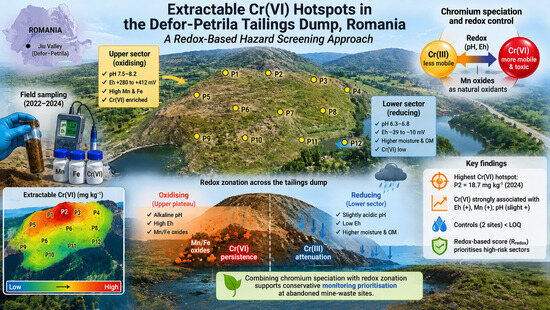
1. Introduction
2. Materials and Methods
2.1. Study Area and Toxicological Relevance
2.2. Sampling Strategy and Sample Preparation
2.3. Field and Laboratory Determinations
2.4. Determination of Pseudo-Total Chromium and Extractable Cr(VI)
2.5. Redox-Based Prioritisation Score for Hazard Screening
2.6. Statistical and Sector-Based Analysis
2.7. Interpretive Safeguards and Uncertainty Control
3. Results
3.1. Physicochemical Heterogeneity and Redox Zonation
3.2. Distribution of Mn and Fe
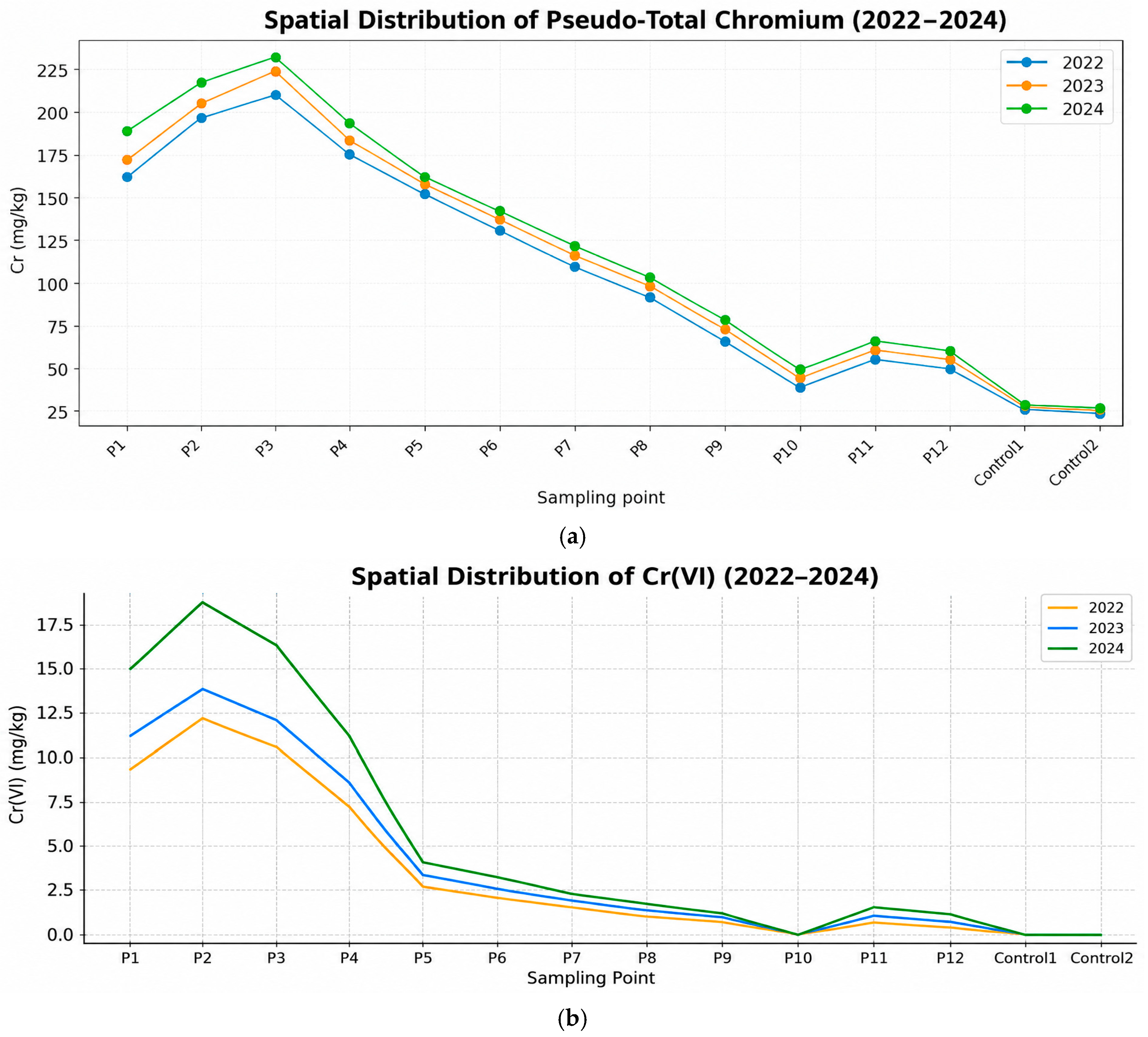
3.3. Total Chromium and Extractable Cr(VI)
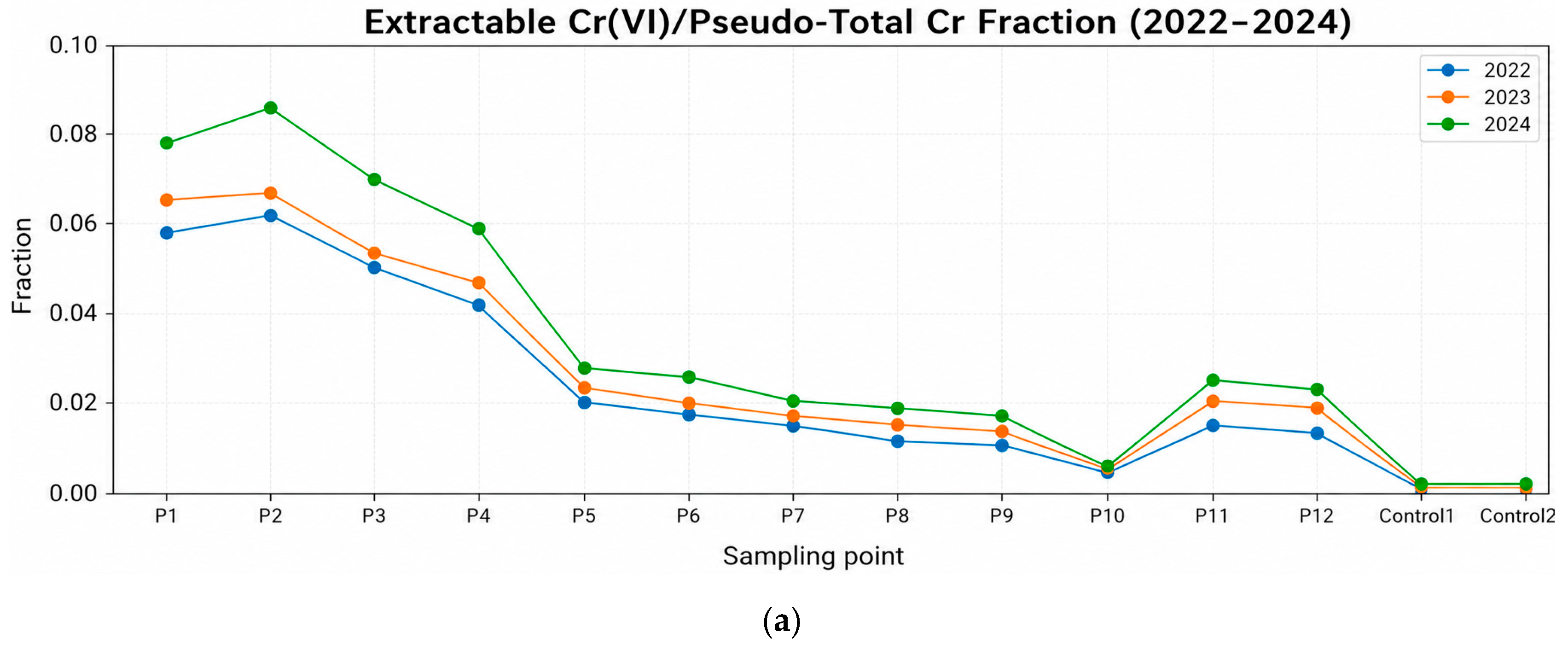
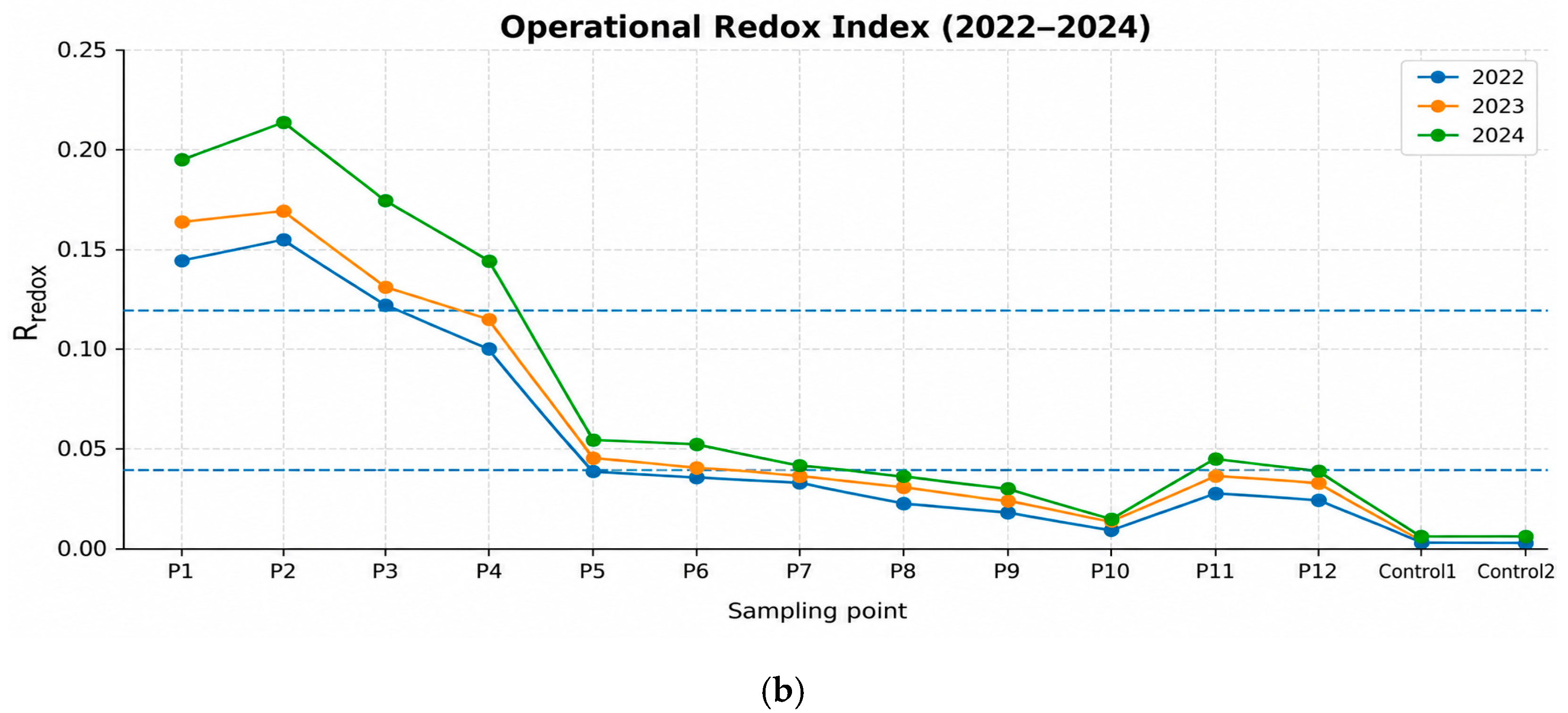
3.4. Cr(VI)/Pseudo-Total Cr Fraction and Rredox Screening
3.5. Statistical Synthesis
4. Discussion
4.1. Why the Upper Sector Behaves as a Cr(VI) Hotspot
4.2. Toxicological Significance and Plausible Exposure Pathways
4.3. Lower-Sector Attenuation Potential and Its Limits
4.4. Usefulness and Limits of Rredox for Hazard-Based Site Screening
4.5. Precautionary Management and Monitoring Implications
4.6. Methodological Constraints and Future Validation Needs
5. Conclusions
Supplementary Materials
Author Contributions
Funding
Institutional Review Board Statement
Informed Consent Statement
Data Availability Statement
Acknowledgments
Conflicts of Interest
References
- IARC Working Group on the Evaluation of Carcinogenic Risks to Humans. Chromium, Nickel and Welding; IARC Monographs on the Evaluation of Carcinogenic Risks to Humans; International Agency for Research on Cancer: Lyon, France, 1990; Volume 49. [Google Scholar]
- Barnhart, J. Occurrences, uses, and properties of chromium. Regul. Toxicol. Pharmacol. 1997, 26, S3–S7. [Google Scholar] [CrossRef]
- Costa, M.; Klein, C.B. Toxicity and carcinogenicity of chromium compounds in humans. Crit. Rev. Toxicol. 2006, 36, 155–163. [Google Scholar] [CrossRef]
- Zhitkovich, A. Chromium in drinking water: Sources, metabolism, and cancer risks. Chem. Res. Toxicol. 2011, 24, 1617–1629. [Google Scholar] [CrossRef] [PubMed]
- Rai, D.; Eary, L.E.; Zachara, J.M. Environmental chemistry of chromium. Sci. Total Environ. 1989, 86, 15–23. [Google Scholar] [CrossRef] [PubMed]
- Richard, F.C.; Bourg, A.C.M. Aqueous geochemistry of chromium: A review. Water Res. 1991, 25, 807–816. [Google Scholar] [CrossRef]
- Kimbrough, D.E.; Cohen, Y.; Winer, A.M.; Creelman, L.; Mabuni, C. A critical assessment of chromium in the environment. Crit. Rev. Environ. Sci. Technol. 1999, 29, 1–46. [Google Scholar] [CrossRef]
- Liang, J.; Huang, X.; Yan, J.; Li, Y.; Zhao, Z.; Liu, Y.; Ye, J.; Wei, Y. A review of the formation of Cr(VI) via Cr(III) oxidation in soils and groundwater. Sci. Total Environ. 2021, 774, 145762. [Google Scholar] [CrossRef]
- Mortada, W.I.; El-Naggar, A.; Mosa, A.; Palansooriya, K.N.; Yousaf, B.; Tang, R.; Wang, S.; Cai, Y.; Chang, S.X. Biogeochemical behaviour and toxicology of chromium in the soil–water–human nexus: A review. Chemosphere 2023, 331, 138804. [Google Scholar] [CrossRef]
- Ao, M.; Chen, X.; Deng, T.; Sun, S.; Tang, Y.; Morel, J.-L.; Qiu, R.; Wang, S. Chromium biogeochemical behaviour in soil–plant systems and remediation strategies: A critical review. J. Hazard. Mater. 2022, 424, 127233. [Google Scholar] [CrossRef]
- Fendorf, S.E.; Zasoski, R.J. Chromium(III) oxidation by δ-manganese oxide. 1. Characterization. Environ. Sci. Technol. 1992, 26, 79–85. [Google Scholar] [CrossRef]
- Oze, C.; Bird, D.K.; Fendorf, S. Genesis of hexavalent chromium from natural sources in soil and groundwater. Proc. Natl. Acad. Sci. USA 2007, 104, 6544–6549. [Google Scholar] [CrossRef]
- Murray, K.J.; Tebo, B.M. Cr(III) is indirectly oxidized by the Mn(II)-oxidizing bacterium Bacillus sp. strain SG-1. Environ. Sci. Technol. 2007, 41, 528–533. [Google Scholar] [CrossRef]
- James, B.R.; Bartlett, R.J. Behavior of chromium in soils. VI. Interactions between oxidation–reduction and organic complexation. J. Environ. Qual. 1983, 12, 173–176. [Google Scholar] [CrossRef]
- Kožuh, N.; Štupar, J.; Gorenc, B. Reduction and oxidation processes of chromium in soils. Environ. Sci. Technol. 2000, 34, 112–119. [Google Scholar] [CrossRef]
- James, B.R.; Bartlett, R.J. Behavior of chromium in soils. VII. Adsorption and reduction of hexavalent forms. J. Environ. Qual. 1983, 12, 177–181. [Google Scholar] [CrossRef]
- Lottermoser, B.G. Mine Wastes: Characterization, Treatment and Environmental Impacts, 3rd ed.; Springer: Berlin/Heidelberg, Germany, 2010. [Google Scholar] [CrossRef]
- Alloway, B.J. (Ed.) Heavy Metals in Soils: Trace Metals and Metalloids in Soils and Their Bioavailability, 3rd ed.; Springer: Dordrecht, The Netherlands, 2013; Volume 22. [Google Scholar] [CrossRef]
- Kabata-Pendias, A. Trace Elements in Soils and Plants, 4th ed.; CRC Press: Boca Raton, FL, USA, 2011. [Google Scholar] [CrossRef]
- Khan, C.; Malik, R.N.; Chen, J. Human exposure to chromite mining pollution, the toxicity mechanism and health impact. Heliyon 2024, 10, e40083. [Google Scholar] [CrossRef]
- Zupančič, M.; Miler, M.; Žibret, G. The relationship between the inhalation bioaccessibility of potentially toxic elements in road dust from a heavily polluted industrial area and the source of their pollution. Environ. Pollut. 2024, 361, 124810. [Google Scholar] [CrossRef]
- Helser, J.; Vassilieva, E.; Cappuyns, V. Environmental and human-health risk assessment of sulfidic mine waste: Bioaccessibility, leaching and mineralogy. J. Hazard. Mater. 2022, 424, 127313. [Google Scholar] [CrossRef]
- Ettler, V.; Křížová, T.; Mihaljevič, M.; Drahota, P.; Racek, M.; Kříbek, B.; Vaněk, A.; Penížek, V.; Zádorová, T.; Sracek, O.; et al. Contaminant bioaccessibility in abandoned mine tailings in Namibia changes along a climatic gradient. Environ. Sci. Process. Impacts 2025, 27, 1088–1102. [Google Scholar] [CrossRef] [PubMed]
- Mehta, N.; Cipullo, S.; Cocerva, T.; Coulon, F.; Dino, G.A.; Ajmone-Marsan, F.; Padoan, E.; Cox, S.F.; Cave, M.R.; De Luca, D.A. Incorporating oral bioaccessibility into human health risk assessment due to potentially toxic elements in extractive waste and contaminated soils from an abandoned mine site. Chemosphere 2020, 255, 126927. [Google Scholar] [CrossRef]
- McHale, S.; Jamieson, H.E.; Cleaver, A.E.; Huntsman, P. Increased human-health risks at a legacy mine site: Copper and lead bioaccessibility of oxidised tailings. Environ. Geochem. Health 2025, 47, 326. [Google Scholar] [CrossRef]
- Mehta, N.; Cocerva, T.; Cipullo, S.; Padoan, E.; Dino, G.A.; Ajmone-Marsan, F.; Cox, S.F.; Coulon, F.; De Luca, D.A. Linking oral bioaccessibility and solid phase distribution of potentially toxic elements in extractive waste and soil from an abandoned mine site: Case study in Campello Monti, NW Italy. Sci. Total Environ. 2019, 651, 2799–2810. [Google Scholar] [CrossRef] [PubMed]
- Dunca, E.-C.; Ioniță, M.-F.; Radu, S.M. Soil contamination and related ecological risks: Complex analysis of the Defor Petrila tailings dump, Romania. Land 2025, 14, 1492. [Google Scholar] [CrossRef]
- Radu, V.M.; Vîjdea, A.M.; Ivanov, A.A.; Alexe, V.E.; Dincă, G.; Cetean, V.M.; Filiuță, A.E. Research on the closure and remediation processes of mining areas in Romania and approaches to the strategy for heavy metal pollution remediation. Sustainability 2023, 15, 15293. [Google Scholar] [CrossRef]
- U.S. Environmental Protection Agency. SW-846 Test Method 3060A: Alkaline Digestion for Hexavalent Chromium; U.S. EPA: Washington, DC, USA, 1996.
- U.S. Environmental Protection Agency. SW-846 Test Method 3051A: Microwave Assisted Acid Digestion of Sediments, Sludges, Soils, and Oils; U.S. EPA: Washington, DC, USA, 2007.
- U.S. Environmental Protection Agency. SW-846 Test Method 7196A: Chromium, Hexavalent (Colorimetric); U.S. EPA: Washington, DC, USA, 1992.
- Huo, D.; Lu, Y.; Kingston, H.M. Determination and correction of analytical biases and study on chemical mechanisms in the analysis of Cr(VI) in soil samples using EPA protocols. Environ. Sci. Technol. 1998, 32, 3418–3423. [Google Scholar] [CrossRef]
- Vitale, R.J.; Mussoline, G.R.; Petura, J.C.; James, B.R. Hexavalent chromium extraction from soils: Evaluation of an alkaline digestion method. J. Environ. Qual. 1994, 23, 1249–1256. [Google Scholar] [CrossRef]
- Fendorf, S.E. Surface reactions of chromium in soils and waters. Geoderma 1995, 67, 55–71. [Google Scholar] [CrossRef]
- Dhal, B.; Thatoi, H.N.; Das, N.N.; Pandey, B.D. Chemical and microbial remediation of hexavalent chromium from contaminated soil and mining/metallurgical solid waste: A review. J. Hazard. Mater. 2013, 250–251, 272–291. [Google Scholar] [CrossRef]



| Factor | Class | Score | Interpretation |
|---|---|---|---|
| α(pH) | pH < 6.5 | 0.8 | Less favourable for Cr(VI) persistence |
| α(pH) | 6.5 ≤ pH < 7.5 | 1.0 | Transitional pH condition |
| α(pH) | pH ≥ 7.5 | 1.2 | Alkaline condition favouring Cr(VI) persistence |
| β(Eh) | Eh < 0 mV | 0.8 | Reducing condition |
| β(Eh) | 0 ≤ Eh < 200 mV | 1.0 | Transitional redox condition |
| β(Eh) | Eh ≥ 200 mV | 1.3 | Oxidising condition favouring Cr(VI) persistence |
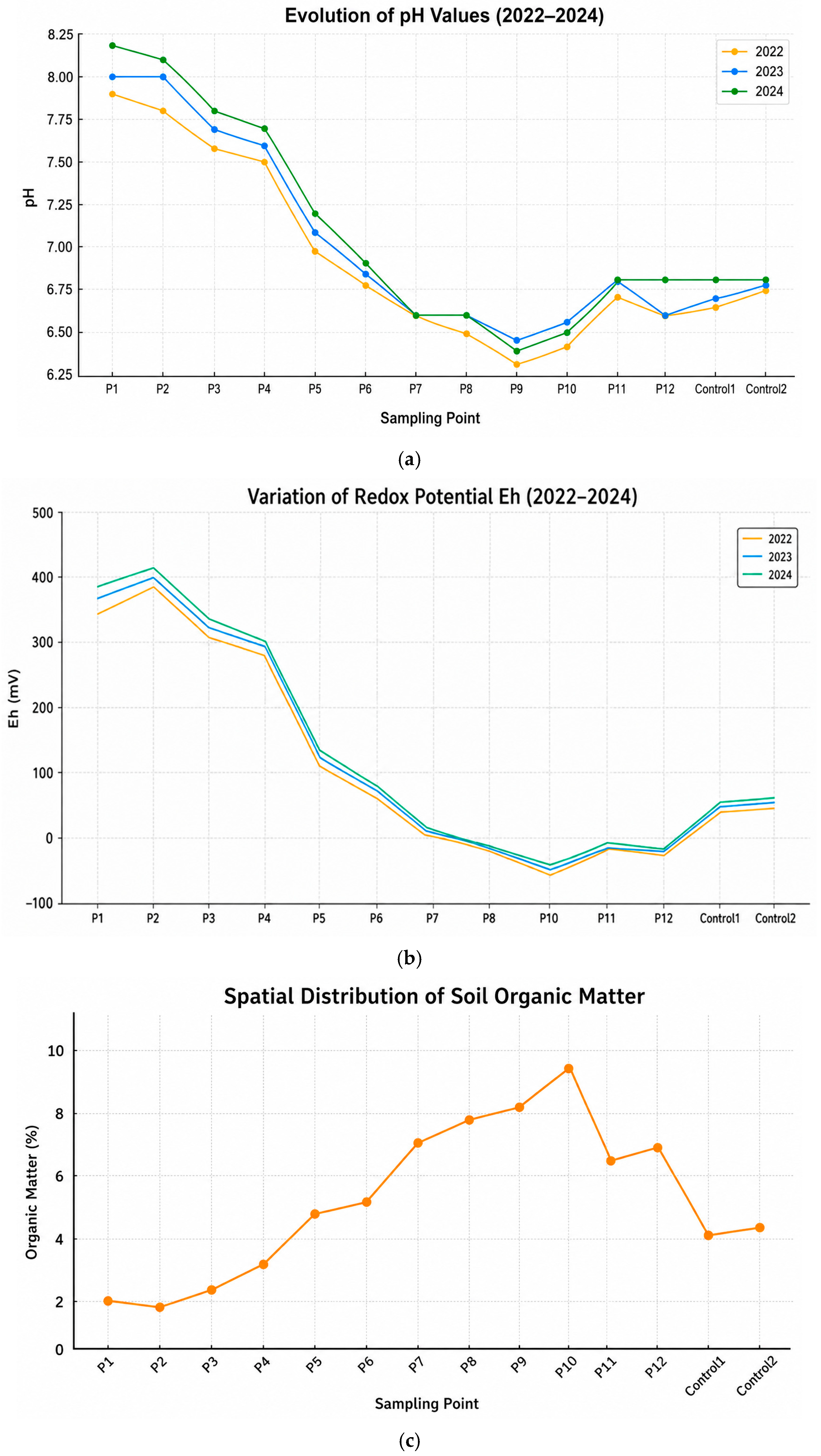
| Sampling Point | pH 2022 | pH 2023 | pH 2024 | Eh 2022 (mV) | Eh 2023 (mV) | Eh 2024 (mV) | Moisture (%) | OM (%) |
|---|---|---|---|---|---|---|---|---|
| P1 | 7.9 | 8.0 | 8.2 | +350 | +372 | +390 | 6.4 | 2.0 |
| P2 | 7.8 | 8.0 | 8.1 | +390 | +402 | +412 | 6.0 | 1.8 |
| P3 | 7.6 | 7.7 | 7.8 | +310 | +325 | +338 | 7.5 | 2.3 |
| P4 | 7.5 | 7.6 | 7.7 | +280 | +295 | +302 | 8.1 | 3.2 |
| P5 | 7.0 | 7.1 | 7.2 | +120 | +130 | +140 | 12.5 | 4.8 |
| P6 | 6.8 | 6.9 | 6.9 | +70 | +80 | +85 | 15.4 | 5.2 |
| P7 | 6.6 | 6.6 | 6.7 | +10 | +17 | +20 | 21.3 | 7.1 |
| P8 | 6.5 | 6.6 | 6.6 | −15 | −10 | −12 | 22.9 | 7.8 |
| P9 | 6.3 | 6.4 | 6.4 | −30 | −38 | −35 | 25.6 | 8.2 |
| P10 | 6.4 | 6.5 | 6.5 | −55 | −62 | −59 | 28.3 | 9.5 |
| P11 | 6.7 | 6.8 | 6.8 | −20 | −15 | −10 | 19.4 | 6.5 |
| P12 | 6.6 | 6.6 | 6.7 | −25 | −21 | −18 | 20.8 | 6.9 |
| Control 1 | 6.7 | 6.7 | 6.8 | +45 | +50 | +55 | 11.3 | 4.1 |
| Control 2 | 6.8 | 6.8 | 6.8 | +55 | +58 | +60 | 10.8 | 4.3 |
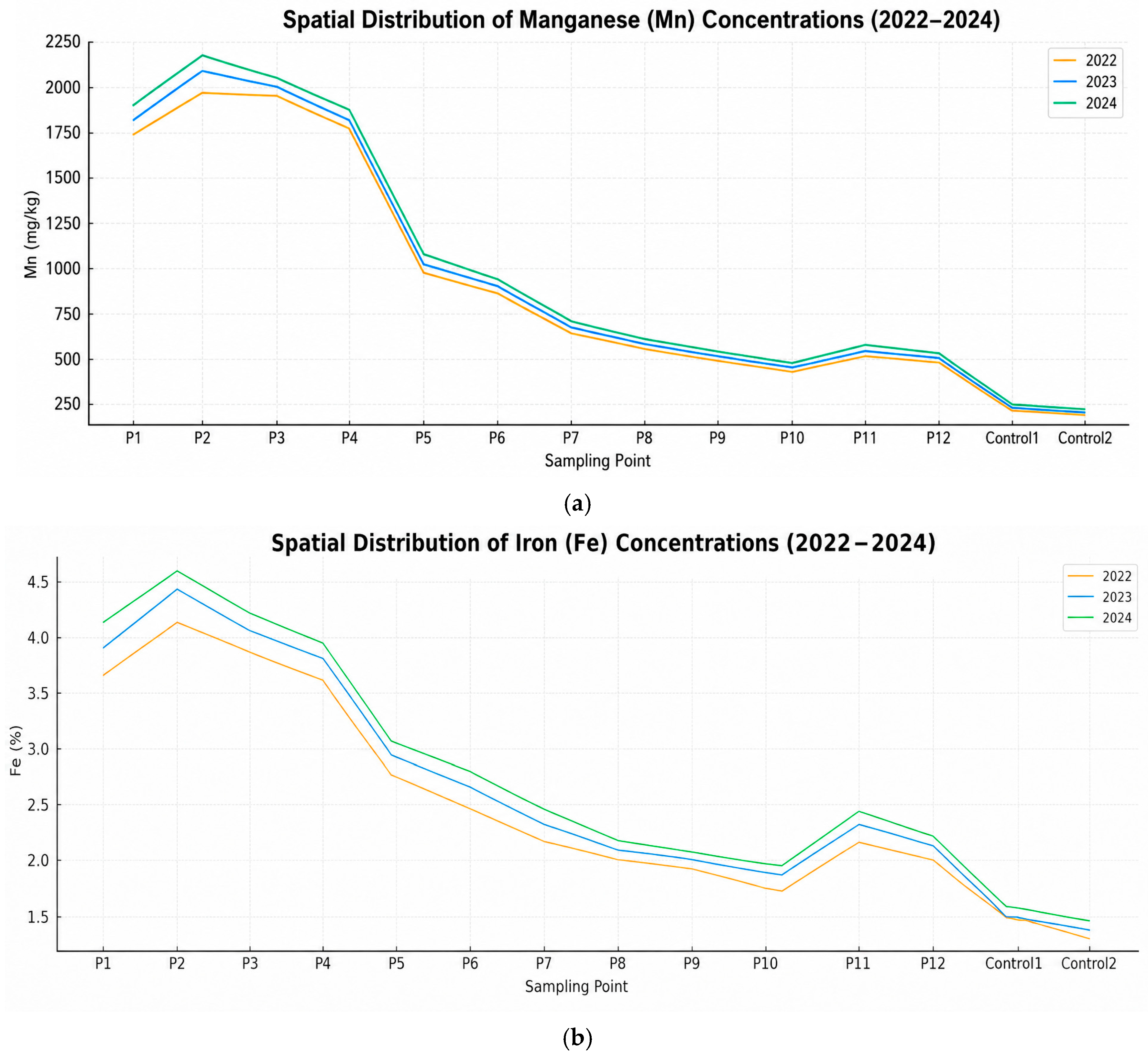
| Sampling Point | Mn 2022 (mg/kg) | Mn 2023 (mg/kg) | Mn 2024 (mg/kg) | Fe 2022 (%) | Fe 2023 (%) | Fe 2024 (%) |
|---|---|---|---|---|---|---|
| P1 | 1750 | 1820 | 1900 | 3.7 | 3.9 | 4.1 |
| P2 | 1980 | 2100 | 2180 | 4.2 | 4.5 | 4.6 |
| P3 | 1960 | 2010 | 2050 | 3.9 | 4.1 | 4.2 |
| P4 | 1780 | 1820 | 1875 | 3.7 | 3.8 | 3.9 |
| P5 | 980 | 1020 | 1080 | 2.9 | 3.0 | 3.1 |
| P6 | 860 | 900 | 930 | 2.6 | 2.7 | 2.8 |
| P7 | 640 | 680 | 700 | 2.3 | 2.4 | 2.4 |
| P8 | 550 | 580 | 600 | 2.1 | 2.1 | 2.2 |
| P9 | 480 | 510 | 530 | 2.0 | 2.0 | 2.1 |
| P10 | 420 | 440 | 460 | 1.8 | 1.9 | 1.9 |
| P11 | 510 | 540 | 570 | 2.2 | 2.3 | 2.4 |
| P12 | 480 | 500 | 520 | 2.1 | 2.2 | 2.2 |
| Control 1 | 210 | 220 | 230 | 1.5 | 1.5 | 1.6 |
| Control 2 | 180 | 190 | 200 | 1.4 | 1.4 | 1.5 |
| Sampling Point | Pseudo-Total Cr 2022 | Pseudo-Total Cr 2023 | Pseudo-Total Cr 2024 | Cr(VI) 2022 | Cr(VI) 2023 | Cr(VI) 2024 |
|---|---|---|---|---|---|---|
| P1 | 162.3 | 171.8 | 189.5 | 9.5 | 11.2 | 14.8 |
| P2 | 198.4 | 205.2 | 218.1 | 12.3 | 13.8 | 18.7 |
| P3 | 212.0 | 226.3 | 231.5 | 10.6 | 12.1 | 16.4 |
| P4 | 175.6 | 182.9 | 194.2 | 7.3 | 8.5 | 11.6 |
| P5 | 152.1 | 158.4 | 160.2 | 3.1 | 3.8 | 4.4 |
| P6 | 130.3 | 136.7 | 140.1 | 2.4 | 2.8 | 3.6 |
| P7 | 108.2 | 115.6 | 118.4 | 1.9 | 2.1 | 2.4 |
| P8 | 92.5 | 96.1 | 100.4 | 1.2 | 1.5 | 1.9 |
| P9 | 68.2 | 72.3 | 75.4 | 0.8 | 1.0 | 1.3 |
| P10 | 38.2 | 42.8 | 46.7 | 0.24 | 0.28 | 0.31 |
| P11 | 55.1 | 60.3 | 64.5 | 0.9 | 1.3 | 1.6 |
| P12 | 48.3 | 52.5 | 56.1 | 0.7 | 1.0 | 1.3 |
| Control 1 | 24.4 | 26.1 | 25.2 | <LOQ | <LOQ | <LOQ |
| Control 2 | 22.1 | 21.8 | 23.5 | <LOQ | <LOQ | <LOQ |
| Point | Fraction 2022 | Fraction 2023 | Fraction 2024 | Rredox 2022 | Rredox 2023 | Rredox 2024 |
|---|---|---|---|---|---|---|
| P1 | 0.058 | 0.065 | 0.078 | 0.145 | 0.163 | 0.195 |
| P2 | 0.062 | 0.067 | 0.086 | 0.155 | 0.168 | 0.215 |
| P3 | 0.050 | 0.053 | 0.070 | 0.125 | 0.133 | 0.175 |
| P4 | 0.041 | 0.046 | 0.059 | 0.103 | 0.115 | 0.147 |
| P5 | 0.020 | 0.024 | 0.027 | 0.040 | 0.048 | 0.054 |
| P6 | 0.018 | 0.020 | 0.026 | 0.036 | 0.040 | 0.052 |
| P7 | 0.017 | 0.018 | 0.020 | 0.034 | 0.036 | 0.040 |
| P8 | 0.013 | 0.016 | 0.019 | 0.023 | 0.029 | 0.034 |
| P9 | 0.012 | 0.014 | 0.017 | 0.019 | 0.022 | 0.027 |
| P10 | 0.006 | 0.007 | 0.007 | 0.010 | 0.013 | 0.013 |
| P11 | 0.016 | 0.021 | 0.025 | 0.029 | 0.038 | 0.045 |
| P12 | 0.014 | 0.019 | 0.023 | 0.025 | 0.034 | 0.041 |
| Control 1 | <0.002 | <0.002 | <0.002 | <0.004 | <0.004 | <0.004 |
| Control 2 | <0.002 | <0.002 | <0.002 | <0.004 | <0.004 | <0.004 |
| Parameter | Shapiro–Wilk W | Normality p | Repeated-Site Test | Test p | Main Exploratory Correlation | Spearman rho | Correlation p |
|---|---|---|---|---|---|---|---|
| pH | 0.877 | <0.001 | Friedman | <0.001 | pH–Eh | ρ = 0.953 | <0.001 |
| Eh | 0.825 | <0.001 | Friedman | 0.002 | Eh–Cr(VI) | ρ = 0.979 | <0.001 |
| Pseudo-total Cr | 0.931 | 0.028 | Friedman | <0.001 | Pseudo-total Cr–Eh | ρ = 0.945 | <0.001 |
| Cr(VI) | 0.811 | <0.001 | Friedman | <0.001 | Cr(VI)–Mn | ρ = 0.991 | <0.001 |
Disclaimer/Publisher’s Note: The statements, opinions and data contained in all publications are solely those of the individual author(s) and contributor(s) and not of MDPI and/or the editor(s). MDPI and/or the editor(s) disclaim responsibility for any injury to people or property resulting from any ideas, methods, instructions or products referred to in the content. |
© 2026 by the authors. Licensee MDPI, Basel, Switzerland. This article is an open access article distributed under the terms and conditions of the Creative Commons Attribution (CC BY) license.
Share and Cite
Ioniță, M.F.; Dunca, E.C.; Radu, S.M.; Irimie, S.I. Extractable Cr(VI) Hotspots in the Defor Petrila Tailings Dump, Romania: A Redox-Based Hazard Screening Approach. Toxics 2026, 14, 479. https://doi.org/10.3390/toxics14060479
Ioniță MF, Dunca EC, Radu SM, Irimie SI. Extractable Cr(VI) Hotspots in the Defor Petrila Tailings Dump, Romania: A Redox-Based Hazard Screening Approach. Toxics. 2026; 14(6):479. https://doi.org/10.3390/toxics14060479
Chicago/Turabian StyleIoniță, Mădălina F., Emilia C. Dunca, Sorin M. Radu, and Sabin I. Irimie. 2026. "Extractable Cr(VI) Hotspots in the Defor Petrila Tailings Dump, Romania: A Redox-Based Hazard Screening Approach" Toxics 14, no. 6: 479. https://doi.org/10.3390/toxics14060479
APA StyleIoniță, M. F., Dunca, E. C., Radu, S. M., & Irimie, S. I. (2026). Extractable Cr(VI) Hotspots in the Defor Petrila Tailings Dump, Romania: A Redox-Based Hazard Screening Approach. Toxics, 14(6), 479. https://doi.org/10.3390/toxics14060479