Unmet Information Needs of Spanish Female Breast Cancer Survivors on Chemical Pollutants: A Cross-Sectional Mixed-Method Study

 , , ,
, , ,  and
and
Abstract
1. Introduction
2. Materials and Methods
2.1. Design and Study Population
2.2. Data Collection
2.3. Data Analysis
2.4. Ethical Considerations
3. Results
3.1. Characteristics of the Study Population

| Sociodemographic Variables | Study Population (N = 150) | |
|---|---|---|
| Population area | ||
| Rural area | 94 * | 62.67% |
| Urban area | 56 | 37.33% |
| Education level | ||
| Unschooled | 5 | 3.33% |
| Primary education | 36 | 24.00% |
| High school | 58 | 38.67% |
| University | 51 | 34.00% |
| Currentself-perception of diet compared to other women with BC | ||
| Quite balanced | 78 | 52.00% |
| Balanced | 55 | 36.67% |
| Unbalanced | 14 | 9.33% |
| Highly unbalanced | 3 | 2.00% |
| Current self-perception of diet compared to before diagnosis | ||
| Balanced | 83 | 55.33% |
| Quite balanced | 46 | 30.67% |
| Unbalanced | 19 | 12.67% |
| Highly unbalanced | 2 | 1.33% |
| Sedentary behavior (sitting time ≥ 7 h) | 89 | 59.33% |
| Surgical interventions associated with BC 1 | 142 | 94.67% |
| Other surgical interventions | 49 | 32.67% |
| Smoking habit | ||
| Never smoked | 82 | 54.67% |
| Former smoker | 48 | 32.00% |
| Current smoker | 17 | 11.33% |
| Second-hand tobacco smoker 2 | 3 | 2.00% |
| Alcohol consumption | ||
| Never | 76 | 50.67% |
| Occasional drinker 3 | 61 | 40.67% |
| Current drinker 4 | 7 | 4.67% |
| Former drinker 5 | 6 | 4.00% |
| Use of illegal drugs | 5 | 3.33% |
| Dietary supplements (regular consumption) | ||
| Vitamins and minerals | 76 | 50.67% |
| None | 65 | 43.33% |
| Collagen | 4 | 2.67% |
| Probiotics | 3 | 2.00% |
| Others | 2 | 1.33% |
| Use of sweeteners | ||
| None | 57 | 38% |
| Regular sugar | 36 | 24.00% |
| Stevia or saccharin | 32 | 21.33% |
| Brown sugar, panela or honey | 25 | 16.67% |
| Main type of cooking fat | ||
| Extra virgin olive oil | 143 | 95.33% |
| Sunflower oil | 5 | 3.35% |
| Virgin olive oil | 1 | 0.67% |
| Butter | 1 | 0.67% |
| Study Population (N = 150) | |||
|---|---|---|---|
| Median | P25 | P75 | |
| Age(y) | 59 | 51 | 67 |
| Weight (kg) | 65 | 60 | 75 |
| Height (cm) | 162 | 158 | 165 |
| Body mass index (kg/m2) | 25.08 | 22.50 | 29.14 |
| Residence in Granada (y) | 51 | 30 | 60 |
| Time from diagnosis (y) | 3 | 2 | 6 |
| Last medical check-up (m) | 6 | 3 | 12 |
| Number of Children | 2 | 1 | 2 |
| Food consumption (t/w) | |||
| 7 | 7 | 14 |
| 3 | 2 | 4 |
| 2 | 2 | 3 |
| 3 | 1 | 7 |
| 2 | 1 | 3 |
| 7 | 7 | 7 |
| 21 | 14 | 21 |
| 3 | 1 | 7 |
| 2 | 2 | 3 |
| 7 | 7 | 14 |
| 2 | 2 | 3 |
| 0 | 0 | 1 |
| N | Percentage | |
|---|---|---|
| Adoptionof any positive change in lifestyle habits | 124 | 82.67% |
| Specific health-oriented changes regarding: | ||
| 62 | 41.33% |
| 41 | 27.33% |
| 38 | 25.33% |
| 35 | 23.33% |
| 25 | 16.67% |
| 20 | 13.33% |
| 19 | 12.67% |
| 14 | 9.33% |
| 14 | 9.33% |
| 12 | 8.00% |
| 6 | 4.00% |
| 3 | 2.00% |
| 2 | 1.33% |
3.2. Qualitative Results
3.2.1. Results from Individual Interviews
3.2.2. Results from Focus Group Meetings (FGMs)
4. Discussion
5. Conclusions
Supplementary Materials
Author Contributions
Funding
Institutional Review Board Statement
Informed Consent Statement
Data Availability Statement
Acknowledgments
Conflicts of Interest
Abbreviations
| BC | Breast Cancer |
| BEUC | The European Consumer Organization |
| BMI: | Body Mass Index |
| BPA | Bisphenol A |
| DDT | Dichlorodiphenyltrichloroethane |
| EDCs | Endocrine-Disrupting Chemicals |
| FGM | Focus Group Meeting |
| PFOA | Perfluorooctanoic Acid |
| PFASs | Per- and Polyfluoroalkyl Substances |
| PFOS | Perfluorooctane Sulphonate |
| POP | Persistent Organic Pollutant |
| SEOM | Spanish Society of Medical Oncology |
References
- Giaquinto, A.N.; Sung, H.; Newman, L.A.; Freedman, R.A.; Smith, R.A.; Star, J.; Jemal, A.; Siegel, R.L. Breast cancer statistic 2024. CA Cancer J. Clin. 2024, 74, 477–495. [Google Scholar] [CrossRef]
- World Health Organization. Breast Cancer. 2025. Available online: https://www.who.int/news-room/fact-sheets/detail/breast-cancer (accessed on 27 February 2026).
- Sociedad Española de Oncología Médica (SEOM). Las Cifras del Cáncer en España; Depósito Legal: M-3222-2024; SEOM: Madrid, Spain, 2024. [Google Scholar]
- Gavili, N.; Sedghi, S.; Panahi, S.; Razmgir, M. Health Information Needs of Breast Cancer Survivors: An Umbrella Review. Breast J. 2024, 15, 5889622. [Google Scholar] [CrossRef]
- Cohen, S.Y.; Stoll, C.R.; Anandarajah, A.; Doering, M.; Colditz, G.A. Modifiable risk factors in women at high risk of breast cancer: A systematic review. Breast Cancer 2023, 25, 45. [Google Scholar] [CrossRef] [PubMed]
- Patel, A.V.; Deubler, E.; Teras, L.R.; Colditz, G.A.; Lichtman, C.J.; Cance, W.G.; Clarke, C.A. Key risk factors for the relative and absolute 5-year risk of cancer to enhance cancer screening and prevention. Cancer 2022, 128, 3502–3515. [Google Scholar] [CrossRef]
- Gearhart-Serna, L.M.; Mills, B.A.; Hsu, H.; Fayanju, O.M.; Hoffman, K.; Devi, G.R. Cumulative environmental quality is associated with breast cancer incidence differentially by summary stage and urbanicity. Sci. Rep. 2023, 13, 20301. [Google Scholar] [CrossRef] [PubMed]
- Gray, J.M.; Rasanayagam, S.; Engel, C.; Rizzo, J. State of the evidence 2017: An update on the connection between breast cancer and the environment. Environ. Health 2017, 16, 94. [Google Scholar] [CrossRef]
- Panis, C.; Lemos, B. Pesticide exposure and increased breast cancer risk in women population studies. Sci. Total Environ. 2024, 933, 172988. [Google Scholar] [CrossRef]
- The European Consumer Organization (BEUC). Ubiquitous but Preventable: Harmful Chemicals in Everyday Consumer Products; BEUC: Bruxelles, Belgium, 2023; Available online: https://www.beuc.eu/sites/default/files/publications/BEUC-X-2023-129_Harmful_chemicals_in_everyday_consumer_products.pdf (accessed on 15 February 2026).
- Wan, M.L.Y.; Co, V.A.; El-Nezami, H. Endocrine disrupting chemicals and breast cancer: A systematic review of epidemiological studies. Crit. Rev. Food Sci. Nutr. 2022, 62, 6549–6576. [Google Scholar] [CrossRef]
- Gamboa-Loira, B.; López-Carrillo, L.; Mar-Sánchez, Y.; Stern, D.; Cebrián, M.E. Epidemiologic evidence of exposure to polycyclic aromatic hydrocarbons and breast cancer: A systematic review and meta-analysis. Chemosphere 2022, 290, 133237. [Google Scholar] [CrossRef] [PubMed]
- Arrebola, J.P.; Fernandez, M.F.; Molina-Molina, J.M.; Martin-Olmedo, P.; Expósito, J.; Olea, N. Predictors of the total effective xenoestrogen burden (TEXB) in human adipose tissue. A pilot study. Reprod. Toxicol. 2012, 33, 45–52. [Google Scholar] [CrossRef]
- Santaliz-Casiano, A.; Lee, A.; Teteh, D.; Erdogan, Z.M.; Treviño, L. Endocrine-Disrupting Chemicals and Breast Cancer: Disparities in Exposure and Importance of Research Inclusivity. Endocrinology 2022, 163, bqac034. [Google Scholar] [CrossRef]
- Barrios-Rodríguez, R.; Pérez-Carrascosa, F.M.; Gómez-Peña, C.; Mustieles, V.; Salcedo-Bellido, I.; Requena, P.; Martin-Olmedo, P.; Jiménez-Moleón, J.J.; Arrebola, J.P. Associations of accumulated selected persistent organic pollutants in adipose tissue with insulin sensitivity and risk of incident type-2 diabetes. Environ. Int. 2021, 155, 106607. [Google Scholar] [CrossRef]
- Kumar, M.; Sarma, D.K.; Shubham, S.; Kumawat, M.; Verma, V.; Prakash, A.; Tiwari, R. Environmental Endocrine-Disrupting Chemical Exposure: Role in Non-Communicable Diseases. Front. Public Health 2020, 8, 553850. [Google Scholar] [CrossRef] [PubMed]
- Arrebola, J.P.; Fernández, M.F.; Martin-Olmedo, P.; Molina-Molina, J.M.; Sánchez-Pérez, M.J.; Sánchez-Cantalejo, E.; Molina-Portillo, E.; Expósito, J.; Bonde, J.P.; Olea, N. Adipose tissue concentrations of persistent organic pollutants and total cancer risk in an adult cohort from Southern Spain: Preliminary data from year 9 of the follow-up. Sci. Total Environ. 2014, 500–501, 243–249. [Google Scholar] [CrossRef]
- Cathey, A.L.; Nguyen, V.K.; Colacino, J.A.; Woodruff, T.J.; Reynolds, P.; Aung, M.T. Exploratory profiles of phenols, parabens, and per- and poly-fluoroalkyl substances among NHANES study participants in association with previous cancer diagnoses. J. Expo. Sci. Environ. Epidemiol. 2023, 33, 687–698. [Google Scholar] [CrossRef] [PubMed]
- Hamer, J.; Warner, E. Lifestyle modifications for patients with breast cancer to improve prognosis and optimize overall health. Can. Med. Assoc. J. 2017, 189, E268–E274. [Google Scholar] [CrossRef]
- Yeganeh, L.; Willey, S.; Wan, C.S.; Khomami, M.B.; Chehrazi, M.; Cook, O.; Webber, K. The effects of lifestyle and behavioral interventions on cancer recurrence, overall survival and quality of life in breast cancer survivors: A systematic review and network meta-analysis. Maturitas 2024, 185, 107977. [Google Scholar] [CrossRef]
- Matheson, L.; McGeagh, L.; Bennett, J.; Davies, E.L.; Brett, J.; Matthews, S.; Watson, E. Lifestyle behavior changes following breast cancer: A qualitative exploration of experiences and unmet support and information needs. J. Health Psychol. 2025, 31, 1120–1135. [Google Scholar] [CrossRef] [PubMed]
- Contri, A.; Costi, S.; Guberti, M.; Soncini, S.; Botti, S.; Frasoldati, A.; Torreggiani, M.; Ghirotto, L. Voices of Survivorship: The Unmet Needs of Italian Cancer Survivors. A Qualitative Study. Cancer Med. 2025, 14, e71121. [Google Scholar] [CrossRef]
- Tracy, S.J. Qualitative Quality: Eight “Big-Tent” Criteria for Excellent Qualitative Research. Qual. Inq. 2010, 16, 837–851. [Google Scholar] [CrossRef]
- Company-Morales, M.; Zafra Aparici, E.; Casadó, L.; Alarcón Montenegro, C.; Arrebola, J.P. Perception and Demands of Pregnant and Breastfeeding Women Regarding Their Role as Participants in Environmental Research Studies. Int. J. Environ. Res. Public Health 2021, 18, 4149. [Google Scholar] [CrossRef]
- Gale, N.K.; Heath, G.; Cameron, E.; Rashid, S.; Rewood, S. Using the framework method for the analysis of qualitative data in multi-disciplinary health research. BMC Med. Res. Methodol. 2013, 13, 117. [Google Scholar] [CrossRef]
- Serra-Majem, L.; Román-Viñas, B.; Sanchez-Villegas, A.; Guasch-Ferré, M.; Corella, D.; La Vecchia, C. Benefits of the Mediterranean diet: Epidemiological and molecular aspects. Mol. Asp. Med. 2019, 67, 1–55. [Google Scholar] [CrossRef]
- World Health Organization. WHO Framework Convention on Tobacco Control: Guidelines for Implementation Article 5.3; Article 8; Articles 9 and 10; Article 11; Article 12; Article 13; Article 14—2013 Edition; World Health Organization: Geneva, Switzerland, 2013; p. 7. [Google Scholar]
- USA National Library of Medicine. Concept ID: C0556298. Available online: https://www.ncbi.nlm.nih.gov/medgen/641401#:~:text=Definition,from%20NCI%5D (accessed on 20 April 2026).
- USA National Library of Medicine. Concept ID: C0556338. Available online: https://www.ncbi.nlm.nih.gov/medgen/641441 (accessed on 20 April 2026).
- WHO. The Global Health Observatory. Available online: https://www.who.int/data/gho/indicator-metadata-registry/imr-details/457 (accessed on 20 April 2026).
- Wang, Y.J.; Wang, F.; Yu, L.X.; Xiang, Y.J.; Zhou, F.; Huang, S.Y.; Zheng, C.; Fu, Q.Y.; Li, L.; Gao, D.Z.; et al. Worldwide review with meta-analysis of women’s awareness about breast cancer. Patient Educ. Couns. 2022, 105, 1818–1827. [Google Scholar] [CrossRef] [PubMed]
- Chiriac, V.F.; Baban, A.; Dumitrascu, D.J. Psychological stress and breast cancer incidence: A systematic review. Clujul Med. 2018, 91, 18–26. [Google Scholar] [CrossRef] [PubMed]
- Galicia Pacheco, S.I.; Petrova, D.; Garrido, D.; Catena, A.; Madrid Pérez-Esparza, B.; Torralba, C.; Ruiz-Vozmediano, J.; García-Pérez, J.; Sánchez, M.J.; Garcia-Retamero, R. The relationship between psychological stress and cancer incidence: A systematic review and meta-analysis. Health Psychol. Rev. 2025, 3, 1–27. [Google Scholar] [CrossRef] [PubMed]
- Hidalgo-García, D.; Arco-Díaz, J. Spatiotemporal analysis of the surface urban heat island (SUHI), air pollution and disease pattern: An applied study on the city of Granada (Spain). Environ. Sci. Pollut. Res. 2023, 30, 57617–57637. [Google Scholar] [CrossRef]
- Pravednikov, A.; Perkovic, S.; Lagerkvist, C.J. Main factors influencing the perceived health risk of endocrine-disrupting chemicals: A systematic literature review. Environ. Res. 2024, 262, 119836. [Google Scholar] [CrossRef]
- Afaya, A.; Japiong, M.; Konlan, K.D.; Solomon, M.S. Factors associated with awareness of breast cancer among women of reproductive age in Lesotho: A national population-based cross-sectional survey. BMC Public Health 2023, 23, 621. [Google Scholar] [CrossRef]
- Matisāne, L.; Knudsen, L.E.; Lobo Vicente, J.; Uhl, M.; Katsonouri, A.; van den Brand, A.D.; Berman, T.; Dimovska, M.; Anastasi, E.; Thoma, A.; et al. Citizens’ Perception and Concerns on Chemical Exposures and Human Biomonitoring-Results from a Harmonized Qualitative Study in Seven European Countries. Int. J. Environ. Res. Public Health 2022, 19, 6414. [Google Scholar] [CrossRef]
- European Commission. Attitudes of Europeans Towards the Environment: Eurobarometer Report, March–April 2024. Available online: https://europa.eu/eurobarometer/surveys/detail/3173 (accessed on 3 March 2026).
- Buchmüller, K.; Bearth, A.; Siegrist, M. Consumers’ perceptions of chemical household products and the associated risks. Food Chem. Toxicol. 2020, 143, 111511. [Google Scholar] [CrossRef]
- Hartmann, S.; Klaschka, U. Interested consumers’ awareness of harmful chemicals in everyday products. Environ. Sci. Eur. 2017, 29, 29. [Google Scholar] [CrossRef] [PubMed]
- Tariq, M.B.; Jaffar, N.; Farhan, K.; Tanveer, M.; Salomon, I.; Anum, F.; Ahmed, A.; Aaqil, I. Knowledge, attitudes, and practices regarding personal care products and their perceived link to breast cancer: A cross-sectional study. BMC Women’s Health 2025, 25, 491. [Google Scholar] [CrossRef]
- Trifunovski, A.; Rotondi, N.K.; Abbass-Dick, J.; Barakat, C. Analysis of Women’s Knowledge, Health Risk Perceptions, Beliefs and Avoidance Behaviour in Relation to Endocrine-Disrupting Chemicals in Personal Care and Household Products. Toxics 2025, 13, 414. [Google Scholar] [CrossRef]
- Janmaimool, P. Application of protection motivation theory to investigate sustainable waste management behaviors. Sustainability 2017, 9, 1079. [Google Scholar] [CrossRef]
- Niño de Guzmán, N.; Song, Y.; Alonso-Coello, P.; Canelo-Aybar, C.; Neamtiu, L.; Parmelli, E.; Pérez-Bracchiglione, J.; Rabassa, M.; Rigau, D.; Saz Parkinson, Z.; et al. Healthcare providers’ adherence to breast cancer guidelines in Europe: A systematic literature review. Breast Cancer Res. Treat. 2020, 181, 499–518. [Google Scholar] [CrossRef]
- Niederdeppe, J.; Boyd, A.D.; King, A.J.; Rimal, R.N. Strategies for Effective Public Health Communication in a Complex Information Environment. Annu. Rev. Public Health 2025, 46, 411–431. [Google Scholar] [CrossRef]
- Stiefel, F.; Bourquin, C.; Salmon, P.; Achtari Jeanneret, L.; Dauchy, S.; Ernstmann, N.; Grassi, L.; Libert, Y. Communication and support of patients and caregivers in chronic cancer care: ESMO Clinical Practice Guideline. ESMO Open 2024, 9, 103496. [Google Scholar] [CrossRef] [PubMed]
- Kerstiens, S.; Scherr, C.L.; Jacobs, M.; Carroll, A.J.; Jayeoba, M.; Daly, E.R.; Phillips, S.M.; Hitsman, B.; Garcia, S.F.; Spring, B. Speaking of survival: Oncologists’ approaches to risk behavior conversations with cancer survivors. J. Cancer Surviv. 2025; in press. [CrossRef]
| Main Topic/Question | Rank | Most Frequent Responses | Percent |
|---|---|---|---|
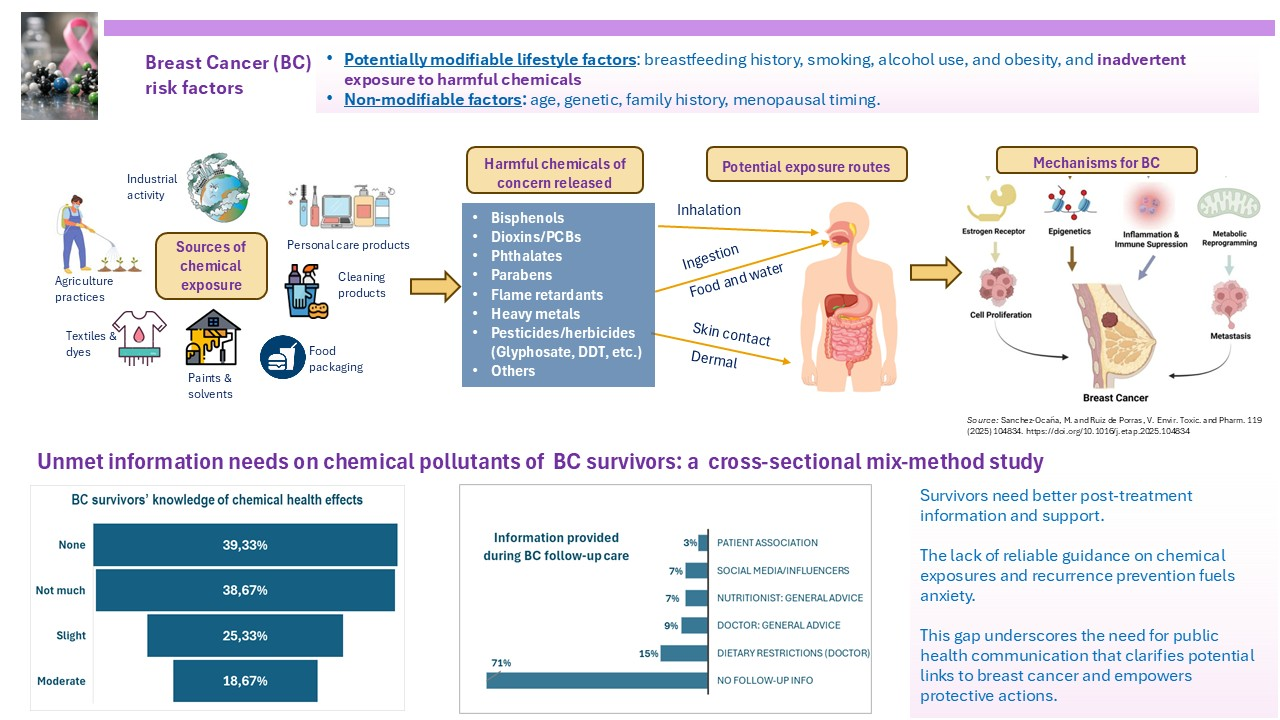
| 1 | I do not know what CPs are nor their risks on health | 39.33% |
| 2 | I know a bit about how CPs can affect health | 38.67% | |
| 3 | I am aware of the presence of some CPs in the air and water | 25.33% | |
| 4 | I am aware of some CPs from agriculture, livestock or industrial sources | 18.67% | |
| 5 | I am aware of the presence of some CPs in personal care products | 18.67% | |
| 6 | I feel like CPs are everywhere and there’s not much we can do | 17.33% | |
| 7 | Comment related to pesticides | 6.67% | |
| 8 | Comments related to heavy metals | 6.00% | |
| 9 | Comments related to plastics | 6.00% | |
| 10 | Comments related to sulfates and bisphenol A | 5.33% | |
| 1 | I have not received information during BC follow-up | 71.33% |
| 2 | My doctor recommended me to avoid dairy, meat, and sugar | 15.33% | |
| 3 | I got some general advice from my doctor | 8.67% | |
| 4 | I got some general advice from a nutritionist | 7.33% | |
| 5 | I looked for info through media and influencers | 7.33% | |
| 6 | I have been informed by a cancer association | 3.33% | |
| 1 | I am interested due to increased awareness and lack of reliable information | 78.67% |
| 2 | I prefer a guide provided by healthcare professionals | 29.33% | |
| 3 | I am indifferent to receiving a guide or not | 9.33% | |
| 4 | I don’t really trust info from TV or social media | 6.67% | |
| 5 | I’d prefer the guide to be given by someone who explains things clearly | 4.67% | |
| 6 | I prefer that the guide be provided by a BC association | 4.00% | |
| 7 | I’m not very trusting of authorities | 2.67% | |
| 8 | I don’t want to receive a guide | 2.67% | |
| 1 | I maintain the same eating habits | 44.67% |
| 2 | I try to follow the guidelines of the Mediterranean diet better | 21.33% | |
| 3 | I have decreased sugar consumption | 20.67% | |
| 4 | I have decreased processed meat consumption | 14.00% | |
| 5 | I have decreased processed food consumption | 13.33% | |
| 6 | I have increased organic product consumption | 11.33% | |
| 7 | I try to choose healthier dishes in restaurants and bars | 8.00% | |
| 8 | I have decreased pastry product consumption | 6.67% | |
| 9 | I am aware of the relationship between food and disease | 6.00% | |
| 1 | I keep using plastic containers | 38.00% |
| 2 | I use glass containers | 37.30% | |
| 3 | I have not changed my way of manipulating food | 20.70% | |
| 4 | I stopped using plastic containers after diagnosis | 14.70% | |
| 5 | I use the same cooking tools | 6.70% | |
| 6 | I found it difficult due to information overload | 4.00% | |
| 7 | I stopped using Teflon pans | 4.00% | |
| 8 | I tried to avoid the microwave | 2.00% | |
| 1 | I purchase groceries at the supermarket | 66.00% |
| 2 | I purchase groceries in specialized stores | 48.70% | |
| 3 | I have no concern about food origin | 28.70% | |
| 4 | I prefer locally or nationally produced food | 21.30% | |
| 5 | I try to check the origin of the food I consume | 18.00% | |
| 7 | I try to consume ecological or organic food | 9.30% | |
| 8 | I have an intermittent interest in food origin | 6.00% | |
| 9 | I consider organic products expensive | 4.70% | |
| 1 | I read cleaning product labels from time to time | 62.70% |
| 2 | I use the same cleaning products | 12.00% | |
| 3 | I have a habit of reading cleaning product labels | 9.30% | |
| 4 | I do not read cleaning product labels | 8.00% | |
| 5 | I read labels since COVID-19 | 3.30% | |
| 1 | I do not read hygiene product labels | 50.70% |
| 2 | I consume higher-quality cosmetic and hygiene products | 21.30% | |
| 3 | I usually read cosmetic and hygiene product labels | 14.00% | |
| 4 | I read the labels regarding parabens, silicones, sulphates | 8.70% | |
| 5 | I do not understand the labels | 8.00% | |
| 6 | I always use the same hygiene products | 7.30% | |
| 7 | I prefer vegan cosmetic products | 2.70% | |
| 1 | I do not read food labels | 44.00% |
| 2 | I usually read food labels | 34.00% | |
| 3 | I have and intermittent habit of reading food labels | 11.70% | |
| 4 | I read the labels looking for sugar content | 8.70% | |
| 5 | I read the labels looking for preservative content | 8.00% | |
| 6 | I read the labels looking for expiration date | 7.30% | |
| 7 | I use the Yuka mobile App to interpret food labels | 6.70% | |
| 8 | I read the labels looking for E-numbers | 4.00% |
| Main Themes | Subtopics |
|
|
|
|
|
|
|
|
|
|
|
|
Disclaimer/Publisher’s Note: The statements, opinions and data contained in all publications are solely those of the individual author(s) and contributor(s) and not of MDPI and/or the editor(s). MDPI and/or the editor(s) disclaim responsibility for any injury to people or property resulting from any ideas, methods, instructions or products referred to in the content. |
© 2026 by the authors. Licensee MDPI, Basel, Switzerland. This article is an open access article distributed under the terms and conditions of the Creative Commons Attribution (CC BY) license.
Share and Cite
García-Molina, L.; Navarro-Matillas, B.; Riquelme-Gallego, B.; Molina-Fernández, M.Z.; Expósito, J.; Arrebola, J.P.; Martin-Olmedo, P. Unmet Information Needs of Spanish Female Breast Cancer Survivors on Chemical Pollutants: A Cross-Sectional Mixed-Method Study. Toxics 2026, 14, 456. https://doi.org/10.3390/toxics14060456
García-Molina L, Navarro-Matillas B, Riquelme-Gallego B, Molina-Fernández MZ, Expósito J, Arrebola JP, Martin-Olmedo P. Unmet Information Needs of Spanish Female Breast Cancer Survivors on Chemical Pollutants: A Cross-Sectional Mixed-Method Study. Toxics. 2026; 14(6):456. https://doi.org/10.3390/toxics14060456
Chicago/Turabian StyleGarcía-Molina, Laura, Bibiana Navarro-Matillas, Blanca Riquelme-Gallego, Marina Zenobia Molina-Fernández, José Expósito, Juan Pedro Arrebola, and Piedad Martin-Olmedo. 2026. "Unmet Information Needs of Spanish Female Breast Cancer Survivors on Chemical Pollutants: A Cross-Sectional Mixed-Method Study" Toxics 14, no. 6: 456. https://doi.org/10.3390/toxics14060456
APA StyleGarcía-Molina, L., Navarro-Matillas, B., Riquelme-Gallego, B., Molina-Fernández, M. Z., Expósito, J., Arrebola, J. P., & Martin-Olmedo, P. (2026). Unmet Information Needs of Spanish Female Breast Cancer Survivors on Chemical Pollutants: A Cross-Sectional Mixed-Method Study. Toxics, 14(6), 456. https://doi.org/10.3390/toxics14060456