Article

Spatiotemporal Variability Analysis of PM2.5 and O3 Pollution Characteristics in the Fenwei Plain


by
Jingyue Xue
1,
Yushuang Wang
1,2,*,
Tingting Fan
1 and
Jian Peng
1
1
School of Artificial Intelligence, China University of Geosciences, Beijing 100083, China
2
Hebei Key Laboratory of Geospatial Digital Twin and Collaborative Optimization, Beijing 100083, China
*
Author to whom correspondence should be addressed.
Toxics 2026, 14(5), 378; https://doi.org/10.3390/toxics14050378
Submission received: 29 March 2026 / Revised: 21 April 2026 / Accepted: 23 April 2026 / Published: 28 April 2026

Abstract

The Fenwei Plain (FWP) is a typical basin-type region in northern China characterized by complex PM2.5 and O3 composite pollution. Based on hourly monitoring data from 11 cities (2015–2024), this study integrated the Mann–Kendall test, standard deviation ellipse (SDE), spatio-temporal cross-correlation function (STCCF), and spatio-temporal geographically weighted regression (GTWR) to systematically analyze decadal pollution patterns and coupling mechanisms. Results revealed a profound transition from particulate-dominated to photochemical-regime pollution: PM2.5 concentrations decreased significantly by 32%, whereas MDA8 O3 rose by 47%. Spring emerged as the critical compound pollution window, accounting for 66.7% of simultaneous exceedances. Spatially, both pollutants maintained a consistent Northeast–Southwest orientation, with PM2.5 hotspots concentrated along the Weihe River Valley. Cluster analysis categorized the 11 cities into O3-dominant, compound-high-risk, and PM2.5-dominant clusters. Furthermore, a dominant positive synergy was observed on an annual scale, although a localized “see-saw” effect occurred at a 150–200 km distance with a 3-year lag. The GTWR model demonstrated high robustness (R2: 0.75–0.86), underscoring the influence of localized driving forces. These findings provide a scientific basis for synergistic governance and precision air quality management in northern basin-type regions.

1. Introduction

Atmospheric pollution remains a paramount challenge for ecological civilization and public health. Fine particulate matter (PM2.5) and ozone (O3) have emerged as the primary pollutants affecting air quality, with their synergistic pollution trends attracting widespread academic attention [1,2,3]. PM2.5 poses severe risks to the respiratory and cardiovascular systems and reduces visibility, while O3, a secondary photochemical pollutant, damages ecosystems and human health through complex interactions with precursors under intense solar radiation [4,5]. The Fenwei Plain (FWP), a vital energy hub in the middle reaches of the Yellow River, is a typical basin-type geographic unit. Its unique “mountain-enclosed” structure, formed by the Lyuliang and Qinling mountains, frequently induces stagnant meteorological conditions that hinder pollutant dispersion [6,7]. Despite significant progress under the “Blue Sky Defense War,” which has successfully curtailed PM2.5 levels, O3 concentrations in the FWP have shown a continuous upward trend [8,9]. This transition toward a “PM-improvement, O3-rebound” phase necessitates a shift toward multi-pollutant synergistic control strategies [10].
Extensive research has explored the mechanisms and spatiotemporal patterns of these pollutants using increasingly sophisticated technical frameworks [11,12]. Methodologically, the field has evolved from simple spatial interpolation to advanced geostatistical and machine learning models capable of handling spatiotemporal non-stationarity. Globally, the non-linear regulation of precursors on O3 formation has been validated through box models and chemical transport models. To address spatial heterogeneity, Spatio-Temporal Geographically Weighted Regression (GTWR) has been widely adopted to confirm the significant local effects of topography and meteorology on PM2.5, outperforming traditional Ordinary Least Squares (OLS) and GWR models by incorporating the temporal dimension [13,14,15,16]. Furthermore, the application of Spatio-Temporal Cross-Correlation Functions (STCCF) has revealed critical time-lagged coupling between O3 and PM2.5 in urban clusters, providing a scientific basis for regional joint prevention and control [17].
In the Chinese context, research has primarily focused on the Beijing-Tianjin-Hebei (BTH) region and the Yangtze River Delta (YRD) [18,19,20,21]. Scholars utilized source apportionment and HYSPLIT models to delineate the seasonal peaks of PM2.5 driven by winter heating and long-range transport [22,23,24]. For O3, studies have highlighted the “south-high, north-low” spatial gradient across China, identifying temperature and solar radiation as the dominant meteorological drivers. Regarding the FWP, existing studies have identified the Weihe River Valley as a persistent PM2.5 hotspot and noted the diverging trends between particulate and photochemical pollution [25,26].
Despite these advancements, current research on the FWP predominantly focuses on short-term periods (typically under five years), failing to reflect long-term evolutionary trends. There remains a lack of quantitative insight into the multi-scale coupling mechanisms of PM2.5 and O3, and the integrated effects of basin topography, complex meteorology, and emission intensity are insufficiently quantified. To address these gaps, this study offers three primary innovations. First, by utilizing a comprehensive 10-year dataset (2015–2024), we systematically analyze the complete transition of the FWP’s pollution structure. Second, we integrate advanced models, including Standard Deviation Ellipse (SDE), STCCF, and GTWR, to reveal refined coupling mechanisms across specific spatial ranges (150–200 km) and temporal lags. Third, we identify the critical spring window for composite pollution and classify city-level pollution clusters using K-means algorithms. These findings provide a new scientific paradigm for atmospheric governance in northern basin-type regions and support the high-quality development of the Yellow River basin.

2. Materials and Methods

2.1. Study Area

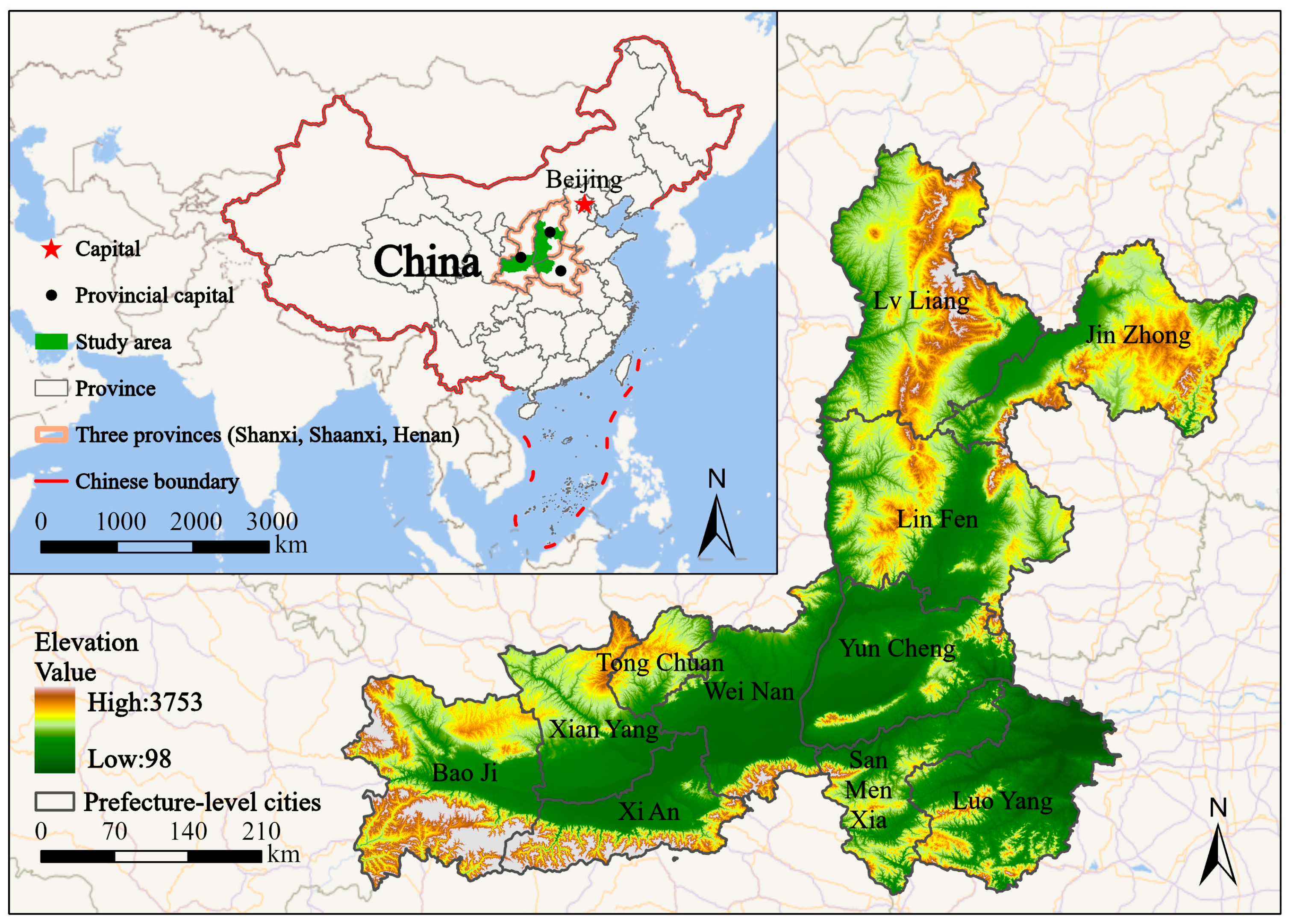
The Fenwei Plain (FWP) (33°33′–38°42′ N, 106°20′–114°07′ E) is a representative basin-type pollution hotspot in northern China, encompassing 11 cities across three provinces: Lvliang (LL), Jinzhong (JZ), Linfen (LF), and Yuncheng (YC) in Shanxi; Xi’an (XA), Tongchuan (TC), Baoji (BJ), Xianyang (XY), and Weinan (WN) in Shaanxi; and Sanmenxia (SMX) and Luoyang (LY) in Henan. Topographically, the FWP is a flat interior basin enclosed by the Lvliang Mountains and the northern foothills of the Qinling Mountains [27]. This “mountain-enclosed” structure frequently induces stagnant meteorological conditions, such as thick inversion layers and low mixed-layer heights, which facilitate the localized accumulation of pollutants. As a major energy-industrial hub in the middle reaches of the Yellow River, the convergence of high emission intensity, complex terrain, and unfavorable meteorology makes the FWP a priority region for synergistic PM2.5 and O3 control in China [28,29].

2.2. Research Data

2.2.1. Data Source

Atmospheric pollutant data, including concentrations of PM2.5 and MDA8 O3 (maximum daily 8 h average O3) from 2015 to 2024 for the 11 studied cities, were obtained from the China National Environmental Monitoring Centre (CNEMC, http://www.cnemc.cn/). Multiple monitoring stations are established for each pollutant, with data recorded at an hourly frequency.
Administrative boundary data for the study area were sourced from the National Geomatics Center of China (NGCC, http://www.ngcc.cn/). Using city-level administrative boundaries as vector data, raster data for the study area were extracted via mask operations in ArcGIS Pro 3.0. Subsequently, mean PM2.5 and O3 concentrations were statistically calculated across multiple timescales—including annual, seasonal, monthly, and daily intervals—to construct a comprehensive spatiotemporal sequence of pollutant concentrations for the Fenwei Plain from 2015 to 2024.
Digital Elevation Model (DEM) data used for the GTWR analysis were retrieved via the Open-Meteo Elevation API, which utilizes the CGIAR/SRTM 90 m (Version 4) dataset. This ensured that topographic parameters were extracted using the same coordinate-based sampling strategy and bilinear interpolation as the meteorological data, thereby reconciling the spatial resolution discrepancies at the station scale. Separately, the Google Earth Engine (GEE) platform was employed to process the same SRTM 90 m dataset specifically for generating high-resolution spatial visualizations, such as the study area overview map (Figure 1). Meteorological data were primarily sourced from the Open-Meteo open-source database (https://open-meteo.com/en/docs (accessed on 20 January 2026)), supplemented by data from the National Meteorological Science Data Center (https://data.cma.cn/). The acquired meteorological parameters include Mean Temperature (MT), Relative Humidity (RH), Mean Wind Speed (MW), Sunlight Duration (SD) and Precipitation (PRE). For occasional missing meteorological observations, linear interpolation was applied to ensure the continuity of the time series and the accuracy of the analysis.

2.2.2. Data Processing

Based on the hourly PM2.5 and O3 monitoring data from 11 prefecture-level cities in the Fenwei Plain (2015–2024), data screening was initially performed according to the study’s spatial and temporal scope. First, invalid records and extreme outliers were excluded through concentration threshold verification. Subsequently, a stratified strategy was employed to handle missing values: for individual stations with a missing rate below 5%, linear interpolation was applied for gap-filling; conversely, stations with a missing rate exceeding 5% were removed entirely to ensure time-series continuity and reliability. Finally, derived indicators such as the daily maximum 8 h average O3 concentration (MDA8 O3) were calculated based on the cleaned raw data. Concentration mean datasets across multiple timescales—including annual, seasonal, monthly, and daily intervals—were then generated to provide high-quality standardized inputs for subsequent spatiotemporal pattern analysis and model development. Considering the aforementioned criteria and the spatial distribution of stations, a total of 55 air quality monitoring stations were ultimately selected for this research [30].

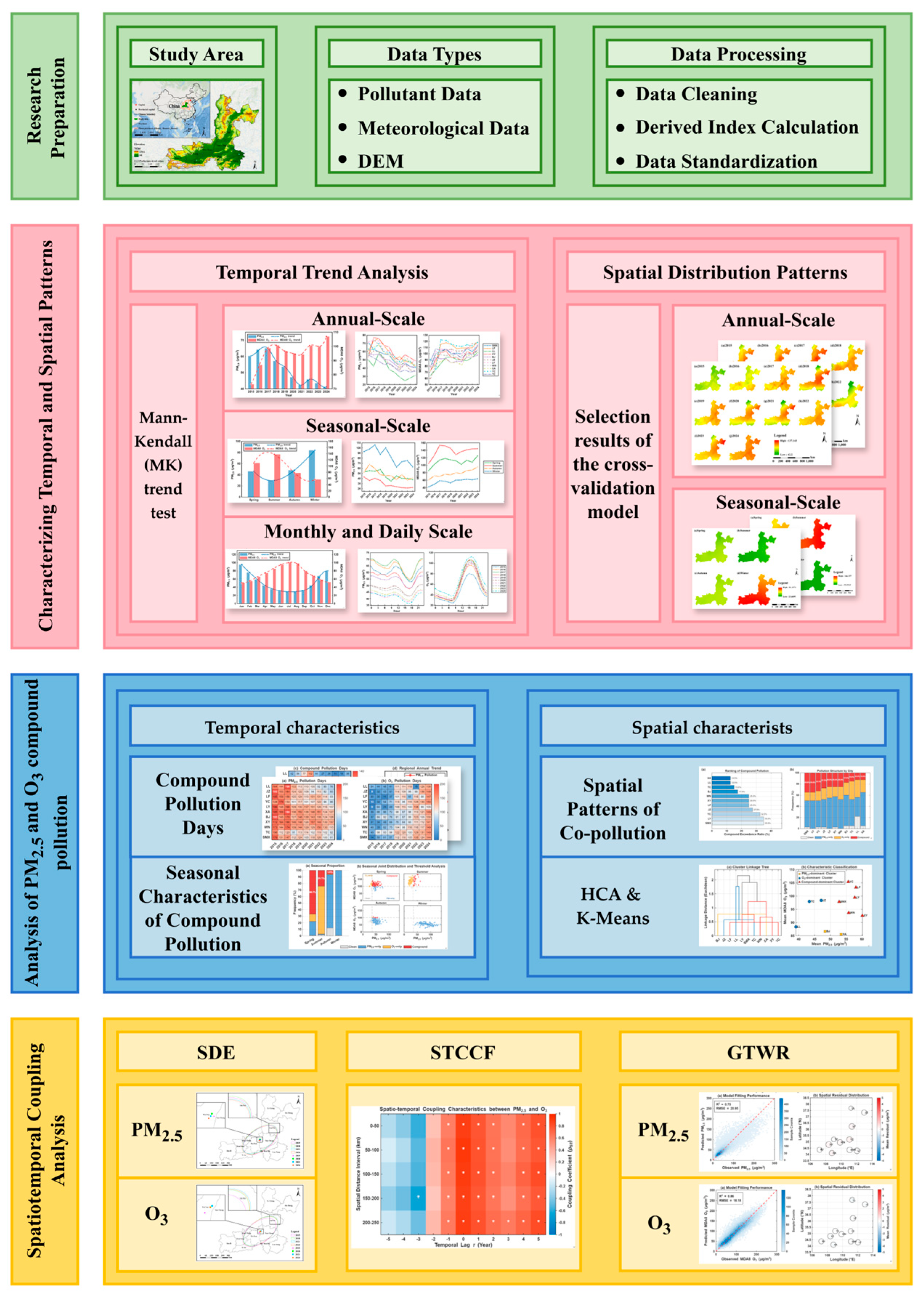
2.3. Methodology Overview

To systematically investigate the spatiotemporal dynamics and coupling relationships between PM2.5 and O3, a comprehensive research framework was designed as illustrated in Figure 2. The methodology is structured into four primary phases: (1) research preparation, including study area, data types and data processing; (2) characterizing temporal and spatial patterns of the pollutants; (3) analysis of PM2.5 and O3 compound pollution characteristics; and (4) spatiotemporal coupling analysis using advanced geostatistical and correlation models.

2.4. Research Methods

2.4.1. Mann–Kendall (MK) Trend Test

The non-parametric Mann–Kendall (MK) test was employed to detect monotonic trends in PM2.5 and O3 time series. The MK test is highly robust against non-normal distributions and outliers, which are common in environmental data. The test statistic S is calculated as follows:
S = i = 1 n 1 j = i + 1 n s g n ( x j x i )
where x i and x j are the sequential data values, n is the length of the dataset, and s g n ( θ ) is the sign function. For n > 10, the standardized statistic Z M K follows a standard normal distribution, computed as follows:
Z M K = S 1 V a r ( S ) , i f   S > 0 0 , i f   S = 0 S + 1 V a r ( S ) , i f   S < 0
The p-value derived from Z M K was used to evaluate the statistical significance of the trend. In this study, significance levels of α = 0.05 and α = 0.01 were adopted. A positive Z M K indicates an upward trend, while a negative value represents a downward trend. Specifically, | Z M K | > 1.96 and | Z M K | > 2.58 represent significant (p < 0.05) and highly significant (p < 0.01) trends, respectively.

2.4.2. Spatial Interpolation and Model Validation

(1)
Ordinary Kriging (OK)
Ordinary Kriging (OK) is a widely utilized geostatistical interpolation method for spatial estimation [31]. Its fundamental premise is the assumption of second-order stationarity, which posits that the attribute mean is a constant unknown across the study area, and the spatial autocorrelation depends solely on the distance between any two locations rather than their absolute positions [32].
The OK method characterizes the spatial structure of the data using a semivariogram. Under the constraint of an unbiasedness condition (where the sum of weights equals 1), the method minimizes the estimation variance to achieve the Best Linear Unbiased Estimation (BLUE). For an unsampled location x 0 , the attribute value Z ^ ( x 0 ) is estimated as a linear combination of the observed values at neighboring sample points:
Z ^ ( x 0 ) = i = 1 n λ i Z ( x i ) , s u b j e c t   t o i = 1 n λ i = 1
where Z ( x i ) represents the observed value at the i -th sample point, n is the number of sample points involved in the interpolation, and λ i denotes the weight assigned to each point. The weights λ i are determined by solving the following Kriging system of equations:
j = 1 n λ j C ( x i , x j ) + μ = C ( x i , x 0 ) ( i = 1,2 , , n ) i = 1 n λ i = 1
In this system, C x i , x j is the covariance between sample points x i and x j , and μ represents the Lagrange multiplier used to minimize the error variance.
To formally define the spatial structure, C h is the spatial autocovariance function for a lag distance h , which characterizes the statistical correlation between two spatial variables. It is defined as follows:
C h = E Z x · Z x + h m 2
where E [ · ] denotes the mathematical expectation and m is the stationary mean.
The relationship between the covariance C h and the semivariogram γ ( h ) is defined as follows:
C ( h ) = C ( 0 ) γ ( h )
where C 0 is the variance of the data, which corresponds to the Sill in the variogram model. The semivariogram γ ( h ) is determined by fitting a theoretical model (e.g., Gaussian, Spherical, or Exponential models) to the experimental semivariogram derived from the sample data:
γ ( h ) = 1 2 N ( h ) i = 1 N ( h ) [ Z ( x i ) Z ( x i + h ) ] 2
where N h is the number of pairs of sample points separated by distance h .
(2)
Model Performance Evaluation and Cross-validation
To ensure the predictive accuracy and reliability of the Ordinary Kriging (OK) models, a Leave-One-Out Cross-Validation (LOOCV) procedure was implemented [33,34,35]. This method involves sequentially removing each monitoring station and using the remaining n − 1 stations to predict the concentration at the excluded location. The interpolation performance was quantitatively assessed across multiple dimensions—unbiasedness, stability, and predictive capability—using five statistical diagnostic metrics: Mean Error (ME), Root Mean Square Error (RMSE), Average Standard Error (ASE), Mean Standardized Error (MSE), and Root Mean Square Standardized Error (RMSSE). The mathematical definitions and optimal value thresholds for these parameters are summarized in Table 1. Specifically, an ideal interpolation result is characterized by an ME and MSE close to 0, a minimized RMSE, and an RMSSE approaching 1. These metrics serve as the scientific basis for selecting the optimal theoretical semivariogram model for PM2.5 and O3 mapping.

2.4.3. Methods of PM2.5 and O3 Compound Pollution Analysis

(1)
Definition of Compound Pollution Days
To systematically quantify the dynamic coupling characteristics of PM2.5 and O3 at multiple timescales, this study constructed a daily air quality classification system for the Fenwei Plain from 2015 to 2024. This system integrates guidelines from the World Health Organization (WHO) and current Chinese ambient air quality standards. Specifically, a Daily mean PM2.5 concentration > 75   μ g / m 3 and a Maximum Daily 8 h Average (MDA8) O3 concentration > 160   μ g / m 3 were defined as the exceedance thresholds for each pollutant, respectively.
Based on these dual thresholds, data records were categorized into four distinct types:
  • Compound Pollution Days: Dates when both PM2.5 and O3 concentrations simultaneously exceeded their respective limits, reflecting periods of intensified risk due to dual-pollutant superposition.
  • PM2.5-only Pollution Days: Dates when only PM2.5 concentrations exceeded the threshold.
  • O3-only Pollution Days: Dates when only O3 concentrations exceeded the threshold.
  • Clean Days: Dates when concentrations of both pollutants remained below their respective limits.
This classification system anchors the regulatory targets with national concentration limit values and systematically delineates the synergistic characteristics of PM2.5 and O3. Furthermore, it establishes a high-quality standardized foundation for the subsequent spatial analysis of pollution patterns and model development in the study area.
(2)
Integrated Spatial Clustering Strategy (HCA & K-Means)
To objectively identify city clusters with distinct compound pollution patterns, this study employed an integrated spatial clustering strategy, combining Agglomerative Hierarchical Clustering (HCA) and K-Means clustering algorithm [36,37]. The input features for clustering comprised the multi-year (2015–2024) mean concentrations of PM2.5 and MDA8 O3, and the compound exceedance ratio for each of the 11 monitored cities. All input features were normalized (z-score standardization) prior to analysis.
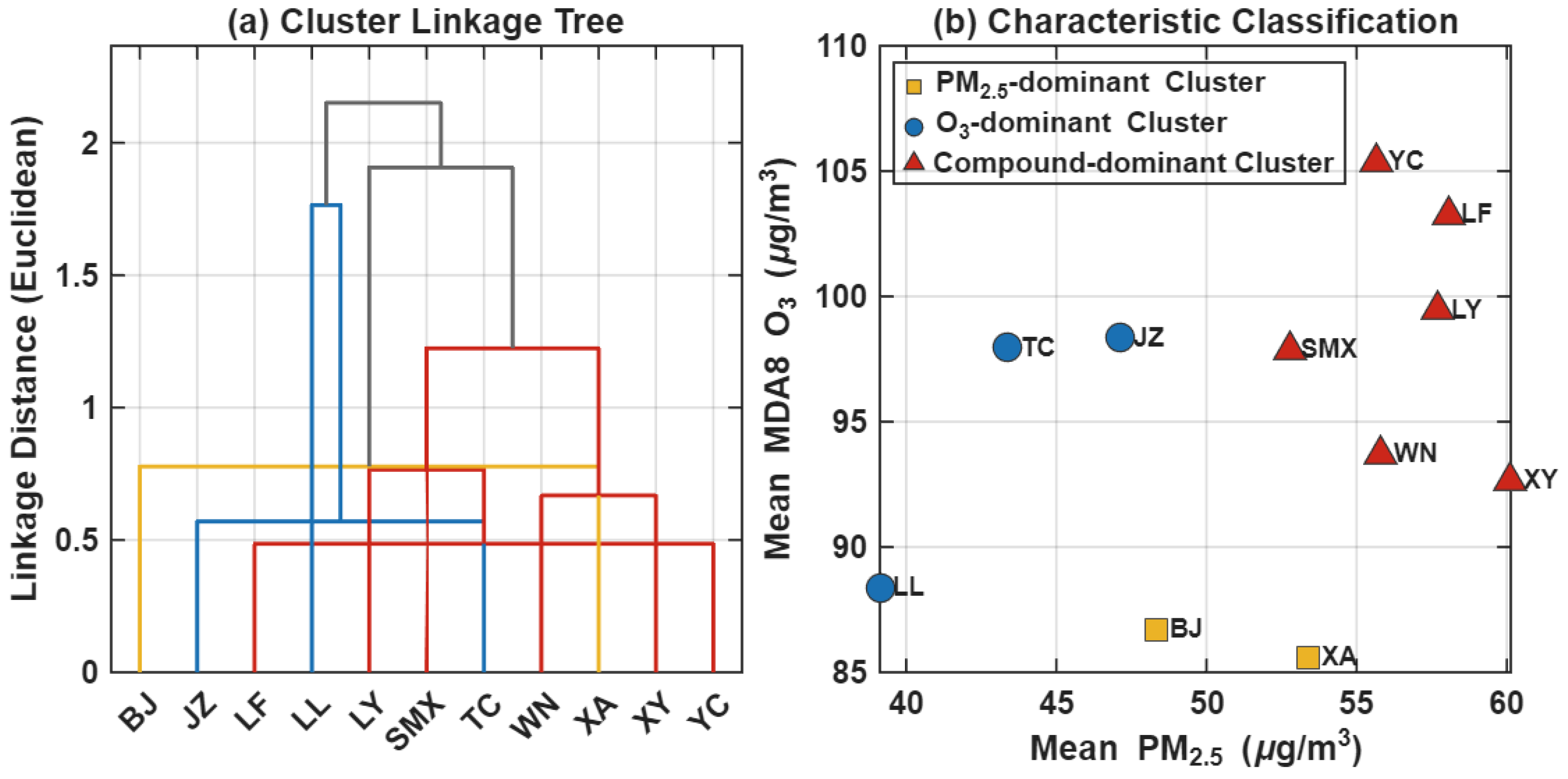
First, HCA was implemented to discover the natural hierarchical structure of the city dataset. This unsupervised method iteratively merges the closest pairs of clusters based on their spatial distance. A linkage tree (Dendrogram) was generated to visualize these relationships, where the X-axis represents individual cities and the Y-axis denotes the Euclidean linkage distance (indicating the degree of dissimilarity). The branch heights correspond directly to the distance at which clusters are merged, with higher branches signifying greater differences in compound pollution characteristics between the merged clusters. Crucially, the distinct branching structure of the dendrogram provided a clear, intuitive, and objective basis for determining the optimal number of clusters ( K ) for the subsequent analysis, rather than using arbitrary selection.
Subsequently, based on the natural cluster divisions identified by HCA, the K-Means algorithm was applied to achieve the final spatial classification. To quantitatively validate the optimal number of clusters ( K ), we employed the Elbow Method and Silhouette Analysis. The K-Means algorithm aimed to minimize the Within-Cluster Sum of Squares (WCSS). The objective function J is defined as follows:
J = k = 1 K i C k x i μ k 2
where C k is the set of cities in the k -th cluster, x i is the normalized feature vector of the i -th city, and μ k is the centroid (mean vector) of the k -th cluster.
The Elbow Method was used to observe the rate of decrease in WCSS as K increased. A distinct “elbow” point was identified at K = 3 , where the WCSS was 6.20, and the addition of more clusters yielded diminishing returns in further reducing the internal variance. Furthermore, the Silhouette Coefficient ( S ), which measures the cohesion of clusters and the separation between them, was calculated to assess the clustering quality. The average silhouette value reached its maximum at K = 3 (approx.0.394). Considering the spatial continuity and regional transport of atmospheric pollutants, this value confirms that the three-cluster partition provided a robust and well-separated cluster structure for the Fenwei Plain.
The algorithm optimizes the final partitions through iterative two-step refinement:
  • Assignment Step: Each city i is assigned to the cluster whose centroid is closest to its standardized vector, according to the condition:
    C k = { i : x i μ k x i μ j , j k }
  • Update Step: The centroids of each of the K clusters are recalculated based on their assigned members.
Through this integrated approach, the cities across the Fenwei Plain were robustly partitioned into three distinct groups: PM2.5-dominant, O3-dominant, and Compound-dominant pollution hotspots. This objective spatial grouping directly informed the development of differentiated, zonally targeted dual-control strategies tailored to each cluster’s unique pollution drivers.

2.4.4. Methods of Spatio-Temporal Interaction and Coupling Analysis

(1)
Standard Deviation Ellipse (SDE)
The Standard Deviation Ellipse (SDE) was employed to characterize the spatio-temporal evolution of PM2.5 and O3 distributions [38,39,40]. By quantifying parameters such as the mean center, major/minor axes, and rotation angle, the SDE effectively captures the spatial concentration, orientation, and dispersion trends of pollutants. The weighted mean center (X, Y) is defined as follows:
X = i = 1 n w i x i i = 1 n w i , Y = i = 1 n w i y i i = 1 n w i
where ( x i , y i ) are the spatial coordinates of city i , and w i represents the pollutant concentration as the spatial weight. The lengths of the major and minor axes are derived from the eigenvalues ( λ 1 , λ 2 ) of the weighted covariance matrix, representing the primary and secondary directions of pollution spread, respectively. The rotation angle θ indicates the orientation of the pollution corridor relative to true north.
(2)
Spatio-Temporal Cross-Correlation Function (STCCF)
To investigate the multi-year synergistic evolution and potential “memory effects” between PM2.5 and O3, the Spatio-Temporal Cross-Correlation Function (STCCF) was utilized. Unlike traditional correlation analysis, STCCF quantifies the interaction intensity between these two pollutants across various temporal lags ( τ ) and spatial distance intervals (d).
For the normalized annual sequences of PM2.5 (X) and O3 (Y), the coupling coefficient S T C C F ( τ , d ) is defined as follows:
S T C C F ( τ , d ) = 1 N d ( i , j ) : D i j d c   o r ( X i , t , Y j , t + τ )
where
  • Temporal Lag ( τ ): Set from −5 to 5 years. A positive τ indicates the potential impact of PM2.5 on subsequent O3 levels, while a negative τ suggests the reverse.
  • Spatial Distance (d): To capture the regional transport scale within the Fenwei Plain, the spatial distance was categorized into five 50 km intervals: 0–50 km, 50–100 km, 100–150 km, 150–200 km, and 200–250 km.
  • N d : Represents the number of city pairs within each spatial bin d .
  • c o r ( X i , t , Y j , t + τ ) represents the Pearson correlation coefficient between the normalized sequences of the two pollutants.
  • The asterisk (*) denotes that the raw data sequences have been normalized (via zero-mean and unit-variance scaling) prior to the calculation, ensuring the variables are dimensionless and comparable.
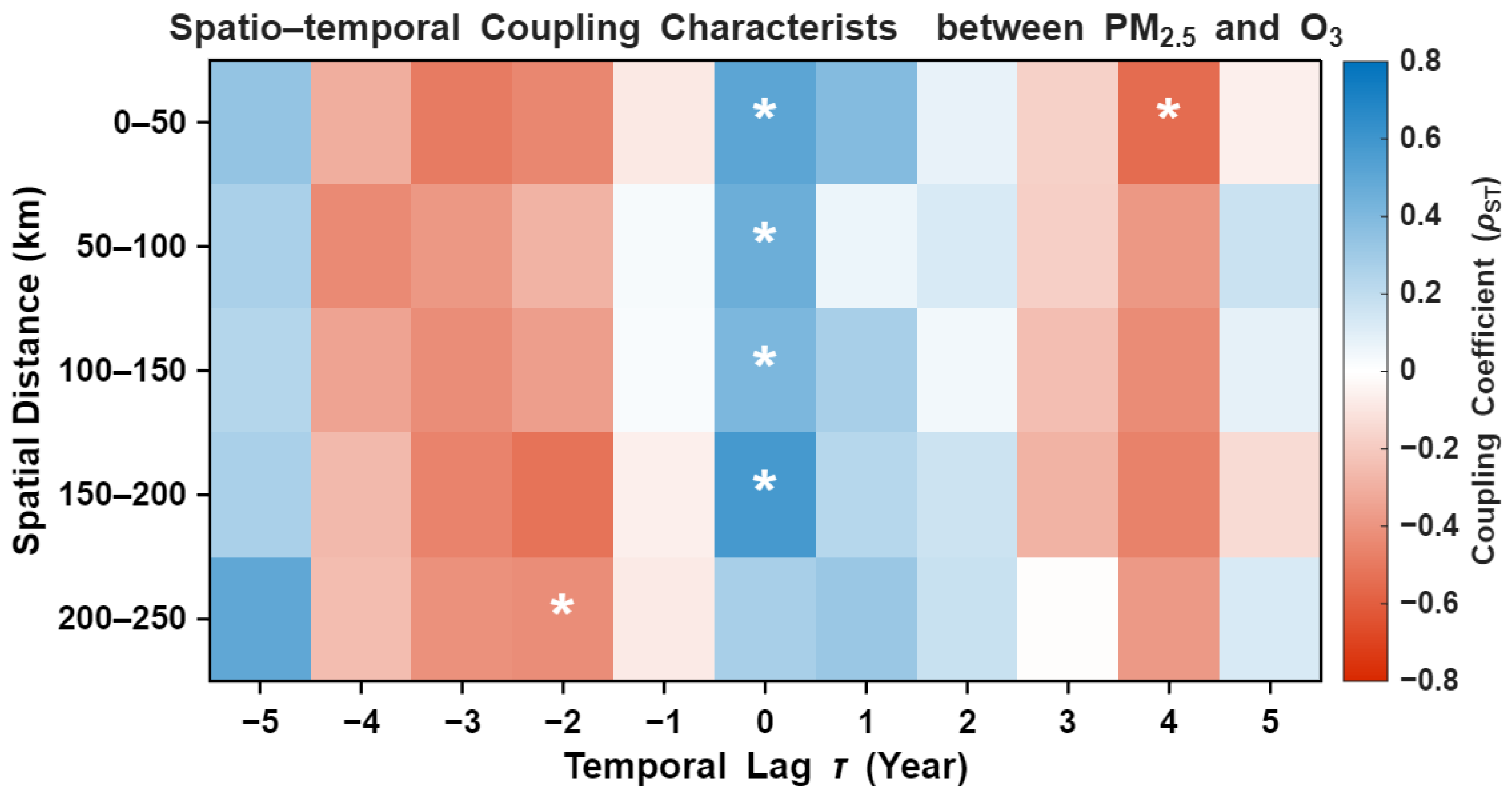
To ensure the reliability of the observed coupling patterns, a Permutation Test (1000 iterations) was performed. Significant spatio-temporal correlations ( p < 0.05 ) are identified by white asterisks (*) in the resulting heatmap. This method effectively isolates whether the observed PM2.5-O3 coupling is a localized phenomenon or a long-range, delayed regional interaction.
(3)
Geographically and Temporally Weighted Regression (GTWR)
The Geographically and Temporally Weighted Regression (GTWR) model was implemented to capture the spatio-temporal non-stationarity of the drivers influencing PM2.5 and O3 concentrations [41,42]. By incorporating a temporal dimension into the traditional GWR, GTWR generates local rather than global regression coefficients:
y i = β 0 ( u i , v i , t i ) + k = 1 p β k ( u i , v i , t i ) x i k + ε i
where ( u i , v i , t i ) represents the spatio-temporal coordinates of the i -th observation; p denotes the total number of explanatory variables, and k represents the index of each independent variable. The core of GTWR is the construction of a spatio-temporal weight matrix w i j using a Gaussian kernel:
w i j = exp 1 2 d s , i j b s 2 1 2 d t , i j b t 2
where d s , i j and d t , i j are the spatial and temporal distances, respectively. The spatial bandwidth ( b s ) and temporal bandwidth ( b t ) were optimized to 0.8 and 1.0, respectively, ensuring that the model captures localized variations while maintaining statistical robustness.

3. Results

3.1. Temporal Variation Characteristics

3.1.1. Results of Time Series Trend Analysis

Between 2015 and 2024, air pollution patterns in the Fenwei Plain underwent a significant shift [43]. MK test results, which are presented in Table 2, indicated a consistent and significant downward trend in PM2.5 concentrations across the region and in individual cities, with a regional Z = 3.04   ( p < 0.01 ) . This reduction was most pronounced in cities such as SMX, YC, and TC, validating the efficacy of emission control policies like the “Blue Sky Defense War.”
Conversely, MDA8 O3 concentrations exhibited an overall increasing trend ( Z = 1.79 ). Although this did not reach the 95% significance level, it approached the threshold. At the city level, O3 levels in JZ and XA rose significantly, while SMX and XY showed near-significant upward trends. In contrast, only TC recorded a non-significant decrease, potentially due to industrial restructuring and intensive precursor emission reductions. Overall, the region has transitioned into a phase characterized by “PM2.5 mitigation and O3 rebound.” Future strategies should therefore shift from PM2.5-centric controls to synergistic management of both PM2.5 and O3, specifically targeting precise NOx and VOCs reductions [44,45,46].

3.1.2. Annual-Scale Variation Trends

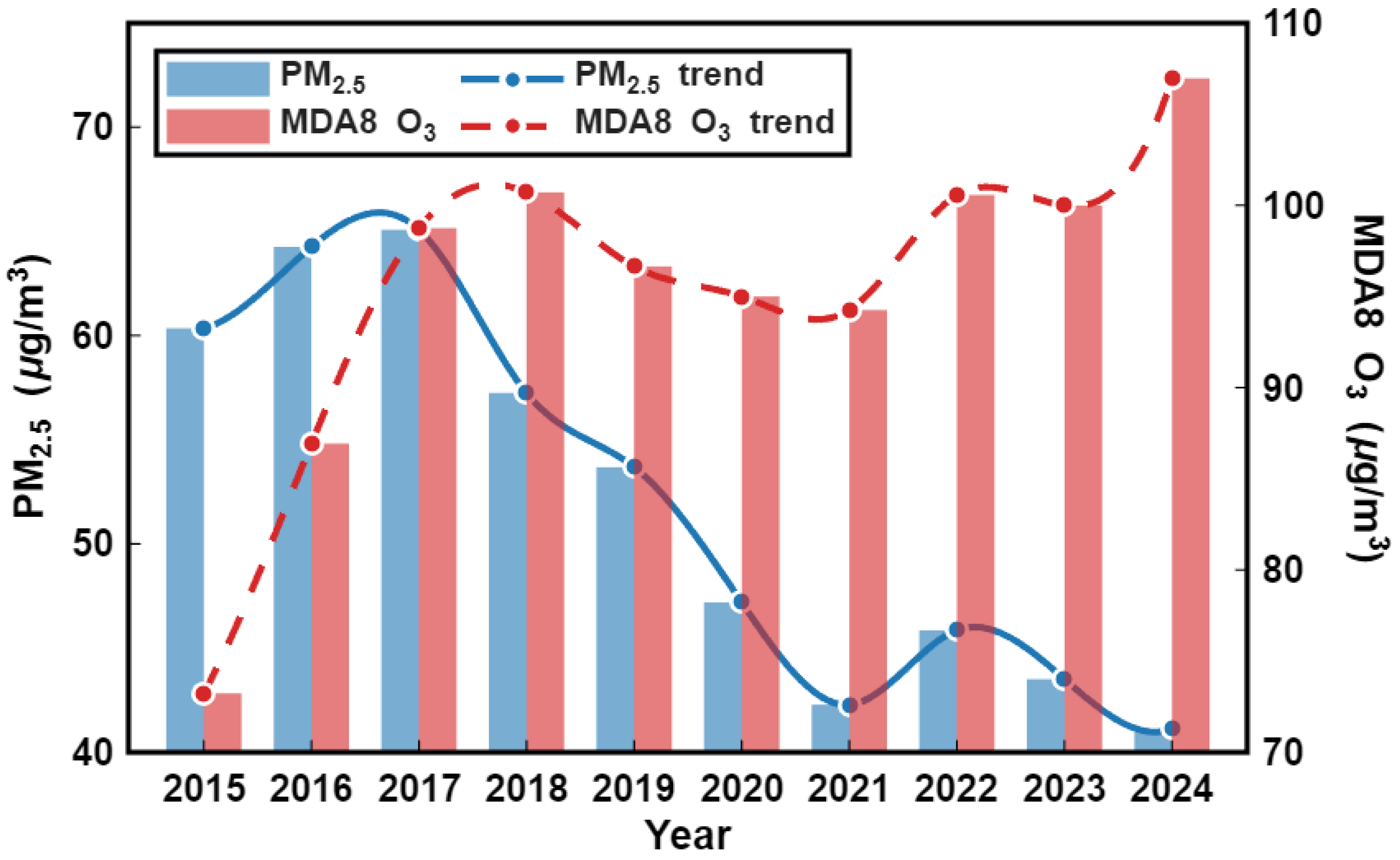
Figure 3 illustrates the interannual variation characteristics of two typical atmospheric pollutants in the Fenwei Plain from 2015 to 2024, clearly revealing a transition in regional air pollution patterns. The PM2.5 concentration exhibited a significant declining trend, fluctuating from approximately 60 μ g / m 3 in 2015 to 41 μ g / m 3 in 2024, representing a reduction of about 32%. This decline reflects the effective control of fine particulate matter resulting from a series of mitigation measures, such as industrial restructuring and energy structure optimization in recent years. In sharp contrast, the MDA8 O3 concentration showed a fluctuating upward trajectory, rising from approximately 75 μ g / m 3 in 2015 to 110 μ g / m 3 in 2024. This 47% increase indicates that ozone has emerged as the primary challenge for current regional air quality management.
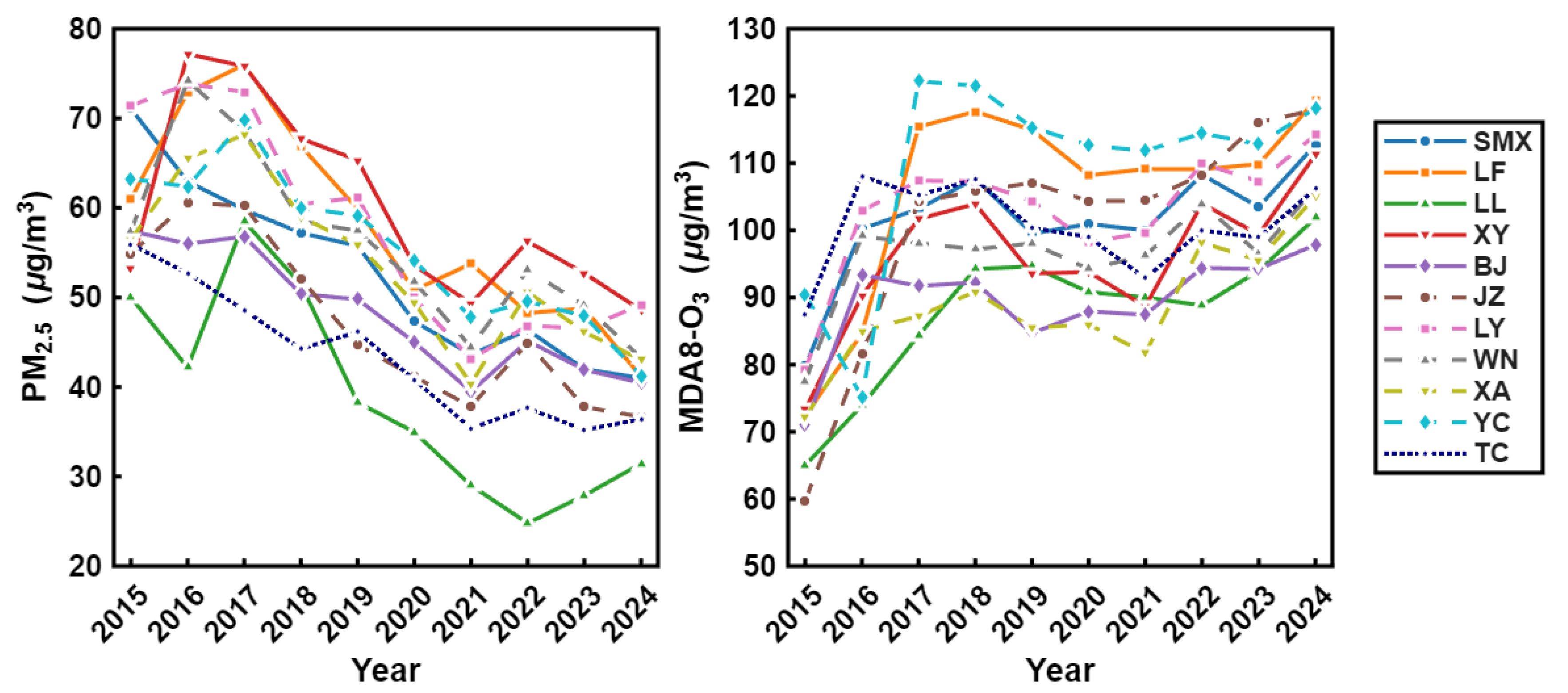
Figure 4 illustrates the temporal evolution of annual mean PM2.5 and MDA8 O3 concentrations across typical cities in the Fenwei Plain from 2015 to 2024. Contrary to the rising trajectory of MDA8 O3, PM2.5 concentrations in all cities exhibited a significant declining trend, highlighting the remarkable efficacy of regional emission reduction measures. Specifically, LL and TC recorded the most substantial decreases; in LL, the concentration dropped from approximately ~ 50 μ g / m 3 in 2015 to about ~ 30 μ g / m 3 in 2024, representing a reduction of over 40%. Similarly, concentrations in SMX and YC decreased from over 70 μ g / m 3 initially to below 50 μ g / m 3 by 2024. Despite minor short-term fluctuations in some cities, the consistent downward trend indicates that PM2.5 pollution in the Fenwei Plain has been effectively curtailed.
Overall, MDA8 O3 concentrations in all cities showed a fluctuating upward trend, revealing that ozone has emerged as a burgeoning challenge for regional air quality. Notably, YC and LF experienced the most significant increases, with the peak concentration in YC exceeding 120 μ g / m 3 and LF approaching 120 μ g / m 3 in 2024. Although LL maintained relatively lower overall levels, it also exhibited a steady rise from approximately 65 μ g / m 3 in 2015 to 102 μ g / m 3 in 2024. While the magnitude of change varied by city, the collective upward trajectory underscores the intensifying pressure of ozone pollution, which is consistent with the significant upward trends identified by the Mann–Kendall (MK) test.

3.1.3. Seasonal-Scale Variation Results

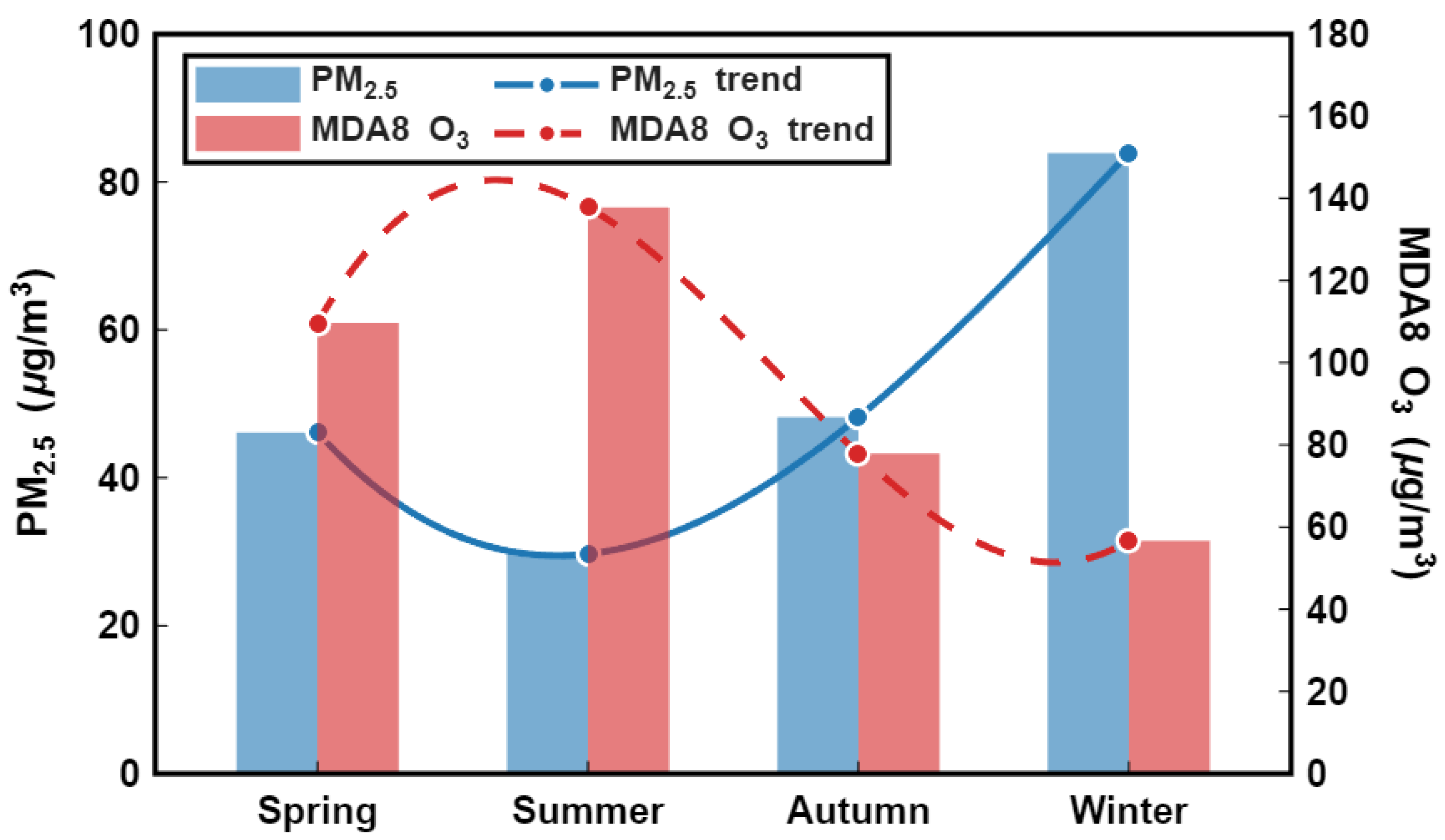
Figure 5 clearly illustrates the seasonal distribution of the two primary atmospheric pollutants in the Fenwei Plain, revealing significant seasonal heterogeneity and transition patterns. MDA8 O3 concentrations peaked in summer ( ~ 140   μ g / m 3 ), substantially exceeding other seasons due to intensive photochemical activity under high temperatures and strong solar radiation. Concentrations were secondary in spring ( ~ 110   μ g / m 3 ) and declined markedly in autumn ( ~ 80   μ g / m 3 ) and winter ( ~ 55   μ g / m 3 ), reflecting the strong dependence of ozone formation on meteorological factors. In sharp contrast, P M 2.5 followed a typical “winter-high and summer-low” pattern: concentrations reached a maximum in winter ( ~ 85   μ g / m 3 ), remained comparable in autumn ( ~ 50   μ g / m 3 ) and spring ( ~ 45   μ g / m 3 ), and dropped to a minimum in summer ( ~ 30   μ g / m 3 ). This distribution pattern is attributed to enhanced emissions during the winter heating period, as well as the beneficial effects of precipitation scavenging and improved dispersion conditions in summer. These seasonal dynamics confirm that air pollution in the Fenwei Plain is dominated by P M 2.5 in winter and shifts to O 3 in summer, with both pollutants exerting synergistic effects during spring and autumn.
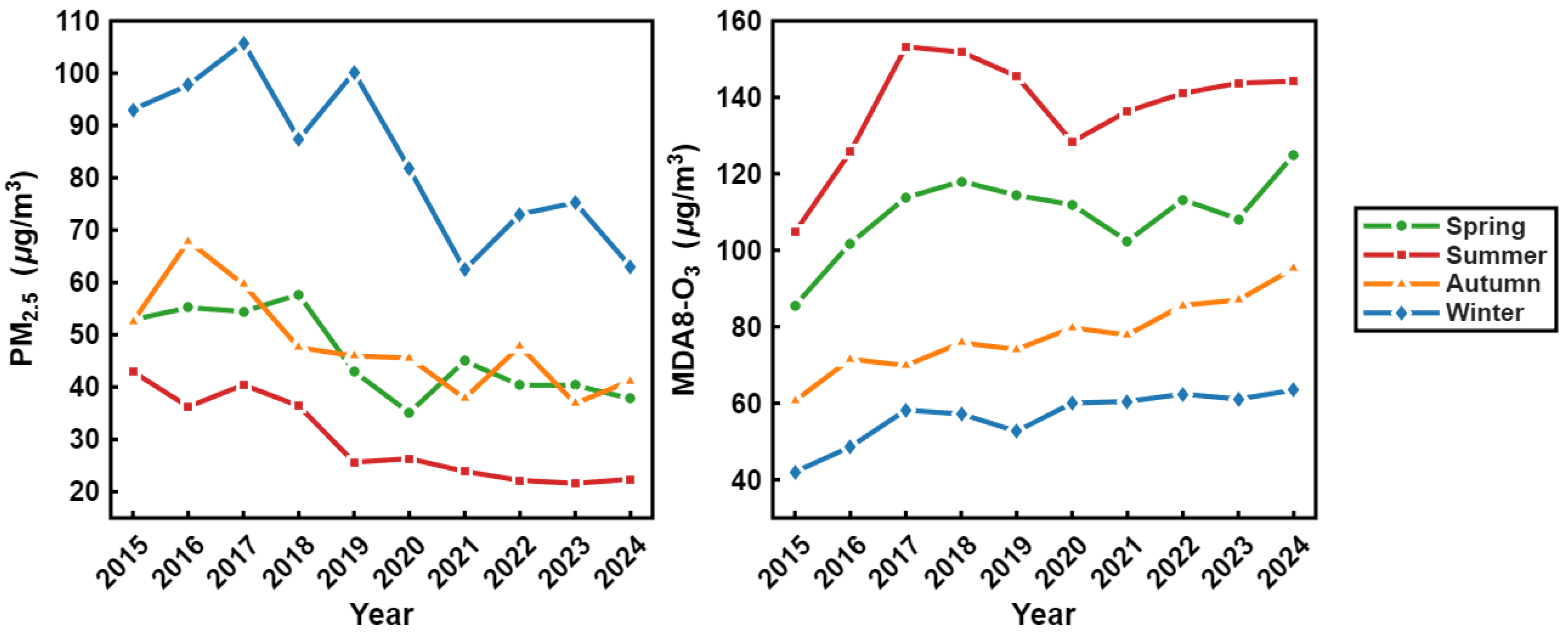
From 2015 to 2024, the seasonal concentration trends of PM2.5 and MDA8 O3 in the Fenwei Plain clearly reveal distinct seasonal heterogeneity and shifting interannual patterns (Figure 6). PM2.5 concentrations consistently followed a typical pattern of peaking in winter and reaching minimums in summer. Furthermore, interannual winter concentrations exhibited a fluctuating downward trend, reflecting the superposition effect of emissions during the winter heating period and unfavorable dispersion conditions, while also verifying the effectiveness of regional emission reduction measures in curbing particulate pollution. In sharp contrast, MDA8 O3 concentrations displayed a seasonal distribution characterized by summer peaks and winter lows, with interannual summer concentrations showing a fluctuating upward trajectory. This demonstrates the strong dependence of ozone formation on meteorological conditions marked by high temperatures and intense solar radiation.

3.1.4. Monthly and Daily Scale Variation Results

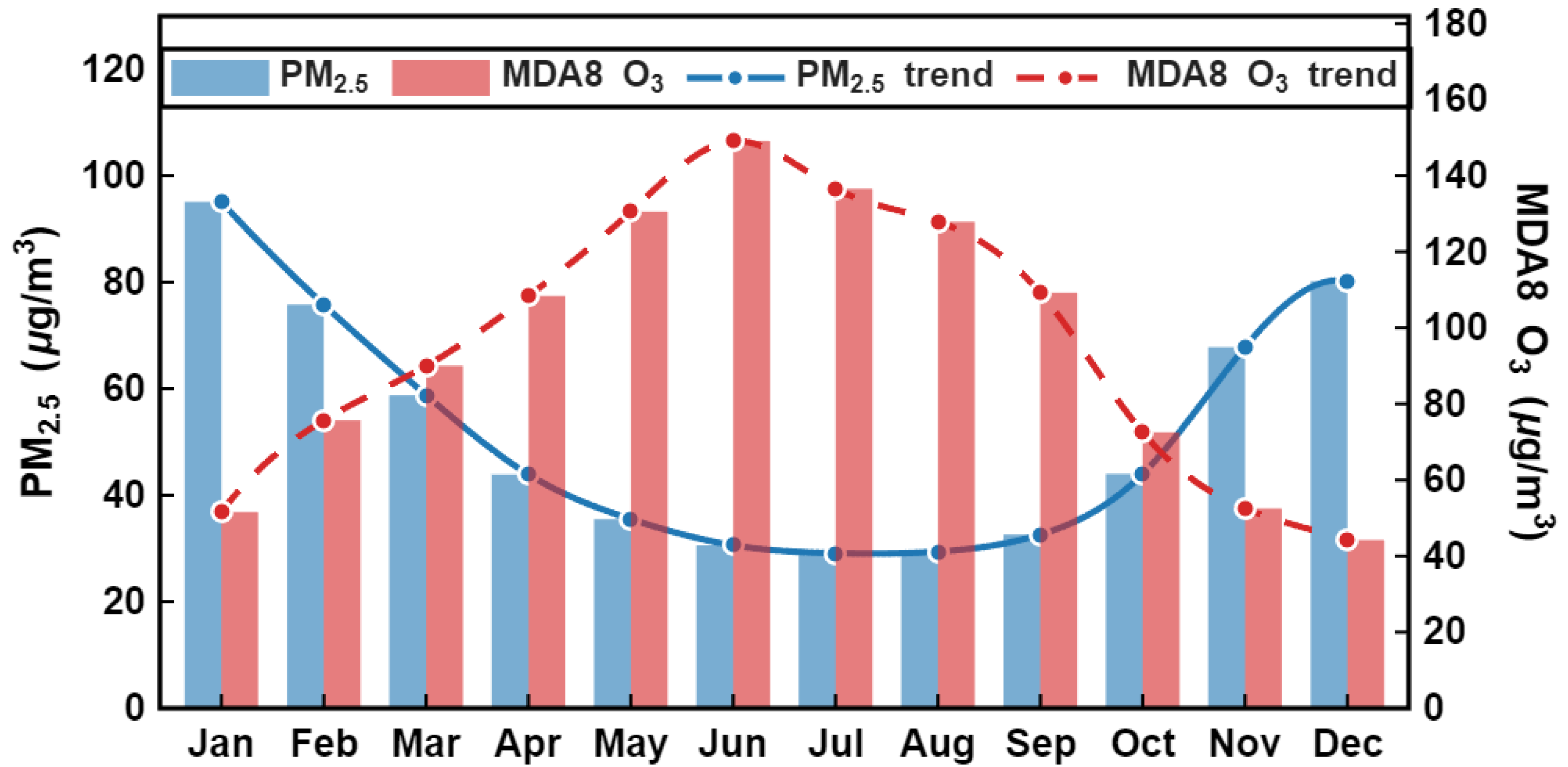
Figure 7 illustrates the intra-annual variation in monthly mean PM2.5 and MDA8 O3 concentrations in the Fenwei Plain from 2015 to 2024. The left and right vertical axes represent the concentrations of PM2.5 and MDA8 O3 ( μ g / m 3 ), respectively.
As shown, P M 2.5 concentrations exhibited a pronounced “winter-high and summer-low” pattern. Annual peaks were recorded in January ( 95   μ g / m 3 ) and December ( 80   μ g / m 3 ), while concentrations declined significantly during the summer (June–August), reaching an annual minimum in July ( ~ 30   μ g / m 3 ). This seasonal cycle is closely associated with enhanced emissions from winter heating and unfavorable atmospheric dispersion conditions, as well as the effective scavenging effect of increased precipitation during the summer months.
Conversely, MDA8 O3 concentrations exhibited a contrasting seasonal pattern, peaking during the summer months with values reaching approximately 140 μ g / m 3 . This summer maximum is primarily attributed to enhanced photochemical reactions driven by stronger solar radiation and higher temperatures, which accelerate the conversion of precursors into ground-level ozone. In contrast, the lower O3 levels observed in winter are linked to reduced photolysis rates and the titration effect of NO under stable atmospheric conditions.
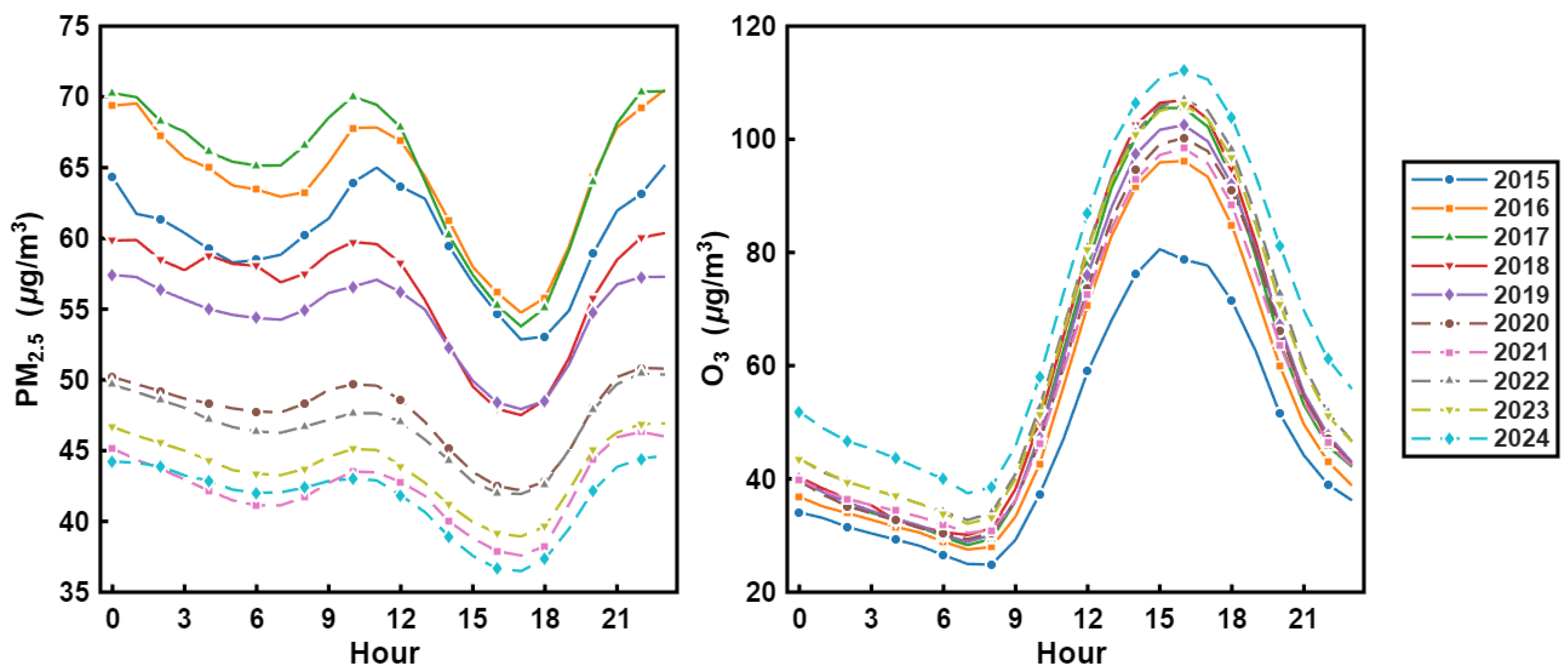
The left panel illustrates the diurnal variation characteristics of hourly mean P M 2.5 concentrations in the Fenwei Plain from 2015 to 2024 (Figure 8). Overall, PM2.5 exhibited a typical “bimodal” diurnal pattern. Two concentration peaks were observed during the morning (9:00–11:00) and evening (21:00–23:00), which are primarily attributed to increased traffic emissions during rush hours and the compression of the planetary boundary layer (PBL) height, leading to unfavorable dispersion conditions. Conversely, concentration valleys occurred in the afternoon (16:00–18:00) and predawn (5:00–7:00). The afternoon minimum is associated with a higher PBL and enhanced thermal turbulence favoring pollutant dilution, while the predawn low reflects the gradual dispersion of overnight accumulation.
The right panel presents the corresponding diurnal profiles for O3 during the same period, showing a prominent “unimodal” distribution. O3 concentrations remained low from night to early morning (0:00–7:00). With the intensification of solar radiation and rising temperatures, photochemical reactions accelerated, causing a rapid increase in O3 that peaked in the afternoon (15:00–17:00). Subsequently, concentrations declined in the evening as solar radiation weakened and the consumption of O3 through NOx titration increased.

3.2. Spatial Variation Characteristics

3.2.1. Selection Results of the Cross-Validation Model

The interpolation accuracy of Ordinary Kriging (OK) highly depends on the structural characteristics of the semivariogram (the mathematical expression of spatial autocorrelation). Therefore, the core objective of cross-validation is not merely the optimization of all parameters, but rather the identification of the optimal semivariogram model that best fits the spatial distribution characteristics of PM2.5 and O3 concentrations in the study area, while simultaneously verifying the rationality of the model parameters.
In this study, four classic semivariogram models—circular, Gaussian, spherical, and exponential—were fitted based on the training dataset to determine key structural parameters, including the nugget (C0), range (a), and sill (C0 + C). A comprehensive evaluation was conducted using five geostatistical cross-validation metrics: Mean Error (ME), Root Mean Square Error (RMSE), Average Standard Error (ASE), Mean Standardized Error (MSE), and Root Mean Square Standardized Error (RMSSE). The optimal semivariogram model was selected based on the criteria that ME and MSE approach 0, RMSE is minimized, RMSSE approaches 1, and ASE is closest to RMSE. This selected model serves as the final theoretical framework for the spatial interpolation of PM2.5 and MDA8 O3 in the Fenwei Plain from 2015 to 2024.
As illustrated in Table 3, the interpolation accuracies of the four semivariogram models for PM2.5 and MDA8 O3 exhibit distinct variations. For PM2.5, the Exponential model achieved the lowest RMSE (10.547), which was notably superior to the Circular (10.869), Gaussian (10.858), and Spherical (10.860) models. While the RMSSE of the Circular model (1.00459) was the closest to the ideal value of 1, the Exponential model’s RMSSE (0.970326) also remained within an acceptable range with high reliability.
Regarding MDA8 O3, the Exponential model also demonstrated the best performance in terms of unbiasedness. Specifically, its RMSE (12.189) was among the lowest, while the ME (−0.024892) and MSE (0.001127) were both near zero, suggesting negligible systematic bias. Consequently, considering both predictive accuracy and unbiasedness, the Exponential model was selected as the optimal semivariogram for the spatial interpolation of PM2.5 and MDA8 O3. This model will be employed for the subsequent simulation of the spatial distribution of air pollutants across the Fenwei Plain from 2015 to 2024.

3.2.2. Spatial Distribution at an Annual Scale

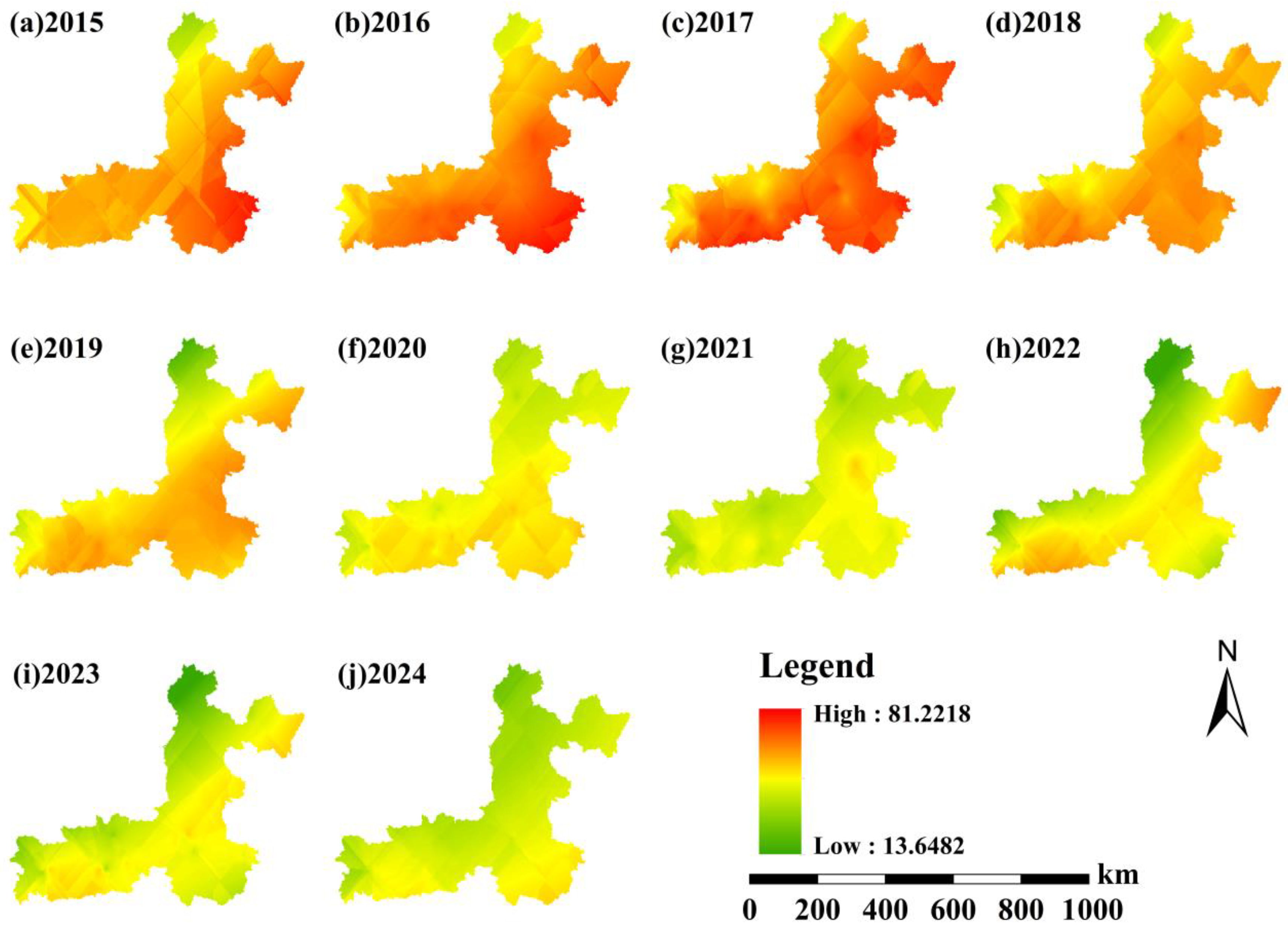
The spatial distribution of annual mean PM2.5 concentrations in the Fenwei Plain exhibits significant regional heterogeneity, with pollution intensity showing a distinct temporal gradient (Figure 9). As illustrated in the figure, high-concentration areas are primarily concentrated in the southern and western regions of the study area, encompassing cities such as BJ, XY, XA, and WN. These areas form a continuous pollution belt along the Weihe River Valley. This spatial clustering is closely associated with topographic blocking, intensive anthropogenic emissions (e.g., industrial clusters and vehicular traffic), and unfavorable meteorological conditions for pollutant dispersion.
From 2015 to 2024, PM2.5 concentrations across the entire plain demonstrated a significant downward trend. In 2015, large-scale areas exceeded the national annual air quality standards, with peak concentrations in core urban centers surpassing 80   μ g / m 3 . By 2023, the extent of high-pollution zones had contracted substantially, the overall concentration gradient had weakened, and air quality had improved markedly.
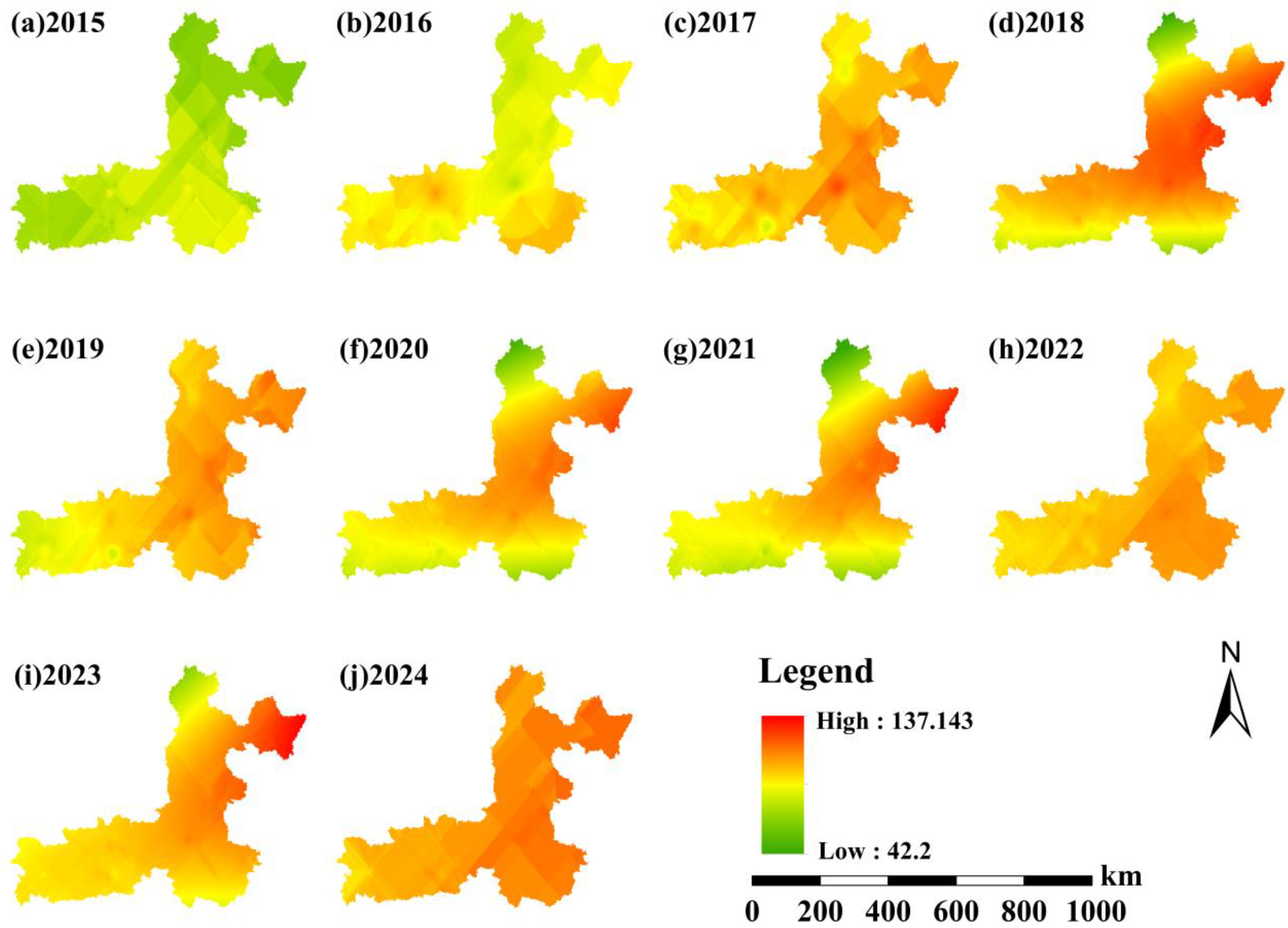
The spatial distribution of annual mean MDA8 O3 concentrations in the Fenwei Plain exhibits a distinct gradient pattern, characterized by higher levels in the south and west compared to the north and east, alongside pronounced spatial clustering of high-value zones (Figure 10). As illustrated in Figure 1, regions with elevated O3 concentrations ( 100   μ g / m 3 ) are predominantly concentrated in southern cities, including XA, XY, WN, and YC, whereas concentrations remain relatively lower in northern areas such as LL and LF.
This spatial heterogeneity is closely coupled with regional photochemical reaction conditions, precursor emission intensities, and meteorological dispersion factors. Southern cities, marked by dense populations and intensive industrial and vehicular activities, exhibit higher concentrations of VOCs and NOx. Coupled with stronger summer solar radiation, these factors create highly favorable conditions for O3 formation. Conversely, northern mountainous regions, characterized by higher vegetation cover and limited anthropogenic emissions, show a substantially lower potential for O3 generation.
From 2015 to 2024, the overall MDA8 O3 concentrations followed a trend of “initial increase followed by stabilization.” Between 2015 and 2020, high-concentration zones expanded and levels in core urban centers climbed steadily, likely driven by rapid regional economic growth, rising precursor emissions, and unfavorable stagnant meteorological conditions (e.g., high temperatures). From 2020 to 2024, however, the previously rapid growth of O3 entered a stabilization phase, with concentrations fluctuating at a high level rather than continuing their steep upward trajectory. This shift suggests that the implementation of the ‘Blue Sky Defense Action Plan’ and targeted O3 control measures effectively curbed the sharp increasing momentum, even though an absolute decrease in concentrations has not yet been achieved. Consequently, the expansion of high-value areas slowed down, and the spatial concentration gradient became relatively stable.

3.2.3. Spatial Distribution at a Seasonal Scale

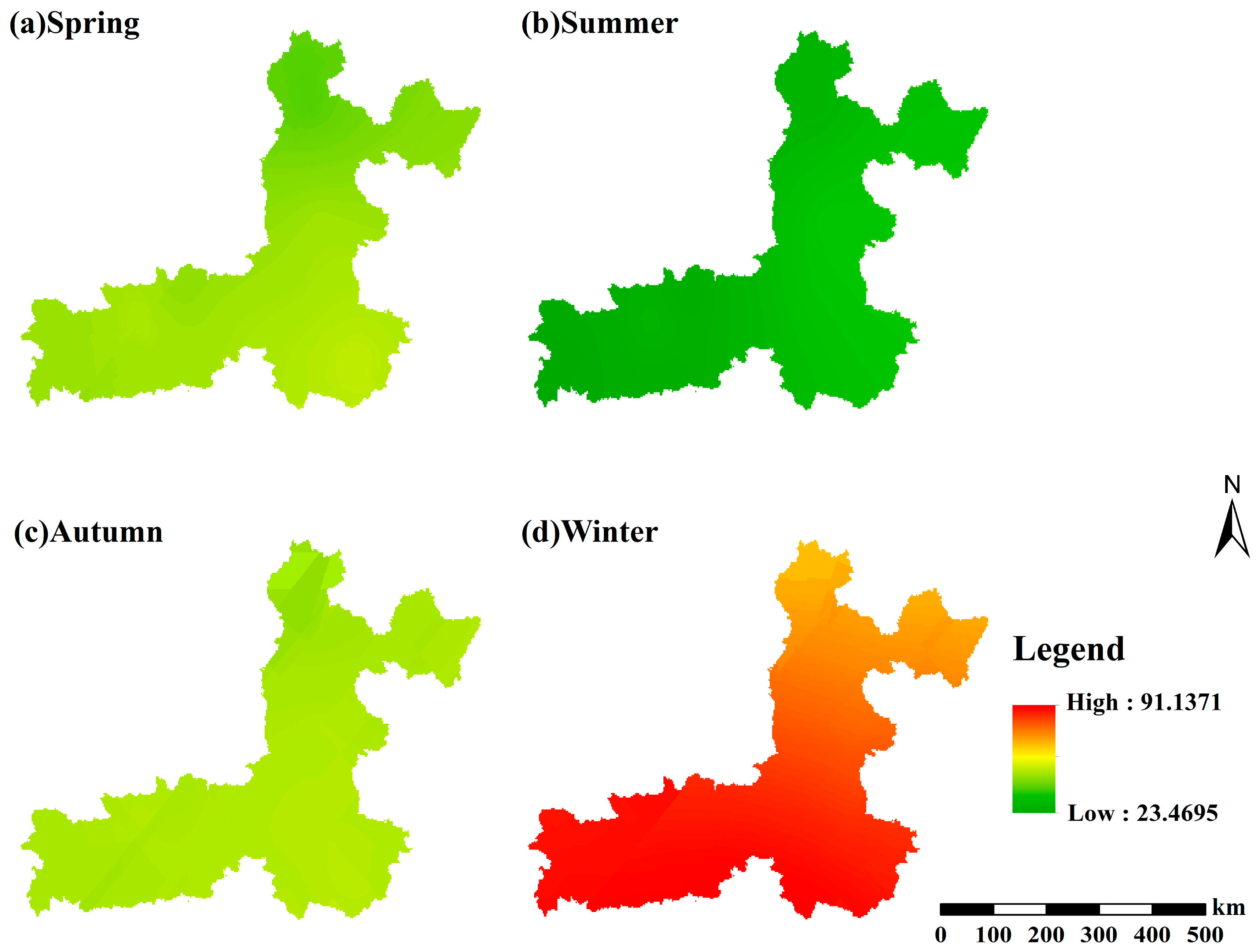
From 2015 to 2024, the spatial patterns of seasonal mean PM2.5 concentrations in the Fenwei Plain exhibited distinct seasonal variations (Figure 11). In winter, a continuous belt of high-value clusters formed along the Weihe River Valley, with both pollution intensity and spatial extent reaching their annual peaks. This phenomenon is primarily attributed to the surge in coal combustion emissions during the heating season, coupled with unfavorable dispersion conditions such as stagnant meteorological patterns and temperature inversions, which facilitate the persistent accumulation of pollutants.
Spring and autumn serve as transitional periods; although pollution levels decline, the southern plain area maintains a relatively clustered distribution. These patterns are influenced by residual emissions from the heating season and the accumulation of precursors, respectively. In contrast, summer concentrations decrease significantly across the entire region, leading to a more uniform and cleaner spatial distribution. This improvement is driven by enhanced vertical mixing within the atmospheric boundary layer, increased precipitation scavenging efficiency, and reduced emission intensities. Fundamentally, this seasonal spatial heterogeneity results from the coupled regulation of emission strengths and meteorological conditions across various time scales, with heavy winter pollution episodes contributing most significantly to the annual regional mean pollution levels.
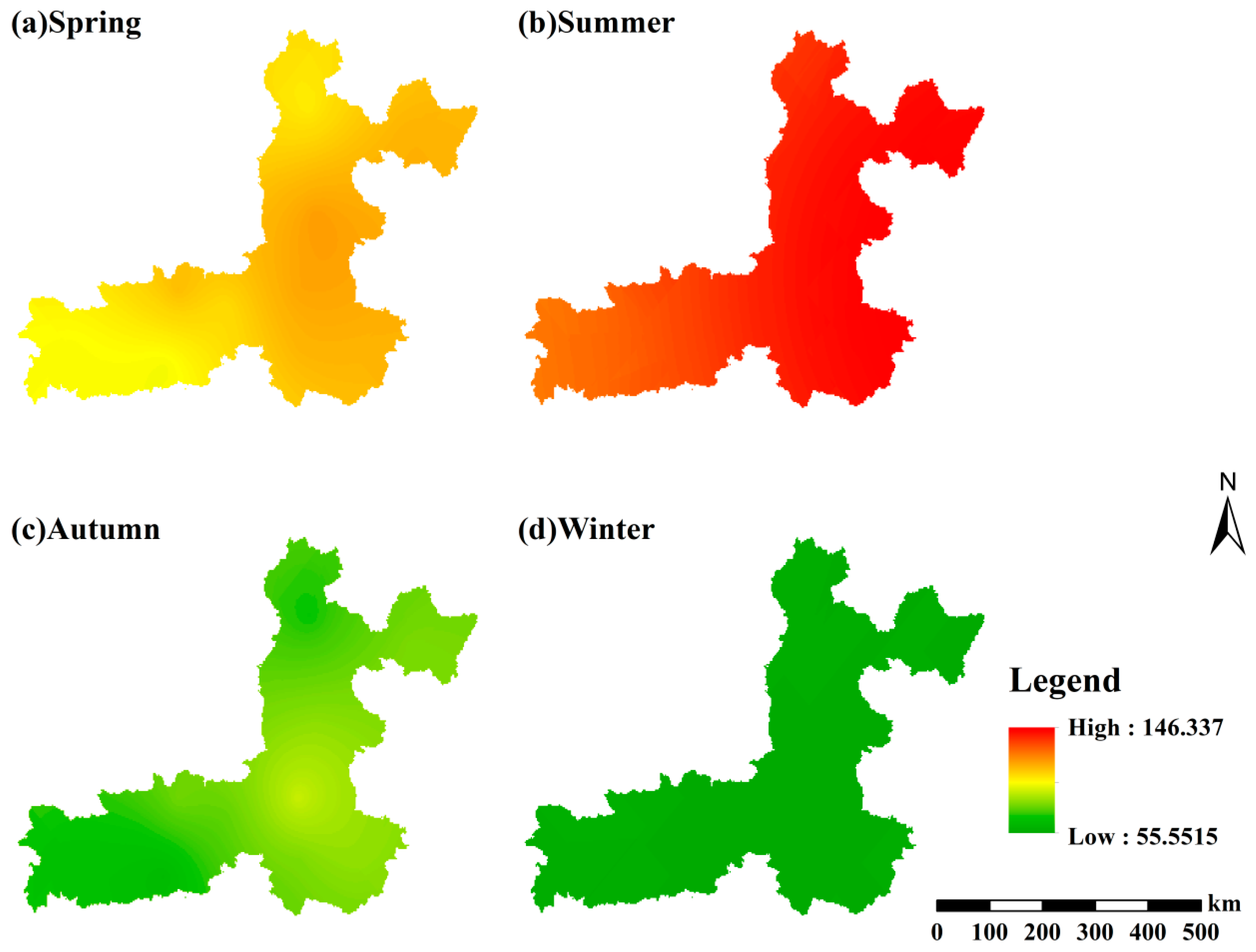
From 2015 to 2024, the spatial distribution of seasonal mean MDA8 O3 concentrations in the Fenwei Plain exhibited a seasonal variation pattern sharply contrasting with that of PM2.5 (Figure 12). In summer, a continuous high-value core region emerged in the southern plain, where peak concentrations exceeded 146   μ g / m 3 . This spatial pattern is closely coupled with intense solar radiation, high temperatures, and elevated precursor emissions (VOCs and NOx). These factors significantly accelerate photochemical reaction rates, driving the persistent formation and accumulation of O3 throughout the region.
In spring and autumn, concentration levels were relatively moderate, characterized by a distinct north–south gradient. These distributions were primarily regulated by long-range dust transport in spring and residual precursors in autumn, respectively. Conversely, O3 concentrations reached their annual minimum in winter, presenting a low-concentration and relatively uniform spatial distribution. This trend is mainly attributed to weakened solar radiation, atmospheric boundary layer (ABL) compression, and a reduction in precursor emissions. Fundamentally, this seasonal spatial heterogeneity results from the coupled regulation of photochemical reaction intensity, meteorological dispersion conditions, and precursor emissions. Notably, the high-value regions identified in summer represent critical target areas for regional O3 pollution prevention and control strategies.

3.3. Analysis of PM2.5 and O3 Compound Pollution

3.3.1. Temporal Characteristics of the Compound Pollution

From the perspective of temporal evolution, the trends in the three categories of pollution days across the Fenwei Plain from 2015 to 2024 exhibit significant divergence. This divergence reflects a profound transition in the regional atmospheric pollution structure, shifting from a traditional “coal-smoke” type to a “photochemical” pollution type.
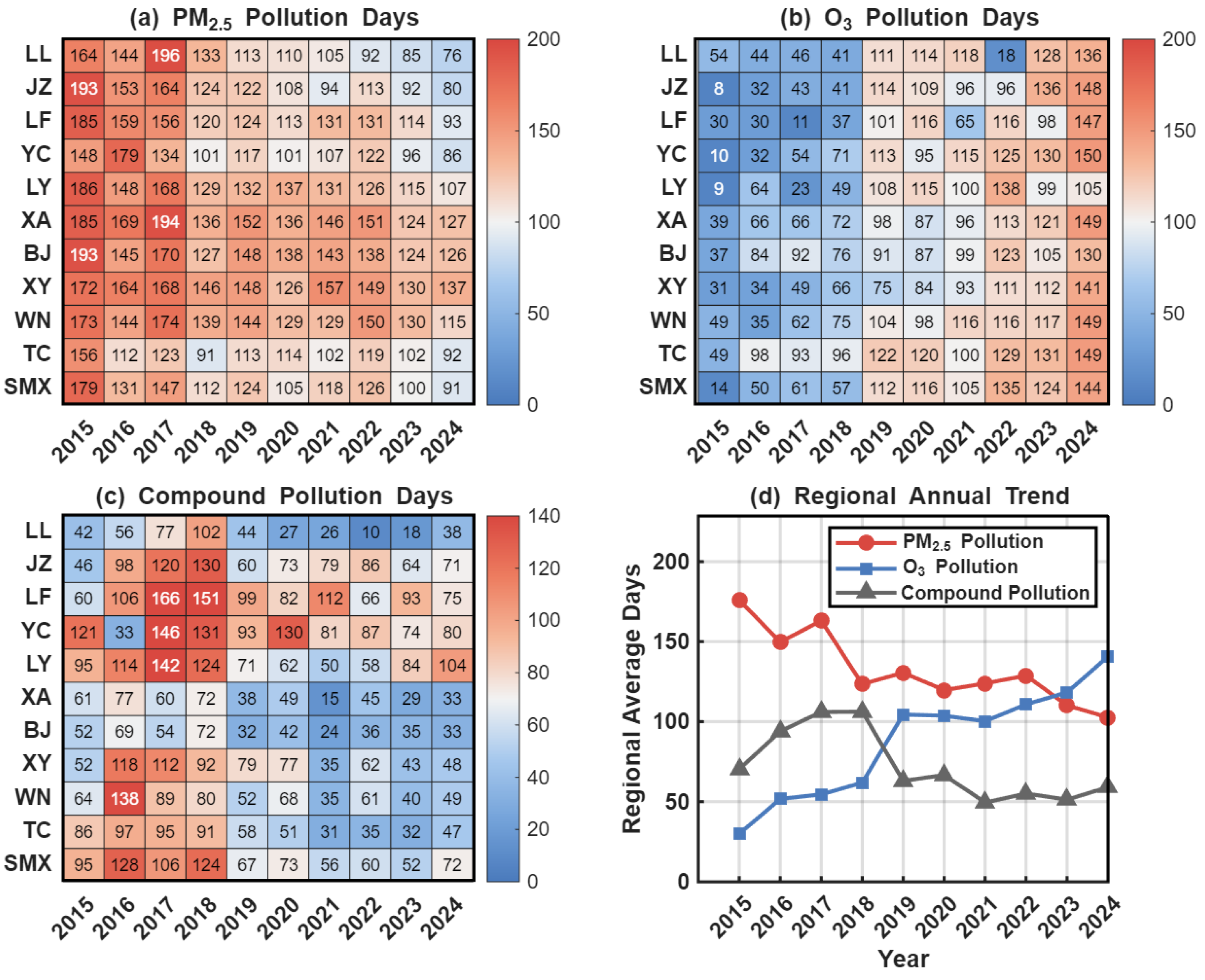
PM2.5 pollution has been effectively mitigated. As illustrated in Figure 13a,d, the number of PM2.5 pollution days generally shows a fluctuating downward trend. The regional average annual pollution days decreased from a peak of over 160 days during 2015–2017 to approximately 100 days in 2022–2024, representing a substantial improvement. This downward trajectory is highly consistent with the rigorous implementation of particulate matter emission reduction measures in the region, such as the “coal-to-gas” conversion and the remediation of “scattered, disordered, and polluting” (SDP) enterprises. These results indicate that traditional particulate matter management has yielded remarkable preliminary success.
In contrast, the O3 pollution situation has become increasingly severe. O3 pollution days have exhibited a continuous and rapid upward trend. As shown in Figure 13b, O3 non-attainment days across all cities were at a relatively low level in 2015 (regional mean < 40 days). However, since 2019, O3 pollution days in all cities have surpassed the 100-day threshold, with the regional mean approaching 140 days by 2024. This trend underscores that photochemical pollution has replaced particulate matter as the core bottleneck restricting the continuous improvement of regional air quality.
Compound pollution is characterized by an “initial increase followed by stabilization.” According to Figure 13c, “compound pollution days”—defined as days with simultaneous PM2.5 and O3 non-attainment—reached a peak in 2017–2018 (regional mean of ~106 days). Although these levels subsequently declined, they remained within the range of 50–60 days in most years. This fluctuation suggests that the rapid surge in O3 has partially offset the benefits of PM2.5 reduction, maintaining a high risk of concurrent pollutant exceedance.
In summary, while PM2.5 management has achieved significant progress, the sharp increase in O3 concentrations poses a persistent risk of synergistic non-attainment for both pollutants. Consequently, regional atmospheric pollution control has transitioned from the early stage of single-pollutant management to a new phase involving the synergistic reduction of PM2.5 and O3, as well as the in-depth remediation of volatile organic compounds (VOCs) and nitrogen oxides (NOx).
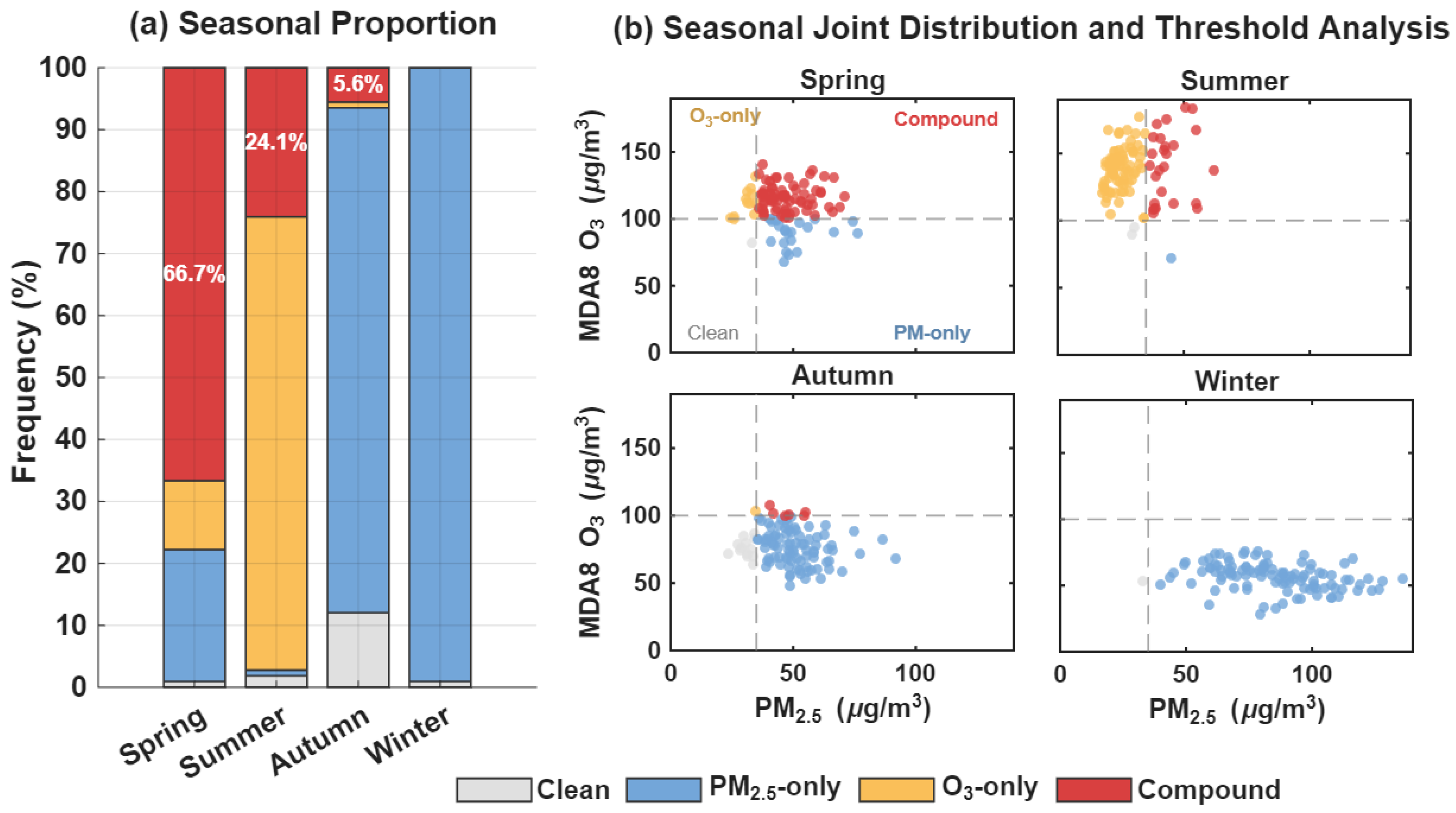
Figure 14 clearly illustrates the distinct seasonal variations of PM2.5 and O3 compound pollution in the Fenwei Plain. As shown in Figure 14a, the frequency of simultaneous exceedance days for both pollutants peaks in spring (66.7%), followed by a progressive decline in summer (24.1%) and autumn (5.6%). No compound exceedance events were recorded in winter. This underscores that spring represents a critical window for the synergistic prevention and control of PM2.5 and O3 in the region.
Figure 14b reveals the seasonal successional patterns (i.e., anti-phase relationship) of the two pollutants: PM2.5 concentrations peak in winter and reach their minimum in summer, whereas MDA8 O3 concentrations exhibit the opposite trend, peaking in summer and reaching their annual low in winter. This distributional discrepancy is primarily attributed to the combined effects of coal-based heating emissions in winter and intensified photochemical reaction mechanisms during summer. Notably, although the absolute concentrations of both pollutants do not reach their annual maximums during spring, the fact that both remain at moderate-to-high levels, coupled with meteorological conditions conducive to their synergistic increase, provides favorable circumstances for the occurrence of compound pollution events.

3.3.2. Spatial Characteristics of Compound Pollution

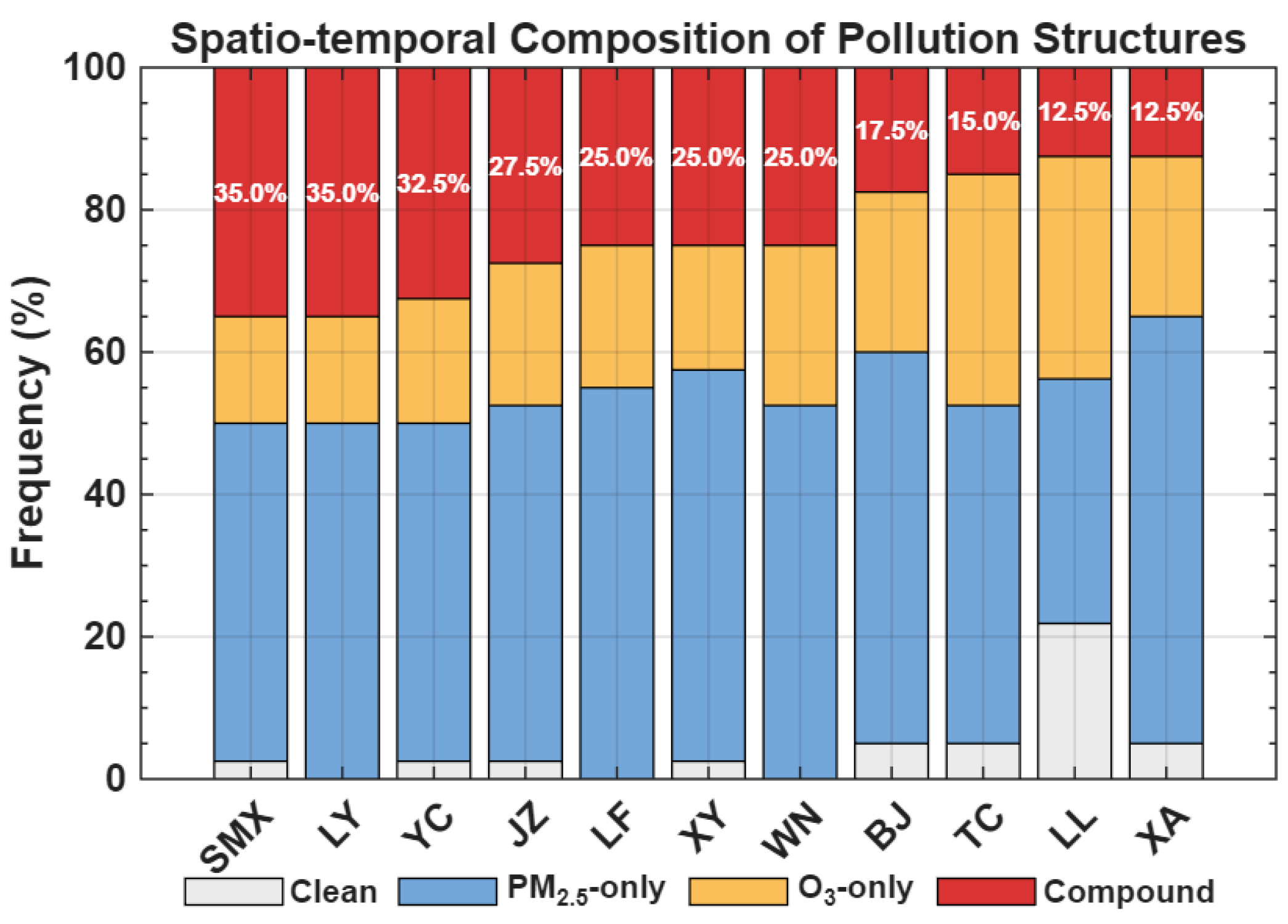
As illustrated in Figure 15, the pollution structures vary significantly across the cities in the Fenwei Plain. Among them, SMX and LY exhibited the highest compound pollution exceedance ratios (35.0%), followed by YC (32.5%) and JZ (27.5%). In contrast, cities like XA and LL showed relatively lower compound pollution frequencies (12.5%). By analyzing the overall structure, it is evident that PM2.5-only pollution remains a dominant contributor in most cities, while the rising proportion of O3-only and compound pollution underscores the increasing complexity of air quality management in the region.
The cluster analysis further elucidates the spatial differentiation patterns of compound pollution across the Fenwei Plain. As illustrated in the hierarchical clustering dendrogram (Figure 16a), the 11 regional cities are categorized into three distinct clusters based on pollution levels and structural discrepancies, exhibiting a strong correlation with their respective geographical locations.
Combined with the characteristic classification plot (Figure 16b), the specific features of each cluster are defined as follows:
(1)
Cluster 1 (O3-dominant type, e.g., LL, TC, and JZ): Characterized by relatively low PM2.5 levels but moderate-to-high MDA8 O3 concentrations, with O3 serving as the primary pollutant contributor.
(2)
Cluster 2 (High compound risk type, e.g., SMX, LY, YC, LF, XY, and WN): These cities exhibit elevated concentrations of both PM2.5 and O3, representing typical “dual-high” compound pollution features. This cluster serves as the high-pressure zone for regional synergistic prevention and control.
(3)
Cluster 3 (PM2.5-dominant type, e.g., XA and BJ): O3 concentrations are relatively low, with pollution pressure predominantly concentrated in PM2.5.
The clustering results demonstrate that compound pollution in the Fenwei Plain is non-homogeneously distributed. Instead, it follows a spatial model characterized by “contiguous high-risk distribution and localized characteristic differentiation.” These findings provide a robust scientific foundation for implementing tailored “one city, one policy” strategies and enhancing regional collaborative governance.

3.4. Spatiotemporal Coupling Analysis

3.4.1. Spatiotemporal Evolution Patterns

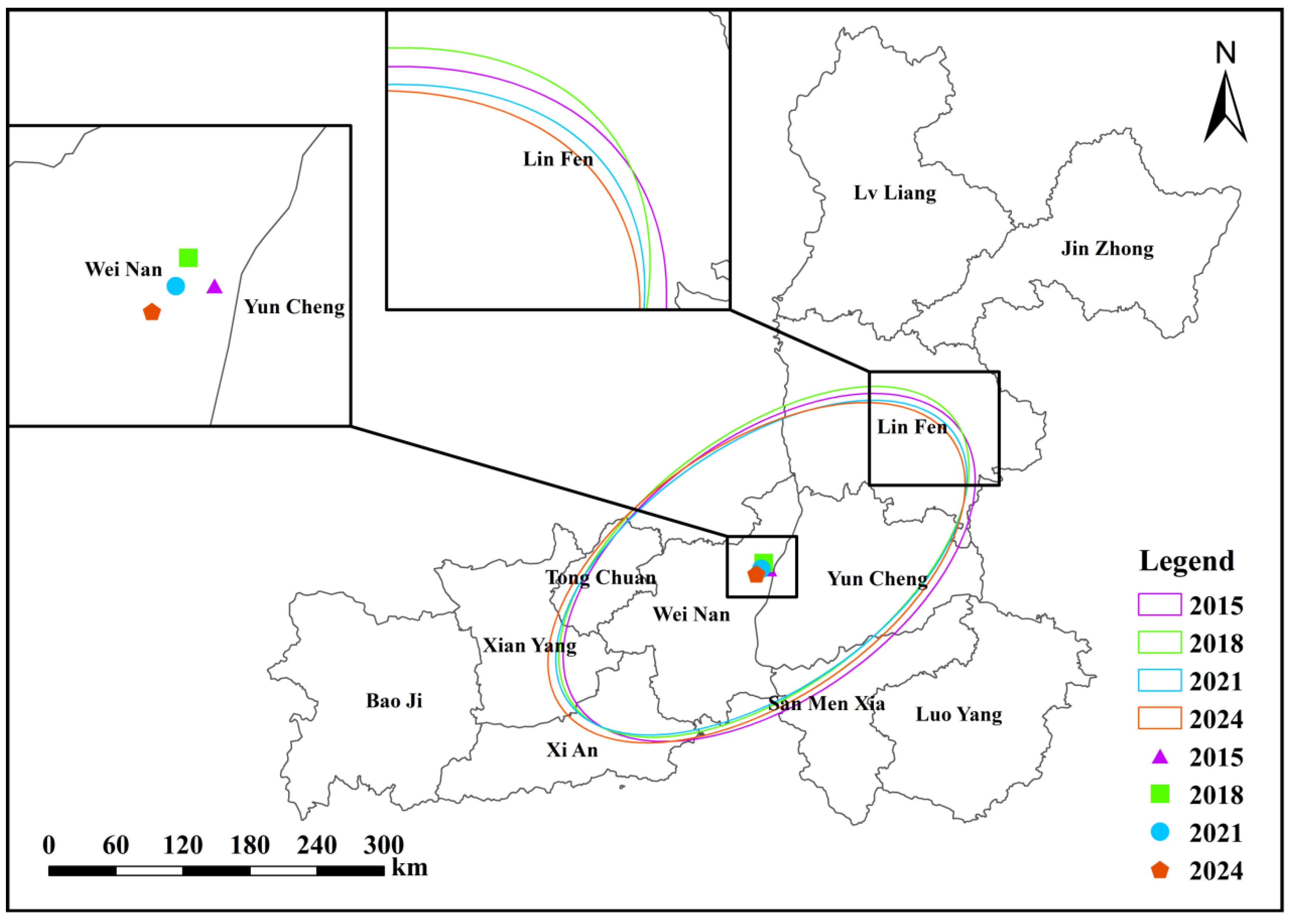
During the study period (2015–2024), the spatial distribution of PM2.5 concentrations in the Fenwei Plain exhibited significant spatiotemporal evolution characteristics (Figure 17). The Standard Deviational Ellipses (SDE) consistently maintained a Northeast–Southwest (NE–SW) orientation, with the major axis aligning closely with regional topography and prevailing wind directions. The spatial centroid of PM2.5 showed a slight migration toward the southwest, remaining primarily within Weinan City and its surrounding areas; this shift was particularly pronounced between 2021 and 2024. The azimuth angle followed a decreasing-then-increasing trend, reaching a minimum of approximately 28.1 4 in 2019 before a gradual rebound, reflecting a clockwise adjustment of the distribution axis in recent years. Furthermore, the lengths of both the major and minor axes, as well as the ellipse area, showed an overall shrinking trend, with the area decreasing from 59,906   k m 2 in 2015 to 58,834   k m 2 in 2024 (Table 4). This spatial contraction indicates that PM2.5 pollution has become more concentrated, reflecting the preliminary efficacy of regional emission reduction measures in narrowing the scope of high-concentration hotspots.
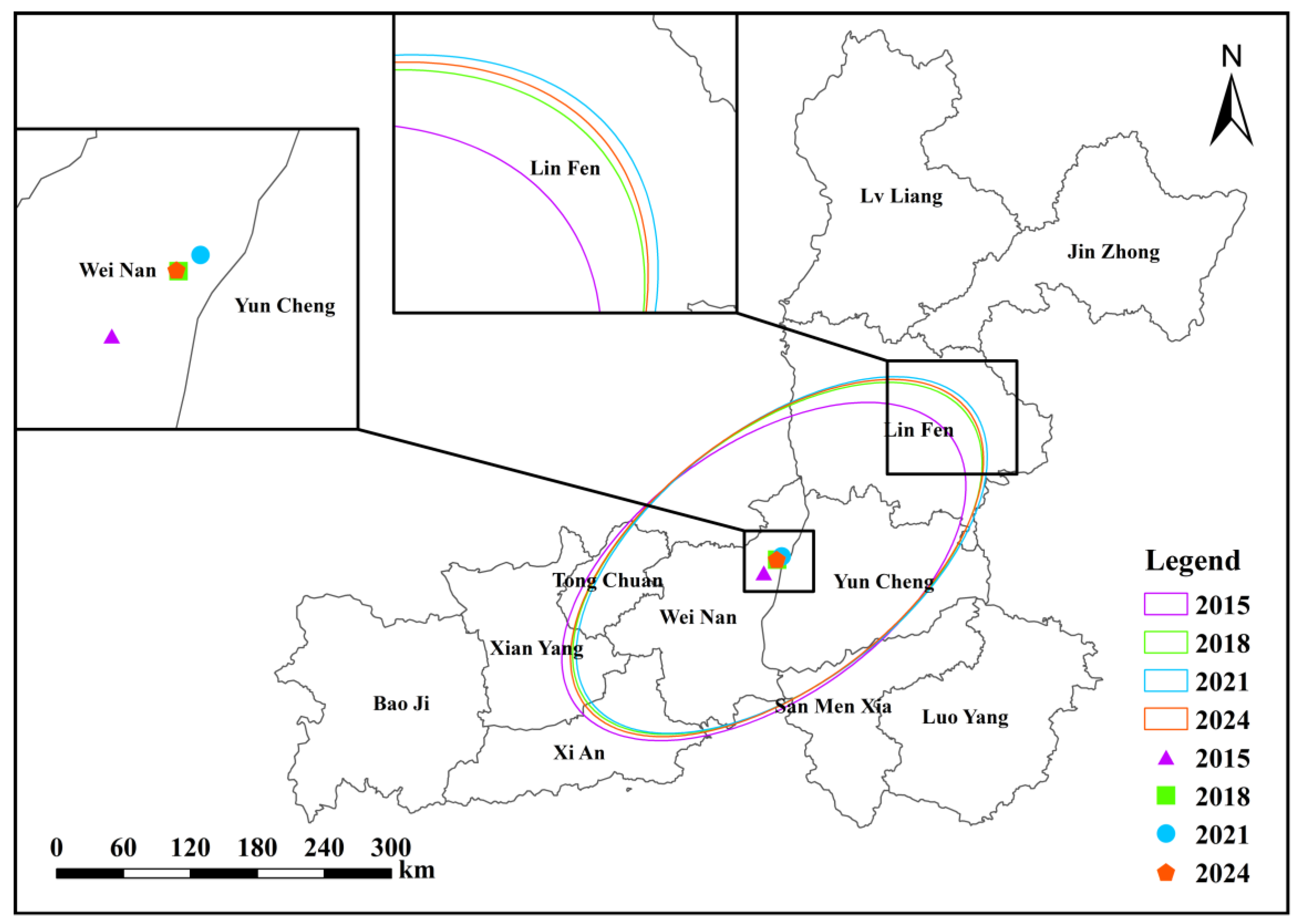
From 2015 to 2024, the spatial distribution of annual mean O3 concentrations in the Fenwei Plain exhibited significant spatiotemporal dynamics (Figure 18). The Standard Deviational Ellipses (SDE) consistently maintained a Northeast–Southwest (NE–SW) orientation, which aligns closely with the regional prevailing summer winds and the emission patterns of precursors (e.g., VOCs and NOx). This consistency highlights the profound influence of topography and meteorological factors on the spatial configuration of O3. During the study period, the spatial centroid of O3 pollution shifted slightly toward the northeast, remaining localized near the boundary between WN and YC. Notably, this migration trend was more pronounced between 2015 and 2018, indicating an expansion of high-concentration centers toward southern Shanxi (e.g., YC and LF). The azimuth angle displayed a phased characteristic of “increasing then decreasing,” peaking at approximately 28.9 2 in 2019 before a subsequent decline. This variation reflects a subtle adjustment of the O3 pollution axis after 2019, suggesting a relative increase in the pollution growth potential or emission contributions from cities in the southwest. Furthermore, the major and minor axes followed a trend of “expansion followed by contraction,” with the total area changing from approximately 60,090   k m 2 in 2015 to 62,804   k m 2 in 2024 (Table 5). This “dispersion followed by concentration” characteristic suggests that O3 pollution underwent a broad expansion phase, while recent control measures may have effectively driven the pollution range to concentrate toward core high-value zones.

3.4.2. Spatio-Temporal Cross-Correlation Function (STCCF) Results

The results of the Spatio-temporal Cross-Correlation Function (STCCF), derived from detrended and normalized annual series, reveal the intrinsic coupling mechanisms between PM2.5 and O3 in the Fenwei Plain (Figure 19). By removing the long-term deterministic trends driven by consistent emission reduction policies, the current STCCF specifically captures the synchronized stochastic fluctuations and interannual oscillation characteristics of the two pollutants.
At a temporal lag of τ = 0 , a significant and robust positive coupling ( ρ > 0.4 ,   p < 0.05 ) is consistently observed across almost all spatial distance bins (0–200 km). This ubiquitous synchronization, even after detrending, suggests that PM2.5 and O3 are governed by shared regional driving forces. These are likely attributed to the high sensitivity of their precursor interactions (e.g., the VOCs-NOx synergetic cycle) to interannual meteorological variability, such as the persistence of stagnant atmospheric conditions or regional-scale climate oscillations.
Notably, at a spatial scale of 0–50 km, the coupling strength exhibits a secondary peak at a positive lag of 4 years, whereas a localized significant negative correlation (the “seesaw” effect) is identified at a temporal lag of 2 years for the 200–250 km distance interval. The transition from positive synchronization at τ = 0 to scattered lag effects underscores the scale-dependent nature of the PM2.5-O3 interaction. The dominance of short-term positive synchronization implies that synergistic control strategies will yield immediate co-benefits across the entire Fenwei Plain.
Conclusion and Policy Implications: The identification of a dominant positive coupling on an interannual scale, independent of long-term policy-driven trends, provides a rigorous scientific foundation for the synergistic management of PM2.5 and O3. Policymakers should transition from trend-based observations to “fluctuation-aware” collaborative governance. Given the high spatial synchronization at Lag 0, cross-regional emergency response measures during meteorologically stagnant years are critical. Strengthening joint emission reductions for shared precursors (e.g., NOx) will effectively leverage this intrinsic positive coupling, leading to a more resilient and synchronized decline in both pollutants across the basin.

3.4.3. Results of the Geographically and Temporally Weighted Regression (GTWR) Model

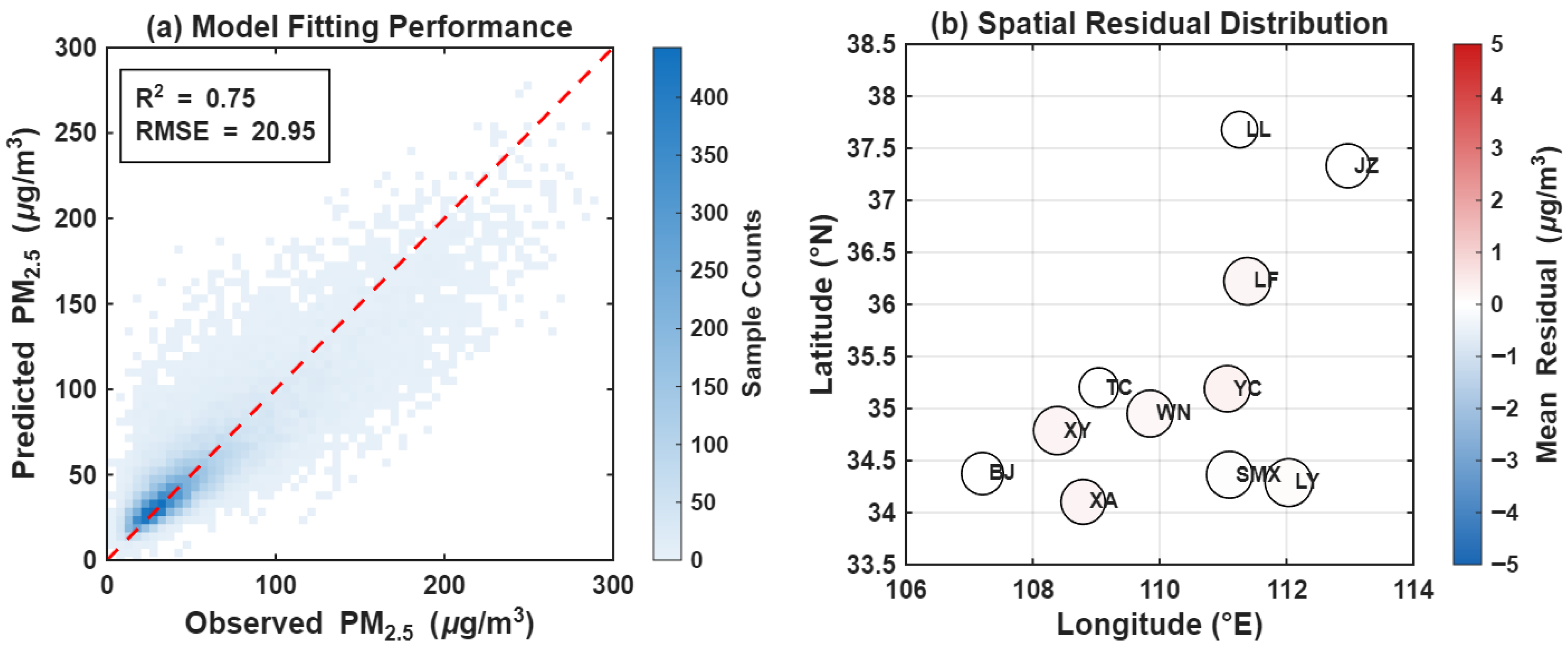
To validate the effectiveness of the GTWR model in estimating PM2.5 concentrations across the Fenwei Plain, we analyzed the model’s fitting performance and residual distribution (Figure 20). The scatter density plot (Figure 20a) reveals that the predicted PM2.5 values are highly concentrated along the 1:1 dashed line with the observed values, demonstrating an excellent linear correlation. The fitting results yielded a coefficient of determination ( R 2 ) of 0.75, indicating that the GTWR model can explain 75% of the spatiotemporal variations in PM2.5 within the region. The Root Mean Square Error (RMSE) was calculated at 20.95   μ g / m 3 . Although a slight underestimation is observed in the extremely high-concentration range, the overall fitting accuracy remains high and is sufficient to support subsequent spatial evolution analysis.
The spatial residual distribution map (Figure 20b) illustrates the prediction bias across different geographical locations. Results show that the Mean Residuals for the 11 cities in the Fenwei Plain remain at a consistently low level, with most circle colors near white (approaching zero). This suggests that the error distribution is relatively uniform across the spatial scale, with no significant systematic biases, such as pronounced regional overestimation or underestimation. Prediction accuracy for core cities, including XA, XY, and WN, is notably stable. In summary, by incorporating geographical locations and temporal lag effects, the GTWR model demonstrates robust mapping capabilities for PM2.5 concentrations in the Fenwei Plain, providing scientifically sound and reliable prediction results.
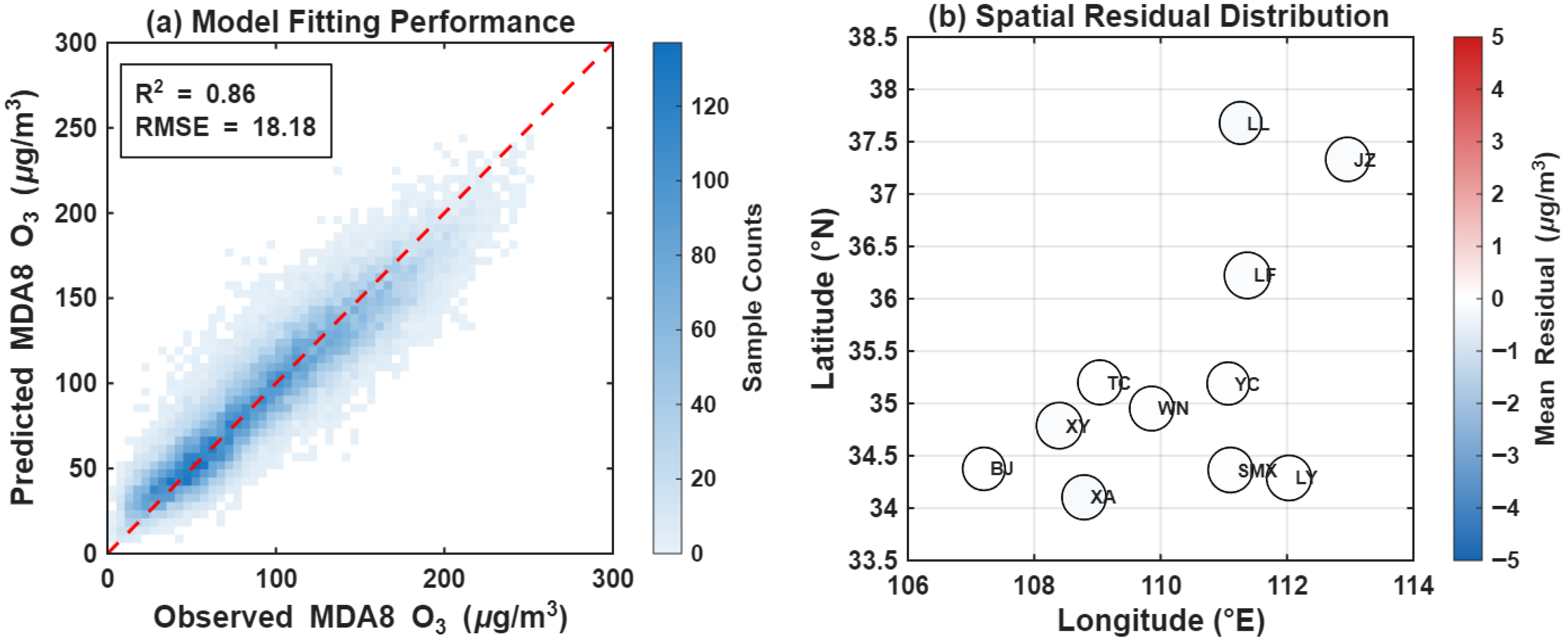
To verify the robustness of the MDA8 O3 estimation model, we conducted a comprehensive comparison between the observed and predicted data (Figure 21). As illustrated in Figure 21a, the predicted values are evenly distributed along both sides of the 1:1 dashed line, demonstrating exceptionally high consistency with the observed data. Statistical indicators reveal that the overall coefficient of determination ( R 2 ) reaches 0.86, with a root mean square error (RMSE) of 18.18   μ g / m 3 . The scatter density is primarily concentrated within the 50 150   μ g / m 3 range, indicating that the model is particularly precise in estimating low-to-medium O3 concentrations. Although a minor underestimation is observed at extremely high concentrations ( > 200   μ g / m 3 ), the overall R 2 remains at the forefront of similar studies, proving that the model can effectively capture the interannual and seasonal fluctuations of O3.
The spatial residual distribution (Figure 21b) further illustrates the prediction bias across various geographical nodes. The results indicate that the Mean Residuals for the 11 major cities (e.g., XA, LY, LF, and LL) consistently fall within the range of [−1, 1], with most circle colors appearing neutral white. This suggests that the model is free from significant spatial systematic biases (Spatial Bias). Whether in topographically complex regions such as LL and JZ, or in the Weihe Valley like XA and XY, the model maintains stable and reliable predictive performance. In summary, the high R 2 value, coupled with a well-balanced spatial residual distribution, underscores the superior performance of the model in resolving the complex spatiotemporal dynamics of MDA8 O3 in the Fenwei Plain. Consequently, the estimation results provide a robust and reliable data source for subsequent investigations into the evolutionary characteristics of regional photochemical pollution.

4. Discussion

4.1. Evolution of PM2.5 and O3 Trends and the “See-Saw” Effect

This study demonstrates that between 2015 and 2024, PM2.5 concentrations in the Fenwei Plain (FWP) decreased significantly by approximately 18% (from ~50 to 41 μg/m3), while MDA8 O3 exhibited a fluctuating upward trend, increasing by roughly 47% (from ~75 to 110 μg/m3). These results confirm that on a decadal scale, the FWP has entered a deep transitional phase of “PM improvement and O3 rebound”. The continuous improvement in PM2.5 is primarily attributable to the effective implementation of emission reduction measures such as “coal-to-gas” conversion, the remediation of “scattered, small, and poorly managed” enterprises, and the elimination of backward production capacity during the “Blue Sky Defense War” [47,48,49].
However, the rise in O3 may stem from two distinct mechanisms. First, the reduction in PM2.5 concentrations enhances surface solar radiation by reducing light scattering and absorption, thereby accelerating photochemical reaction rates. Second, as suggested by the photochemical theories of Schwartz et al., the non-linear relationship between VOCs and NOx emission ratios may push the atmosphere into a regime more sensitive to O3 formation following a substantial reduction in fine particulates [50,51,52]. The significant negative correlation identified by the STCCF method at the 150–200 km scale (p < 0.05) quantitatively characterizes this synergistic “see-saw” evolution.

4.2. Seasonal Characteristics and the Critical Spring Window

The study indicates that compound pollution days in the FWP followed a “increase then stabilize” pattern, with spring identified as the critical window for simultaneous exceedances of both pollutants, accounting for 66.7% of all compound pollution days. This finding holds significant early-warning value. Unlike the pure O3 pollution typical of summer, the spring window is characterized by rising temperatures and enhanced solar radiation coupled with frequent dust transport from northern regions [53]. This creates a unique scenario where high background PM2.5 overlaps with rapid O3 generation.
Furthermore, K-means clustering identified high-risk composite pollution clusters represented by SMX and LY, where the compound exceedance ratio reached 35.0%. This reflects the synergistic effect of high precursor emission intensity in the industrial bases of western Henan and southern Shanxi combined with topographic obstruction. In contrast, while the core Guanzhong area (e.g., XA) faces considerable PM2.5 pressure, its compound pollution ratio remains relatively controlled, potentially due to stricter mobile source regulations and more favorable dispersion conditions in recent years.

4.3. Spatiotemporal Heterogeneity of Driving Mechanisms and Basin Topography

The GTWR model results reveal the non-stationary driving characteristics of meteorological factors on pollutant distribution. As summarized in Table 6, the regression coefficients vary across space and time, highlighting the localized effects of each driver. The significant negative correlation between temperature and PM2.5 is most prominent in certain parts of the Guanzhong Plain. However, on a regional scale, the impact of temperature exhibits notable heterogeneity, reflecting the complex balance between thermal convection and precursor transformation. Crucially, relative humidity (RH) exhibits a predominantly positive correlation across the entire region, with a mean coefficient of 0.432 and positive values in 75% of the samples.
These findings support the perspective of Kumar et al. regarding the localized effects of meteorological factors [54,55].
The unique “mountain-enclosed” basin structure of the FWP acts as an “accelerator” in these driving mechanisms. The physical barriers formed by the Lyuliang Mountains and the northern foot of the Qinling Mountains frequently induce stagnant weather and deep inversion layers during autumn and winter, leading to rapid PM2.5 accumulation. In summer, the thermal circulation is constrained by the topography, causing precursors to circulate within the basin and intensifying the potential for secondary O3 formation. This explains why the Standard Deviation Ellipse (SDE) consistently maintains a “Northeast–Southwest” orientation, aligning closely with the basin’s terrain and dominant wind directions.

4.4. Policy Implications and Limitations

Atmospheric governance in the Fenwei Plain should transition from “single-pollutant control” to “precision-partitioned, synergistic control”. First, given the high incidence of compound pollution in spring, intervention for VOCs and NOx emissions should be advanced. Second, the mid-scale transmission characteristics (150–200 km) necessitate strengthened cross-regional joint prevention and control among cities such as XA, LY, and YC.
While this study analyzes long-term spatiotemporal patterns, limitations remain. Socio-economic indicators (e.g., GDP density, industrial structure) were not integrated into the GTWR analysis. Future research should incorporate human activity data to construct a more comprehensive driving index system. Additionally, the sensitivity of O3 increases to precursors (VOC-limited vs. NOx-limited) requires further in-depth verification through numerical modeling at the micro-scale.

5. Conclusions

5.1. Summary of Findings

This study comprehensively analyzed the decadal spatiotemporal evolution and coupling mechanisms of PM2.5 and O3 in the Fenwei Plain from 2015 to 2024. The primary findings are as follows:
(1)
Pollution Transition: The FWP has transitioned from a particulate-dominated regime to a complex composite pollution phase. While PM2.5 concentrations decreased significantly by approximately 32% (from ~60 to 41 μ g / m 3 ), MDA8 O3 concentrations rose by 47% (from ~75 to 110 μ g / m 3 ). Spring was identified as the critical window for compound pollution, accounting for 66.7% of simultaneous exceedance events.
(2)
Spatial Heterogeneity: Both pollutants exhibited a distinct “Northeast–Southwest” orientation, consistent with the basin’s topography and prevailing wind directions. High-value PM2.5 clusters remained along the Weihe River Valley, while O3 exhibited a “high in the south, low in the north” gradient. Cluster analysis categorized the 11 cities into O3-dominant (e.g., LL, TC), compound high-risk (e.g., SMX, LY, YC, LF), and PM2.5-dominant (e.g., XA, BJ) clusters.
(3)
Coupling and Drivers: A dominant positive synergy was observed between PM2.5 and O3 on an annual scale, though a localized “see-saw” effect occurred at specific scales (150–200 km distance with a 3-year lag). The GTWR model demonstrated high robustness in explaining these patterns, achieving R 2 values of 0.75 and 0.86 for PM2.5 and O3, respectively.

5.2. Policy Implications

The results underscore the necessity of shifting from single-pollutant control to a localized, synergistic governance paradigm.
(1)
Synergistic Mitigation: Policymakers should prioritize the synchronized reduction of NOx and VOCs during the spring window to curb the rising trend of O3 while maintaining PM2.5 improvements.
(2)
Regional Cooperation: Strengthening joint prevention and control within the “SMX-LY-YC-LF” industrial corridor is essential to mitigate the high risks of compound pollution observed in the eastern FWP.

5.3. Limitations and Future Research

Despite the systematic insights provided, this study has limitations that warrant further investigation.
(1)
Statistical vs. Causal Inference: The GTWR model employed in this research is fundamentally a regression-based statistical method. While it effectively captures spatiotemporal heterogeneity and quantifies the strength of associations between pollutants and driving factors, it does not provide direct causal inference. The identified driving mechanisms should be interpreted as statistical correlations rather than definitive causal pathways. Future research could incorporate structural equation modeling (SEM) or causal discovery algorithms to further validate these underlying relationships.
(2)
Indicator Integration: The GTWR model primarily focused on meteorological and topographic factors. Future research should integrate socio-economic indicators, such as GDP density and industrial output, to build a more comprehensive driver index.
(3)
Micro-scale Mechanisms: While the study quantified spatiotemporal coupling, micro-level photochemical sensitivity (e.g., VOC-limited vs. NOx-limited regimes) remains to be verified through advanced chemical transport modeling or smog chamber experiments.

Author Contributions

Conceptualization, Y.W. and J.X.; methodology, Y.W.; software, Y.W.; validation, J.X.; formal analysis, J.X.; investigation, J.X.; resources, J.X.; data curation, T.F.; writing—original draft preparation, J.X.; writing—review and editing, J.X. and Y.W.; visualization, J.X. and J.P.; supervision, J.X.; project administration, J.X.; funding acquisition, Y.W. All authors have read and agreed to the published version of the manuscript.

Funding

This research was funded by 2026 College Students’ Innovation and Entrepreneurship Training Programs of China University of Geosciences, Beijing (2026A89).

Institutional Review Board Statement

Not applicable.

Informed Consent Statement

Not applicable.

Data Availability Statement

The original contributions presented in this study are included in the article. Further inquiries can be directed to the corresponding author.

Acknowledgments

We sincerely thank the reviewers for their insightful comments and constructive suggestions, which have substantially enhanced the quality of this manuscript.

Conflicts of Interest

The authors declare no conflicts of interest.

References

  1. Feng, S.; Gao, D.; Liao, F.; Zhou, F.; Wang, X. The Health Effects of Ambient PM2.5 and Potential Mechanisms. Ecotoxicol. Environ. Saf. 2016, 128, 67–74. [Google Scholar] [CrossRef]
  2. Thangavel, P.; Park, D.; Lee, Y.-C. Recent Insights into Particulate Matter (PM2.5)-Mediated Toxicity in Humans: An Overview. Int. J. Environ. Res. Public Health 2022, 19, 7511. [Google Scholar] [CrossRef] [PubMed]
  3. Zhu, Y.; Xie, J.; Huang, F.; Cao, L. Association between Short-Term Exposure to Air Pollution and COVID-19 Infection: Evidence from China. Sci. Total Environ. 2020, 727, 138704. [Google Scholar] [CrossRef]
  4. Basith, S.; Manavalan, B.; Shin, T.H.; Park, C.B.; Lee, W.-S.; Kim, J.; Lee, G. The Impact of Fine Particulate Matter 2.5 on the Cardiovascular System: A Review of the Invisible Killer. Nanomaterials 2022, 12, 2656. [Google Scholar] [CrossRef]
  5. Xiao, Q.; Geng, G.; Xue, T.; Liu, S.; Cai, C.; He, K.; Zhang, Q. Tracking PM2.5 and O3 Pollution and the Related Health Burden in China 2013–2020. Environ. Sci. Technol. 2022, 56, 6922–6932. [Google Scholar] [CrossRef]
  6. Cao, J.J.; Cui, L. Current Status, Characteristics and Causes of Particulate Air Pollution in the Fenwei Plain, China: A Review. J. Geophys. Res. Atmos. 2021, 126, e2020JD034472. [Google Scholar] [CrossRef]
  7. Peng, S.; Ju, T.; Liang, Z.; Li, M.; Liu, S.; Pan, B. Analysis of Atmospheric Ozone in Fenwei Plain Based on Remote Sensing Monitoring. Environ. Monit. Assess. 2022, 194, 412. [Google Scholar] [CrossRef] [PubMed]
  8. Feng, Y.; Ning, M.; Lei, Y.; Sun, Y.; Liu, W.; Wang, J. Defending Blue Sky in China: Effectiveness of the “Air Pollution Prevention and Control Action Plan” on Air Quality Improvements from 2013 to 2017. J. Environ. Manag. 2019, 252, 109603. [Google Scholar] [CrossRef] [PubMed]
  9. Jiang, X.; Li, G.; Fu, W. Government Environmental Governance, Structural Adjustment and Air Quality: A Quasi-Natural Experiment Based on the Three-Year Action Plan to Win the Blue Sky Defense War. J. Environ. Manag. 2021, 277, 111470. [Google Scholar] [CrossRef]
  10. Li, K.; Jacob, D.J.; Liao, H.; Shen, L.; Zhang, Q.; Bates, K.H. Anthropogenic Drivers of 2013–2017 Trends in Summer Surface Ozone in China. Proc. Natl. Acad. Sci. USA 2019, 116, 422–427. [Google Scholar] [CrossRef]
  11. Yang, Z.; Yang, J.; Li, M.; Chen, J.; Ou, C.-Q. Nonlinear and Lagged Meteorological Effects on Daily Levels of Ambient PM2.5 and O3: Evidence from 284 Chinese Cities. J. Clean. Prod. 2021, 278, 123931. [Google Scholar] [CrossRef]
  12. Liu, X.; Yi, G.; Zhou, X.; Zhang, T.; Bie, X.; Li, J.; Tan, H. Spatio-Temporal Variations of PM2.5 and O3 in China during 2013–2021: Impact Factor Analysis. Environ. Pollut. 2023, 334, 122189. [Google Scholar] [CrossRef] [PubMed]
  13. Mirzaei, M.; Amanollahi, J.; Tzanis, C.G. Evaluation of Linear, Nonlinear, and Hybrid Models for Predicting PM2.5 Based on a GTWR Model and MODIS AOD Data. Air Qual. Atmos. Health 2019, 12, 1215–1224. [Google Scholar] [CrossRef]
  14. Yang, Z.; Ren, Y.; Shen, L.; Liao, X.; Kwan, M.-P. Spatiotemporal Evolutions and Drivers of Ground-Level Ozone in China (2015–2020): A GTWR-Kriging Approach. Environ. Res. 2025, 279, 121748. [Google Scholar] [CrossRef] [PubMed]
  15. Li, Y.; Wang, X.; Li, J.; Zhu, L.; Chen, Y. Numerical Simulation of Topography Impact on Transport and Source Apportionment on PM2.5 in a Polluted City in Fenwei Plain. Atmosphere 2022, 13, 233. [Google Scholar] [CrossRef]
  16. She, Y.; Chen, Q.; Ye, S.; Wang, P.; Wu, B.; Zhang, S. Spatial-Temporal Heterogeneity and Driving Factors of PM2.5 in China: A Natural and Socioeconomic Perspective. Front. Public Health 2022, 10, 1051116. [Google Scholar] [CrossRef]
  17. Miao, Y.; Guo, J.; Liu, S.; Liu, H.; Zhang, G.; Yan, Y.; He, J. Relay Transport of Aerosols to Beijing-Tianjin-Hebei Region by Multi-Scale Atmospheric Circulations. Atmos. Environ. 2017, 165, 35–45. [Google Scholar] [CrossRef]
  18. Lyu, Y.; Wu, D.; Han, F.; Zhang, H.; Lv, F.; Kang, A.; Hu, Y.; Pang, X. Co-Occurring Extremes of PM2.5 and Ozone in Warm Seasons of the Yangtze River Delta of China: Insights from Explainable Machine Learning. ACS ES&T Air 2025, 2, 578–588. [Google Scholar] [CrossRef]
  19. Wu, X.; Xin, J.; Zhang, W.; Gao, W.; Ma, Y.; Ma, Y.; Wen, T.; Liu, Z.; Hu, B.; Wang, Y.; et al. Variation Characteristics of Air Combined Pollution in Beijing City. Atmos. Res. 2022, 274, 106197. [Google Scholar] [CrossRef]
  20. Wu, S.; Yan, X.; Yao, J.; Zhao, W. Quantifying the Scale-Dependent Relationships of PM2.5 and O3 on Meteorological Factors and Their Influencing Factors in the Beijing-Tianjin-Hebei Region and Surrounding Areas. Environ. Pollut. 2023, 337, 122517. [Google Scholar] [CrossRef] [PubMed]
  21. Jia, C.; Yan, G.; Yu, X.; Li, X.; Xue, J.; Wang, Y.; Cao, Z. Evidence for Coordinated Control of PM2.5 and O3: Long-Term Observational Study in a Typical City of Central Plains Urban Agglomeration. Toxics 2025, 13, 330. [Google Scholar] [CrossRef]
  22. Zhang, Y.-L.; Cao, F. Fine Particulate Matter (PM2.5) in China at a City Level. Sci. Rep. 2015, 5, 14884. [Google Scholar] [CrossRef] [PubMed]
  23. Li, K.; Jacob, D.J.; Shen, L.; Lu, X.; De Smedt, I.; Liao, H. Increases in Surface Ozone Pollution in China from 2013 to 2019: Anthropogenic and Meteorological Influences. Atmos. Chem. Phys. 2020, 20, 11423–11433. [Google Scholar] [CrossRef]
  24. Zhao, S.; Yin, D.; Yu, Y.; Kang, S.; Qin, D.; Dong, L. PM2.5 and O3 Pollution during 2015–2019 over 367 Chinese Cities: Spatiotemporal Variations, Meteorological and Topographical Impacts. Environ. Pollut. 2020, 264, 114694. [Google Scholar] [CrossRef]
  25. Yin, Z.; Yuan, L.; Yang, Y.; Wu, X.; Chen, Z.; Long, H. Exploring the Altitude Differentiation and Influencing Factors of PM2.5 and O3: A Case Study of the Fenwei Plain, China. Front. Environ. Sci. 2025, 12, 1509460. [Google Scholar] [CrossRef]
  26. Xiao, C.; Jingbo, Z.; Meng, F.; Cullen, J.; Wang, X.; Zhu, Y. Regional Characteristics and Spatial Correlation of Haze Pollution: Interpretative System Analysis in Cities of Fenwei Plain in China. SSRN Electron. J. 2022, 869, 161779. [Google Scholar] [CrossRef]
  27. Xu, L.; Wang, B.; Wang, Y.; Zhang, H.; Xu, D.; Zhao, Y.; Zhao, K. Characterization and Source Apportionment Analysis of PM2.5 and Ozone Pollution over Fenwei Plain, China: Insights from PM2.5 Component and VOC Observations. Toxics 2025, 13, 123. [Google Scholar] [CrossRef]
  28. Zhang, H.; Zhang, C.; Liu, S.; Yin, S.; Zhang, S.; Zhu, H.; Yan, F.; Yang, H.; Ru, X.; Liu, X. Insights into the Source Characterization, Risk Assessment and Ozone Formation Sensitivity of Ambient VOCs at an Urban Site in the Fenwei Plain, China. J. Hazard. Mater. 2025, 484, 136721. [Google Scholar] [CrossRef] [PubMed]
  29. Jia, M.; Jiang, F.; Evangeliou, N.; Eckhardt, S.; Huang, X.; Ding, A.; Stohl, A. Rapid Decline of Carbon Monoxide Emissions in the Fenwei Plain in China during the Three-Year Action Plan on Defending the Blue Sky. J. Environ. Manag. 2023, 337, 117735. [Google Scholar] [CrossRef] [PubMed]
  30. Xu, W.; Wang, Y.; Sun, S.; Yao, L.; Li, T.; Fu, X. Spatiotemporal Heterogeneity of PM2.5 and Its Driving Difference Comparison Associated with Urbanization in China’s Multiple Urban Agglomerations. Environ. Sci. Pollut. Res. 2022, 29, 29689–29703. [Google Scholar] [CrossRef]
  31. Shukla, K.; Kumar, P.; Mann, G.S.; Khare, M. Mapping Spatial Distribution of Particulate Matter Using Kriging and Inverse Distance Weighting at Supersites of Megacity Delhi. Sustain. Cities Soc. 2020, 54, 101997. [Google Scholar] [CrossRef]
  32. Di, Q.; Amini, H.; Shi, L.; Kloog, I.; Silvern, R.; Kelly, J.; Sabath, M.B.; Choirat, C.; Koutrakis, P.; Lyapustin, A.; et al. An Ensemble-Based Model of PM2.5 Concentration across the Contiguous United States with High Spatiotemporal Resolution. Environ. Int. 2019, 130, 104909. [Google Scholar] [CrossRef]
  33. Etherington, T.R. Discrete Natural Neighbour Interpolation with Uncertainty Using Cross-Validation Error-Distance Fields. PeerJ Comput. Sci. 2020, 6, e282. [Google Scholar] [CrossRef]
  34. Michaelsen, J. Cross-Validation in Statistical Climate Forecast Models. J. Clim. Appl. Meteorol. 1987, 26, 1589–1600. [Google Scholar] [CrossRef]
  35. Risk, C.; James, P.M.A. Optimal Cross-Validation Strategies for Selection of Spatial Interpolation Models for the Canadian Forest Fire Weather Index System. Earth Space Sci. 2022, 9, e2021EA002019. [Google Scholar] [CrossRef]
  36. Nedyalkova, M.; Simeonov, V. Chemomertic Risk Assessment of Soil Pollution. Open Chem. 2019, 17, 711–721. [Google Scholar] [CrossRef]
  37. Marín Celestino, A.; Martínez Cruz, D.; Otazo Sánchez, E.; Gavi Reyes, F.; Vásquez Soto, D. Groundwater Quality Assessment: An Improved Approach to K-Means Clustering, Principal Component Analysis and Spatial Analysis: A Case Study. Water 2018, 10, 437. [Google Scholar] [CrossRef]
  38. Tariq, S.; Mariam, A.; ul-Haq, Z.; Mehmood, U. Spatial and Temporal Variations in PM2.5 and Associated Health Risk Assessment in Saudi Arabia Using Remote Sensing. Chemosphere 2022, 308, 136296. [Google Scholar] [CrossRef] [PubMed]
  39. Zhao, Y.; Wu, Q.; Wei, P.; Zhao, H.; Zhang, X.; Pang, C. Explore the Mitigation Mechanism of Urban Thermal Environment by Integrating Geographic Detector and Standard Deviation Ellipse (SDE). Remote Sens. 2022, 14, 3411. [Google Scholar] [CrossRef]
  40. Shi, S.; Li, M.; Li, Z.; Xi, J. Spatial Heterogeneity and Influencing Factors of High-Grade Tourist Attractions in the Tibetan Plateau. Int. J. Environ. Res. Public Health 2023, 20, 4650. [Google Scholar] [CrossRef]
  41. Wang, H.; Zhao, M.; Huang, X.; Song, X.; Cai, B.; Tang, R.; Sun, J.; Han, Z.; Yang, J.; Liu, Y.; et al. Improving Prediction of Soil Heavy Metal(Loid) Concentration by Developing a Combined Co-Kriging and Geographically and Temporally Weighted Regression (GTWR) Model. J. Hazard. Mater. 2024, 468, 133745. [Google Scholar] [CrossRef]
  42. Liu, L.; Liu, Y.; Cheng, F.; Yu, Y.; Wang, J.; Wang, C.; Nong, L.; Deng, H. Remote Sensing Estimation of Regional PM2.5 Based on GTWR Model -a Case Study of Southwest China. Environ. Pollut. 2024, 351, 124057. [Google Scholar] [CrossRef] [PubMed]
  43. Wang, Q.; Li, J.; Yang, J.; Chen, Y.; Li, Y.; Li, S.; Xie, C.; Chen, C.; Wang, L.; Wang, L.; et al. Seasonal Characterization of Aerosol Composition and Sources in a Polluted City in Central China. Chemosphere 2020, 258, 127310. [Google Scholar] [CrossRef]
  44. Li, L.; Lu, C.; Chan, P.-W.; Zhang, X.; Yang, H.-L.; Lan, Z.-J.; Zhang, W.-H.; Liu, Y.-W.; Pan, L.; Zhang, L. Tower Observed Vertical Distribution of PM2.5, O3 and NOx in the Pearl River Delta. Atmos. Environ. 2020, 220, 117083. [Google Scholar] [CrossRef]
  45. Zhang, K.; Xiu, G.; Zhou, L.; Bian, Q.; Duan, Y.; Fei, D.; Wang, D.; Fu, Q. Vertical Distribution of Volatile Organic Compounds within the Lower Troposphere in Late Spring of Shanghai. Atmos. Environ. 2018, 186, 150–157. [Google Scholar] [CrossRef]
  46. Nguyen, T.P.M.; Bui, T.H.; Nguyen, M.K.; Nguyen, T.H.; Vu, V.T.; Pham, H.L. Impact of COVID-19 Partial Lockdown on PM2.5, SO2, NO2, O3, and Trace Elements in PM2.5 in Hanoi, Vietnam. Environ. Sci. Pollut. Res. 2022, 29, 41875–41885. [Google Scholar] [CrossRef]
  47. Cheng, J.; Su, J.; Cui, T.; Li, X.; Dong, X.; Sun, F.; Yang, Y.; Tong, D.; Zheng, Y.; Li, Y.; et al. Dominant Role of Emission Reduction in PM2.5 Air Quality Improvement in Beijing during 2013–2017: A Model-Based Decomposition Analysis. Atmos. Chem. Phys. 2019, 19, 6125–6146. [Google Scholar] [CrossRef]
  48. Zhang, Q.; Geng, G. Impact of Clean Air Action on PM2.5 Pollution in China. Sci. China Earth Sci. 2019, 62, 1845–1846. [Google Scholar] [CrossRef]
  49. Zhang, Q.; Zheng, Y.; Tong, D.; Shao, M.; Wang, S.; Zhang, Y.; Xu, X.; Wang, J.; He, H.; Liu, W.; et al. Drivers of Improved PM2.5 Air Quality in China from 2013 to 2017. Proc. Natl. Acad. Sci. USA 2019, 116, 24463–24469. [Google Scholar] [CrossRef]
  50. Zhao, H.; Chen, K.; Liu, Z.; Zhang, Y.; Shao, T.; Zhang, H. Coordinated Control of PM2.5 and O3 Is Urgently Needed in China after Implementation of the “Air Pollution Prevention and Control Action Plan”. Chemosphere 2021, 270, 129441. [Google Scholar] [CrossRef] [PubMed]
  51. Wang, T.; Xue, L.; Brimblecombe, P.; Lam, Y.F.; Li, L.; Zhang, L. Ozone Pollution in China: A Review of Concentrations, Meteorological Influences, Chemical Precursors, and Effects. Sci. Total Environ. 2017, 575, 1582–1596. [Google Scholar] [CrossRef] [PubMed]
  52. Maji, K.J.; Ye, W.-F.; Arora, M.; Nagendra, S.M.S. Ozone Pollution in Chinese Cities: Assessment of Seasonal Variation, Health Effects and Economic Burden. Environ. Pollut. 2019, 247, 792–801. [Google Scholar] [CrossRef]
  53. Nie, Y.; Yan, Y.; Ji, Y.; Gao, R.; Ren, Y.; Bi, F.; Shang, F.; Li, J.; Chu, W.; Li, H. Assessing the PM2.5–O3 Correlation and Unraveling Their Drivers in Urban Environment: Insights from the Bohai Bay Region, China. Atmosphere 2025, 16, 512. [Google Scholar] [CrossRef]
  54. Dai, H.; Zhu, J.; Liao, H.; Li, J.; Liang, M.; Yang, Y.; Yue, X. Co-Occurrence of Ozone and PM2.5 Pollution in the Yangtze River Delta over 2013–2019: Spatiotemporal Distribution and Meteorological Conditions. Atmos. Res. 2021, 249, 105363. [Google Scholar] [CrossRef]
  55. Ma, X.; Yin, Z.; Cao, B.; Wang, H. Meteorological Influences on Co-Occurrence of O3 and PM2.5 Pollution and Implication for Emission Reductions in Beijing-Tianjin-Hebei. Sci. China Earth Sci. 2023, 66, 1258–1267. [Google Scholar] [CrossRef] [PubMed]
Figure 1. Overview map of the study area.
Toxics 14 00378 g001
Figure 2. The methodology framework.
Toxics 14 00378 g002
Figure 3. Temporal trends of annual average PM2.5 and MDA8 O3 concentrations in the Fenwei Plain from 2015 to 2024.
Toxics 14 00378 g003
Figure 4. Temporal trends of annual average PM2.5 (left) and MDA8 O3 (right) concentrations in various cities of the Fenwei Plain from 2015 to 2024.
Toxics 14 00378 g004
Figure 5. Seasonal variations of PM2.5 and MDA8 O3 concentrations in the Fenwei Plain.
Toxics 14 00378 g005
Figure 6. Interannual variation trends of seasonal mean PM2.5 (left) and MDA8 O3 (right) concentrations in the Fenwei Plain from 2015 to 2024.
Toxics 14 00378 g006
Figure 7. Monthly variations of PM2.5 and MDA8 O3 concentrations in the Fenwei Plain from 2015 to 2024.
Toxics 14 00378 g007
Figure 8. Diurnal variations of hourly mean PM2.5 (left) and O3 (right) concentrations in the Fenwei Plain from 2015 to 2024.
Toxics 14 00378 g008
Figure 9. Spatial distribution of annual mean PM2.5 concentrations in the Fenwei Plain (2015–2024).
Toxics 14 00378 g009
Figure 10. Spatial distribution of annual mean MDA8 O3 concentrations in the Fenwei Plain (2015–2024).
Toxics 14 00378 g010
Figure 11. Seasonal spatial distribution of mean PM2.5 concentrations in the Fenwei Plain (2015–2024).
Toxics 14 00378 g011
Figure 12. Seasonal spatial distribution of mean MDA8 O3 concentrations in the Fenwei Plain (2015–2024).
Toxics 14 00378 g012
Figure 13. Pollution days and regional trends in the Fenwei Plain from 2015 to 2024. (a) PM2.5 pollution days; (b) MDA8 O3 pollution days; (c) Compound pollution days; (d) Trends in regional average annual pollution days.
Toxics 14 00378 g013
Figure 14. Seasonal characteristics of PM2.5 and O3 compound pollution in the Fenwei Plain. (a) Seasonal proportions of different pollution types. (b) Seasonal joint distribution and threshold analysis of PM2.5 and MDA8 O3 concentrations.
Toxics 14 00378 g014
Figure 15. Composition of pollution structures by city across the Fenwei Plain. The red portions represent the compound pollution exceedance ratios.
Toxics 14 00378 g015
Figure 16. Cluster analysis of PM2.5 and O3 compound pollution across cities in the Fenwei Plain. (a) Hierarchical clustering dendrogram based on Euclidean distance; (b) Characteristic classification based on mean PM2.5 and MDA8 O3 concentrations.
Toxics 14 00378 g016
Figure 17. Spatiotemporal evolution of PM2.5 concentrations in the Fenwei Plain from 2015 to 2024. (Note: The map illustrates the Standard Deviational Ellipses (SDE) and spatial centroid shifts for the selected years).
Toxics 14 00378 g017
Figure 18. Spatiotemporal evolution of O3 concentrations in the Fenwei Plain from 2015 to 2024. (Note: The map illustrates the Standard Deviational Ellipses (SDE) and spatial centroid shifts for the selected years).
Toxics 14 00378 g018
Figure 19. Heatmap of spatiotemporal coupling coefficients between PM2.5 and O3 in the Fenwei Plain. The asterisk (*) denotes statistically significant correlations (p < 0.05).
Toxics 14 00378 g019
Figure 20. Fitting performance and spatial residual distribution of the PM2.5 GTWR model. (a) Scatter density plot comparing observed and predicted PM2.5 concentrations. (b) Spatial distribution of the Mean Residuals across the 11 studied cities.
Toxics 14 00378 g020
Figure 21. Fitting performance and spatial residual distribution of the MDA8 O3 GTWR model. (a) Scatter density plot comparing observed and predicted MDA8 O3 concentrations; (b) Spatial distribution of the Mean Residuals across the 11 studied cities.
Toxics 14 00378 g021
Table 1. Diagnostic metrics for Kriging interpolation performance and their evaluation criteria.
Parameter (Abbreviation)Mathematical FormulaOptimal ValueDescription/Physical Meaning
Mean Error (ME) 1 n i = 1 n ( Z i Z ^ i ) Near 0Evaluates systematic bias (unbiasedness).
Root Mean Square Error (RMSE) 1 n i = 1 n ( Z i Z ^ i ) 2 MinimumReflects the overall prediction precision.
Average Standard Error (ASE) 1 n i = 1 n σ i 2 Close to RMSEMeasures the uncertainty of predictions.
Mean Standardized Error (MSE) 1 n i = 1 n Z i Z ^ i σ i Near 0Standardized measure of prediction bias.
Root Mean Square Standardized Error (RMSSE) 1 n i = 1 n Z i Z ^ i σ i 2 Near 1Assesses the validity of prediction variability.
Table 2. Mann–Kendall (MK) trend test results.
CityPM2.5ZPM2.5pO3ZO3p
SMX−3.760.00021.970.0491
LF−2.860.00421.250.2105
LL−2.400.01651.360.1753
XY−2.330.02001.790.0736
BJ−3.040.00241.610.1074
JZ−3.040.00243.220.0013
LY−2.500.01231.430.1524
WN−2.680.00730.720.4743
XA−2.500.01232.150.0318
YC−3.220.00130.360.7205
TC−3.220.0013−0.540.5915
FWP−3.040.00241.790.0736
Table 3. Cross-validation and structural parameters of different semivariogram models for PM2.5 and MDA8 O3.
PollutantSemivariogramMERMSEMSERMSSEASE
PM2.5Circular function0.24567410.8690.0242341.0045910.835
Gaussian function0.34085410.8580.0314801.01429210.717
Spherical function0.30658710.8600.0288641.01073210.758
Exponential function0.20360310.5470.0256740.97032610.910
MDA8 O3Circular function0.08956612.3500.0083380.97611012.649
Gaussian function0.16945412.5530.0140441.01075812.620
Spherical function0.11717112.1570.0101470.96595612.478
Exponential function−0.02489212.1890.0011270.93797512.804
Table 4. Standard deviational ellipse (SDE) parameters for PM2.5.
YearCentroid Longitude (°E)Centroid Latitude (°N)Major Axis (km)Minor Axis (km)Azimuth (°)Area
(km2)
2015110.39235.245402.89189.3228.6959,905.66
2016110.33335.198404.36179.8028.9857,101.16
2017110.36435.258404.79185.2330.4658,889.80
2018110.35035.257403.95183.8930.5458,339.71
2019110.30335.178399.10179.9528.1456,405.93
2020110.29535.196401.70179.6028.8656,663.22
2021110.33035.217401.89177.0529.0155,883.27
2022110.26235.161407.98173.2028.5355,496.89
2023110.27635.170403.01176.4328.2955,843.24
2024110.29635.192406.39184.3328.3158,833.47
Table 5. Standard deviational ellipse (SDE) parameters for O3.
YearCentroid Longitude (°E)Centroid
Latitude (°N)
Major Axis
(km)
Minor Axis
(km)
Azimuth (°)Area
(km2)
2015110.24735.242391.11195.6226.3760,090.99
2016110.22435.233401.87197.6925.9162,397.20
2017110.35235.312401.33194.3227.4961,252.86
2018110.35535.328401.62196.13928.1561,869.16
2019110.39835.358402.07197.10728.9262,243.25
2020110.36535.342404.68195.9828.6162,288.51
2021110.39135.349404.41196.9728.6862,562.40
2022110.33935.301404.56195.8127.8662,217.13
2023110.37035.341410.06196.7328.6463,359.66
2024110.35235.330406.50196.7128.6362,803.71
Table 6. Statistical summary of the spatiotemporal regression coefficients derived from the GTWR model for the Fenwei Plain (2015–2024).
PredictorsMeanStd.Dev.Min
RH0.4320.691−1.743
ME0.2441.924−12.357
MW0.8841.930−10.848
PRE−2.6035.310−68.172
SD−1.1032.097−11.973
DEM0.0590.096−0.533
Disclaimer/Publisher’s Note: The statements, opinions and data contained in all publications are solely those of the individual author(s) and contributor(s) and not of MDPI and/or the editor(s). MDPI and/or the editor(s) disclaim responsibility for any injury to people or property resulting from any ideas, methods, instructions or products referred to in the content.