Article

Size Distribution and Metal Concentrations of Particulate Matter (PM) Sourced from Fireworks Shows in the Indoor Air of Wedding Halls in Bursa, Türkiye

by
Mert Karacalı
1,
Burcu Onat
2,
Ülkü Alver Şahin
2,
Sabahattin Sıddık Cindoruk
3 and
Berna Kırıl Mert
4,*
1
Environmental Protection and Control Department, Bursa Metropolitan Municipality, 16080 Bursa, Türkiye
2
Environmental Engineering Department, Engineering Faculty, Istanbul University-Cerrahpaşa, 34315 Istanbul, Türkiye
3
Department of Environmental Engineering, Faculty of Engineering, Bursa Uludag University, 16059 Bursa, Türkiye
4
Department of Environmental Engineering, Faculty of Engineering, Sakarya University, 54187 Sakarya, Türkiye
*
Author to whom correspondence should be addressed.
Toxics 2026, 14(5), 377; https://doi.org/10.3390/toxics14050377
Submission received: 26 February 2026 / Revised: 27 March 2026 / Accepted: 7 April 2026 / Published: 28 April 2026
(This article belongs to the Topic Indoor Air Quality and Built Environment)

Abstract

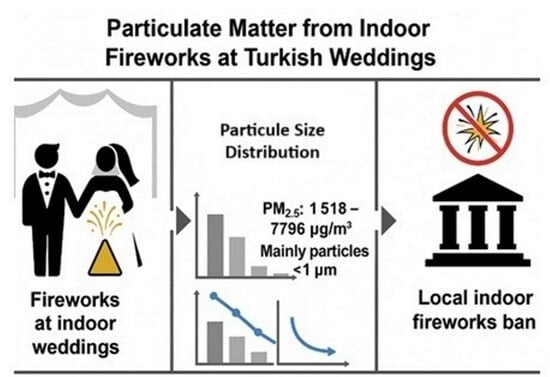
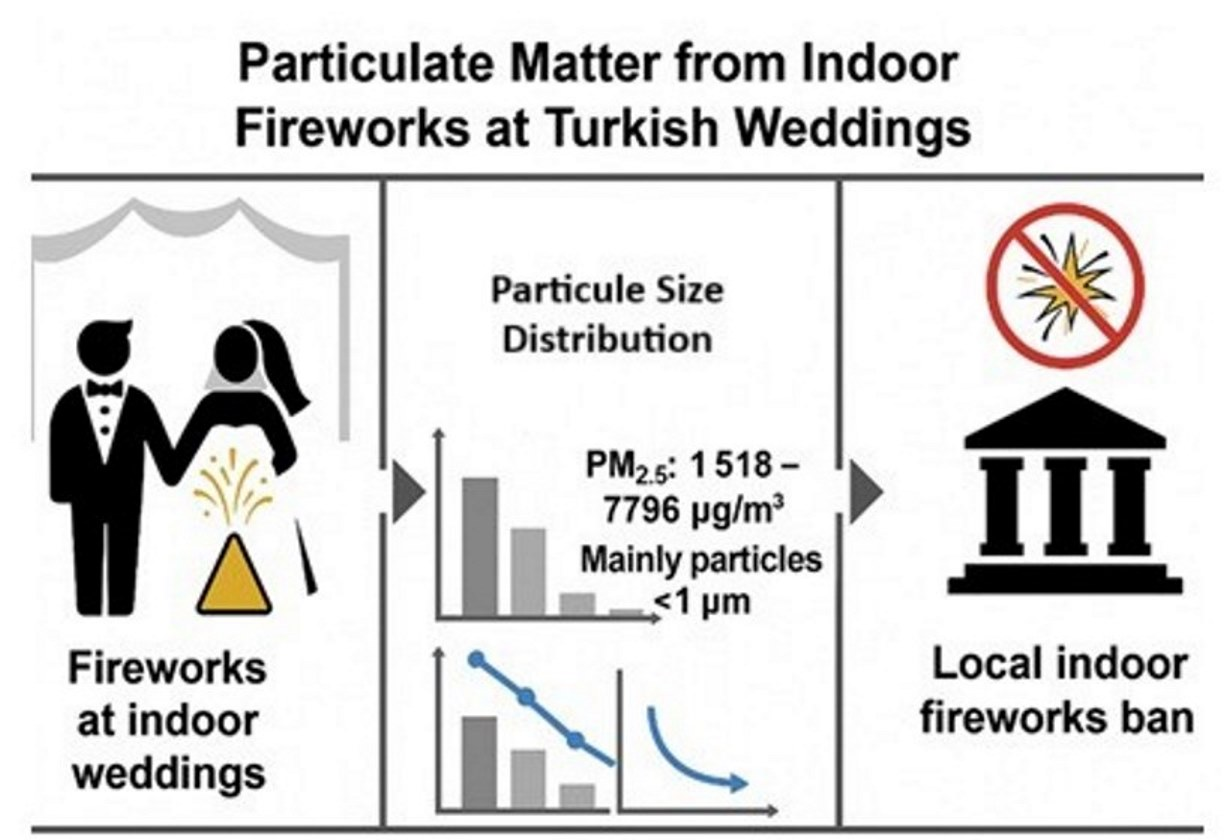
Fireworks are widely used at festive events worldwide and are commonly employed at indoor wedding ceremonies in Türkiye; however, their impact on indoor air quality has not been adequately investigated. This study examines particulate matter (PM) emissions generated by volcano-type fireworks used in indoor wedding halls. Particle samples were collected across five size fractions (>2.5, 1.0–2.5, 0.50–1.0, 0.25–0.50, and <0.25 µm) using a 5-stage Sioutas cascade impactor, and elemental compositions were determined by ICP-MS. PM2.5 concentrations ranged between 1518 and 7796 µg/m3, while total PM concentrations varied between 2088 and 8656 µg/m3. These values are substantially higher than the guideline limits reported by the World Health Organization (WHO) and the United States Environmental Protection Agency (USEPA), indicating very high short-term exposure levels. Fine particles (PM2.5) accounted for 56.5–92.4% of total PM, with particles smaller than 1 µm forming the dominant fraction. Among the analyzed elements, aluminum (Al), zinc (Zn), and iron (Fe) were the most abundant metals, predominantly associated with fine particles. The highest concentrations were generally observed in the 0.25–0.5 µm size range. These findings showed that the use of indoor fireworks can lead to high concentrations of fine particulate matter and metal-rich aerosols. This issue should be considered, as it may pose a health risk for those in enclosed spaces in future studies.

Graphical Abstract

1. Introduction

Air pollution is one of the most pressing environmental problems worldwide, directly associated with adverse effects on human health and ecosystems. It contributes to increased morbidity and mortality, particularly in densely populated urban areas. Current estimates suggest that more than one billion people live in regions with air quality below acceptable levels [1,2]. The U.S. Environmental Protection Agency (EPA) defines air pollution as the presence of pollutants in the atmosphere that can negatively impact human health, welfare, or the environment [3].
In addition to outdoor pollution, indoor air pollution has emerged as a major concern, as individuals spend most of their time in enclosed spaces. Indoor pollution refers to contaminants in non-industrial buildings, such as homes, offices, schools, and public facilities. The World Health Organization (WHO) has reported that indoor air pollution accounts for 2.7% of the global burden of disease [4]. Pollutants such as particulate matter (PM), nitrogen oxides (Nox), carbon monoxide (CO), carbon dioxide (CO2), volatile organic compounds (VOCs), polycyclic aromatic hydrocarbons (PAHs), formaldehyde, radon, cigarette smoke, allergens, and mineral fibers have been identified as key contributors to poor indoor air quality [5,6,7,8,9,10,11,12]. Since indoor air quality is strongly linked to outdoor conditions, infiltration of outdoor pollutants further exacerbates exposure risks.
Particulate matter is considered one of the most hazardous pollutants due to its small size, chemical composition, and ability to penetrate deep into the respiratory system. PM10 includes particles such as dust and pollen, while PM2.5 consists of finer particles, including combustion by-products and organic compounds. Both fractions are associated with significant health effects, ranging from respiratory ailments to carcinogenic outcomes [13,14]. Indoor PM levels vary with ventilation, building materials, and human activities, making indoor exposure particularly complex [15,16,17]. WHO emphasizes the “Rule of 1000,” which highlights that pollutants generated indoors are far more likely to be inhaled than those released outdoors. Each year, 3.8 million deaths are attributed to indoor air pollution, compared with 4.2 million from outdoor pollution [18,19]. These findings emphasize that strategies to improve air quality must focus not only on outdoor environments but also on indoor settings where exposure risks may be higher.
Although some air pollution sources are natural, such as forest fires, volcanic activity, desert dust, or lightning, anthropogenic emissions are more widespread and cause greater environmental and health problems [20]. Among these, fireworks represent a significant yet often overlooked short-term source of pollution [21]. Traditionally used in festivals and celebrations, fireworks are especially common in Turkey during weddings and cultural events [22].
Several studies have shown that during and immediately after firework displays, air pollutant concentrations increase dramatically, often between two and eight times higher than background levels before gradually returning to normal within about 24 h. The smoke produced by fireworks can reduce visibility by over 90%. Their combustion releases fine particles enriched with metals such as magnesium (Mg), aluminum (Al), iron (Fe), and zinc (Zn), as well as water-soluble ions including potassium (K+), chloride (Cl), and sulfate (SO42−). These phenomena have been documented during various celebrations, including the Sant Joan festival in Spain, the World Cup celebrations in Italy, the Festival of Lights in India, the Lantern Festival in Taiwan, and the Spring Festival in China [23].
The chemical composition of fireworks is central to their environmental impact. They typically contain oxidizers (such as nitrates, chlorates, and perchlorates), fuels (aluminum, magnesium, or coal), and coloring agents (strontium and barium salts) [24]. When ignited, these components generate particulate matter, carbon monoxide, nitrogen oxides, sulfur dioxide, ozone, and other toxic by-products. The released particles often contain toxic metals such as cadmium (Cd), copper (Cu), lead (Pb), chromium (Cr), manganese (Mn), and barium (Ba), which can accumulate in the environment and enter the food chain [25,26,27,28]. Health studies have demonstrated that exposure to these metals may cause neurotoxic effects, respiratory impairment, and increased risks of cancer [29]. Fine and ultrafine fractions of fireworks-related PM are particularly dangerous, as they can penetrate deeply into the lungs and bloodstream, aggravating conditions such as asthma and cardiovascular disease [30,31,32].
Despite growing international awareness of the environmental and health risks associated with fireworks, research on their effects in indoor environments remains limited. This gap is especially important in Turkey, where fireworks are frequently used in enclosed wedding halls, potentially exposing large groups of people to elevated pollutant concentrations in confined spaces. However, little is known about the specific levels of particulate matter and associated metals released indoors, or how these pollutants may impact human health under such conditions.
To address this knowledge gap, the present study focuses on the use of volcano-type fireworks in wedding halls in Bursa, Turkey. By sampling particulate matter in indoor air during these events, the study evaluates size distribution, concentration, and chemical composition, aiming to provide new insights into the health risks posed by indoor fireworks emissions.

2. Materials and Methods

2.1. Sampling and Gravimetric Analysis

Bursa, in northwest Turkey, lies southeast of the Sea of Marmara (40°15′–41°38′ N, 28°40′–30°48′ E) with a population of about 3 million. Key industries include textile, automotive, metal, food, and leather [33].
In 10 wedding halls in Bursa, samples were collected from indoor air during the explosion of volcano-type fireworks to determine the particle size distribution and metal content of the particulate matter. All materials used in the study were indoor pyrotechnic products manufactured by Venüs Fireworks (Sakarya, Turkey). The technical specifications of the pyrotechnic materials analyzed in this study were standardized to ensure the reproducibility of the experiments. All sampled volcano-type fireworks were 3 inches in size and, under controlled conditions, exhibited an average burning time of 30 s and a smoke rise height of 3 m. Model-based details and the quantities of the materials used in the experiments are presented in Table 1.
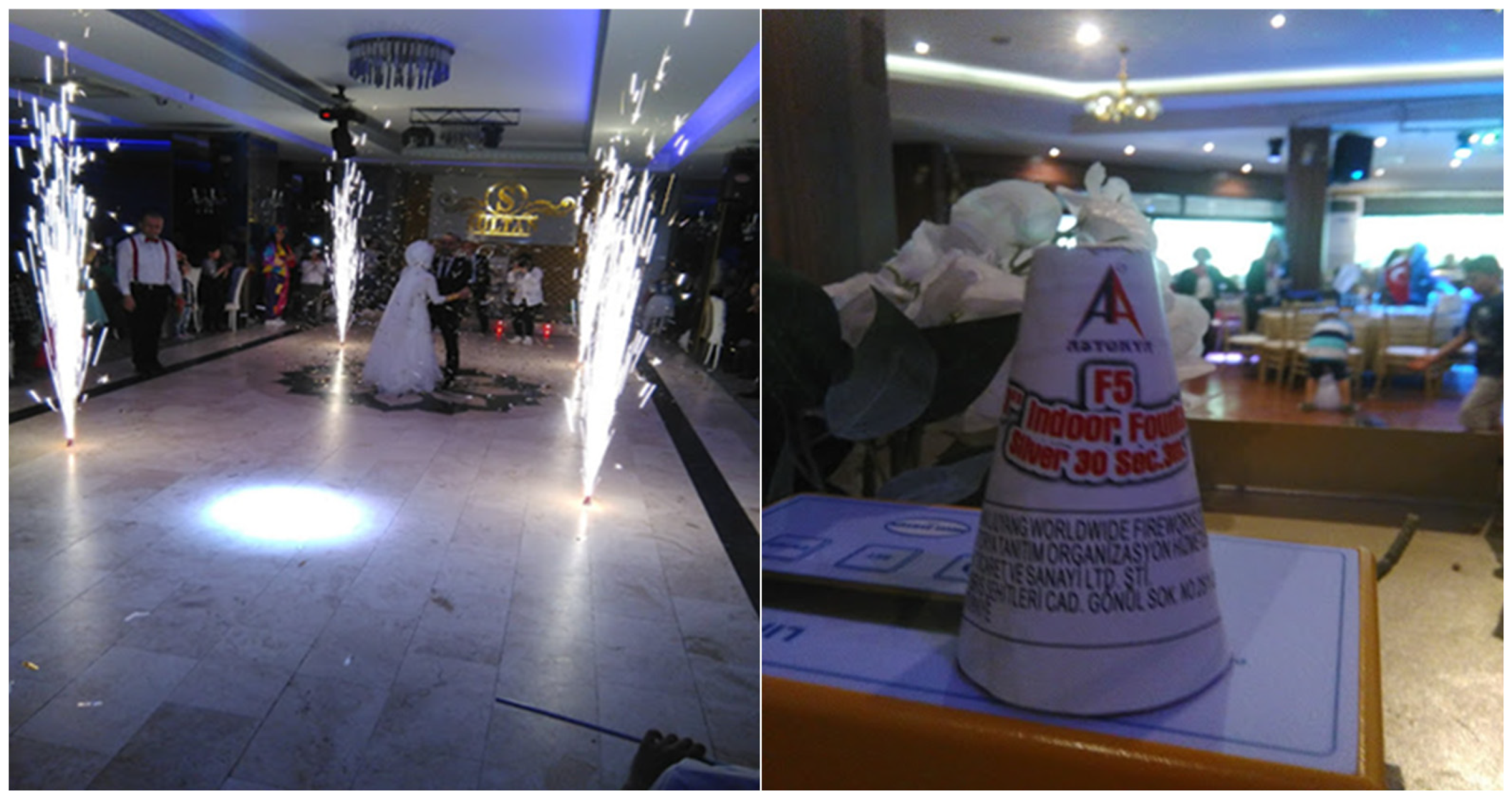
The sampling process was carried out from an average distance of 3–5 m from the exploding material and from a height of 1.5 m above the ground. The sampling process began 10 min before the fireworks were set off. The sampling process lasted 60 min after the explosion. Images of volcano-type fireworks exploding in wedding halls are given in Figure 1.
Indoor airborne particle sampling was performed using a 5-stage Sioutas personal cascade impactor (Sioutas Cascade Impactor, model SKC) and a 9 L/min sampling pump (SKC Leland Legacy, Dorset, UK, origin is USA). The particle size ranges collected on the filter were >2.5 µm, 1.0–2.5 µm, 0.50–1.0 µm, 0.25–0.50 µm, and <0.25 µm. Particles larger than 0.25 µm were collected in a 25 mm PTFE filter, and particles smaller than 0.25 µm were collected in a 37 mm PTFE filter. The SKC Leland Legacy pump was calibrated with a DryCal calibrator (Bios-IC, Lakewood, NJ, USA). Gravimetric analysis was performed with a precision electronic balance with an accuracy of 0.01 mg. Filters were conditioned at 20 ± 2 °C and 50 ± 5% relative humidity before and after sampling.

2.2. Extraction and Metal Analysis

Various analytical methods, including atomic absorption spectrometry (AAS), inductively coupled plasma optical emission spectrometry (ICP-OES), and inductively coupled plasma mass spectrometry (ICP-MS), have been used to detect heavy metal elements. Among these techniques, ICP-MS is the most common due to its advantages, including extremely high sensitivity, a wide dynamic range, and the ability to analyze multiple elements simultaneously [34].
Inductively Coupled Plasma Mass Spectrometry (ICP-MS) (Perkin Elmer Model) was conducted to analyze metals in the PM. The filters were digested using a Microwave Digestion System (MARS 5) to prepare a solution for metal analysis. Acid dissolution of filtres was performed with 5 mL of 65% nitric acid (HNO3), 1 mL of 30% hydrochloric acid (HCl), and 0.5 mL of hydrogen fluoride (HF) acid. Digestion was performed simultaneously on a blank filter, five sample filters, and a control solution. After digestion, the sample solutions were directly diluted to 15 mL with deionized distilled water and stored in the refrigerator at approximately −4 °C before analysis. The measurement was considered accurate when the repeatability of the three measurements for each sample was less than 5%. Fe, Ti, Sn, Al, Sr, Sb, and Zn, elements commonly found in fireworks, were analyzed by ICP-MS [35,36]. The limit of detection (LOD) of metal by ICP-MS is given in Table S1 in the Supplementary Materials.

3. Results and Discussion

3.1. Particulate Matter Concentration and Size Distribution

The mass concentrations of PM collected on filters of different sizes in wedding halls were calculated using the gravimetric method, and the results are given in Table 2 (also Table S2). It was found that PM > 2.5 (coarse particles) concentrations ranged from 567 µg/m3 to 1574 µg/m3, and PM2.5 (fine particles) concentrations ranged from 1518 µg/m3 to 7796 µg/m3. The highest concentrations of PM2.5 were determined as 7796 µg/m3 and 6939 µg/m3 in Hall 3 and Hall 4, respectively. It was observed that the PM2.5 fraction of total PM ranged from 56.5% to 92.4%, with fine particles being the dominant component.
There is no limit value for PM2.5 in our country yet; the United States Environmental Protection Agency (USEPA) has accepted the 24 h averOrganizationandard of 35 µg/m3 [37]. The World Health Organization (WHO) recommends a limit value of 15 µg/m3 for PM2.5 [19]. In our country, the limit value for the 8 h average respirable dust (<5 microns) is 5 mg/m3, and the limit value for total dust is 15 mg/m3, according to the Occupational Health and Safety Regulation on Dust Control. This study found that the average PM2.5 concentrations in all wedding halls were well above the EPA standard and the WHO-recommended limit. Compared to the limit value given in the Regulation on Combating Dust, the average PM concentration in Hall 3 and Hall 4 exceeded the limit value of 5 mg/m3 for respirable dust. However, the average concentrations determined in this study represent a sampling period of approximately 70 min. Given the 8 h exposure time, the average PM concentration across all halls will remain below the limit of 5000 µg/m3.
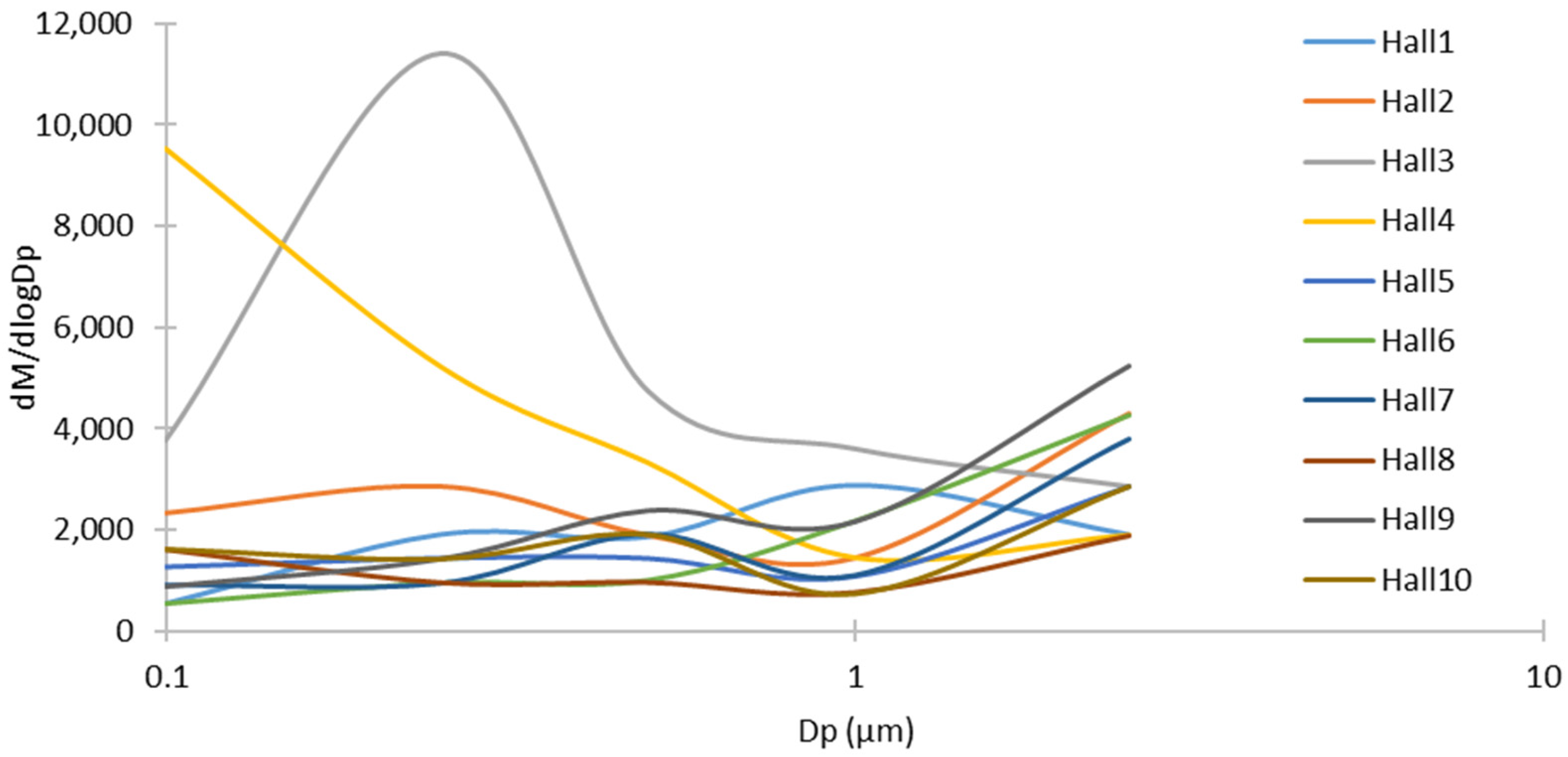
Figure 2 shows the particle size distributions of total PM sampled in 10 wedding halls. It was observed that the main component of total PM in all halls was particles smaller than 1 μm, and the particle size distribution was similar in all halls except Hall 3 and Hall 4. In Halls 3 and 4, particles smaller than 0.5 μm are more abundant. Differences in the production and use of fireworks may alter particle size distributions. These results are similar to those reported by Salma et al. during fireworks displays in Budapest, Hungary [38]. The study conducted in Budapest found that the average PM10 concentration over 1 h increased by 123 times compared to the concentration before the demonstration, and the highest particle diameter range was 0.1–1 μm.

3.2. Metal Concentration

The concentrations of Fe, Ti, Sn, Al, Sr, Sb, and Zn in PM sampled in five different sizes in wedding halls were determined by ICP-MS analysis. The average concentrations in total PM were determined as 403.77 μg/m3 for Al, 240.96 μg/m3 for Zn, 209.96 μg/m3 for Fe, 5.37 μg/m3 for Sr, 5.32 μg/m3 for Sn, 0.477 μg/m3 for Sb, and 0.0078 μg/m3 for Ti (Table S3). Al was the metal with the highest concentration in all samples. Al is one of the most widely used components in explosive and flammable products due to bright flames and white sparks [39]. In the measurement results, Hall 6 has the highest Al concentration (0.5–1.0 μm, 1596.53 μg/m3), while Hall 4, Hall 5, Hall 7, and Hall 8 have the highest Al concentrations. In Halls 1 and 2, the lowest Al level was analyzed. In the PM > 2.5 fraction, Al levels are generally low, but in some halls, such as Hall 5 and Hall 9, they are quite high. In the PM fraction < 0.25, an increase in Al levels is generally observed. In general, as the PM decreases, Al concentration increases.
Zn and Fe have the second- and third-highest concentrations, respectively, after Al. Zn is widely used to produce smoke effects in fireworks and pyrotechnics. Al and Zn are typically used instead of Mg in pyrotechnic compositions to decrease the melting point and ignition temperature of the flash mixtures [40].
In our study, Hall 4 has the highest Zn content (375.41 μg/m3) in the 0.25–0.5 μm PM size range. It was determined that the Zn parameter reached high levels in Hall 3 at sizes of 0.5–1.0 μm and PM < 0.25, and was at the lowest levels in Hall 1 and Hall 2. Zn concentrations increase significantly as PM gets smaller.
Fe is widely used for forming fuel and golden sparks [36]. Hall 6 had the highest Fe concentration levels of 87.95 μg/m3 at 0.5–1.0 μm particle size, while a significant decrease in Fe was observed for PM < 0.25 μm. Halls 5, 7, 8, and 9 had high Fe levels (50–80 μg/m3 range), while the lowest Fe levels were around 0.1 μg/m3 in Hall 3 (PM > 2.5) and Hall 10 (PM > 2.5). Fe levels fluctuated as PM decreased, and in some halls, Fe was concentrated in large particle sizes, whereas it was detected more in medium particle sizes. Kulshrestha et al. [41] conducted an indoor air assessment without fireworks in 2014. When the concentrations of individual metals in PM10 and PM2.5 were analyzed indoors in roadside, rural, and urban settlements, the trends were Fe > Zn > Pb > Cr > Ni > Cu > Mn [41].
In addition to Al, Fe, and Zn, components such as Ti, Sr(NO3)2, SnO, and SnO2 are used in volcano-type fireworks preferred in indoor environments. In this study, Sn and Sr were detected in the samples, and Ti and Sb showed lower concentrations. The low concentrations of Sb and Ti indicate that they are minor components of the explosive. These metals were likely converted to various oxides during pyrotechnic combustion (Saporito et al. [32]. The highest Sb concentration levels (0.5–1.0 μm, 0.228 μg/m3) were detected in Hall 6, while Hall 5 and 7 also had high Sb levels (0.145–0.170 μg/m3). As with other metals, the lowest Sb levels were observed in Halls 1 and 3. Sb could not be measured in some PM fractions of Hall 1. Sb levels appear to fluctuate slightly as PM size decreases, but do not show significant changes. In general, Ti concentrations ranged from 0 to 0.01 μg/m3, and Ti levels were generally very low; the highest Ti value was 0.01 μg/m3 for PM > 2.5 in Halls 5 & 9. In most halls, the Ti concentration did not change significantly as the PM size decreased.
SnO and SnO2 are used as active components in fireworks [42]. The highest Sn concentration values were 0.25–0.5 μm and 2.32 μg/m3 for Hall 9. Measurements were made at the levels of (PM < 0.25, 2.29 μg/m3), (PM < 0.25, 1.115 μg/m3), PM < 0.25, 1.555 μg/m3), (PM < 0.25, 1.375 μg/m3), (PM > 2.5, 1.315 μg/m3), 0.5–1.0 μm, 1.355 μg/m3) in Halls 2, 4, 5, 6, 7, and 8, respectively. The lowest Sn values were observed in Hall 1 (PM < 0.25, 0.01 μg/m3), and Sn levels are generally lower in the PM > 2.5 fraction, except in Hall 3 (2 μg/m3). In the PM fraction < 0.25, Sn levels generally increase. This distribution shows that the Sn parameter is generally more concentrated as particle size decreases (in small-size fractions such as PM < 0.25).
Sr(NO3)2 is rarely used as an oxidizer in fireworks. Sb2S3 is often used in the composition of fountain-type fireworks to produce bright red, blue, and purple light [32]. Hall 6 has high Sr components, as in the Al metal parameter (0.5–1.0 μm, 2.09 μg/m3). Hall 6 and Hall 9 have high Sr levels. Halls 1, 2, and 3 have the lowest Sr levels. Especially in Hall 1, Sr could not be measured in the PM2.5 fraction. Sr metal level generally increased as PM decreased.
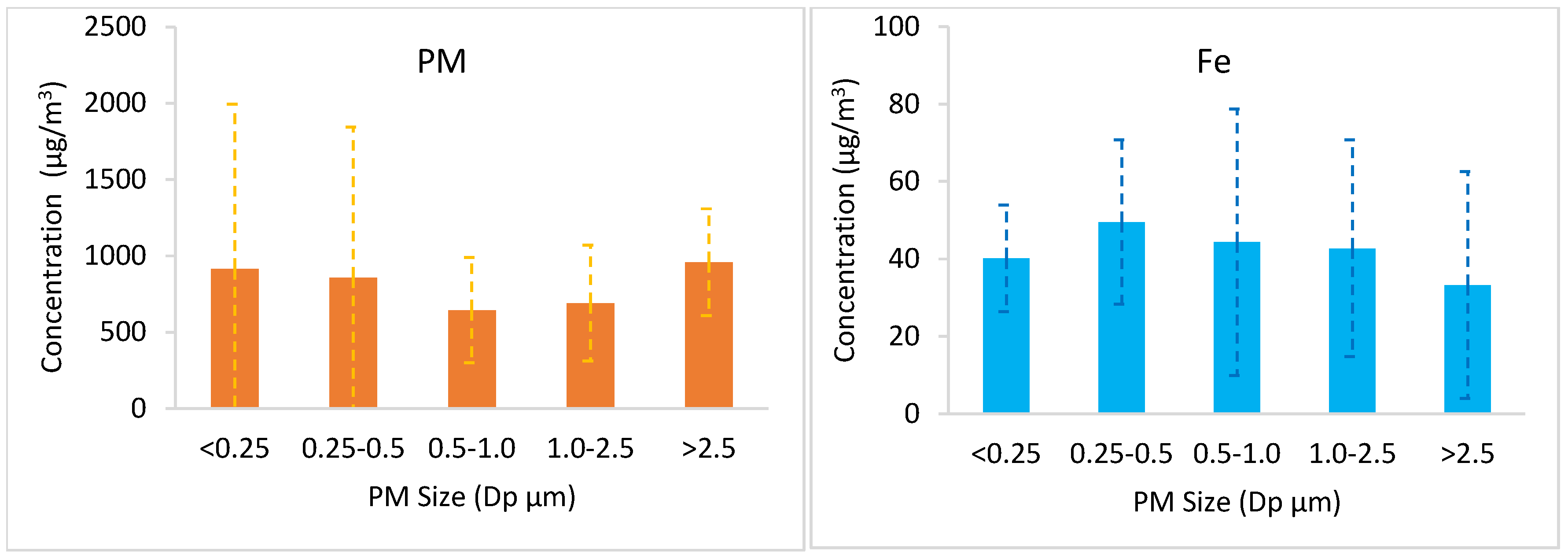
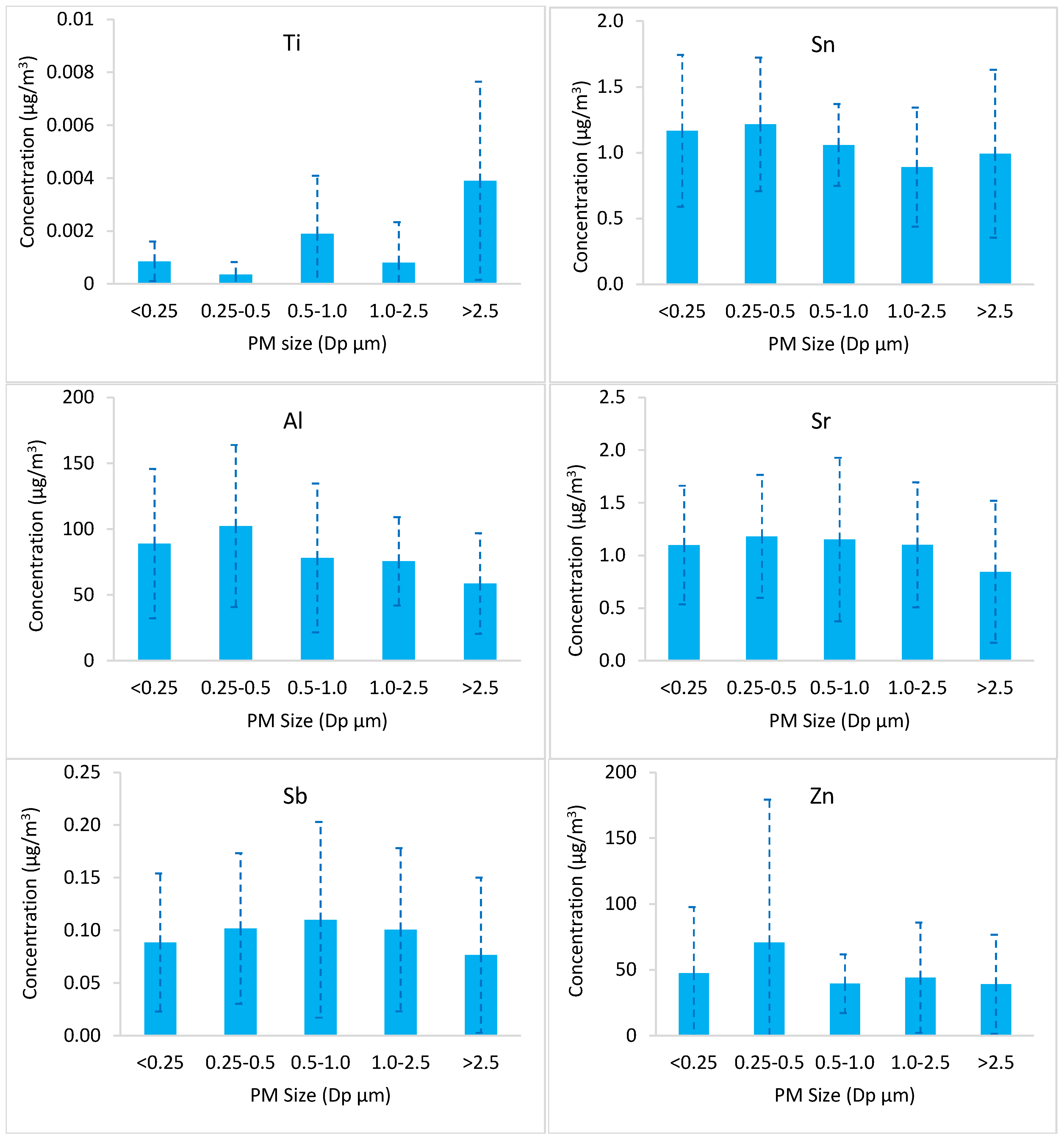
Particle size distributions of the analyzed metals and PM are given in Figure 3. In general, it was observed that all metals except Ti showed a balanced distribution similar to the size distribution of PM in 5 different particle fractions. It was determined that the particle size range with the highest concentration of Fe, Sn, Sr, Zn, and Al was 0.25–0.5 µm, and the particle size range with the highest concentration of Sb was 0.5–1.0 µm. It was observed that all metals except Ti were collected in PM2.5, and PM2.5 concentrations were higher than those of PM > 2.5.
When the distribution of Ti concentration across particle sizes is examined, it is found that Ti is concentrated in particles larger than 2.5 µm, unlike other elements. This is because the silver-coloured sparkle image in volcano-type fireworks is produced by burning Ti metal in the form of powder or particles [38].
In an indoor study similar to this one, the concentrations of heavy metals (Ag+, Cd2+, Cr2+, and Pb2+) were investigated to assess their risk to human health. Samples were collected using a high-volume air sampler installed after silver fireworks were lit in a laboratory, where indoor conditions were simulated by keeping windows and doors closed. The results showed that the concentrations exceeded the permissible values of the US National Ambient Air Quality Standards (0.0005, 0.004, and 0.6 μg/cm3) for rural, urban, and industrial areas. Higher concentrations of Ag+, Cd2+, and Cr2+ indicated greater toxicity. The evaluation of the potential health risks posed by these metals showed they were highly harmful [43].
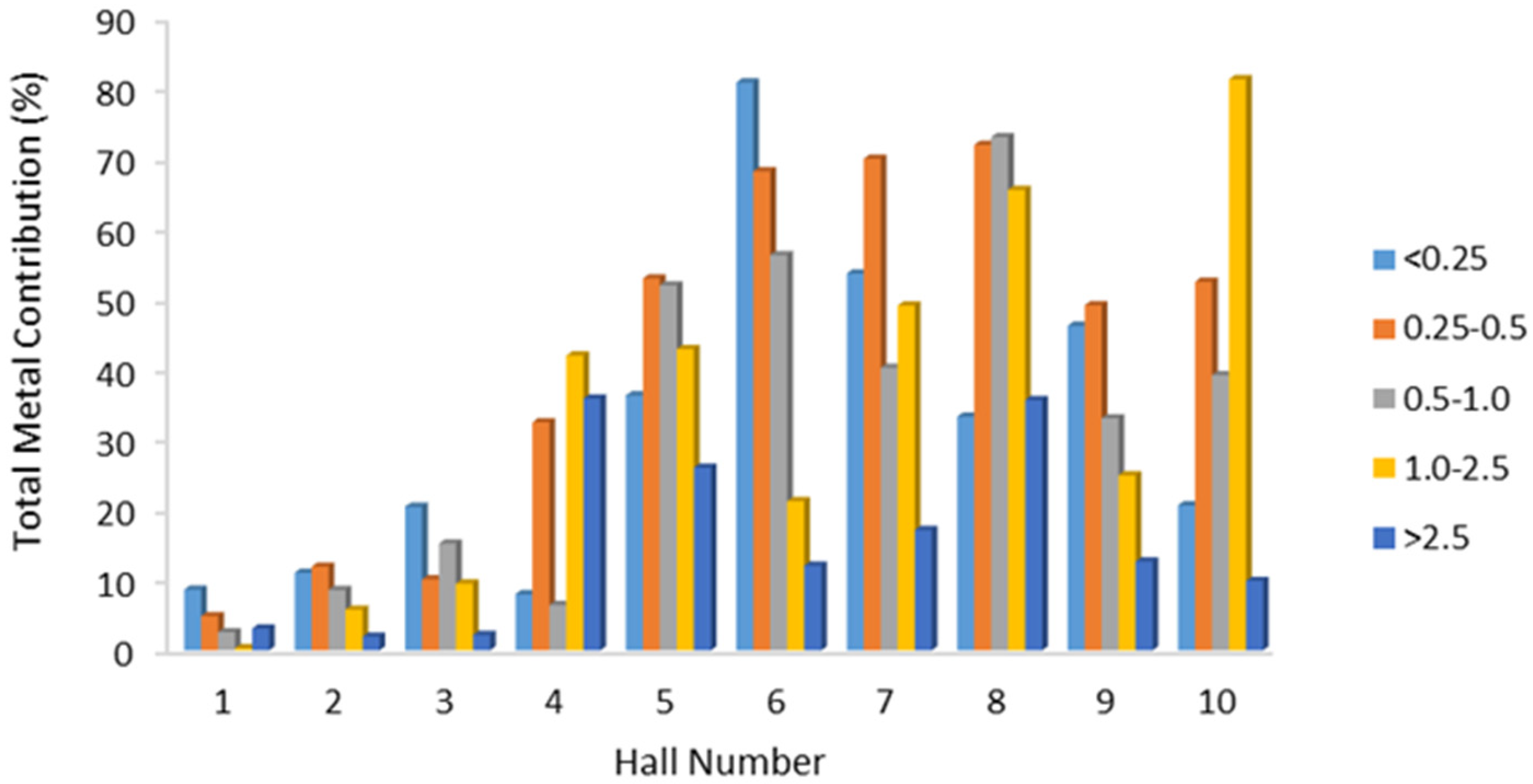
In Figure 4, the total metal ratios in PM sampled in 5 different sizes are given as percentages. The metal ratios in PM2.5 are high in all halls except halls 1, 2, and 3. In hall 6, approximately 80% of particles smaller than 0.25 were composed of metals. Similarly, in halls 5, 6, 7, 8, 9, and 10, the ratio of metals in particles of 0.25–0.5 microns ranges from 48% to 70%. The color, type, and intensity of fireworks are considered the reasons for the differences in metal content [44,45,46].
The United States Environmental Protection Agency (USEPA) identified three exposure routes in the risk assessment: inhalation, ingestion, and dermal contact [37,47]. Inhalation is the most rapid exposure pathway. Generally, an exposure pathway defines the process by which a stressor can come into contact with receptors. Health risks posed by contaminated metals were assessed by calculating hazard quotients for ingestion and dermal absorption, revealing the combined potential health risks to humans exposed to different heavy metals. Risks include cuts, burns, fatigue, and fumes. Major health implications include kidney damage, degenerative neurological conditions, cancer, respiratory and cardiovascular diseases [43].
The fact that a significant proportion of the metals detected in samples taken during fireworks in wedding halls are present in particles smaller than 2.5 µm requires that these particles be considered for their potential adverse health effects when inhaled. There is no regulation on indoor air quality in our country yet, nor any limit values for these metals in the rules on outdoor air quality. According to Occupational Health and Safety regulations, the Regulation on Health and Safety Measures in Working with Chemical Substances and the U.S. Occupational Safety and Health Administration (OSHA) set the TWA (time-weighted average) limits for Al metal at 15 mg/m3 for total dust and 5 mg/m3 for respirable dust over 8 h. In OSHA, the TWA value for Sn metal in total dust is given as 2 mg/m3 (inorganic compound) and 0.1 mg/m3 (organic compound), and the TWA value for Sb metal in total dust is 0.5 mg/m3. In this study, Al concentrations detected in total dust were below the 15 mg/m3 limit. This study found that Sn and Sb concentrations in total dust were below the OSHA limit values [48,49].
In addition to the statistical analysis, the relationships between particle size fractions and metal concentrations were qualitatively examined. The results indicate that most metals, particularly Al, Zn, and Fe, are associated with fine particles, with a distribution pattern consistent with the overall PM size distribution. Higher metal concentrations were generally observed in smaller particle fractions, especially within the 0.25–0.5 µm range.
However, due to the limited number of samples per wedding hall, robust statistical correlations could not be established with sufficient confidence. Therefore, the observed relationships are interpreted as general trends rather than definitive quantitative associations. These findings are nevertheless consistent with previous studies and support the conclusion that fine particles play a key role in transporting metal pollutants generated by fireworks.

3.3. Result of Statistical Analysis

We added a dedicated Statistical Analysis subsection and provided descriptive statistics (mean, standard deviation, min–max) for each metal across size fractions (Table S3).

3.4. Short-Term Exposure and Risk Context

Their combustion produces smoke, noise, and visual displays, but also releases pollutants into the atmosphere. Fireworks emissions include particulate matter, gases, and heavy metals that adversely affect local air quality and visibility [21]. Beyond direct hazards such as accidental detonations or hearing damage from high sound pressure levels, the inhalation of pollutants generated during fireworks displays represents a serious risk for both humans and the environment [50,51,52,53,54].
We estimated short-term inhalation exposure for attendees, assuming 1 h of light activity (Inhalation rate = 1.2 m3/h). Based on measured PM2.5 (Aver = 7.71 mg/m3; Max = 17.14 mg/m3), the inhaled PM2.5 mass is ≈ 9.25 mg (mean) and ≈ 20.57 mg (peak hall). For metals in PM2.5, the average inhaled mass over 1 h is ≈ 2.07 mg Al, ≈ 1.21 mg Zn, and ≈ 0.42 mg Fe. We provide a qualitative risk context against the WHO PM2.5 guidelines and OSHA metal limits and discuss that acute peaks of ultrafine/fine particles carry heightened respiratory risk despite short durations.
Although the Incremental Lifetime Cancer Risk (ILCR) is a widely used indicator for long-term health risk assessment, it was not calculated in this study because the focus was on short-term exposure conditions during firework events. ILCR assessments typically require long-term exposure assumptions and chronic intake parameters, which are not directly applicable to the short-duration, event-based exposure scenario investigated in this study.
Instead, the evaluation was based on short-term inhalation exposure estimates and comparison with established guideline values, which are more appropriate for assessing acute exposure risks. Nevertheless, the inclusion of ILCR-based assessments could provide additional insight and is recommended for future studies incorporating long-term exposure data.

3.5. Limitations

This study has several limitations that should be considered when interpreting the findings. First, sampling was limited to single 70 min windows, which may not fully capture the temporal variability of pollutant concentrations during or after firework displays. Event-based sampling reflects realistic exposure conditions despite limited replication. Second, the absence of personal exposure monitoring limited the ability to directly assess the health risks associated with individual-level exposures. Third, the lack of real-time particulate matter instrumentation limited the capacity to observe short-term concentration peaks and dynamic changes in particle size distribution. This study primarily focused on characterizing short-term exposure during active firework events in indoor environments, aiming to capture peak pollutant concentrations under realistic conditions. Due to the event-based nature of fireworks usage and logistical constraints in operational wedding halls, time-resolved sampling at multiple post-ignition intervals (e.g., 1 h, 2 h, and 4 h) could not be conducted within the scope of this study.
Nevertheless, the high concentrations observed during the sampling period clearly indicate that fireworks represent a significant short-term pollution source in enclosed environments. Investigation of the temporal attenuation and removal dynamics of these pollutants remains an important area for future research to better understand indoor air recovery processes and exposure duration. Finally, using a single replicate per wedding hall reduced the statistical power of inferential analyses, thereby constraining the generalizability of the results. Future research incorporating longer monitoring periods, personal exposure assessments, real-time instrumentation, and multiple replicates would strengthen the robustness of conclusions regarding indoor air pollution from fireworks and its health implications. Variability in firework composition from unknown manufacturers may have influenced the particle size distribution. Background concentrations were assumed to be negligible compared to peak levels observed during fireworks events. Selected metals represent dominant pyrotechnic components rather than a full toxicological screening.

4. Conclusions

In this study, the particle size distribution and particle concentration of volcano-type fireworks, which exploded for demonstration purposes in 10 different wedding halls in Bursa province, were determined, and their chemical composition was analyzed. Although the burn time of volcano-type fireworks was short, the average PM2.5 concentration during and after the explosion, over a total exposure time of 70 min, was well above the WHO and EPA limits. It was determined that PM2.5 constituted 56.5% and 92.4% of the total particulate matter, especially particles smaller than 1 micron, which were the main component of total PM. The metals with the highest concentrations in total dust were Al, Fe, and Zn, and metals were mainly concentrated in fine particles. Therefore, it should be taken into consideration that the fact that the particles emitted to the environment are mainly composed of particles smaller than 1.0 µm may cause adverse health effects, even for a short time, depending on the distance to the explosion process and the type and chemical content of the fireworks, especially for children, the elderly and people with chronic respiratory diseases among the audience. For this reason, the use of such products for demonstration and show purposes in closed areas should be prevented. The results of this study were shared with the local government, and fireworks were banned in indoor venues such as wedding halls. This study is intended as a reference for countries where fireworks are widely used indoors.

Supplementary Materials

The following supporting information can be downloaded at: https://www.mdpi.com/article/10.3390/toxics14050377/s1, Table S1: The Limit of detection (LOD) of metal by ICP-MS; Table S2: Metal concentrations in different size fractions; Table S3: Summary of statistical parameters for metals (µg/m3) in halls by particle size.

Author Contributions

Research concept: Ü.A.Ş.; Research methodology: Ü.A.Ş., B.O., M.K. and S.S.C.; Material collection: M.K.; Research: B.O.; Supervision: S.S.C.; Resources: M.K. and B.K.M. The first draft of the article was written by M.K., and all authors commented on previous versions. All authors have read and agreed to the published version of the manuscript.

Funding

This research received no external funding.

Institutional Review Board Statement

Not applicable.

Informed Consent Statement

Not applicable.

Data Availability Statement

The original contributions presented in this study are included in the article/Supplementary Materials. Further inquiries can be directed to the corresponding author.

Conflicts of Interest

The authors declare no conflict of interest.

References

  1. Onat, B. Metro İstasyonları ile Metro ve Şehirlerarası Tren Vagonlarında İç Hava Kalitesi. In Proceedings of the 12. Ulusal Tesisat Mühendisliği Kongresi, Izmir, Turkey, 8–11 April 2015; pp. 217–227. [Google Scholar]
  2. Alves, C.; Evtyugina, M.; Vicente, E.; Vicente, A.; Rienda, I.C.; De La Campa, A.S.; Tome, M.; Duarte, I. PM2.5 Chemical Composition and Health Risks by Inhalation Near a Chemical Complex. J. Environ. Sci. 2023, 124, 86–97. [Google Scholar] [CrossRef]
  3. Hırca, T.; Türkkan, G.E.; Bayraktar, H. Analysis of Air Pollution in Bayburt Province with Statistical Methods. Düzce Üniversitesi Bilim Teknol. Derg. 2022, 10, 685–699. [Google Scholar] [CrossRef]
  4. Güllü, G. Türkiye’de İç Ortam Hava Kirliliği Çalışmaları. Hava Kirliliği Araştırmaları Derg. 2013, 2, 146–158. [Google Scholar]
  5. Bayram, H.; Dörtbudak, Z.; Fişekçi, F.E.; Kargın, M.; Bülbül, B. Hava Kirliliğinin İnsan Sağlığına Etkileri, Dünyada, Ülkemizde ve Bölgemizde Hava Kirliliği Sorunu. Dicle Tıp Derg. 2006, 33, 105–112. [Google Scholar]
  6. Park, S.W.; Choi, B.S.; Lee, B.D.; Lee, J.W. Chemical Absorption of Carbon Dioxide into Aqueous PAA Solution of NaOH. Sep. Sci. Technol. 2005, 40, 911–926. [Google Scholar] [CrossRef]
  7. Onat, Ü.B.; Haksevenler, T.; Alver Şahin, B. İstanbul’da Farklı Bina İçi Ortamlarda PM2.5, CO Konsantrasyonları ve Partikül Sayısının Belirlenmesi. In Proceedings of the 10. Ulusal Tesisat Mühendisliği Kongresi, Izmir, Turkey, 13–16 April 2011; pp. 1785–1790. [Google Scholar]
  8. Deng, G.F.; Li, Z.H.; Wang, Z.C.; Gao, J.B.; Xu, Z.W.; Li, J.D. Indoor/Outdoor Relationship of PM2.5 Concentration in Typical Buildings with and without Air Cleaning in Beijing. Indoor Built Environ. 2017, 26, 60–68. [Google Scholar] [CrossRef]
  9. Camilleri, R.; Vella, A.J.; Harrison, R.M.; Aquilina, N.J. Source Apportionment of Indoor PM2.5 at A Residential Urban Background Site in Malta. Atmos. Environ. 2022, 278, 119093. [Google Scholar] [CrossRef]
  10. Fu, N.D.; Kim, M.K.; Chen, B.; Sharples, S. Investigation of Outdoor Air Pollutant PM2.5 Affecting The Indoor Air Quality in A High-Rise Building. Indoor Built Environ. 2022, 31, 895–912. [Google Scholar] [CrossRef]
  11. Chamseddine, I.; Alameddine, I.; Hatzopoulou, M.; El-Fadel, M. Seasonal Variation of Air Quality in Hospitals with Indoor–Outdoor Correlations. Build. Environ. 2019, 148, 689–700. [Google Scholar] [CrossRef]
  12. Suroto, A.; Yusof, N.; Norfazlinda, W.; Ramli, N.A.; Shith, S. Influence of Outdoor Source on The Variations of Indoor PM2.5 Concentration and Its Morphological Properties in Roadside School Environment. Int. J. Integr. Eng. 2019, 11, 119–128. [Google Scholar] [CrossRef]
  13. Braniš, M.; Řezáčová, P.; Domasová, M. The Effect of Outdoor Air and Indoor Human Activity on Mass Concentrations of PM10, PM2.5, and PM1 in A Classroom. Environ. Res. 2005, 99, 143–149. [Google Scholar] [CrossRef] [PubMed]
  14. Aydınoğlu, A.Ç.; Bovkır, R.; Bulut, M. Akıllı Şehirlerde Büyük Coğrafi Veri Yönetimi Ve Analizi: Hava Kalitesi Örneği. Geomatik 2022, 7, 174–186. [Google Scholar] [CrossRef]
  15. Li, Y.; Chen, Z. A Balance-Point Method for Assessing the Effect of Natural Ventilation on Indoor Particle Concentrations. Atmos. Environ. 2003, 37, 4277–4285. [Google Scholar] [CrossRef]
  16. Lazaridis, M.; Eleftheriadis, K.; Zdimal, V.; Schwarz, J.; Wagner, Z.; Ondracek, J.; Drossinos, Y.; Glytsos, T.; Vratolis, S.; Torseth, K.; et al. Number Concentrations and Modal Structure of Indoor/Outdoor Fine Particles in Four European Cities. Aerosol Air Qual. Res. 2017, 17, 131–146. [Google Scholar] [CrossRef]
  17. Bucur, E.; Danet, A. Indoor/Outdoor Correlations Regarding Indoor Air Pollution with Particulate Matter. Environ. Eng. Manag. J. 2019, 18, 425–432. [Google Scholar] [CrossRef]
  18. Dass, A.; Srivastava, S.; Chaudhary, G. Air Pollution: A Review and Analysis Using Fuzzy Techniques in the Indian Scenario. Environ. Technol. Innov. 2021, 22, 101441. [Google Scholar] [CrossRef]
  19. World Health Organization. Air Pollution; World Health Organization: Geneva, Switzerland, 2022. [Google Scholar]
  20. İspir, D.A.; Yıldız, F. Air Quality of Bursa: Temporal and Spatial Evaluation of PM10, PM2.5, NO2 and SO2 Pollutants Using IDW Geostatistical Technique. Doğal Afetler Ve Çevre Derg. 2025, 11, 181–193. [Google Scholar] [CrossRef]
  21. Marcy, M.J.; Carling, G.T.; Thompson, A.N.; Bickmore, B.R.; Nelson, S.T.; Rey, K.A.; Fernandez, D.P.; Heiner, M.; Adams, B.R. Trace Element Chemistry and Strontium Isotope Ratios of Atmospheric Particulate Matter Reveal Air Quality Impacts from Mineral Dust, Urban Pollution, and Fireworks. Appl. Geochem. 2024, 162, 105906. [Google Scholar] [CrossRef]
  22. Achathuparambil Gopalakrishnan, B.; Varghese, G.K. Chemical Speciation of Particulate Matter as a Tool in Air Pollution Forensics: A Case Study. Environ. Forensics 2024, 26, 261–275. [Google Scholar] [CrossRef]
  23. Yavaş, S.P.; Baysan, C.; Önal, A.E. The Effect of Firework Explosion at The Fireworks Factory on Air Pollutant Levels. Anatol. J. Fam. Med. 2021, 4, 80–85. [Google Scholar]
  24. Islam, M.Z. Is Celebration of New Year and Other Festivals Worth Their Environmental Impact? Geogr. J. 2024, 190, e12589. [Google Scholar] [CrossRef]
  25. Wang, Y.; Zhuang, G.; Xu, C.; An, Z. The Air Pollution Caused by The Burning of Fireworks During the Lantern Festival in Beijing. Atmos. Environ. 2007, 41, 417–431. [Google Scholar] [CrossRef]
  26. Pongpiachan, S.; Iijima, A.; Cao, J.J. Hazard Quotients, Hazard Indexes, and Cancer Risks of Toxic Metals in PM10 During Firework Displays. Atmosphere 2018, 9, 144. [Google Scholar] [CrossRef]
  27. Asif, M.; Bhatti, M.S.; Dhuria, R.S.; Yadav, S. Source Apportionment of Metal İons İn Ambient Air (PM2.5) During Firecracker Bursting: A Case Study of Amritsar Diwali on 24 October 2022. Urban Clim. 2024, 53, 101796. [Google Scholar] [CrossRef]
  28. Faisal, M.; Ali, U.; Kumar, A.; Hazarika, N.; Singh, V.; Kumar, M. Festive Fireworks in Delhi: A Major Source of Elemental Aerosols Established Through Dispersion Normalized PMF in A Multi-Year Study. Atmos. Environ. 2024, 323, 120394. [Google Scholar] [CrossRef]
  29. Manchanda, C.; Kumar, M.; Singh, V.; Hazarika, N.; Faisal, M.; Lalchandani, V.; Shukla, A.; Dave, J.; Rastogi, N.; Tripathi, S.N. Chemical Speciation and Source Apportionment of Ambient PM2.5 in New Delhi Before, During, and after The Diwali Fireworks. Atmos. Pollut. Res. 2022, 13, 101428. [Google Scholar] [CrossRef]
  30. Galea, O.; Powles, A. A Review of Firework Legislation and Acute Health Effects. In Chemical Hazards and Poisons Report; UK Health Security Agency: London, UK, 2010. [Google Scholar]
  31. Pope, C.A., III; Burnett, R.T.; Thun, M.J.; Calle, E.E.; Krewski, D.; Ito, K.; Thurston, G.D. Lung Cancer, Cardiopulmonary Mortality, and Long-Term Exposure to Fine Particulate Air Pollution. JAMA 2002, 287, 1132–1141. [Google Scholar] [CrossRef]
  32. Saporito, A.F.; Gordon, T.; Kim, B.; Huynh, T.; Khan, R.; Raja, A.; Terez, K.; Camacho-Rivera, N.; Gordon, R.; Gardella, J.; et al. Skyrocketing Pollution: Assessing The Environmental Fate of July 4th Fireworks in New York City. J. Expo. Sci. Environ. Epidemiol. 2024, 35, 214–222. [Google Scholar] [CrossRef]
  33. Turkish Statistical Institute. Turkish Statistical Institute. 2024. Available online: https://www.tuik.gov.tr/ (accessed on 15 February 2025).
  34. Zhao, G.; Huang, Y.; Yang, M.; Liu, L.; Jia, B.; Cheng, P. EDTA-Assisted MPT-MS for Trace Analysis of Heavy Metals in Fireworks. J. Mass Spectrom. 2024, 59, e5093. [Google Scholar] [CrossRef]
  35. Grudzinski, J. Determination of Major Particulate Matter (PM10) Components in Urban Aerosol from Taiyuan City, China. Master’s Thesis, University of Oslo, Oslo, Norway, 2007. [Google Scholar]
  36. Onat, B.; Caliskan, N.S.; Sahin, U.A.; Uzun, B. Assessment of The Health Risk Related to Exposure to Ultrafine, Fine, and Total Particulates and Metals in a Metal Finishing Plant. Environ. Sci. Pollut. Res. 2020, 27, 4058–4066. [Google Scholar] [CrossRef]
  37. United States Environmental Protection Agency (USEPA). Risk Assessment Guidance for Superfund; Human Health Evaluation Manual. Part A. Interim Report (Final); Technical Report No. PB-90-155581/XAB; Environmental Protection Agency: Washington, DC, USA, 1989.
  38. Salma, I.; Maenhaut, W. Changes in Elemental Composition and Mass of Atmospheric Aerosol Pollution between 1996 and 2002 in a Central European City. Environ. Pollut. 2006, 143, 479–488. [Google Scholar] [CrossRef] [PubMed]
  39. Wang, W.; Zhou, H.; Gao, Y.; Shao, L.; Zhou, X.; Li, X.; Wei, D.; Xing, J.; Lyu, R. Chemical Composition and Morphology of PM2.5 During Chinese New Year’s Eve: Impact of Firework/Firecracker Display. Atmos. Environ. 2024, 318, 120225. [Google Scholar] [CrossRef]
  40. Do, T.M.; Wang, C.F.; Hsieh, Y.K.; Hsieh, H.F. Metals Present in Ambient Air Before and After a Firework Festival in Yanshui, Tainan, Taiwan. Aerosol Air Qual. Res. 2012, 12, 981–993. [Google Scholar] [CrossRef]
  41. Kulshrestha, M.J.; Singh, R.; Engardt, M. Ambient and Episodic Levels of Metals in PM10 Aerosols and Their Source Apportionment in Central Delhi, India. J. Hazard. Toxic Radioact. Waste 2016, 20, A4014002. [Google Scholar] [CrossRef]
  42. Chen, D.; Pan, X.; Cao, G.; Guan, C.; Lv, H.; Zheng, H.; Zhu, C.; Song, D. Active Agent for Improving Reaction Activity of Firework Oxidant Barium Nitrate. CN Patent 201010129581, 13 March 2013. [Google Scholar]
  43. Ntesat, U.B.; Ojadi, D.; Emeka, C.; Okparanma, R.N. Ambient Air Quality and Human Health Risk Assessment of Heavy Metals in a Potentially Toxic Silver-Polluted Environment. Res. J. Ecol. Environ. Sci. 2025, 5, 1058. [Google Scholar] [CrossRef]
  44. Rende, H. Havai Fişek Etkinliklerinin Etkileri. Mühendis Makina 2012, 53, 37–43. [Google Scholar]
  45. Chen, W.C.; Lin, Y.H.; Ouyang, S.M.; Lee, Y.R. Effect of Relative Humidity on the Emission Height of Fireworks. J. Therm. Anal. Calorim. 2023, 148, 4997–5007. [Google Scholar] [CrossRef]
  46. Latha, R.; Anand, V.; Korhale, N.; Kori, P.; Murthy, B.S. Festival Ushered Pollutants in Indian Metropolitan Cities: Resemblance, Variance, and Concerns. Environ. Process. 2022, 9, 42. [Google Scholar] [CrossRef]
  47. Zhang, L.; Zeng, G.; Dong, H.; Chen, Y.; Zhang, J.; Yan, M.; Zhu, Y.; Yuan, Y.; Xie, Y.; Huang, Z. The Impact of Silver Nanoparticles on The Co-Composting of Sewage Sludge and Agricultural Waste. Bioresour. Technol. 2017, 230, 132–139. [Google Scholar] [CrossRef]
  48. Ministry of Labour and Social Security. Kimyasal Maddelerle Çalışmalarda Sağlık ve Güvenlik Önlemleri Hakkında Yönetmelik. Resmi Gazete. 2013; 28733. Available online: https://www.resmigazete.gov.tr/eskiler/2013/08/20130812-1.htm (accessed on 3 March 2024).
  49. Occupational Safety and Health Administration. 2024. Available online: https://www.osha.gov/annotated-pels/table-z-1 (accessed on 10 March 2024).
  50. Dutschke, A.; Lohrer, C.; Kurth, L.; Seeger, S.; Barthel, M.; Panne, U. Aerosol Emissions from Outdoor Firework Displays. Chem. Eng. Technol. 2011, 34, 2044–2050. [Google Scholar] [CrossRef]
  51. Kong, S.F.; Li, L.; Li, X.X.; Yin, Y.; Chen, K.; Liu, D.T.; Yuan, L.; Zhang, Y.J.; Shan, Y.P.; Ji, Y.Q. The Impacts of Firework Burning on Air Quality: Insights of Tracers, Source Evolution and Aging Processes. Atmos. Chem. Phys. 2015, 15, 2167–2184. [Google Scholar] [CrossRef]
  52. Kulshrestha, A.; Massey, D.D.; Masih, J.; Taneja, A. Source Characterization of Trace Elements in Indoor Environments at Urban, Rural, and Roadside Sites in A Semi-Arid Region of India. Aerosol Air Qual. Res. 2014, 14, 1738–1751. [Google Scholar] [CrossRef]
  53. Mahato, D.K.; Patidar, K.; Badaik, S.; Ambade, B. Source Apportionment of Black Carbon and PM2.5 During Diwali Festivals over an Industrial City in India. Int. J. Environ. Sci. 2024, 13, 11–19. [Google Scholar]
  54. Mishra, M.; Boopathy, R.; Mallik, C.; Das, T. Short-Term Effects of Diwali Fireworks Emissions on Particulates and Their Associated Empirically Calculated Health Risk Assessment at Bhubaneswar City. Environ. Geochem. Health 2024, 46, 21. [Google Scholar] [CrossRef]
Figure 1. Fireworks Show in Wedding Halls and Firework Type.
Toxics 14 00377 g001
Figure 2. Particle mass size distribution for all wedding halls.
Toxics 14 00377 g002
Figure 3. Average PM and metal concentrations in five different size fractions.
Toxics 14 00377 g003aToxics 14 00377 g003b
Figure 4. Percentage distribution of total metal ratios in different PM sizes.
Toxics 14 00377 g004
Table 1. Properties of Materials Used in the Sampled Volcano-Type Fireworks.
The Sampled Volcano-Type Fireworks
Sample No.NameQuantityTypeAverage Burning Time (sn)Size (inç)Average Smoke Height (m)
1FRK-VO24Volcano-type (white, odorless)3033
2MK-F044Volcano-type (white, odorless)3033
3MK-F042Volcano-type (white, odorless)3033
4F5 (Astorya)2Volcano-type3033
5BCSP-30152Volcano-type3033
6BCSP-30152Volcano-type3033
7BCSP-30152Volcano-type3033
8BCSP-30152Volcano-type3033
9MK-F04 BCSP-30151
1
Volcano-type3033
10BCSP-30152Volcano-type3033
Table 2. Particulate matter concentrations in different size fractions, μg/m3.
Wedding Hall
No.
A
PM
>2.5
B
PM
1.0–2.5
C
PM
0.5–1.0
D
PM
0.25–0.5
F
PM < 0.25
PM
>2.5
PM2.5PM Total% PM
2.5
%
PM
>2.5
157311485605742145692497306681.4 18.6
2129057757286092812902937422669.5 30.5
386014341431343115008607796865690.1 9.9
45725771002157437865676939750792.4 7.6
58604254294305008601784264467.5 32.5
6128086230028521412801661294156.5 43.5
7114543357428035711451644278958.9 41.1
85703002882876435741518208872.7 27.3
9157486271743035315742363393760.0 40.0
108602915744286438601936279669.2 30.8
Disclaimer/Publisher’s Note: The statements, opinions and data contained in all publications are solely those of the individual author(s) and contributor(s) and not of MDPI and/or the editor(s). MDPI and/or the editor(s) disclaim responsibility for any injury to people or property resulting from any ideas, methods, instructions or products referred to in the content.