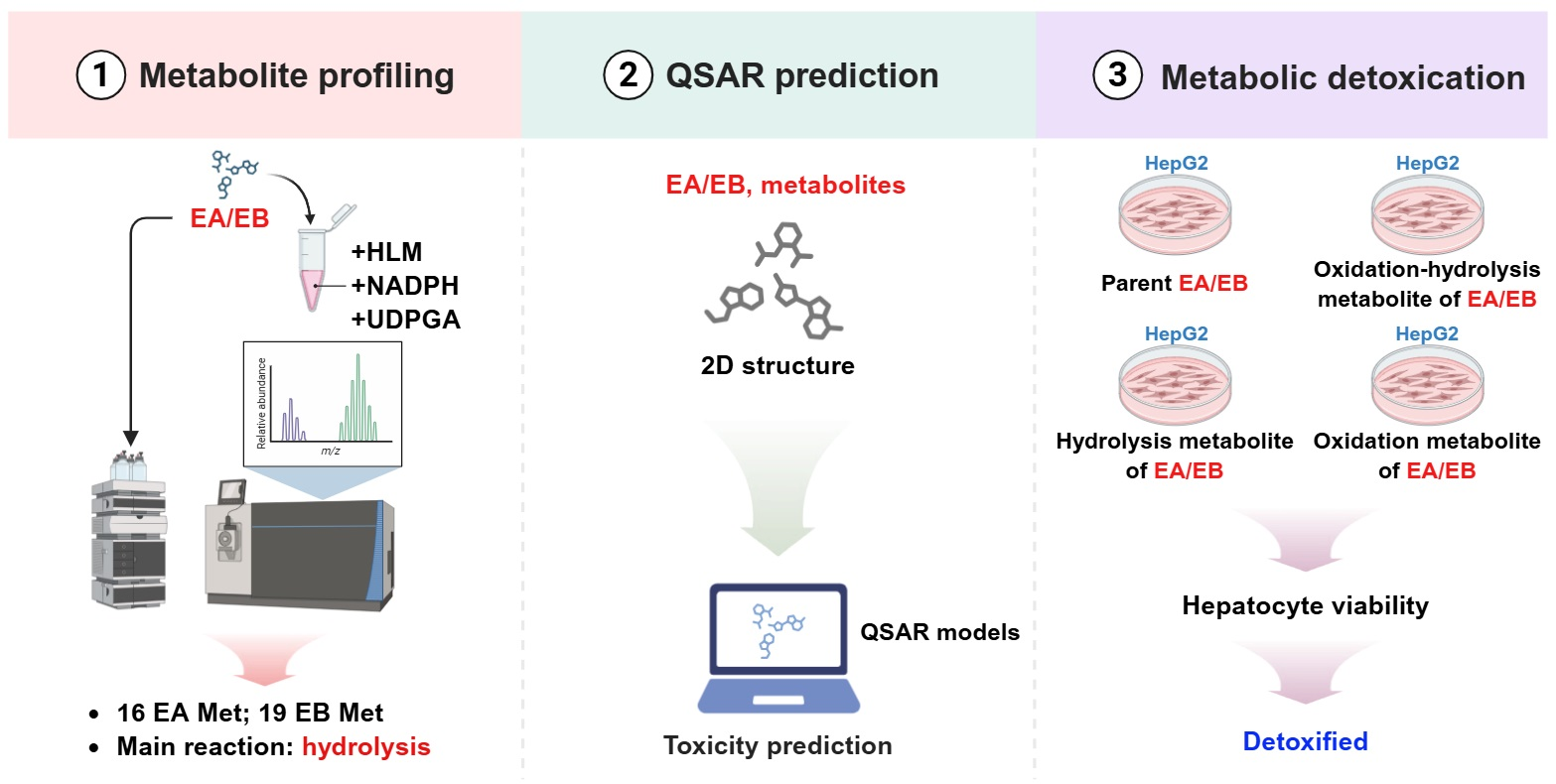
Metabolic Profiling and Detoxification of Eupalinolide A and B in Human Liver Microsomal Systems

 ,
,  ,
, 

Abstract
1. Introduction
2. Materials and Methods
2.1. Reagents and Materials
2.2. Metabolite Profiling
2.2.1. HLMs Incubation System and Sample Pretreatment
2.2.2. UPLC-Q-TOF-MS Analysis of EA and EB Metabolites
2.2.3. Metabolite Identification
2.3. Hepatotoxicity Prediction of EA, EB, and Their Metabolites by QSAR Models
2.4. Hepatocyte Toxicity Testing
2.4.1. Cell Culture
2.4.2. Hepatocyte Toxicity Changes in EA/EB in Different Metabolic Patterns
- (1)
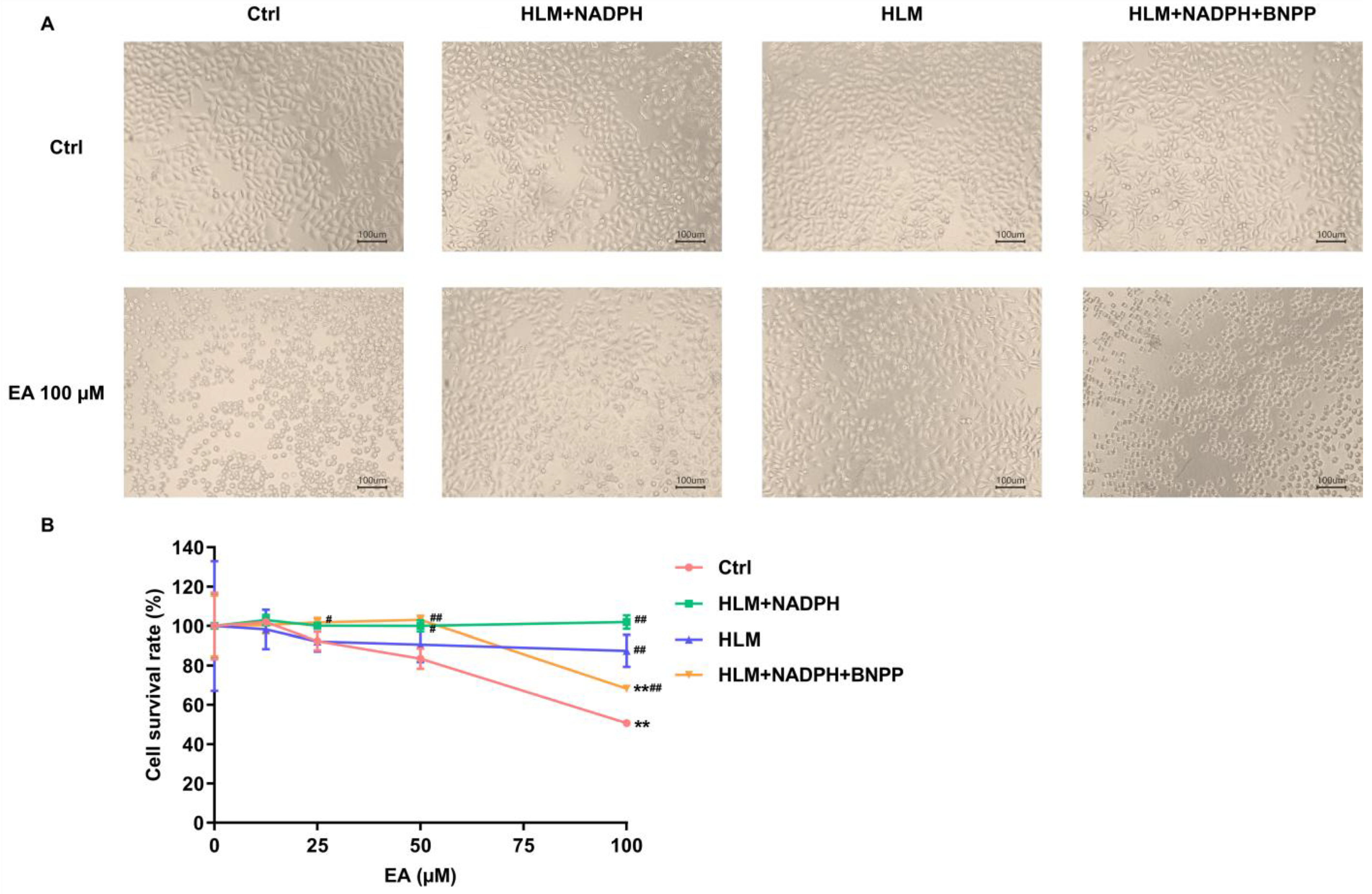
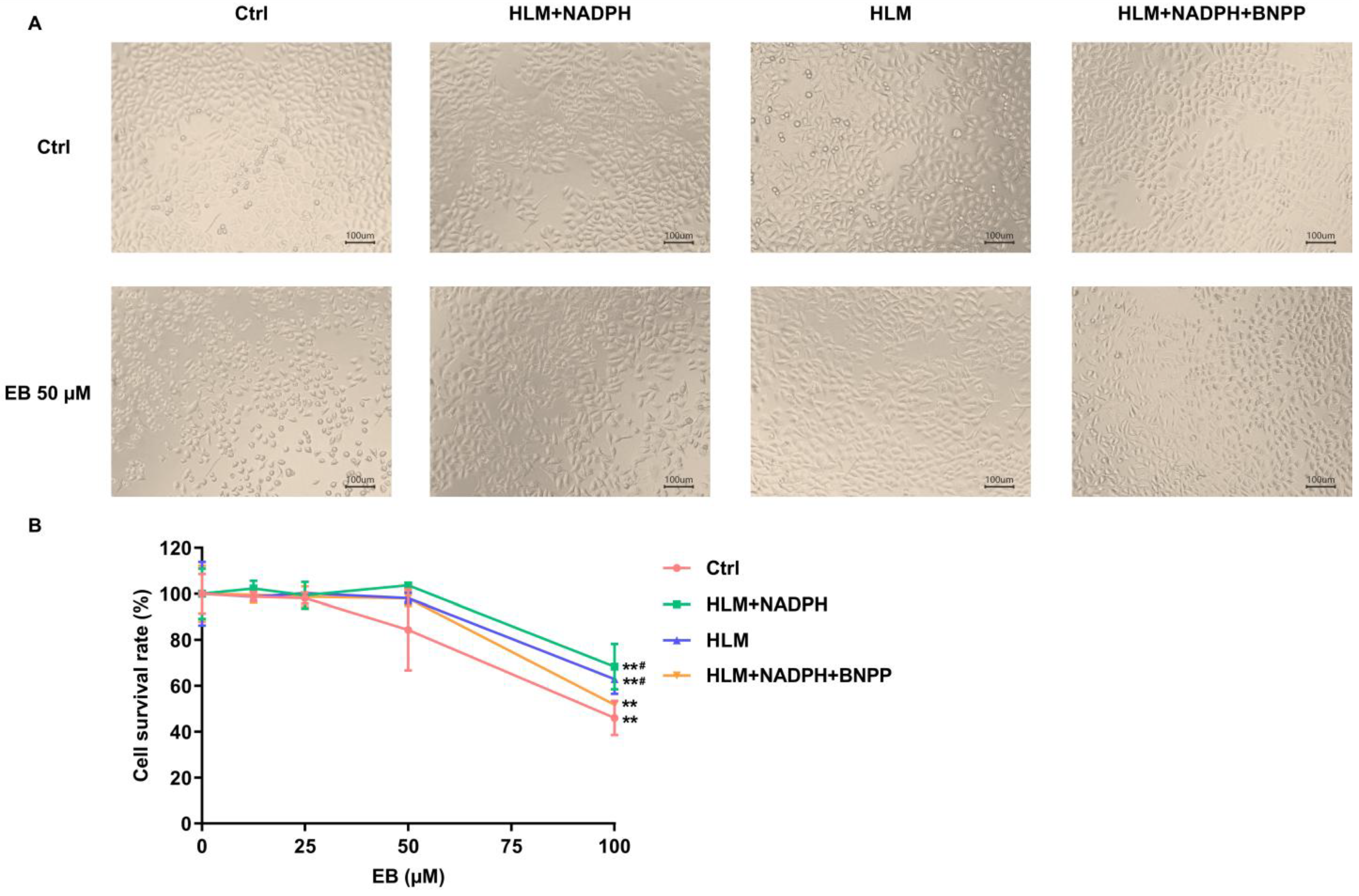
- Prototype groups: solvent control groups: 0.4% DMSO; treatment groups: EA or EB (12.5, 25, 50, 100 µM).
- (2)
- Hydrolysis–oxidation metabolite groups: solvent control groups: 0.4% DMSO + 0.16 g/L HLMs + 0.5 mM NADPH; treatment groups: EA or EB (12.5, 25, 50, 100 µM) + 0.16 g/L HLMs + 0.5 mM NADPH.
- (3)
- Hydrolysis metabolite groups (without NADPH, which is a coenzyme for initiating phase I reaction): solvent control groups: 0.4% DMSO + 0.16 g/L HLMs; treatment groups: EA or EB (12.5, 25, 50, 100 µM) + 0.16 g/L HLMs.
- (4)
- Oxidation metabolite groups (with BNPP, which is a carboxylesterase inhibitor [22]): solvent control groups: 0.4% DMSO + 0.16 g/L HLMs + 0.5 mM NADPH + 100 µM BNPP; treatment groups: EA or EB (12.5, 25, 50, 100 µM) + 0.16 g/L HLMs + 0.5 mM NADPH + 100 µM BNPP.
2.5. Statistical Analyses
3. Results
3.1. Metabolite Profiling of EA and EB
3.2. Toxicity Prediction of EA, EB, and Their Metabolites by QSAR Model
3.3. Metabolic Detoxification of EA and EB
4. Discussion
5. Conclusions
Supplementary Materials
Author Contributions
Funding
Institutional Review Board Statement
Informed Consent Statement
Data Availability Statement
Conflicts of Interest
References
- Kaplowitz, N. Idiosyncratic drug hepatotoxicity. Nat. Rev. Drug Discov. 2005, 4, 489–499. [Google Scholar] [CrossRef] [Scilit] [PubMed]
- Chaudhari, P.V.; Jadhav, R.; Jain, A.; Jagtap, P.; Mahajan, B.; Gawand, P.J. A Comprehensive review on drug-induced diseases and teratogenicity. Prospect. Pharm. Sci. 2025, 23, 66–73. [Google Scholar] [CrossRef] [Scilit]
- Hewitt, N.J.; Lechón, M.J.; Houston, J.B.; Hallifax, D.; Brown, H.S.; Maurel, P.; Kenna, J.G.; Gustavsson, L.; Lohmann, C.; Skonberg, C.; et al. Primary hepatocytes: Current understanding of the regulation of metabolic enzymes and transporter proteins, and pharmaceutical practice for the use of hepatocytes in metabolism, enzyme induction, transporter, clearance, and hepatotoxicity studies. Drug Metab. Rev. 2007, 39, 159–234. [Google Scholar] [CrossRef] [Scilit] [PubMed]
- Wang, X.; Ma, S.; Lai, F.; Wang, Y.; Lou, C. Traditional applications, phytochemistry, and pharmacological activities of Eupatorium lindleyanum DC.: A comprehensive review. Front. Pharmacol. 2020, 8, 577124. [Google Scholar] [CrossRef] [Scilit]
- Zhang, Y.; Dong, F.; Cao, Z.; Wang, T.; Pan, L.; Luo, W.; Ding, W.; Li, J.; Jin, L.; Liu, H.; et al. Eupalinolide A induces autophagy via the ROS/ERK signaling pathway in hepatocellular carcinoma cells in vitro and in vivo. Int. J. Oncol. 2022, 61, 131. [Google Scholar] [CrossRef] [Scilit]
- Yang, L.; Chen, H.; Hu, Q.; Liu, L.; Yuan, Y.; Zhang, C.; Tang, J.; Shen, X. Eupalinolide B attenuates lipopolysaccharide-induced acute lung injury through inhibition of NF-κB and MAPKs signaling by targeting TAK1 protein. Int. Immunopharmacol. 2022, 111, 109148. [Google Scholar] [CrossRef] [Scilit]
- Zhang, Y.; Zhang, H.; Mu, J.; Han, M.; Cao, Z.; Dong, F.; Wang, T.; Pan, L.; Luo, W.; Li, J.; et al. Eupalinolide B inhibits hepatic carcinoma by inducing ferroptosis and ROS-ER-JNK pathway. Acta Biochim. Biophys. Sin. 2022, 54, 974–986. [Google Scholar] [CrossRef] [Scilit]
- Zhang, X.W.; Feng, N.; Liu, Y.C.; Guo, Q.; Wang, J.K.; Bai, Y.Z.; Ye, X.M.; Yang, Z.; Yang, H.; Liu, Y.; et al. Neuroinflammation inhibition by small-molecule targeting USP7 noncatalytic domain for neurodegenerative disease therapy. Sci. Adv. 2022, 8, eabo0789. [Google Scholar] [CrossRef] [Scilit]
- Bai, Q.; Wang, C.; Ding, N.; Wang, Z.; Liu, R.; Li, L.; Piao, H.; Song, Y.; Yan, G. Eupalinolide B targets DEK and PANoptosis through E3 ubiquitin ligases RNF149 and RNF170 to negatively regulate asthma. Phytomedicine 2025, 141, 156657. [Google Scholar] [CrossRef] [Scilit]
- Zhang, J.; Zhao, F.; Yu, X.; Lu, X.; Zheng, G. Pharmacokinetics of eupalinolide A, eupalinolide B and hyperoside from Eupatorium lindleyanum in rats by LC/MS/MS. J. Chromatogr. B Anal. Technol. Biomed. Life Sci. 2015, 995–996, 1–7. [Google Scholar] [CrossRef] [Scilit]
- Li, Y.; Liu, X.; Li, L.; Zhang, T.; Gao, Y.; Zeng, K.; Wang, Q. Characterization of the metabolism of eupalinolide A and B by carboxylesterase and cytochrome P450 in human liver microsomes. Front. Pharmacol. 2023, 14, 1093696. [Google Scholar] [CrossRef] [Scilit] [PubMed]
- Timmerman, P.; Blech, S.; White, S.; Green, M.; Delatour, C.; McDougall, S.; Mannens, G.; Smeraglia, J.; Williams, S.; Young, G. Best practices for metabolite quantification in drug development: Updated recommendation from the European Bioanalysis Forum. Bioanalysis 2016, 8, 1297–1305. [Google Scholar] [CrossRef] [Scilit] [PubMed]
- Qin, W.H.; Song, X.X.; Li, X.M.; Li, Q.; Yang, Y. Serum medicinal chemistry study of Eupalinilide C based on UPLC-Q-TOF-MS. China J. Tradit. Chin. Med. Pharm. 2021, 36, 130–134. [Google Scholar]
- Qin, W.H.; Li, X.M.; Yang, Y.; Li, Q. Metabolic study of Eupalinilide B in rats based on ultra-high performance lipuid chromatography-time of flight-mass spectrometry. J. Anal. Sci. 2020, 36, 347–352. [Google Scholar]
- Zhang, D.; Ma, B.; Dragovich, P.S.; Ma, L.; Chen, S.; Chen, E.C.; Ye, X.; Liu, J.; Pizzano, J.; Bortolon, E.; et al. Tissue distribution and retention drives efficacy of rapidly clearing VHL-based PROTACs. Commun. Med. 2024, 4, 87. [Google Scholar] [CrossRef] [Scilit]
- Clune, S.; Awolade, P.; Zhou, Q.; Esquer, H.; Matter, B.; Kearns, J.T.; Kellett, T.; Akintayo, D.C.; Kompella, U.B.; LaBarbera, D.V. The validation of new CHD1L inhibitors as a therapeutic strategy for cancer. Biomed. Pharmacother. 2024, 170, 116037. [Google Scholar] [CrossRef] [Scilit]
- Lade, J.M.; Avery, L.B.; Bumpus, N.N. Human biotransformation of the nonnucleoside reverse transcriptase inhibitor rilpivirine and a cross-species metabolism comparison. Antimicrob. Agents Chemother. 2013, 57, 5067–5079. [Google Scholar] [CrossRef] [Scilit]
- Huang, L.; Nikolic, D.; van Breemen, R.B. Hepatic metabolism of licochalcone A, a potential chemopreventive chalcone from licorice (Glycyrrhiza inflata), determined using liquid chromatography-tandem mass spectrometry. Anal. Bioanal. Chem. 2017, 409, 6937–6948. [Google Scholar] [CrossRef] [Scilit]
- Schymanski, E.L.; Jeon, J.; Gulde, R.; Fenner, K.; Ruff, M.; Singer, H.P.; Hollender, J. Identifying small molecules via high resolution mass spectrometry: Communicating confidence. Environ. Sci. Technol. 2014, 48, 2097–2098. [Google Scholar] [CrossRef] [Scilit]
- Liew, C.Y.; Lim, Y.C.; Yap, C.W. Mixed learning algorithms and features ensemble in hepatotoxicity prediction. J. Comput.-Aided Mol. Des. 2011, 25, 855–871. [Google Scholar] [CrossRef] [Scilit]
- Choi, J.M.; Oh, S.J.; Lee, J.Y.; Jeon, J.S.; Ryu, C.S.; Kim, Y.M.; Lee, K.; Kim, S.K. Prediction of drug-induced liver injury in HepG2 cells cultured with human liver microsomes. Chem. Res. Toxicol. 2015, 28, 872–885. [Google Scholar] [CrossRef] [Scilit]
- Tang, S.C.; Sparidans, R.W.; Cheung, K.L.; Fukami, T.; Durmus, S.; Wagenaar, E.; Yokoi, T.; van Vlijmen, B.J.; Beijnen, J.H.; Schinkel, A.H. P-glycoprotein, CYP3A, and plasma carboxylesterase determine brain and blood disposition of the mTOR Inhibitor everolimus (Afinitor) in mice. Clin. Cancer Res. 2014, 20, 3133–3145. [Google Scholar] [CrossRef] [Scilit] [PubMed]
- Qin, W.H.; Liu, X.; Wang, Y.H.; Song, X.X.; Yang, Y.; Li, Q. Analysis of metabolites of eupalinolide F in rats based on UPLC-Q-TOF-MS. Nat. Prod. Res. Dev. 2019, 31, 2137–2143. [Google Scholar]
- Hu, X.J.; Zhang, Y.B.; Zhao, Z.J.; Zhang, L.; Wang, Q.; Yang, X.W. Metabolic detoxification of bakuchiol is mediated by oxidation of CYP 450s in liver microsomes. Food Chem. Toxicol. Int. J. Publ. Br. Ind. Biol. Res. Assoc. 2018, 111, 385–392. [Google Scholar] [CrossRef] [Scilit]
- Klein, P.; Nelson, W.L. Electrophilic gamma-lactone kappa-opioid receptor probes. Analogues of 2′-hydroxy-2-tetrahydrofurfuryl-5,9-dimethyl-6,7-benzomorphan diastereomers. J. Med. Chem. 1991, 34, 2438–2444. [Google Scholar] [CrossRef] [Scilit]
- Schöning, V.; Hammann, F.; Peinl, M.; Drewe, J. Identification of any structure-specific hepatotoxic potential of different pyrrolizidine alkaloids using random forests and artificial neural networks. Toxicol. Sci. 2017, 160, 361–370. [Google Scholar] [CrossRef] [Scilit]
- Schwöbel, J.A.; Koleva, Y.K.; Enoch, S.J.; Bajot, F.; Hewitt, M.; Madden, J.C.; Roberts, D.W.; Schultz, T.W.; Cronin, M.T. Measurement and estimation of electrophilic reactivity for predictive toxicology. Chem. Rev. 2011, 111, 2562–2596. [Google Scholar] [CrossRef] [Scilit] [PubMed]
- Dambach, D.M.; Andrews, B.A.; Moulin, F. New technologies and screening strategies for hepatotoxicity: Use of in vitro models. Toxicol. Pathol. 2005, 33, 17–26. [Google Scholar] [CrossRef] [Scilit] [PubMed]



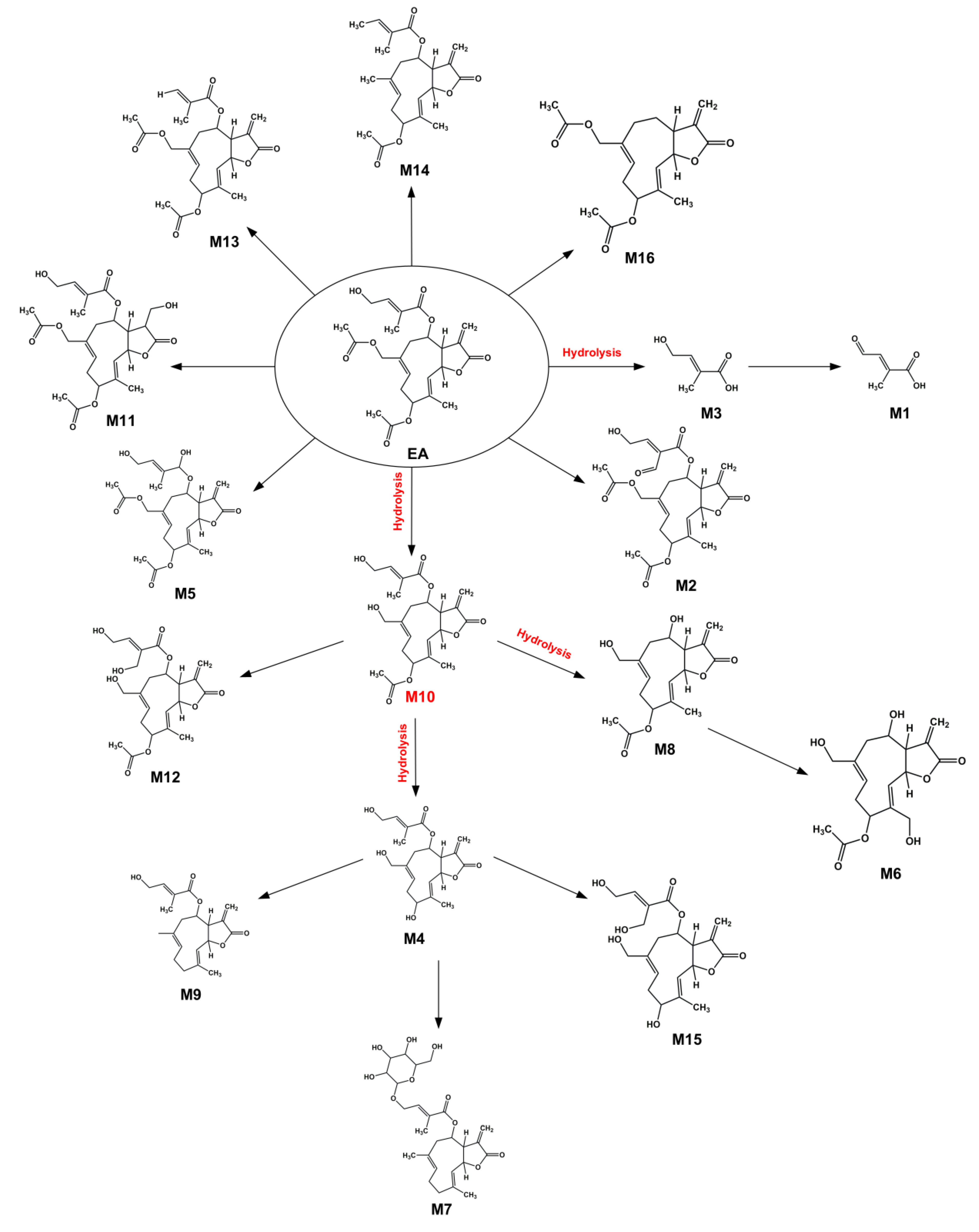
| Peak ID | Retention Time (min) | Metabolic Process | Formula | Ion Mode | m/z | ppm | Peak Area | Score (%) * |
|---|---|---|---|---|---|---|---|---|
| M1 | 2.96 | Hydrolysis + Ketone Formation | C5H6O3 | - | 113.0241 | −2.5 | 885 | 73.6 |
| M2 | 5.63 | Ketone Formation | C24H28O10 | - | 475.1603 | −1.4 | 9130 | 75.0 |
| M3 | 6.56 | Hydrolysis | C5H8O3 | - | 115.0400 | −0.6 | 13,200 | 75.0 |
| M4 | 6.56 | Hydrolysis | C20H26O7 | - | 377.1601 | −1.2 | 70,200 | 75.0 |
| M5 | 6.77 | Double bond reduction | C24H32O9 | + | 465.2085 | −7.4 | 73,800 | 49.1 |
| M6 | 6.81 | Hydrolysis + Oxidation | C17H22O7 | - | 337.1290 | −0.7 | 48,700 | 75.0 |
| M7 | 6.90 | Hydrolysis + Glucose Conjugation + Dehydroxylation | C26H36O10 | + | 509.2350 | −6.2 | 45,100 | 39.6 |
| M8 | 6.93 | Hydrolysis | C17H22O6 | - | 321.1341 | −1.0 | 121,000 | 75.0 |
| M9 | 6.98 | Hydrolysis + Dehydroxylation | C20H26O5 | + | 347.1821 | −9.3 | 107,000 | 56.8 |
| M10 | 7.07 | Hydrolysis | C22H28O8 | - | 419.1714 | 0.6 | 240,000 | 75.1 |
| M11 | 7.07 | Hydroxylation | C24H32O10 | - | 479.1922 | −0.2 | 135,000 | 75.0 |
| M12 | 7.10 | Hydrolysis + Oxidation | C22H28O9 | - | 435.1659 | −0.4 | 27,500 | 75.0 |
| M13 | 8.43 | Dehydroxylation | C23H28O8 | + | 433.1840 | −3.9 | 37,800 | 70.2 |
| M14 | 8.57 | Dehydroxylation + Deesterification | C22H28O6 | + | 389.1927 | −8.1 | 24,600 | 59.8 |
| M15 | 11.04 | Hydrolysis + Oxidation | C20H26O8 | + | 395.1722 | 5.3 | 18,900 | 66.7 |
| M16 | 11.77 | Dehydroxylation + Deesterification | C19H24O6 | + | 349.1680 | 9.9 | 3170 | 42.7 |
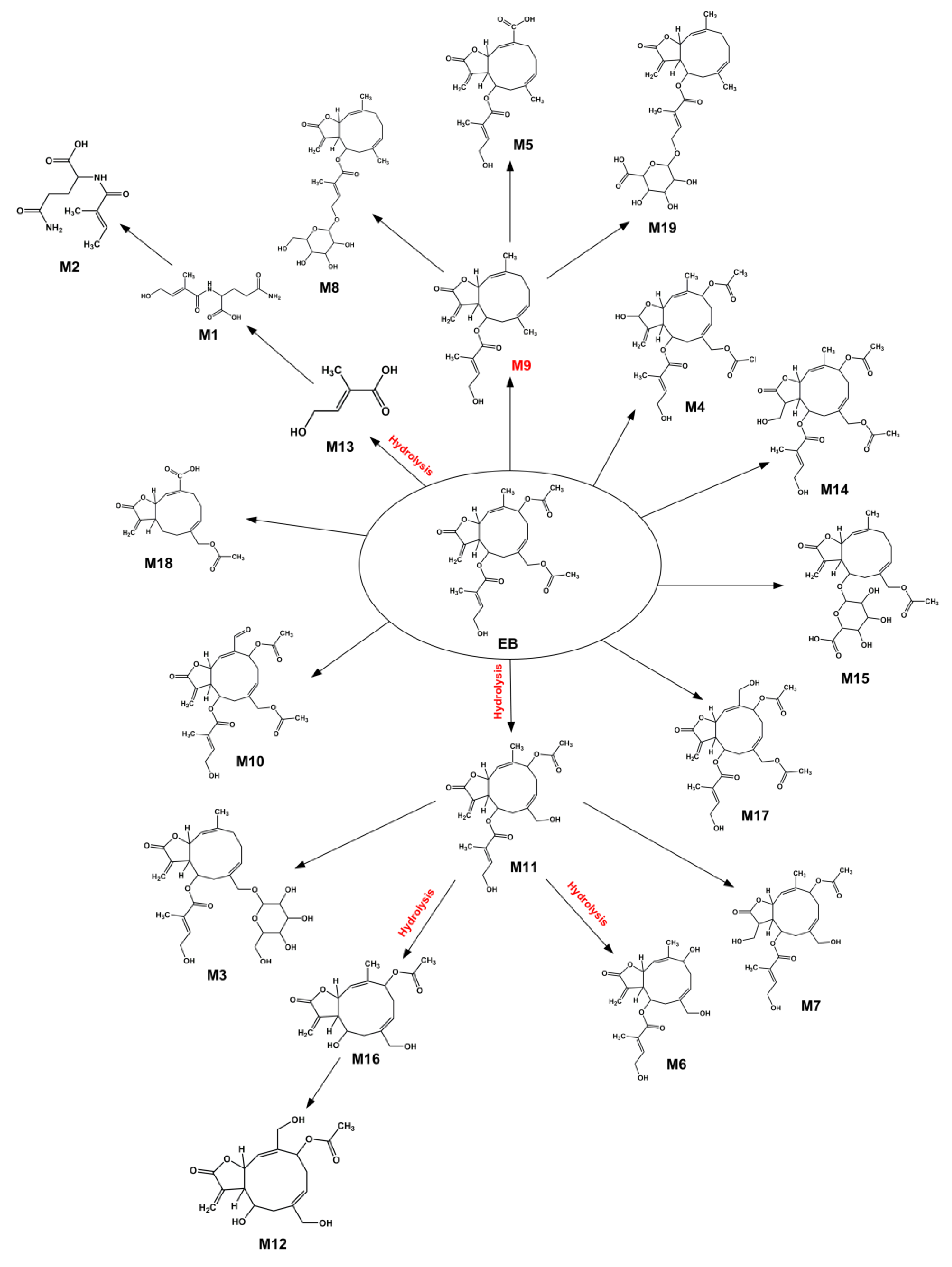
| Peak ID | Retention Time (min) | Metabolic Process | Formula | Ion Mode | m/z | ppm | Peak Area | Score (%) * |
|---|---|---|---|---|---|---|---|---|
| M1 | 2.21 | Hydrolysis + Glutamine Conjugation | C10H16N2O5 | - | 243.0989 | 0.9 | 2940 | 50.0 |
| M2 | 2.40 | Hydrolysis + Glutamine Conjugation + Dehydroxylation | C10H16N2O4 | + | 229.1177 | −2.8 | 33,000 | 48.1 |
| M3 | 4.30 | Hydrolysis + Glucose Conjugation | C26H36O11 | + | 525.2317 | −2.6 | 17,400 | 36.1 |
| M4 | 6.03 | Double bond reduction | C24H32O9 | + | 465.2086 | −7.0 | 25,100 | 62.4 |
| M5 | 6.21 | Deesterification + Demethylation to Carboxylic Acid | C20H24O7 | + | 377.1559 | −9.6 | 27,200 | 56.0 |
| M6 | 6.25 | Hydrolysis | C20H26O7 | - | 377.1599 | −1.7 | 27,000 | 75.0 |
| M7 | 6.25 | Hydrolysis + Hydroxylation | C22H30O9 | - | 437.1820 | 0.7 | 11,700 | 75.0 |
| M8 | 6.88 | Deesterification + Glucose Conjugation | C26H36O10 | + | 509.2339 | −8.3 | 61,300 | 34.3 |
| M9 | 6.96 | Deesterification | C20H26O5 | + | 347.1819 | −9.7 | 166,000 | 55.9 |
| M10 | 7.03 | Ketone Formation | C24H28O10 | - | 475.1603 | −1.4 | 50,600 | 75.0 |
| M11 | 7.46 | Hydrolysis | C22H28O8 | - | 419.1711 | −0.1 | 9700 | 75.0 |
| M12 | 7.68 | Hydrolysis + Oxidation | C17H22O7 | - | 337.1288 | −1.3 | 39,400 | 75.0 |
| M13 | 7.70 | Hydrolysis | C5H8O3 | - | 115.0401 | 0.0 | 51,900 | 75.0 |
| M14 | 7.72 | Hydroxylation | C24H32O10 | - | 479.1918 | −1.0 | 57,200 | 75.0 |
| M15 | 7.75 | Deesterification + Glucuronidation | C23H30O11 | - | 481.1711 | −0.8 | 16,800 | 62.5 |
| M16 | 7.77 | Hydrolysis | C17H22O6 | - | 321.1341 | −0.7 | 84,200 | 75.0 |
| M17 | 8.01 | Oxidation | C24H30O10 | + | 479.1900 | −2.4 | 12,500 | 73.9 |
| M18 | 8.53 | Deesterification + Demethylation to Carboxylic Acid | C17H20O6 | + | 321.1304 | −9.1 | 37,600 | 57.4 |
| M19 | 8.92 | Deesterification + Glucuronidation | C26H34O11 | - | 521.2034 | 1.1 | 13,100 | 50.0 |
| Acute Toxicity 1 | Hepatotoxicity 2 | |||
|---|---|---|---|---|
| EA | Rat_Acute | 969.04 | Ser_AST | Elevated |
| Ser_ALT | Elevated | |||
| Ser_LDH | Normal | |||
| Prediction result | Negative | Prediction result | Negative | |
| EB | Rat_Acute | 634.11 | Ser_AST | Elevated |
| Ser_ALT | Elevated | |||
| Ser_LDH | Normal | |||
| Prediction result | Negative | Prediction result | Negative | |
| ID | Formula | Phase I/II Metabolite | Metabolic Process | Prediction 1 | Probability 2 |
|---|---|---|---|---|---|
| EA | C24H30O9 | — | — | Positive | 0.6317 |
| M1 | C5H6O3 | Phase I metabolite | Hydrolysis + Ketone Formation | Positive | 0.6979 |
| M2 | C24H28O10 | Ketone Formation | Positive | 0.5855 | |
| M3 | C5H8O3 | Hydrolysis | Positive | 0.5958 | |
| M4 | C20H26O7 | Hydrolysis | Positive | 0.6357 | |
| M5 | C24H32O9 | Double bond reduction | Positive | 0.6533 | |
| M6 | C17H22O7 | Hydrolysis + Oxidation | Positive | 0.7919 | |
| M8 | C17H22O6 | Hydrolysis | Positive | 0.8272 | |
| M9 | C20H26O5 | Hydrolysis + Dehydroxylation | Positive | 0.8500 | |
| M10 | C22H28O8 | Hydrolysis | Positive | 0.6365 | |
| M11 | C24H32O10 | Internal Hydrolysis | Positive | 0.6128 | |
| M14 | C22H28O6 | Loss of O and C2H2O2 | Positive | 0.7183 | |
| M15 | C20H26O8 | Hydrolysis + Oxidation | Positive | 0.6144 | |
| M16 | C19H24O6 | Loss of C5H6O3 | Positive | 0.6958 | |
| M12 | C22H28O9 | Hydrolysis + Oxidation | Negative | 0.5364 | |
| M13 | C23H28O8 | Loss of C19H22O6 | Negative | 0.5796 | |
| M7 | C26H36O10 | Phase II metabolite | Hydrolysis + Glucose Conjugation | Negative | 0.4853 |
| ID | Formula | Phase I/II Metabolite | Metabolic Process | Prediction 1 | Probability 2 |
|---|---|---|---|---|---|
| EB | C24H30O9 | — | — | Positive | 0.7278 |
| M4 | C24H32O9 | Phase I metabolite | Double bond reduction | Positive | 0.8106 |
| M5 | C20H24O7 | Loss of C2H2O2 and C2H2O2 + Demethylation to Carboxylic Acid | Positive | 0.7201 | |
| M6 | C20H26O7 | Hydrolysis | Positive | 0.7919 | |
| M9 | C20H26O5 | Loss of C2H2O2 and C2H2O2 | Positive | 0.8243 | |
| M10 | C24H28O10 | Ketone Formation | Positive | 0.7226 | |
| M11 | C22H28O8 | Hydrolysis | Positive | 0.7568 | |
| M12 | C17H22O7 | Hydrolysis + Oxidation | Positive | 0.8165 | |
| M13 | C5H8O3 | Hydrolysis | Positive | 0.8602 | |
| M14 | C24H32O10 | Internal Hydrolysis | Positive | 0.5859 | |
| M16 | C17H22O6 | Hydrolysis | Positive | 0.8969 | |
| M17 | C24H30O10 | Oxidation | Positive | 0.7951 | |
| M7 | C22H30O9 | Hydrolysis + Internal Hydrolysis | Negative | 0.5425 | |
| M18 | C17H20O6 | Loss of C2H2O2 and C5H6O3 + Demethylation to Carboxylic Acid | Negative | 0.5812 | |
| M1 | C10H16N2O5 | Phase II metabolite | Loss of C19H22O6 + Glutamine Conjugation | Positive | 0.5919 |
| M3 | C26H36O11 | Hydrolysis + Glucose Conjugation | Positive | 0.7691 | |
| M8 | C26H36O10 | Loss of C2H2O2 and C2H2O2 + Glucose Conjugation | Positive | 1.0000 | |
| M15 | C23H30O11 | Loss of C2H2O2 and C5H6O2 + Glucuronidation | Positive | 0.7366 | |
| M19 | C26H34O11 | Loss of C2H2O2 and C2H2O2 + Glucuronidation | Positive | 1.0000 | |
| M2 | C10H16N2O4 | Loss of C19H22O7 + Glutamine Conjugation | Negative | 0.5422 |
| Treatment Group | Metabolic Process | IC50 [95% CI]/µM | |
|---|---|---|---|
| EA | EB | ||
| EA/EB | — | 101.9 [93.22, 114.2] | 94.12 [81.30, 115.2] |
| EA/EB + HLMs + NADPH | oxidation–hydrolysis | Unable to calculate [very wide] | 104.1 [very wide] |
| EA/EB + HLMs | hydrolysis | 2063 [very wide] | 111.2 [very wide] |
| EA/EB + HLMs + NADPH + BNPP | oxidation | 103.9 [very wide] | 101.2 [98.40, 104.9] |
Disclaimer/Publisher’s Note: The statements, opinions and data contained in all publications are solely those of the individual author(s) and contributor(s) and not of MDPI and/or the editor(s). MDPI and/or the editor(s) disclaim responsibility for any injury to people or property resulting from any ideas, methods, instructions or products referred to in the content. |
© 2026 by the authors. Licensee MDPI, Basel, Switzerland. This article is an open access article distributed under the terms and conditions of the Creative Commons Attribution (CC BY) license.
Share and Cite
Li, Y.; Liu, X.; Li, L.; Xiao, W.; Zhang, Y.; Zeng, K.; Wang, Q. Metabolic Profiling and Detoxification of Eupalinolide A and B in Human Liver Microsomal Systems. Toxics 2026, 14, 235. https://doi.org/10.3390/toxics14030235
Li Y, Liu X, Li L, Xiao W, Zhang Y, Zeng K, Wang Q. Metabolic Profiling and Detoxification of Eupalinolide A and B in Human Liver Microsomal Systems. Toxics. 2026; 14(3):235. https://doi.org/10.3390/toxics14030235
Chicago/Turabian StyleLi, Yingzi, Xiaoyan Liu, Ludi Li, Wusheng Xiao, Youbo Zhang, Kewu Zeng, and Qi Wang. 2026. "Metabolic Profiling and Detoxification of Eupalinolide A and B in Human Liver Microsomal Systems" Toxics 14, no. 3: 235. https://doi.org/10.3390/toxics14030235
APA StyleLi, Y., Liu, X., Li, L., Xiao, W., Zhang, Y., Zeng, K., & Wang, Q. (2026). Metabolic Profiling and Detoxification of Eupalinolide A and B in Human Liver Microsomal Systems. Toxics, 14(3), 235. https://doi.org/10.3390/toxics14030235