Review

Thorium Valorization at the Interface of Technology, Risk, and Sustainability

by
Geani Teodor Man
1,2,
Andreea Maria Iordache
1,
Diana Ionela Popescu (Stegarus)
1,
Ionela Ramona Zgavarogea
1,* and
Nicoleta Anca Șuțan
3,*
1
National Research and Development Institute for Cryogenics and Isotopic Technologies—ICSI Râmnicu Valcea, 4th Uzinei Street, 240050 Ramnicu Valcea, Romania
2
Department of Analytical Chemistry and Environmental Engineering, National University of Science and Technology POLITEHNICA Bucharest, Bucharest University Centre, Splaiul Independenţei nr. 313, Sector 6, 060042 Bucharest, Romania
3
Department of Natural Sciences, National University of Science and Technology POLITEHNICA Bucharest, Piteşti University Centre, Targul din Vale 1, 110040 Pitesti, Romania
*
Authors to whom correspondence should be addressed.
Toxics 2026, 14(3), 193; https://doi.org/10.3390/toxics14030193
Submission received: 4 February 2026 / Revised: 22 February 2026 / Accepted: 22 February 2026 / Published: 25 February 2026
(This article belongs to the Topic Disease Risks from Environmental Radiological Exposure)

Abstract

Thorium (Th), a naturally occurring actinide, is gaining renewed attention due to its dual role as a strategic nuclear resource and a potential environmental contaminant. This review critically reassesses thorium valorization pathways by integrating extraction technologies, environmental behavior, toxicological risks, and regulatory constraints. While thorium is primarily recovered as a by-product of rare earth element (REE) processing, conventional hydrometallurgical methods—though mature—generate significant secondary waste and pose environmental challenges. Emerging technologies, such as functionalized adsorbents, membrane systems, and biohydrometallurgy, show promise but remain largely confined to laboratory-scale studies due to scalability and stability issues. A key finding is that thorium’s environmental mobility and toxicological impact are directly influenced by the extraction processes used, creating species with distinct bioavailability and risk profiles. This work highlights the disconnect between high laboratory efficiencies and real-world applicability, emphasizing the need for integrated approaches that consider lifecycle impacts, waste minimization, and occupational safety. We propose a circular economy framework for sustainable thorium management, connecting green primary processing, secondary recovery from industrial residues, smart environmental stewardship, and supportive policy. The review concludes that successful thorium valorization depends not on incremental efficiency gains but on holistic designs that reconcile technological performance with environmental and health safeguards.

1. Introduction

Thorium (Th) is a naturally occurring actinide widely distributed in the Earth’s crust, with an average abundance of approximately 9–10 ppm in the bulk continental crust in specific igneous and metasedimentary formations; concentrations may increase to several tens or even hundreds of grams per ton (ppm) [1,2,3,4,5,6].
Due to its comparable ionic radius to U4+ under similar coordination conditions and its tetravalent oxidation state, thorium commonly occurs alongside uranium, particularly in alkaline magmatic systems and rare earth element (REE)-rich pegmatites, where both elements substitute for high-field-strength cations in accessory minerals [7,8]. It occurs predominantly as the long-lived isotope 232Th, which accounts for nearly all natural thorium; although 232Th has a very long half-life, the main radiological concern is associated with its daughter radionuclides formed along the decay chain [9].
Interest in thorium has intensified over the past two decades due to its dual status as both a strategic resource and a potential environmental contaminant. On one hand, thorium has been promoted as a fertile nuclear material capable of breeding fissile 233U, offering theoretical advantages over conventional uranium-based fuel cycles in terms of resource abundance, fuel utilization efficiency, and reduced production of long-lived transuranic waste [10,11]. This renewed interest is inextricably linked to the rapid expansion of the REEs sector, as thorium is predominantly recovered as a by-product of REE mining and processing. The strategic importance of REEs for modern energy technologies has consequently reopened discussions on thorium valorization within the framework of sustainable nuclear energy systems. Consequently, life cycle assessment (LCA) approaches have been increasingly applied to evaluate the environmental, radiological, and socio-economic indicators of thorium fuel cycles [12]. On the other hand, thorium is classified as a radioactive heavy metal with recognized toxicological risks, particularly when mobilized through mining, processing, or waste disposal activities [13]. This intrinsic duality places thorium at the intersection of energy policy, environmental protection, and public health.
Beyond nuclear energy, thorium has been utilized in a range of industrial and technological applications, including high-temperature ceramics, catalysts, optical components, and historically in gas mantles and radiological contrast agents [14,15,16]. While these applications highlight thorium’s technological value, they also amplify concerns related to occupational exposure, waste generation, and long-term environmental contamination [17,18,19].
The extraction and separation of thorium are rarely conducted as stand-alone processes. Instead, thorium is predominantly recovered as a by-product during REE mining and beneficiation, where its presence is often undesirable due to radiological constraints and regulatory limits [20]. As a result, a wide spectrum of chemical, physical, and biological separation techniques has been proposed, ranging from conventional acid or alkaline leaching and solvent extraction to advanced approaches such as membrane technologies, adsorption on functionalized materials, and biohydrometallurgical processes [21,22,23,24]. However, despite the extensive volume of published research, the majority of these methods remain confined to laboratory or pilot-scale studies, with limited evidence of industrial viability.
At the same time, thorium released into the environment through mining tailings, fertilizer production, coal combustion, and nuclear-related activities exhibits low solubility but strong affinity for particulates, sediments, and biological interfaces [25,26,27]. These properties govern its environmental fate, transport, and bioavailability, ultimately influencing exposure pathways for humans and non-human biota. Epidemiological and experimental studies have linked thorium exposure, particularly via inhalation and ingestion, to increased risks of lung cancer, liver dysfunction, genotoxicity, and other chronic health effects, largely driven by alpha radiation emitted during radioactive decay [17,18,19,25]. Nevertheless, available toxicological data are often fragmented, derived from heterogeneous exposure scenarios, or extrapolated from uranium-focused studies, limiting robust risk assessment.
Despite the breadth of existing literature, several critical issues remain insufficiently addressed. First, there is no consensus on which thorium separation and recovery technologies are realistically scalable when energy consumption, secondary waste generation, and regulatory constraints are taken into account. Methods frequently described as “highly efficient” in laboratory settings often rely on large volumes of hazardous reagents, expensive functional materials, or complex multi-step processes that undermine their industrial applicability [28,29]. Second, the relationship between thorium valorization and environmental or occupational risk is rarely analyzed in an integrated manner. Extraction efficiency is typically discussed independently of downstream waste management, exposure scenarios, and long-term health implications [17,30].
In this context, the objective of this review is to critically reassess thorium valorization pathways by jointly examining extraction and separation technologies, environmental behavior, and toxicological risks. Rather than providing an exhaustive catalogue of available methods, this work focuses on identifying technological bottlenecks, contradictions within the literature, and gaps between experimental performance and real-world applicability. By integrating technological, environmental, and health-related perspectives, this review seeks to clarify which approaches hold genuine potential for sustainable thorium management and which remain primarily academic constructs. Such an assessment is particularly timely given the renewed global interest in thorium-based energy systems and the expanding scale of rare earth mining, both of which are likely to intensify thorium-related environmental and public health challenges in the near future.

2. Sources and Occurrence of Thorium in Natural and Technological Systems

Thorium is commonly associated with REE minerals such as monazite, bastnäsite, xenotime, perovskite–loparite, pyrochlore, britholite, and, to a lesser extent, zircon, as well as in ion-adsorption clays. It is frequently present in technological residues generated during REE extraction and processing, where it represents both a regulatory burden and a potential secondary resource [21,31,32,33]. Thorium resources occur mainly in placer, carbonatite, and vein-type deposits and are hosted by minerals such as monazite, thorite, and thorianite. According to the OECD Nuclear Energy Agency, globally identified thorium resources are estimated at about 6.4 million tons, with the largest shares in India, followed by Brazil, Australia, and the United States [34].
Thorium is a naturally occurring actinide widely distributed in the Earth’s crust, with an average abundance higher than that of uranium, although its spatial distribution is highly heterogeneous [9,35,36]. From a geochemical perspective, thorium is only tetravalent (Th4+) and exhibits strong lithophile behavior, resulting in its preferential incorporation into accessory minerals rather than major rock-forming phases [37,38,39]. While this general behavior is well established, its practical relevance lies less in mineralogical classification and more in the technological and regulatory consequences of thorium’s co-occurrence with economically valuable resources [21,40].
A defining characteristic of thorium occurrence is its close association with REE-bearing minerals, particularly monazite, bastnäsite, xenotime, and related phases [38,41,42]. In these systems, thorium is rarely present as an independent target element. Instead, it accompanies REEs as a chemically persistent and radiologically regulated component. This association has direct implications for extraction strategies, as thorium recovery is often driven not by economic demand but by the necessity to manage radioactive content during REE processing. Consequently, thorium is frequently treated as an unwanted by-product, influencing process flowsheets, waste classification, and downstream handling requirements [43,44].
Beyond primary mineral deposits, thorium is increasingly encountered in technological and industrial residues. Significant amounts have been reported in tailings from REE mining and beneficiation [45,46,47,48], phosphogypsum generated during phosphate fertilizer production [49], coal combustion residues [50], and red mud derived from alumina processing [32,51]. In these secondary matrices, thorium concentrations are generally lower than in primary ores but are often more environmentally relevant due to increased surface area, altered chemical speciation, and greater potential for dispersion. From a risk perspective, these residues represent diffuse sources of thorium release rather than controlled extraction points [27,52,53].
The technological relevance of thorium occurrence in such residues is related to both potential resource valorization and environmental management considerations. On one hand, secondary materials have been proposed as alternative thorium sources, potentially reducing the need for new mining activities [54]. On the other hand, the heterogeneous composition and variable physicochemical properties of industrial wastes complicate separation processes and raise concerns regarding secondary waste generation and occupational exposure [55,56].
Importantly, the form in which thorium occurs in natural and technological systems strongly influences both its processability and environmental behavior. Thorium bound within resistant mineral lattices exhibits limited mobility, whereas thorium associated with fine particulates, amorphous phases, or process-derived compounds may display enhanced reactivity under changing physicochemical conditions [25,57,58,59,60]. This distinction should be considered when evaluating separation strategies, as aggressive chemical treatments designed to liberate thorium from solid matrices may simultaneously increase its environmental availability and radiological risk [44].
Rather than serving as a purely descriptive background, the sources and occurrence of thorium therefore provide contextual information relevant to the development of valorization or remediation strategy [61]. The persistent coupling of thorium with REE production chains, combined with its presence in diverse industrial residues, ensures that thorium management remains as much a regulatory and environmental challenge as a technological one [16,62,63]. Knowledge of thorium occurrence can support the optimization of separation processes and help anticipate potential implications of thorium mobilization across natural and engineered systems.
Materials containing elevated concentrations of naturally occurring radioactive materials (NORM) are subject to specific control regimes under the International Atomic Energy Agency Safety Standards, which establish dose limits, exemption criteria, and requirements for occupational and environmental monitoring. Within the European Union, the Euratom Basic Safety Standards Directive (2013/59/Euratom) integrates NORM industries, including rare earth processing and mineral sands operations, into a harmonized radiological protection framework based on justification, optimization, and dose limitation principles.
These regulatory instruments influence technology deployment by imposing authorization procedures, radiological characterization of residues, long-term waste management obligations, and worker dose monitoring. At the same time, they may enable controlled valorization pathways when exposure scenarios remain below regulatory thresholds and when stabilization measures are demonstrably effective. Consequently, the feasibility of thorium recovery from both primary and secondary resources is closely linked to compliance costs, waste classification criteria, and long-term stewardship requirements defined by international and regional radiation protection systems [13,64,65,66,67].

3. Thorium Extraction and Separation Technologies: A Critical Assessment

The extraction and separation of thorium have been investigated for decades, largely in connection with REE processing [68] and nuclear fuel cycle research [36,69]. While a broad range of techniques has been proposed, their technological maturity, environmental footprint, and industrial relevance vary substantially. Rather than providing an exhaustive catalogue of available methods, this section compares the main technological approaches based on common criteria, including chemical efficiency, process robustness, waste generation, and scalability.

3.1. Conventional Hydrometallurgical Approaches

Conventional hydrometallurgical methods are among the well-established strategies reported in the literature and widely applied for thorium recovery, primarily due to their compatibility with established REE processing flowsheets. Acidic leaching, typically using sulfuric acid (H2SO4), nitric acid (HNO3), or hydrochloric acid (HCl), but also condensed phosphoric acid [70] is the dominant approach for mobilizing thorium from monazite [71], bastnäsite [72], xenotime [73] and related matrices, while alkaline digestion with sodium hydroxide [74] and more recently with potassium hydroxide [75] has been applied in selected cases to improve selectivity or reduce silica dissolution [76,77].
From a technical standpoint, these methods can achieve high thorium dissolution efficiencies under controlled conditions. However, such performance is often associated with aggressive chemical environments, elevated temperatures, and low solid-to-liquid ratios, all of which impose significant constraints on industrial implementation [58,78]. Moreover, acidic leaching processes frequently solubilize multiple co-existing elements, necessitating complex downstream separation steps and increasing the volume of secondary radioactive waste [68,79].
Solvent extraction represents the most established technique for thorium separation from leach liquors, employing extractants such as organophosphorus compounds, tributyl phosphate (TBP), Di(1-methyl-heptyl) methyl phosphonate (DMHMP) [80], D2EHPA [81], and Cyanex-type reagents [82]. These systems offer high selectivity when process parameters are carefully optimized, and they have been successfully integrated into pilot-scale operations [74,75]. Moreover, Wang et al. [83] reported that a synergistic mixture of Cextrant 230 and Cyanex 923 improved Th4+ extraction performance in chloride media, with increased thorium loading, facilitated stripping, and reduced rare earth co-extraction compared to single extractants.
Nevertheless, solvent extraction circuits are chemically intensive, sensitive to feed composition, and generate spent organic phases and acidic raffinate streams that require careful management.
Overall, while conventional hydrometallurgical approaches provide established routes for thorium recovery, their efficiency could be evaluated alongside reagent consumption, waste neutralization requirements, and long-term environmental liabilities, especially under stricter regulatory and sustainability frameworks [40,61].

3.2. Advanced and Emerging Technologies

In response to the limitations of conventional methods, a wide range of advanced and emerging separation technologies has been proposed, often with the aim of improving selectivity, reducing chemical consumption, or enabling thorium recovery from low-grade or secondary resources [22,84,85,86,87,88,89,90,91,92]. Among these, functionalized adsorbents [24,93,94,95], membrane-based systems [92,96,97], and biohydrometallurgical approaches [98,99,100,101] have attracted particular attention.
Solvometallurgy is a low-temperature extractive approach that can be applied to metals including thorium, particularly from complex ores, tailings, and secondary resources where conventional aqueous processing is inefficient. By replacing a discrete aqueous phase with low-water, non-aqueous solvents, solvometallurgy enables more selective leaching and separation of metal ions, a feature directly relevant to thorium chemistry given its strong solvation and coordination behavior in organic media. The integration of solvent leaching and separation into a single step reduces water consumption, avoids wastewater generation, and minimizes acid use, providing potential benefits for environmentally safer thorium processing compared with classical hydrometallurgy. Although the technology readiness remains low (TRL 3–4), solvometallurgy has been investigated as a research direction for thorium extraction that may minimize waste when green, low-toxicity, and recyclable solvents are employed [102].
Functionalized solid adsorbents, including ion-exchange resins [103], metal–organic frameworks [104,105,106,107], graphene-based materials [78,90,108], and modified polymers [97,109], frequently demonstrate high thorium affinity and selectivity under laboratory conditions. These materials are often presented as environmentally benign alternatives to solvent extraction. However, their performance is typically evaluated at low thorium concentrations, narrow pH ranges, and small solution volumes, limiting the relevance of reported capacities to real industrial streams. In addition, challenges related to adsorbent synthesis, regeneration efficiency, and long-term stability remain insufficiently addressed.
Electrosorption has been investigated as a strategy for selective thorium recovery, addressing the limitations of conventional adsorption by using an electric field to accelerate ion migration and enhance adsorption rates. Functionalized electrodes, such as amidoxime-modified graphite felt (GF-AO), g-C3N4, activated carbon electrodes (ACE), and graphene-based electrodes (GBE), demonstrate high thorium affinity and selectivity even in the presence of competing rare earth elements [78,91,110]. Many advanced materials are optimized against idealized Th4+ species that rarely dominate real leachates, which can limit their practical performance under complex industrial conditions. The GF-AO electrode achieves exceptionally high electrochemical recovery capacities (>3000 mg·g−1) and rapid sorption–desorption cycles [91], while g-C3N4 electrodes show a threefold increase in capacity under applied voltage, driven by synergistic electrostatic and chemisorption interactions [110]. Comparative studies indicate that graphene-based electrodes outperform activated carbon electrodes in both thorium recovery efficiency (~92%) and environmental performance, with lower human toxicity, freshwater and marine ecotoxicity, and resource impacts, highlighting the importance of electrode material choice for sustainable radioactive waste management [78]. Both GF-AO and g-C3N4 electrodes exhibit good reusability and stability, reduce chemical consumption, and offer potential for integration with renewable energy sources, underscoring electrosorption as a low-carbon, efficient, and potentially industrially relevant method for thorium recovery from aqueous solutions and complex residues [91,110].
Conceptually, electrosorption provides enhanced control over ion selectivity and overcomes diffusion limitations through electric-field-assisted adsorption [85,111]. In practice, however, its effectiveness is limited by the availability and long-term stability of high-capacitance functional electrodes, low throughput, and sensitivity to competing ions, which constrain its scalability beyond laboratory demonstrations [110]. Consequently, the technology readiness level remains low to moderate, reflecting strong potential but significant challenges for industrial deployment.
Membrane-based separation techniques, such as supported liquid membranes [112,113] and polymer inclusion membranes [114], offer the theoretical advantage of combining extraction and stripping in a single step. Although some recent studies reported significant improvement in selectivity, permeability and fouling resistance [115], membrane systems are inherently sensitive to fouling, mechanical degradation, and fluctuations in feed composition. These factors, coupled with limited throughput, currently restrict their application to proof-of-concept or niche scenarios.
Bioleaching and biosorption approaches have also been explored as low-energy alternatives for thorium mobilization, particularly from low-grade ores and industrial residues [116,117,118]. Although microbial activity and biomass-based sorbents can interact with thorium-bearing phases, process kinetics are generally slow, microorganisms could be inhibited by toxic metals and the reproducibility of results across different matrices remains problematic [119,120,121].
Taken together, advanced separation technologies provide information on alternative thorium binding mechanisms but remain largely constrained to laboratory-scale demonstrations. Their transition to industrial application is hindered by material complexity, process sensitivity, and insufficient evaluation under realistic operating conditions.
To move beyond descriptive comparisons, the main thorium extraction and separation approaches reported in the literature are summarized comparatively in Table 1. Taken together, advanced separation technologies provide innovative insights into thorium recovery mechanisms and environmental risk reduction, but most remain confined to laboratory or pilot-scale demonstration due to material complexity, process sensitivity, and insufficient evaluation under realistic operating conditions.

3.3. Scalability and Waste Challenges in Thorium Extraction

A persistent issue in developing thorium separation methods, from conventional solvent extraction to novel adsorbents, is the absence of a standardized method for evaluating scalability, waste management, and regulatory considerations in industrial deployment [29,61]. High extraction yields in a controlled laboratory setting may not directly correspond to industrial feasibility due to challenges of reagent recycling, effluent detoxification, and ensuring worker safety against radiation exposure [85].
A common shortfall is the narrow focus on chemical efficiency at the expense of the total waste footprint. For instance, while advanced MOFs boast exceptional selectivity for thorium in pure solutions, their practical application is hindered by complex synthesis, poor stability in acidic industrial liquors, and the unresolved cost of regenerating or disposing of the spent material [93,106]. The resulting secondary streams, whether spent solvents, loaded adsorbents, or acidic sludges containing residual radioactivity, represent not just a technical problem but the primary driver of operational cost and regulatory complexity, particularly under strict controls for naturally occurring radioactive materials (NORM) [105,124].
Furthermore, the leap from a beaker to a continuous plant is rarely tackled in earnest. Critical engineering parameters, such as the handling of solid feed variability, the long-term stability of phase separation in mixer-settlers, or membrane fouling in real wastewater, are frequently overlooked in favor of optimizing batch performance [85]. Limitations in assessing process robustness under non-ideal conditions may contribute to discrepancies between laboratory results and plant-scale feasibility.
Activated carbon obtained from avocado seeds showed very high efficiency for Th (IV) removal, achieving 97.3% adsorption from a 750 mg L−1 solution at pH 3.0, with a working capacity of 73 mg g−1 and 94% uptake within the first five minutes. The process was spontaneous and endothermic, followed pseudo-second-order kinetics and the Freundlich isotherm, and allowed partial regeneration, with 70.5% of adsorbed thorium recovered using 1.0 M nitric acid [125]. While the referenced study demonstrates high Th (IV) removal efficiency, it does not provide an economic assessment, and no specific cost data for avocado seed-derived activated carbon are available; estimates for comparable biomass-derived activated carbons suggest production costs on the order of a few US dollars per kilogram, depending on raw material, activation method, and production scale [126,127].
The above studies revealed that scalability is constrained by material stability, process control, and system integration. Laboratory efficiency represents only one factor in assessing potential industrial readiness, and pilot-scale testing under realistic feed and operational conditions is essential. Furthermore, thorium extraction inevitably generates secondary waste streams, including spent solvents, loaded adsorbents, and acidic sludges containing residual radioactivity. These streams represent both environmental hazards and significant operational costs under NORM regulations [128]. Advanced adsorbents, resins, and MOFs often require complex regeneration procedures, while solvent extraction circuits produce organic waste and acid raffinate streams that necessitate neutralization and stabilization.
Based on the reviewed literature, conventional hydrometallurgical methods, particularly acid leaching combined with solvent extraction, remain the most effective and cost-effective routes for thorium recovery due to their high efficiency, industrial maturity, and predictable operational costs. Emerging technologies such as advanced adsorbents, electrosorption, and biohydrometallurgical approaches offer high selectivity and reduced chemical consumption, but their limited scalability, material stability, and regeneration challenges currently constrain industrial applicability.
These observations indicate that the future of sustainable thorium management could benefit from a shift in research priorities toward integrated assessments. Progress will depend less on marginal gains in laboratory efficiency and more on integrated, holistic assessments from the earliest stages of development. This requires the systematic adoption of LCA to quantify environmental trade-offs and techno-economic analysis (TEA) to reveal true costs, as shown in recent evaluations of monazite processing routes [61,78,129]. For transparency and comparability, future LCA applications could state system boundaries, functional units, allocation procedures for co-produced REEs, electricity mix assumptions, and impact categories [130]. Similarly, TEA should specify the discount rate, plant lifetime, throughput capacity, and treatment of secondary waste management costs [130,131].
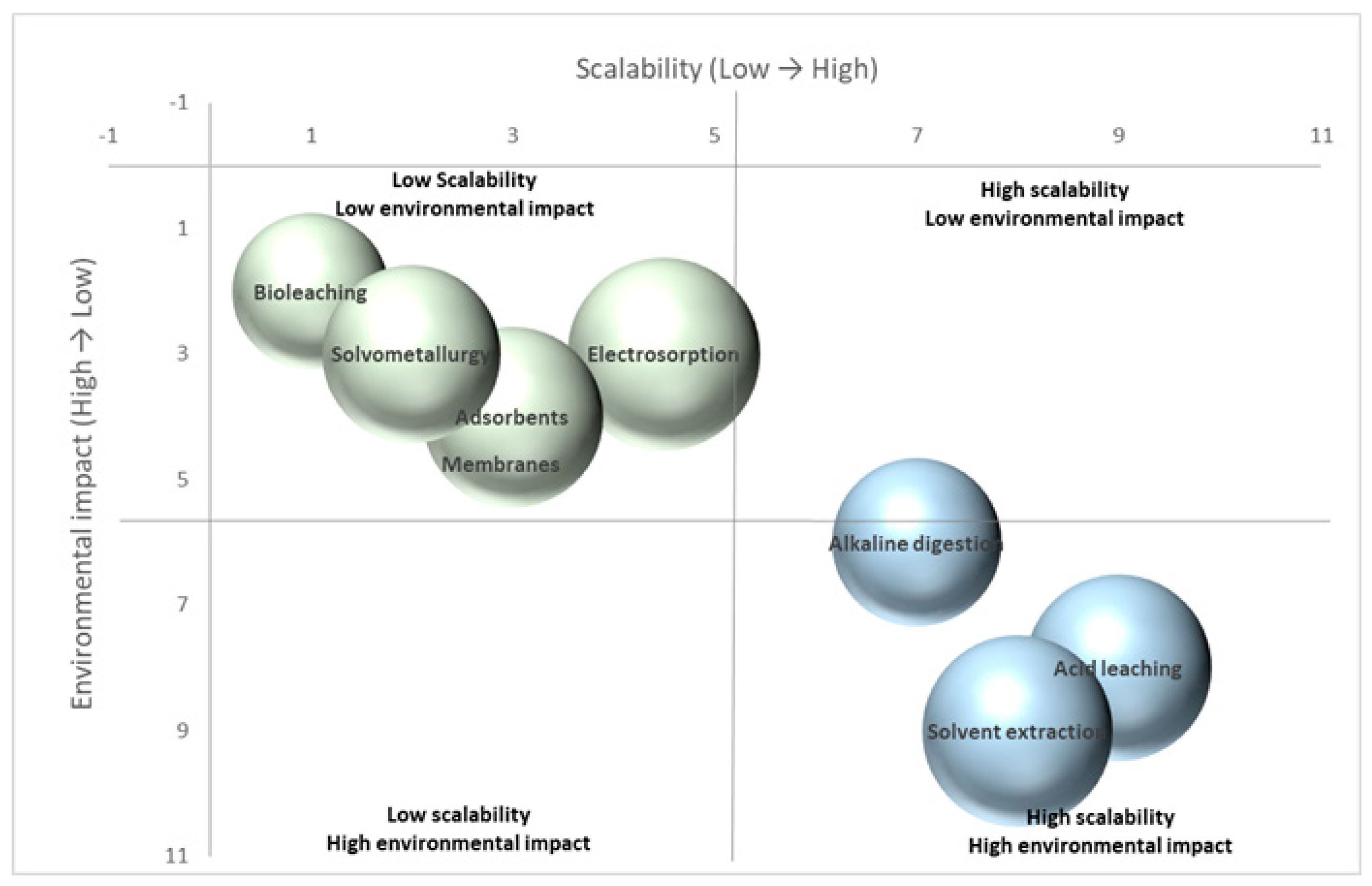
To complement the descriptive comparison, Figure 1 synthesizes the relative positioning of conventional and emerging thorium separation technologies in terms of scalability and environmental burden, highlighting the trade-offs between technological maturity and sustainability that are not immediately apparent from tabulated data alone. Notably, no widely investigated thorium separation technology currently occupies the low-scalability/high-impact quadrant, reflecting the tendency for environmentally burdensome processes to persist only when industrially scalable.
Thorium speciation changes throughout extraction, and these transformations directly shape downstream process design. In industrial flowsheets, Th(IV) evolves from lattice-bound forms in minerals to soluble sulfate, nitrate, or chloride complexes during leaching, then to extractant-bound species in solvent extraction, and finally to hydrolyzed or polymeric forms during stripping and neutralization. Each step alters solubility, separability, and waste characteristics [50,132,133,134,135].
For instance, sulfuric acid leaching of monazite generates soluble Th–sulfate complexes at low pH. Extractants such as TBP, D2EHPA, or Cyanex reagents are therefore selected based on their affinity for these dominant aqueous complexes rather than for free Th4+, which is rarely present under process conditions [29,136,137]. Downstream, neutralization typically precipitates amorphous Th(OH)4, often as fine or colloidal particles [138,139], requiring appropriate solid–liquid separation and stabilization strategies under NORM constraints.
Advanced materials show similar dependencies. Adsorbents and electrosorption systems tested in simplified nitrate or chloride media may perform differently in real leachates containing sulfate, phosphate, carbonate, or organic ligands that modify Th coordination chemistry [110,140,141].
Speciation should therefore be considered a design variable. Integrating equilibrium modeling and phase characterization into flowsheet development can improve extractant selection, control hydrolysis, and anticipate waste forms. Linking speciation analysis with techno-economic and environmental assessment would allow technologies to be evaluated not only by recovery efficiency but also by their ability to generate chemically stable and manageable downstream products.

4. Environmental Behavior and Speciation of Thorium

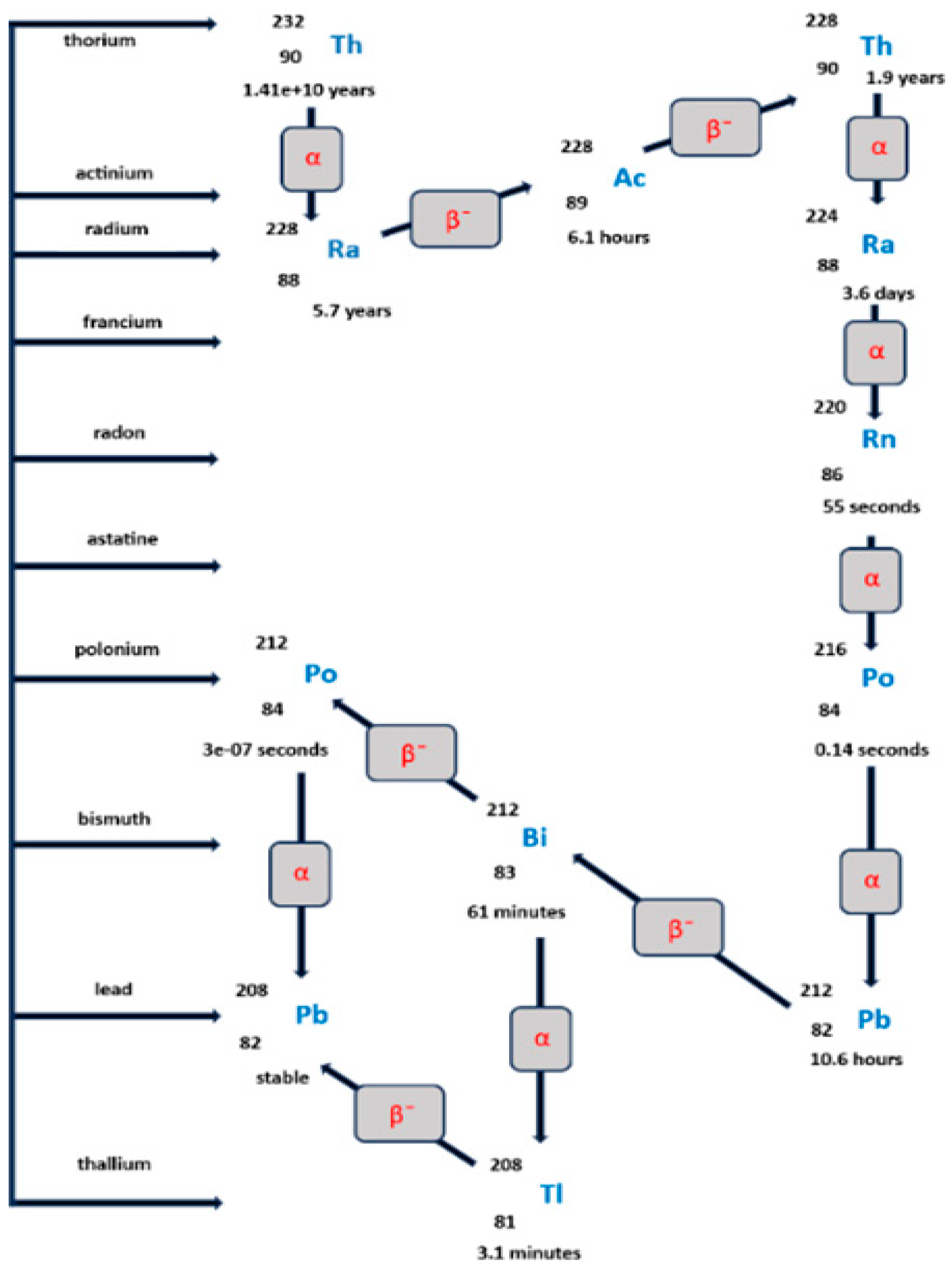
Thorium and some of its decay products are of increasing interest due to their radiological properties and potential applications, such as targeted alpha therapy using radionuclides like 227Th, 229Th, 232Th, 212Pb, and 225Ac [142,143]. While 232Th follows the classical thorium series (4n disintegration chain), ending in stable 208Pb (Figure 2), 227Th, 229Th, and 225Ac originate from separate decay chains. Understanding the environmental behavior of thorium is therefore essential for assessing both its long-term radiological persistence and its potential biological impacts.
From a geochemical perspective, thorium occurs predominantly as Th4+, a highly charged cation with a large ionic radius, strong Lewis acidity, substantial covalent bonding potential, and a stable + 4 oxidation state. These characteristics are associated with notable interactions with mineral surfaces, organic ligands, and particulate phases, while under certain conditions, Th4+ can form soluble complexes and colloidal species. Consequently, thorium mobility is not uniform but depends on local geochemical parameters such as pH, redox potential, mineralogy, ionic strength, and the availability of complexing ligands [25].
In many near-surface environments, thorium exhibits low mobility due to preferential association with solid phases. In karst systems developed on carbonate rocks, thorium binds initially to carbonate surfaces and cements and may be partially released during early weathering stages. However, as dissolution continues, thorium may be retained [144]. Similar retention has been observed in coastal soils and sands of Odisha, India, where thorium is hosted in resistant heavy minerals such as monazite and zircon. Under oxidizing conditions, this mineralogical association tends to limit thorium mobility and may maintain localizedsources of environmental radiation [145]. In the Central Gulf of Gabes, thorium accumulation in surface sediments is associated with phosphogypsum contamination, particularly under acidic conditions with elevated phosphorus and organic matter, promoting localized persistence rather than widespread dispersion [146].
In mineralized regions such as Norway’s Fen Complex, thorium occurs mainly as micrometer-scale inclusions within monazite and niobium-rich minerals, conferring low mobility and limited bioavailability. Resuspension and redistribution may occur under changing hydrological or physical conditions [147]. Comparable patterns have been reported in Lake Bolshoye Yarovoye, where thorium concentrations remain at or below natural background levels, constrained by soil texture, mineral composition, low organic matter content, and salinization [148]. Overall, thorium mobility is generally low but highly site-specific, governed primarily by mineralogical and geochemical context.
Exceptions to thorium immobility are rare under natural conditions but can occur under elevated temperatures or in strongly acidic solutions. In hydrothermal environments, thorium mobility is generally limited. While Th(SO4)2 complexes can form in sulfate-bearing fluids at moderate to elevated temperatures (175–250 °C), their stability is enhanced at higher temperatures due to positive entropic contributions that can outweigh the endothermic enthalpy of complexation Nevertheless, neutralization of acidic solutions, as often occurs in industrial raffinates, typically precipitates amorphous Th(OH)4 nanoparticles, which represent the most common form in natural settings [58,149,150].
Anthropogenic activities further influence thorium speciation and mobility. Mining, chemical processing, and waste management alter thorium’s chemical forms, affecting environmental behavior and exposure potential [59]. During sulfuric acid leaching of monazite, thorium forms neutral sulfate complexes rather than free Th4+ ions, increasing solubility and transport potential [72,151]. Subsequent solvent extraction steps, using systems such as Cextrant 230 and Cyanex 923, generate stable organic-phase thorium complexes [83]. Solvent degradation and stripping can remobilize thorium into aqueous raffinates as hydrolyzed or colloidal species, which are difficult to control [122].
Advanced immobilization strategies, including phosphonic acid-grafted metal–organic frameworks (e.g., UiO-66), demonstrate strong inner-sphere thorium complexation and high removal efficiency under laboratory conditions [93]. Nevertheless, the long-term stability of these waste forms is uncertain under variable pH, microbial activity, and ion-exchange conditions. Fine particles and colloids act as critical vectors for post-processing thorium dispersion, particularly in tailings where pH and chloride control is limited [77]. Neutralization of acidic raffinates precipitates amorphous Th(IV) hydroxide [Th(OH)4] nanoparticles, which may redissolve under acidic conditions or undergo long-range colloidal transport, further facilitated by wind erosion, seepage, and interactions with natural organic matter [59,152,153].
Speciation strongly influences thorium bioavailability and toxicity. Processes that promote soluble or colloidal species increase biological uptake, while association with resistant mineral phases limits immediate bioavailability yet creates persistent reservoirs capable of remobilization under changing conditions [18]. Experimental studies demonstrate that thorium toxicity depends on the exposure medium and chemical form. In artificial media without bicarbonate, ThO2 particles exhibit limited solubility, and toxicity is driven primarily by particle-related interactions rather than dissolved ions [40,154]. Alveolar macrophage studies confirm that insoluble particulate forms are the main driver of biological effects, differentiating thorium from other actinides.
In aquatic assays using OECD TG 201 medium, thorium occurs predominantly as amorphous Th(OH)4 precipitates. Toxicity in Chlorella pyrenoidosa is mediated by particle attachment, internalization of nanoscale particles, and heteroagglomeration with algal cells, highlighting the importance of chemical speciation and particle behavior over total concentration in predicting biological effects [18,139,155].
Field and geochemical studies reinforce that thorium behavior is controlled by mineralogy, pH, redox conditions, and complexing ligands. In coastal sediments of the Central Gulf of Gabes, phosphogypsum discharge shifts thorium speciation from insoluble hydroxides to dissolved phosphate complexes, increasing mobility and bioavailability [146]. In karst and carbonate environments, thorium released during mineral dissolution is largely retained in residual solids, leading to long-term soil accumulation [144]. In boreal catchments under Th-rich granites, dissolved thorium is primarily transported as organic complexes, emphasizing the role of natural organic matter in enhancing mobility [156].
Overall, thorium toxicity arises from both radiological and chemically mediated mechanisms, including oxidative stress, mitochondrial dysfunction, DNA damage, genomic instability, altered signaling pathways, and inflammation. Effective risk mitigation requires integrating geochemical controls on mobility and speciation with toxicological thresholds and realistic exposure scenarios. High-quality, standardized studies that link contemporary processing conditions to biological outcomes are essential to refine risk assessments, support regulatory frameworks, and guide long-term management strategies for thorium-containing materials.

5. Toxicological Effects and Human Health Implications

Current thorium toxicology data are fragmented, with heterogeneous exposure scenarios and limited direct applicability to contemporary industrial conditions. Available evidence is largely derived from historical medical applications, such as Thorotrast use [157,158,159], legacy occupational cohorts in mining and early nuclear industries [17,160,161,162], as well as computational studies [163] or experimental investigations that vary widely in exposure route, dose metrics, and thorium physicochemical form [18,164,165,166]. Consequently, toxicological datasets are often difficult to compare and may limit the robustness of quantitative risk assessments. Inconsistent metrics, heterogeneity in thorium forms, and differences in historical processing conditions complicate quantitative risk assessments [55].

5.1. Thorium Exposure, Bioavailability, and Occupational Risk

Occupational exposure to thorium is typically associated with mining, processing, and waste management, with inhalation of fine particles or ingestion of soluble compounds as the main intake pathways. Thorium’s radioactive and chemotoxic nature produces overlapping chemical and radiological effects; acute chemical toxicity typically limits health outcomes before deterministic radiation effects manifest [18,153].
Biokinetic models suggest that lethal internal radiation doses are not expected under modeled exposure scenarios, whereas chemical toxicity sets the upper bound for acute risk [167]. Epidemiological studies show measurable systemic retention and associated health effects. Indian monazite-processing workers experienced low but chronic thorium intake (~2 µg/day via food; ~0.02 µg/day via inhalation), with accumulation in lungs, bones, and muscles and elevated rates of cardiovascular disease, sterility, and genetic disorders [168,169]. Western Australian mineral sands workers displayed committed internal doses exceeding 20 mSv/year due to low solubility and slow pulmonary clearance [160,167]. Conversely, dietary intakes in German volunteers (~10 ppm thorium) did not significantly increase excretion, indicating low gastrointestinal absorption [170].
Experimental evidence has reported higher toxicity of insoluble thorium compounds, such as thorium dioxide (ThO2), compared to soluble forms [171]. Thorium-based targeted radionuclide therapies (227Th conjugates) elicit dose-dependent DNA damage, oxidative stress, and immunogenic cell death, showing clinical safety and antitumor activity [172,173,174].
Therefore, chemical toxicity dominates acute outcomes, while long-term retention poses chronic exposure concerns.

5.2. Molecular Mechanisms of Thorium Toxicity

Chronic low-level thorium exposure induces systemic effects, including hematological changes, neurochemical alterations, and oxidative stress [175].
232Thorium’s alpha emissions can result in localized cellular damage, particularly following inhalation of thorium dust. In WI26 lung epithelial cells, ThO2 caused dose- and time-dependent cytotoxicity, ROS generation, lipid peroxidation, mitochondrial dysfunction, DNA double-strand breaks, and activation of HSP90 and ATM signaling pathways [176]. Thorium exposure disrupts Complex IV of the mitochondrial electron transport chain, reducing ATP synthesis and enhancing ROS leakage [177]. Thorium exposure also activates NF-κB, IL-6, and TNF-α in vitro and in vivo, amplifying ROS production and promoting pro-tumorigenic microenvironments [171,178,179,180]. In this sense, it has been proven that chronic exposure dysregulates Wnt/β-catenin signaling, driving hepatic carcinogenesis through transcriptomic and proteomic alterations in mice [181].
DNA damage from high-LET alpha particles is highly clustered, persistent, and repaired inefficiently, leading to chromosomal aberrations and genomic instability [182,183,184,185].
Persistent DNA damage and oxidative stress activate stress-response pathways including ATM/ATR and p53, shifting cellular outcomes from transient repair to senescence or apoptosis [186,187].
Epigenetic modifications observed under high-LET radiation, including DNA methylation and histone modification changes, likely contribute to long-term genomic instability [188,189].
Thorium, primarily as Th(IV), exhibits strong and selective interactions with biologically relevant organic molecules, particularly carboxylate-containing amino acids, phosphorylated peptides, and proteins, forming stable complexes that influence its mobility, bioavailability, and long-term behavior in environmental and biological systems [190]. Molecular dynamics and spectroscopic studies demonstrate that Th(IV) preferentially binds to acidic residues (aspartic acid, glutamic acid), phosphorylated motifs, and carboxylates on protein rings, as seen in hyperphosphorylated proteins such as osteopontin and in ferritin, where up to 2840 Th atoms per protein can be accommodated at physiological pH without involving the ferrihydric core, with potential contributions from carbonate ions [191,192,193]. Experimental evidence from peptide-based models confirms that Th(IV) forms highly stable complexes, such as tetra-phosphorylated peptide Th2(pS1368) and ternary Th2(pS16) (pS1368) structures, which can be detected at sub-nanomolar levels with nanopore sensors, even in the presence of competing metal ions [194]. Computational studies, including DFT and molecular dynamics parameterized for Th4+, reproduce these binding geometries and provide quantitative insights into coordination modes, energetics, and pH-dependent stability [195]. Collectively, these findings support the use of Th(IV) as a model actinide for investigating actinide–biomolecule interactions, informing nuclear toxicology, environmental monitoring, and strategies for safe management and decorporation of actinide contaminants [190].
Such molecular-scale behavior is essential for understanding long-term biological retention and exposure, but does not directly address technological valorization or process-level trade-offs.
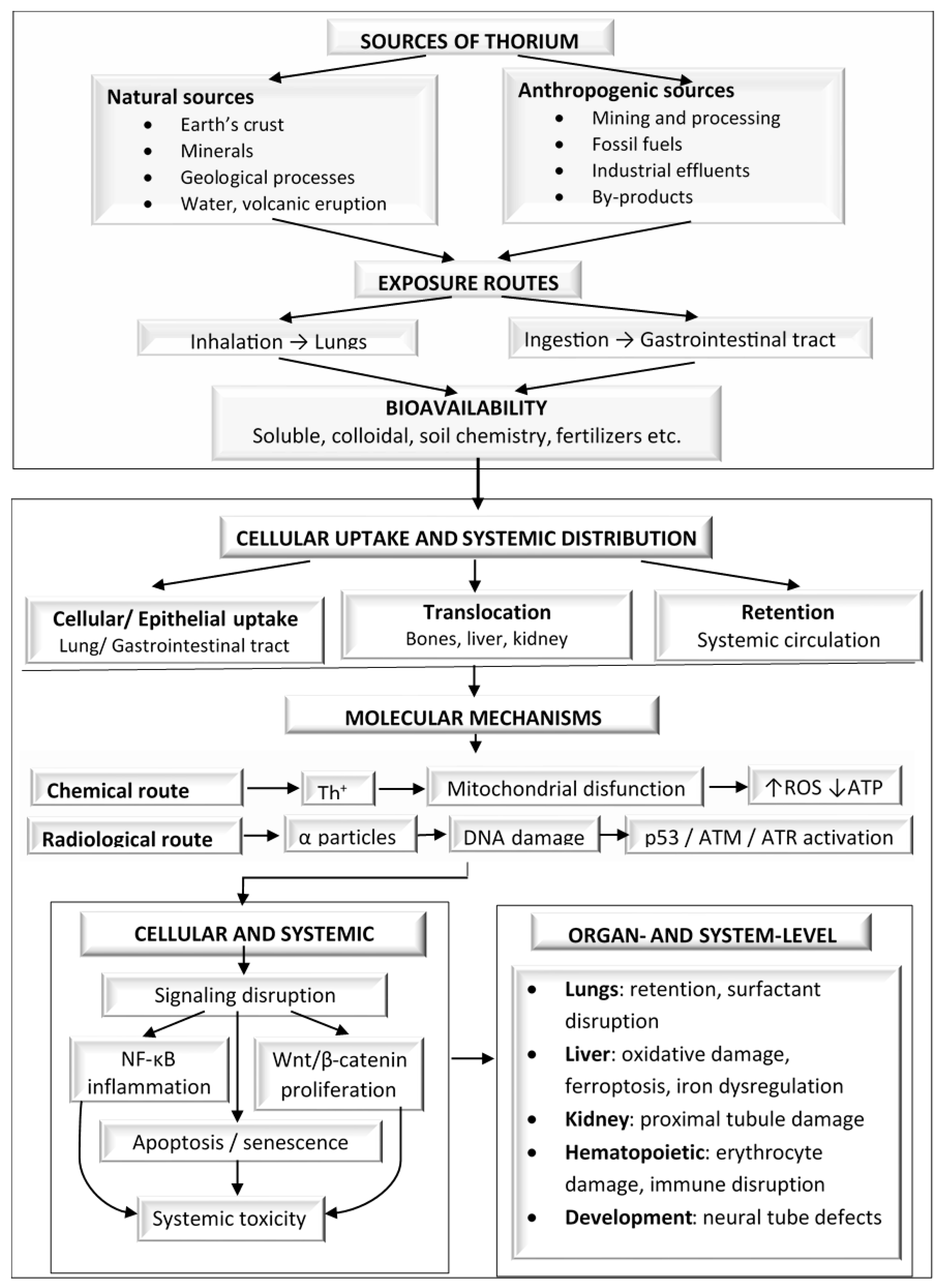
Figure 3 summarizes the main sources and exposure routes of thorium, the key modifiers of its bioavailability, the downstream molecular and cellular toxicity mechanisms, and the resulting organ-level effects.

6. Integrating Valorization and Risk: Technological Trade-Offs and Knowledge Gaps

Assessment of thorium valorization may benefit from considering the extraction yield or separation efficiency. Laboratory-scale studies often report high performance but may not reflect the complexities of industrial implementation, where environmental, occupational, and economic considerations become increasingly relevant. A comprehensive approach requires integrating technological performance with environmental risk, economic feasibility, and long-term system behavior.
LCA highlights these trade-offs. The LCA boundary is typically defined as cradle-to-gate or gate-to-gate, with 1 kg of recovered thorium (or equivalent thorium compound) as the functional unit. Impact categories typically include global warming potential (kg CO2-eq), cumulative energy demand (MJ/kg), acidification potential, and human toxicity indicators. Assumptions regarding electricity mix, reagent regeneration rates, and waste neutralization significantly influenced reported outcomes [78,196]. Comparative LCAs in Malaysia show that conventional solvent extraction from monazite is dominated by energy- and reagent-intensive steps, with thorium sulfate production contributing approximately 45 kg CO2-eq per kg Th. Electrosorption-based recovery from radioactive residues requires roughly one-third of the energy input and exhibits lower toxicity and emission profiles [78]. Nonetheless, uncertainties remain regarding electrode lifetime, performance under variable electricity mixes and climatic conditions, and the absence of reliable industrial-scale cost data. A parallel LCA comparing activated carbon and graphene-based electrodes illustrates that material choice significantly affects both recovery efficiency and environmental burden while leaving open questions about scalability and lifecycle emissions [197].
TEA studies are typically based on discounted cash flow models, incorporating capital expenditure, operational expenditure, reagent consumption, energy demand, labor, and waste treatment costs. Key financial indicators include net present value, internal rate of return, return on investment, and discounted payback period, often evaluated under specific assumptions regarding plant capacity, feed composition, and thorium or rare earth market prices [74,198,199]. TEA emphasizes scale-dependent trade-offs. Large batch sizes reduce unit production costs but require high capital investments, constraining return on investment and increasing financial risk [40,74]. Sensitivity analyses frequently identify raw material cost, reaction duration, and equipment investment as critical variables, underscoring persistent knowledge gaps in process integration and commercial feasibility beyond pilot scale. Integrating thorium recovery with rare earth element processing can improve economic viability and mitigate waste-related risks, but favorable outcomes depend on market conditions and careful cost allocation [61]. This suggests potential sensitivity to commodity price fluctuations, which is rarely addressed in laboratory-driven research.
Advanced separation materials illustrate additional technological trade-offs. Acid-stable frameworks, functionalized carbons, resins, and green solvent systems can achieve near-quantitative Th(IV) capture under highly acidic or radioactive conditions [31,43,77,200,201]. These materials simultaneously support resource recovery and risk mitigation, yet they introduce new uncertainties related to synthesis complexity, regeneration efficiency, secondary waste generation, radiolytic stability, and regulatory classification of spent materials. Often, environmental and occupational risks are shifted rather than fully eliminated.
From a lifecycle perspective, additional uncertainties arise from radiolytic stability and material durability. Alpha-emitting decay products associated with 232Th may accelerate structural degradation of functionalized adsorbents, membranes, or organic solvents, increasing replacement frequency and consequently the embodied energy and carbon footprint per kilogram of recovered thorium [123,202,203]. Although several zirconium-based MOFs (e.g., UiO-type structures) demonstrate acid resistance, systematic data on long-term structural integrity under continuous exposure to alpha-emitting Th(IV) species are scarce. The potential radiolytic degradation of functional groups may compromise selectivity and regeneration efficiency over extended operational cycles [204,205]. Moreover, the synthesis of advanced materials such as MOFs, graphene derivatives, or deep eutectic solvents may involve multi-step procedures with significant energy and reagent demand [206,207]. In several reported systems, the environmental burden of material production may equal or exceed that of the separation step itself [208,209]. These aspects are rarely incorporated into existing LCAs, which are often based on model solutions rather than radioactive, compositionally complex process streams.
Reactor-focused analyses further highlight the gap between technological promise and environmental integration. Economic evaluations of thorium-compatible molten salt reactors indicate favorable financial performance and inherent safety advantages, yet chemical speciation, waste forms, and long-term environmental behavior are seldom considered across the full fuel cycle [204,210]. Financial modeling using discounted cash flow and Monte Carlo simulations in Bangka Belitung, Indonesia, revealed strong economic indicators (NPV USD 338.7 million; IRR 13.06%; profitability index 1.40; discounted payback 11.19 years) but also exposed potential downside risks from construction delays, public acceptance, fuel supply continuity, regulatory shifts, and efficiency reductions, emphasizing the importance of integrate economic valorization with environmental and safety [199].
Across studies, a recurring trend has been observed: high extraction efficiency is often pursued in isolation, with limited attention to downstream consequences such as secondary waste stabilization, occupational exposure, decommissioning, and long-term monitoring. Regulatory frameworks (IAEA Safety Standards, Euratom Treaty) establish requirements for dose control and environmental monitoring, yet documented contamination cases reveal persistent gaps in integrating thorium resource development with effective environmental governance [64,115,211,212].
Table 2 provides an integrated summary of the performance and limitations of these processes, reinforcing the need for holistic assessments encompassing techno-economic feasibility, environmental impact, and operational safety.
Emerging technologies are promoted as cleaner or more selective alternatives but bring hidden constraints, including complex synthesis, narrow operational windows, and uncertain long-term stability. Functionalized adsorbents and membrane-based systems may reduce solvent use but introduce new challenges related to material regeneration, waste classification, and process scalability. In many cases, these trade-offs shift rather than eliminate environmental and occupational risks.
From a techno-economic standpoint, the cost structure of emerging thorium separation materials remains insufficiently characterized. Laboratory demonstrations rarely include full capital expenditure for material synthesis, scale-up of functionalized sorbents, or replacement rates under radiological exposure [203,213]. In thorium-bearing systems classified as NORM, additional operational costs arise from radiological monitoring, shielding, waste stabilization, and long-term liability management [30,214]. When regeneration efficiency declines below laboratory-reported values, the effective cost per kilogram of recovered thorium may increase substantially. These factors are seldom incorporated into published techno-economic assessments, which tend to extrapolate from short-term batch experiments rather than continuous, radiation-exposed industrial operation.
Several knowledge gaps continue to limit a comprehensive integrated assessment. First, standardized metrics for comparing technologies across efficiency, risk, and cost are lacking. Second, economic analyses often exclude waste management, decommissioning, and long-term monitoring costs, leading to overly optimistic feasibility assessments. Third, the interaction between chemical speciation, environmental mobility, and human exposure remains insufficiently quantified under realistic industrial scenarios. Addressing these gaps requires a shift from laboratory-centric optimization toward lifecycle-informed process design that minimizes secondary waste, reduces occupational exposure, and aligns with regulatory and environmental constraints. Such an integrated approach could facilitate the transition of thorium valorization from conceptual development to responsible industrial implementation.
Table 2. Thorium recovery methods: performance, scalability, and key limitations.
Process/MaterialType of ProcessKey PerformanceScalability & LimitationsReferences
Activated carbon (avocado seeds)Adsorbent97.3% Th(IV) removal; 73 mg·g−1 capacity; 94% uptake in 5 minPartial regeneration (70.5%), lab-scale; industrial scaling requires optimization[125]
MOFs (SZ-7 zirconium phosphonate)AdsorbentNear-quantitative Th(IV) capture from acidic wastewater (pH < 2)Exceptional acid stability; regeneration and long-term scaling unknown[77]
Polyethylenimine-functionalized graphene oxideAdsorbent38.17 mg·g−1 capacity; SF > 100High selectivity and recyclability; industrial deployment limited by synthesis and scale[215]
Polycinnamic acid resinAdsorbentSelective Th(IV) removal from REE solutionsRequires precise polymer synthesis; large-scale production uncertain[87]
TOPO/XAD-7 resinResin/Solid-phase extractor59.79 mg·g−1 capacity; >99.5% recovery in dynamic columnsHigh acid and radiation tolerance; scale-up requires consideration of competing ions[216]
N,O-donor hybrid heterocyclic extractantsSolvent/Extractant>90% Th(IV) recovery; SF 50–110Effective under controlled HNO3; multi-step stripping needed; scale-up challenges[217]
Deep eutectic solvents (2-hexyldecanoic acid-based)Solvent/Green extractant>98% Th extraction; SF > 1000 vs. REEsLab-scale; long-term stability, radiolytic resistance, and industrial scalability unresolved[200]
HCl multi-step leaching (Longnan, China)Acid leaching~99% Th leaching; >98% REE recoveryReduces acid consumption; secondary waste management and extractant sustainability need evaluation[43]
Alkaline fusion (ThO2 from monazite)Alkaline/Conventional processROI 21.92% at 1 t batch; payback 4.56 yearsHigh capital for large batch; sensitive to raw material cost and reaction time[74]
Monazite processing (Korea, eco-friendly)Conventional/Integrated REE-Th-UTh and U recovery with REEs; payback ~4.5 yOperational cost dominated by materials/reagents; market-dependent[61]
While 232Th has been proposed as an alternative nuclear fuel through its conversion to 233U, the fuel system involves radiological and operational challenges. 233U is highly radioactive with alpha emissions that require appropriate shielding and controlled handling protocols throughout fuel fabrication, irradiation, and reprocessing. Long-lived decay products contribute to waste management complexity, necessitating robust containment, storage, and monitoring strategies over extended timescales. Moreover, variations in thorium feedstock composition and chemical form influence neutron flux behavior and reactor kinetics, creating operational uncertainties. Consequently, any valorization of thorium resources for energy purposes must integrate these radiological and engineering considerations into lifecycle assessments and risk management frameworks, alongside environmental and occupational safety evaluations already discussed for extraction and separation processes [137,218].

7. Future Research Directions and a Framework for Sustainable Thorium Management

The future of thorium utilization may benefit from a holistic approach that balances technological performance with regulatory, environmental, and occupational safety imperatives. Incremental gains in laboratory-scale separation efficiency may be insufficient if they do not translate into processes that are scalable, safe, and environmentally responsible. A recurring gap exists between promising lab results and industrial implementation, often due to underestimation of non-technical barriers, including heterogeneous regulations for NORM, undefined waste classification for novel streams, and limited predictive models for occupational exposure [25,36,216].
Future research should adopt an integrated, decision-oriented paradigm that prioritizes technologies capable of simultaneously minimizing secondary waste, simplifying regulatory compliance, and enhancing intrinsic safety. High-performance adsorbents such as functionalized COFs or activated carbons should be evaluated not only for chemical selectivity but also for stability in complex feedstocks, recyclability, and the environmental footprint of synthesis and disposal [86,201,203]. For thorium-specific applications, this evaluation should explicitly include radiolytic resistance, long-term regeneration under alpha-emitting conditions, lifecycle emissions associated with material synthesis, and full cost accounting, including NORM compliance and end-of-life disposal. Standardized benchmarking protocols would facilitate more consistent evaluation of recovery efficiency, reagent consumption, waste generation, energy intensity, and scalability on a common basis.
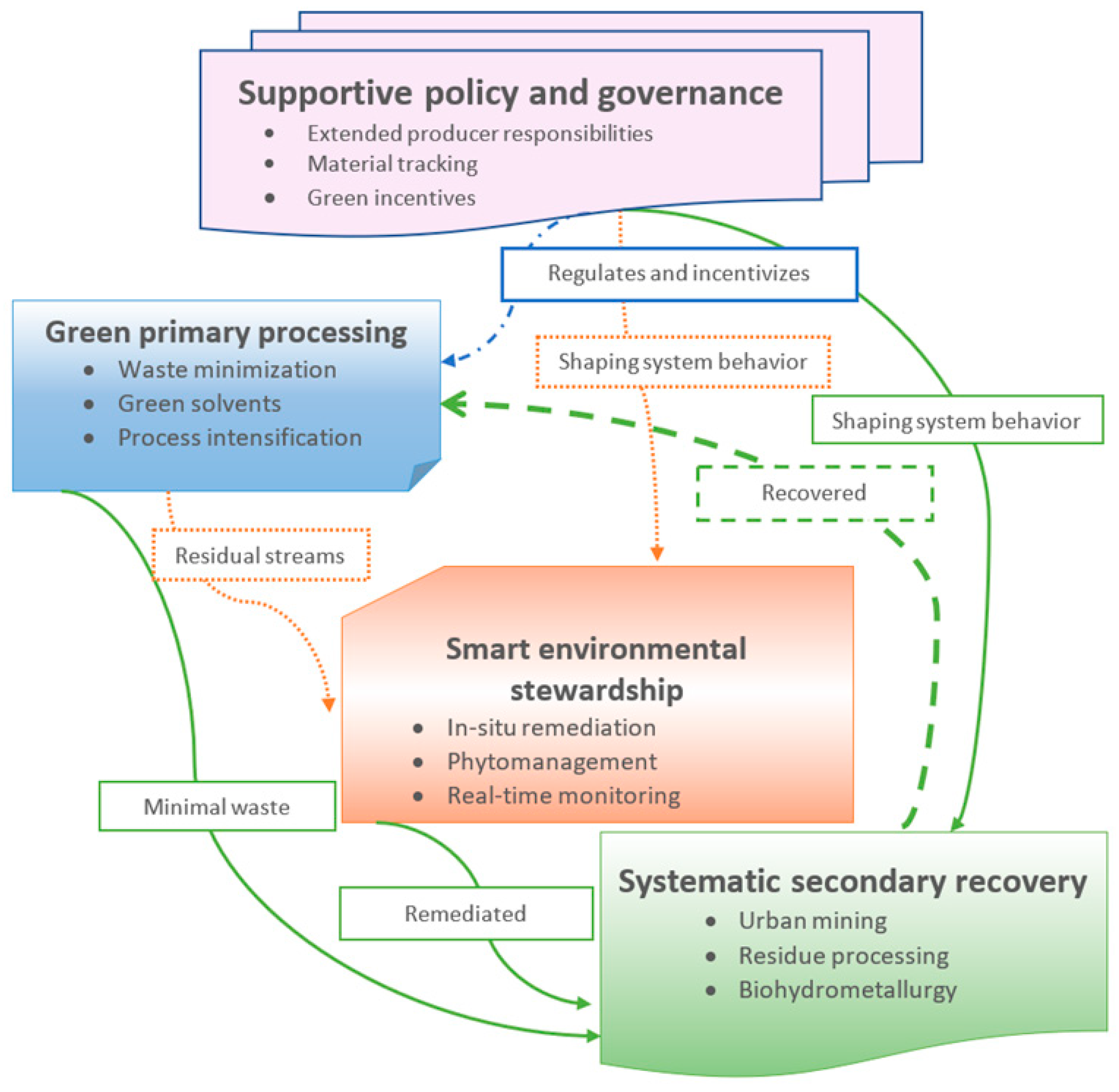
A sustainable thorium management framework can be conceptualized as a circular system integrating four pillars, as illustrated in Figure 4:
  • Green Primary Processing: Minimization of waste at source through process intensification, green solvents, and membrane-assisted extraction technologies [16,142,219].
  • Systematic Secondary Recovery: Reclamation of thorium from industrial residues, end-of-life products, and other secondary streams using advanced hydrometallurgical and bio-hydrometallurgical approaches [63,101,220].
  • Smart Environmental Stewardship: Site-specific remediation through in situ immobilization, phytomanagement, and real-time monitoring to ensure minimal ecological impact [12,95,221].
  • Supportive Policy and Governance: Regulatory frameworks, extended producer responsibilities, material tracking, and green incentives that guide and facilitate the circular management of thorium [222].
The path forward for thorium is systemic rather than reliant on isolated breakthroughs. Advancement may be facilitated by interdisciplinary approaches, standardized evaluation protocols, and consideration of circular economy principles, ensuring that thorium management becomes both environmentally sustainable and industrially feasible.

8. Conclusions

This review critically examined thorium valorization by integrating extraction technologies with environmental behavior, toxicological evidence, and regulatory constraints. Several robust conclusions emerge from the current body of literature.
First, thorium cannot be effectively managed as an isolated resource. Its persistent association with rare earth element production, mining residues, and industrial by-products means that thorium recovery, waste handling, and exposure control are inherently interconnected. Conventional hydrometallurgical routes are currently reported as technologically mature and infrastructure-compatible options. However, their deployment is inseparable from significant challenges related to high reagent consumption, secondary waste generation, and long-term environmental and occupational liabilities.
Methods reported to date that combine high chemical efficiency with established industrial scalability have been highlighted as particularly relevant for thorium separation. At present, conventional acid leaching followed by solvent extraction remains the benchmark for thorium recovery, whereas advanced adsorbents, electrosorption, and bio-based methods offer valuable insights into selective and environmentally safer recovery, but require further development and techno-economic evaluation before large-scale deployment.
Second, laboratory-scale performance metrics may not directly reflect potential performance under industrial conditions. High extraction efficiencies and selectivities achieved under controlled conditions do not necessarily translate into scalable, regulatory-compliant, or sustainable processes. Many advanced and emerging technologies reduce solvent use or improve selectivity, but often shift environmental and occupational risks rather than eliminating them. Economic feasibility, long-term material stability, and regulatory classification of secondary waste streams remain insufficiently addressed in much experimental research.
Third, assumptions regarding thorium’s environmental immobility and predictable toxicological behavior are not consistently supported when chemical speciation, process-induced transformations, and exposure pathways are considered. Occupational risk is primarily governed by inhalation and ingestion of bioavailable thorium forms, where chemical toxicity dominates acute effects and long-term retention contributes to chronic exposure. At the mechanistic level, thorium toxicity is mediated by oxidative stress, alpha-induced DNA damage, and strong biomolecular interactions, leading to cumulative cellular, organ-level, and systemic effects.
Experimental and field studies reported thorium toxicity across aquatic, mammalian, and developmental models. Industrial and energy-related activities amplify thorium dispersion and persistence in the environment. While mineralogical sequestration can limit short-term mobility, it complicates long-term remediation and monitoring. These findings underscore the necessity of integrating mineralogical, geochemical, and toxicological knowledge into comprehensive risk assessment and mitigation strategies.
Overall, thorium valorization is defined by interlinked trade-offs between recovery efficiency, environmental and occupational risk, capital intensity, and long-term system stability. Persistent knowledge gaps remain in scaling behavior, lifecycle emissions, waste form durability, and the coupling between chemical speciation and realistic exposure scenarios. Addressing these gaps requires a shift away from laboratory-centric optimization toward lifecycle-informed, system-level process design aligned with regulatory and environmental constraints.
Finally, sustainable thorium management depends on the coordinated integration of five critical conditions: (i) pilot-scale validation to confirm performance under realistic feedstocks and operational conditions; (ii) LCA to quantify environmental trade-offs, including secondary waste, solvent use, and radiological hazards; (iii) techno-economic analysis to assess capital and operational costs, payback periods, and market sensitivity; (iv) demonstrated robustness and regenerability of adsorbents, resins, and framework materials under industrial conditions; and (v) integrated risk management encompassing worker safety, compliance with NORM regulations, and effective effluent detoxification. Only through such a comprehensive and balanced framework can thorium technologies progress from conceptual promise to responsible and sustainable industrial implementation.

Author Contributions

Conceptualization, G.T.M., D.I.P. and N.A.Ș.; methodology, G.T.M. and N.A.Ș.; software, N.A.Ș.; validation, G.T.M., A.M.I., D.I.P., I.R.Z. and N.A.Ș.; formal analysis, G.T.M., A.M.I., D.I.P., I.R.Z. and N.A.Ș.; investigation, G.T.M., A.M.I., D.I.P. and N.A.Ș.; resources, G.T.M. and I.R.Z.; data curation, G.T.M., A.M.I., D.I.P., I.R.Z. and N.A.Ș.; writing—original draft preparation, G.T.M., D.I.P. and N.A.Ș.; writing—review and editing, G.T.M., A.M.I., D.I.P., I.R.Z. and N.A.Ș.; visualization, G.T.M., A.M.I., D.I.P., I.R.Z. and N.A.Ș.; supervision, G.T.M., A.M.I., D.I.P., I.R.Z. and N.A.Ș. All authors have read and agreed to the published version of the manuscript.

Funding

This complex research was funded by the Ministry of Agriculture and Rural Development—Romania, under Sectorial Plan—ADER 2026, Project ADER 6.3.7—“Applicability measures regarding the investigation of the organochlorine and organophosphorus contaminants distribution on the soil–plant-vegetable/fruit-finished product chain, following different types of soils in various areas”, and by the Romanian Ministry of Education and Research, through Project PN 23 15 03 02—Development of innovative technology for Lithium isotope separation through electromobility and artificial intelligence algorithms—acronym ISO-Li.

Institutional Review Board Statement

Not applicable.

Informed Consent Statement

Not applicable.

Data Availability Statement

No new data were created or analyzed in this study. Data sharing is not applicable to this article.

Conflicts of Interest

The authors declare no conflicts of interest.

Abbreviations

The following abbreviations are used in this manuscript:
ACEActivated carbon electrodes
COFsCovalent organic frameworks
DMHMPDi(1-methyl-heptyl) methyl phosphonate
GBEGraphene-based electrodes
g-C3N4Graphitic carbon nitride
GF-AOAmidoxime-modified graphite felt
H2SO4Sulfuric acid
HClHydrochloric acid
HNO3Nitric acid
LCALife cycle assessment
MOFsMetal–organic frameworks
NORMNaturally occurring radioactive materials
REERare earth element
TBPTributyl phosphate
TEATechno-economic analysis
ThThorium

References

  1. Zhang, J.; Liu, J. Thorium Anomaly on the Lunar Surface and Its Indicative Meaning. Acta Geochim. 2024, 43, 507–519. [Google Scholar] [CrossRef]
  2. Williams, M.A.; Kelsey, D.E.; Baggs, T.; Hand, M.; Alessio, K.L. Thorium Distribution in the Crust: Outcrop and Grain-Scale Perspectives. Lithos 2018, 320–321, 222–235. [Google Scholar] [CrossRef]
  3. Degueldre, C.; Joyce, M.J. Evidence and Uncertainty for Uranium and Thorium Abundance: A Review. Prog. Nucl. Energy 2020, 124, 103299. [Google Scholar] [CrossRef]
  4. Vikre, P.; Browne, Q.J.; Fleck, R.; Hofstra, A.; Wooden, J. Ages and Sources of Components of Zn-Pb, Cu, Precious Metal, and Platinum Group Element Deposits in the Goodsprings District, Clark County, Nevada. Econ. Geol. 2011, 106, 381–412. [Google Scholar] [CrossRef]
  5. Soesoo, A.; Vind, J.; Hade, S. Uranium and Thorium Resources of Estonia. Minerals 2020, 10, 798. [Google Scholar] [CrossRef]
  6. International Atomic Energy Agency (IAEA). Geological Classification of Uranium Deposits and Description of Selected Examples; International Atomic Energy Agency (IAEA): Vienna, Austria, 2018. [Google Scholar]
  7. Tutson, C.D.; Gorden, A.E.V. Thorium Coordination: A Comprehensive Review Based on Coordination Number. Coord. Chem. Rev. 2017, 333, 27–43. [Google Scholar] [CrossRef]
  8. Poliakovska, K.; Annesley, I.R.; Hajnal, Z. Geophysical Constraints to the Geological Evolution and Genesis of Rare Earth Element–Thorium–Uranium Mineralization in Pegmatites at Alces Lake, SK, Canada. Minerals 2023, 14, 25. [Google Scholar] [CrossRef]
  9. United Nations Scientific Committee on the Effects of Atomic Radiation. Sources and Effects of Ionizing Radiation; United Nations Scientific Committee on the Effects of Atomic Radiation: New York, NY, USA, 2000. [Google Scholar]
  10. Humphrey, U.E.; Khandaker, M.U. Viability of Thorium-Based Nuclear Fuel Cycle for the next Generation Nuclear Reactor: Issues and Prospects. Renew. Sustain. Energy Rev. 2018, 97, 259–275. [Google Scholar] [CrossRef]
  11. Amatullah, A.; Permana, S.; Irwanto, D.; Aimon, A.H. Comparative Analysis on Small Modular Reactor (SMR) with Uranium and Thorium Fuel Cycle. Nucl. Eng. Des. 2024, 418, 112934. [Google Scholar] [CrossRef]
  12. Chen, J.; Yap, I. Imaginaries of the Resilient Second Nuclear Era: Nuclear Paradox Resolution and a Feasible Atomic Priesthood. Nucl. Eng. Technol. 2025, 57, 103695. [Google Scholar] [CrossRef]
  13. International Atomic Energy Agency. Radiation Protection and Safety of Radiation Sources: International Basic Safety Standards. General Safety Requirements Part 3 No. GSR Part 3; International Atomic Energy Agency: Vienna, Austria, 2014; p. 436. [Google Scholar]
  14. Hassan, H.J.; Hashim, S.; Sanusi, M.S.M.; Bradley, D.A.; Alsubaie, A.; Tenorio, R.G.; Bakri, N.F.; Tahar, R.M. The Radioactivity of Thorium Incandescent Gas Lantern Mantles. Appl. Sci. 2021, 11, 1311. [Google Scholar] [CrossRef]
  15. Schirmer, A.; Kersting, M.; Uschmann, K. Occupational Doses from the Use of Thoriated Optical Components. Health Phys. 2016, 111, 106–111. [Google Scholar] [CrossRef]
  16. Man, G.T.; Albu, P.C.; Nechifor, A.C.; Grosu, A.R.; Tanczos, S.-K.; Grosu, V.-A.; Ioan, M.-R.; Nechifor, G. Thorium Removal, Recovery and Recycling: A Membrane Challenge for Urban Mining. Membranes 2023, 13, 765. [Google Scholar] [CrossRef]
  17. Zhang, Y.; Shao, X.; Yin, L.; Ji, Y. Estimation of Inhaled Effective Doses of Uranium and Thorium for Workers in Bayan Obo Ore and the Surrounding Public, Inner Mongolia, China. Int. J. Environ. Res. Public Health 2021, 18, 987. [Google Scholar] [CrossRef]
  18. Rump, A.; Hermann, C.; Lamkowski, A.; Popp, T.; Port, M. A Comparison of the Chemo- and Radiotoxicity of Thorium and Uranium at Different Enrichment Grades. Arch. Toxicol. 2023, 97, 1577–1598. [Google Scholar] [CrossRef]
  19. Agency for Toxic Substances and Disease Registry (US). Chapter 2, Health Effects. In Toxicological Profile for Thorium; Agency for Toxic Substances and Disease Registry: Atlanta, GA, USA, 2019. [Google Scholar]
  20. International Atomic Energy Agency. Radiation Protection and NORM Residue Management in the Production of Rare Earths from Thorium Containing Minerals; International Atomic Energy Agency: Vienna, Austria, 2011. [Google Scholar]
  21. Atamanova, T.; Lesbayev, B.; Tanirbergenova, S.; Alsar, Z.; Kalybay, A.; Mansurov, Z.; Atamanov, M.; Insepov, Z. Advanced Techniques for Thorium Recovery from Mineral Deposits: A Comprehensive Review. Appl. Sci. 2025, 15, 11403. [Google Scholar] [CrossRef]
  22. Yu, L.; Gao, Y.; Zhang, H.; Tian, Z.; Li, T.; Zhang, H.; Sun, X. Efficient Separation of Thorium and Rare Earth Elements with Bifunctional Ionic Liquid [DOC4mim][TTA] Based Extraction. Sep. Purif. Technol. 2026, 384, 136254. [Google Scholar] [CrossRef]
  23. Ding, H.; Zhang, X.; Yang, H.; Luo, X.; Lin, X. Highly Efficient Extraction of Thorium from Aqueous Solution by Fungal Mycelium-Based Microspheres Fabricated via Immobilization. Chem. Eng. J. 2019, 368, 37–50. [Google Scholar] [CrossRef]
  24. Zhang, Y.; Chen, J.; He, Q.; He, J.; Xu, W.; Sun, M.; Qiu, H. Selective Separation of Thorium from Rare Earth Ions Using Bisphosphonate-Functionalized Ionic Single Crystals Co-Self-Assembled via π–π and Ionic Interactions. Nano Lett. 2025, 25, 7665–7672. [Google Scholar] [CrossRef]
  25. Alsar, Z.; Gajimuradova, A.; Mansurov, Z.; Gubaidullin, N.; Hassanein, A.; Insepov, Z. Thorium in Energy and Ecology: Prospects for Clean Fuel Sources and Protection of Water and Soil Systems from Radiation Risks. Energies 2025, 18, 6177. [Google Scholar] [CrossRef]
  26. Xu, H.; Weber, T. Quantifying Lithogenic Inputs to the Ocean From the GEOTRACES Thorium Transects in a Data-Assimilation Model. Glob. Biogeochem. Cycles 2025, 39, e2024GB008485. [Google Scholar] [CrossRef]
  27. Patel, K.S.; Sharma, S.; Maity, J.P.; Martín-Ramos, P.; Fiket, Ž.; Bhattacharya, P.; Zhu, Y. Occurrence of Uranium, Thorium and Rare Earth Elements in the Environment: A Review. Front. Environ. Sci. 2023, 10, 1058053. [Google Scholar] [CrossRef]
  28. Chen, B.; He, M.; Zhang, H.; Jiang, Z.; Hu, B. Chromatographic Techniques for Rare Earth Elements Analysis. Phys. Sci. Rev. 2017, 2, 20160057. [Google Scholar] [CrossRef]
  29. Kanojia, A.; Nyembwe, J.K.; Petranikova, M.; Retegan Vollmer, T.; Ekberg, C. Solvent Extraction and Isolation Strategies for Uranium, Thorium, and Radium in Rare Earth Element Recovery from Ores: A Review. Solvent Extr. Ion Exch. 2025, 43, 671–707. [Google Scholar] [CrossRef]
  30. Idrisheva, Z.; Ostolska, I.; Skwarek, E.; Daumova, G.; Wiśniewska, M.; Toktaganov, T.; Kozhakhmetov, Y. Evaluation of Long-Term Environmental Impact and Radiological Risks at a Former Thorium and Rare Earth Site in North-Eastern Kazakhstan. Sustainability 2025, 17, 8569. [Google Scholar] [CrossRef]
  31. Aziman, E.S.; Ismail, A.F. Rapid Selective Removal of Thorium via Electrosorption towards Efficiently Managing Rare-Earth Extraction Residue. J. Environ. Chem. Eng. 2021, 9, 105478. [Google Scholar] [CrossRef]
  32. Gamaletsos, P.N.; Godelitsas, A.; Kasama, T.; Kuzmin, A.; Lagos, M.; Mertzimekis, T.J.; Göttlicher, J.; Steininger, R.; Xanthos, S.; Pontikes, Y.; et al. The Role of Nano-Perovskite in the Negligible Thorium Release in Seawater from Greek Bauxite Residue (Red Mud). Sci. Rep. 2016, 6, 21737. [Google Scholar] [CrossRef] [PubMed]
  33. Dekusar, V.M.; Kolesnikova, M.S.; Nikolaev, A.I.; Maiorov, V.G.; Zilberman, B.Y. Mineral Reserves of Naturally Radioactive Thorium-Bearing Raw Materials. At. Energy 2012, 111, 185–194. [Google Scholar] [CrossRef]
  34. U.S. Geological Survey. Mineral Commodity Summaries; U.S. Geological Survey: Reston, VA, USA, 2020. [Google Scholar]
  35. Rudnick, R.L.; Gao, S. Composition of the Continental Crust. In Treatise on Geochemistry; Elsevier: Amsterdam, The Netherlands, 2014; pp. 1–51. [Google Scholar]
  36. Jyothi, R.K.; De Melo, L.G.T.C.; Santos, R.M.; Yoon, H.-S. An Overview of Thorium as a Prospective Natural Resource for Future Energy. Front. Energy Res. 2023, 11, 1132611. [Google Scholar] [CrossRef]
  37. Ghosh, M.; Kadlag, S.S.; Swain, K.K.; Ghosh, A.; Sahu, A.K.; Singh, P.K. Bright and Selective: A Dicarboxylate-Functionalized AIE Sensor for Th4+ in 100% Water with a Sub-ppm Level Sensitivity. Small 2025, 21, e08399. [Google Scholar] [CrossRef]
  38. Li, J.; Bai, T.; Hu, W.; Wang, M.; Liao, L.; Xun, Z.; Wang, Z.; Song, H. Geochemical Properties and Mineralization of Thorium. Ore Energy Resour. Geol. 2025, 18, 100081. [Google Scholar] [CrossRef]
  39. Martín, D.; Fernández-Caliani, J.C.; Romero-Baena, A.; Delgado, J.; González, I. Geological Constraints on the Distribution of Naturally Occurring Uranium and Thorium in Soils of Southwestern Spain. J. Iber. Geol. 2025, 51, 445–461. [Google Scholar] [CrossRef]
  40. Salehuddin, A.H.J.M.; Ismail, A.F.; Bahri, C.N.A.C.Z.; Aziman, E.S. Economic Analysis of Thorium Extraction from Monazite. Nucl. Eng. Technol. 2019, 51, 631–640. [Google Scholar] [CrossRef]
  41. García, A.C.; Latifi, M.; Amini, A.; Chaouki, J. Separation of Radioactive Elements from Rare Earth Element-Bearing Minerals. Metals 2020, 10, 1524. [Google Scholar] [CrossRef]
  42. Society for Mining, Metallurgy & Exploration. Thorium as a Byproduct of Rare Earth Element Production; Society for Mining, Metallurgy & Exploration: Littleton, CO, USA, 2023. [Google Scholar]
  43. Su, J.; Gao, Y.; Ni, S.; Xu, R.; Sun, X. A Safer and Cleaner Process for Recovering Thorium and Rare Earth Elements from Radioactive Waste Residue. J. Hazard. Mater. 2021, 406, 124654. [Google Scholar] [CrossRef]
  44. Akhtar, N.; Ismail, A.F.; Hanafiah, M.M.; Fadzil, S.B.M.; Muhammad, S.A.; Ahmed, T.; Flafel, H.M. Bridging Malaysian Thorium Processing and Sustainable Environmental Policy with Life Cycle Assessment. Discov. Sustain. 2025, 6, 1241. [Google Scholar] [CrossRef]
  45. Findeiß, M.; Schäffer, A. Fate and Environmental Impact of Thorium Residues During Rare Earth Processing. J. Sustain. Metall. 2017, 3, 179–189. [Google Scholar] [CrossRef]
  46. Chadirji-Martinez, K.; Grosvenor, A.P.; Crawford, A.; Chernikov, R.; Heredia, E.; Feng, R.; Pan, Y. Thorium Speciation in Synthetic Anhydrite: Implications for Remediation and Recovery of Thorium from Rare-Earth Mine Tailings. Hydrometallurgy 2022, 214, 105965. [Google Scholar] [CrossRef]
  47. Huang, Y.-Q.; Wu, M.-Q.; Germain, B.; Yu, H.-C.; Qiao, B.-X.; Zhao, Z.-G.; Qiu, K.-F. Geodynamic Setting and Ore Formation of the Younusisayi Thorium Deposit in the Altyn Orogenic Belt, NW China. Ore Geol. Rev. 2022, 140, 104552. [Google Scholar] [CrossRef]
  48. Chowdhury, M.O.S.; Talan, D. From Waste to Wealth: A Circular Economy Approach to the Sustainable Recovery of Rare Earth Elements and Battery Metals from Mine Tailings. Separations 2025, 12, 52. [Google Scholar] [CrossRef]
  49. Samsonov, M.D.; Trofimov, T.I.; Kulyako, Y.M.; Malikov, D.A.; Myasoedov, B.F. Supercritical Fluid Extraction of Rare Earth Elements, Thorium and Uranium from Monazite Concentrate and Phosphogypsum Using Carbon Dioxide Containing Tributyl Phosphate and Di-(2-Ethylhexyl)Phosphoric Acid. Russ. J. Phys. Chem. B 2016, 10, 1078–1084. [Google Scholar] [CrossRef]
  50. Talan, D.; Huang, Q.; Liang, L.; Song, X. Conceptual Process Development for the Separation of Thorium, Uranium, and Rare Earths from Coarse Coal Refuse. Miner. Process. Extr. Metall. Rev. 2023, 44, 330–345. [Google Scholar] [CrossRef]
  51. Landsberger, S.; Sharp, A.; Wang, S.; Pontikes, Y.; Tkaczyk, A.H. Characterization of Bauxite Residue (Red Mud) for 235U, 238U, 232Th and 40K Using Neutron Activation Analysis and the Radiation Dose Levels as Modeled by MCNP. J. Environ. Radioact. 2017, 173, 97–101. [Google Scholar] [CrossRef]
  52. Grebenshchikova, V.I.; Kuzmin, M.I.; Rukavishnikov, V.S.; Efimova, N.V.; Donskikh, I.V.; Doroshkov, A.A. Chemical Contamination of Soil on Urban Territories with Aluminum Production in the Baikal Region, Russia. Air Soil Water Res. 2021, 14, 11786221211004114. [Google Scholar] [CrossRef]
  53. Nascimento, R.C.; Da Silva, Y.J.A.B.; Do Nascimento, C.W.A.; Da Silva, Y.J.A.B.; Da Silva, R.J.A.B.; Collins, A.L. Thorium Content in Soil, Water and Sediment Samples and Fluvial Sediment-Associated Transport in a Catchment System with a Semiarid-Coastal Interface, Brazil. Environ. Sci. Pollut. Res. 2019, 26, 33532–33540. [Google Scholar] [CrossRef]
  54. Da Silva, G.V.M.; Chaves, L.V.G.; Pereira, C. Actinides and Depleted Uranium as an Alternative for Sustainable Nuclear Energy in Thermal Reactors. Prog. Nucl. Energy 2026, 191, 106057. [Google Scholar] [CrossRef]
  55. Agency for Toxic Substances and Disease Registry (US). Chapter 3. Toxicokinetics, Susceptible Populations, Biomarkers, Chemical Interactions. In Toxicological Profile for Thorium; Agency for Toxic Substances and Disease Registry (US): Atlanta, GA, USA, 2019. [Google Scholar]
  56. Ault, T.; Gosen, B.V.; Krahn, S.; Croff, A. Natural Thorium Resources and Recovery: Options and Impacts. Nucl. Technol. 2016, 194, 136–151. [Google Scholar] [CrossRef]
  57. Moldoveanu, G.A.; Papangelakis, V.G. An Overview of Rare-Earth Recovery by Ion-Exchange Leaching from Ion-Adsorption Clays of Various Origins. Mineral. Mag. 2016, 80, 63–76. [Google Scholar] [CrossRef]
  58. Nisbet, H.; Migdisov, A.; Xu, H.; Guo, X.; Van Hinsberg, V.; Williams-Jones, A.E.; Boukhalfa, H.; Roback, R. An Experimental Study of the Solubility and Speciation of Thorium in Chloride-Bearing Aqueous Solutions at Temperatures up to 250 °C. Geochim. Et Cosmochim. Acta 2018, 239, 363–373. [Google Scholar] [CrossRef]
  59. Santofimia, E.; González, F.J.; Rincón-Tomás, B.; López-Pamo, E.; Marino, E.; Reyes, J.; Bellido, E. The Mobility of Thorium, Uranium and Rare Earth Elements from Mid Ordovician Black Shales to Acid Waters and Its Removal by Goethite and Schwertmannite. Chemosphere 2022, 307, 135907. [Google Scholar] [CrossRef] [PubMed]
  60. Hsueh, F.-C.; Barluzzi, L.; Keener, M.; Rajeshkumar, T.; Maron, L.; Scopelliti, R.; Mazzanti, M. Reactivity of Multimetallic Thorium Nitrides Generated by Reduction of Thorium Azides. J. Am. Chem. Soc. 2022, 144, 3222–3232. [Google Scholar] [CrossRef]
  61. Mukhlis, R.Z.; Lee, J.-Y.; Kang, H.N.; Haque, N.; Pownceby, M.I.; Bruckard, W.J.; Rhamdhani, M.A.; Jyothi, R.K. Techno-Economic Evaluation of an Environmental-Friendly Processing Route to Extract Rare Earth Elements from Monazite. Clean. Eng. Technol. 2024, 20, 100742. [Google Scholar] [CrossRef]
  62. Gruppelaar, H.; Philippen, P.W.; Modolo, G.; Schapira, J.P.; Fourrest, B.; Tommasi, J.; Renard, A.F.; Landeyro, P.A.; Magill, J. Thorium Cycle as a Waste Management Option. In Proceedings of the 5. International Information Exchange Meeting on Actinide and Fission Product Partitioning and Transmutation; OECD Nuclear Energy Agency: Paris, France, 1999. [Google Scholar]
  63. Gkika, D.A.; Chalaris, M.; Kyzas, G.Z. Review of Methods for Obtaining Rare Earth Elements from Recycling and Their Impact on the Environment and Human Health. Processes 2024, 12, 1235. [Google Scholar] [CrossRef]
  64. International Atomic Energy Agency. Safety Standards for Protecting People and the Environment. Radiation Protection of the Public and the Environment. General Safety Guide No. GSG-8. 2018. Available online: https://opis-cdn.tinkoffjournal.ru/mercury/radiatsionnaia-zashchita-naseleniia-i-okruzhaiushchei-sredy-mezhdunarodnoe-agentstvo-atomnoi-energii.pdf (accessed on 4 February 2026).
  65. International Atomic Energy Agency. Radiation Protection and Management of NORM Residues in the Phosphate Industry; International Atomic Energy Agency: Vienna, Austria, 2016. [Google Scholar]
  66. International Atomic Energy Agency. Management of NORM Residues; International Atomic Energy Agency: Vienna, Austria, 2013. [Google Scholar]
  67. Council of the European Union. Council Directive 2013/59/Euratom of 5 December 2013 Laying Down Basic Safety Standards for Protection Against the Dangers Arising from Exposure to Ionising Radiation, and Repealing Directives 89/618/Euratom, 90/641/Euratom, 96/29/Euratom, 97/43/Euratom and 2003/122/Euratom. Off. J. Eur. Union 2013, 13, 1–73. [Google Scholar]
  68. Lan, Q.; Zhang, X.; Niu, F.; Liu, D.; Shen, L.; Yang, Y. Recovery of Rare Earth Elements and Thorium from Acid Leaching Residue of Ionic Rare Earth Concentrates. J. Rare Earths 2025, 43, 794–804. [Google Scholar] [CrossRef]
  69. Depraiter, L.; Goutte, S. The Role and Challenges of Rare Earths in the Energy Transition. Resour. Policy 2023, 86, 104137. [Google Scholar] [CrossRef]
  70. Watts, H.; Fisher, T. Leaching the Unleachable Mineral: Rare Earth Dissolution from Monazite Ore in Condensed Phosphoric Acid. Minerals 2021, 11, 931. [Google Scholar] [CrossRef]
  71. Chung, K.W.; Yoon, H.-S.; Kim, C.-J.; Lee, J.-Y.; Jyothi, R.K. Solvent Extraction, Separation and Recovery of Thorium from Korean Monazite Leach Liquors for Nuclear Industry Applications. J. Ind. Eng. Chem. 2020, 83, 72–80. [Google Scholar] [CrossRef]
  72. Kursun, I.; Tombal, T.D.; Terzi, M. Solubility of Eskisehir Thorium/Rare Earth Ores in Sulphuric and Nitric Acids. Physicochem. Probl. Miner. Process. 2018, 54, 476–483. [Google Scholar] [CrossRef]
  73. Lin, P.; Yang, X.; Werner, J.M.; Honaker, R.Q. Application of Eh-pH Diagrams on Acid Leaching Systems for the Recovery of REEs from Bastnaesite, Monazite and Xenotime. Metals 2021, 11, 734. [Google Scholar] [CrossRef]
  74. Udayakumar, S.; Baharun, N.; Rezan, S.A.; Ismail, A.F.; Mohamed Takip, K. Economic Evaluation of Thorium Oxide Production from Monazite Using Alkaline Fusion Method. Nucl. Eng. Technol. 2021, 53, 2418–2425. [Google Scholar] [CrossRef]
  75. Galvin, J.; Safarzadeh, M.S. Decomposition of Monazite Concentrate in Potassium Hydroxide Solution. J. Environ. Chem. Eng. 2018, 6, 1353–1363. [Google Scholar] [CrossRef]
  76. Özkan, B.; Altaş, Y.; İnan, S. Extraction and Purification of Thorium and Rare Earth Elements from Bastnaesite Mineral: A Comprehensive Leaching and Precipitation Study. J. Radioanal. Nucl. Chem. 2025, 334, 541–550. [Google Scholar] [CrossRef]
  77. He, X.; Tang, J.; Wang, Z.; Feng, W.; Yan, Q.; Wei, Y.; Watabe, H.; Li, W.; Ning, S.; Chen, L. Method and Mechanism for Efficient Radium Isolation from Bulk Thorium Based on Anion Exchange. Chem. Eng. J. 2024, 496, 154283. [Google Scholar] [CrossRef]
  78. Akhtar, N.; Ismail, A.F.; Mohd Hanafiah, M.; Mohd Fadzil, S.; Park, S. Evaluating Environmental Impacts of Thorium Extraction: A Comparative Study of Solvent and Electrosorption Technologies Using Life Cycle Assessment (LCA). Clean. Eng. Technol. 2025, 26, 100960. [Google Scholar] [CrossRef]
  79. Borai, E.H.; El-Ghany, M.S.A.; Ahmed, I.M.; Hamed, M.M.; El-Din, A.M.S.; Aly, H.F. Modified Acidic Leaching for Selective Separation of Thorium, Phosphate and Rare Earth Concentrates from Egyptian Crude Monazite. Int. J. Miner. Process. 2016, 149, 34–41. [Google Scholar] [CrossRef]
  80. Tan, M.; Huang, C.; Ding, S.; Li, F.; Li, Q.; Zhang, L.; Liu, C.; Li, S. Highly Efficient Extraction Separation of Uranium(VI) and Thorium(IV) from Nitric Acid Solution with Di(1-Methyl-Heptyl) Methyl Phosphonate. Sep. Purif. Technol. 2015, 146, 192–198. [Google Scholar] [CrossRef]
  81. Madbouly, H.A.; El-Hefny, N.E.; El-Nadi, Y.A. Adsorption and Separation of Terbium(III) and Gadolinium(III) from Aqueous Nitrate Medium Using Solid Extractant. Sep. Sci. Technol. 2021, 56, 681–693. [Google Scholar] [CrossRef]
  82. Wang, Y.; Huang, C.; Li, F.; Dong, Y.; Sun, X. Process for the Separation of Thorium and Rare Earth Elements from Radioactive Waste Residues Using Cyanex® 572 as a New Extractant. Hydrometallurgy 2017, 169, 158–164. [Google Scholar] [CrossRef]
  83. Wang, H.; Kuang, S.; Liao, W. Synergistic Extraction and Separation of Thorium from Rare Earths in Chloride Media Using Mixture of Cextrant 230 and Cyanex 923. J. Rare Earths 2024, 42, 759–767. [Google Scholar] [CrossRef]
  84. Kongasseri, A.; Madhesan, T.; Mitra, S.; Rao, C.V.S.B.; Nagarajan, S.; Chinaraga, P.K.; Deivasigamani, P.; Mohan, A.M. Fast and Selective Reversed-Phase High Performance Liquid Chromatographic Separation of UO22+ and Th4+ Ions Using Surface Modified C18 Silica Monolithic Supports with Target Specific Ionophoric Ligands. RSC Adv. 2023, 13, 3317–3328. [Google Scholar] [CrossRef]
  85. Iskandar, B.T.; Ismail, A.F.; Aziman, E.S.; Ahmad, S. Advancing towards Technology Readiness: Continuous-Flow Electrosorption for Thorium Separation from Rare Earth Processing by-Products. Nucl. Eng. Technol. 2024, 56, 4611–4619. [Google Scholar] [CrossRef]
  86. Zhang, X.; Yan, M.; Chen, P.; Li, J.; Li, Y.; Li, H.; Liu, X.; Chen, Z.; Yang, H.; Wang, S.; et al. Emerging MOFs, COFs, and Their Derivatives for Energy and Environmental Applications. Innovation 2025, 6, 100778. [Google Scholar] [CrossRef] [PubMed]
  87. Zhou, H.; Huang, Z.; Zhang, X.; Bu, X.; Du, Y.; Shi, W.; Yuan, L. Enabling the Extraction of High-Purity Thorium from Rare Earth Ores by Simple One-Step Crystallization. Chem. Eng. J. 2025, 519, 165158. [Google Scholar] [CrossRef]
  88. Zhou, J.; Zhang, X.; Deng, B.; Huang, Y.; Kuang, W.; Liu, X.; Kuang, S.; Hao, Z.; Liao, W. Enhancing the Deep Removal of Trace Thorium from Rare Earths Using Polycinamic Acid Resin. Sep. Purif. Technol. 2025, 363, 132129. [Google Scholar] [CrossRef]
  89. He, D.; Ning, S.; Liu, J.; Zhang, S.; Chen, L.; Xu, Y.; Feng, Z.; Hamza, M.F.; Wei, Y. Efficiently Selective Removal of Radioactive Thorium and Uranium from Rare Earths by Trialkyl Phosphine Oxide Modified Porous Silica-Polymer Based Adsorbent. Sep. Purif. Technol. 2025, 364, 132426. [Google Scholar] [CrossRef]
  90. Lei, P.; Gao, Y.; Zhai, R.; Zhang, H.; Tian, Z.; Sun, X.; Chai, Y. The Selective Electrosorption of Thorium from Rare Earth with Molybdenum Disulfide-Modified Reduced Graphene Oxide Aerogel MoS2@rGA. Sep. Purif. Technol. 2025, 363, 132242. [Google Scholar] [CrossRef]
  91. Lei, P.; Gao, Y.; Sun, X. Electrochemical Selective Recovery of Thorium from Rare Earths Using an Amidoxime Modified Graphite Felt Electrode. Green Chem. 2026, 28, 2510–2518. [Google Scholar] [CrossRef]
  92. Ma, J.; Huang, Q.; Zhang, B.; Fang, M.; Li, X.; Junaid, M.; Ning, Z.; Tang, J.; Guo, Z.; Yao, H.; et al. GOQDs-Intercalated GO Membranes for High-Efficiency Lanthanum-Thorium Separation. Sep. Purif. Technol. 2025, 370, 133237. [Google Scholar] [CrossRef]
  93. Yan, C.; Peng, Q.; Peng, L.; Liu, Z.; Qian, Y.; Jin, T. Highly Efficient Adsorption of Thorium(IV) from Aqueous Solutions by Functionalized UiO-66 with Abundant Phosphonic Acid Active Sites. New J. Chem. 2024, 48, 10093–10103. [Google Scholar] [CrossRef]
  94. Abu Shawer, A.I.; Khalili, F.I.; Hamzeh, E.A. Thorium(IV) Removal by Nano Olive Pomace and Its Nano Biochar: A Comparative Study. Adsorpt. Sci. Technol. 2025, 43, 02636174251366591. [Google Scholar] [CrossRef]
  95. Chen, L.; Zhang, Z.; Xiao, S.; Li, X.; Zhao, S.; Zhao, Y.; Yu, C.; Feng, Z.; Ma, K.; Liu, X.; et al. Efficient Capture of Thorium Ions by the Hydroxyl-Functionalized Sp2c-COF through Nitrogen-Oxygen Cooperative Mechanism. Green Chem. Eng. 2026, 7, 191–199. [Google Scholar] [CrossRef]
  96. Kujawa, J.; Al Gharabli, S.; Szymczyk, A.; Terzyk, A.P.; Boncel, S.; Knozowska, K.; Li, G.; Kujawski, W. On Membrane-Based Approaches for Rare Earths Separation and Extraction—Recent Developments. Coord. Chem. Rev. 2023, 493, 215340. [Google Scholar] [CrossRef]
  97. Nechifor, A.C.; Albu, P.C.; Motelica, L.; Man, G.T.; Grosu, A.R.; Tanczos, S.-K.; Grosu, V.-A.; Marinescu, V.E.; Nechifor, G. Thorium Recovery with Crown Ether–Polymer Composite Membranes. Appl. Sci. 2024, 14, 9937. [Google Scholar] [CrossRef]
  98. Castro, L.; Blázquez, M.L.; González, F.; Muñoz, J.Á. Biohydrometallurgy for Rare Earth Elements Recovery from Industrial Wastes. Molecules 2021, 26, 6200. [Google Scholar] [CrossRef] [PubMed]
  99. Panda, S.; Costa, R.B.; Shah, S.S.; Mishra, S.; Bevilaqua, D.; Akcil, A. Biotechnological Trends and Market Impact on the Recovery of Rare Earth Elements from Bauxite Residue (Red Mud)—A Review. Resour. Conserv. Recycl. 2021, 171, 105645. [Google Scholar] [CrossRef]
  100. Shi, S.; Pan, J.; Dong, B.; Zhou, W.; Zhou, C. Bioleaching of Rare Earth Elements: Perspectives from Mineral Characteristics and Microbial Species. Minerals 2023, 13, 1186. [Google Scholar] [CrossRef]
  101. Huang, M.; Zhou, H.; Shao, S.; Yu, X.; Shu, X.; Chen, Z.; Qiu, G.; Shen, L.; Zhao, H. Potential of Bio-Hydrometallurgical Recovery of Rare Earth Elements from Secondary Resources: Research Progress and Prospects. J. Clean. Prod. 2025, 521, 146180. [Google Scholar] [CrossRef]
  102. Binnemans, K.; Jones, P.T. Solvometallurgy: An Emerging Branch of Extractive Metallurgy. J. Sustain. Metall. 2017, 3, 570–600. [Google Scholar] [CrossRef]
  103. Ang, K.L.; Li, D.; Nikoloski, A.N. The Effectiveness of Ion Exchange Resins in Separating Uranium and Thorium from Rare Earth Elements in Acidic Aqueous Sulfate Media. Part 1. Anionic and Cationic Resins. Hydrometallurgy 2017, 174, 147–155. [Google Scholar] [CrossRef]
  104. Liu, X.; Gao, F.; Jin, T.; Ma, K.; Shi, H.; Wang, M.; Gao, Y.; Xue, W.; Zhao, J.; Xiao, S.; et al. Efficient and Selective Capture of Thorium Ions by a Covalent Organic Framework. Nat. Commun. 2023, 14, 5097. [Google Scholar] [CrossRef] [PubMed]
  105. Gaidimas, M.A.; Smoljan, C.S.; Ye, Z.-M.; Stern, C.L.; Malliakas, C.D.; Kirlikovali, K.O.; Farha, O.K. Thorium Metal–Organic Framework Crystallization for Efficient Recovery from Rare Earth Element Mixtures. Chem. Sci. 2025, 16, 3895–3903. [Google Scholar] [CrossRef]
  106. Sheybani, S.; Abbas, M.; Joy, M.; Brewer, C.R.; Walker, A.V.; Balkus, K.J. Selective Extraction of Thorium Using Nanoporous Sulfate-Functionalized Fluoro-Bridged Holmium Metal–Organic Frameworks. ACS Appl. Nano Mater. 2025, 8, 18762–18771. [Google Scholar] [CrossRef]
  107. Sun, S.; Jia, K.; Cheng, G.; Shi, L.; Zhou, Q. Phosphine-Functionalized Aluminum-Based Metal Organic Framework for Ultra-Fast and Selective Thorium Capture from Rare Earth Contaminated Wastewater. Environ. Technol. Innov. 2025, 40, 104442. [Google Scholar] [CrossRef]
  108. Kaptanoglu, I.G.; Yusan, S.; Kaynar, U.H.; Aytas, S.; Erenturk, S.A.; Dianellou, I. Investigation of Thorium(IV) Removal Utilizing Reduced Graphene Oxide-Zinc Oxide Nanofibers via Response Surface Methodology. J. Radioanal. Nucl. Chem. 2025, 334, 6663–6676. [Google Scholar] [CrossRef]
  109. Saha, S.; Basu, H.; Choudhury, N.; Pimple, M.V. Theoretical and Experimental Study on Efficient Thorium Removal from Aquatic Environment Using Phosphate-Modified Graphene Oxide Polymeric Beads. J. Radioanal. Nucl. Chem. 2025, 334, 4343–4351. [Google Scholar] [CrossRef]
  110. Yussuf, N.M.; Ismail, A.F.; Yasir, M.S. Revolutionizing Thorium Capture: G-C3N4 Electrodes for Enhanced Thorium Electrosorption. J. Saudi Chem. Soc. 2025, 29, 1. [Google Scholar] [CrossRef]
  111. Lissaneddine, A.; Pons, M.-N.; Aziz, F.; Ouazzani, N.; Mandi, L.; Mousset, E. A Critical Review on the Electrosorption of Organic Compounds in Aqueous Effluent—Influencing Factors and Engineering Considerations. Environ. Res. 2022, 204, 112128. [Google Scholar] [CrossRef]
  112. Milani, S.A.; Zahakifar, F.; Faryadi, M. Membrane Assisted Transport of Thorium (IV) across Bulk Liquid Membrane Containing DEHPA as Ion Carrier: Kinetic, Mechanism and Thermodynamic Studies. Radiochim. Acta 2022, 110, 841–852. [Google Scholar] [CrossRef]
  113. Ehyaie, D.; Zaheri, P.; Samadfam, M.; Zahakifar, F. Evaluation of Cyanex272 in the Emulsion Liquid Membrane System for Separation of Thorium. Sci. Rep. 2024, 14, 31897. [Google Scholar] [CrossRef] [PubMed]
  114. Arabi, H.R.; Milani, S.A.; Abolghasemi, H.; Zahakifar, F. Recovery and Transport of Thorium(IV) through Polymer Inclusion Membrane with D2EHPA from Nitric Acid Solutions. J. Radioanal. Nucl. Chem. 2021, 327, 653–665. [Google Scholar] [CrossRef]
  115. Ye, W.; Yu, F.; Yu, Z.; Kong, N.; Lin, X.; Liu, R.; Du, J.; Huang, X.; Gu, A.; Arcadio, S.; et al. High-Performance Antibacterial Tight Ultrafiltration Membrane Constructed by Co-Deposition of Dopamine and Tobramycin for Sustainable High-Salinity Textile Wastewater Management. Desalination 2024, 579, 117482. [Google Scholar] [CrossRef]
  116. Brisson, V.L.; Zhuang, W.; Alvarez-Cohen, L. Bioleaching of Rare Earth Elements from Monazite Sand. Biotechnol. Bioeng. 2016, 113, 339–348. [Google Scholar] [CrossRef] [PubMed]
  117. Chen, Z.; Han, Z.; Gao, B.; Zhao, H.; Qiu, G.; Shen, L. Bioleaching of Rare Earth Elements from Ores and Waste Materials: Current Status, Economic Viability and Future Prospects. J. Environ. Manag. 2024, 371, 123217. [Google Scholar] [CrossRef]
  118. Bhatti, T.M.; Tuovinen, O.H. Bioleaching of Uranium from Ores and Rocks Using Filamentous Fungi. Front. Microbiol. 2025, 16, 1523962. [Google Scholar] [CrossRef]
  119. Cheng, K.; Qu, L.; Mao, Z.; Liao, R.; Wu, Y.; Hassanvand, A. Biosorption of Thorium onto Chlorella Vulgaris Microalgae in Aqueous Media. Sci. Rep. 2024, 14, 20866. [Google Scholar] [CrossRef] [PubMed]
  120. Dash, J.; Ojha, R.; Pradhan, D. Progress in Bioleaching and Its Mechanism: A Short Review. Discov. Environ. 2025, 3, 238. [Google Scholar] [CrossRef]
  121. Joshi, K.; Magdouli, S.; Brar, S.K. Bioleaching for the Recovery of Rare Earth Elements from Industrial Waste: A Sustainable Approach. Resour. Conserv. Recycl. 2025, 215, 108129. [Google Scholar] [CrossRef]
  122. Lade, V.G.; Wankhede, P.C.; Rathod, V.K. Removal of Tributyl Phosphate from Aqueous Stream in a Pilot Scale Combined Air-Lift Mixer-Settler Unit: Process Intensification Studies. Chem. Eng. Process. Process Intensif. 2015, 95, 72–79. [Google Scholar] [CrossRef]
  123. Zahakifar, F.; Khanramaki, F. Continuous Removal of Thorium from Aqueous Solution Using Functionalized Graphene Oxide: Study of Adsorption Kinetics in Batch System and Fixed Bed Column. Sci. Rep. 2024, 14, 14888. [Google Scholar] [CrossRef]
  124. Zhong, W.; Wang, M.; Hu, H.; Qian, J.; Wang, S.; Su, X.; Xiao, S.; Xu, H.; Gao, Y. Ultrahigh-Efficient N,O-Functionalized Covalent Organic Framework towards Thorium Adsorption from Uranium and Rare Earth Elements. Sep. Purif. Technol. 2024, 347, 127603. [Google Scholar] [CrossRef]
  125. Alnasra, O.; Alkhabbas, M.; Khalili, F.; Abdel Jabbar, D. Unlocking the Potential of Avocado Seed Activated Carbon: Rapid and Efficient Adsorption of Th(IV) Ions for Sustainable Nuclear Waste Management. J. Environ. Sci. Health Part A 2025, 60, 224–236. [Google Scholar] [CrossRef]
  126. Kundu, S.; Khandaker, T.; Anik, M.A.-A.M.; Hasan, M.K.; Dhar, P.K.; Dutta, S.K.; Latif, M.A.; Hossain, M.S. A Comprehensive Review of Enhanced CO2 Capture Using Activated Carbon Derived from Biomass Feedstock. RSC Adv. 2024, 14, 29693–29736. [Google Scholar] [CrossRef] [PubMed]
  127. Shaheen, J.; Fseha, Y.H.; Sizirici, B. Performance, Life Cycle Assessment, and Economic Comparison between Date Palm Waste Biochar and Activated Carbon Derived from Woody Biomass. Heliyon 2022, 8, e12388. [Google Scholar] [CrossRef] [PubMed]
  128. Michalik, B.; Dvorzhak, A.; Pereira, R.; Lourenço, J.; Haanes, H.; Di Carlo, C.; Nuccetelli, C.; Venoso, G.; Leonardi, F.; Trevisi, R.; et al. A Methodology for the Systematic Identification of Naturally Occurring Radioactive Materials (NORM). Sci. Total Environ. 2023, 881, 163324. [Google Scholar] [CrossRef]
  129. Nili, S.; Thella, J.S.; Sharifian, S.; Chu, P.; Vasquez, V.R.; Vahidi, E. Economic Viability and Environmental Impact: A Dual Approach to Sustainable REE Production from Bastnasite Using a Density-Based Sorting Machine. Sci. Total Environ. 2025, 983, 179696. [Google Scholar] [CrossRef]
  130. Smerigan, A.; Shi, R. Toward Sustainable Rare Earth Element Production: Key Challenges in Techno-Economic, Life Cycle, and Social Impact Assessment. ACS Sustain. Chem. Eng. 2026, 14, 2733–2751. [Google Scholar] [CrossRef]
  131. Ashley, S.F.; Fenner, R.A.; Nuttall, W.J.; Parks, G.T. Life-Cycle Impacts from Novel Thorium–Uranium-Fuelled Nuclear Energy Systems. Energy Convers. Manag. 2015, 101, 136–150. [Google Scholar] [CrossRef]
  132. Guo, P.; Duan, T.; Song, X.; Chen, H. Evaluation of a Sequential Extraction for the Speciation of Thorium in Soils from Baotou Area, Inner Mongolia. Talanta 2007, 71, 778–783. [Google Scholar] [CrossRef]
  133. Aziman, E.S.; Ismail, A.F.; Muttalib, N.A.; Hanifah, M.S. Investigation of Thorium Separation from Rare-Earth Extraction Residue via Electrosorption with Carbon Based Electrode toward Reducing Waste Volume. Nucl. Eng. Technol. 2021, 53, 2926–2936. [Google Scholar] [CrossRef]
  134. Sasaki, T.; Takaoka, Y.; Kobayashi, T.; Fujii, T.; Takagi, I.; Moriyama, H. Hydrolysis Constants and Complexation of Th(IV) with Carboxylates. Radiochim. Acta 2008, 96, 799–803. [Google Scholar] [CrossRef]
  135. Zhao, M.; Fouda, A.; Salih, K.A.M.; Guibal, E.; Wei, Y.; Ning, S.; Hamza, M.F.; El Dakkony, S.R. Toward Efficient and Selective Thorium Recovery Using Stable Ion-Imprinting Sorbent − Application to Processed Acidic Ore Leachate as a Case Study. Chem. Eng. J. 2024, 496, 154045. [Google Scholar] [CrossRef]
  136. Mends, E.A.; Chu, P. Radionuclide Removal in Rare Earth Mineral Processing: A Review of Existing Methods and Emerging Biochemical Approaches Using Siderophores. Minerals 2025, 15, 1308. [Google Scholar] [CrossRef]
  137. Kiegiel, K.; Smoliński, T.; Herdzik-Koniecko, I. Advanced Nuclear Reactors—Challenges Related to the Reprocessing of Spent Nuclear Fuel. Energies 2025, 18, 4080. [Google Scholar] [CrossRef]
  138. Huang, Z.; Guo, A.; Lan, Q.; Zhang, X.; Yang, Y.; Liao, C.; Zhang, H.; Qi, T.; Nie, H. Experimental and Mechanistic Study on the Stripping of Uranium and Thorium from HEHEHP Organic Phase Using Sodium Carbonate. J. Radioanal. Nucl. Chem. 2026, 335, 267–278. [Google Scholar] [CrossRef]
  139. Peng, C.; Ma, Y.; Ding, Y.; He, X.; Zhang, P.; Lan, T.; Wang, D.; Zhang, Z.; Zhang, Z. Influence of Speciation of Thorium on Toxic Effects to Green Algae Chlorella Pyrenoidosa. Int. J. Mol. Sci. 2017, 18, 795. [Google Scholar] [CrossRef]
  140. LaFlamme, B.D.; Murray, J.W. Interaction: The Effect of Carbonate Alkalinity on Adsorbed Thorium. Geochim. Et Cosmochim. Acta 1987, 51, 243–250. [Google Scholar] [CrossRef]
  141. Alvarado Quiroz, N.G.; Hung, C.-C.; Santschi, P.H. Binding of Thorium(IV) to Carboxylate, Phosphate and Sulfate Functional Groups from Marine Exopolymeric Substances (EPS). Mar. Chem. 2006, 100, 337–353. [Google Scholar] [CrossRef]
  142. Song, W. Mine-on-a-Chip: Megascale Opportunities for Microfluidics in Critical Materials and Minerals Recovery. Lab Chip 2025, 25, 4461–4472. [Google Scholar] [CrossRef] [PubMed]
  143. Zhang, J.; Qin, S.; Yang, M.; Zhang, X.; Zhang, S.; Yu, F. Alpha-emitters and Targeted Alpha Therapy in Cancer Treatment. iRADIOLOGY 2023, 1, 245–261. [Google Scholar] [CrossRef]
  144. Ma, Q.; Zhou, B.; Feng, Z.; Wang, X.; Chen, R.; Li, P.; Huang, C. Geochemical Behaviors of Uranium and Thorium during Weathering and Pedogenesis of Carbonate Rock: Constraint from Their Speciation. Environ. Sci. Pollut. Res. 2023, 30, 95348–95366. [Google Scholar] [CrossRef]
  145. Veerasamy, N.; Sahoo, S.K.; Inoue, K.; Arae, H.; Fukushi, M. Geochemical Behavior of Uranium and Thorium in Sand and Sandy Soil Samples from a Natural High Background Radiation Area of the Odisha Coast, India. Environ. Sci. Pollut. Res. 2020, 27, 31339–31349. [Google Scholar] [CrossRef]
  146. El Zrelli, R.B.; Klar, J.K.; Castet, S.; Grégoire, M.; Courjault-Radé, P.; Fabre, S. Spatial Distribution Patterns, Eco-Environmental Risk Assessment, and Human Health Impacts of Uranium and Thorium in Beach Sediments in the Central Gulf of Gabes (Southern Mediterranean Sea). Sustainability 2025, 17, 1283. [Google Scholar] [CrossRef]
  147. Cagno, S.; Lind, O.C.; Popic, J.M.; Skipperud, L.; De Nolf, W.; Nuyts, G.; Vanmeert, F.; Jaroszewicz, J.; Janssens, K.; Salbu, B. Micro-Analytical Characterization of Thorium-Rich Aggregates from Norwegian NORM Sites (Fen Complex, Telemark). J. Environ. Radioact. 2020, 219, 106273. [Google Scholar] [CrossRef]
  148. Malikova, I.N.; Strakhovenko, V.D.; Ustinov, M.T. Uranium and Thorium Contents in Soils and Bottom Sediments of Lake Bolshoye Yarovoye, Western Siberia. J. Environ. Radioact. 2020, 211, 106048. [Google Scholar] [CrossRef]
  149. Nisbet, H.; Migdisov, A.A.; Williams-Jones, A.E.; Xu, H.; Van Hinsberg, V.J.; Roback, R. Challenging the Thorium-Immobility Paradigm. Sci. Rep. 2019, 9, 17035. [Google Scholar] [CrossRef]
  150. Di Bernardo, P.; Endrizzi, F.; Melchior, A.; Zhang, Z.; Zanonato, P.L.; Rao, L. Complexation of Th(IV) with Sulfate in Aqueous Solution at 10–70 °C. J. Chem. Thermodyn. 2018, 116, 273–278. [Google Scholar] [CrossRef]
  151. Demol, J.; Ho, E.; Soldenhoff, K.; Karatchevtseva, I.; Senanayake, G. Beneficial Effect of Iron Oxide/Hydroxide Minerals on Sulfuric Acid Baking and Leaching of Monazite. Hydrometallurgy 2022, 211, 105864. [Google Scholar] [CrossRef]
  152. Wang, L.; Zhong, B.; Liang, T.; Xing, B.; Zhu, Y. Atmospheric Thorium Pollution and Inhalation Exposure in the Largest Rare Earth Mining and Smelting Area in China. Sci. Total Environ. 2016, 572, 1–8. [Google Scholar] [CrossRef]
  153. Abdul Rashid, N.S.; Um, W.; Juhasz, A.L.; Ijang, I.; Khoo, K.S.; Singh, B.K.; Mahzan, N.S.; Maliki, S.K. Assessment of Uranium and Thorium Co-Contaminant Exposure from Incidental Concrete Dust Ingestion. Korean J. Chem. Eng. 2024, 41, 2871–2880. [Google Scholar] [CrossRef]
  154. Manaud, J.; Maynadié, J.; Mesbah, A.; Hunault, M.O.J.Y.; Martin, P.M.; Zunino, M.; Dacheux, N.; Clavier, N. Hydrothermal Conversion of Thorium Oxalate into ThO2·nH2O Oxide. Inorg. Chem. 2020, 59, 14954–14966. [Google Scholar] [CrossRef] [PubMed]
  155. Di Iorio, V.; Sarnelli, A.; Boschi, S.; Sansovini, M.; Genovese, R.M.; Stefanescu, C.; Ghizdovat, V.; Jalloul, W.; Young, J.; Sosabowski, J.; et al. Recommendations on the Clinical Application and Future Potential of α-Particle Therapy: A Comprehensive Review of the Results from the SECURE Project. Pharmaceuticals 2025, 18, 1578. [Google Scholar] [CrossRef]
  156. Yu, C.; Berger, T.; Drake, H.; Song, Z.; Peltola, P.; Åström, M.E. Geochemical Controls on Dispersion of U and Th in Quaternary Deposits, Stream Water, and Aquatic Plants in an Area with a Granite Pluton. Sci. Total Environ. 2019, 663, 16–28. [Google Scholar] [CrossRef]
  157. Cuperschmid, E.M.; de Campos, T.P.R. The Tragic History of Thorotrast. In Proceedings of the 2009 International Nuclear Atlantic Conference, Rio de Janeiro, Brazil, 27 September–2 October 2009. [Google Scholar]
  158. Igarashi, Y.; Ishikawa, Y.; Shiraishi, K.; Takaku, Y.; Masuda, K. Determination of Thorium in Thorotrast Patient’s Liver by Inductively Coupled Plasma-Mass Spectrometry. Radioisotopes 1991, 40, 197–199. [Google Scholar] [CrossRef][Green Version]
  159. Ishikawa, Y.; Mori, T.; Kato, Y.; Machinami, R.; Priest, N.D.; Kitagawa, T. Systemic Deposits of Thorium in Thorotrast Patients with Particular Reference to Sites of Minor Storage. Radiat. Res. 1993, 135, 244–248. [Google Scholar] [CrossRef] [PubMed]
  160. Hewson, G.S.; Ralph, M.I.; Cattani, M. Thorium Ore Dust Research Applicable to Mineral Sands Industry Workers. J. Radiol. Prot. 2025, 45, 011502. [Google Scholar] [CrossRef]
  161. Xing-An, C.; Yong-E, C. Lung Cancer Mortality among the Miners in a Rare-Earth Iron Mine. Radioprotection 2008, 43, 439–448. [Google Scholar] [CrossRef]
  162. Semenova, Y.; Pivina, L.; Zhunussov, Y.; Zhanaspayev, M.; Chirumbolo, S.; Muzdubayeva, Z.; Bjørklund, G. Radiation-Related Health Hazards to Uranium Miners. Environ. Sci. Pollut. Res. 2020, 27, 34808–34822. [Google Scholar] [CrossRef]
  163. Bianconi, A. Thorotrast and in Vivo Thorium Dioxide: Numerical Simulation of 30 Years of α Radiation Absorption by the Tissues near a Large Compact Source. Phys. Medica 2014, 30, 489–496. [Google Scholar] [CrossRef]
  164. Bhatt, D.; Kumar, R.; Kumar, R.; Prakash, O. Health Effects and Toxicity Mechanism of Thorium: Knowledge Gaps and Research Prospects. In Hazardous Chemicals; Elsevier: Amsterdam, The Netherlands, 2025; pp. 729–740. [Google Scholar]
  165. Ali, J.S.; Ma, M.; Alamova, M.; Chong, C.; Duda, A.; Liu, F.; Groveman, S.; Alexandratos, S.D.; Younes, A. Investigation of Chelating Agents for the Removal of Thorium from Human Teeth upon Nuclear Contamination. Chem. Res. Toxicol. 2023, 36, 1693–1702. [Google Scholar] [CrossRef] [PubMed]
  166. Yadav, R.; Agrawal, A.K.; Ali, M.; Kumar, A.; Singh, B.; Kashyap, Y.; Sinha, A.; Gadkari, S.C.; Pandey, B.N. Thorium-Induced Anatomical and Histopathological Changes in Liver of Swiss Mice. Toxicol. Environ. Health Sci. 2018, 10, 97–106. [Google Scholar] [CrossRef]
  167. Hewson, G.S.; Ralph, M.; Cattani, M. Thorium Bioassay of Miners Revisited. J. Radiol. Prot. 2025, 45, 011511. [Google Scholar] [CrossRef]
  168. Sunta, C.M.; Dang, H.S.; Jaiswal, D.D.; Soman, D.S. Thorium in human blood serum, clot, and urine comparison with ICRP excretion model. J. Radioanal. Nucl. Chem. 1990, 138, 13–144. [Google Scholar] [CrossRef]
  169. Padmanabhan, V.T. The Number Game: Occupational Health Hazards at Indian Rare Earths Plant. Econ. Political Wkly. 1986, 21, 443–452. [Google Scholar]
  170. Höllriegl, V.; Greiter, M.; Giussani, A.; Gerstmann, U.; Michalke, B.; Roth, P.; Oeh, U. Observation of Changes in Urinary Excretion of Thorium in Humans Following Ingestion of a Therapeutic Soil. J. Environ. Radioact. 2007, 95, 149–160. [Google Scholar] [CrossRef] [PubMed]
  171. Das, S.K.; Ali, M.; Shetake, N.G.; Dumpala, R.M.R.; Pandey, B.N.; Kumar, A. Mechanism of Thorium-Nitrate and Thorium-Dioxide Induced Cytotoxicity in Normal Human Lung Epithelial Cells (WI26): Role of Oxidative Stress, HSPs and DNA Damage. Environ. Pollut. 2021, 281, 116969. [Google Scholar] [CrossRef] [PubMed]
  172. Lejeune, P.; Cruciani, V.; Berg-Larsen, A.; Schlicker, A.; Mobergslien, A.; Bartnitzky, L.; Berndt, S.; Zitzmann-Kolbe, S.; Kamfenkel, C.; Stargard, S.; et al. Immunostimulatory Effects of Targeted Thorium-227 Conjugates as Single Agent and in Combination with Anti-PD-L1 Therapy. J. Immunother. Cancer 2021, 9, e002387. [Google Scholar] [CrossRef]
  173. Göring, L.; Schumann, S.; Müller, J.; Buck, A.K.; Port, M.; Lassmann, M.; Scherthan, H.; Eberlein, U. Repair of α-Particle-Induced DNA Damage in Peripheral Blood Mononuclear Cells after Internal Ex Vivo Irradiation with 223Ra. Eur. J. Nucl. Med. Mol. Imaging 2022, 49, 3981–3988. [Google Scholar] [CrossRef] [PubMed]
  174. Bannik, K.; Madas, B.; Jarzombek, M.; Sutter, A.; Siemeister, G.; Mumberg, D.; Zitzmann-Kolbe, S. Radiobiological Effects of the Alpha Emitter Ra-223 on Tumor Cells. Sci. Rep. 2019, 9, 18489. [Google Scholar] [CrossRef]
  175. El-Banna, M.H.; Abdelgawad, M.H.; Eltahawy, N.; Algeda, F.R.; Elsayed, T.M. Hematological and Neurological Impact Studies on the Exposure to Naturally Occurring Radioactive Materials. Appl. Radiat. Isot. 2024, 211, 111424. [Google Scholar] [CrossRef]
  176. Das, S.K.; Ali, M.; Shetake, N.G.; Pandey, B.N.; Kumar, A. Thorium Alters Lung Surfactant Protein Expression in Alveolar Epithelial Cells: In Vitro and In Vivo Investigation. Environ. Sci. Technol. 2024, 58, 12330–12342. [Google Scholar] [CrossRef]
  177. Yu, L.; Lin, Z.; Cheng, X.; Chu, J.; Li, X.; Chen, C.; Zhu, T.; Li, W.; Lin, W.; Tang, W. Thorium Inhibits Human Respiratory Chain Complex IV (Cytochrome c Oxidase). J. Hazard. Mater. 2022, 424, 127546. [Google Scholar] [CrossRef]
  178. Chaudhury, D.; Sen, U.; Sahoo, B.K.; Bhat, N.N.; Kumara, K.S.; Karunakara, N.; Biswas, S.; Shenoy, P.S.; Bose, B. Thorium Promotes Lung, Liver and Kidney Damage in BALB/c Mouse via Alterations in Antioxidant Systems. Chem.-Biol. Interact. 2022, 363, 109977. [Google Scholar] [CrossRef]
  179. Tanaka, T. Introduction for Inflammation and Cancer. Semin. Immunopathol. 2013, 35, 121–122. [Google Scholar] [CrossRef]
  180. Zhao, H.; Wu, L.; Yan, G.; Chen, Y.; Zhou, M.; Wu, Y.; Li, Y. Inflammation and Tumor Progression: Signaling Pathways and Targeted Intervention. Signal Transduct. Target. Ther. 2021, 6, 263. [Google Scholar] [CrossRef] [PubMed]
  181. Yadav, R.; Das, S.K.; Ali, M.; Shetake, N.G.; Pandey, B.N.; Kumar, A. Mechanistic Insights into Thorium-232 Induced Liver Carcinogenesis: The Driving Role of Wnt/β-Catenin Signaling Pathway. Sci. Total Environ. 2024, 907, 168065. [Google Scholar] [CrossRef] [PubMed]
  182. Danforth, J.M.; Provencher, L.; Goodarzi, A.A. Chromatin and the Cellular Response to Particle Radiation-Induced Oxidative and Clustered DNA Damage. Front. Cell Dev. Biol. 2022, 10, 910440. [Google Scholar] [CrossRef]
  183. Stanley, F.K.T.; Berger, N.D.; Pearson, D.D.; Danforth, J.M.; Morrison, H.; Johnston, J.E.; Warnock, T.S.; Brenner, D.R.; Chan, J.A.; Pierce, G.; et al. A High-Throughput Alpha Particle Irradiation System for Monitoring DNA Damage Repair, Genome Instability and Screening in Human Cell and Yeast Model Systems. Nucleic Acids Res. 2020, 48, e111. [Google Scholar] [CrossRef] [PubMed]
  184. Lorat, Y.; Reindl, J.; Isermann, A.; Rübe, C.; Friedl, A.A.; Rübe, C.E. Focused Ion Microbeam Irradiation Induces Clustering of DNA Double-Strand Breaks in Heterochromatin Visualized by Nanoscale-Resolution Electron Microscopy. Int. J. Mol. Sci. 2021, 22, 7638. [Google Scholar] [CrossRef]
  185. Nickson, C.M.; Fabbrizi, M.R.; Carter, R.J.; Hughes, J.R.; Kacperek, A.; Hill, M.A.; Parsons, J.L. USP9X Is Required to Maintain Cell Survival in Response to High-LET Radiation. Front. Oncol. 2021, 11, 671431. [Google Scholar] [CrossRef]
  186. Pack, L.R.; Daigh, L.H.; Meyer, T. Putting the Brakes on the Cell Cycle: Mechanisms of Cellular Growth Arrest. Curr. Opin. Cell Biol. 2019, 60, 106–113. [Google Scholar] [CrossRef]
  187. Alessio, N.; Esposito, G.; Galano, G.; De Rosa, R.; Anello, P.; Peluso, G.; Tabocchini, M.A.; Galderisi, U. Irradiation of Mesenchymal Stromal Cells With Low and High Doses of Alpha Particles Induces Senescence and/or Apoptosis. J. Cell. Biochem. 2017, 118, 2993–3002. [Google Scholar] [CrossRef]
  188. Xue, X.; Su, L.; Zhang, T.; Zhan, J.; Gu, X. Effects of α-Particle Radiation on DNA Methylation in Human Hepatocytes. Dose-Response 2024, 22, 15593258241297871. [Google Scholar] [CrossRef]
  189. Song, Z.; Zhang, J.; Qin, S.; Luan, X.; Zhang, H.; Yang, M.; Jin, Y.; Yang, G.; Yu, F. Targeted Alpha Therapy: A Comprehensive Analysis of the Biological Effects from “Local-Regional-Systemic” Dimensions. Eur. J. Nucl. Med. Mol. Imaging 2025, 53, 30–47. [Google Scholar] [CrossRef]
  190. Tsushima, S.; Takao, K. Interactions of Early Actinides with Biologically-Relevant Organic Molecules Including Carboxylates, Amino Acids and Proteins. Dalton Trans. 2026, 55, 1938–1957. [Google Scholar] [CrossRef]
  191. Creff, G.; Zurita, C.; Jeanson, A.; Carle, G.; Vidaud, C.; Den Auwer, C. What Do We Know about Actinides-Proteins Interactions? Radiochim. Acta 2019, 107, 993–1009. [Google Scholar] [CrossRef]
  192. Zurita, C.; Tsushima, S.; Bresson, C.; Garcia Cortes, M.; Solari, P.L.; Jeanson, A.; Creff, G.; Den Auwer, C. How Does Iron Storage Protein Ferritin Interact with Plutonium (and Thorium)? Chem. A Eur. J. 2021, 27, 2393–2401. [Google Scholar] [CrossRef]
  193. Knope, K.E.; Wilson, R.E.; Vasiliu, M.; Dixon, D.A.; Soderholm, L. Thorium(IV) Molecular Clusters with a Hexanuclear Th Core. Inorg. Chem. 2011, 50, 9696–9704. [Google Scholar] [CrossRef]
  194. Abou-Zeid, L.; Pell, A.; Amaral Saraiva, M.; Delangle, P.; Bresson, C. Hydrophilic Interaction Liquid Chromatography: An Efficient Tool for Assessing Thorium Interaction with Phosphorylated Biomimetic Peptides. J. Chromatogr. A 2024, 1735, 465341. [Google Scholar] [CrossRef]
  195. Roozbahani, G.M.; Chen, X.; Zhang, Y.; Juarez, O.; Li, D.; Guan, X. Computation-Assisted Nanopore Detection of Thorium Ions. Anal. Chem. 2018, 90, 5938–5944. [Google Scholar] [CrossRef]
  196. International Organization for Standardization (ISO). Environmental Management—Life Cycle Assessment—Principles and Framework; International Organization for Standardization (ISO): Geneva, Switzerland, 2006. [Google Scholar]
  197. Akhtar, N.; Ismail, A.F.; Hanafiah, M.M.; Fadzil, S.B.M. Comparing Activated Carbon and Graphene-Based Electrodes Using Electrosorption Process to Quantify Environmental Impact Associated with Thorium Extraction via LCA Framework. Sci. Rep. 2025, 15, 44458. [Google Scholar] [CrossRef]
  198. Giacomella, L. Techno-Economic Assessment (TEA) and Life Cycle Costing Analysis (LCCA): Discussing Methodological Steps and Integrability. Insights Into Reg. Dev. 2021, 3, 176–197. [Google Scholar] [CrossRef]
  199. Akmalsyah, R.; Moeis, A.O.; Widiono, E. Techno-Economic Assessment and Risk Considerations of Thorium-Based Molten Salt Reactor Nuclear Power Plants for Indonesia’s Energy Future. In Proceedings of the 15th Annual International Conference on Industrial Engineering and Operations Management, Singapore, 18–20 February 2025. [Google Scholar]
  200. Ni, S.; Gao, Y.; Yu, G.; Zhang, S.; Zeng, Z.; Sun, X. A Sustainable Strategy for Targeted Extraction of Thorium from Radioactive Waste Leachate Based on Hydrophobic Deep Eutectic Solvent. J. Hazard. Mater. 2023, 460, 132465. [Google Scholar] [CrossRef] [PubMed]
  201. Şenol, Z.M.; El Messaoudi, N.; Miyah, Y.; Georgin, J.; Franco, D.S.P.; Kazan-Kaya, E.S.; Ciğeroğlu, Z.; Jada, A. A Critical and Comprehensive Review of the Removal of Thorium Ions from Wastewater: Advances and Future Perspectives. J. Water Process Eng. 2025, 69, 106587. [Google Scholar] [CrossRef]
  202. Sharma, M.; Anshika; Yadav, L.; Sharma, P.; Janu, V.C.; Gupta, R. Breaking New Ground: Innovative Adsorbents for Uranium and Thorium Ions Removal and Environmental Cleanup. Coord. Chem. Rev. 2024, 517, 216008. [Google Scholar] [CrossRef]
  203. Patra, K.; Mollick, S.; Pal, H.; Sengupta, A.; Saha, R.; Dey, S.; Selvakumar, J. Highlighting the Advancement of Nuclear Waste Water Treatment with Modular Porous Scaffolds. ACS Appl. Mater. Interfaces 2025, 17, 61571–61603. [Google Scholar] [CrossRef]
  204. Kim, J.Y.; Kang, J.; Cha, S.; Kim, H.; Kim, D.; Kang, H.; Choi, I.; Kim, M. Stability of Zr-Based UiO-66 Metal–Organic Frameworks in Basic Solutions. Nanomaterials 2024, 14, 110. [Google Scholar] [CrossRef]
  205. Achen, B.; Goldstanian, M. UiO-66 (Zr-MOF): Adsorption and Sensing of Pollutants. Inorg. Chem. Commun. 2026, 186, 116321. [Google Scholar] [CrossRef]
  206. Reda, A.T.; Park, Y.T. Sustainable Synthesis of Functional Nanomaterials: Renewable Resources, Energy-Efficient Methods, Environmental Impact and Circular Economy Approaches. Chem. Eng. J. 2025, 516, 163894. [Google Scholar] [CrossRef]
  207. Zameran, N.I.; Saleh, N.M.; Nazirah, N.H. Graphene-Based Magnetic Covalent Organic Frameworks and Deep Eutectic Solvent Functionalized Adsorbents for Polycyclic Aromatic Hydrocarbons: A Review. R. Soc. Open Sci. 2025, 12, 251102. [Google Scholar] [CrossRef]
  208. Golroudbary, S.R.; Makarava, I.; Kraslawski, A.; Repo, E. Global Environmental Cost of Using Rare Earth Elements in Green Energy Technologies. Sci. Total Environ. 2022, 832, 155022. [Google Scholar] [CrossRef]
  209. Talan, D.; Huang, Q. Separation of Thorium, Uranium, and Rare Earths from a Strip Solution Generated from Coarse Coal Refuse. Hydrometallurgy 2020, 197, 105446. [Google Scholar] [CrossRef]
  210. Emblemsvåg, J. Safe, Clean, Proliferation Resistant and Cost-Effective Thorium-Based Molten Salt Reactors for Sustainable Development. Int. J. Sustain. Energy 2022, 41, 514–537. [Google Scholar] [CrossRef]
  211. Vijayan, P.K.; Shivakumar, V.; Basu, S.; Sinha, R.K. Role of Thorium in the Indian Nuclear Power Programme. Prog. Nucl. Energy 2017, 101, 43–52. [Google Scholar] [CrossRef]
  212. National Research Council (US) Committee on Evaluation of EPA Guidelines for Exposure to Naturally Occurring Radioactive Materials. Evaluation of Guidelines for Exposures to Technologically Enhanced Naturally Occurring Radioactive Materials; National Academies Press (US): Washington, DC, USA, 1999. [Google Scholar]
  213. Chen, X.; Li, G.; Xiao, S.; Xue, W.; Zhao, X.; Yang, Q. Efficient Capture of Th(IV) and U(VI) by Radiation-Resistant Oxygen-Rich Ion Traps Based on a Metal–Organic Framework. ACS Appl. Mater. Interfaces 2023, 15, 25029–25040. [Google Scholar] [CrossRef] [PubMed]
  214. Omri, N.; Souissi, R.; Souissi, F.; Gleyzes, C.; Zaaboub, N.; Abderrazak, H.; Donard, O.F.X.; Rddad, L. Rare Earth Elements in Phosphate Ores and Industrial By-Products: Geochemical Behavior, Environmental Risks, and Recovery Potential. Minerals 2025, 15, 1232. [Google Scholar] [CrossRef]
  215. Bai, R.; Yang, F.; Meng, L.; Zhao, Z.; Guo, W.; Cai, C.; Zhang, Y. Polyethylenimine Functionalized and Scaffolded Graphene Aerogel and the Application in the Highly Selective Separation of Thorium from Rare Earth. Mater. Des. 2021, 197, 109195. [Google Scholar] [CrossRef]
  216. Yang, B.; Zhang, X.; Tan, S.; Wang, H.; Kuang, S.; Liu, X.; Liao, W. Ultra-Selective Removal of Thorium from Rare Earths by Aminophosphonic Acid-Modified Porous Silica. Sep. Purif. Technol. 2024, 341, 126952. [Google Scholar] [CrossRef]
  217. Safiulina, A.M.; Lizunov, A.V.; Ivanov, A.V.; Borisova, N.E.; Matveev, P.I.; Aksenov, S.M.; Ivanets, D.V. Uranium(VI), Thorium(IV), and Lanthanides(III) Extraction from the Eudialyte Concentrate Using the N,O-Hybrid Heterocyclic Reagents. Metals 2025, 15, 494. [Google Scholar] [CrossRef]
  218. International Atomic Energy Agency. Waste from Innovative Types of Reactors and Fuel Cycles: A Preliminary Study; IAEA Nuclear Energy Series No. NW-T-1.7; International Atomic Energy Agency: Vienna, Austria, 2019. [Google Scholar]
  219. Croft, C.F.; Nagul, E.A.; Almeida, M.I.G.S.; Kolev, S.D. Polymer-Based Extracting Materials in the Green Recycling of Rare Earth Elements: A Review. ACS Omega 2024, 9, 40315–40328. [Google Scholar] [CrossRef]
  220. Abbadi, A.; Mucsi, G. A Review on Complex Utilization of Mine Tailings: Recovery of Rare Earth Elements and Residue Valorization. J. Environ. Chem. Eng. 2024, 12, 113118. [Google Scholar] [CrossRef]
  221. Singh, B.S.M.; Singh, D.; Dhal, N.K. Enhanced Phytoremediation Strategy for Sustainable Management of Heavy Metals and Radionuclides. Case Stud. Chem. Environ. Eng. 2022, 5, 100176. [Google Scholar] [CrossRef]
  222. Alexandru, D.-G.; Balan, E.; Berceanu, I.B.; Iftene, C.; Varia, G. Green Initiative and Mineral Governance: The Interplay of EU Policies and Romania’s Regulatory Framework. Sustainability 2025, 17, 4512. [Google Scholar] [CrossRef]
Figure 1. Comparative matrix of thorium extraction and separation technologies by scalability and environmental impact. Blue bubble color—conventional hydrometallurgical processes (acid leaching, alkaline digestion, solvent extraction). Green bubble color—advanced and emerging technologies (adsorbents, electrosorption, membrane processes, biohydrometallurgy, solvometallurgy). Bubble size is proportional to the reported thorium recovery efficiency (%), based on representative values from the literature. Larger bubbles correspond to higher recovery efficiencies. Quadrant boundaries indicate conceptual thresholds between low and high scalability and high and low environmental burden.
Toxics 14 00193 g001
Figure 2. The 4n—thorium disintegration series, initiated by 232Th and ending with stable 208Pb.
Toxics 14 00193 g002
Figure 3. Integrated schematic overview of thorium exposure pathways, cellular toxicity mechanisms, systemic effects, and therapeutic implications.
Toxics 14 00193 g003
Figure 4. A sustainable circular economy framework for thorium management.
Toxics 14 00193 g004
Table 1. Technical overview, advantages, limitations, and development stage of thorium separation techniques in rare earth element processing.
Separation Method for ThoriumKey Technical AdvantagesMajor Limitations/ChallengesTechnology Maturity
and Key Evidence
References
Acid leaching (H2SO4, HCl, HNO3)High thorium dissolution efficiency from monazite; well-integrated into conventional rare earth processing flowsheets.Generation of large volumes of acidic, radioactive waste; high reagent consumption and corrosion issues.Commercial process. Subject of recent techno-economic evaluations for integrated industrial flowsheets[61,72,79]
Alkaline leaching/fusion (NaOH, KOH)Provides improved control over thorium separation; can reduce co-dissolution of rare earths compared to some acid routes.High energy input required; generates alkaline waste that needs neutralization.Commercial process (conditional). Economically evaluated for ThO2 production.[74,75]
Solvent extraction (TBP, D2EHPA, etc.)High selectivity and efficiency for Th/RE separation; proven in scalable, multi-stage contactor systems (e.g., mixer-settlers).Generates organic secondary waste; risks of solvent degradation and crud formation; requires rigorous safety protocols.Commercial unit operation. Solvent extraction circuits are designed and optimized for “nuclear industry applications”.[71,103,122]
Ion-exchange resinsHighly effective for polishing and recovering thorium from dilute or low-concentration streams (e.g., wastewater).Limited kinetic rates and adsorption capacity; generates secondary waste from resin regeneration.Pilot-scale/auxiliary. Primarily demonstrated at laboratory scale for separation from complex sulfate media.[103]
Advanced solid adsorbents—MOFs, COFs, functional polymersExceptional selectivity and high adsorption capacity under controlled laboratory conditions.Complex and costly synthesis; performance often degrades in complex, real matrices; challenges with material stability and recycling.Fundamental research. Novel materials described for “selective extraction” in batch lab studies.[93,95,106,107]
Membrane-based processesPotential for continuous, low-chemical-input operation with a small footprint.Susceptibility to fouling and scaling; low throughput; limited long-term stability data for radioactive feeds.Emerging technology (pilot-concept). Systems like “continuous-flow electrosorption” are “advancing towards technology readiness”. [85,123]
Bio-hydrometallurgy (bioleaching, biosorption)Low energy and chemical consumption in principle; potential for processing low-grade or secondary resources.Very slow kinetics; sensitive to environmental conditions; poor reproducibility and control at larger scales.Early-stage research. Reviewed as a “sustainable approach” with focus on “future prospects” rather than current application.[99,101,121]
Electrosorption/electrochemical recoveryElectric-field-assisted adsorption enhances thorium uptake, selectivity, and reusability; reduces chemical use; compatible with renewable energy.Limited electrode stability and availability; low throughput; sensitive to competing ions; lab-scale demonstrationEmerging technology. High lab-scale recovery (>3000 mg·g−1 GF-AO; ~124 mg·g−1 g-C3N4); industrial scale-up not yet validated[31,90,110]
Note: Technology maturity reflects the highest demonstrated readiness level reported in the cited literature. Reported advantages and limitations are method-specific and may vary with feed composition, operating conditions, and process integration. References correspond to representative studies and reviews rather than an exhaustive survey.
Disclaimer/Publisher’s Note: The statements, opinions and data contained in all publications are solely those of the individual author(s) and contributor(s) and not of MDPI and/or the editor(s). MDPI and/or the editor(s) disclaim responsibility for any injury to people or property resulting from any ideas, methods, instructions or products referred to in the content.