Spatial Patterns of Breast Cancer Risk Associated with Industrial and Environmental Pollutants: A Scoping Review
 ,
,
Abstract
1. Introduction
2. Materials and Methods
2.1. Study Design and Framework
2.2. Research Questions
- What design methodologies are commonly used to examine environmental exposures and breast cancer risk?
- What is the quality and nature of the evidence linking ambient exposures to breast cancer?
- What specific environmental exposures are most frequently associated with breast cancer risk?
- Which geographical locations have been most studied in this context?
- Where are the research gaps?
2.3. Eligibility Criteria
2.4. Search Strategy
2.5. Study Selection
2.6. Quality Assessment
2.7. Data Extraction
2.8. Data Synthesis
2.9. Ethical Considerations
2.10. Use of AI Tools
3. Results
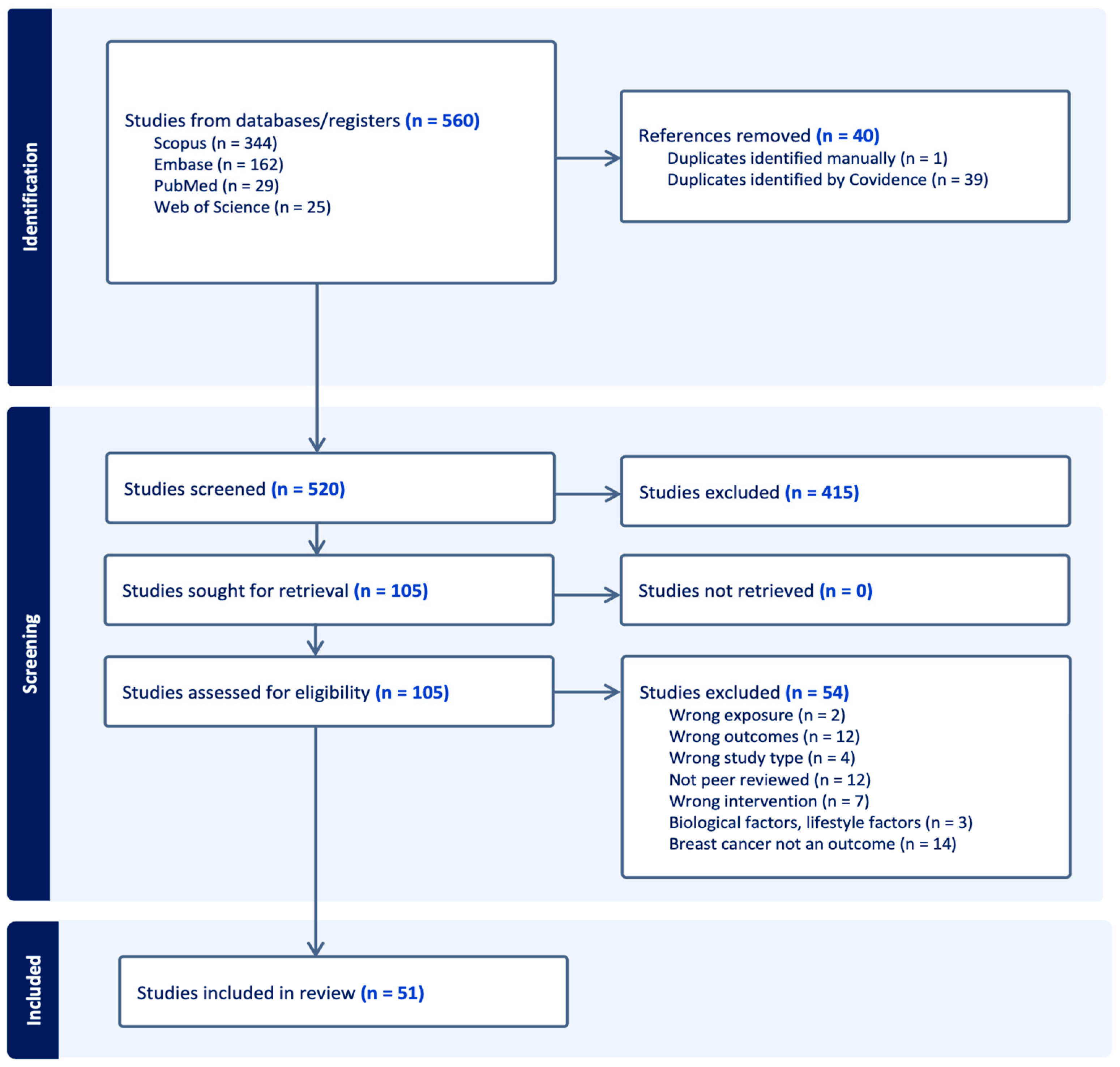
3.1. Selected Study Characteristics
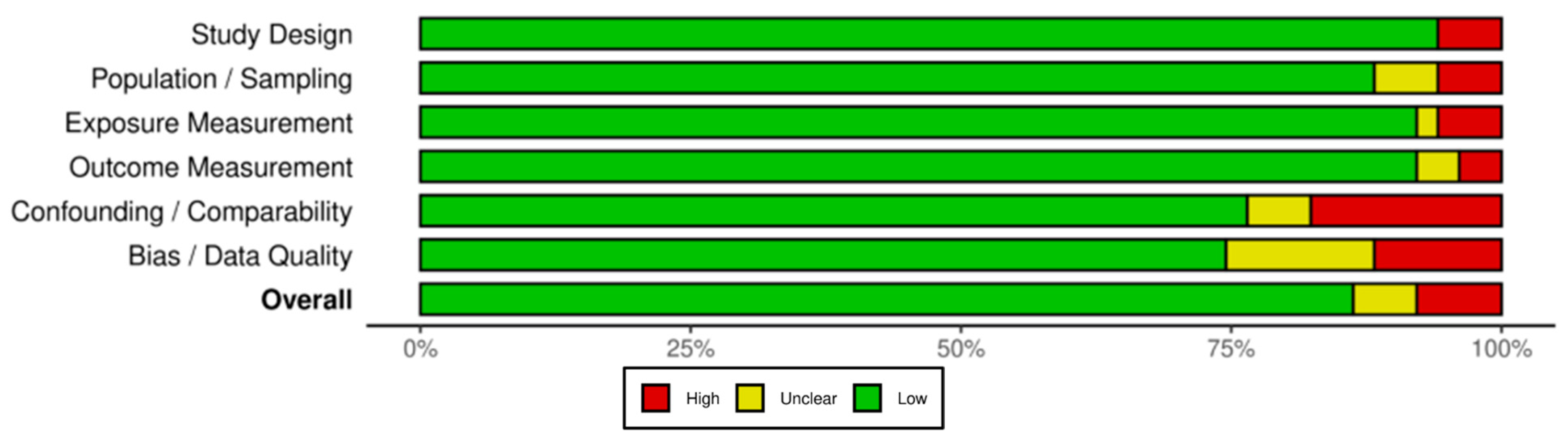
3.2. Quality and Bias in Results
3.3. Key Findings and Patterns
3.3.1. Design Methodologies
3.3.2. Evidence Quality and Nature of Evidence
3.3.3. Ambient Exposure Types Most Frequently Associate with Breast Cancer
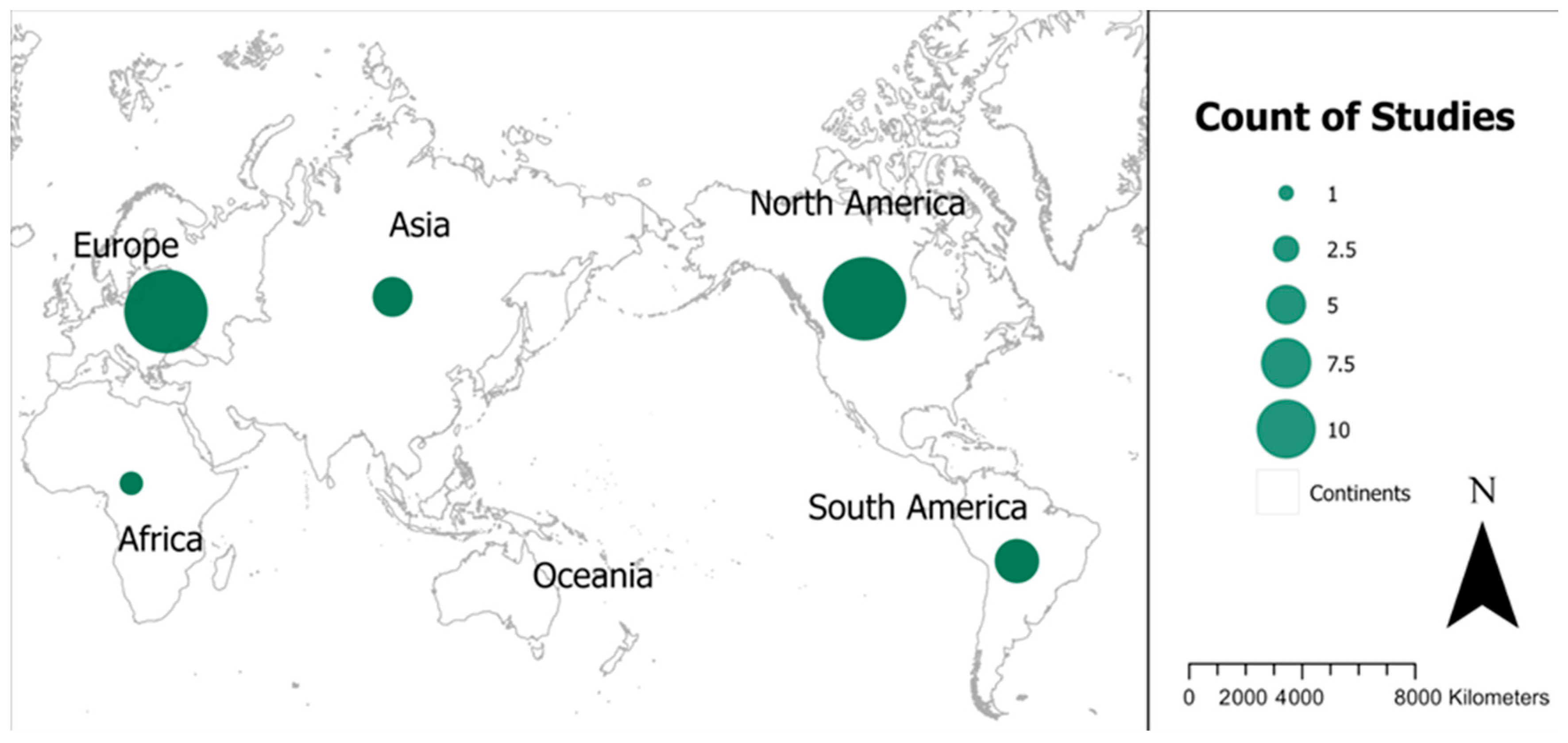
3.3.4. Geographical Trends—Urbanicity, Region, Country, Hot Spot
3.3.5. Stated Gaps
4. Discussion
4.1. Context and Interpretation
4.2. Methodological Factors (Limitations and Analytical Challenges)
4.3. Geographic Disparities and Environmental Justice
4.4. Future Directions
5. Policy and Implications
5.1. Research Funding and Infrastructure
5.2. Advancing Health Equity and Public Health Prevention
6. Conclusions
Author Contributions
Funding
Institutional Review Board Statement
Informed Consent Statement
Data Availability Statement
Acknowledgments
Conflicts of Interest
Abbreviations
| Abbreviation | Full Term |
| AOD | Aerosol Optical Depth |
| BPA | Bisphenol A |
| BRCA1 | Breast Cancer Gene 1 |
| BRCA2 | Breast Cancer Gene 2 |
| CDC | Centers for Disease Control and Prevention |
| DALYs | Disability-Adjusted Life-Years |
| DCIS | Ductal carcinoma in situ |
| DDT | Dichlorodiphenyltrichloroethane |
| DEHP | Di(2-ethylhexyl) phthalate |
| DNA | Deoxyribonucleic Acid |
| DOI | Digital object identifier |
| EC | Elemental Carbon |
| EDC | Endocrine-Disrupting Chemical |
| EPA | Environmental Protection Agency |
| EQI | Environmental Quality Index |
| GIS | geographic information systems |
| HER1/2 | Human Epidermal Growth Factor Receptor 1/2 |
| IARC | International Agency for Research on Cancer |
| JBI | Joanna Briggs Institute |
| LAN | Outdoor light at night |
| LUR | Land-use regression |
| MDPI | Multidisciplinary Digital Publishing Institute |
| NATA | National Air Toxics Assessment |
| NO2 | Nitrogen Dioxide |
| NOx | Nitrogen oxides |
| PAH | Polycyclic Aromatic Hydrocarbon |
| PCBs | Polychlorinated biphenyls |
| PFCs | perfluorinated chemicals |
| PICOS | Population, Intervention, Comparator, Outcomes, Study Design |
| PM | Particulate Matter |
| PM10 | Fine Particulate Matter 10 μm |
| PM2.5 | Fine Particulate Matter 2.5 μm |
| PRISMA | Preferred Reporting Items for Systematic Reviews and Meta-Analyses |
| PRTR | Pollutant Release and Transfer Register |
| PVC | Polyvinyl Chloride |
| TX | Texas (state abbreviation) |
| URL | Uniform Resource Locator |
| USA | United States of America |
| UV | Ultraviolet |
| YAP | Yes-Associated Protein |
Appendix A

| Domain | Question | Low Risk | High Risk | Unclear |
|---|---|---|---|---|
| Study Design | What was the study design? (Cohort/Case–control/Cross-sectional/Ecological/Other) | Study design appropriate and clearly reported. | Study design inappropriate for the question or unclear. | Insufficient information. |
| Population/Sampling | Was the population clearly defined and was sample size adequate? | Population described + sample size adequate/justified. | Poorly defined population or inadequate sample. | Not enough detail to judge. |
| Exposure Measurement | Was exposure measured validly and reliably, and was geographic/industrial context described? | Validated exposure (registry, monitoring, modelled); geography clear. | Self-report only or unclear exposure source. | Insufficient detail. |
| Outcome Measurement | Was breast cancer outcome clearly defined and measured appropriately (registry/pathology vs. self-report)? Were subtypes reported? | Registry/pathology data, subtypes and stratifications included. | Self-report or vague/unclear outcomes. | No detail. |
| Confounding/Comparability | Were key confounders identified and controlled (age, SES, BMI, family history, lifestyle, reproductive factors)? | Most key confounders controlled. | Minimal/no adjustment. | Not reported. |
| Bias/Data Quality | Were missing data addressed and key biases acknowledged (exposure misclassification, residual confounding)? | Missing data handled + biases discussed. | No handling or acknowledgement. | Not described. |
| Overall Appraisal | Considering all domains, what is the overall study quality? | Strong across domains. | Serious limitations across multiple domains. | Evidence insufficient. |
References
- Arzanova, E.; Meyrovitz, H.N. The Epidemiology of Breast Cancer. In Breast Cancer; Exon Publications: Brisbane, Australia, 2022; pp. 1–19. [Google Scholar] [CrossRef]
- Obeagu, E.I.; Obeagu, G.U. Breast Cancer: A Review of Risk Factors and Diagnosis. Medicine 2024, 103, e36905. [Google Scholar] [CrossRef]
- Breast Cancer. Available online: https://www.who.int/news-room/fact-sheets/detail/breast-cancer (accessed on 23 December 2025).[Green Version]
- Wilkinson, L.; Gathani, T. Understanding Breast Cancer as a Global Health Concern. Br. J. Radiol. 2022, 95, 20211033. [Google Scholar] [CrossRef]
- Colditz, G.A.; Bohlke, K. Priorities for the Primary Prevention of Breast Cancer. CA Cancer J. Clin. 2014, 64, 186–194. [Google Scholar] [CrossRef]
- Kuchenbaecker, K.B.; Hopper, J.L.; Barnes, D.R.; Phillips, K.-A.; Mooij, T.M.; Roos-Blom, M.-J.; Jervis, S.; Van Leeuwen, F.E.; Milne, R.L.; Andrieu, N.; et al. Risks of Breast, Ovarian, and Contralateral Breast Cancer for BRCA1 and BRCA2 Mutation Carriers. JAMA 2017, 317, 2402–2416. [Google Scholar] [CrossRef]
- Chang, C.-J.; Ish, J.L.; Chang, V.C.; Daniel, M.; Jones, R.R.; White, A.J. Exposure to Per- and Polyfluoroalkyl Substances and Breast Cancer Risk: A Systematic Review and Meta-Analysis of Epidemiologic Studies. Am. J. Epidemiol. 2024, 193, 1182–1196. [Google Scholar] [CrossRef]
- Fenton, S.E.; Birnbaum, L.S. Timing of Environmental Exposures as a Critical Element in Breast Cancer Risk. J. Clin. Endrocrinol. Metab. 2015, 100, 3245–3250. [Google Scholar] [CrossRef][Green Version]
- Zeinomar, N.; Oskar, S.; Kehm, R.D.; Sahebzeda, S.; Terry, M.B. Environmental Exposures and Breast Cancer Risk in the Context of Underlying Susceptibility: A Systematic Review of the Epidemiological Literature. Environ. Res. 2020, 187, 109346. [Google Scholar] [CrossRef]
- Saxena, V. Water Quality, Air Pollution, and Climate Change: Investigating the Environmental Impacts of Industrialization and Urbanization. Water Air Soil Pollut. 2025, 236, 73. [Google Scholar] [CrossRef]
- Rudel, R.A.; Fenton, S.E.; Ackerman, J.M.; Euling, S.Y.; Makris, S.L. Environmental Exposures and Mammary Gland Development: State of the Science, Public Health Implications, and Research Recommendations. Environ. Health Perspect. 2011, 119, 1053–1061. [Google Scholar] [CrossRef]
- Brody, J.G.; Rudel, R.A. Environmental Pollutants and Breast Cancer. Environ. Health Perspect. 2003, 111, 1007–1019. [Google Scholar] [CrossRef]
- CDC. Agency for Toxic Substances and Disease Registry. Available online: https://www.atsdr.cdc.gov/index.html (accessed on 5 November 2025).
- Calaf, G.M.; Ponce-Cusi, R.; Aguayo, F.; Muñoz, J.P.; Bleak, T.C. Endocrine Disruptors from the Environment Affecting Breast Cancer (Review). Oncol. Lett. 2020, 20, 19–32. [Google Scholar] [CrossRef]
- Birnbaum, L.S.; Fenton, S.E. Cancer and Developmental Exposure to Endocrine Disruptors. Environ. Health Perspect. 2003, 111, 389–394. [Google Scholar] [CrossRef]
- Soto, A.M.; Sonnenschein, C. Environmental Causes of Cancer: Endocrine Disruptors as Carcinogens. Nat. Rev. Endocrinol. 2010, 6, 363–370. [Google Scholar] [CrossRef]
- Goldberg, M.; D’Aloisio, A.A.; O’Brien, K.M.; Zhao, S.; Sandler, D.P. Pubertal Timing and Breast Cancer Risk in the Sister Study Cohort. Breast Cancer Res. 2020, 22, 112. [Google Scholar] [CrossRef]
- Terry, M.B.; Michels, K.B.; Brody, J.G.; Byrne, C.; Chen, S.; Jerry, D.J.; Malecki, K.M.C.; Martin, M.B.; Miller, R.L.; Neuhausen, S.L.; et al. Environmental Exposures during Windows of Susceptibility for Breast Cancer: A Framework for Prevention Research. Breast Cancer Res. 2019, 21, 96. [Google Scholar] [CrossRef]
- García-Pérez, J.; Lope, V.; Pérez-Gómez, B.; Molina, A.J.; Tardón, A.; Díaz Santos, M.A.; Ardanaz, E.; O’Callaghan-Gordo, C.; Altzibar, J.M.; Gómez-Acebo, I.; et al. Risk of Breast Cancer and Residential Proximity to Industrial Installations: New Findings from a Multicase-Control Study (MCC-Spain). Environ. Pollut. 2018, 237, 559–568. [Google Scholar] [CrossRef] [PubMed]
- Gasca-Sanchez, F.M.; Santuario-Facio, S.K.; Ortiz-López, R.; Rojas-Martinez, A.; Mejía-Velázquez, G.M.; Garza-Perez, E.M.; Hernández-Hernández, J.A.; del Carmen López-Sánchez, R.; Cardona-Huerta, S.; Santos-Guzman, J. Spatial Interaction between Breast Cancer and Environmental Pollution in the Monterrey Metropolitan Area. Heliyon 2021, 7, e07915. [Google Scholar] [CrossRef]
- Pan, S.Y.; Morrison, H.; Gibbons, L.; Zhou, J.; Wen, S.W.; DesMeules, M.; Mao, Y. Canadian Cancer Registries Epidemiology Research Group Breast Cancer Risk Associated with Residential Proximity to Industrial Plants in Canada. J. Occup. Environ. Med. 2011, 53, 522–529. [Google Scholar] [CrossRef]
- Praud, D.; Deygas, F.; Amadou, A.; Bouilly, M.; Turati, F.; Bravi, F.; Xu, T.; Grassot, L.; Coudon, T.; Fervers, B. Traffic-Related Air Pollution and Breast Cancer Risk: A Systematic Review and Meta-Analysis of Observational Studies. Cancers 2023, 15, 927. [Google Scholar] [CrossRef]
- Homaei Shandiz, F.; Hadizadeh Talasaz, Z. The Relationship between Breast Cancer and Air Pollution: Review Article. Rev. Clin. Med. 2017, 4, 136–139. [Google Scholar] [CrossRef]
- White, A.J.; Weinberg, C.R.; O’Meara, E.S.; Sandler, D.P.; Sprague, B.L. Airborne Metals and Polycyclic Aromatic Hydrocarbons in Relation to Mammographic Breast Density. Breast Cancer Res. 2019, 21, 24. [Google Scholar] [CrossRef]
- Thong, M.S.Y.; Mols, F.; Stein, K.D.; Smith, T.; Coebergh, J.-W.W.; van de Poll-Franse, L.V. Population-Based Cancer Registries for Quality-of-Life Research. Cancer 2013, 119, 2109–2123. [Google Scholar] [CrossRef]
- List, J.M.; O’Connor, J.M. How Should Low- and Middle-Income Countries Motivate Equity in Cancer Prevention and Control? Ethics 2020, 22, 147–155. [Google Scholar] [CrossRef]
- Tolentino-Rodriguez, L.; Chkeir, M.; Pofagi, V.; Ahindu, I.; Toniolo, J.; Erazo, A.; Preux, P.-M.; Blanquet, V.; Vergonjeanne, M.; Parenté, A. Breast Cancer Characteristics in Low- and Middle-Income Countries: An Umbrella Review. Cancer Epidemiol. 2025, 96, 102797. [Google Scholar] [CrossRef]
- Amadou, A.; Praud, D.; Coudon, T.; Danjou, A.M.N.; Faure, E.; Leffondré, K.; Le Romancer, M.; Severi, G.; Salizzoni, P.; Mancini, F.R.; et al. Chronic Long-Term Exposure to Cadmium Air Pollution and Breast Cancer Risk in the French E3N Cohort. Int. J. Cancer 2020, 146, 341–351, Erratum in Int. J. Cancer 2020, 146, E1–E4. https://doi.org/10.1002/ijc.32873. [Google Scholar] [CrossRef]
- Amadou, A.; Praud, D.; Coudon, T.; Danjou, A.; Faure, E.; Deygas, F.; Grassot, L.; Leffondré, K.; Severi, G.; Salizzoni, P.; et al. Exposure to Airborne Cadmium and Breast Cancer Stage, Grade and Histology at Diagnosis: Findings from the E3N Cohort Study. Sci. Rep. 2021, 11, 23088. [Google Scholar] [CrossRef]
- Amadou, A.; Praud, D.; Coudon, T.; Deygas, F.; Grassot, L.; Faure, E.; Couvidat, F.; Caudeville, J.; Bessagnet, B.; Salizzoni, P.; et al. Risk of Breast Cancer Associated with Long-Term Exposure to Benzo[a]Pyrene (BaP) Air Pollution: Evidence from the French E3N Cohort Study. Environ. Int. 2021, 149, 106399. [Google Scholar] [CrossRef]
- Amadou, A.; Praud, D.; Coudon, T.; Deygas, F.; Grassot, L.; Dubuis, M.; Faure, E.; Couvidat, F.; Caudeville, J.; Bessagnet, B.; et al. Long-Term Exposure to Nitrogen Dioxide Air Pollution and Breast Cancer Risk: A Nested Case-Control within the French E3N Cohort Study. Environ. Pollut. 2023, 317, 120719. [Google Scholar] [CrossRef]
- Arif, I.; Adams, M.D.; Johnson, M.T.J. A Meta-Analysis of the Carcinogenic Effects of Particulate Matter and Polycyclic Aromatic Hydrocarbons. Environ. Pollut. 2024, 351, 123941. [Google Scholar] [CrossRef]
- Arrebola, J.P.; Belhassen, H.; Artacho-Cordón, F.; Ghali, R.; Ghorbel, H.; Boussen, H.; Perez-Carrascosa, F.M.; Expósito, J.; Hedhili, A.; Olea, N. Risk of Female Breast Cancer and Serum Concentrations of Organochlorine Pesticides and Polychlorinated Biphenyls: A Case-Control Study in Tunisia. Sci. Total Environ. 2015, 520, 106–113. [Google Scholar] [CrossRef]
- Carreras, G.; Lachi, A.; Boffi, R.; Clancy, L.; Gallus, S.; Fernández, E.; López, M.J.; Soriano, J.B.; López Nicolás, Á.; Semple, S.; et al. Burden of Disease from Breast Cancer Attributable to Smoking and Second-Hand Smoke Exposure in Europe. Int. J. Cancer 2020, 147, 2387–2393. [Google Scholar] [CrossRef]
- Carroll, R.; Ish, J.; Sandler, D.; White, A.; Zhao, S. Understanding the Role of Environmental and Socioeconomic Factors in the Geographic Variation of Breast Cancer Risk in the US-Wide Sister Study. Environ. Res. 2023, 239, 117349. [Google Scholar] [CrossRef]
- Cazzolla Gatti, R.; Di Paola, A.; Monaco, A.; Velichevskaya, A.; Amoroso, N.; Bellotti, R. The Spatial Association between Environmental Pollution and Long-Term Cancer Mortality in Italy. Sci. Total Environ. 2023, 855, 158439. [Google Scholar] [CrossRef]
- Cazzolla Gatti, R. Why We Will Continue to Lose Our Battle with Cancers If We Do Not Stop Their Triggers from Environmental Pollution. Int. J. Environ. Res. Public Health 2021, 18, 6107. [Google Scholar] [CrossRef]
- Chen, X. A Temporal Analysis of the Association between Breast Cancer and Socioeconomic and Environmental Factors. GeoJournal 2018, 83, 1239–1256. [Google Scholar] [CrossRef]
- Cohen, G.; Levy, I.; Yuval; Kark, J.D.; Levin, N.; Witberg, G.; Iakobishvili, Z.; Bental, T.; Broday, D.M.; Steinberg, D.M.; et al. Chronic Exposure to Traffic-Related Air Pollution and Cancer Incidence among 10,000 Patients Undergoing Percutaneous Coronary Interventions: A Historical Prospective Study. Eur. J. Prev. Cardiol. 2018, 25, 659–670. [Google Scholar] [CrossRef]
- Coudon, T.; Praud, D.; Faure, E.; Danjou, A.; Mancini, F.; Severi, G.; Fervers, B. GEO3N: Environmental Exposure to Dioxins and Breast Cancer Risk in the E3N Cohort. Environ. Risues Sante 2020, 19, 15–21. [Google Scholar]
- Da Silva, M.; Moreno, M.; De Sá, C.; Rizzi, C.; Ribeiro, E.; Ripke, M.; Corralo, V. Mortality from Breast Cancer and Use of Pesticides in the Western Mesoregion of Santa Catarina—Brazil. Rev. Bras. Cienc. Ambient. 2024, 59, e1784. [Google Scholar] [CrossRef]
- Danjou, A.; Coudon, T.; Praud, D.; Lévêque, E.; Faure, E.; Salizzoni, P.; Le Romancer, M.; Severi, G.; Mancini, F.; Leffondré, K.; et al. Long-Term Airborne Dioxin Exposure and Breast Cancer Risk in a Case-Control Study Nested within the French E3N Prospective Cohort. Environ. Int. 2019, 124, 236–248. [Google Scholar] [CrossRef]
- Deygas, F.; Amadou, A.; Coudon, T.; Grassot, L.; Couvidat, F.; Bessagnet, B.; Faure, E.; Salizzoni, P.; Gulliver, J.; Caudeville, J.; et al. Long-Term Atmospheric Exposure to PCB153 and Breast Cancer Risk in a Case-Control Study Nested in the French E3N Cohort from 1990 to 2011. Environ. Res. 2021, 195, 114293. [Google Scholar] [CrossRef]
- Duboeuf, M.; Amadou, A.; Coudon, T.; Grassot, L.; Ramel-Delobel, M.; Faure, E.; Salizzoni, P.; Gulliver, J.; Severi, G.; Mancini, F.R.; et al. Long-Term Exposure to Air Pollution at Residential and Workplace Addresses and Breast Cancer Risk: A Case-Control Study Nested in the French E3N-Générations Cohort from 1990 to 2011. Eur. J. Cancer 2024, 210, 114293. [Google Scholar] [CrossRef] [PubMed]
- DuPre, N.C.; Hart, J.E.; Holmes, M.D.; Poole, E.M.; James, P.; Kraft, P.; Laden, F.; Tamimi, R.M. Particulate Matter and Traffic-Related Exposures in Relation to Breast Cancer Survival. Cancer. Epidemiol. Biomark. Prev. 2019, 28, 751–759. [Google Scholar] [CrossRef]
- Garcia, E.; Hurley, S.; Nelson, D.; Hertz, A.; Reynolds, P. Hazardous Air Pollutants and Breast Cancer Risk in California Teachers: A Cohort Study. Environ. Health 2015, 14, 14. [Google Scholar] [CrossRef] [PubMed]
- García-Pérez, J.; Pérez-Abad, N.; Lope, V.; Castelló, A.; Pollán, M.; González-Sánchez, M.; Valencia, J.L.; López-Abente, G.; Fernández-Navarro, P. Breast and Prostate Cancer Mortality and Industrial Pollution. Environ. Pollut. 2016, 214, 394–399. [Google Scholar] [CrossRef] [PubMed]
- Gearhart-Serna, L.M.; Hoffman, K.; Devi, G.R. Environmental Quality and Invasive Breast Cancer. Cancer Epidemiol. Biomark. Prev. 2020, 29, 1920–1928. [Google Scholar] [CrossRef]
- He, Y.; Wang, X.; Wu, K. Evaluating Breast Cancer Risk under Exposure to Environmental Estrogen-like Chemicals. Pol. J. Environ. Stud. 2016, 25, 2239–2250. [Google Scholar] [CrossRef]
- Hvidtfeldt, U.A.; Chen, J.; Rodopoulou, S.; Strak, M.; de Hoogh, K.; Andersen, Z.J.; Bellander, T.; Brandt, J.; Fecht, D.; Forastiere, F.; et al. Breast Cancer Incidence in Relation to Long-Term Low-Level Exposure to Air Pollution in the ELAPSE Pooled Cohort. Cancer Epidemiol. Biomark. Prev. 2023, 32, 105–113. [Google Scholar] [CrossRef]
- Ilozumba, M.N.; Shelver, W.L.; Hong, C.-C.; Ambrosone, C.B.; Cheng, T.-Y.D. Urinary Concentrations of Triclosan, Bisphenol A, and Brominated Flame Retardants and the Association of Triclosan with Demographic Characteristics and Body Fatness among Women with Newly Diagnosed Breast Cancer. Int. J. Environ. Res. Public Health 2022, 19, 4681. [Google Scholar] [CrossRef] [PubMed]
- Kayyal-Tarabeia, I.; Zick, A.; Kloog, I.; Levy, I.; Blank, M.; Agay-Shay, K. Beyond Lung Cancer: Air Pollution and Bladder, Breast and Prostate Cancer Incidence. Int. J. Epidemiol. 2024, 53, dyae093. [Google Scholar] [CrossRef]
- Large, C.; Wei, Y. Geographic Variations in Female Breast Cancer Incidence in Relation to Ambient Air Emissions of Polycyclic Aromatic Hydrocarbons. Environ. Sci. Pollut. Res. 2017, 24, 17874–17880. [Google Scholar] [CrossRef]
- Le Provost, B.; Parent, M.-É.; Villeneuve, P.J.; Waddingham, C.M.; Brook, J.R.; Lavigne, E.; Dugandzic, R.; Harris, S.A. Residential Exposure to Ambient Fine Particulate Matter (PM2.5) and Nitrogen Dioxide (NO2) and Incident Breast Cancer among Young Women in Ontario, Canada. Cancer Epidemiol. 2024, 92, 102606. [Google Scholar] [CrossRef]
- Liu, G.; Cai, W.; Liu, H.; Jiang, H.; Bi, Y.; Wang, H. The Association of Bisphenol a and Phthalates with Risk of Breast Cancer: A Meta-Analysis. Int. J. Environ. Res. Public Health 2021, 18, 2375. [Google Scholar] [CrossRef] [PubMed]
- Mekonen, S.; Ibrahim, M.; Astatkie, H.; Abreha, A. Exposure to Organochlorine Pesticides as a Predictor to Breast Cancer: A Case-Control Study among Ethiopian Women. PLoS ONE 2021, 16, e0260106. [Google Scholar] [CrossRef]
- Michel-Ramirez, G.; Recio-Vega, R.; Lantz, R.C.; Gandolfi, A.J.; Olivas-Calderon, E.; Chau, B.T.; Amistadi, M.K. Assessment of YAP Gene Polymorphisms and Arsenic Interaction in Mexican Women with Breast Cancer. J. Appl. Toxicol. 2020, 40, 342–351. [Google Scholar] [CrossRef]
- Mukherjee Das, A.; Gogia, A.; Garg, M.; Elaiyaraja, A.; Arambam, P.; Mathur, S.; Babu-Rajendran, R.; Deo, S.V.S.; Kumar, L.; Das, B.C.; et al. Urinary Concentration of Endocrine-Disrupting Phthalates and Breast Cancer Risk in Indian Women: A Case-Control Study with a Focus on Mutations in Phthalate-Responsive Genes. Cancer Epidemiol. 2022, 79, 102188. [Google Scholar] [CrossRef]
- Omoike, O.E.; Pack, R.P.; Mamudu, H.M.; Liu, Y.; Wang, L. A Cross-Sectional Study of the Association between Perfluorinated Chemical Exposure and Cancers Related to Deregulation of Estrogen Receptors. Environ. Res. 2021, 196, 110329. [Google Scholar] [CrossRef] [PubMed]
- Panis, C.; Candiotto, L.Z.P.; Gaboardi, S.C.; Gurzenda, S.; Cruz, J.; Castro, M.; Lemos, B. Widespread Pesticide Contamination of Drinking Water and Impact on Cancer Risk in Brazil. Environ. Int. 2022, 165, 107321. [Google Scholar] [CrossRef] [PubMed]
- Peng, S.; Dong, S.; Gong, C.; Chen, X.; Du, H.; Zhan, Y.; Yang, Z. Evidence-Based Identification of Breast Cancer and Associated Ovarian and Uterus Cancer Risk Components in Source Waters from High Incidence Area in the Pearl River Basin, China. Sci. Total Environ. 2023, 903, 166060. [Google Scholar] [CrossRef]
- Poulsen, A.H.; Hvidtfeldt, U.A.; Sørensen, M.; Pedersen, J.E.; Ketzel, M.; Brandt, J.; Geels, C.; Christensen, J.H.; Raaschou-Nielsen, O. Air Pollution with NO2, PM2.5, and Elemental Carbon in Relation to Risk of Breast Cancer– a Nationwide Case-Control Study from Denmark. Environ. Res. 2023, 216, 114740. [Google Scholar] [CrossRef]
- Prada, D.; Baccarelli, A.A.; Terry, M.B.; Valdéz, L.; Cabrera, P.; Just, A.; Kloog, I.; Caro, H.; García-Cuellar, C.; Sánchez-Pérez, Y.; et al. Long-Term PM2.5 Exposure before Diagnosis Is Associated with Worse Outcome in Breast Cancer. Breast Cancer Res. Treat. 2021, 188, 525–533. [Google Scholar] [CrossRef]
- Praud, D.; Amadou, A.; Coudon, T.; Duboeuf, M.; Mercoeur, B.; Faure, E.; Grassot, L.; Danjou, A.M.; Salizzoni, P.; Couvidat, F.; et al. Association between Chronic Long-Term Exposure to Airborne Dioxins and Breast Cancer. Int. J. Hyg. Environ. Health 2025, 263, 114489. [Google Scholar] [CrossRef] [PubMed]
- Shekarrizfard, M.; Valois, M.-F.; Goldberg, M.S.; Crouse, D.; Ross, N.; Parent, M.-E.; Yasmin, S.; Hatzopoulou, M. Investigating the Role of Transportation Models in Epidemiologic Studies of Traffic Related Air Pollution and Health Effects. Environ. Res. 2015, 140, 282–291. [Google Scholar] [CrossRef]
- Shekarrizfard, M.; Valois, M.; Weichenthal, S.; Goldberg, M.; Fallah-Shorshani, M.; Cavellin, L.; Crouse, D.; Parent, M.; Hatzopoulou, M. Investigating the Effects of Multiple Exposure Measures to Traffic-Related Air Pollution on the Risk of Breast and Prostate Cancer. J. Transp. Health 2018, 11, 34–46. [Google Scholar] [CrossRef]
- Silva, A.M.C.; Campos, P.H.N.; Mattos, I.E.; Hajat, S.; Lacerda, E.M.; Ferreira, M.J.M. Environmental Exposure to Pesticides and Breast Cancer in a Region of Intensive Agribusiness Activity in Brazil: A Case-Control Study. Int. J. Environ. Res. Public Health 2019, 16, 3951. [Google Scholar] [CrossRef]
- Stults, W.P.; Wei, Y. Ambient Air Emissions of Polycyclic Aromatic Hydrocarbons and Female Breast Cancer Incidence in US. Med. Oncol. 2018, 35, 88. [Google Scholar] [CrossRef]
- Tang, L.; Wang, Y.; Yan, W.; Zhang, Z.; Luo, S.; Wen, Q.; Wang, S.; Zhou, N.; Chen, Q.; Xu, Y. Exposure to Di-2-Ethylhexyl Phthalate and Breast Neoplasm Incidence: A Cohort Study. Sci. Total Environ. 2024, 926, 171819. [Google Scholar] [CrossRef] [PubMed]
- Vieira, V.M.; Vopham, T.; Bertrand, K.A.; James, P.; Dupré, N.; Tamimi, R.M.; Laden, F.; Hart, J.E. Contribution of Socioeconomic and Environmental Factors to Geographic Disparities in Breast Cancer Risk in the Nurses’ Health Study II. Environ. Epidemiol. 2019, 4, e080. [Google Scholar] [CrossRef]
- Waddingham, C.M.; Hinton, P.; Villeneuve, P.J.; Brook, J.R.; Lavigne, E.; Larsen, K.; King, W.D.; Wen, D.; Meng, J.; Zhang, J.; et al. Exposure to Ambient Polycyclic Aromatic Hydrocarbons and Early-Onset Female Breast Cancer in a Case-Control Study in Ontario, Canada. Environ. Epidemiol. 2024, 8, e333. [Google Scholar] [CrossRef]
- Yaghjyan, L.; Arao, R.; Brokamp, C.; O’Meara, E.S.; Sprague, B.L.; Ghita, G.; Ryan, P. Association between Air Pollution and Mammographic Breast Density in the Breast Cancer Surveilance Consortium. Breast Cancer Res. 2017, 19, 36. [Google Scholar] [CrossRef] [PubMed]
- Yu, P.; Xu, R.; Li, S.; Coelho, M.S.Z.S.; Saldiva, P.H.N.; Sim, M.R.; Abramson, M.J.; Guo, Y. Associations between Long-Term Exposure to PM2.5 and Site-Specific Cancer Mortality: A Nationwide Study in Brazil between 2010 and 2018. Environ. Pollut. 2022, 302, 119070. [Google Scholar] [CrossRef]
- Zhai, Y.; Amadou, A.; Mercier, C.; Praud, D.; Faure, E.; Iwaz, J.; Severi, G.; Mancini, F.; Coudon, T.; Fervers, B.; et al. The Impact of Left Truncation of Exposure in Environmental Case-Control Studies: Evidence from Breast Cancer Risk Associated with Airborne Dioxin. Eur. J. Epidemiol. 2022, 37, 79–93. [Google Scholar] [CrossRef]
- White, A.J.; O’Brien, K.M.; Niehoff, N.M.; Carroll, R.; Sandler, D.P. Metallic Air Pollutants and Breast Cancer Risk in a Nationwide Cohort Study. Epidemiology 2019, 30, 20–28. [Google Scholar] [CrossRef]
- Northeim, K.; Tiwari, C.; Oppong, J. Surface Ozone Monitoring and Policy: A Geospatial Decision Support Tool for Suitable Location of Monitoring Stations in Urban Areas. Environ. Sci. Policy 2021, 126, 48–59. [Google Scholar] [CrossRef]
- Northeim, K.; Oppong, J.R.; Northeim, K.; Oppong, J.R. Mapping Health Fragility and Vulnerability in Air Pollution–Monitoring Networks in Dallas–Fort Worth. Int. J. Environ. Res. Public Health 2023, 20, 1807. [Google Scholar] [CrossRef]
- Tarhonska, K.; Lesicka, M.; Janasik, B.; Roszak, J.; Reszka, E.; Braun, M.; Kołacińska-Wow, A.; Jabłońska, E. Cadmium and Breast Cancer—Current State and Research Gaps in the Underlying Mechanisms. Toxicol. Lett. 2022, 361, 29–42. [Google Scholar] [CrossRef] [PubMed]
- Reich, B.J.; Yang, S.; Guan, Y.; Giffin, A.B.; Miller, M.J.; Rappold, A. A Review of Spatial Causal Inference Methods for Environmental and Epidemiological Applications. Int. Stat. Rev. 2021, 89, 605–634. [Google Scholar] [CrossRef] [PubMed]
- Shaw, P.A.; Deffner, V.; Keogh, R.H.; Tooze, J.A.; Dodd, K.W.; Küchenhoff, H.; Kipnis, V.; Freedman, L.S. Epidemiologic Analyses with Error-Prone Exposures: Review of Current Practice and Recommendations. Ann. Epidemiol. 2018, 28, 821–828. [Google Scholar] [CrossRef] [PubMed]
- Mansournia, M.A.; Poole, C. Case-Control Matching on Confounders Revisited. Eur. J. Epidemiol. 2023, 38, 1025–1034. [Google Scholar] [CrossRef]
- Zhang, L.; Mukherjee, B.; Ghosh, M.; Gruber, S.; Moreno, V. Accounting for Error Due to Misclassification of Exposures in Case-Control Studies of Gene-Environment Interaction. Stat. Med. 2008, 27, 2756–2783. [Google Scholar] [CrossRef]
- Chen, C.; Chen, H.; Kaufman, J.S.; Benmarhnia, T. Differential Participation, a Potential Cause of Spurious Associations in Observational Cohorts in Environmental Epidemiology. Epidemiology 2024, 35, 174–184. [Google Scholar] [CrossRef]
- Rocha, P.R.S.; Oliveira, V.D.; Vasques, C.I.; Dos Reis, P.E.D.; Amato, A.A. Exposure to Endocrine Disruptors and Risk of Breast Cancer: A Systematic Review. Crit. Rev. Oncol. Hematol. 2021, 161, 103330. [Google Scholar] [CrossRef]
- Dominici, F.; Zanobetti, A.; Schwartz, J.; Braun, D.; Sabath, B.; Wu, X. Assessing Adverse Health Effects of Long-Term Exposure to Low Levels of Ambient Air Pollution: Implementation of Causal Inference Methods. Res. Rep. Health Eff. Inst. 2022, 2022, 1–56. [Google Scholar]
- Hoek, G.; Vienneau, D.; de Hoogh, K. Does Residential Address-Based Exposure Assessment for Outdoor Air Pollution Lead to Bias in Epidemiological Studies? Environ. Health 2024, 23, 75. [Google Scholar] [CrossRef]
- Webster, T.F. Bias Magnification in Ecologic Studies: A Methodological Investigation. Environ. Health 2007, 6, 17. [Google Scholar] [CrossRef]
- Shih, Y.-C.T.; Bradley, C.; Yabroff, K.R. Ecological and Individualistic Fallacies in Health Disparities Research. J. Natl. Cancer Inst. 2023, 115, 488–491. [Google Scholar] [CrossRef]
- Wacholder, S.; McLaughlin, J.K.; Silverman, D.T.; Mandel, J.S. Selection of Controls in Case-Control Studies. I. Principles. Am. J. Epidemiol. 1992, 135, 1019–1028. [Google Scholar] [CrossRef] [PubMed]
- Czaczkowska, L.; Jabłońska, E.; Ratajczak-Wrona, W. Endocrine Disruptors and Breast Cancer: A Comprehensive Review. Biomedicines 2025, 13, 2774. [Google Scholar] [CrossRef]
- Day, D.B.; Sathyanarayana, S.; LeWinn, K.Z.; Karr, C.J.; Mason, W.A.; Szpiro, A.A. A Permutation Test-Based Approach to Strengthening Inference on the Effects of Environmental Mixtures: Comparison between Single-Index Analytic Methods. Environ. Health Perspect. 2022, 130, 87010. [Google Scholar] [CrossRef] [PubMed]
- Ma, X.; Zou, B.; Deng, J.; Gao, J.; Longley, I.; Xiao, S.; Guo, B.; Wu, Y.; Xu, T.; Xu, X.; et al. A Comprehensive Review of the Development of Land Use Regression Approaches for Modeling Spatiotemporal Variations of Ambient Air Pollution: A Perspective from 2011 to 2023. Environ. Int. 2024, 183, 108430. [Google Scholar] [CrossRef]
- Rudel, R.A.; Ackerman, J.M.; Attfield, K.R.; Brody, J.G. New Exposure Biomarkers as Tools for Breast Cancer Epidemiology, Biomonitoring, and Prevention: A Systematic Approach Based on Animal Evidence. Environ. Health Perspect. 2014, 122, 881–895. [Google Scholar] [CrossRef]
- Salama, Y.; Chennaoui, M.; Salama, Y.; Chennaoui, M. A Critical Review of Biomarkers in Toxicology and Risk Assessment of Environmental Pollutants. Ann. Environ. Sci. Toxicol. 2024, 8, 006–018. [Google Scholar] [CrossRef]
- Aroma R, J.; Raimond, K. An Overview of Technological Revolution in Satellite Image Analysis. J. Eng. Sci. Technol. Rev. 2016, 9, 1. [Google Scholar] [CrossRef]
- Diao, M.; Holloway, T.; Choi, S.; O’Neill, S.M.; Al-Hamdan, M.Z.; van Donkelaar, A.; Martin, R.V.; Jin, X.; Fiore, A.M.; Henze, D.K.; et al. Methods, Availability, and Applications of PM2.5 Exposure Estimates Derived from Ground Measurements, Satellite, and Atmospheric Models. J. Air Waste Manag. Assoc. 2019, 69, 1391–1414. [Google Scholar] [CrossRef]
- Orozco-Acosta, E.; Adin, A.; Ugarte, M.D. Big Problems in Spatio-Temporal Disease Mapping: Methods and Software. Comput. Methods Programs Biomed. 2023, 231, 107403. [Google Scholar] [CrossRef]
- Tim, U.S. The Application of GIS in Environmental Health Sciences: Opportunities and Limitations. Environ. Res. 1995, 71, 75–88. [Google Scholar] [CrossRef]
- Kehm, R.D.; Lloyd, S.E.; Burke, K.R.; Terry, M.B. Advancing Environmental Epidemiologic Methods to Confront the Cancer Burden. Am. J. Epidemiol. 2025, 194, 195–207. [Google Scholar] [CrossRef]
- Fairbrother, M. Rich People, Poor People, and Environmental Concern: Evidence across Nations and Time. Eur. Sociol. Rev. 2013, 29, 910–922. [Google Scholar] [CrossRef]
- Koval, L.E.; Dionisio, K.L.; Friedman, K.P.; Isaacs, K.K.; Rager, J.E. Environmental Mixtures and Breast Cancer: Identifying Co-Exposure Patterns between Understudied vs Breast Cancer-Associated Chemicals Using Chemical Inventory Informatics. J. Expo. Sci. Environ. Epidemiol. 2022, 32, 794–807. [Google Scholar] [CrossRef]
- Stordal, B.; Harvie, M.; Antoniou, M.N.; Bellingham, M.; Chan, D.S.M.; Darbre, P.; Karlsson, O.; Kortenkamp, A.; Magee, P.; Mandriota, S.; et al. Breast Cancer Risk and Prevention in 2024: An Overview from the Breast Cancer UK—Breast Cancer Prevention Conference. Cancer Med. 2024, 13, e70255. [Google Scholar] [CrossRef] [PubMed]
- Zahnd, W.E.; McLafferty, S.L.; Eberth, J.M. Multilevel Analysis in Rural Cancer Control: A Conceptual Framework and Methodological Implications. Prev. Med. 2019, 129, 105835. [Google Scholar] [CrossRef] [PubMed]
- Davis, D.L.; Axelrod, D.; Bailey, L.; Gaynor, M.; Sasco, A.J. Rethinking Breast Cancer Risk and the Environment: The Case for the Precautionary Principle. Environ. Health Perspect. 1998, 106, 523–529. [Google Scholar] [CrossRef] [PubMed][Green Version]
- Brody, J.G.; Tickner, J.; Rudel, R.A. Community-Initiated Breast Cancer and Environment Studies and the Precautionary Principle. Environ. Health Perspect. 2005, 113, 920–925. [Google Scholar] [CrossRef] [PubMed][Green Version]
- Doherty, B.T.; McRitchie, S.L.; Pathmasiri, W.W.; Stewart, D.A.; Kirchner, D.; Anderson, K.A.; Gui, J.; Madan, J.C.; Hoen, A.G.; Sumner, S.J.; et al. Chemical Exposures Assessed via Silicone Wristbands and Endogenous Plasma Metabolomics during Pregnancy. J. Expo. Sci. Environ. Epidemiol. 2022, 32, 259–267. [Google Scholar] [CrossRef] [PubMed]
- Martenies, S.E.; Zhang, M.; Corrigan, A.E.; Kvit, A.; Shields, T.; Wheaton, W.; Him, D.A.; Aschner, J.; Talavera-Barber, M.M.; Barrett, E.S.; et al. Developing a National-Scale Exposure Index for Combined Environmental Hazards and Social Stressors and Applications to the Environmental Influences on Child Health Outcomes (ECHO) Cohort. Int. J. Environ. Res. Public Health 2023, 20, 6339. [Google Scholar] [CrossRef]
- Santaliz Casiano, A.; Lee, A.; Teteh, D.; Madak Erdogan, Z.; Treviño, L. Endocrine-Disrupting Chemicals and Breast Cancer: Disparities in Exposure and Importance of Research Inclusivity. Endocrinology 2022, 163, bqac034. [Google Scholar] [CrossRef]
- European Commission. Zero Pollution Action Plan—Environment. Available online: https://environment.ec.europa.eu/strategy/zero-pollution-action-plan_en (accessed on 23 December 2025).
- Environmental Inequalities. Available online: https://www.eea.europa.eu/en/topics/in-depth/environmental-inequalities (accessed on 23 December 2025).


| Author, Year | Study Objective | Study Design | Study Population | Exposure Type (Data Source) | Geographic Distribution | Results/Summary |
|---|---|---|---|---|---|---|
| Amadou et al., 2020 [28] | Assess chronic long-term exposure to cadmium air pollution and breast cancer risk in the French E3N cohort | Case–control study | 9058 women total: 4529 invasive breast cancer cases and 4529 matched controls (nested within the E3N cohort). | Airborne cadmium (Exposure data from national emission inventories (OMINEA, EMEP), industrial databases, and Geographic Information Systems (GIS) geocoded residential histories) | E3N cohort France 1990–2008. Industrial hotspot proximity not assessed | No significant association between airborne cadmium and overall breast cancer risk |
| Amadou 2020 Erratum [28] | Assess chronic long-term exposure to cadmium air pollution and breast cancer risk in the French E3N cohort | Case–control study | 4401 cases and 4401 matched controls | Atmospheric exposure (GIS) | E3N cohort France 1990–2008 Industrial hotspot not assessed | No significant association between airborne cadmium and overall breast cancer risk |
| Amadou et al., 2021 [29] | Examine exposure to airborne cadmium and breast cancer stage/grade/histology at diagnosis | Case–Control study | 3924 | Cadmium (GIS) | France | No relationship between cadmium exposure and stage or grade of breast cancer. Positive association between cadmium and risk of invasive tubular carcinoma |
| Amadou et al., 2021 [30] | Investigate risk of breast cancer associated with long-term exposure to benzo[a]pyrene (BaP) air pollution: Evidence from the French E3N cohort study | Case–control study | 5222 cases + 5222 controls | Air pollution (CHIMERE transport model) | France—wide cohort; residential addresses all over metropolitan France (except for Corsica). Industrial hotspot not assessed | Cumulative airborne BaP (benzopyrene) exposure was significantly associated with the overall risk for breast cancer |
| Amadou et al., 2023 [31] | Assess long-term exposure to nitrogen dioxide air pollution and breast cancer risk within the French E3N cohort study | Case–control study | 5222 cases and 5222 matched controls | Air toxics (Annual means concentrations of Nitrogen Dioxide (NO2) at participants’ residential addresses) | Metropolitan France. Industrial hotspots reflected high NO2 in urban and traffic-dense areas. | Exposure was associated with an increased risk of breast cancer |
| Arif et al., 2024 [32] | Meta-analysis of the carcinogenic effects of particulate matter and polycyclic aromatic hydrocarbons. | Meta-analysis | 24 breast cancer incidence studies | Air pollution (data extracted from literature that was analyzed) | Urban with general outdoor urban air pollution | Increased breast cancer mortality with PM2. |
| Arrebola et al., 2015 [33] | Investigate association between serum concentrations of compounds with xenoestrogenic potential and risk of breast cancer | Case–control study | 69 cases and 56 controls | Organochlorine pesticides and PCBs (human serum levels) | 2 Main Specialist Cancer Centers Tunis Metropolitan Area | Potential association between exposure to at least one organochlorine pesticide and breast cancer risk |
| Calaf et al., 2020 [14] | Analyze EDCs in relation to breast cancer to create model for future analysis of EDCs | Review | N/A | EDCs (literature) | Chile and USA | BPA, Dichlorodiphenyltrichloroethane (DDT)/DDE, and PCBs alter proliferation, are genotoxic, immunosuppressive, induce epigenetic alterations and oxidative stress; DDT and PCBs induce chronic inflammation; BPA also alters DNA repair/genomic instability; PCBs can be electrophilic or metabolically activated. Each suggest breast cancer susceptibility |
| Carreras et al., 2020 [34] | Investigate burden of disease from breast cancer attributable to smoking and second-hand smoke exposure in Europe | Comparative risk assessment | 82,239 Disability-Adjusted Life Years (DALYs) and 3354 deaths from breast cancer | Tobacco smoke and exposure (Eurobarometer Survey) | European Union | Highest burden due to smoking and smoke exposure was estimated in Denmark, Malta, Croatia, Hungary, and United Kingdom |
| Carroll et al., 2023 [35] | Investigate whether environmental exposures or neighborhood socioeconomic status explain geographic pattern of breast cancer incidence in the U.S. | Prospective cohort study | 44,707 | NOx, fine particulate matter 2.5 μm (PM2.5), (Light at Night (LAN), Ambient noise, Ultraviolet (UV) Radiation, Greenspace (accelerated failure time models with spatial random effect term) | United States | Suggests role of environmental exposures in breast cancer incidence and geographical-based risk factors vary according to breast cancer subtype |
| Cazzolla Gatti et al., 2023 [36] | Investigate possible significant correlations between spatial distribution of different sources of pollution and cancer mortality | Retrospective ecological study | Italian population (20 regions and 127 provinces) | Air quality, traffic emissions, pesticides, radiofrequency emitters (Regional environmental agencies and ISTAT and Air Quality Index) | Italy (rural, urban, and industrial zones) | Breast cancer mortality showed a stronger link with urban and industrial areas (pollution explained 50% of variation) |
| Cazzolla Gatti, 2021 [37] | Synthesize and review state of knowledge of links between cancer and environmental pollution | Review | N/A | Pesticides, heavy metals, solvents, PAHs, PCBs, dioxins, asbestos, radon, nitrates, EMF (literature) | Global (emphasis on industrial hotspots) | Environmental triggers may explain increases in breast cancer incidence beyond detection or lifestyle changes |
| Chen, 2018 [38] | Examine associations between incidence rate of invasive breast cancer and socioeconomic characteristic and environmental risks over time in Illinois | Retrospective ecological study | >8000 cases/year (Illinois State Cancer Registry) | Air toxics (Environmental Protection Agency (EPA) National Air Toxics Assessment) | Illinois | Ethylene oxide and benzene were linked to higher rates. Socioeconomic factors explained most of differences |
| Cohen et al., 2018 [39] | Assess chronic exposure to traffic-related air pollution and cancer incidence among patients undergoing percutaneous coronary interventions | Retrospective cohort study | 9816 participants | Traffic-related air pollution (Land Use Regression (LUR) model, national coverage, 50-m spatial resolution) | Nationwide Israel. Industrial hotspot proximity not assessed | Breast cancer incidence was significantly associated with long-term exposure to traffic-related air pollution. |
| Coudon, et al., 2020 [40] | Study association between environmental exposure to dietary and airborne dioxins and breast cancer risk | Case–control study | Dietary exposure: 63,830 women (3465 cases); Airborne exposure: 4529 cases and 4529 controls | Airborne dioxins and dietary dioxins (GIS) | France | No statistically significant association observed for dietary dioxin exposure; Rhône-Alpes regional analysis showed no significant association for airborne exposure; National airborne exposure analysis ongoing |
| Da Silva et al., 2024 [41] | Investigate relationship between mortality from breast cancer and use of pesticides | Retrospective ecological study | 118 municipalities | Pesticides known to be EDCs (state pesticide registry) | Mesoregion of Santa Catarina—Brazil (Rural) | Municipalities with higher pesticide use had higher breast cancer mortality after 15 years of exposure |
| Danjou et al., 2019 [42] | Estimate breast cancer risk associated with airborne dioxin exposure | Case–control study | 429 Cases, 716 Controls | Airborne dioxins (GIS) | Entire region—not restricted to industrial hotspot | No clear association between dioxin exposure and breast cancer. Possible non-linear relationship between dioxin exposure and breast cancer |
| Deygas et al., 2021 [43] | Estimate association between cumulative atmospheric exposure to total PCBs exposure | Case–control study | 5222 breast cancer cases and 5222 controls | PCB (deterministic chemistry-transport model—CHIMERE and geocoded residential history) | France | Cumulative PCB153 exposure was tied to higher breast cancer risk |
| Duboeuf et al., 2024 [44] | Investigate association between PM2.5/(fine particulate matter 10 μm (PM10) and NO2 atmospheric concentrations at women’s residential/workplace locations and breast cancer risk | Case–control study | 2419 cases and 2984 controls | PM2.5/PM10 and NO2 (LUR model) | France | Increased breast cancer risk observed for 10 μg/m3 increase in average PM2.5/PM10 and NO2 concentration estimates. PM2.5/PM10 and NO2 residential concentrations strongly correlated with workplace concentrations allowing residential data to serve as proxy for overall exposure |
| DuPre et al., 2019 [45] | Investigate particulate matter and traffic-related exposures in relation to breast cancer survival | Longitudinal study | Total sample size = 8936 women with stage I-III breast cancer | Air pollution (spatiotemporal models) | Nurses who resided in 11 states unknown whether it was urban or rural. Industrial hotspot proximity not assessed | PM was not associated with breast cancer |
| Garcia et al., 2015 [46] | Examine relationships between breast cancer incidence and modeled concentrations of air pollutants shown to be mammary gland carcinogens | Prospective cohort study | 5676 | Air pollutants shown to be mammary gland carcinogens | California | Elevated risk of breast cancer may be associated with some compounds for certain subgroups of interest |
| García-Pérez et al., 2016 [47] | Examine if excess breast and prostate cancer mortality among population residing near Spanish industries | Retrospective ecological study | 57,830 deaths from breast cancer in 8098 Spanish towns between 1997 and 2006 | Industrial pollution (Spanish Environmental Ministry and European Pollutant Release and Transfer register (PRTR) Registry) | Spain Industrial Sites | Residing in the vicinity of pollutant industries as a whole is not a risk factor for breast and prostate cancer mortality |
| García-Pérez et al., 2018 [19] | Assess relationships between risk of breast cancer and residential proximity to industries | Case–control study | 1738 breast cancer cases and 1910 controls | EDCs (Euclidean distance and European Pollutant Release and Transfer Register) | Spain (10 provinces) | Woman living within 3 km of any industrial site had higher breast cancer risk |
| Gearhart-Serna et al., 2020 [48] | Investigate environmental quality and invasive breast cancer relationship | Case–control study | Women diagnosed with breast cancer in North Carolina from 2009 to 2014 | Air, land, water pollutants (Environmental Quality Index (EQI)) | Statewide in North Carolina. Covered both urban and rural counties. Industrial hot spots not assessed | Overall environmental quality was not strongly linked with invasive breast cancer. But poor land quality stood out. Women in counties with the worst land quality were more likely to have invasive breast cancer compared to carcinoma in situ, especially in rural areas. |
| He et al., 2016 [49] | Provide insight into evidence for risk of breast cancer with exposure to environmental estrogen-like chemicals | Review | N/A | EDCs (literature) | Global | Exposure to environmental estrogen-like chemicals may increase breast cancer risk |
| Hvidtfeldt et al., 2023 [50] | Investigate breast Cancer Incidence in Relation to Long-Term Low-Level Exposure to Air Pollution in the ELAPSE Pooled Cohort | Prospective cohort study | Total sample size: 199,719 women; 9659 incident breast cancer cases. | Air Pollution: PM2.5, NO (European monitoring stations (AirBase, ESCAPE), satellite images, and computer models that combined land use and road data.) | Predominantly urban and peri-urban settings in Europe. not specifically industrial hotspots | Found a higher risk of breast cancer incidence in relation to higher exposure |
| Ilozumba et al., 2022 [51] | Urinary Concentrations of Triclosan, Bisphenol A (BPA), and Brominated Flame Retardants and the Association of Triclosan with Demographic Characteristics and Body Fatness among Women with Newly Diagnosed Breast Cancer | Observational, cross-sectional study | 302 women with newly diagnosed stage 0 breast cancer. | Endocrine-disrupting chemicals (urine samples) | United States, multi-center hospital-based study. Industrial hotspot not assessed | Obese women had significantly lower urinary triclosan compared with normal-weight women, especially postmenopausal women. BPA and brominated flame retardants were rarely detected. |
| Kayyal-Tarabeia et al., 2024 [52] | Investigate air pollution and bladder, breast and prostate cancer incidence | Prospective cohort study | Nationwide cohort of 918,046 adults in Israel. | Air pollution: PM2.5 (satellite-based Aerosol Optical Depth (AOD) modeling calibrated to monitors) | Nationwide Israel. Both urban and rural areas were included. No industrial hotspot(s) were identified. | Per one IQR increase in PM2.5 (2.11 µg/m3), breast cancer risk increased: HR 1.50 (95% CI 1.42–1.58) in single-pollutant models. |
| Large & Wei, 2017 [53] | Assess role of exposure to ambient air pollution in geographical variation in breast cancer incidence | Retrospective ecological study | 18 regions | PAHs (EPA national Emissions Inventory) | Northeastern v. Southeaster U.S. regions | Positive links between PAH emissions and breast cancer |
| Le Provost et al., 2024 [54] | Characterize association between residential exposure to PM2.5 and NO2 and breast cancer | Case–control study | 465 cases and 242 controls | PM2.5 and NO2 (Spatiotemporal pollution models based on regional air monitoring) | Ontario, Canada | Recent exposure to NO2 was significantly associated with increased risk of early onset breast cancer |
| Liu et al., 2021 [55] | Explore the association of BPA and phthalates with risk of breast cancer | Meta-Analysis of 9 Case–Control Studies | 7820 breast cancer cases and controls | Endocrine-disrupting chemicals (urine samples) | America (6 studies), Alaska Native (1 study), North Mexico (1 study), and Poland (1 study). Industrial hotspots not assessed | Phthalate metabolites MBzP and MiBP were passively associated with breast cancer, whereas no associations were found between BPA, MEP, MEHHP, MEHP, MEOHP, MCPP, and MBP and breast cancer. |
| Mekonen et al., 2021 [56] | Assess exposure to organochlorine pesticides as a predictor to breast cancer | Case–control study | 50 cases and 50 controls | Organochlorine pesticides (blood samples) | Oncology unit in Ethiopia | Organochlorines are a risk factor for breast cancer in Ethiopia |
| Michel-Ramirez et al., 2020 [57] | Assess Yes-Associated Protein (YAP) gene polymorphisms and arsenic interaction in Mexican women with breast cancer | Cross-sectional | 77 women with breast cancer and 105 controls with benign breast biopsies. | Heavy metals (Urinary arsenic speciation) | Residents of Comarca Lagunera Region (north-central region of Mexico). High arsenic tap water levels have been detected at this region | Positive and significant associations were found between breast cancer and smoking, type of drinking water, As, As, and iAs, whereas a negative and significant association was found with first methylation |
| Mukherjee Das et al., 2022 [58] | Assess urinary concentration of endocrine-disrupting phthalates and breast cancer risk in Indian women | Case–control study | 171 women total: 90 invasive breast cancer cases and 81 controls recruited at AIIMS, New Delhi. | Endocrine-disrupting chemicals (urine samples) | Both urban and rural populations. Not designed around an industrial hotspot, though Delhi is a highly polluted city with known phthalate exposure sources. | Higher urinary levels of certain phthalates were linked to increased breast cancer risk. |
| Omoike et al., 2021 [59] | Examine association between (Perfluorinated chemicals (PFCs) and a group of estrogen related cancers | Cross-sectional | 11,631 adults | EDC (serum biomarkers) | United States | PFC exposure was linked to higher odds of breast and ovarian cancer |
| Panis et al., 2022 [60] | Evaluate evidence regarding pesticide contamination in drinking water of municipalities in the state of Parana | Retrospective ecological study | 5.5 million people (127 municipalities) | Pesticides (SISAGUA Report of National Program for Monitoring Quality of Water for Human Consumption) | Parana, Brazil | Municipality-level estimated cancer cases from contaminated water strongly correlated with recorded breast cancer cases |
| Peng et al., 2023 [61] | Identification of breast cancer and associated ovarian/uterus cancer risk components in source waters from high incidence area in Pearl River Basin, China | Cross-sectional & observational study | 3 Study regions (populations of 602,000; 375,000; 526,000) | EDCs, Heavy metals, Nitrates (long-term & short-term monitoring programs, and additional reported sampling results) | Pearl-River Basin, China (Rural) | Contaminant levels correlate with higher regional breast cancer incidence |
| Poulsen et al., 2023 [62] | Examine air pollution with NO2, PM2.5, and elemental carbon (EC) in relation to risk of breast cancer | Case–control study | French E3N cohort including 5222 breast 55,745 breast cancer cases and 55,745 individually matched controls | Air toxics (modeled using DEHM/UBM/AirGIS system) | Nationwide Denmark. High industrial densities/hotspots identified and analyzed. | Long-term residential PM2.5 exposure was consistently associated with increased risk of breast cancer. |
| Prada et al., 2021 [63] | Long-term PM2.5 exposure before diagnosis is associated with worse outcome in breast cancer | Prospective cohort study | 151 women with breast cancer treated at Mexico’s National Cancer Institute | Air pollution: PM2.5 (AOD model) | Mexico City (urban). Industrial hotspot not assessed | Among women already diagnosed, higher long-term PM2.5 (1-year pre-diagnosis) was linked to larger tumors at diagnosis |
| Praud et al., 2025 [64] | Investigate association between long-term exposure to airborne dioxins and breast cancer | Case–control study | 5222 breast cancer cases and 5222 matched controls | Airborne dioxins (GIS) | France | Increased risk of breast cancer associated with long-term residential exposure to dioxins |
| Shekarrizfard et al., 2015 [65] | Investigate the role of transportation models in epidemiologic studies of traffic related air pollution and health effects | Case–control study | 377 postmenopausal breast cancer cases and 415 controls | Traffic-related air pollution (LUR model, national coverage, 50-m spatial resolution) | Dense urban center with high traffic and industrial emissions | A comparison of odds ratios (ORs) obtained from NO2 and NOx used in two case–control studies of breast and prostate cancer, showed that the differences between the ORs associated with NO2 exposure vs. NOx exposure differed by 5.2–8.8% |
| Shekarrizfard et al., 2018 [66] | Compare distribution of spatial estimates of NOx and estimates of risk of breast/prostate cancer computed from transportation model and LUR model | Case–control study | 792 breast cancer and 1722 prostate cancer participants | NOx (LUR and Air Pollution Dispersion Models) | Montreal, Quebec, Canada (Urban) | Higher long-term NOx exposure was linked to increased breast cancer risk. Stronger associations were seen with land-use regression models. |
| Silva et al., 2019 [67] | Investigate environmental exposure to pesticides and breast cancer in a region of intensive agribusiness activity in Brazil | Case–control study | 351 women (85 cases and 266 controls) | Pesticides (self-reported questionnaires) | Urban (located in a region of heavy agricultural activity and high pesticide use) | In the final model, living near cropland with pesticides (OR: 2.37; CI: 95% 1.7–3.16) and women aged over 50 years who experienced early menarche (OR: 2.08; CI: 95% 1.06–4.12) had a higher risk of developing breast cancer compared to control subjects. |
| Stults et al., 2018 [68] | Examine ambient air emissions of polycyclic aromatic hydrocarbons and female breast cancer incidence in US. | Ecological study | Ecological study across 194 US counties within SEER 9 regions | Air pollution (2008 US EPA National Emissions Inventory) | SEER regions across the US and industrial hotspots were assessed. | Breast cancer incidence was consistently higher in metropolitan/industrialized regions compared to rural/micropolitan areas. Traffic emissions appeared to be the strongest predictor of breast cancer incidence. |
| Tang et al., 2024 [69] | Investigate exposure to di-2-ethylhexyl phthalate (DEHP) and breast neoplasm incidence | Prospective cohort study | 273,295 women. | Water pollution: Phthalates (DEHP levels interpolated to residential addresses) | United Kingdom, nationwide cohort. Urban vs. rural not explicitly stratified. No industrial hotspot(s) were identified. | Long-term average DEHP exposure in drinking water was significantly associated with increased risk of breast neoplasms |
| Vieira et al., 2019 [70] | Examine contribution of socioeconomic and environmental factors to geographic disparities in breast cancer risk in the Nurses’ Health Study II | Case–control study | 3478 breast cancer cases; 24,519 control women | Radon (Satellite data for LAN and the Lawrence Berkeley National Laboratory U.S. radon model for radon estimates) | 48 U.S. states; mainly urban and suburban areas. Elevated risk areas identified in Iowa, Ohio, southern New England, and the New York region (areas of higher population and industrial activity). | Breast cancer risk varied geographically |
| Waddingham et al., 2024 [71] | Characterize relationship between ambient PAH exposure and early-onset breast cancer risk | Case–control study | 435 cases and 222 controls | PAHs (Global Environmental Multiscale Modeling Air Quality and Chemistry) | Ontario, Canada | Women with higher ambient PAH exposure (fluoranthene) had significantly higher odds of early-onset breast cancer |
| White et al., 2019 [24] | Examine airborne metals and polycyclic aromatic hydrocarbons in relation to mammographic breast density | Cross-sectional study | 222,581 women | Air pollution (EPA and National Air Toxics Assessment (NATA)) | Urban and suburban regions across five U.S. states. Industrial hotspot proximity not assessed | Women living in areas with higher levels of lead, cobalt, manganese, nickel, arsenic, or PAHs had higher odds of dense breasts |
| Yaghjyan et al., 2017 [72] | Association between air pollution and mammographic breast density in the Breast Cancer Surveillance Consortium | Cross-sectional study | 279,967 women | PM2.5 and O3 (US Environmental Protection Agency hierarchical Bayesian Model) | United States | Exposures to PM2.5 and O3 may in part explain geographical variation in mammographic density |
| Yu et al., 2022 [73] | Investigate associations between long-term exposure to PM2.5 and site-specific cancer mortality: A nationwide study in Brazil between 2010 and 2018 | Ecological | 1,768,668 adult cancer deaths (830,468 women) from a population of ~208 million. | Air pollution: PM2.5 (GEOS-Chem CTM, calibrated with MODIS, MISR, SeaWiFS satellite AOD + ground monitors,) | Nationwide, across 5565 municipalities in Brazil (urban + rural included). Industrial hotspot not assessed | Exposure was significantly associated with higher mortality from total and multiple site-specific cancers, including breast cancer. |
| Zhai et al., 2022 [74] | Analyze bias induced by left truncation in estimating breast cancer risk associated with exposure to airborne dioxins | Simulation (500 random case–control studies) | 200,000 virtual women cohort | Airborne dioxins (GIS) | Simulation based on French National E3N cohort | Exposures before enrollment are ignored, estimated breast cancer risks from dioxins are overstated compared with models that include lifetime exposure |
| Pollutant Category | Total Studies | Significant | Not Significant | Mixed/Inconclusive | Significant Study Citations |
|---|---|---|---|---|---|
| Airborne Dioxins | 4 | 1 | 2 | 1 | Praud 2025 [64] |
| PCBs | 1 | 1 | 0 | 0 | Deygas 2021 [43] |
| NOx/NO2 | 5 | 4 | 0 | 1 | Amadou 2023; Cohen 2018; Le Provost 2024; Shekarrizfard 2018 [31,39,54,66] |
| Metals | 5 | 2 | 2 | 1 | White 2019; Michel-Ramirez 2020 [24,57] |
| Pesticides | 5 | 5 | 0 | 0 | Arrebola 2015; daSilva 2024; Mekonen 2021; Panis 2022; Silva 2019 [33,41,56,60,67] |
| PAHs | 5 | 5 | 0 | 0 | Amadou 2021; Large 2017; Stults 2018; Waddingham 2024 [30,53,68,71] |
| Particulate Matter (PM) | 10 | 7 | 1 | 2 | Arif 2024; Duboeuf 2024; Hvidtfeldt 2023; Kayyal-Tarabeia 2024; Poulsen 2023; Prada 2021; Yu 2022 [32,44,50,52,62,63,73] |
| EDCs (non-pesticide) | 8 | 4 | 1 | 3 | Mukherjee Das 2022; Omoike 2021; Peng 2023; Tang 2024 [58,59,61,69] |
| Miscellaneous | 8 | 5 | 0 | 3 | Garcia-Perez 2018; Carreras 2020; Cazzolla Gatti 2023; Chen 2018; Vieira 2019 [19,34,36,38,70] |
| Total | 51 | 34 | 6 | 11 |
Disclaimer/Publisher’s Note: The statements, opinions and data contained in all publications are solely those of the individual author(s) and contributor(s) and not of MDPI and/or the editor(s). MDPI and/or the editor(s) disclaim responsibility for any injury to people or property resulting from any ideas, methods, instructions or products referred to in the content. |
© 2026 by the authors. Licensee MDPI, Basel, Switzerland. This article is an open access article distributed under the terms and conditions of the Creative Commons Attribution (CC BY) license.
Share and Cite
Nahal, D.; Hoffpauir, A.; Kinariwala, K.; Tetteh, P.; Orenge, F.; Patel, A.; Ghalib, A.; Northeim, K. Spatial Patterns of Breast Cancer Risk Associated with Industrial and Environmental Pollutants: A Scoping Review. Toxics 2026, 14, 139. https://doi.org/10.3390/toxics14020139
Nahal D, Hoffpauir A, Kinariwala K, Tetteh P, Orenge F, Patel A, Ghalib A, Northeim K. Spatial Patterns of Breast Cancer Risk Associated with Industrial and Environmental Pollutants: A Scoping Review. Toxics. 2026; 14(2):139. https://doi.org/10.3390/toxics14020139
Chicago/Turabian StyleNahal, Darashagam, Abigail Hoffpauir, Kush Kinariwala, Priscilla Tetteh, Francesca Orenge, Anjali Patel, Ashreen Ghalib, and Kari Northeim. 2026. "Spatial Patterns of Breast Cancer Risk Associated with Industrial and Environmental Pollutants: A Scoping Review" Toxics 14, no. 2: 139. https://doi.org/10.3390/toxics14020139
APA StyleNahal, D., Hoffpauir, A., Kinariwala, K., Tetteh, P., Orenge, F., Patel, A., Ghalib, A., & Northeim, K. (2026). Spatial Patterns of Breast Cancer Risk Associated with Industrial and Environmental Pollutants: A Scoping Review. Toxics, 14(2), 139. https://doi.org/10.3390/toxics14020139