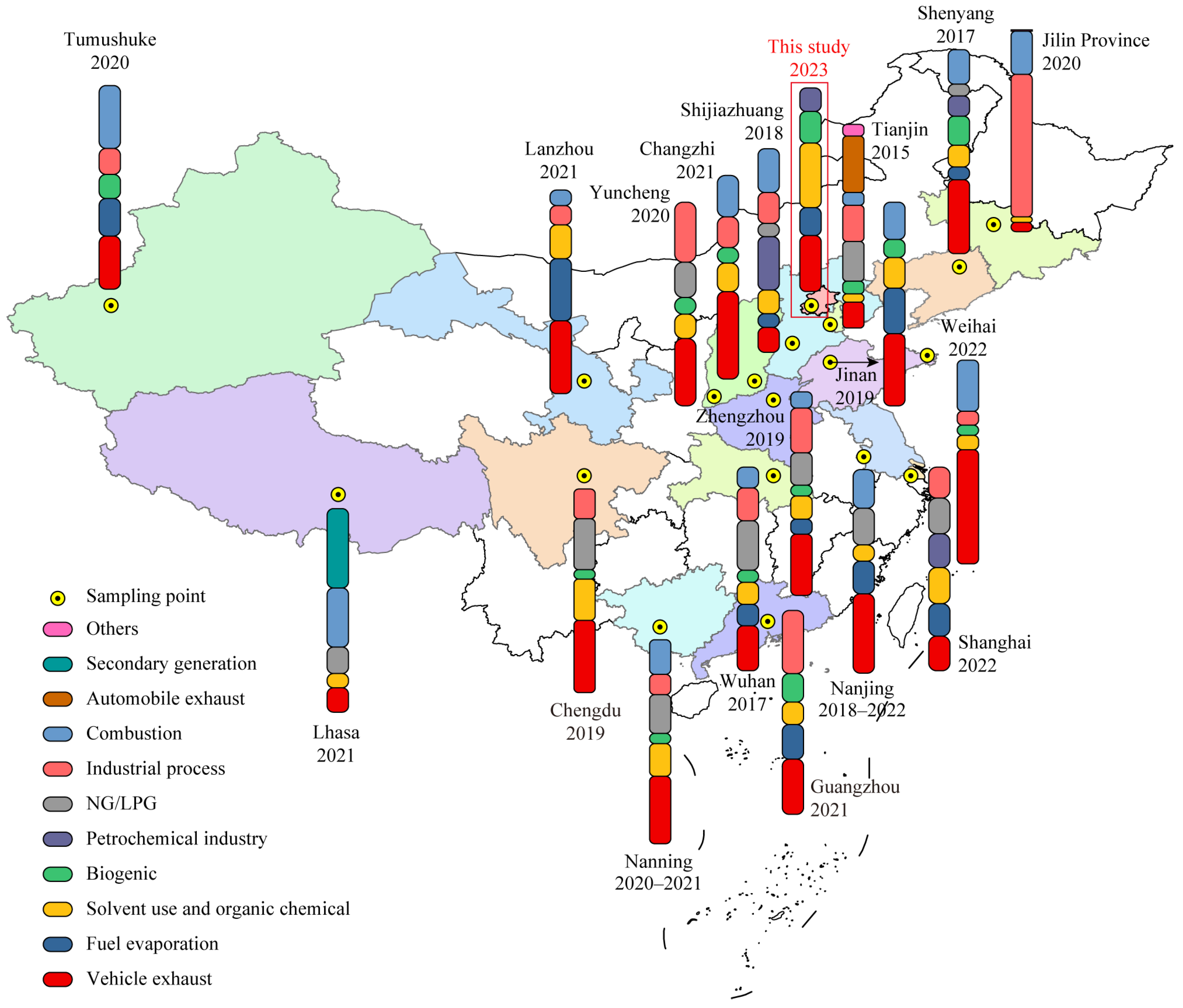

Undervalued Contribution of OVOCs to Atmospheric Activity: A Case Study in Beijing



Highlights
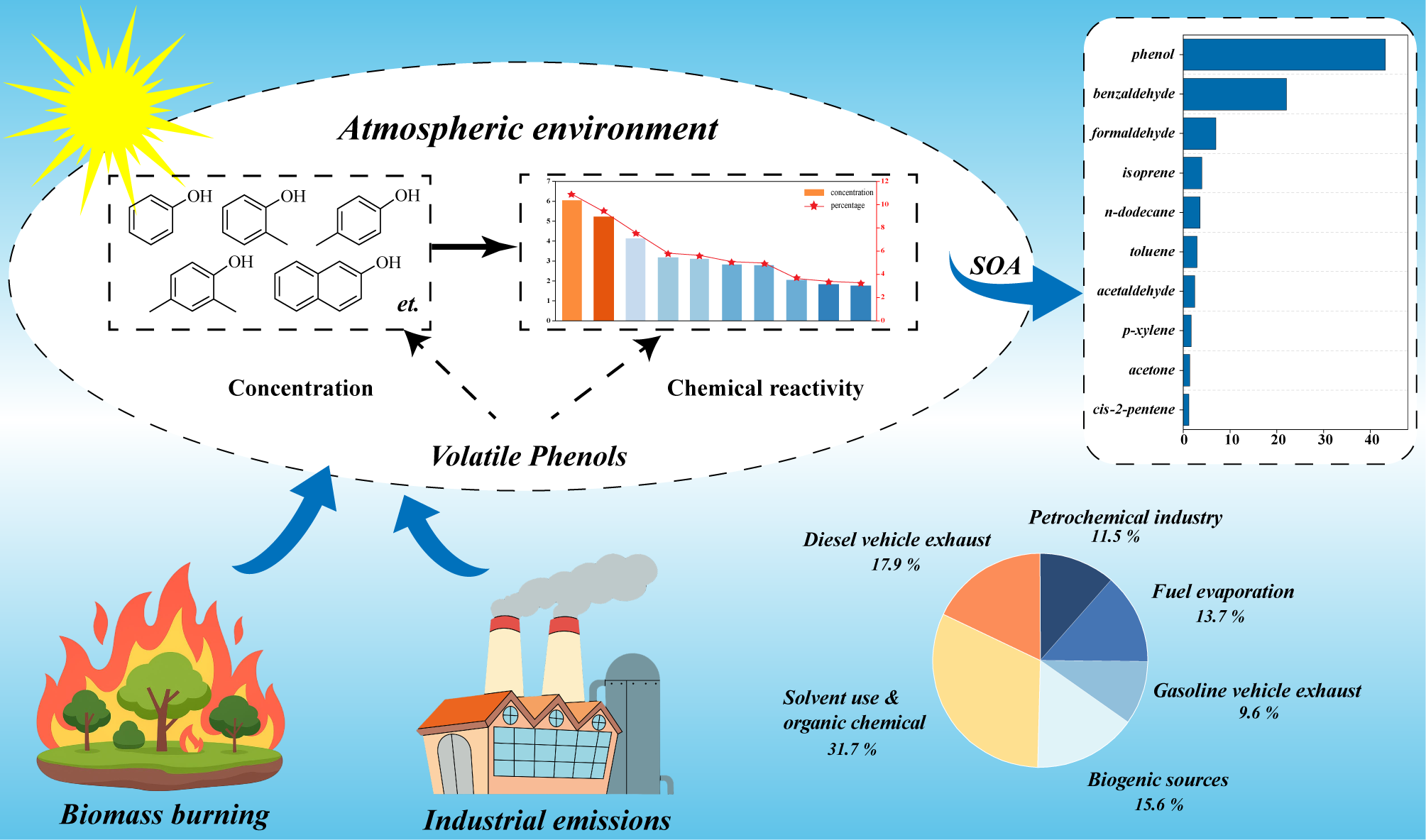
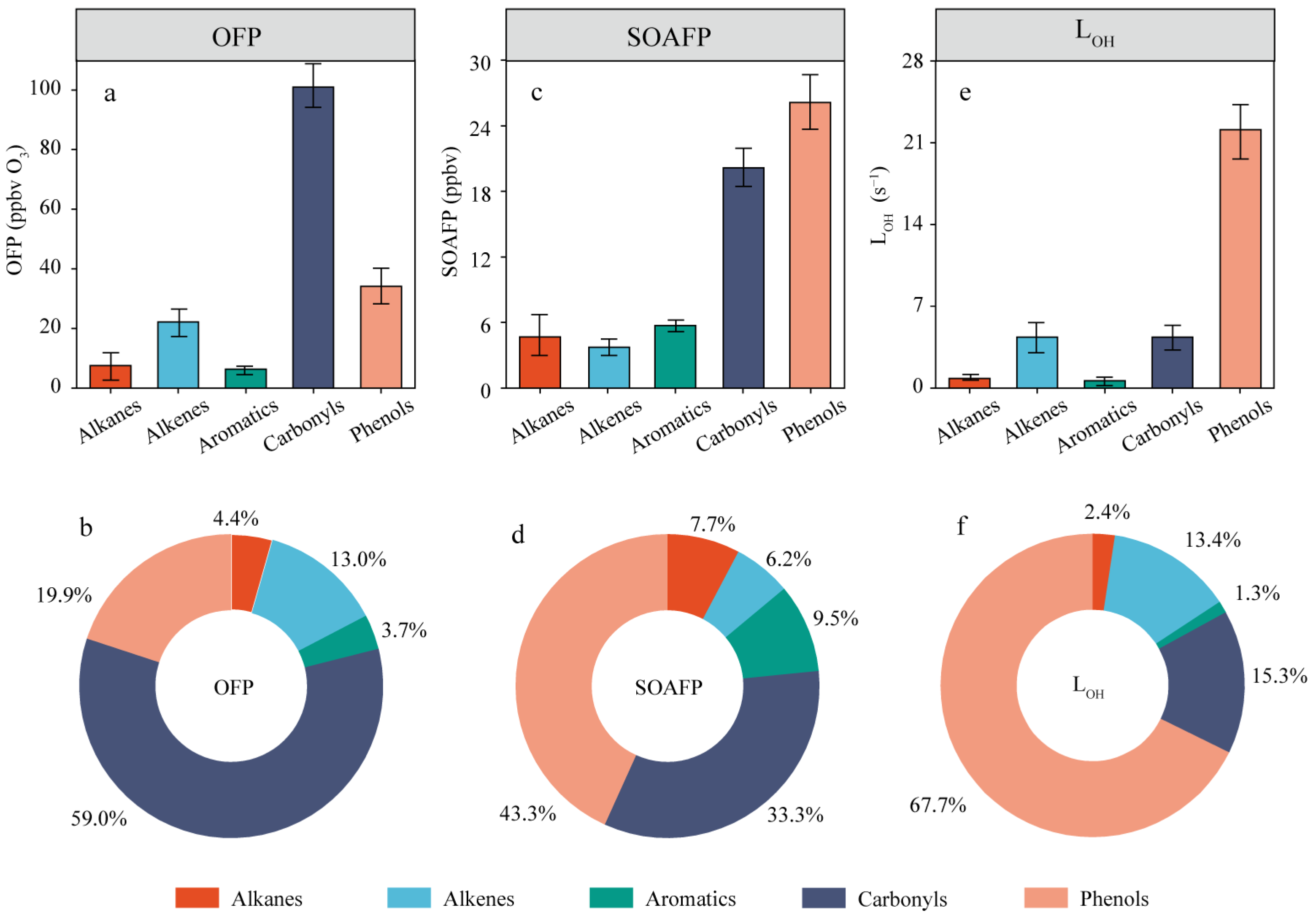
- Oxygenated VOCs, particularly volatile phenols, dominated VOC chemical activity despite low concentrations.
- Volatile phenols exhibited strong OH reactivity and non-negligible ozone formation potential.
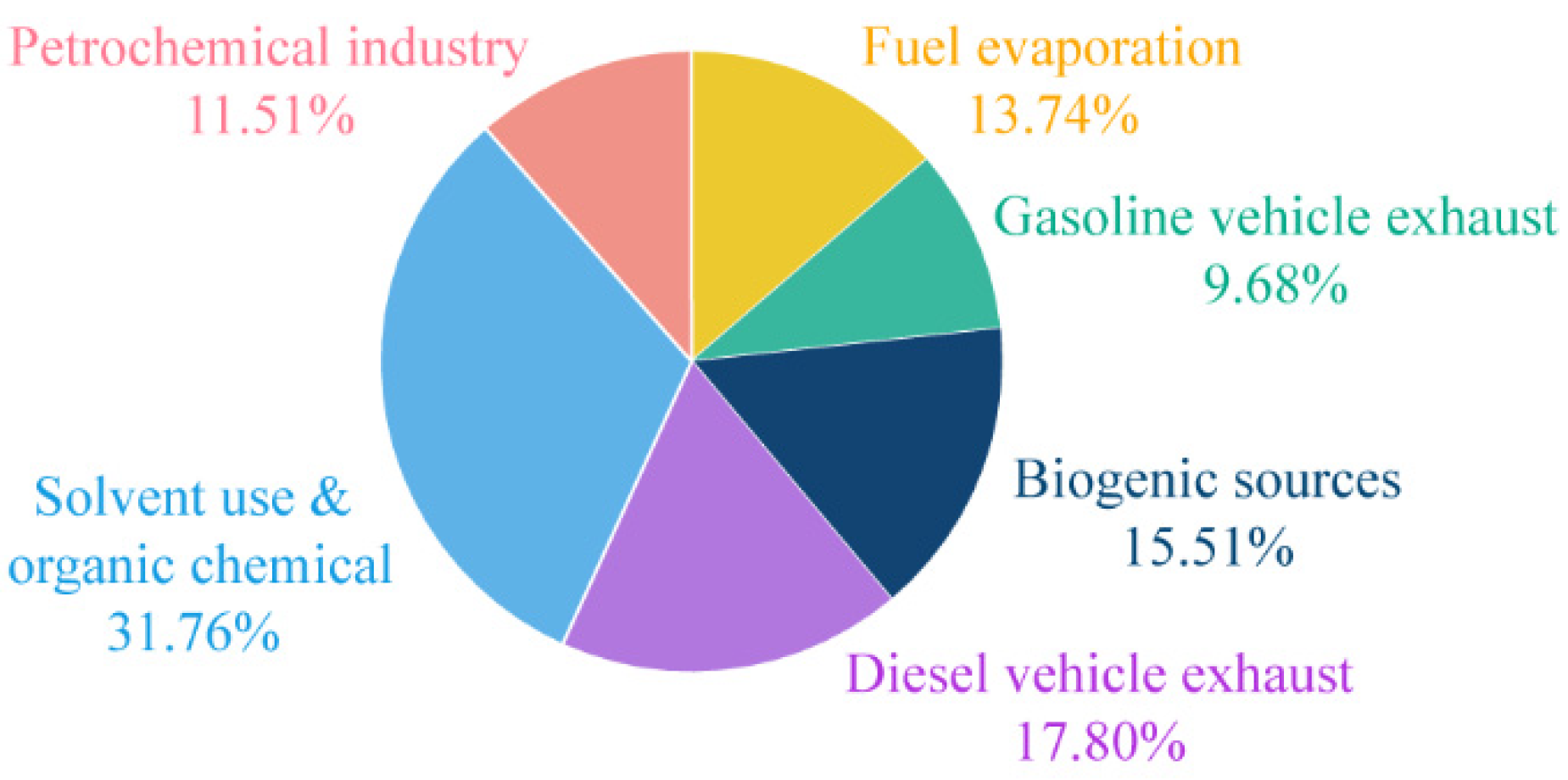
- Biomass combustion and secondary formation were identified as major sources of atmospheric phenols.
- Studying volatile phenols provides a novel perspective for understanding the mechanisms underlying urban ozone pollution.
Abstract
1. Introduction

2. Materials and Methods
2.1. Sample Collection
2.2. Sample Analysis
2.3. Quality Assurance and Quality Control
2.4. Atmospheric Chemical Activity Analysis
2.4.1. OH Radical Loss Rate Calculation Method (LOH)
2.4.2. Ozone Formation Potential (OFP)
2.4.3. Secondary Organic Aerosol Formation Potential (SOAFP)
3. Results and Discussion
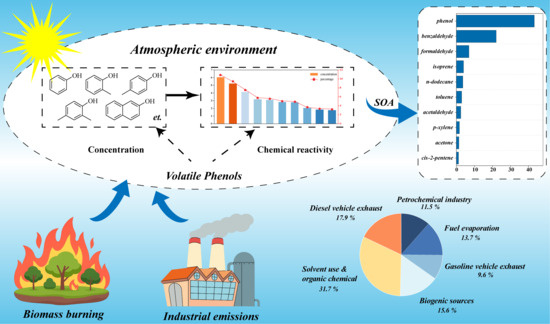
3.1. Emission Characteristics
3.2. Photochemical Reactivity
3.2.1. OFP
3.2.2. SOAFP
3.2.3. LOH
3.3. Source Apportionment
4. Conclusions
Supplementary Materials
Author Contributions
Funding
Institutional Review Board Statement
Informed Consent Statement
Data Availability Statement
Conflicts of Interest
References
- Zhang, H.; Jiang, H.; Jian, G.; Li, H. Formation Mechanism and Management Strategy of Cooperative Control of PM2.5 and O3. Res. Environ. Sci. 2022, 35, 611–620. [Google Scholar] [CrossRef]
- GB 3095-2012; Ambient Air Quality Standards. Ministry of Ecology and Environment of the People’s Republic of China: Beijing, China, 2012.
- Ministry of Ecology and Environment of the People’s Republic of China. Ministry of Ecology and Environment Reports on National Ambient Air Quality Conditions in July and January–July. Available online: https://www.mee.gov.cn/hjzl/sthjzk/zghjzkgb/ (accessed on 1 December 2025).
- Mozaffar, A.; Zhang, Y.-L.; Lin, Y.-C.; Xie, F.; Fan, M.-Y.; Cao, F. Measurement report: High contributions of halocarbon and aromatic compounds to atmospheric volatile organic compounds in an industrial area. Atmos. Chem. Phys. 2021, 21, 18087–18099. [Google Scholar] [CrossRef]
- Song, M.D.; Tan, Q.W.; Feng, M.; Qu, Y.; Liu, X.G.; An, J.L.; Zhang, Y.H. Source Apportionment and Secondary Transformation of Atmospheric Nonmethane Hydrocarbons in Chengdu, Southwest China. J. Geophys. Res. Atmos. 2018, 123, 9741–9763. [Google Scholar] [CrossRef]
- Ji, Y.M.; Shi, Q.J.; Li, Y.X.; An, T.C.; Zheng, J.; Peng, J.F.; Gao, Y.P.; Chen, J.Y.; Li, G.Y.; Wang, Y.; et al. Carbenium ion-mediated oligomerization of methylglyoxal for secondary organic aerosol formation. Proc. Natl. Acad. Sci. USA 2020, 117, 13294–13299. [Google Scholar] [CrossRef]
- Wang, S.; Cui, J.; Feng, Y.; Liu, D.; Chen, J.; Wang, M.; Wang, X.; Wang, T. Characteristics and Source Apportionment of VOCs and O3 in Shijiazhuang. Environ. Sci. 2020, 41, 5325–5335. [Google Scholar] [CrossRef]
- Ye, C.; Guo, S.; Lin, W.; Tian, F.; Wang, J.; Zhang, C.; Chi, S.; Chen, Y.; Zhang, Y.; Zeng, L.; et al. Measurement report: Source apportionment and environmental impacts of volatile organic compounds (VOCs) in Lhasa, a highland city in China. Atmos. Chem. Phys. 2023, 23, 10383–10397. [Google Scholar] [CrossRef]
- Zhang, X.; Wang, L.; Jin, X.; Zhang, R. Composition characteristics, source and sensitivity to O3 formation of volatile organic compounds in Weihai. Environ. Prot. Sci. 2023, 49, 130–137. [Google Scholar] [CrossRef]
- Li, Q.; Su, G.; Li, C.; Liu, P.; Zhao, X.; Zhang, C.; Sun, X.; Mu, Y.; Wu, M.; Wang, Q.; et al. An investigation into the role of VOCs in SOA and ozone production in Beijing, China. Sci. Total Environ. 2020, 720, 137536. [Google Scholar] [CrossRef] [PubMed]
- Liu, B.; Liang, D.; Yang, J.; Dai, Q.; Bi, X.; Feng, Y.; Yuan, J.; Xiao, Z.; Zhang, Y.; Xu, H. Characterization and source apportionment of volatile organic compounds based on 1-year of observational data in Tianjin, China. Environ. Pollut. 2016, 218, 757–769. [Google Scholar] [CrossRef]
- Yurdakul, S.; Civan, M.; Kuntasal, Ö.; Doğan, G.; Pekey, H.; Tuncel, G. Temporal variations of VOC concentrations in Bursa atmosphere. Atmos. Pollut. Res. 2018, 9, 189–206. [Google Scholar] [CrossRef]
- Qian, X.; Shen, H.; Chen, Z. Characterizing summer and winter carbonyl compounds in Beijing atmosphere. Atmos. Environ. 2019, 214, 116845. [Google Scholar] [CrossRef]
- Cheng, Y.; Lee, S.C.; Huang, Y.; Ho, K.F.; Ho, S.S.H.; Yau, P.S.; Louie, P.K.K.; Zhang, R.J. Diurnal and seasonal trends of carbonyl compounds in roadside, urban, and suburban environment of Hong Kong. Atmos. Environ. 2014, 89, 43–51. [Google Scholar] [CrossRef]
- Huang, Y.; Li, X.; Chen, X.; Wang, W.; Wang, Y.; Liu, Z.; Tang, G. Low-molecular-weight carbonyl volatile organic compounds on the North China Plain. Atmos. Environ. 2022, 275, 119000. [Google Scholar] [CrossRef]
- Xiao, Y.; Hu, M.; Li, X.; Zong, T.; Xu, N.; Hu, S.; Zeng, L.; Chen, S.; Song, Y.; Guo, S.; et al. Aqueous secondary organic aerosol formation attributed to phenols from biomass burning. Sci. Total Environ. 2022, 847, 157582. [Google Scholar] [CrossRef]
- Smith, J.D.; Kinney, H.; Anastasio, C. Aqueous benzene-diols react with an organic triplet excited state and hydroxyl radical to form secondary organic aerosol. Phys. Chem. Chem. Phys. 2015, 17, 10227–10237. [Google Scholar] [CrossRef] [PubMed]
- Crawford, J.; Faroon, O.; Llados, F.; Wilson, J.D. Toxicological Profile for Phenol; Agency for Toxic Substances and Disease Registry: Atlanta, GA, USA, 2008; pp. 191–220. [Google Scholar]
- MacFarlane, S.M.; Fisher, J.A.; Xu, L.; Wennberg, P.O.; Crounse, J.D.; Ball, K.; Zhai, S.; Bates, K.H.; Kim, Y.; Zhang, Q.; et al. Sources, Sinks, and Oxidation Pathways of Phenolic Compounds in South Korea Constrained Using KORUS-AQ Airborne Observations. J. Geophys. Res. Atmos. 2025, 130. [Google Scholar] [CrossRef]
- Leuenberger, C.; Ligocki, M.P.; Pankow, J.F. Trace organic compounds in rain. 4. Identities, concentrations, and scavenging mechanisms for phenols in urban air and rain. Environ. Sci. Technol. 1985, 19, 1053–1058. [Google Scholar] [CrossRef]
- Belloli, R.; Barletta, B.; Bolzacchini, E.; Meinardi, S.; Orlandi, M.; Rindone, B. Determination of toxic nitrophenols in the atmosphere by high-performance liquid chromatography. J. Chromatogr. A 1999, 846, 277–281. [Google Scholar] [CrossRef]
- Rubio, M.A.; Lissi, E.; Herrera, N.; Pérez, V.; Fuentes, N. Phenol and nitrophenols in the air and dew waters of Santiago de Chile. Chemosphere 2012, 86, 1035–1039. [Google Scholar] [CrossRef]
- Lüttke, J.; Scheer, V.; Levsen, K.; Wünsch, G.; Neil Cape, J.; Hargreaves, K.J.; Storeton-West, R.L.; Acker, K.; Wieprecht, W.; Jones, B. Occurrence and formation of nitrated phenols in and out of cloud. Atmos. Environ. 1997, 31, 2637–2648. [Google Scholar] [CrossRef]
- Delhomme, O.; Morville, S.; Millet, M. Seasonal and diurnal variations of atmospheric concentrations of phenols and nitrophenols measured in the Strasbourg area, France. Atmos. Pollut. Res. 2010, 1, 16–22. [Google Scholar] [CrossRef]
- Smith, J.D.; Sio, V.; Yu, L.; Zhang, Q.; Anastasio, C. Secondary Organic Aerosol Production from Aqueous Reactions of Atmospheric Phenols with an Organic Triplet Excited State. Environ. Sci. Technol. 2014, 48, 1049–1057. [Google Scholar] [CrossRef]
- Li, M.; Wang, X.; Lu, C.; Li, R.; Zhang, J.; Dong, S.; Yang, L.; Xue, L.; Chen, J.; Wang, W. Nitrated phenols and the phenolic precursors in the atmosphere in urban Jinan, China. Sci. Total Environ. 2020, 714, 136760. [Google Scholar] [CrossRef]
- Liang, Y.; Wang, X.; Dong, S.; Liu, Z.; Mu, J.; Lu, C.; Zhang, J.; Li, M.; Xue, L.; Wang, W. Size distributions of nitrated phenols in winter at a coastal site in north China and the impacts from primary sources and secondary formation. Chemosphere 2020, 250, 126256. [Google Scholar] [CrossRef]
- Xiao, M.; Wang, M.; Mentler, B.; Garmash, O.; Lamkaddam, H.; Molteni, U.; Simon, M.; Ahonen, L.; Amorim, A.; Baccarini, A.; et al. Anthropogenic organic aerosol in Europe produced mainly through second-generation oxidation. Nat. Geosci. 2025, 18, 239–245. [Google Scholar] [CrossRef] [PubMed]
- Volkamer, R.; Klotz, B.; Barnes, I.; Imamura, T.; Wirtz, K.; Washida, N.; Becker, K.H.; Platt, U. OH-initiated oxidation of benzene. Phys. Chem. Chem. Phys. 2002, 4, 1598–1610. [Google Scholar] [CrossRef]
- Olariu, R.I.; Klotz, B.; Barnes, I.; Becker, K.H.; Mocanu, R. FT–IR study of the ring-retaining products from the reaction of OH radicals with phenol, o-, m-, and p-cresol. Atmos. Environ. 2002, 36, 3685–3697. [Google Scholar] [CrossRef]
- Yan, L.J.; Bai, Y.H.; Zhao, R.F.; Li, F.; Xie, K.C. Correlation between coal structure and release of the two organic compounds during pyrolysis. Fuel 2015, 145, 12–17. [Google Scholar] [CrossRef]
- Wang, Y.; Hu, M.; Wang, Y.; Zheng, J.; Shang, D.; Yang, Y.; Liu, Y.; Li, X.; Tang, R.; Zhu, W.; et al. The formation of nitro-aromatic compounds under high NOx and anthropogenic VOC conditions in urban Beijing, China. Atmos. Chem. Phys. 2019, 19, 7649–7665. [Google Scholar] [CrossRef]
- Liang, Z.; Li, Y.; Go, B.R.; Chan, C.K. Complexities of Photosensitization in Atmospheric Particles. ACS EST Air 2024, 1, 1333–1351. [Google Scholar] [CrossRef]
- Bolzacchini, E.; Bruschi, M.; Hjorth, J.; Meinardi, S.; Orlandi, M.; Rindone, B.; Rosenbohm, E. Gas-phase reaction of phenol with NO3. Environ. Sci. Technol. 2001, 35, 1791–1797. [Google Scholar] [CrossRef]
- Cai, M.; Zhao, Z.; Li, X.; Wang, G.; Yang, Y.; Zhao, W.; Wang, B.; Yang, H.; Chen, K.; Ge, S.; et al. Aqueous-Phase Photooxidation of Vanillin in the Presence of Nitrite: Characteristics, Products, and Mechanism. ACS EST Air 2024, 1, 860–870. [Google Scholar] [CrossRef]
- Atkinson, R.; Aschmann, S.M.; Arey, J. Reactions of hydroxyl and nitrogen trioxide radicals with phenol, cresols, and 2-nitrophenol at 296 .+-. 2 K. Environ. Sci. Technol. 2002, 26, 1397–1403. [Google Scholar] [CrossRef]
- McGillen, M.R.; Carter, W.P.L.; Mellouki, A.; Orlando, J.J.; Picquet-Varrault, B.; Wallington, T.J. Database for the kinetics of the gas-phase atmospheric reactions of organic compounds. Earth Syst. Sci. Data 2020, 12, 1203–1216. [Google Scholar] [CrossRef]
- Yu, J.; Wu, B.; Peng, C.; Wentzell, J.; Wheeler, M.J.; Osagu, J.O.; Zhang, X.; Li, L.; Abbatt, J.P.D.; Liggio, J. Multiphase OH Oxidation of Bisphenols: Chemical Transformation and Persistence in the Environment. Environ. Sci. Technol. 2025, 59, 13319–13332. [Google Scholar] [CrossRef] [PubMed]
- Choi, J.; Jang, M.; Blau, S. Dual roles of the inorganic aqueous phase on secondary organic aerosol growth from benzene and phenol. Atmos. Chem. Phys. 2024, 24, 6567–6582. [Google Scholar] [CrossRef]
- Cheng, X.; Chen, Q.; Li, Y.; Huang, G.; Liu, Y.; Lu, S.; Zheng, Y.; Qiu, W.; Lu, K.; Qiu, X.; et al. Secondary Production of Gaseous Nitrated Phenols in Polluted Urban Environments. Environ. Sci. Technol. 2021, 55, 4410–4419. [Google Scholar] [CrossRef]
- Garmash, O.; Rissanen, M.P.; Pullinen, I.; Schmitt, S.; Kausiala, O.; Tillmann, R.; Zhao, D.; Percival, C.; Bannan, T.J.; Priestley, M.; et al. Multi-generation OH oxidation as a source for highly oxygenated organic molecules from aromatics. Atmos. Chem. Phys. 2020, 20, 515–537. [Google Scholar] [CrossRef]
- Bejan, I.; Schürmann, A.; Barnes, I.; Benter, T. Kinetics of the gas-phase reactions of OH radicals with a series of trimethylphenols. Int. J. Chem. Kinet. 2011, 44, 117–124. [Google Scholar] [CrossRef]
- Bejan, I.G.; Olariu, R.I.; Wiesen, P. Secondary Organic Aerosol Formation from Nitrophenols Photolysis under Atmospheric Conditions. Atmosphere 2020, 11, 1346. [Google Scholar] [CrossRef]
- An, Z.; Sun, J.; Han, D.; Mei, Q.; Wei, B.; Wang, X.; He, M. Theoretical study on the mechanisms, kinetics and ecotoxicity assessment of OH-initiated reactions of guaiacol in atmosphere and wastewater. Sci. Total Environ. 2019, 685, 729–740. [Google Scholar] [CrossRef]
- Couzo, E.; Lefer, B.; Stutz, J.; Yarwood, G.; Karamchandani, P.; Henderson, B.; Vizuete, W. Impacts of heterogeneous HONO formation on radical sources and ozone chemistry in Houston, Texas. Atmos. Environ. 2015, 112, 344–355. [Google Scholar] [CrossRef]
- Berndt, T.; Böge, O. Gas-phase reaction of OH radicals with phenol. Phys. Chem. Chem. Phys. 2003, 5, 342–350. [Google Scholar] [CrossRef]
- Xu, C.; Wang, L. Atmospheric Oxidation Mechanism of Phenol Initiated by OH Radical. J. Phys. Chem. A 2013, 117, 2358–2364. [Google Scholar] [CrossRef]
- Mvula, E.; von Sonntag, C. Ozonolysis of phenols in aqueous solution. Org. Biomol. Chem. 2003, 1, 1749–1756. [Google Scholar] [CrossRef] [PubMed]
- Schwantes, R.H.; Schilling, K.A.; McVay, R.C.; Lignell, H.; Coggon, M.M.; Zhang, X.; Wennberg, P.O.; Seinfeld, J.H. Formation of highly oxygenated low-volatility products from cresol oxidation. Atmos. Chem. Phys. 2017, 17, 3453–3474. [Google Scholar] [CrossRef]
- Zaytsev, A.; Koss, A.R.; Breitenlechner, M.; Krechmer, J.E.; Nihill, K.J.; Lim, C.Y.; Rowe, J.C.; Cox, J.L.; Moss, J.; Roscioli, J.R.; et al. Mechanistic study of the formation of ring-retaining and ring-opening products from the oxidation of aromatic compounds under urban atmospheric conditions. Atmos. Chem. Phys. 2019, 19, 15117–15129. [Google Scholar] [CrossRef]
- Pillar-Little, E.A.; Camm, R.C.; Guzman, M.I. Catechol Oxidation by Ozone and Hydroxyl Radicals at the Air–Water Interface. Environ. Sci. Technol. 2014, 48, 14352–14360. [Google Scholar] [CrossRef] [PubMed]
- Ji, Y.; Zhao, J.; Terazono, H.; Misawa, K.; Levitt, N.P.; Li, Y.; Lin, Y.; Peng, J.; Wang, Y.; Duan, L.; et al. Reassessing the atmospheric oxidation mechanism of toluene. Proc. Natl. Acad. Sci. USA 2017, 114, 8169–8174. [Google Scholar] [CrossRef]
- Butkovskaya, N.I.; Pouvesle, N.; Kukui, A.; Bras, G.L. Mechanism of the OH-initiated oxidation of glycolaldehyde over the temperature range 233–296 K. J. Phys. Chem. A 2006, 110, 13492–13499. [Google Scholar] [CrossRef]
- Crutzen, P.J.; Lawrence, M.G.; Pöschl, U. On the background photochemistry of tropospheric ozone. Tellus B Chem. Phys. Meteorol. 1999, 51, 123–146. [Google Scholar] [CrossRef]
- Hofzumahaus, A.; Lefer, B.L.; Monks, P.S.; Hall, S.R.; Kylling, A.; Mayer, B.; Shetter, R.E.; Junkermann, W.; Bais, A.; Calvert, J.G.; et al. Photolysis frequency of O3 to O(1D): Measurements and modeling during the International Photolysis Frequency Measurement and Modeling Intercomparison (IPMMI). J. Geophys. Res. Atmos. 2004, 109, D08S90. [Google Scholar] [CrossRef]
- Jiang, W.; Yu, L.; Yee, L.; Chhabra, P.; Seinfeld, J.; Anastasio, C.; Zhang, Q. Chemical Differences between Phenolic Secondary Organic Aerosol Formed through Gas-Phase and Aqueous-Phase Reactions. ACS Earth Space Chem. 2024, 8, 2270–2283. [Google Scholar] [CrossRef]
- Hu, J.; Chen, Z.; Qin, X.; Dong, P. Reversible and irreversible gas–particle partitioning of dicarbonyl compounds observed in the real atmosphere. Atmos. Chem. Phys. 2022, 22, 6971–6987. [Google Scholar] [CrossRef]
- Chen, Z.; Chen, K.; Li, X.; Li, R.; Li, Z.; Xiao, B.; Wang, G. Characterization, sources and reactivity of carbonyl volatile organic compounds in North China: Based on long-term observations. J. Environ. Sci. 2026, 159, 797–808. [Google Scholar] [CrossRef]
- Li, F.; Zhou, S.; Du, L.; Zhao, J.; Hang, J.; Wang, X. Aqueous-phase chemistry of atmospheric phenolic compounds: A critical review of laboratory studies. Sci. Total Environ. 2023, 856, 158895. [Google Scholar] [CrossRef]
- Jiang, W.; Niedek, C.; Anastasio, C.; Zhang, Q. Photoaging of phenolic secondary organic aerosol in the aqueous phase: Evolution of chemical and optical properties and effects of oxidants. Atmos. Chem. Phys. 2023, 23, 7103–7120. [Google Scholar] [CrossRef]
- Ferracci, V.; Heimann, I.; Abraham, N.L.; Pyle, J.A.; Archibald, A.T. Global modelling of the total OH reactivity: Investigations on the “missing” OH sink and its atmospheric implications. Atmos. Chem. Phys. 2018, 18, 7109–7129. [Google Scholar] [CrossRef]
- Atkinson, R.; Arey, J. Atmospheric degradation of volatile organic compounds. Chem. Rev. 2003, 103, 4605–4638. [Google Scholar] [CrossRef] [PubMed]
- Chen, K.; Gu, X.; Cai, M.; Zhao, W.; Wang, B.; Yang, H.; Liu, X.; Li, X. Emission characteristics, environmental impacts and health risk assessment of volatile organic compounds from the typical chemical industry in China. J. Environ. Sci. 2025, 149, 113–125. [Google Scholar] [CrossRef] [PubMed]
- Carter, W.P.L. Development of the SAPRC-07 chemical mechanism. Atmos. Environ. 2010, 44, 5324–5335. [Google Scholar] [CrossRef]
- Carter, W.P.L. Development of Ozone Reactivity Scales for Volatile Organic-Compounds. J. Air Waste Manag. Assoc. 1994, 44, 881–899. [Google Scholar] [CrossRef]
- Sahar, G.; Zhu, H.W.; Durbin, T.D.; Cocker, D.R.; Georgios, K. The impact of hydrogenated vegetable oil (HVO) on the formation of secondary organic aerosol (SOA) from in-use heavy-duty diesel vehicles. Sci. Total Environ. 2022, 822, 153583. [Google Scholar] [CrossRef]
- Liu, R.; Chen, J.; Li, G.; Wang, X.; An, T. Cutting down on the ozone and SOA formation as well as health risks of VOCs emitted from e-waste dismantlement by integration technique. J. Environ. Manag. 2019, 249, 107755. [Google Scholar] [CrossRef]
- Li, J.; Deng, S.; Li, G.; Lu, Z.; Song, H.; Gao, J.; Sun, Z.; Xu, K. VOCs characteristics and their ozone and SOA formation potentials in autumn and winter at Weinan, China. Environ. Res. 2021, 203, 111821. [Google Scholar] [CrossRef] [PubMed]
- Grosjean, D. In situ organic aerosol formation during a smog episode: Estimated production and chemical functionality. Atmos. Environ. Part A Gen. Top. 1992, 26, 953–963. [Google Scholar] [CrossRef]
- Grosjean, D.; Seinfeld, J.H. Parameterization of the formation potential of secondary organic aerosols. Atmos. Environ. (1967) 1989, 23, 1733–1747. [Google Scholar] [CrossRef]
- Grosjean, E.; Grosjean, D. The reaction of unsaturated aliphatic oxygenates with ozone. J. Atmos. Chem. 1999, 32, 205–232. [Google Scholar] [CrossRef]
- Dechapanya, W.; Russell, M.; Allen, D.T. Estimates of Anthropogenic Secondary Organic Aerosol Formation in Houston, Texas Special Issue of Aerosol Science and Technology on Findings from the Fine Particulate Matter Supersites Program. Aerosol Sci. Technol. 2004, 38, 156–166. [Google Scholar] [CrossRef]
- Huang, X.F.; Zhang, B.; Xia, S.Y.; Han, Y.; Wang, C.; Yu, G.H.; Feng, N. Sources of oxygenated volatile organic compounds (OVOCs) in urban atmospheres in North and South China. Environ. Pollut. 2020, 261, 114152. [Google Scholar] [CrossRef] [PubMed]
- Zhao, Q.; Bi, J.; Liu, Q.; Ling, Z.; Shen, G.; Chen, F.; Qiao, Y.; Li, C.; Ma, Z. Sources of volatile organic compounds and policy implications for regional ozone pollution control in an urban location of Nanjing, East China. Atmos. Chem. Phys. 2020, 20, 3905–3919. [Google Scholar] [CrossRef]
- Guo, W.; Yang, Y.; Chen, Q.; Zhu, Y.; Zhang, Y.; Zhang, Y.; Liu, Y.; Li, G.; Sun, W.; She, J. Chemical reactivity of volatile organic compounds and their effects on ozone formation in a petrochemical industrial area of Lanzhou, Western China. Sci. Total Environ. 2022, 839, 155901. [Google Scholar] [CrossRef]
- Wang, D.; Zhou, J.; Han, L.; Tian, W.; Wang, C.; Li, Y.; Chen, J. Source apportionment of VOCs and ozone formation potential and transport in Chengdu, China. Atmos. Pollut. Res. 2023, 14, 101730. [Google Scholar] [CrossRef]
- Zhang, G.; Zhou, X.; Sun, Y.; Han, C.; Xian, J.; Mu, C.; Xu, W.; Liang, L. Oxygenated volatile organic compounds in Beijing: Characteristics, chemical reactivity, and source identification. Environ. Pollut. 2025, 373, 126065. [Google Scholar] [CrossRef] [PubMed]
- Wei, Y.; Jing, X.; Chen, Y.; Sun, W.; Zhang, Y.; Zhu, R. Spatial-Temporal Characteristics, Source Apportionment, and Health Risks of Atmospheric Volatile Organic Compounds in China: A Comprehensive Review. Toxics 2024, 12, 787. [Google Scholar] [CrossRef] [PubMed]
- Ye, C.; Yuan, B.; Lin, Y.; Wang, Z.; Hu, W.; Li, T.; Chen, W.; Wu, C.; Wang, C.; Huang, S.; et al. Chemical characterization of oxygenated organic compounds in the gas phase and particle phase using iodide CIMS with FIGAERO in urban air. Atmos. Chem. Phys. 2021, 21, 8455–8478. [Google Scholar] [CrossRef]
- Liu, Z.; Zha, F.; Wang, Y.; Yuan, B.; Liu, B.; Tang, G. Vertical evolution of the concentrations and sources of volatile organic compounds in the lower boundary layer in urban Beijing in summer. Chemosphere 2023, 332, 138767. [Google Scholar] [CrossRef]
- Russell, A.; Milford, J.; Bergin, M.S.; McBride, S.; McNair, L.; Yang, Y.; Stockwell, W.R.; Croes, B. Urban Ozone Control and Atmospheric Reactivity of Organic Gases. Science 1995, 269, 491–495. [Google Scholar] [CrossRef]
- Yang, Y.; Shao, M.; Keßel, S.; Li, Y.; Lu, K.; Lu, S.; Williams, J.; Zhang, Y.; Zeng, L.; Nölscher, A.C.; et al. How the OH reactivity affects the ozone production efficiency: Case studies in Beijing and Heshan, China. Atmos. Chem. Phys. 2017, 17, 7127–7142. [Google Scholar] [CrossRef]
- Whalley, L.K.; Stone, D.; Bandy, B.; Dunmore, R.; Hamilton, J.F.; Hopkins, J.; Lee, J.D.; Lewis, A.C.; Heard, D.E. Atmospheric OH reactivity in central London: Observations, model predictions and estimates of in situ ozone production. Atmos. Chem. Phys. 2016, 16, 2109–2122. [Google Scholar] [CrossRef]
- Lou, S.; Holland, F.; Rohrer, F.; Lu, K.; Bohn, B.; Brauers, T.; Chang, C.C.; Fuchs, H.; Häseler, R.; Kita, K.; et al. Atmospheric OH reactivities in the Pearl River Delta—China in summer 2006: Measurement and model results. Atmos. Chem. Phys. 2010, 10, 11243–11260. [Google Scholar] [CrossRef]
- Shirley, T.R.; Brune, W.H.; Ren, X.; Mao, J.; Lesher, R.; Cardenas, B.; Volkamer, R.; Molina, L.T.; Molina, M.J.; Lamb, B.; et al. Atmospheric oxidation in the Mexico City Metropolitan Area (MCMA) during April 2003. Atmos. Chem. Phys. 2006, 6, 2753–2765. [Google Scholar] [CrossRef]
- Ramasamy, S.; Nagai, Y.; Takeuchi, N.; Yamasaki, S.; Shoji, K.; Ida, A.; Jones, C.; Tsurumaru, H.; Suzuki, Y.; Yoshino, A.; et al. Comprehensive measurements of atmospheric OH reactivity and trace species within a suburban forest near Tokyo during AQUAS-TAMA campaign. Atmos. Environ. 2018, 184, 166–176. [Google Scholar] [CrossRef]
- Liu, Y.; Shao, M.; Kuster, W.C.; Goldan, P.D.; Li, X.; Lu, S.; Gouw, J.A.d. Source Identification of Reactive Hydrocarbons and Oxygenated VOCs in the Summertime in Beijing. Environ. Sci. Technol. 2009, 43, 75–81. [Google Scholar] [CrossRef] [PubMed]
- Yang, Y.; Wang, Y.; Zhou, P.; Yao, D.; Ji, D.; Sun, J.; Wang, Y.; Zhao, S.; Huang, W.; Yang, S.; et al. Atmospheric reactivity and oxidation capacity during summer at a suburban site between Beijing and Tianjin. Atmos. Chem. Phys. 2020, 20, 8181–8200. [Google Scholar] [CrossRef]
- Wei, N.; Zhao, W.; Zhang, T.; Wang, J.; Zhang, C.; Chen, Y.; Yu, X.; Lin, W.; Ye, C.; Fittschen, C.; et al. Bridging the Gap Between Total Peroxyl Radical Observations and Models by Measuring OH Reactivity to Improve Estimates of Ozone Production: A Case Study From the 24th Winter Olympics Games. J. Geophys. Res. Atmos. 2025, 130. [Google Scholar] [CrossRef]
- Illmann, N. A perspective on the reactions of organic peroxy radicals with HO2. Environ. Sci. Atmos. 2025, 5, 737–755. [Google Scholar] [CrossRef]
- Whalley, L.K.; Slater, E.J.; Woodward-Massey, R.; Ye, C.; Lee, J.D.; Squires, F.; Hopkins, J.R.; Dunmore, R.E.; Shaw, M.; Hamilton, J.F.; et al. Evaluating the sensitivity of radical chemistry and ozone formation to ambient VOCs and NOx in Beijing. Atmos. Chem. Phys. 2021, 21, 2125–2147. [Google Scholar] [CrossRef]
- Chen, L.; Huang, Y.; Xue, Y.; Jia, Z.; Wang, W. Atmospheric oxidation of 1-butene initiated by OH radical: Implications for ozone and nitrous acid formations. Atmos. Environ. 2021, 244, 118010. [Google Scholar] [CrossRef]
- Xiao, F.; Sun, X.; Li, Z.; Li, X. Theoretical Study of Radical–Molecule Reactions with Negative Activation Energies in Combustion: Hydroxyl Radical Addition to Alkenes. ACS Omega 2020, 5, 12777–12788. [Google Scholar] [CrossRef]
- Zhang, X.; Luo, J.; Pan, W.; Xue, Q.; Liu, X.; Fu, J.; Zhang, A.; Jiang, G. Implications of VOC oxidation in atmospheric chemistry: Development of a comprehensive AI model for predicting reaction rate constants. Atmos. Chem. Phys. 2025, 25, 13379–13391. [Google Scholar] [CrossRef]
- Chen, Z.; Chen, K.; Yang, Z.; Yang, F.; Zhao, W.; Li, X. Characterization of atmospheric volatile phenolic compounds in china: Based on long-term observations—Possibly seriously underestimated OVOCs. Atmos. Res. 2026, 330, 108586. [Google Scholar] [CrossRef]
- Wang, W.; Yuan, B.; Su, H.; Cheng, Y.; Qi, J.; Wang, S.; Song, W.; Wang, X.; Xue, C.; Ma, C.; et al. A large role of missing volatile organic compound reactivity from anthropogenic emissions in ozone pollution regulation. Atmos. Chem. Phys. 2024, 24, 4017–4027. [Google Scholar] [CrossRef]
- Wu, R.; Li, J.; Hao, Y.; Li, Y.; Zeng, L.; Xie, S. Evolution process and sources of ambient volatile organic compounds during a severe haze event in Beijing, China. Sci. Total Environ. 2016, 560–561, 62–72. [Google Scholar] [CrossRef]
- Yan, Y.; Peng, L.; Li, R.; Li, Y.; Li, L.; Bai, H. Concentration, ozone formation potential and source analysis of volatile organic compounds (VOCs) in a thermal power station centralized area: A study in Shuozhou, China. Environ. Pollut. 2017, 223, 295–304. [Google Scholar] [CrossRef]
- Ho, K.F.; Lee, S.C.; Guo, H.; Tsai, W.Y. Seasonal and diurnal variations of volatile organic compounds (VOCs) in the atmosphere of Hong Kong. Sci. Total Environ. 2004, 322, 155–166. [Google Scholar] [CrossRef] [PubMed]
- Barletta, B.; Meinardi, S.; Rowland, F.S.; Chan, C.Y.; Wang, X.M.; Zou, S.C.; Chan, L.Y.; Blake, D.R. Volatile organic compounds in 43 Chinese cities. Atmos. Environ. 2005, 39, 5979–5990. [Google Scholar] [CrossRef]
- Wu, F.; Yu, Y.; Sun, J.; Zhang, J.; Wang, J.; Tang, G.; Wang, Y. Characteristics, source apportionment and reactivity of ambient volatile organic compounds at Dinghu Mountain in Guangdong Province, China. Sci. Total Environ. 2016, 548–549, 347–359. [Google Scholar] [CrossRef] [PubMed]
- Ou, J.; Feng, X.; LIu, Y.; Gao, Z.; Yang, Y.; Zhang, Z.; Wang, X.; Zheng, J. Source characteristics of VOCs emissions from vehicular exhaust in the Pearl River Delta region. Acta Sci. Circumstantiae 2014, 34, 826–834. [Google Scholar] [CrossRef]
- Pal, R.; Kim, K.; Hong, Y.; Jeon, E. The pollution status of atmospheric carbonyls in a highly industrialized area. J. Hazard. Mater. 2008, 153, 1122–1135. [Google Scholar] [CrossRef]
- Dörter, M.; Odabasi, M.; Yenisoy-Karakaş, S. Source apportionment of biogenic and anthropogenic VOCs in Bolu plateau. Sci. Total Environ. 2020, 731, 139201. [Google Scholar] [CrossRef]
- Shen, W.; Mu, Y.; Wang, B.; Ai, Z.; Zhang, L. Enhanced aerobic degradation of 4-chlorophenol with iron-nickel nanoparticles. Appl. Surf. Sci. 2017, 393, 316–324. [Google Scholar] [CrossRef]
- Huang, X.; Zhao, G.; Liu, M.; Li, F.; Qiao, J.; Zhao, S. Highly sensitive electrochemical determination of 1-naphthol based on high-index facet SnO2 modified electrode. Electrochim. Acta 2012, 83, 478–484. [Google Scholar] [CrossRef]
- Krugly, E.; Martuzevicius, D.; Tichonovas, M.; Jankunaite, D.; Rumskaite, I.; Sedlina, J.; Racys, V.; Baltrusaitis, J. Decomposition of 2-naphthol in water using a non-thermal plasma reactor. Chem. Eng. J. 2015, 260, 188–198. [Google Scholar] [CrossRef]
- Li, G.; Wei, W.; Shao, X.; Nie, L.; Wang, H.; Yan, X.; Zhang, R. A comprehensive classification method for VOC emission sources to tackle air pollution based on VOC species reactivity and emission amounts. J. Environ. Sci. 2018, 67, 78–88. [Google Scholar] [CrossRef] [PubMed]
- Zhang, Z.; Zhang, Y.; Wang, X.; Lü, S.; Huang, Z.; Huang, X.; Yang, W.; Wang, Y.; Zhang, Q. Spatiotemporal patterns and source implications of aromatic hydrocarbons at six rural sites across China’s developed coastal regions. J. Geophys. Res. Atmos. 2016, 121, 6669–6687. [Google Scholar] [CrossRef]
- Cui, Y.Y.; Liu, S.; Bai, Z.; Bian, J.; Li, D.; Fan, K.; McKeen, S.A.; Watts, L.A.; Ciciora, S.J.; Gao, R.-S. Religious burning as a potential major source of atmospheric fine aerosols in summertime Lhasa on the Tibetan Plateau. Atmos. Environ. 2018, 181, 186–191. [Google Scholar] [CrossRef]
- Zhang, Y.; You, B.; Shang, Y.; Bao, Q.; Zhang, Y.; Pang, X.; Guo, L.; Fu, J.; Chen, W. Characteristics and ozone formation potentials of volatile organic compounds in a heavy industrial urban agglomeration of Northeast China. Air Qual. Atmos. Health 2024, 17, 2235–2246. [Google Scholar] [CrossRef]
- Lee, B.-c.; Yoon, H.; Lee, B.; Kim, P.; Moon, H.-B.; Kim, Y. Occurrence of bisphenols and phthalates in indoor dust collected from Korean homes. J. Ind. Eng. Chem. 2021, 99, 68–73. [Google Scholar] [CrossRef]
- Xiao, Z.; Yang, X.; Gu, H.; Hu, J.; Zhang, T.; Chen, J.; Pan, X.; Xiu, G.; Zhang, W.; Lin, M. Characterization and sources of volatile organic compounds (VOCs) during 2022 summer ozone pollution control in Shanghai, China. Atmos. Environ. 2024, 327, 120464. [Google Scholar] [CrossRef]
- Hui, L.; Liu, X.; Tan, Q.; Feng, M.; An, J.; Qu, Y.; Zhang, Y.; Jiang, M. Characteristics, source apportionment and contribution of VOCs to ozone formation in Wuhan, Central China. Atmos. Environ. 2018, 192, 55–71. [Google Scholar] [CrossRef]
- Wu, Y.; Mo, Z.; Wu, Q.; Fan, Y.; Chen, X.; Li, H.; Lin, H.; Huang, X.; Tang, H.; Liao, D.; et al. A Year-Long Measurement and Source Contributions of Volatile Organic Compounds in Nanning, South China. Atmosphere 2024, 15, 560. [Google Scholar] [CrossRef]
- Kong, L.; Zhou, L.; Chen, D.; Luo, L.; Xiao, K.; Chen, Y.; Liu, H.; Tan, Q.; Yang, F. Atmospheric oxidation capacity and secondary pollutant formation potentials based on photochemical loss of VOCs in a megacity of the Sichuan Basin, China. Sci. Total Environ. 2023, 901, 166259. [Google Scholar] [CrossRef] [PubMed]
- Liu, X.; Lu, J.; Li, W.; Liu, Z.; Tong, Y.; Chen, H.; Yu, J.; Ding, Y. Characterization, source apportionment, and assessment of volatile organic compounds in a typical urban area of southern Xinjiang, China. Air Qual. Atmos. Health 2021, 15, 785–797. [Google Scholar] [CrossRef]
- Lai, Y.-J.; Wang, X.-W.; Liu, J.-F. Occurrence of trimethyl phosphate and triethyl phosphate in a municipal wastewater treatment plant and human urine. Environ. Pollut. Bioavailab. 2022, 34, 146–153. [Google Scholar] [CrossRef]
- Fuentes-Ferragud, E.; Miralles, P.; Lopez, A.; Ibanez, M.; Coscolla, C. Non-target screening and human risk assessment for adult and child populations of semi-volatile organic compounds in residential indoor dust in Spain. Chemosphere 2023, 340, 139879. [Google Scholar] [CrossRef] [PubMed]
- Niu, Y.; Yan, Y.; Xing, Y.; Duan, X.; Yue, K.; Dong, J.; Hu, D.; Wang, Y.; Peng, L. Analyzing ozone formation sensitivity in a typical industrial city in China: Implications for effective source control in the chemical transition regime. Sci. Total Environ. 2024, 919, 170559. [Google Scholar] [CrossRef]
- Wang, T.; Tao, J.; Li, Z.; Lu, X.; Liu, Y.; Zhang, X.; Wang, B.; Zhang, D.; Yin, S. Characteristic, source apportionment and effect of photochemical loss of ambient VOCs in an emerging megacity of Central China. Atmos. Res. 2024, 305, 107429. [Google Scholar] [CrossRef]
- Guan, Y.; Wang, L.; Wang, S.; Zhang, Y.; Xiao, J.; Wang, X.; Duan, E.; Hou, L.a. Temporal variations and source apportionment of volatile organic compounds at an urban site in Shijiazhuang, China. J. Environ. Sci. 2020, 97, 25–34. [Google Scholar] [CrossRef]
- Ma, Z.; Liu, C.; Zhang, C.; Liu, P.; Ye, C.; Xue, C.; Zhao, D.; Sun, J.; Du, Y.; Chai, F.; et al. The levels, sources and reactivity of volatile organic compounds in a typical urban area of Northeast China. J. Environ. Sci. 2019, 79, 121–134. [Google Scholar] [CrossRef]
- Zou, Y.; Yan, X.L.; Flores, R.M.; Zhang, L.Y.; Yang, S.P.; Fan, L.Y.; Deng, T.; Deng, X.J.; Ye, D.Q. Source apportionment and ozone formation mechanism of VOCs considering photochemical loss in Guangzhou, China. Sci. Total Environ. 2023, 903, 166191. [Google Scholar] [CrossRef] [PubMed]
- Magesh, N.S.; Tiwari, A.; Botsa, S.M.; da Lima Leitao, T. Hazardous heavy metals in the pristine lacustrine systems of Antarctica: Insights from PMF model and ERA techniques. J. Hazard. Mater. 2021, 412, 125263. [Google Scholar] [CrossRef] [PubMed]
- Wen, X.Y.; Zhao, W.T.; Luo, S.Z.; Zhang, Q.; Wang, Y.T.; Ma, J.J.; Liu, X.G. Pollution Characteristics and Source Apportionment of Atmospheric Volatile Organic Compounds in Summer in Yuncheng City. Huan Jing Ke Xue 2022, 43, 2979–2986. [Google Scholar] [CrossRef]
- Sun, X.Y.; Zhao, M.; Shen, H.Q.; Liu, Y.; Du, M.Y.; Zhang, W.J.; Xu, H.Y.; Fan, G.L.; Gong, H.L.; Li, Q.S.; et al. Ozone Formation and Key VOCs of a Continuous Summertime O3 Pollution Event in Ji’nan. Huan Jing Ke Xue 2022, 43, 686–695. [Google Scholar] [CrossRef]
- Liu, H.; Tong, J.; Yang, H.; Liu, Y.; Ao, C.; Wang, S. Comparative Study of VOCs Pollution Characteristics and Sources Analysis between Lanzhou Downtown Area and Xigu Refining Chemical Industrial Zone. Environ. Eng. 2024, 42, 139–147. [Google Scholar] [CrossRef]


Disclaimer/Publisher’s Note: The statements, opinions and data contained in all publications are solely those of the individual author(s) and contributor(s) and not of MDPI and/or the editor(s). MDPI and/or the editor(s) disclaim responsibility for any injury to people or property resulting from any ideas, methods, instructions or products referred to in the content. |
© 2026 by the authors. Licensee MDPI, Basel, Switzerland. This article is an open access article distributed under the terms and conditions of the Creative Commons Attribution (CC BY) license.
Share and Cite
Chen, K.; Chen, Z.; Yang, F.; Li, X.; Wu, F. Undervalued Contribution of OVOCs to Atmospheric Activity: A Case Study in Beijing. Toxics 2026, 14, 77. https://doi.org/10.3390/toxics14010077
Chen K, Chen Z, Yang F, Li X, Wu F. Undervalued Contribution of OVOCs to Atmospheric Activity: A Case Study in Beijing. Toxics. 2026; 14(1):77. https://doi.org/10.3390/toxics14010077
Chicago/Turabian StyleChen, Kaitao, Ziyan Chen, Fang Yang, Xingru Li, and Fangkun Wu. 2026. "Undervalued Contribution of OVOCs to Atmospheric Activity: A Case Study in Beijing" Toxics 14, no. 1: 77. https://doi.org/10.3390/toxics14010077
APA StyleChen, K., Chen, Z., Yang, F., Li, X., & Wu, F. (2026). Undervalued Contribution of OVOCs to Atmospheric Activity: A Case Study in Beijing. Toxics, 14(1), 77. https://doi.org/10.3390/toxics14010077