


Highlights
What are the main findings?
- n-TiO₂ acts as a carrier, significantly enhancing the bioaccumulation of total ammonia nitrogen in zebrafish larvae.
- Co-exposure to n-TiO₂ and TAN exacerbates neurodevelopmental toxicity, leading to severe locomotor deficiencies.
- Aggravated neurotoxicity is driven by multi-mechanistic synergy involving oxidative stress, neuronal apoptosis, and the disruption of cholinergic and dopaminergic systems.
What is the implication of the main finding?
- This work underscores the potential neurotoxic threat posed by complex pollutant interactions in aquatic ecosystems.
Abstract
Total ammonia nitrogen (TAN) is a common and potent neurotoxic pollutant in aquatic environments. Due to their strong adsorption capacity, titanium dioxide nanoparticles (n-TiO2), a widely used engineered material, can induce combined toxicity with multiple pollutants. However, the combined neurotoxicity of n-TiO2 and TAN and its underlying mechanisms remain unclear. In this study, zebrafish embryos were exposed to TAN (0, 0.1, 1, 10 mg/L) and n-TiO2 (100 µg/L) individually or in combination for 120 h. The results indicated that co-exposure to n-TiO2 and TAN significantly increased the bioaccumulation of TAN in zebrafish embryos compared to TAN alone. Consequently, this led to exacerbated neurotoxicity, manifested as developmental impairments and abnormal motor behavior. Mechanistic investigations revealed that the co-exposure aggravated developmental neurotoxicity by triggering neuronal apoptosis and oxidative stress, disrupting the cholinergic and dopaminergic systems, and impairing neural and retinal development. Transcriptomic analysis further indicated that the co-exposure predominantly perturbed neurodevelopment, oxidative stress, and apoptosis. In conclusion, this study confirms that n-TiO2 significantly amplifies TAN-induced neurodevelopmental toxicity by promoting its bioaccumulation and synergistically disrupting multiple neurophysiological processes. These findings provide crucial scientific evidence for assessing the combined ecological risks of nanomaterials and conventional pollutants.
1. Introduction
Total ammonia nitrogen (TAN) is a pollutant of global concern due to its ubiquity in surface waters and high toxicity to aquatic life. TAN is primarily derived from excreta in agriculture, animal husbandry, industry, and other sectors [1,2]. In water, TAN exists mainly in the ionic form as ammonium (NH4+) and the non-ionic form as ammonia (NH3) [3]. Of the two forms, NH3 is more toxic because its electrical neutrality and high lipid solubility facilitate diffusion across cell membranes, leading to intracellular ammonia accumulation and toxicity [4]. In aquaculture water bodies, TAN concentrations often exceed 10 mg/L [5]. TAN levels in some polluted rivers have reached concentrations comparable to aquaculture water standards. Wang et al. [6] reported that both TAN and non-ionic ammonia in the Liaohe River showed an increasing trend between 2013 and 2018, with the acute water quality benchmark for TAN determined to be 16.86 mg/L. High concentrations of TAN can cause abnormalities in neurotransmitter metabolism, thereby overactivating NMDA-type glutamate receptors (NMDARs) and impairing central nervous system function [7,8] Previous studies have shown that TAN exposure induces abnormal social behavior in zebrafish, which may compromise individual fitness and population survival competitiveness [9]. However, most current research on ammonia neurotoxicity has focused on mammals or adult fish, leaving the mechanisms of developmental neurotoxicity in zebrafish embryos poorly understood.
As one of the most widely produced engineered nanomaterials (ENMs) globally, titanium dioxide nanoparticles (n-TiO2) are extensively used in consumer products such as coatings, sunscreens, and cosmetics [10,11] Their large-scale production and use result in substantial and continuous environmental release, raising public concern over the associated environmental risks [12,13]. The adverse effects of n-TiO2 on aquatic environments primarily stem from its unique physicochemical properties, particularly its large specific surface area and strong adsorption capacity. These characteristics enable n-TiO2 to act as a carrier for adsorbing other pollutants, thereby influencing the interaction between contaminants and organisms [14,15]. Evidence indicates that the carrier effect of n-TiO2 can exacerbate the neurotoxicity of pollutants. For example, n-TiO2 can form complexes with microcystin-LR (MC-LR), enhancing oxidative stress in the zebrafish brain and aggravating MCLR-induced brain tissue damage [16]. Furthermore, n-TiO2 can promote the bioaccumulation of triphenyl phosphate in zebrafish, leading to alterations in locomotor behavior by inhibiting neuronal development, damaging axons of secondary motor neurons, and reducing serotonin (5-HT) content [17]. Currently, the studies on the combined neurotoxicity of n-TiO2 with pollutants mainly focus on its association with organic pollutants. The combined neurotoxic effects and mechanisms of n-TiO2 with inorganic pollutants deserve further exploration.
In recent years, n-TiO2 has been widely applied and inevitably entered aquatic environments to interact with TAN [18,19]. However, whether n-TiO2 exacerbates the neurotoxic effects of TAN remains elusive. In this study, zebrafish embryos were selected as the model organism due to their significant advantages in developmental biology and toxicological research. Their external fertilization and rapid, transparent developmental process allow for direct, non-invasive, and real-time observation of morphological abnormalities and organogenesis [20]. Zebrafish embryos were used as the model organisms and exposed to TAN (0, 0.1, 1, 10 mg/L) with or without n-TiO2 (100 µg/L) for 120 h post-fertilization (hpf). The neurotoxicity mechanisms of n-TiO2 and TAN were thoroughly investigated from multiple perspectives, including behavioral studies, histopathology, neurotransmitter levels, enzyme activity, gene expression, and transcriptomic analysis. The findings of this study could provide a theoretical basis for early warning of aquatic ecological risks posed by combined pollution from ENMs and traditional pollutants.
2. Materials and Methods
2.1. Chemicals
NH4Cl (purity > 99.5%) was purchased from China National Pharmaceutical Chemical Reagent Co., Ltd. (Shanghai, China). n-TiO2 (purity > 99%, particle size < 100 nm) was purchased from Beijing Northern Weiye Metrology Technology Research Institute Co., Ltd. (Beijing, China). All other chemicals used in this experiment were of analytical grade.
2.2. Characterization of n-TiO2 Suspension
The n-TiO2 stock suspension was added to ultrapure water to prepare a 100 µg/L solution. After vortex mixing, the suspension was subjected to ultrasonic treatment for 20 min to prepare a fresh n-TiO2 suspension for testing. The particle size distribution of n-TiO2 was observed using transmission electron microscopy (TEM; HT-7700 model, Hitachi Ltd., Tokyo, Japan). The zeta potential of n-TiO2 was analyzed using a Zetasizer instrument (Malvern, UK).
2.3. Exposure of Embryos
Zebrafish embryos (AB strain) were obtained from the Institute of Hydrobiology, Chinese Academy of Sciences (Wuhan, China). Normally developing embryos were selected at 0.5–1.0 h post-fertilization (hpf) for acute exposure experiments. Embryos were randomly allocated to experimental groups using a random number table to ensure baseline consistency between groups. Eight exposure groups were established: control group (without TAN and n-TiO2), TAN alone groups (0.1, 1, and 10 mg/L), n-TiO2 alone group (100 µg/L), and n-TiO2 combined with TAN groups (0.1, 1, 10 mg/L). Each group included three independent biological replicates. Each replicate consisted of 1200 embryos distributed across six standard 90 mm polystyrene culture dishes (200 embryos per dish). During transfer to culture dishes, embryos were evenly distributed across the bottom of each dish using wide-bore pipettes with slow rotational movements to avoid local aggregation and ensure spatial distribution consistency of 200 embryos per dish. Exposure experiments were conducted using standard 90 mm polystyrene Petri dishes. Each dish was filled to approximately two-thirds of its capacity with exposure solution, corresponding to a working volume of 30 mL. The water volume per embryo was approximately 0.15 mL. Throughout the exposure period, dishes were spatially arranged in the incubator using a randomized block design and maintained with loose-fitting lids to ensure adequate gas exchange while minimizing evaporation. After 120 h, larvae were collected on ice, rapidly frozen in liquid nitrogen in order to instantaneously terminate all biochemical reactions and completely preserve the molecular profile of the larvae at the time of sampling, before storage at −80 °C for subsequent analysis. Acute endpoint metrics (mortality, malformation rate, body length) were recorded from at least three replicate groups. Heart rate (beats/10 s) was counted under a stereomicroscope (Leica M205 FA, 8× magnification). To maintain stable TAN and n-TiO2 concentrations, all experimental solutions were replaced daily with fresh solutions of equivalent concentrations. Dead larvae were removed from culture dishes to prevent bacterial contamination of the medium. This study was approved by the Institutional Animal Care and Use Committee (IACUC, Wuhan, China) of Huazhong Agricultural University.
2.4. TAN Levels in Zebrafish Larvae
Detection of TAN content in zebrafish larvae was performed using an ammonia assay kit (Jiangsu AidiSheng Biotechnology Co., Ltd., Nanjing, China) according to the manufacturer’s instructions. This method utilizes the reaction of TAN with hypochlorite and phenol in a strongly alkaline environment to generate the water-soluble dye indophenol blue, which exhibits a characteristic absorption peak at 630 nm. The absorbance value is directly proportional to the TAN concentration, enabling the determination of total TAN content. Specifically, collected zebrafish larvae (100 per tube) were mixed with TAN extraction solution at a mass (g) to volume (mL) ratio of 1:9. The mixture was homogenized on ice for 5 min, and then centrifuged at 12,000 rpm at room temperature for 10 min. The supernatant from all treatment groups (n = 3) was collected for TAN content determination.
2.5. Detection of Locomotor Behaviour in Zebrafish Larvae
The locomotor behavior was quantified using a video tracking system (ViewPoint LifeSciences, Montreal, QC, Canada) in zebrafish larvae at 120 h post-fertilization (hpf). Larvae were individually placed in 24-well plates with 2 mL of purified water per well. Each experimental group utilized two 24-well plates (see Figure S1), with three biological replicates per group, totaling six culture plates. To eliminate inter-plate variation, locomotor behavior data were collected simultaneously from all six plates. Larvae were acclimated for 30 min prior to swimming speed monitoring, with the 24-well plates maintained at 28 °C. Swimming speed was monitored under continuous visible light and in response to dark-to-light transitions (5 min light, 5 min dark, 5 min light, 5 min dark). Data were collected every 30 s, including distance traveled during dark and light periods, average speed, and movement duration. Each experiment was repeated four times. Data were further analyzed using customized OpenOffice.org 2.4 software.
2.6. Oxidative Stress Analysis
Detection of malondialdehyde (MDA) and glutathione (GSH) levels, as well as superoxide dismutase (SOD) and glutathione peroxidase (Gpx) activity, was performed using assay kits purchased from Jiangsu Addison Biotechnology Co., Ltd. (Yancheng, China). In brief, the collected zebrafish larvae (100 per tube) were added to 1 mL extraction buffer and homogenized on ice. The mixture was centrifuged at 4 °C and 12,000 rpm for 15 min. The supernatant was collected and assayed following the manufacturer’s instructions.
2.7. Acridine Orange (AO) Staining
At 120 hpf, 10 zebrafish larvae per group were randomly selected with 3 replicates. The larvae were rinsed three times with PBST, then placed in a 5 µg/mL AO solution for 30 min in the dark. The AO solution was discarded, and the larvae were rinsed three times with phosphate-buffered saline with Tween-20 (PBST) to thoroughly remove surface staining before observation under a fluorescence stereomicroscope.
2.8. Detection of Caspase Enzyme Activity
Caspase 3, Caspase 8, and Caspase 9 were detected using kits purchased from Nanjing Jiancheng Bio-Tech Co., Ltd. (Nanjing, China). The lysis buffer working solution and 2× reaction buffer were prepared. After processing zebrafish larvae samples, the supernatant was centrifuged and collected. The reagents were then added according to the specific reaction system. Incubation was performed at 37 °C, and the absorbance was measured at 405 nm using an enzyme-linked immunosorbent assay (ELISA) reader (Molecular Devices Shanghai Corporation, Shanghai, China).
2.9. Detection of Dopamine Levels
Dopamine (DA) levels in zebrafish larvae were measured using an ELISA method developed by Nanjing Jiancheng Bioengineering Institute (Nanjing, China). Specifically, 300 larvae were randomly collected from each group (n = 3). Samples were weighed and diluted with PBS (pH 7.4) at a 1:9 (w/v) ratio. Specimens were thoroughly homogenized using a homogenizer and then centrifuged at 3000 rpm for 20 min at 4 °C. The supernatant was collected and analyzed according to the manufacturer’s instructions.
2.10. Determination of AChE Activity
For acetylcholinesterase (AChE) activity assays, 100 larvae were randomly selected (n = 3). On ice, 0.9% physiological saline was added at a 1:9 (w/v) ratio, followed by centrifugation at 3000 rpm for 10 min at 4 °C. The supernatant was transferred to a fresh tube for protein content and AChE activity assays. Kits for total protein content and AChE activity detection were purchased from Nanjing Jiancheng Bioengineering Institute (Nanjing, China).
2.11. Gene Expression
Zebrafish larvae from each group were placed in enzyme-free centrifuge tubes (30 larvae per tube, n = 3). Larval tissues were lysed using the Trizol method to extract total RNA. RNA purity was assessed, and samples with an A260/A280 ratio between 1.8 and 2.1 were selected. Reverse transcription was performed using a reverse transcription kit (TaKaRa, PrimeScript®, Kusatsu, Japan) according to the manufacturer’s instructions to convert purified RNA into cDNA. Gene expression levels related to neural and retinal development were analyzed using a quantitative PCR kit (TaKaRa, SYBR Green®, Kusatsu, Japan). Primer sequences for genes related to neural and retinal development were designed using NCBI (https://www.ncbi.nlm.nih.gov/). Primer sequences are presented in Table S1. Relative mRNA expression levels were determined using the relative Ct method (2–ΔΔCt).
2.12. Transcriptomics Sequencing
Approximately 100 larvae were randomly selected from each group and transferred to Eppendorf (EP) tubes (n = 3). After 3 washes with PBS, moisture was removed by pipetting, followed by rapid freezing in liquid nitrogen and storage at −80 °C. Transcriptome sequencing was performed using the DNBSEQ platform (Meiji Bio, Shanghai, China), yielding a total of 12 samples. The full transcriptome sequencing (RNA-Seq) workflow comprised total RNA extraction and quality control, sequencing library preparation, and machine sequencing. Total RNA was extracted using the Trizol method and quality-assessed with an Agilent 2100 Bioanalyzer (Agilent Technologies, Inc., Santa Clara, CA, USA). mRNA enrichment was performed on the total RNA. The obtained RNA was fragmented using a fragmentation reagent, reverse transcribed into cDNA, and purified into double-stranded DNA. The synthesized double-stranded DNA was end-blunted and repaired, then ligated with specific adapters. The ligation products were amplified via PCR using specific primers. PCR products were denatured into single strands, which were then circularized into single-stranded circular DNA libraries using bridge primers. The constructed libraries underwent quality control, and those meeting standards proceeded to sequencing.
2.13. Statistical Analyses
All data were analyzed with SPSS 27.0 (IBM SPSS Statistics, Armonk, NY, USA) and expressed as mean standard error (mean ± SEM). The data’s adherence to normal distribution was assessed with the Shapiro–Wilk test, while the homogeneity of variance was examined through Levene’s test. Tukey’s test and one-way analysis of variance (ANOVA) were utilized to assess the variations between the exposed and control groups. When homogeneity of variance was not satisfied, the independent samples t-test was used to analyze the differences between the two sets of data. Statistical significance was established for p values < 0.05.
3. Results
3.1. n-TiO2 Characterisation
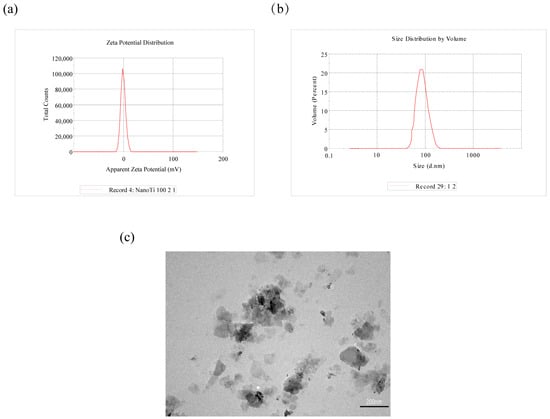
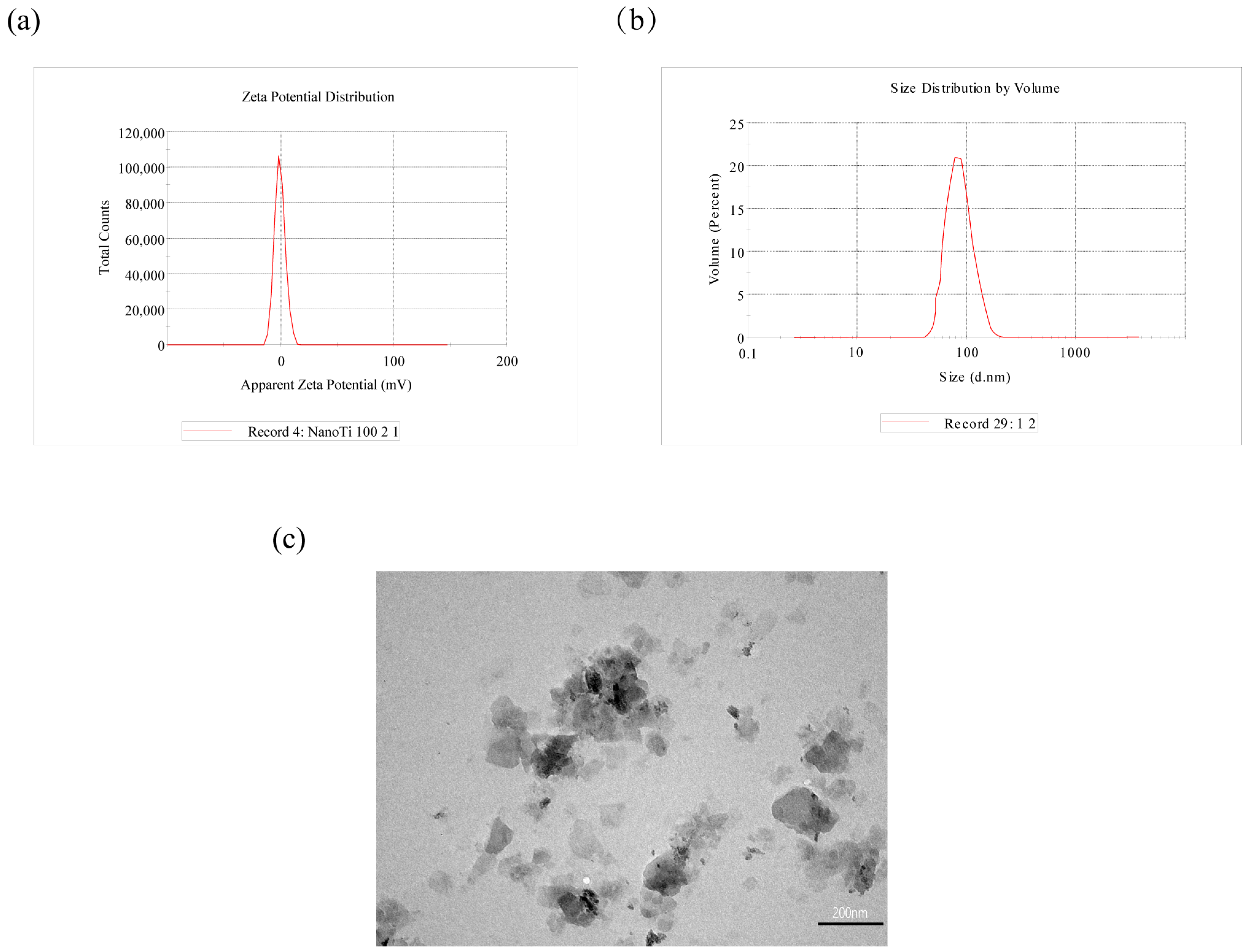
The zeta potential of n-TiO2 in suspension was measured at −1.2 mV using a Zetasizer nanoparticle analyzer (Figure 1a), with an average particle size distribution of 99.8 nm in the n-TiO2 exposure solution (Figure 1b). Transmission electron microscopy (TEM) observations and images (Figure 1c) revealed that n-TiO2 existed in aqueous solution as primary particles and small aggregates.
Figure 1.
Characterization of n-TiO2: (a) zeta potential of n-TiO2; (b) particle size distribution in n-TiO2 exposure solution; (c) transmission electron microscopy image of n-TiO2.
3.2. Developmental Toxicity
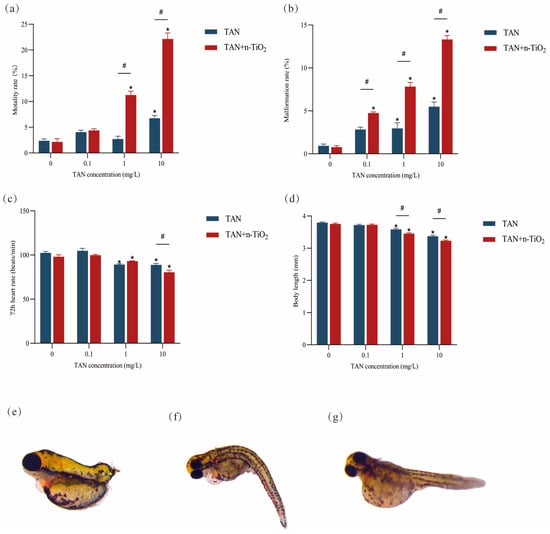
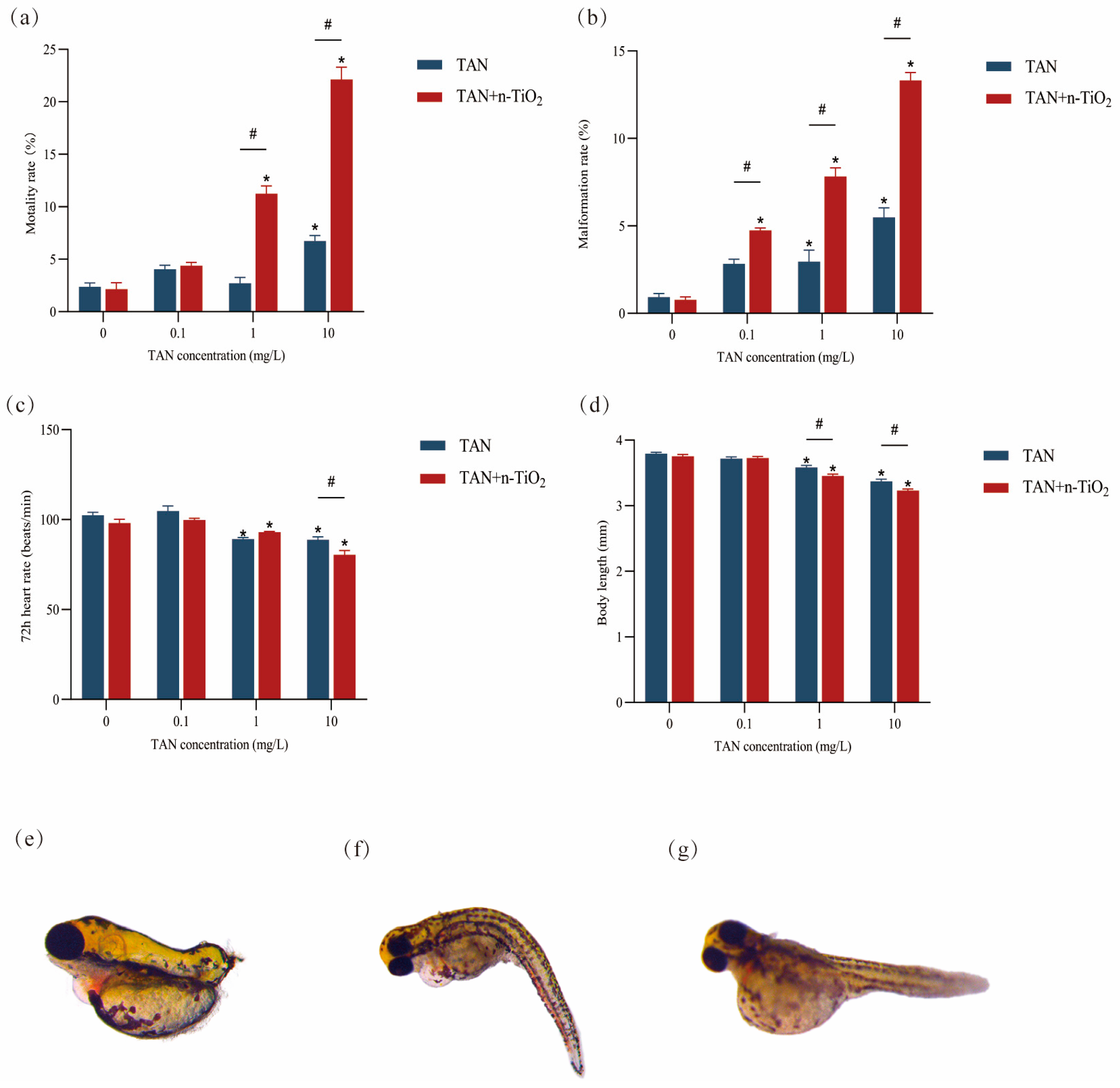
Statistical analysis was conducted on the mortality rate, malformation rate, heart rate, and body length of juvenile fish exposed to pollutants (Figure 2). Results indicated that exposure to n-TiO2 alone did not affect zebrafish development. Compared with the control group, mortality rates were significantly elevated in the 1 mg/L TAN + n-TiO2 group, the 10 mg/L TAN group, and the 10 mg/L TAN + n-TiO2 group (p < 0.05). Additionally, the malformation rate of zebrafish embryos significantly increased in the 1 mg/L TAN group, the 10 mg/L TAN group, and all combined exposure groups (p < 0.05). Regardless of exposure type, zebrafish larvae exhibited significantly reduced heart rate and body length in both the 1 mg/L TAN and 10 mg/L TAN groups (p < 0.05), with the decline being significantly greater in the high-concentration combined exposure group compared to the single-exposure group. Based on changes in toxicity endpoint indicators, n-TiO2 significantly exacerbated the adverse effects of TAN on zebrafish embryo development compared to TAN alone. Morphological observations were conducted on zebrafish larvae at 120 hpf. Larvae in the co-exposure groups exhibited a variety of severe malformations, including tail hypoplasia (Figure 2e), spinal curvature (Figure 2f), and yolk sac edema (Figure 2g).
Figure 2.
Zebrafish embryonic developmental endpoints and representative morphological malformations at 120 hpf: (a) mortality rate (%); (b) malformation rate (%); (c) heart rate (beats/min); (d) body length (mm); (e) representative image showing tail hypoplasia; (f) representative image showing spinal curvature; (g) representative image showing yolk sac edema. Data are presented as mean ± SEM (n = 3 independent experiments). Statistical significance was determined by one-way ANOVA with Tukey’s post hoc test. * indicates significant difference between control and exposed groups (p < 0.05); # indicates significant difference between TAN and n-TiO2 + TAN treatments (p < 0.05).
3.3. Behavioural Detection
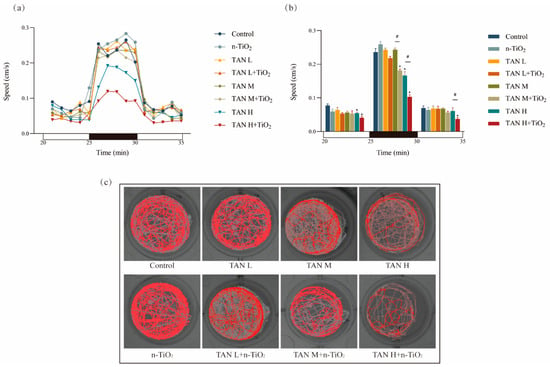
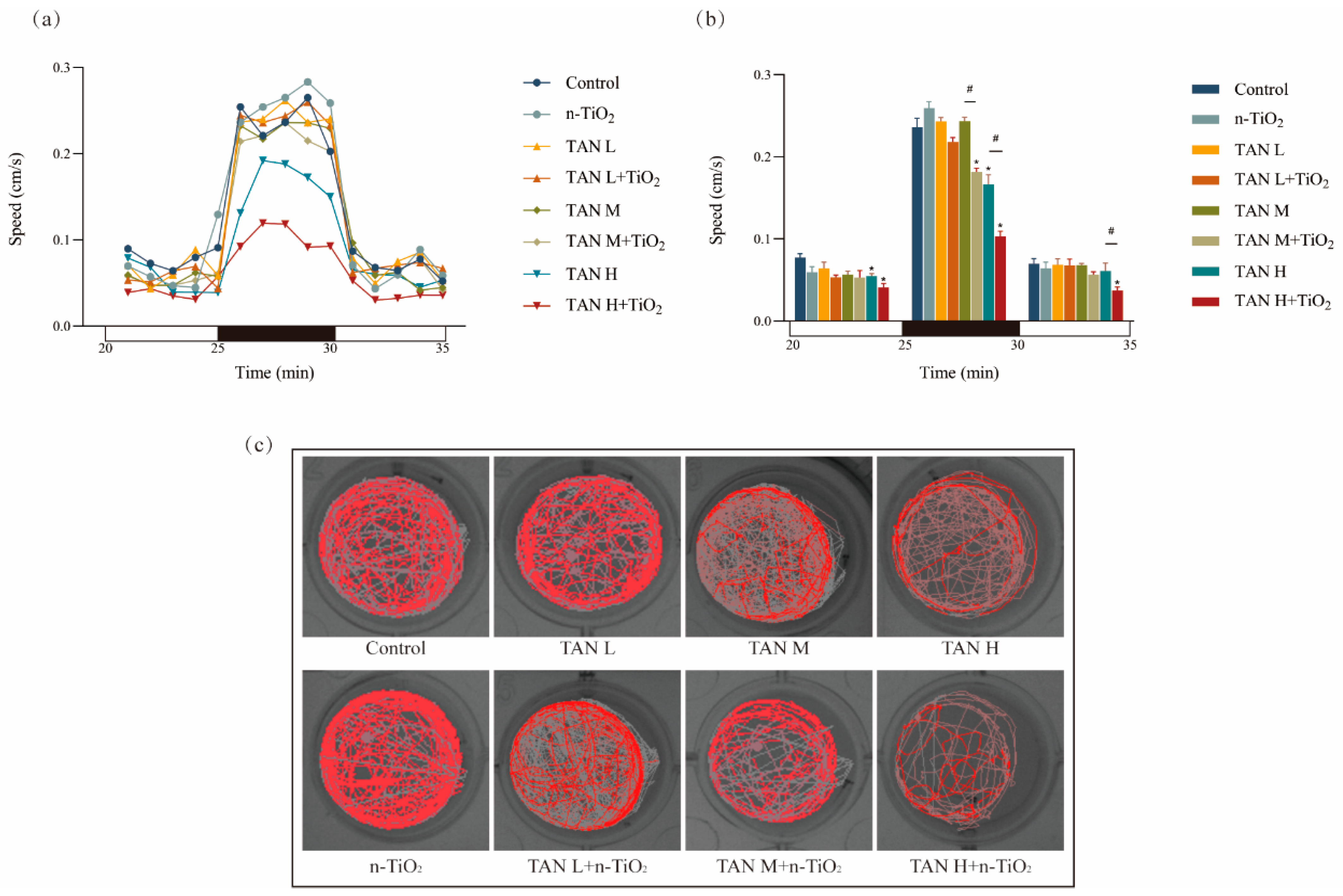
Swimming behavior of zebrafish larvae was further assessed at 120 hpf using the DanioVision™ (Noldus, Beijing, China) behavior system, with results shown in Figure 3. Findings revealed that swimming activity during the light period was reduced compared to the dark period. Compared to the control group, all three experimental groups, 10 mg/L TAN alone, 1 mg/L TAN + n-TiO2, and 10 mg/L TAN + n-TiO2, exhibited delayed activity decline during the transition from dark to light. Average larval activity was quantified during each 5 min photoperiod interval (Figure 3b). During the dark period, the average swimming speed of larvae in the 10 mg/L TAN + n-TiO2 group was significantly reduced. Figure 3c illustrates the movement trajectories of zebrafish larvae during the photoperiod.
Figure 3.
Locomotor behavior analysis of 120 hpf zebrafish larvae following 120 h exposure to TAN and n-TiO2: (a) mean swimming velocity (cm/s) recorded at 60-s intervals during light–dark transition stimulation. The horizontal axis shows dark phases (black bars, 25–30 min) and light phases (white bars, 20–25 min and 30–35 min); (b) average swimming speed (cm/s) calculated per 5 min photoperiod interval, summarizing locomotor activity during each light or dark phase; (c) representative movement trajectories of larvae during the dark phase (red curve); * indicates significant differences between the control and exposed groups (p < 0.05); # indicates significant difference between TAN and n-TiO2 + TAN treatments (p < 0.05). Note: TAN L: low-concentration TAN; TAN M: medium-concentration TAN; TAN H: high-concentration TAN.
3.4. TAN Content in Zebrafish Larvae
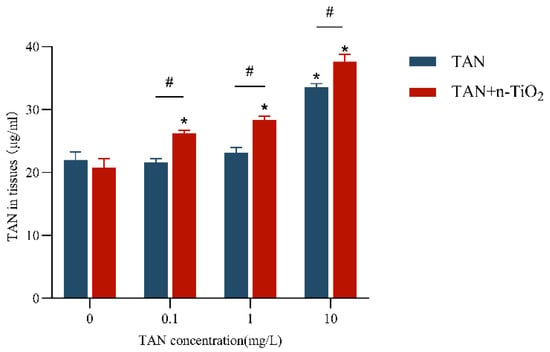
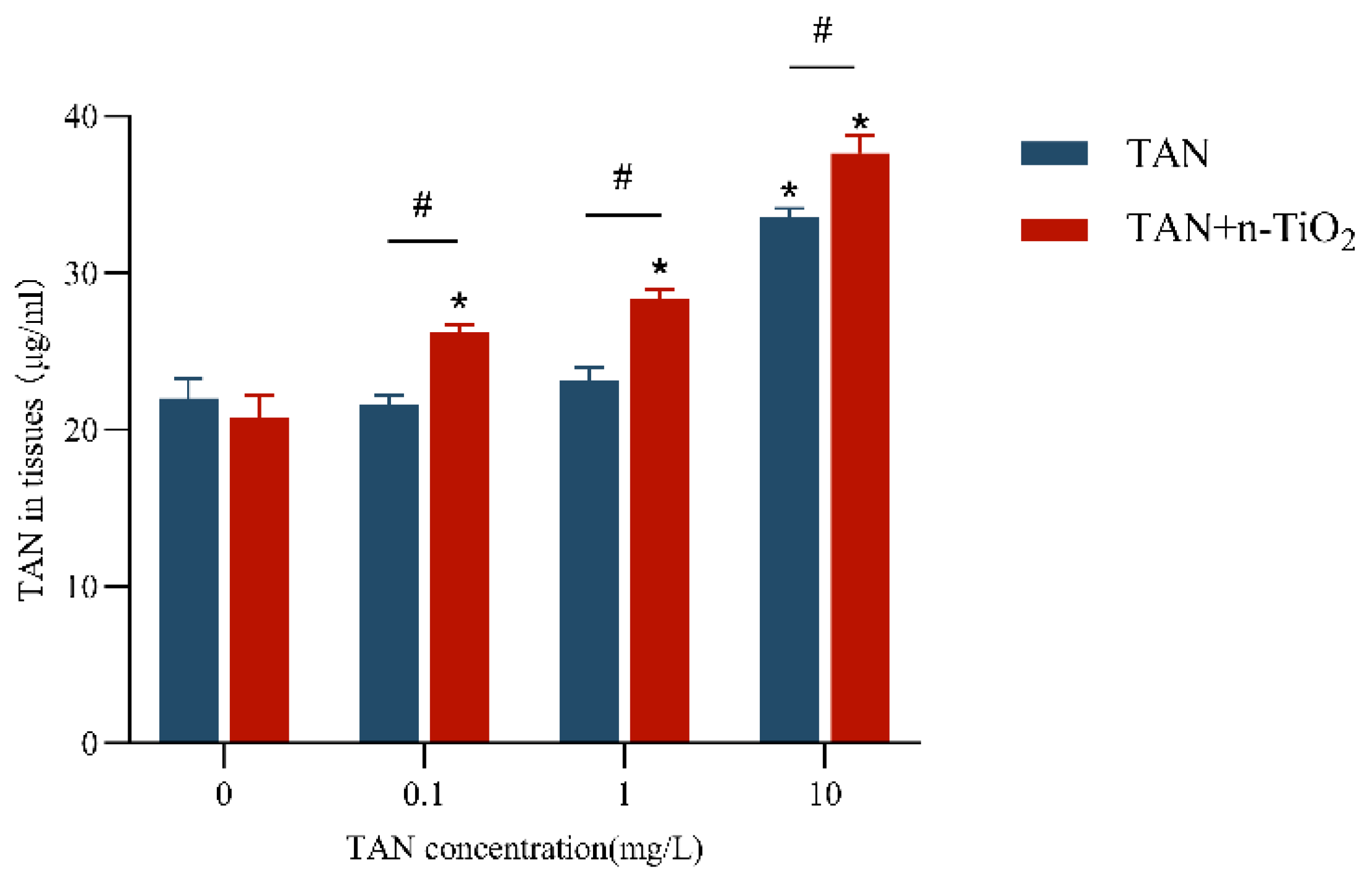
TAN levels were measured in tissues of zebrafish larvae (Figure 4). The results showed that in the group exposed to TAN alone, TAN content in the high-concentration (10 mg/L) TAN exposure group was significantly elevated compared to the control group (p < 0.05). Sole n-TiO2 exposure had no significant effect on TAN metabolism. However, when n-TiO2 and TAN were co-exposed, TAN levels significantly increased (p < 0.05) in both the low-concentration TAN group (0.1 mg/L) and the high-concentration TAN group (10 mg/L) compared to the TAN-only group. This indicated that n-TiO2 enhanced TAN accumulation.
Figure 4.
TAN content in zebrafish larvae following 120 h exposure. Quantification of total ammonia nitrogen accumulation in larval tissues after exposure to control, TAN alone (0.1, 1, 10 mg/L), n-TiO2 alone (100 µg/L), and co-exposure treatments. Data are presented as mean ± SEM (n = 3 biological replicates). * p < 0.05 vs. control group; # p < 0.05 between TAN alone and corresponding co-exposure groups.
3.5. Measurement of Oxidative Stress
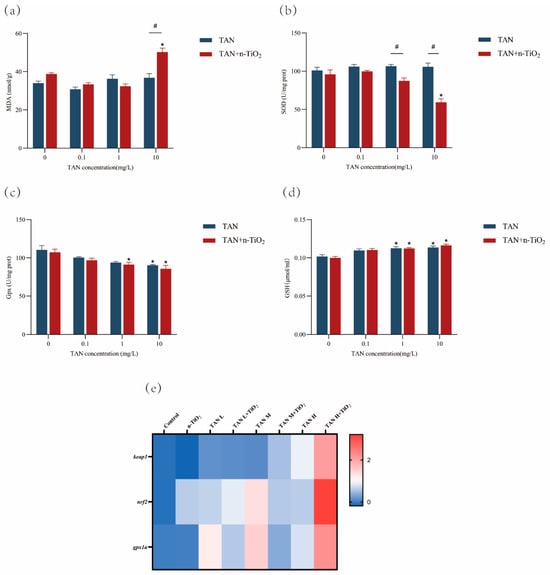
Assessment of oxidative stress markers revealed (Figure 5) that compared with the control group, exposure to n-TiO2 alone (100 µg/L) had no significant effect on MDA content, GSH levels, SOD, and Gpx activity. In the TAN-exposed group alone, MDA content showed no significant change. GSH levels in the 1 mg/L and 10 mg/L groups were significantly higher than those in the control group (p < 0.05). Gpx activity exhibited a decreasing trend with increasing concentrations, with activity in the 10 mg/L group significantly lower than the control group. When co-exposed to n-TiO2 and TAN, oxidative stress damage was further exacerbated. MDA content in the 10 mg/L TAN + n-TiO2 group was significantly higher than in the 10 mg/L TAN alone group. SOD activity showed a marked reduction in the 10 mg/L TAN + n-TiO2 group compared to the 10 mg/L TAN alone group. These results indicated that TAN exposure induced oxidative stress in zebrafish larvae, and the presence of n-TiO2 enhanced this effect.
Figure 5.
Oxidative stress markers in zebrafish larvae at 120 hpf following 120 h exposure: (a) MDA content; (b) SOD activity; (c) Gpx activity; (d) GSH content; (e) heatmap of oxidative stress-related gene expression levels, where values represent log2-transformed fold changes in gene expression. Data are presented as mean ± SEM (n = 3 biological replicates); * indicates significant differences between control and exposed groups (p < 0.05); # indicates significant differences between TAN and TAN + n-TiO2 treatment groups (p < 0.05).
3.6. AO Staining
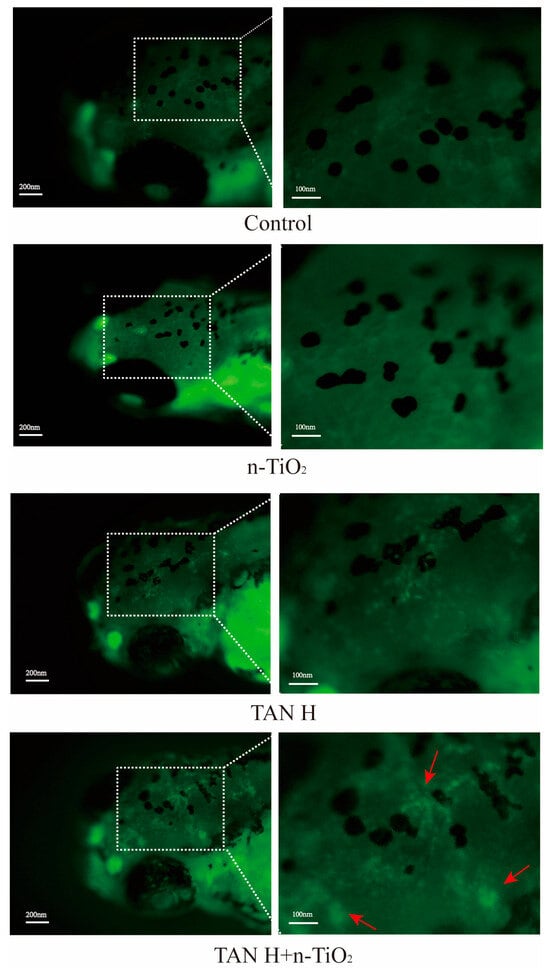
AO staining specifically labeled apoptotic cells (bright green fluorescence). Results are shown in Figure 6. The control group exhibited uniform green fluorescence overall, indicating normal cellular structure and nucleic acid distribution. The number of apoptotic cells in the n-TiO2 alone exposure group showed no significant difference compared to the control group. In the TAN alone exposure group, the number of apoptotic cells increased with rising concentration. The fluorescence intensity in neural tissues such as the brain and spinal cord was significantly enhanced in the 10 mg/L group. The combined exposure groups exhibited further increases in apoptotic cells. The fluorescence signal coverage was markedly expanded in the 10 mg/L TAN + n-TiO2 group, particularly in the midbrain and medulla regions, indicating that n-TiO2 exacerbated ammonia-induced neuronal apoptosis.
Figure 6.
AO Staining in 120 hpf zebrafish larvae. Red arrows indicate distinct apoptotic cell regions, with prominent fluorescent signals observed in neural tissues, including the brain and spinal cord. Imaging parameters were maintained consistent (ISO 100, f/11, 1/5 s).
3.7. Result of Caspase Enzyme Activity
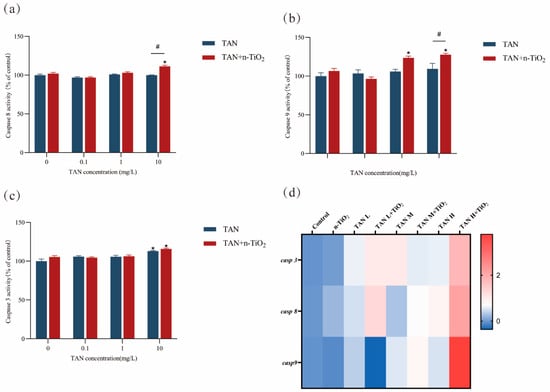
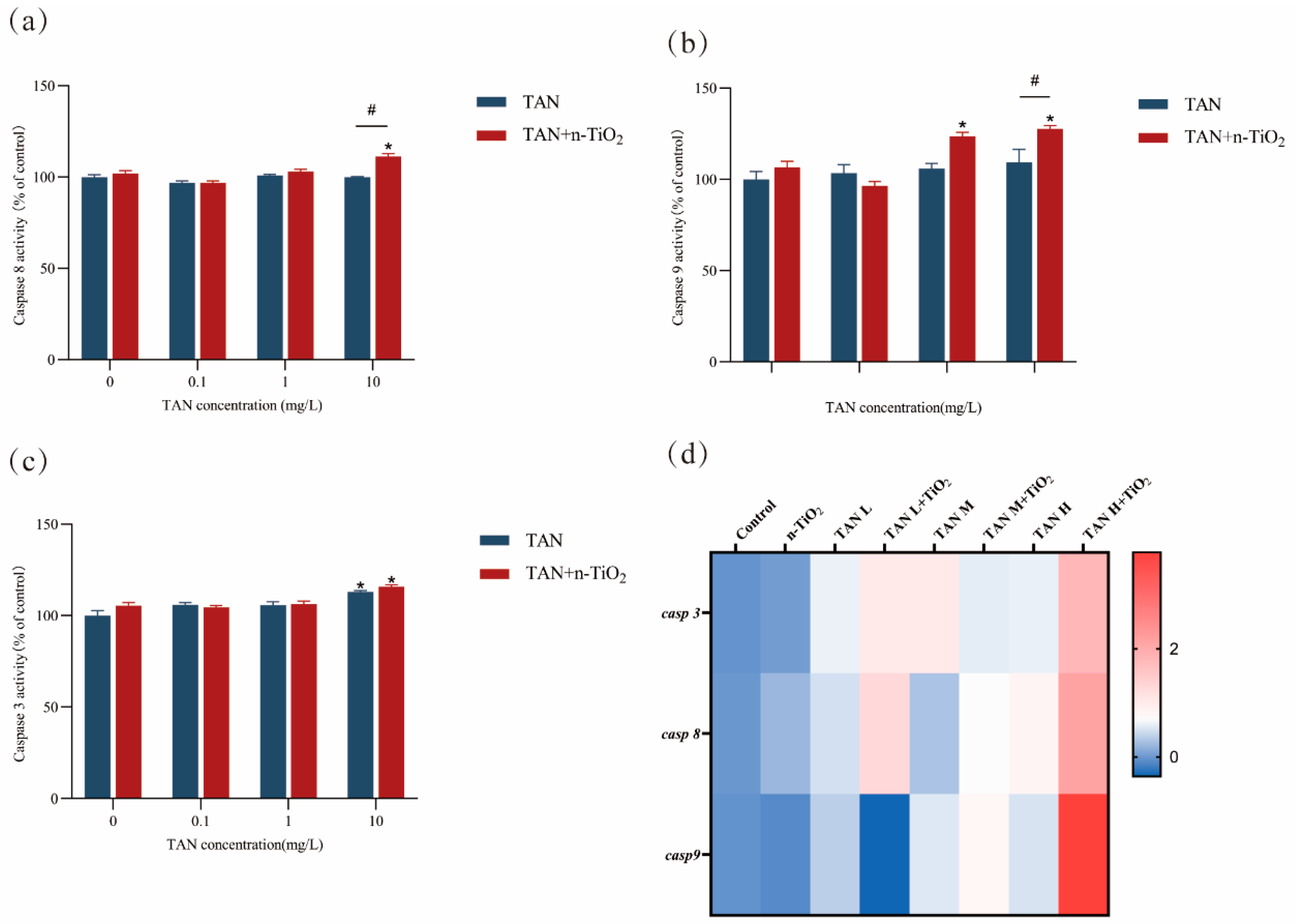
Results of caspase family activity assays (Figure 7) showed that, compared with the control group, exposure to n-TiO2 alone had no significant effect on Caspase 3, Caspase 8, and Caspase 9 activity. In the TAN-exposed group alone, Caspase 3 activity in the 10 mg/L group was significantly elevated compared to the control. In the 10 mg/L TAN + n-TiO2 group, Caspase 3, Caspase 8, and Caspase 9 activities were all significantly elevated, with Caspase 8 and Caspase 9 activities significantly higher than in the 10 mg/L TAN group (p < 0.05). Additionally, casp3, casp8, and casp9 were significantly upregulated in the 10 mg/L TAN + n-TiO2 group. This suggested that combined exposure exacerbates neuronal apoptosis by activating both intrinsic and extrinsic apoptotic pathways.
Figure 7.
Analysis of caspase activity and apoptosis-related gene expression in zebrafish larvae following 120-hour exposure: (a) Caspase 8 activity; (b) Caspase 9 activity; (c) Caspase 3 activity; (d) heatmap of relevant gene expression, with values derived from log2-transformed fold changes in gene expression. Data are presented as mean ± SEM (n = 3 biological replicates); * indicates significant differences between control and exposed groups (p < 0.05); # indicates significant differences between TAN and TAN + n-TiO2 treatment groups (p < 0.05).
3.8. Determination of AChE Activity and DA Content
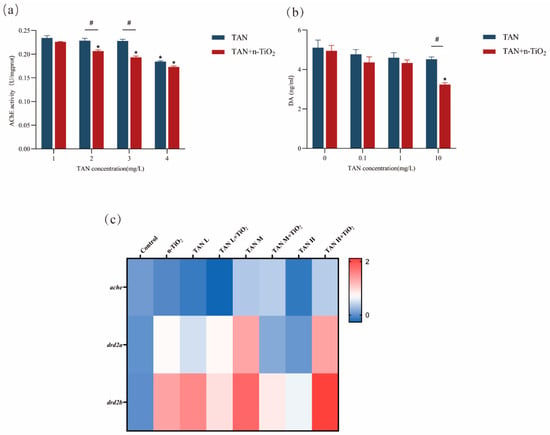
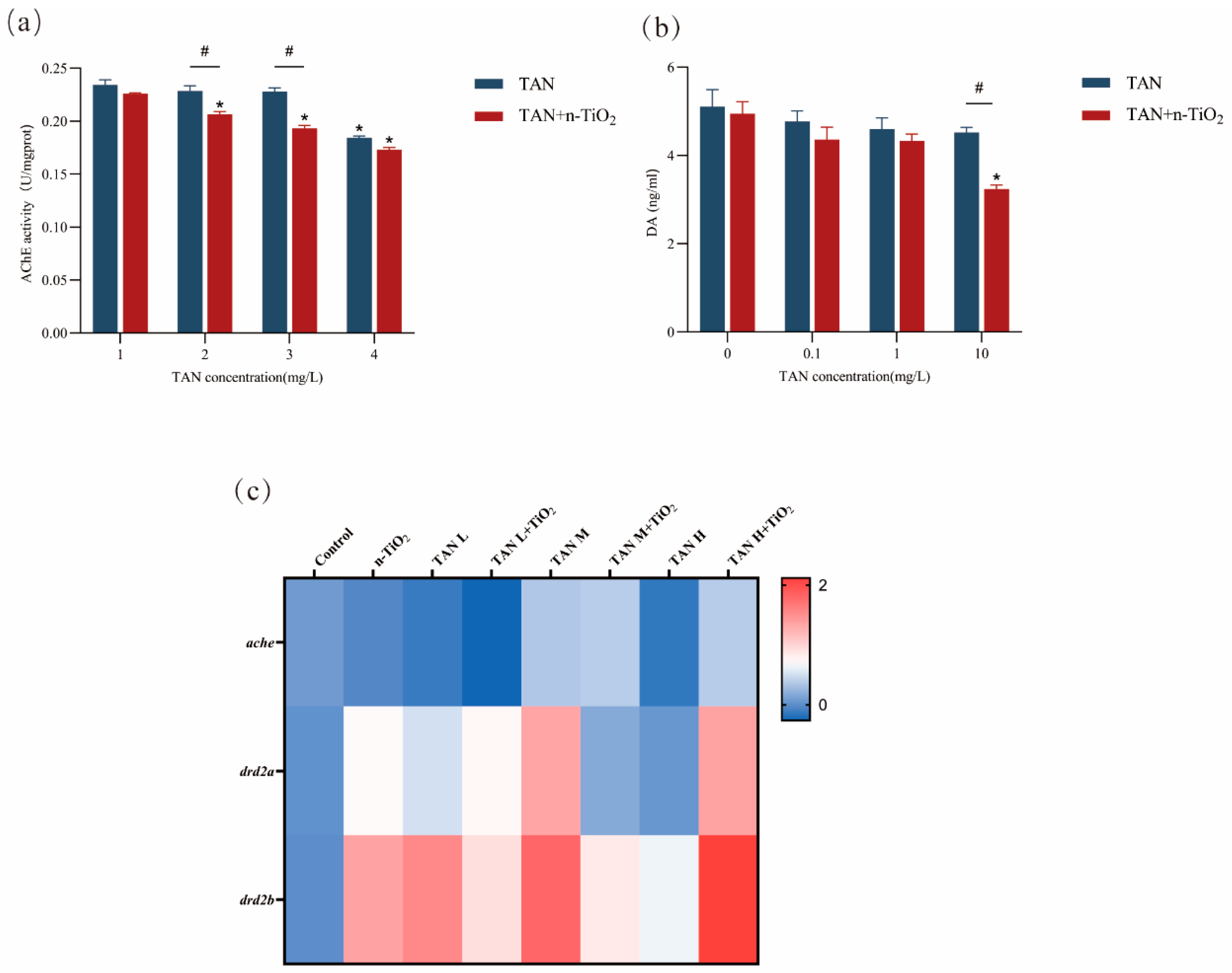
Neurotransmitter detection results (Figure 8) indicated that n-TiO2 exposure alone had no significant effect on DA content or AChE activity. Compared to the control group, AChE activity was significantly reduced in the 10 mg/L TAN group. AChE activity was significantly reduced in all combined exposure groups, with concentrations of 0.1 and 1 mg/L showing significantly lower AChE activity than their respective single-exposure counterparts. DA content was significantly reduced only in the 10 mg/L TAN + n-TiO2 group. Furthermore, compared to the single-exposure groups, gene expression levels of drd2a and drd2b were significantly upregulated.
Figure 8.
Analysis of AChE activity and DA content in zebrafish larvae following 120 h exposure: (a) AChE activity; (b) DA content; (c) heatmap of related gene expression levels, where values represent fold changes in gene expression log-transformed to base 2. Data are presented as mean ± SEM (n = 3 biological replicates); * indicates significant differences between control and exposed groups (p < 0.05); # indicates significant differences between TAN and TAN + n-TiO2 treatment groups (p < 0.05).
3.9. Result of Gene Expression
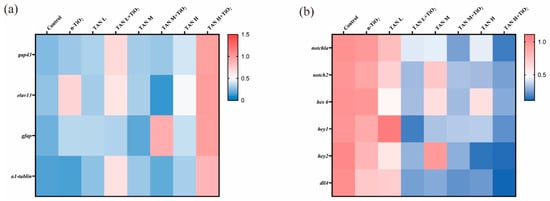
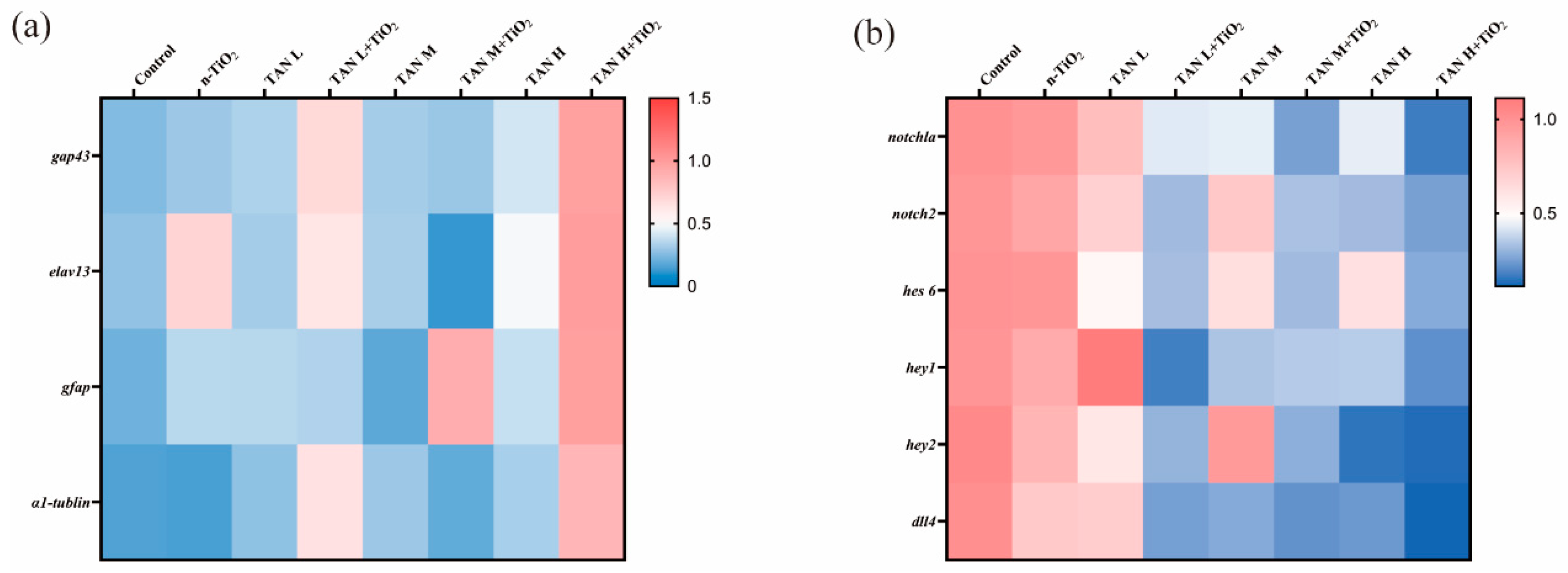
After 120 h of exposure, the expression levels of genes related to neural and retinal development in all groups of zebrafish larvae were detected (Figure 9a). Compared with the control group, the expression of gap43, elavl3, gfap, and a1-tubulin genes was significantly upregulated in the high-concentration combined exposure group (p < 0.05). Monitoring of Notch pathway-related genes showed (Figure 9b) that compared with the control group, the expression levels of notch1a, notch2, hes6, hey1, hey2, and dll4 genes were significantly decreased in the 10 mg/L TAN group (p < 0.05), and the combined exposure exacerbated this effect.
Figure 9.
Analysis of neural development and Notch pathway gene expression in zebrafish larvae after 120 h exposure: (a) heatmap of neural development-associated gene expression; (b) heatmap of Notch signaling pathway gene expression. Data represent log2-transformed fold changes relative to control from three independent biological replicates. Values indicate fold changes in gene expression log-transformed to base 2. Data are presented as mean ± SEM (n = 3 biological replicates).
3.10. Transcriptomic Analysis
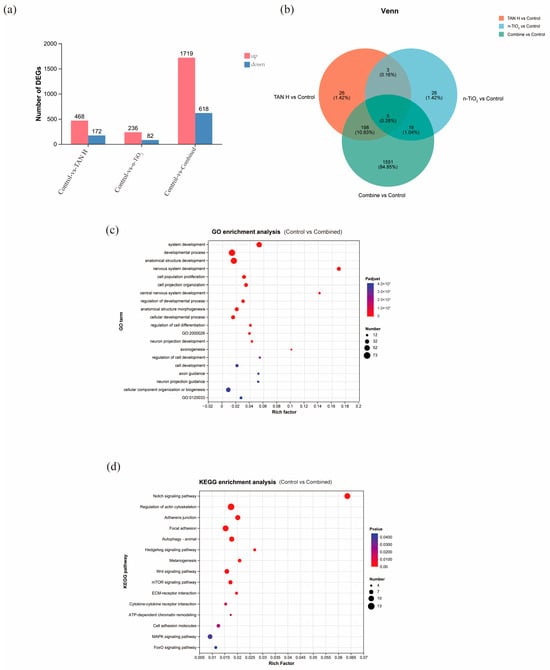
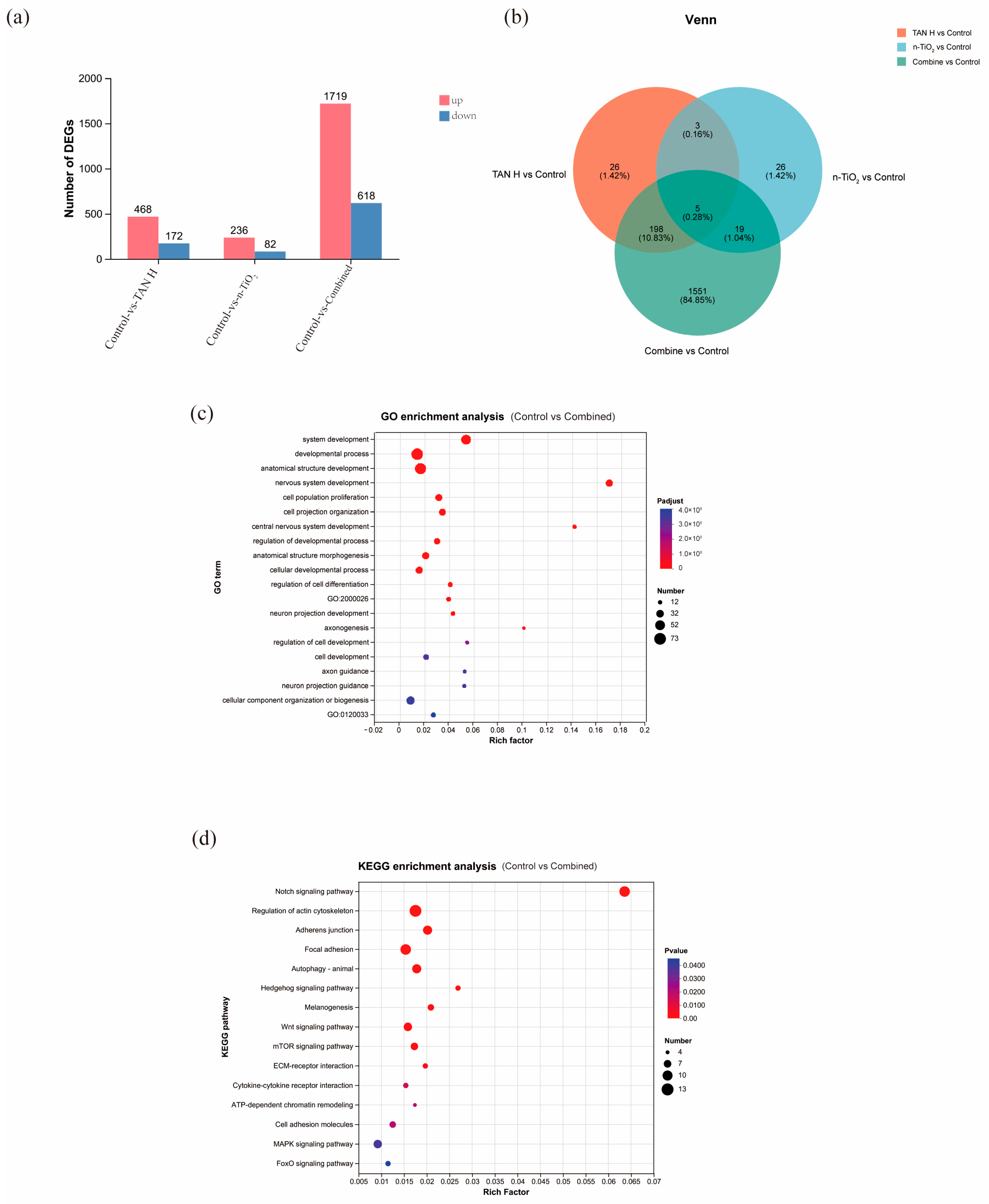
The transcriptomic analysis results are presented in Figure 10. Figure 10a displays the statistical distribution of differentially expressed genes across experimental groups. Compared with the control group, the co-exposure group exhibited 2337 differentially expressed genes, with 1719 being upregulated and 618 downregulated. Figure 10b presents the overlapping relationships of differentially expressed genes between each treatment group and the control group in Venn diagrams. Based on KEGG pathway annotation, we selected nervous system-related differentially expressed genes for further investigation. Systematic cluster analysis, GO functional annotation, and KEGG pathway enrichment analysis were conducted on the 74 selected nervous system-related differentially expressed genes. KEGG enrichment analysis indicates that TAN may affect nervous system function through the regulation of key signaling pathways, including Notch signaling, actin cytoskeleton reorganization, autophagy, Wnt signaling, and MAPK signaling pathways.
Figure 10.
(a) Number of differentially expressed genes among different treatment groups; (b) Venn diagram of differentially expressed gene sets between each treatment group and the control group; (c) GO enrichment bubble chart; (d) KEGG enrichment bubble chart.
4. Discussion
This study systematically investigated developmental neurotoxicity induced by the co-exposure of n-TiO2 and TAN in zebrafish embryos. Our results showed that while n-TiO2 (100 µg/L) alone at an environmentally relevant concentration induced no overt toxicity, its co-presence with TAN significantly exacerbated TAN-induced neurotoxicity. This synergistic effect manifested as developmental impairment, behavioral abnormalities, increased apoptosis, oxidative stress imbalance, and disruption of neurotransmitter systems. Collectively, our findings highlight the significant ecological risk posed by n-TiO2 as a potent enhancer of TAN-induced neurodevelopmental toxicity in aquatic organisms.
In the present study, our results indicated that n-TiO2 significantly enhances TAN accumulation in zebrafish. n-TiO2 has been reported to act as a carrier for environmental pollutants, potentially influencing their bioaccumulation in aquatic organisms [21]. Whether n-TiO2 can enter biological systems depends on its ability to penetrate biological membranes [22]. Previous research reported that zebrafish villi measure approximately 600 nm in size [23]. This study measured the average particle size of n-TiO2 in aqueous solution to be 99.8 nm, suggesting potential for n-TiO2 to penetrate villi and accumulate within zebrafish. Therefore, it is reasonable to speculate that n-TiO2 may act as a carrier for TAN, leading to significant TAN accumulation in the larvae and causing severe health impacts.
Motor behavior has been widely recognized as a critical indicator for the effects of toxic substances on zebrafish neurobehavior [24]. In the present study, we assessed the swimming behavior of zebrafish larvae after 120 h of exposure. The results showed that zebrafish larvae exhibited progressively slower activity in the TAN exposure group. Furthermore, compared to TAN exposure alone, a greater reduction in activity was observed in the n-TiO2-co-TAN exposure group, suggesting n-TiO2 could exacerbate TAN-induced neurotoxicity. Short-term sublethal TAN exposure induced neurotoxicity, altering fish behavior by increasing fear responses and decreasing schooling cohesion [9]. Xu et al. [25] found significant declines in fish activity levels and vitality after one day of exposure to 100 mg/L TAN solution. Xing et al. [26] demonstrated that polystyrene nanoplastics (PSNPs) exacerbate TAN-induced cholinergic system disruption in zebrafish, thereby altering their motor behavior. In addition, n-TiO2 is known to enhance the toxicity of other pollutants through its carrier effect. Wu et al. [16] found that co-exposure with n-TiO2 further aggravated brain tissue damage by intensifying the oxidative stress levels induced by MCLR. Therefore, the significant attenuation of zebrafish motility in the combined TAN and n-TiO2 exposure group may reflect the exacerbation of TAN-induced neurotoxicity in zebrafish embryos by n-TiO2.
Behavioral alterations in zebrafish are typically closely associated with oxidative damage to brain tissue [27]. In this experiment, TAN exposure significantly increased MDA levels and decreased GSH content in zebrafish larvae brains, while reducing SOD and Gpx activity. Concurrently, n-TiO2 presence amplified these changes. Studies indicate that elevated TAN concentrations in aquatic environments induce reactive oxygen species (ROS) production in aquatic organisms [28]. Excessive ROS production disrupts the cerebral redox balance and induces lipid peroxidation by reacting with unsaturated fatty acids and cholesterol in cell membranes [29]. This process reduces membrane fluidity, increases permeability, and generates oxidative byproducts such as MDA. As a hallmark of lipid peroxidation, MDA can cross-link with nucleic acids, proteins, and nucleophospholipids via its nucleophilic groups, leading to cytotoxic effects upon accumulation [30]. To counteract oxidative stress, the antioxidant defense system eliminates excess MDA through both enzymatic and non-enzymatic mechanisms [21]. SOD primarily catalyzes the dismutation of superoxide radicals [31], while GPx acts as a detoxifying agent by reducing lipid hydroperoxides to their corresponding alcohols and converting hydrogen peroxide to water, simultaneously oxidizing glutathione [32]. As a key non-enzymatic antioxidant, GSH plays critical roles in antioxidant defense, detoxification, and metabolic regulation, making it a central component of the antioxidant system [33]. Under physiological conditions, nrf2 binds to its inhibitor keap1 in the cytoplasm and undergoes rapid degradation. Upon oxidative stress, nrf2 dissociates from Keap1, translocates into the nucleus, binds to antioxidant response elements (AREs), and activates the transcription of various antioxidant and detoxification genes [34]. To further elucidate the mechanism of n-TiO2 exacerbating TAN-induced oxidative stress, we found that TAN exposure significantly induced the expression of the keap1, nrf2, and gpx1a genes. Notably, co-exposure to n-TiO2 markedly enhanced the upregulation of these genes. In conclusion, our findings provide compelling evidence that n-TiO2 exacerbates TAN-induced swimming abnormalities and neurotoxicity in zebrafish embryos by intensifying oxidative stress.
Apoptosis is a critically involved process in the developmental neurotoxicity of environmental pollutants [35]. As a form of programmed cell death, apoptosis undergoes precise and stringent regulation, playing an irreplaceable and pivotal role in the normal growth and development of organisms [36]. Previous research has proven that TAN could induce apoptosis in the organs of the dark-striped pufferfish [37]. In this experiment, AO staining results revealed that apoptotic cells were concentrated in neural tissues such as the brain and spinal cord, with stronger signals observed in the combined exposure group. To delineate the molecular mechanisms, we investigated the caspase-dependent pathways. Caspase 8 and caspase 9, upon stimulation by cytochrome C, initiate a downstream caspase cascade. Once activated, Caspase 3 acts as the primary executor of apoptosis, enhancing its efficiency [38]. Lin et al. [39] found that TAN exposure elevated transcription levels of the apoptosis gene casp3 in zebrafish embryos, thereby inducing keratinocyte apoptosis. In this study, both Caspase 3, Caspase 8, Caspase 9 enzyme activity and casp3, casp8, and casp9 gene expression were significantly upregulated in the combined exposure group, indicating that n-TiO2 could exacerbate TAN-induced apoptosis through a caspase-dependent pathway.
Another potential mechanism for neurotoxicity induced by n-TiO2 and TAN involves cholinergic system disruption. During early life stages of zebrafish, AChE within the cholinergic system is essential for neuronal and muscular development [40]. In this study, we observed a concentration-dependent inhibition of AChE activity by TAN, which was significantly potentiated by n-TiO2 co-exposure. AChE catalyzes the hydrolysis of acetylcholine in the synaptic cleft, playing a crucial role in neural signaling. It serves as a biomarker for detecting developmental neurotoxicity and correlates with motor behavior; changes in its activity are important indicators for assessing neurotoxicity [41]. Xing et al. [26] demonstrated that exposure to PSNPs and TAN induces developmental neurotoxicity in zebrafish embryos by altering AChE activity and ache gene expression. Therefore, n-TiO2 may exacerbate TAN-induced neurotoxicity by altering AChE activity in zebrafish. Additionally, the mechanism by which combined exposure to n-TiO2 and TAN induces neurotoxicity in zebrafish may also involve alterations in dopaminergic neurons [42]. Previous studies reported that dopamine plays an important role in motor control, cognition, and motivation, particularly in the development of dopaminergic neurons and circuits [43,44]. In the present study, we found that dopamine levels and gene expression of related genes (drd2a and drd2b) in zebrafish changed progressively following TAN exposure, with n-TiO2 exacerbating this trend. The synergistic disruption of both cholinergic and dopaminergic systems by n-TiO2 and TAN offers a physiological basis for the severe neurobehavioral deficits observed.
Given the close association between early swimming behavior and nervous system development in zebrafish, this study analyzed the expression of central nervous system-related genes (gap43, elavl3, gfap, and α1-tubulin). A marked dysregulation of these genes was observed, which was significantly amplified in the co-exposure group. Functionally, these genes can be categorized into three groups: gap43 and α1-tubulin are involved in axonal growth and neuronal cytoskeleton assembly, regulating axonal regeneration and microtubule formation, respectively [45,46,47]; elavl3 serves as a key marker gene for nervous system development, maintaining normal neuronal function [48,49]; and gfap reflects the cytoskeletal integrity of astrocytes [50,51]. Previous studies have shown that upregulation of axon-related genes following tris (1,3-dichloroisopropyl) phosphate and dechlorane plus exposure often represents a compensatory response to axonal growth inhibition [52,53]. The gene expression patterns observed in this experiment are consistent with this phenomenon, suggesting that the upregulation is likely a compensatory mechanism for impaired neuronal axon development. Notably, n-TiO2 co-exposure intensified this dysregulation, which strongly suggests a more severe underlying damage to neuronal development. Therefore, we conclude that the synergistic disruption of these critical neurodevelopmental processes, from axonal growth to astrocyte function, constitutes a key molecular mechanism underlying the exacerbated behavioral abnormalities. This mechanism is likely driven by the previously demonstrated role of n-TiO2 in enhancing TAN bioaccumulation, leading to more profound neurodevelopmental damage.
To systematically elucidate the neurotoxic mechanisms of ammonia in zebrafish, this study conducted an in-depth analysis using transcriptome sequencing technology. Based on the screened nervous system-related differentially expressed genes, we performed systematic cluster analysis and functional enrichment analysis. The results showed significant alterations in neuronal development-related pathways as well as oxidative stress and apoptosis-related pathways. Existing studies reported that the Wnt/β-catenin signaling pathway plays a crucial role in key biological processes, including neural development, cell survival, cell cycle regulation, and microglial activation [54]. This signaling pathway possesses multidimensional core regulatory functions in nervous system development, functional maintenance, and neural repair. Our findings suggest that n-TiO2 and TAN may affect nervous system development by modulating this pathway. As an important stress response mechanism in eukaryotic cells, autophagy achieves degradation and recycling of organelles and proteins through the lysosomal pathway. Research demonstrated that during neural development and neuronal homeostasis maintenance, autophagy participates in regulating key physiological processes, including presynaptic function, synaptic remodeling, and synaptic plasticity [55,56]. The MAPK signaling pathway, serving as a core regulatory pathway for neurophysiological function and pathological damage, has been confirmed as a common target for various neurotoxic substances (including mycotoxins and environmental pollutants) [57]. Abnormal activation or inhibition of this pathway disrupts the dynamic balance between neuronal apoptosis and survival, ultimately leading to neuronal damage. Our findings indicate that n-TiO2 and TAN may produce neurotoxic effects by synergistically affecting these key signaling pathways, particularly through interfering with neuronal development processes and stress response mechanisms.
To validate our transcriptomic findings, we quantified the expression of key genes within the Notch signaling pathway (notch1a, notch2, hes6, hey1, hey2, and dll4). The Notch signaling pathway represents a central regulatory pathway in the development of multiple organ systems, including hematopoiesis, angiogenesis, and neurogenesis [58]. Previous studies have demonstrated that Notch activation downregulates Xic1 gene transcription and inhibits primordial neuron formation [59]. Furthermore, Notch has been shown to regulate apoptosis in early neural progenitor cells [60]. Despite its pivotal role, a potential connection between TAN-induced neurodevelopmental defects and Notch signaling had not been established. Our qPCR results demonstrated that TAN exposure suppresses the Notch signaling pathway, an effect that was significantly potentiated by n-TiO2 co-exposure. This identifies the Notch pathway as a novel and previously unrecognized target for TAN-mediated neurodevelopmental toxicity. Nevertheless, the precise molecular initiation event represents an important focus for future research.
5. Conclusions
In conclusion, this study demonstrates that n-TiO2 acts as a critical enhancer of TAN-induced developmental neurotoxicity in zebrafish. The exacerbated toxicity is driven by a multi-mechanistic synergy, wherein n-TiO2 promotes the bioaccumulation of TAN, which in turn leads to severe oxidative stress, amplified neuronal apoptosis, and concurrent disruption of the cholinergic and dopaminergic systems, ultimately manifesting as impaired neural development and locomotor deficits. Future research should focus on elucidating the molecular mechanisms underlying the synergistic interaction between TAN and n-TiO2, exploring effective environmental monitoring and remediation strategies to mitigate the potential risks posed by these two pollutants to aquatic ecosystems and human health. Concurrently, studies on the combined toxicity of other common pollutants should be intensified to provide a more robust scientific basis for comprehensively assessing the ecological and health risks of environmental contaminants.
Supplementary Materials
The following supporting information can be downloaded at: https://www.mdpi.com/article/10.3390/toxics13121031/s1, Figure S1: larval distribution pattern; Table S1: Gene primer sequence.
Author Contributions
M.L.: Investigation, Data curation, Visualization, Writing—original draft, Writing—review and editing. J.Y.: Investigation, Data curation, Visualization, Writing—original draft, Writing—review and editing. Q.Y.: Methodology, Conceptualization, Writing—review and editing, Project administration, Funding acquisition. Y.S.: Investigation, Data curation. H.L.: Investigation, Writing—review and editing. X.W.: Data curation. X.L.: Data curation, Writing—original draft. F.S.: Writing—review and editing, Validation. X.Z.: Writing—review and editing, Validation. J.Z.: Writing—review and editing, Supervision, Investigation. G.L.: Writing—original draft, Writing—review and editing, Investigation. X.M.: Writing—review and editing, Supervision, Investigation. All authors have read and agreed to the published version of the manuscript.
Funding
This work was supported by the National Key Research and Development Program of China (No. 2022YFC3203905).
Institutional Review Board Statement
Not applicable.
Informed Consent Statement
Not applicable.
Data Availability Statement
The datasets used and/or analyzed during the current study are available from the corresponding author upon reasonable request.
Conflicts of Interest
The authors declare no conflicts of interest in the present experiment.
References
- Cheng, C.H.; Ma, H.L.; Su, Y.L.; Deng, Y.Q.; Feng, J.; Xie, J.W.; Chen, X.L.; Guo, Z.X. Ammonia toxicity in the mud crab (Scylla paramamosain): The mechanistic insight from physiology to transcriptome analysis. Ecotoxicol. Environ. Saf. 2019, 179, 9–16. [Google Scholar] [CrossRef] [Scilit]
- Snelder, T.H.; Whitehead, A.L.; Fraser, C.; Larned, S.T.; Schallenberg, M. Nitrogen loads to New Zealand aquatic receiving environments: Comparison with regulatory criteria. N. Z. J. Mar. Freshw. Res. 2020, 54, 527–550. [Google Scholar] [CrossRef] [Scilit]
- Cong, M.; Wu, H.; Yang, H.; Zhao, J.; Lv, J. Gill damage and neurotoxicity of ammonia nitrogen on the clam Ruditapes philippinarum. Ecotoxicology 2017, 26, 459–469. [Google Scholar] [CrossRef] [Scilit]
- Jiang, D.D.; Chen, Q.; Ding, D.; Zhou, Y.; Xie, W.; Xia, F.; Li, M.; Jing Wei Chen, Y.; Deng, S. Derivation of human health and odor risk control values for soil ammonia nitrogen by incorporating solid-liquid partitioning, ammonium/ammonia equilibrium: A case study of a retired nitrogen fertilizer site in China. Ecotoxicol. Environ. Saf. 2024, 273, 116133. [Google Scholar] [CrossRef] [Scilit]
- Hu, J.; Cai, T.; Klümper, U.; Luo, L.; Zhu, Y.; He, Y. Novel multi-drug-resistant yeast efficiently removed ammonia nitrogen from antibiotic-contaminated aquaculture water. Int. Biodeterior. Biodegrad. 2025, 203, 106111. [Google Scholar] [CrossRef] [Scilit]
- Wang, X.N.; Chen, J.; Cui, L.; Li, W.; Gao, X.Y.; Liu, Z.T. Water quality criteria of total ammonia nitrogen (TAN) and un-ionized ammonia (NH3-N) and their ecological risk in the Liao River, China. Chemosphere 2020, 243, 125328. [Google Scholar] [CrossRef] [Scilit]
- Randall, D.J.; Tsui, T.K.N. Ammonia toxicity in fish. Mar. Pollut. Bull. 2002, 45, 17–23. [Google Scholar] [CrossRef] [Scilit] [PubMed]
- He, Y.; Ouyang, K.; Yang, H.; Wang, L.; Wang, X.; Li, D.; Li, L. The impact of ammonia and microcystin-LR on neurobehavior and glutamate/gamma-aminobutyric acid balance in female zebrafish (Danio rerio): ROS and inflammation as key pathways. Sci. Total Environ. 2024, 920, 170914. [Google Scholar] [CrossRef] [Scilit]
- Lin, L.Y.; Horng, J.L.; Cheng, C.A.; Chang, C.Y.; Cherng, B.W.; Liu, S.T.; Chou, M.Y. Sublethal ammonia induces alterations of emotions, cognition, and social behaviors in zebrafish (Danio rerio). Ecotoxicol. Environ. Saf. 2022, 244, 114058. [Google Scholar] [CrossRef] [Scilit]
- Chandoliya, R.; Sharma, S.; Sharma, V.; Joshi, R.; Sivanesan, I. Titanium dioxide nanoparticle: A comprehensive review on synthesis, applications and toxicity. Plants 2024, 13, 2964. [Google Scholar] [CrossRef] [Scilit]
- Chang, X.; Zhang, Y.; Tang, M.; Wang, B. Health effects of exposure to nano-TiO2: A meta-analysis of experimental studies. Nanoscale Res. Lett. 2013, 8, 51. [Google Scholar] [CrossRef] [Scilit]
- Zhao, J.; Lin, M.Q.; Wang, Z.Y.; Cao, X.S.; Xing, B.S. Engineered nanomaterials in the environment: Are they safe? Crit. Rev. Environ. Sci. Technol. 2021, 51, 1443–1478. [Google Scholar] [CrossRef] [Scilit]
- Gottschalk, F.; Sonderer, T.; Scholz, R.W.; Nowack, B. Modeled environmental concentrations of engineered nanomaterials (TiO2, ZnO, Ag, CNT, Fullerenes) for different regions. Environ. Sci. Technol. 2009, 43, 9216–9222. [Google Scholar] [CrossRef] [Scilit] [PubMed]
- Wang, Q.W.; Chen, Q.; Zhou, P.; Li, W.W.; Wang, J.X.; Huang, C.J.; Wang, X.F.; Lin, K.F.; Zhou, B.S. Bioconcentration and metabolism of BDE-209 in the presence oftitanium dioxidenanoparticles and impact on the thyroid endocrine system and neuronal developmentin zebrafish larvae. Nanotoxicology 2014, 8, 196–207. [Google Scholar] [CrossRef] [Scilit]
- Bakir, M.; Abad-Alvaro, I.; Laborda, F.; Slaveykova, V.I. Comparative assessment of uptake and effects of TiO2 and CeO2 nanoparticles in Algae using advanced single-entity analytical techniques. Aquat. Toxicol. 2025, 286, 107430. [Google Scholar] [CrossRef] [Scilit] [PubMed]
- Wu, Q.; Yan, W.; Liu, C.; Hung, T.C.; Li, G.Y. Co-exposure with titanium dioxide nanoparticles exacerbates MCLR-induced brain injury in zebrafish. Sci. Total Environ. 2019, 693, 133540. [Google Scholar] [CrossRef] [Scilit]
- Fan, B.; Dai, L.; Liu, C.; Sun, Q.; Yu, L. Nano-TiO2 aggravates bioaccumulation and developmental neurotoxicity of triphenyl phosphate in zebrafish larvae. Chemosphere 2022, 287 Pt 3, 132161. [Google Scholar] [CrossRef] [Scilit] [PubMed]
- Faria, M.; Navas, J.M.; Soares, A.M.V.M.; Barata, C. Oxidative stress effects of titanium dioxide nanoparticle aggregates in zebrafish embryos. Sci. Total Environ. 2014, 470, 379–389. [Google Scholar] [CrossRef] [Scilit]
- Ihtisham, M.; Noori, A.; Yadav, S.; Sarraf, M.; Kumari, P.; Brestic, M.; Imran, M.; Jiang, F.; Yan, X.; Rastogi, A. Silver nanoparticle’s toxicological effects and phytoremediation. Nanomaterials 2021, 11, 2164. [Google Scholar] [CrossRef] [Scilit]
- Patel, U.D.; Srinivasan, M.R. Zebrafish: An Animal Model in Biomedical Research. In Animal Models in Research; Vijayakumar Sreelatha, H., Patel, S., Nagarajan, P., Eds.; Springer: Singapore, 2024. [Google Scholar]
- Wu, S.M.; Liu, J.H.; Shu, L.H.; Chen, C.H. Anti-oxidative responses of zebrafish (Danio rerio) gill, liver and brain tissues upon acute cold shock. Comp. Biochem. Physiol. Part A Mol. Integr. Physiol. 2015, 187, 202–213. [Google Scholar] [CrossRef] [Scilit]
- Bouwmeester, H.; Hollman, P.C.H.; Peters, R.J.B. Potential Health Impact of Environmentally Released Micro- and Nanoplastics in the Human Food Production Chain: Experiences from Nanotoxicology. Environ. Sci. Technol. 2015, 49, 8932–8947. [Google Scholar] [CrossRef] [Scilit]
- Pitt, J.A.; Kozal, J.S.; Jayasundara, N.; Massarsky, A.; Trevisan, R.; Geitner, N.; Wiesner, M.; Levin, E.D.; Di Giulio, R.T. Uptake, tissue distribution, and toxicity of polystyrene nanoparticles in developing zebrafish (Danio rerio). Aquat. Toxicol. 2018, 194, 185–194. [Google Scholar] [CrossRef] [Scilit]
- Fouke, K.E.; He, Z.; Loring, M.D.; Naumann, E.A. Neural circuits underlying divergent visuomotor strategies of zebrafish and Danionella cerebrum. Curr. Biol. 2025, 35, 2457–2466. [Google Scholar] [CrossRef] [Scilit]
- Xu, W.; Zhu, Z.; Ge, F.; Han, Z.; Li, J. Analysis of behavior trajectory based on deep learning in ammonia environment for fish. Sensors 2020, 20, 4425. [Google Scholar] [CrossRef] [Scilit] [PubMed]
- Xing, D.; Zheng, W.; Zhou, H.; Li, G.; Li, Y.; Jia, J.; Liu, H.; Luan, N.; Liu, X. Polystyrene nanomicroplastics aggravate ammonia-induced neurotoxic effects in zebrafish embryos. Toxics 2024, 12, 853. [Google Scholar] [CrossRef] [Scilit] [PubMed]
- Desai, J.K.; Trangadia, B.J.; Patel, U.D.; Patel, H.B.; Kalaria, V.A.; Kathiriya, J.B. Neurotoxicity of 4-nonylphenol in adult zebrafish: Evaluation of behaviour, oxidative stress parameters and histopathology of brain. Environ. Pollut. 2023, 334, 122206. [Google Scholar] [CrossRef] [Scilit] [PubMed]
- Zhang, C.N.; Ma, J.S.; Qi, Q.; Xu, M.J.; Xu, R.Y. Effects of ammonia exposure on anxiety behavior, oxidative stress and inflammation in guppy (Poecilia reticulate). Comp. Biochem. Physiol. C Toxicol. Pharmacol. 2023, 265, 109539. [Google Scholar] [CrossRef] [Scilit]
- Al-Gubory, K.H. Environmental pollutants and lifestyle factors induce oxidative stress and poor prenatal development. Reprod. BioMed. Online 2014, 29, 17–31. [Google Scholar] [CrossRef] [Scilit]
- Riggins, J.N.; Pratt, D.A.; Voehler, M.; Daniels, J.S.; Marnett, L.J. Kinetics and mechanism of the General-Acid-Catalyzed Ring-Closure of the Malondialdehyde-DNA Adduct, N2-(3-Oxo-1-propenyl)deoxyguanosine (N2OPdG-), to 3-(2’-Deoxy-β-d-erythro-pentofuranosyl)pyrimido[1,2-α]purin-10(3H)-one (M1dG). J. Am. Chem. Soc. 2004, 126, 10571–10581. [Google Scholar] [CrossRef] [Scilit]
- Hernández, J.A.; López-Sánchez, R.C.; Rendón-Ramírez, A. Lipids and Oxidative Stress Associated with Ethanol-Induced Neurological Damage. Oxidative Med. Cell. Longev. 2016, 2016, 1543809. [Google Scholar] [CrossRef] [Scilit]
- Flohé, L.; Toppo, S.; Orian, L. The glutathione peroxidase family: Discoveries and mechanism. Free Radic. Biol. Med. 2022, 187, 113–122. [Google Scholar] [CrossRef] [Scilit]
- Pisoschi, A.M.; Pop, A. The role of antioxidants in the chemistry of oxidative stress: A review. Eur. J. Med. Chem. 2015, 97, 55–74. [Google Scholar] [CrossRef] [Scilit] [PubMed]
- Sajadimajd, S.; Khazaei, M. Oxidative Stress and Cancer: The Role of Nrf2. Curr. Cancer Drug Targets 2018, 18, 538–557. [Google Scholar] [CrossRef] [Scilit]
- Gyimah, E.; Zhu, X.; Zhang, Z.; Guo, M.; Xu, H.; Mensah, J.K.; Dong, X.; Zhang, Z.; Gyimah, G.N.W. Oxidative stress and apoptosis in Bisphenol AF-induced neurotoxicity in zebrafish embryos. Environ. Toxicol. Chem. 2022, 41, 2273–2284. [Google Scholar] [CrossRef] [Scilit] [PubMed]
- Nagata, S. Apoptosis and clearance of apoptotic cells. Annu. Rev. Immunol. 2018, 36, 489–517. [Google Scholar] [CrossRef] [Scilit]
- Cheng, C.H.; Yang, F.F.; Ling, R.Z.; Liao, S.A.; Miao, Y.T.; Ye, C.X.; Wang, A.L. Effects of ammonia exposure on apoptosis, oxidative stress and immune response in pufferfish (Takifugu obscurus). Aquat. Toxicol. 2015, 164, 61–71. [Google Scholar] [CrossRef] [Scilit]
- Brentnall, M.; Rodriguez-Menocal, L.; De Guevara, R.L.; Cepero, E.; Boise, L.H. Caspase9, Caspase 3 and Caspase 7 have distinct roles during intrinsic apoptosis. BMC Mol. Cell Biol. 2013, 14, 32. [Google Scholar]
- Lin, L.Y.; Cheng, C.A.; Liu, S.T.; Horng, J.L. Investigation of ammonia-induced lethal toxicity toward ion regulation in zebrafish embryos. Comp. Biochem. Physiol. Part C Toxicol. Pharmacol. 2024, 276, 109807. [Google Scholar] [CrossRef] [Scilit]
- Behra, M.; Cousin, X.; Bertrand, C.; Vonesch, J.L.; Biellmann, D.; Chatonnet, A.; Strähle, U. Acetylcholinesterase is required for neuronal and muscular development in the zebrafish embryo. Nat. Neurosci. 2002, 5, 111–118. [Google Scholar] [CrossRef] [Scilit] [PubMed]
- Moyano, P.; Flores, A.; García, J.; García, J.M.; Anadon, M.J.; Frejo, M.T.; Sola, E.; Pelayo, A.; Del Pino, J. Bisphenol A single and repeated treatment increases HDAC2, leading to cholinergic neurotransmission dysfunction and SN56 cholinergic apoptotic cell death through AChE variants overexpression and NGF/TrkA/P75NTR signaling disruption. Food Chem. Toxicol. 2021, 157, 112614. [Google Scholar] [CrossRef] [Scilit]
- Kaasinen, V.; Vahlberg, T.; Stoessl, A.J.; Strafella, A.P.; Antonini, A. Dopamine Receptors in Parkinson’s Disease: A Meta-Analysis of Imaging Studies. Mov. Disord. 2021, 36, 1781–1791. [Google Scholar] [CrossRef] [Scilit] [PubMed]
- Bradner, J.M.; Suragh, T.A.; Wilson, W.W.; Lazo, C.R.; Stout, K.A.; Kim, H.M.; Wang, M.Z.; Walker, D.I.; Pennell, K.D.; Richardson, J.R.; et al. Exposure to the polybrominated diphenyl ether mixture DE-71 damages the nigrostriatal dopamine system: Role of dopamine handling in neurotoxicity. Exp. Neurol. 2013, 241, 138–147. [Google Scholar] [CrossRef] [Scilit] [PubMed]
- Xiao, Y.; Wang, J. Dopamine: Opening the door of movement. Mov. Disord. 2018, 33, 1269. [Google Scholar] [CrossRef] [Scilit]
- Alm, H.; Kultima, K.; Scholz, B.; Nilsson, A.; Andrén, P.E.; Fex-Svenningsen, Å.; Dencker, L.; Stigson, M. Exposure to brominated flame retardant PBDE-99 affects cytoskeletal protein expression in the neonatal mouse cerebral cortex. NeuroToxicology 2008, 29, 628–637. [Google Scholar] [CrossRef] [Scilit]
- Udvadia, A.J.; Köster, R.W.; Skene, J.H.P. GAP-43 promoter elements in transgenic zebrafish reveal a difference in signals for axon growth during CNS development and regeneration. Development 2001, 128, 1175–1182. [Google Scholar] [CrossRef] [Scilit]
- Brösamle, C.; Halpern, M.E. Characterization of myelination in the developing zebrafish. Glia 2002, 39, 47–57. [Google Scholar] [CrossRef] [Scilit]
- Wu, X.; Shen, W.; Zhang, B.; Meng, A. The genetic program of oocytes can be modified in vivo in the zebrafish ovary. J. Mol. Cell Biol. 2018, 10, 479–493. [Google Scholar] [CrossRef] [Scilit]
- Zhao, C.; He, X.; Tian, C.; Meng, A. Two GC-rich boxes in huC promoter play distinct roles in controlling its neuronal specific expression in zebrafish embryos. Biochem. Biophys. Res. Commun. 2006, 342, 214–220. [Google Scholar] [CrossRef] [Scilit]
- Brenner, M.; Messing, A. Regulation of GFAP Expression. ASN Neuro 2021, 13, 1759091420981206. [Google Scholar] [CrossRef] [Scilit]
- Tykhomyrov, A.A.; Pavlova, A.S.; Nedzvetsky, V.S. Glial Fibrillary Acidic Protein (GFAP): On the 45th Anniversary of Its Discovery. Neurophysiology 2016, 48, 54–71. [Google Scholar] [CrossRef] [Scilit]
- Chen, X.; Dong, Q.; Chen, Y.; Zhang, Z.; Huang, C.; Zhu, Y.; Zhang, Y. Effects of Dechlorane Plus exposure on axonal growth, musculature and motor behavior in embryo-larval zebrafish. Environ. Pollut. 2017, 224, 7–15. [Google Scholar] [CrossRef] [Scilit]
- Cheng, R.; Jia, Y.; Dai, L.; Liu, C.; Wang, J.; Li, G.; Yu, L. Tris(1,3-dichloro-2-propyl) phosphate disrupts axonal growth, cholinergic system and motor behavior in early life zebrafish. Aquat. Toxicol. 2017, 192, 7–15. [Google Scholar] [CrossRef] [Scilit]
- Xu, Y.; Liu, J.; Tian, Y.; Wang, Z.; Song, Z.; Li, K.; Zhang, S.; Zhao, H. Wnt/β-Catenin signaling pathway is strongly implicated in cadmium-induced developmental neurotoxicity and neuroinflammation: Clues from zebrafish neurobehavior and in vivo neuroimaging. Int. J. Mol. Sci. 2022, 23, 11434. [Google Scholar] [CrossRef] [Scilit] [PubMed]
- Bai, I.; Keyser, C.; Zhang, Z.; Rosolia, B.; Hwang, J.-Y.; Zukin, R.S.; Yan, J. Epigenetic regulation of autophagy in neuroinflammation and synaptic plasticity. Front. Immunol. 2024, 15, 1322842. [Google Scholar] [CrossRef] [Scilit] [PubMed]
- Cho, K.S.; Lee, J.H.; Cho, J.; Cha, G.-H.; Song, J.G. Autophagy Modulators and Neuroinflammation. Curr. Med. Chem. 2020, 27, 955–982. [Google Scholar] [CrossRef] [Scilit] [PubMed]
- Wang, X.; Fan, M.; Chu, X.; Zhang, Y.; Rahman, S.U.; Jiang, Y.; Chen, X.; Zhu, D.; Feng, S.; Li, Y.; et al. Deoxynivalenol induces toxicity and apoptosis in piglet hippocampal nerve cells via the MAPK signaling pathway. Toxicon 2018, 155, 1–8. [Google Scholar] [CrossRef] [Scilit]
- Zhou, B.; Lin, W.; Long, Y.; Yang, Y.; Zhang, H.; Wu, K.; Chu, Q. Notch signaling pathway: Architecture, disease, and therapeutics. Signal Transduct. Target Ther. 2022, 7, 95. [Google Scholar] [CrossRef] [Scilit]
- Siebel, C.; Lendahl, U. Notch signaling in development, tissue homeostasis, and Disease. Physiol. Rev. 2017, 97, 1235–1294. [Google Scholar] [CrossRef] [Scilit]
- Yang, D.; Liu, F.; Wan, M.; Liu, J.; Huang, L.; Chen, C.; Li, X.; Zhang, L.; Ding, X.; Liao, X.; et al. Pamiparib induces neurodevelopmental defects and cerebral haemorrhage in zebrafish embryos via inhibiting notch signalling. Mol. Neurobiol. 2022, 59, 6652–6665. [Google Scholar] [CrossRef] [Scilit]
Disclaimer/Publisher’s Note: The statements, opinions and data contained in all publications are solely those of the individual author(s) and contributor(s) and not of MDPI and/or the editor(s). MDPI and/or the editor(s) disclaim responsibility for any injury to people or property resulting from any ideas, methods, instructions or products referred to in the content. |
© 2025 by the authors. Licensee MDPI, Basel, Switzerland. This article is an open access article distributed under the terms and conditions of the Creative Commons Attribution (CC BY) license (https://creativecommons.org/licenses/by/4.0/).