Supply Chain in the Age of Industry 4.0: A Literature Review

 , ,
, ,
Abstract
1. Introduction
- What are Industry 4.0 trends in the manufacturing supply chain?
- What are the journals, authors, and countries contributing to this domain?
- What are the models, theories, or frameworks for the adoption of advanced technologies?
- What are the adoption drivers and impact on the manufacturing companies?
2. Industry 4.0 in the Supply Chain
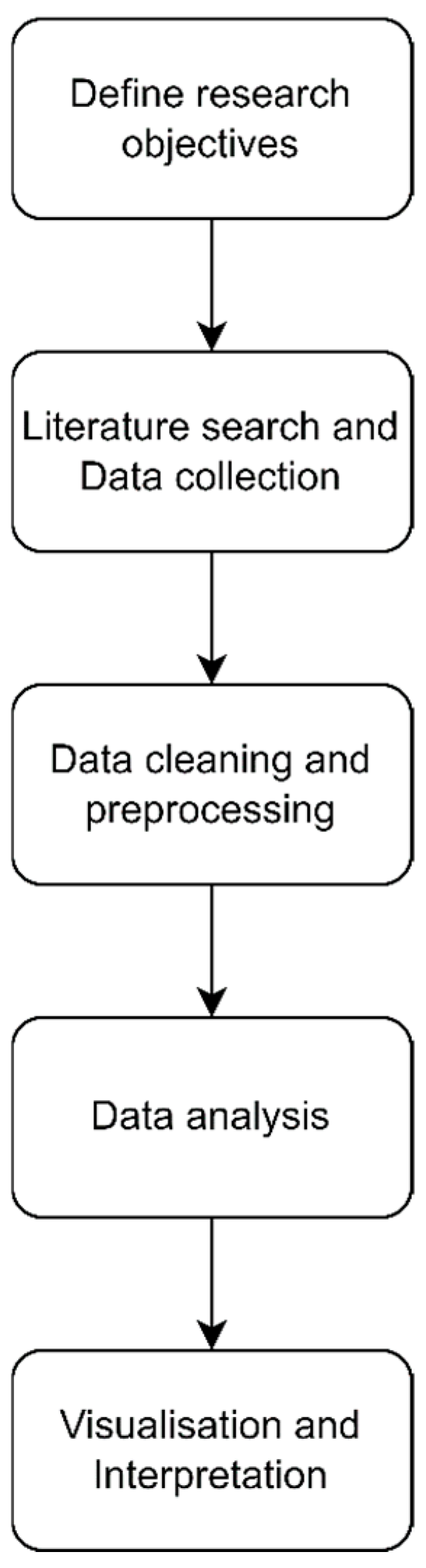
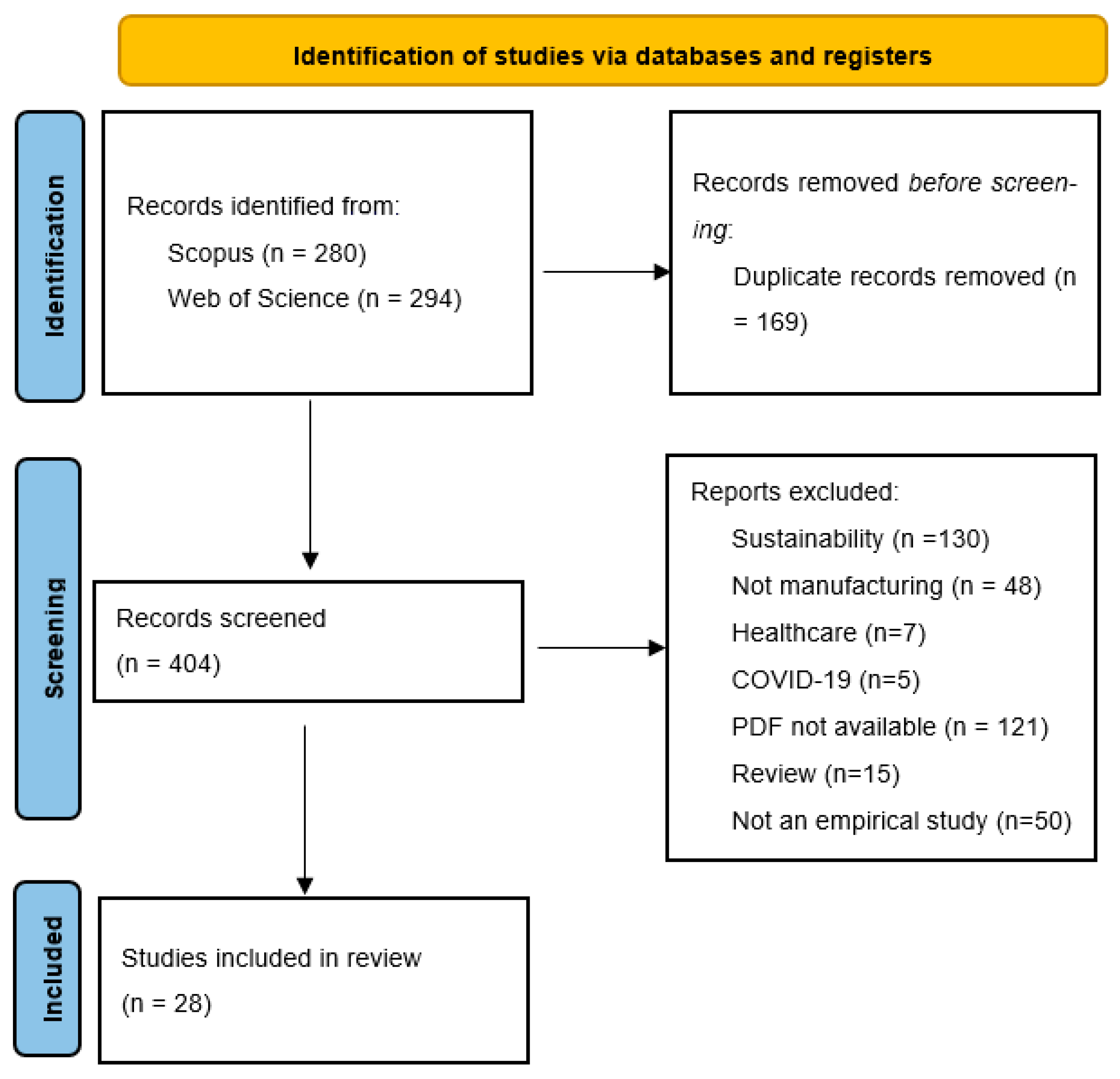
3. Materials and Methods
4. Bibliometric Analysis
4.1. Publication Trends
4.1.1. Total and Annual Publications
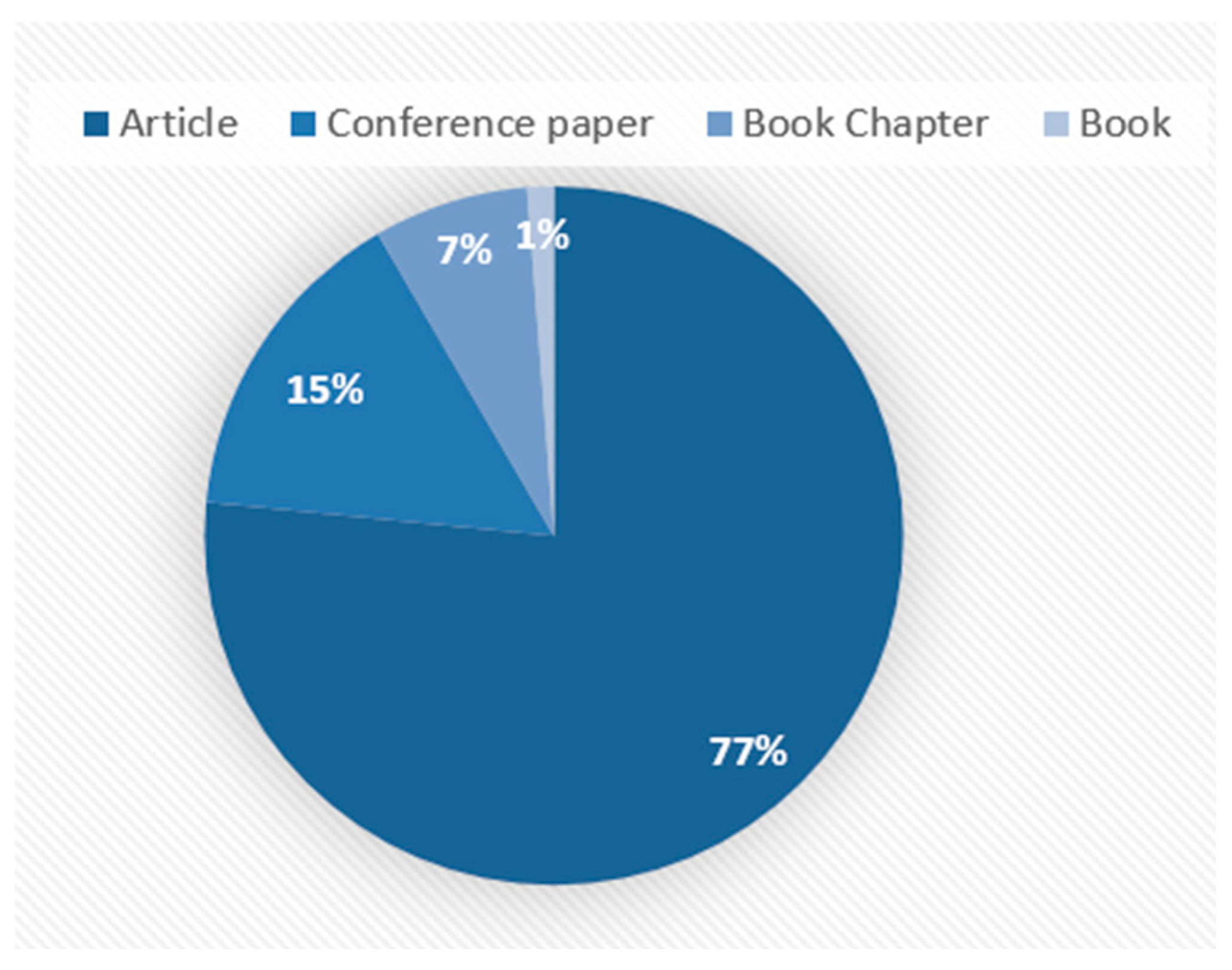
4.1.2. Publications Type
4.1.3. Journal
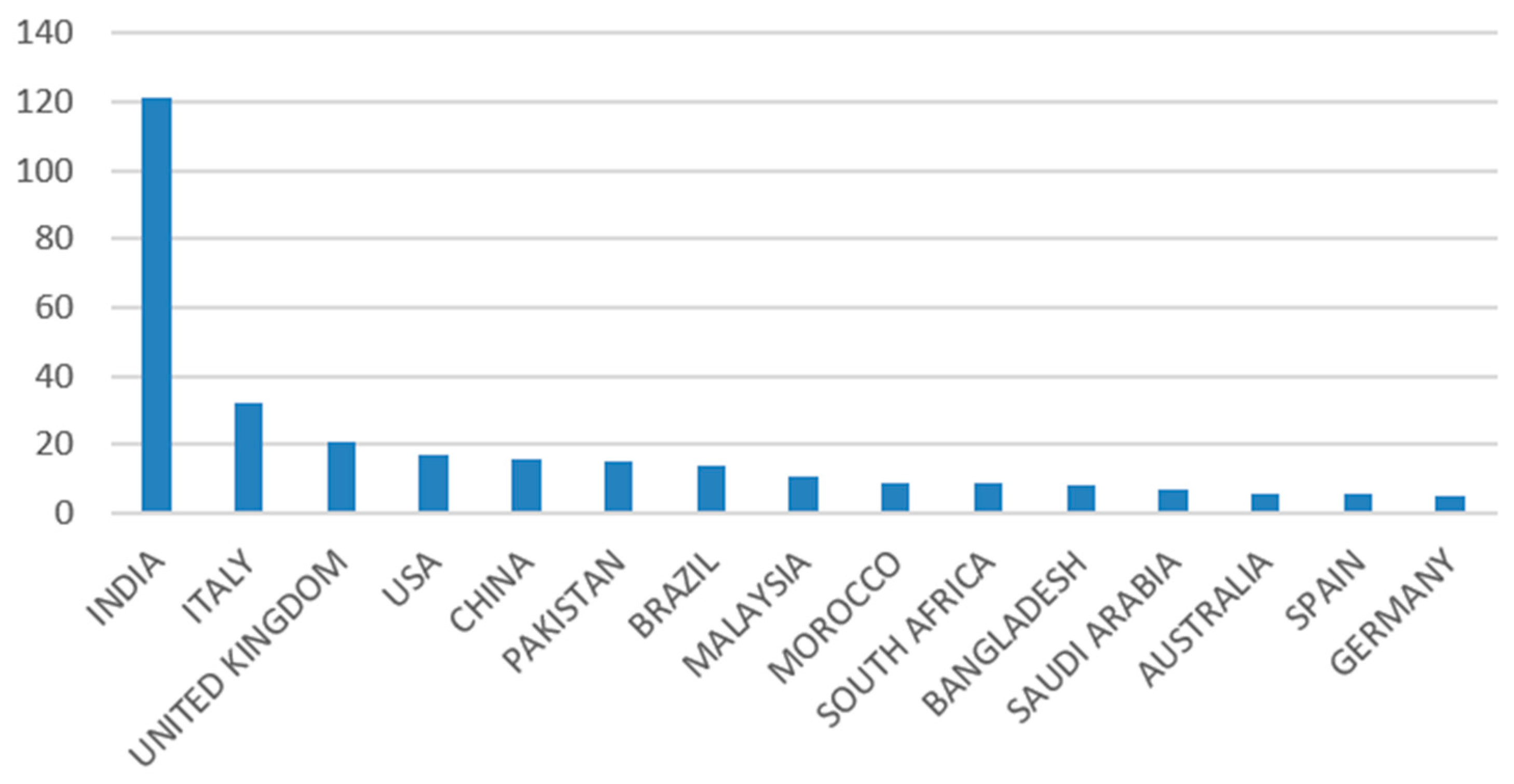
4.1.4. Geographic Distribution
4.2. Keyword and Topic Analysis
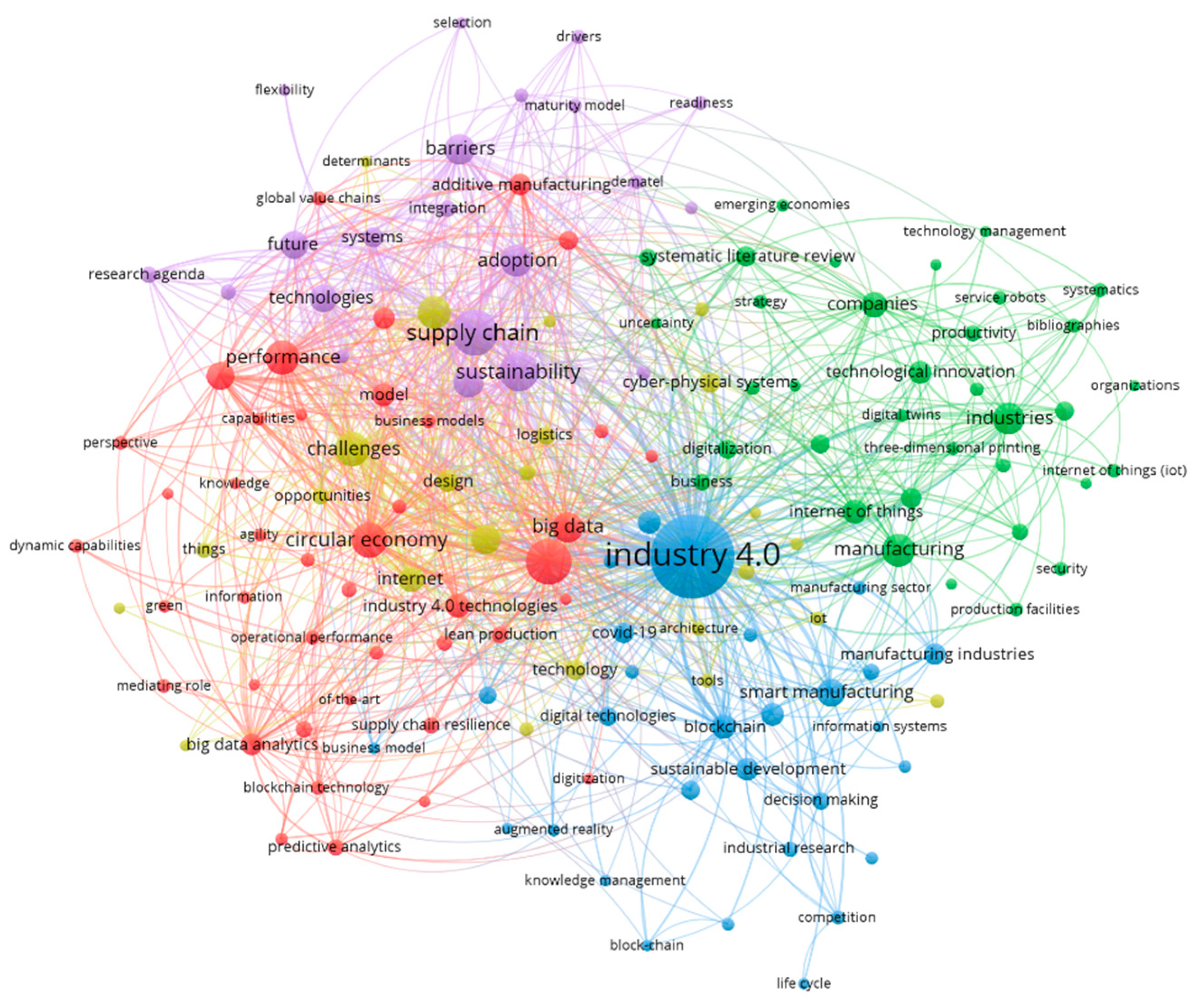
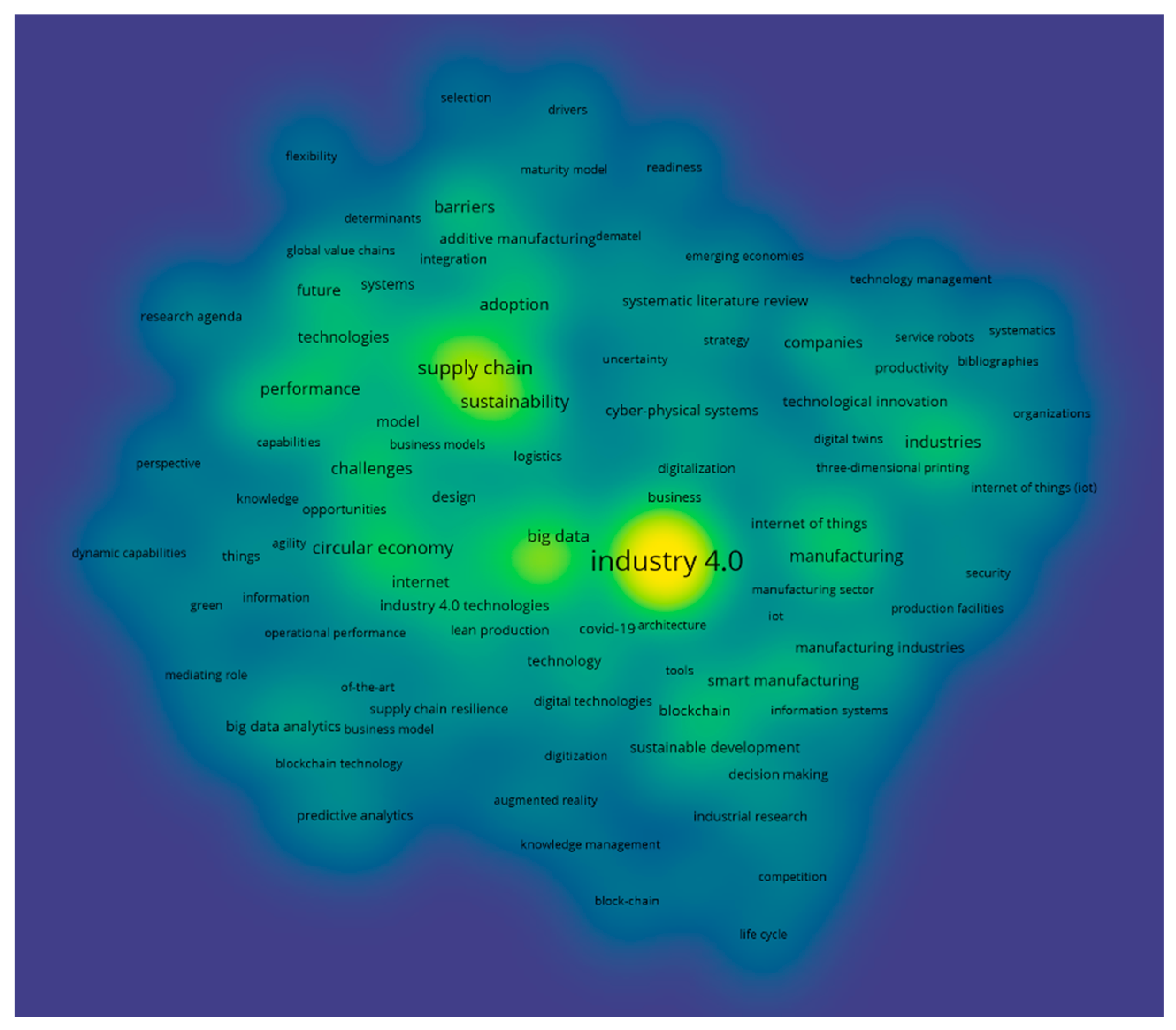
Keyword Analysis
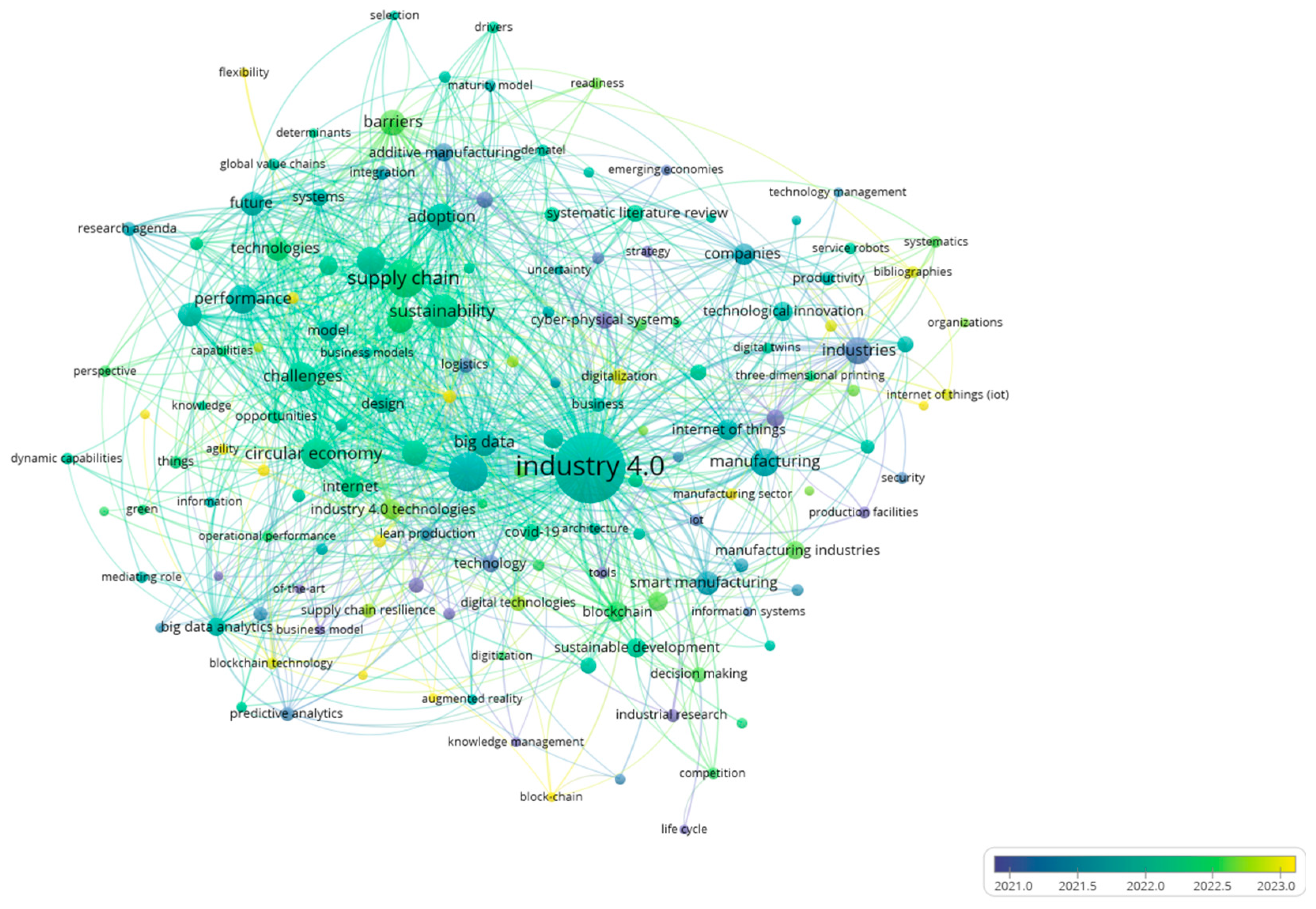
- Cluster 1 has 42 items marked in red. The focus in this cluster is supply chain, big data, and circular economy. Keywords like “supply chain”, “resilience”, and “logistics” highlight research on adapting supply chain operations to Industry 4.0 technologies. The prominence of “big data” and “predictive analysis” suggests a focus on leveraging data for decision-making and optimization. Circular economy links sustainability practices with Industry 4.0 implementations. This cluster explores how data-driven insights and sustainability principles influence supply chains in Industry 4.0.
- Cluster 2 has 35 items marked in green. Its focus is Manufacturing Industries and IoT. Some of the items in this cluster are “IoT”, “Digital Twin”, “Productivity”, “Industries”, and “Security”. This cluster explores the integration of IoT and related technologies into manufacturing industries while addressing productivity and security concerns.
- Cluster 3 has 29 items marked in blue. The focus in this cluster is smart manufacturing and digital transformation. Keywords like “smart manufacturing”, “digital technologies”, and “augmented reality” indicate a focus on digital transformation in industrial processes. The keyword “blockchain” suggests the emerging role of blockchain in ensuring transparency and security in Industry 4.0. The link with “decision-making” highlights how technology helps strategic planning in manufacturing systems.
- Cluster 4 has 24 items marked in yellow. The main items are opportunities, optimization, management, quality management, management practices, models, system, design, framework, and determinants. Keywords like “models” and “design” highlight the role of systematic planning and innovative frameworks for Industry 4.0 implementation. This cluster focuses on management systems and their optimization using Industry 4.0 technologies.
- Cluster 5 has 21 items marked in purple. Keywords like “adoption”, “barriers”, “readiness”, “drivers”, “implementation”, “supply chain”, and “maturity model” dominate this cluster. This cluster addresses challenges in the adoption of Industry 4.0 technologies, especially in less technologically advanced regions or industries and testing their readiness.
4.3. Co-Authorship and Collaboration Networks
4.3.1. Citation Analysis
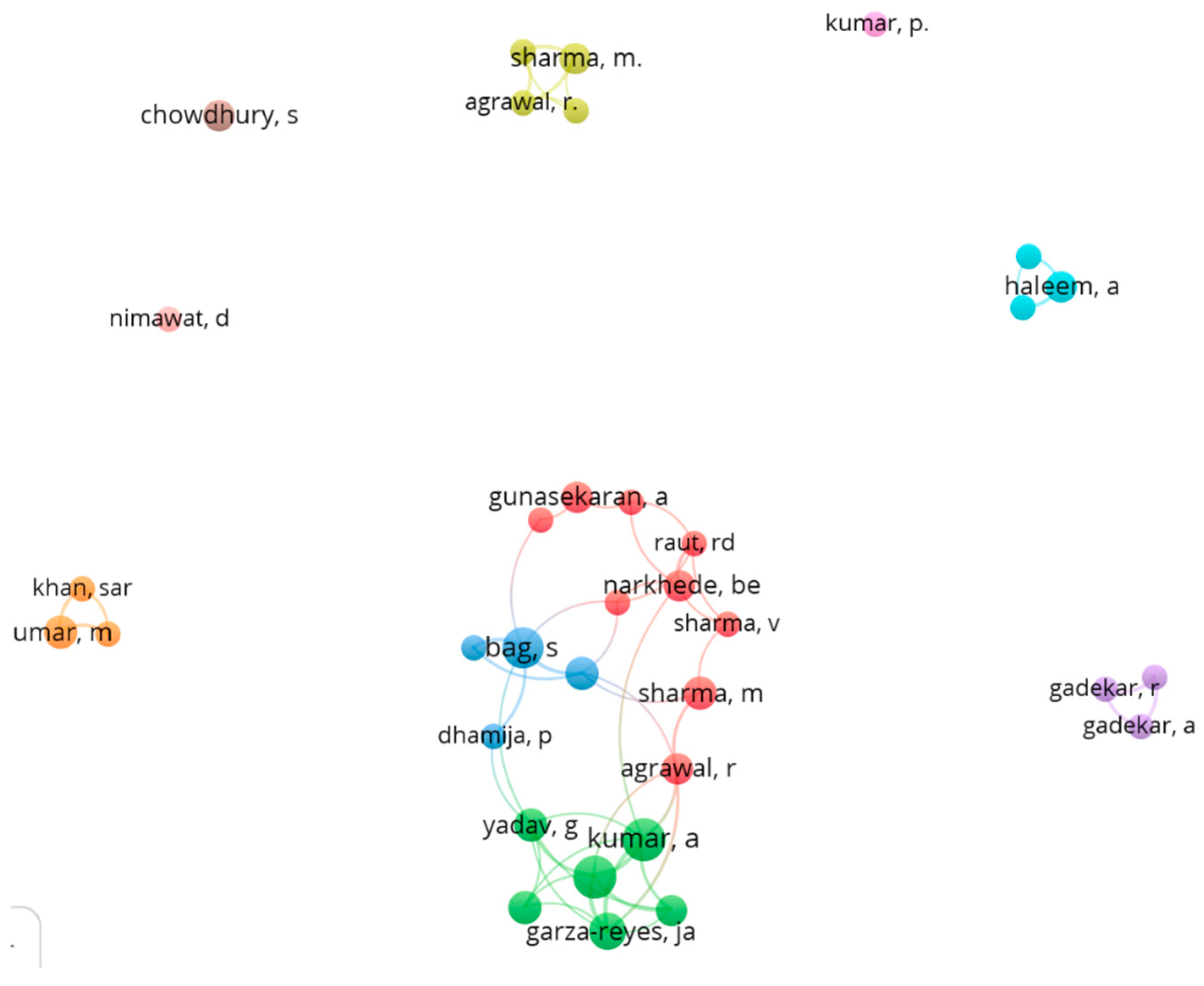
4.3.2. Co-Authorship
4.3.3. Most Productive Authors
5. Discussion
5.1. Empirical Studies on Industry 4.0 Technologies Adoption in the Supply Chain
5.2. Adoption Drivers and Impact on Manufacturing Companies
6. Conclusions
Supplementary Materials
Author Contributions
Funding
Institutional Review Board Statement
Informed Consent Statement
Data Availability Statement
Conflicts of Interest
Abbreviations
| I4.0 | Industry 4.0 |
| AI | Artificial Intelligence |
| IoT | Internet of Things |
| DCV | Dynamic capabilities view |
| TOE | Technology organization environment |
| INT | Institutional theory |
| DOI | Diffusion of innovation |
| RBV | Resource-based view |
| TAM | Technology acceptance model |
| BRT | Behavioral reasoning theory |
References
- Haman, S.; Tajmout, Y.; Idrissi, Y.E.B.E.; El Bhiri, B.; Moumen, A. Adoption of advanced technologies in industrial companies: A bibliometric analysis. In Proceedings of the 6th International Conference on Networking, Intelligent Systems & Security, New York, NY, USA, 13 November 2023. [Google Scholar] [CrossRef]
- Kunovjanek, M.; Knofius, N.; Reiner, G. Additive manufacturing and supply chains—a systematic review. Prod. Plan. Control 2022, 33, 1231–1251. [Google Scholar] [CrossRef]
- Franco, D.; Ganga, G.M.D.; de Santa-Eulalia, L.A.; Filho, M.G. Consolidated and inconclusive effects of additive manufacturing adoption: A systematic literature review. Comput. Ind. Eng. 2020, 148, 106713. [Google Scholar] [CrossRef]
- Savolainen, J.; Collan, M. How Additive Manufacturing Technology Changes Business Models?—Review of Literature. Addit. Manuf. 2020, 32, 101070. [Google Scholar] [CrossRef]
- Song, Z.; Zhu, J. Blockchain for smart manufacturing systems: A survey. Chin. Manag. Stud. 2022, 16, 1224–1253. [Google Scholar] [CrossRef]
- Ahmed, S.; Kalsoom, T.; Ramzan, N.; Pervez, Z.; Azmat, M.; Zeb, B.; Rehman, M.U. Towards Supply Chain Visibility Using Internet of Things: A Dyadic Analysis Review. Sensors 2021, 21, 4158. [Google Scholar] [CrossRef]
- Naciri, L.; Gallab, M.; Soulhi, A.; Merzouk, S.; Di Nardo, M. Digital Technologies’ Risks and Opportunities: Case Study of an RFID System. Appl. Syst. Innov. 2023, 6, 54. [Google Scholar] [CrossRef]
- Cammarano, A.; Varriale, V.; Michelino, F.; Caputo, M. A Framework for Investigating the Adoption of Key Technologies: Presentation of the Methodology and Explorative Analysis of Emerging Practices. IEEE Trans. Eng. Manag. 2024, 71, 3843–3866. [Google Scholar] [CrossRef]
- Asrol, M. Industry 4.0 Adoption in Supply Chain Operations: A Systematic Literature Review. Int. J. Technol. 2024, 15, 544–560. [Google Scholar] [CrossRef]
- Abdirad, M.; Krishnan, K. Industry 4.0 in Logistics and Supply Chain Management: A Systematic Literature Review. Eng. Manag. J. 2021, 33, 187–201. [Google Scholar] [CrossRef]
- Ajayi, M.O.; Laseinde, O.T. A review of supply chain 4IR management strategy for appraising the manufacturing industry’s potentials and shortfalls in the 21st century. Procedia Comput. Sci. 2023, 217, 513–525. [Google Scholar] [CrossRef]
- Weerabahu, W.M.S.K.; Samaranayake, P.; Nakandala, D.; Hurriyet, H. Enabling Factors of Digital Manufacturing Supply Chains: A Systematic Literature Review. In Proceedings of the 2021 IEEE International Conference on Industrial Engineering and Engineering Management, Singapore, 13–16 December 2021; pp. 118–123. [Google Scholar] [CrossRef]
- Tiwari, S. Supply chain integration and Industry 4.0: A systematic literature review. Benchmarking Int. J. 2021, 28, 990–1030. [Google Scholar] [CrossRef]
- Bandara, L.; Withanaarachchi, A.; Peter, S. Industry 4.0 Implementation in Sri Lankan Manufacturing Firms: A Lean Perspective. In Proceedings of the 2023 International Research Conference on Smart Computing and Systems Engineering (SCSE), Kelaniya, Sri Lanka, 29 June 2023; pp. 1–9. [Google Scholar] [CrossRef]
- Lasi, H.; Fettke, P.; Kemper, H.-G.; Feld, T.; Hoffmann, M. Industry 4.0. Bus. Inf. Syst. Eng. 2014, 6, 239–242. [Google Scholar] [CrossRef]
- Lu, Y. Industry 4.0: A survey on technologies, applications and open research issues. J. Ind. Inf. Integr. 2017, 6, 1–10. [Google Scholar] [CrossRef]
- Xu, L.D.; Xu, E.L.; Li, L. Industry 4.0: State of the art and future trends. Int. J. Prod. Res. 2018, 56, 2941–2962. [Google Scholar] [CrossRef]
- Stock, T.; Seliger, G. Opportunities of sustainable manufacturing in industry 4.0. Procedia CIRP 2016, 40, 536–541. [Google Scholar] [CrossRef]
- Haman, S.; Moumen, A.; Jenoui, K.; Elbhiri, B.; Idrissi, Y.E.B.E. Machine Learning Techniques in Supply Chain Management: An Exploratory Literature Review. In Smart Mobility and Industrial Technologies; Bhiri, B.E., Saidi, R., Essaaidi, M.N., Kaabouch, É., Eds.; Springer Nature: Cham, The Switzerland, 2024; pp. 155–161. [Google Scholar] [CrossRef]
- Ivanov, D.; Dolgui, A.; Sokolov, B. The impact of digital technology and Industry 4.0 on the ripple effect and supply chain risk analytics. Int. J. Prod. Res. 2019, 57, 829–846. [Google Scholar] [CrossRef]
- Queiroz, M.M.; Wamba, S.F.; De Bourmont, M.; Telles, R. Blockchain adoption in operations and supply chain management: Empirical evidence from an emerging economy. Int. J. Prod. Res. 2021, 59, 6087–6103. [Google Scholar] [CrossRef]
- Tjahjono, B.; Esplugues, C.; Ares, E.; Pelaez, G. What does industry 4.0 mean to supply chain? Procedia Manuf. 2017, 13, 1175–1182. [Google Scholar] [CrossRef]
- Tanshzil, S.W.; Suryadi, K.S.; Komalasari, K.; Anggraeni, L. Radicalism in the Age of Digital Technology: A Bibliometric Study. J. Adv. Res. Appl. Sci. Eng. Technol. 2025, 50, 18–29. [Google Scholar] [CrossRef]
- Frank, A.G.; Dalenogare, L.S.; Ayala, N.F. Industry 4.0 technologies: Implementation patterns in manufacturing companies. Int. J. Prod. Econ. 2019, 210, 15–26. [Google Scholar] [CrossRef]
- Luthra, S.; Mangla, S.K. Evaluating challenges to Industry 4.0 initiatives for supply chain sustainability in emerging economies. Process Saf. Environ. Prot. 2018, 117, 168–179. [Google Scholar] [CrossRef]
- Diez-Olivan, A.; Del Ser, J.; Galar, D.; Sierra, B. Data fusion and machine learning for industrial prognosis: Trends and perspectives towards Industry 4.0. Inf. Fusion 2019, 50, 92–111. [Google Scholar] [CrossRef]
- Bag, S.; Pretorius, J.H.C.; Gupta, S.; Dwivedi, Y.K. Role of institutional pressures and resources in the adoption of big data analytics powered artificial intelligence, sustainable manufacturing practices and circular economy capabilities. Technol. Forecast. Soc. Change 2021, 163, 120420. [Google Scholar] [CrossRef]
- Dubey, R.; Gunasekaran, A.; Childe, S.J.; Bryde, D.J.; Giannakis, M.; Foropon, C.; Roubaud, D.; Hazen, B.T. Big data analytics and artificial intelligence pathway to operational performance under the effects of entrepreneurial orientation and environmental dynamism: A study of manufacturing organisations. Int. J. Prod. Econ. 2020, 226, 107599. [Google Scholar] [CrossRef]
- Masood, T.; Sonntag, P. Industry 4.0: Adoption challenges and benefits for SMEs. Comput. Ind. 2020, 121, 103261. [Google Scholar] [CrossRef]
- GBüchi, G.; Cugno, M.; Castagnoli, R. Smart factory performance and Industry 4.0. Technol. Forecast. Soc. Change 2020, 150, 119790. [Google Scholar] [CrossRef]
- GYadav, G.; Luthra, S.; Jakhar, S.K.; Mangla, S.K.; Rai, D.P. A framework to overcome sustainable supply chain challenges through solution measures of industry 4.0 and circular economy: An automotive case. J. Clean. Prod. 2020, 254, 120112. [Google Scholar] [CrossRef]
- Bag, S.; Gupta, S.; Kumar, S. Industry 4.0 adoption and 10R advance manufacturing capabilities for sustainable development. Int. J. Prod. Econ. 2021, 231, 107844. [Google Scholar] [CrossRef]
- Bag, S.; Pretorius, J.H.C. Relationships between industry 4.0, sustainable manufacturing and circular economy: Proposal of a research framework. Int. J. Organ. Anal. 2020, 30, 864–898. [Google Scholar] [CrossRef]
- Bag, S.; Telukdarie, A.; Pretorius, J.H.C.; Gupta, S. Industry 4.0 and supply chain sustainability: Framework and future research directions. Benchmarking 2018, 28, 1410–1450. [Google Scholar] [CrossRef]
- Bag, S.; Yadav, G.; Dhamija, P.; Kataria, K.K. Key resources for industry 4.0 adoption and its effect on sustainable production and circular economy: An empirical study. J. Clean. Prod. 2021, 281, 125233. [Google Scholar] [CrossRef]
- Haleem, A.; Javaid, M. Additive Manufacturing Applications in Industry 4.0: A Review. J. Ind. Integr. Manag.-Innov. Entrep. 2019, 4, 1930001. [Google Scholar] [CrossRef]
- Fraga-Lamas, P.; Fernandez-Carames, T.M. A Review on Blockchain Technologies for an Advanced and Cyber-Resilient Automotive Industry. IEEE Access 2019, 7, 17578–17598. [Google Scholar] [CrossRef]
- SLuthra, S.; Kumar, A.; Zavadskas, E.K.; Mangla, S.K.; Garza-Reyes, J.A. Industry 4.0 as an enabler of sustainability diffusion in supply chain: An analysis of influential strength of drivers in an emerging economy. Int. J. Prod. Res. 2020, 58, 1505–1521. [Google Scholar] [CrossRef]
- Gupta, H.; Kumar, A.; Wasan, P. Industry 4.0, cleaner production and circular economy: An integrative framework for evaluating ethical and sustainable business performance of manufacturing organizations. J. Clean. Prod. 2021, 295, 126253. [Google Scholar] [CrossRef]
- Yadav, G.; Kumar, A.; Luthra, S.; Garza-Reyes, J.A.; Kumar, V.; Batista, L. A framework to achieve sustainability in manufacturing organisations of developing economies using industry 4.0 technologies’ enablers. Comput. Ind. 2020, 122, 103280. [Google Scholar] [CrossRef]
- Chauhan, C.; Singh, A.; Luthra, S. Barriers to industry 4.0 adoption and its performance implications: An empirical investigation of emerging economy. J. Clean. Prod. 2021, 285, 124809. [Google Scholar] [CrossRef]
- Zangiacomi, A.; Pessot, E.; Fornasiero, R.; Bertetti, M.; Sacco, M. Moving towards digitalization: A multiple case study in manufacturing. Prod. Plan. Control 2020, 31, 143–157. [Google Scholar] [CrossRef]
- Chiarini, A.; Belvedere, V.; Grando, A. Industry 4.0 strategies and technological developments. An exploratory research from Italian manufacturing companies. Prod. Plan. Control 2020, 31, 1385–1398. [Google Scholar] [CrossRef]
- Gillani, F.; Chatha, K.A.; Jajja, M.S.S.; Farooq, S. Implementation of digital manufacturing technologies: Antecedents and consequences. Int. J. Prod. Econ. 2020, 229, 107748. [Google Scholar] [CrossRef]
- Senna, P.P.; Barros, A.C.; Roca, J.B.; Azevedo, A. Development of a digital maturity model for Industry 4.0 based on the technology-organization-environment framework. Comput. Ind. Eng. 2023, 185, 109645. [Google Scholar] [CrossRef]
- Gupta, S.; Modgil, S.; Gunasekaran, A.; Bag, S. Dynamic capabilities and institutional theories for Industry 4.0 and digital supply chain. Supply Chain. Forum 2020, 21, 139–157. [Google Scholar] [CrossRef]
- Huang, K.; Wang, K.; Lee, P.K.; Yeung, A.C. The impact of industry 4.0 on supply chain capability and supply chain resilience: A dynamic resource-based view. Int. J. Prod. Econ. 2023, 262, 108913. [Google Scholar] [CrossRef]
- Riaz, A.; Rehman, H.M.; Sohail, A.; Rehman, M. Industry 4.0 supply chain nexus: Sequential mediating effects of traceability, visibility and resilience on performance. Asia Pac. J. Mark. Logist. 2024, 37, 842–860. [Google Scholar] [CrossRef]
- PSaha, P.; Talapatra, S.; Belal, H.; Jackson, V.; Mason, A.; Durowoju, O. Examining the viability of lean production practices in the Industry 4.0 era: An empirical evidence based on B2B garment manufacturing sector. J. Bus. Ind. Mark. 2023, 38, 2694–2712. [Google Scholar] [CrossRef]
- Rodríguez-Espíndola, O.; Chowdhury, S.; Dey, P.K.; Albores, P.; Emrouznejad, A. Analysis of the adoption of emergent technologies for risk management in the era of digital manufacturing. Technol. Forecast. Soc. Change 2022, 178, 121562. [Google Scholar] [CrossRef]
- Meafa, A.-E.; Benabdellah, A.C.; Zekhnini, K. Enhancing Supply Chain Resilience Through Dynamic Capabilities of Blockchain Technology: A Structural Model Analysis. Procedia Comput. Sci. 2024, 232, 980–989. [Google Scholar] [CrossRef]
- irmani, N.; Sharma, S.; Kumar, A.; Luthra, S. Adoption of industry 4.0 evidence in emerging economy: Behavioral reasoning theory perspective. Technol. Forecast. Soc. Change 2023, 188, 122317. [Google Scholar] [CrossRef]
- Dey, P.K.; Chowdhury, S.; Abadie, A.; Yaroson, E.V.; Sarkar, S. Artificial intelligence-driven supply chain resilience in Vietnamese manufacturing small- and medium-sized enterprises. Int. J. Prod. Res. 2024, 62, 5417–5456. [Google Scholar] [CrossRef]
- Bhatia, M.S.; Kumar, S. An empirical analysis of critical factors of Industry 4.0: A contingency theory perspective. Int. J. Technol. Manag. 2023, 91, 82–106. [Google Scholar] [CrossRef]
- Lorenz, R.; Benninghaus, C.; Friedli, T.; Netland, T. Digitization of manufacturing: The role of external search. Int. J. Oper. Prod. Manag. 2020, 40, 1129–1152. [Google Scholar] [CrossRef]
- Wong, A.; Kee, D. Driving Factors of Industry 4.0 Readiness among Manufacturing SMEs in Malaysia. Information 2022, 13, 552. [Google Scholar] [CrossRef]
- Parhi, S.; Joshi, K.; Wuest, T.; Akarte, M. Factors affecting Industry 4.0 adoption-A hybrid SEM-ANN approach. Comput. Ind. Eng. 2022, 168, 108062. [Google Scholar] [CrossRef]
- de Oliveira-Dias, D.; Maqueira-Marin, J.M.; Moyano-Fuentes, J.; Carvalho, H. Implications of using Industry 4.0 base technologies for lean and agile supply chains and performance. Int. J. Prod. Econ. 2023, 262, 108916. [Google Scholar] [CrossRef]
- Manresa, A.; Bikfalvi, A.; Ligthart, P.; Kok, R. Insights into the digitalization-performance relationship: The role of flexibility and quality enhancing organizational practices. Prod. Plan. Control 2024, 35, 1909–1925. [Google Scholar] [CrossRef]
- Hopkins, J. An investigation into emerging industry 4.0 technologies as drivers of supply chain innovation in Australia. Comput. Ind. 2021, 125, 103323. [Google Scholar] [CrossRef]
- Eslami, M.H.; Achtenhagen, L.; Bertsch, C.T.; Lehmann, A. Knowledge-sharing across supply chain actors in adopting Industry 4.0 technologies: An exploratory case study within the automotive industry. Technol. Forecast. Soc. Change 2023, 186, 122118. [Google Scholar] [CrossRef]
- Agostini, L.; Nosella, A. The adoption of Industry 4.0 technologies in SMEs: Results of an international study. Manag. Decis. 2019, 58, 625–643. [Google Scholar] [CrossRef]
- Buer, S.-V.; Strandhagen, J.W.; Semini, M.; Strandhagen, J.O. The digitalization of manufacturing: Investigating the impact of production environment and company size. J. Manuf. Technol. Manag. 2021, 32, 621–645. [Google Scholar] [CrossRef]
- Siagian, H.; Yuliana, O.Y.; Purwanto, G.R. The Effect of Information Technology Implementation on Supply Chain Performance through Information Sharing and Supply Chain Collaboration. Curr. Appl. Sci. Technol. 2022, 22, 14. [Google Scholar] [CrossRef]
- Sawangwong, A.; Chaopaisarn, P. The impact of applying knowledge in the technological pillars of Industry 4.0 on supply chain performance. Kybernetes 2023, 52, 1094–1126. [Google Scholar] [CrossRef]
- Zhu, M.; Liang, C.; Yeung, A.C.; Zhou, H. The impact of intelligent manufacturing on labor productivity: An empirical analysis of Chinese listed manufacturing companies. Int. J. Prod. Econ. 2024, 267, 1090710. [Google Scholar] [CrossRef]
- Weerakkody, V.; Dwivedi, Y.K.; Irani, Z. The Diffusion and Use of Institutional Theory: A Cross-Disciplinary Longitudinal Literature Survey. J. Inf. Technol. 2009, 24, 354–368. [Google Scholar] [CrossRef]
- García-Avilés, J.-A. Diffusion of innovation. Int. Encycl. Media Psychol. 2020, 1, 1–8. Available online: https://www.researchgate.net/profile/Jose-Garcia-Aviles/publication/344338279_Diffusion_of_Innovation/links/64673ced9533894cac7c75d0/Diffusion-of-Innovation.pdf (accessed on 1 November 2024).
- Madhani, P.M. Resource Based View (RBV) of Competitive Advantage; Icfai University Press: Hyderabad, India, 2009. [Google Scholar]
- Kraaijenbrink, J.; Spender, J.-C.; Groen, A.J. The Resource-Based View: A Review and Assessment of Its Critiques. J. Manag. 2010, 36, 349–372. [Google Scholar] [CrossRef]
- Cavusgil, E.; Seggie, S.H.; Talay, M.B. Dynamic Capabilities View: Foundations and Research Agenda. J. Mark. Theory Pract. 2007, 15, 159–166. [Google Scholar] [CrossRef]
- Chirico, F.; Sirmon, D.G.; Sciascia, S.; Mazzola, P. Resource orchestration in family firms: Investigating how entrepreneurial orientation, generational involvement, and participative strategy affect performance. Strateg. Entrep. J. 2011, 5, 307–326. [Google Scholar] [CrossRef]
- Eisenhardt, K.M.; Santos, F.M. Knowledge-based view: A new theory of strategy? In Handbook of Strategy and Management; Consulté le: 18 février 2025; SAGE Publications Ltd.: London, UK, 2006; pp. 139–164. Available online: https://sk.sagepub.com/hnbk/edvol/hdbk_strategymgmt/chpt/knowledgebased-view-new-theory-strategy (accessed on 1 November 2002).
- Baker, J. The technology-organization-environment framework. Ser. Integr. Ser. Inf. Syst. 2011, 28, 231–245. [Google Scholar]
- Hadid, W.; Mansouri, S.A.; Gallear, D. Is lean service promising? A socio-technical perspective. Int. J. Oper. Prod. Manag. 2016, 36, 618–642. [Google Scholar] [CrossRef]

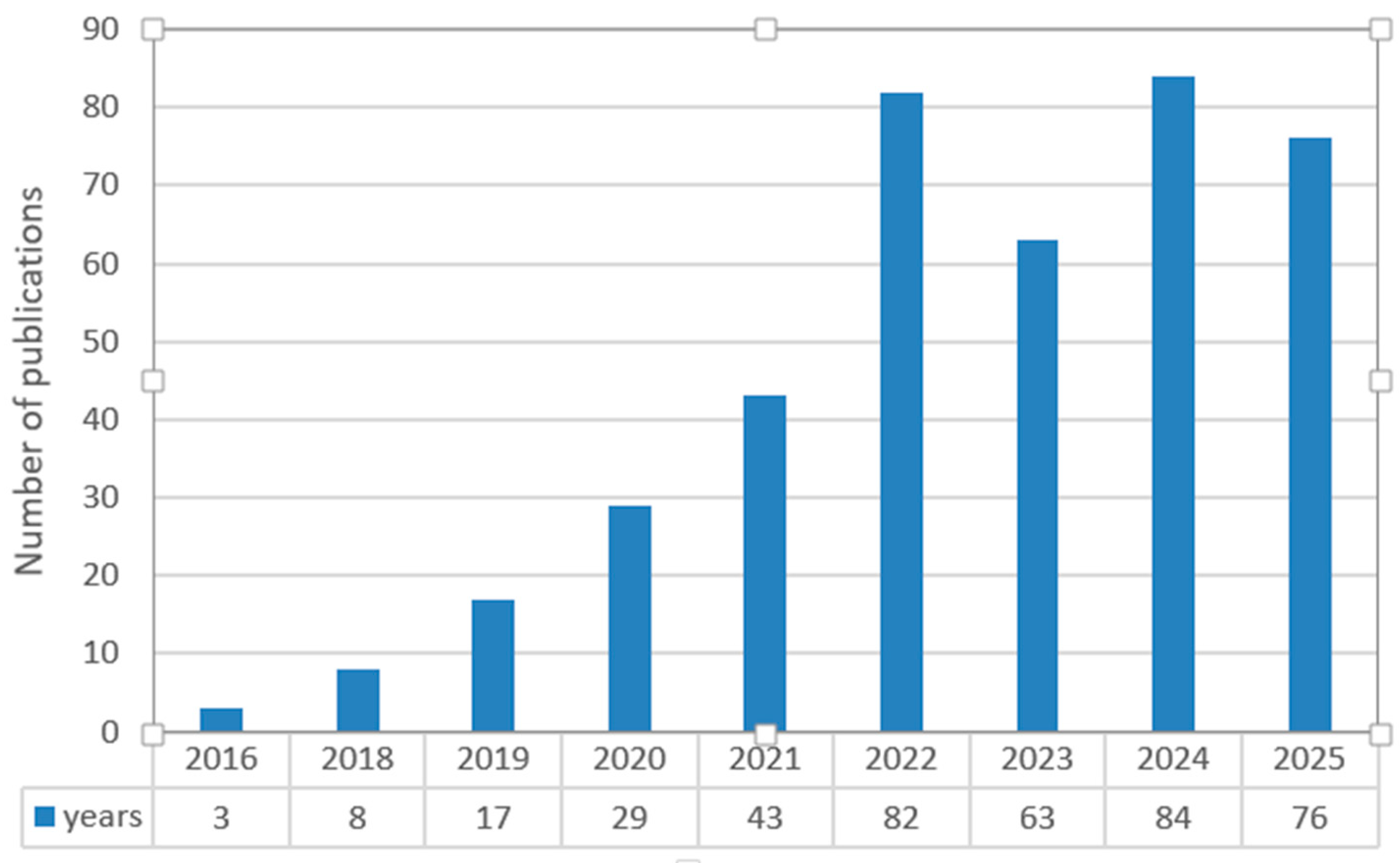




| Year | Number of Publications |
|---|---|
| 2016 | 3 |
| 2018 | 8 |
| 2019 | 17 |
| 2020 | 29 |
| 2021 | 43 |
| 2022 | 82 |
| 2023 | 63 |
| 2024 | 84 |
| 2025 | 76 |
| Publication Type | Number of Publications | % |
|---|---|---|
| Article | 310 | 76.54 |
| Conference paper | 61 | 15.06 |
| Book Chapter | 29 | 7.1 |
| Book | 5 | 1.3 |
| Journal | Number of Publications | H-Index |
|---|---|---|
| Sustainability | 17 | 169 |
| International Journal of Production Economics | 14 | 231 |
| Operations Management Research | 13 | 41 |
| Technological Forecasting and Social Change | 13 | 179 |
| Business Strategy and the Environment | 11 | 147 |
| Journal of Manufacturing Technology Management | 11 | 93 |
| Benchmarking | 10 | 81 |
| Journal of Cleaner Production | 7 | 309 |
| Computers & Industrial Engineering | 7 | 161 |
| Computers in industry | 6 | 129 |
| Annals of operations research | 6 | 125 |
| International Journal of Productivity and Performance Management | 5 | 77 |
| Country | Number of Articles |
|---|---|
| INDIA | 121 |
| ITALY | 32 |
| UNITED KINGDOM | 21 |
| USA | 17 |
| CHINA | 16 |
| PAKISTAN | 15 |
| BRAZIL | 14 |
| MALAYSIA | 11 |
| MOROCCO | 9 |
| SOUTH AFRICA | 9 |
| BANGLADESH | 8 |
| SAUDI ARABIA | 7 |
| AUSTRALIA | 6 |
| SPAIN | 6 |
| GERMANY | 5 |
| References | Publication Type | Country | Total Citations |
|---|---|---|---|
| [24] | Journal Article | Brazil | 3758 |
| [25] | Journal Article | India | 1226 |
| [26] | Journal Article | Italy | 971 |
| [27] | Journal Article | South Africa | 934 |
| [28] | Journal Article | India | 923 |
| [29] | Journal Article | United Kingdom | 901 |
| [30] | Journal Article | Spain | 853 |
| [31] | Journal Article | India | 750 |
| [32] | Journal Article | South Africa | 711 |
| [33] | Journal Article | China | 592 |
| [34] | Journal Article | South Africa | 577 |
| [35] | Journal Article | South Africa | 526 |
| [36] | Journal Article | India | 512 |
| [37] | Journal Article | Spain | 461 |
| [38] | Journal Article | India | 446 |
| [39] | Journal Article | India | 420 |
| [40] | Journal Article | India | 404 |
| [41] | Journal Article | India | 384 |
| [42] | Journal Article | Italy | 360 |
| [43] | Journal Article | Italy | 334 |
| Country | Total Citations |
|---|---|
| India | 9337 |
| Brazil | 3420 |
| South Africa | 2106 |
| Italy | 2306 |
| United Kingdom | 1415 |
| Author | Nbr of Publications | Country of Affiliation | Affiliation |
|---|---|---|---|
| Kumar, A. | 9 | India | Indian Institute of Management Rohtak |
| Bag, S. | 8 | South Africa | University of Johannesburg |
| Luthra, S. | 7 | India | Ch. Ranbir Singh State Institute of Engineering and Technology |
| Gupta, S. | 7 | India | Swarrnim Startup and Innovation University |
| Kumar, V. | 7 | United Kingdom | University of the West of England |
| Yadav, G. | 6 | India | Veermata Jijabai Technological Institute |
| Chowdhury, S. | 4 | France | TBS Business School |
| Khan, S.a.r. | 4 | China | Xuzhou University of Technology |
| Singh, Rk. | 4 | India | Management Development Institute |
| Reference | Model | Sample Size | Data Collection |
|---|---|---|---|
| [44] | TOE-TE | 931 respondents from manufacturing firms | Questionnaire |
| [45] | TOE | 24 companies | Semi-structured interviews |
| [46] | INT-DCV | 256 respondents from Indian manufacturing firms | Questionnaire |
| [47] | RBV | 408 respondents from Chinese manufacturing firms | Questionnaire |
| [48] | RBV | 510 managers of manufacturing firms | Questionnaire |
| [49] | PBV | 80 respondents from Bangladeshi clothing factories | Questionnaire |
| [28] | TAM | 271 respondents of United Kingdom SMEs | Questionnaire |
| [50] | TAM-INT-RBV | 117 operation managers of UK manufacturing firms | Questionnaire |
| [29] | DCV | 256 respondents from Indian manufacturing firms | Questionnaire |
| [51] | DCV | 193 respondents from 28 Moroccan manufacturing companies | Questionnaire |
| [52] | BRT | 215 respondents from manufacturing companies | Questionnaire |
| [53] | KBV-ROT | 280 operation managers from Vietnamese SMEs | Questionnaire |
| [54] | - | 154 respondents from Indian companies | Questionnaire |
| [41] | RBV | 143 respondents from Indian manufacturing firms | Questionnaire |
| [55] | - | 151 senior managers from Switzerland manufacturing firms | Questionnaire |
| [56] | RBV | 110 respondents from Malaysian SMEs | Questionnaire |
| [57] | - | 350 respondents from Indian manufacturing industries | Questionnaire |
| [58] | DCV | 256 respondents from Spanish manufacturing firms | Questionnaire |
| [24] | - | 92 respondents from manufacturing | Questionnaire |
| [59] | DOI–RBV–Socio-technical theory | 502 respondents from Spanish and Dutch organizations | Questionnaire |
| [60] | 188 respondents from Australian | Questionnaire | |
| [61] | KBV | 27 interviewees | Semi-structure Interviews |
| [26] | - | 1331 respondents from Italian manufacturing firms | Questionnaire |
| [62] | - | 163 respondents from manufacturing firms in Italy, Poland, Germany, Austria, and Hungary | Questionnaire |
| [63] | - | 76 respondents from Norwegians manufacturing firms | Questionnaire |
| [64] | - | 70 respondents from Indonesian manufacturing firms. | Questionnaire |
| [65] | - | 240 respondents from Thailand SMEs | Questionnaire |
| [66] | RBV | 16441 respondents from Chinese manufacturing firms | Questionnaire |
| Model | Category | Core Theoretical Focus | Application Context in I4.0 Studies |
|---|---|---|---|
| RBV | Organizational/Strategic | Emphasizes the strategic importance of firm resources in achieving sustained competitive advantage | Assess how I4.0 technologies are leveraged as internal resources to enhance supply chain resilience, operational performance, efficiency, and risk mitigation. |
| DCV | Organizational/Strategic | Builds on RBV by focusing on a firm’s capacity to reconfigure and adapt its resource base in response to dynamic environments | Examine how organizations reconfigure digital and operational resources during I4.0 adoption to sustain competitive advantage |
| TAM | Technology Adoption | Explains technology adoption based on perceived usefulness and perceived ease of use among users | Assess behavioral intention and attitude toward I4.0 technology uptake among decision-makers |
| TOE | Technology Adoption | Integrates contextual factors from technological, organizational, and environmental domains affecting technology adoption | Identify external and internal drivers influencing I4.0 integration within firms |
| INT | Technology Adoption | Investigates the influence of regulatory, normative, and mimetic pressures on organizational decision-making | Explore how institutional forces (e.g., government mandates, market norms) shape I4.0 adoption |
| DOI | Technology Adoption | Describes the process by which innovations are communicated over time among members of a social system | Evaluate the rate and pattern of I4.0 technology dissemination across supply chains |
| KBV | Organizational/Strategic | Highlights the role of knowledge as the most strategically significant organizational resource | Assess how knowledge acquisition, sharing, and utilization enable I4.0 readiness |
| BRT | Technology Adoption | Explores the underlying reasons for or against a particular behavioral decision within a given context | Uncover cognitive and affective reasoning influencing the adoption or rejection of I4.0 technologies |
| Reference | Results | Analysis Methodology |
|---|---|---|
| [44] | All the hypotheses were supported in this study. | SEM |
| [28] | H1, H3, and H5 were supported. H2, H4, and H6 were rejected. | PLS SEM |
| [46] | H1, H2, H3a, H3b, and H4a were supported. H4b, H5a, and H5b were rejected. | PLS-SEM |
| [47] | H1, H3a, H3b, H4a, H4b, H5a, and H5b were supported. H4a and H4b were not supported. | SEM |
| [48] | All the hypotheses were supported in this study. | PLS-SEM |
| [49] | Both hypotheses were accepted. | SEM |
| [50] | Hypotheses were tested for each technology: Big data: Hypotheses H2, H3, H6, H8, H9, and H11 were not accepted. H1, H4, H5, H7, H10, H12, and H13 were accepted. Artificial Intelligence: Hypotheses H2, H6, and H7 were not accepted. H1, H3, H4, H5, H8, H9, H10, H11, H12, and H13 were accepted. Cloud computing: Hypotheses H2, H3, H4, H8, H9, H11, and H12 were not accepted. H1, H5, H6, H7, H10, and H13 were accepted. Blockchain: Hypotheses H2, H3, and H7 were not accepted. H1, H4, H5, H6, H8, H9, H10, H11, H12, and H13 were accepted. | SEM using SPSS 26 |
| [29] | All the hypotheses were supported. | PLS technique using WarpPLS |
| [51] | H1 and H4 were not supported. H2, H3, H5, and H6 were supported. | PLS-SEM |
| [52] | H1, H5, H6, and H7 were not supported. H2, H3, H4, and H8 were supported. | SEM |
| [53] | H1, H2, H3, H4, H5, H5.1, H6, H7, H8, H9, H10, and H11 were accepted. H4.1 was rejected. | SEM |
| [54] | H1 was rejected and H2 was accepted. | Confirmatory factor analysis (CFA). |
| [41] | H1, H2, H3, H4, H5, H7, and H8 were supported. H6 was not supported. | SEM |
| [55] | External search depth is more important for the digitization of manufacturing than external search breadth. H3a, H3b, and H4 were rejected. H5 was supported. | Linear regression |
| [56] | H1, H2, H4, and H6 were supported. H3, H5, H7, and H8 were not supported. | Pls 3.0 |
| [57] | All the Hypotheses were supported. | SEM-ANN using SPSS 26 tool |
| [58] | H1, H3, and H5 were supported. H2, H4, and H6 were not supported. | SEM |
| [24] | All hypotheses were supported. | Cluster Analysis-Pearson’s Chi-squared test-Fisher’s exact test |
| [59] | H1 and H3 were supported. H2 and H4 were not supported. | Regression Analysis |
| [26] | H1a, H2a, and H3 were supported. H1b, H2b, H4, and H5 were not supported. | Regression Analysis |
| [62] | H1, H2a and H2b, and H3 were only partially supported. H4a, H4b, H5a, and H5b were supported. | Confirmatory factor analysis using SPSS 26 Logistic Regression |
| [63] | H4 and H6 were supported. H1, H2, H3, and H5 were rejected. | Two-way ANOVA method |
| [64] | All hypotheses were supported. | Partial Least Square SEM |
| [65] | All hypotheses were supported. | SEM |
| [66] | All hypotheses were supported. | Logistic Regression |
Disclaimer/Publisher’s Note: The statements, opinions and data contained in all publications are solely those of the individual author(s) and contributor(s) and not of MDPI and/or the editor(s). MDPI and/or the editor(s) disclaim responsibility for any injury to people or property resulting from any ideas, methods, instructions or products referred to in the content. |
© 2025 by the authors. Licensee MDPI, Basel, Switzerland. This article is an open access article distributed under the terms and conditions of the Creative Commons Attribution (CC BY) license (https://creativecommons.org/licenses/by/4.0/).
Share and Cite
Haman, S.; Ben Abdelouahab, A.; El Bouzekri El Idrissi, Y.; Merzouk, S.; Moumen, A. Supply Chain in the Age of Industry 4.0: A Literature Review. Logistics 2025, 9, 173. https://doi.org/10.3390/logistics9040173
Haman S, Ben Abdelouahab A, El Bouzekri El Idrissi Y, Merzouk S, Moumen A. Supply Chain in the Age of Industry 4.0: A Literature Review. Logistics. 2025; 9(4):173. https://doi.org/10.3390/logistics9040173
Chicago/Turabian StyleHaman, Samia, Anass Ben Abdelouahab, Younes El Bouzekri El Idrissi, Safae Merzouk, and Aniss Moumen. 2025. "Supply Chain in the Age of Industry 4.0: A Literature Review" Logistics 9, no. 4: 173. https://doi.org/10.3390/logistics9040173
APA StyleHaman, S., Ben Abdelouahab, A., El Bouzekri El Idrissi, Y., Merzouk, S., & Moumen, A. (2025). Supply Chain in the Age of Industry 4.0: A Literature Review. Logistics, 9(4), 173. https://doi.org/10.3390/logistics9040173