1. Introduction
In the context of the ongoing digital transformation of the transport industry, the development of multimodal transportation system capable of ensuring effective integration of different modes of transport is acquiring particular importance. For transit countries, in particular, the Republic of Kazakhstan, this is a critically important objective, as the country serves as a key link between China and the European Union. One of the strategic directions is the Middle Corridor, also known as the Trans-Caspian International Transport Route (TITR), which enables cargo transportation over a distance of more than 6000 km, connecting Kazakhstan’s railway and road infrastructure with the ports of the Caspian Sea.
The concept for the development of the transport and logistics potential of the Republic of Kazakhstan [
1] is aimed at the innovative advancement of the national transport system to meet the needs of the economy and society for high-quality and competitive transport services in the context of modern development. Such progress is impossible without efficient multimodal transportation and for Kazakhstan, with its vast territory and advantageous geopolitical position, effective multimodal logistics is key factor for entering the international transport services market [
2].
Despite its high potential, the transport and logistics system faces a number of challenges: limited throughput capacity at border crossing and container terminals [
3], long idle times at borders, insufficient digital integration between different modes of transport and low flexibility in managing transit flows. This creates a need for the application of modern modelling methods and digital twins, which make it possible to analyse development scenarios and optimize supply chain management.
1.1. Motivation
Indeed, Kazakhstan plays a key role in transit transportation between Europe and Asia due to its geographical location and developed network of transport corridors. However, the country’s transport system faces a number of challenges, including limited capacity on certain sections, delays at border crossings, uneven development of road and railway infrastructure and insufficient integration of multimodal transport. These factors directly affect the efficiency of freight delivery and reduce the competitiveness of the transport and logistics system of the Republic of Kazakhstan.
The development of an efficient and integrated transport and logistics system is a strategic priority for Kazakhstan, as emphasized in national policy documents such as the “Nurly Zhol” State Infrastructure Development Program (2020–2025) and the State Program for Industrial and Innovative Development. These initiatives underscore that industrial growth depends on the proactive development of multimodal transport corridors and logistics hubs. The country’s transit potential is being realized through projects aimed at reducing delivery costs and improving speed by integrating Kazakhstan’s infrastructure into global supply chains. A key strategic step in this direction is the adoption of the Concept for the Development of the Transport and Logistics Potential of the Republic of Kazakhstan until 2030, which highlights digitalization, efficiency, and modeling of logistics processes as central priorities.
To analyse such complex processes and identify solutions, it is necessary to use tools that take into account the interaction of numerous participants and elements of the transport networks. Agent-based simulation modelling is one of the most promising approaches, as it makes it possible to reproduce the behavior of various agents, from shippers and carriers to infrastructure nides and to explore the impact of changes in flow structure, infrastructure or system operating rules. In this context, simulation modeling becomes an essential analytical tool to support infrastructure planning, policy evaluation, and operational optimization. According to the Bureau of National Statistics of the Agency for Strategic Planning and Reforms of the Republic of Kazakhstan, in January–May 2025, the volume of cargo transportation reached 455.9 million tons (an increase of 11.9% compared to the same period in 2024), while cargo turnover rose by 13.6% to 229.4 billion ton-kilometers. The majority of this volume was handled by railway and road transport, with a growing share of transit cargo along the Middle Corridor. These dynamics call for data-driven models capable of capturing complex interactions across logistics chains, evaluating the impact of infrastructure investments, and testing scenario-based solutions for future growth. Our study addresses this demand by introducing an agent-based simulation framework tailored to Kazakhstan’s unique transport structure and strategic role as a Eurasian transit hub.
Thus, the motivation of this study lies in the development of an agent-based simulation model of multimodal freight flows in the Republic of Kazakhstan, which will make it possible to generate scenarios for the development of the transport system, assess its resilience, and identify directions for improving the efficiency of logistics processes.
1.2. State of the Art and Problem Statement
In order to determine how to model transport flows with consideration of multimodal constraints and to identify the challenges and solutions related to improving logistics efficiency, a review of existing studies was conducted.
In study [
4], the authors analyze the digital transformation of Kazakhstan’s transport and logistics sector, highlighting integration challenges, low digital maturity, and the need for “smart” logistics solutions. However, the study does not include simulation models or methodological tools, and digitalization is considered only at the macro level, without instruments for analysing multimodal freight flows.
In study [
5], the authors substantiate the relevance of establishing a network of multimodal transport hubs in the Republic of Kazakhstan, which would enable the formation of an efficient multimodal transport and technological system.
The analysis of transport system planning and modelling methods reveals several approaches that differ in terms of accuracy, computational complexity, and scope of application. Traditionally, deterministic mathematical models are used, such as transport flow optimization problems on networks, which are formulated as mixed-integer linear programming (MILP) problems [
6,
7]. In study [
7], a nonlinear binary integer programming model is proposed to study multimodal transport systems with the aim of reducing logistics costs and emissions. It determines the most efficient mode of transport for each route, taking into account variables such as distance, volume and type of cargo. However, the presented model is static in that it does not account for changes in demand and infrastructure development.
Thus, such approaches make it possible to obtain near-optimal solutions for freight flow distribution and capacity utilization; however, they are often limited due to high computational complexity when dealing with large-scale transport networks.
In response to these limitations, evolutionary optimization methods such as genetic algorithms (GA), particle swarm optimization (PSO) [
8], ant colony optimization [
9] and others are widely used. These methods enable efficient search within the space of possible routing scenarios, transport plans, or resource allocation strategies, which is particularly relevant for multimodal transport systems with numerous interacting agents and stochastic constraints (delays, border queues, uneven freight flows).
Study [
8] addresses the problem of selecting optimal emergency logistics routes using a multimodal transport approach under uncertainty, employing models based on particle swarm optimization and genetic algorithms. However, the research considers only uncertainties related to transportation cost and time.
An extension of the study on multimodal routing under uncertainty is proposed in study [
10], where uncertainties in product demand, vehicle speed, and transfer time between different modes of transport are considered. To obtain a feasible solution, the authors applied chance-constrained mathematical programming and linearisation.
In study [
11], the authors develop a robust optimization model for selecting multimodal transport routes under uncertainty. The model focuses on aspects of sustainable transport, including environmental friendliness and resilience to disruptions. The proposed approach makes it possible to account for risks and variability in delivery conditions.
Machine learning is increasingly used for forecasting transport demand. Assessing the load on transport corridors and adaptive management of logistics flows. In particular, reinforcement learning methods enable transport agents to “learn” optimal routing strategies and resource planning through interaction with a dynamic environment.
In study [
12], the authors addressed the problem of predicting multimodal container transport times from Germany to the United States using various machine learning algorithms, achieving the highest prediction accuracy with a mean absolute error of 17 h for transport durations of up to 30 days.
In study [
13], an optimization of multimodal transport routes using multi-objective Q-learning under temporal uncertainty is proposed. The model enables real-time route adaptation based on machine learning. However, it does not take into account spatial infrastructure constraints or interactions between different modes of transport, which limits its applicability in complex logistics scenarios.
A significant portion of modern research is focused on modelling multimodal transportation within urban transport infrastructure. This direction is becoming increasingly relevant in the context of city digitalization, the implementation of sustainable transport solutions and the improvement in last-mile logistics efficiency. For instance, in study [
14]. An approach to stimulation modelling of an urban transport network using data augmentation techniques based on geological services is proposed. This allows not only for higher accuracy in reproducing transport flows but also for the integration of real behavioral patterns of traffic participants. The model is oriented towards urban scenarios with high transport density and limited throughput capacity. In study [
15], an approach to constructing a multimodal urban transport network is considered, with particular attention given to the coordination of different modes of transport within an agglomeration. The proposed architecture enables analysis of synchronization between road, rail and public transport, as well as assessment of the impact of infrastructure decisions on the overall efficiency of transport operations in the city. Article [
16] examines the problem of route optimization for electric multimodal transport. The work is useful as a broad analytical review in the field of multimodal transport planning and the evolution of related methods; however, no original models are proposed in the article.
In the current context of digital transformation in the transport sector, the concept of Transportation Cyber–Physical Systems (TCPS) is gaining increasing importance. In the monograph [
17], various approaches to the creation and development of such systems are systematized, integrating physical transport vehicles and infrastructure with digital platforms, sensors, control models, and real-time analytics. Study [
18] is devoted to the development and validation of a large-scale hybrid multimodal transport model. The model combines micro-and macro-simulation for urban transport planning and the authors demonstrate its effectiveness using mobility planning scenarios.
In study [
19], an approach is presented for modelling the operations of a transport company conducting international shipments of various types of cargo. The authors use simulation modelling to analyse logistics processes and support managerial decision-making based on order structure, transport types and route specifics. However, the use of GPSS World is limited due to the lack of support for the agent-based approach, integration with GIS, and modern visualization tools, which makes it difficult to model multimodal transportation.
An important trend is the application of multi-agent simulation modelling [
20,
21], where enterprises, vehicles, terminals and border checkpoints are considered as individual agents with their own behavioral rules. This approach makes it possible to reproduce the decentralized dynamics of the transport system, account for stochastic factors and test scenarios of infrastructure digital transformation through simulation experiments. Most of these studies are focused on road transportation and do not account for multimodal transport.
The paper [
22] presents an agent-based model of multimodal passenger movement within an urban transport node, focusing on the integration of different transport modes at a single station. However, the model targets passenger mobility and a local urban case, and therefore does not address freight logistics or large-scale transit flows, which are essential for the context of Kazakhstan.
In study [
23], the authors develop an agent-based simulation model of combined sea–road transport as a decision-support tool. The model demonstrates effectiveness for managing inter-port transport flows. Nevertheless, it covers only two transport modes and does not account for the full complexity of multimodal freight transport, including the railway component that is critical for Kazakhstan.
1.3. Objectives and Methodology
Although agent-based simulation is widely applied in studies of multimodal freight transport in Europe, China, and North America, the scientific landscape in Kazakhstan remains substantially less developed. Existing research is mostly descriptive and focuses on economic assessments or digitalisation effects, while complex simulation frameworks that integrate real transport infrastructure, multimodal routing, border crossing bottlenecks, and the dominance of railway transit are almost absent. Unlike countries with dense logistics networks, Kazakhstan faces a unique combination of factors: a limited number of border crossing points, high dependence on transit flows, and uneven development of road and rail infrastructure. Therefore, the development of an agent-based multimodal simulation model tailored specifically to Kazakhstan fills an important methodological gap and provides a level of detail not previously reflected in national or regional transport studies.
These contextual specifics determine the objectives and methodological choices of the current research. The conducted analysis of existing publications has shown that issues of digital transformation of transport systems are covered in the scientific literature mainly in the context of urban logistics concepts, the implementation of Internet of Things technologies, and digital twins of infrastructure facilities. At the same time, the specific features of the transport and logistics complex of the Republic of Kazakhstan—related to the country’s transit function and integration into global multimodal corridors—remain insufficiently explored.
The purpose of this article is to develop an agent-based simulation model of multimodal freight flows in the Republic of Kazakhstan using the AnyLogic environment, reflecting export, import, and transit transportation. The model is aimed at studying scenarios for improving the efficiency of transport infrastructure by:
- –
increasing the throughput capacity of border checkpoints and terminals;
- –
expanding the fleet of transport vehicles;
- –
reducing idle time along routes;
- –
optimizing transit flows;
- –
developing multimodal logistics hubs.
Thus, the study is aimed at developing tools for supporting managerial decision-making in the digital transformation of transport and logistics sector of Kazakhstan.
To achieve this goal, the following tasks were set: Thus, the study is aimed at developing tools for supporting managerial decision-making in the digital transformation of Kazakhstan’s transport and logistics sector.
To achieve this goal, the following tasks were set:
- –
to analyse the current state and key challenges of Kazakhstan’s transport infrastructure in the context of global digitalisation;
- –
to develop the structure of a simulation model reflecting the interaction of different modes of transport as well as transit and export–import flows;
- –
to implement a simulation model for analysing Kazakhstan’s transport infrastructure under multimodal freight transportation in the AnyLogic environment;
- –
to conduct scenario-based experiments and assess the impact of infrastructural constraints on transport efficiency.
The methodological basis of the study relies on systemic and process-based approaches to the analysis of transport infrastructure, as well as on agent-based simulation modeling methods. The choice of this methodology is driven by the need to reproduce the complex interactions between participants in logistics processes (manufacturing enterprises, distributors, transport companies, border crossings, container terminals, and hubs) and by the ability to experiment with various development scenarios (increasing node throughput, reducing idle times, growth of transit flows).
2. Characteristics of the Transport Infrastructure of the Republic of Kazakhstan
The transport and logistics complex of the Republic of Kazakhstan holds strategic importance for both regional and global economies, acting as a “land bridge” between China and the European Union. The country’s infrastructure includes:
- –
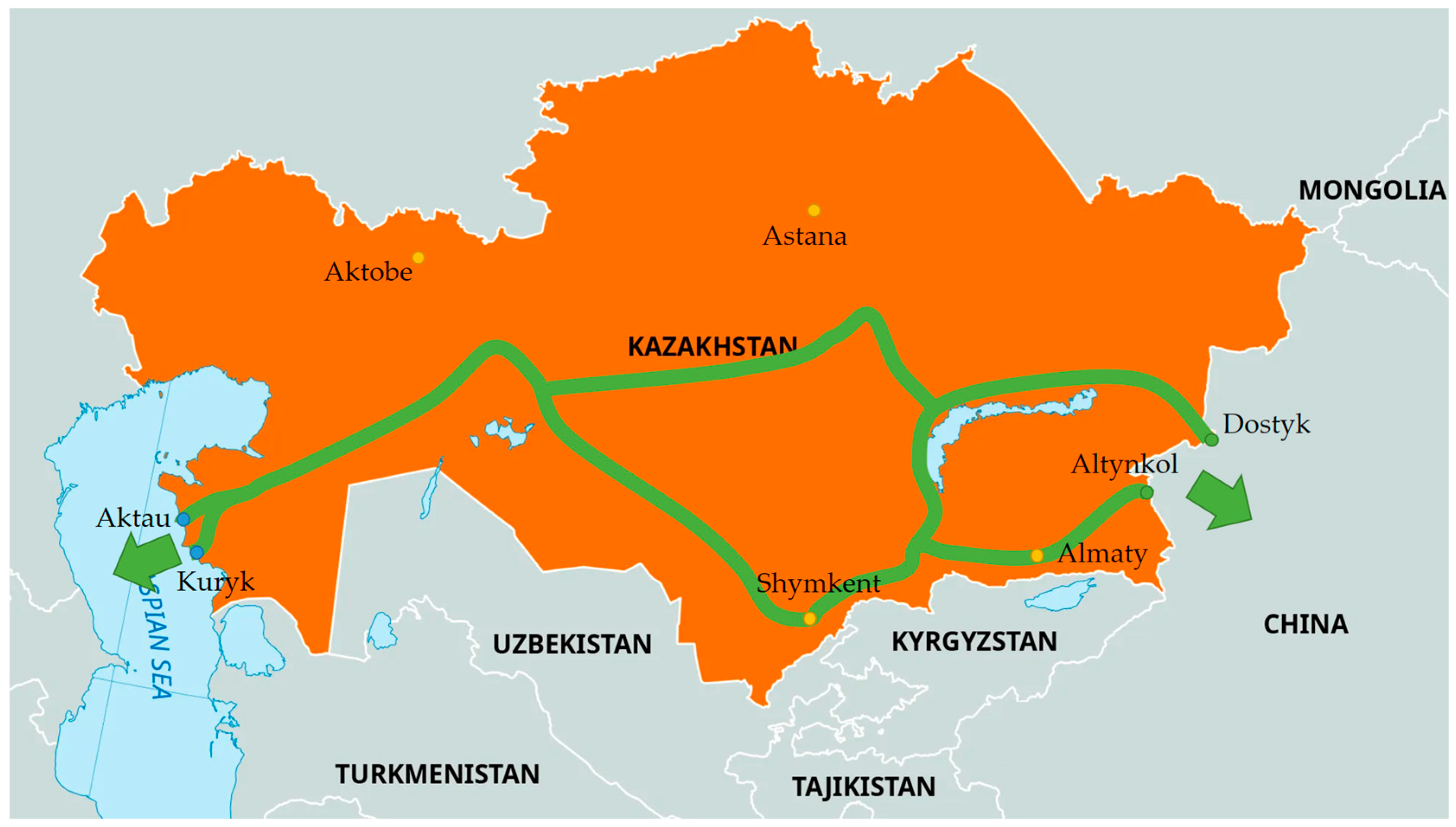
Railway system—more than 16,000 km of railways, accounting for over 60% of transit transportation. Kazakhstan has direct connections with China via the Dostyk–Alashankou and Altynkol-Khorgos border crossings, which serve as the main entry and exit points for cargo flows along the Middle Corridor, as illustrated in
Figure 1.
- –
Road network—over 90,000 km of motor roads, including international transport corridors. Road transport is primarily used for domestic shipments, as well as the first and last mile in multimodal chains.
- –
Seaports—the ports of Aktau and Kuryk on the Caspian Sea, which are key hubs of the Trans-Caspian International Transport Route (TITR). Their combined throughput capacity exceeds 15 million tons per year.
- –
Logistics hubs—major cargo concentration centers in Almaty, Astana, Shymkent, and Aktobe, which facilitate flow distribution and support warehouse infrastructure development. A special role is played by the Khorgos International Centre for Cross-Border Cooperation—a multimodal hub on the border with China.
Despite its significant potential, Kazakhstan’s transport system faces several challenges that limit its competitiveness as a transit corridor:
- –
limited throughput capacity of certain border crossings (Dostyk, Khorgos) and ports (Aktau, Kuryk), leading to bottlenecks in supply chains;
- –
idle time at customs checkpoints and terminals, which increases delivery duration and reduces the attractiveness of the route;
- –
imbalance between transport modes, insufficient integration of multimodal transportation, limited use of digital platforms, and the lack of a unified information environment for supply chain participants.
3. Methodology of Agent-Based Simulation Modeling of Multimodal Transportation in the Republic of Kazakhstan
To analyze and forecast the efficiency of the transport infrastructure of the Republic of Kazakhstan, we apply agent-based simulation modeling. This approach makes it possible to:
Reproduce the interaction between various participants in the logistics chain; account for the specifics of multimodal transportation (rail, road, and maritime components); explore infrastructure development scenarios and assess their impact on throughput capacity and delivery time.
To capture the interdependencies, constraints, and dynamic processes of multimodal transportation, the model includes a set of agents representing real-world entities of the transport system:
- –
Factory—manufacturing enterprises acting as major exporters that generate freight transportation orders;
- –
Distributor (logistics centers)—intermediate points for cargo consolidation and distribution;
- –
Order (cargo/shipment)—the key agent moving between infrastructure objects, characterized by parameters such as cargo type, volume, and direction (export, import, or transit);
- –
Truck—road transport vehicles used for domestic transportation or for the “first/last mile”;
- –
Train—rail transport providing the main share of transit shipments (air transport is not considered in the model at this stage);
- –
BorderCheckpoint—nodes with limited throughput capacity where control procedures take place and delays may occur;
- –
ContainerTerminal—maritime, rail, or inland transshipment facilities;
- –
TransitHub—multimodal transshipment centers;
- –
Customer—the end recipient.
In the developed simulation model of multimodal transportation in the Republic of Kazakhstan, the key element is the Order agent, which represents a specific cargo or shipment. Each Order has a set of attributes that determine its behavior within the system: direction of movement (export, import, transit, or domestic transportation), volume measured in tons or container equivalents (TEU), cargo type, time constraints, and execution priority. Additionally, route parameters are recorded—such as the origin node, entry and exit border checkpoints (for transit shipments), as well as transport mode preferences. Due to these characteristics, the Order becomes the central agent that initiates the operation of the entire transport infrastructure within the model.
The Factory agent represents large manufacturing enterprises generating export shipments. They create Orders, which are then injected into the transport system. Depending on cargo parameters, an order may be assigned to road transport (Truck) for the first-mile delivery or directly loaded into a railcar of a Train.
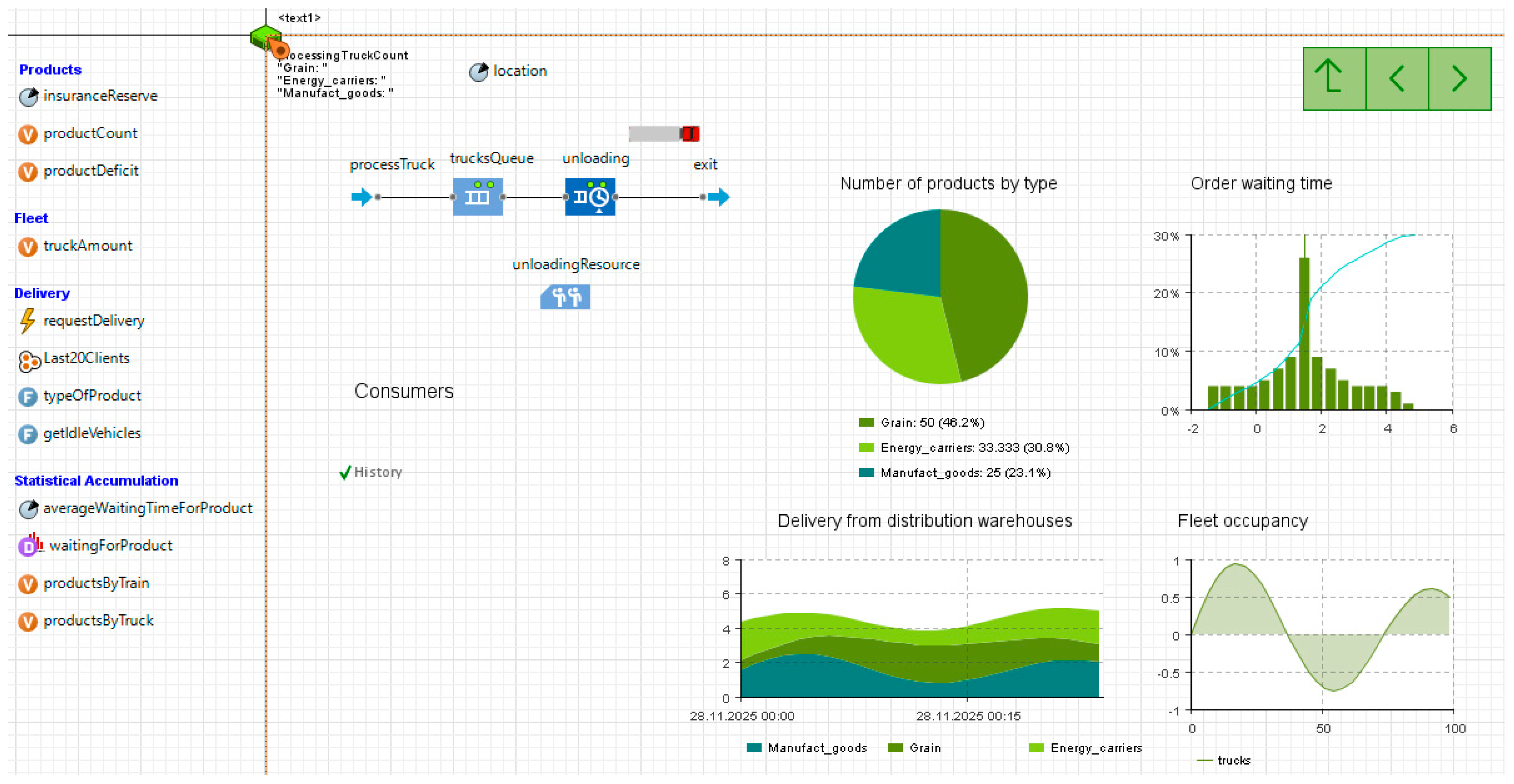
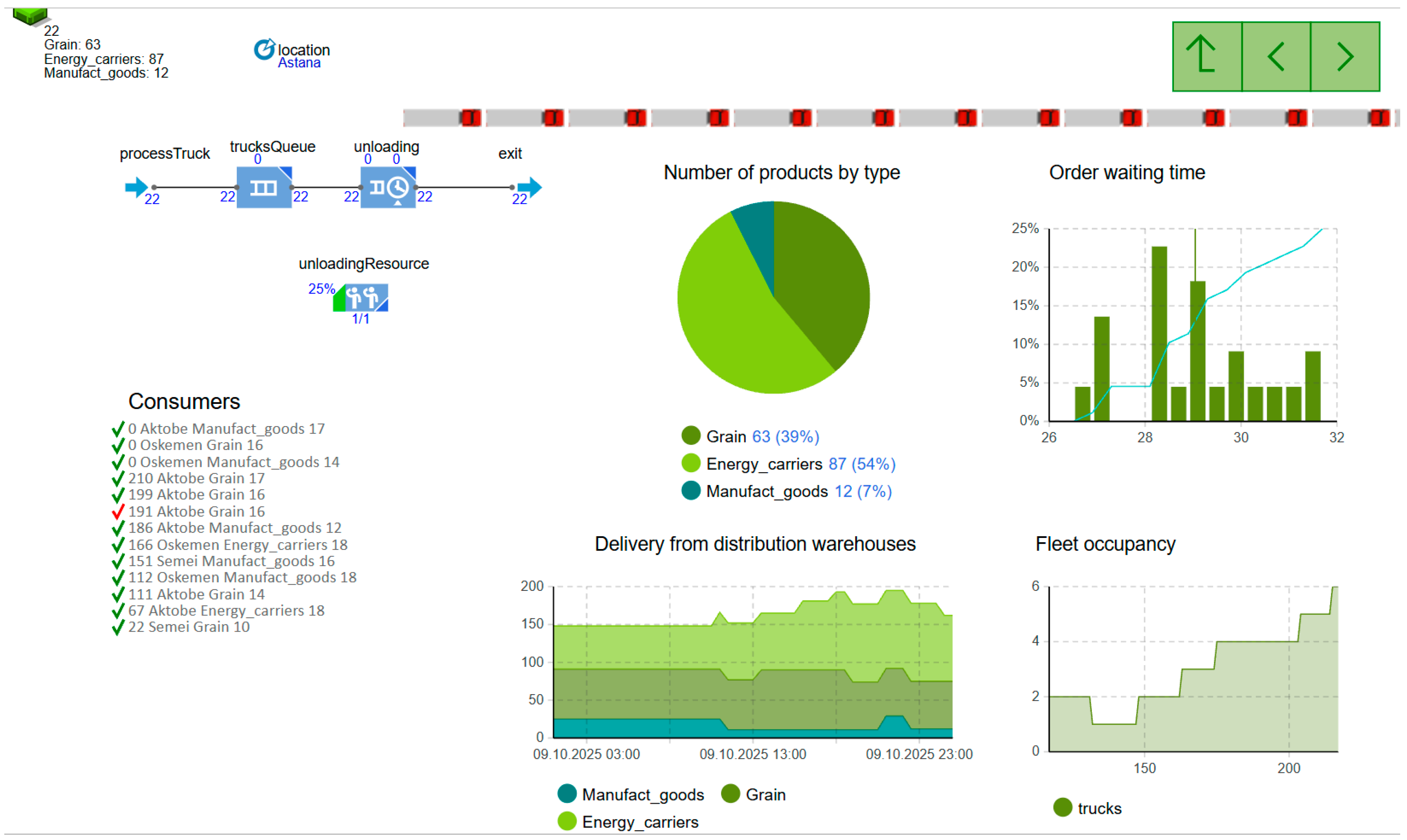
The Distributor agent models logistics centers or warehouses that perform consolidation and distribution of cargo within the country. Import orders arriving from abroad or from ports may be routed here and, after sorting, delivered further to consumers or enterprises. At the same time, distributors may serve as intermediate hubs for domestic freight flows. The hub maintains (
Figure 2) a structured inventory of product types, tracks their availability, and records shortages or delays in processing. Incoming deliveries are queued and unloaded through a controlled resource mechanism, after which goods are stored and made available for outgoing orders. Each Distributor agent has: statistical counters (current stock levels, truck availability, etc.); logic for request handling and prioritization; visualization dashboards for real-time monitoring of product mix, waiting times, delivery volumes, and fleet occupancy. The internal logic includes event-based triggers for delivery requests, processing queues, and resource allocation. The agent can dynamically dispatch trucks from its fleet in response to external orders, tracking key performance metrics such as: average product waiting time, fleet utilization ratio, response time to demand. This structure allows the Distributor to function autonomously while remaining fully integrated into the broader multimodal network through connections to trains and border checkpoints. Its parameters, such as location, product types handled, and storage capacity, are configurable via database input, supporting model adaptability and scenario testing.
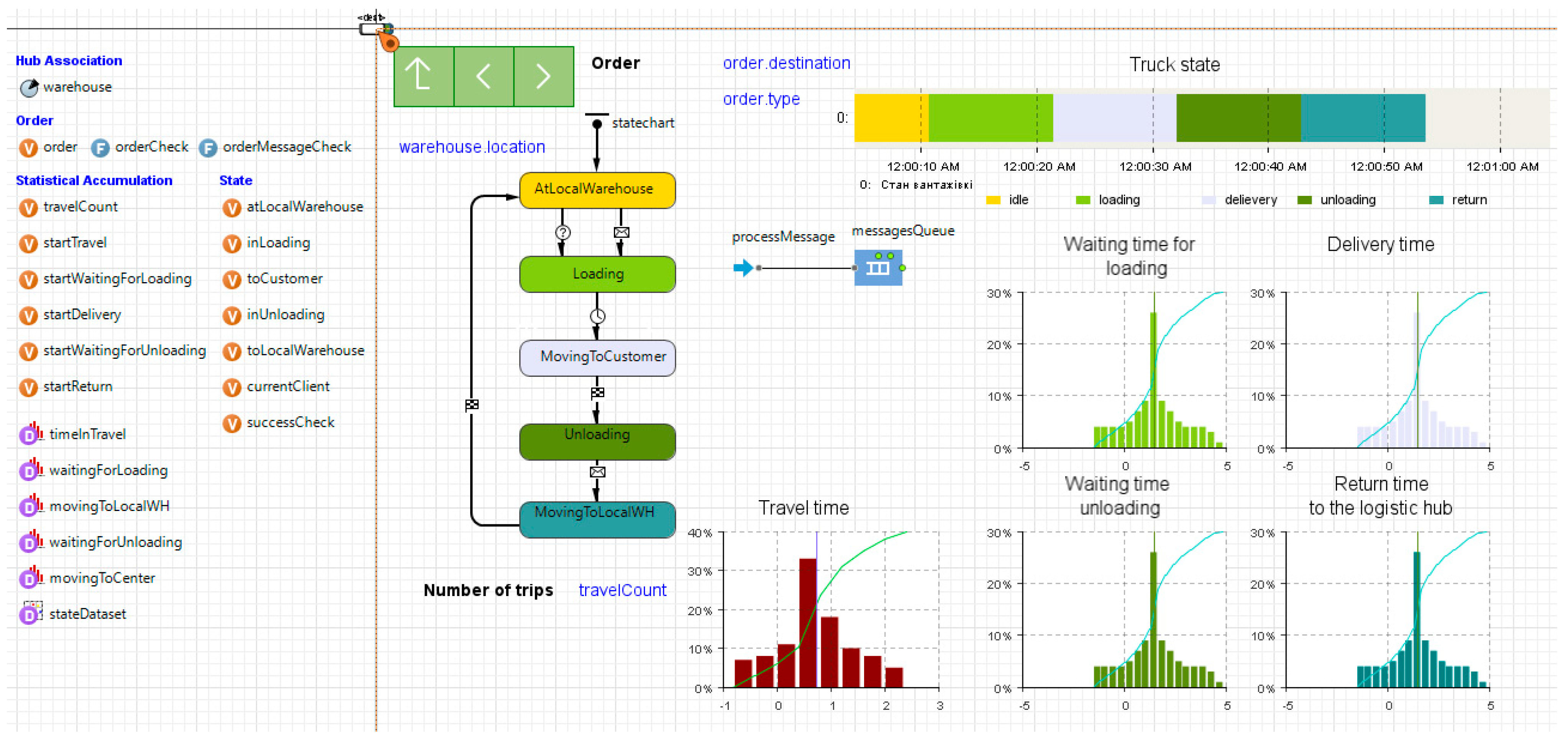
The Truck agent represents road transport. It can perform domestic and transit deliveries, as well as short-haul operations, providing first- and last-mile connectivity to railway terminals, ports, and border checkpoints. Each truck travels along routes generated from OpenStreetMap road networks, has limited carrying capacity and speed, and may queue when being serviced at transport network nodes. Its internal logic (
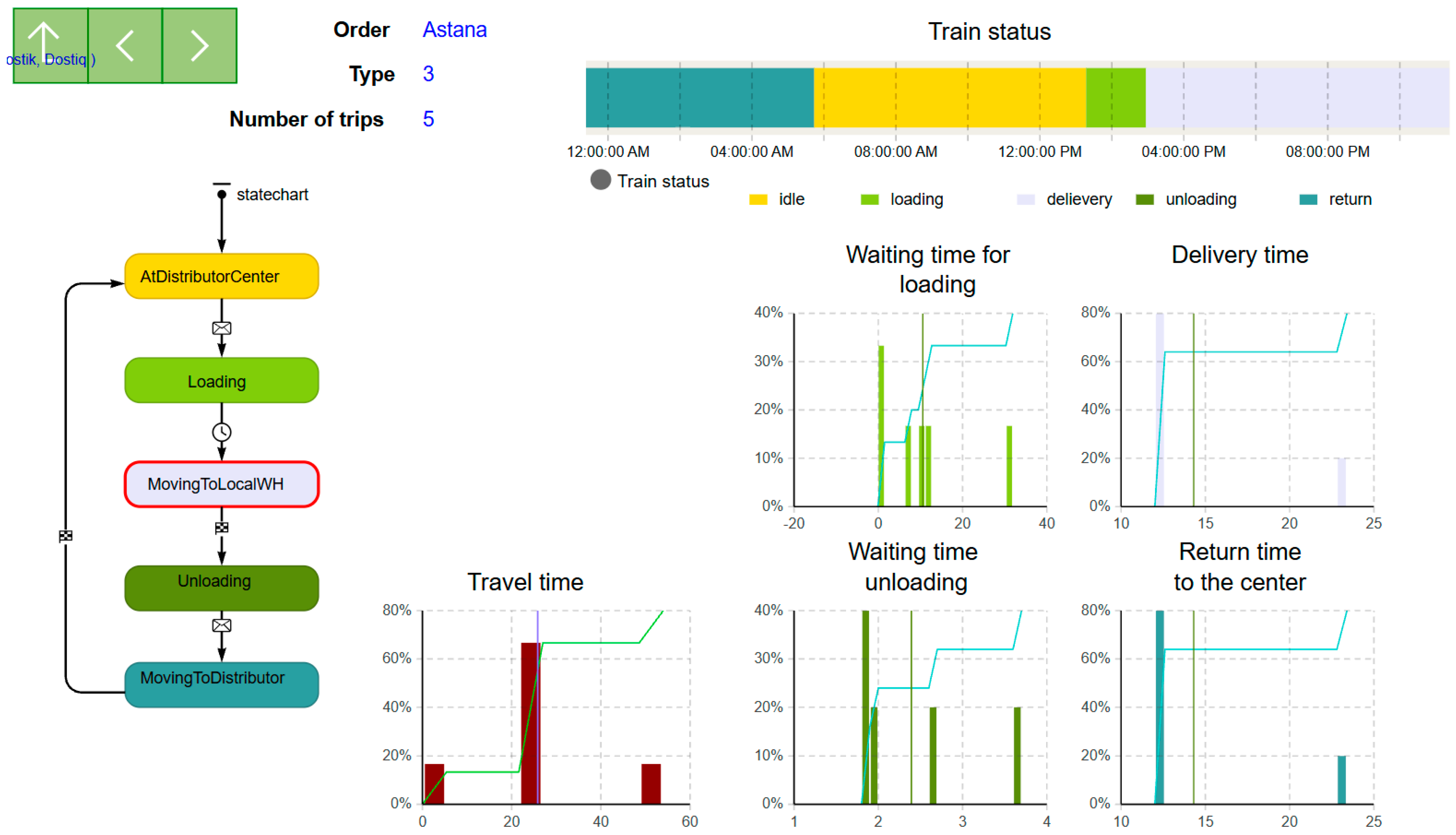
Figure 3) is structured through a statechart diagram that captures the full life cycle of a truck, including stages such as waiting at the warehouse, loading cargo, traveling to the customer, unloading, and returning to the logistics hub. Transitions between these states are governed by specific event triggers, and relevant performance metrics are recorded at each stage. The agent includes key embedded parameters and variables, such as the current warehouse location, the destination associated with a particular order, the number of completed trips, and the status of the message queue that manages delivery requests. To evaluate operational efficiency, the Truck agent collects statistical data including waiting times for loading and unloading, delivery and return durations, and overall travel time. These performance indicators are visualized in real time through integrated histograms, enabling dynamic monitoring of model performance. Geographical routing is implemented using OpenStreetMap-based road networks, ensuring that trucks follow realistic paths between locations. The Truck agent is also linked to a specific logistics hub, which allows aggregation of fleet utilization statistics at the hub level. This setup enables the model to reflect both individual vehicle behavior and system-wide logistics dynamics in a spatially accurate and analytically rich manner.
The Train agent models railway convoys that handle the primary workload of transit transportation. A train is formed from a group of Orders, can move along railway corridors on the map, and passes through hub stations and marshalling yards. Its key parameters include the number of railcars, total capacity, and dispatching policy—either scheduled departures or dispatch based on cargo accumulation.
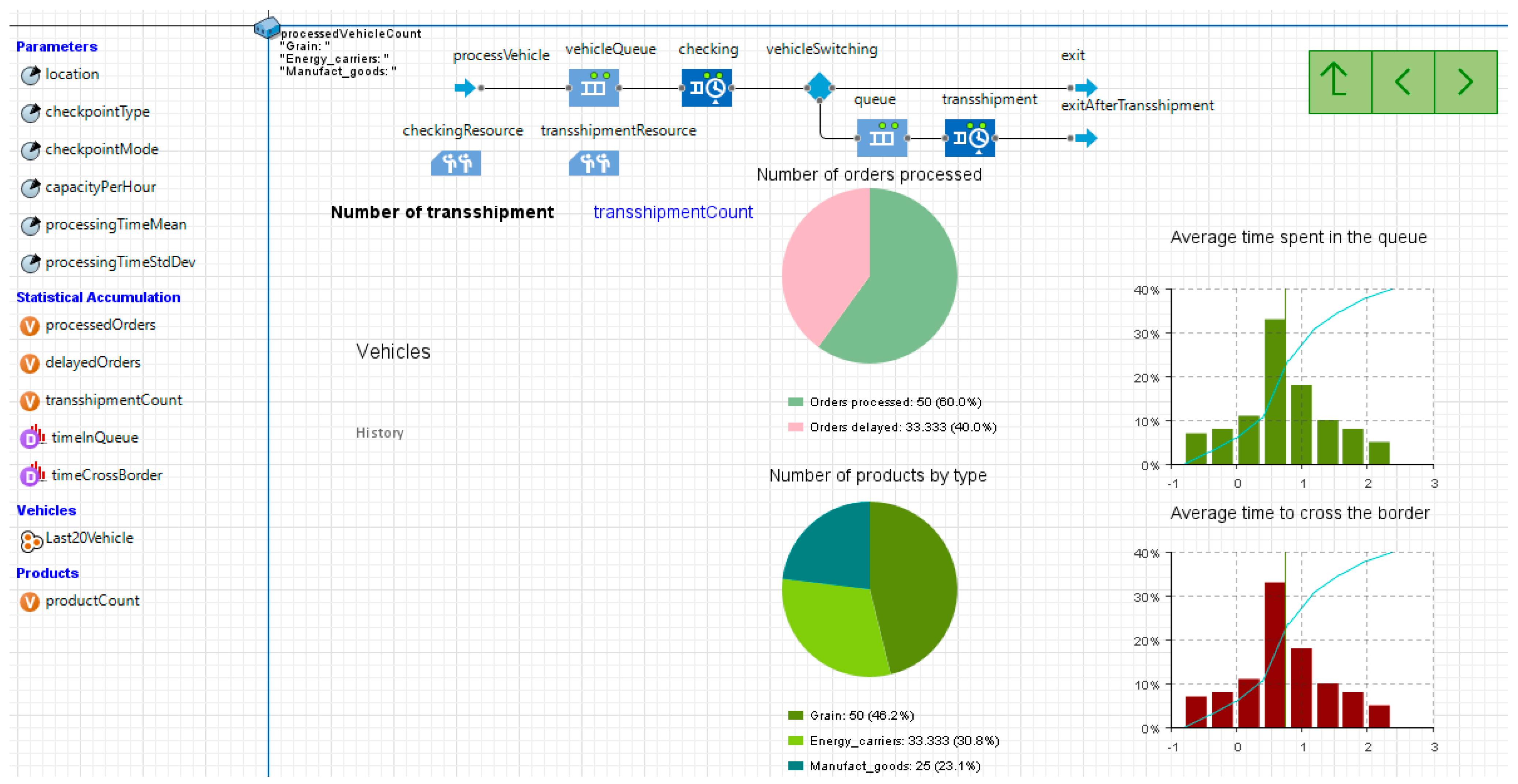
The BorderCheckpoint agent represents border crossing points. These are bottlenecks in the system due to constrained throughput capacity and stochastic processing times. At the border, cargo may be delayed in queues, undergo customs clearance and reloading operations, which affects overall delivery time. It supports both road and rail transportation modes and can operate in different processing modes depending on the scenario. Each checkpoint has configurable parameters (
Figure 4) such as location, capacity per hour, and processing time distributions. The agent logic includes queuing, checking, and transshipment mechanisms. Each processed order is tracked with respect to product type and delivery mode. The model accumulates statistics on the number of processed and delayed orders, queue time, and total time to cross the border. Performance indicators such as the average queue length and delays due to bottlenecks are recorded. In addition, the agent dynamically routes vehicles through different checkpoint branches depending on capacity and processing rules. This allows for realistic simulation of infrastructure constraints and border delays observed in international transport corridors such as Dostyk and Khorgos.
The ContainerTerminal agent represents transshipment facilities (seaports, railway terminals, and inland depots). Cargo may switch transport mode here—for example, from truck to train or from train to vessel. Each terminal has storage capacity, container handling time, and potential queues for service.
The TransitHub agent models multimodal logistics centers that receive and redistribute freight flows. They are used both for transit cargo crossing Kazakhstan’s territory and for export–import operations. In the model, the TransitHub serves as a key integration point between different transport modes, enabling the execution of multimodal delivery scenarios.
The overall logic of the model’s operation is that each Order is either generated at a production facility or received from outside (via a border or port) from Customer agents, after which it moves through the network according to its direction. Export orders move from Factory to BorderCheckpoint or ContainerTerminal, and then exit the country. Import orders, on the contrary, enter through a BorderCheckpoint or ContainerTerminal and are directed to a Distributor or Factory. Transit orders travel from one border to another, usually by rail, using a TransitHub as a transshipment node.
The interactions between different agents make it possible to reproduce competition for infrastructure resources, queue formation, border delays, and capacity constraints, bringing the model closer to real conditions of Kazakhstan’s transport system.
To implement multimodal transportation in AnyLogic, the Router Provider mechanism is used, which enables the simultaneous use of multiple transport networks on a single map. This ensures accurate representation of different transport modes within a unified spatial model—which is especially important for multimodal transportation scenarios, allowing the analysis of capacity at individual segments and the assessment of intermodal interaction efficiency.
The model is initialized using a set of database tables containing information on all elements of the transport system: manufacturing companies—export volumes; border crossings—type (road/rail), throughput capacity, average delay time; ports and terminals—cargo types, capacity, current load; internal logistics hubs—location, warehouse infrastructure capacity data; scenario parameters.
4. An Example of Modeling Multimodal Transportation in the Republic of Kazakhstan
As part of the experiments with the agent-based simulation model, several multimodal transportation scenarios were developed to reflect the characteristic features of the transport infrastructure of the Republic of Kazakhstan. Distributor agents represent major freight consolidation centers (logistics hubs in Almaty and Astana). Their functions include aggregating cargo batches and preparing them for dispatch to both the domestic market and for export. BorderCheckpoint agents model border crossings—specifically Dostyk and Khorgos—which serve as bottlenecks for international trade. Inspection procedures and waiting times are taken into account here, as they significantly affect total delivery time. ContainerTerminal agents are located in the ports of Aktau and Kuryk, which enable multimodal transportation involving maritime transport. In the model, they serve as transshipment points for containers between rail and sea routes. TransitHub agents represent intermediate railway stations and distribution points through which freight flows pass. Their role is to balance transport routes and redistribute resources across different directions. Customer agents symbolize end consumers in various regions of the country as well as in neighboring states, which allows the model to simulate both domestic and transit shipments.
For demonstration purposes, three types of cargo were selected, as they play the most significant role in Kazakhstan’s freight structure: grain crops (export flows to China and the Caspian region), energy carriers (transshipment of petroleum products through ports), and industrial goods and equipment (import and transit through key transport hubs). Limiting the range of cargo types at this stage of model development helps avoid excessive complexity while still reflecting the specifics of multimodal logistics.
Let us consider several operating modes of the system.
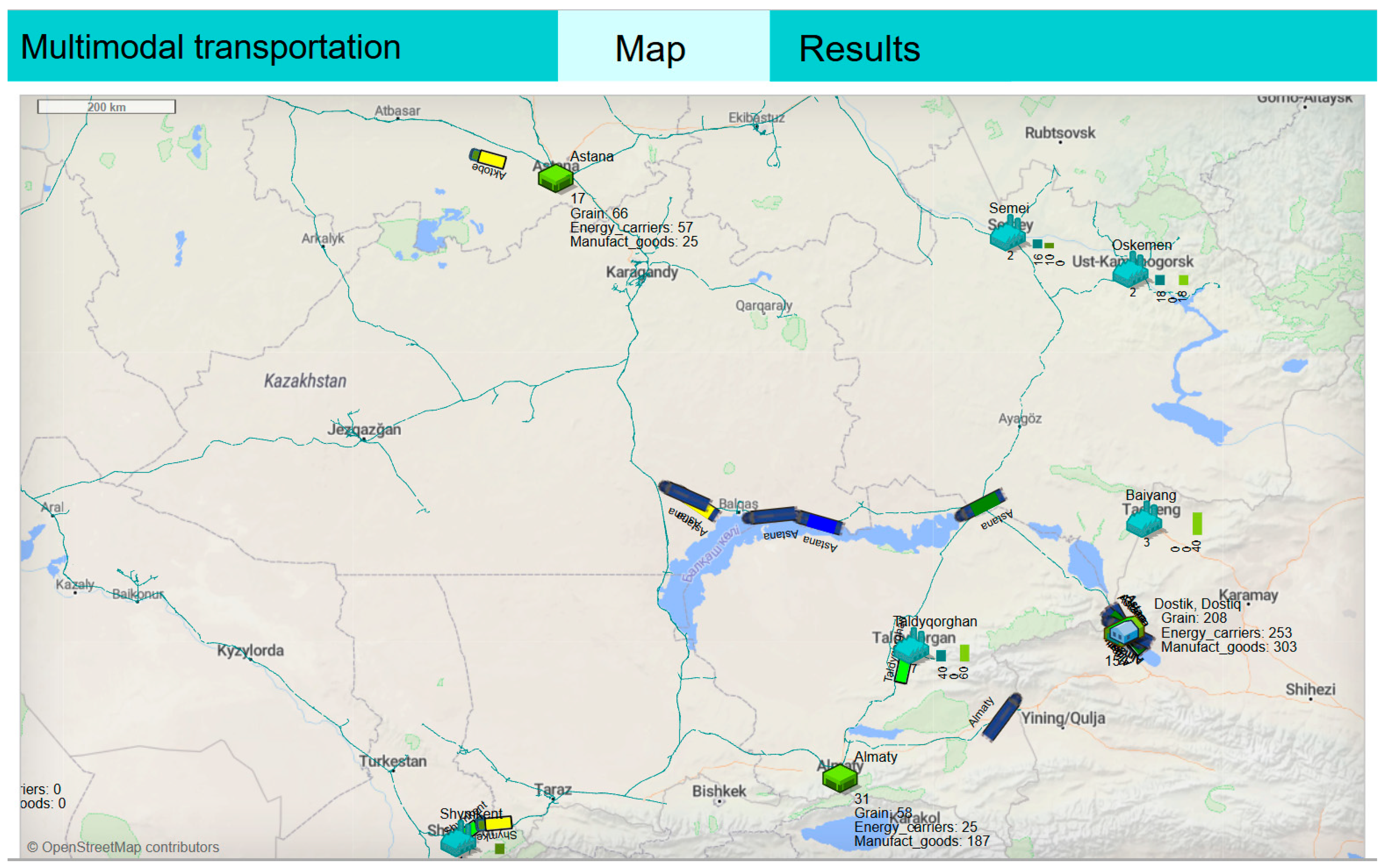
Figure 5 presents the geographical visualization of the model integrated with the OpenStreetMap service. All key elements of the multimodal logistics network are displayed: logistics hubs, border crossing points, container handling terminals, distribution centers, and consumers. Train and truck agents are shown in motion, illustrating active routes and delivery directions. Labels and charts display data on the current stock levels of each cargo type (grain, energy resources, industrial goods), as well as the number of transport units assigned to each location. This mode is used both for visual monitoring of delivery processes and for debugging the routing and freight flow distribution logic.
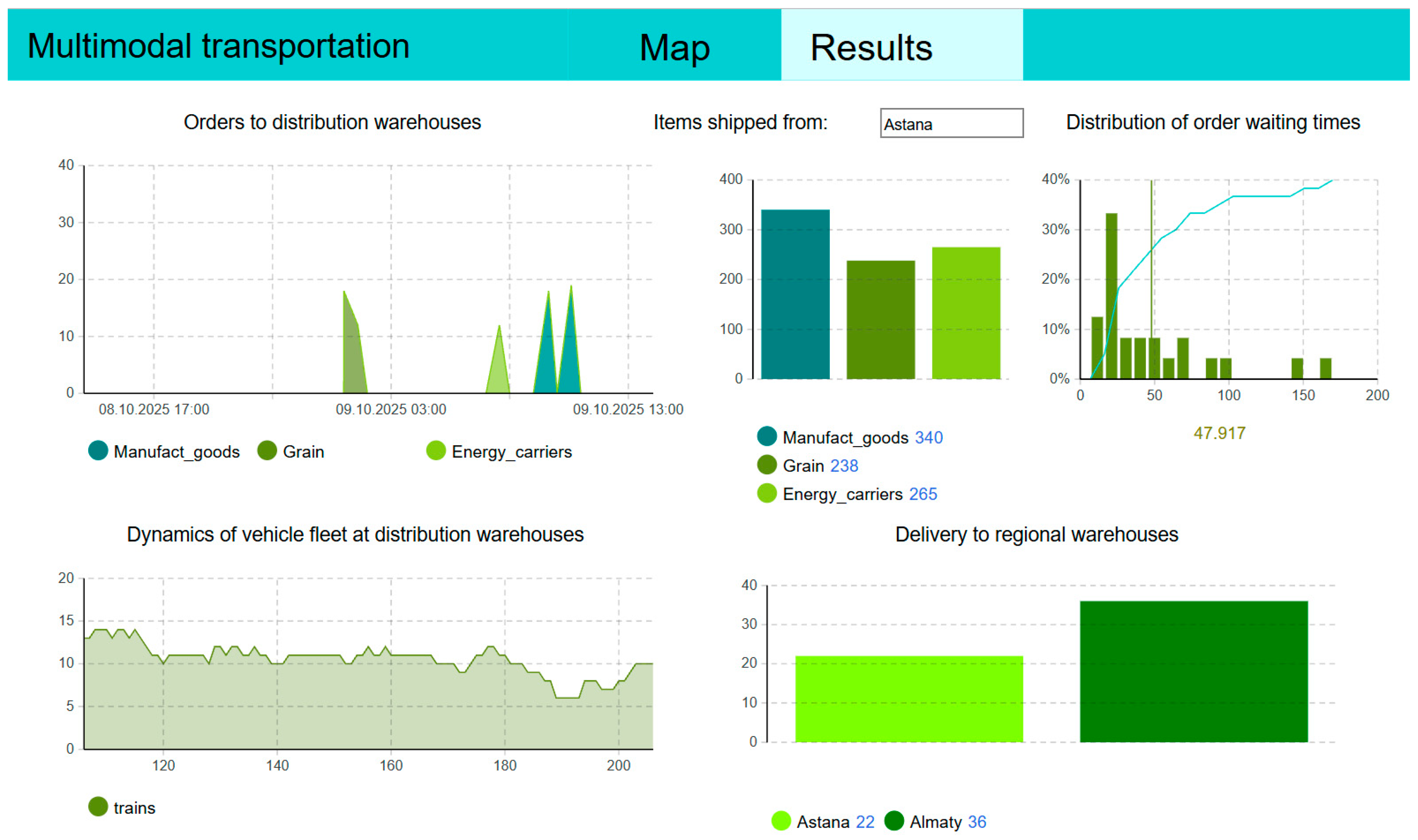
Figure 6 displays the key aggregated metrics of the logistics system, namely:
- –
the dynamics of incoming orders by cargo type to distribution warehouses;
- –
the number of cargo units dispatched from a selected hub, broken down by type;
- –
the distribution of order waiting times, presented as a histogram and cumulative curve to assess service efficiency;
- –
the dynamics of fleet size at warehouses;
- –
delivery to regional warehouses—showing the volume of shipments to major recipient cities.
This dashboard allows for rapid comparison of distribution efficiency and helps identify bottlenecks by cargo type and route.
Figure 7 presents detailed analytics for a specific logistics center. It includes:
- –
a queue chart for unloading operations and the current utilization of unloading resources;
- –
a pie chart showing warehouse stock composition by cargo category;
- –
a histogram of order waiting times;
- –
a list of customers who received shipments, indicating quantity and type;
- –
the dynamics of hub dispatches by cargo type;
- –
fleet utilization—showing the current load of transport vehicles.
This dashboard allows evaluation of the performance of an individual logistics node, providing insight into demand structure and fleet management.
Figure 8 presents dispatch information for a train agent, showing:
- –
a statechart illustrating the train’s behavior (loading, transportation, unloading, return);
- –
a Gantt chart of the current trip broken down into stages: waiting, loading, transportation, unloading, return;
- –
histograms of loading wait time, unloading wait time, transit time, return time, and total travel time.
This interface allows monitoring of each transport agent over time and identifying delays at each stage of the logistics cycle. It is used to analyze bottlenecks in the coordination of different transport modes within the multimodal system.
5. Results
We conducted a series of experiments aimed at evaluating the efficiency of Kazakhstan’s multimodal transport system under changes in key parameters (
Table 1).
Scenario 1 (Baseline): The model represents the current state of the transport infrastructure without any additional improvements.
Scenario 2 (Increased Border Checkpoint Capacity): The average cargo processing time at the Dostyk and Khorgos crossings is reduced by 20%.
Scenario 3 (Optimization of Transshipment at Aktau and Kuryk Ports): The average container handling time is reduced by 15%.
Scenario 4 (Increased Transit): Transit flows are increased by 25% due to route adjustments between China and Europe through Kazakhstan.
The bottlenecks in the transport system are primarily located at border crossings, where delays occur that have the greatest impact on average delivery times. Increasing the capacity of border checkpoints has the most significant effect on export and transit shipments. Optimizing port operations significantly reduces the load on container terminals, thereby improving the performance of import deliveries. An increase in transit flows without corresponding infrastructure development leads to a substantial rise in delivery times and congestion at key nodes.
To ensure the credibility and practical relevance of the developed agent-based simulation model, a multi-stage process of model calibration and verification was carried out. Calibration involved adjusting model parameters based on real-world data on freight volumes and infrastructure capacities, while validation focused on comparing simulation results with observed transport performance indicators. Data sources included: official statistics of the Committee for Transport of the Republic of Kazakhstan on annual volumes of rail and road cargo transportation; OpenStreetMap for transport network topology; publicly available throughput data for key infrastructure nodes, including the ports of Aktau and Kuryk, the Dostyk and Altynkol border crossings, and large logistics hubs in Almaty, Astana, and Shymkent; operational information from regional customs authorities regarding average border crossing times; realistic assumptions for agent behavior (e.g., truck speeds, queue processing times) based on regulatory and expert data.
The model was calibrated to replicate the average volumes and flow structures observed in multimodal transit through Kazakhstan, with particular focus on the Middle Corridor (Trans-Caspian International Transport Route). The key performance indicators used for validation included: total throughput by transport mode; average delivery time across transit corridors; utilization rates of infrastructure nodes; delays at border checkpoints and terminals; ratio of successful deliveries within time constraints.
Simulation results under baseline scenario showed a high degree of congruence with actual observed values. This confirms that the developed model reliably reflects key features and bottlenecks of the transport system of Kazakhstan and can be used to analyze development scenarios and assess the efficiency of logistics strategies.
To ensure the credibility and practical relevance of the developed agent-based simulation model, a multi-stage validation methodology was applied. This included calibration using real-world data, expert validation, sensitivity analysis, and quantitative benchmarking. The process was designed to verify both the internal consistency of the model and its ability to reproduce observable dynamics of Kazakhstan’s multimodal transport system.
Model calibration was based on empirical data from official statistics on annual cargo volumes by transport mode, infrastructure capacity data (including ports, border checkpoints, and logistics hubs), and road network topology from OpenStreetMap. During this phase, model parameters such as cargo generation rates, transport capacities, and processing times were adjusted to ensure that the simulated freight flows aligned with real-world averages.
Face validation was conducted through iterative simulation runs and expert review. Transportation professionals with experience in Kazakhstan’s logistics sector assessed the model’s operational logic, agent behavior (e.g., order generation, queuing, and vehicle movement), and interaction patterns. They confirmed that the simulation reproduced key aspects of logistical operations under multimodal transit conditions.
- 2.
Sensitivity Analysis.
To test the robustness of the model, a sensitivity analysis was performed. Key parameters—including checkpoint processing times, port handling capacities, and truck fleet sizes—were varied within a ±20% range. Although absolute performance metrics shifted accordingly, the ranking and nature of bottlenecks remained consistent, demonstrating model stability and the reliability of conclusions across tested scenarios.
- 3.
Quantitative Validation and Benchmarking.
Quantitative benchmarking was conducted by comparing simulation outcomes against observed indicators, such as:
- –
average delivery time along key corridors (China—Kazakhstan—Europe);
- –
border crossing delay durations (Dostyk and Khorgos);
- –
port handling efficiency (Aktau and Kuryk);
- –
infrastructure node utilization rates;
- –
percentage of shipments delivered within time constraints.
Results under the baseline scenario showed high congruence with operational benchmarks, affirming the model’s empirical validity.
To enhance the credibility of the model validation, a set of representative logistics routes was used, including export (grain from central and northern Kazakhstan), import (consumer goods and machinery via Chinese border crossings), and transit (containerized cargo along the Middle Corridor). For each route, key parameters such as cargo volume range, transport distance, number of modal transfers (from rail to truck at logistics hubs), and estimated delivery time were evaluated. The simulation outputs were compared with real-world statistical data and expert estimates available from national transport agencies and logistics operators. Instead of exact values, results were benchmarked against typical ranges observed in actual operations to reflect variability and uncertainty in multimodal logistics chains. This approach allowed validation not only of numerical indicators (throughput time, border crossing delays, asset utilization, etc.) but also of behavioral and structural consistency of the model in representing complex interactions across transport modes and logistics hubs.
Thus, the model enables a quantitative assessment of the impact of various management decisions on the functioning of Kazakhstan’s transport system and helps identify priority areas for infrastructure investment.
6. Discussion
6.1. Implications for Theory
The simulation results confirmed the importance of a comprehensive approach to the development of Kazakhstan’s transport infrastructure in the context of digital transformation. The developed agent-based model allowed reproducing the operational logic of key components of the transport and logistics system and analyzing the consequences of configuring specific characteristics.
The proposed agent-based model offers several theoretical contributions to the field of transport and logistics modeling. First, it advances the conceptual understanding of multimodal transportation systems in landlocked countries by incorporating spatial constraints, diverse infrastructure types, and cross-border coordination challenges into a unified simulation framework. Unlike many existing models that focus on isolated subsystems or single transport modes, our approach emphasizes the dynamic interactions between road and rail transport, logistics hubs, and border checkpoints, reflecting the operational complexity of real-world multimodal chains.
Second, the integration of geospatial data and behavioral agent logic supports the development of more context-sensitive simulation models, which is especially relevant for countries like Kazakhstan, where transport flows are highly dependent on geographic topology and infrastructure bottlenecks. This represents a methodological enhancement over conventional discrete-event or system dynamics models that often lack spatial resolution or agent autonomy.
Third, the model contributes to the theoretical discourse on transport system resilience by enabling the analysis of how changes in infrastructure capacity, transshipment efficiency, or demand structures affect overall performance indicators. The simulation platform facilitates scenario-based experimentation, which can inform the development of more robust logistics strategies under uncertainty. Thus, the study extends existing theory by offering a replicable and modular framework for analyzing multimodal logistics in transition economies and beyond.
6.2. Implications for Practice
First, it was demonstrated that the most critical bottlenecks remain the border crossings, where delays and idle times are concentrated. This is consistent with the findings of Zhang et al. [
13], which also emphasize the significance of temporal uncertainty when crossing intermodal borders. However, unlike Q-learning-based models, the proposed agent-based model accounts for the spatial structure and real transport nodes, including railway and road infrastructure, providing a more practical interpretation. Furthermore, this aligns with preliminary studies highlighting the limited capacity of international corridors in Central Asia. Digital solutions in monitoring, logistics management, and document flow automation can significantly enhance the efficiency of these nodes.
Second, the scenarios optimizing port transshipment demonstrated significant potential for enhancing Kazakhstan’s role as a transit hub on the China–Europe route. However, this effect is achievable only through the digital integration of ports into multimodal logistics chains and the creation of a unified information environment for coordinating the actions of various stakeholders. This conclusion aligns with the findings of Ren et al. [
11], which emphasize the resilience of multimodal routes under proper infrastructure integration. Unlike the formalized approach accounting for robust uncertainties, agent-based modeling allowed a detailed reproduction of operations at key nodes (terminals, hubs) and an assessment of cumulative effects.
Third, increasing transit flows without corresponding infrastructure development leads to the overloading of the transport system. This requires long-term planning that combines investments in physical modernization (railways, roads, terminals) with digital tools (digital twins, predictive analytics, route optimization). This conclusion is consistent with the analysis of Schuhmann et al. [
18], which highlights the need for large-scale multimodal modeling for transport system development planning. Unlike hybrid macro-level models, the model presented in our study implements micro-level agent behavior, including logistics operations and the interaction of orders and transport vehicles.
In the study by Lebid et al. [
19], enterprise logistics processes were modeled with a focus on multimodal transport but without spatial referencing or integrated GIS components. In contrast, the model developed in our work uses the actual coordinates of transport nodes, integration with OpenStreetMap, and combined routing capabilities (road and rail), significantly expanding the model’s practical potential for analyzing transport policy in Kazakhstan.
6.3. Limitations of the Study and Future Research Directions
Despite the flexibility and visual modeling capabilities offered by AnyLogic, there are certain limitations that may affect the scalability and extensibility of agent-based models, particularly in large-scale transport systems. When simulating tens of thousands of agents and their interactions on complex transport networks, the computational performance can degrade significantly. This may result in longer simulation times and reduced responsiveness during experiments with large scenarios. Large multimodal maps combined with rich agent states can lead to high memory usage. In particular, when multiple layers (rail, road) are loaded simultaneously via OpenStreetMap GIS routing provider, memory pressure increases, which limits scalability.
Thus, agent-based simulation with geographic routing and consideration of multimodal cargo characteristics represents an effective approach for strategic analysis, confirming its relevance and applied value among contemporary studies. The obtained results can be used to evaluate modernization scenarios, identify bottlenecks, and plan investments in Kazakhstan’s transport infrastructure in the context of digital transformation.
The model’s architecture is modular and parameterized, with all key input parameters—including the geographic locations of infrastructure objects, node capacities, route characteristics, and transport properties—being loaded directly from a database. This design enables full configurability without modifying the model’s internal structure: updating the dataset is sufficient to adapt the model to a new context. Consequently, the model can be reconfigured to analyze transport systems of other countries, logistics corridors, or regional networks. The ability to flexibly adjust capacities, routes, and agent configurations makes the model applicable to a wide range of tasks, including assessing delays and infrastructure congestion, planning the development of logistics hubs, evaluating scenarios of transit flow growth, and optimizing multimodal routing strategies.
Future development of the research is associated with expanding the model to include air transport, more accurately account for maritime flows through the Caspian region, consider containerization characteristics, and integrate optimization modeling methods with simulation scenarios.
Additionally, the construction of digital twins of transport nodes and the implementation of predictive analytics based on machine learning are planned. This will allow simulation models to be integrated into a broader concept of digital transformation of Kazakhstan’s transport infrastructure.
7. Conclusions
During the study, an agent-based simulation model of multimodal cargo flows in the Republic of Kazakhstan was developed. The model enables the reproduction of interactions among key participants in the logistics system—producers, distributors, transport companies, terminals, border checkpoints, and multimodal hubs. It accounts for the characteristics of road and rail transport, reflecting the actual distribution of transit flows within the country. Scenario-based experiments demonstrated that the model can be used to analyze the impact of bottlenecks in the transport network, assess border delays, and compare different transportation strategies. The results confirm the effectiveness of agent-based modeling for identifying imbalances between transport modes and exploring ways to optimize multimodal logistics chains.
From a scientific perspective, the study contributes to the advancement of agent-based modeling in multimodal logistics by integrating geospatial infrastructure data, scenario-based calibration, and synchronized agent interaction mechanisms tailored for transit-intensive economies such as Kazakhstan.
The practical significance of this work lies in the potential application of the developed model as an analytical tool to support decision-making in transport policy and infrastructure development in Kazakhstan.
Despite the obtained results, the study has several limitations. First, the model focuses on road and rail transport, while the role of maritime and air transport flows is considered only partially at the terminal level. Second, the data used on cargo turnover and throughput capacity are averaged, which limits the accuracy of predictive assessments. Third, at this stage, the model does not include the dynamics of tariffs, logistics costs, or the impact of market factors, which can significantly affect cargo flows.
Due to its modular and data-driven architecture, the model can be adapted to simulate multimodal transport systems in other countries or corridors, making it a transferable tool for comparative logistics studies.
Moreover, the model can serve as a basis for developing digital twins of national logistics systems, supporting policy simulations, strategic investment planning, and operational coordination between transport agencies.





 ,
,