Article

Industry 4.0 and Industrial Robots: A Study from the Perspective of Manufacturing Company Employees


by
Şemsettin Çiğdem
1,2,*,
Ieva Meidute-Kavaliauskiene
3 and
Bülent Yıldız
4
1
Faculty of Economics and Administrative Sciences, Gaziantep University, 27310 Gaziantep, Turkey
2
Sustainable Development Research Center, Khoja Akhmet Yassawi International Kazakh-Turkish University, Turkestan 161200, Kazakhstan
3
Department of Business Technologies and Entrepreneurship, Vilnius Gediminas Technical University, Sauletekio al. 11, 10223 Vilnius, Lithuania
4
Faculty of Economics and Administrative Sciences, Kastamonu University, 37150 Kastamonu, Turkey
*
Author to whom correspondence should be addressed.
Logistics 2023, 7(1), 17; https://doi.org/10.3390/logistics7010017

Submission received: 28 January 2023 / Revised: 1 March 2023 / Accepted: 6 March 2023 / Published: 15 March 2023
(This article belongs to the Special Issue Lights-Out Logistics)

Abstract

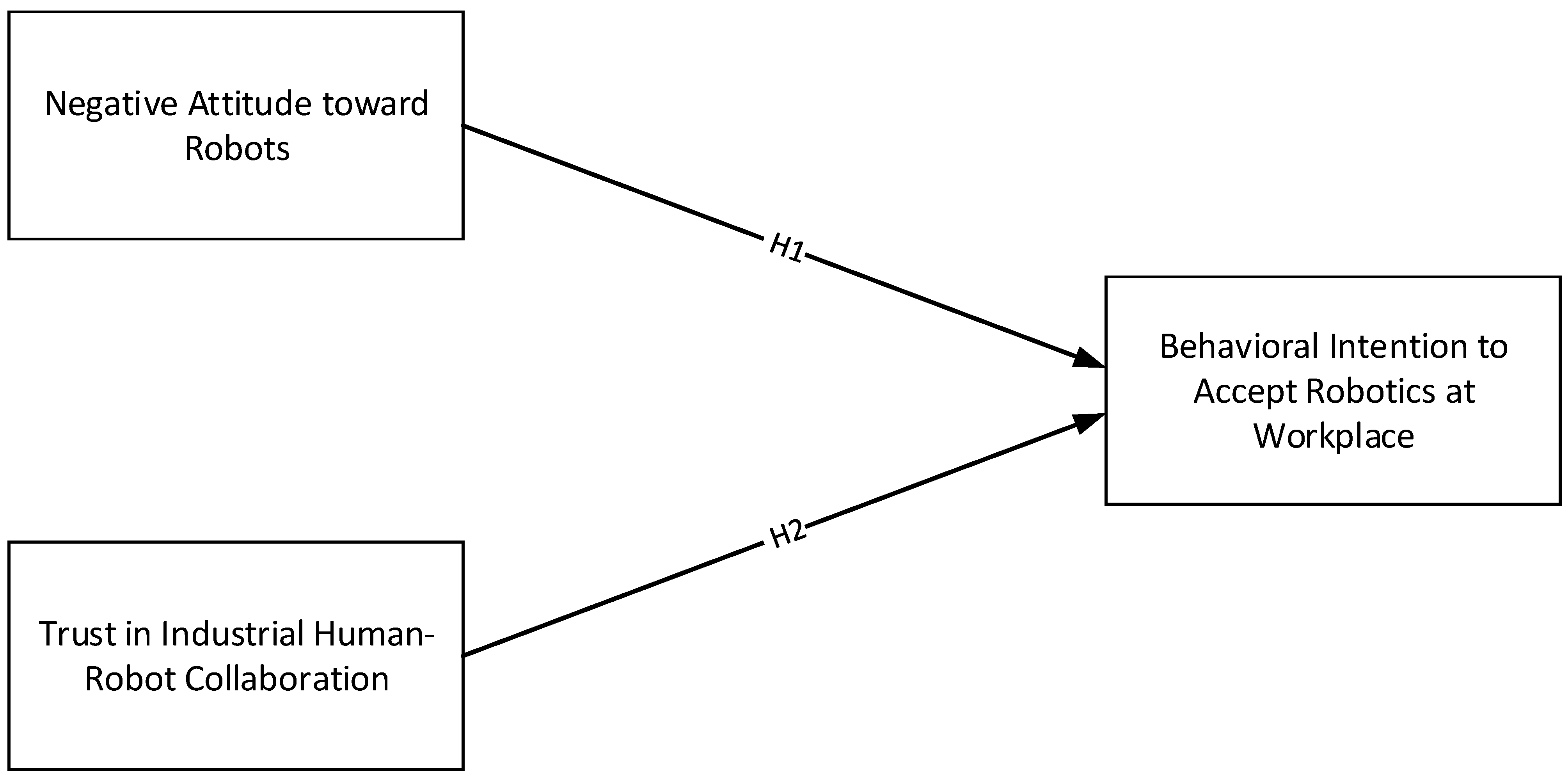
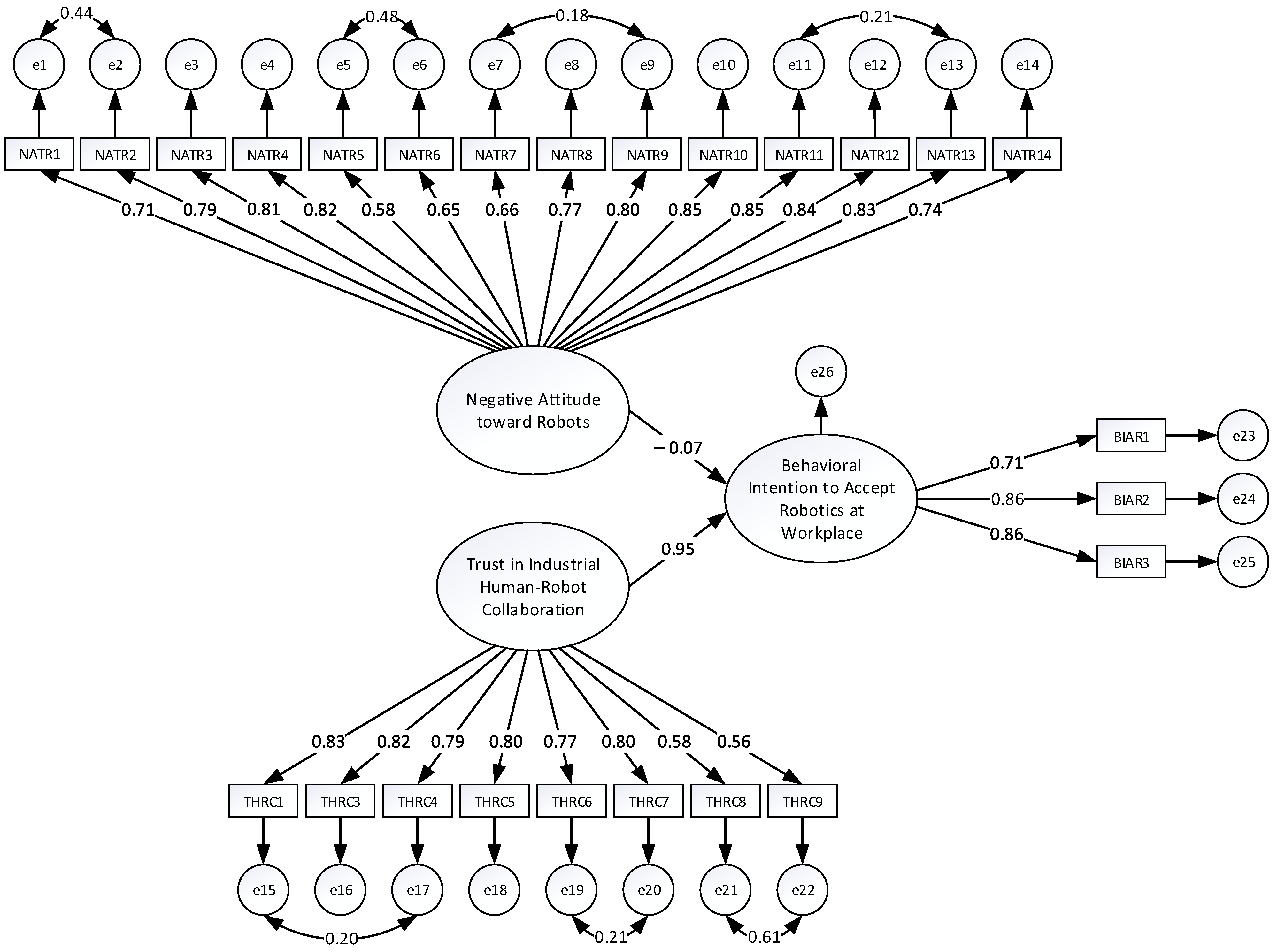
Background: Human–robot collaboration is essential for efficient manufacturing and logistics as robots are increasingly used. Using industrial robots as part of an automation system results in many competitive benefits, including improved quality, efficiency, productivity, and reduced waste and errors. When robots are used in production, human coworkers’ psychological factors can disrupt operations. This study aims to examine the effect of employees’ negative attitudes toward robots on their acceptance of robot technology in manufacturing workplaces. Methods: A survey was conducted with employees in manufacturing companies to collect data on their attitudes towards robots and their willingness to work with them. Data was collected from 499 factory workers in Istanbul using a convenience sampling method, which allowed for the measurement of variables and the analysis of their effects on each other. To analyze the data, structural equation modeling was used. Results: The results indicate that negative attitudes towards robots have a significant negative effect on the acceptance of robot technology in manufacturing workplaces. However, trust in robots was found to be a positive predictor of acceptance. Conclusions: These findings have important implications for manufacturing companies seeking to integrate robot technology into their operations. Addressing employees’ negative attitudes towards robots and building trust in robot technology can increase the acceptance of robots in manufacturing workplaces, leading to improved efficiency and productivity.
Keywords: industrial robots; negative attitudes; trust; human–robot collaboration; intention to use industrial robots; negative attitudes; trust; human–robot collaboration; intention to use