1. Introduction
Blockchain and related distributed ledger technologies have attracted increasing attention as digital infrastructures for coordinating transactions among actors that do not fully rely on a single centralized authority [
1,
2]. In supply chains, these technologies are commonly associated with shared recordkeeping, traceability, auditability, smart contract automation, and more transparent information exchange across firms, locations, and regulatory interfaces [
1,
2,
3,
4]. Their relevance has grown particularly in settings where products move through fragmented networks, documentation is distributed across organizations, and stakeholders require stronger guarantees of provenance, compliance, and accountability [
1,
5,
6].
These characteristics are especially pertinent to the mining industry. Mining and mineral supply chains are often geographically dispersed, operationally complex, and institutionally heterogeneous [
7,
8]. They involve multiple actors across extraction, transport, processing, refining, export, and downstream manufacturing, while also facing persistent challenges related to provenance verification, fragmented documentation, contractor coordination, authenticity of spare parts, regulatory compliance, and cybersecurity [
7,
8]. In critical mineral chains, these technical and governance challenges may also intersect with broader social and environmental pressures [
9,
10]. In the case of cobalt, for example, responsible sourcing concerns are intensified by opaque supply chains, weak formal structures, and severe labor and environmental risks, especially in artisanal and small-scale mining settings, and, in some contexts, by exposure to conflict [
10,
11,
12].
Against this background, blockchain has been proposed as a promising digital infrastructure for mining and mineral systems. The prior literature has most consistently associated it with stronger chain-of-custody control, improved traceability, auditable compliance, secure data exchange, and reduced reliance on paper-based or fragmented reporting processes [
8,
13,
14]. Beyond these functions, the adjacent mining-oriented literature has also suggested more exploratory applications, including legal smart contracts for derivative trading over mineral stockpiles and blockchain- or NFT-based certification and tokenization of in situ gold reserves [
15,
16]. Taken together, these contributions suggest that blockchain in mining is being considered not only as a provenance tool, but also as a mechanism for governance, coordination, and, in some proposals, digital asset representation [
8,
15,
16].
Even so, the state of knowledge remains fragmented. The most directly mining-focused review identified potential application areas, such as supply chain visibility, traceability in OEM parts, contract management, regulatory compliance, cybersecurity, and token-based innovation, but it also noted that mining-specific academic studies were scarce and therefore relied substantially on white papers, consultancy materials, and industry-authored documents [
8]. A broader mixed-method review of blockchain and sustainability in supply chains included mining and minerals as one industry category, but its purpose was cross-industry comparison rather than mining-specific synthesis, and mining and minerals formed only one part of a broader industry-based sample [
14]. A further systematic review examined blockchain-enabled supply chain traceability implementations from a technical and implementation-oriented perspective, with particular attention to domain variation, implementation maturity, and sustainability dimensions, but it likewise addressed cross-sector traceability systems rather than mining-specific applications [
17]. Other relevant contributions have been narrower in scope. A cobalt-focused framework paper examined how blockchain source data could be linked to ESG metrics for responsible sourcing in artisanal and small-scale mining, while emphasizing that traceability and chain-of-custody governance do not automatically translate into improved sustainability outcomes [
13]. A proof-of-concept study on legal smart contracts explored derivative trading over mineral stockpiles through a permissioned blockchain infrastructure, with particular emphasis on regulatory compliance, security auditing, and institutional permissibility [
15]. A recent concept paper on gold proposed blockchain- and NFT-based certification of in situ reserves, but concentrated specifically on reserve estimation, ownership certification, valuation, and regulatory feasibility in the gold context [
16].
Taken together, these studies are important, but they do not provide an integrated, mining-wide synthesis of how blockchain-enabled systems are being designed, implemented, and evaluated across different mining settings and application domains. To the best of our knowledge, the peer-reviewed mining literature still lacks a mining-specific systematic mapping review that consolidates the contexts of use, the problems addressed, the functional roles of blockchain systems, the underlying technical and organizational architectures, the reported evidence on performance and utility, and the barriers that shape adoption and scaling in the industry [
8,
13,
14]. More importantly, this is not only a matter of missing synthesis. The literature also advances partly divergent understandings of what blockchain is expected to do in mining, with some studies emphasizing provenance and transparency, others governance and compliance, and others operational coordination or more experimental forms of tokenization [
8,
13,
14,
15,
16]. This makes it difficult to determine whether the field is converging around a coherent set of functional roles or merely accumulating heterogeneous claims under a common technological label, a tension that further supports a problematization-oriented framing of the review [
18,
19]. As a result, the field still lacks a structured account of whether blockchain in mining is being used primarily for traceability, for governance and compliance, for operational coordination, or for combinations of these purposes, as well as a consolidated synthesis of the evidence reported for transparency, security, efficiency, sustainability, productivity, and institutional usefulness [
8,
13,
14].
Against this background, and to resolve these divergent ways of framing blockchain applications in mining, this review examines the peer-reviewed literature through the following questions: in which mining contexts and for which problems are blockchain-enabled systems being used; what types of systems predominate and how can they be classified functionally; how are traceability and governance implemented in these systems; which technical architectures, platforms, and complementary technologies are most frequently employed; what evidence has been reported regarding performance, impact, and utility; and which limitations, adoption barriers, and research gaps continue to shape the field.
Accordingly, the objective of this review is to critically synthesize how blockchain-enabled systems are being designed, implemented, and evaluated in the mining industry, and to clarify whether the literature is coalescing around a limited set of functional axes or remaining dispersed across only loosely comparable application claims, with particular emphasis on their traceability, governance, and operational functions. To achieve this objective, this review characterizes the mining contexts, problems, and application domains in which these systems are used; develops a functional typology of blockchain applications in mining; analyzes their technical and organizational architectures, including platforms, consensus mechanisms, access models, data management strategies, and integration with complementary technologies; synthesizes the reported evidence on transparency, security, efficiency, sustainability, compliance, and productivity; and identifies the limitations, adoption barriers, and research gaps that condition the maturity and scalability of the field.
The remainder of this manuscript is organized as follows.
Section 2 presents the review design, search strategy, eligibility criteria, and study selection procedures.
Section 3 reports the results of the systematic mapping review.
Section 4 discusses the findings in relation to the prior literature and outlines the main limitations and future perspectives. Finally,
Section 5 summarizes the main conclusions of this review.
2. Methodology
2.1. Review Design and Scope
We conducted a systematic mapping review of blockchain-enabled systems in the mining industry. This review type was considered appropriate because the field remains emergent, methodologically heterogeneous, and distributed across multiple application domains, making it more suitable to map the research landscape, functional orientations, technical patterns, and reported evidence than to address a narrowly defined intervention question [
20,
21]. Unlike a more conventional systematic literature review aimed at answering a tightly bounded question or comparing study outcomes at a more granular level, the present review was designed to provide a structured overview of the main mining contexts, problem framings, functional roles, technical configurations, evidence types, and research gaps through which blockchain-enabled systems are currently being examined [
20,
21]. In this sense, this review prioritizes breadth of field coverage over exhaustive depth at the level of study-by-study appraisal, while retaining systematic search, screening, and extraction procedures to ensure transparency and reproducibility [
22]. This review focused on peer-reviewed journal articles and early access articles published in English that addressed applications, frameworks, adoption, traceability, governance, security, or the integration of blockchain or distributed ledger technologies in the mining sector, the mineral sector, or mineral supply chains. We included two study families: empirical primary studies and technical or conceptual design studies with explicit methodology. Eligible methodological approaches included the system architecture, simulation, prototyping, comparative evaluation, case study, survey, and experimental validation.
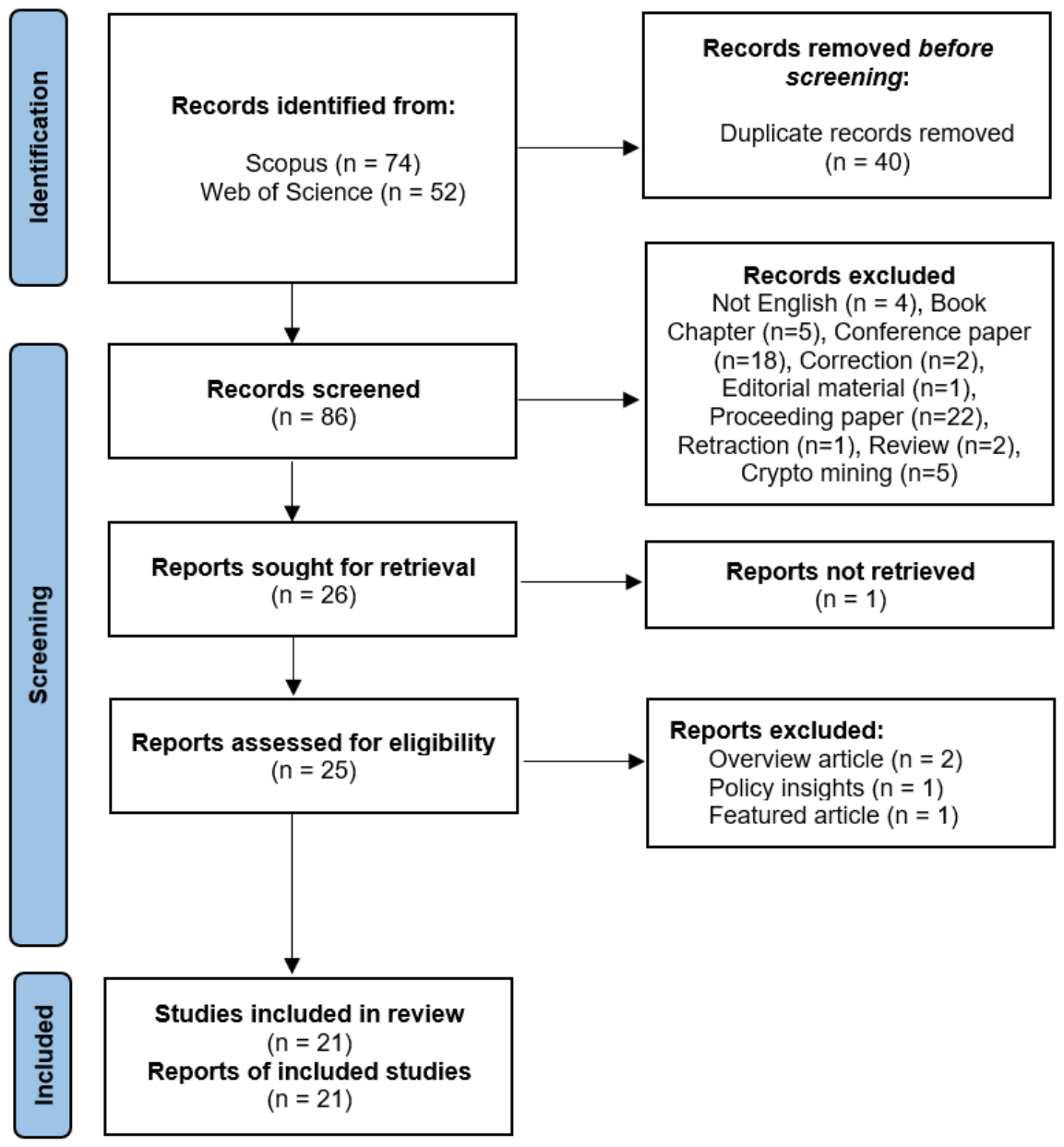
We documented the identification, screening, eligibility assessment, and inclusion process in the flow diagram shown in
Figure 1.
2.2. Information Sources and Search Strategy
We searched Scopus and Web of Science on 1 March 2026. These databases were selected because they provide broad, multidisciplinary coverage across mining, supply chain, and information system domains, along with structured indexing suitable for reproducible, field-restricted searches. Given the focus of this review on peer-reviewed journal articles and early access articles rather than the gray literature, these databases were considered appropriate core sources for constructing the review corpus.
The search strategy was organized into three groups: G1, a blockchain block that captured the core digital infrastructure terms; G2, a mining block that captured extractive, mining, mineral, and supply chain contexts; and G3, an exclusion block designed to remove records in which the term mining referred to cryptocurrency mining, generic blockchain mining terminology, or unrelated domains. We applied G1 and G2 to titles in order to prioritize topical precision and retain records in which both concept families were central to the study. This title-based restriction reflected a deliberate precision-oriented strategy, since broader searches using positive concept blocks across indexed fields retrieved numerous false positives, including records in which mining referred to cryptocurrency mining or other unrelated contexts, as well as studies in which blockchain and mining appeared only peripherally rather than as central topics. We applied G3 to broader indexed fields, namely the title, abstract, and keywords in Scopus and the topic in Web of Science, because many false positives did not reveal their irrelevance in the title alone but did so in the abstract or indexed terms. The generic search logic was as follows:
("block chain" OR "block-chain" OR DLT OR "blockchain" OR
"distributed ledger technology" OR "smart contract*" OR
"distributed ledger*")
AND
(mining OR mine* OR mineral* OR "mining sector" OR "mining industry"
OR "mineral extraction" OR "mining operation*" OR
"mineral supply chain*" OR "mining supply chain*" OR "artisanal gold"
OR "extractive industry*" OR "resource extraction" OR
"mining activity*" OR "ore extraction" OR "ore processing" OR
"mineral value chain*" OR "mining value chain*" OR "mineral chain*"
OR "commodity chain*" OR "raw material supply chain*")
AND NOT
("Minerless Scalable" OR "ACFix mines" OR "introductory tutorial" OR
"rule mining" OR "Blockchain Tournaments" OR "auto mining" OR
attackers OR Microgrid OR "systematic review" OR
"proof-of-spatial trust" OR "proof-of-temporal trust" OR
"heterogeneous miners" OR "block validation" OR "miner registration" OR
cryptocurrencies OR "smart grids" OR "smart grid" OR
"multi-microgrids" OR "knowledge graph mining" OR
"post-quantum security" OR "group decision making" OR
"front-running" OR "mining work centralization" OR
"dynamic spectrum access" OR "social media marketing" OR
scientometric* OR "front running" OR "mining strategy" OR
"mining strategies" OR "mining a block" OR
"blockchain competition between miners" OR "selfish miners" OR
"selfish-mine" OR "cellular V2X" OR "intrusion detection system" OR
"mining decision" OR "miner decision" OR "vaccine supply chain" OR
opcode OR "quantum-enabled blockchain" OR "crypto-miners" OR
"Ponzi scheme" OR "order book" OR "edge computing" OR
"mobile edge computing" OR "mining congestion" OR "hashing power" OR
"proof-of-stake" OR "blockchain mining" OR "proof of work" OR
"proof-of-work" OR "miner selection" OR "miner reputation" OR
"MEC-enabled mining" OR "mobile blockchain mining" OR
"cloud mining" OR "mining attacks" OR "Ethereum mining" OR
"Bitcoin mining" OR "mining pools" OR "data mining" OR
"text mining" OR "process mining" OR "opinion mining" OR
"web mining" OR "mining game" OR "selfish mining")
Because the search strategy required database-specific field restrictions and syntax adaptations, the exact executable search strings used in Scopus and Web of Science are reported in
Appendix A.
The search retrieved 74 records from Scopus and 52 records from Web of Science, for a total of 126 records before deduplication. No a priori publication-year restriction was applied in the database searches beyond the search date itself. The eligible corpus therefore begins in 2020, as earlier retrieved records published prior to 2020 did not meet the final methodological scope of this review.
2.3. Eligibility Criteria
We included studies that met all of the following criteria: they were peer-reviewed journal articles or early access articles, written in English, and centered directly on applications, frameworks, adoption, traceability, governance, security, or the integration of blockchain or distributed ledger technologies in the mining sector, the mineral sector, or mineral supply chains. We considered both empirical primary studies and technical or conceptual design studies with explicit methodology.
We excluded records that were not written in English, were not journal articles or early access articles, addressed cryptocurrency mining rather than extractive mining, or did not focus directly on the mining sector, the mineral sector, or mineral supply chains. At the full-text stage, we also excluded articles that did not meet the methodological scope of this review, including records that functioned as an overview, a policy, or featured pieces rather than empirical primary studies or technical or conceptual design studies with explicit methodology. These full-text exclusions comprised two overview articles [
23,
24], one policy insights document [
25], and one featured article [
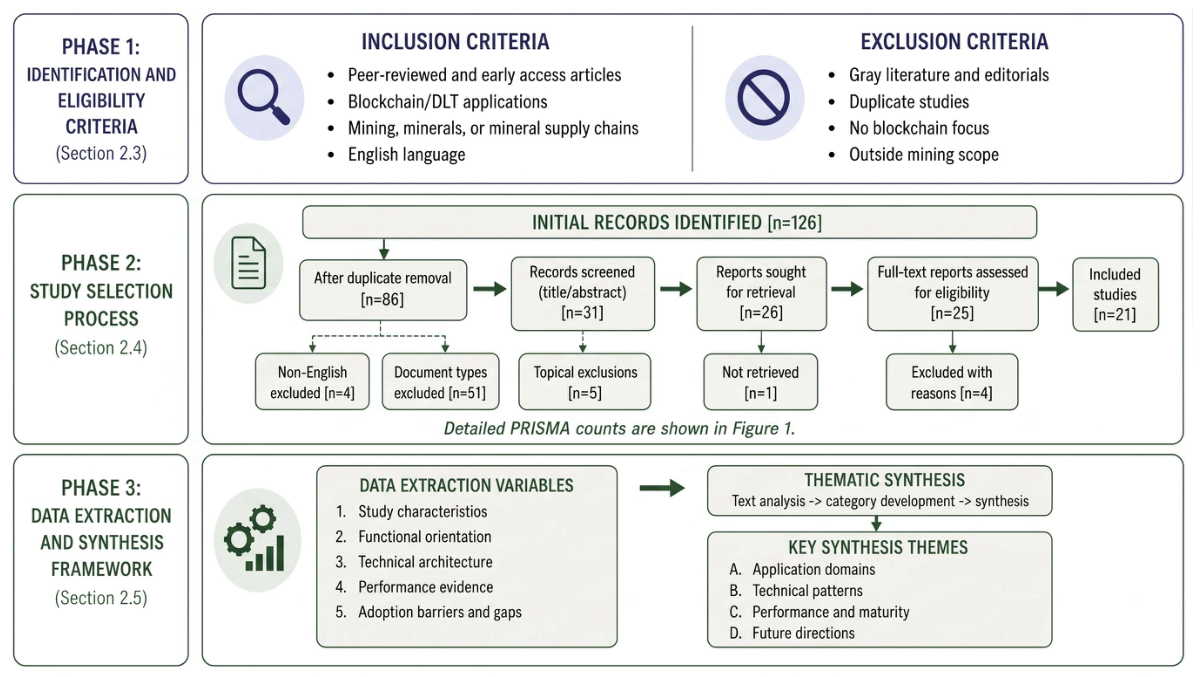
26]. The eligibility logic applied in this review is visually summarized in
Figure 2.
2.4. Study Selection
Two reviewers independently screened the records at the title and abstract stage and then independently assessed the retrieved full texts for eligibility using the predefined inclusion and exclusion criteria. Disagreements were first discussed with a third reviewer, and any cases that remained unresolved were adjudicated by a fourth reviewer.
Figure 2 provides a simplified visual summary of the study selection logic and screening sequence, whereas the detailed PRISMA record counts are reported in
Figure 1.
We removed 40 duplicate records prior to screening, which left 86 records for further evaluation. We first excluded 4 non-English records, specifically 3 Chinese articles and 1 Russian article. We then applied a document-type filter and excluded 51 records, comprising book chapters (n = 5), conference papers (n = 18), corrections (n = 2), editorial materials (n = 1), proceeding papers (n = 22), retractions (n = 1), and reviews (n = 2). After these language and document-type exclusions, 31 English journal articles or early access articles remained for topical screening.
At the topical screening stage, we excluded 5 additional records because they did not address blockchain applications in the mining sector, the mineral sector, or mineral supply chains. These comprised one buyer-driven commodity chain study focused on furniture and apparel, two articles on cryptocurrency mining, one study on blockchain mining in decentralized finance, and one generic blockchain and IoT metadata aggregation study unrelated to mining or minerals. This left 26 reports for retrieval.
One report could not be retrieved. We therefore assessed 25 full texts for eligibility. At this stage, we excluded 4 reports that did not meet the methodological scope defined in
Section 2.3. These included 2 overview articles [
23,
24], 1 policy insights document [
25], and 1 featured article [
26]. The final corpus consisted of 21 studies.
2.5. Data Extraction and Synthesis Framework
A standardized data extraction template was developed in line with the review objectives and research questions. Two reviewers independently extracted the study information and cross-checked the resulting records for accuracy, completeness, and consistency. Any discrepancies in coding or interpretation were first discussed with a third reviewer, and any cases that remained unresolved were adjudicated by a fourth reviewer.
We designed the data extraction process to align with the review objectives and research questions. The extraction template captured the analytical dimensions used to structure the synthesis presented in
Section 3.1,
Section 3.2,
Section 3.3,
Section 3.4,
Section 3.5,
Section 3.6,
Section 3.7 and
Section 3.8, as summarized in
Figure 2. Functional orientation was one of the extracted analytical dimensions and served as the basis for the typology reported in
Section 3.2. To develop this typology, we compared the subset of studies classified as system-oriented, according to the primary problem addressed, the primary managed entity or process, and the dominant role performed by blockchain within the reported system. Studies with overlapping functions were assigned to the category that best captured their principal functional role in order to reduce overlap across classes. Alternative grouping logics were also considered as part of this classification process, including classification by the mining setting, mineral or resource type, technical architecture, and evidence type. These alternatives were not adopted as the primary organizing principle because they combined contextual, technological, and methodological variation without adequately capturing the main role played by blockchain across studies. The final typology was therefore developed as an inductive, function-oriented classification intended to organize this heterogeneous corpus at the level of system purpose rather than commodity, setting, or study design.
For each study we included, we gathered details about its characteristics, functional orientation, traceability focus, governance and compliance mechanisms, operational uses, technical architectures and design patterns, and evidence of performance and impacts, as well as any adoption barriers, limitations, and research gaps. We focused on collecting information needed to summarize the study characteristics, types of blockchain-enabled systems in mining, traceability applications, governance and data control, operational uses in mining, technical designs, performance evidence, and any barriers or gaps found.
This structure helped us organize the synthesis by the types of blockchain-enabled systems studied, the mining problems they addressed, the design and validation methods used, the kinds of evidence reported, and the limitations found in the field.
Given the methodological heterogeneity of the included studies and the objective of mapping the field rather than estimating pooled effect sizes or answering a narrowly defined intervention question, we did not employ a formal study-quality scoring system or risk-of-bias assessment tool [
20,
21]. Instead, the synthesis prioritizes classification, pattern identification, thematic comparison, and gap detection across the corpus, while more critical interpretation of evidentiary maturity, implementation limits, and contested claims is developed later in the discussion [
20,
21,
22].
3. Results
The results show a heterogeneous but structured body of evidence on blockchain-enabled systems in mining. The reviewed studies span multiple mining settings, functional applications, and levels of maturity, ranging from conceptual and simulation-based proposals to pilots and implementation-oriented cases. The following subsections synthesize this evidence from general study characteristics to functional applications, governance mechanisms, technical architectures, reported impacts, and remaining barriers and gaps.
3.1. Characteristics of the Included Studies
The 21 included studies outline a heterogeneous research landscape within the final corpus. As shown in
Table 1, the evidence spans industrial and large-scale mining, artisanal and small-scale mining, critical mineral supply chains, coal and resource management systems, environmental and safety monitoring, data governance and secure information management, and equipment or fleet management. This distribution indicates that blockchain-enabled systems in mining are being examined across multiple operational settings rather than within a single segment of the sector.
The represented minerals, resources, and environments are similarly varied. The corpus includes studies focused on copper, cobalt, lithium, nickel, cassiterite or tin, coal, uranium, gold, tantalum, diamonds, emeralds, and colored gemstones, as well as studies centered on environmental parameters, water quality, emissions, vegetation change, inspection measurements, enterprise data authenticity, mine energy systems, and equipment remanufacturing. Taken together, these studies cover activities ranging from extraction and traceability to monitoring, inspection, maintenance, tokenization, controlled data sharing, and compliance-oriented information management.
Methodologically, the corpus combines critical qualitative analysis, case studies, multiple case studies, mixed-method pilot research, surveys, structural equation modeling, system design, smart contract implementation, system architectures, simulations, optimization models, and experimental validation. Case-based approaches are especially visible in studies of mineral traceability, ethical sourcing, and compliance-oriented adoption, whereas architecture and design studies are common in work on inspection, remanufacturing, data governance, and access control. Simulation and controlled evaluation are prominent in monitoring, warning, and consensus-oriented applications, while survey-based and mixed-method studies contribute evidence on adoption barriers, managerial perceptions, and organizational readiness, particularly in artisanal mining and critical minerals contexts.
The geographic coverage is broad, with studies situated in Africa, South America, Europe, Asia, and North America, alongside global or multi-jurisdictional supply chain settings. Reported contexts include the Democratic Republic of Congo, Zambia, Rwanda, Chile, Peru, Italy, Spain, Norway, Finland, Bulgaria, China, Russia, Pakistan, and the United States. This spread reflects the international character of mining and mineral supply chains and shows that blockchain-related applications are being explored under diverse regulatory, logistical, environmental, and operational conditions.
The evidence is recent, spanning from 2020 to 2025, and varies considerably in maturity. This interval was not imposed as an a priori temporal filter, but emerged from the final eligible corpus identified up to the search date. Some studies remain conceptual or simulation-based, particularly in access control, optimization, and collaborative data-sharing designs, whereas others report bounded pilots, live-environment evaluations, or active implementations in traceability, compliance, and industrial monitoring. Rather than indicating a uniform progression toward deployment, the corpus points to the coexistence of exploratory, design-oriented, experimentally validated, and implementation-focused work.
Overall, the included studies form a heterogeneous but interpretable body of evidence. They cover industrial operations, artisanal mining settings, critical mineral supply chains, environmental and safety monitoring, and data-governance-oriented systems, while combining conceptual modeling, controlled validation, exploratory field research, survey-based evidence, and implementation cases. This profile provides the descriptive basis for the functional and thematic synthesis developed in the following subsections.
3.2. Function-Oriented Classification of Blockchain-Enabled Mining Systems
Of the 21 studies included in the final corpus, 17 were classified as system-oriented because they described, proposed, implemented, or evaluated blockchain-enabled systems, architectures, or operational frameworks in mining. The remaining four studies were retained in this review but were not treated as primary units in this typology, since their main contribution lay in critical qualitative analysis, survey-based adoption evidence, or business model-oriented analysis rather than in system design or system evaluation.
From this system-oriented subset, we developed a functional typology with five classes: traceability and provenance systems; governance, compliance, and secure data control systems; operational monitoring and inspection systems; energy and market coordination systems; and sustainability and environmental surveillance systems. These categories were derived by grouping studies according to a similar dominant function, based on the extracted information on functional orientation, primary problem addressed, and primary managed entity or process. As shown in
Table 2, the classification is based on the dominant function performed by blockchain within the reported system rather than on the mining setting or the specific mineral involved. This function-oriented grouping also provides a mining-specific synthesis beyond the broader use-case lists reported in the earlier literature. Prior reviews and adjacent conceptual contributions had already pointed to themes such as traceability, compliance, cybersecurity, responsible sourcing, and token-based innovation, but they did not consolidate these recurrent uses into an integrated functional classification tailored to mining applications. The present typology builds on those recurring themes while reorganizing them into five analytically distinct system roles that help structure comparison across commodities, mining settings, and levels of technical maturity. Accordingly, the typology should be interpreted as an analytic organizing framework for the present corpus rather than as a fixed or universal taxonomy of all possible blockchain applications in mining.
Each class is defined by a distinct primary managed entity or process. Traceability and provenance systems focus on the movement, transformation, and verification of minerals, components, and related records across supply chains or service cycles. Governance, compliance, and secure data control systems regulate access, permissions, auditability, and the conditions under which sensitive mining information is generated, shared, protected, or verified. Operational monitoring and inspection systems support the oversight of safety conditions, equipment status, inspection routines, and other process-critical activities within mining environments. Energy and market coordination systems structure transactions, decentralized exchange, and coordination processes related to energy management and mining operations. Sustainability and environmental surveillance systems record environmental indicators and monitoring data to support accountability, compliance, and ecological assessment.
Because several studies combine more than one function within the same architecture, each study was assigned to the category that best captures the dominant role of blockchain in the reported system. This rule reduces overlap across categories while clarifying the principal ways in which blockchain is being positioned in mining applications. Although
Table 2 assigns each study to a single functional class, some studies also contribute secondary evidence that is examined in later subsections on operations, governance, architecture, performance, and adoption-related constraints.
This typology provides the conceptual basis for the remaining system-focused results and can also be read as the main research axes through which blockchain-enabled systems are currently being examined in mining. The following subsections examine traceability-oriented applications, governance and data control mechanisms, and operational uses in mining, while adoption evidence, critical interpretations, and contested benefits are incorporated later in the discussion of impacts, barriers, and research gaps.
3.3. Traceability-Oriented Applications
Within the system-oriented subset, traceability-oriented applications focus on preserving provenance, chain-of-custody continuity, and verifiable service-history records for physical materials and remanufactured components. In these studies, blockchain is used to document where a mineral or component originates, how it moves through successive stages, and which process or quality records remain linked to it over time. As summarized in
Table 3, this group centers on two main traced objects: responsibly sourced minerals and gemstones, and remanufactured coal mining equipment.
The traced materials include diamonds, colored gemstones, cobalt, tantalum, and cassiterite or tin, together with events that connect extraction, tagging, shipment, refining, and downstream transfer across supply chains [
41,
43]. In parallel, the remanufacturing study extends traceability to equipment service cycles by recording disassembly, cleaning, inspection, repair, remanufacturing, reassembly, use, and maintenance events for coal mining equipment [
35]. These studies show that traceability in mining is not limited to ore or concentrate flows. It also encompasses lifecycle information for high-value industrial components whose repair history, quality status, and reuse conditions must remain verifiable.
Provenance is implemented through different forms of physical-to-digital linkage. In the cassiterite traceability case, blockchain-secured digital product passports register provenance, compliance information, carbon emissions, and recycling-related data for material shipments [
43]. In diamond and responsible sourcing systems, provenance is tied to unique physical characteristics captured through 3-D scans, geolocation records, tamper-proof QR-coded bags, and cryptographic identifiers [
41]. In the remanufacturing system, provenance is represented through chained process information, component information, quality data, service-cycle records, and Merkle-tree-based integrity checks that preserve traceability across the equipment lifecycle [
35]. These mechanisms indicate that provenance in blockchain-based mining systems depends not only on immutable ledgers but also on reliable ways of linking physical assets and process events to digital records at the point of capture.
Actor configurations vary with the traced object. In mineral and gemstone systems, the chain of custody includes miners, mine-site personnel, laboratories, smelters, refiners, logistics actors, downstream manufacturers, jewelers, validators, regulators, and end users [
41,
43]. In the remanufacturing system, the main actors are material suppliers, component suppliers, remanufacturers, and coal mining enterprises that exchange process, quality, and service records across the remanufacturing cycle [
35]. This shows that mining traceability is not a single linear chain, but a set of linked verification processes shaped by the nature of the asset and the industrial purpose of the system.
At the same time, the physical-to-digital interface remains one of the main vulnerabilities in traceability-oriented applications. In mineral and gemstone systems, provenance still depends on accurate tagging, scanning, bagging, testing, and data entry at the source [
41,
43]. Complementary critical evidence from the DRC cobalt literature shows that the most risk-laden segment of the supply chain remains upstream and that some blockchain-ready initiatives still depend on documentary traceability, human review, and external screening before information enters the platform [
27]. The same literature highlights corruption risks, contamination through material mixing, and persistent skepticism toward measurement and recording practices in artisanal settings [
27]. In remanufacturing systems, traceability is reinforced by detailed identification and lifecycle recording, but designers still face storage pressure, data heterogeneity, and coordination burdens across multiple nodes [
35]. These findings indicate that blockchain can strengthen the persistence, auditability, and visibility of traceability records, but it does not remove the need for robust data-capture and verification practices outside the ledger itself.
Traceability-oriented applications in mining extend well beyond simple shipment logging. They include digital product passports for mineral flows, responsible sourcing infrastructures for gemstones and critical minerals, and service-cycle traceability architectures for remanufactured coal mining equipment [
35,
41,
43]. However, provenance claims remain conditional on trusted tagging, testing, and verification practices outside the ledger, making physical-to-digital integrity one of the most decisive constraints in this application domain [
27].
3.4. Governance, Compliance, and Data Control
Governance, compliance, and data control emerged as a distinct application domain within the system-oriented subset, addressing fragmented data infrastructures, weak trust among participants, limited auditability, unclear data rights, and the risk of manipulation in mining and mineral-sector settings. In these studies, blockchain functions not merely as a storage layer, but as a mechanism for structuring access, verification, accountability, and regulatory oversight, as summarized in
Table 4.
A recurrent pattern is the preference for permissioned and consortium-based infrastructures in governance-oriented applications [
30,
31,
42,
44,
45,
46,
47]. In coal mine safety systems, consortium architectures connect enterprises, supervisory bodies, sensor networks, and smart contracts under controlled participation rules [
30,
31,
45]. In mineral data storage and access-control systems, permissioned frameworks, such as Hyperledger Fabric, are chosen to support auditable policy evaluation, collaborative validation, and protected access to sensitive records [
42,
44,
46]. In the data-sharing mechanism for various mineral resources, blockchain is likewise implemented through an industrial alliance chain in which nodes must be authorized before joining and participating in shared data access [
47]. These choices indicate that governance-oriented mining systems generally prioritize controlled participation, institutional supervision, and confidentiality over unrestricted openness.
Some systems, however, use public or hybrid visibility layers when transparency toward external actors is a primary objective. In the IOTA-based framework for sustainable material certification, environmental records are anchored in a public explorer and made available through dashboards for governmental entities, mining managers, and the general public [
28]. In the mineral industry storage scheme, blockchain and IPFS are combined through public and consortium layers, together with public and private IPFS clusters, to support differentiated levels of visibility according to data sensitivity [
44]. In this sense, governance design varies with the intended audience for verification, whether internal actors, supervisory authorities, or broader public stakeholders.
Access control is one of the most developed governance dimensions in the technically oriented studies. The literature shows a shift from static role-based assumptions toward more dynamic attribute-based models. In the tokenized mineral asset study, the objective is explicitly to move beyond traditional role-based control by validating a model in which permissions depend on real-world conditions, such as mining licenses, ownership percentages, and regulatory status [
42]. In the secure mineral industry storage scheme, a traceable and revocable multi-authority ciphertext-policy attribute-based access-control mechanism is used to achieve fine-grained regulation, secure storage, and effective control over mineral industry chain data [
44]. In that design, a central authority acts as a supervisory authority, while attribute and lower-level authorities manage domain-specific permissions and revocation functions [
44]. This layered structure reflects the multi-organizational character of mining data governance.
Identity management is implemented through cryptographic credentials, certification procedures, and device-linked verification mechanisms. In the coal mine consortium blockchain, a certification authority performs identity authentication and authorization within the chain [
30]. In the mine consortium blockchain study, the certificate authority also manages identity registration, digital certificate issuance, and certificate renewal or revocation for participating entities [
31]. In the mining inspection architecture, blockchain identities, digital signatures, certification authorities, and trusted measurement tools are used to bind inspection records to accountable entities [
36]. In the IOTA-based sustainability framework, decentralized identifiers support encrypted records and user-controlled access to traceable information [
28], while in the digital watermarking study, machine identifiers and other non-modifiable transaction elements bind sensor outputs to their sources [
38]. Across these studies, identity extends beyond users to include devices, tools, and technological units that generate or validate mining data.
Compliance-oriented validation is another recurrent function. In coal mine monitoring systems, smart contracts validate uploaded data against predefined safety thresholds and trigger alerts or event reports when values fall outside permitted ranges [
45]. In consortium-based coal mine safety production, smart contracts support automated production management, data-credibility functions, and accountable supervision [
30]. In the data-sharing mechanism for various mineral resources, smart contracts are also positioned as a key component of property-right transactions and controlled data-query operations [
47]. In the IOTA-based environmental framework, recorded metrics serve as verifiable proof of compliance, although smart contract-based automation of emissions compliance remains prospective rather than deployed [
28]. The literature, therefore, shows compliance-oriented automation at different levels of maturity, from implemented validation logic to forward-looking design.
The reviewed studies also connect governance to data rights, information control, storage design, and auditability. In the data-sharing mechanism for various mineral resources, blockchain is used to clarify data ownership, management rights, use rights, and supervision rights while supporting collaborative exploration, data quality control, intellectual property protection, and traceable queries [
47]. In the secure mineral industry storage architecture, blockchain and IPFS are combined with encryption and revocation mechanisms to protect private data while preserving traceability and regulated access [
44]. In the model for manipulation prevention in mineral exploration and atomic absorption analysis, a private permissioned blockchain records and monitors exploration and laboratory results to reduce manipulation risks [
46]. To accommodate large and heterogeneous datasets, several systems adopt dual-storage or collaborative storage designs, storing hashes or summaries on-chain while keeping full monitoring or encrypted data in cloud repositories, relational databases, IPFS, or multi-chain structures [
31,
35,
44,
45]. Auditability is reinforced through hash anchoring, explorer-linked verification, immutable ledgers, digital signatures, and digital watermarking, which, together, enable tamper detection, verifiable audit trails, and source binding for transmitted data [
28,
36,
38,
45].
Overall, governance in blockchain-enabled mining systems is built around controlled participation, fine-grained permissions, verifiable identities, auditable records, and scalable storage arrangements. In the technically oriented studies, governance is not treated as an external legal layer, but as an architectural property embedded in permissioned infrastructures, smart contracts, authority hierarchies, encryption and revocation mechanisms, storage choices, and traceable verification procedures. This makes governance, compliance, and data control one of the central domains in which blockchain is adapted to mining-specific institutional and operational requirements.
3.5. Operational Applications in Mining Systems
Beyond commercial mineral traceability, blockchain is also being applied to several operational functions in mining systems. These studies support the protection of safety-critical data, inspection and maintenance routines, the management of equipment operation records, internal market transactions, fleet-related information flows, and the operational visibility of environmental and industrial processes. These applications are typically integrated with IoT devices, smart contracts, distributed storage models, and, in some cases, artificial intelligence modules for prediction and early warning, as summarized in
Table 5.
One major operational cluster concerns mine safety monitoring in coal production settings. In these studies, the central problem is the risk that monitoring data may be concealed, deleted, or modified during transmission and storage, thereby preventing alarms and allowing unsafe production to continue [
30,
31,
45]. The proposed architectures collect underground sensor data and route them through monitoring layers to supervisory platforms, while consortium blockchain infrastructures record validated summaries, preserve accountability, and support tamper-resistant supervision [
30,
31,
45]. In some systems, smart contracts compare uploaded data against predefined thresholds and trigger alerts or event reports when values fall outside permitted ranges [
45]. In others, optimized block structures and consortium data-sharing schemes are designed to improve the reliability and efficiency of underground safety-data transmission and collaborative monitoring [
31]. Across these studies, blockchain functions primarily as an operational safeguard for monitoring reliability, data sharing, and supervisory response rather than as a stand-alone production technology.
A second application area is inspection and maintenance. Here, blockchain is used to digitalize procedures that are usually paper-based and difficult to audit across OEMs, owners, inspectors, and certifiers [
36]. The proposed architecture combines off-the-shelf mobile devices, connected measuring tools, smart contracts, and cloud support to generate inspection records directly linked to accountable tools and actors [
36]. Modern instruments can transmit readings through BLE, while legacy tools can be retrofitted with low-cost IoT boards [
36]. The evaluated pilot shows that blockchain-enabled inspection can be integrated into field-oriented workflows under realistic operational constraints [
36].
Operational blockchain use also appears in fleet and haulage coordination. In the electric mining haulage study, blockchain structures communication channels and operational information flows related to vehicle status, transported material, repairs, financial transactions, and battery-charging conditions [
29]. Although the study does not report a deployed mine-scale implementation, it shows how permissioned blockchain channels can organize record sharing and coordination among actors involved in electric haulage systems [
29]. This extends blockchain use from fixed monitoring infrastructures to mobile transport processes within mining operations.
A related application appears in mine filling and overlimit warning systems. In this case, blockchain is combined with transfer learning, convolutional neural networks, IPFS, and alliance-chain permissions to address the risks associated with centralized storage and limited early warning capacity [
33]. The proposed system stores equipment operation and overlimit data in IPFS and anchors the corresponding CID records on-chain, while the warning model predicts the position and timing of possible overlimit situations [
33]. Although this architecture is evaluated in a simulation environment rather than in a deployed mine-scale setting, it shows how blockchain can support predictive operation management when integrated with storage optimization and learning-based warning models [
33].
Another operational application concerns energy coordination and carbon trading in coal mine integrated energy systems. Here, blockchain is used not to trace commodities, but to structure decentralized transactions and protect private trading information among market participants [
32]. The proposed framework combines a Stackelberg game, an ADMM-based distributionally robust optimization method, and a PoA blockchain with smart contracts [
32]. Within this architecture, blockchain records variable updates, protects sensitive trading information, and supports a safe and anonymous transaction environment for coal mine integrated energy systems and virtual power plants [
32]. This differs from safety or inspection systems, but it remains operational in orientation because it supports internal energy coordination, market interaction, and privacy-preserving dispatch decisions.
Operational uses also include asset lifecycle control and environmental monitoring. In the remanufacturing study, blockchain supports the management of disassembly, cleaning, inspection, repair, reassembly, use, and maintenance records for coal mining equipment [
35]. The proposed master–slave multi-chain architecture is intended to isolate sensitive design information while preserving process traceability and improving service-cycle management [
35]. In the environmental monitoring studies, blockchain is integrated with sensor networks, dashboards, and remote-sensing pipelines to record pH, turbidity, electrical conductivity, emissions, and broader environmental indicators in a verifiable way [
28,
39]. In the IOTA-based framework, the methodology is evaluated in the European Commission-funded DIG_IT project, and the architecture supports live dashboards for regulatory and public verification of environmental records [
28]. In the TCN-based environmental framework, blockchain acts as the integrity and traceability layer for monitoring outputs generated from temporal environmental data streams [
39]. These studies show that operational blockchain use in mining includes both in-mine process control and the management of environmental records tied to ongoing site performance.
Taken together, these applications point to three main operational logics. The first is safety and integrity control, where the main objective is to prevent manipulation of monitoring or inspection data and support timely response [
30,
31,
33,
36,
45]. The second is operational coordination, where blockchain structures transactions, variable updates, lifecycle records, and fleet-related information flows across multiple actors and subsystems [
29,
32,
35]. The third is evidence generation for ongoing environmental and industrial performance, where blockchain provides verifiable operational records for managers, regulators, and other stakeholders [
28,
39]. This pattern shows that blockchain in mining is being developed not only for provenance but also as an infrastructure for operational reliability, coordination, and accountable system performance.
3.6. Technical Architectures and Design Patterns
We synthesized the technical architectures and design patterns reported in the architecture and system-focused studies to clarify how blockchain is implemented in mining settings and how it interacts with complementary digital technologies. Across this subset, blockchain rarely appears as a stand-alone solution. Instead, it is combined with sensing devices, databases, file systems, smart contracts, optimization modules, and, in some cases, artificial intelligence, as summarized in
Table 6.
A recurrent architectural pattern is the preference for permissioned and consortium-oriented platforms in enterprise and industrial settings. Hyperledger Fabric appears repeatedly in studies that require controlled participation, auditable collaboration, and protected access to commercially or operationally sensitive data [
31,
35,
42,
44,
46]. In coal mine monitoring and data-sharing systems, Fabric is used to implement consortium blockchains with authenticated participants and evaluable performance under industrial transaction conditions [
31]. In the remanufacturing supply chain study, Fabric 2.0 provides the multi-channel and chaincode capabilities needed to deploy a master–slave multi-chain structure and coordinate business-specific chains [
35]. In the ABAC-based mineral governance model, Hyperledger Fabric v2.2 serves as the permissioned foundation for secure and auditable policy enforcement over tokenized mining licenses [
42]. In the secure mineral industry storage scheme, it is selected because it is better suited to enterprise-level data storage and sharing cooperation than public-chain alternatives [
44]. The gold and precious metal production study likewise identifies Hyperledger Fabric as the most suitable permissioned platform after comparison with other alternatives, reporting better latency, throughput, and scalability for version 1.0 than for version 0.6 [
46]. A permissioned architecture is also proposed in the electric mining haulage study to organize communication channels and operational record sharing for vehicle status, transported material, repairs, financial transactions, and battery-charging conditions [
29]. Together, these cases show that permissioned designs are preferred when confidentiality, auditability, and cross-organizational control are central.
Public or public-facing blockchain environments appear in a smaller subset of studies where external verification or transparency is a core design objective. In the mining inspection architecture, the implemented prototype uses Ethereum as the smart contract platform for inspection workflows [
36]. In the carbon and energy trading framework, a private PoA blockchain is deployed on Ethereum through Geth to support secure and anonymous market coordination [
32]. In the sustainable material certification framework, IOTA Tangle is used to expose verifiable environmental records and DID documents through a public explorer, alongside conventional data platforms and messaging components [
28]. In the remote sensing and TCN framework, the protection layer is described as a public blockchain environment combined with IPFS-based preservation of assessment outputs [
39]. These cases indicate that public or public-facing designs are mainly adopted when systems must support public transparency, external verification, or open inspection of records.
Consensus design is another recurring dimension. Rather than adopting generic consensus schemes unchanged, the reviewed studies adapt or select them according to mining-specific constraints, such as latency, communication overhead, dynamic node participation, and resource limitations. In the coal mine consortium blockchain, PBFT is adapted so that master and slave nodes coordinate data packaging and verification under safety-oriented conditions [
30]. In the remanufacturing study, MS-PBFT is proposed to improve consensus efficiency in a master–slave multi-chain structure and to support dynamic node joining and exit [
35]. In the coal mine sharing platform, standard consensus logic is replaced with Block Alliance Consensus, which is designed for consortium mining scenarios, reduces time complexity to
, and supports resource-constrained underground settings [
31]. In the carbon and energy trading framework, PoA is selected over computationally intensive public-chain mechanisms to support a secure and efficient private market platform [
32]. In the service-machine data authenticity study, the authors use a private blockchain with a Proof-of-Work-type consensus and also discuss the conditions under which a Proof-of-Authority-type algorithm would be more energy efficient [
38]. In the gold and precious metal production study, the authors argue that consensus choice should follow the operational characteristics of the mining setting and identify Federated Byzantine Agreement as the most suitable option within their permissioned Hyperledger-based architecture, particularly with respect to throughput and scalability [
46]. Across these studies, consensus is treated as an adjustable architectural component rather than a fixed technological default.
Storage design is similarly patterned. Dual-storage and collaborative storage models recur whenever systems must manage large sensor logs, equipment records, imagery, or encrypted industry datasets. In the coal mine data-sharing system, underground sensor blocks store only the hash of the sensor data, while the full data are kept in the cloud [
31]. In the mine filling warning system, data are stored in IPFS, and the corresponding CID is recorded on-chain [
33]. In the remanufacturing supply chain architecture, timestamps and transaction digests are recorded on the master chain, whereas business data are distributed across slave chains, with large files stored in IPFS or FastDFS and structured state data stored in CouchDB [
35]. In the mineral industry storage scheme, ciphertext is uploaded to IPFS, and the returned address hash is uploaded to the Hyperledger Fabric blockchain [
44]. In the coal mine monitoring model, complete monitoring data are kept in a relational database while on-chain records preserve verifiable summaries [
45]. In the remote sensing framework, IPFS preserves environmental assessment outputs in an organized and immutable form [
39]. These architectures show that blockchain in mining commonly functions as an integrity and audit layer, while bulk or high-frequency data are handled through off-chain components.
The reviewed studies also distribute technical functions across complementary layers. Sensors, connected tools, and embedded devices operate as the primary source layer for field data. In the mining inspection study, low-cost microcontrollers, such as ESP32, are used to retrofit legacy tools and create connected instruments with sensing, communication, and blockchain layers [
36]. In the service-machine data authenticity study, additional hardware modules preprocess and protect transmitted data before they enter the enterprise information space [
38]. In the IOTA-based compliance platform, data from garments, wristbands, environmental sensors, geotechnical instruments, gateways, and brokers are aggregated and routed to storage, dashboards, and distributed ledger endpoints [
28]. Data transport and orchestration are sometimes managed through publish-subscribe middleware; in the DIG_IT architecture, near real-time transmission is implemented with MQTT and Kafka connecting data sources, processing modules, and ledger-writing adapters [
28]. Smart contracts act as the rule-execution layer in multiple studies, encoding business logic, policy evaluation, inspection conditions, variable updates, certification states, and threshold-based automation [
32,
35,
36,
42,
45]. Artificial intelligence appears as an additional analytical layer rather than as a native blockchain component. In the mine filling warning system, transfer learning and convolutional neural networks are coupled with blockchain and IPFS [
33]. In the environmental monitoring framework, TCNs process temporal remote-sensing and sensor data while blockchain preserves integrity, traceability, and automated chaincode-based alerts [
39]. Identity and access layers are likewise explicit in several systems. In the mine consortium blockchain study, a certificate authority manages identity registration, certificate issuance, and certificate renewal or revocation for participating entities [
31]. In the IOTA-based framework, DIDs identify sensors and control access to DID documents published on the Tangle [
28]. In the inspection architecture, actors and devices are identified through blockchain key pairs, and device identities can be linked to hardware and firmware integrity via a physical unclonable function [
36].
From these studies, we identified three recurrent design patterns. The first is a source-bound measurement pattern, in which trusted devices or connected tools generate signed or otherwise protected data at the edge before blockchain recording [
36,
38]. The second is a hierarchical or multi-chain segregation pattern, in which business-specific chains, channels, or storage partitions isolate sensitive information while preserving shared supervision and cross-chain coordination [
35,
44]. The third is a policy-enforcement pattern, in which smart contracts implement dynamic access or validation logic over regulated mining data, inspections, licenses, or tokenized assets [
42,
44,
45]. These patterns recur across functional domains even when the application goals differ.
Across this subset, blockchain implementations in mining appear modular rather than monolithic. The ledger layer is typically combined with external storage, sensing infrastructure, identity mechanisms, and application-specific logic. Permissioned and consortium designs dominate where governance and confidential data sharing are central, whereas public or public-facing architectures appear when broader transparency is required. Consensus, storage, and smart contract layers are repeatedly adapted to mining-specific constraints, such as dynamic node participation, remote connectivity, sensor heterogeneity, and high data volume. These technical patterns provide the architectural basis for the performance evidence and implementation limitations examined in the following subsections.
3.7. Evidence of Performance and Reported Impacts
The evidence on performance and reported impacts in blockchain-enabled mining systems is heterogeneous and rests on multiple forms of validation. Some studies report direct technical measurements through simulation, benchmarking, comparative testing, or pilot evaluation. Others estimate operational or economic gains through modeling, while a further group relies on survey-based perceptions or qualitative case analysis to describe expected benefits in transparency, resilience, and responsible sourcing. As summarized in
Table 7, the strength and maturity of these claims vary substantially across the corpus.
The most developed evidence concerns technical feasibility under experimental, simulated, comparative, or bounded pilot conditions. In the coal mine safety monitoring model, the EPBFT consensus algorithm reaches a throughput of about 360 TPS when concurrent transaction volume reaches 400 TPS, and the average transaction latency is about 0.45 s at 250 TPS, representing an improvement of about 30% over traditional PBFT [
45]. In the coal mine consortium blockchain model, throughput rises with the send rate and stabilizes at around 270 TPS, while latency remains below 1500 ms at lower send rates before increasing rapidly at higher load [
30]. In the mine consortium blockchain study, Hyperledger Caliper benchmarking shows that READ throughput reaches 1183 TPS at a 1200 TPS workload, whereas WRITE throughput reaches 668 TPS at an 800 TPS workload, with a 93% success rate and latency below 0.5 s [
31]. In the blockchain-enforced ABAC framework for tokenized mining licenses, average latency is about 39.7 ms, throughput exceeds 100 tx/min, and manual cross-checks reveal zero mismatches in access decisions across 1500 requests [
42]. In the mining inspection pilot, the average blockchain processing time for registering a measurement is 24 s, and the median is 21 s on a public Ethereum test network [
36]. In the mine filling overlimit warning system, the combined blockchain and IPFS storage model reduces the generated block size by more than 72%, while the prediction model reports
, a mean absolute error of 0.023, and a mean square error of 0.001 [
33]. In the remanufacturing study, the MS-PBFT algorithm consistently outperforms PBFT in consensus delay and throughput; under fixed-node conditions, the throughput advantage ranges from 9 to 13 TPS, with an average improvement of 10.72 TPS, and under larger network sizes, it increases up to 6.55-fold at 50 nodes, although the authors note that these results are comparative rather than deployment benchmarks because all nodes were deployed on a single terminal [
35]. In the blockchain and TCN environmental monitoring framework, the reported accuracy for predicting vegetation-cover change is 97.3%, the RMSE is 0.05, the MAPE for water-quality forecasts is 4.5%, transaction latency is 1.2 s, and throughput is 350 transactions per second [
39]. Additional benchmarking in a gold and precious metal production setting shows that Hyperledger Fabric v1.0 outperforms v0.6 in latency, throughput, and scalability, although this evidence is platform-comparative rather than field-deployment-based [
46].
A smaller subset of studies also provides technical evidence on deployment feasibility. In the mining inspection pilot, enabling blockchain functionality has very little influence on device energy requirements when compared with BLE transmission alone. The connected tool can operate continuously for 2.75 h with blockchain enabled on a 500 mAh battery, and a full inspection involving 60 to 70 measurements requires only 30 to 35 min of connected operation [
36]. These results do not establish large-scale deployment readiness on their own, but they do indicate that portable inspection architectures can operate under realistic field constraints.
Operational and economic effects are reported mainly through case-based evidence and modeled estimates. In the Chilean copper mining study, accreditation times in large-scale mining operations range from 15 to 75 days, with an average of 38 days, and the authors estimate that reducing accreditation times by 10 days per year could generate USD 50 million to USD 100 million in NPV for Chilean mining over 5 to 10 years [
34]. For an average mining company, the same study reports an NPV of about USD 5.6 million and an ROI close to 2300% under the assumed implementation scenario [
34]. These are exploratory model-based projections rather than realized ex post impacts [
34]. In the Minespider tin traceability case, the reported operating cost amounts to pennies per container, whereas a 25-tonne container of tin is valued at about USD 600,000, suggesting a low operating cost relative to shipment value [
43]. In the ASM business model study from Zambia, the proposed framework and contextual evidence suggest potential transaction cost reductions of 30–50% and premium market margins of 15–30%, although these estimates remain tied to adoption assumptions rather than to documented ASM deployment [
37].
Environmental, compliance, and responsible sourcing impacts are supported by a more heterogeneous form of evidence. The TCN-based framework reports predictive accuracy and blockchain-related performance metrics for environmental monitoring [
39], whereas the IOTA-based certification framework contributes implementation-oriented evidence in the form of verifiable environmental records, public dashboards, explorer-linked message identifiers, and proof-of-compliance claims for parameters such as pH, turbidity, electrical conductivity, and emissions [
28]. At the supply chain governance end, the Minespider case shows that blockchain-based digital product passports can support due diligence documentation, chain-of-custody visibility, and auditable provenance records for tin shipments [
43]. The broader literature on ethical sourcing and responsible supply chain governance also reports that blockchain can improve transparency, accountability, and the inclusion of external actors in sustainability-oriented networks [
41]. At the same time, these benefits remain qualified. In the Minespider case, the system facilitates data collection and audit processes for human-rights due diligence, but it does not solve the problem of reliable working-condition monitoring at remote mine sites and does not by itself provide human-rights assurance [
43]. In the cobalt-focused critical analysis, blockchain-ready traceability initiatives are described as limited by political resistance, upstream verification problems, contamination risks, and unequal distributions of costs and benefits in artisanal settings [
27]. As a result, the strongest sustainability-related evidence concerns environmental monitoring and record verification, whereas broader social claims remain more interpretive and conditional.
Perceptual and adoption-oriented evidence appears mainly in survey-based studies. In the Chilean mining survey, 81% of respondents believe that smart contracts will be highly or moderately important in the future of the mining industry, and respondents broadly associate blockchain with improved transparency, supply chain management, accountability, information security, collaboration, and operational efficiency [
34]. In the U.S. critical minerals study, 122 managers and professionals were surveyed, and the structural equation model shows significant positive paths from supply chain risk management to blockchain perceived usefulness (
,
) and perceived usability (
,
), from perceived usefulness to an intention to use blockchain (
,
), and from supply chain resiliency to an intention to adopt blockchain (
,
) [
40]. The model reports an
of 0.557 for an intention to adopt blockchain [
40]. These findings are useful for understanding perceived value and adoption readiness, but they do not constitute direct evidence of realized operational impact.
The clearest support in the current corpus concerns technical feasibility under experimental, simulated, comparative, or bounded pilot conditions. Metrics such as throughput, latency, consensus delay, storage efficiency, prediction accuracy, and processing feasibility are reported directly across multiple studies, although the underlying evidence remains heterogeneous, ranging from controlled simulations to comparative benchmarking and pilot tests. By contrast, economic and operational benefits are more often estimated through modeling or case-based interpretation than demonstrated through retrospective impact assessment. Environmental and responsible sourcing outcomes rest on a mixture of measurable monitoring results, implementation-oriented record verification, and qualitative arguments about transparency and auditability. Perceptual studies illuminate managerial expectations and adoption intentions, but not realized performance. Taken together, these patterns indicate that blockchain research in mining has advanced further in demonstrating technical feasibility than in substantiating long-term economic, social, or governance outcomes at scale.
3.8. Adoption Barriers, Limitations, and Research Gaps
The adoption and scaling of blockchain-enabled systems in mining are constrained by a multi-layered set of barriers, limitations, and research gaps. Across the reviewed studies, these challenges arise at the level of infrastructure, cost, organizational readiness, data reliability, technical architecture, and research design. The evidence also indicates that many of the claimed benefits of blockchain remain conditional on complementary institutions, trusted audits, and site-specific digital capacities, as summarized in
Table 8.
A first set of barriers concerns infrastructure and implementation feasibility, especially in resource-constrained settings. In the ASM study from Zambia, none of the surveyed operators had adopted blockchain technology, and the main reasons were a lack of awareness, a lack of resources, and a lack of skills [
37]. The same study reports that 90.9% of operators cited unreliable electricity and poor internet as implementation barriers, 72.7% had only basic education, and 63.6% lacked awareness of blockchain functionalities [
37]. Economic constraints reinforce these limitations: mean annual earnings were reported at USD 1200–2500, 81.8% of operators relied on informal lenders charging high interest, and the estimated blockchain platform subscription cost was approximately USD 6000 per year [
37]. In such contexts, blockchain adoption cannot be understood as a purely technical upgrade; it depends on basic infrastructure, financing capacity, and digital readiness.
A second challenge concerns organizational and institutional readiness in more formal mining environments. In the Chilean mining study, respondents identified a lack of in-house capabilities, technical difficulties, reticence, and a procedural industry culture as major barriers to broader adoption [
34]. The same study reports that 60% of surveyed executives were unfamiliar with blockchain technology and that 83% of those familiar with it had not yet started implementation [
34]. In the U.S. critical minerals study, adoption is strongly associated with digital awareness, digital transformation, and supply chain risk management, suggesting that implementation depends on organizational preparedness rather than on technical availability alone [
40]. These findings indicate that internal culture, skills, and strategic alignment remain major constraints even where infrastructure is less restrictive than in ASM settings.
A third barrier involves source data reliability and the physical-to-digital link. Several studies show that ledger immutability does not guarantee the truthfulness of recorded information when data collection remains manual, selective, or socially contested [
27,
43]. In the DRC cobalt analysis, traceability initiatives are described as forms of documentary traceability that still require human assessment, cleaning, review, and screening before information enters the platform [
27]. The same study emphasizes vulnerability to corruption, political resistance, contamination through the mixing of ores from different sources, and skepticism among artisanal miners [
27]. In one reported survey, only two respondents, or 2.47%, trusted the instruments used to measure the quantity and grade quality of cobalt ore [
27]. In the Minespider tin case, blockchain improves provenance tracking and due diligence documentation, but it does not replace prior audits or solve the problem of reliable working-condition data collection around remote mine sites [
43]. The study further notes that social audit information is qualitative, dynamic, difficult to measure, and not remotely verifiable in the same way as environmental sensor data [
43]. Together, these studies suggest that the most persistent weakness in blockchain-enabled mining systems lies not in ledger immutability itself, but in the credibility of the data-generation process.
Technical and architectural constraints also remain significant. Several studies are motivated precisely by the storage pressure, consensus inefficiency, and scalability limits of straightforward blockchain deployment in mining environments [
31,
33,
35,
42,
44,
45]. In the mine filling warning study, the large amount of operational data generated during filling is explicitly identified as a reason why direct blockchain storage becomes impractical, motivating the blockchain and IPFS design [
33]. In the remanufacturing study, traditional single-chain structures and PBFT consensus are described as inefficient for the coal mining equipment supply chain because they create high storage pressure, low consensus efficiency, and growing communication costs as the number of nodes increases [
35]. In the ABAC study, public blockchains are considered less suitable for enterprise-grade applications because of scalability and privacy limitations [
42]. In the mineral industry collaborative storage scheme, user and attribute revocation improve control but consume additional storage space [
44]. Interoperability is an additional concern. In the Minespider case, upstream suppliers may face multiple private blockchain systems that function differently and do not communicate, increasing organizational cost and the risk of neglect or error [
43]. These findings show that scalability, privacy, and interoperability remain open design challenges rather than settled implementation issues.
The current evidence base is also constrained by methodological limitations. Several technical studies rely on simulation environments, controlled pilots, or synthetic conditions rather than long-term deployment in live mining systems. The ABAC framework, for example, is validated in a controlled simulation environment with 50 synthetic users and 30 tokenized resources rather than in production deployment [
42]. The coal mine safety and monitoring studies evaluate performance through simulation or benchmark-style testing rather than longitudinal field implementation [
30,
45]. The mine filling overlimit system is tested through an experimental design and simulation architecture rather than mine-scale operation [
33]. The remanufacturing study experimentally validates its architecture and consensus design, but treats lifecycle expansion and digital twin integration as future work [
35]. The mining inspection study includes a real pilot scenario, yet remains a bounded proof of concept with a defined set of connected tools and evaluation conditions [
36]. Survey-based evidence is limited in different ways. The Chilean study includes 84 respondents from a population of 2078 executives and senior professionals, but only 34 completed the main section because the remainder were unfamiliar with blockchain [
34]. The authors explicitly state that the sample is too small for statistically reliable conclusions under the stated confidence and error assumptions and characterize the results as exploratory [
34]. The U.S. critical minerals study also notes limited generalizability because it focuses only on U.S. firms and relies on self-reported data [
40]. These constraints limit the extent to which the current literature can support broad claims about large-scale mining adoption.
We also identified several research gaps. Longitudinal and cross-country adoption studies remain limited, even though recent survey work explicitly recommends them for understanding adoption over time and across jurisdictions [
34,
40]. Security evaluation is incomplete in some technically advanced models. The ABAC study notes that the framework has not yet been tested against insider collusion, policy injection attacks, or compromised peer nodes and recommends formal threat modeling for future work [
42]. The mineral industry collaborative storage study proposes stronger cryptographic security and keyword-search functions for traceability scenarios [
44]. The remanufacturing study highlights the need to extend traceability across the full lifecycle of coal mining equipment, including design, manufacturing, and use phases, and proposes integrating digital twins and codifying technical standards in smart contracts [
35]. The mining inspection study points to future integration of more complex AI-based evaluation algorithms outside the blockchain layer [
36]. In ASM contexts, the Zambian study emphasizes the need for context-specific interfaces, such as SMS-based platforms, together with institutionally supported financing and training models [
37]. These gaps indicate that the next stage of research is not only about improving blockchain performance but also about broader validation, stronger security analysis, fuller lifecycle coverage, and more realistic adoption pathways.
Critical studies in the corpus also caution against technological overpromise. In the DRC cobalt analysis, blockchain-enabled traceability systems are described as failing to challenge existing inequalities in resource access and management, while the benefits and power generated by transparency schemes remain unevenly distributed [
27]. The same study argues that some digital traceability initiatives create new forms of enclosure, leave local labor conditions outside the main data architecture, and primarily respond to downstream consumer demands rather than to the transformation of extractive relations themselves [
27]. In the Minespider case, the study notes that the costs of responsible sourcing can become a negative incentive for small-scale producers and that each additional mine added to the system increases onboarding and monitoring complexity and cost [
43]. These findings indicate that adoption barriers are not only technical or financial but also political and distributive.
Across the corpus, adoption barriers in blockchain-enabled mining systems operate simultaneously at infrastructural, organizational, technical, methodological, and political levels. Infrastructure and cost constrain entry in ASM settings, whereas organizational readiness and digital capabilities shape adoption in more formal mining environments. Problems of source data reliability and weak physical-to-digital linkage limit the credibility of traceability and compliance claims, while architectural constraints continue to motivate custom storage and consensus designs. The evidence base also remains methodologically uneven, with many studies still relying on simulation, bounded pilots, or exploratory perception data. Future research, therefore, needs to move beyond demonstrating technical feasibility and toward long-term field validation, cross-system interoperability, adversarial resilience, lifecycle coverage, and closer attention to the distributive consequences of digital governance in mining.
4. Discussion
When read alongside earlier reviews and concept-oriented contributions, the evidence suggests that blockchain in mining is not converging toward a single traceability model. Earlier mining-focused syntheses emphasized prospective use cases, such as supply chain visibility, OEM parts, contract management, regulatory compliance, cybersecurity, and related innovation, often drawing on white papers and industry-oriented documents rather than on a mining-specific peer-reviewed corpus [
8]. The broader sustainability-oriented supply chain literature also addressed mining and minerals largely as a small subset within a much wider cross-industry landscape [
14]. By contrast, the studies mapped here show that blockchain-enabled mining systems extend across traceability and provenance, governance and secure data control, operational monitoring and inspection, energy and market coordination, and sustainability and environmental surveillance. Taken together, these patterns indicate that blockchain in mining is better understood as a configurable infrastructure for coordination and control than as a single-purpose provenance technology.
This interpretation also helps explain why permissioned and consortium-based architectures dominate many mining applications. In mining, transparency is rarely pursued as unrestricted openness. Instead, the reviewed systems combine distributed participation with confidentiality, institutional oversight, and controlled access to sensitive records. This is particularly evident in governance-oriented and operational applications, where access-control models, certificate authorities, encrypted storage, smart contracts, and layered data infrastructures embed governance functions directly into system design. The resulting logic is one of selective transparency rather than full disclosure, with specific records becoming visible only to designated actors under defined conditions. This pattern is also consistent with broader organization scholarship that interprets blockchain not merely as an information infrastructure, but as a governance mechanism capable of structuring cooperation, coordination, and rule enforcement in ways that differ from both traditional contractual and relational governance [
48]. The earlier literature on mining and sustainable supply chains similarly emphasized trust, certification, and auditable information flows [
8,
14]. The present synthesis clarifies that enterprise mining applications tend to favor permissioned designs because transparency objectives in this sector are usually conditional, role-specific, and institutionally bounded.
Traceability remains one of the most visible application areas, and in this respect, the present findings align with earlier mining reviews and the cobalt-focused responsible sourcing literature [
8,
13,
14]. At the same time, the evidence suggests that traceability claims should be interpreted more narrowly than broad provenance rhetoric often implies. This more cautious reading is also consistent with operations-oriented work on blockchain traceability, which emphasizes that implementation outcomes depend not only on the ledger itself but also on broader business requirements and critical success factors, such as governance, collaboration, technological readiness, and supply chain practices [
49]. Blockchain can preserve chain-of-custody continuity, link events across process stages, and support digital passports or lifecycle records, but it does not by itself guarantee the validity of source data. This limitation is especially important in artisanal and first-mile settings. The cobalt-focused literature argues that current blockchain architectures still prioritize traceability and chain-of-custody governance over substantive ESG integration [
13]. The studies reviewed here reinforce that point by showing that upstream tagging, sampling, scanning, testing, audits, and manual data entry remain decisive vulnerabilities. In practice, blockchain is more effective at preserving the history of recorded claims than at guaranteeing their initial validity. In mining, this distinction is critical because it separates auditable documentation from verified material reality.
The evidence also brings operational and site-level applications closer to the center of the field. Earlier syntheses often foregrounded supply chains, compliance, or future-oriented innovation [
8,
14]. By contrast, some of the most credible near-term applications identified here are found in coal mine monitoring, inspection workflows, equipment lifecycle management, mine safety data, and environmental recordkeeping, where blockchain mainly functions as a reliability layer that reduces opportunities for concealment, tampering, or record fragmentation. In these contexts, blockchain is rarely a stand-alone solution. Rather, it is combined with IoT sensing, edge devices, connected tools, dual-storage architectures, cloud repositories, and threshold-based smart contracts. This pattern suggests that adoption in mining is more plausible where blockchain addresses specific operational problems related to record integrity, supervision, and accountable coordination than where it is framed as a comprehensive mechanism for transforming the entire supply chain.
The architectural evidence supports this interpretation. In the reviewed mining systems, blockchain is not simply transferred from other sectors without adaptation. Consensus design, storage arrangements, identity management, and smart contract logic are repeatedly tailored to mining-specific constraints, such as remote connectivity, high data volume, sensor heterogeneity, dynamic node participation, and commercial confidentiality. Recurring patterns, including source-bound measurement, multi-chain or segregated storage, and policy-enforcement logic, indicate that the ledger is only one layer within a broader digital stack. This observation also connects the present findings with the broader supply chain literature that frames blockchain as a trust-enabling infrastructure [
14]. In mining, however, trust does not arise from the ledger alone. It depends on the interaction between the ledger, measurement devices, identity mechanisms, cryptographic controls, storage systems, and institutional procedures. The evidence is therefore more persuasive when interpreted at the level of socio-technical systems rather than isolated blockchain functions.
The adjacent mining literature also points to an emerging frontier beyond chain-of-custody systems and operational monitoring. One line of work proposes legal smart contracts for trading derivative rights over mineral stockpiles through the permissioned blockchain infrastructure [
15]. Another concept paper proposes the tokenization of in situ gold reserves through blockchain and NFTs, linking digitally certified ownership to geostatistically modeled reserve blocks [
16]. These contributions show that blockchain in mining is not limited to provenance and compliance; it is also being positioned as an infrastructure for asset tokenization, market coordination, and new ownership models. At the same time, they reinforce several central conclusions of the present review. Such proposals remain strongly conditioned by legal permissibility, valuation methods, and governance design [
15,
16]. They also do not remove the importance of data credibility. In the gold case, the value of tokenized reserves still depends on the quality of exploration, sampling, laboratory analysis, reserve certification, and reserve estimation [
16]. Likewise, the derivative-trading model makes clear that real-world deployment depends on regulatory compliance, security auditing, and institutional acceptance rather than on technical feasibility alone [
15]. These studies broaden the application horizon while also supporting a cautious interpretation of implementation maturity.
One of the clearest analytical conclusions of this review is that the literature remains uneven in evidentiary maturity. The strongest evidence concerns technical feasibility under experimental, simulated, comparative, or pilot conditions. By contrast, evidence on longer-term organizational, economic, social, and governance outcomes remains much thinner. Earlier mining-oriented and cross-industry syntheses noted the promise of blockchain in related settings [
8,
14], and a technical cross-sector review of blockchain-enabled supply chain traceability implementations likewise observed that the literature remains concentrated in implementation experimentation and still requires more real-life validation with closer attention to feasibility and cost-related considerations [
17]. The present mapping, however, makes more visible the gap between engineering validation and demonstrated institutional effectiveness. Throughput, latency, access-control performance, storage efficiency, prediction accuracy, and device-level feasibility are reported more frequently than retrospective organizational impacts or realized governance improvements. Economic and operational benefits are often modeled, perceptual studies capture expected usefulness and adoption intention, and sustainability claims frequently rest on verifiable records combined with interpretive assumptions about what those records mean in practice. Overall, the field appears to have advanced further in technical validation than in demonstrating durable institutional value.
The adoption literature and the critical qualitative evidence help explain why this imbalance persists. In this respect, the present findings converge with the cobalt-focused responsible sourcing literature that highlights weak formal structures, infrastructure deficits, and the social complexity of artisanal mining environments [
13]. The studies synthesized here extend that point beyond cobalt by showing that adoption barriers span infrastructure, cost, organizational readiness, data reliability, technical architecture, and distributive politics. In artisanal settings, weak electricity and internet access, limited digital readiness, low institutional trust, and prohibitive platform costs can block adoption before system design becomes the central issue. In formal industrial settings, internal culture, uneven digital transformation, and limited in-house capabilities remain major constraints. These patterns indicate that blockchain adoption in mining should not be treated as a purely technical upgrade. It is shaped by organizational preparedness, financing capacity, institutional incentives, and the distribution of costs and benefits across actors.
This distinction is especially important when evaluating responsible sourcing and sustainability claims. The reviewed studies show that blockchain can improve documentation, auditability, and visibility for specific transactions and monitoring records. In this sense, it has clear procedural value. However, critical work on mineral traceability and responsible sourcing shows that transparency infrastructures do not automatically transform the social relations that structure extraction [
13]. If upstream verification remains weak, if monitoring burdens are shifted to smaller producers, or if labor and power asymmetries remain outside the data architecture, blockchain may improve reporting while leaving deeper accountability problems unresolved. It is therefore important to distinguish between procedural transparency and substantive governance improvement. The former is reasonably supported in the current literature, whereas the latter remains much harder to demonstrate. This distinction tempers broad technological claims while preserving the practical relevance of better documentation, auditable records, and controlled information sharing.
Methodological diversity also shapes the conclusions that can be drawn. The earlier literature includes broad use-case reviews, cross-industry bibliometric and content analyses, focused framework papers, conceptual tokenization proposals, and proof-of-concept system designs [
8,
13,
14,
15,
16]. The present review helps situate this diversity within a mining-specific systematic mapping framework. The resulting evidence should therefore be read in layers rather than as a single scale of proof. System architecture, simulation, and prototype studies are most useful for understanding feasibility and design trade-offs. Survey studies clarify readiness and perceived utility. Critical qualitative studies are essential for interpreting the political and distributive conditions of implementation. Conceptual and proof-of-concept financialization studies identify an emerging frontier, but they do not yet demonstrate established value at an operational scale. Read together, these layers indicate that blockchain in mining is best understood as a conditional technology whose relevance depends on context, objective, and implementation environment.
Taken as a whole, the evidence is most persuasive when blockchain is framed as infrastructure for controlled coordination, auditable recordkeeping, and process reliability, but it is much less conclusive when framed as a comprehensive solution to traceability, sustainability, or governance problems. This more cautious reading is also consistent with recent commentary that calls for reframing the promise of blockchain in more delimited terms, emphasizing its capacity for rule enforcement and verifiable coordination rather than assuming broader transformative effects by default [
50]. This conclusion is consistent with the earlier literature that highlighted transparency, trust, and responsible sourcing as central promises of blockchain in mineral supply chains [
8,
13,
14]. The present review clarifies where those promises are technically supported, where they remain conditional, and where they are still largely aspirational. The broader value of blockchain-enabled mining systems depends on factors beyond the ledger itself, including reliable data capture, institutional compatibility, legal and regulatory arrangements, interoperability, organizational readiness, and the distribution of costs and benefits among stakeholders. Where the main objective is record integrity, controlled data sharing, or accountable process coordination, the evidence is increasingly persuasive. Where the claim is that blockchain will, by itself, transform upstream social conditions or redistribute power across mineral supply chains, the current evidence remains much less decisive.
These conclusions also carry differentiated implications for practice, policy, and research. For practitioners, the evidence suggests that blockchain is more likely to generate operational value when deployed in clearly bounded functions, such as auditable recordkeeping, controlled data sharing, inspection traceability, and the coordination of sensitive multi-actor processes, rather than as a stand-alone promise of end-to-end transformation. For policymakers and regulators, the findings indicate that effective blockchain use depends less on promoting ledger adoption in the abstract than on strengthening source data verification, interoperability, workable governance arrangements, and a fair distribution of implementation burdens, especially in artisanal and other resource-constrained settings. For researchers, the main implication is the need to move beyond technical validation toward longitudinal, field-based, and socio-technical evaluation designs capable of examining organizational durability, distributive consequences, and institutional effectiveness under real mining conditions.
4.1. Limitations of This Review
This review has several limitations that should be considered when interpreting the findings. First, the search was restricted to Scopus and Web of Science. Although these databases provide broad coverage of the peer-reviewed literature, they do not index all potentially relevant publications. Some studies published in other databases or dissemination channels may therefore not have been captured.
Second, this review was limited to English-language journal articles and early access articles. This decision improved consistency during screening and synthesis, but it may have excluded relevant evidence published in other languages or in other document types, such as conference papers, book chapters, technical reports, industry reports, and white papers. This limitation is particularly relevant in an emerging field where some earlier syntheses relied heavily on white papers, consultancy reports, and other gray literature to map prospective mining applications [
8]. We deliberately prioritized peer-reviewed evidence, but this decision also reduces visibility into implementation narratives circulating outside the journal literature.
Third, the search strategy prioritized topical precision by applying the blockchain and mining concept blocks to titles and by using an extensive exclusion block to remove false positives related to cryptocurrency mining and unrelated domains. Although this approach improved corpus relevance, it may also have reduced recall by excluding studies in which mining applications were not stated explicitly in the title or were described using alternative terminology.
Fourth, one report could not be retrieved and therefore could not be assessed at the full-text stage. Although the final corpus remained analytically coherent, the non-retrieval of this report represents a small but unavoidable limit to completeness.
Fifth, we did not apply a formal study-quality scoring system or risk-of-bias assessment tool because the objective was to map an emerging and methodologically heterogeneous field rather than to estimate pooled effects. This decision is consistent with the review design, but it means that the synthesis should not be interpreted as a ranked assessment of evidentiary quality across studies.
Finally, the conclusions of this review are constrained by the characteristics of the available literature. The corpus combines qualitative studies, surveys, conceptual designs, simulations, prototypes, pilot cases, and implementation-oriented reports. This breadth was necessary to represent the field, but it limits direct comparability across studies and does not support strong causal inference or quantitative generalization. For this reason, this review is best understood as a structured interpretation of the current evidence base rather than as a definitive assessment of long-term effectiveness or sector-wide impact.
4.2. Future Perspectives
Several priorities emerge from the present review and from the adjacent literature on responsible sourcing, tokenization, and mining-oriented smart contracts [
13,
15,
16]. This broader agenda is also consistent with recent operations management commentary that emphasizes the need for a process-centric and empirically grounded inquiry into the conditions under which blockchain can generate operational value beyond technical promise alone [
51]. The first is to move beyond limited validation and generate longer-term implementation evidence. Current studies still emphasize simulations, prototypes, pilots, and bounded implementation cases. More field-based and longitudinal research is needed to assess adoption trajectories, organizational integration, regulatory interaction, and the durability of reported benefits after deployment.
A second priority is to improve the physical-to-digital interface. For traceability, monitoring, reserve certification, and compliance, the usefulness of blockchain records depends on reliable data capture, measurement, sampling, tagging, and verification. This is clear not only in artisanal cobalt sourcing, where weak upstream visibility and contested verification practices remain central challenges [
13], but also in tokenization proposals for in situ gold reserves, where the credibility of the blockchain layer depends on exploration quality, geostatistical analysis, reserve estimation, and legal certification [
16]. In mining, progress in source verification and off-chain data integrity may therefore have greater practical value than further increases in ledger immutability alone.
A third direction is the development of more robust socio-technical evaluation frameworks. Blockchain systems in mining are repeatedly combined with IoT devices, storage infrastructures, access-control mechanisms, cryptographic identity layers, optimization modules, and, in some cases, artificial intelligence. Future studies should assess these systems as integrated socio-technical arrangements by linking technical performance with interoperability, institutional compatibility, user practices, audit procedures, and governance requirements. This broader evaluative agenda could also benefit from closer dialogue with the supply chain decision-making literature, where structured approaches have long been used to address operational, tactical, and strategic trade-offs across complex supply chain functions [
52]. This is also important for ESG-oriented architectures, because responsible sourcing claims become more credible when blockchain source data are explicitly connected to environmental and social indicators rather than treated as sufficient evidence in themselves [
13].
A fourth priority concerns the financialization and tokenization frontier. The literature suggests a growing interest in legal smart contracts for derivative trading over stockpiled minerals and in digital ownership models for in situ reserves [
15,
16]. These proposals expand the application horizon of blockchain in mining, but they also raise unresolved questions about valuation, fungibility, liquidity, fragmented ownership, mine development incentives, legal compliance, and regulatory supervision. Future research should therefore examine not only whether tokenized mineral assets are technically feasible, but also whether they are economically coherent, operationally compatible, and institutionally governable in real mining settings.
The architectural evidence also highlights ongoing technical priorities. The literature points to continued needs in fault tolerance, cryptographic assurance, privacy protection, scalable storage, and formal threat modeling. Fragmented private infrastructures and non-communicating systems indicate that interoperability remains a central issue. Future studies should compare alternative storage, consensus, and identity solutions in mining-specific contexts and should evaluate the costs imposed by isolated architectures across mine sites, firms, and supervisory bodies.
The coexistence of permissioned and public-facing designs suggests another important research direction. Internal coordination, regulatory supervision, certification, and public accountability require different forms of visibility. Future studies should specify more clearly which records are intended for internal control, which are intended for institutional oversight, and which are intended for external assurance. A clearer conceptual separation between these transparency layers would improve both system design and the interpretation of reported benefits.
Finally, future work should remain attentive to contextual diversity. The reviewed evidence shows that adoption conditions differ sharply across artisanal and industrial settings, across commodities, and across levels of digital maturity. Context-sensitive interfaces, financing and training models, and cross-country comparative studies are therefore likely to be necessary for broader scaling. Taken together, these directions indicate that the next phase of research should focus less on blockchain novelty and more on field validity, institutional credibility, interoperable design, and the conditions under which blockchain-enabled mining systems produce benefits that are not only technically demonstrable but also organizationally durable and socially meaningful.
5. Conclusions
This systematic mapping review synthesized the peer-reviewed literature on blockchain-enabled systems in the mining industry in order to clarify how the field is currently structured across applications, system functions, technical designs, reported evidence, and adoption constraints. This review showed that blockchain in mining extends beyond traceability and includes broader roles related to provenance, governance, operational control, market coordination, and environmental recordkeeping. Taken together, these findings shift the interpretation of blockchain in mining from a narrow supply chain tracing tool toward an infrastructure for managing records, permissions, and verifiable coordination across diverse mining contexts.
This review also found that the most common uses involve controlled data sharing, auditable recordkeeping, and the protection of process-critical information in fragmented or low-trust environments. This helps explain the prevalence of permissioned and consortium-based architectures, as well as the frequent integration of blockchain with sensing devices, connected tools, external storage, identity mechanisms, encryption, and smart contracts. Across the reviewed studies, a consistent pattern emerges: blockchain is rarely valuable in isolation, and its effectiveness depends on how well it is integrated with supporting technical and organizational systems.
At the same time, the evidentiary base remains uneven. The literature provides stronger support for technical feasibility than for durable institutional or organizational value. Experimental evaluations, simulations, benchmarking, and pilot studies report direct evidence on performance-related dimensions, such as latency, throughput, storage efficiency, access control, predictive performance, and device-level feasibility. By contrast, claims about long-term economic benefits, governance improvement, sustainability, or responsible sourcing remain more tentative and often rely on models, contextual interpretation, or perception-based evidence. Hence, this review indicates that blockchain in mining is currently better supported as a mechanism for preserving the integrity and auditability of records than as a comprehensive solution to broader sectoral challenges.
Another key finding is that the main limitations of blockchain-enabled mining systems extend beyond ledger design. Their credibility and scalability depend on the quality of the physical-to-digital interface, the reliability of source data, infrastructure conditions, organizational readiness, interoperability, and the distribution of implementation burdens across actors. Accordingly, the practical significance of blockchain in mining depends less on the ledger alone than on how effectively these systems are embedded in workable governance arrangements and reliable data-generation practices. Overall, the current literature supports a cautious but constructive interpretation: blockchain has established a meaningful role within emerging digital mining infrastructures, but its value is most evident in clearly defined coordination, verification, and record-integrity functions rather than in broad transformative claims that still exceed the available evidence.