1. Introduction
Conventional production systems have evolved from job shops, characterized by general purpose machines, low productivity, a wide variety of products, and a high degree of human involvement in production processes [
1]. A conventional production system consists of machines, a material handling system, materials, and information. Since these systems have many characteristics, how they can be distinguished varies. In particular, a distinction can be made based on the flexibility to cope with market uncertainties, by which two categories of production systems can be distinguished [
1]. Dedicated Manufacturing Systems (DMSs) constitute the first category with the least flexibility and consist of special purpose machines or dedicated machines. Such a system and its machines have a fixed structure, and it is challenging and time-consuming to reconfigure. As these systems have dedicated machines consisting of multi-point cutting tools, the productivity of a DMS is the highest of both systems. Additionally, it has the lowest cost and the most uncomplicated design [
1].
Flexible Manufacturing Systems (FMSs) form the second category with the highest degree of flexibility. FMSs were introduced in the 1980s [
2] in response to the need for responsiveness to changes in products, production technology, and the market. They typically consist of Computerized Numerical Control (CNC) machines grouped into multiple cells linked by an automated material handling system and controlled by an integrated computer system. These systems have built-in high flexibility by design to cope with market fluctuations but have high initial investment costs and low productivity. According to research, most producers state that the potential of FMSs is not fully exploited and that the initial cost, system complexity, and reliability are deterrents to investing in it [
2]. In today’s industrial world, manufacturing firms experience radical changes that compel them to enhance their production, planning, and management activities. These changes involve more frequent introduction to new products, alteration in the components of existing products, a wide variation in demand and product mix, and change in government regulations related to safety and the environment [
3].
Thus, there emerged the need to develop a new form of manufacturing system capable of reacting to changes fast and efficiently in order to cope with aggressive competition [
4], more educated and demanding customers, and rapid change in process technologies. The necessity of a Reconfigurable Manufacturing System (RMS) was first articulated in 1990 [
5], when an appropriate computer-based production scheduling architecture was suggested. The first attempt at solving this problem was made several years later in 1999 when it was proposed to design factories according to this new RMS paradigm [
6]. Such a system has a modular structure (hardware and software) that allows reconfiguration to meet market demands. It consists of modular machines and open architecture controllers that enable the addition/removal of hardware and software modules without affecting the overall system. These features allow the system to rapidly convert for the manufacturing of products from new product families, adapt to production requirements, and integrate new technologies. As a result, a new manufacturing system was born, known as the RMS, being more robust over time due to its increased reconfigurability and productivity.
In comparing the three types of manufacturing systems, it can be concluded that while DMSs provide the highest productivity and unit cost, they completely lack any flexibility because to produce any different type of product, or to increase production volume, the whole system needs to be physically rearranged at great time and expense. On the other hand, while a FMS is highly flexible and capable of production variability as per its design, it has a prohibitive capital investment and high complexity and, as a result, is persistently underutilized. Therefore, it can be argued that neither the DMS nor the FMS satisfy the present industrial requirements, which requires highly productive, low-cost and rapid adaptation to new products, and the ability to scale to capacity with unpredictable demand [
3,
6]. The RMS has been specifically developed to address the above trilemma by utilizing both hardware and software modularity and reconfigurability to ensure that retooling to new product families or increasing throughput is fast and inexpensive and yet does not entail the extremely high capital investment or the complete inflexibility of DMSs [
6]. Considering shortening lifecycles, volatile demand and product variety, RMSs represent the manufacturing paradigm for continued competitive success.
Despite their conceptual maturity, the design and implementation of RMSs pose critical challenges [
7,
8,
9]. Systems must be planned for the possibility of change, but current design methods are fragmented and inconsistent [
10,
11]. Moreover, the lack of a common conceptualization on reconfigurability characteristics makes it difficult to design systems and to assess their performance [
12,
13]. Also, although RMSs have mostly been researched on the production system level, its consequences are applicable to the supply chain as a whole. Parallel to manufacturing issues, contemporary supply chains are becoming increasingly vulnerable to demand fluctuations, international interruptions, and the necessity to be more responsive [
14]. The conventional centralized manufacturing systems tend to develop inflexible logistical systems, which are typified by long lead times, an extensive inventory, and a lack of responsiveness to demand changes. Also, manufacturing systems are no longer self-contained systems but nodes in an interconnected supply network in an ever-volatile, demand-driven market [
15]. RMSs have the potential to enable quick and affordable responses to changes in capacity and functionality, which offers an avenue to more agile, resilient, and demand-driven supply chains. Their factual flexibility in matching production capacity with logistics needs makes RMSs not only a manufacturing paradigm, but one of the enablers of next-generation supply chain systems [
16].
Current literature reviews present a disjointed and partial overview of RMS progress [
14,
17,
18]. An important research effort [
14] provides a bibliometric and thematic perspective on trends in RMSs but fails to classify research from several analysis dimensions and to consider supply chain impacts. Another valuable effort [
17] only includes optimization-based research and omits other research types such as technological, organizational, and empirical studies. Also, a significant study [
18] presents a state-of-the art review but stops in 2008. Hence, it fails to include research during the Industry 4.0 era which contains a large amount of studies and focuses mainly on design and implementation issues without establishing a formal classification structure and supply chain impacts. Most important of all, existing review papers fail to classify RMS studies from several dimensions simultaneously such as research scope, industrial sector, research type, and system characteristics. Furthermore, none of them translate reconfigurability features to supply chain resilience capabilities. As a result, the network responsiveness, inventory optimization, and disruption mitigation contributions of RMSs have not been developed both conceptually and empirically in prior studies. In order to overcome these limitations, the present study develops a four-stream classification framework for RMSs and makes explicit conceptual connections between RMS attributes and supply chain resilience.
This paper aims to provide a comprehensive literature review on the current RMS state-of-the-art, analyzing a wide range of papers covering multiple areas and topics related to RMS design, management methodologies, and industrial applications. The analysis moves beyond traditional topic-based reviews and proposes a holistic framework that classifies the RMS based on the scope of research, industrial sector, type of research, and RMS characteristics. It also covers the full range from 1990, when the term RMS was first mentioned, up to 2025 for a clear and precise analysis of RMS research. The paper also progresses the current reviews by exposing systematic gaps (e.g., fragmented design protocols and methodologies, lack of empirical validation and connection of theory to practice as well as conceptual ambiguity) and trends to shape future research directions. Lastly, it expands conceptual frontiers of RMSs through a three-level conceptual model, mapping RMS characteristics to manufacturing capabilities and supply chain resilience outcomes, therefore connecting manufacturing system design to logistics and supply chain performance.
The following research questions (RQs) were formed:
(RQ1) How has RMS research evolved in terms of methodologies, industrial applications, and technological focus?
(RQ2) What are the most prevalent research patterns and gaps within the four selected streams of research in RMS?
(RQ3) How do RMS characteristics contribute to supply chain resilience capabilities?
(RQ4) How well have the studies of RMSs been empirically tested and implemented in industrial and supply chain settings?
Accordingly,
Section 2 presents the methodology followed for conducting the research.
Section 3 analyzes the framework that resulted from the review and classification of the papers.
Section 4 includes a quantitative analysis of the research metrics that are presented graphically and explained.
Section 5 deeply analyzes the research findings in a qualitative manner. Finally,
Section 6 concerns the research discussion and
Section 7 offers conclusions and future research directions.
2. Materials and Methods
The first step in preparing a systematic literature review is to have a precise and transparent protocol for its implementation. A systematic methodology, following the PRISMA2020 guidelines, was used to ensure transparency, rigor and reproducibility. This study investigates research related to RMSs, defining a framework and providing valuable findings, trends, and directions for future research.
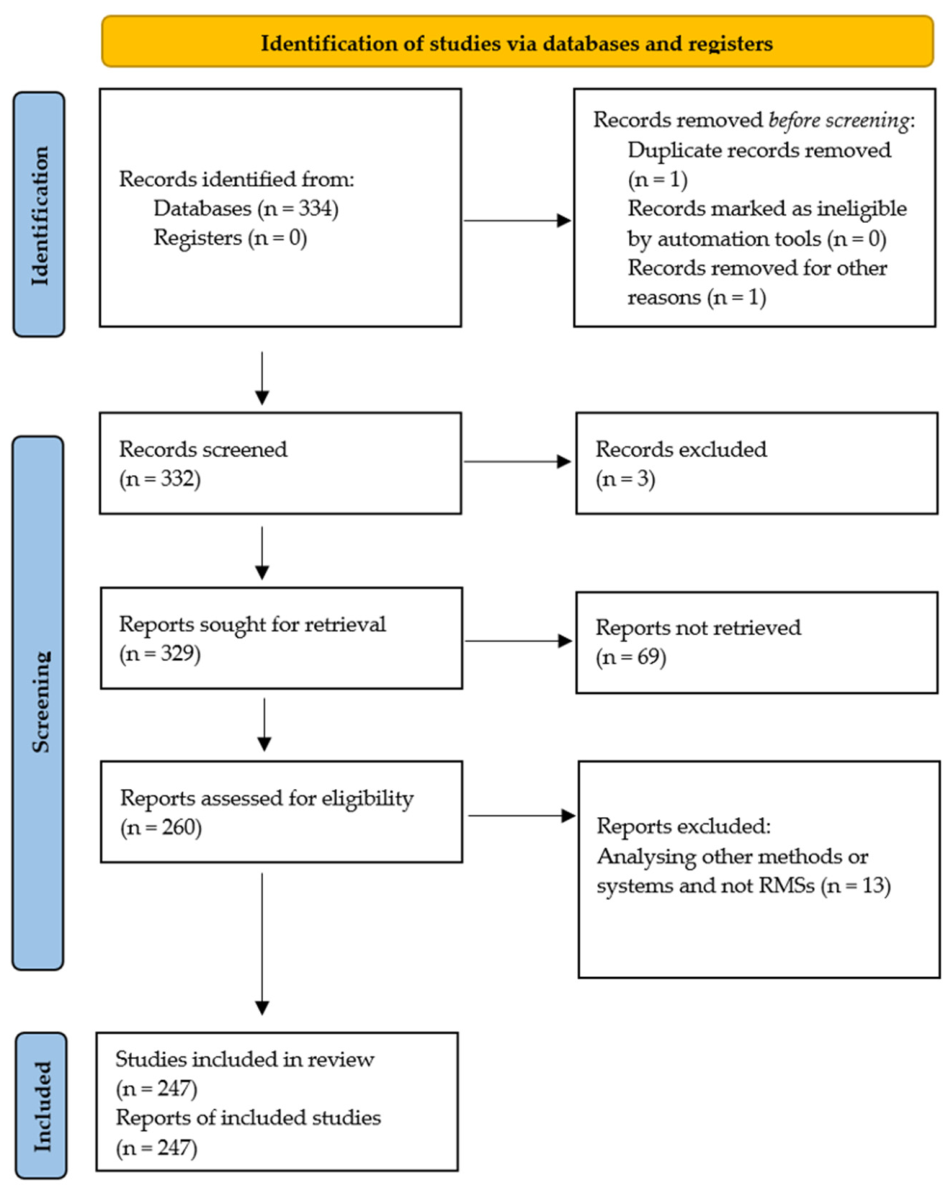
First, it was essential to define the database that would be used to extract scientific articles and research papers from the outset. It was necessary to choose a database that is freely accessible, reliable, and widely available to the scientific community. The literature review was conducted following the Preferred Reporting Items for Systematic Reviews and Meta-Analyses (PRISMA) 2020 guidelines (see also PRISMA Checklist in
Supplementary Materials Table S1), and the PRISMA flow diagram can be seen in
Figure 1. The Scopus database was selected as the main source of data because of its wide coverage of scholarly manufacturing and industrial engineering literature. Other databases (e.g., Web of Science, IEEE Xplore) offer limited coverage compared to Scopus, which was found to sufficiently cover the central part of the RMS research and maintain consistency in indexing and metadata. The specification of a strictly defined search time range is not necessary for this research since it aims to examine all research efforts related to RMSs. Therefore, as the term RMS was first mentioned by Liles and Huff (1990) [
5], the selected time range is from 1990 to 2025.
Following the specification of the timeline, it was essential to target all available papers related to the context of this research. Selection and data extraction were conducted independently by four reviewers, and any discrepancies were resolved through a consensus process. Reviewers used a predefined form to extract data, which was cross-validated to be consistent. Eligibility criteria were specified to achieve methodological rigor, cross-study comparability, and consistency with analysis of RMSs on a system level, and to exclude contributions of lower quality or non-peer-reviewed papers. Inclusion criteria were the following:
Studies directly related to RMSs;
Studies that focus on design, methodologies, applications, enabling technologies or system characteristics;
Peer-reviewed journal articles, books or book chapters;
Papers in the final publication stage;
Publications written in English.
Exclusion criteria included:
Studies not directly related to RMSs;
Conference proceedings (many have a lower acceptance threshold, and robustness of the publication cannot be easily identified as they have very small or even no impact factors);
Editorial or introductory notes and non-research contributions;
Studies that lack adequate methodological coverage.
These criteria were defined with the aim of ensuring that only high-quality, relevant studies were included, while also maintaining consistency across the dataset. The search was based on titles, abstracts, and keywords. Results were refined with the help of Boolean operators and filters depending on the document type, language, and publication stage. The search strategy was tailored to achieve a balance between comprehensiveness and relevance which would capture the major RMS-related studies without including irrelevant areas of research. The selection process involved two steps, namely (i) title and abstract screening and (ii) full-text eligibility. The screening process was conducted in a systematic manner, providing consistency and reproducibility. In cases of ambiguity regarding study relevance, a full-text assessment was conducted. Any uncertainties regarding inclusion decisions were resolved through discussion among the authors to ensure consensus. Analysis of data was conducted through a structured coding scheme that was in line with the study objectives. Each paper was systematically reviewed, and relevant information was recorded in a predefined framework. The process of extraction aimed to retrieve the quantitative and qualitative characteristics of the studies to facilitate classification and synthesis. The following data items were extracted from each study: scope of research, industrial sectors and subsectors, type of research, RMS characteristics, year and type of document. These variables were chosen to allow multi-dimensional analysis and the formation of the classification framework.
The query “TITLE-ABS-KEY(“reconfigurable manufacturing” AND system AND (application OR methodology OR tool)) AND (LIMIT-TO (PUBSTAGE, “final”)) AND (LIMIT-TO (DOCTYPE, “ar”) OR LIMIT-TO (DOCTYPE, “ch”) OR LIMIT-TO (DOCTYPE, “bk”)) AND (LIMIT-TO (LANGUAGE, “English”))” was used in the Scopus database, resulting in a total of 334 papers as of 20 March 2026. The search string was developed iteratively based on key RMS terminology and validated through multiple pilot search efforts. From these papers, as seen in
Figure 1, two were removed before screening:
Based on the title/abstract screening, most of the results were found to be relevant to the thematic axis, while three papers were excluded due to not being related to the subject. More specifically:
One was an introductory note for a Special Issue;
One was about teaching methodologies to familiarize students with the subject;
One was investigating methods for product design.
Furthermore, 69 papers were found with no access to the full text. Due to this limitation, those papers were analyzed based on the abstract and therefore were only accounted for in the publication statistics, where it was possible to quantify them, as their content could not be sufficiently verified to be included in the main literature analysis. Finally, during the full text assessment, 13 papers were found to refer to another type of manufacturing system (FMS) or other methods without being RMS-specific, despite mentioning so in their titles/abstracts. Therefore, a total of 247 papers were used for detailed analysis as part of the literature review, while a total of 316 papers were used for publication statistics. The full list of the 247 papers can be found in
Supplementary Materials Table S2.
Given the predominance of conceptual and theoretical studies, formal risk-of-bias or certainty assessment tools were not applicable. This imbalance indicates the possibility of a bias in conceptual development, which can undermine the practical applicability and generalizability of results. Nevertheless, the reproducibility of results in several studies was taken into account when weighing the effectiveness of conclusions. Potential reporting bias may also arise from the exclusion of non-English publications and conference proceedings, as well as reliance on a single database. This hints at a possible publication bias, because early-stage or exploratory studies and region-specific studies might not be well-represented. Finally, it should be noted that this review was not registered in a review protocol database, and no formal protocol was published prior to conducting this review.
Bias was assessed through a qualitative appraisal of the methodological characteristics and evidence base of the included studies due to the predominantly conceptual nature of the literature. In particular, the studies were assessed using three criteria: (i) level of empirical validation (theoretical, experimental, or practical), (ii) methodological transparency, and (iii) repeatability of proposed methods. Frequency and thematic analysis approaches were also applied. To assess certainty, a convergent synthesis strategy was used, which integrates quantitative frequency analysis and qualitative thematic interpretation of the four streams of research. Qualitative evaluation of the overall evidence certainty was performed based on the consistency of results, rigor of methodology, and level of empirical validation.
3. Classification Framework
Classification Streams
The process of classification was systematic and according to a set of predefined criteria for each stream. As seen in
Table 1,
Table 2,
Table 3 and
Table 4, four streams have been established to classify the articles according to the thematic focus of the research. The four streams and their subcategories were developed through an iterative inductive coding process. Initially, all included papers were independently read by the four authors and coded based on the principal contribution of each paper. Codes were subsequently compiled and synthesized through structured discussion until agreement was reached. The created categories were verified using pilot coding of a random 30 paper sample and refined to ensure mutual exclusivity and exhaustive coverage within each stream. Stream 1 (Scope of Research) was created on a three-level hierarchy of physical, logical, and technological intervention based upon conventional RMS design literature [
6,
11]. Stream 2 (Industrial Sector) categories follow conventional industrial classification schemas adjusted for the focus on manufacturing. Stream 3 (Type of Research) utilizes classification schemes commonly found within manufacturing systems review literature [
7,
14]. Stream 4 (RMS Characteristics) uses the six reconfigurability characteristics defined in the original description of RMSs [
6] and widely utilized thereafter.
The first stream (
Table 1) concerned the scope of research, specifically the developed methodologies and technologies, and has three subcategories concerning the configuration at the physical level, the configuration at the logical level, and, finally, the related technologies.
The second stream (
Table 2) concerns the industrial sector and is divided into six subcategories. The main identified industrial sectors are the heavy industry, the light industry, the electrical and optical, the chemical, the materials, and the utilities sectors. Each sector also contains various subsectors. It should be noted that some other sectors were also identified in theoretical papers; however, they were not included in the deeper analysis as there was no empirical or practical implementation in the literature.
The third stream (
Table 3) contains the four different types of research, and more specifically it categorizes the papers as theoretical, experimental, practical or reviews.
Finally, the fourth stream (
Table 4) includes the six used RMS characteristics, namely modularity, scalability, convertibility, customization, integrability and diagnosability.
Each stream is multi-dimensional, i.e., there are subcategories to which a paper may be relevant. After studying the full text, an effort was made to assign each paper to the most relevant subcategories for it, e.g., in stream four, an essential requirement to match a paper to a characteristic was not only that the characteristic was mentioned in the full text, but also that it was actually used in the relevant research effort. It should be noted that some papers may match to more than one subcategory, and others may not have a match in some streams.
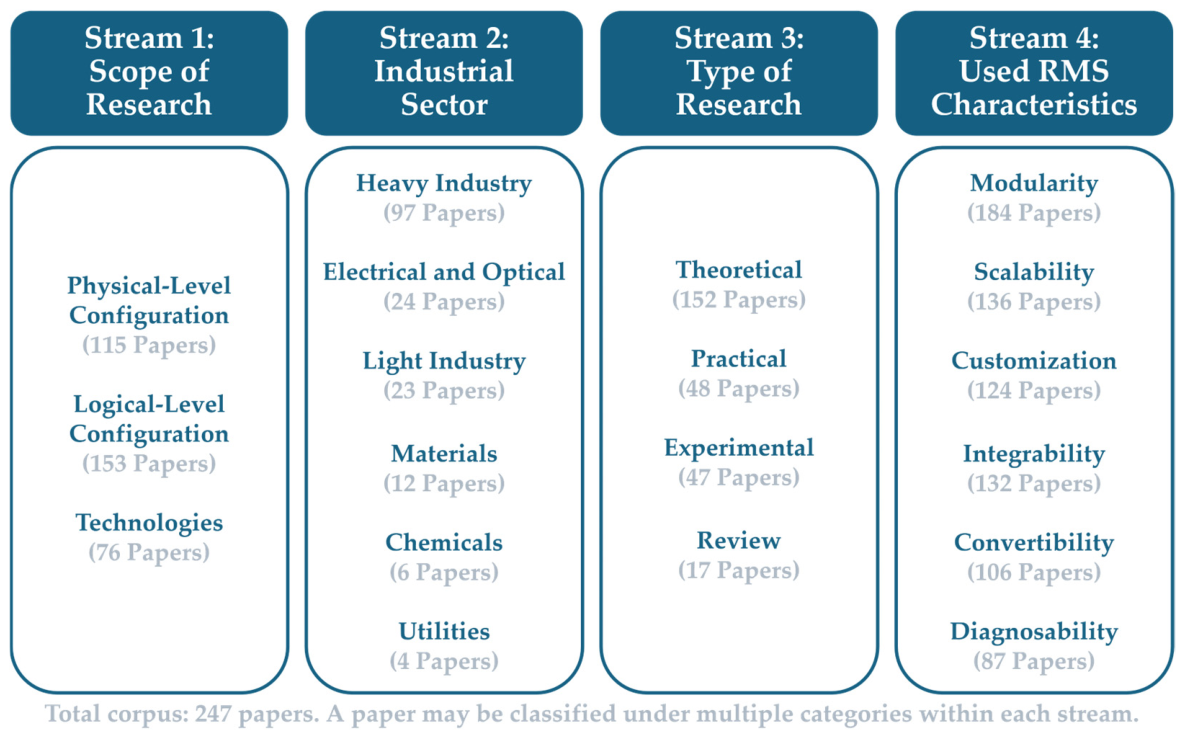
The four streams are visualized in the RMS Research Classification Framework, shown in
Figure 2. The framework is designed to be used as a layered lens to view RMS studies: Stream 1 (Scope of Research) provides the outmost analytical layer, depicting whether the research applies to a physical-level, logical-level or technological-level reconfiguration of RMSs. The second layer, Stream 2 (Industrial Sector), defines the applied context within a manufacturing scenario (heavy industry, light industry, electrical/optical, chemicals, materials, utilities) and is structured according to common industrial classification schemas. Stream 3 (Type of Research) clarifies the methodological contribution of a paper (theoretical, experimental, practical or review) and hence its contribution to an evidence-based or theoretical understanding of RMSs. Stream 4 (RMS Characteristics) identifies which of the six principal components of RMS reconfigurability (modularity, scalability, convertibility, customization, integrability, and diagnosability) are integrated into a paper’s proposal. Combining the information presented by the four streams in a single classification schema allows researchers to identify a RMS study’s thematic area, methodological stage, and system level. Examining structural imbalances in the classification matrix can also inform researchers about underrepresented areas of RMS investigation, such as theoretical studies on logical-level configurations or practical applications.
In addition to the descriptive role, the framework allows cross-dimensional analysis of RMS research. It can be used to identify structural imbalances by concurrently considering research scope, industrial application, methodological approach, and reconfigurability characteristics. This multi-layered view assists in the classification as well as the detection of gaps in the systemic research.
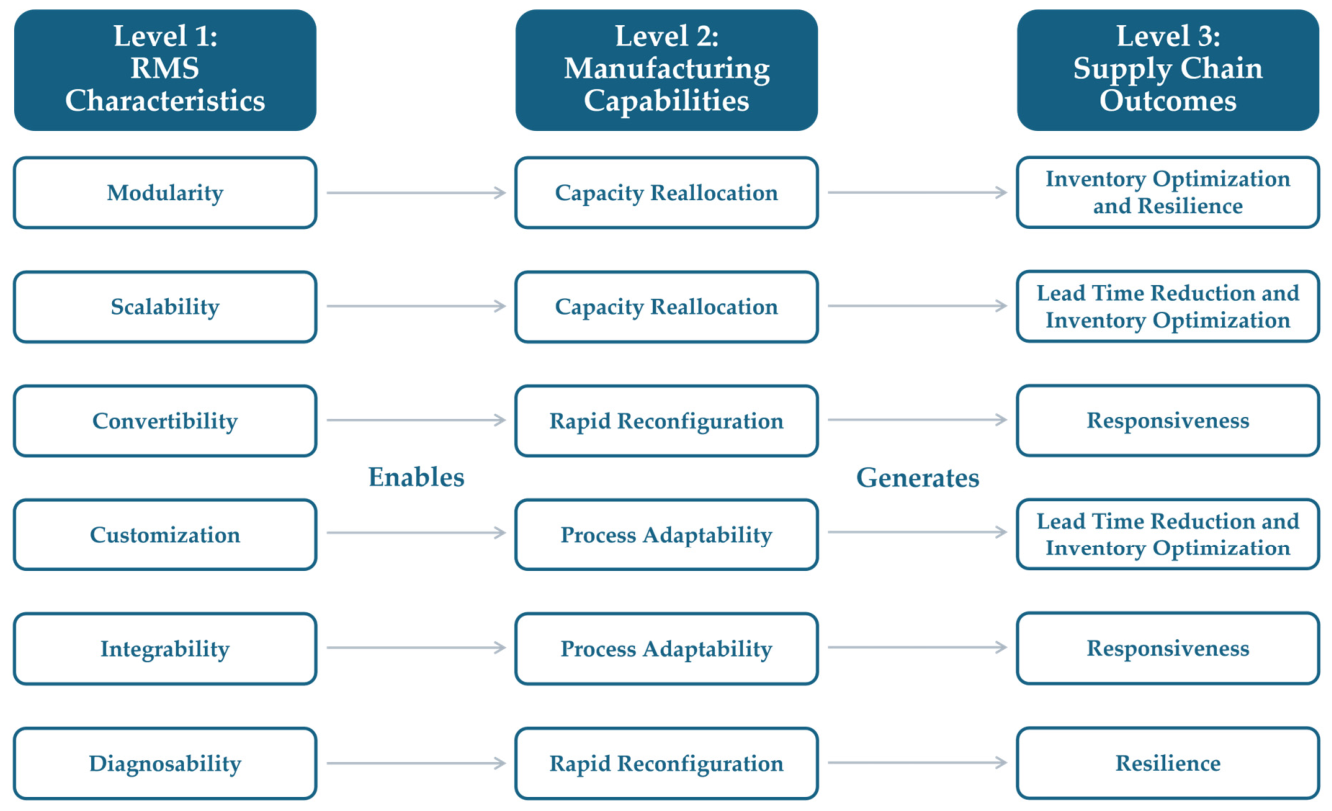
Furthermore, a three-level relationship between RMS characteristics, manufacturing capabilities, and supply chain outcomes (as shown in
Figure 3) is also framed. This approach is not just descriptive but also provides the structure to understand the supply chain relevance of RMS research, its implications for the logistics network, and it identifies the areas where contributions are yet to materialize. The first level includes the six RMS characteristics (modularity, scalability, convertibility, customization, integrability, diagnosability), each of which is a design property of reconfigurable manufacturing systems. The second level maps the design dimensions of RMS characteristics into corresponding manufacturing operational capabilities (capacity reallocation, rapid reconfiguration, process adaptability). Finally, the third layer maps these operational capacities into supply chain outcomes (inventory optimization, lead time reduction, resilience, responsiveness). These mappings are posed as hypotheses derived from synthesis of the analyzed literature. Each RMS characteristic is connected to manufacturing capabilities and supply chain outcomes by means of an operational mechanism. More specifically:
Modularity supports the reallocation of manufacturing capacities among manufacturing sites without re-designing the system, and becomes a mechanism for creating resilience at the network level instead of inventory buffer.
Scalability acts as a demand-side buffer by enabling capacity reallocation without physical system redesign. This reduces variance in manufacturing lead times, hence lowering demand amplification and burden of safety stocks for the supply chain downstream partners.
Convertibility facilitates rapid reconfiguration across product families in minimum time, making it highly pertinent to retailers/distributors who operate with short lifecycle and variety products, therefore directly enhancing responsiveness to volatile demand patterns at the supply chain level.
Customization drives process adaptability as it allows for demand-driven production as opposed to having to carry large, finished goods inventories. This helps to minimize exposure to forecast errors in the supply chain and to shorten the order-to-delivery lead time, while also helping to optimize inventory for partners in the downstream supply chain.
Integrability contributes to process adaptability by allowing the quick integration of new suppliers and the flexible combinations of logistics flows using standard interfaces. This brings down the necessary time to develop new modules and technologies in the production system, thus directly improving responsiveness of the supply chain at the network level.
Diagnosability adds a unique value to supply chain resilience: once a fault is identified and localized, the manufacturing system can be reconfigured in a short time, thus avoiding the propagation of quality failures to the following members of the supply chain. This lowers the risk and extent of supply chain disruptions, thereby improving the network level of resilience directly.
Following,
Section 4 presents the results through quantitative analysis while
Section 5 performs a qualitative analysis. A descriptive and comparative synthesis approach was adopted. Frequency distribution and cross tabulation were used to perform quantitative analysis across the four streams of research. Patterns were interpreted through qualitative synthesis to determine research gaps and relationships between RMS characteristics and supply chain implications.
4. Quantitative Analysis
The systematic search, as shown in the PRISMA flow diagram (
Figure 1) in
Section 2 of the paper, identified a total of 334 records. Having eliminated duplicates and out-of-scope studies, 247 papers were left to undergo full-text analysis. Another 69 papers, where full texts were not accessible, were only accounted for in publication statistics. Therefore, in total, 316 papers were used to derive publication statistics, while the detailed thematic analysis was conducted based on 247 full-text papers.
4.1. Publication Statistics
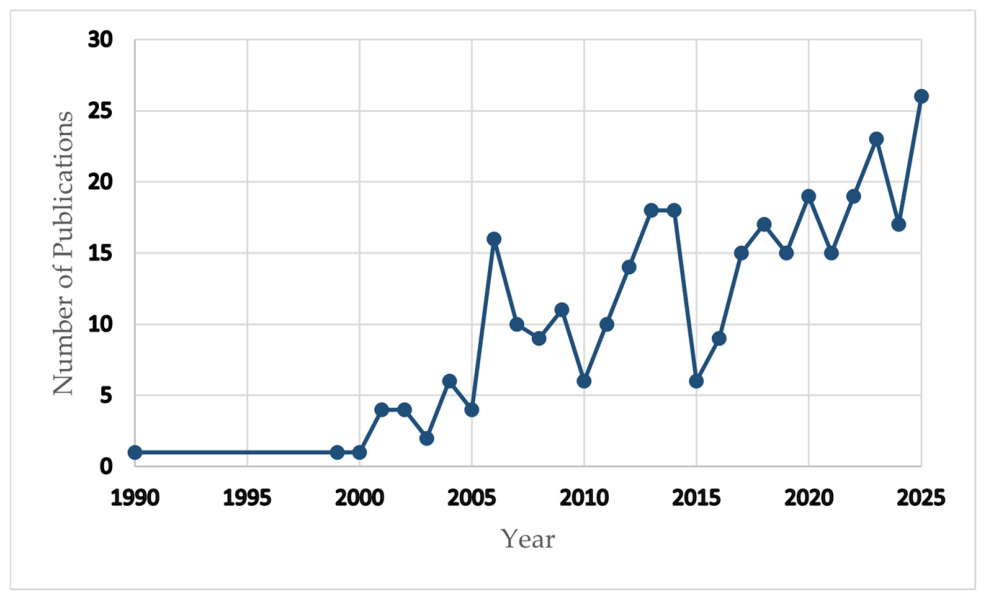
Initially, papers were grouped according to the date they were published.
Figure 4 reveals a clear growth pattern in the long term, divided into various phases. In the first phase, from 1990 to 2005, the output is very low, indicating the infancy of the concept and the lack of conceptual maturity in the field. In fact, a significant time gap can be observed between 1990, when the concept was first introduced, and 1999, when it was studied again. In the next phase, from 2006 to 2012, the number of publications is significantly higher compared to the previous period, indicating the stabilization of the concept in the academic domain.
Accordingly, a new phase emerged from 2013 to 2019 in which the output was consistently high, i.e., ≥15 (apart from years 2015 and 2016), which indicates the increasing importance of the concept in the industry, as well as the increasing scope of the concept in the broader paradigm of Industry 4.0. Finally, in the most recent phase from 2020 to 2025, the output increases rapidly, reaching a maximum of 26 papers published in 2025, which indicates the increasing research interest in the domain, as well as the increasing scope of the concept.
However, fluctuations in the output are clear in the recent phase, i.e., in 2021 and 2024, which indicates the lack of growth momentum in the field, suggesting the possible influence of external factors, including funding patterns or general technology hype in the industry. Moreover, the lack of constant growth in output, considering the importance of the concept, indicates the possible lack of growth momentum in the field, suggesting the possible lack of conceptual standardization in the domain, as well as the possible lack of large-scale adoption in industry.
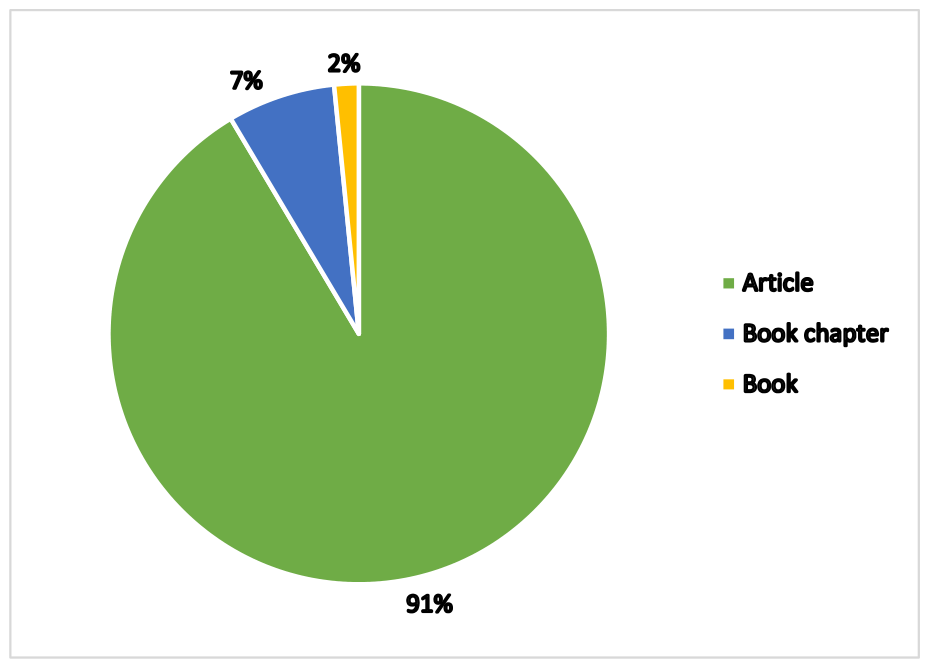
The types of publications, as seen in
Figure 5, are dominated by articles (289), which make up the vast majority, while book chapters (22) and books (5) make up only a very small fraction of the published works. This is an indicator of a research area that emphasizes the rapid dissemination of research increments, which is in keeping with the nature of a technically advancing field, such as reconfigurable manufacturing systems. The small number of books published indicates a lack of integrated, comprehensive approaches or theoretical canon, while the small proportion of book chapters published indicates a low level of engagement with integrated or cross-disciplinary works. The dominance of articles supports the interpretation of the research area of reconfigurable manufacturing systems as an active but consolidating research area, in which knowledge is advancing but has yet to be systematized into foundational works.
4.2. Research Stream Metrics
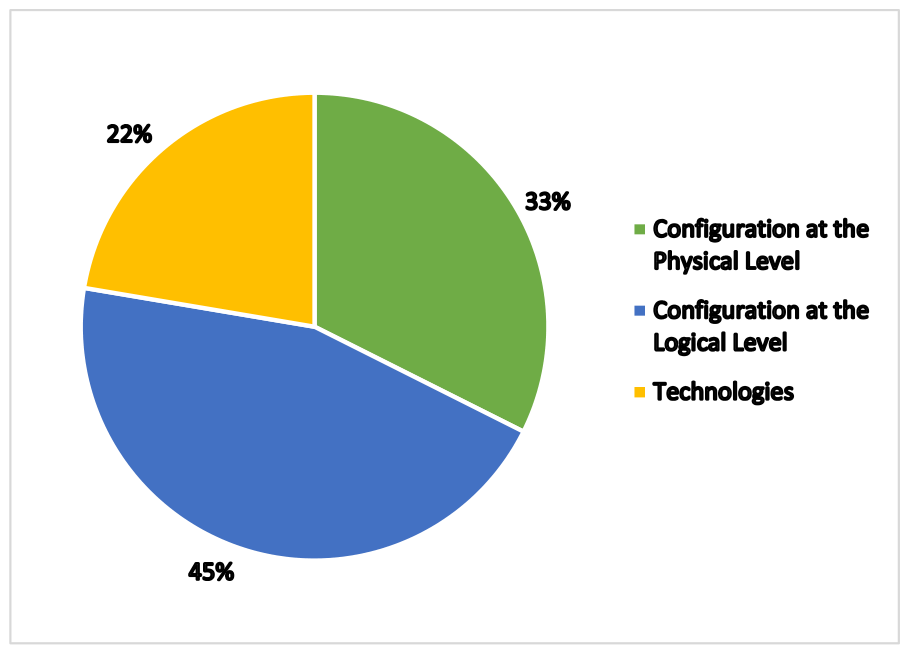
As seen in
Figure 6, almost half of the articles (153) are about configuration at the logical level. This result is to be expected because RMSs are complex systems, i.e., they consist of a multitude of variable elements that must optimally interact to achieve productivity goals. The next most popular research topic concerns the configuration at the physical level (115), i.e., attempts to solve the problem of designing and reconfiguring equipment. Finally, research developing innovative technologies and methodologies for the design of reconfigurable machines has the least number of references (76). This may be due to the absence of integrated RMSs, in the sense that most production systems following the RMS principles are not fully equipped with the latest technologies. As a result, there is no feedback from the operation and needs developed using reconfigurable equipment and software components.
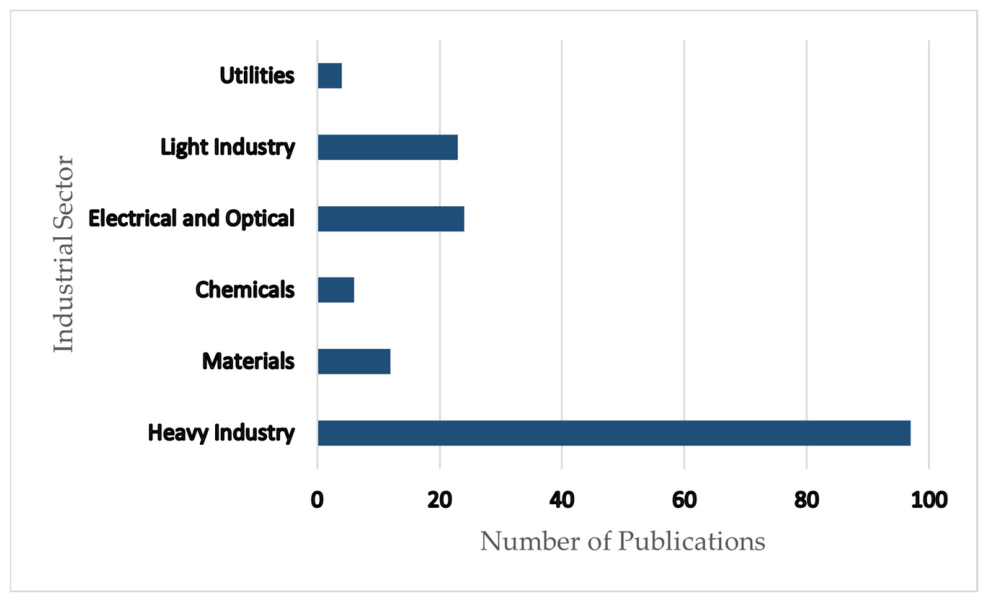
The quantification of the search results concerning the industrial sector, as shown in
Figure 7, shows a dominant presence of RMS research in heavy industry, with 97 publications, far outstripping all other sectors. This implies that RMS concepts and ideas are mostly developed and verified in large-scale production settings where reconfigurability promises immediate benefits in terms of flexibility in production rates and system flexibility. The presence in electrical/optical (24) and light industry (23) sectors implies some penetration into more specific and consumer-oriented manufacturing domains, though still limited in comparison. The presence in materials (12), chemicals (6), and utilities (4) sectors shows a relative under-representation, implying a research gap in process-oriented and continuous production sectors, where RMS research might be more challenging, either technically or economically. Overall, this distribution implies that RMS research remains heavily skewed towards discrete manufacturing settings, with no adequate exploration of RMS research opportunities in process industries and infrastructure sectors.
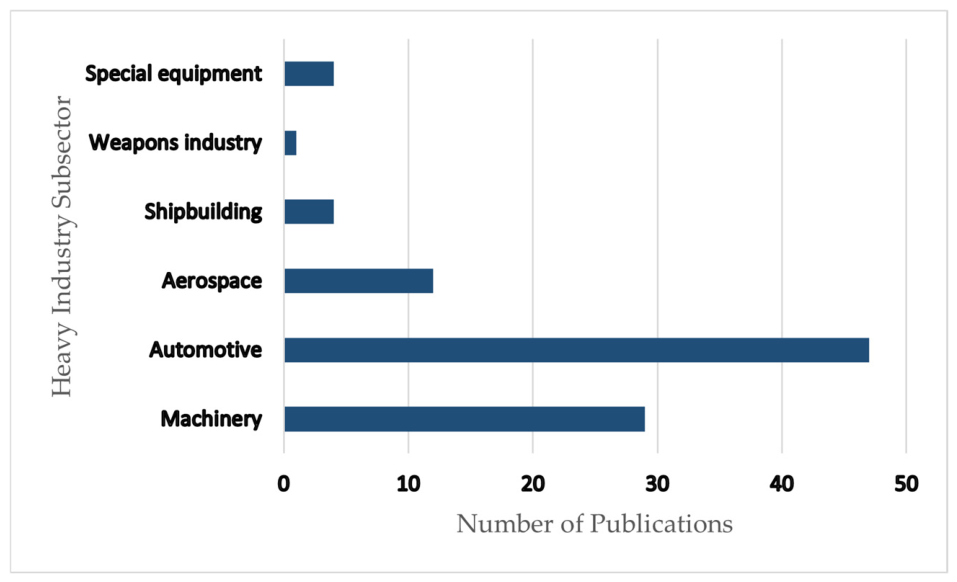
Further analyzing the subcategories of the Heavy Industry sector (
Figure 8), as it is the most frequently mentioned sector in the literature, the dominance of the automotive industry (47) is obvious, followed by machinery (29). This implies a strong link between RMS research and industries with high production volume, modularity, and assembly-based production paradigms where reconfigurability can offer significant operational benefits. Aerospace (12) represents a relatively moderate presence of RMS research, which can be explained by the need to achieve flexibility in such industries while being constrained by low production volume and the difficulty of the process. Shipbuilding (4), special equipment (4), and the weapons industry (1) represent a relatively low presence of RMS research in industries with highly customized production paradigms and project-based production systems.
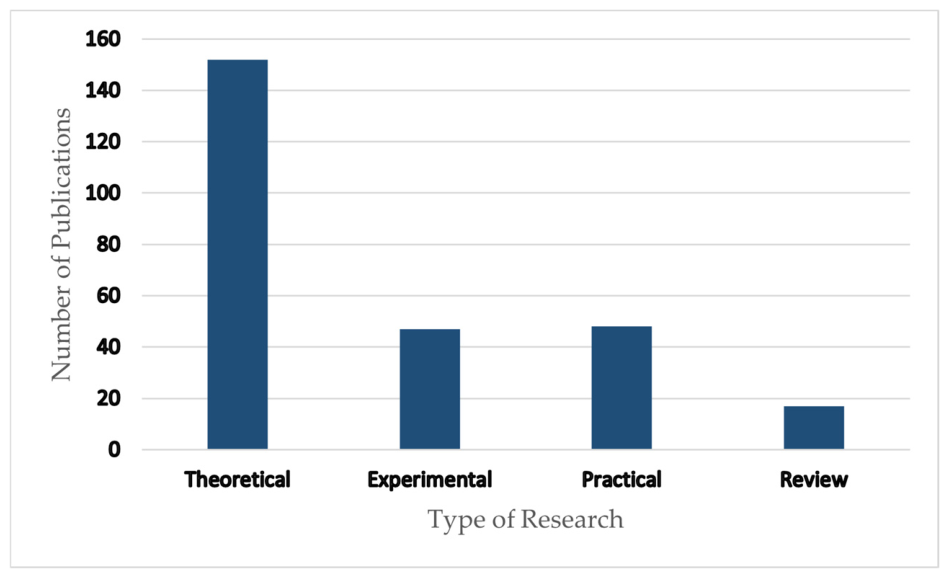
Concerning the types of research (
Figure 9), results show that research is predominantly focused on theoretical contributions (152), implying that RMS studies are primarily driven by conceptual development, modeling, and methodological formulation rather than validation. In contrast, experimental study types (47) and practical study types (48) are significantly fewer and more balanced, implying limited yet increasing validation of RMS concepts through experiments or industrial practice. The low number of review study types (17) verifies that there is a lack of consolidation of existing knowledge. This imbalance implies a critical gap between theory and practice, illustrating that though RMS conceptual development is sufficiently addressed, its large-scale industrial validation, standardization, and integration remain insufficiently addressed.
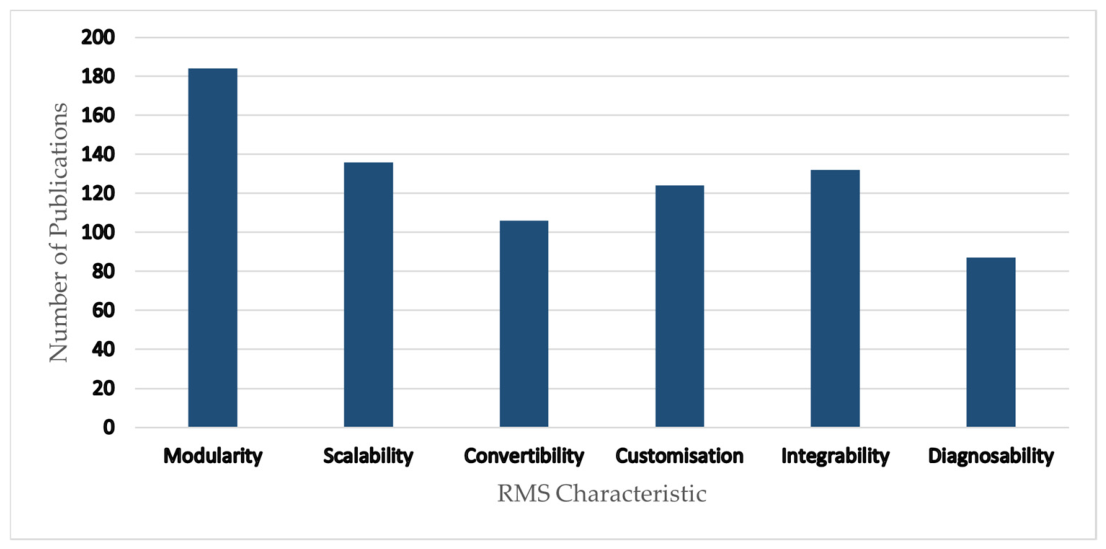
The distribution per RMS characteristic (
Figure 10) shows the clear prioritization of modularity (184), which is utterly related to the ability of a system to reconfigure itself, establishing this as the fundamental principle. This means that if a system, machine, or software component does not have the characteristic of modularity, i.e., it cannot change its structural units relatively easily, it cannot be reconfigurable. Scalability (136), integrability (132) and customization (124), follow in numbers. Integrability is directly linked to the need for a production system that can evolve technologically over time to meet the needs of the market for new products. Scalability and customization are very closely linked to the market’s needs, which justifies their importance. Customization is related to the need for a system to be able to adapt to the needs of manufacturing products from a different product family. Convertibility (106) follows, indicating continued interest in the ability to enable product adaptability, although this is somewhat less prioritized than the structural and integration aspects. Finally, diagnosability (87) is the least prioritized characteristic, indicating a potential gap in the ability to monitor and diagnose system state, detect faults, and have self-awareness. The overall trend appears to indicate that the literature is primarily focused on the architectural and design aspects of enablers of reconfigurability, with the operational aspects somewhat less well explored.
Lastly, a cross-analysis of the four streams enables us to understand significant interdependencies. Logical-level configuration is mostly linked to theoretical studies, which implies emphasis on optimization and modeling, but not implementation. Physical-level configuration, in turn, is relatively better-represented in experimental and practical literature, since it is closer to practice. Technology seems to be equally present in both theoretical and practical and empirical studies. Moreover, the predominance of modularity is especially apparent in works that deal with heavy industry-related issues, which implies that the industrial environment has a significant effect on the prioritization of reconfigurability characteristics. Finally, it should be noted that the most influential relationships are formed between technologies and RMS characteristics, which implies that the technological selection, especially digital, automation, and advanced manufacturing systems, directly contributes to such capabilities as integrability, modularity, convertibility, and diagnosability. Research Scope is an up-stream design driver, which influences the choice of technologies and, indirectly, the resultant RMS attributes. In the meantime, the Industrial Context (Stream 2) is a moderating variable, affecting the adoption of technology but also the prioritization of particular capabilities of a system (e.g., scalability in heavy industry versus customization in high-variability sectors). All in all, the results imply that there is a definite dependency chain, i.e., Scope → Technologies → RMS Characteristics, that is determined by the demands of the industry, which means that RMS characteristics have a co-determined rather than an autonomous genesis.
5. Qualitative Analysis
Patterns were interpreted through qualitative synthesis to develop a sense of gaps in the research and to formulate associations between the attributes of RMSs and supply chain implications. The qualitative risk-of-bias assessment revealed that the majority of the articles have moderate risks of bias, mainly because there is a preponderance of theoretical studies with little empirical evidence to validate the findings. However, some articles have a low risk of bias since they include experimental studies with practical application.
5.1. 1st Research Stream: Scope of Research
5.1.1. Configuration at the Physical Level
In terms of configuration at the physical level, after processing the articles, the identified methodologies can be separated into cyclic and phased design ones [
11]. In practice, design methodologies follow many different approaches and consider various factors to solve the layout design problem. In addition, many articles develop combinatorial methodologies for simultaneous design at the physical and logical levels. The use of this separation is considered to help categorize the methodologies.
Phased design methodologies focus on the structural aspects of the design process, and the methodology is described through distinct successive phases leading to a specific design stage. The solution path that follows, as well as the intermediate stages, may present deviations, but the most common intermediate stages observed were specification design, concept development, preliminary design and detailed design. A recent effort [
4] developed a generic methodology consisting of four steps following the basic principles of RMS design: identification of reconfigurability needs, system modeling, determination of best configuration and reconfiguration of the system. Another effort [
19] developed a four-step methodology to incorporate the key features of reconfigurability. This methodology provides valuable information for the preliminary design of a system and provides a basis to assist in converting conventional production systems to RMSs.
A valuable research effort [
20] developed a methodology to support the modeling, control, and evaluation of RMS configuration using the Intelligent Colored Token Petri Nets (ICTPN) method. This method can derive an alternative production process or model to reconfigure the system in cases where a machine fails, a new product or machine is introduced, or a part requires additional machining due to non-compliance with the specifications [
21,
22]. Another effort [
23] proposed that the selection of a new configuration should be based on the previous configuration of the system. This reduces the complexity of the change process and hence the cost of change. Additionally, in a methodology developed for monitoring and evaluating system reconfigurations required due to changes in product families, it is suggested to prepare the reconfiguration well before the end of the lifecycle of an existing product for a smoother transition from one product family to another [
24]. Finally, a methodology that can aid in decision-making at the early stages of planning and in assessing the viability of the proposed design was also proposed [
25]. It offers a quantitative model that evaluates the present value of capital and operating costs of candidate designs and aids in decision-making based on the lowest cost.
In cyclical design methodologies, the solution process follows a circular path, i.e., when a possible solution to the problem is found, it is tested and evaluated to identify possible corrective actions to be taken. To find the optimal solution, the methodology has to be repeated several times until it concludes. This design cycle contains the following steps: analysis that translates functional requirements into criteria of specifications for the solution, synthesis in terms of generating provisional design proposals and evaluation of solutions, and finally, a decision of which design proposal to proceed with [
11]. The first stage in the initial configuration or reconfiguration of a RMS is the design of the production system architecture, i.e., the rearrangement of production resources and supporting systems. RMSs are complex systems that can produce many products simultaneously and respond to changes in market needs. It is therefore necessary to have an open architecture, which means that any component required must be able to be moved to another location within the factory. The choice of the optimal system architecture depends on many factors, such as system productivity, investment cost, output quality, and company policy. Recently, a methodology was developed to evaluate the architecture of a RMS consisting of machine tools and gantries with geometric reliability, and their failures depend on time and operational factors [
26]. Given the uncertainty of demand and the difficulty of quantifying configuration criteria, alternative configurations must be evaluated based on multiple criteria for each product family [
27].
Moreover, an approach to support the decision-making in the design of a reconfigurable rotary machining system used to produce parts of different product families has been proposed [
28]. The methodology enables effective decision-making regarding part orientation, component selection, and workstation configuration/reconfiguration depending on the product families to be produced. Another study [
29] identified the nine most essential criteria for evaluating the performance of a configuration for RMSs, more specifically: total configuration cost, reconfiguration time, time to product delivery, the effort required for reconfiguration, maximum system productivity, reliability, system utilization rate, system availability, and operational capability. They then synthesized a Critical Path Method (CPM) methodology that uses the subjective or objective weight attached to each criterion and then ultimately evaluate and select the ideal system configuration. Design methodologies for focused flexibility systems are based on scenario modeling and stochastic programming. A further research effort [
30] proposed the creation of an alternative scenario tree that takes into account the market trends and possible reconfigurations of the production system. At the base of the tree is the current system configuration, with each stage of market evolution at each branch and the planned system reconfiguration. Finally, a combination of the two previous methodologies was developed as a new attempt [
31], which consists of two approaches. In the first approach, the system is designed based on the information available during the reconfiguration period. Then, the system is reconfigured according to market requirements in each subsequent period. In the second approach, all reconfiguration decisions for subsequent periods are determined based on minimum cost and the demand forecast.
The wide range of physical-level design methodologies described above is indicative of a field that has found many solutions but has not converged upon a fundamental understanding. While phased design methodologies [
4,
19] seem theoretically appropriate in situations where predictable reconfiguration is anticipated due to their structured nature that keeps the process traceable, it is an impediment to fast-changing markets because it presumes the ability to forecast the next product family change before the current transition is complete. Cyclic methodologies [
11] on the other hand compensate for an unpredictable future by alternating synthesis with evaluation at the cost of longer convergence time and non-linear growth of computation burden with the expanding configuration space. It is therefore the case that neither has achieved the goal of enabling RMSs that reconfigure quickly and cheaply without prevision. Added to this is the issue of multi-criteria configuration selection methodologies [
29], where studies use different and mostly incomparable performance metrics such as cost, throughput, reliability, reconfiguration time etc., without any underlying consensus on weighting. Consequently, theoretically strong research papers applying relevant methodologies can present opposing configurations. Consequently, the physical-level RMS design is difficult to reuse in different environments and seems to have little chance of standardization in terms of design methodology, which accounts for the delayed usage of RMSs in a lot of industries.
Supply chain-wise, physical-level configuration directly affects material flow effectiveness, facility layout flexibility, and internal logistics effectiveness. The flexibility of machine and material handling systems is closely related to the demand of flexible intralogistics, whereby the production structures should respond to demand fluctuations in terms of demand volume and product mix. Therefore, physical reconfigurability contributes to a shorter material handling distance, higher throughput, and responsiveness of the production node in the overall supply chain network [
32]. This points to the fact that not only is physical-level RMS design a manufacturing issue, but also a factor of logistics efficiency on the facility level.
5.1.2. Configuration at the Logical Level
Moving to the configuration at the logical level, in RMSs, products are grouped into families, each requiring a specific system configuration. Initially, the system is configured to produce the first product family. When a new product or new specifications for existing products enter the market, the production system needs to be reconfigured to meet these changes. The efficiency of a RMS is based on the optimal selection of product families and their scheduling. A considerable research effort [
33] developed a ten-step methodology, which creates a model describing the characteristics of a product family, a model of the production processes, and the relationships between them. These three models are combined into a configuration model that is used to evaluate the necessary changes in the production system caused by changes in product specifications. A decision support tool for RMS design was developed in another study (2017) [
28] to provide a cost-effective solution for creating multiple product families. Similarly, a research effort [
34] proposed a neural network-based sorting approach for such classification, and another study [
35] focused on determining the optimal sequencing of family formation and configuration selection based on the previous one. In parallel, a design methodology that computes the similarity matrix, forms families of components, and selects the optimal one using the Average Linkage Clustering (ALC) algorithm and the Analytic Hierarchy Process (AHP) method was developed [
36]. In another effort, the researchers [
37] evaluated four pre-existing methodologies. They came up with a new approach for conceptual product design that aims to address the customer uncertainty factor during the product development process. To address the problem of optimal selection and design of the modules for a modular product, another research effort [
38] developed a methodology based on finding the optimal tradeoff between the reduction in quality due to the modular product structure and the reconfiguration costs, and a similar study [
35] proposed a methodology for optimal selection of modular products using the AHP method.
Furthermore, researchers [
39] developed a four-step bottleneck control policy for detecting and dealing with failures in a RMS. Another effort [
40] developed a methodology for line balancing for Raw Material Handling Systems (RMHSs) in a serial production system with multiple machines at each work center. Additionally, a study [
41] proposed a Reconfigurable Maintenance Time Window (RMTW) method for scheduling opportunistic maintenance at the system level, while another one [
42] proposed a safety bubble methodology that enables the exchange of safety data between robotic assembly modules in a Reconfigurable Assembly System (RAS). Aiming to improve process planning, researchers [
43] developed a production plan design methodology that continuously incorporates the key features of RMSs into production planning and control. In a similar effort, researchers [
3] developed a dynamic methodology based on the complexity of the RMS to determine the appropriate time to start the reconfiguration process.
Finally, two more research efforts [
44,
45] addressed the production planning problem by introducing Mixed Integer Non-Linear Programming (MINLP) models to optimize total profit. MINLP models offer guaranteed global optimality of solutions given their stated constraints; however, this requires that the model falls within a computationally intractable class of problems whose runtime is not polynomially bounded in the number of decision variables. Thus, at industrial scale, when the number of machines, families of products, stages of reconfiguration, and the number of demands in a given time period grow, there is not sufficient time to apply the MINLP solvers to determine the exact solutions of a MINLP model. The studied research [
44,
45] restricted their MINLP model to small-to-medium RMS instances with somewhat simplified and deterministic demands to reduce the size of the search space and make them solvable. It should be emphasized that this qualification affects the guarantees of optimality that their models provided because with more variables, their models might not be feasible to solve even with a sophisticated MINLP solver. Hence, they rely on a Tabu search and genetic algorithm heuristic approach to find solutions. Such heuristic methods can provide solutions for even larger problems, but they cannot guarantee optimality, and rarely do the authors quantify the gap between their solution and the optimal solution.
AHP-based models [
35,
36] exhibit completely different characteristics as their algorithmic complexity is negligible and it barely requires time to obtain a solution, even for large-size decision spaces, so AHP-based approaches can easily be implemented in industries. However, there is a cost to this efficiency. The number of pairwise comparisons of the AHP model required to construct the weights matrix grows quadratically with the number of criteria. Beyond some limits (e.g., number of criteria is 10 to 20), the consistency of the weights matrix reduces and the results are no longer reliable. Most RMS research studies applying AHP have not reported the consistency ratio (a measure of inconsistency in judgments) which is essential to test the reliability of the solution. Another issue is that it depends on expert judgment, so the result cannot be replicated with another group of experts, which limits its use as an independent design tool applicable at large scale.
Artificial neural network (ANN)-based approaches [
34] are efficient to classify decisions for given input features without using extensive computation (time is negligible), but the main issue is with the training stage of the ANN model. The training of an ANN model requires a large amount of historical data (of reasonable quality) and can be very time-consuming without guarantee of global optimization. For dynamically reconfiguring RMSs, the data can only reflect one configuration, which is generally not sufficient to train an ANN model to predict correctly and reliably for different configurations of machines and for a diverse set of demand patterns. Since RMS configuration changes dynamically by its definition, more reconfigurations will cause the ANN model to be less relevant to the present and future situation, with training costs becoming repeatedly expensive.
All of these computational approaches can therefore be only applied to small/medium problems with the corresponding compromise of a solution, and a robust design of reconfiguring systems at the industrial level based on logical models seems a difficult task from a computational perspective, regardless of the logic approach utilized (MINLP, AHP or ANN). The optimization methodologies that have dominated the field have these fundamental flaws that do not seem to have been thoroughly examined within the body of the work itself. While not often spoken about, it is difficult to imagine that these differing operational conditions contribute to the theory-practice gap seen in
Section 5.3.
Focusing on organizational aspects, a research effort [
46] developed a methodology to compare machines based on their reusability and their geographical locations in the factory using the MIP method in the preliminary design stages. The reconfiguration process is closely linked to cost, energy consumption and, especially, data management. Two more research efforts [
47,
48] proposed a Multi-Dimensional Green Bill of Materials (MDG-BOM) that possesses an additional multi-dimensional attribute to minimize emissions and hazardous materials during product development and manage product information during reconfiguration. Another effort [
49] adapted the Data Envelopment Analysis (DEA) methodology to take into account the different ways of operating a production system. The proposed modeling calculates a target operating point for each operating mode to maximize the system efficiency in terms of technical performance, cost efficiency, and layout. Despite their degree of automation, RMSs still require actions to be performed by machine operators. In particular, they require frequent assembly and disassembly of the modules incorporated into RMTs during the remodeling process. This human–machine collaboration raises ergonomics and safety issues that researchers [
50] have attempted to solve with a two-objective methodology. Its technical objective is to minimize the reconfiguration time by optimizing the individual tasks to be performed, and its ergonomic objective is to minimize the repetitive movements performed by the operators.
In an examination of the logical-level literature as a whole, a deeper contradiction is observed that the field appears reluctant to tackle. Within product family formation methodologies, there are essentially two competing epistemological camps. Data-driven methodologies such as neural network classifications [
34] assume that an optimal grouping structure exists as a latent pattern in historical data, and it can be found with little or no prior knowledge of what comprises a “good” family. Expert-driven approaches like AHP [
35,
36] operate with the converse presumption: the existence of optimal solutions are based upon normative criteria, where structured expert judgments are valid and provide sufficient input into the decision-making process. These are not merely two alternative approaches to the same problem, as their underlying assumptions are mutually exclusive. Neural network analyses depend heavily upon machine configurations, production lot sizes, and demand patterns specific to the analyzed plant, thus precluding generalizability. Expert panel studies produce analyses heavily weighted by team expertise, thus limiting reproducibility. These are fundamental points that literature has failed to reconcile. Because of this lack of converged understanding on a few methodologies, large-scale optimization studies within the logical-level RMS stream do not lead to stable, generally applicable design recommendations.
Finally, logical-level configuration at the supply chain is closely related to production planning, demand fulfillment, and coordination with downstream logistics process. Organizing products into families as well as optimization of the scheduling decision has a direct impact on order fulfillment lead times and inventory positioning strategies [
51]. In this respect, RMS logical configuration may be viewed as a tool for coordinating production decisions with demand in real-time, which would facilitate demand-oriented supply chain models.
5.1.3. Technologies
Analyzing the technological aspects of RMSs, the key factor that makes them feasible are RMTs. These machine tools are a new class of machines designed around a specific product family and represent a middle ground between the high flexibility and high cost of flexible machine tools and the limited flexibility but low cost of dedicated machines. A strong research effort [
52] introduced an archetype RMT which allows the production of a family of products from different angles. The archetype RMT is capable of machining at angles from −15° to 45° and is suitable for machining the V6 and V8 engine block. More recently, another effort [
53] proposed a prototype machine for metal processing. This machine is the result of integrating two conventional machines, a Reconfigurable Guillotine Shear (RGS) and a Bending Press Machine (BPM). This prototype has a fixed production capacity, but another matching machine can easily be attached to it to cope with increased production needs. It is an ideal solution for small to medium-sized enterprises because it is scalable without requiring a large initial investment.
The next key factor for implementing RMSs is Reconfigurable Inspection Machines (RIMs). Researchers [
52] presented a RIM for online inspection of the machining characteristics of automotive engine components. This machine measures geometric features such as surface roughness, parallelism, and profile. Similarly, a system combining two robotic material handling systems, a robotic welding system, and an optical measuring system has also been developed [
54]. These three systems are integrated into a welding work center. This technology allows the production process to be switched immediately to a different product on the same production line. A more recent effort [
55] developed a design strategy for RMTs. Their proposal is that for a RMT to be able to respond to major product differentiation, its design process must be based on the same design parameters that determine product variation.
Furthermore, researchers [
56] developed a set of algorithms and methods for designing micro-assembled products in a way that ensures their manufacturability by a RMS. This software, called Planning Tool for Micro-Assembly (PlaTooMA), allows designers to model simplified assembly sequences and receive feedback about which configurations are capable of carrying out that assembly. Another effort [
57] proposed a software tool for decision support in alternative machine selection. This program uses a fuzzy AHP and Artificial Neural Network (ANN) model and is used to find the priority weights of the selected criteria and the alternatives assigned.
Finally, aiding the reconfiguration process, the digital twin emerges as an innovative method for accurate and synchronous simulation. The synchronous connection between the natural plant and its digital twin helps to evaluate configurations efficiently, avoid errors, and inspect the system for compliance with specifications [
58,
59,
60,
61]. Research efforts present digital twins within the RMS context as a multi-layer architecture consisting of three dependent components, all of which is addressed with widely differing levels of rigor in the literature. The data layer is architecturally the most fundamental of the components and involves the real-time acquisition, conditioning, and transfer of data from physical RMS elements, such as the CNC machine controller and the spindle’s position sensors, the material handling unit with RFID tag, or the quality measurement instruments. Two valuable research efforts [
58,
60] cover this component in the contexts of automated manufacturing reconfiguration and machine tool design respectively, where the data obtained from numerous machines is organized into a single twin model; however, both efforts, similar to most other in this topic, share a common and highly detrimental assumption, i.e., that there are always reliable streams of continuous and properly formatted data. In practice, the reconfiguration events, e.g., adding/removing machine modules, changing material handling routes, reassigning controllers, would precisely be the point where signals could be lost and data streams would be interrupted. None of these research efforts explore the behavior of a digital twin during these transition periods and, therefore, the fundamental layer of the entire architecture is theoretical only under a condition it could never actually achieve.
The synchronization layer is responsible for the mirroring of the system’s states (e.g., physical configuration, performance, and operational status) to the digital twin, and vice versa, to keep the digital twin constantly updated. Research efforts [
59,
61] present applications in the manufacturing lines of automotive parts and aerospace reconfigurable fixtures, respectively, where this is technically achievable; however, neither mention issues like synchronization lag (time delay between changes on the physical and virtual system) or loss of synchronization fidelity (deviation between virtual and physical states as physical system dynamics overwhelm the twin update rate). This is important because a reconfiguration decision must be based on a sufficiently accurate picture of the actual system. If the twin is many seconds behind a rapidly reconfiguring system, it may propose an operation or reconfiguration that is already physically outdated, introducing errors that are difficult to track down. This layer is architecturally crucial in terms of support and perhaps the least developed from a theoretical stand-point in the reviewed literature.
The control/decision layer utilizes the synchronized twin for the evaluation of potential configurations, simulation of experiments, and the ultimate decision of which actions must be taken to reconfigure the RMS. A research effort [
62] comes closest to an operational control layer in the context of an adaptive reconfigurable production line to account for manufacturing disruptions, although the system is still operated in human-supervised mode, with decision output from the twin confirmed by human operators prior to implementation. This is an important difference. Full implementation of an operational control layer without human intervention, i.e., dynamic closed-loop reconfiguration where the twin itself automatically detects a deviation, optimizes solutions and directly initiates reconfiguration actions, is severely lagging. Decision models are not yet available for reliable deployment in all possible scenarios and conditions a RMS could experience, let alone how to address the safety and liability issues involved.
All considered, the digital twin literature primarily views the technology as a simulation and off-line analysis tool rather than an operational component to a real-time RMS control system. The data layer is addressed under acceptable assumptions, the synchronization layer is demonstrated, not theorized, and the control layer is conceived, but not yet realized. These differences are not subtle: they indicate the gap between what has been developed for a visualization and an operational architecture of RMSs, but closing it (primarily with respect to the synchronization and control layers) is critical for the supply chain coordination benefits (dynamic production-logistics coordination, autonomous disturbance mitigation, and signaling dynamic capacity) envisioned for a RMS [
63].
Overall, looking across the entire technology literature reveals a disparate spread that has fundamental implications. RMTs have arguably already reached a level of conceptualization and prototyping sophistication that RIMs have not [
52,
53]. The cause is not solely reduced attention devoted to inspection-level technologies, but rather an inherently more challenging design problem for RIMs. While the performance of RMTs can be clearly defined and evaluated by a relatively constrained set of manufacturing and machining-related metrics (machining range, spindle types and orientations, speed, throughput), RIMs have to accommodate at the same time manufacturing process-relevant metrology specifications, real-time data integration, dimensional fidelity standards, and complex object geometries—all parameters which shift depending on the product family to which they are applied [
52,
54]. One system might be able to quickly switch between product lines, but its ability to verify that it is producing acceptable parts at that rate does not correspondingly accelerate. The systemic risk of rapid, unreliable product family switching is therefore a reality of current RIM systems; they can shift manufacturing modes faster than they can be certified to manufacture defect-free products. In addition to a reliability risk in a manufacturing environment, there is a critical systemic quality propagation risk when defects occur at the production stage and are then magnified downstream to the end customer; it is precisely this systemic consequence which the field has not explicitly theorized or integrated.
In logistics, RMS-enabling technologies, such as reconfigurable machine tools, inspection tools, and digital decision support tools, help in the formation of interconnected and data-based supply chain systems. Specifically, digital twins and smart decision support systems can be used to enable real-time monitoring and coordination between production and logistics processes to enhance end-to-end visibility [
62]. These technologies allow for detecting disruptions faster and enable dynamic reconfiguring, not only at the production level, but also in accordance with the requirements of logistics like the delivery schedule and inventory replenishment [
63]. Consequently, it is possible to consider RMS technologies as the building blocks of intelligent and responsive ecosystems of the supply chain.
5.2. Second Research Stream: Industrial Sector
5.2.1. Heavy Industry
RMSs have been widely used, although the level of penetration and maturity varies greatly depending on the industry. The literature continuously points out that the highest concentration of RMSs is observed within the heavy industry sector and, more specifically, in automotive, machinery, and aerospace manufacturing. RMSs are advantageous to these industries because they require quick adjustment to changing demand, high product diversity, high capital intensity, long system lifecycle and the necessity to compromise between volume efficiency and product variety [
59]. In this context, the automotive industry comes out as the main field of application, which is mostly because it has been at the forefront of adopting flexible and reconfigurable paradigms to meet the needs of platform-based production, mass customization, and regular model changes. Initial pioneering development and large-scale applications were fueled by the need of the automotive industry for flexible but high-throughput assembly lines [
14].
RMSs applied in the automotive manufacturing industry show a high level of focus on modular production lines, reconfigurable tooling, and scalable capacity adjustment of the process, which allows manufacturers to react quickly to changes in demand without any form of inflexibility from the dedicated systems. In this industry, a factory has to produce different types of intermediate products simultaneously (engines, chassis, electronics, final assembly) and must have the feature of reconfigurability built in to cope with unpredictable demand [
64,
65]. The RAS is a variant of the RMS that uses specialized machines to assemble the final product. Such a system has adaptable productivity and can be configured to be compatible with the requirements of new production technologies [
66]. The main application of a RAS is in the automotive industry (engine assembly). A derivative of a RAS is micro-assembly, the goal of which is the selection, mounting, and joining of small components on substrates with a tolerance corresponding to the micrometer (μm) order. Its main application in industry is assembling electronic components on flat substrates, typically on printed circuit boards (PCBs) using fast, high-precision pick-and-place machines [
56].
The machinery industry, which includes general machinery, machine tools, and special equipment, is also a major user of RMSs, following the automotive industry. RMSs allow manufacturers to work with families of parts and be flexible to the introduction of new products or shifts in production volume. The ease with which system architecture can be adjusted, and the diversity of product specifications, coupled with low-to-medium production volumes, presents a powerful demand in machinery manufacturing. In this case, studies are inclined to research modular machine tools, reconfigurable fixturing and adaptive control systems [
67].
Another area in which RMS principles have been widely used is in aerospace. Aerospace industry is characterized by special challenges like high quality standards, complex product structure, and fast-changing regulatory standards. RMSs enable simultaneous product and manufacturing resource design in the aerospace industry, which helps in flexibility and adherence [
61]. Within the aerospace industry, the volumes of production are smaller, but the high level of complexity and customization necessities leads to interest in RMSs as a tool to make systems more responsive and fulfill their lifecycle needs. Nevertheless, RMS implementation in the aerospace sector is more theoretical and experimental in nature than in the automotive industry, which is usually limited by the strict certification standards and risk-averse manufacturing conditions [
68].
5.2.2. Light Industry
In addition to the heavy industry, the light industry sectors such as food processing, clothing/textiles, consumer goods and construction have more limited but increasing interest in RMSs, mainly due to growing demand variability and product customization. The adoption in this case is frequently limited by reduced capital intensity and reduced frequency of large-scale reconfigurations and, since these industries are increasingly adopting customization and shorter product cycles (e.g., fast fashion or custom-made food products), the applicability of RMSs is on the rise [
69].
5.2.3. Electrical/Optical
Equally, the electrical/optical industry, comprising electronics manufacturing (consumer electronics, electrical equipment), has increasingly incorporated RMS ideas to facilitate fast product development and high-mix/low-volume manufacturing. The manufacturing of electronics is characterized by the high level of integration between product design and system design, which is a major facilitator in the successful implementation of RMSs. Also, the high rates of technological obsolescence and limited product lifecycle in the manufacturing of electronics and electrical equipment provide a solid theoretical argument in favor of RMSs [
70].
5.2.4. Chemicals, Materials, Utilities
Chemicals (petroleum refining, pharmaceuticals), materials (fabrics/textiles, carbon fiber composites, metals), and utilities (maintenance operations in energy generation/distribution) have also experimented with or tried RMS applications to a lesser degree than the above sectors. Continuous processing, safety, and the high prices of system change limit reconfigurability in these industries. Consequently, many studies in these areas involving RMSs pay more attention to modular units of processes and flexible batch processing than reconfiguring the whole system. In chemicals and pharmaceuticals, regulation complexity and process-based models of production are barriers to full-scale adoption; however, new cases of modularity and reconfigurability-based agile batch production or fast changeover between formulations are being seen [
71]. RMSs are mainly used in material processing industries to complete specialized work such as fabricating composites or forming metals in which flexibility is beneficial but not always necessary at scale [
72]. RMS concepts are being explored in utilities, particularly maintenance in energy infrastructure, as a component of more general digitalization processes to enhance asset utilization and minimize downtime by means of modular maintenance cells or flexible service platforms [
41].
5.2.5. Other Sectors
An interesting upward trend in the literature is the incremental movement of RMSs out of traditional manufacturing contexts to whole supply chain operations. The move is facilitated by the growing demand for supply chains that are not only efficient but resilient, and that are able to cope with disruptions and fluctuation in demand. The principles of RMSs are found to be applicable to logistical nodes, e.g., distribution centers, warehousing systems, and fulfillment hubs which can be reconfigured quickly due to modularity and scalability of storage, picking, and handling processes [
24]. This change represents a conceptual transformation of RMSs as production-focused paradigms into more system-wide paradigms, in which flexibility, scalability, and modularity are exploited across a network of industrial sectors. This indicates that there is potential for a transition to reconfigurable supply networks, where both manufacturing and logistics nodes are dynamically reconfigured to disruption, demand variation and network structural change. Indicatively, reconfigurable warehousing systems are able to dynamically integrate the storage layouts, picking strategy, and the level of automation as the order profiles change. On the same note, modular and scalable configurations can be implemented in distribution centers to meet the variation in throughput, especially in e-commerce where the demand variation is high [
46]. RMSs also aid in the creation of decentralized manufacturing and micro-factory models, whereby the range of production capacity is distributed geographically nearer to the end customers, thus decreasing the transportation distances and increasing responsiveness in delivery. Moreover, the collaboration with digital technologies including digital twins, Internet of Things (IoT), and data analytics allows RMSs to provide the ability to see and coordinate the supply chain in real time. This allows production schedules to be synchronized with logistics operations to enable dynamic reconfiguration in case of disruption by supply shortages or demand spikes [
27]. These advancements are also enabling cyber-physical production systems, which allows for integrating RMSs with smart manufacturing ecosystems, and opens opportunities to apply it in other key sectors (e.g., agricultural operations, renewable energy systems, circular economy operations, remanufacturing, recycling, and bio-manufacturing) [
73,
74]. Although these are promising developments, the existing applications are more of a concept or experimental nature, and empirical research has not been performed in a way to effectively validate the effectiveness of RMSs in logistics and supply chain settings.
5.3. Third Research Stream: Type of Research
As already mentioned, methodologies and technologies that have been tested in real-world conditions, and thus have been practically evaluated for their effectiveness, are more valid. Practical application in real-life situations provides valuable feedback on the implementation process of the methodology in question, possible obstacles encountered along the way, and the different approaches used to overcome them. In contrast, theoretical research can introduce innovative ideas and techniques, but additional analysis is required to ensure their feasibility. Experimental research provides useful feedback on the effectiveness but does not consider factors of uncertainty that exist in real-life situations. Reviews summarize the results of previous research and usually conclude on gaps in the literature that need further research.
The field of RMS research can be described by a strong focus on theoretical and conceptual advancement and a relative lack of experimental, practical, and review articles. The shortage of practical applications of RMSs has been identified by multiple researchers [
11,
36,
75]. Such distribution has profound consequences on the maturity, industrial application, and the future path of RMS research. This theoretical bias is not accidental but is based on the complexity of RMSs that require defining system behavior across multiple dimensions before it can be realized physically. This is also a very critical gap when reflecting on the integration of supply chains because the absence of large-scale empirical validation restricts the knowledge of how RMSs interrelate with logistics operations within real-life settings [
75]. In the absence of such validation, the possibilities of RMSs to aid end-to-end supply chain coordination, resilience, and performance optimization are mostly theoretical.
Most of the literature on RMSs is based on theoretical work that aims at defining fundamental concepts, creating modeling systems, and suggesting optimization algorithms to design and operate the system. Seminal publications have defined the principles of reconfigurability and have explained why RMSs were necessary in response to dynamic market conditions and the necessity to adapt systems quickly [
52]. Such research tends to use mathematical modeling (e.g., mixed integer linear programming), simulation-based analysis, or conceptual optimization to deal with issues such as layout design, configuration planning, and process optimization. One of the most evident tendencies in this literature is the growing complexity of models that consider dynamic production needs, optimization of costs over product lifecycles, and combination with the latest technologies like the digital twin and Industry 4.0 paradigms [
76]. Nevertheless, closer examination of the literature indicates that this theoretical hegemony has not resulted in consolidation, but in disintegration. The available literature is more likely to discuss individual subproblems, including reconfiguration planning, or performance evaluation, without providing them in the context of lifecycle frameworks. This is the reason why despite the great volume of theoretical contributions, RMSs are still not fully operationalized in industries.
There is still a relative dearth of experimental research into RMSs, but it is slowly increasing in popularity. Where available, these studies usually include testbeds or pilot implementations of scale in a laboratory, which confirm a particular facet of reconfigurability—the adaptability of machine tools, the flexibility of layout, or human–machine interaction, under controlled conditions [
77]. Some empirical studies have examined the appearance of core features of reconfigurability in an industrial context through surveys or small-scale experiments, and others have shown the provision of cyber-physical structures to monitor human-centric RMS environments through IoT-enabled data capture [
78]. Nevertheless, in spite of these developments, experimental validation is usually disjointed and contextualized. The vast majority of experiments are performed on individual technical characteristics as opposed to system-based performance over a long period or in different manufacturing conditions [
30]. Although these methods can offer a lot of insight into the dynamics of a system and its feasibility, they tend to be run under simplified assumptions (e.g., deterministic patterns of demand, limited heterogeneity of machines), which limit their external validity.
Practical studies of research, including industrial case studies and field applications, are also not vastly implemented. The limited literature that exists tends to record the use of systematic approaches to the development of RMSs in liaison with industry partners. Such initiatives offer useful information on the issues of implementing RMS concepts in the current manufacturing systems, but they tend to be small-scale (e.g., pilot projects at one company) and short-lasting [
69,
79]. The main obstacles that have been identified are organizational inertia, absence of standardized tools that can be used in designing and evaluating systems, inadequacy of the workforce to handle reconfigurable systems, and challenges in measuring the lifecycle costs and benefits. The literature clearly states the necessity of generalized implementation frameworks and best practices to enable adoption, which implies that the work on translating the theory to practice is not only technological but also organizational and systemic.
Review articles are important in summarizing knowledge but their quantity is significantly low compared to primary research products. Current reviews are inclined to concentrate on particular subtopics, e.g., layout design or enabling technologies, instead of delivering meta-analyses or systematic syntheses of the whole field [
14,
74,
80]. This inability to consolidate interferes with cumulative learning—new theoretical suggestions tend not to interact with previous empirical results or the experiences that have been gained in practice. Literature explicitly demands standardized taxonomies, unified frameworks, and cross-domain synthesis to reach valuable insights.
As has become clear, the existing discrepancy between theoretical and empirical/practical verification results in the constant disconnect between academic and industrial practice. In both experimental and practical research streams, critical areas like standardization, legacy system interoperability, economic justification at scale, change management processes, and regulatory compliance have not been adequately explored. A significant consequence of such an imbalance is the absence of feedback loops between theory and practice. As a result, stress-testing against the actual variability of real operations is not performed in many of the proposed models, which causes less trust in industry and slower uptake. Therefore, closing this research to practice gap will necessitate:
Intentional interventions to balance theory-building with serious experimentation (both in the laboratory and in industries);
Longitudinal field observation that follows systems performance over time;
Cross-case analyses to distinguish between best practices;
Solutions tailored to situations;
More systematic synthesis by high-quality review articles.
It is only by an approach like this that RMSs can be made more of an integrated paradigm that can offer consistent value in complex industrial settings.
5.4. Fourth Research Stream: Used RMS Characteristics
The principles on which RMSs are constructed are modularity, scalability, integrability, customization, convertibility, and diagnosability. These occur in the literature with highly varying frequencies and levels of treatment, which is indicative of what researchers and practitioners currently perceive to be of the greatest importance to attain responsiveness and competitiveness.
Several studies have investigated these characteristics both individually and jointly. A strong research effort [
81] developed a methodology to measure the reconfigurability index. Each individual characteristic is first measured and then combined together using the multi-attribute utility theory. The modularity value depends on the relationships between the machines in the system. The efficiency of the system gives the value of scalability. Convertibility depends on the machine inputs, their layout and configuration, as well as on the material handling system. Diagnosability is the ability to automatically read the current status of a system in order to identify and diagnose the root cause of defective products and quickly correct the production process. After quantifying the characteristics, the manufacturer can determine their importance based on the type of product to be manufactured in the system. For example, if the demand for a product frequently changes, then emphasis should be placed on scalability. If outgoing quality is the utmost priority, emphasis should be placed on diagnosability. Based on empirical data collected from questionnaire surveys, a research effort [
82] analyzed the characteristics of reconfigurability and their impact on the production system’s performance. They concluded that customization combined with integrability, as well as modularity can contribute to rapid delivery. Also, they combined convertibility and scalability to a single characteristic (adaptability) that, together with integrability and modularity, can contribute to increasing the system’s flexibility. Furthermore, diagnosability is directly linked to ensuring outgoing quality. Finally, integrability and modularity have an impact on the degree of adaptability of the system. Following this research, another effort [
19] developed a methodology for the phased design of RMSs and the reconfigurability characteristics that need to be used at each stage. Finally, a study [
75] proposed the inclusion of module mobility (ability to move freely and easily) and automatability (the ability to be automated without requiring human action) to form eight characteristics of reconfigurability.
Supply chain-wise, these attributes go beyond the performance of the internal systems. Modularity facilitates the reallocation of production activities between geographically spread plants and facilitates the reconfiguration of networks. Scalability enables dynamic capacity to adapt in line with the fluctuations of demand which minimizes the use of safety stock. Integrability increases the interoperability with the enterprise and logistics information systems so that coordination can be performed in real-time [
46]. Customization facilitates demand-based production and mass personalization policies, which are becoming significant components in supply chains. Lastly, diagnosability enriches the supply chain resilience by facilitating fast detection and elimination of disruptions [
24,
83]. Therefore, the prevailing nature of these attributes is not only indicative of manufacturing priorities but also of developing demands for responsive and adaptive supply chain arrangements.
The results of the literature review show that modularity is clearly the dominant and most frequently discussed characteristic. Modularity allows manufacturing systems to be broken down into discrete, functionally independent components which can be reconfigured, swapped or upgraded without impacting the system as a whole. The functions of RMSs are usually specified using modular machines, controllers, and software, the functions of which can be added, taken away or reconfigured to alter capacity and functionality when and where it is required [
83]. This property forms a strong interconnection with other RMS features: scalability is based on the addition/removal of modules, integrability is based on standardized modular interfaces, and convertibility is supported by reconfiguring modules into new forms. Therefore, modularity is a first-order design principle, which is why it is so vastly represented in the literature [
84].
After modularity, scalability, integrability, and customization are given considerable, albeit more equal consideration. These three have been treated as system-level operational capabilities that seem to be closely related. Scalability is concerned with the ability to scale-up or scale-down production capacity and is commonly mentioned as an important buffer to demand variability and machine unreliability [
85]. Integrability deals with standardized interfaces enabling new modules, technologies and control systems to be added rapidly and reliably, a theme which is more eminent in work relating RMSs to digital twins and cyber-physical systems [
86]. Customization (or customized flexibility) is a focus area in which RMSs are integrated with modular product design and mass customization; in this case, the system is customized to a product family or customer needs, and thus RMSs are an architecture of choice when dealing with mass-customized products [
55]. Recent studies associated with Industry 4.0 further verify the increasing focus on these characteristics, as cyber-physical systems and digital twins enhance integrability and allow for dynamic scaling and mass customization [
87,
88]. Therefore, the recent literature clearly shows that there is a tendency toward digital-enabled reconfigurability, in which software integration is as important as physical modularity.
Less common than these aspects of structure and integration is convertibility, which can be described as the capability to reconfigure production functionality to support new products or product families with an insignificant delay. Although conceptually at the heart of RMSs, its comparatively lesser emphasis implies that the research has paid more attention to how systems are constructed (modularity, integrability) than to how they move between product states [
89]. Convertibility is commonly considered to be an operational extension of modularity and scalability, allowing the product to be flexible to the system lifecycle, but not always quantified and operationalized to the same degree. This indirect treatment seems to be the reason why it is not as represented as it should be given its strategic value [
19].
Diagnosability is the least emphasized characteristic in the surveyed literature. It is the capability of the system to identify, isolate and diagnose faults during the operation of the system in real time to provide reliability and quick recovery. Although vital in keeping the system going in highly dynamic environments, it has traditionally been under-researched since early RMS studies were centered on design and configuration, not on operation and lifecycle management [
39]. Recent trends, however, indicate a change as digital twins and data-based monitoring allow new possibilities to improve the diagnosability of the system with real-time data collection, predictive analytics, and system transparency [
62,
88,
90]. However, the literature has yet to provide systematic structures that incorporate diagnosability with the other features, especially in closed-loop reconfiguration situations. This reflects an organizational deficiency in self-awareness and independent choice, which is becoming increasingly important in Industry 4.0 scenarios.
5.5. Operational Mechanisms Linking RMS Characteristics and Supply Chain Resilience
This section addresses why RMS characteristics are significant at the supply chain level and how that linkage works; i.e., moving from the claim that RMSs support supply chain resilience to an analytic account of how it achieves this. The four streams of research examined in the previous sections show what RMSs can accomplish at the manufacturing system level. Supply chain resilience, in this discussion, is the ability of a supply network to cope with, recover from, and adapt to disturbances within an acceptable time frame to return to an equivalent or improved state. Resilience is therefore not a single characteristic, but a composition of operational capabilities:
Flexibility (reconfiguration of supply chain flows and sourcing options);
Redundancy (backup capacity or inventory to withstand shocks);
Velocity (speed in which the network can detect and respond to disruptions);
Visibility (knowledge about the state of the network in real-time).
RMS characteristics affect these capabilities, but not consistently or unconditionally. The interconnected, complex nature of modern supply chains has increasingly exposed them to shocks emanating from demand fluctuations or international disturbances, and conventional centralized manufacturing systems supplying these chains have generated inflexible logistics structures such as long lead times and poor responsiveness. RMSs are theorized as a structural response to precisely this condition [
16]. The most straightforward and robust of the six characteristics of RMSs which influences supply chain resilience is modularity. An independently operable module system may reconfigure production across disparate geographical locations upon system failure without altering any system within the origin or destination location [
45]. A similar argument is made by a valuable study [
46] that analyzes how reusable modular manufacturing resources across facilities shortens the lead time for reconfiguring capacity when a disruption hits the supply network, making it resilient for both sustainable practices and by replication of conventional redundancy strategies for safety stock at the inventory level rather than capacity level. Theoretically, capacity redundancy can buffer demand surprises and supply-side disruptions, while inventory redundancy buffers solely demand variability. Such redundancy may still require identical interfaces between manufacturing facilities and standard operating procedures in logistics, which remain persistent barriers to RMS standardization [
11].
Scalability offers contributions to supply chain resilience through the demand-buffering mechanism. The capability of RMSs to scale production volumes up and down according to actual demands without restructuring the manufacturing system reduces lead time variation from manufacturing sites to downstream logistics actors [
24]. This leads to improved supply chain coordination by providing a basis for matching production to logistics across the network [
24], and reduces distributors and retailers’ inventory requirements by making them more confident about supply lead time, thereby lowering carrying costs across the supply chain. This is additionally supported by a valuable research effort [
51] whose analysis indicates that scalability, associated with Industry 4.0 practices, directly impacts the synchronization between production scheduling decisions and real-world demand, thus benefiting downstream supply chains. However, this extended influence of RMSs from a production node to the entire supply chain has only been discussed conceptually.
Integrability and its supply chain effects are highlighted in research linking RMSs with cyber-physical and digital manufacturing systems. Rapidly adding modules, technologies or control systems via modular and standardized interfaces accelerates the adaptation and reconfiguration of logistics streams in times of disruption [
46]. For supply chain resilience, this enables inter-organizational resource sharing [
46] and creates integrated, data-based supply chains [
32]. Integration enabled through digital twin architectures provides real-time synchronization and network visibility to enable a coordinated supply chain response to disruption [
58,
62]. These research gaps relate to the real-world application of the integrability principle and the conditions under which it reliably contributes to the desired supply chain coordination effects, especially when considered across geographically diverse and interdependent networks.
Customization provides a mechanism of flexibility in the demand interface for supply chain resilience. With the ability for a production system to cater to product family demands without retooling, customization enables demand-driven strategies that reduce the order-to-delivery cycle without accumulating a finished goods inventory [
55,
82]. It reduces supply chain exposure to demand forecast error, which is one of the causes of inventory inefficiency and service-level risk under high market variability [
8,
83]. High product variety and short lifecycle supply chains that are capable of efficiently switching between product families demonstrate a reduced bullwhip effect and downstream replenishment behavior [
51].
Convertibility relates to the product mix for supply chain resilience [
19,
89]. While closely related to customization in definition, convertibility is characterized at a different level. If customization refers to the range of product families a production system can satisfy, convertibility refers to how quickly and cheaply a system can switch between product families [
19,
82]. From a supply chain perspective, this transition speed dictates whether a manufacturing unit can keep up with a downstream partner’s inventory. High convertibility indicates a manufacturing unit’s ability to smooth out product mix disruption. For example, an abrupt change in demand from one variant to another is absorbed through this convertibility. If a system does not have high convertibility, a finished goods inventory is then used to absorb such demand-driven supply gap, which increases cost and exposure to demand forecast error [
24,
82].
Diagnosability is the least extensively theorized characteristic of RMSs, but among the most important in real-world application because its contribution is more concerned with containing the disruption than preventing it. Identifying failures and pinpointing root causes enables corrective measures to be initiated before defective products enter the supply chain, or for disruptions to be contained within the boundaries of a manufacturing system [
39]. At the supply chain level, this allows RMSs with high diagnosability to provide more reliable delivery performance even in disruptive periods by discriminating between recoverables and non-recoverables early in the disruption phase, before a problem emerges in downstream logistics [
24]. The theoretical challenge is that present-day diagnosability frameworks are primarily focused on identifying manufacturing-level system faults and have not addressed the propagation and impact of this information downstream. That is, whether a production deviation will lead to an inventory over-draw at a distributor or a final product having a lower quality at the end customer level is unknown and may not be automatically incorporated into existing frameworks. Integrating intelligent manufacturing with downstream supply chain management and control platforms will likely lead to a solution that bridges this gap [
63].
To sum up, on a conceptual level, these contributions to supply chain resilience, when discussed theoretically, show complementarity but uneven progress. Both modularity and scalability are well-theorized and frequently cited; their supply chain mechanisms can be deduced even if not empirically verified [
14,
46]. The mechanism for integrability, customization, and convertibility is defined at the manufacturing level rather than at the supply chain level [
19,
82]. Diagnosability is still not well-theorized in either dimension [
39,
90]. Therefore, a fully developed theoretical framework for supply chain resilience in RMSs needs not only empirical verification of the proposed mechanisms but also theoretical work for the unexamined characteristics and their interaction effects. For example, research fails to answer critical questions like the extent to which well-developed characteristics such as modularity balance the underdeveloped diagnosability in cases of simultaneous production and logistics disruption [
81,
82]. In general, interaction effects between all characteristics are missing from the current literature, and this work is a necessary prerequisite for creating a trustworthy RMS-enabled supply chain resilience strategy rather than merely a plausible one [
16,
75].
6. Discussion
The results of the present study give a multi-dimensional and systematic insight into the present status of Reconfigurable Manufacturing System (RMS) research, as well as unveil important inconsistencies, gaps, and new directions when considered through the lens of the previous literature and research goals. One of the most important findings is the continued absence of conceptual and methodological consensus in the design of RMSs. Although over thirty years have been spent on the research, a standardized and universally accepted design framework does not exist. This supports previous research which identifies fragmentation in methodologies, but the current analysis shows that this fragmentation is spread over the entire four streams of research; scope, industrial application, characteristics, and research type. The fact that most studies have been on logical-level configuration is another pointer that the discipline has been more focused on optimization and control issues and not on holistic system design, implying that RMS research is still largely reductionist and under-integrated.
These findings are generally in line with, and in several areas advance, previous systematic reviews of RMSs. A previous effort [
14] found a similarly growing body of RMS literature and a heavy concentration in automotive applications, but their review was not extensive enough to formally classify research types or the dimension of the supply chain. This work supports their observed trend finding and provides additional specificity, showing that their found theory-practice imbalance has continued and worsened despite over a decade more of research. Another previous effort [
7] pointed out the fragmentation of design methodologies and the lack of empirical verification in the body of RMS research. This paper finds those same issues are prevalent and, through its framework, highlights their structural presence within the four classification dimensions. Additionally, this paper advances the related research as it introduces a structured multi-stream framework which clearly and visibly categorizes these imbalances, making them directly comparable across streams. Also, a research effort [
17] concentrated their review on the optimization of RMSs and found a similar over-dominance of theory, but were unable to offer conclusions about sector prevalence or coverage of RMS characteristics—both being gaps this study directly fills with its classification framework and analysis. Most importantly, it is regarding the supply chain dimension that this paper’s framework offers the most valuable additions to existing literature. Where all other reviews only implicitly or tangentially touch upon supply chain issues, this paper frames RMS characteristics with supply chain resilience outcomes explicitly. Research efforts [
24] have referenced RMS capacity utilization within supply chains and have also discussed resource reuse in supply chain management [
46]; however, no systematic review to this point has offered a structured model relating RMS reconfigurability to supply chain resilience performance.
The implications of this research are relevant to both researchers and practitioners in the field of RMSs. To researchers, the four-stream classification framework is an immediately reusable and extensible research methodology capable of standardizing future systematic reviews of RMSs, or related manufacturing paradigms. The multi-stream aspect allows for an exploration of thematic, methodological, and sector-based imbalances not identifiable from single-stream reviews, acting as a useful research field maturation diagnostic. Furthermore, the framework and analysis allow RMSs to be viewed outside the boundaries of individual manufacturing systems and extends RMS theory to the domain of the supply chain, opening a novel theoretical area where manufacturing systems engineering and supply chain management can intersect, and further research through quantitative modeling and empirical testing can be conducted. To practitioners, RMSs should no longer be viewed solely from a production perspective. Decision makers must begin to account for the upstream supply chain effects of investing in RMSs at the manufacturing level (particularly to reduce inventory, decrease lead time, and bolster resiliency against disruptions). In an area where modularity and scalability are the most operationally viable RMS characteristics, managers in automotive, aerospace, and machinery sectors where RMS investment is most common should focus on these elements to achieve their supply chain objectives. Conversely, the consistent under-development of the diagnosability characteristic signifies a critical operational weakness: in a supply chain increasingly dominated by digital control and networked systems, real-time fault diagnosis and complete transparency become critical, lacking attributes that current RMSs fail to deliver. Finally, managers and researchers must focus on the implementation of diagnostically enabled systems in future RMS development.
Supply chain-wise, the findings reinforce the assumption that RMSs may serve as a major facilitator of resilience. The prevailing RMS characteristics found in the literature, especially concerning modularity, scalability and integrability, play a direct role in dynamic capacity allocation, responsiveness to fluctuation in demand, and better coordination between production and logistics. The findings are in line with the general supply chain literature that highlights agility and adaptability as critical capabilities in unpredictable environments. Nonetheless, the analysis also demonstrates that this is a relationship which is mostly theoretical. Although it is generally accepted that RMSs have the potential to improve end-to-end supply chain performance, there is a distinct absence of empirical network-level validation. Consequently, the role of RMSs in supply chain resilience, despite their sound theoretical basis, has not been so far fully operationalized in practice. A limitation of this research is that the proposed relationships between RMS characteristics and supply chain performance are not empirically validated. Further studies are needed on quantitative modeling and validation of case studies to determine these effects in practical environments.
The research type distribution also gives additional information on the maturity of the field. The fact that theoretical contributions dominate over experimental and practical studies strongly proves that RMSs are still a concept-driven field. Yet, this unequal distribution is not only a situational choice in research but a more fundamental structural problem, i.e., the lack of feedback between theory and practice. Theoretical models that are not systematically empirically verified are not connected to practical realities, and their application is restricted, which slows down their integration into industry. This is one of the critical gaps in the environment of supply chain integration, where real-world complexity, uncertainty, and interdependencies play a vital role in determining the performance of the systems.
The industrial sector analysis supports the conclusion that the development of RMSs has been motivated by the requirements of discrete manufacturing sectors, particularly in the automotive and machinery sectors. Such industries are naturally characterized by modular architectures, large volumes of production, and flexibility requirements, which make them appropriate to implement RMSs. Conversely, the scarcity of RMS research in the process industries like chemicals, materials and utilities points to a major gap in research. Technical and economic limitations of continuous production settings seem to make the principles of reconfigurability inapplicable, suggesting that modern RMS models are not yet adequately adapted to those environments. Simultaneously, the incremental expansion of RMS ideas to logistics and supply chain nodes implies a more radical shift in paradigm to the reconfigurability of the network level as opposed to factory-level optimization.
RMS characteristics analysis also helps to better understand the current research priorities and implications. Modularity obviously stands out as the most prevalent RMS characteristic, proving its position as the enabling factor of reconfigurability and its close links with other characteristics like scalability and integrability. Nonetheless, the comparatively low emphasis on diagnosability also demonstrates a serious flaw in the literature. With the growing digitalization of manufacturing and supply chains, real-time monitoring and diagnostics of the state of systems and responses to them are a necessity. Under-representation of diagnosability implies that operational intelligence and self-awareness of the system are not yet thoroughly integrated into the design of RMSs. This is especially an important gap in terms of resilient supply chains, where fast response in terms of disruption detection and mitigation is essential.
On a larger scale, the results show that RMSs are shifting from a manufacturing-based notion into a wider system-level paradigm which involves supply chains, digital technology, and cyber-physical systems. The combination of the enabling technologies of digital twins, the IoT, and sophisticated analytics is gradually allowing the real-time synchronization of production and logistics operations. Such development correlates with Industry 4.0 and Industry 5.0 principles, according to which flexibility, connectivity and responsiveness are the key elements. However, these technological and organizational aspects have not yet been offered in the literature as coherent frameworks that can bring them together in a single RMS architecture. This importance is also strengthened by recent works which highlight the necessity of linking operational systems design with overall organizational- or sustainability-related contexts. Recent efforts [
91,
92] focus on the crucial role of knowledge integration, coordination of systems, and sustainability-based design for enhanced robustness and usability in manufacturing and supply systems. These views emphasize that RMS research can no longer be solely developed on specific optimization models but needs to incorporate interdisciplinary approaches which span organizational, environmental, and lifecycle aspects. Such integration could provide the bridge from abstract research to practical applications, particularly under evolving industrial circumstances driven by complexity and sustainability concerns.
Finally, two very recent publications further support the findings of this review. A longitudinal case study on the development of a RMS from design to full-scale production [
93] provides one of the rare empirical accounts of a complete implementation lifecycle, directly reinforcing the theory-practice gap identified in this review and demonstrating that phased, iterative approaches can yield successful industrial deployment. Also, a valuable study on batch production scheduling in a reconfigurable hybrid manufacturing–remanufacturing system [
94] extends the logical-level configuration stream into circular economy contexts, while confirming that the scalability limitations of optimization-based methods persist even in hybrid configurations. Together, these contributions signal that the research priorities identified in this review are beginning to attract empirical attention, while underscoring how much work remains. In general, the findings of this study suggest that RMS research has attained a level of high conceptual maturity but is still constrained by the absence of systemic integration and an empirical foundation. Although its potential to enable resilient and responsive supply chains is evidently upheld, to actualize this potential, there is a need to move towards more interdisciplinary, application-focused and system-level research. This transition is needed to enable RMSs to move beyond being a promising manufacturing paradigm into a key element of next-generation supply chain systems.
7. Conclusions
The main findings related to the four research questions are: RMS research grew substantially, with the most rapid increase observed post 2020, concentrated at the logical-level configuration and in heavy industry sectors, and most notably the automotive sector (RQ1). This research identified inherent and persistent structural imbalances throughout the body of literature across all streams: theoretical studies dominate across sectors and RMS characteristics, few practical implementations and applications exist, and diagnosability, despite its strategic importance, remains an underrepresented RMS characteristic (RQ2). The six RMS characteristics found translate directly to manufacturing capabilities which allow supply chain resilience: dynamism in capacity assignment, fast response to demand, and rapid resilience to various forms of disruption (RQ3). Validation remains mostly theoretical as very few research publications reported empirical tests or applications, and supply chain level testing and validation of RMSs was almost non-existent (RQ4).
The key contributions of this paper are: first, the identification and operationalization of a comprehensive and multi-dimensional classification scheme for RMS literature. Second, the systematic exposure of gaps that have been identified in prior reviews, particularly in the areas of the theory-practice disparity and the need for greater practical validation. Third, the introduction of a novel three-layer model of the relationships between RMS characteristics and supply chain resilience and the relevant analysis of RMS implications for supply chain resilience.
There are certain methodological limitations in this study. First, the application of one database (Scopus) could have led to the exclusion of applicable studies indexed in other databases. Second, selection bias could be caused by the omission of conference proceedings and non-English publications. Third, the lack of formal quantification of risk-of-bias limits the systematic evaluation of the quality of studies. Lastly, the generalizability of the conclusions is influenced by the preponderance of theoretical literature, especially within the industrial and supply chain settings. These limitations were thoroughly assessed through a qualitative appraisal of the methodological characteristics and evidence base of the included studies. By doing so, it was possible to systematically evaluate the quality and limitations of evidence, in line with the magnitude and nature of the reviewed literature. In particular, the classification framework designed in this study aided in overcoming these limitations because it allowed for comparing the features of the research and revealed areas that require more attention, especially from the perspective of empirical support and integration on a supply chain level.
Based on the research findings, it is possible to outline several future research directions. It is evident that standardized and holistic design frameworks should be developed, which combine physical and logical configuration, and lifecycle and performance assessment. There should be a focus on bridging the gap between theory and practice, which would necessitate large-scale industrial case studies, longitudinal analysis, and cross-sector validation. Also, RMSs hold tremendous promise as a foundation for next-generation resilient supply chains, given the convergent trends within Industry 4.0 and 5.0 manufacturing systems and supply chains; however, realization of this promise will necessitate a rapid move away from concept- and towards application-based research that accounts for an entire supply chain. Another significant direction is the extension of RMS applications to process industries, which requires the development of new models that consider the peculiarities of continuous production. Moreover, more focus should be made on improving diagnosability and digitalization by incorporating real-time monitoring, predictive analytics, and autonomous decision-making. It is also necessary to develop holistic performance measures that reflect resilience, sustainability, and responsiveness in addition to traditional efficiency measures. Last but not least, human and organizational facets, such as workforce skills and change management, should be systematically included in future RMS research to aid in successful implementation.




 ,
,