

Strategic Capabilities Integration for Competitive Advantage: Evidence from Thailand’s Freight Forwarding Industry
Abstract
1. Introduction
2. Literature Review
2.1. Empirical Studies on Competitive Advantage in Logistics and Freight Forwarding
2.2. Research Gap
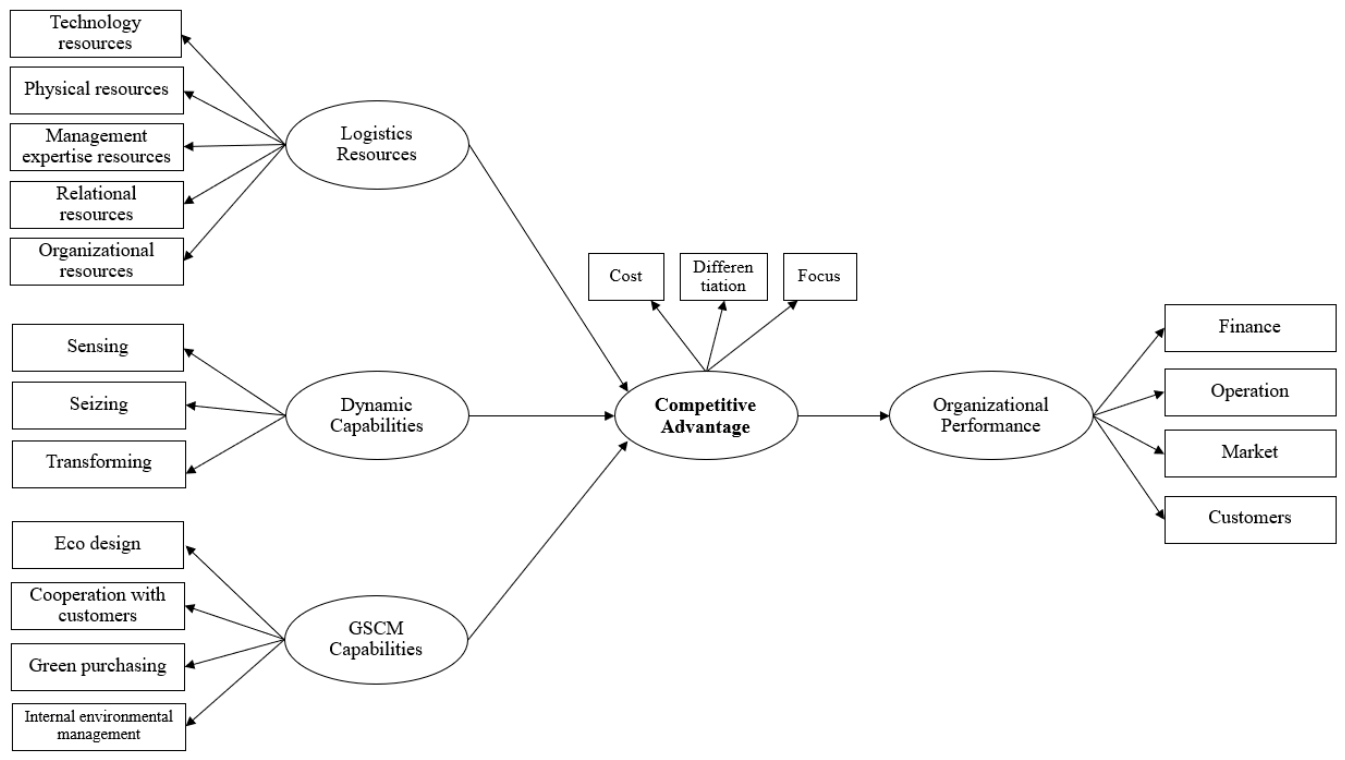
3. Theoretical Framework and Hypotheses Development
3.1. Resource-Based View and Logistics Resources
3.2. Dynamic Capabilities Theory
3.3. Green Supply Chain Management Capabilities
3.4. Competitive Advantage and Organizational Performance
3.5. Mediating Role of Competitive Advantage
4. Methodology
4.1. Research Methods
4.2. Research Instrument
4.3. Data Analysis Method
5. Results
5.1. Respondents’ Personal and Organizational Profiles
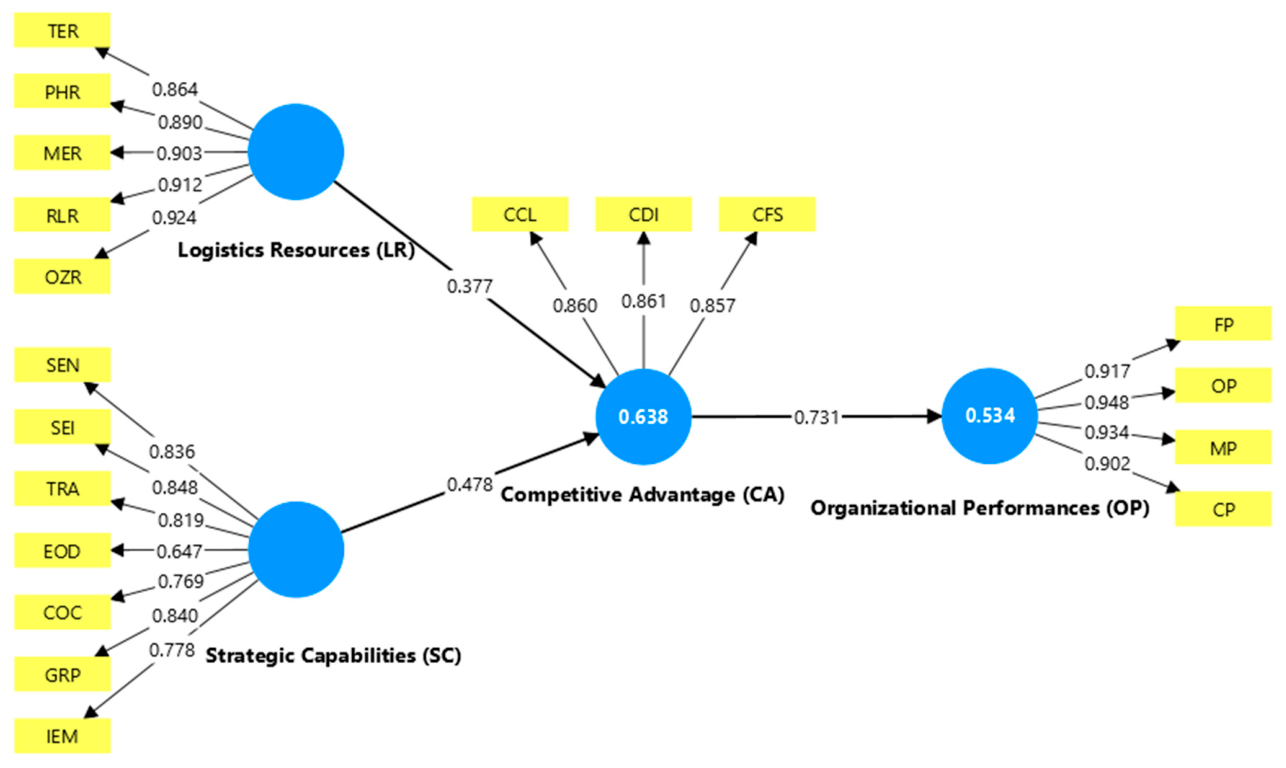
5.2. Measurement Model Assessment
5.3. Structural Model Assessment
6. Discussion
7. Conclusions
8. Implications
8.1. Theoretical Implications
8.2. Practical Implications
9. Suggestions for Future Study
Author Contributions
Funding
Institutional Review Board Statement
Informed Consent Statement
Data Availability Statement
Acknowledgments
Conflicts of Interest
References
- Grand View Research. Logistics Market Size & Outlook, 2030. Available online: https://www.grandviewresearch.com/industry-analysis/logistics-market-report (accessed on 15 March 2025).
- Theparat, C. Logistics Costs in 2021 Accounted for 14% of GDP. The Bangkok Journal. 2022. Available online: https://www.thebangkokjournal.com/article-129162-investment-logistics.html (accessed on 15 March 2025).
- World Bank. Logistics Performance Index (LPI). 2023. Available online: https://lpi.worldbank.org/en/home (accessed on 15 March 2025).
- World Economic Forum. Are These 5 Trends Disrupting or Driving Logistics Growth? 2024. Available online: https://www.weforum.org/stories/2024/05/logistics-growth-trends/ (accessed on 15 March 2025).
- Sun, X.; Yu, H.; Solvang, W.D.; Wang, Y.; Wang, K. The Application of Industry 4.0 Technologies in Sustainable Logistics: A Systematic Literature Review (2012–2020) to Explore Future Research Opportunities. Environ. Sci. Pollut. Res. 2022, 29, 9560–9591. [Google Scholar] [CrossRef]
- Christopher, M. Logistics & Supply Chain Management, 5th ed.; Pearson: London, UK, 2016. [Google Scholar]
- Langley, J. Third-Party Logistics Study: The State of Logistics Outsourcing; Capgemini Consulting: Mumbai, India, 2019; Available online: https://www.infosysbpm.com/portland/resources/third-party-logistics-study.html (accessed on 15 March 2025).
- Rushton, A.; Croucher, P.; Baker, P. The Handbook of Logistics and Distribution Management, 6th ed.; Kogan Page: London, UK, 2017. [Google Scholar]
- Kunte, M.; Sarika, W. Competency Modeling at an International Freight Forwarding Company in Bangkok, Thailand. Asia Soc. Issues 2024, 17, e256288. [Google Scholar] [CrossRef]
- Huang, S.T.; Bulut, E.; Duru, O. Service Quality Evaluation of International Freight Forwarders: An Empirical Research in East Asia. J. Shipp. Trd. 2019, 4, 14. [Google Scholar] [CrossRef]
- Hair, J.F.; Black, W.C.; Babin, B.J.; Anderson, R.E. Multivariate Data Analysis, 8th ed.; Cengage Learning: London, UK, 2019. [Google Scholar]
- Wong, C.Y.; Karia, N. Explaining the competitive advantage of logistics service providers: A resource-based view approach. Int. J. Prod. Econ. 2010, 128, 51–67. [Google Scholar] [CrossRef]
- Lee, S.Y.; Klassen, R.D.; Furlan, A.; Vinelli, A. The green bullwhip effect: Transferring environmental requirements along a supply chain. Int. J. Prod. Econ. 2014, 156, 39–51. [Google Scholar] [CrossRef]
- Bleady, A.; Ali, A.H.; Ibrahim, S.B. Dynamic Capabilities Theory: Pinning Down a Shifting Concept. Acad. Account. Financ. Stud. J. 2018, 22, 1–16. [Google Scholar]
- Wang, Z.; Wang, Q.; Zhang, S.; Zhao, X. Effects of customer and cost drivers on green supply chain management practices and environmental performance. J. Clean. Prod. 2018, 189, 673–682. [Google Scholar] [CrossRef]
- Zhang, Y.; Long, J.; Zhao, W. The Curvilinear Relationships Between Relational Embeddedness and Dynamic Capabilities: The Mediating Effect of Ambidextrous Learning. Front. Psychol. 2022, 13, 830377. [Google Scholar] [CrossRef]
- Peng, M.W.; Wang, D.Y.L.; Jiang, Y. An Institution-Based View of International Business Strategy: A Focus on Emerging Economies. J. Int. Bus. Stud. 2008, 39, 920–936. [Google Scholar] [CrossRef]
- Lin, C.; Tsai, H.L. Achieving a Firm’s Competitive Advantage Through Dynamic Capability. Balt. J. Manag. 2016, 11, 260–285. [Google Scholar] [CrossRef]
- Tan, B.L.; Abdullah, M.N.; Mustapha, F.; Ahmad, K.A.; Gunasekera, D.A. Optimizing Innovation in Malaysia: Analyzing Cultural, Organizational, and Strategic Factors Influencing R&D and Patent Output. Int. J. Innov. Stud. 2026, in press. [Google Scholar] [CrossRef]
- Bonyasuwon, K.; Thanaiudompat, T. Dynamic Capabilities and Quality of Logistics Services and Business Competencies of the Sports Equipment Distribution Business in Thailand. Dusit Thani Coll. J. 2024, 18, 56–68. [Google Scholar]
- Dovbischuk, I. Innovation-oriented dynamic capabilities of logistics service providers and firm performance during the COVID-19 pandemic. Sustainability 2022, 14, 275. [Google Scholar] [CrossRef]
- Bag, S.; Gupta, S.; Luo, S. Examining the Role of Logistics 4.0 Enabled Dynamic Capabilities on Firm Performance. Int. J. Logist. Manag. 2020, 31, 607–628. [Google Scholar] [CrossRef]
- Khan, S.A.R.; Zkik, K.; Belhadi, A.; Kamble, S.S. Green Supply Chain Management in Manufacturing Firms: A Resource-Based Viewpoint. Bus. Strategy Environ. 2023, 32, 1311–1330. [Google Scholar] [CrossRef]
- Fathi, M.; Yousefi, N.; Vatanpour, H.; Peiravian, F. The Effect of Organizational Resilience and Strategic Foresight on Firm Performance: Competitive Advantage as Mediating Variable. Iran. J. Pharm. Res. 2021, 20, 548–560. [Google Scholar] [CrossRef]
- Huang, B.; Song, J.; Xie, Y.; Li, Y.; He, F. The Effect of Big Data Analytics Capability on Competitive Performance: The Mediating Role of Resource Optimization and Resource Bricolage. Front. Psychol. 2022, 13, 882810. [Google Scholar] [CrossRef] [PubMed]
- Wiredu, J.; Yang, Q.; Labaran, M.H.; Kwasi, A.A. The Effect of Green Supply Chain Management Practices on Corporate Environmental Performance: Does Supply Chain Competitive Advantage Matter? Bus. Strategy Environ. 2024, 33, 3507–3524. [Google Scholar] [CrossRef]
- Bu, X.; Dang, W.V.T.; Wang, J.; Liu, Q. Environmental Orientation, Green Supply Chain Management, and Firm Performance: Empirical Evidence from Chinese Small and Medium-Sized Enterprises. Int. J. Environ. Res. Public Health 2020, 17, 1199. [Google Scholar] [CrossRef]
- Chu, Z.; Lai, F.; Wang, L. Leveraging Interfirm Relationships in China: Western Relational Governance or Guanxi? Domestic Versus Foreign Firms. J. Int. Mark. 2020, 28, 37–55. [Google Scholar] [CrossRef]
- Zhang, M.; Hartley, J.L. Guanxi, IT Systems, and Innovation Capability: The Moderating Role of Proactiveness. J. Bus. Res. 2018, 90, 75–86. [Google Scholar] [CrossRef]
- Proykratok, W.; Chuchottaworn, C.; Ngamcharoen, W. The Evaluation and Development of Thai Logistics Service Providers to Logistics Management Excellence. J. Logist. Inform. Serv. Sci. 2024, 11, 209–227. [Google Scholar] [CrossRef]
- Teece, D.J.; Pisano, G.; Shuen, A. Dynamic capabilities and strategic management. Strateg. Manag. J. 1997, 18, 509–533. [Google Scholar] [CrossRef]
- Ellström, D.; Holtström, J.; Berg, E.; Josefsson, C. Dynamic Capabilities for Digital Transformation. J. Strategy Manag. 2022, 15, 272–286. [Google Scholar] [CrossRef]
- Winter, S.G. Understanding Dynamic Capabilities. Strateg. Manag. J. 2003, 24, 991–995. [Google Scholar] [CrossRef]
- Helfat, C.E.; Finkelstein, S.; Mitchell, W.; Peteraf, M.A.; Singh, H.; Teece, D.J.; Winter, S.G. Dynamic Capabilities: Understanding Strategic Change in Organizations; Blackwell: Oxford, UK, 2007. [Google Scholar]
- Cerchione, R.; Passaro, R.; Tavano, M. The Integration of AI, Blockchain and IoT for the Sustainable Development of the Logistics Service Industry: Insights From a PRISMA-Based Analysis. Sustain. Dev. 2026, 1–28. [Google Scholar] [CrossRef]
- Srivastava, S.K. Green Supply-Chain Management: A State-of-the-Art Literature Review. Int. J. Manag. Rev. 2007, 9, 53–80. [Google Scholar] [CrossRef]
- Wichaisri, S.; Sopadang, A. Unboxing: Exploring the Challenges of Green Supply Chain Initiatives in Thailand. Logistics 2025, 9, 12. [Google Scholar] [CrossRef]
- Yi, Y.; Demirel, P. The Impact of Sustainability-Oriented Dynamic Capabilities on Firm Growth: Investigating the Green Supply Chain Management and Green Political Capabilities. Bus. Strategy Environ. 2023, 32, 5873–5888. [Google Scholar] [CrossRef]
- Bovea, M.D.; Perez-Belis, V. A Taxonomy of Ecodesign Tools for Integrating Environmental Requirements into the Product Design Process. J. Clean. Prod. 2012, 20, 61–71. [Google Scholar] [CrossRef]
- Horn, S.; Partanen, J.; Mäkinen, S. Promoting Ecodesign Implementation: The Role and Development Areas of National Public Policy. Environ. Policy Gov. 2023, 33, 158–171. [Google Scholar] [CrossRef]
- Phonthanukitithaworn, C.; Srisathan, W.A.; Worakittikul, W.; Inthachack, M.; Pancha, A.; Naruetharadhol, P. Conceptualising the Effects of Green Supply Chain on Firms’ Propensity for Responsible Waste Disposal Practices in Emerging Markets. Int. J. Sustain. Eng. 2024, 17, 429–447. [Google Scholar] [CrossRef]
- Hasan, S.M.; Ahmed, W.; Waris, I.; Najmi, A. Understanding the Influence of Organizational Compatibility on Green Supply Chain Management Efforts to Boost Environmental Performance. Corp. Soc. Responsib. Environ. Manag. 2026, 33, 1511–1527. [Google Scholar] [CrossRef]
- Youngswaing, W.; Jomnonkwao, S.; Cheunkamon, E.; Ratanavaraha, V. Key Factors Shaping Green Logistics in Thailand’s Auto Industry: An Application of Structural Equation Modeling. Logistics 2024, 8, 17. [Google Scholar] [CrossRef]
- Porter, M.E. The five competitive forces that shape strategy. Harv. Bus. Rev. 2008, 86, 78–93. [Google Scholar]
- Porter, M.E. Competitive Advantage: Creating and Sustaining Superior Performance; Free Press: New York, NY, USA, 1985. [Google Scholar]
- Barney, J. Firm Resources and Sustained Competitive Advantage. J. Manag. 1991, 17, 99–120. [Google Scholar] [CrossRef]
- Department of Business Development. Registered Freight Forwarding Firms in Thailand. Ministry of Commerce Thailand. 2023. Available online: https://www.dbd.go.th/manual?group=7&category=74 (accessed on 15 March 2025). (In Thai)
- Patton, M.Q. Qualitative Research and Evaluation Methods, 4th ed.; SAGE Publications: Thousand Oaks, CA, USA, 2015. [Google Scholar]
- Saunders, M.; Lewis, P.; Thornhill, A. Research Methods for Business Students, 9th ed.; Pearson: Harlow, UK, 2023. [Google Scholar]
- Hamann, M.; Schiemann, F. Organizational Performance as a Set of Four Dimensions: An Empirical Analysis. J. Bus. Res. 2021, 127, 45–65. [Google Scholar] [CrossRef]
- Hu, L.T.; Bentler, P.M. Cutoff Criteria for Fit Indexes in Covariance Structure Analysis: Conventional Criteria Versus New Alternatives. Struct. Equ. Model. 1999, 6, 1–55. [Google Scholar] [CrossRef]
- Henseler, J.; Hubona, G.; Ray, P.A. Using PLS Path Modeling in New Technology Research: Updated Guidelines. Ind. Manag. Data Syst. 2016, 116, 2–20. [Google Scholar] [CrossRef]



| Author(s) | Purpose | Methods | Key Findings |
|---|---|---|---|
| Wong & Karia [12] | Examine logistics resources and their impact on 3PL provider performance | Survey-based quantitative study | Identified five resource dimensions (technology, physical, management expertise, relational, organizational) that positively influence logistics performance |
| Lee et al. [13] | Investigate green supply chain management practices and their effects | Survey, structural equation modeling | Four GSCM dimensions (eco-design, customer cooperation, green purchasing, internal environmental management) significantly impact environmental and operational performance |
| Bleady et al. [14] | Review dynamic capabilities theory evolution and application | Systematic literature review | Dynamic capabilities enable firms to adapt to changing environments; application varies across cultural contexts |
| Wang et al. [15] | Examine drivers of GSCM practices and environmental performance | Survey, SEM with 256 manufacturing firms | Customer pressure and cost drivers significantly influence GSCM adoption and subsequent environmental performance |
| Zhang et al. [16] | Investigate dynamic capabilities in Asian business environments | Mixed-methods study | Dynamic capabilities require adaptation for collective decision-making and relationship-centric practices prevalent in Asian contexts |
| Peng et al. [17] | Analyze resource deployment capabilities in Asian markets | Systematic literature review | Resource deployment effectiveness varies based on institutional and cultural factors in Asian markets |
| Lin & Tsai [18] | Validate distinctions between capabilities and resources | Empirical study using SEM | Confirms that dynamic capabilities have stronger effects on competitive positioning than static resource possession |
| Tan et al. [19] | Examine dynamic capabilities in Asian organizational frameworks | Systematic literature review | Asian firms demonstrate distinct patterns of capability development influenced by collectivistic cultural values |
| Bonyasuwon & Thanaiudompat [20] | Examine dynamic capabilities in supply chain management from organizational learning perspective | Empirical study with mixed methods | Organizational learning mechanisms facilitate dynamic capability development; knowledge acquisition, distribution, and interpretation processes enable supply chain adaptation and reconfiguration |
| Dovbischuk [21] | Examine innovation-oriented dynamic capabilities and resilience during COVID-19 | Longitudinal study of logistics service providers | Innovation-oriented dynamic capabilities and dynamic resilience significantly impact firm performance during disruptions |
| Bag et al. [22] | Examine Logistics 4.0 enabled dynamic capabilities and firm performance | Survey-based SEM with 230 automotive manufacturers | Technological, organizational, and environmental capabilities significantly affect Logistics 4.0 capabilities, which in turn enhance firm performance |
| Frequency (n) | % | |
|---|---|---|
| Current Position | ||
| CEO/Managing Director | 141 | 56.4 |
| General Manager | 33 | 13.2 |
| Operations Manager | 45 | 18.0 |
| Supply Chain Manager | 8 | 3.2 |
| Logistics Manager | 11 | 4.4 |
| Sales Manager | 4 | 1.6 |
| Import–Export Manager | 8 | 3.2 |
| Freight-Related Working Experience | ||
| Less than 5 years | 11 | 4.4 |
| 5–10 years | 58 | 23.2 |
| 11–15 years | 41 | 16.4 |
| 16–20 years | 54 | 21.6 |
| More than 20 years | 86 | 34.4 |
| Fit Index | Saturated Model | Estimated Model |
|---|---|---|
| SRMR | 0.047 | 0.114 |
| d_ULS | 0.417 | 2.487 |
| d_G | 0.329 | 0.493 |
| Chi-square | 468.838 | 608.276 |
| NFI | 0.893 | 0.861 |
Disclaimer/Publisher’s Note: The statements, opinions and data contained in all publications are solely those of the individual author(s) and contributor(s) and not of MDPI and/or the editor(s). MDPI and/or the editor(s) disclaim responsibility for any injury to people or property resulting from any ideas, methods, instructions or products referred to in the content. |
© 2026 by the authors. Licensee MDPI, Basel, Switzerland. This article is an open access article distributed under the terms and conditions of the Creative Commons Attribution (CC BY) license.
Share and Cite
Pinyanitikorn, N.; Wiriyakitjar, R.; Thunyachairat, A. Strategic Capabilities Integration for Competitive Advantage: Evidence from Thailand’s Freight Forwarding Industry. Logistics 2026, 10, 119. https://doi.org/10.3390/logistics10060119
Pinyanitikorn N, Wiriyakitjar R, Thunyachairat A. Strategic Capabilities Integration for Competitive Advantage: Evidence from Thailand’s Freight Forwarding Industry. Logistics. 2026; 10(6):119. https://doi.org/10.3390/logistics10060119
Chicago/Turabian StylePinyanitikorn, Nattakorn, Rawida Wiriyakitjar, and Aannicha Thunyachairat. 2026. "Strategic Capabilities Integration for Competitive Advantage: Evidence from Thailand’s Freight Forwarding Industry" Logistics 10, no. 6: 119. https://doi.org/10.3390/logistics10060119
APA StylePinyanitikorn, N., Wiriyakitjar, R., & Thunyachairat, A. (2026). Strategic Capabilities Integration for Competitive Advantage: Evidence from Thailand’s Freight Forwarding Industry. Logistics, 10(6), 119. https://doi.org/10.3390/logistics10060119