1. Introduction
Humanitarian aid supply chains often operate under conditions of extreme uncertainty, limited resources and rapidly evolving needs [
1,
2]. Crises such as natural disasters, armed or non-armed conflicts, and large-scale social unrest require mechanisms that can allocate, route and track aid efficiently, transparently, and flexibly.
Traditional humanitarian aid supply chains often suffer from fragmented data flows, lack of interoperability and difficulty in coordinating heterogeneous actors in distributed environments [
1]. They often rely on manual coordination processes, information systems without active interfaces, reporting mechanisms with long delays, and limited, if not non-existent, data analysis. These structural weaknesses can lead to duplication of efforts, poor stock tracking, inefficient routing, delayed aid distribution, slow coordination between stakeholders, and reduced transparency about the use of donations.
For these reasons, the digital transformation of humanitarian supply chains has emerged as a research and operational priority. The recent literature has examined the role of digital technologies such as Artificial Intelligence (AI), the Internet of Things (IoT), blockchain, cloud-edge computing, advanced analytics, digital twins and decision support systems in improving humanitarian operations. The predictive models that have been proposed rely on AI for demand forecasting, prioritization of beneficiaries and anomaly detection [
3,
4,
5]. Also, IoT systems improve real-time monitoring of shipments and actual warehouse stocks. Thus, blockchain-based infrastructures enhance traceability, trust and accountability in all donation and distribution processes. Finally, optimization and operations research techniques continue to play a central role in routing, inventory planning, matching, scheduling and resource allocation under conditions of uncertainty.
Although these developments are significant, the current body of knowledge remains fragmented. Many studies focus on single technologies or isolated operational problems rather than addressing humanitarian logistics as an integrated cyber–physical ecosystem. For example, routing optimization may be studied separately from governance mechanisms, predictive analytics may be disconnected from executable operational decisions, and blockchain traceability may be analysed without interoperability with forecasting or allocation engines. Similarly, sustainability, privacy protection, and fairness considerations are often treated as secondary constraints rather than embedded design principles [
6,
7].
The work in [
8] identifies key drivers for incorporating AI in humanitarian supply chains, and as such, our work is partially complementary to it, including other enablers as well, e.g., blockchain for tracking, optimal control for decision-making, etc. The work in [
9] is more focused on the COVID-19 case of humanitarian supply chains, identifying challenges and strategies for mitigating them within the context of COVID-19 specifically. Our work deals with all types of humanitarian supply chains and proposes an architecture for holistic solutions.
1.1. Research Gaps in Digital Humanitarian Supply Chains
Although significant progress has been made in digital humanitarian supply chain management, the literature still reveals important unresolved challenges. The central issue is no longer the isolated availability of advanced technological solutions, but how these solutions can be effectively integrated into unified, scalable, resilient, and deployable humanitarian ecosystems.
A first critical gap concerns the limited integration of digital technologies into coherent platform architectures. Existing studies frequently focus on individual domains such as routing optimization, blockchain traceability, forecasting systems, IoT monitoring, or sustainability metrics, while relatively few works examine how these components can operate jointly within an interoperable humanitarian platform.
The second gap relates to the weak linkage between predictive analytics and prescriptive decision-making. Many forecasting models estimate demand surges, beneficiary inflows, or operational disruptions, yet these outputs are rarely connected in real time with optimization engines responsible for allocation, routing, inventory planning, and scheduling decisions.
Third, interoperability remains inadequate. Humanitarian ecosystems include governments, municipalities, NGOs (Non-Governmental Organizations), donors, logistics providers, and vulnerable populations, each operating with heterogeneous systems, data structures, and governance requirements.
Fourth, scalability and real-time response remain significant research challenges. Humanitarian responses can involve thousands of beneficiaries, hundreds of providers, and rapidly changing field conditions under damaged infrastructure or unstable connectivity. Existing models often lack practical mechanisms for edge-cloud execution, decentralized optimization, asynchronous coordination, and real-time adaptation.
Fifth, data quality, privacy, and ethical constraints create incomplete, delayed, noisy, and even biased data. At the same time, systems must preserve privacy while avoiding biased algorithmic outcomes. Fairness, accountability, and privacy must therefore become core design principles rather than secondary considerations.
Sixth, sustainability remains insufficiently embedded in operational models. Although green logistics principles are increasingly discussed, environmental and social objectives are rarely integrated directly into routing, matching, inventory, and scheduling algorithms. The trade-off between rapid emergency response and environmentally sustainable operations also remains inadequately explored.
Seventh, trusted governance and traceability infrastructures require further development. Blockchain and distributed ledger technologies offer promising mechanisms for transparency and auditability, yet practical questions remain regarding interoperability, scalability, privacy compatibility, energy efficiency, and integration with operational decision systems.
These gaps indicate that future research should focus on hybrid cyber–physical humanitarian platforms that combine optimization, AI, IoT sensing, privacy-preserving learning, blockchain governance, and sustainability-aware control. Particular attention should be given to real-time prescriptive analytics, fairness-aware algorithms, federated intelligence, decentralized coordination under disrupted environments, and measurable impact frameworks that jointly capture efficiency, equity, resilience, and sustainability.
1.2. The Fundamental Pillars of Modern Humanitarian Platform
Along these lines, in this paper we identify five fundamental technological pillars, defining the architecture of modern humanitarian platform:
Algorithmic Optimization and Operations Research for equitable and cost-effective distribution and routing.
Decision Support and Predictive Intelligence for demand forecasting, beneficiary classification and multi-criteria evaluation.
Privacy, Security and Multi-Stakeholder Collaboration through Role-Based Access Control (RBAC)/Attribute-Based Access Control (ABAC) models and secure data governance mechanisms.
Blockchain Traceability and Digital Governance enabling end-to-end verification of aid flows through standards such as Electronic Product Code Information Services (EPCIS)/Core Business Vocabulary (CBV).
Sustainable Humanitarian Supply Chain Models that incorporate environmental, social, and operational indicators.
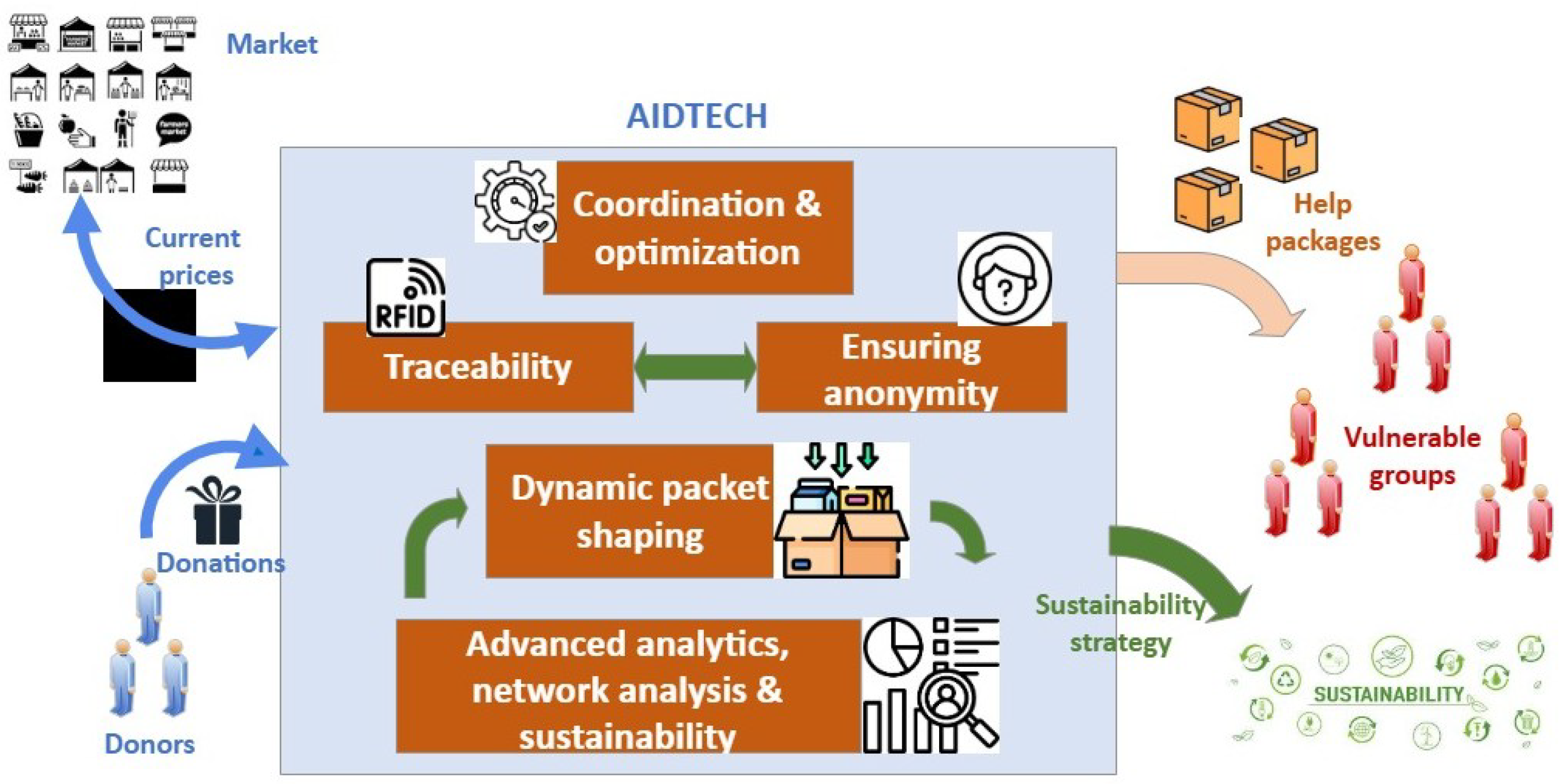
Based on these five pillars, we propose AidTech framework that can be defined as a hierarchical conceptual model representing a digital humanitarian supply chain. The framework is designed to operate under conditions of uncertainty and limited resources. Its main modules include: (1) a data collection module that collects information from IoT devices, Radio Frequency Identification (RFID) tags, telematics systems, warehouse platforms and beneficiary interfaces, (2) an interoperability module that enables data exchange via APIs, EPCIS/CBV schemas and middleware services, (3) an intelligence module that includes Business Intelligence optimization, graph matching, routing engines, machine learning prediction and multi-criteria decision support tools, (4) a module that integrates blockchain traceability, smart contracts, privacy mechanisms, and RBAC/ABAC access control; and finally (5) an execution module that coordinates routing, inventory actions, packet shaping, and delivery processes. The framework leverages general-purpose technologies such as AI/ML, IoT, edge-cloud computing, distributed ledgers, optimization algorithms, and secure data governance mechanisms.
All of the above can be made a reality by leveraging the contributions of this: (1) it examines the mathematical and algorithmic foundations that support matching, routing, scheduling, and clustering in humanitarian contexts, (2) it analyzes AI-based techniques for predictive analytics and decision support, (3) it explores privacy-preserving architectures based on blockchain technology for transparent and accountable multi-stakeholder coordination, (4) it explores sustainability metrics and their integration into operational decision-making, and (5) the AidTech framework is based on a novel architecture for a designated platform capable of combining the above and providing effective and transparent humanitarian supply chain management, and finally, (6) it identifies research challenges that define the path for next-generation cyber-physical humanitarian systems.
1.3. Objectives and Contributions
Building on the five fundamental pillars presented above, the present study develops a unified and technologically grounded perspective on next-generation humanitarian supply chains. Rather than analysing isolated tools or single operational problems, this work examines how complementary paradigms from Operations Research, Artificial Intelligence, secure data governance, blockchain traceability, and sustainable logistics can be orchestrated within a coherent humanitarian platform.
Specifically, the study responds to the fragmentation of the existing literature by proposing the AidTech framework as an integrated system-level architecture that connects algorithmic optimization, predictive intelligence, interoperability mechanisms, trusted governance, and sustainability objectives. The perspective adopted is integrative and architectural rather than methodological, proposing an architectural design for a platform addressing holistically challenges and gaps in existing solutions.
The main objectives and contributions of the present study are summarized as follows:
To examine the mathematical and algorithmic foundations supporting humanitarian matching, routing, scheduling, clustering, and resource allocation under uncertainty.
To analyse Operations Research techniques capable of improving efficiency, fairness, and responsiveness in humanitarian logistics environments.
To investigate Artificial Intelligence and machine learning approaches for demand forecasting, anomaly detection, beneficiary prioritization, and proactive decision support.
To bridge predictive analytics with prescriptive decision-making by showing how forecasting outputs can support executable routing, inventory, and allocation decisions.
To explore privacy-preserving governance architectures based on RBAC, ABAC, secure data management principles, and multi-stakeholder coordination mechanisms.
To examine blockchain-enabled traceability models that strengthen accountability, transparency, provenance verification, and trusted collaboration through standards such as EPCIS/CBV and smart contracts.
To integrate sustainability principles into humanitarian logistics through environmental, social, and operational performance indicators, as well as optimization-aware green logistics approaches.
To propose the hierarchical conceptual architecture of the AidTech platform, combining data collection, interoperability middleware, intelligence services, governance mechanisms, and execution layers.
To identify open scientific and technical challenges that define the future research agenda for scalable, ethical, resilient, and digitally transformed humanitarian supply chains.
Through these contributions, the present study aims to move the discussion from isolated technological adoption toward holistic cyber-physical humanitarian ecosystems capable of delivering faster, fairer, more transparent, and more sustainable aid operations.
1.4. Structure of the Paper
The rest of this paper is organized as follows.
Section 2 describes the methodological framework of this research by explaining the process of a systematic literature review.
Section 3,
Section 4,
Section 5 and
Section 6 discuss the main technological pillars of the Aidtech framework, algorithmic optimization and Operations Research, support and predictive intelligence approaches used for decision-making, privacy-preserving data governance and traceability approaches enabled by blockchain, sustainability-based humanitarian supply chain models, adaptive models enabled by green logistics principles, and adaptive aid packages. Finally,
Section 7 discusses the proposed architecture and various aspects of the overall ecosystem, while
Section 8 concludes the paper.
2. Methodology
The methodological approach is based on a systematic research process that combines a structured Systematic Literature Review (SLR) with a State of the Technology (SotA) mapping process. The aim is to identify, filter and synthesize scientific and technological contributions related to algorithmic optimization, decision support, data governance, blockchain traceability and sustainable humanitarian supply chain design.
The review process followed the PRISMA principles and included the following steps: (1) a comprehensive search of major scientific repositories (Scopus, IEEE Xplore, ACM Digital Library, SpringerLink), (2) extraction of publications and technical reports from 2015–2025 on humanitarian supply chain, algorithmic decision systems and data governance, (3) screening of results using predefined eligibility criteria, and finally (4) matching of contributions to the technology architecture.
The search strings combined humanitarian and technological terms such as: (“humanitarian supply chain” OR “humanitarian logistics”) AND (“optimization” OR “operations research” OR routing OR allocation) AND (“AI” OR “machine learning” OR “forecasting”) AND (“blockchain” OR “traceability”) AND (“sustainability”).
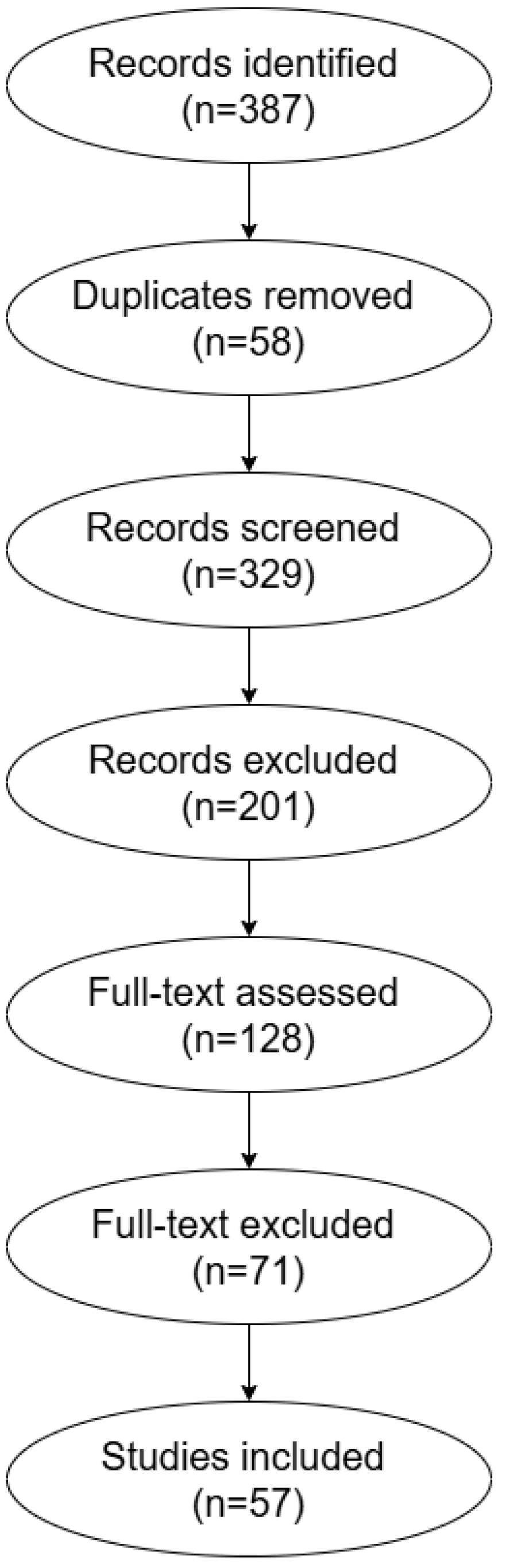
A total of 387 records were initially retrieved. After duplicate removal, 329 records remained. Title and abstract screening reduced the set to 128 studies. Full-text eligibility assessment resulted in 57 studies retained for final synthesis, as it is shown in
Figure 1.
The PRISMA methodology was chosen for its reliability and reproducibility in terms of identifying, evaluating and synthesizing the literature from various sources. Considering that the present study involves a multidisciplinary approach integrating areas such as humanitarian logistics, Operations Research, Artificial Intelligence, data management and technological innovations of digital transformation, a clearly defined protocol was necessary to avoid any form of bias and ensure consistency in the process. The PRISMA methodology was deemed most appropriate in this case due to the need for an evidence map spanning various research areas.
The selection criteria focused on four key pillars:
Humanitarian relevance—direct application to aid distribution, routing, resource prioritization, or crisis response systems;
Scientific rigor—quality of mathematical formulation, model validation, and reproducibility;
Computational robustness—algorithmic complexity, scalability, and adaptability under uncertainty;
Architectural compatibility—alignment with the operational, business, and data governance requirements of the humanitarian aid supply chain ecosystem.
For each of the four thematic pillars, representative models and technologies were created, compared and evaluated based on criteria such as algorithmic performance, sensitivity to incomplete information, feasibility of implementation and compliance with humanitarian aid key performance indicators (KPIs). Particular attention was paid to methods that enable dynamic adaptation (e.g., reverse pressure programming), equitable resource allocation (e.g., stable and socially aware matching) and transparent multi-stakeholder coordination (e.g., EPCIS-compatible blockchain models).
This methodological synthesis creates a coherent analytical basis for the subsequent sections of the paper, supporting the benchmarking and future development and improvement of humanitarian aid platforms.
Furthermore, sustainability is one of the aspects that are included in the research methodology as both input and output. The sustainability-related factors (such as efficiency of resource use, reduction of waste, impacts on the environment, and even distribution of resources) are taken into account when analyzing and mapping the literature on the issue and the developed framework.
Meanwhile, the implementation of data-based analytics into the research methodology allows revealing new sustainability strategies according to the operational information, demands, and resource allocation. The consideration of sustainability as both design constraint and adaptable goal helps create new sustainable models of humanitarian supply chain management.
It should be noted that there is a need to differentiate between traditional assumptions that have been made by researchers in their work on humanitarian supply chains and the new assumptions proposed in the current research.
Traditional assumptions include demand uncertainty, limitations in resources, heterogeneous actors, and dynamically changing conditions, which have received significant attention in the literature.
The uniqueness of the present research comes from its integration-oriented assumptions, which include: (i) taking into account optimization, predictive analytics, and governance in the context of a single cyber-physical architecture, (ii) the assumption of immediate interconnection between predictive and prescriptive decision layers, (iii) adding privacy protection and blockchain-based traceability requirements to the decision process itself, and (iv) viewing sustainability and equity as optimization targets rather than evaluation criteria.
Such assumptions facilitate the creation of a realistic model of humanitarian supply chains.
3. Algorithmic Optimization and Operations Research
Operations Research (OR) is the analytical foundation on which data-driven decision-making for humanitarian purposes is based. As humanitarian environments are characterized by uncertainty, fluctuating demand, scarce resources and numerous constraints, OR offers a structured mathematical framework for designing robust, effective and equitable allocation and routing strategies.
OR integrates mathematical modelling, quantitative analysis and algorithmic computation to make complex logistical decisions [
10]. OR methods when embedded in a platform enable it to model supply chain flows, optimise donor-beneficiary linkages, design resilient and efficient routing plans and support multi-objective decision-making processes that minimise costs and maximise equity and responsiveness.
Achieving all these objectives requires a diverse set of OR approaches to capture the wide range of constraints present in humanitarian systems. Classical models are used such as:
Linear and Mixed Integer Programming (LP/MIP), which is used for cost minimization, resource allocation and inventory planning under deterministic constraints.
Dynamic Programming (DP), which supports sequential decision making when actions affect future states of the system.
Network Flow and Multi-Commodity Flow Models, which represent the movement of goods between donor nodes, warehouses and beneficiaries [
11].
Variations of the Vehicle Routing Problem (VRP), which models transportation under complex geographical and temporal constraints.
Stochastic Programming, which addresses randomness in demand, donations, travel times, and resource availability.
Multi-Objective Optimization, which allows for trade-offs between cost-effectiveness, equity, sustainability, and operational risk.
These methods are essential for building and operating a scalable humanitarian platform. Their ability to incorporate uncertainty, optimize competing objectives, and encode complex logistics dependencies makes OR essential for systems such as humanitarian supply chains. Using OR techniques, a humanitarian supply chain management platform can generate near-optimal policies that remain effective despite heterogeneous factors, incomplete information, or dynamic on-site conditions.
Modern humanitarian supply chain systems integrate several digital tools to support operational and strategic decision-making, including demand forecasting, logistics planning, optimal resource allocation, and traceability. These tools integrate heterogeneous data sources and computational methods to improve the efficiency, transparency, and sustainability of the entire aid network.
This section provides the necessary conceptual foundation for understanding how advanced algorithmic optimization interacts with forecasting using artificial intelligence tools, blockchain-based transparency, and sustainable supply chain design, as presented in the following parts of the review.
3.1. Graph-Based Matching Algorithms
In a humanitarian aid platform, graph-based matching can serve as a fundamental, enabling mechanism connecting donors with beneficiaries, routing opportunities across transportation channels, and even aligning aid types with dynamically constructed packages [
12,
13]. Its computational efficiency, formal fairness properties, and scalability to socially sensitive variants make it essential for scalable and equitable humanitarian aid distribution.
Graph theory is a key tool for modeling and analyzing donor-recipient relationships in humanitarian supply chains. A bipartite graph
can successfully model a structured mapping between supply nodes
(e.g., donors, warehouses) and demand nodes
W (beneficiaries or groups of recipients), with edges
representing possible, feasible aid allocation connections [
14,
15]. Such representations allow for the modeling—expression of complex allocation problems as well-defined mathematical structures with algorithmic solutions.
Classical allocation algorithms provide computationally efficient mechanisms for assigning resources under various constraints. The Hopcroft–Karp algorithm achieves maximal bipartite matching in
, while the Hungarian algorithm offers an optimal solution for weighted assignments in
,
n denoting the number of vertices and
m the number of edges of the underlying graph as noted above [
16,
17,
18]. For general (non-bipartite) graphs, Edmonds’ Blossom algorithm provides exact maximal matchings in
[
19].
The strong need for a clear correspondence between the type of graph, the corresponding algorithm, and the computational characteristics follows from the above. This is summarized in the following
Table 1 based on the findings of [
16,
17,
19,
20]:
Beyond efficiency, humanitarian logistics also requires fairness and social acceptance. Stable matching formulations, such as the Gale–Shapley algorithm [
20], ensure stable allocations from which no donor-recipient pair has an incentive to deviate. Stability is crucial when allocating scarce resources to vulnerable populations, where perceived inequality can exacerbate social tension.
Recent developments introduce socially sensitive and advice-enhanced matching frameworks [
6]. These extend traditional matching by incorporating external constraints such as vulnerability indices, priority categories, equity criteria, or expert guidance. Such models align algorithmic decisions with humanitarian ethics by incorporating social utility directly into matching preferences or objective functions.
3.2. Mapping Objectives to Optimization Models
We provide a first mapping between humanitarian objectives and suitable OR models in the following table [
1,
2,
3,
5]:
A closer look at
Table 2 reveals a number of interesting observations. First, most of the research done so far has emphasized particular components of operations rather than a comprehensive systems approach. Such an approach makes it harder to take into consideration the complex interactions within humanitarian supply chains.
Second, optimization-oriented models have been considered extensively in the literature, while governance and multi-stakeholder coordination aspects have not received sufficient attention. This could be viewed as the lack of balance between operational and governance issues that exist in reality.
Third, sustainability considerations seem to play a minor role and may not even be explicitly addressed in the reviewed works.
To extend the scientific scope beyond humanitarian aid supply chains, we introduce the following classification (
Table 3). While the previous analysis focused on the application of Operations Research techniques to humanitarian logistics systems, the underlying decision-making principles, i.e., the analytical and optimization tools it offers, exhibit a wide range of complex socio-technical uses where resources need to be allocated efficiently under uncertainty and multiple operational constraints.
For this reason, it is useful to shift the perspective from which we view the problem to one that is not focused to specific domains but rather to a more general conceptual categorization. Such a categorization allows us to systematically organize the different types of decision-making problems that arise in these environments. By structuring the problem space in this way, we create a clearer connection between humanitarian supply chain optimization and the broader categories of resource allocation and logistics problems studied by Operations Research.
Furthermore, this shift in perspective is important because it highlights the need to use both of these perspectives. On the one hand, humanitarian logistics provides a specific application context with real-world constraints, societal goals, and high levels of uncertainty. On the other hand, a generalized classification framework allows for the extension of methodological tools, analytical models, and algorithmic strategies developed in other research fields. Combining these two aspects of the problem improves both the theoretical understanding and the practical design of scalable decision support platforms.
Additionally,
Table 3 highlights some critical constraints in the present research scenario. While there has been an increased uptake in machine learning and predictive tools, the incorporation of these tools with prescriptive optimization and decision support is minimal. Thus, most of the methods used generate predictions but fail to translate them into useful decisions.
Moreover, it emerges that real-time adaptation and scalability have not been sufficiently addressed, especially when dealing with dynamic demand, disrupted infrastructures, and poor connectivity conditions.
It should also be noted that few solutions have been validated from end-to-end. Most researches focus on assessing individual elements separately, and under ideal conditions, making it unclear whether they can work in practical humanitarian settings.
From the results obtained, it becomes clear why frameworks like AidTech are necessary as they attempt to address issues of prediction, optimization, governance, and execution together [
1,
2,
11,
13,
21,
22].
3.3. Dynamic Routing, Wireless Analogies, and Backpressure Scheduling
Humanitarian logistics often shares structural similarities with dynamic wireless communication networks, where resources must be efficiently routed under uncertainty, congestion, and rapidly evolving system states. These analogies motivate the transfer of algorithmic principles from wireless resource allocation to aid distribution systems.
In wireless networks, allocation schemes based on matching and popularity are commonly used to assign communication resources, such as channels or UAVs, to receivers. For example, popular vehicle matching methods have been applied to UAV routing, ensuring that mobile transmitters serve ground users with maximum overall satisfaction [
23]. When interpreted in a humanitarian context, the means of transport—ground vehicles, UAVs, or distributed warehouse nodes—act as “transmitters” and groups of beneficiaries form dynamically evolving “receivers”. The goal becomes analogous: maximizing global satisfaction by allocating limited resources to demand groups in a fair and computationally efficient manner.
Beyond matching theory, dynamic programming plays a central role in ensuring response during crises. Humanitarian platforms can leverage on the backpressure paradigm [
24], a well-established technique from stochastic network optimization and for supporting adaptive logistics decisions [
21]. In a network representation of humanitarian flows, queues correspond to pending shipments, unmet needs, or regional delays. Backpressure values are calculated from the differences between upstream and downstream queues. Routes or transport actions with the highest pressure differences are prioritized, automatically directing resources to the most urgent or congested areas.
This approach offers several advantages, as it does not require prior knowledge of demand distributions or future arrivals, guarantees global network stability under wide operating conditions, adapts in real time to shocks, bottlenecks or operational disruptions, and of course supports multimodal transport networks involving trucks, UAVs, and micro-fulfillment nodes [
24].
Importantly, the backpressure scheduling-routing paradigm and graph-based matching are complementary, as matching algorithms can be used to identify feasible or socially preferred allocations of donors, resources or transport modes, while backpressure governs the temporal prioritization and dynamic routing necessary for the operational implementation of these allocations under uncertainty. Their combined use enables immediate and real-time assignment of resources to beneficiary groups, as well as adaptive routing that balances the load across the system and alleviates congestion.
This synergy—structural allocation through matching and temporal control through backpressure—is a key innovation highlighted in the proposed architecture. It forms the basis for an adaptive, data-driven humanitarian logistics engine capable of maintaining stable and equitable operations even in crises characterized by incomplete information and rapidly changing demands.
3.4. Fuzzy Clustering and Interference Graphs
Humanitarian environments are characterized by noisy data, overlapping needs, and partially observable conditions. Addressing these significant complexities is done through the adaptability of tools such as fuzzy clustering and interpolation graph modeling.
Fuzzy C-Means (FCM), introduced by Bezdek [
25], allows each data point to belong to multiple clusters with varying degrees of membership. In contrast to hard clustering methods that impose rigid boundaries and one-sided clustering, FCM captures the structural ambiguity of humanitarian contexts—where areas may simultaneously exhibit two or different levels of vulnerability, or beneficiaries may fall into multiple priority categories. Hybrid algorithms such as FCM–ABC (Artificial Bee Colony) improve convergence, robustness and resistance to local minima of the data [
7,
26]. Furthermore, dynamic visual or sensory data can be incorporated, thus supporting real-time classification in rapidly changing environments, based on recent extensions such as FCM enhanced with DeepSORT (Deep Simple Online-and-Realtime Tracking).
Typical applications of fuzzy clustering in the humanitarian supply chain are prioritizing aid delivery based on complex socioeconomic and vulnerability indicators, segmenting disaster zones according to urgency, accessibility, or resource density, informing routing decisions when data completeness is limited or uncertainty is high, and dynamically clustering beneficiaries to support equitable allocation planning.
Complementing this fuzzy clustering, interference graphs model situations in which resource conflicts or overlapping functional zones must be managed. Originally applied to wireless networks to model channel interference [
27], interference graphs can be adapted to humanitarian environments where logistics operations may compete for limited transportation corridors, warehouse capacity, or UAV flight paths. Nodes represent functional entities—such as regions, distribution centers, or delivery routes—while edges encode potential conflicts, overlaps, or capacity constraints.
Applications of interference-aware modeling include preventing path conflicts in dense or congested delivery areas, scheduling UAV or ground vehicle operations to avoid mutual interference, clustering access points or nodes in wirelessly supported humanitarian networks, and ensuring conflict-free resource allocation in overlapping deployment zones.
Combining the ability of fuzzy clustering to model uncertainty with the ability of interference graphs to encode conflicts creates a powerful toolkit for adaptive and resilience-oriented design. These methods enhance a platform’s ability to differentiate levels of urgency, avoid operational bottlenecks, and dynamically reconfigure paths or priorities as conditions evolve.
4. Decision Support and Predictive Intelligence
Decision-making is at the core of any humanitarian logistics system, as they operate under conditions of uncertainty, resource limitations, infrastructural disruption, and dynamically fluctuating demand. In contrast to the purely business-oriented logistics systems, humanitarian logistics must be effective, equitable, urgent, accessible, and accountable all at once. Due to these reasons, modern humanitarian platforms adopt multi-layered analytical tools.
The goal is to create interpretable and transparent mechanisms for prioritizing interventions across multiple objectives, such as cost, equity, urgency, and accessibility [
28]. This can be achieved by methods such as the Analytic Hierarchy Process (AHP) [
29], the Technique for Preference Order by Similarity to the Ideal Solution (TOPSIS) [
30], and goal programming.
Predictive intelligence, by leveraging machine learning and statistical forecasting to predict humanitarian needs, complements and extends these frameworks. Techniques including time series forecasting, reinforcement learning, and neural network architectures—such as LSTM (Long Short-Term Memory) models and temporal convolutional models—allow the estimation of demand spikes, beneficiary inflows, supply chain breakpoints, and logistics bottlenecks. These predictive methods support proactive planning, helping to allocate resources before conditions worsen.
Distributed learning approaches allow models to be trained on multiple nodes without sharing raw data. This improves both privacy compliance and resilience, while reducing the reliance on constant cloud connectivity. This also addresses a key requirement in humanitarian contexts, which is the ability to deploy AI models in bandwidth-constrained or privacy-sensitive environments.
Combined, multi-criteria decision support models and predictive intelligence form a coherent layer of decision-making to improve the humanitarian chain. Multi-Criteria Decision Support Systems (MC-DSS) ensures transparent prioritization aligned with humanitarian principles, while AI-powered forecasting enhances situational awareness and preparedness. Their integration provides a robust analytical framework for managing uncertainty and proactively supporting equitable and effective humanitarian operations.
4.1. Multi-Criteria Decision Support Systems
MC-DSS provide a rigorous analytical framework for evaluating competing alternatives when humanitarian planners must balance cost, responsiveness, equity, sustainability, and operational feasibility. These systems integrate quantitative models with stakeholder priorities, enabling transparent and reproducible decision-making in resource-constrained environments [
22].
To address the multidimensional nature of humanitarian objectives, MC-DSS combines:
Hierarchical decomposition of criteria (e.g., urgency, vulnerability, cost, accessibility);
Preference mining from policymakers, field workers, and subject matter experts;
Quantitative scoring or ranking models that produce interpretable decisions;
Scenario-based assessment to manage uncertainty in supply chain conditions.
A generic prioritization model can be expressed as:
where
denotes the importance weight of criterion
k, and
is the normalized performance of alternative
i.
Three main groups of MC-DSS methods are: the Analytic Hierarchy Process (AHP), the Technique for Ordered Preference by Similarity to the Ideal Solution (TOPSIS), and Goal Programming. Their conceptual functions and humanitarian applications are summarized below in
Table 4) [
22,
29,
30].
These methods support computational modules that require structured multi-objective reasoning. For example:
AHP helps prioritize high-level geographic areas and beneficiary groups;
TOPSIS ranks operational alternatives, such as vehicle routes or distribution plans, based on conflicting performance metrics (e.g., cost versus coverage);
Goal programming allows for the incorporation of fairness and vulnerability-sensitivity constraints directly into optimization routines.
A distinctive feature of humanitarian MC-DSS—compared to commercial optimization—is the explicit incorporation of ethical and socially weighted objectives. Integrating these priorities through multi-criteria scoring levels embedded in routing, matching and inventory allocation algorithms ensures that operational decisions remain aligned not only with efficiency goals but also with core humanitarian principles, such as inclusion, equity and proportionality.
4.2. Machine-Learning-Assisted Forecasting
Machine Learning (ML) methods significantly enhance predictive capabilities in the humanitarian supply chain, capturing nonlinear temporal patterns, spatial correlations, and complex interactions that traditional statistical techniques often fail to model. In crisis environments characterized by fluctuating demand, incomplete information, and heterogeneous beneficiary profiles, ML provides a powerful foundation for predictive intelligence and proactive decision-making.
A generic forecasting model may be represented as:
where
denotes the predicted future demand or system state.
Emphasis should be placed on the use of advanced learning architectures capable of processing both historical and real-time data streams. Basic supervised and reinforcement learning models include:
Long Short-Term Memory (LSTM) Networks, suitable for long-range temporal dependencies and nonlinear demand patterns;
Temporal Convolutional Networks (TCN), which offer stable and scalable sequence modeling for operational metrics;
Reinforcement Learning (RL), which allows for policy optimization through interaction with dynamic environments;
Graph Neural Networks (GNNs), which exploit the graphically structured nature of human networks to improve the accuracy of spatial predictions.
These models support predictions related to: (1) beneficiary arrival rates and population flows, (2) demand spikes and consumption dynamics, (3) congestion patterns in distribution routes, (4) emerging crisis points requiring pre-determined supplies, (5) detection of anomalies in supply chain operations [
31].
A critical improvement we identify is the integration of Edge-Assisted Federated Learning (EAFL), a distributed learning paradigm that allows training models across multiple nodes—such as shelters, municipal facilities, or logistics hubs—without transferring raw data. EAFL offers several advantages:
Privacy preservation and compliance with data protection regulations,
Reduced communication overhead compared to centralized learning,
Resilience in bandwidth-constrained or intermittently connected environments,
Faster adaptation to local conditions through in-place model updates.
To provide a structured overview of the modeling landscape,
Table 5 summarizes the main approaches to ML and their main humanitarian applications [
28,
31].
By incorporating these ML capabilities into the supply chain, decision-making shifts from reactive to proactive data-driven humanitarian design. Predictive intelligence is therefore a critical component of its operational backbone, supporting equitable aid distribution, proactive logistics, and resilient crisis response strategies.
4.3. From Prediction to Operational Decisions
Forecasting alone does not create humanitarian value unless connected to executable decisions. Predicted shortages, beneficiary inflows, or route congestion should trigger routing updates, inventory repositioning, workforce allocation, and emergency procurement actions.
A simplified prescriptive objective can be written as:
where:
Z: overall objective value of the humanitarian response plan;
: proportion or number of beneficiaries successfully served;
: fairness level of aid distribution across vulnerable groups or regions;
: total operational cost (transportation, storage, procurement, workforce);
: cumulative delivery or response delays;
: weighting coefficients reflecting the relative importance assigned to coverage, equity, cost, and delay, respectively.
subject to inventory availability, transport capacity, workforce limits, budget constraints, and policy requirements.
4.4. Real-Time KPIs and Performance Monitoring
An effective humanitarian supply chain depends on continuous monitoring of shipment status and timely feedback mechanisms for rescheduling. Real-time monitoring allows humanitarian platforms to identify emerging bottlenecks, adapt to fluctuating demand, and ensure that operations remain transparent, equitable, and efficient. We identify the need for a unified monitoring architecture that integrates IoT sensor feeds, vehicle telematics, blockchain events, and beneficiary interaction data.
To this end, end-to-end performance monitoring approaches are adopted based on:
IoT-enabled data acquisition, capturing temperature, location, load measurements, energy consumption, and environmental conditions in real time;
Edge-based preprocessing, where local devices filter and aggregate data to minimize latency and communication overhead;
Blockchain-anchored event logging, ensuring immutable audit trails for key supply chain transactions;
Central analytic integration, where cleansed and synchronized data feeds predictive models and Multi-Criteria Decision Support Systems (MC-DSS).
Real-time monitoring is essential for assessing operational performance across multiple dimensions, such as efficiency, delay, equity, sustainability, and accountability.
Table 6 summarizes representative Key Performance Indicators (KPIs) related to humanitarian platforms [
28,
32,
33].
The Integration of these metrics enables continuous assessment and supports predictive orchestration. Predictive intelligence—powered by predictive ML—identifies emerging needs or logistics disruptions before they escalate; MC-DSS then incorporates these predictions into scenario assessments and resource prioritization. This synergy enables:
Pre-positioning of supplies in anticipation of crisis escalation,
Dynamic rerouting when bottlenecks or shortages are detected,
Rapid reallocation of assets based on urgency signals triggered by reverse pressure,
Proactive mitigation of environmental or operational risks.
Real-time KPIs therefore function not only as passive monitoring tools, but also as integral elements of a feedback control ecosystem. They allow such platforms to move from reactive to proactive humanitarian logistics, ensuring that businesses remain aligned with the core principles of fairness, transparency, and sustainability, while maintaining high levels of operational resilience.
Despite recent advances, open challenges remain regarding data scarcity, model bias, explainability, interoperability, and real-time optimization under disrupted connectivity.
5. Privacy, Security, and Blockchain Traceability
Humanitarian information systems process highly sensitive data, including personal identifiers, needs related to the individual’s health, household vulnerabilities, geographical locations of affected persons, and donation details. Examples include shelter resident registries, household vulnerability assessments, beneficiary eligibility records, and geolocated field assistance requests. Any breach of confidentiality, data tampering, or inadequate accountability measures will lead to adverse effects such as direct harm to the vulnerable people, donor distrust, and lack of coordination in the efforts by the humanitarian organizations.
Protecting sensitive information and creating tamper-resistant records are parallel and equally critical priorities in digital humanitarian systems. A system should ensure that beneficiary data, vulnerability indicators, and operational logs remain confidential and in compliance with legal and ethical frameworks, while maintaining verifiable transparency into supply chain operations. Typical humanitarian use-cases include refugee shelter registration, food voucher issuance, medicine cold-chain monitoring, donor fund traceability, and cross-border custody transfer of aid consignments. It should be based on a comprehensive architecture that incorporates privacy-preserving mechanisms, structured access control models, and blockchain-based traceability to support secure and accountable multi-stakeholder collaboration.
Privacy in humanitarian data management is enforced through a combination of Privacy Enhancing Technologies (PETs), including anonymization, pseudonymization, and encryption, which collectively minimize the exposure of personal data. In addition, the platform should incorporate
Role-Based Access Control (RBAC) and
Attribute-Based Access Control (ABAC) to ensure that users—such as public authorities, NGOs, donors and logistics partners—interact with the data strictly in accordance with their rights and responsibilities. These mechanisms are supported by Policy Administration Points (PAP) and Policy Enforcement Points (PEP), ensuring consistent compliance with regulatory standards such as General Data Protection Regulation (GDPR) [
34,
35].
Access authorization can be formally represented as:
where:
: authorization decision function that returns whether access is granted or denied;
u: the requesting user or system entity (e.g., NGO officer, municipal employee, donor, warehouse operator);
r: the requested resource, such as beneficiary records, warehouse inventory data, shipment status, or donation transactions;
a: the requested action, for example read, write, update, approve, transfer, or delete;
c: the operational context under which the request is made;
: the organizational role assigned to user u under Role-Based Access Control (RBAC), such as administrator, field coordinator, logistics partner, or auditor;
: descriptive attributes of the requesting user, such as organization type, security clearance, geographic jurisdiction, mission assignment, or authentication level;
: attributes of the requested resource, such as data sensitivity level, ownership domain, geographic location, emergency category, or confidentiality classification;
: dynamic environmental conditions affecting authorization, such as declared emergency status, access time window, user location, device trust level, network security level, or incident severity;
: policy evaluation mechanism combining RBAC and ABAC rules to determine whether the access request satisfies all security and governance constraints.
For example, a municipal emergency coordinator may be permitted to read anonymized beneficiary demand data during an active crisis, while access to personally identifiable information may remain restricted to specifically authorized case-management personnel.
Complementing these layers of privacy and security, blockchain technology provides the basis for immutable, auditable recordkeeping. Leveraging distributed ledger infrastructures aligned with EPCIS/CBV standards [
32], end-to-end traceability of supply chain events is ensured, such as:
Creation and recording of item donations,
Centralized and decentralized item package analysis,
Transport and shipping events,
Delivery confirmation and distribution results.
Each event is cryptographically anchored in the ledger, preventing retroactive tampering and enabling transparent audits by authorized stakeholders. Smart contracts further automate compliance checks, validation processes, and event-triggered policies, reducing the possibility of human error and ensuring system integrity.
Privacy-preserving access control and blockchain traceability are not independent modules. Together, they form an integrated layer of governance. Secure access mechanisms ensure that sensitive data remains protected, while blockchain guarantees that authorized interactions with the system leave a verifiable, immutable trail. This dual structure supports trust between different actors, enables accountability without compromising individual rights, and strengthens the legitimacy of humanitarian operations.
Therefore, the combination of PETs, RBAC/ABAC controls, and an EPCIS-compliant blockchain infrastructure creates a comprehensive solution to balance confidentiality with transparency, a prerequisite for ethical, secure and reliable humanitarian logistics.
5.1. Privacy vs. Transparency Trade-Off
In humanitarian applications, there is a trade-off between privacy and transparency. On the one hand, privacy regulations call for minimizing access to beneficiary information; on the other hand, funders and regulators demand that proof be provided about how funds were distributed.
Such trade-offs become more pronounced when blockchain technology is involved. The issue of reconciling immutable ledgers with data deletion requests is particularly relevant. Potential workarounds might involve hashing off-chain or storing only data hashes on-chain.
5.2. Privacy-Preserving Data Governance
Humanitarian information systems must protect sensitive data, such as personally identifiable information, vulnerability characteristics and geolocation traces. To achieve lawful, ethical and secure processing, a comprehensive privacy-friendly data governance framework will be adopted, aligned with the GDPR and the ISO/IEC 27001 standard for information security management [
36].
Privacy Enhancing Technologies (PET) form the basis of this framework. Various mechanisms that limit unauthorized access, minimize the exposure of personal information, and ensure controlled data flows are presented in
Table 7 [
34,
35,
36]:
Beyond access control, a layered privacy architecture should be used that incorporates data minimization, encryption and machine learning safeguards:
Data minimization limits collection and retention to the minimum amount necessary for operational functionality.
Federated Learning (FL) enables collaborative training of models without sharing raw data, preventing unnecessary exposure of sensitive features.
End-to-End Encryption secures sensitive files during transmission and storage, ensuring confidentiality even in distributed deployments.
This privacy-preserving governance model ensures that humanitarian operations maintain transparency and accountability, while protecting the dignity of beneficiaries and complying with regulatory obligations. By integrating PETs, structured access control, and secure ML workflows, a strong foundation is created for ethical data management within a multi-stakeholder humanitarian ecosystem. Therefore, we adopt this approach in the proposed architecture.
5.3. Blockchain-Enabled Traceability
Blockchain technology provides an immutable, tamper-resistant basis for recording logistics events in humanitarian operations. Blockchain traceability ensures that all critical interactions—donation creation, package assembly, shipping, transportation and delivery—are permanently and verifiably recorded. Representative applications include tracking refrigerated medicine deliveries, verifying donor-funded purchases, recording custody transfer across borders, and validating final-mile delivery confirmations. This level of transparency is essential for building trust between donors, authorities, NGOs, logistics providers and beneficiaries, while reducing the risk of fraud, manipulation or data loss.
Based on the Electronic Product Code Information Services (EPCIS) and Core Business Vocabulary (CBV) standards for the structure and serialization of supply chain events [
33], which include:
Items Events: creation, observation, aggregation, or disaggregation of aid items;
Transformation Events: repackaging, quality checks or resource conversion;
Transaction Events: donation registration, custody transfer;
Master Data Events: metadata related to products, locations or agents.
Each package or donation should be associated with a unique digital token in the ledger, allowing interested parties to search for provenance, verify authenticity, and track the history of items. Smart contracts automate verification steps such as shipping confirmation, arrival validation, and receipt confirmation, thereby reducing administrative costs and increasing operational reliability.
Choice of Consensus protocol is one of the key considerations in the design process. Public Proof-of-Work-based mechanisms cannot be applied in humanitarian contexts due to issues with latency and computational costs. Permissioned consensus protocols, like Practical Byzantine Fault Toleranc (PBFT) and Reliable, Replicated, and Fault-Tolerant (RAFT), should be considered due to their ability to provide fast confirmation and low computational expense.
Examples of cybersecurity risks that may exist in a system include malicious insiders, credential theft, spoofing sensor inputs, ransomware, and donation record tampering. It is advisable to incorporate zero-trust access frameworks, multi-factor authentication, cryptographic signatures, logging capabilities, and anomaly detection strategies into the suggested governance framework.
To extend interoperability, the blockchain will be integrated with IoT data sources. Radio Frequency Identification (RFID) tags, GPS telemetry, and environmental sensors serve as trusted oracles that feed real-time data into the ledger. The InterPlanetary File System (IPFS) is used to store larger, encrypted documents or sensor payloads off-chain, while cryptographic hashes ensure referential integrity.
Table 8 summarizes the blockchain architecture that supports humanitarian traceability [
32,
33].
Collectively, this architecture ensures:
Transparent donation streams, allowing donors to verify how funds are being used;
Tamper-resistant provenance, with cryptographically protected event paths;
Decentralized auditability, allowing authorized entities validate independent events;
Full IoT interoperability, combining physical detection with digital verification.
By combining blockchain, IoT, and global standards such as EPCIS/CBV, the level of traceability moves to the next generation that supports reliable, ethical and responsible humanitarian logistics. Such capabilities are particularly important in crisis environments where multiple actors must coordinate rapidly without compromising trust, privacy, or auditability.
Despite the benefits of trusted digital governance, practical deployment challenges remain, including heterogeneous stakeholder readiness, legal differences across jurisdictions, interoperability costs, smart-contract maintenance, and low-connectivity field environments.
6. Sustainable and Adaptive Humanitarian Supply Chains
Sustainability, as a key feature of the contemporary humanitarian logistics, goes beyond environmental issues and includes economic efficiency and ethical aspects. The sustainability aspect is integrated in the “triple bottom line”-
people,
planet,
profit by customizing the principles of green logistics and circular supply chain management to emergency operations restrictions [
37].
The humanitarian supply chain experiences severe challenges of sustainability related to unpredictable demand, short delivery age times, poor transportation conditions and difficulties in observing across multi-actor network. The key sustainability dimensions are:
Environmental sustainability: it holds that emphasis should be placed on the reduction of emissions, the reduction of packaging waste, vehicle load optimization, and promoting the use of low-carbon transportation modes.
Economic sustainability including aspects such as cost-effective routing, inventory management optimization, waste or overdue good minimization and unnecessary deliveries prevention.
Social sustainability, including justice, inclusion, equitable access to support and transparent governance of resource allocation.
Integrating these sustainability dimensions creates adaptive design models that dynamically adapt to disruptions. For example, multi-criteria scoring integrates ecological and social weights into routing, matching, and inventory decisions. Predictive analytics identify high-risk areas or vulnerable populations, enabling proactive resource pre-positioning. IoT-enabled monitoring provides real-time metrics on energy usage, temperature variations, and vehicle performance. Blockchain traceability ensures transparent documentation of environmental and social compliance throughout the supply chain.
By combining green logistics principles, predictive intelligence, and transparent governance, support to humanitarian supply chains is not only efficient but also environmentally responsible and ethically aligned with humanitarian values.
6.1. Foundations of Green Humanitarian Logistics
Green Humanitarian Supply Chain Management (GHSCM) aims to minimize the environmental footprint of the supply chain while maintaining operational responsiveness and social impact. Sustainability is defined as a multidimensional requirement, incorporating eco-efficiency throughout routing, warehousing, packaging, and inventory planning. Unlike commercial supply chains, humanitarian systems must address sustainability constraints under severe uncertainty and time-critical conditions [
38,
39].
These principles translate into optimization models that jointly incorporate economic and ecological objectives [
40]. Mixed integer programming (MIP) and stochastic optimization frameworks allow designers to capture trade-offs between operational efficiency and carbon impact [
2]. For example:
Carbon-aware minimum-cost flow models extend classic network flow formulations by adding emission factors for vehicles, routes, or warehouse operations, allowing for multi-objective optimization.
Multi-scale Inventory Models (MEIM) incorporate environmental constraints and site-specific sustainability scores, ensuring that restocking, warehouse placement, and distribution activities minimize the weighted sum of cost and environmental burden.
Multi-objective stochastic programming evaluates trade-offs under uncertain environmental conditions (e.g., road closures, fuel supply disruptions, or changing temperature-sensitive storage needs).
By incorporating environmental criteria into the mathematical core of humanitarian logistics, these models enable decision-makers to achieve resilient, efficient, and sustainable operations. Integrating these principles through routing engines, MC-DSS scoring levels, IoT-based environmental monitoring, and blockchain-based carbon traceability creates a holistic approach to sustainably coordinating the humanitarian supply chain.
6.2. Dynamic Package Configuration
The traditional humanitarian supply chain often relies on static, pre-defined aid packages that do not reflect real-time needs, budget constraints, or sustainability goals. To address these limitations, dynamic package creation is introduced, a methodology in which aid packages are adaptively created rather than selected from fixed templates. This approach integrates business research models, sustainability metrics, and beneficiary-specific indicators into a unified optimization process.
Dynamic packaging takes into account multiple dimensions, such as cost constraints, which ensure that packages remain within donors’ budgets or financial limits related to shipping, personalization to beneficiary needs, which uses vulnerability indicators, household size, medical conditions or nutritional requirements, sustainability metrics, which incorporates environmental scores such as emissions, packaging waste and recyclability, and logistics capacity, which takes into account vehicle availability, warehouse inventory or supply chain disruptions.
To implement these principles, mathematical optimization models are used capable of generating near-optimal package compositions in real time. Two main families of models are applied:
Linear and mixed integer programming for selecting combinations of items that maximize total aid while respecting cost and sustainability constraints.
Goal programming for encoding multiple trade-offs, balancing fairness, satisfaction, and environmental impacts.
Let
I denote the set of available aid items and let
represent the number of units of item
included in a bundle. The optimization problem can be formulated as follows:
where:
: number of units of item i included in the bundle
: satisfaction score associated with item i
: cost of item i
: environmental impact coefficient of item i
B: available budget for the bundle
: maximum allowable environmental impact
I: set of available aid items
More advanced models may additionally incorporate beneficiary profiles, minimum nutritional requirements, medical priority constraints, and carbon budget limitations.
The dynamic nature of this approach allows the platform to reconfigure aid packages on the fly based on fluctuating stock levels, adjust package composition for different beneficiary categories, optimize for sustainability without compromising equity, and support data-driven donor engagement by showing transparent impact in real time.
By replacing static kits with adaptive package configuration based on optimization, the efficiency, fairness and ecological performance of humanitarian aid supply chains are significantly improved.
6.3. Governance and Measurable Outcomes
Effective sustainability assessment requires clearly defined and continuously monitored indicators. In humanitarian supply chains, measurable outcomes support transparency, guide operational optimization, and ensure that decisions remain aligned with broader ecological and social goals.
Operational data streams—such as energy consumption, vehicle efficiency, warehouse load factors, and delivery delays—are captured by distributed IoT devices and fed into a feedback control loop. This loop informs the platform’s tactical decisions, allowing adjustments to routing strategies, resource allocation, and warehouse operations based on actual environmental and logistical conditions.
Governance is enhanced by blockchain-based verification, ensuring that all environmental and social data remains tamper-proof and auditable. Through EPCIS/CBV compliant event logs, the platform maintains immutable records of transportation emissions, distributive justice, and sustainability compliance across the supply chain. This ensures that multi-stakeholder operations maintain both transparency and integrity.
A comprehensive set of indicators covering environmental, economic, social, and operational dimensions is defined for the sustainability assessment framework. These indicators quantify short-term performance goals and long-term sustainability objectives as shown in
Table 10 [
37,
39,
40,
41].
These metrics form the backbone of a platform’s sustainability governance layer. Integrating real-time monitoring, predictive modeling, and immutable reporting, the platform provides a powerful mechanism for aligning day-to-day operations with long-term environmental, economic, and social goals.
7. Discussion and Proposed AidTech Framework Architecture
The above analysis discussed the technological and methodological fundamentals of next-generation humanitarian supply chains, including Operations Research techniques, AI-based forecasting methods, privacy-preserving governance structures, blockchain-based traceability solutions, and sustainable supply chain logistics. While each of these building blocks addresses a particular operational need in humanitarian supply chains, collectively they represent a much broader cyber–physical infrastructure for humanitarian coordination and support.
As a result, the discussion must progress from a description of individual enabling technologies to a more system-oriented understanding of their mutual interactions. The latter is necessary because it is not only the individual enabling technologies that are important for the scientific value of the framework; it is also the mutual complementarities between those technologies that are important for the proposed approach. In other words, it is not only important that individual modules of the framework are scientifically sound; it is also important that those modules complement each other.
In particular, Operations Research supplies a formal optimization foundation for allocation, routing, and scheduling; machine learning offers predictive capabilities and adaptive situational awareness; blockchain and privacy-preserving governance provide accountability and trusted collaboration; while sustainability-aware logistics extends the decision space from economic efficiency to environmental and social responsibility. The result is a platform-level view of the problem that enables a modeling of humanitarian supply chains as dynamic data-driven and multi-objective systems, rather than as isolated logistics activities.
This broader perspective naturally leads to two complementary questions. The first concern how such a platform can be organized architecturally so that heterogeneous modules can interoperate under real-world humanitarian constraints. The second concern which scientific and technical gaps remain unresolved despite the maturity of the individual technologies. Consequently, this section first discusses the architectural implications of the proposed ecosystem and then identifies the main research gaps that define the agenda for future work.
7.1. Major Findings of the Present Study
Based on the preceding analysis, five major findings emerge.
First, the primary obstacle to current humanitarian logistics is not a lack of technology, but rather the disintegration of available technology within disparate operations.
Second, predictive analytics provides significant utility only when combined with optimization techniques for routing, allocation, scheduling, and inventory management.
Third, trust mechanisms that incorporate privacy and blockchain technologies are imperative in humanitarian multi-stakeholder environments.
Fourth, scalable humanitarian solutions demand edge-cloud infrastructure that can function with unreliable connections and hard time constraints.
Fifth, future humanitarian logistics should not focus exclusively on efficiency and velocity, but also consider fairness, resilience, and sustainability in multi-criteria decision-making models.
7.2. Architectural Perspective of the Proposed Platform
The proposed humanitarian platform should not be considered as a monolithic software system. It is noteworthy from this research that monolithic architectures are not structurally compatible with the humanitarian setting where different parties exist, connections are sporadic, and conditions change swiftly. Instead, it should be viewed as an interoperable and layered architecture that integrates optimization, prediction, monitoring, governance, and execution in the distributed humanitarian environment. On a higher level of abstraction, the proposed humanitarian platform aims at transforming fragmented operational data into timely, explainable, and actionable decisions.
From an architectural perspective, it is conceivable that the system can be thought of as having a number of tightly coupled layers. At the physical and operational edge, IoT devices, RFID tags, vehicle telematics, warehouse systems, and beneficiary-facing interaction channels all contribute real-time information about inventory, transportation, delivery, and environmental factors. These real-time information sources can be thought of as the sensing layer of the system.
Above this layer, an integration and communication layer is required to synchronize heterogeneous data sources and system events. For this purpose, standardized data schemes such as JavaScript Object Notation for Linked Data (JSON-LD) and EPCIS/CBV are used to represent logistics events, asset movements, and governance data in a unified manner. Lightweight messaging middleware and microservices containers facilitate communication between various components such as routing engines, matching modules, forecasting services, blockchain connectors, and monitoring pipelines without enforcing any coupling between them.
The third layer would be the intelligence and decision support layer. It is at this point that the predictive machine learning techniques, together with the MC-DSS mechanisms and OR optimization techniques, work in concert with one another. It is at this point that machine learning techniques would be used to predict demand surges, inflows of beneficiaries, abnormal patterns, and operational disruptions. On the other hand, the MC-DSS techniques would be used to transform humanitarian priorities into understandable multi-criteria rankings. Finally, the OR techniques would use these inputs to develop allocation decisions, routing decisions, scheduling decisions, and inventory decisions with explicit constraints. It is in this regard that the proposed architecture would support not only descriptive analytics and predictive analytics but also prescriptive analytics.
A governance and trust layer is also proposed as a complementary layer to the above-mentioned analytical modules. Privacy-preserving data governance techniques like anonymization, encryption, federated learning, and structured data access controls through RBAC/ABAC and PAP/PEP ensure that the humanitarian data is accessed legally and ethically. At the same time, a blockchain-based traceability mechanism is proposed for auditable event recording of donations, package creation, custody transfer, transportation, and delivery confirmation. The combination of privacy-preserving data access controls and auditable event recording is important for a multi-stakeholder scenario like a humanitarian response.
Finally, the architecture must support an orchestration layer for coordination and execution across edge and cloud environments. Due to the nature of humanitarian environments, where connectivity is intermittent, bandwidth is low, and local conditions are dynamic, it is not possible to assume that computation is available in a centralized environment. Therefore, edge-cloud computing with adaptive offloading is required to support environments where local, lightweight filtering, and operational responses must be performed at the edge, and more computationally intensive optimizations, scenario analysis, and balancing must be performed in the cloud. This architectural principle is particularly significant for backpressure routing, hybrid optimizations, and federated intelligence.
Overall, it is envisioned that the proposed architecture will act as a cohesive cyber–physical decision ecosystem where data is sensed within the field, integrated through interoperable services, transformed into a prediction/optimization input, governed by privacy and traceability means, and finally translated into a decision that can be executed or re-evaluated.
7.3. Architecture Overview and Figure Placement
The conceptual architecture of the proposed platform is presented in
Figure 2. It depicts the entire process of interaction between the acquisition of field data, the integration middleware, intelligence and optimization services, governance services, and execution services. The integration middleware should include (i) a series of standardized data schemas, message brokers, and microservices using containerization technology; (ii) the integration middleware, including a series of standardized data schemas, message brokers, and microservices using containerization technology; (iii) the intelligence middleware, including ML-based forecasting services, MC-DSS services, graph-based matching services, OR optimization services, and backpressure routing services; (iv) the governance middleware, including RBAC/ABAC, PAP/PEP, PETs, and blockchain/EPCIS-based traceability; and (v) the orchestration middleware, where edge-cloud coordination supports adaptive execution.
Such an architectural view is useful in that it makes it clear that the proposed humanitarian platform is not just a grouping of individual analytical tools. Rather, it is a holistic operational system in which data, models, policies, and logistics actions are continuously related to each other in a closed feedback loop manner. Through such an architecture, the focus shifts from a plain technology inventory to a system interpretation of how the proposed ecosystem should operate.
7.4. Limitations of the Study
Despite the contributions made by current research, there are some weaknesses associated with it. First, the framework proposed herein is theoretical in nature, and its implementation on a larger scale has not been done yet. Secondly, the use of heterogeneous technology, such as optimization, machine learning, IoT, and blockchain, creates many complexities during implementation.
Moreover, the efficiency of the proposed model relies heavily on data that is available and accurate. The latter can pose serious challenges in humanitarian settings where data may not be complete or clean.
Lastly, although sustainability has been considered an objective of design, a thorough investigation of trade-offs between sustainability and emergency response needs to be carried out.
These limitations define important directions for future research and practical implementation.
7.5. Illustrative Case Study: Earthquake Response Scenario
As a proof-of-concept demonstration of the practicality of the AidTech architecture, we present an example humanitarian relief operation that follows a destructive earthquake in a coastal area where about 5000 people have been displaced.
After the disaster event, disjointed data from municipalities, emergency agencies, citizens mobile app requests, and IoT devices in the field start coming in. This information is aggregated using the sensing and interoperability components of the proposed framework.
The intelligence component utilizes the machine learning modules to make predictions about beneficiary population influxes, demand prioritization zones, food, water, and medicines shortages, as well as possible logistics disruptions due to road damage. These predictions are subsequently sent to the decision support layer.
Using Operations Research and MC-DSS models, resource allocation plans are devised, priority areas are ranked, and vehicle routes are optimized with respect to road capacity, fairness, and timeliness.
In execution, a blockchain-based traceability system keeps track of donations, inventory assembly, handover, transport, and delivery activities. Verified transactions can be monitored in real-time by authorized parties.
At the same time, KPI monitoring modules monitor delivery delay, service coverage, stock shortage, and congestion. In the event of disruption, the system initiates dynamic rerouting, stock relocation, or emergency sourcing.
In this case study, the proposed AidTech framework demonstrates how disjointed post-disaster information can be turned into organized humanitarian response efforts. When compared with static coordination methods, the proposed system framework is anticipated to cut down on allocation delays and expand beneficiary reach.
7.6. Integration Complexity and Interoperability Challenges
Although the proposed architecture is conceptually sound, implementing it remains technically challenging. For example, while combining graph-based matching engines, backpressure routing, machine learning-based prediction pipelines, blockchain-based traceability, IoT-based sensor networks, and human decision interfaces into a cohesive platform for human service has significant interoperability challenges. This is due to differing computational characteristics, latency sensitivity, data governance, and synchronization.
At the architectural level, interoperability is enabled by four enabling principles of consistent data representation, standardized communication protocols, modular compute isolation, and adaptive execution across edge and cloud computing. While these principles allow for the coexistence of heterogeneous architecture and systems, they do not change the fact that the realities of the humanitarian environment continue to be problematic in terms of the reliability of connectivity, sensor availability, and access to the cloud.
In any case, the framework allows for seamless and transparent integration/inter-connection with other decision-making modules. For instance, regarding the coordination & optimization module, the framework is possible to interface with standard cloud-native optimization solutions offered as services, and implement the received results in specific decisions. For instance, one may use the gurobi optimization solver in case the emerging problems are of standard form. At the same time, if the emerging problem is not standard, e.g., as in [
13], custom optimization solution approaches can be used, as in this work where a genetic algorithm approach was developed. This flexibility and modularity of the proposed framework allows to tradeoff complexity–flexibility–accuracy in the decision-making, utilizing more computationally intensive but robust solutions offered as cloud services at potentially higher cost and larger response time, or preferring cheaper, more targeted and lighter solutions when disctated by the needs and requirements of the given humanitarian case.
Therefore, architectural robustness should be complemented with decentralized optimization techniques, asynchronous computation methods, and effective communication techniques. Decentralized optimization techniques reduce the dependency on a single point of coordination, asynchronous back-pressure control ensures the routing policy does not change during heterogeneous updates in the systems, and federated learning architectures promote local intelligence without the need for continuous transfer of raw data. However, there are still some open issues with regard to security in distributed nodes, policy consistency in PAP/PEP systems, schema evolution, and low-latency analytics in crisis situations.
7.7. Data Quality, Privacy Trade-Offs, and Ethical Constraints
A humanitarian information system is also marked by data disorder. That is to say that the data on the beneficiaries might be incomplete, delayed, noisy, and inconsistent. On the other hand, the data on the operations might be irregular and dynamically changing. Therefore, any platform that needs to be integrated for optimization and predictive analysis needs to be marked by an ongoing tension between the requirements of analysis accuracy, privacy preservation, fairness, and ethical responsibility.
From the perspective of data quality, the requirements of the humanitarian information system on the machine learning and decision support systems include handling the challenges of missing data imputation, bias removal, domain adaptation, robustness against sensor and reporting noise, and explainability. These challenges are important because they might directly impact the outcomes of prioritization, matching, and resource allocation. On the other hand, the requirements of privacy preservation using federated learning, anonymization, and pseudonymization need to be met to satisfy the requirements of humanitarian ethics and data protection.
The inherent tension in these principles is further highlighted when considering blockchain-based auditability. Humanitarian platforms must balance principles such as data minimization and erasure with the use of immutable ledgers, creating a complex interplay between these principles. Ethical considerations also introduce a further layer, particularly in relation to the potential for inequality in algorithmic decision-making, particularly if data is biased. As a result, fairness is not simply a consideration in the evaluation of a system, but rather a fundamental consideration in its design, particularly in relation to its optimization and decision-making processes.
7.8. Scalability and Real-Time Constraints
Scalability is another important challenge that the proposed architecture will face. Humanitarian responses might involve thousands of beneficiaries, hundreds of donors, and many distribution nodes. Under these circumstances, it will be impossible to design routing plans, inventory allocations, and prioritization strategies and use them statically. The analysis indicates that static optimization models are insufficient for large-scale humanitarian operations; instead, continuously adaptive decision engines are required. Strategies will need to be updated in near real time while being feasible, fair, and operationally robust.
The situation will be more challenging if the environment is multimodal and includes various transportation modes such as trucks, UAVs, ships, and pedestrian couriers. Each of the modes will have different capacity and timing constraints. Additionally, the communication infrastructure might be unstable.
In this regard, the prospects of backpressure scheduling are particularly promising, as it responds to the information of queue differentials and unsatisfied demands without requiring full knowledge of future demands. However, there are many open questions with regard to the performance of backpressure scheduling in humanitarian environments with regard to convergence, fairness, and computational complexity. Therefore, the architecture should be able to incorporate hybrid optimization techniques that include exact optimization, heuristics, neural search, distributed edge computations, and dynamic offloading between the edge and cloud environments.
7.9. Sustainability vs. Operational Responsiveness
Another area that warrants further discussion is related to the structural conflict between sustainability and emergency response. In fact, a major challenge that humanitarian logistics has to deal with is the trade-off between choosing more sustainable options versus more emergency-oriented options. For example, choosing a more environmentally friendly transportation mode, consolidating cargo to minimize transportation needs, or choosing routes that are more eco-friendly may result in longer routes or less flexible routes. However, emergency response situations may require more resource-intensive options that are more ecologically unfriendly. This is not a minor problem that needs to be addressed; it is a fundamental problem that needs to be factored into the design of decision models for humanitarian logistics.
This is not a minor problem that needs to be addressed; it is a fundamental problem that needs to be factored into the design of decision models for humanitarian logistics. Multi-objective optimization is a branch of optimization that is best suited to handle such conflicts. However, translating this into actual decision models that can be executed in real-time is a challenge that needs to be addressed. In fact, it is a challenge that needs to be addressed as a whole.
Overall, the central finding of this study is that the future of humanitarian logistics depends less on isolated technological adoption and more on the coordinated orchestration of optimization, intelligence, governance, and sustainability within unified cyber–physical platforms such as the proposed AidTech framework.
8. Conclusions
In this work, we investigated the digital transformation of humanitarian supply chains by adopting an interdisciplinary approach involving Operations Research, predictive intelligence, privacy-preserving governance, traceability via blockchain, and sustainable logistics. From the empirical analysis, we conclude that standalone technology is inadequate, and a holistic cyber–physical ecosystem may provide substantial gains in terms of reactivity, visibility, equity, and resiliency.
More specifically, optimization methods such as graph matching, network flows, and adaptive control support dynamic resource allocation; MC-DSS and machine learning enable predictive and proactive decision-making; blockchain infrastructures enhance traceability and trusted governance; while routing, inventory, and packaging models allow the integration of environmental and social sustainability criteria.
The suggested AidTech methodology shows how optimization techniques, artificial intelligence forecasting algorithms, secure multi-party computation systems, and traceability procedures can be effectively integrated in a scalable humanitarian platform. Thus, one can say that a contemporary supply chain platform may become a solid basis for developing next-generation humanitarian and social aid systems that operate reliably, transparently, and equitably under highly volatile conditions.
As further steps, we suggest focusing on practical deployment, large-scale experiments under crisis conditions, interoperability with public infrastructure, fairness-aware artificial intelligence models, and distributed decision-making systems supported by edge technologies.




 ,
,